



Abstract
A strength-based approach to teaching digital literacies can advance language education for adults from refugee and migrant backgrounds, preparing them for life in a new country. This article draws on a 6-month ethnographic study at an adult English language center in Australia and explores teachers’ perspectives and practices related to teaching digital literacies to understand how prepared they are to employ learners’ own resources. Using sociomaterial theory, this research found that English as an Additional Language (EAL) teachers’ narratives about learners focused on what they lacked rather than what they brought to learning. It also found that while teaching practices utilized some strength-based pedagogical principles, the teachers viewed their work as being deficient. They did not always recognize their agential power nor did they overtly understand that the technology itself afforded this power. The article concludes with implications for EAL practice and professional learning of teachers who work in the adult sector.
Keywords
Introduction
Everyday life, learning, and work have become increasingly digitized in many contexts (Smythe, 2018). Thus, being able to use technology in English as an Additional Language (EAL 1 ) is important for displaced adults moving to Australia and other countries as part of humanitarian and migration programs to access essential services and information, join new communities, form networks, and engage in independent language learning (Alam & Imran, 2015; Kenny, 2016). It is also central to social inclusion as well as the development and maintenance of social capital, locally and globally (Alam & Imran, 2015). Engaging effectively in these digital practices, however, requires a complex amalgam of linguistic, technological, contextual, and critical skills, knowledge, and understandings, or, in other words, “digital literacies.”
The view that digital literacies are multiple, used in this article, originates from the New Literacy Studies tradition, which conceives literacy as contextually situated, taking multiple forms, and requiring different understandings, competences, and skills (Barton & Hamilton, 2012; Street, 2009). This perspective suggests that there are many digital literacies because reading, writing, and communication in digital spaces are shaped contextually and subject to change (Knobel & Lankshear, 2006). In this sense, digital literacies are “the practices of communicating, relating, thinking and ‘being’ associated with digital media” (Jones & Hafner, 2012, p. 13) that are linked to the capabilities of using different digital technologies in diverse contexts for a range of social purposes and audiences.
From this perspective, although people from migrant and refugee backgrounds come with incredibly varied digital experiences (Kenny, 2016), digital literacies can represent a significant challenge for anyone learning a new language (Alam & Imran, 2015; McClanahan, 2014; Smyser, 2019; van Rensburg & Son, 2010). Learners from migrant and refugee backgrounds are usually optimistic about learning digital literacies, at least initially (Gangadharan, 2017). Thus, the importance of digital literacies has been widely recognized, resulting in different digital inclusion programs. Furthermore, English language programs are often encouraged to extend their curriculum to include digital literacies (Kenny, 2016; Smyser, 2019; van Rensburg & Son, 2010).
In Australia, the Adult Migrant English Program (AMEP) sits under the umbrella of adult community education (ACE). National policies on immigration, refugees, and asylum seekers are complex and contested. Laney et al. (2016) note that despite its immigration history, “Australia has gradually become obstinate on asylum-seeker policy” (p. 143) shifting from a welcoming culture toward “a culture of fear and anxiety towards the ‘other’” (p. 143). In response to this policy shift by the Federal Government in recent years, protests have ensued, in particular, against offshore detention. At the same time, there is considerable evidence of support for new settlers (Pedersen & Hartley, 2015). ACE programs may be seen as a reflection of that continuing support.
The ACE sector, governed by voluntary management committees, has a long-standing commitment to equity and social justice, with roots going back to community-based learning that aims to empower individuals. Many practitioners are passionate about their work and its potential to make a difference in their students’ lives (Rappel, 2015). ACE pedagogy 2 tends to be driven by students’ needs and influenced by adult learning principles (Sanguinetti et al., 2005). A strength-based approach to policy and practice is seen as generative for this context (The Global Education Monitoring Report Team, 2019). It is being viewed as opening learning opportunities and empowering students to develop their own agency (Ryu & Tuvilla, 2018; Shapiro & MacDonald, 2017). People from migrant and refugee backgrounds often have rich life experiences and cultural resources from which they can build confidence as learners (Benseman, 2014; Kenny, 2016).
A strength-based approach can be especially useful for teaching digital literacies. It can significantly advance digital literacies pedagogies in adult language education, which is important for adequate provision of language and settlement programs worldwide. Its success, however, may largely depend on what EAL teachers think and do and how they utilize the materiality of their learning environments—an area that remains largely underresearched. In response to these concerns, this article reports aspects of a larger ethnographic study and explores EAL teachers’ perspectives and practices in one adult EAL center in Melbourne (Australia) in relation to teaching digital literacies. The article explores the following questions:
What are EAL teachers’ assumptions about their learners’ digital literacies?
How are digital literacies taught in the adult EAL context?
What are EAL teachers’ perspectives on their approaches to teaching digital literacies?
These questions provide insights into the extent to which EAL teachers in the adult education sector are prepared for a strength-based approach to teaching digital literacies. Such understanding has the potential to advance digital pedagogies within learning programs for adult language learners. With increasing migration rates worldwide and rapid development in digital technologies, high-quality programs that effectively scaffold the learning of digital literacies are central to the successful settlement in an intensely digital environment (Alam & Imran, 2015; Kenny, 2016; Smyser, 2019).
Literature Review
The conceptual and research landscape informing this study is multifaceted. The exploration of EAL teachers’ perspectives and practices associated with teaching digital literacies in the adult EAL setting requires understanding of several interrelated domains of professional discourse and practice.
Deficit Discourse and Learning Assets
In many contexts, people from refugee and migrant backgrounds are perceived and positioned by policy, public media, and research as deficient. This perspective, and its ensuing destructive consequences, has been problematized by some scholars who argue that this deficit discourse focuses too much on what learners lack and cannot do (Ryu & Tuvilla, 2018; Shapiro & MacDonald, 2017). In Australia, as evidenced in national and state curriculum frameworks, there has been a shift to a more inclusive stance (e.g., from English as a Second Language to English as an Additional Language). Nevertheless, the pervasiveness of the deficit discourse is still apparent in policy and practice and continues to sustain long-held stereotypes that affect teaching and learning. According to Roy and Roxas (2011), many deficit practices have their roots in “common sense notions” (p. 521), established attitudes, and “unconscious discursive practices” (p. 522) that have become normalized in use by the majority of educators. Hence, the lack of awareness and “invisibility” of these practices makes them difficult to address and change.
Tuck (2009) highlighted how even research promoting social justice can be “damage-centred” because it “reinforces and reinscribes a one-dimensional notion of these people as depleted, ruined, and hopeless” (p. 409). The same discourses often become embedded in programs (Baldridge, 2014). According to Ryu and Tuvilla (2018), “while with good intentions, these practices inadvertently perpetuate the idea that refugees are helpless victims who need extra help” (p. 541). Furthermore, Baldridge (2014) illustrated how educators were often caught in a dilemma because access to funding is contingent on engaging with and, to some extent, subscribing to the dominant discourse about learners.
We are mindful that even by discussing and critiquing the dominant deficit discourse we are bringing attention to it and, therefore, potentially reinforcing it (Lakoff, 2010). The challenge is to step outside taken-for-granted deficit discourses and to appreciate learners’ needs without falling into deficit thinking (Benseman, 2014; Roy & Roxas, 2011). Vella (1994) emphasized the importance of a genuine “listening effort” (p. 6) to solicit learners’ personal and material resources that they bring to learning. This perspective aligns with other scholars’ work who suggested that deliberately searching for strengths, assets, and resources, rather than perceived deficits, is more beneficial (Ryu & Tuvilla, 2018; Shapiro & MacDonald, 2017). If it is the adult learners who articulate what they have, know, and can do, then they are afforded agency and, thus, bring their own resources, concerns, and needs into decision making that shapes teaching and learning.
Principles of strength-based pedagogy have long been discussed in the literature (Gramsci, 1999; Rettew & Lopez, 2009). Sanguinetti et al. (2005) proposed a framework outlining principles for ACE pedagogy, many of which reflect a strengths-based approach and a focus on the efficacy of negotiation. Thus, one of the principles that is especially orientated to strength and enhancing agency is “sharing power-empowering people and communities” (p. 278). The authors focused on the importance of empowerment for all stakeholders built on negotiation and an articulation of need.
Digital Literacies in Adult Language Learning
Research exploring teachers’ work with digital literacies in the adult language learning sector is scarce. Nevertheless, existing literature suggests a relative diversity of digital technologies being used in language programs for adults from refugee and migrant backgrounds. For example, van Rensburg and Son (2010) explored the use of desktop computers, online games, images found online, and word processing tools. Pearson (2011) researched the potential of mobile phone-based language learning for migrant families. Cowans (2018) reported the use of virtual reality and Google Expeditions.
While research reported that teachers used different digital technologies in language classrooms for different purposes, only one study on teaching some aspects of digital literacies in the adult language learning context was identified. Van Rensburg and Son (2010) explored how computers were used to improve the participants’ English language skills alongside with teaching “basic computer literacy skills” (p. 72). Through different language activities, the teachers introduced basic computer terminology, explained some functions of the devices, introduced the Internet, and taught simple word processing techniques. This research did not explore teachers’ experiences and perspectives, but it recognized that learning with and about technologies was not always easy for adult learners.
This suggests that teaching digital literacies may be difficult too. Smyser (2019) points out that teachers often have little or no training in how to teach digital literacies; while McClanahan (2014) argued that language teachers and program managers have concerns that technology integration will face many complexities due to the deficit assumptions that they have about adult learners from refugee and migrant backgrounds. Through consideration of our research questions, we aim to contribute new knowledge on teachers’ perspectives and practices associated with teaching digital literacies in the adult EAL sector.
Research Design
In this section, we explain the components of our research design: sociomaterial theory, institutional ethnography, study methods, and description of our research site—Langfield (pseudonym)—and participants. Our goal through this design is to understand the complex phenomenon of Langfield. While we acknowledge that sociomaterial theory and institutional ethnography come from different ontological and epistemological positions, we believe it is in these differences that a more complete understanding of the complexity of the setting can be found. One attends to the material and the other to the sociocultural. Both were needed in our interpretive ethnographic work at Langfield.
Sociomaterial Theory
The perspective of sociomaterial theory is used as a lens in this research design for understanding the interconnections between the various materialities, including digital technologies, and teachers’ practices within the organization. We conceive of sociomaterial theory as being about the complex connections of agency, meaning, and action that cross the social and material worlds (including all forms of technology) and emerge fluidly within institutional settings and everyday life (Orlikowski, 2010). One of the core concerns of sociomaterial theory is that materiality needs to be acknowledged as an integral part of all spaces and networks in which people interact. Furthermore, these interactions are often contingent on the spatial designs in which material objects and people intermingle (Cruickshank & Trivedi, 2017). Such spaces might also be virtual and contain elements that replicate the physical world. Our understanding of sociomaterial theory is thus especially oriented to (but not limited to) the technological.
In terms of the place of technologies as complex materialities in juxtaposition to human activity, Barad (2007) suggests that technologies are relationally fundamental to and have agency within both social and institutional processes and are pivotal to the formation of meaning for people that includes affective engagement. Technologies also engender assemblages of different sociomaterialities that emerge from their ontological features and design characteristics. Importantly, technologies have agential power that affects how humans think and behave. Thus, technologies are integral to the materiality of living and critical to the ways that people construct the world and develop personal agency in the process of generating knowledge (Orlikowski & Scott, 2008). The material interacts in multiple ways with the agency of people in institutional contexts. Indeed, as Fenwick and Edwards (2013) argue: “Research influenced by sociomateriality adopts the notion of many worlds, and multiple ontologies, enacted through the different forms of material assemblings” (p. 54).
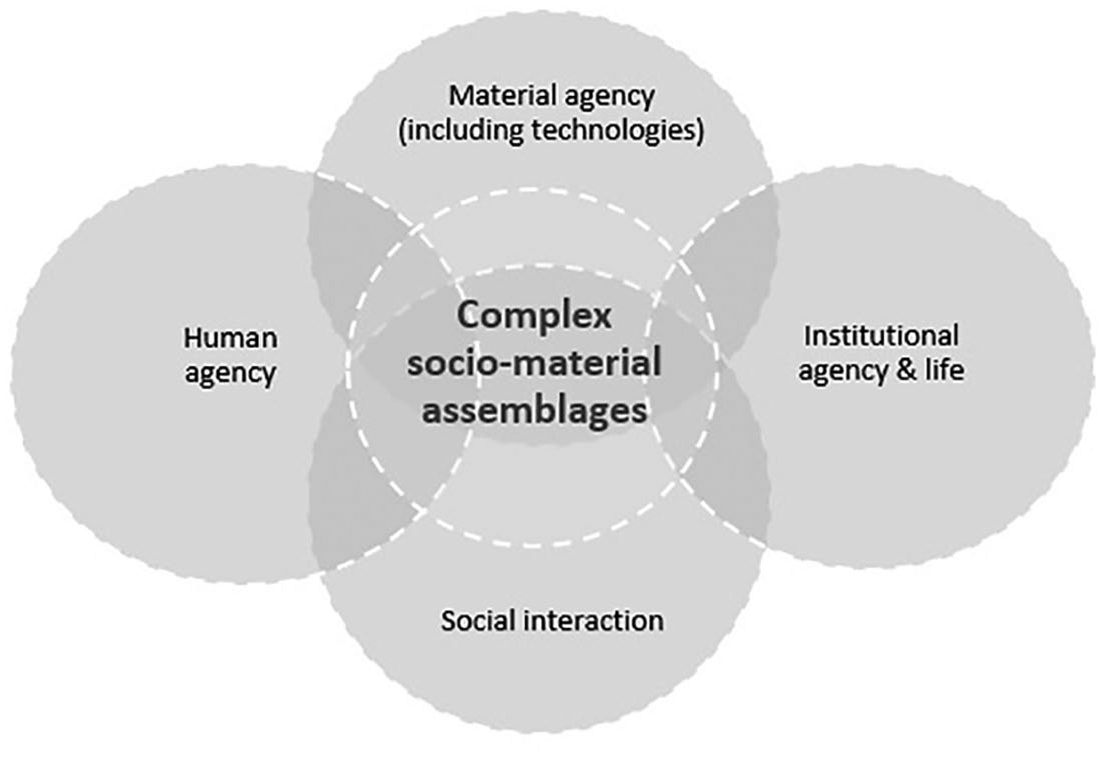
The core dimensions of sociomaterial theory are schematized in Figure 1 where the material is positioned agentially as an important part of and having substantial power within the interactions of all the other dimensions ontologically.
Dimensions of sociomaterial theory.
At the center of the diagram are the complex assemblages and multiplicities that emerge from a set of agencies that operate within an institutional setting. This representation also suggests that an array of meanings is formed in the fluid interactions and confluence of people with the material content of their worlds, including the tools and technologies they employ, bodily movements and haptic engagement, human actions, and the interconnections of objects, texts, discourses. The central notion is the often unrecognized but pivotal agencies of the material with human agency (Fenwick et al., 2011). Some of these entanglements between humans and the material (including the technological) can be unpredictable and lead to unexpected outcomes, which might even be deleterious (Hodder, 2014).
Sociomaterial theory has particular significance for understanding technology use in education. Technologies have tangible effects on the humans who engage with them (in affective flow, in shaping choices, and in being instrumental in sociomaterial assemblages). The potential agency of technologies also shapes how they are deployed and used in innovative ways in teaching and learning. Digital literacies might be viewed as an outcome of the purposeful interaction between human agencies and technological agencies. The theory also has the potential to help understand the complex intersectionalities of the human, the social and the material (including the virtual) in terms of the institutional outcomes and productivity. Materiality, thus, cannot be separated from all the outcomes of an organization, including the ones that are positive, strength-based, and effective.
Institutional Ethnography
In conducting the 6-month ethnographic study reported in this article, we employed an institutional ethnographic approach, centering on Dorothy Smith’s (2005) ideas about the explicit and implicit professional relationships within an institution. According to Smith, there is a positive correlation between the interactions of individuals within an organization and the effectiveness of that organization in meeting its goals. Kearney et al. (2019) describe Smith’s approach this way: “Institutional ethnography orients to exploring and explicating the social relations that organize . . . experience in the institutional setting or settings in which they exist” (p. 18). Core to Smith’s (2005) rendering of institutional ethnography is a focus on what is experienced by individuals within the institution, what is done practically, and the efficacy of the professional relationships that afford or constrain practice and collegiality, thus bringing attention to the operation of power.
Institutional ethnography is positioned as the larger methodological position of this study as a whole. In this article, sociomaterial theory is used to understand the agential interactions between the material and the human within an institutional context, bringing an alternate perspective alongside the human-to-human interactions that are emphasized in institutional ethnography. Given the focus of this article on digital literacies and the importance of engaging with digital devices in teaching and learning, this attention to materiality is justified, even though there are evident differences of analytic focus between sociomaterial theory and institutional ethnography.
Research Context and Participants
The study was conducted in one ACE provider operating under the Adult Migrant English Program–Langfield. It is a registered government-funded multisite provider of English and employment programs for adult learners in several different locations in Melbourne. At the time when the study was conducted, Langfield catered for 200 learners whose age ranged from the early 20s to 80s. They mainly came from Vietnam, China, Thailand, Somali, Ethiopia, and South Sudan. The majority of Langfield learners were not employed at the time of the reported research and lived in social housing estates. They were no longer homeless or stateless and were building cultural and language foundations for the future. Many learners had little or interrupted schooling – yet despite difficult histories, they remained committed to education. Some could not read and write in their home languages, but they embodied important cultural and linguistic understandings that may richly inform learning, including the development of their digital literacies.
The Langfield chief executive officer (CEO), 20 adult learners, and six EAL teachers volunteered to participate in the study: Kate, Andrea, Susan, Polly, Tanya, Nicole (pseudonyms). As a Vietnamese-Australian Nicole was bilingual; the others were monolingual, of Caucasian heritage. Across its sites, Langfield had two dedicated computer rooms, several sets of iPads, as well as projectors and teachers’ laptops in some classrooms. There was a specific learning program at Langfield—Techno-Tuesday (pseudonym)—initiated and led by three teachers (Tanya, Nicole, and Polly). The program focused on digital literacies and was delivered on a weekly basis. It was based on a rotating model: three teachers simultaneously led 30-minute sessions each focusing on a particular digital practice. These sessions typically involved and were centered on mobile phones, iPads, and desktop computers. The learners split into three groups and rotated from one session to another, which allowed them to practice different digital literacy capabilities with a range of devices.
Methods and Data Analysis
This ethnographic study relied on triangulated qualitative data collection methods (Merriam & Tisdell, 2015) to understand different interactions and practices with and about digital technologies within Langfield. Data collection methods included individual interviews with the teachers (six in total), an interview and a guided tour of the facilities with the CEO, one focus group with five of the teachers, two focus groups with adult learners (four participants per group), photographing of teaching and administrative spaces at Langfield, collecting artefacts, and six extended video-recorded observations of class teaching, followed up by additional reflective interviews with the teachers. Due to the focus of the article, we mainly use data from the teachers and the CEO in the findings.
Brooks’s (2015) approach to coding and identifying themes in qualitative data was used in this research. The data analysis in the study included the identification of emergent themes grounded in sociomaterial theory. This theory is applied contextually and holistically to tease out the relationships between the material, social, personal, and institutional world in intersectionality, rather than being a demonstrative set of static categories for analysis. The use of a priori codes, based on the sociomaterial theory (Figure 1) and an inductive iterative process of reading and understanding the data facilitated the development of several categories which later, through refining and revision, were merged into themes. Using collaboratively generated codes, the researchers coded the data separately before comparing their categories and themes. Discussion of discrepancies in analysis occurred until a consensus about important themes was reached. This article focuses on one of those themes—inconsistency between teachers’ assumptions about students and their grounded practices with a range of digital technologies.
Findings
With regard to the research questions posed earlier, in the following sections, we examine teachers’ practices in juxtaposition with the deficit discourse that operated at the time in Langfield, as well as the ways that technologies intersected materially with human agencies. We see the intersections of discourse and materiality reflected in the CEO’s and teachers’ comments about the work with learners. We also highlight strength-based approaches to digital literacies employed by teachers, although they did not seem to recognize their agential power in this regard nor did they overtly understand that the technology itself afforded this power.
Teachers’ Assumptions About Learners’ Digital Literacies
Referring to Langfield learners, the CEO and participating teachers often identified their English proficiency levels using terms “low level” and “illiterate.” The CEO said: “We’re also working with low level, you know, beginner level adults, especially those with low literacy because they are quite difficult; it’s a difficult cohort to teach.”
Similar comments were made by the teachers about their learners’ capacity to use technologies and engage in digital literacy practices in both everyday life and learning at Langfield. Nicole explained: “The level is too low. Actually, it’s really hard to think of something else except for typing and using the mouse and creating the folder.” Andrea shared similar concerns: “Some of them don’t know how to turn on the computer. Some don’t know how to turn off the computer. Very few of them know how to use the keyboard . . . They find it difficult.” The data contain language that suggests a deficit discourse and negative assumptions about learners’ literacies and capacities to utilize digital technologies as material provisions for learning. The teachers’ frequent use of the word “low” and focus on gaps in learners’ capacities to engage with technologies, are especially illustrative of such thinking. Such perspectives tend to be normative and broadly representative of the discourse about adult learners from refugee and migrant backgrounds. Ironically, in conventional policy terms, these “deficits” are the reason for the program’s existence in the first place.
There was another discourse evident in the data. Most teachers were aware of the learners’ life circumstances and they empathized with their learners: They’re [adult learners] often intimidated by their own children in that their children don’t want them to speak English because their English isn’t very good, and so they feel disempowered a lot at home. When they come here, I’d like to think that if I could give them the skill . . . that empowers them a little bit. They can take that skill home and they might feel a little empowered . . . I love to see them empowered. (Andrea)
Empathy for, and even apprehension about, their learners was emphatic in what the teachers shared. They thought that learners’ lives were complex, and they hoped that learning at Langfield could improve their life prospects. The empathy and aspirations were well-intentioned, but they were still based on perceptions of what the learners lacked, rather than their resourcefulness, resilience, and capacity for transformation. The teachers tended to view their learners as victims who needed help.
While they believed that agency is a key to better lives, Andrea and other teachers conceptualized it as “giving students a skill” rather than framing it around learners’ capacities for agency, voice, and decision making within the instructional context, especially in recognizing the power of technologies to forge with human agency effective assemblages for learning. The complex phenomenon of displaced people transitioning into a new society clearly involves a range of contextual adaptations; and, in terms of the perspective of sociomaterial theory, adaptations with regard to what technologies can provide is a critical substrate to their learning for a digital world.
Strength-Based Approaches to Digital Literacies
Although teachers’ perspectives on their learners often focused on what they lack and need, some teaching practices observed in the study seemed to be effectively informed by strength-based principles. During the interview, Tanya shared one example. Her class discussed their weekend and then, building on this positive discussion, students created digital texts about the weekend activities. Similarly, Nicole described how the focus of Techno-Tuesday classes was often planned in her case: “Okay, what we did this morning? So in the afternoon in the computer room they can just type it.” Nicole further elaborated that if there was a focus on particular vocabulary, then the activities in the Techno-Tuesday class were also centered around this vocabulary intersecting with learning about technologies.
Indeed, we observed this integrated approach during her class that included centralizing the agency of the devices in the learning. The devices tended to direct the learning. Sitting in the circle, the learners used their personal mobile phones to engage with the app that allowed them to video record their pronunciation practice and then playback. The affordances of these devices for this task became centralized in the pedagogical frame of the lesson and its twofold focus. First, the learners practiced pronunciation to achieve better intelligibility—something the class learned before. Second, they also learnt how to video record, which was new to them as Nicole explained: “I think most of the time they just take pictures, but they don’t really use the video recording . . . I think that they learned how to do the recording.”
In this example, the assemblage of the affordances of the mobile device with the learners’ affective engagement enabled the integration of a digital literacy practice into language learning. When teaching digital literacies, the teachers often drew on learners’ previous experiences. For example, Nicole organized the activities with video recording considering what learners could already do with technology (e.g., take photos). As we observed, she used learners’ existing haptic input skills, their prior knowledge of the apps, and pronunciation practices (completed in previous classes) as a starting point in the video recording activities. In sum, the materiality of the mobile phones and their agential impact on the learners (as recording devices) in complex interplay with human learning was integral to the learning phenomenon that emerged.
Tanya’s and Nicole’s examples also suggest that to scaffold learning they focused on what their learners were familiar with in their material and social worlds and used the intersections between the two as a resource for teaching digital literacies. This means that their teaching practices were implicitly informed by a strength-based principle of learning from learners’ prior knowledge, experience, and familiarity with the mobile devices that are in constant interplay in their lives beyond the institutional context. Another strength-based principle was evident in this work. Learning was largely experiential and collaborative. It drew on the multiplicity of learners' intersubjectivities, together with affective engagement with technologies and social interactions within the physical setting of the learning spaces.
Building from strengths and offering experiential learning worked well. We observed that the learners were able to use video recording independently and confidently to practice pronunciation skills. There was a complex interconnection of a human learning act with the material provisions that supported that act. The larger material dimension—the classroom physical space constructed by Nicole for this class and the use of learners’ personal (and thus, familiar) devices—also seemed to contribute agentially to this successful learning in directing how learners were able to move in the space in interaction with each other. This approach also allowed Nicole to integrate some aspects of digital literacies almost seamlessly into language learning, such that technologies were integral, not peripheral, to learning experiences and to the social engagements in situ. The technologies in the space had a generative function in learning that appeared to transcend even what the teacher provided.
Another pertinent example of strength-based pedagogy was observed in Susan’s class. The learners used iPads to access interactive digital books that were specifically commissioned by Langfield for its learners. After the class, Susan said, Our students have been very keen to use these stories . . . So we’d have a story featuring one of our Somali students. We also have a family who is a Vietnamese family who are going shopping . . . So, we’re hoping that our students can open these stories and the environment looks familiar. But also, the people look familiar and they’re going about their everyday lives and doing things that they would ordinarily do. They also are very engaged with them because they’re actually quite autonomous in their use [of the book]. They have control over it so they’re able to go back over words that they can’t pronounce, or they’re trying to pronounce and need support with.
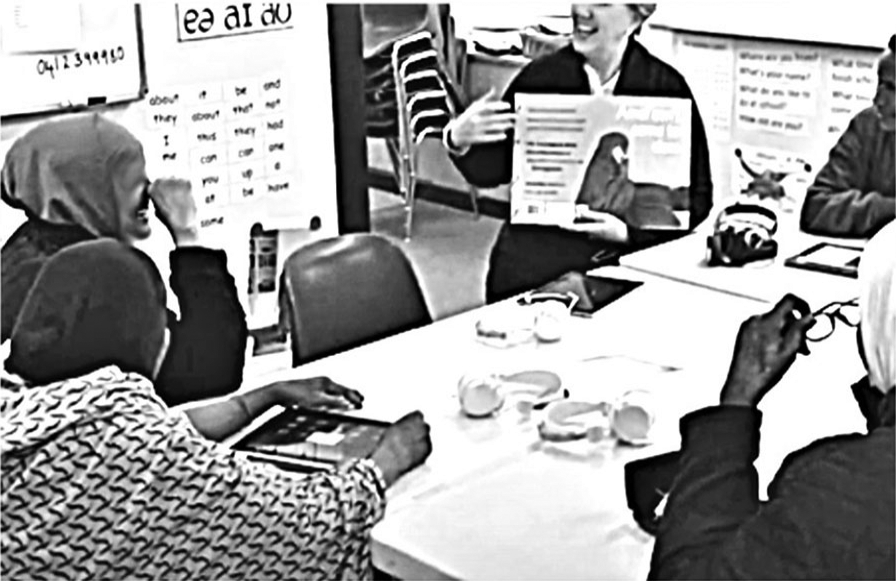
These digital books featured content and targeted language that were relevant to adult English learners living in Australia (e.g., medical appointments, contacting a child’s school, daily routines, etc.). The books had a significant focus on English language, but they also provided an opportunity to learn how to interact with digital texts as material objects. They evoked language learning and meaning creation apart from the teacher’s pedagogical input in class time, suggesting the extent to which the technology shifted agential focus in learning. Susan’s work also demonstrated a number of strength-based principles. In particular, these books were contextualized around everyday social and institutional language practices reflecting learners’ unique social and material worlds. This helped make their learning meaningful. Figure 2 captures Susan showing a hard copy of the book at the beginning of the lesson before learners accessed an interactive digital version on iPads. This book features one of the Langfield learners present in this class.
Susan’s class with interactive books.
The photograph captures the participants smiling and laughing as they see their peer as a book character. Tapping into learners’ identities and affective flow helped Susan to connect to learners and create a welcoming and relaxed environment for learning. Furthermore, Susan’s comment about opportunities for autonomous learning suggests that she employed these books as a strategy to further empower learners. This productive and successful example from practice reflected some but not all the teaching and learning at Langfield.
Teachers’ Perspectives on Their Own Practice
In the teachers’ discussions of their work, there was a lot of uncertainty about their own ability to address learners’ needs associated with digital literacies. Tanya, describing a recent class on creating an email account, said: “I think I got grey hair that day . . . it was so stressful.” Another teacher, Kate, expressed similar feelings: “I wouldn’t say that I’ve been overly successful in teaching technology.” This echoed Andrea’s perspective: Even though I’ll sit down with them before, we’ll sit at the desk and we’ll go through each of the steps and then I’ll show them on the data projector and then they go to the computer and they can’t remember how to do it . . . So, it’s not easy.
During the activity-based focus group, the teachers used the image of a “black hole” to represent their experience associated with teaching digital literacies. One teacher explained the meaning of the image: “It is a black hole that we find ourselves in because we’re lost, and we can’t go any further because of the ineffectiveness of equipment and not skilled enough.” She conveyed an overt sense of frustration and inadequacy shared by all the teachers. Their “black hole” image reflects perceived uncertainty about the efficacy of their digital pedagogies.
There is evident tension about how the material can be placed strategically with the social as part of effective assemblages for learning. Their words reflect a belief evident in the larger data set that sometimes even their best efforts were not good enough for these learners. Interestingly, as evident in Andrea’s comment, it was not only the learners that were identified as the problem. This discourse was evident in the teachers’ self-identification. They did not seem to recognize their agential power. The power of the material as a constructive force in learning was also not fully understood in their teaching practices. These teachers did not seem to recognize that their extant successful embodied classroom practices were actually informed by strength-based principles and they viewed their own work as pedagogically deficient and, perhaps, even inadequate.
Discussion
The aim of this article is to explore adult EAL teachers’ perspectives and practices related to teaching digital literacies in order to understand the extent to which they are prepared to identify and employ learners’ resources when teaching digital literacies. The article also considered the agential role of materiality and the complex assemblages and multiplicities with technologies that can be part of multifaceted learning. This knowledge is important for advancing pedagogical practices about digital literacies in adult EAL programs.
The study found that teachers’ narratives about their learners mainly focused on what they lack more than what they bring. This finding is consistent with the conclusions in the literature that even well-intentioned teachers usually focus on student deficiencies rather than on their strengths (McClanahan, 2014; Ryu & Tuvilla, 2018). The teachers in this study were compassionate, empathetic, and resolute about the learning goals for their learners, but their everyday normative assumptions may have negative implications for classroom practices and, importantly, for learners’ self-perceptions of their capacities (Ryu & Tuvilla, 2018; Shapiro & MacDonald, 2017). Teachers’ unexamined perspectives on learners and their digital literacies can reinforce perceptions of digital helplessness and disempowerment among their learners.
Consistent with previous research (van Rensburg & Son, 2010), this study found that the teachers at Langfield effectively embedded some aspects of digital literacies into language learning. Adding to this research knowledge, our study also found that some teaching practices for digital literacies were effective for their adult learners because they were informed by strength-based principles in connection with the affordances of material resources. Echoing previous research (Sanguinetti et al., 2005; Shapiro & MacDonald, 2017), these included teaching developmentally at the level of each student; drawing on adult learners’ prior skills and knowledge in all its material dimensions; using authentic teaching materials reflecting the students’ social worlds and lived experiences; building positive, trusting empathetic relationships and effective learning groups/communities; and adopting strategies to empower learners, encouraging autonomy, and continuing lifelong learning.
However, the teachers did not always recognize or theorize what made their teaching effective. There was a strong sense of their own pedagogical deficits and high levels of anxiety associated with teaching digital literacies. Teaching language and literacy has always contained emotional and affective dimensions (Ehret & Leander, 2019). These were overt in this study. The findings suggest that the teachers in this research recognized and employed some of the learners’ assets when teaching digital literacies, but they did this intuitively, rather than by design. They did not seem to recognize their agential power in this regard, nor did they explicitly understand the ways that the technology itself afforded this power or indeed had power itself. Given the lack of research about teachers’ perspectives on teaching digital literacies in adult EAL contexts, this new insight is significant. It points to the need for critical awareness of taken-for-granted skills, capacities, positionings, material provisions, and teaching strategies.
It seems that the existing approaches to teaching digital literacies at Langfield can be further enhanced and extended. Sensitivity to learners’ needs is important and this sensitivity is evident at Langfield, but there is also a necessity for a richer repertoire of strength-based teaching practices informed by a clear theoretical rationale for teaching and understanding of the central role of materiality in learning. It is also important to consider the professional capacity to identify, articulate, theorize, design, and consolidate the “naturalized” strengths of ACE practice. Developing such professional knowledge and, importantly, agency can be challenging. This may require a significant paradigm shift and further professional learning (Benseman, 2014; Smyser, 2019; Sofo, 2011). Consistent with this view, this study affirms the imperative of support for the teachers at Langfield to appreciate their own strengths, recognize the potential of their unique learning environments for excellent practice, understand the ways in which technology itself affords agential power, and build theoretically informed models to consolidate their practice through embodied and affective engagement with technologies.
This research also contributes new important insights to the body of literacy studies research concerned with digital literacies pedagogies for language learners (e.g., Hafner, 2019) by advocating for a strength-based approach to digital literacies that overtly incorporates the material. Helping learners to learn digital literacies is important, but drawing only on the needs identified by others, often through a deficit frame of reference, is ultimately unhelpful. Deficit discourses reflect a top-down view in which teacher agency overrides that of the learners and does not fully account for the material setting in which they learn. As illustrated above, the deficit discourse is endemic. It is evident in the teacher’s accounts of their learners and, at another level, it “flavors” the teacher’s versions of their own practice. To build effective strength-based practices to enhance digital literacies, a range of agencies, including the materiality of the learning context, need to be operationalized. In other words, genuine strength-based practices need to allow for all agencies to intersect in synergy with the prior knowledge and materials with which the learners are familiar with.
Viewed through the sociomaterial lens adopted in this article, digital literacies seem best embodied in the agential potential of materiality—in the technologies, settings, and physical resources that support learning, in the very real influence of the devices that the learners bring to class. Both teachers and adult learners were doing better than they know in regard to operationalizing the sociomaterialities; but both teachers and learners appear to need strategies and support to navigate around, or out of, the “black hole” of the dominant deficit discourse that runs counter to the strong practices observed.
Implications and Conclusions
These findings have important implications for EAL teachers’ professional learning. If progress is to be made in moving away from deficit discourses, an important starting point can be increasing EAL practitioners’ awareness about such discourses and their implications, including how they construct and position both teachers and learners. It would be useful to increase this awareness through targeted professional learning that focuses on critical engagement with existing teaching practice and pedagogies. Building on what learners and teachers are already doing effectively can be generative for identifying principles and practices that may underlie quality pedagogies. Capitalizing on their current practices, teachers would benefit from more opportunities to reflect on, evaluate, and share their approaches. In turn, these collegial dialogues can help consolidate and enhance strength-based approaches to digital literacies.
Teachers also need support to learn how to recognize and employ the assets (material, cultural, and social). Sociomaterial theory points to the fluid and emergent (and sometimes unpredictable) entanglements of the material and the agency of the material with a range of institutional and social factors in the complex unfolding of learning as a phenomenon in this adult education setting. Consideration of materiality appears to be essential to the resourcefulness and the resilience demonstrated by learners from refugee and migrant backgrounds and a pedagogical foundation in designing teaching for learning digital literacies. It is why we positioned sociomaterial theory alongside institutional ethnography in this research.
Just as we ask whether these teachers fully appreciate their own professional capabilities and agency, they, in turn, might enquire of their adult EAL learners about learning that works for them. It may be helpful for teachers and learners to work interactively by looking at what the learners are already doing that involves digital literacies and considering the materiality of technologies that is so formative for learning.
Footnotes
Declaration of Conflicting Interests
The author(s) declared no potential conflicts of interest with respect to the research, authorship, and/or publication of this article.
Funding
This research was supported by TELAPL AC Collaborative Research Fund (Faculty of Education, Monash University).
Notes
Author Biographies
