



Abstract
Adult basic education (ABE) scholars, practitioners, and policymakers have long debated the purpose and outcomes of federal ABE policy. Although the current policy, the Workforce Innovation and Opportunity Act (WIOA), became law in 2014, there is no comprehensive analysis of the diverging perspectives on WIOA implementation. This integrative literature review generates a synthesis of WIOA-Title II implementation and suggests implications for future research. Based on a thematic analysis of 35 publications (2014–2021), the paper elaborates on four themes: limited ABE funding and the need to use funds efficiently, WIOA-mandated coordination between ABE providers and workforce development partners, increased accountability requirements that narrowly focus on economic outcomes, and framing adult education for economic purposes. Future research on WIOA-Title II implementation should build on this foundation to inquire for whom WIOA works, where it works, and under what conditions it is or isn’t successful in helping learners to flourish.
Adult education and literacy are in a “a new and crucial era” (Eyre, 2013, p. iii) since the time of the Great Recession (Roumell et al., 2019). One salient marker of this new policy era is the 2014 bipartisan federal legislation, the Workforce Innovation and Opportunity Act (WIOA). Though WIOA includes adult education in multiple titles (e.g., Title I-Workforce Development Activities), this literature review focuses on Title II, the Adult Education and Family Literacy Act (hereafter, AEFLA or WIOA-Title II), and adult basic education (ABE), which incorporates “adult literacy and numeracy education, adult secondary education, and English language education” (Belzer & Kim, 2020, p. 189). In 2019–20, federally funded ABE programs reached only 1.1 million adults (National Reporting System for Adult Education [NRS], n.d.), or approximately 4% of those who may benefit from adult education and literacy services, such as adults with low literacy skills, without a high school degree, or with limited English proficiency (McHugh & Doxsee, 2018).
Since WIOA became law in 2014, scholars have explored relevant topics such as the historical evolution of U.S. federal adult education policy (Belzer, 2017; Roumell et al., 2019), accountability (Pickard, 2021a, 2021b) and family literacy under WIOA (Clymer et al., 2017). Nevertheless, due to WIOA's recency, the field has yet to produce a comprehensive literature review on the implementation of this policy. Therefore, this integrative literature review draws from academic scholarship, practitioner perspectives, and policy analysis to generate a synthesis of the collective knowledge on WIOA-Title II implementation and share the implications of this analysis for future research on the topic. The research questions are: How do adult education scholars, practitioners, and policy analysts describe WIOA-Title II implementation? What are the implications of this literature for future research on WIOA-Title II implementation? These questions are critical in light of the COVID-19 pandemic and growing awareness of racial and economic injustice, which “may also suggest a favorable opportunity structure for further policy reform” (Roumell, 2021, p. 77).
Theoretical Framework: A Critical Policy Analysis
Rational policy analysis conceptualizes policy as a predictable, manageable event (Diem et al., 2019) and situates rational individuals and their often competing goals, preferences, and resources as the central focus of analysis (Young, 1999). Researchers employing this framework often overlook the role of ideologies and power relations within policy formulation and implementation (Diem et al., 2019). However, for critical policy analysis (CPA), policy is not simply a text to be acted upon, but rather a socially and culturally informed process that is both expressive (it communicates cultural beliefs) and constitutive (it constructs reality; Rosen, 2009). Following CPA, this literature review focuses on the implementation of WIOA-Title II, including the ideologies and power relations embedded within the policy, and its intended and unintended consequences. Therefore, instead of asking “what works,” our CPA research focuses on “what is implementable and what works for whom, where, when, and why?” (Honig, 2006, p. 2).
Framing U.S. Federal Adult Basic Education Policy
The history of ABE policy is critical for understanding our current juncture (see Rose, 1991 and Roumell et al., 2019 for historical analyses). Though U.S. federal adult education policy can trace its roots further back (e.g., the Morrill Act of 1862), the Economic Opportunity Act (EOA) of 1964 marks the start of direct involvement in ABE (Eyre, 2013) by establishing the Adult Education Act of 1964, increasing federal intragovernmental partnerships, and connecting adult education to Johnson's War on Poverty (Roumell et al., 2019). During the “stabilizing years” (Eyre, 2013, p. 13) of the 1970s, the federal role in adult education grew via additional funding, expanded services for secondary education, more bilingual programs for adults (Rose, 1991), and increased focus on job-related training, such as the Comprehensive Employment and Training Act of 1973.
The 1980s marked another consensus on a new era of adult education policy, emphasizing increasing accountability (Condelli, 2007; Merrifield, 1998) and human capital development. Within a context of high unemployment, a reduced role of the federal government in education, and a focus on adult literacy for economic well-being (Eyre, 2013; Roumell et al., 2020a), this period was considered “the literacy thrust” (Rose, 1991, p. 25). This is exemplified by the passage of the 1991 National Literacy Act, which positioned literacy as both a neutral set of skills and a lever of social justice (Belzer, 2017). The growing emphasis on accountability and employment was solidified in the 1990s and 2000s through the passage of the 1998 Workforce Investment Act (WIA; Condelli, 2007), the subsequent move of adult education to the Department of Labor (Eyre, 2013), and finally, the passage of the Workforce Innovation and Opportunity Act in 2014.
Current Policy: WIA, WIOA, and Literacy Education as a Workforce Strategy
The Workforce Investment Act of 1998 was the result of greater convergence between the Democratic and Republic parties on the notion of adult education as skills training (Milana & McBain, 2014). WIA, combined with welfare reform, had a tremendous impact on ABE practices over the next two decades (Belzer, 2003). Though funding somewhat steadily declined when adjusted for inflation (Yankwitt, 2020), accountability expanded and transitioned from a focus on program quality (inputs) to student outcomes (outputs; Condelli, 2007). WIA implementation varied greatly across states and local contexts (Belzer, 2003), with state education agencies powerfully shaping local providers’ capacity to respond to changes (Belzer, 2007). WIA offered less space for practitioners to track non-traditional student outcomes such as helping children in school (Belzer & St. Clair, 2007), reinforced the idea of “literacy education as a workforce strategy” (Belzer & St. Clair, 2007, p. 29), prioritized transitions to postsecondary education (Eyre, 2013), and built on earlier workforce programming (e.g., the Job Training Partnership Act of 1982).
The current federal ABE legislation, Title II of WIOA, built on WIA but also initiated a new wave of adult education policy (Roumell et al., 2019), one of performance accountability, decreased funding (Bergson-Shilcock, 2020), and intensified focus on economic development (Belzer, 2017). As illustrated in this program memorandum from the Department of Education Office of Career, Technical, and Adult Education, the "critical services" that AEFLA programs provide under WIOA reflects the emphasis on economic outcomes (Uvin, 2015, p. 2):
Assist adults to become literate and obtain the knowledge and skills for employment and economic self-sufficiency; Support the educational and skill achievement of parents and family members to participate in the educational development of their children and improve economic opportunities for families; Assist immigrants and English learners in improving their English and math proficiency and understanding of the rights and responsibilities of citizenship; and Assist incarcerated individuals in strengthening their knowledge and skills to promote successful re-entry into society.
The critical services in WIOA-Title II are similar to WIA, and so is the process of funding allocation. WIOA-Title II provides federal dollars in block grants to the state education agencies such as state departments of education or labor, who then hold local competitive grant applications for providers (e.g., community colleges, community-based organizations, libraries) to obtain federal and state funds. State education agencies may differ in their priorities for WIOA-Title II programs and the amount of additionally allotted state funding, which creates variation in ABE services among states.
WIOA-Title II differs from previous federal legislation in several ways: the provision of integrated education and training (IET) 1 and prominence of career pathways programming, an emphasis on alignment and coordination across titles (workforce and education), and adherence to the six “core” indicators in the performance accountability system. These performance indicators mainly measure employment and postsecondary outcomes: (1 and 2) obtaining unsubsidized employment after program exit (2nd and 4th quarters); (3) median earnings (2nd quarter after exit); (4) obtaining a postsecondary diploma or secondary diploma or equivalent within 1 year of program exit; (5) enrollment in an education or training program that leads to postsecondary education or employment and achieving measurable skill gains; and (6) effectiveness in serving employers (WIOA §116). “Measurable Skills Gain” refers to improvements in literacy, numeracy, or English language through standardized testing such as the Comprehensive Adult Student Assessment Systems, Basic English Skills Test, or Tests of Adult Basic Education. Overall, WIOA-Title II builds on WIA, strengthening the connections between adult education and economic outcomes.
Research Design: The Integrative Literature Review
Since WIOA has only been law for seven years, a comprehensive literature review on this emerging topic does not exist. As the first comprehensive review, our analysis focuses on a “holistic conceptualization and synthesis of the literature” (Torraco, 2016, p. 410). Integrative literature reviews aim to provide new knowledge or perspectives on “mature” or “emerging” topics by combining critical analysis and synthesis (Torraco, 2016). Our critical analysis followed a thematic analysis approach (Braun & Clarke, 2006), and the synthesis resulted in a reconceptualization of current knowledge of WIOA-Title II implementation and implications for future research (Torraco, 2016).
The Systematic Search
The first author conducted a two-staged review of literature on WIOA-Title II implementation. First, the author searched in ProQuest and Google Scholar (see Table 1), which was added to include grey literature such as policy analysis. The ProQuest searches consisted of combinations of the keywords policy, adult education (including variations), and WIOA, whereas the Google Scholar searches used combinations of keywords WIOA and adult education OR Title II. Other sources were identified through referential backtracking, researcher checking, and journal scouring (Alexander, 2020).
Literature Search.

WIOA: Workforce Innovation and Opportunity Act.
The search focused on 2014 (the year WIOA was passed) to 2021 and included academic sources that are historical, empirical (e.g., qualitative or quantitative data), or non-empirical (e.g., forums, commentaries, practitioner perspectives), and policy analyses (see reference list for included sources). Though most gray literature such as conference proceedings and dissertations was excluded due to the scope of this review, policy analyses were included to address the policy-related research questions. Most importantly, publications needed to focus on the implementation of Title II, so publications that did not foreground policy implications were excluded. Publications that analyzed Title II and other titles within WIOA or other education or workforce policies were included. Out of over 400 publications, 62 documents met these inclusion criteria.
The second round involved a more extensive review of the documents’ content. We excluded 28 more documents due to insufficient focus on Title II implementation and/or adult basic skills or literacy. We selected 35 publications, including academic articles that are historical (n = 3), empirical (n = 9), or non-empirical (e.g., forum, commentary, practitioner perspective; n = 13), and policy analyses (n = 13).
The Thematic Analysis
To search for trends and discrepancies across the publications, the first author conducted a thematic analysis. Thematic analysis is appropriate when researchers want to selectively code for specific topics (e.g., major changes from WIA to WIOA) and make the analysis accessible to an audience who may be unfamiliar with the topic (Braun & Clarke, 2006). This analysis included six phases outlined by Braun and Clarke (2006): (1) becoming familiar with the data, (2) generating initial codes, (3) generating secondary codes, (4) searching for themes, (5) reviewing themes, and (6) reporting the themes. For phase 2, the initial codes were based on deductive and inductive categories. Four deductive codes were derived from the National Skills Coalition's (2014) comparison of the major differences between WIA and WIOA: alignment and coordination, career pathways and IET, funding, and performance accountability. These codes were selected to analyze the authors’ views on the most substantial changes resulting from WIOA. A fifth inductive code, the framing of adult education, corresponds to the CPA framework and aimed to analyze authors’ perspectives on WIOA's ideologies. The final inductive code, authors’ recommendations for future research or policy, was employed to gather information for the implications for future research.
All publications were coded, primarily at the sentence level, in NVivo. Phase three (generating secondary codes) was inductive and built on iterations of evaluative coding, which combines descriptive and magnitude coding (Saldaña, 2016), as illustrated in Figure 1. First, descriptive coding was added to better understand how policies and programs may have deviated from the initial intention (Patton, 2015). Next, magnitude codes (codes used “to assign judgments about the merit, worth, or significance of programs or policy” [Saldaña, 2016, p. 293]) were added where applicable to evaluate the content of the descriptive codes (Saldaña, 2016)—in this case, whether the authors had a positive ( + ) or negative (−) perspective toward the policy. Finally, we identified patterns from initial and evaluative codes and used these to create the four themes below.
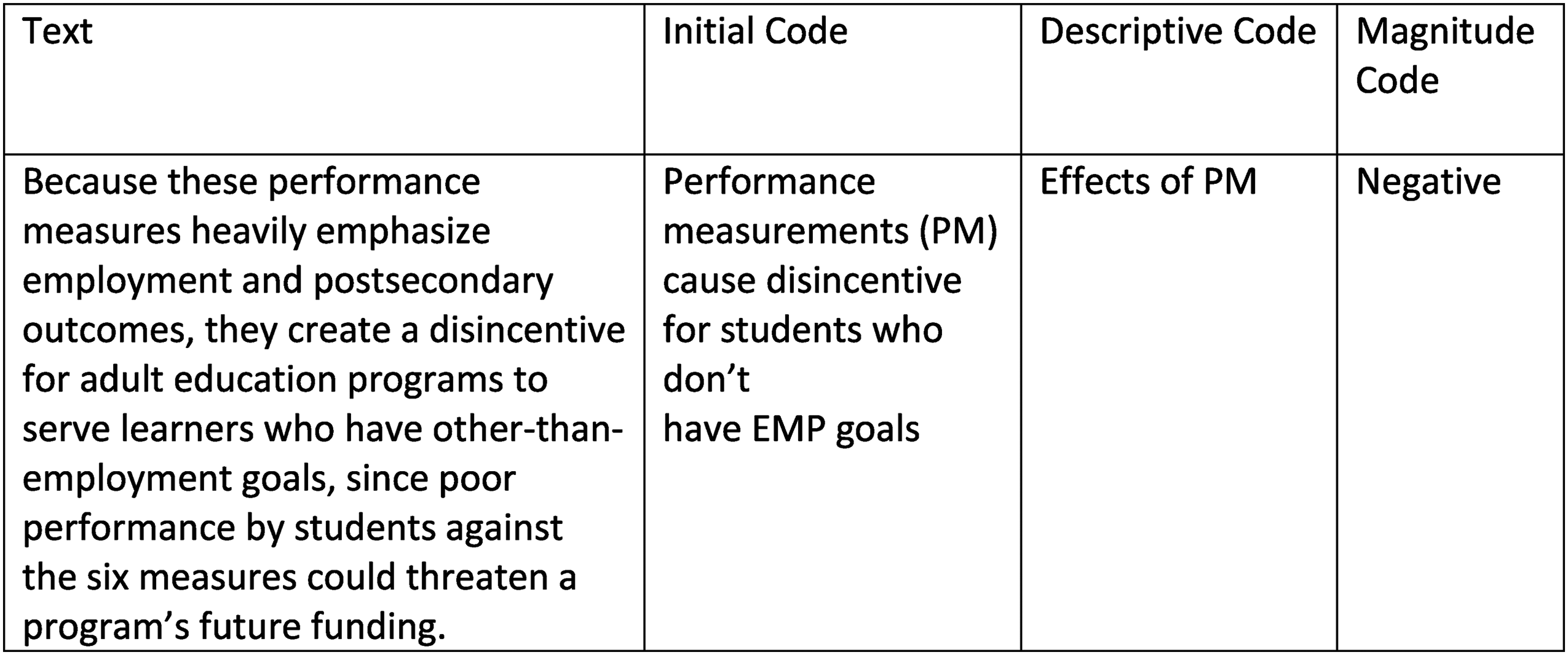
Example of three types of coding.
The Critical Analysis
The following sections define and describe the four themes. The framing of adult education for economic outcomes (theme one, discussed last) permeates the WIOA-Title II policy. This policy, in turn, leads to the other three themes: the efficiency and limitations of funds, changing roles and stakeholders, and heightened yet narrowed accountability.
Efficiency and Limitations of Funds
Authors included in this analysis overwhelmingly agreed that funds for WIOA-Title II are limited, and this may negatively influence services. For example, the authors argued that there is insufficient funding for resource-intensive programs such as IETs or career pathways and that insufficient funding prevents the expansion of effective program models and inhibits innovation at the local level (Bird et al., 2014; Mortrude, 2017). In one study of 36 adult education program directors in the southern United States, the authors found that the survey statement, “I think we have an adequate budget for our adult education programme,” had the lowest mean level of agreement of the 40 Likert-type questions (Udouj et al., 2017, p. 109).
This is not to say that all researchers make this same claim about why funding is insufficient. Within our analysis, those who are concerned about expanding programs and innovation are critiquing the ability to implement the intended legislative goals and model with the current funding level rather than critiquing why funding is limited in the first place. For example, policy analysts at the Center for Law and Social Policy affirmed that “current investment in federal workforce education and training programs is insufficient to achieve legislative goals or meet the demand for services” (Bird et al., 2014, p. 16). Other authors contended that limited funding prevents programs from providing a wide range of services, especially for students with the greatest needs. Reder (2020), for instance, argued that “we need funding for basic skills programs that are designed to meet a broader set of lifelong and life-wide goals of adults and communities” (p. 49). Smith (2017) also suggested that funding limitations and related issues such as low salaries may undermine WIOA's efforts to expand teacher professional development.
Though the authors differed in their views of why funding is insufficient, they were united in their belief that it is inadequate and has steadily decreased when adjusting for inflation over the past two decades: “federal funding for adult literacy education has remained largely stagnant, and actually decreased in inflation-adjusted dollars from FY2001-FY2019, despite the fact that the field serves fewer than 5% of those in need” (Yankwitt, 2020, p. 59). In fact, Jacobson (2017) revealed that the current per-student expenditure is 10% of 1965 levels. Belzer and Kim (2020) also addressed the low levels of per-student funding in ABE, explaining that the 2016 per student federal spending was less than $400, compared to over $11,000 on average per K-12 student. Low per-student spending comes at the same time as WIOA encourages programs to offer comprehensive programs such as IETs and mandates compliance with new accountability measures, both of which require additional staff time and financial resources (Jacobson, 2017; Rutschow et al., 2019).
The second component of this theme is using funds efficiently. Some authors offered advice for ABE providers to leverage funds and combine funding sources, often to support services with limited funds. For instance, Mortrude (2017) wrote, “for credit-based postsecondary education programs, partners should leverage the Pell Grant Ability to Benefit option to cover higher education costs for IET” (p. 9). Others pointed to how limited funding has necessitated efficient use of resources across partners and providers: “As states grapple with competing priorities and constrained resources, there is an increasing focus on efficiency and alignment of programs and resources across state agencies” (Cushing et al., 2019, p. 1). Overall, many authors cautioned that this constant need to leverage funds creates a “triage-like approach” for providers who consistently aim to avoid closure due to a lack of sustainable, reliable funding (Jacobson, 2020, p. 9). This need to use funds efficiently stems from elevated accountability requirements, low levels of per-student funding, and calls for more coordination across educational and workforce partners.
Changing Roles and Stakeholders in Collaboration
WIOA calls for alignment and coordination across titles, thus changing the nature of the adult education providers’ role: “WIOA also emphasizes greater involvement by adult education providers with workforce partners” (Clymer et al., 2017, p. 11). The authors addressed these changes regarding adult education providers’ relationships with employers and workforce development stakeholders. For example, Shin and Ging (2019) argued that “private enterprises are expected to be treated as ‘partners’ in adult education so that AEFLA-funded programs can better respond to their wants and to ‘market demands’” (p. 173). The inclusion of employers as a powerful stakeholder is illustrated in two ways. First, local workforce development boards (WDBs) are required to maintain a majority of business members, and because WDBs now review Title II applications, authors showed concern for the changing relationship between employers, workforce development stakeholders, and ABE providers (Jacobson, 2017). Additionally, though workforce development organizations have long been considered a “crucial partner” for some adult education services (Bird et al., 2014), the relationship with adult education providers is often strained, reflecting the long-standing tension between workforce and adult education systems regarding core purposes and competition for students (see Prins et. al., 2018). Finally, the performance accountability system also targets adult educators’ ability to serve employers, with one author even claiming that “employers, not just students, are customers of adult education services” (Green, 2020, p. 60). This unequal power dynamic, coupled with performance measurements that mention meeting employers’ needs, effectively makes ABE providers subservient to the industry.
On the other hand, several researchers noted the benefits of increased alignment and coordination with workforce partners. Davidson (2017) claimed that adult education providers like “community colleges can be the hub of communication and change that further the creation and sustaining efforts of a trained workforce, social equality, and access to higher education through adult basic and developmental education” (p. 33). Others commented that this alignment was beneficial for learners with undiagnosed disabilities to receive diagnostic testing through another title under WIOA: Vocational Rehabilitation (Bergson-Shilcock, 2019). Authors particularly advocated for coordinated services to serve individuals who face the most barriers (Bird et al., 2014). However, some authors stressed the lack of coordination with partners outside of WIOA. For instance, the authors mentioned the lack of connection between adult education and childcare and/or early childhood education, claiming that collaboration could benefit low-income and immigrant families (McHugh & Doxsee, 2018; Spaulding, 2015). In sum, the push for greater alignment between workforce development partners, employers, and adult education has altered adult educators’ role, potentially allowing them to act as a central hub while also diminishing their influence in collaborative efforts. The greater alignment with workforce development is also visible in the newly mandated performance accountability system.
Heightened yet Narrowed Accountability
According to the analyzed documents, WIOA-Title II's increased accountability requirements have powerfully shaped implementation. As noted above, the six-core performance accountability measures primarily focus on employment and postsecondary outcomes. Only one measure captures growth in literacy, numeracy, or English proficiency, and this growth is assessed only by improvement on standardized assessments. The authors’ comments on this topic were strongly negative and tended to focus either on the impact of the current measures or on what the measures exclude.
Implications of Narrowed Indicators
The authors articulated the performance measures’ potential negative outcomes for providers, instruction, and students. For ABE providers, “a failure to meet expectations could place adult basic education funding at risk of being reduced even further” (Jacobson, 2017, p. 26), which is quite possible since “adult education programs are being evaluated for delivering outcomes they have little or no control over” (p. 26), such as the labor market. The performance accountability system also influences ABE instruction. Authors documented how practitioners devote substantial time to testing and test preparation, in the case of English language learners in an IET, Certified Nursing Assistant program (Britton & Austin, 2020) and adult literacy classes (Pickard, 2021a, 2021b). Furthermore, Pickard (2021a) suggested that the emphasis on accountability has shifted professional development, likely influencing the types of instructional services that practitioners can provide.
Though providers can prepare adults for jobs and assist with job placement, they cannot control the labor market or local wages, making the employment metrics difficult to achieve. Instead, many providers most frequently apply the measurable skills gain (MSG) metric. MSG is commonly demonstrated through standardized tests, which often do not adequately reflect students’ learning and success (Pickard, 2021b), and many adults may not increase their scores quickly enough (Belzer & Kim, 2018; Jacobson, 2017; Pickard, 2016). This leads some authors to suggest that “WIOA's funding and compliance regimes often effectively prevent programs from serving those most in need” (Reder, 2020, p. 49). In fact, in contrast to the aforementioned priority of service (Bird et al., 2014), many authors agreed that the new performance measures may make it more difficult to serve students with the greatest needs, through what is known as creaming, or selecting students who are most prepared to meet the outcomes (McHugh & Doxsee, 2018; Pickard, 2016; Reder, 2020). Authors have documented how these requirements create a disincentive to serving students who have difficulty reading or have lower levels of literacy or education. Pickard (2021a) illustrated how practitioners narrowed the focus of instruction, spent more time on test preparation, neglected writing, and normalized harmful practices (e.g., removing low-performing students from class) to meet the accountability measures and avoid closure. She asserted, “practitioners felt they had to choose between the survival of the program as a publicly funded entity and allowing lower-performing students to participate” (p. 15). Overall, the authors’ perspectives on the narrowed indicators suggest that this is an area for further study.
Implications of Excluding Civic and Social Outcomes
Many authors critiqued the voluntary nature of secondary measures. In addition to the six required measures, WIOA includes five optional measures, but only for family literacy (e.g., involvement in children's education) and Integrated English Literacy and Civics Education (e.g., voting registration). Belzer and Kim (2020) documented that the number of states adopting these secondary measures has declined; as such, “the lack of either mandate or incentive to collect this data…hinders research and development endeavors to improve their measurement and to demonstrate their effects for broad policy constituencies” (p. 194).
More broadly, the authors were concerned about what WIOA's core performance measures exclude. As Hughes and Knighton (2020) declared, “the issue is not that ABE focusing on ‘transitions to’ for economic gain is bad. The conversation that has been lost is the question of what is missing. In not interrogating this often-singular purpose, we miss other potential purposes” (pp. 68–69). Such measures include those related to family literacy (e.g., parenting and advocacy skills; Clymer et al., 2017), digital literacy, health and civic engagement (Belzer & Kim, 2018), skills for immigrant integration (e.g., navigating the health care system and family finance; McHugh & Doxsee, 2018), and longer-term outcomes (Reder, 2020). For example, Reder (2020) argued that “if evaluations are conducted using only short-term outcomes measures, they may miss much of the actual impact that programs are having” (p. 50). This argument is based on findings from Reder's Longitudinal Study of Adult Literacy, which showed that proficiency gains appeared several years after program exit and that they followed greater engagement in everyday literacy practices. Accordingly, short-term literacy scores are an incomplete, ill-timed measure of program impact. In sum, the authors argued that performance accountability is narrowed (Belzer, 2017) and increasingly focused on short-term, economic goals. Correspondingly, the framing of adult education mirrors this focus on economic outcomes.
Framing Adult Education for Economic Development
According to the authors in this sample, ABE under WIOA-Title II has been framed as a way to enhance economic development (Belzer, 2017; Clymer et al., 2017; Jacobson, 2017). To borrow Belzer’s (2017) metaphor, many researchers believe WIOA has “narrowed” the field by turning adult education policy toward economic development. For instance, Jacobson (2017) claimed, “WIOA can be seen simply as the latest in a series of federal education policies that frame the purpose of schooling in starkly economic terms” (p. 26). Authors expressed concern that framing adult education for solely postsecondary entrance and economic development may lead providers to devote scarce resources toward these goals and neglect learners’ other goals (Clymer et al., 2017; Hughes & Knighton, 2020). WIOA's focus on workplace preparation may also influence instructors' ability to implement other initiatives such as the College and Career Readiness Standards (CCRS): “these two simultaneous emphases of implementing the CCRS and preparation for the local workforce present a powerful challenge for adult math/numeracy instructors. On the one hand, the instructors are expected to teach all mathematical content areas… emphasizing meaning and understanding. On the other hand, instruction must also prepare learners for the numeracy demands of particular workplaces” (Ginsburg, 2017, pp. 59-60). Some scholars, though, remained cautiously optimistic, claiming that “the integration of adult literacy instruction and workforce preparation is tricky but possible” (Bragg, 2016, p. 58) and may support adult learners who are finding greater pressure to complete postsecondary training (Bird et al., 2014) or are aiming for higher earning potential (Shin & Ging, 2019).
Authors in this sample challenged ABE providers’ ability to promote economic development given the lack of living-wage employment (Jacobson, 2017) and structural inequities (Jacobson, 2020). Pickard (2016) cautioned that “even if all 5,000,000 unfilled jobs were ‘good’ jobs and it were possible to successfully prepare 5,000,000 people with the skills needed for those jobs, about 28 million people would be left without a job that provides a living wage” (p. 51). Furthermore, in one qualitative study of a certified nursing assistant (CNA) IET program for English language learners, the instructor contended that “even with the great amount of resources spent on CNA testing certification, students exit the program only qualifying for minimum wage jobs” (Britton & Austin, 2020, p. 10). Even if the ABE system were able to help adult learners earn family-sustaining wages, too few such jobs exist (Rank et al., 2021).
Scholars shared concern for the discourses perpetuated by WIOA, including merit-based discourses, maintaining that WIOA-Title II attempts to reduce the government's responsibility for “the costs of social programs” by “ascribing poverty to individuals’ difficult circumstances rather than structural and systemic inequality” (Shin & Ging, 2019, p. 1717). For example, systemic racism and its impact on education are seldom discussed, leading Pickard (2016) to declare WIOA to be a “‘colorblind’ or ‘race-neutral’ policy” that fails to consider how race or racial discrimination marginalizes adult learners (p. 53). Finally, the narrowed focus on employment overrides adult learners’ other goals, leading some authors to suggest that “the field has moved away from identifying itself as part of the broader struggle for human rights and social justice”; instead, “we accepted our role and continually tried to make the case that we are an essential and effective part of the human capital/workforce development system” (Yankwitt, 2020, pp. 59–60). Based on his analysis of funding in New York State, Yankwitt contended that this human capital argument is not working: none of the state's new investment in workforce development is devoted to literacy education, and private funders have little to gain from investing in literacy instruction for adults who may take years to improve their employment and earnings. In conclusion, the prevalent framing of adult education as a cure for individuals’ economic hardships fails to address the structural challenges that adult learners face in improving their economic situations.
Discussion
Since the start of WIOA-Title II, authors in this sample have expressed concerns and offered empirical evidence on the policy's implementation. First, our analysis showed widespread apprehension about limited ABE funding and the negative impact this may have on instruction and support services (Bird et al., 2014; Eyster & Nightingale, 2017; Jacobson, 2017; Mortrude, 2017; Pickard, 2021; Rutschow et al., 2019; Spaulding, 2015). Second, the authors emphasized that WIOA-mandated coordination between ABE providers and workforce development partners, including employers, could potentially increase access to services for some students (Bergson-Shilcock, 2019; Davidson, 2017; Green, 2020), but also requires ABE providers and students to prioritize employers’ needs (Reder, 2020; Shin & Ging, 2019). Next, the authors criticized the new performance accountability system (McHugh & Doxsee, 2018; Pickard, 2016; Reder, 2020) and how it disincentivizes ABE providers from supporting adult learners who would benefit most from adult education (Pickard, 2021a, 2021b). Finally, the authors asserted that WIOA's prevailing focus on economic outcomes constricts adults’ opportunities to achieve other lifewide goals such as civic engagement or family literacy (Belzer, 2017; Clymer et al., 2017; McHugh & Doxsee, 2018; Vanek, 2016; Vanek et al., 2020) and discourages providers from working toward educational equity (Yankwitt, 2020).
Although a few authors saw opportunities in WIOA-Title II implementation, the majority were concerned about what and who it excludes, namely non-economic purposes and adults with the greatest educational needs. These tensions among differing perspectives of why ABE policy should exist, whom it should serve, and how to support adults in reaching their educational goals are not new. Though the human capital framework has dominated adult education policy since the 1990s, it has competed for decades with a more humanistic perspective, both in the U.S. (Roumell et al., 2019) and in international organizations such as UNESCO (Elfert, 2018).
In the United States, the human capital framework drives the “enduring myth” that education and skills alone will end poverty (Rank et al., 2021, p. 48). WIOA-Title II reflects this argument because its goal is to develop individuals’ skills and education levels so they can obtain employment and become “self-sufficient.” Though ABE programs may help some individuals rise above poverty, they do so only by making adults more competitive for a limited number of high-quality jobs. Thus, ABE as articulated in WIOA is an ineffective macro-level strategy for reducing poverty because it “is played as a zero-sum game” (Rank et al., 2021, p. 49). In other words, WIOA-Title II cannot create more high-quality jobs; it can only help certain individuals move ahead in the long line of people competing for these jobs. Thus, a contradiction of WIOA-Title II is that ABE services it provides are insufficient to help most adults achieve the goal of economic self-sufficiency, yet the policy excludes the many non-economic, lifewide goals that are more achievable and highly relevant to adults’ daily lives.
Concern over the implications of outcomes-based accountability systems such as WIOA-Title II also appears in adult education policy analyses in other countries (Gibb, 2015; Tett, 2014). Our analysis reflects the growing scholarly attention to accountability and assessment in U.S. adult education (Hill, 2020) and how the neoliberal logic of efficiency, competition, and return on investment (ROI) drive domestic and global efforts to make educational programs show and answer for their results. The documents discussed here reveal how accountability pressures permeate ABE practice, even as practitioners have fewer resources to meet the rising standards.
Implications for Future Research
Based on the authors’ perspectives and empirical evidence presented in this review, we have identified several key remaining questions on WIOA-Title II implementation. In this section, we draw on Honig’s (2006) observation that education policies are not universally successful in all times and places. As such: implementation research should aim to reveal the policies, people, and places that shape how implementation unfolds and provide robust, grounded explanations for how interactions among them help to explain implementation outcomes. The essential implementation question then becomes not simply “what's implementable and what works,” but “what works for whom, where, when, and why.” (p. 2)
The question of for whom WIOA works looms large. WIOA claims to prioritize adults who are problematically termed “basic skills deficient,” including English learners or adults who read below an 8th-grade level. However, these populations, which disproportionately include people of color, may experience barriers to accessing WIOA programs (Pickard (2021a); Prins & Clymer, 2018). Moreover, for an accountability system that relies on student outcomes, we do not have sufficient evidence of how outcomes are disaggregated by race, ethnicity, and immigration status (Mortrude, 2020)—nor are the datasets publicly available. Consequently, research is needed to understand how WIOA implementation affects who participates in Title II services and how outcomes vary by race, ethnicity, and foreign-born status, among other factors. Additionally, researchers have already documented detrimental practices such as creaming and pushing out learners who make insufficient gains, particularly adults with difficulty reading (Pickard (2021a, 2021b); see also Prins & Gungor, 2011). However, researchers have not examined how WIOA's performance accountability system affects emergent multilingual adults with limited formal schooling or emergent native language literacy.
The question of where WIOA works also matters. Previous scholarship illustrates the integral role of state education agencies in WIA implementation (Belzer, 2007), but state-level analyses of WIOA are limited. Furthermore, the number of states that provide family literacy programs and track the non-mandatory, secondary outcomes, including civic outcomes (e.g., gaining citizenship) and family literacy outcomes (e.g., advocating for children at school) has declined, yet some states have continued these and other efforts to maintain or expand these and other types of adult education programming under WIOA (Belzer & Kim, 2018; Clymer et al., 2017). States vary drastically in how they enact educational policies and mandates, and local efforts such as Washington's I-BEST programs can ultimately influence national policy (Roumell et al., 2020b). As such, state-level and finer-grained geographic analyses could reveal differences in WIOA implementation and outcomes.
Finally, exploring why WIOA works the way it does is key for advancing CPA in ABE. If education policy like WIOA-Title II expresses and constitutes society's values (Rosen, 2009), why and how does the policy conversation continue to be dominated by the human capital framework? The prevailing ROI measurement is emblematic. ROI has been applied to ABE in the past, although there is still inadequate empirical evidence that skills development and education lead directly to higher earnings (Kim & Belzer, 2021). This type of CPA could elucidate alternative visions of ABE policy that providers, states, and other countries have cultivated. For instance, Scotland's community learning and development programs aim to improve “life chances for people of all ages, through learning, personal development and active citizenship” and to create “stronger, more resilient supportive, influential and inclusive communities” (Eurydice, 2021, n.p.), a stark contrast to WIOA's narrow, instrumental vision of adult education. Power mapping (Noy, 2008) and analyzing the behind-the-scenes ways that ABE is included in or excluded from policy agendas (Witko et al., 2021) could uncover the key actors who create and implement ABE policy at multiple scales, with the goals of identifying levers of change and enabling public stakeholders (ABE educators, learners, administrators, advocates, scholars, etc.) to shape policymaking in meaningful ways.
Conclusion
This integrative literature review on WIOA-Title II implementation is the first of its kind on this emerging topic in ABE. Our analysis shows that since WIOA's passage, the selected authors see some potential benefits such as increased coordination across titles and opportunities for innovative programming like integrated education and training. However, overall they expressed concerns and provided some empirical evidence on how limited funding, the performance accountability system, and the framing of adult education for economic outcomes are affecting programs and learners. Based on the diverging perspectives of ABE scholars, policy analysts, and practitioners on WIOA-Title II implementation, future research on WIOA-Title II implementation should build on this foundation to inquire for whom WIOA works, where it works, and under what conditions it is or isn’t successful in helping learners to flourish in their multiple roles.
Footnotes
Authors’ Note
Previous oral presentations: Cherewka, A. (2020, October 27–30). Federal adult basic education policy: Research trends and future directions of study [Concurrent Presentation]. American Association of Adult and Continuing Education National Conference: Improving Social Engagement through Adult Education, Virtual.
Cherewka, A., & Prins, E. (2021, June 3–6). WIOA-Title II implementation: An integrative literature review [Concurrent Presentation]. Adult Education in Global Times: An International Research Conference, Virtual.
Declaration of Conflicting Interests
The authors declared no potential conflicts of interest with respect to the research, authorship, and/or publication of this article.
Funding
The authors received no financial support for the research, authorship, and/or publication of this article.

Supplemental material
Supplemental material for this article is available online.