




Abstract
Considering the needs of siblings is an important component of family-centered practice for children with developmental disabilities. A syntactically and semantically simplified version of the Sibling Need and Involvement Profile (SNIP) was developed to allow self-report. Total profile scores for the self-report version correlated well with the original (Spearman’s rho = .928, p < .01), and test–retest reliability was good (Spearman’s rho = .896, p < .01). Children who piloted the instrument demonstrated good understanding of the vocabulary and the intent of the questions; however, using the instrument with adult supervision is suggested. A comparison of children’s self-report scores to those of their parents’ resulted in low, insignificant correlations, suggesting that parents’ and children’s perspectives do not always agree. Multiple measures, including sibling self-report and parent reports, are necessary for accurate determination of sibling need and involvement.
Family-centered care has become preferred practice for a variety of medical and educational programs, including those serving individuals with developmental disabilities (Dunst, Trivette, & Hamby, 2007). Family-centered practice is characterized by recognizing family diversity, respecting families, treating them with dignity, sharing information, and engaging in professional–parent collaborations (Barr, McLeod, & Daniel, 2008; Dunst et al., 2007). Unfortunately, siblings are often overlooked in pediatric family-centered services, in which parents are typically the focus (Barr et al., 2008; Conway & Meyer, 2008).
Although there can be considerable diversity in the qualities and characteristics of sibling relationships, the sibling relationship can be one of the most significant relationships one has throughout the lifespan (Furman & Buhrmester, 1985; Volling & Blandon, 2005). Most individuals grow up in a household with at least one brother or sister, and it has been suggested that emotional ties between siblings are often second in strength only to parent–child bonds. The quality of sibling relationships can depend on family constellation variables (e.g., birth order, family size, sib sex pattern, age difference, and relative age), sibling relationship variables (e.g., warmth or closeness, relative power or status, conflict, and rivalry), characteristics of individual children, and parent–child relationships (Furman & Buhrmester, 1985). Sibling relationships play an important role in social competence with peers, psychological adjustment, and social cognition. The sibling relationship is typically the longest lasting relationship of one’s life (Volling & Blandon, 2005). Because some individuals with disabilities require lifelong care and may outlive their parents, siblings may be called on to provide ongoing support when a parent dies. It has been suggested that it is important to understand siblings’ hopes and expectations to ensure a smooth transition from parents to adult siblings (Dew, Balandin, & Llewellyn, 2008; Reichman, Corman, & Noonan, 2008). Awareness and tolerance may affect the likelihood of siblings supporting their brothers and sisters with disabilities when their parents are no longer able to do so (Dew, Llewellyn, & Balandin, 2004).
Paucity of supports for families of people with disabilities can have a significant impact on all family members (Fisman, Wolf, Ellison, & Freeman, 2000). The effects on the family can in turn affect the health and well-being of the child with a disability (Reichman et al., 2008). Siblings of children with disabilities may feel anger, guilt, and resentment (Seligman, 1987). Studies have also suggested that nondisabled siblings may be at risk for adjustment and/or behavioral difficulties (Guite, Lobato, Kao, & Plante, 2004).
Family support can influence well-being for family members, family functioning, and utilization of social resources (Canary, 2008). Intervention or support groups for siblings have been linked with positive outcomes for siblings such as increased knowledge of a brother’s or sister’s disorder, increased connectedness and involvement with a brother or sister with special needs, improvement in self-esteem, and improved socioemotional adjustment (Evans, Jones, & Mansell, 2001; Lobato & Kao, 2002; Phillips, 1999). Identification of sibling needs is critical in helping siblings obtain appropriate supports and services. Questionnaires and observation have been the two most commonly used methods for assessing sibling relationships; however, it has been noted that sibling research lacks a consistent methodology for evaluating the qualities of sibling relationships (Furman & Buhrmester, 1985).
Observation has been primarily been used with toddlers and preschoolers because of their limited ability to provide interviews or self-reports (Volling & Blandon, 2005; Volling, McElwain, & Miller, 2002). Observation can be time-consuming, and interpretation can be subjective. In research, observation has been used to examine a single element of sibling interaction such as jealousy (Volling et al., 2002).
A limited number of sibling questionnaires have been described in the literature (Cole & Kerns, 2001; Fish, McCaffrey, Bush, & Piskur, 1995; Furman & Buhrmester, 1985; Sahler & Carpenter, 1989; Schaefer & Edgerton, 1981; Stocker & McHale, 1992; Volling & Blandon, 2005). All involve Likert-type scales with a variable number of response options and graded response choices. Only two have been specifically designed for use with brothers and sisters of individuals with developmental disabilities (Fish et al., 1995; Schaefer & Edgerton, 1981). Furthermore, the majority of these instruments must be obtained by contacting the researchers and are not easily accessible for clinical or research use.
The Sibling Need and Involvement Profile (SNIP; Fish et al., 1995), which both was specifically designed for use with siblings of people with developmental disabilities and is easily available through the Nisonger Center, was developed in 1995 to help “parents and professionals understand the strengths and needs of siblings of children with disabilities or developmental delays” (Fish et al., 1995, p. 1). A panel of experts composed of parents, siblings, and early intervention professionals worked as a team to construct the SNIP and establish content validity. The instrument consists of five sections, including (a) Awareness (whether or not a sibling has information about a brother or sister’s developmental delay), (b) Feelings (feelings about having a brother or sister with special needs), (c) Having Fun (play), (d) Helping (the balance between helping at home and being burdened with responsibilities), and (e) Advocacy (speaking out or standing up for a brother or sister with a developmental delay). Each section has a corresponding questionnaire, which utilizes a 5-point rating scale ranging from strongly agree (1) to strongly disagree (5). Answers help identify strengths (agreement = lower scores) and concerns (disagreement = higher scores). Total profile scores can range from 28 to 140 points. The profile was field tested with 24 families at three sites in Columbus, Ohio—the Nisonger Early Education Center, the Columbus Speech and Hearing Center, and the Early Childhood Program of the Franklin County Board of Mental Retardation and Developmental Disabilities.The original tool was designed for parents to complete on behalf of their nondisabled child or children and has a Flesch Reading Ease of 36.6% and Flesch–Kincaid Grade Level of 8.4.
Most studies on the impact of having a sibling with a disability have relied on parents, particularly mothers as informants. Studies using parents as informants have generally been more negative in their reports than studies using siblings as primary informants (Dew et al., 2008). Little research has been done comparing parent perceptions to children’s own reports. Cuskelly and Gunn (2006) found significant but low (.31–.33) correlations between mother and child ratings on some constructs (e.g., social competence or social acceptance). Many correlations between father and child scores were not statistically significant. However, it should be noted that parent and child scores were obtained using two different instruments—parents completed the Child Behavior Checklist and children used the Self Perception Profile. In another study completed by Guite et al. (2004), “Discordance between sibling and parent reports on the SPQ was common, with parents tending to report more sibling adjustment problems than did siblings. Siblings who reported more problems tended to be younger and male” (p. 77).
Such studies highlight the importance of obtaining sibling self-reports in addition to parent reports in clinical and research settings utilizing the same instrument. The purpose of the current study is to (a) determine whether the concepts on a self-report version of the SNIP are comparable to the original, (b) determine the ease of comprehension of the self-report SNIP items among children aged 8 to 14, and (c) compare parent and child perceptions using the original and self-report versions of the SNIP.
Method
Materials
Questions on the original SNIP were reworded to decrease semantic complexity (e.g., informed was replaced with told about). Furthermore, negative items, which require a higher level of verbal reasoning than positive items (Marsh, 1986), were rephrased in the positive while retaining initial meaning. For example, “I am not embarrassed by the reactions of others to my brother or sister” was reworded as “I am comfortable with the reactions of others to my brother or sister” (see the appendix, available online at http://rse.sagepub.com/supplemental). The Macmillan Dictionary for Children and readability scores generated using the Grammar Check function contained in Microsoft Word were used for guidance. The self-report version of the SNIP has a Flesch Reading Ease of 78.7% and a Flesch–Kincaid Grade Level of 4.9.
Participants
In the first experiment, 88 parents of children with disabilities were recruited from a variety of online communities and Listservs (e.g., Autism News, Sib Parent, Ups for Downs, etc.). Parents were eligible to participate if they had one child with a disability living at home and at least one child without a disability age 4 or older living at home as determined via questionnaire. No additional data were collected about the parents in this study.
In the second experiment, four males and two females aged 8 to 11 years piloted the self-report instrument. All of the participants had siblings with autism, cerebral palsy, or Down syndrome living at home. None of the participants had any diagnosed reading or learning difficulties.
In the final experiment, 11 females and 7 males ranging from 11 to 14 years participated along with a parent (16 mothers and 2 fathers). Only 4 participants were the same gender as their sibling with a disability. Of the participants, 13 had siblings with autism and 5 had siblings with Down syndrome. Of participants, 12 were older than their sibling with a disability, 5 were younger, and 1 was a twin. The majority of participants (14) had parents who were married, 3 had parents who were divorced, and 1 participant had a parent who was widowed. Of participants, 9 came from a family with two children (i.e., their only sibling was the one with a disability), 6 participants came from a family with three children, 2 came from a family with four children, and only 1 came from a family with more than five children.
Procedure
In the first experiment, the self-report version of the SNIP was compared to the original to determine if the concepts on the self-report version maintained the intent of the original. A total of 88 parents completed both versions of the SNIP online. Administration was counterbalanced with approximately half of the participants taking the revised version first and the remainder taking the original version first. At the end of the survey, parents were asked if they could be contacted to examine instrument stability and were asked to provide an e-mail address. Of the parents, 83 agreed to be contacted again. Of the 83 parents, 50 (60%) completed the self-report version a second time. Time between responses ranged from 1 to 36 days, with a mean of 13.5 days.
In the second experiment, the children independently completed the self-report questionnaire online. The researcher was present in person or on the phone and asked follow-up questions after each item regarding whether or not there were any vocabulary items that the child did not understand. In addition, each child was asked to rephrase each question in his or her own words to determine comprehension.
In the third experiment, parents completed the original SNIP online while simultaneously being interviewed regarding their answers by the researcher. Their children were out of the room during the interview. Next the children completed the self-report SNIP in the same manner with their parents out of the room. Parent and child SNIP scores were compared, as were qualitative interviews.
Results
Total profile scores, scale scores, and individual items from both versions of the questionnaire were correlated using Spearman’s rho. The total profile correlation (Spearman’s rho = .928, p < .01) suggests that the self-report version maintains the original’s intent. Scale scores suggest the same (see Table 1). Although individual test items were more variable, all were significantly correlated (p < .01), with the exception of two items: Item 4 from the Feelings subtest (Spearman’s rho = .57), which was not significantly correlated, and Item 4 from Helping (Spearman’s rho = .232, p < .05). The majority of questions were correlated at .735 or higher. However, Question 3 under Helping was poorly correlated (Spearman’s rho = .336, p < .01), although statistically significant.
Reliability and Validity of Scale and Total Profile Scores for Self-Report Sibling Need and Involvement Profile
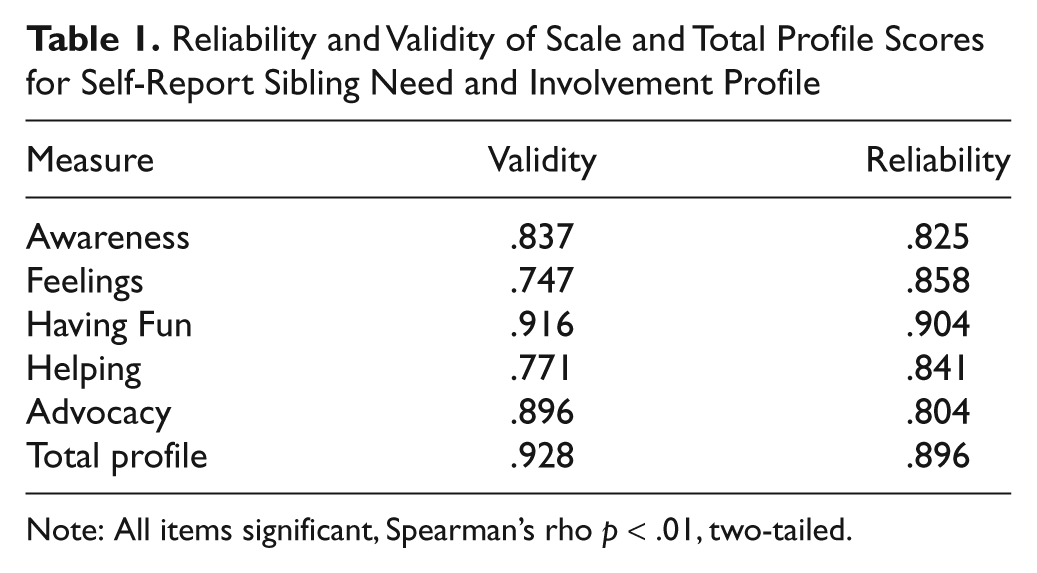
Note:All items significant, Spearman’s rho p < .01, two-tailed.
Total test scores also correlated well between the two administrations (Spearman’s rho = .896, p < .01), as did subtest scores (see Table 1), suggesting good stability. All individual test items were significantly correlated (p < .01) with the exception of Feelings Item 3 (Spearman’s rho =.319, p < .05), and all items were correlated at the .515 level or higher, with the exception of Feelings Item 3.
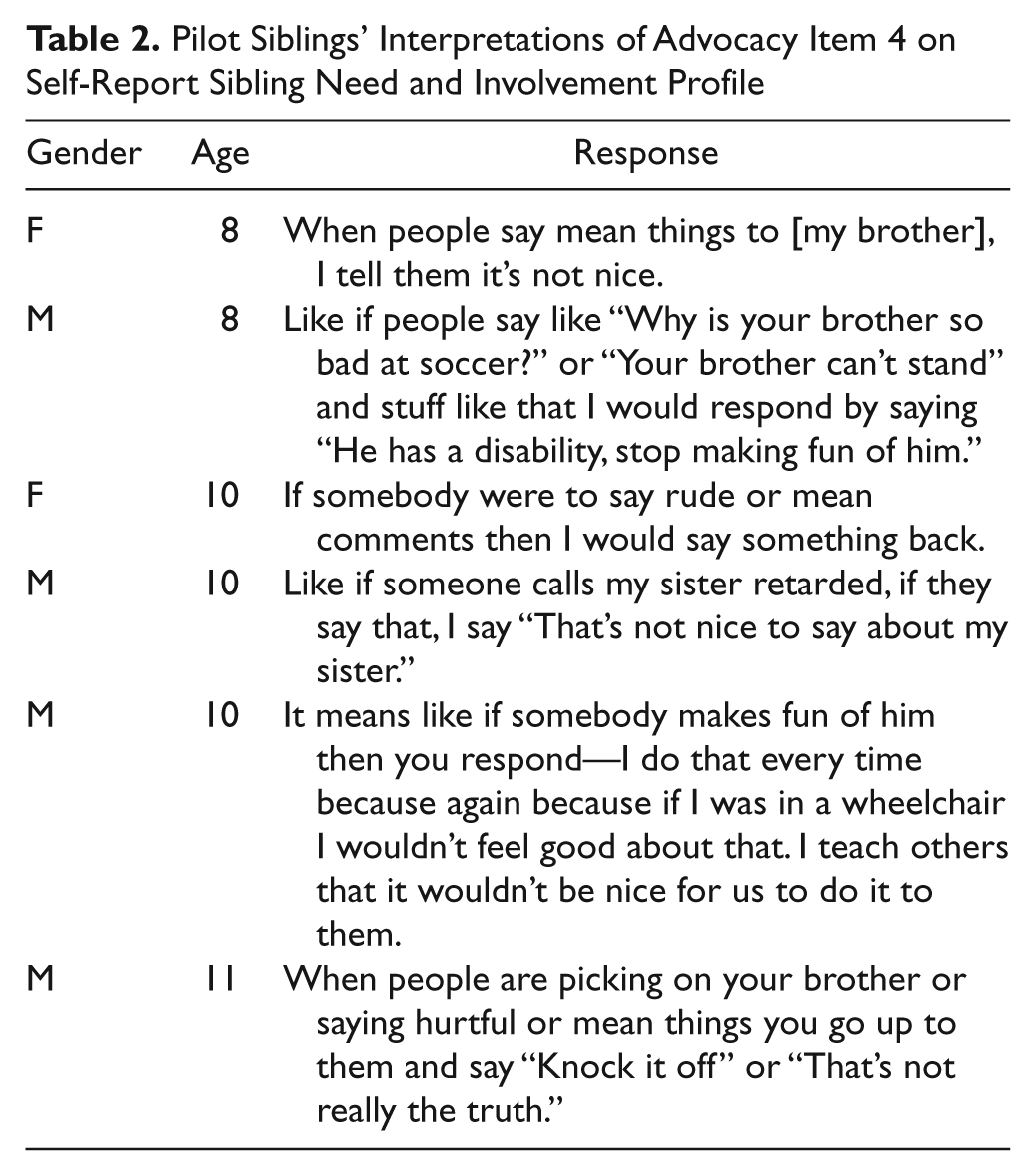
In the second experiment, children who completed the questionnaire were able to do so independently, although the two 8-year-old children requested clarification regarding use of the rating scale and tended to use it as a yes–no scale instead of as a continuum. One of the 8-year-olds asked for the definition of the word duties; however, the rest of the children reported comprehending all vocabulary words. When asked to interpret the question in using their own words, the children were able to do so accurately (see Table 2), although one 10-year-old indicated, “I’m kind of confused about what they’re saying” regarding Advocacy Item 5. Internal consistency reliability estimates (Cronbach’s alpha) were calculated for each of the five scales for all children participating in Experiments 2 and 3 (see Table 3). These data suggest good internal consistency on all scales except Helping. Internal consistency was higher on three of the scales when data from younger children (ages 8–10) were eliminated from the analysis (Awareness = .811, Feelings = .739, Advocacy = .757), suggesting that the scales may be more reliable with older children. For comparison, internal consistency reliability estimates were also calculated for the 18 parents who took the original version (see Table 3).
Pilot Siblings’ Interpretations of Advocacy Item 4 on Self-Report Sibling Need and Involvement Profile
Internal Consistency Reliability Estimates
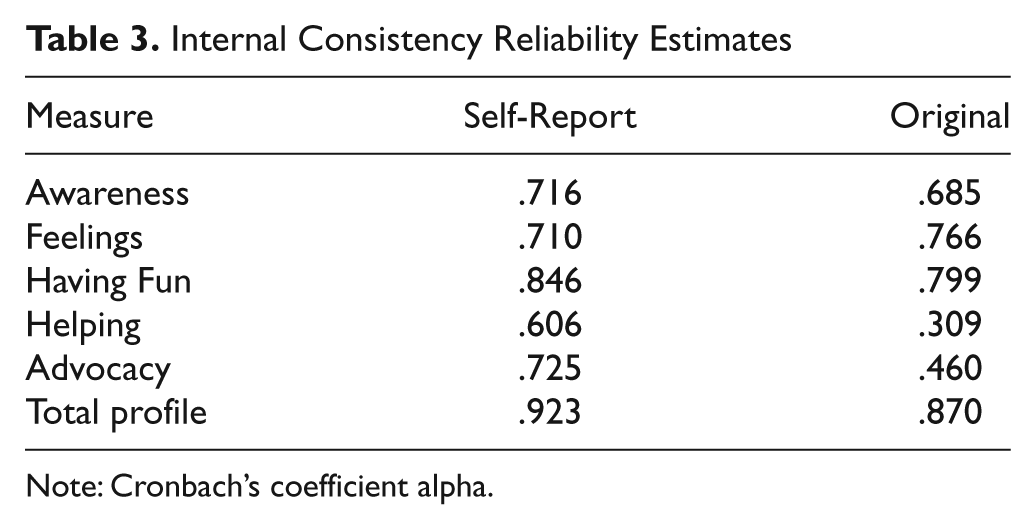
Note: Cronbach’s coefficient alpha.
In the third experiment, parent and child total profile scores and subtest scores were correlated using Spearman’s rho. Total test scores were not significantly correlated between parent and child (Spearman’s rho = .318). Likewise, the majority of subtests had low and insignificant correlations, with the exception of the Feelings subtest (see Table 4).
Spearman’s Rho Correlations Between Parent and Child Scores
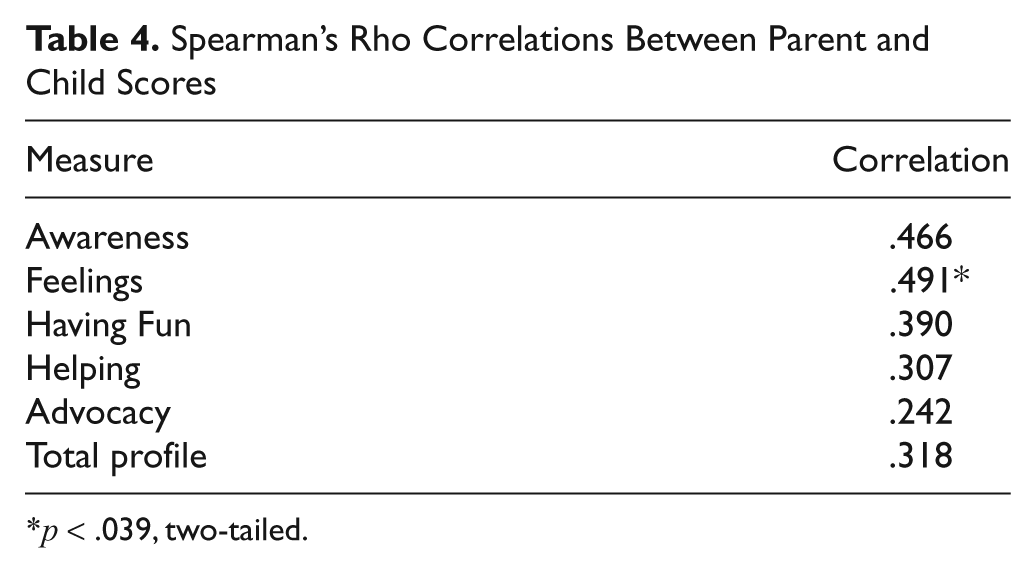
p < .039, two-tailed.
A paired-samples t test was conducted to compare parent and child total profile scores on the SNIP. There was not a significant difference in the scores for parents (M= 58.5, SD = 13.798) and children (M = 55.5, SD =16.118), t(17) = −0.818, p = .425. In an effort to further examine this, raw score differences were calculated (see Table 5). Scores between parent and child dyads differed as much as 30 points. Positive scores indicate parents reporting higher scores (i.e., more concern) than children, whereas negative scores indicate parents reporting less concern than children. Unlike previous studies suggesting that parent reports tend to be more negative than child reports, some parents in this study reported more concern whereas other parents rated less concern than did children.
Differences Between Parent and Child Total Profile Raw Scores
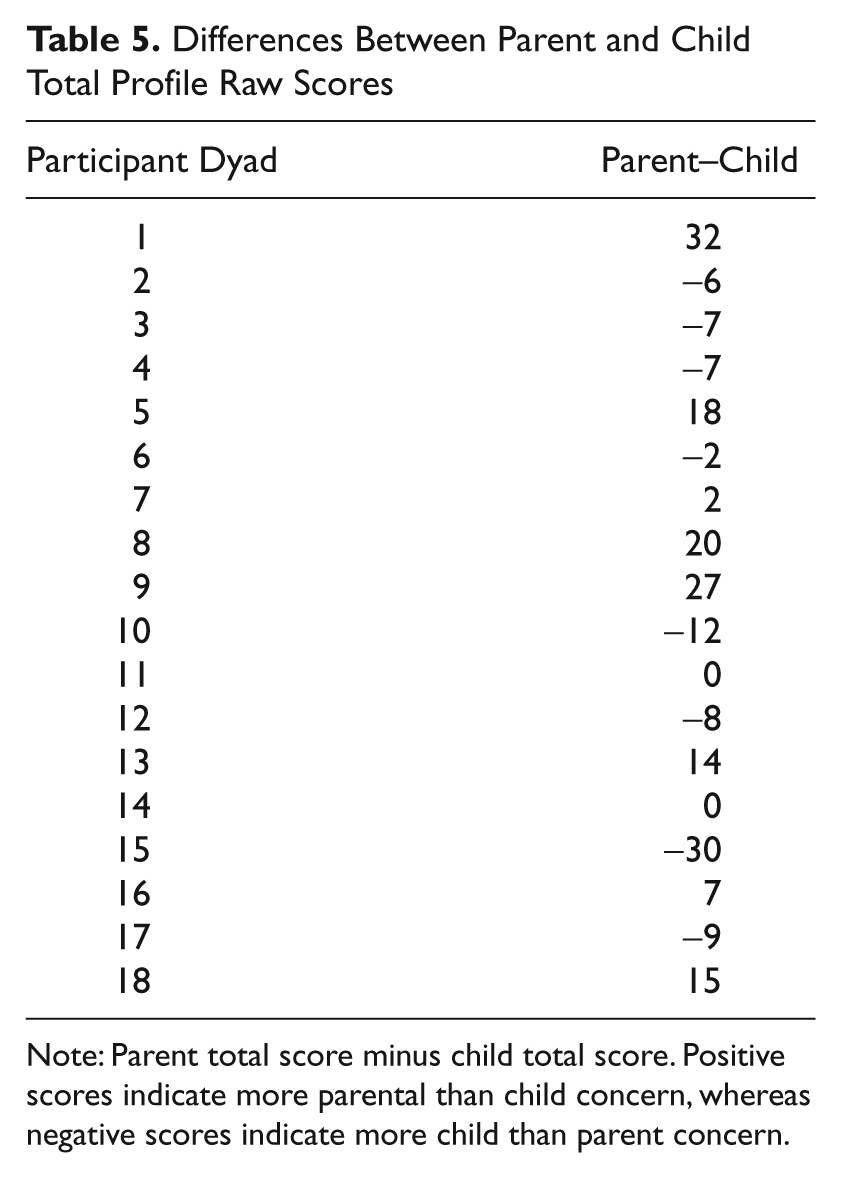
Note: Parent total score minus child total score. Positive scores indicate more parental than child concern, whereas negative scores indicate more child than parent concern.
Qualitative responses from the interview were helpful in examining similarities and differences in parent and child responses. For example, below are selected responses from Feelings Question 5 (“I am OK with the special attention my parents and others give to my brother”). One mother selected 3, indicating, “I’m sure there are some times he resents it.” Her son chose 1, saying, “I would say that because I’m okay with doing my own thing and it’s fine. I know he needs the extra help and extra attention.” In this case, the explanation clarified why the parent selected a higher score (i.e., indicated greater concern) than the child. On the same item, another mother selected 1, indicating, “I don’t think he resents it. I think he wishes he got the time sometimes but I don’t think he resents it.” Her son, on the other hand, selected 3, saying, “Well, I hope my mom doesn’t hear about this. I, uh, I feel like they spend a little more time with my brother than me because, well, I understand it because he’s special needs but it’s still hard.” In this instance, the child indicated more concern than the parent on the questionnaire, and his interview response again clarified the reason for the difference. Finally, illustrating agreement is a mother–daughter dyad who both selected 4 in response to this question. The parent noted, “I think she does resent it.” The child indicated, “4 because it seems like they’re always with him.”
Discussion
The total profile and subtest correlations suggest that the self-report version of the SNIP maintains the original’s intent. However, three items posed concerns—Feelings Item 4, Helping Item 3, and Helping Item 4. Comparing the original wording to the revised wording shed some light on the poor correlations. On these items, it seems as though the original wording may have been confusing, even to adults. For example, parents were asked to strongly agree or disagree with the following statement in Helping Item 3: “Does not take on too much responsibility.” Missing the negative not may have led to an interpretation of a sibling having too many duties at home rather than the revised wording, “I have the right amount of duties at home.” Unfortunately, because parents anonymously participated online, it was not possible to follow up and ask them about their interpretations of the questions. In the third experiment, however, it became apparent that several parents misunderstood questions worded in the negative and required clarification from the researcher.
Test–retest stability for total test and subtest scores was also good. However, variability in individual test items highlights the importance of using subtests and total test scores rather than individual test items to determine need and involvement. Individual test items may be too sensitive to daily fluctuations in family life.
Data from the six children who piloted the self-report instrument suggest that it may be used with children as young as 8, provided that adult guidance is available to define and clarify when necessary. In addition, interview information should also be collected along with the questionnaire so that a rationale for each score can be clarified. As noted in the results, the two 8-year-olds tended to use the questionnaire as a yes–no scale rather than a continuum. Researchers have found that younger children (e.g., 5- to 6-year-olds) may not be able to appropriately use Likert-type rating scales to respond to questions about feelings. Developmental differences have been identified in children’s use of such scales. In particular, young children tend to select responses toward the extremes of the rating scale when answering questions about emotions (Chambers & Johnston, 2002). This tendency should be considered when using the self-report SNIP with young children.
In the third experiment, total profile scores were not significantly correlated between parent and child (Spearman’s rho = .318), suggesting that parents and children do not always agree. These results are consistent with previous studies demonstrating discordance between parent and child reports (Cuskelly & Gunn, 2006; Guite et al., 2004). Despite low correlations, t test results did not demonstrate statistically significant differences between parent and child total profile means. However, individual participant scores between parent and child differed as much as 30 points. Positive scores indicate parents reporting higher scores (i.e., more concern) than did children, whereas negative scores indicate parents reporting less concern than children. Unlike previous studies suggesting that parent reports tend to be more negative than child reports, some parents in this study reported more concern whereas other parents rated less concern than did children. Interview data proved to be a helpful addition to questionnaire scores in providing a rationale for some of these differences. In the third experiment, even though differences were present, they cancelled each other out, thus resulting in similar means. Because of small numbers of participants, it was statistically impossible to calculate which family constellation variables might relate to parental report of more concern versus less concern rather than child report. Future research controlling for these variables might shed light on which parents report more concern, report less concern, or have good agreement with their children.
Considering the needs of siblings is an important component of family-centered practice for individuals with developmental disabilities. Researchers have stressed the importance of incorporating numerous perspectives and multiple forms of data to obtain a complete picture of sibling relationships (Furman & Buhrmester, 1985). This and other studies demonstrate that parents’ perceptions often differ from those of their children. Thus, when considering siblings’ needs, it is important to obtain sibling self-reports as well as parent reports. The self-report SNIP is one tool that can be used along with the original SNIP as part of individual family service plan development and other family-centered practices to determine the unique needs of siblings of individuals with disabilities.
Footnotes
Acknowledgements
Special thanks to Alan D. Moore for statistical consultation and Pamela Harris for assistance with the project.
The authors declared no potential conflicts of interests with respect to the authorship and/or publication of this article.
The authors received no financial support for the research and/or authorship of this article.
References
Supplementary Material
Please find the following supplemental material available below.
For Open Access articles published under a Creative Commons License, all supplemental material carries the same license as the article it is associated with.
For non-Open Access articles published, all supplemental material carries a non-exclusive license, and permission requests for re-use of supplemental material or any part of supplemental material shall be sent directly to the copyright owner as specified in the copyright notice associated with the article.
