



Abstract
This study investigated the efficacy of a writing (ANSWER) strategy to improve the essay test responses of students who were enrolled in a campus-based, postsecondary education program for individuals with developmental disabilities. Random assignment to treatment or control groups and a pre- and posttest design were employed. Students used the six-step ANSWER strategy to analyze essay test prompts, construct outlines, generate essay responses, and revise as needed. The results were evaluated using a strategy scoring rubric. The treatment group received higher scores than the control group in the areas of strategy use and quality of essay responses. The results support the ANSWER strategy as an effective writing intervention for improving students’ essay responses.
A recent increase in advocacy and growth for postsecondary college programs for individuals with developmental disabilities (Newman, Wagner, Cameto, Knokey, & Shaver, 2010; Papay & Bambara, 2011; Stodden & Whelley, 2004; Zaft, Hart, & Zimbrich, 2004) affords individuals with disabilities and their families new options for life after high school. Individuals with developmental disabilities represent a heterogeneous group of students who have lifelong mental and/or physical condition(s) that occurred before 22 years of age (Developmental Disabilities Assistance and Bill of Rights Act, 2000). These students vary widely with regard to personal strengths and areas of need (e.g., self-care, communication, ability to learn, mobility).
Successful postsecondary programs for individuals with developmental disabilities should equip students through strategic academic instruction. One academic skill that permeates the areas of employment, daily living, and communication is the ability to convey one’s thoughts through writing (Cobb & Alwell, 2009; Halpern, 1993; Rubin, Chan, & Thomas, 2003; Stuart & Smith, 2002). Written expression is not just an academic enterprise, it has real-world applications, including important social functions. Adult life activities such as writing notes, emailing, blogging, and texting all employ aspects of written expression (Penner-Williams, Smith, & Gartin, 2009; Woods-Groves et al., in press). If difficulties in written expression are not reconciled through strategic instruction, individuals may have difficulty communicating and procuring employment (Penner-Williams et al., 2009; Woods-Groves et al., in press).
Expressive writing is a multifaceted process that involves hierarchal goal setting and incorporates aspects of planning, creating sentences, and revising (Englert, 1992; Englert, Raphael, & Anderson, 1992; Hayes & Flower, 1987). Englert, Raphael, Fear, and Anderson (1988) asserted that writers must activate and apply personal knowledge of the writing process (e.g., planning, drafting, editing) and organizational structures (e.g., gathering and synthesizing multiple sources of information). Proficient writers use metacognitive skills in passage construction and commonly utilize strategies such as writing for the audience (Englert et al., 1988; Graham & Harris, 2003; Hayes & Flower, 1987; Wong, Wong, & Blenkinsop, 1989). Mercer, Mercer, and Pullen (2011) noted that the process of writing requires one to invoke sustained attention and concentration.
For individuals with and without disabilities, the aspect of composing expository text is not easily undertaken (Englert et al., 2009; Salahu-Din, Persky, & Miller, 2008). The 2007 National Assessment of Educational Progress provided an appraisal of eighth- and twelfth-graders’ writing skills and determined that only 33% of the participants fell within the proficient range (Salahu-Din et al., 2008). With regard to producing written passages, students with disabilities commonly experience difficulties developing a comprehensive plan, generating sentences beyond listing topical knowledge, and revising compositions further than the correction of grammatical errors (Englert et al., 1988; Englert et al., 2009; Graham & Harris, 2003; Harris, Graham, & Mason, 2003; Hayes & Flower, 1987).
Mercer et al. (2011) noted that students with learning problems who experience difficulty constructing written passages require explicit, concentrated instruction to become proficient writers. Students with disabilities and learning problems often benefit from instruction that incorporates significant practice, application, and generalization training of relevant skills and concepts (Mastropieri et al., 2007). Learning strategies that encompass attributes such as structure, step-by-step sequences, and teaching to mastery may increase organizational skills, and improve performance (Songlee, Miller, Tincani, Sileo, & Perkins, 2008).
Students in secondary and postsecondary settings are frequently required to express information through writing and taking tests (Schumaker & Deshler, 2009). Therrien, Hughes, Kapelski, and Mokhtari (2009) noted that students typically engage in expository writing tasks in order to fulfill secondary and postsecondary academic requirements. A common expository exercise involves the presentation of a written prompt and directs the student to construct an essay response (Therrien et al., 2009).
One learning strategy that has shown promise in improving students with disabilities’ responses to essay questions is the Essay Test-Taking Strategy (Hughes, Schumaker, & Deshler, 2005). In this six-step strategy, the ANSWER mnemonic is used to teach students to write essay test responses that are organized and of high quality. The ANSWER strategy consists of the following steps: (1)
Therrien et al. (2009) investigated the efficacy of the ANSWER strategy for seventh- and eighth-grade students with and without learning disabilities. The authors used a pre- and postexperimental design and random assignment of students to treatment or control groups. A comparison of the posttest scores revealed a significance difference in students’ essay responses in the areas of strategy use, content, and organization in favor of the treatment group and yielded a large effect size (d = 1.69; Cohen, 1988). The results provided support for the use of the ANSWER strategy for students enrolled in secondary settings.
Woods-Groves et al. (in press) noted there is a paucity of research concerning the use of strategic instruction in written expression for individuals with developmental disabilities at the postsecondary level. Woods-Groves et al. investigated the ANSWER strategy for students enrolled in a campus-based postsecondary program for students with developmental disabilities. The students who participated in this study represented a heterogeneous group of individuals with a range of diagnostic labels (i.e., autism, mild intellectual disability, severe learning disability, Asperger syndrome). A random assignment method and pre- and postexperimental design were employed. The students’ pre- and posttest essays were examined via a strategy scoring rubric. The authors supplemented the ANSWER strategy manual materials with graphic organizers, highlighters, and use of the visual ANSWER mnemonic as a cue. Differences between groups were statistically significant and a large effect size (d = 2.63) was found in favor of the treatment group for overall strategy use.
Although there was a significant difference in overall use of the strategy in Woods et al. (in press), there was not a significant difference in the overall quality of essay responses. The authors examined specific aspects of the ANSWER strategy to ascertain why this occurred. For the strategy-specific steps (1–4) of the ANSWER strategy (i.e., analyzing the essay prompt, noticing the requirements, setting up an outline, and working in the details) the students in the treatment group significantly outperformed the control group and yielded a large effect size (d = 4.68). However, a significant difference was not found for the generalization steps (5 and 6) that included engineering an essay response (i.e., an introduction sentence, detail sentences, summary sentence) and reviewing one’s response. The medium effect size (d = 0.40) indicated that a portion of the students in the treatment group did create essay responses that successfully incorporated all six steps of the ANSWER strategy. These students produced essays that were better organized and of a higher quality than students in the control group.
Aspects of the Woods-Groves et al. (in press) study were examined in an attempt to discern why students in the treatment group did not uniformly apply the generalization steps (5 and 6) of the ANSWER strategy. There appeared to be two limitations of the Woods-Groves et al. study that may have affected the performance of the students with regard to how they completed the generalization steps of the strategy. The first limitation addressed the length of the intervention. In the Woods-Groves et al. study, the ANSWER strategy was taught through a series of six 30-min lessons. The authors acknowledged that perhaps the length of the intervention should be increased. By extending the instructional time for each lesson, students would be afforded multiple opportunities to practice target skills and receive feedback. A second limitation of the Woods-Groves et al. (in press) study was the lack of individual writing goals. Individual writing goals could be developed for each student based on his or her pretest essay responses. For students whose essay responses consisted of two or three sentences, they would construct a five-sentence, one-paragraph response. Students whose pretest responses consisted of one paragraph or more would be encouraged to develop essay responses of two or more paragraphs. The students had extremely different skill levels, and although all could benefit from the structure of the ANSWER strategy, some were capable of writing longer essays while others could only write one-paragraph essays. By developing individual writing goals, students could receive differentiated instruction targeted toward the construction of essay responses of a specific length.
In this current examination of the ANSWER strategy, limitations delineated in the Woods-Groves et al. (in press) study were addressed (i.e., increased instructional time, individual writing goals based on pretest responses) in order to increase the likelihood that students would successfully apply all six steps of the ANSWER strategy. The purpose of this study was to further investigate the efficacy of the ANSWER strategy for use as a writing intervention for students enrolled in a postsecondary college program for individuals with developmental disabilities. The following research questions were posed:
Can students enrolled in a postsecondary college program for individuals with developmental disabilities acquire and apply the ANSWER writing strategy when constructing their essay test responses?
Will there be a difference in how students acquire and apply the strategy-specific aspects (Steps 1–4) and the strategy generalization aspects (Steps 5 and 6) of the ANSWER writing strategy?
Method
Participants
Originally there were 17 students included in the study. One individual in the treatment group was absent during posttesting and was not included in the analysis. Sixteen students—with an equal number of males and females—who attended a 2-year campus-based postsecondary certificate program for individuals with developmental disabilities at a Midwest university participated in this study. Students who met the criteria of being diagnosed with a developmental disability along with other program-specific requirements were admitted into the postsecondary program. Individuals who were enrolled in their first year of the program were invited to participate in the study. The students ranged in age from 17 to 24 years with a mean of 19 years 6 months (SD = 1.98 years). With regard to ethnicity, 14 (88%) of the students were White and 2 (12%) were African American. Six (38%) individuals were from rural areas, five (31%) were from urban areas, and five (31%) were from a suburban area. With regard to disability categories, two (13%) individuals were diagnosed with autism, two (13%) with Asperger syndrome, one (6%) with a non-verbal learning disorder, three (19%) with severe learning disabilities, seven (43%) with mild intellectual disabilities, and one (6%) with a traumatic brain injury. Participants’ IQ levels (standard scores) ranged from 54 to 107 (Mdn = 77). Participants’ Woodcock Johnson Achievement III (WJIII; Woodcock, McGrew, & Mather, 2001) Broad Reading standard scores ranged from 62 to 99 (Mdn = 81).
Material
The instructor’s manual provided directions and core materials for the ANSWER strategy implementation. Lessons were undergirded with graphic organizers, advance organizers, and highlighters. For each lesson, students were provided with a graphic organizer and a copy of the ANSWER mnemonic that was attached to their student folders. In addition, each student received a highlighter and was directed to highlight aspects of the lesson that he or she felt was important. A folder was given to each student, which included his or her progress graph, completed practice exercises, and materials for the lesson for the day. These procedures closely resembled those used in the Woods-Groves et al. (in press) study. See Figure 1 for an example of a graphic organizer used in the study.

ANSWER Sample Graphic Organizer adapted from Woods-Groves et al. (in press).
The pre- and posttest essay prompts from Therrien et al. (2009) and Woods-Groves et al. (in press) were used in this study. Therrien and colleagues (2009) noted that the prompts were created to mirror essay questions commonly found in statewide assessments and to provide an assessment of writing ability and critical thinking skills. The pre- and posttest prompts are provided in Table 1.
Essay Pre- and Posttest Prompts.
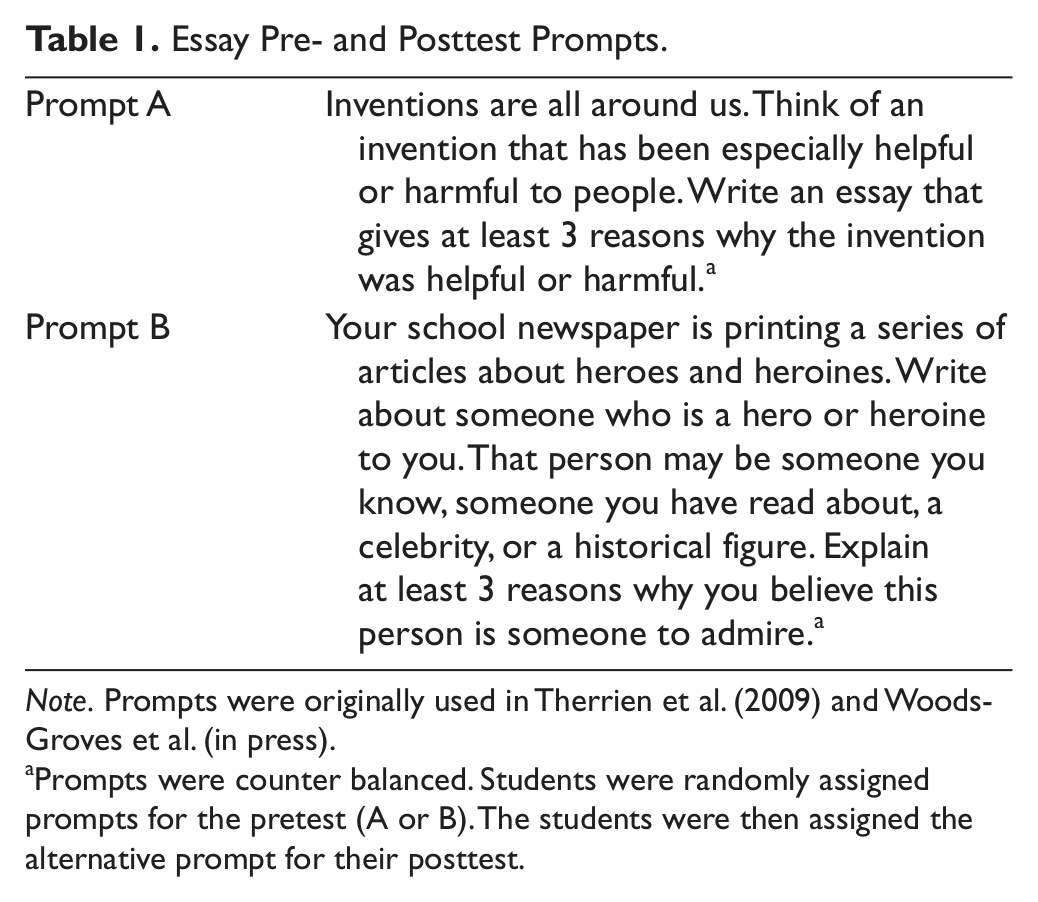
Note. Prompts were originally used in Therrien et al. (2009) and Woods-Groves et al. (in press).
Prompts were counter balanced. Students were randomly assigned prompts for the pretest (A or B). The students were then assigned the alternative prompt for their posttest.
Design and Procedures
Design
A two-level (treatment or control), single-factor, pre- and postexperimental design was used to examine the effect of the intervention on students’ essay responses. To assign students, we first rank-ordered them based on their WJIII Broad Reading standard scores. Then we paired each participant to the next closest standard score. Subsequently, we used a coin flip to place one of the participant pairs into the treatment group (n = 8) and the other into the control group (n = 8). To control for the difficulty across the two essay prompts, we counterbalanced the prompts across the pre- and posttest for the treatment and control groups.
Intervention
The ANSWER strategy (Hughes et al., 2005) was designed to teach students how to respond to essay test questions. Students were taught the following steps of the ANSWER strategy, the steps were also used in Therrien et al. (2009) and Woods-Groves et al. (in press).
Analyze the action words in the essay prompt. Students read the essay prompt and identify the action words by underlining them once.
Notice the requirements of the essay prompt. Students examine the essay prompt and underline key requirements twice. Students also change the essay question into their own words.
Set up an outline. Students create an outline that includes their main ideas.
Work in details. Students incorporate information using their key action words and requirements from the essay prompt to add important details to their outline.
Engineer your answer. Students construct an essay response that includes an introductory sentence, detailed sentences about each of the main ideas in their outline, and a conclusion, or summary sentence(s).
Review your answer. Students revise and edit their essay response.
The instructor implemented the ANSWER strategy through a series of six lessons. The lessons were aligned with the procedures outlined in the instructor’s manual and included the use of explicit instruction, modeling, thinking out loud procedures, immediate feedback, and daily probes for mastery. Supplemental materials were incorporated into the daily lessons, which included the use of graphic organizers, highlighters, and the visual ANSWER mnemonic.
The daily lessons included the following activities. In Lesson 1, the students were presented with a brief overview of the ANSWER mnemonic. The utility of the strategy was discussed and the students committed to learning the strategy. In Lesson 2, the students were taught the first two steps of the ANSWER strategy. They were instructed to analyze an essay prompt by underlining the action words (e.g., describe, justify, defend) once. They were also directed to notice the essay prompt requirements (e.g., four reasons, two examples, three ways) by underlining them twice.
Lesson 3 involved setting up an outline and working in the details, which required the students to list their main ideas and any pertinent details they wanted to discuss in their essay responses. In Lesson 4, the students engineered their answer by writing an essay response that included an introductory sentence or paragraph, a sentence or paragraph for each detail included in their outline, and a summary sentence or paragraph. The students were also instructed to review their essay response. Lesson 5 involved a verbal rehearsal of the ANSWER strategy components. In Lesson 6, the students practiced all six steps of the strategy.
Examples of essay prompts employed for Lessons 3 through 6 included the following: (a) Describe the inside of the eye. Be sure to include all five major parts in your description (Hughes et al., 2005). (b) Computers are a part of everyday life. Identify three reasons why computers are important in the classroom. (c) Recycling has become very popular. The university is encouraging students to recycle. Describe four ways students can recycle. A prompt was presented for each lesson. For each instructional period, the instructor and students completed respective steps for Lessons 3 through 6 for one prompt together. Main ideas were generated by the group during this instruction. The students were then given a prompt and completed the respective steps for each lesson independently, which included generating their own main idea(s) and details.
Individualized writing goals were created for each student in the treatment group based on their pretest essay responses. Students who constructed pretest responses consisting of two or three sentences were encouraged to write one-paragraph responses consisting of at least five sentences, whereas students with pretest responses consisting of one or more paragraphs were encouraged to write essay responses consisting of two or more paragraphs.
Treatment group intervention
The intervention was conducted in six lessons, with two sessions occurring each week for three weeks. Each session was 50 min in duration. The instructional time was controlled between the treatment and control groups. The students in the treatment group received the intervention instruction in place of their regularly scheduled reading and writing class. Instruction was provided in a group setting. The instructor had a master’s degree in special education, had previously been a special educator for 5 years, and currently held a teaching certificate. The second author provided the instructor with additional supplemental training and the instructional manual was reviewed.
Control group intervention
During the ANSWER intervention, students in the control group participated in their regularly scheduled reading and writing class. Their instructional time was 50 min in duration and occurred twice a week, every other day. The writing instruction component of the class consisted of students participating in various writing exercises. Writing assignments included constructing business letters, drawing web diagrams to create outlines for writing tasks, and writing expository essays that described various topics (e.g., summaries of reading assignments, autobiographies).
Dependent variables
A strategy scoring rubric (Therrien et al., 2009; Woods-Groves et al., in press) was used to evaluate the students’ pre- and posttest essays. The rubric yielded a total score ranging from 0 to 6 points and was used to evaluate whether or not the students implemented any or all of the six steps of the strategy. The strategy scoring rubric provided two additional scores. The “strategy specific component” score for ANSWER steps 1 to 4 was used to appraise the students’ ability to use the planning and goal setting part of the strategy. Possible points ranged from 0 to 4 points. The “essay general component” score for steps 5 and 6 was used as a generalization measure to evaluate if essay responses contained an introduction, sentences with topic specific details, and a summary or conclusion. Possible points ranged from 0 to 2. The strategy scoring rubric is provided in Figure 2.
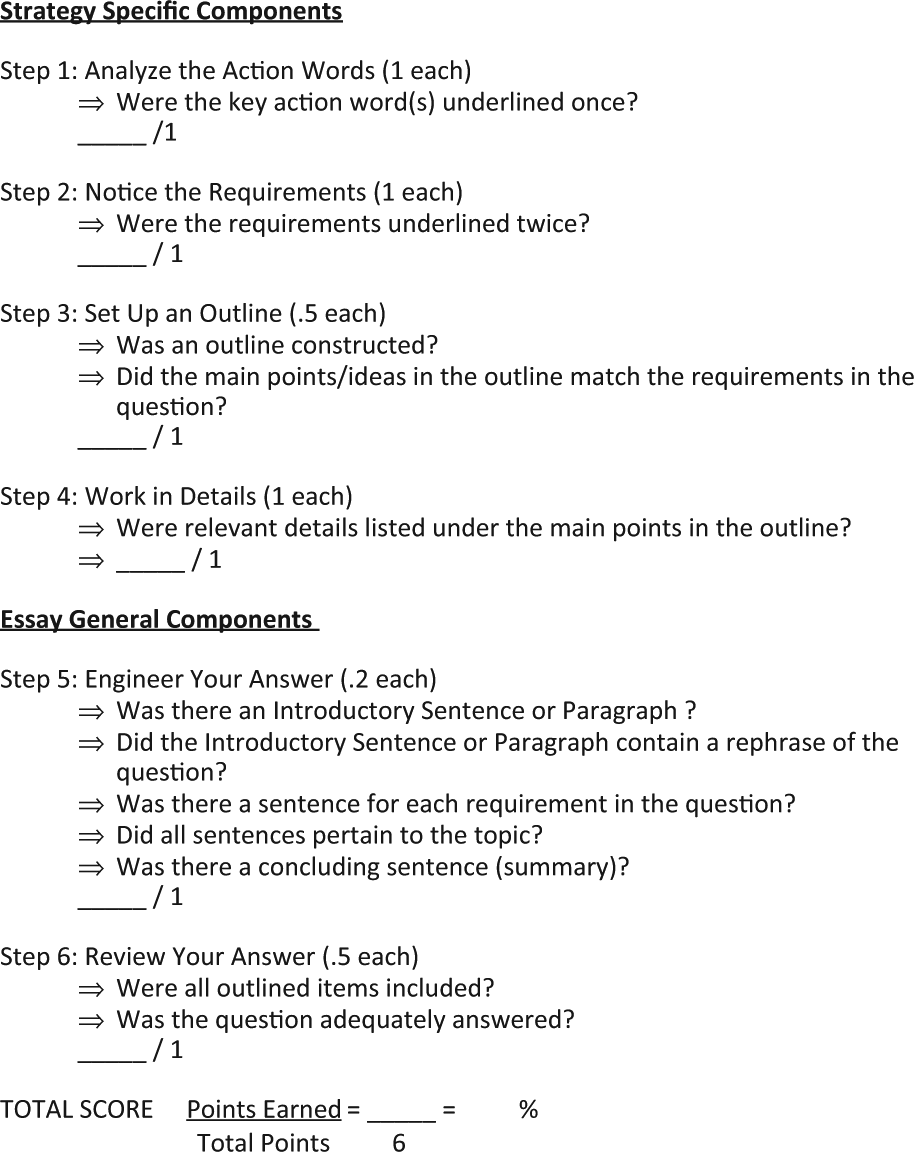
Strategy Scoring Rubric adapted from Therrien et al. (2009) and Woods-Groves et al. (in press).
Data collection
The pre- and posttest essays were administered 1 week prior to program implementation and 1 week after program completion, respectively. Two graduate students in the College of Education who had extensive experience administering and evaluating assessments evaluated the essays. The first and second authors introduced the raters to the components of the strategy rubric and observed as the raters practiced evaluating examples of essay answers using the rubric. The student raters did not have knowledge of the ANSWER study. In addition, they did not know which essays were completed by the treatment or control group or which essays were pre- or posttest responses.
Data Analysis
Before proceeding with the data analysis, all variables were screened for possible missing values and outliers. No missing values were found. The data were analyzed using SPSS 11.0 (2002). A series of analyses of variance (ANOVAs) and analyses of covariance (ANCOVAs) were conducted to examine differences among the treatment and control groups’ pre- and posttest essays using the strategy scoring rubric. Differences between the two groups’ total word count for pre- and posttest responses were also compared.
Results
Treatment Integrity and Interrater Reliability
The second and third authors conducted fidelity data collection. The raters observed the instructor teaching each lesson and checked off lesson steps that were completed or not completed. Treatment integrity checklists containing the essential instructional components for each lesson were completed for all sessions. An overall integrity percentage of 99% was obtained with a range per observation between 97% and 100%. Final strategy scoring rubric scores were calculated by averaging the two rater scores. Correlations between rater scores were calculated for all measures and averaged r = .951.
Strategy Scoring Rubric
Before implementing the intervention, students were administered a pretest. There were no significant differences on pretest scores between control (M = 1.20, SD = 0.22) and treatment (M = 1.19, SD = 0.26) groups for the overall strategy scoring rubric, F(1, 15) = 0.003, p = .959, d = 0.03. When the strategy-specific rubric pretest scores were examined, none of the students in the treatment or control group applied aspects of the strategy. For the rubric essay general component pretest scores, there was no significant difference between control (M = 1.20, SD = 0.22) and treatment (M = 1.19, SD = 0.26) groups, F(1, 15) = 0.003, p = .959, d = 0.03.
The overall strategy scoring rubric posttest scores for the treatment and control groups were compared. ANCOVA results using pretest scores as the covariate were significant in favor of the treatment group and yielded a large effect size (d =1.90). To investigate what might account for the difference in the posttest, the strategy scoring rubric was broken down into two parts. The strategy-specific components (Steps 1–4) and the essay general components (Steps 5 and 6) of the rubric were examined. The students in the treatment group significantly outperformed those in the control group for the strategy-specific components and for the essay general components, yielding large effect sizes (d) of 1.85 and 1.12, respectively. Students’ posttest scores are summarized in Table 2.
Posttest Scores for Strategy Scoring Rubric Components.
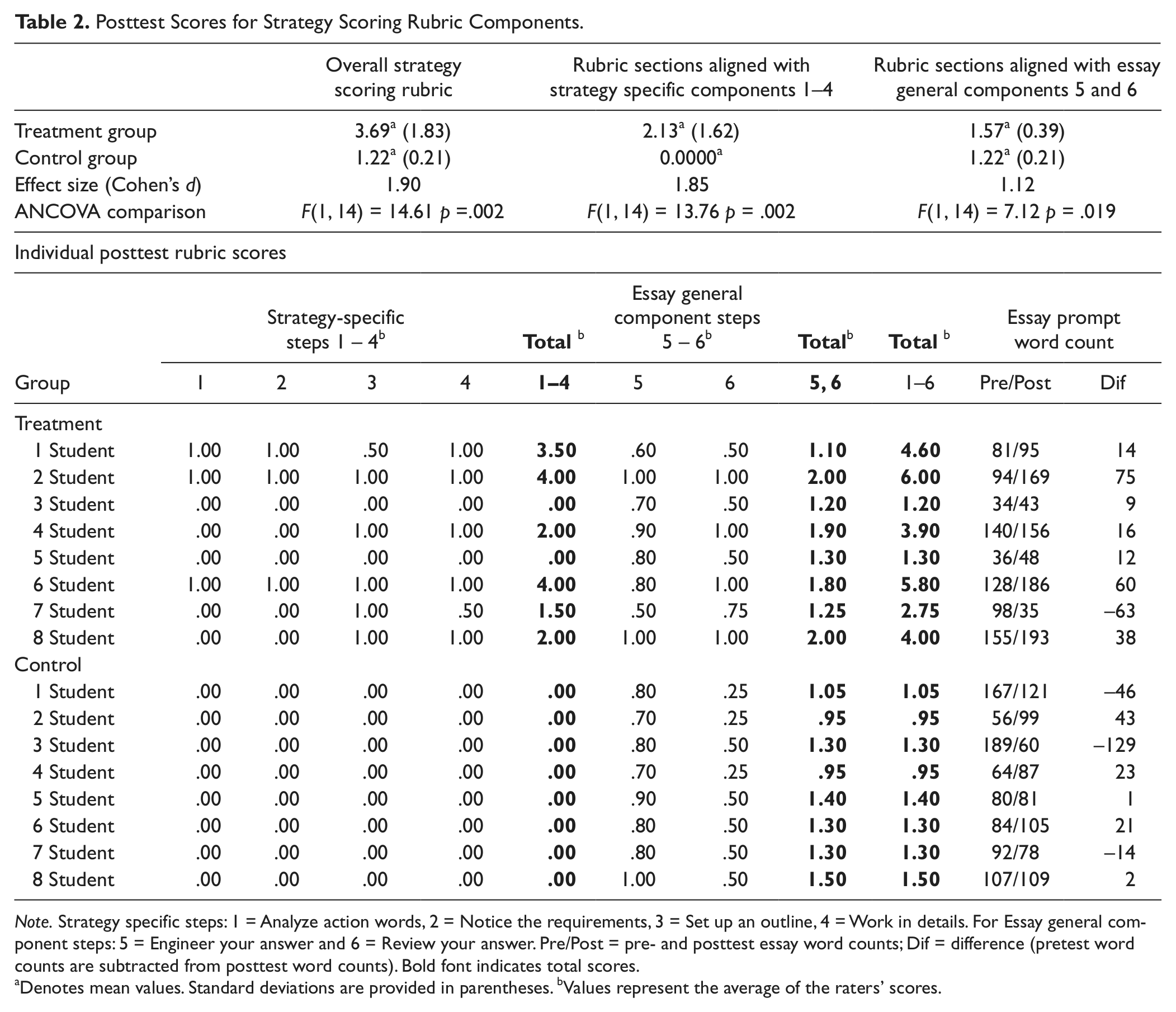
Note. Strategy specific steps: 1 = Analyze action words, 2 = Notice the requirements, 3 = Set up an outline, 4 = Work in details. For Essay general component steps: 5 = Engineer your answer and 6 = Review your answer. Pre/Post = pre- and posttest essay word counts; Dif = difference (pretest word counts are subtracted from posttest word counts). Bold font indicates total scores.
Denotes mean values. Standard deviations are provided in parentheses. bValues represent the average of the raters’ scores.
The total word count for the pretest essays was compared for the treatment (M = 95.50, SD = 44.71) and control (M = 104.88, SD = 48.14) groups. No significant difference was found, F(1, 15) = 0.163, p = .693, d = 0.202. In addition, an ANCOVA was employed with the pretest as a covariate to examine the total word count for the posttest essays for the treatment (M = 116, SD = 68.27) and control (M = 92.50, SD = 19.68) groups. The results were not significant, F(1, 14) = 1.583, p = .230. However, a medium effect size was revealed, d = .468 (Cohen, 1988).
No significant difference was found between the treatment and control groups with regard to word count. However, the pre- and posttests for the students in the treatment group yielded an average word count gain of 20.50 points, whereas the control group’s pre- and posttests revealed an average word count decrease of 12.38 points. Examples of posttest essay prompt responses of students who were taught the ANSWER strategy are depicted in the Appendix.
Discussion
To date, three studies have supported the efficacy of the ANSWER strategy (Hughes et al., 2005) for use with individuals with disabilities. Therrien et al. (2009) demonstrated the effectiveness of the ANSWER strategy in significantly improving the essay responses of seventh- and eighth-grade students with learning disabilities in the areas of strategy use, content, and organization. Woods-Groves and colleagues (in press) successfully used the ANSWER strategy with postsecondary students with developmental disabilities and improved their essay prompt responses with regard to strategy use. This study further explored the use of the ANSWER strategy to determine if postsecondary students with developmental disabilities could acquire and apply the strategy when they constructed their expository essays, as well as whether differences would be found in the application of strategy-specific aspects and the generalization aspects. Our results indicated that students in the treatment group acquired and applied the overall ANSWER strategy and significantly outperformed the control group. When aspects of the ANSWER strategy were examined, a significant difference was found for the application of the ANSWER strategy components and general essay components in favor of the treatment group.
Although a significant difference was found in favor of the treatment group when compared to the control group for strategy use and the generalization component, it is imperative to also evaluate the practical significance of the intervention. Posttest responses for the treatment group were examined to determine which strategy-specific steps (1–4) were employed by the eight students who were taught the ANSWER intervention. Three students applied all four strategy-specific steps (i.e., analyze the action words, notice the requirements, set up an outline, work in the details). Two students used no strategy steps. Three students used Steps 3 and 4 (i.e., set up an outline, work in the details), with one of the students successfully setting up an outline but not including details that matched his or her main idea. Thus, the majority of students in the treatment group successfully set up an outline and worked in the details.
The treatment group’s posttest essay responses were further examined to determine how many students applied the generalization components steps. Step 5 (i.e., engineer your answer) required students to include an introductory sentence or paragraph that rephrased the essay question, to include a sentence for each requirement in the question that pertained to the topic, and to include a summary sentence. Seven students had introductory sentences that rephrased the essay prompt question and included topical sentence(s). Four students included a summary/conclusion sentence or paragraph in their response. Step 6 required students to review their answer. Six students included all of their outlined items (i.e., main ideas and details) in their essay responses and adequately answered the essay question.
In this study, we increased the ANSWER strategy instructional time and incorporated individual writing goals based on the recommendations of Woods-Groves et al. (in press). We anticipated these accommodations would increase the likelihood that students would successfully apply all six steps of the ANSWER strategy. We extended the length of the ANSWER strategy instruction from 30- to 50-min lessons, increasing total instructional time from 3 to 6 hr. Overall, we found that students who were taught the ANSWER strategy successfully completed more of the strategy steps than the students in the Woods-Groves et al. study.
With regard to the inclusion of individual writing goals, seven students maintained or increased the number of paragraphs they produced when their pre- and posttest essay responses were compared. Four students were asked to write essay responses that consisted of two or more paragraphs. Three of the students successfully produced posttest responses consisting of two or more paragraphs. The remaining students were asked to produce essay responses consisting of at least one paragraph. This contrasts with the Woods-Groves et al. (in press) study in which students were not given individual writing goals based on their pretest essay responses. Subsequently, all of the students in this prior study produced posttest essay responses that consisted of only one-paragraph responses.
Limitations and Future Research
There were several limitations to this study that should be addressed by future researchers. First, because of time constraints, we were not able to determine if the students who were taught the ANSWER strategy maintained their skills over an extended period of time. Future studies should investigate whether students used the ANSWER strategy across time. Another limitation relates to the context of the intervention. In this study, the students were taught the ANSWER strategy in a campus-based, postsecondary college setting. Instruction was delivered by a former special education teacher within a small-group setting consisting of eight students with developmental disabilities. Postsecondary programs for students with developmental disabilities are offered in a myriad of instructional settings that range from community college settings, 4-year universities, and extensions of K–12 programs. Instruction may be delivered by a college professor, peer tutor, or employee of the postsecondary program. Further investigation is needed to ensure that results from the current study can be replicated within these diverse settings. In addition, future studies could also employ a holistic rubric as a dependent measure to evaluate the effect of the ANSWER strategy concerning aspects of written expression, such as examining the number of main ideas and details generated by students and providing an appraisal of voice, word choice, sentence fluency, and conventions not specifically targeted by the ANSWER strategy.
Implications for Practice
This study further investigated the efficacy of the ANSWER strategy with postsecondary students enrolled in a college-based program for individuals with developmental disabilities. As with many students with developmental disabilities, the students in this current investigation represented a widely diverse group with regard to their disability diagnoses. The commonality among the students was the fact that they were all enrolled in a particular postsecondary college-based program. When the students’ performances within the treatment and control groups were examined, no particular pattern emerged with regard to individuals’ diagnoses, or previous performance on intellectual or achievement measures. All of the pretest essay responses for the treatment and control groups exhibited patterns of performance common for individuals with disabilities for whom the construction of expository text is difficult. Their responses included the following aspects: (a) lack of planning (e.g., goal setting, outline construction), (b) the construction of short responses that employ listing or knowledge telling, and (c) passages that ended abruptly with no conclusion or summary sentence (Englert et al., 1988; Gersten & Baker, 2001; Graham & Harris, 2003). The ANSWER strategy can be used to address each of these critical components of written expression.
The ANSWER strategy embodied evidence-based core components of explicit instruction and employed modeling, think-aloud procedures, immediate feedback, and teaching to mastery (Gersten & Baker, 2001; Graham & Harris, 2009; Schumaker & Deshler, 2009). Students with disabilities who experience difficulty in the area of written expression have been shown to benefit from intensive explicit instructional techniques (Mastropieri et al., 2007; Mercer et al., 2011). The results of this investigation supported the use of the ANSWER strategy for improving essay test responses for individuals with developmental disabilities who were enrolled in a postsecondary college-based program. The students who were taught the ANSWER strategy employed several of the strategy steps and several produced essay responses that contained an introduction, topical sentences, and a conclusion. The results were encouraging. The first investigation of this strategy revealed that college-age students with developmental disabilities were able to learn the ANSWER strategy-specific steps. This current investigation incorporated longer instructional sessions and individual writing goals and revealed that the majority of the students with developmental disabilities were able to apply aspects of the strategy-specific and general components of the ANSWER strategy. The students also maintained or increased the number of paragraphs they included in their essay responses.
It is imperative that individuals with developmental disabilities who are enrolled in postsecondary programs receive evidence-based instruction designed to empower them to succeed in academic areas such as written expression. Macarthur and Philippakos (2010) asserted that writing is an essential skill that is not only culturally valued but equally important in achieving success in “one’s school (i.e., as a means demonstrating content knowledge), work (i.e., many occupations require writing skills) and personal life (i.e., communicating socially with others)” (p. 438). There is a dearth of information concerning evidence-based practices, which target academic instruction for individuals enrolled in postsecondary programs for students with developmental disabilities (Bouck & Flanagan, 2010; Woods-Groves et al., in press). Two separate investigations have supported the potential value of the ANSWER strategy for improving the essay test responses of individuals with developmental disabilities. We hope these findings will stimulate future investigations designed to examine the efficacy of explicit instructional approaches within the area of written expression for individuals with developmental disabilities in postsecondary settings.
Footnotes
Appendix
Declaration of Conflicting Interests
The authors declared no potential conflicts of interest with respect to the research, authorship, and/or publication of this article.
Funding
The authors disclosed receipt of the following financial support for the research, authorship, and/or publication of this article: The research reported herein was supported in part by the Office of Postsecondary Education (OPE), U.S. Department of Education, through Grant P407A100030 to the University of Iowa. The opinions expressed are those of the authors and do not represent views of the OPE or the U.S. Department of Education.