



Abstract
The number of individuals with Autism Spectrum Disorder (ASD) who enter secondary school settings and access the general education curriculum continues to grow. Many educators may find they are not prepared to adapt their instruction to meet both state standards and the diverse needs of the full spectrum individuals with ASD, which has implications for postsecondary success. In this article, we present an overview of current knowledge around academic instruction for this population, specifically (a) how characteristics associated with ASD can impact academic performance, (b) academic profiles of individuals with ASD across content areas, and (c) interventions that have been successful in improving academic outcomes for this population, including special considerations for those individuals who take alternate assessments based on alternate achievement standards. We conclude by offering suggestions for future research and considerations for professional development.
Keywords
Academic achievement in high school plays a critical role in a student’s future academic and career success. Accordingly, high school is a time of increased academic focus for all adolescents, with and without disabilities, as they transition to adulthood. The greater demand for a more technologically advanced workforce makes academic skills ever more essential for high school graduates (National Academies, 2010). It is projected that roughly two thirds of American jobs will require some amount of postsecondary education by 2020 (Carnevale, Jayasundera, & Hanson, 2012), yet the current educational system is not keeping pace with the demand for higher level skills. The presence of a disability, such as Autism Spectrum Disorder (ASD), has been associated with poor postsecondary outcomes. According to findings from the National Longitudinal Transition Study–2 (NLTS-2, n.d.), college enrollment for individuals with ASD is among the third lowest of all 11 disability categories, making it difficult for individuals to gain employment. It is estimated that only 37% of young adults with ASD are employed, most work part-time, and few receive benefits.
Interestingly, one study found that individuals with ASD without intellectual disability (ID) are 3 times more likely to be unemployed and participate less frequently in recreational activities than individuals with ASD and ID (Taylor & Seltzer, 2011). Possible reasons for this finding include a lack of vocational support services provide opportunities for job training for individuals with ASD who receive the majority of their instruction in general education classes (Taylor & Seltzer, 2011), coupled with insufficient academic and behavioral supports to succeed in postsecondary education (Camarena & Sarigiani, 2009; VanBergeijk, Klin, & Volkmar, 2008). Research indicates that for those with ASD, academic performance not only plays a role in postsecondary education outcomes but also in employment opportunities, wages earned, and hours worked (Migliore, Timmons, Butterworth, & Lugas, 2012). Even for students with ASD with comorbid IDs for whom employment may be a more frequently utilized route than higher education, effective instructional strategies to promote academic performance should be prioritized (Stodden & Mruzek, 2010).
The research citing poor postsecondary outcomes for all individuals with ASD calls into question the quality of academic instruction they receive throughout their educational careers, particularly during high school. It has been suggested that increased access to the general education curriculum, with appropriate instructional strategies and supports, will improve academic performance and participation in postsecondary education for individuals with ASD (Stodden & Mruzek, 2010). According to the 30th Annual Report to Congress on the Implementation of Individuals With Disabilities Education Act (IDEA; Office of Special Education and Rehabilitative Services, U.S. Department of Education, 2008), the inclusion of individuals with disabilities (ages 6–21) in general education settings has increased dramatically over the past 20 years with the largest increase made by individuals being served under the disability category of autism. Although most high school students with ASD attend regular public schools (84%), only one third of their courses are taken in a general education classroom, and only 36% of those courses are academic courses (Newman, 2007). Furthermore, data from the NLTS-2 reveal that many individuals with ASD do not actively participate in general education academic classes. Teachers report their students with ASD participate less actively than other students in the general education classroom in responding orally to questions, making presentations to class, and working with peer partners. As academic participation is a significant factor in predicting postsecondary education participation (Chiang, Cheung, Hickson, Xiang, & Tsai, 2012), the poor postsecondary outcomes for students with ASD are not surprising.
In an effort to better prepare all students for college and careers, the National Governors Association Center for Best Practices and the Council of Chief State School Officers released the Common Core State Standards (CCSS) for English language arts and literacy and mathematics (CCSS Initiative, 2010). Although the CCSS outlines expectations of what educators should teach, it provides no guidance on how these skills should be taught. If educators and other school personnel are to be successful in aligning educational programs with these standards and providing appropriate supports to improve academic achievement for individuals with ASD, it is critical they are better informed about ASD. In this article, we present the current body of knowledge around academic instruction for this population, specifically (a) how characteristics associated with ASD can impact student performance, (b) academic profiles of individuals with ASD across content areas, and (c) interventions found to be successful in improving academic outcomes across individuals with ASD.
Impact of Student Characteristics on Academic Performance
Research related to poor academic achievement for students with ASD, which will be described in greater detail in the following section, indicates there are factors related to school structures and student characteristics interfering with classroom success. Though the diagnostic criteria for ASD does not imply academic difficulties, impairments in the social communication domain, as well as engagement in restricted, repetitive, and stereotypic behaviors may contribute to the challenges around academic performance, and may be predictive of future academic achievement (Estes, Rivera, Bryan, Cali, & Dawson, 2011). Deficits in the areas of imitation and observational learning are well documented and may limit a student’s ability to watch others in an effort to learn skills necessary in an academic setting (Plavnick & Hume, 2013). Delayed or limited receptive and expressive communication also may affect academic performance across content areas, impacting primarily comprehension and understanding of vocabulary and sentence structure (Norbury & Bishop, 2002). In addition, students with ASD may have difficulty disengaging from repetitive or stereotypic behaviors, which can interfere with school activities (Zandt, Prior, & Kyrios, 2007). Additional diagnoses can also play a role in academic performance, as a subset of students with ASD has a comorbid diagnosis, such as ID (16%–30%, de Bildt, Systema, Kraijer, & Minderaa, 2004), or Attention Deficit Hyperactivity Disorder (ADHD, 31%, Lecavalier, 2006), which contributes to the varied academic profile.
The impact of social communication differences and their impact on academic performance require additional emphasis. Broadly, limited social initiation may contribute to academic difficulty, as students may not seek out social and verbal learning opportunities and miss opportunities to gain valuable information from the environment (Peck, 1985). More specifically, social communication impairment is a significant predictor of reading comprehension. For example, a recent study indicated these deficits limit reading comprehension above and beyond the influence of word recognition and oral language deficits (Ricketts, Jones, Happé, & Charman, 2013). Researchers theorize that difficulties in understanding social and communicative norms may make inferencing and perspective taking more difficult for readers with ASD (Ricketts et al., 2013). Similarly, a recent meta-analysis of reading comprehension skills indicated that texts with highly social content (e.g., texts requiring perspective taking) were more difficult to comprehend than those with lower social content (e.g., general knowledge; Brown, Oram-Cardy, & Johnson, 2013).
Cognitive Profile of Students With ASD
Understanding the profile of students with ASD is complex, as they often have uneven skill profiles or splinter skills that make accurate assessment and support more difficult. For example, students who are low performers on the Wechsler Intelligence Scales for Children–Second Edition (WISC-II) have consistently demonstrated reading decoding, spelling, and visuospatial skills that are above the expected range, and students who have performed highly on the Wechsler Intelligence Scales for Children–Third Edition (WISC-III) often demonstrate significant weaknesses in graphomotor and writing skills (Mayes & Calhoun, 2003). In the past decade, there has been an increased emphasis on examining the cognitive profile of students with ASD to better understand the complexities and the impact of the cognitive profile on academic performance (e.g., Charman et al., 2011; Noterdaeme, Wriedt, & Hohne, 2010). Although findings have not been conclusive on all aspects of cognitive functioning, several characteristics of the cognitive profile have emerged that may impact both academic performance and influence the development of academic supports.
Auditory and visual processing
Research indicates individuals with ASD may process auditory or linguistic information at a slower rate than their peers (Cashin & Barker, 2009). In addition, research indicates processing verbal and visual stimuli simultaneously may also be difficult. However, individuals with ASD may also have enhanced perceptual functioning when engaged in visual processing (Samson, Mottron, Soulières, & Zeffiro, 2012). Although brain imaging studies suggest superior performance on visual tasks, many individuals with ASD show enhanced visual mental imagery or “visual thinking” as compared with individuals without ASD. Individuals with ASD have described their reasoning processes to be comprised of a series of images when engaged in problem-solving behaviors (Kunda & Goel, 2011).
Detail focused processing
Individuals with ASD may exhibit a bias toward local processing (e.g., detail; weak central coherence [WCC]) rather than global processing (“big picture”; Happé & Frith, 2006). Several studies have shown superior performance on tasks relying on local processing versus those relying on global processing of stimuli, thus supporting the theory that individuals with ASD may have more difficulty extracting the overall meaning or “big picture” while attending to specific details instead (Grinter, Maybery, Pellicano, Badcock, & Badcock, 2010). For example, in a study of individuals with high-functioning autism, researchers found that participants spent more time processing the individual words that comprised a sentence rather than the meaning of the full sentence, thus impacting comprehension (Norbury & Bishop, 2002).
Executive function (EF)
EFs are processes such as behavioral regulation (e.g., inhibition) and metacognition (e.g., manage self and tasks; Rosenthal et al., 2013). These functions are often impaired in individuals with ASD, specifically the abilities to plan multistep sequences of events, demonstrate mental flexibility, reflect, and reason (Joseph & Tager-Flusberg, 2004). Research indicates EF impairments increase in adolescence and may manifest in students with ASD in secondary settings as difficulty following multistep directions, keeping materials organized, and being a “self-starter” (Rosenthal et al., 2013).
Theory of mind (ToM)
Individuals with ASD may demonstrate difficulty in recognizing and understanding the mental states of themselves and others and have deficits in their understanding of irony, symbolic language, and deception (Hill & Frith, 2003). ToM deficits impact and are impacted by language levels, can impair social relationships, and may have ramifications in academic performance as well, particularly in literacy activities where taking the perspective of another (e.g., a character in a book) may prove difficult (Norbury & Bishop, 2002).
Memory
Research indicates a varied memory profile for individuals with ASD, with recognition memory and cued recall intact (Williams, Goldstein, & Minshew, 2006). The memory challenges experienced by individuals with ASD are around the ability to recall words, stories, and sentences (Williams et al., 2006) and also memory within the context of day-to-day activities such as people’s names, locations, and appointments (Jones et al., 2011). These deficits in adolescents with ASD in everyday memory are related to not only their memory capabilities but also EF and social communication skills (Jones et al., 2011).
Academic Performance of Students With ASD
These characteristics, related to both ASD diagnosis and cognitive profile, influence student performance across academic domains. While individuals with ASD may share common diagnostic features, there is great heterogeneity across the autism spectrum. This variability, in combination with a limited body of research, makes it extremely difficult to draw general conclusions about academic performance.
In addition, the influence of cognitive variables, as well as the complex relationship between the cognitive variables described (e.g., the influence of EF deficits on the performance of memory tasks) on academic performance, is likely great yet difficult to quantify on measures of academic skill. In the following section, we summarize what is known about reading, writing and science, technology, engineering, and math (STEM) skills for students with ASD.
Reading
Our understanding of the unique cognitive style of individuals with ASD, particularly around ToM, WCC, and EF, provides some insight into factors that negatively impact reading achievement for this population (Carnahan & Williamson, 2013). A recent longitudinal study of reading achievement of students with disabilities revealed that while students with ASD develop reading skills as they progress through formal schooling, the rate of their reading improvement is significantly slower than that of students with learning disabilities (Wei, Blackorby, & Schiller, 2011). Many students with ASD show a unique profile of reading performance that includes strengths in the mechanics of reading (i.e., word decoding) coupled with difficulties in reading comprehension (Chiang & Lin, 2007). Research including a larger sample of individuals representing a range of language ability has revealed great variability in decoding skills, with especially poor reading accuracy in students with poor oral language comprehension and vocabulary (Nation, Clarke, Wright, & Williams, 2006), suggesting that language skills are a strong moderator in the mechanics of reading. While there is conflicting research around the assertion that individuals with ASD possess adequate or superior word-reading ability, there is a general agreement that individuals with ASD have difficulties comprehending text.
Given the great heterogeneity within ASD, it is not surprising there exists variability in the approaches individuals take to draw meaning from text. In a study of high-functioning adolescents with ASD, Williamson, Carnahan, and Jacobs (2012) identified three reading comprehension profiles: text bound comprehenders who rely heavily on the text without interpretation, imaginative comprehenders who understand best with the support of pictures and produce subjective representations of the text, and strategic comprehenders who employ strategies similar to skilled readers (i.e., asking questions during reading, connecting background knowledge with text) but have difficulties making predictions. It is worth noting that each of these profiles not only have strengths but also have unique challenges with comprehension. This study provides further evidence that the psychological constructs (e.g., ToM, WCC, EF) believed to characterize cognitive differences of individuals with ASD do play a role in comprehension difficulties to differing degrees.
Writing
The writing difficulties that students with ASD encounter may be attributed to both the mechanics of writing (i.e., handwriting) and content-related aspects of writing (Church, Alisanski, & Amanullah, 2000). It is believed individuals with ASD have poor fine motor skills and difficulties with visual-motor speed, in particular when using a writing utensil (Silverman & Weinfeld, 2007). Because of these difficulties, writing can be a burdensome task for many students with ASD, resulting in often illegible (Fuentes, Mostofsky, & Bastian, 2009) or brief writing samples (Sansosti, Powell-Smith, & Cowan, 2010). Looking beyond writing mechanics, the quality of written expression is often compromised by problems with perspective taking (Hill & Frith, 2003). Writing is a communicative act between a writer and his audience (McCutchen, 2003), and individuals who have difficulty understanding others’ perspectives will have problems tailoring their writing for the intended audience. The writing process is also complex and requires that students be able to plan, generate text, organize, and revise, which is difficult for many individuals with ASD due to EF impairments described previously (Minshew, Goldstein, & Siegel, 1997). Taken together, issues around fine motor, processing, and executive functioning can affect both the quantity and quality of the written product (Sansosti et al., 2010; Whitby & Mancil, 2009).
STEM
Careers in STEM fields are quickly replacing manufacturing jobs (Kaku, 2011) and may be a viable postsecondary option for many individuals with ASD provided they are equipped with the level of STEM skills that are necessary to contribute to the workforce. Although college enrollment for individuals with ASD is strikingly low compared with other disability groups (Newman, 2007), they comprise the highest STEM participation rates out of all disability groups, mainly due to a high concentration of math, science, and computer majors (Baron-Cohen, Wheelwright, Burtenshaw, & Hobson, 2007; Wei, Yu, Shattuck, McCracken, & Blackorby, 2012). The overrepresentation of individuals with ASD in STEM postsecondary majors does not imply individuals with ASD do not struggle with this content. Based on what we know about the cognitive profiles of individuals with ASD, it is not surprising the challenges individuals face in STEM fields reflect their difficulties with language comprehension and executive functioning. For example, a longitudinal study of individuals with ASD indicate that growth rates in calculation skills were significantly slower for students with ASD compared with those with learning disabilities (Wei, Lenz, & Blackorby, 2013). Difficulties such as remembering mathematical operations needed to solve equations and understanding instructions or word problems can negatively affect student performance in math (Minshew, Goldstein, Taylor, & Siegel, 1994). The extent to which these difficulties impact math performance, however, is difficult to extrapolate from the limited literature base. In a literature review of mathematical abilities of students with ASD without ID, Chiang and Lin (2007) reported that mathematic achievement for this subset of individuals ranges from clinically modest weaknesses to mathematical giftedness. We caution that the general mathematical profile of individuals with ASD that is presented by the aforementioned studies is limited in generalizability, given that these studies focused on one subset of the autism spectrum.
Academic Interventions for Students With ASD
Many students with ASD receive some type of accommodation and/or curricular modification when accessing content area instruction. In addition, roughly half of all students with ASD take alternative tests (Newman, 2007). Regardless of whether students with ASD receive the majority of their academic instruction in general education or in special education classes, they are likely to have difficulty acquiring some academic skills without appropriate instructional and behavioral supports to maintain engagement in classroom activities (Jones et al., 2009). The demand for interventions to improve academic performances for the full range of students with ASD is growing as more individuals are being diagnosed and expected to meet the same academic standards of their typically developing peers. A full description of how to implement specific strategies is beyond the scope of this article; rather, our intention is to provide a broad overview of the different strategies that researchers have found to be effective in helping students with ASD meet the curricular demands in high school. Although these strategies would likely benefit all learners with disabilities, we have included them in this summary because it can be argued that these strategies effectively support specific cognitive deficits that are associated with ASD.
Considerations for Academic Instruction in General Education Classrooms
The number of adolescents with ASD who receive the majority of their academic instruction in general education settings and take standard state assessments has increased over recent years. Because many of these students demonstrate normal or above average intellectual abilities, it is possible for educators to overlook the special academic needs of adolescents with ASD in their classrooms as they may appear to understand more than they actually do (Myles & Simpson, 2001). Accordingly, educators should be aware of potential difficulties that students with ASD may encounter during academic instruction and be able to use instructional strategies that are appropriate given their students’ unique learning styles if needed. A summary of instructional strategies is provided in Table 1 to provide educators and researchers with an overview of the type of research conducted with middle and high school students with ASD in general education classrooms. We have organized these studies as follows: (a) antecedent interventions that occur outside of the immediate teaching context that support students’ participation in academic activities, (b) specific strategy instruction that scaffold students’ thinking during academic tasks, and (c) strategies that occur after skill mastery that facilitate generalization and independence.
Instructional Strategies for Teaching Content to Students With ASD in General Education Settings.
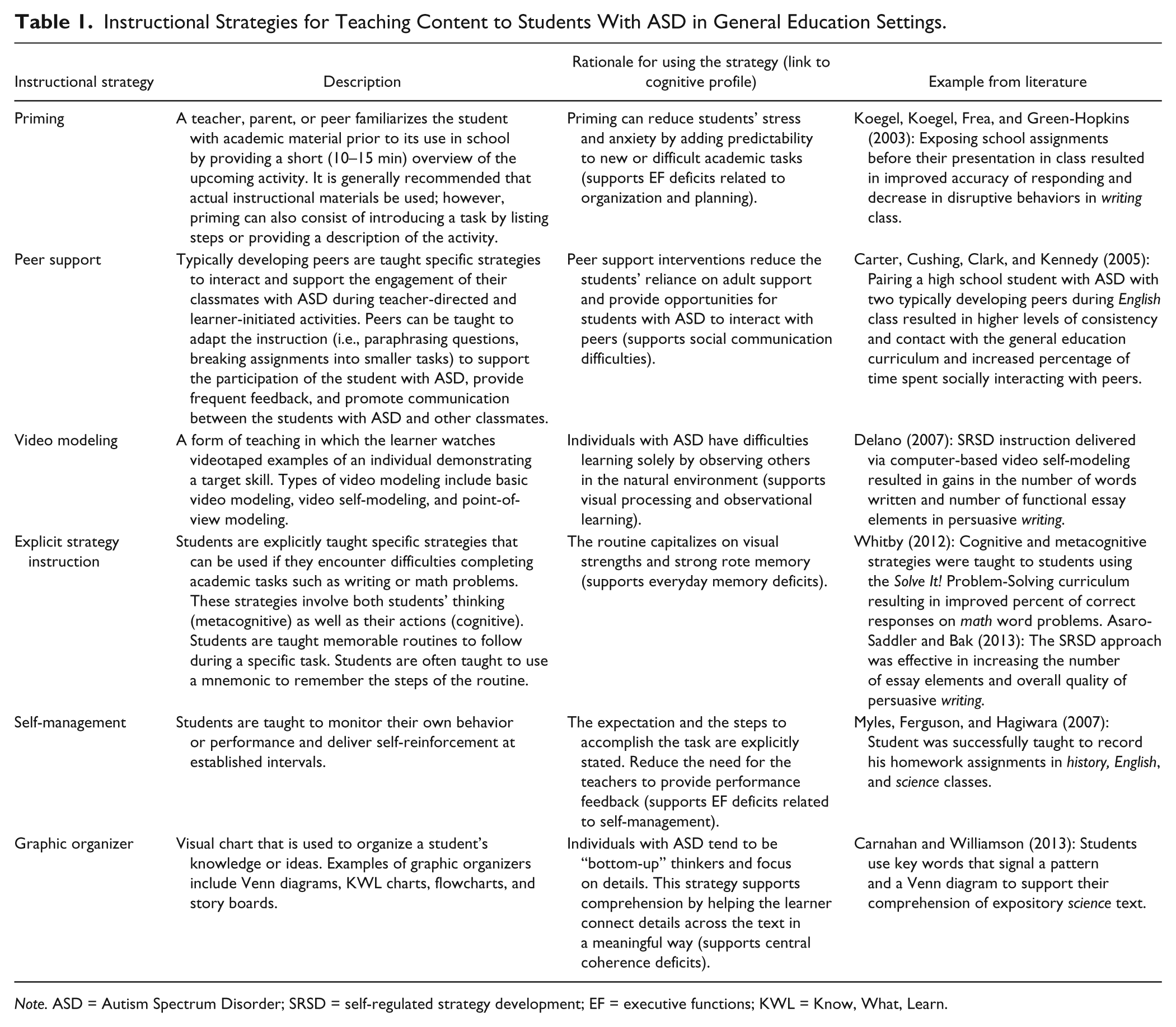
Note. ASD = Autism Spectrum Disorder; SRSD = self-regulated strategy development; EF = executive functions; KWL = Know, What, Learn.
Antecedent interventions: Setting the stage for successful participation
The very structure of high school poses several challenges for many students with ASD. The physical environment is often crowded and noisy; students frequently transition between classrooms or buildings; there are different teachers for each subject each with their own expectations and rules; and possibly, a different set of peers is in each class. Being able to anticipate and understand activities, schedules, and expectations improves students’ ability to appropriately participate and respond to classroom demands (Myles & Simpson, 2001). Establishing routines and creating written schedules will support executive functioning difficulties that may impede students’ ability to plan and organize their schedules. Executive functioning deficits have also been attributed to students having difficulty managing their own behavior during a given academic task. The use of priming—exposing school assignments to students before their presentation in class—has been found to be particularly effective in helping students with ASD anticipate what is expected of them and better prepare them to participate in classroom activities and assignments (Koegel, Koegel, Frea, & Green-Hopkins, 2003).
Scaffold student’s thinking
Individuals with ASD require explicit instruction to learn new skills, including academic skills. Generally, the instruction individuals with ASD receive around academic content should include clear explanations of the skill or task sequence, modeling, guided practice, and multiple opportunities to independently practice and apply the learned knowledge (Pennington & Delano, 2012). The use of visual supports has been found to be a useful tool in addressing WCC by enabling students with ASD to identify and connect important ideas and features of writing and reading tasks (Carnahan & Williamson, 2013). Of particular importance for individuals with ASD is providing explicit instruction on the cognitive processes involved in completing academic tasks, as well as teaching self-monitoring skills that will support their ability to identify and address problems they encounter during the task, which is especially problematic for many individuals with ASD due to executive functioning difficulties. During explicit strategy instruction, students are taught a strategy (e.g., a mnemonic) to help them remember specific steps or processes to complete a task, along with modeling and guided practice in using the steps. Cognitive and metacognitive strategies have been successfully used to improve math (Whitby, 2012) and writing (Asaro-Saddler & Bak, 2013) performances of individuals with ASD in general education classrooms. Although teachers have traditionally provided this type of instruction, the use of technology such as video modeling procedures (Delano, 2007), which capitalizes on visual processing strengths associated with ASD, and enlisting support from trusted peers (Carter, Cushing, Clark, & Kennedy, 2005) are gaining popularity and are successfully being used to complement teacher-led instruction in classrooms.
Facilitate skill generalization and independence
The ability to generalize skills beyond the immediate teaching context is a common difficulty encountered by many individuals with ASD (National Research Council, 2001). For this reason, it is especially important that educators specifically plan their instruction to facilitate skill generalization (Alberto & Troutman, 2009). One method for improving students’ ability to generalize learned skills is to provide them with ample opportunities to practice skills across settings by integrating instruction throughout the school day. Developing strong home–school collaborations, through various means such as email correspondence, periodic team meetings, home visits, or communication notebooks, can also support skill generalization (Morrow & Carnahan, 2010). Furthermore, teaching students to monitor and manage their own behavior (Myles, Ferguson, & Hagiwara, 2007) will help ensure that these skills are being used in a variety of settings with the additional benefit of reducing the need for constant adult guidance. Thoughtful educational planning that includes generalization and independence targets will ensure that the skills that are being taught are functional for individuals with ASD.
Considerations for Alternate Achievement
The term alternate achievement became well established in schools when federal policy permitted using alternate assessments based on alternate achievement standards (AA-AAS) for students who could not participate in general assessments with or without accommodations. Students in AA-AAS work toward the same grade-level standards as their same-age peers who are nondisabled but with alternate achievement targets. These alternate achievement standards had to be linked to the state’s academic content standards in the areas targeted by the law (U.S. Department of Education, 2005). As states move toward adopting the CCSS, the new generation of alternate assessments is also being aligned with these standards but with some alternate achievement. Alternate achievement of grade-level standards target some prioritized, pinpointed, or simplified version of the original standard while retaining the original content of the grade level to the greatest extent possible.
Because some students with ASD work on alternate achievement standards in fully inclusive general education classrooms, it would be erroneous to assume that alternate achievement academics are only for students in self-contained settings. Whether students with ASD participate in the general state assessment or an alternate assessment is an Individualized Education Program (IEP) team decision using state guidelines for eligibility. Even if the team selects an AA-AAS as the appropriate way for the student to show progress, it still is important for students with ASD to have full access to the general curriculum content for their assigned grade level based on chronological age. Table 2 includes descriptions of instructional strategies and examples of grade-aligned content successfully taught to students with ASD accessing AA-AAS. Many of the strategies used with this population provide extra support for executive functioning difficulties by breaking down multiple-step tasks into component parts that can be taught incrementally and prompting procedures to support memory deficits.
Instructional Strategies for Teaching Grade-Aligned Content to Students With ASD Who Access AA-AAS.
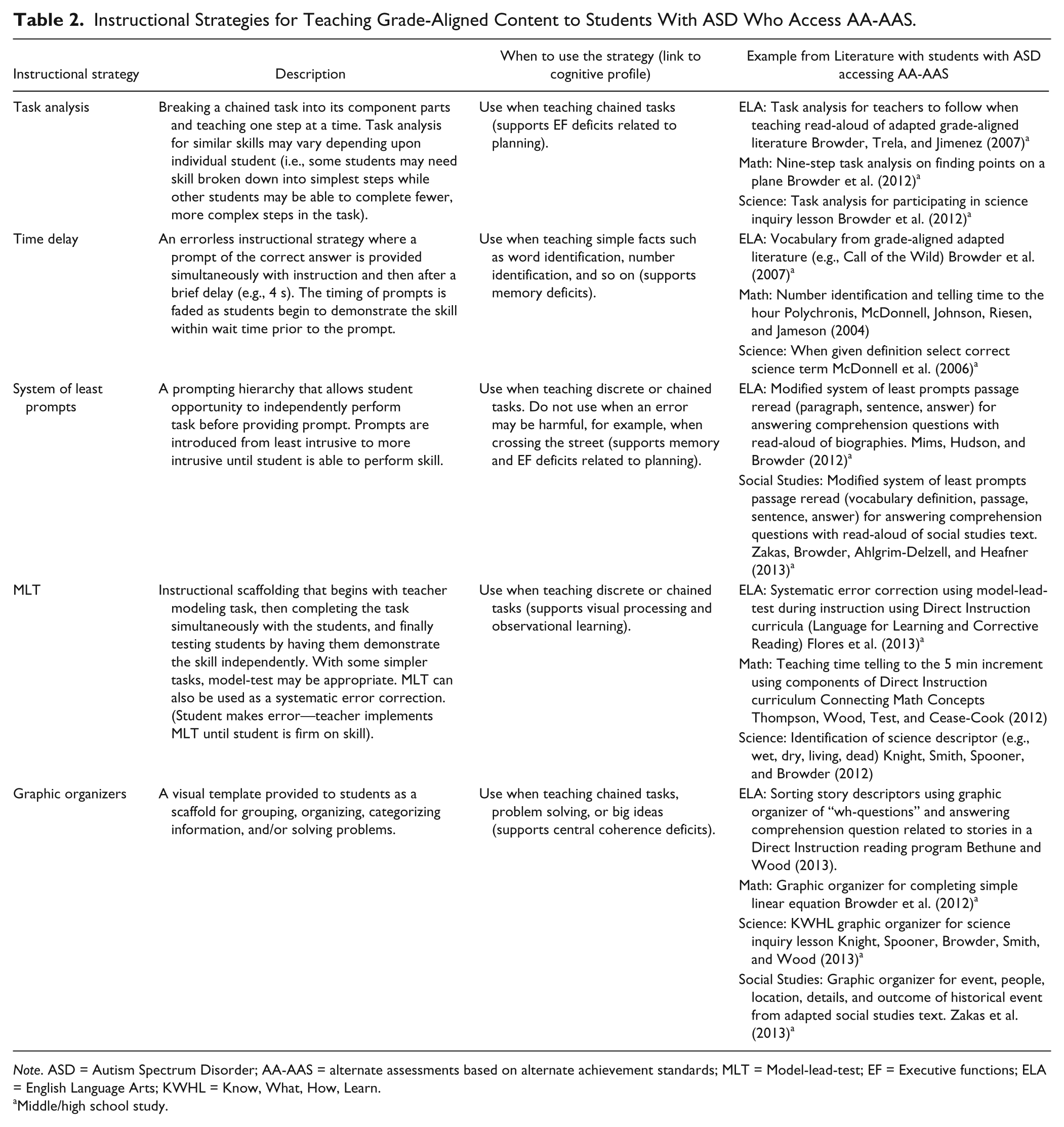
Note. ASD = Autism Spectrum Disorder; AA-AAS = alternate assessments based on alternate achievement standards; MLT = Model-lead-test; EF = Executive functions; ELA = English Language Arts; KWHL = Know, What, How, Learn.
Middle/high school study.
Alternate achievement literacy
Alternate achievement literacy is the ability for nonreaders to access and comprehend text that is chronologically age appropriate by using adaptations, modifications, and technology. Although many students with ASD can learn to read and comprehend text, some will need alternate routes to this goal. The primary goal of alternate achievement literacy is for students to apply whatever independent reading skills they have and become fluent in listening comprehension of connected text (Browder, Trela, & Jimenez, 2007). Reading aloud by the student or teacher is a key feature of alternate achievement literacy. Reading aloud can be a target of the lesson; alternatively, the teacher may read the text for her students to provide them with opportunities to develop important skills such as vocabulary (McDonnell et al., 2006; Polychronis, McDonnell, Johnson, Riesen, & Jameson, 2004) and simplified ways to write text (Pennington & Delano, 2012). It may be necessary for teachers to adapt the piece of literature by shortening the text while preserving the overall theme, plot, and important literary elements (i.e., grade-level vocabulary, a mix of sentence structure, author’s tone and purpose) in order for some students to access literary content (Saunders, Spooner, Browder, Wakeman, & Lee, 2013). In addition, because many students with ASD do not use functional speech as their primary form of communication (Noens & van Berckelaer-Onnes, 2005), consideration may also need to be given to alternative ways that these students communicate their understanding of the material.
Alternate achievement of mathematics and science
Researchers have found that students with severe disabilities, including those with ASD and ID, were able to participate in lessons aligned with biology, life science, and chemistry/physical science standards with adaptations that included teacher-directed inquiry (e.g., experiments to discover a concept), explicit instruction in science vocabulary, hands-on materials (Browder et al., 2012), graphic organizers (Knight, Spooner, Browder, Smith, & Wood, 2013), and explicit e-text (Knight, Wood, Spooner, Browder, & O’Brien, in press). While the research on alternate achievement mathematics and science has been inclusive of students with ASD at the secondary level, much more research is needed to build an evidence-base for practice. These initial studies do show promise that students with more severe ASD can learn content of their grade level that has been adapted and prioritized. Until more research emerges, teachers may try using the adaptations demonstrated in these studies using data to evaluate their effectiveness for specific content and students.
Moving Forward
The data on dismally poor postsecondary outcomes for individuals with ASD highlight the urgent need to reevaluate the quality and quantity of academic preparation individuals with ASD receive in schools. If postsecondary outcomes are expected to improve for individuals with ASD, the field must place greater value on the importance of academics for adolescents with disabilities. The CCSS for English language arts and literacy and mathematics, which has already been adopted in most states, provides educators with guidance on what students need to learn across grades and content areas. In reading, this means there will be more emphasis on the comprehension of complex texts in all subjects (Rothman, 2012), and in writing, there will be a shift in the emphasis from narrative to more informational and explanatory writing as these are more useful in the postsecondary educational and work environments (Graham & Harris, 2013). Simply knowing what should be taught, however, will likely be insufficient for those who teach individuals with ASD. Educators will need to not only be able to align educational programming with content grade-level standards but also be skilled at adapting their instruction to meet the unique needs of individuals with ASD.
More research on the academic achievement and instruction for individuals with ASD is needed to move the field forward, especially in the secondary grades. The following are some specific areas of need that practitioners and researchers who are invested in improving academic achievement for individuals with ASD are asked to consider.
Recognize the cognitive profiles for learners with ASD when adapting instruction. There is an urgent need for the development of academic interventions that simultaneously target the specific learning needs of individuals with ASD and are appropriate for the secondary school context. With the CCSS, teachers will be presenting students with more complex texts across content areas, which will present additional challenges for individuals with ASD. Individuals with ASD will benefit from explicit instruction on specific cognitive processes employed by successful readers (e.g., locating referents, asking questions, repair strategies such as rereading) as they tackle more challenging texts (Randi, Newman, & Grigorenko, 2010). While initial studies of explicit strategy instruction have been found to be effective for adolescents with ASD, it is likely that instruction will require further adaptation to be effective for the broader spectrum. The challenge for researchers will be to develop strategies that build upon cognitive strengths (i.e., visual processing) and address areas of weaknesses (i.e., WCC, executive functioning).
Recognize the need for multicomponent interventions. There exists a strong relationship between social skills and academic performance (McClelland, Morrison, & Holmes, 2000). Teachers structure their instruction in a number of different ways, most of which require a level of active participation by the learner. Because there is a strong link between social and academic skills, it is important that researchers consider developing interventions that simultaneously address students’ social and academic needs. This can be done by explicitly targeting both social (e.g., conversation skills) and academic (e.g., identifying key concepts in text) goals during academic instruction. Alternatively, some academic interventions may enhance social communication without explicitly targeting it. Researchers studying reading comprehension may consider adding social communication measures to identify if there are some collateral benefits in this area.
Inform all educators about ASD. Teachers’ ability to understand their students’ learning needs and abilities leads to the success of students with disabilities who participate in general education classes (Marino, 2010). Although special education teachers should be available to support general education teachers, it is important that general education teachers are able to collaborate with specialists and carry out educational plans, as it is deemed appropriate. Professional development of all teachers—preservice/inservice, special education/general education—should include coursework or resources focused on understanding ASD. Some advocacy groups (i.e., Organization for Autism Research) and federally funded projects (i.e., Center on Secondary Education for Students with ASD; National Professional Development Center on ASD) have already created such materials and present information in a way that is practitioner friendly and accessible to all individuals regardless of expertise level.
Although knowledge about how to effectively instruct individuals with ASD has grown over recent years, much more work needs to be done, particularly around adolescence and the transition to adulthood. Schools are experiencing increasing numbers of individuals with ASD who are accessing the general education curriculum and subsequently entering college or pursuing jobs. The limited information currently known about academic interventions for individuals with ASD is promising: Individuals with ASD are able to learn academic content that is aligned with state standards when provided with appropriate instruction and supports. Future research efforts focused on academic achievement for individuals with ASD are needed, and necessary, to support successful postsecondary outcomes for this population.
Footnotes
Authors’ Note
The opinions expressed represent those of the authors and do not represent views of the Institute of Education Sciences or the U.S. Department of Education.
Declaration of Conflicting Interests
The author(s) declared no potential conflicts of interest with respect to the research, authorship, and/or publication of this article.
Funding
The author(s) disclosed receipt of the following financial support for the research, authorship, and/or publication of this article: The work reported here was supported by the Institute of Education Sciences, U.S. Department of Education through Grant R324C120006 and Grant R324B090005 awarded to University of North Carolina at Chapel Hill.