




Abstract
Students with and without learning disabilities in high school chemistry classes, either co-taught or self-contained, received instruction on calculating molar conversions using universal design for learning (UDL) or business-as-usual techniques. For Study 1, posttest scores of students with and without learning disabilities (LD) in co-taught classes who received the UDL treatment are compared with peers’ scores in the comparison group. For Study 2, posttest scores from students with LD who received UDL treatment in a self-contained special education class are reported. Students in the UDL treatment scored significantly higher on posttests than comparison group peers in Study 1. Mean scores for students with LD in Study 2 were similar to UDL students in Study 1. Social validity feedback on the UDL instruction was positive. Implications for UDL chemistry instruction and future research are described.
Keywords
Some students with diverse learning needs, including students with learning disabilities (LD), struggle in secondary science classes (Terrazas-Arellanes, Gallard, Strycker, & Walden, 2018). Even so, a research base in science is evolving for students with LD (Brigham, Scruggs, & Mastropieri, 2011; Therrien, Taylor, Hosp, Kaldenberg, & Gorsh, 2011; Thornton, McKissick, Spooner, Lo, & Anderson, 2015). Nonetheless, secondary students with disabilities continue to lag behind their peers in science (National Assessment of Educational Progress, 2015), indicating the achievement gap is not closing. Moreover, for students with disabilities pursuing standard graduation, more than one-third lack science credits (Nord et al., 2011). Science coursework required for graduation, coupled with science content assessed annually on states’ high-stakes tests, calls for an increase in responsive pedagogy for students with disabilities. Universal design for learning (UDL) is a framework that can guide such pedagogy (Basham, Hall, Carter, & Stahl, 2016; Lapinski, Gravel, & Rose, 2012). Some researchers found that students with and without disabilities fared well in science when UDL techniques were used (Dymond et al., 2006), whereas others’ results are more equivocal (King-Sears et al., 2015; Marino et al., 2014). The purpose of this study is to determine the impact of a UDL-based chemistry intervention for students with and without LD in co-taught and self-contained classes.
UDL
UDL is a framework of three principles characterized by multiple and flexible ways of representing content to students (such as providing alternatives for visual representation), engaging students in learning tasks (such as varying demands and resources for engagement), and varying how students express what they know (such as supporting strategy development for expression; CAST, 2018). The UDL framework is intended to be used at the lesson design stage to proactively design, implement, and evaluate instruction that provides access to general education curriculum for a diverse group of learners, including students with LD. As such, some students’ accommodations can be built into the lesson design and delivery for all students versus retrofitting the accommodations after lesson design has occurred (King-Sears, 2001). Although UDL’s research base is emerging, more studies that clearly delineate how UDL is operationalized are needed (Ok, Rao, Bryant, & McDougall, 2017; Rao, Ok, & Bryant, 2014). In some studies, with data disaggregated for students with and without high-incidence disabilities (HID; e.g., LD, emotional or behavioral disorders), all students fared well (Hall, Cohen, Vue, & Ganley, 2015; Kennedy, Thomas, Meyer, Alves, & Lloyd, 2014). Targeting students’ learning, then disaggregating data for students from diverse learning groups, provides transparency about which students benefit from UDL instruction (Hall et al., 2015; Kennedy et al., 2014; Marino et al., 2014). In addition, Rao et al. (2018) provided guidelines, such as explicitness about specific UDL content operationalized in the study, for reporting UDL research. The current study incorporates all guidelines recommended, including clarity about what the barriers are for students. In the next sections, barriers in chemistry are described as well as characteristics of students with LD.
Chemistry
Chemistry concepts can be complex (Fang, Hart, & Clarke, 2014; Lynch et al., 2007; Sirhan, 2007), with conceptually difficult content (Shadreck & Enunuwe, 2017) and unfamiliar terminology, compounding difficulties for students (Derman & Eilks, 2016; Isaacson & Michaels, 2015). With students’ success in chemistry dependent on teachers’ use of effective pedagogy (Derman & Eilks, 2016; McDermott & Hand, 2013; Stefanich, 2001; Zhang & Linn, 2011), teachers need a repertoire of instructional techniques for diverse learners in inclusive chemistry classes (Mujtaba, Sheldrake, Reiss, & Simon, 2018). Criswell (2012) found that secondary students benefited when scaffolding occurred to support increasing cognitive load (i.e., more complex content to assimilate) in chemistry, particularly within an inquiry-based instructional approach where learners with LD struggle (McGrath & Hughes, 2018). Similarly, visual diagrams can also mediate students’ cognitive load (Carlson, Chandler, & Sweller, 2003).
In addition to effective pedagogy for chemistry, students’ success is also dependent on their proficiency with prerequisite mathematics skills. For example, the Next Generation Science Standards for chemistry specify that students need to use mathematical representations of atoms and mass as well as use the mole to convert from the atomic to the macroscopic scale, all of which involve algebraic skills (National Research Council, 2013). As such, students need foundational mathematical and algebraic skills, which is a barrier for students not fluent in such reasoning (Donovan & Wheland, 2009; Scott, 2012).
Chemistry and Students With LD
Few studies focus on the chemistry performance of students with LD and other HID. From the three chemistry studies involving students with LD and other HID, the first study occurred in co-taught chemistry classes that included students with LD (Mastropieri, Scruggs, & Graetz, 2005). Treatment included class-wide peer tutoring and mnemonics. All treatment students outperformed students in the comparison classes; gain scores for students with LD were higher than scores for students with and without LD in the comparison group.
In the second chemistry study, Lynch et al. (2007) found that students with and without LD and other HID who were taught using student-centered and hands-on curriculum materials performed statistically higher than peers in comparison classrooms. Judicious review and strategy instruction were among effective teaching components. In the third study, King-Sears et al. (2015) reported that UDL-based interventions benefited students with LD and other HID in chemistry classes, but did not yield significant improvement over business-as-usual instruction for students without disabilities (SWOD). The current study’s purpose is extending previous researchers’ work with these questions:
Do students with and without LD in co-taught general education chemistry classes calculate molar conversions more accurately after UDL treatment compared with business-as-usual?
How accurately do students with LD in a self-contained special education chemistry class calculate molar conversions after receiving UDL treatment?
General Method
Two high school chemistry studies are presented. The first consisted of students with and without LD from three co-taught classes, including a comparison group. The second consisted of students with LD from a self-contained class. The UDL treatment was the same for the co-taught and self-contained classes, with one extra session for the latter. Research approvals from the university and school system as well as participants’ informed consents/assents were acquired.
Settings
The high school was located in the northeast region of the United States and served almost 2,400 students, with 12.3% who received English language and 13.7% who received special education services. Thirty-nine percent of the students were Caucasian, 6.3% Asian, 31.8% Hispanic, and 18.6% African American. Just over 42% of the students received free or reduced meals.
Instruments
Students in treatment and comparison groups completed pre- and posttests. Students in the treatment group completed a social validity questionnaire.
Molar conversion tests
Equivalent versions of Calculating Molar Conversions pretest and posttest were developed. Each featured 12 molar conversion problems using varied formats matching the state’s chemistry test: (a) Convert 4.8 moles of Al2(SO4)3 to grams; (b) How many grams are contained in 4.8 moles of Al2(SO4)3? and (c) What is the mass of 4.8 moles of Al2(SO4)3? Students earned up to 3 points for the correct number and 1 point for the correct unit. Partial credit was earned if the answer was 4.88 × 1024 atoms and students answered some part incorrectly or omitted something, such as responding 4.88 atoms. Inter-rater reliability was 100% for pretests and 96.4% for posttests. Students completed the pretest the week before instruction; the posttest was completed the next instructional day after instruction ended.
Social validity questionnaire
Treatment students answered 10 queries about the UDL treatment by responding strongly agree, agree, disagree, or strongly disagree.
UDL Instruction and Materials
Three types of materials were used within an explicit instruction structure (demonstration, guided practice, and independent practice). First, six videos were developed and narrated, varying in duration from 7 to 14 min (contact lead author for videos). Videos contained demonstrations of how to solve molar conversions. The videos were paused intermittently to engage students and have them write in their Mole Student Workbook (MSW).
The UDL treatment (see Figures 1 and 2) featured the IDEAS self-management strategy. IDEAS was the mnemonic sequencing the step-by-step nature of how to solve molar conversion problems. The mnemonic provided students a process by which they could self-regulate, or self-manage, what to do and in what order, eventually using IDEAS as a checklist, then memorizing the steps toward independence in problem-solving. As such, IDEAS was demonstrated in the videos as a sequenced process to focus students on how and when to make decisions to solve conversion problems (i.e., self-manage), including when to use the one-step or two-step process. In addition to IDEAS as the self-management strategy, a graphic procedural facilitator (Scanlon, Cass, Amtzis, & Sideridis, 2009), featuring patterned boxes indicating where to write numbers and corresponding units (e.g., 36 g) using IDEAS, was used (see Figure 1). The six videos were accessible via the Internet, and they were developed from a PowerPointTM presentation in which highlighting and animation occurred to focus students’ attention on specific features of static problems as each was solved. For example, spotlights, arrows, and fly-ins indicated the relevant part of the problem being solved and tracked the progression of solving problems. Actions for each of the I-D-E-A-S self-management strategy steps were demonstrated, with emphasis on how each step occurred, how decisions were made, and where content appeared in the procedural facilitator. Students used a laminated sheet (see Figure 2) as a support and were cued when to complete activities in the 52-page MSW.

IDEAS procedural facilitator for one- and two-step mole conversions in Mole Student Workbook.

IDEAS at-a-glance featured on one side of the two-sided laminated sheet.
The second material was the MSW, which featured slides from each video clip and practice problems. All demonstration problems were in both the video and the MSW. When guided and independent practice occurred, students referred to those worked examples in their MSW. Following three demonstration problems were 12 practice problems, with supports systematically decreased: Problems 1 to 3 showed all IDEAS content (refer to Figure 2 for an example), Problems 4 to 6 showed the first word in IDEAS in checklist format, Problems 7 to 9 showed the first letter in IDEAS in checklist format, and Problems 10 to 12 showed only the practice problems. Scaffolding via gradual fading of IDEAS was to reduce support to students. The final three practice problems mirrored problems’ formats on the state’s chemistry assessment as well as the pretest and posttest, including varied wording and a mix of compounds’ complexity (e.g., H2, Al[NO3]3). Three sets of 12 practice problems with scaffolding were in the MSW: one-step, two-step, and mixed one- and two-step conversions. Answer keys for practice problems were available so students who worked at different paces could check their work.
The third material was a laminated strategy sheet, designed for durability and to consolidate key information, which featured the periodic table on one side and content from the IDEAS self-management strategy on the other side (see Figure 2). Among the IDEAS content were three mole equalities, which was a decision point when calculating molar conversions. The three mole equalities were within a gray rectangular box representing the Mole Equality Organizer, and students called this the “gray box of mole equalities.”
Each UDL material was designed to align with UDL principles, guidelines, and checkpoints (refer to Table 1). For example, both IDEAS and the Mole Equality Organizer aligned with UDL’s principle of representation in that “big ideas” were highlighted. Among options for UDL’s principle of expression were the scaffolded problems which reduced supports as students’ fluency and proficiency increased. The IDEAS self-management strategy corresponded to UDL’s principle of expression, in which distractions were minimized (i.e., focus only on these steps), and self-regulation, which facilitated students’ execution of the strategy.
UDL Mole Module Aligned to UDL Framework.
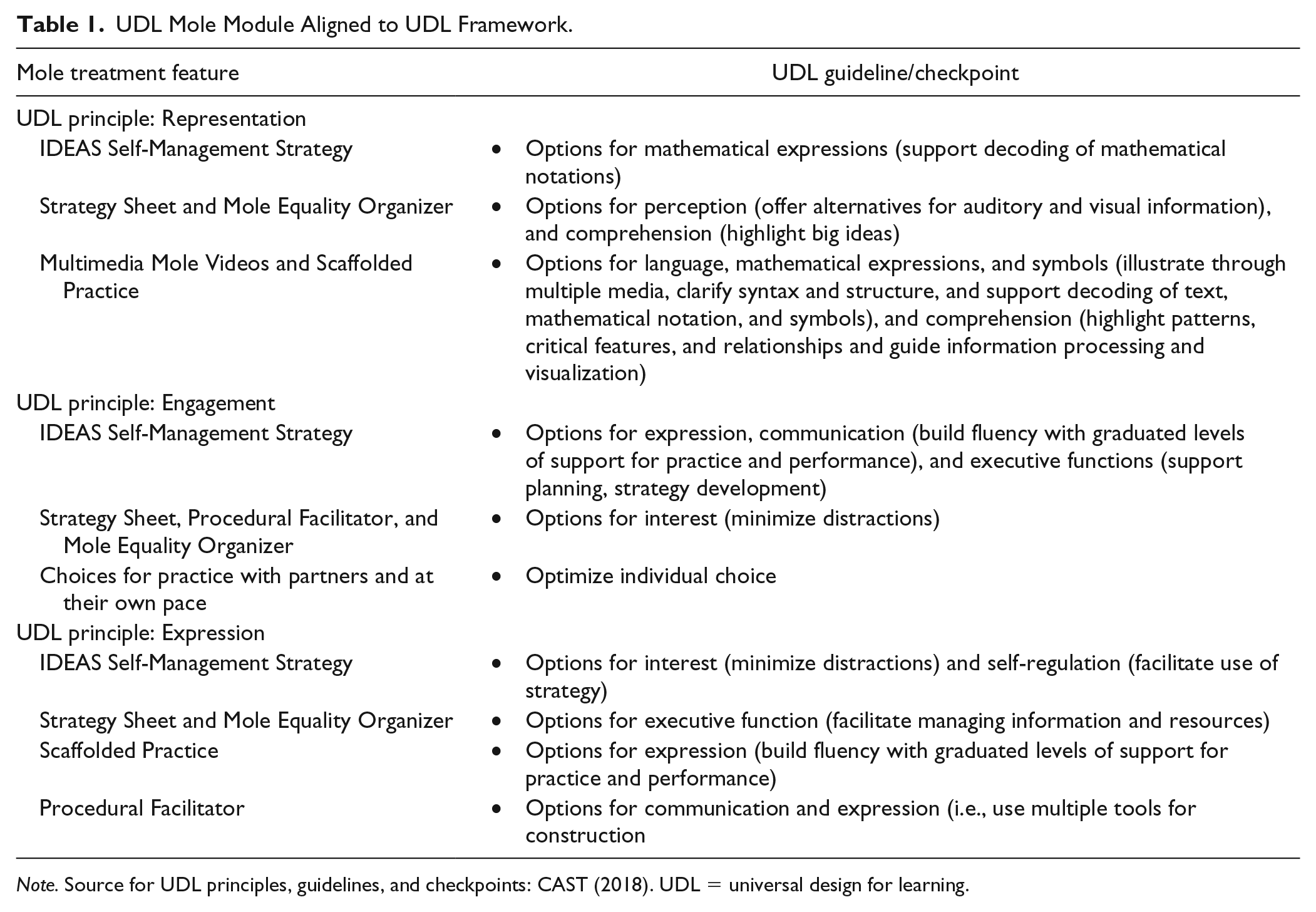
Note. Source for UDL principles, guidelines, and checkpoints: CAST (2018). UDL = universal design for learning.
In addition to the materials for UDL implementation, there was a 16-page Chemistry Mole Module Fidelity Manual. This Manual was used for teacher training, instructors’ self-monitoring when delivering the UDL treatment, and an independent observer’s use when calculating fidelity. For self-monitoring, instructors could check off what they had done/were doing in the Manual. For the independent observer, a data sheet was developed for fidelity calculated from videoed sessions. Our use of multiple methods to assess fidelity is consistent with recommendations from other researchers (Barnett et al., 2014), including use of a treatment manual and videotaped sessions (Swanson, Wanzek, Haring, Ciullo, & McCulley, 2013).
Procedure
Teacher preparation
Prior to UDL treatment, teachers received the 16-page Chemistry Mole Module Fidelity Manual and the six videos. The researchers identified and described the entire UDL treatment (i.e., the instruction and materials), particularly focusing on how to use the UDL materials to both deliver instruction and respond to students during practice. Training occurred on multiple days during after-school time, with a duration of approximately 1 hr for each session. In addition, because teachers had the videos, the Manual, and the students’ 52-page MSW in advance, teachers reviewed those materials prior to and after the training time with the researchers. Prior to commencement of the study, each teacher demonstrated that he or she (a) could demonstrate one- and two-step problems using the IDEAS self-management strategy, (b) was familiar with how to integrate videos and MSW pages, (c) was fluent with IDEAS, and (d) knew what materials to access when students were completing practice problems.
UDL treatment
On Days 1 and 2, the researcher used five videos and the MSW to teach molar conversions. On Day 3, the sixth video was shown, then students practiced molar conversions with their respective teachers by completing scaffolded problems in the MSW. Due to block scheduling, instruction occurred every-other-day across a 2-week period with 90 min per session (see Table 2 for the progression of treatment and comparison groups across days.)
UDL Mole Module Video Clip Title and Day of Treatment for Study 1, Comparison Group for Study 1, and Study 2.
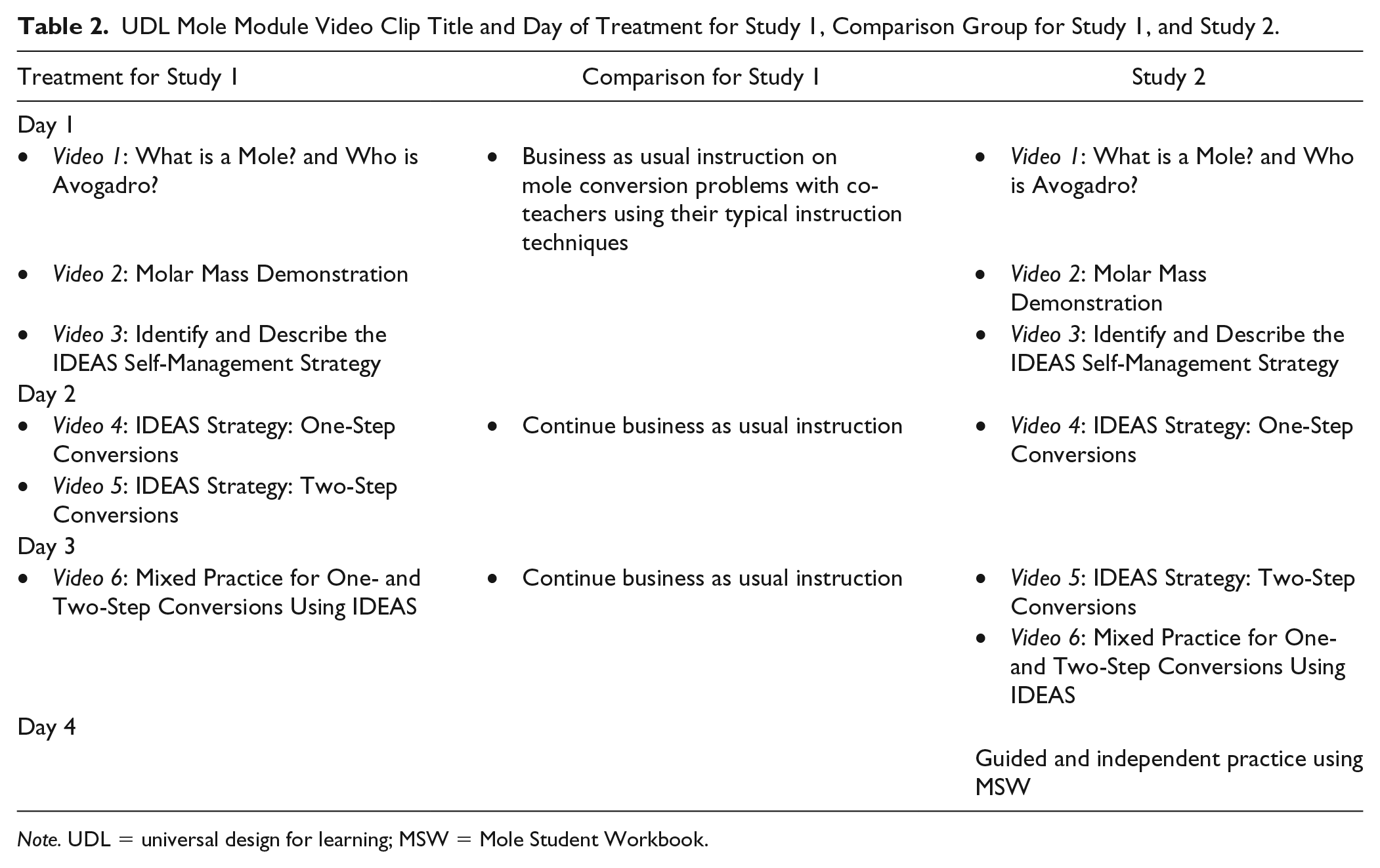
Note. UDL = universal design for learning; MSW = Mole Student Workbook.
On Day 1, UDL students received the MSW and laminated strategy sheet, and the first three videos were played. Embedded in the videos were pauses to practice or review content, so students were actively engaged through writing in the MSW using content from the laminated sheet. Videos 1 and 2 provided background and prerequisite information (Who is Avogadro? How to calculate molar mass). Video 3 was a demonstration of the IDEAS self-management strategy.
On Day 2, Video 4 featured three demonstration problems of solving one-step molar conversion problems, after which students began guided practice problems with scaffolded IDEAS support in the MSW. Students completed all demonstration problems in the MSW so they could refer to worked examples. Students had choices to work as partners and proceed at their own pace while the researcher and teachers circulated and assisted. After most of the class had finished a minimum of three practice problems for one-step conversions, Video 5 was shown, featuring three demonstration problems using two-step conversions. After Video 5 concluded, students completed guided practice problems in their MSW until the end of the class period.
On Day 3, Video 6, featuring mixed one- and two-step demonstration problems, was shown. The participating teachers taught on Day 3. After that, students completed a minimum of three guided practice problems in their MSW. Students could work as partners or small groups, and teachers circulated and assisted. There were a total of 36 practice problems in the MSW, from which at least 18 were completed during Days 1, 2, and the beginning of Day 3. During the rest of Day 3, students completed all or most of the remaining problems using additional active engagement activities, such as Relay Problem Solving (small groups of students formed a team and completed problems on the whiteboard) or Pass the Problem, Please (small groups of students worked as a team to solve problems). As students’ proficiency increased, students worked on their own to solve problems in the MSW.
Study 1
Method
Participants followed the methods previously described for UDL treatment. Students in the comparison co-taught group received business-as-usual instruction, which consisted of lecture in which students were taught to calculate molar conversions, based on unit cancelations, via demonstrations on the board. Students were taught to identify “known” quantities provided in the problem as well as the “unknown” quantities needed to solve the problem. The special education co-teacher devised a mnemonic to assist students in calculating parts of the molar conversion problems. After demonstrations, students received guided practice opportunities in which various molar conversion problems were provided via board work and worksheets. Students were expected to take notes during the lecture and work out molar conversion problems on their own paper.
Participants
In the UDL treatment group, there were 16 SWOD and nine students with LD. In the comparison group, there were 11 SWOD and one student with LD. Refer to Table 3 for more details on the participants’ characteristics, including ethnicity, English language learner status, and socioeconomic status for all students. We were not able to acquire more detailed information about the students with LD from the school system. All students’ pass or fail for the state’s chemistry test is noted.
Participant Characteristics for Studies 1 and 2.
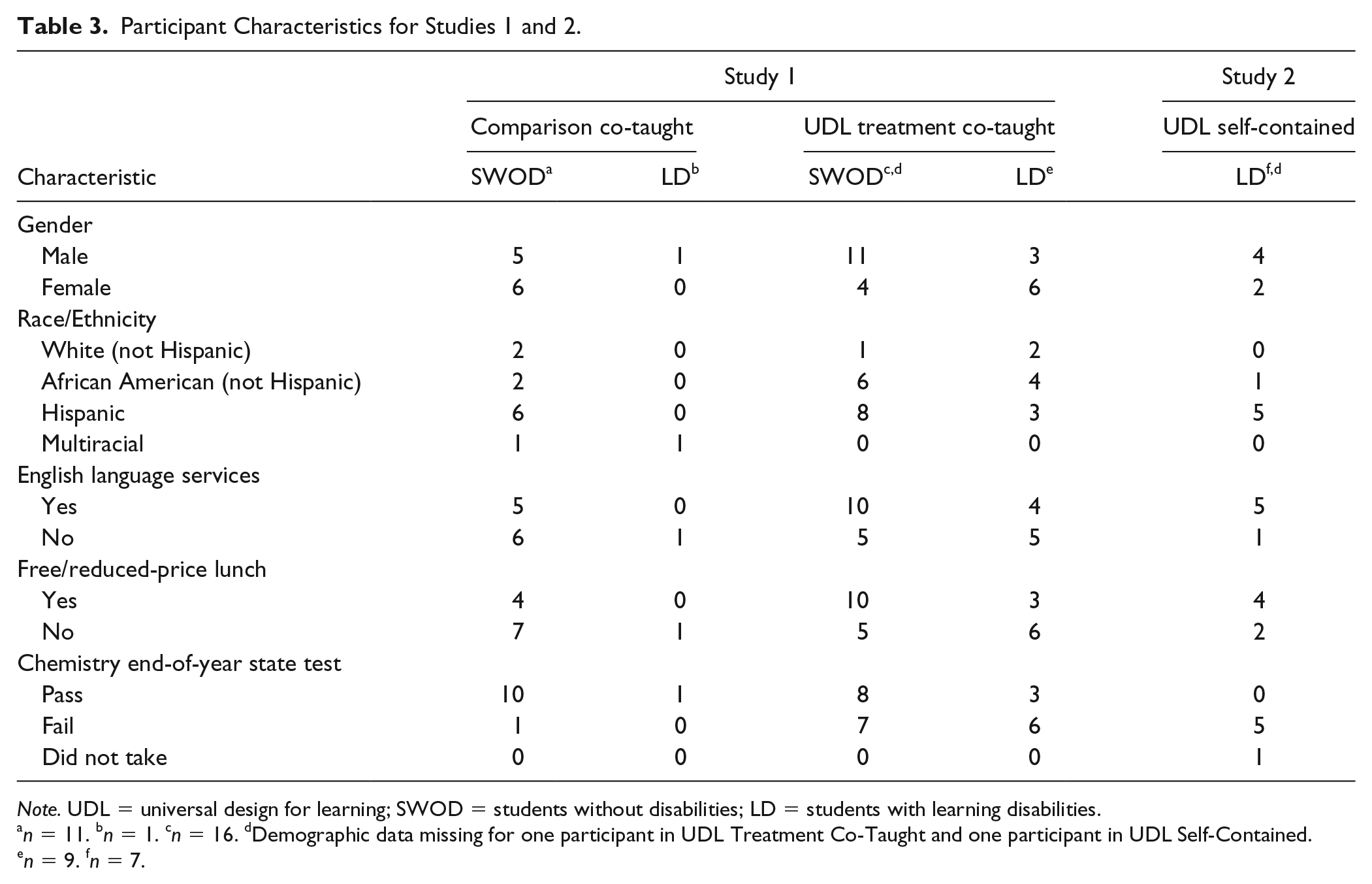
Note. UDL = universal design for learning; SWOD = students without disabilities; LD = students with learning disabilities.
n = 11. bn = 1. cn = 16. dDemographic data missing for one participant in UDL Treatment Co-Taught and one participant in UDL Self-Contained. en = 9. fn = 7.
The researcher who delivered UDL treatment for Days 1 and 2 was a doctoral student and former high school chemistry and special education teacher, with certifications in each area and a master’s degree. The co-teaching team included a general educator and a special educator. Each had master’s degrees. The general educator was a Caucasian male with more than 30 years of teaching experience, with 27 teaching chemistry. His certification was in chemistry and other sciences (e.g., biology, physics). The special educator was a Caucasian female with more than 25 years of teaching experience, most of which was teaching chemistry. The special educator’s certification was in special education. The co-teachers co-taught chemistry classes for 6 years.
Data analysis
Nonparametric tests were used due to low sample size and unequal number of participants in the comparison and UDL treatment groups. A Wilcoxon signed-rank test was used to compare UDL treatment students’ performance at pretest to their performance at posttest. A Mann–Whitney U test was performed to compare treatment and comparison students’ performance at posttest.
Results
When comparing UDL treatment students’ pretest to posttest scores using a Wilcoxon signed-rank test, the results were significant (z = 3.92; p < .001) with mean performance improving from a score of 0 at pretest to 17 at posttest. The results of the Mann–Whitney U test, comparing the posttest scores of treatment and comparison students, were significant (U = 77.5, p = .038), with the UDL treatment group outperforming the comparison group (see Table 4).
Descriptive Statistics and Mean Comparisons for Studies 1 and 2.

Note. UDL = universal design for learning.
Fidelity of treatment
Fidelity of treatment was determined in two ways using the Chemistry Mole Module Fidelity Manual. First, instructors (whether researcher or participating co-teachers) self-monitored their adherence to instruction using fidelity directions in the Manual. These directions detailed the instructional sequence and use of corresponding materials (e.g., the video, MSW) as well as what instructor behaviors to exhibit, which indicated adherence to the treatment. Second, when the researcher was instructing, the co-teachers observed the researcher using the Manual to determine his adherence to the treatment. All instructors self-monitored 67% of the sessions, and co-teachers observed all sessions. Neither the researcher nor co-teachers reported deviations from the instructional sequence when self-monitoring or observing.
Social validity
Social validity data were disaggregated for students with and without LD (see Table 5). Most students with and without LD believed using the IDEAS self-management strategy for molar conversions improved their learning, increased their confidence, and helped them remember steps. All students with LD noted the laminated strategy sheet was helpful. Almost all students believed the video clips helped them learn better.
Social Validity Feedback from Students in UDL Treatment in Studies 1 and 2.

Note. UDL = using universal design for learning; SWOD CT = students without disabilities in co-taught classroom (Study 1); LD CT = students with learning disabilities in co-taught classroom (Study 1); LD SC = students with learning disabilities in self-contained classroom (Study 2).
Patterned boxes same as Procedural Facilitator. bGray box of mole equalities same as Mole Equality Organizer.
Study 2
Method
Participants in the self-contained classroom followed the general methods previously described for UDL treatment. For Study 2, an additional 90-min session was requested by the teacher based on the pace with which students were progressing with guided and independent practice problems in the MSW (refer to Table 2).
Participants
All seven students in Study 2 were eligible for special education services under the category of LD (see Table 2 for more details on the participants’ characteristics). The self-contained teacher was a Caucasian female with more than 20 years of experience teaching chemistry. The self-contained teacher’s certifications were in chemistry and administration. She had taught chemistry in a self-contained setting for 3 years.
Data analysis
To compare self-contained students’ performance at pretest with their performance at posttest, a Wilcoxon signed-rank test was performed.
Results
Per the Wilcoxon signed-rank test, the change in students’ results from pretest to posttest was significant (z = 1.99; p = .046), with mean performance improving from a score of 0.57 at pretest to 17.71 at posttest (see Table 3).
Fidelity of treatment
Fidelity of treatment was measured the same as for Study 1 (self-monitoring and observation using the Manual). Instructors reported alignment with the UDL treatment implementation per the Manual. In addition, an independent observer viewed videos of instruction to determine adherence to the Manual. Using the Manual, the video was paused every 3 min to record yes/no responses to whether instructors were complying with four behaviors during the entire interval: (a) following the sequence of the Manual, (b) using fluent pacing, (c) using materials correctly, and (d) involving students appropriately. Due to video malfunction, 86% of the treatment was available. Fidelity for following the sequence was 98%, fluent pacing was 100%, correct use of materials was 98%, and student involvement was 100%.
Social validity
Students with LD in the self-contained class were unanimous in agreement of most statements on the social validity ratings, concurring components of UDL instruction helped them learn and remember how to calculate molar conversions (see Table 4 for more results).
Discussion
In Study 1, students in UDL co-taught classes scored significantly higher on the molar conversions posttest (17.0) than their peers receiving business-as-usual instruction (9.20). In Study 2, students with LD in the self-contained chemistry class had a group mean of 17.71 on the posttest. Even with these means, the range of scores across students per group was variable, indicating that some students may need more time to demonstrate proficiency. As occurred in Study 2, comprised entirely of students with LD in a self-contained setting, additional time was needed to accrue scores reported in this study. Similarly, Kennedy et al. (2014) provided additional time for students with LD receiving UDL instruction to learn vocabulary terms and definitions.
These results are in contrast with an earlier study (King-Sears et al., 2015) in which all students in the UDL treatment did not outperform all students in the comparison group. However, in that study, students with HID receiving UDL treatment did score higher than students with HID in the comparison group. We posit that the increased fidelity of treatment in the current study per the researcher’s delivery of most UDL instruction may be one reason for all students’ improved results.
The IDEAS self-management strategy and other UDL materials featured explicit instruction then gradual removal of supports, consistent with the scaffolding Criswell (2012) identified as beneficial for secondary students and supportive of increasing cognitive load in chemistry and other science courses (Therrien, Benson, Hughes, & Morris, 2017). The procedural facilitator (i.e., the patterned boxes) used in this research was similar to visual diagrams, which Carlson et al. (2003) stated could mediate students’ cognitive load. As noted by most students with and without LD in this study, the procedural facilitator helped them learn to calculate molar conversions.
Implications for Instruction
UDL instruction has the potential to be responsive for students with and without LD, and its use may be particularly important when complex content, such as in chemistry, is taught. Among the UDL components that accrued primarily positive feedback from students in Study 1 and 2 were (a) the MSW, (b) the procedural facilitator (patterned boxes in Figure 1), (c) the gray box of mole equalities (Mole Equality Organizer in Figure 2), (d) the IDEAS strategy (see Figure 2), and (e) videos for demonstration problems. The nature of instruction via the demonstrations on video and strategic use of the mnemonic is consistent with other research indicating students who lack background knowledge learn better with explicit demonstrations (Rizzo & Taylor, 2016) and benefit from mnemonics (Mastropieri et al., 2005). Because the video clips were interactive (paused to engage students) and used highlighting and color to feature important parts when solving problems, it may be that the verbal or language requirements typically evident during science instruction (Isaacson & Michaels, 2015; Taylor & Hord, 2016) were mediated by the videos, MSW, and procedural facilitator. As such, chemistry teachers can examine what kinds of materials or processes they are using and consider incorporating similar UDL components that can be responsive to the needs of students with and without LD in their classes. Chemistry co-teachers, in particular, have increased opportunities to incorporate UDL components into instruction, maximizing the presence of two teachers to provide support for a variety of students’ learning needs. This responsiveness is consistent with what other researchers note as an effective pedagogical repertoire specific to chemistry (Derman & Eilks, 2016; Fang et al., 2014; McDermott & Hand, 2013; Mujtaba et al., 2018; Sirhan, 2007), with the UDL framework providing a guide for expanding teachers’ repertoire (CAST, 2018).
Limitations and Future Research
Sample size was a limitation. Students’ results in Study 1 are aggregated because the N was too low for students with LD to be calculated separately. To determine differential effects of UDL treatments, a higher N is needed. Future research with sufficient N should disaggregate data because some UDL treatments do not result in comparable impacts for diverse student groups (King-Sears et al., 2015; Marino et al., 2014), whereas other UDL treatments do (Hall et al., 2015; Kennedy et al., 2014).
Participants in this study were from one school in one school district. Future research that includes multiple classes across a school district or districts may enhance the generalizability of results. Also desirable is implementing UDL across multiple instructional units and shifting more instruction from researchers to teachers.
Among limitations is the study design, in that Study 2 did not have a comparison group, although Study 1 did. Johnson and Christensen (2016) noted that the one-group pretest-posttest design can be strengthened by adding a comparison group, which can lead to increased confidence in interpreting results as attributable to the treatment provided. Johnson and Christensen also recommended using additional related outcome measures, as opposed to a single dependent variable, to obtain a more complete understanding of how the provided treatment affects student performance. Thus, in addition to using researcher-designed tests, we recommend using more distal measures, such as (a) use of maintenance tests that would provide evidence of retention of molar conversions and (b) use of a more comprehensive unit test or quiz (e.g., on stoichiometry) that would provide evidence of generalization of molar conversion skills.
An additional limitation is that only one special education disability category, LD, was represented in the participants’ sample. Future research that includes students with other disability categories, such as emotional disturbance or autism, who are placed in the respective service delivery systems (i.e., co-taught setting, self-contained setting) may be more representative of the range of students in these settings.
A question is how many, or which, components of the UDL intervention are needed to effect desired learning in students with diverse learning needs. That is, would the video clips alone have sufficed? Was the procedural facilitator necessary? Did students need the MSW? Future research that isolates specific UDL components compared with the package of UDL used in this study could determine whether similar learning outcomes for students with and without LD and other disability categories occur.
In future research, the six video clips could be transferred to devices such as iPads so that students can individually pace their instruction along with using the corresponding materials (e.g., MSW, procedural facilitator). However, students with and without LD likely need variable levels of teacher interaction when using such a UDL treatment package; teacher monitoring and support should be available to ensure students are proceeding through videos with understanding and accurately completing problems in the MSW. In addition, particularly with co-teaching, the use of varied co-teaching models (e.g., station teaching; parallel instruction) provides teachers the flexibility to individualize per students’ progress and proficiency.
As a framework, UDL addresses variability for a range of learners, thus can be used to provide responsive instruction to students with diverse learning needs (e.g., Hall et al., 2015; Marino et al., 2014; Rose & Meyer, 2006). For example, many students in all conditions in the current research were (a) English language learners and (b) receiving free or reduced lunch. Because these students were spread across conditions, including UDL treatments where students’ scores surpassed those in the comparison group, UDL may be considered a culturally responsive technique which also encompasses students with diverse learning needs and varied socioeconomic status. For example, given the range of representations used to demonstrate problems and options for language and comprehension, such as highlighting patterns (see Table 1), students who were typically overwhelmed with the molar conversion process and terminology seemed to find the UDL in this study responsive to their needs. Future studies can explore impacts of UDL on different constituent groups, hence providing an empirical base for UDL’s responsiveness to multiple diverse populations.
Footnotes
Declaration of Conflicting Interests
The author(s) declared no potential conflicts of interest with respect to the research, authorship, and/or publication of this article.
Funding
The author(s) received no financial support for the research, authorship, and/or publication of this article.
