




Abstract
A shift from reactive and punitive practices in secure juvenile facilities has prompted facilities in the United States to adopt multitiered systems of support such as facility-wide positive behavioral interventions and supports (FW-PBIS) to address climate and culture concerns. To date, most implementation efforts have focused on defining adult behaviors and systems. There is limited understanding of the role of youth voice related to adoption and implementation of the advocated practices. This pilot study sought to understand youth perspectives of FW-PBIS implementation as viewed through the lens of facility/organizational climate assessment. We piloted a facility climate survey for use in juvenile facilities and conducted focus group sessions to capture youth voice. Facilitator and barrier themes related to facility climate with FW-PBIS implementation were identified. Implications for practice, as well as limitations and future directions for research, are discussed.
As secure and nonsecure juvenile facilities shift from punitive approaches and practices (e.g., seclusion and restraint methods) to address youth behavior, many are exploring, adopting, and implementing proactive and preventive multitiered systems of support (MTSS) frameworks per suggested guidelines from federal agencies and others (e.g., Read & Lampron, 2012; U.S. Departments of Education and Justice, 2014) as a means to address facility culture and climate concerns. One MTSS framework used in juvenile facilities is facility-wide positive behavioral interventions and supports (FW-PBIS; please refer to www.pbis.org for a full description of the PBIS framework and to Jolivette & Kumm, 2018, on that website for a FW-PBIS resource list). FW-PBIS is a three-tiered framework adapted to match the contextual variables inherent within juvenile corrections and is an outgrowth of school-wide PBIS (www.pbis.org). Within the framework, systems are put in place to support staff members in implementation of policies and procedures, real-time data are used for decision-making purposes across the tiers, and practices are tiered within an all (Tier 1), some (Tier 2), and few (Tier 3) logic of support provision. The specific practices at each tier detail their different entrance or exit criteria, dosages, intensities, and progress monitoring requirements, with Tier 1 providing universal supports for all youth, the additive Tier 2 targeting supports for some youth needing additional supports, and the additive Tier 3 for intensive supports for a few youth with the most intensive needs. FW-PBIS implementation “maximize[s] all programming time with youth to help remediate skill deficits and promote skill-building so youth can transition successfully back into and remain in their communities” (Jolivette, 2016, p. 1). Thus, FW-PBIS can be defined as the implementation of tiered practices supported by systems and data in which all waking hours are considered “intervention” opportunities and whereby all staff members (no matter their discipline, role, or shift) implement the tiered practices matched to individual youth needs while simultaneously collecting data to determine effectiveness and fidelity of practice (Kumm & Jolivette, 2017). More succinctly, FW-PBIS is implemented across all three tiers within juvenile corrections 24 hr a day, 7 days a week in all facility environments and activities by all staff as part of the daily operations and it is embedded within the master schedule (Jolivette, 2016; Jolivette, Kimball, Boden, & Sprague, 2016; Jolivette, Swoszowski, & Ennis, 2013; Kimball & Jolivette, 2016; Kumm & Jolivette, 2017). Practices implemented within the FW-PBIS framework include those from multiple domains—education, mental health, physical health, social and emotional health, substance-abuse health, and self-care (e.g., Chafouleas, Johnson, Overstreet, & Santos, 2016; Jolivette et al., 2016; Lampron & Gonsoulin, 2013), with positive benefits being reported related to youth engagement, behavior, and youth–staff relations (e.g., as cited in Jolivette, 2016; Jolivette, Sprague, & Doyle, 2018; Kindt & Dana, 2018).
Across the country, juvenile corrections have shifted to encompass a more evidence-based lens when viewing the policies, practices, and frameworks/models being adopted, adapted, and implemented as a means to address facility culture and climate (e.g., trauma-informed lens, FW-PBIS). However, juvenile corrections is a complex organizational structure often characterized as being “consistently inconsistent” in its processes, missions, visions, and policies within and across states, agencies, and facilities, which can impact facility culture and climate (Jolivette et al., 2018). Such variations mean that organizational climate and its relation to the broader concepts of climate and culture needs to be taken into account. Organizational climate is the process of quantifying the “culture” of an organization, and it precedes the notion of organizational culture (Ehrhart & Schneider, 2016). On the contrary, school culture reflects the shared ideas—assumptions, values, and beliefs—that give an organization its identity and standards for expected behavior. Climate and culture are both important aspects of the overall context or environment in which an intervention is carried out. The U.S. Department of Education (2013), in tandem with other federal departments, provides three guiding principles, each with specific action steps for implementation for promoting positive and healthy educational climates for school-age students, including school-age youth served in secure juvenile facilities. These principles include (a) climate and prevention; (b) clear, appropriate, and consistent expectations and consequences; and (c) equity and continuous improvement. In 2014, the U.S. Departments of Education and Justice released their five guiding principles for providing high-quality education in secure juvenile facilities with the first principle targeting facility climate—“a safe, healthy, facility-wide climate that prioritizes education, provides the conditions for learning, and encourages the necessary behavioral and social support services that address the individual needs of all youth”—and the third principle targeting staff skill sets—“recruitment, employment, and retention of qualified education staff with skills relevant in juvenile justice settings who can positively impact long-term student outcomes through demonstrated abilities to create and sustain effective teaching and learning environments”—leading us to contend that education includes all staff members, roles, and programming hours (pps. 8 & 14). Sedlak and McPherson (2010) interviewed more than 7,000 juveniles in facilities using an audio-recorded computer self-guided system related to overall conditions of their confinement. Several of the interview aspects related to facility climate and behavior management, even though their definitions may differ (a) regarding facility climate (concepts of relations, gang affiliation, and contraband), more than 43% reported poor youth–staff relations with the poorest ratings for youth in secure juvenile facilities; (b) regarding safety (supports and fears of personal safety), almost 40% of the youth perceived they would be attacked by either another resident or staff; (c) regarding clarity and consistency of rules (given a copy of the rules), the majority of youth stated they understood the rules and they were applied equally; (d) regarding fair and reasonable treatment (use of fair practices and application of consequences), 50% indicated they were punished without reason; and (e) regarding discipline, the majority indicated that group punishment contingencies were used. The authors made several recommendations as the data collected did not match the application of best practice guidelines for those in secure juvenile facilities. The most applicable suggestions relating to facility climate being to improve the quality of youth–staff relations, require fair treatment, and establish an effective grievance process. These recommendations, paired with the other areas assessed, could be aligned with facility climate tenets and FW-PBIS implementation.
To date, only one study has investigated youth voice within secure juvenile facilities with a focus on Tier 1 FW-PBIS implementation. Jolivette, Boden, Sprague, Ennis, and Kimball (2015) conducted focus groups with 35 youth across eight secure juvenile facilities where FW-PBIS had been implemented for 1½ years with questions centered on (a) behavioral expectations defined, (b) behavioral expectations taught, (c) sustainability of FW-PBIS tenets upon release, (d) reinforcement, and (e) consequences. They found that some youth shared examples of how FW-PBIS implementation was part of the facility culture (i.e., part of the daily routine, is consistently talked about, staff teach and support them in their new behaviors, there is reinforcement for changing one’s behavior). Youth also discussed aspects to improve facility culture (i.e., respect in relation to staff and youth relations) which in part can be aligned with climate tenets such as expectations, acknowledgment, discipline, and respect; however, the tenets of safety and connections were not explicitly explored or queried. Jolivette et al. (2015) contended that “youth voice is a critical aspect to buy-in to any framework, intervention, or programming being implemented for the benefit of youth. Their perceptions may influence their engagement . . .; thus, impacting outcomes gleaned” (p. 315). Thus, gaining youth voice and better understanding their perceptions of FW-PBIS as it relates to facility climate can assist the juvenile agency and the juvenile facility in their implementation efforts to maximize youth outcomes.
To extend the above-noted study on youth voice, the purpose of this study was to better understand youth perspectives of FW-PBIS implementation as viewed through the lens of climate assessment as well as to pilot a climate survey for broader use in juvenile facilities. Researchers have emphasized the importance of including, collecting, and formalizing youth voice within the FW-PBIS framework related to implementation and climate (e.g., Jolivette et al., 2015; Jolivette, McDaniel, Sprague, Swain-Bradway, & Ennis, 2012). The research questions were the following:
Method
Participants
Youth
Thirteen youth ages 13 to 16 years participated in the focus groups and completed the pilot survey (refer to Table 1 demographics). The size of the focus groups was capped at five youth per facility to minimize potential safety issues. Youth were randomly selected 1 week prior to the scheduled focus group by the facility juvenile detention counselors. These counselors served as youth advocates and surrogates within the facility. The counselors based their selection of youth on (a) who may be available on the date of and time of the focus group (i.e., did not have therapeutic appointments [e.g., mental health sessions] or have scheduled out-of-facility appointments [e.g., court appearances] at the same time), and (b) which youth were in the general population and restriction free (i.e., not on discipline status).
Youth Demographics.
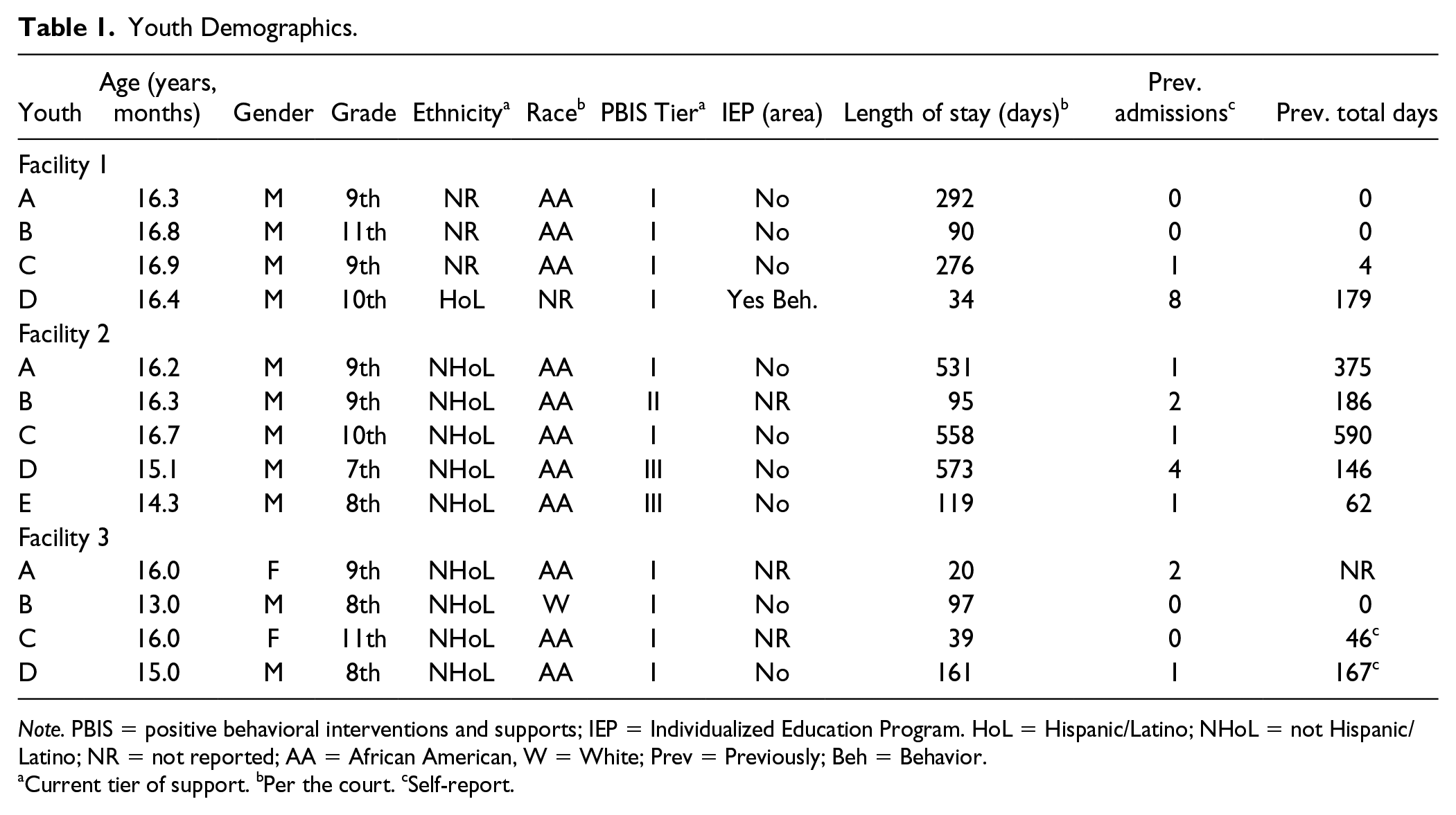
Note. PBIS = positive behavioral interventions and supports; IEP = Individualized Education Program. HoL = Hispanic/Latino; NHoL = not Hispanic/Latino; NR = not reported; AA = African American, W = White; Prev = Previously; Beh = Behavior.
Current tier of support. bPer the court. cSelf-report.
Facility staff members
At each facility, the juvenile detention counselors facilitated the consent and assent process (see below) and completed a demographic form on the youth (see Table 1) if they provided consent. Also, at each facility a security staff member escorted youth to and from the focus groups as well as was present outside the focus group room door to ensure the safety and security of both youth and researchers. These counselors and security staff were not privy to the focus group/survey discussion or questions.
Data collectors
Two researchers conducted the focus groups and oversaw the administration of the surveys at the end of the focus groups. One researcher, who facilitated the focus groups and survey administration and conducted the analyses, had a doctorate in special education with an emphasis on emotional and behavioral disorders and over 17 years of research experiences with emphasis on the PBIS framework within restrictive settings. The second researcher, who took anecdotal notes during the focus groups and survey administration, transcribed the audio of the focus groups, and assisted with focus group analyses, had a master’s degree in special education with an emphasis on emotional and behavioral disorders and 4 years of classroom experience as a teacher in a residential facility and several years of research experience. A third data collector with data analysis experiences recalculated the survey analyses with 100% reliability.
Settings
Three secure juvenile facilities from the Southeastern United States that had been implementing FW-PBIS across the tiers for more than 4 years were selected for this pilot study. These three were randomly selected from the 16 facilities whom, based on the last administration of the Facility-Wide Evaluation Tool (Jolivette, Sprague, & Boden, 2014), met and/or exceeded the minimum fidelity criteria for FW-PBIS at Tier 1 implementation (i.e., >80% percentage of behavioral expectations taught subscale/80% the mean of all seven features). The fidelity scores for each facility at the time of this study were (a) Facility 1: 80/95 (percentage of behavioral expectations taught subscale/the mean of all seven features: 100% expectations defined, 80% behavioral expectations taught, 100% on-going system for rewarding behavioral expectations, 100% system for responding to behavioral violations, 100% monitoring and decision-making, 88% management, 100% state agency level support); (b) Facility 2: 80/94 (percentage of behavioral expectations taught subscale/the mean of all seven features: 100% expectations defined, 80% behavioral expectations taught, 100% on-going system for rewarding behavioral expectations, 88% system for responding to behavioral violations, 100% monitoring and decision-making, 88% management, 100% state agency level support); and (c) Facility 3: 90/84 (percentage of behavioral expectations taught subscale/the mean of all seven features: 100% expectations defined, 90% behavioral expectations taught, 100% on-going system for rewarding behavioral expectations, 88% system for responding to behavioral violations, 69% monitoring and decision-making, 63% management, 75% state agency level support). Each of these facilities had a FW-PBIS Leadership Team comprised of staff members from each of the facility disciplines (e.g., education, security, treatment, recreation), which met monthly for data review, implementation updates and changes, and action planning. Of the three facilities, which served youth ages 13 to 21 years, one served committed long-term youth and two served detained short-term youth. Facility 1 was a short-term all-male facility serving approximately 70 youth from five counties. Facility 2 was a long-term all-male facility serving approximately 60 youth from all counties within the state. Facility 3 was a short-term male and female facility serving approximately 64 youth from 13 counties.
Consent and Assent Process
Our consent and assent process followed agency policy and included the following steps. First, we obtained university Institutional Review Board and agency approvals to conduct the focus groups and survey. Second, the FW-PBIS Leadership Team leaders and facility directors were notified of the study with opportunities to ask questions and decline overall facility participation. Third, the juvenile detention counselors from each selected facility were given consent permission forms which included detailed information on the purpose, time commitments, possible risks and benefits for participation, and the opportunity to decide if they wanted to provide consent for their assigned youth to be involved in the study. Each youth is assigned a juvenile detention counselor upon entrance to the facility who serves as the youth’s advocate. Fourth, on-site the day of the scheduled focus group, the researchers collected the signed consent forms and then randomly selected five forms. Fifth, a facility staff member then brought those five youth to a location near the focus group room where each were assented by the researchers. During the assent process, the youth were given an assent form, which was read aloud with time for them to independently read through the form, ask questions, and accept or decline the opportunity to participate in the focus group. Once assent was obtained, the youth were brought as a group to the focus group room. Two youth (one from Facility I and one from Facility III) declined to provide assent and were returned to their regular programming. Neither of these youth provided a reason for declining nor were they asked for a reason.
Focus Group and Survey Procedures
Prior to the youth entering the focus group room, the researchers had arranged the individual desks or small tables in a circle with arms-length in between each youth’s seat with one researcher sitting among the group. The other researcher sat outside the group at the back of the room out of the line of sight of the youth. Once the consent/assent procedures were finished, the security officer brought the youth to the room, and youth could select their seats. The purpose of the focus group was reviewed, behavioral expectations reviewed (e.g., all can speak and provide their own opinion whether you agree or not with what is shared, that we need to take turns talking), any questions about the processes were answered, and an explanation was provided of how the first part was a whole group focus group with a set of questions and with use of an audio recorder, and the second part was an independent survey with questions related to what would be discussed as a whole group. Then, the audio recorders for the focus group portion were turned on and the focus group began.
One researcher facilitated the focus group by asking the a priori focus group questions in order with the ability for follow-up questions for clarity and details (e.g., how so, tell me more, can you provide an example of that idea). The focus group questions were categorized into the seven tenets of climate assessment adapted from a variety of public school assessments with specific links to the PBIS framework and FW-PBIS implementation. The main tenets included (a) expectations—the behaviors identified as being important within the facility environment (i.e., FW-PBIS expectations); (b) acknowledgment—how one is positively reinforced and/or recognized for behavioral actions by self and/or others within the facility (i.e., linked to the FW-PBIS plan and display of FW-PBIS expectations); (c) discipline—the natural or facility policy consequences for not engaging in the expectation as applied by facility staff (i.e., linked to the FW-PBIS plan and agency/facility consequence flowchart); (d) safety—one’s sense of feeling safe and secure within the facility; (e) respect—one’s sense of how one is being treated or treating others within the facility; (f) connections—one’s sense of belonging to and within the facility; and (g) perspective—one’s individual ideas on improvements within and/or connections to life outside the facility related to FW-PBIS (focus group questions available from author).
To assess student perceptions of facility climate, we adapted an existing survey designed for K-12 school systems, the Stakeholder Input and Satisfaction Survey—Student (SISS-Student; McIntosh, Pinkelman, Girvan, & Sugai, 2017). The SISS-Student is a survey to obtain student perspectives regarding the behavior support systems in the school. In contrast to a standardized school climate measure (e.g., the Georgia Brief School Climate Inventory; White, La Salle, Ashby, & Meyers, 2014), it is intended to provide formative input and student voice for teams to revise their PBIS system to improve contextual fit. As such, its purpose is to obtain feedback and not generate a standardized score of school climate. It includes a set of demographic questions (e.g., gender identity, race/ethnicity), a series of dichotomous questions regarding perceptions about the school behavior systems (e.g., “Are the school-wide behavior expectations meaningful or important to you?”), and associated open-ended questions (e.g., “If not, what do you think the expectations should be?”). The SISS-Student is intended to be delivered anonymously to encourage students to respond as accurately as possible.
The measure used in this study, SISS-Student (McIntosh et al., 2017), was adapted to change the survey language to match juvenile justice facility semantics (e.g., from school to facility, from students to youth), processes (e.g., facility-wide), and the systems in which they operate as well as to focus youth to FW-PBIS implementation as it specifically relates to facility climate. That is, some questions on the adapted survey had the phrase FW-PBIS embedded with them as FW-PBIS was a more concrete anchor for climate than leaving it a more abstract idea. By doing so, we attempted to address some of the potential cognitive and processing issues (e.g., having or being at-risk for educational disabilities) of the targeted population. The survey began with four demographic questions and an open-ended question on what they thought was the best part of their facility. Following were questions related to the major tenets of climate: (a) expectations, with 12 questions of which nine were dichotomous (five had embedded open-ended questions, and one involved circling additional and multiple responses) and three were open-ended; (b) acknowledgment, with five questions of which four were dichotomous (two had embedded open-ended questions with one also having a dichotomous question); (c) discipline, with three questions of which two were dichotomous (both had an embedded an open-ended question) and one open-ended; (d) safety, with five questions of which three were dichotomous (two had embedded open-ended questions) and two open-ended (both had a further embedded open-ended question); (e) respect, with six questions of which five were dichotomous (two had embedded open-ended questions) and one open-ended; (f) connections, with five questions which were all dichotomous; and (g) your perspective, with four questions which were all open-ended.
Data Analyses
Focus groups
After each focus group was transcribed, two researchers replicated procedures used by other researchers investigating stakeholder voice with FW-PBIS implementation (e.g., Jolivette et al., 2015; Kimball, Jolivette, & Sprague, 2017; Swain-Bradway, Swoszowski, Boden, & Sprague, 2013) by way of the constant comparative method (Glaser & Strauss, 1967). Two researchers independently read each transcript, identified and named possible facilitator themes (i.e., positive) and barrier themes (i.e., negative), categorized youth responses into these themes, highlighted such themes on the transcript, and created a notecard per theme with verbatim examples from the transcript. Then, the researchers met to discuss how they had each identified and named their themes and what examples from the transcript supported these themes. After this discussion, the researchers either kept or renamed a theme and then agreed upon the specific youth responses which supported each theme. During this discussion, the specific length of the youth response to include as part of a theme example was solidified.
Survey
Descriptive statistics from the survey responses and the percentage of “no,” “yes,” and “no response” responses were calculated across all facilities. The open-ended question responses were summarized by climate tenet with specific examples provided in the results.
Results
Focus Groups
Several themes emerged across the facility focus groups and climate tenets. The positive themes include (a) that youth can influence their own change, (b) relevancy and transference of new skills and behavior, and (c) equity of treatment.
Youth can influence their own behavioral change
Youth discussed how FW-PBIS has provided them a mechanism from which to change their trajectories and behaviors. For example, within the connections climate construct, a youth stated “it [PBIS] gives [one] a different mind-set.” While within the expectations climate construct, another stated “this whole facility you know, I feel like this facility is meant to change the people that come in. You know you either let it change you, make you, or break you . . . that’s up to you,” and “I think that PBIS is like a standard for people. If you can meet all the [expectations] that you have set, then you can set a standard for yourself to become [better].” Within the respect construct, one youth stated “if you don’t respect yourself, nobody else will” and “respect is not given, it is earned,” whereas another linked it to self-control which themselves and most of their peers have not mastered (i.e., “it takes a man and a woman to walk away . . . it takes a lot . . . and everybody is able to do that . . . it all comes down to self-control. To respect someone, you have to have self-control”). Within the acknowledgment construct, a youth stated that FW-PBIS taught him or her that “you can reward yourself on the outside” whereas another stated that through FW-PBIS he or she learned that “you know everybody falls but it’s your choice to stay down when you fall or your choice to get back up.” At one facility, a youth summarized the discussion in that FW-PBIS taught them the expectations and there was a system to acknowledgment those who displayed the FW-PBIS expectations; thus, “it’s basically up to us to change or go down the wrong path.”
Relevancy and transference of new skills and behavior
When answering questions within the expectations climate construct, multiple youth indicated that FW-PBIS was providing them the context to improve from their current circumstances, especially for their lives upon discharge. Several youth stated that FW-PBIS and the expectations of the facility were similar to how they should behave at home and if they were to go to their neighborhood school, with one youth stating that FW-PBIS “is basically you can learn it from your surroundings.” A youth stated that FW-PBIS “can make a major difference in your life” whereas another youth stated that through FW-PBIS, he or she “thought to myself, if I can be good in here . . . then I can go out and do good out there.” Another youth stated FW-PBIS helped him or her by “I think that I got my head where I need it to be now . . . when I get out of here I’m not going to be worried about doing what I used to do . . . running the streets . . . I got my priorities together.” Other youth stated “it’s [FW-PBIS] like the things we’re going to do when we get out,” “if I can do good here, then I can do good there [anywhere],” and “a [FW-PBIS] picture in my mind of the outside, it really can take you a long way. It can take you to bigger and better things.” Other youth stated how FW-PBIS was teaching them new skills. For example, youth stated that they “learn responsibility” and how to “make the right choices.” Other youth stated they are “trying to make other people to be a model student,” “I’ll teach my little brother [FW-PBIS],” and “I’m learning to do good here and I’ll get rewarded when I go home if I do good.” A youth stated that FW-PBIS is teaching him or her to “focus on your future which sounds good.” Only one youth expressed hesitancy as to his or her ability to use FW-PBIS components once discharged from the facility (i.e., “I don’t know about PBIS out on the streets”).
Equity of treatment
When discussing the expectations and acknowledgment climate constructs within the PBIS framework, the youth expressed that FW-PBIS has created a facility environment that has improved equal and fair treatment across youth and locations/activities. For example, youth stated that FW-PBIS has “standards that everyone is required to meet,” “it’s pretty straightforward,” “you see them [FW-PBIS expectation posters] everywhere you go,” and that you can be acknowledged “based on your behavior,” the acknowledgment system is “fair,” and that staff “let you know that you did right.” Within the discipline climate construct discussion, youth stated that with FW-PBIS discipline practices were “fair” and within the safety construct that they felt safe and “don’t have to watch your back all the time.” Youth also stated there is equitable treatment in that FW-PBIS is in their “handbook” and “it is part of the intake process” which all youth participate in. Basically, a youth stated that FW-PBIS “tells us all how to act” and “I feel like a lot of kids do go [display the expectations] because they know if I do this . . . I get something.” In one facility, the youth linked equity of treatment to how one of their peers created the FW-PBIS logo for all the PBIS posters throughout the facility (i.e., “that poster right there, there is a boy here he actually drew that and made it—that youth also had voice in creating FW-PBIS”).
Few youth shared concerns related to FW-PBIS; however, some negative themes emerged across several of the climate constructs and at times, were contradictory to a positive theme. These negative themes include (a) inconsistent aspects of FW-PBIS, (b) ambivalence of usefulness of FW-PBIS within the facility, and (c) lack of connectedness to the facility.
Inconsistent aspects of FW-PBIS
Some youth disagreed with their peers within the climate constructs of expectations, acknowledgment, and respect. In terms of acknowledgment and primarily from one of the sampled facilities, youth expressed concern that staff inconsistently acknowledged them and/or did not adhere to the FW-PBIS policies they were taught (e.g., such as during the intake process or as per their Youth Handbook). For example, two youth stated “it depends how the [staff] want to do it,” “it goes by how much your [staff] wants to give you,” “some [staff] they just don’t give us points for no reason,” and “I feel like we don’t get rewarded enough.” Youth did not verbally discuss any negativity related to this theme for the climate constructs of discipline, respect, connectedness, or safety.
Ambivalence of usefulness of FW-PBIS within the facility
A few youth expressed that FW-PBIS may not be as useful to all youth given the complexities of a facility and the youth served within. For example, within the expectations climate construct, a youth summarized it as “I think that sometimes the [FW-PBIS] expectations that they set, they can’t be met because it’s so much going on in this little place that not everybody can deal with it and not everybody can cope with it . . . cause for some people, it’s their first time being here so they don’t know how to deal with [FW-PBIS].” Another youth stated “sometimes it’s like you know, I don’t care or I care.” Within the respect construct, youth expressed how the youth they live with within the cottages/dorms/units or in the classroom, which they have no control over, affect the interactional nature of respect. For example, a youth stated “the youth here don’t respect me and I don’t respect them” and “some people expect people to respect them but they don’t respect that person back.” Another youth summarized the ambivalence specific to the respect construct by saying “I think that’s [respect] is the biggest expectation in here because being around a lot of other kids, you know that kind of struggle with the same thing [respect] as you.” Youth did not verbally share concerns for the constructs of discipline or safety within this theme.
Lack of connectedness to the facility
When responding to the first question (i.e., do you feel connected to this facility—how so) within this climate construct, most of youth across each facility expressed a negative response. Either youth stated in unison and loudly “no” or a youth or two stated “no” with the rest of the group shaking their heads in agreement. Other youth rolled their eyes and repeated ‘“no.” Youth further stated “no one should feel connected [to here]” and “I don’t want to feel connected to no facility.” One youth imposed the construct of time onto connectedness and stated “I’ve been here a long time so of course, I’ve got to connect to it.”
Survey Responses
Table 2 provides the yes/no dichotomous survey response summaries across facilities per the independent youth responses.
Expectations Climate Construct Response Summary.
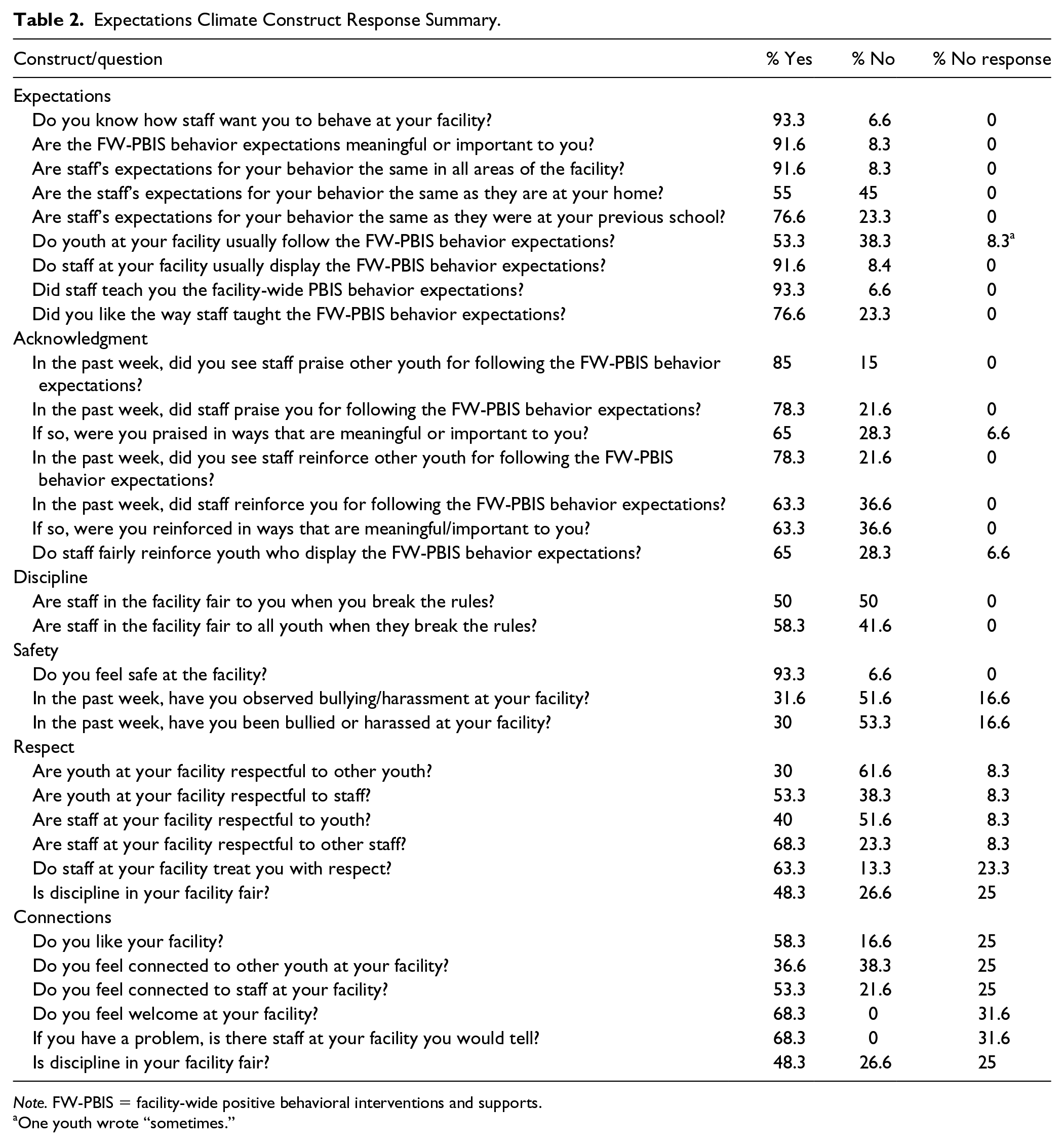
Note. FW-PBIS = facility-wide positive behavioral interventions and supports.
One youth wrote “sometimes.”
Expectations
For the expectations climate construct, the question of whether the FW-PBIS expectations were the same as at home produced mixed responses, with most of youth indicating a no response. Some youth wrote how at “home it’s [rules are] more basic,” or that they followed their “mom’s rules.” Other youth wrote that the expectations were different “because I don’t have to be good to reward myself at home” and “because we ain’t got to ask to go to certain places.” In terms of whom within the facility taught the youth FW-PBIS expectations, all the youth identified at least one person with a range of one to seven staff positions named (M = 4). Most of youth indicated they were taught by their youth counselor (n = 10) with intake officers and security following (n = 6). Youth also indicated that their teachers (n = 4), recreation staff and case managers (n = 3), and unit managers (n = 2) taught them the FW-PBIS expectations at some point during their stay. One youth wrote in that the director of the facility taught the FW-PBIS expectations. In relation to whether the youth liked the way in which staff taught the FW-PBIS expectations, the majority stated they did and offered many reasons why. For example, some youth wrote “they had a good way of explaining it,” “because they made it easy to understand,” “they explained everything clearly,” and “they told us what was expected before we did something to get in trouble.” Some youth linked the way in which they were taught motivational issues such as “because it gives me something to work towards.” For those youth who stated they did not like how FW-PBIS expectations were taught, they wrote “they didn’t teach them, they just hung up posters” and “they really didn’t explain it enough.”
Acknowledgment
For the acknowledgment climate construct, most of youth indicated positive responses as to how staff were catching them doing things the right way. However, fewer youth indicated that they themselves had been acknowledged for displaying the FW-PBIS expectations (63.3%) as compared with observing other youth receiving acknowledgment (78.3%). Furthermore, fewer youth indicated that when they were acknowledged, it was in a meaningful way (63.3%). For example, a youth wrote “when I do something good, I would like to get acknowledged” and another youth wrote that when being acknowledged by staff they need to “say it in a respectful way.”
Discipline
For the discipline climate construct, youth responded with mixed results with 50% in the negative in terms of fairness for themselves and other youth when being disciplined and the other 50% in positive terms. All youth in two of the sampled facilities responded in the positive, and half in the third facility. Examples of negative responses youth wrote were “to treat all youth the same as others,” “other youth should get the same treatment as me,” and “same treatment as everybody.” The youth who wrote negative responses indicated the behavioral strategy of response cost (i.e., the removal of something earned prior when a negative behavioral incident occurs) was in effect and unfairly used across youth in their facility. For example, youth wrote “stop taking our events” and “some of us get more events taken away.” Also, many of these youth indicated that when they break the rules, all access to the FW-PBIS framework is removed (i.e., “you lose PBIS” and “no PBIS”). Within the participating facilities, response cost was not an approved behavioral strategy to address youth who did not engage in the behavioral expectations within the FW-PBIS framework nor part of the agency/facility consequence flowcharts. Other youth indicated that the disciplinary practices were “harsh” but provided no further details.
Safety
For the safety climate construct, most of the youth responded that they feel safe in their facility (93.3%), and the majority reported that they have not witnessed bullying harassment (51.6%) nor been a victim of bullying or harassment (53.3%). For the bullying and harassment questions, several youth did leave their responses blank (16.6%); however, they also stated they felt safe in the facility. Most of the youth left the location of where they observed bullying or harassment blank, but for those who did indicate a response they wrote “everywhere,” “in groups,” or “cottage.” When asked where they felt the most safe, two themes emerged from youth responses: (a) places where there were few to no other youth (i.e., room/cell), and (b) the size of the space whether it be small (i.e., room and cottage/unit/dorm where there were few to no other youth) or large (i.e., multipurpose room due to space to move around). Youth also wrote that “staff,” “security,” and “PBIS” make them feel safe. When asked where they felt the most unsafe, youth indicated locations where there were more youth or perceived as “too crowded” (i.e., education, recreation areas) and where they identified “blind spots” (i.e., areas in the cottage/unit/dorm) or places where there are “no cameras” (i.e., closets) or “officers watching” (i.e., cottage/unit/dorm). Two facility locations received mixed responses related to perceptions of safety: (a) education, with some youth indicating the positive of fewer youth in a class, while others indicating the negative mixture of youth in the classroom or vulnerability to being “popped off”; and (b) cottage/unit/dorm, with a youth indicating positively that it is a contained space while others indicating negatively that it was dependent on officer presence (i.e., “no officer watching) and concern for “blind spots” where safety was not ideal.
Respect
For the respect climate construct, youth indicated that youth are more likely to be respectful toward staff (53.3%) than to each other (30%); and staff are more likely to be respectful to each other (68.3%) and less likely to be respectful to youth (51.6%). Most of youth responded that staff treat them with respect (63.3%). When asked how staff treat them with respect, several youth indicated that it is a reciprocal phenomenon (i.e., “give respect to get it,” “they treat me how I treat them,” and “because I show them respect”). For those few youth who responded negatively, they wrote that they perceived unfair treatment (i.e., “they come after me in a rude manner”) or negative language is used (i.e., “cursing at me”). For all items within this construct, one youth provided no responses.
Connections
For the connections climate construct, most of youth responded that they liked their facility (58.3%), felt welcomed (68.3%), and felt connected to the facility staff (53.3%). All those who responded to whether there was a staff person to contact if they had a problem while in their facility, did so positively. For all items within this construct, three youth provided no responses which resulted in more “no response” than any other section.
Comparison of Focus Group and Survey Responses
Overall, there were no substantive differences between the responses provided by youth via the focus groups compared with the survey. Previous researchers (e.g., Jolivette et al., 2015) hypothesized that such differences may exist. For one climate assessment tenet, connectedness, during the focus group almost all the youth either verbally or nonverbally questioned this tenet. Anecdotally, one to three youth at each facility verbalized their concern and appropriateness of this survey section as well. During the survey completion, youth were heard saying aloud “connectedness—who would want to be connected to jail,” “[expletive] this—no one would be here if they had a choice,” and “of course I’m not connected here.” This survey section also had the most number of youth who provided no responses to the questions.
Discussion
It is critical that youth have a voice within the construction and implementation of FW-PBIS, especially given that youth voice is typically an embedded procedure within FW-PBIS Tier 1 local operating procedures (Jolivette, 2016) and agency programming and policies (i.e., youth councils). In this study, youth shared their perceptions, both positive and negative, related to facility climate as viewed through the lens of FW-PBIS implementation.
Implications for Practice
When data are collected, it is important that the information be gathered in a manner conducive to the population being sampled and new information used in a purposeful and meaningful manner. Youth within juvenile facilities may have difficulties independently and accurately completing a survey due to deficits in cognition, language, and self-regulation skills as many have or are suspected of having educational disabilities or mental health needs (e.g., Dierkhising et al., 2013; Gagnon & Barber, 2017; Krezmien, Mulcahy, & Leone, 2008; Quinn, Rutherford, Leone, Osher, & Poirier, 2005; Wagner & Davis, 2006). Therefore, the way youth are sampled may need to be altered such as by staff reading aloud each survey item, conducting the survey electronically whereby items can be adjusted by readability level for the individual, altering the assessment environment to be free of distractions or with fewer youth at a time, or via other assessment accommodations. In this study, the data related to FW-PBIS implementation and climate may be used to inform practice at both the agency and facility level. At the agency level, action items may include (a) describing what climate is, how it can effect youth behavior, how it can be supported by FW-PBIS implementation, barriers to climate perceptions, and the benefits of a perceived and actual safe and supportive climate can have for both youth and staff; (b) training clarification and communication on the consequences approved by the agency for youth who do not engage in the FW-PBIS expectations such as how to use the consequence processes in place of specific, non-approved behavioral strategies (i.e., response cost, group consequences) and why such strategies are no longer in place with links to the notion of fairness and adherence to agency/facility Youth Handbook language; (c) conducting walkthroughs of their facilities to identify and minimize any blind spots that could affect the overall safety of a facility, such as through the addition of more or different camera placements, movement of furniture, or change of routines per the master schedule; and (d) modeling for Teams how to explicitly teach FW-PBIS expectations instead of relying on only posting the content on the walls of the facility. In one juvenile agency implementing FW-PBIS statewide, the FW-PBIS primary system support is through assigned climate specialists who assist FW-PBIS Leadership teams at the facility-level, conduct fidelity of implementation assessments, and provide ongoing FW-PBIS professional development across the tiers (Doyle, Nihles, & Taylor, 2018). At the facility level, action items may include (a) scheduling boosters to reteach staff on the facility-specific procedures for reinforcing youth engagement in the FW-PBIS expectations including the importance of equity and fidelity of implementation; (b) reviewing the agreed upon FW-PBIS language and the use of approved de-escalation strategies and language to use when youth are or are about to engage in behaviors outside FW-PBIS expectations; and (c) conducting periodic assessments related to the FW-PBIS acknowledgment system to keep it “fresh” for the current interests of the youth within the facility and to avoid satiation for those youth who may have been at the facility for a longer period of time. Thus, data gleaned from assessing youth perceptions of climate and culture within facilities implementing FW-PBIS can be used to produce actionable and tangible changes. The teams assessing climate and culture can analyze the data, provide recommendations for improvements, provide training and ongoing support to facility staff for implementing such changes, and continue monitoring the effects of such changes on youth and staff climate perceptions. Overall, the use of a climate survey specific to youth in juvenile settings paired with FW-PBIS implementation has the potential to formalize and standardize climate assessment within the data feature of the framework and link assessment data to system and/or practice changes for daily operations.
Limitations
The conclusions of this pilot study should be interpreted with caution. First, our sample size was small which limits the generalizability of the conclusions. Second, social desirability bias may have occurred with the youth responding during, both or either of, the focus group or survey in a manner they perceived less likely to be punished (i.e., sharing ideas they think will not get them in trouble). Third, sampling bias may have occurred as the juvenile correctional officers were the first to randomly select the youth from which we pulled participants; thus, our group may have provided responses different from other participants.
Future Research Directions
As more secure juvenile facilities, as well as nonsecure facilities and other residential settings (e.g., therapeutic residential facilities and hospitals), adopt and implement FW-PBIS, it will be important that links to overall facility climate and such data collection be made given that a premise of FW-PBIS is to support and strengthen safety and security of youth and staff (Jolivette, Colombi, & Taylor, 2018). Future researchers may want to replicate the survey on a larger scale to hear from more youth within an entire facility or across facilities within an agency to better understand the intersection and nuances of FW-PBIS implementation on the tenets of facility climate. Such replication may indicate necessary edits to the conventions of the survey (e.g., changing dichotomous questions to open-ended responses or vice versa). Also, researchers may want to distribute the survey prior to the focus groups. This would allow for targeted follow-up questions for survey responses which may need further exploration or youth feedback. It will be important that future facility climate surveys be validated for use in secure and nonsecure juvenile facilities and other residential settings which operate 24 hr a day, 7 days a week as compared with traditional school delivery models and the climate surveys used there. In addition, researchers may want to further investigate the utility and dimensions of the connectedness climate construct given the different reactions of youth when discussing or responding to those items. For youth who are remanded into the custody and care of a juvenile facility, many may not view this setting as one in which they want or need to be connected as it is a temporary placement with the goal of release back to the community. If this construct remains, then rephrasing of survey items may need to be reconsidered. For example, youth focus groups may be held to purposefully target only this construct to better understand how these youth define connectedness. A change in the conceptualization of connectedness or clarification by what is meant by it, may address their anecdotal reactions and/or decision to not respond to these survey items. This construct also may be better assessed if other terminology is used as it relates to other aspects of their treatment of programming. For example, the construct of connectedness could be associated with aspects of the trauma-informed, social-emotional learning, and reentry practices they are receiving. By doing so, the youth may better understand what is actually trying to be assessed. Another possibility for this construct is the placement of it during the focus group and on the survey. Currently, connectedness is addressed during the later portions of both so it is possible that youth responses were an artifact of fatigue. Also, researchers may want to simultaneously assess climate from both youth and staff perspectives within juvenile facilities to determine whether there is congruency or differences in overall climate perceptions and per the tenets of climate (Jolivette et al., 2015). This may be conducted at specific time points as would other academic, behavior, and mental health screeners or be on a schedule specifically set by the agency and/or facility. This research would entail adapting the climate survey used in this study or the creation of new climate surveys for both depending on the types of data to be gleaned (e.g., descriptive statistics). Furthermore, researchers may need to assist FW-PBIS Leadership Teams and agency-level supporters (e.g., coaches) in securing, interpreting, and using the climate data gleaned from youth voice. For example, researchers may assist the teams or personnel in scheduling when such surveys are provided (e.g., during in-take, so many months after admittance, and upon exit) to determine whether FW-PBIS and its effect on facility climate are improving or not in a systematic manner so that analyses can be conducted. To minimize response bias, surveys may be administered by researchers or others who do not work in that particular facility. Once surveys are completed, researchers may assist in how to analyze the data (e.g., statistical analyses, qualitative review), secure follow-up information or triangulate data (e.g., sampling youth in one-on-one or focus group formats for clarification or additional ideas), and then how to use the data to inform action items and alterations to the FW-PBIS plans or other programming aspects (e.g., translating data into meaningful steps for improvement). Such assistance may include other means of collecting data on FW-PBIS implementation and climate (e.g., adding youth to the FW-PBIS Leadership Team, embedding climate agenda items to the Youth Counsel).
As with climate measurement in typical school settings, it is just as important to measure climate within facilities in which school-age youth reside. Although comparisons between climate data from typical school settings to facility-wide settings would not be possible nor appropriate (e.g., apples to oranges), soliciting the voice of youth and staff is critical for improvements in learning contexts. In conclusion, researchers have encouraged inclusion of youth voice within the FW-PBIS framework associated with implementation and climate to improve existing practices and support youth buy-in. This study sought to evaluate youth perspectives of FW-PBIS related to climate using an adapted climate survey and focus groups—two forms of youth voice. Further research addressing youth perspectives of FW-PBIS continue to be warranted and will provide valuable information to FW-PBIS Leadership teams as they continue to implement and refine their preventive and proactive practices afforded to the youth served in secure facilities.
Footnotes
Acknowledgements
We thank Kathleen Kimball for her assistance in data collection and preliminary data analyses.
Declaration of Conflicting Interests
The author(s) declared no potential conflicts of interest with respect to the research, authorship, and/or publication of this article.
Funding
The author(s) disclosed receipt of the following financial support for the research, authorship, and/or publication of this article: Development of this article was supported in part by grant #R324A100286 from the U.S. Department of Education, Institute of Education Sciences. The opinions expressed are those of the authors and not necessarily of the funding agency.
