




Abstract
Disability support office (DSO) staff are responsible for providing appropriate support for an increasing population of undergraduate students with autism. A total of 153 DSO staff members in higher education institutions in the United States completed an online survey on their autism attitudes and knowledge, previous contact with autistic people, and demographic characteristics. Multiple regressions were conducted to investigate which variables uniquely predict their attitudes and knowledge. Quality of contact and education level predicted openness toward autism. Quality and quantity of contact, knowledge, and public versus private status of institutions predicted social distance toward autistic individuals. Finally, quality of contact, school size, and average annual cost predicted their knowledge. The underlying mechanisms between institutional variables and autism attitudes and knowledge need to be explored. Understanding what kinds of institutional supports and context-appropriate training should be provided to promote collaborative relationships between DSO staff and autistic students is a promising avenue for future studies.
Recent trends suggest that enrollments of autistic (see Note 1) students in higher education institutions (HEIs) are increasing (Bakker et al., 2019). Section 504 of the Rehabilitation Act of 1973 stipulates that all students with documented disabilities can request accommodations that will enable them to participate in and benefit from all postsecondary educational activities to the greatest extent possible. Disability service offices (DSOs) thus exist in HEIs to help students with various disabilities access resources on campus and successfully complete their education (Enright et al., 1996). However, many autistic undergraduates have reported significant difficulties and institutional barriers in making a successful transition into and graduating from college (Gelbar et al., 2014).
Although Cai and Richdale (2016) reported that DSO staff members effectively support autistic students with class selection, time management, and academic assignments, growing evidence indicates that many DSOs lack the resources and knowledge to cater to the varied needs of autistic students (VanBergeijk & Cavangh, 2012). Kim and Crowley (2021) indicated that autistic college students felt their DSO staff members lacked understanding of autism, especially about the variability of support needs in autism. Autistic students in Cai and Richdale (2016) and Van Hees et al. (2014) also stressed the need for sufficient awareness of and knowledge about autism among staff members. DSO staff members who have accurate and comprehensive knowledge about autism are likely not only to be more effective in understanding the needs of students and providing helpful and appropriate services but also to advocate on behalf of the students to provide a more inclusive and supportive environment.
In addition to knowledge about autism, DSO staff members’ autism attitudes are also particularly critical for autistic undergraduate students. Students seeking accommodations for disabilities are required to disclose relevant information to the university, which typically brings them into contact with DSO staff members. When staff members show accepting attitudes, autistic students may be more likely to disclose their disability and any related concerns.
However, no previous study has examined DSO staff members’ attitudes and knowledge about autism. The majority of studies investigating attitudes and knowledge about autism have been conducted on nonautistic undergraduate student samples (Gardiner & Iarocci, 2014; Nevill & White, 2011; White et al., 2019) or faculty members (Zeedyk et al., 2018). These studies have frequently sought to identify variables that are associated with attitudes and knowledge about autism such as previous contacts with autistic individuals and demographic variables to understand ways to promote societal attitudes and knowledge about autism and support successful college experiences for autistic undergraduates. In addition to individual characteristics, institutional characteristics may also be associated with staff members’ attitudes and knowledge about autism. Therefore, this study will investigate DSO staff members’ attitudes and knowledge about autism and determine whether knowledge, previous contact, demographic variables, and institutional variables are associated with DSO staff members’ attitudes about autism. Associations between knowledge about autism and previous contact, demographic variables, and institutional variables will also be examined. The section below describes how attitudes and knowledge about autism have been studied in previous literature and how previous contact, demographic, and institutional variables may be implicated with attitudes and knowledge about autism.
Attitudes
Noting the difficulty of defining the term “attitude,” Eagly and Chaiken (2007) theorized that attitude refers to the degree of favorability or unfavorability when overtly or covertly evaluating a particular entity and the characteristics associated with it. The autism literature has frequently investigated openness toward autism using the Openness Scale (e.g., the extent to which one feels afraid or comfortable around an autistic person or thinks an autistic person is different from him or her or as smart as him or her, Nevill & White, 2011) or stigmatizing attitudes held about autism with the Social Distance Scale (SDS; that is, measuring how willing a person is to engage with an autistic individual at various levels of intimacy, Gillespie-Lynch et al., 2015; Link et al., 1999).
Knowledge
In the autism literature, knowledge about autism is frequently assessed by measuring the extent to which nonautistic individuals can correctly identify social, emotional, or behavioral traits and general features of autism and reject misconceptions about autism (Gillespie-Lynch et al., 2015; White et al., 2019). The association between knowledge and attitudes about autism has been repeatedly reported (Gillespie-Lynch et al., 2019; Kuzminski et al., 2019; Mahoney, 2008). For example, Gillespie-Lynch and colleagues (2015) found that after participating in an online training program that taught knowledge about autism, nonautistic undergraduate students reported less autism stigma.
Others found more nuanced associations between autism knowledge and attitudes. Knowledge about how autistic individuals experience their emotions and social world (e.g., “autistic people experience emotions differently to people who do not have autism”) predicted nonautistic individuals’ attitudes about autism, but having inaccurate knowledge about specific characteristics of autism (e.g., “autism only occurs in children”) did not (Kuzminski et al., 2019). White et al. (2019) asked nonautistic undergraduate participants to identify correct (i.e., behaviors that an autistic peer may demonstrate in the classroom such as wanting to follow syllabus strictly) and incorrect (i.e., behaviors that do not fit the representative profiles of autistic college students) traits of autism to measure their accurate and inaccurate knowledge about autism, respectively. Inaccurate knowledge was associated with negative attitudes (e.g., unwillingness to have an autistic peer in their class or to socialize with an autistic student) regardless of participants’ ability to accurately identify the correct traits.
Previous Contact
Previous studies have tried to understand the associations between attitudes and knowledge about autism and previous contact (i.e., quality and quantity of contact) with autistic individuals. For instance, previous studies on nonautistic undergraduate students have repeatedly reported a positive association between the quality of contact and attitudes about autism (Gardiner & Iarocci, 2014; Gillespie-Lynch et al., 2015, 2019). Quality of contact was also correlated with knowledge about autism (Gillespie-Lynch et al., 2019).
Studies examining quantity of contact reported that nonautistic undergraduate students’ attitudes toward autism were positively associated with having met an autistic person (Gillespie-Lynch et al., 2019), knowing an autistic person (White et al., 2019), and having had frequent and more intimate interactions with an autistic individual (Gardiner & Iarocci, 2014). In regard to the association between the quantity of contact and knowledge about autism, White et al. (2019) found that undergraduate students who did not know an autistic person were more likely than those who did to believe that autistic individuals have cognitive deficits and speech impairments. However, Bottema-Beutel et al. (2018) suggested the quantity of contact alone may not change attitudes and knowledge about autism. Frequent contact that results in negative or uncooperative interaction may reinforce rather than dispel stereotypes of autism.
Demographic Factors
In addition to quality and quantity of previous contact, several demographic characteristics have been suggested as potential variables influencing attitudes and knowledge about autism, but results have been inconsistent across studies. Gender and age have frequently been examined in studies exploring autism attitudes (Gillespie-Lynch et al., 2015). Some studies have reported that women report less autism stigma than men (Gillespie-Lynch et al., 2015) and have more favorable societal attitudes toward autistic individuals, as measured by items such as “People with autism should not engage in romantic relationships” on the Societal Attitudes Toward Autism Scale (Kuzminski et al., 2019). However, Nevill and White (2011) found no gender differences in nonautistic undergraduate students’ openness toward autism. Similar contradictory results have been found regarding the association between age and attitudes, with at least one study reporting a significant positive association (Findler et al., 2007), whereas others did not (Dachez et al., 2015; Sasson & Morrison, 2019). Meanwhile, Tipton and Blacher (2014) reported that females and younger individuals had more accurate knowledge about autism but demographic variables explained only a small portion of the variance.
In regard to education level, Tipton and Blacher (2014) found no significant pattern of association between education level and autism knowledge among the members of a college campus community (faculty, staff, and students). Nonetheless, because most studies of attitudes about autism have been conducted with undergraduate students, education level has not been extensively studied in previous studies. It may be speculated that years of employment as a DSO staff member indicate the level of expertise as a service provider, which may result in greater ease working with autistic students and contribute to more accepting attitudes and accurate knowledge. However, some DSO staff members may see supporting autistic students simply as a professional responsibility, and the level of expertise as a DSO staff member may not necessarily affect attitudes.
While some researchers have found that country of residence was a significant predictor of participants’ attitudes toward and knowledge about autism (Mac Cárthaigh & López, 2020; Someki et al., 2018), little is known about the influence of race on attitudes and knowledge. Burkett et al.’s (2015) qualitative study of African American families with autistic children suggested that the parents perceived a lack of knowledge about autism and low acceptance of disability within the African American community. However, there is a need for robust quantitative examination of the associations between race and attitudes and knowledge about autism.
Finally, it is possible that having autism-specific training is positively related to attitudes and knowledge about autism because DSO staff with direct autism training may have had more opportunities to be exposed to the discussions that promote knowledge and attitudes about autism. However, Park et al. (2010) reported that the experience of attending autism workshops was not associated with the autism attitudes of preservice teachers, suggesting the potential importance of working and teaching experience over attending workshops.
Institutional Factors
Despite the lack of previous literature, institutional factors specific to each higher education context, such as the location or the number of autistic students attending the institution, may also be associated with the attitudes and knowledge about autism of DSO staff members. Determining which institutional variables are correlated with knowledge and attitudes may help researchers and educators plan targeted support and resources to help staff members gain more accurate knowledge and more accepting attitudes. Potential factors that may be associated with DSO staff members’ attitudes and knowledge about autism are private or public status, average annual costs, size of the undergraduate student body, urbanicity, and whether or not the institution is a 4-year institution.
Staff members who are better supported by institutional authority and customs may be more likely to have high-quality contact with autistic students, which may then translate into accurate knowledge and accepting attitudes about autism. For instance, institutions with higher average annual costs may provide better resources to DSO staff members (e.g., better pay) than institutions with lower annual costs. This may motivate staff members to learn more about autism, resulting in a greater likelihood of having high-quality and sustained interaction with autistic students. Private institutions and institutions with small student bodies tend to have a lower staff-to-student ratio, a variable that has been associated with more opportunity for staff–student contact, than public institutions and institutions with large student bodies (McDonald, 2013). Greater amounts of sustained quality contact with autistic students may positively influence the knowledge and attitudes of DSO staff members working at private institutions or institutions with small student bodies.
Because there are more health care resources in urban than in rural areas (Malatzky & Bourke, 2016), staff members working in urban institutions may feel more supported by the availability of on- and off-campus health care providers (e.g., mental health counselors or job coaches), who can support autistic students more effectively than DSO staff in specialized areas. Staff members at 2-year, technical, or community colleges may have more experience working with autistic students as 80% of autistic young adults choose to attend such institutions rather than 4-year colleges (Roux et al., 2015). At the same time, because more autistic students attend 2-year, technical, or community colleges, DSO staff members at these institutions may receive a more structured institutional support that allows them to have high-quality interactions with students, leading them to have more accepting attitudes and accurate knowledge than those at 4-year institutions. However, it is also possible that the type of institution is not related to the resources provided to DSO staff members and, consequently, does not influence their attitudes and knowledge about autism.
The Current Study
In this study, an online survey was utilized to quantitatively assess DSO staff members’ autism knowledge and attitudes (measured by openness to and degree of social distance from autistic individuals) to address the following research questions:
The premise of this study was that having accepting attitudes and accurate knowledge would lead DSO staff members to provide effective services for autistic students. Also, as distinct albeit related constructs, attitudes and knowledge about autism may be implicated in different aspects of autistic students’ interactions with staff members. That is, autistic students are more likely to disclose their diagnoses and needs if staff members show accepting attitudes, and staff members are more likely to provide appropriate support if they have accurate knowledge about autism. Therefore, this study aimed to inform which subgroups of DSO staff members have inaccurate knowledge and unaccepting attitudes about autism and may need further assistance to promote their autism attitudes and knowledge.
This was an exploratory study without specific directional hypotheses associated with each variable, with one exception: It was hypothesized that quality of contact would be positively related to staff members’ attitudes about autism. High quality of previous contact with autistic individuals was expected to lead to rejection of misconceptions about autism and result in accepting attitudes about autism, and low-quality contact with autistic people was expected to reinforce incorrect misconceptions and negative attitudes about autism.
Method
Participants
A total of 153 DSO staff members of 92 HEIs (see Note 2) in the United States participated in this study for compensation of US$20. Table 1 presents detailed participant characteristics. Nine participants self-identified as having a type of developmental disability that is not autism. The survey responses from these participants were included because this study aimed to explore attitudes and knowledge about autism of any DSO staff member whom autistic undergraduate students might encounter in their institutions regardless of their disability status. Moreover, sensitivity tests showed that disability status did not influence the results of significance testing of any regression models.
Participant Characteristics.

Frequencies do not add up to 153 because some participants did not reveal the information. Percentages were calculated out of 153.bRace categories are not mutually exclusive. cForty community colleges, three technical colleges, and three community and technical colleges.
Several purposeful methods were employed to recruit participants from institutions that provide different ranges of support to autistic students and from both 4-year institutions and non-4-year institutions. Initially, DSO staff members, whose contact information was collected from the websites of HEIs listed in the K&W Guide to Colleges for Students with Learning Differences (the K&W Guide; Kravets & Wax, 2016), were approached via email to participate in the survey and encouraged to share information about the survey with their colleagues. The K&W Guide categorizes U.S. HEIs into three tiers based on their levels of support services available to disabled students: institutions that provide a basic level of support that meets legal requirements (Services); institutions that include at least one certified learning disability specialist on the DSO staff (Coordinated Services); and institutions in which students with disabilities may have their own individualized learning plans and offer programs specifically for students with learning differences (Structured Services). Fifty institutions were randomly selected from each tier. Supplementary Information A provides a detailed description of the K&W Guide.
In addition, because the K&W Guide does not provide a comprehensive list of U.S. HEIs, professional organizations, and conferences (e.g., the Association on Higher Education and Disability and the National Center for College Students with Disabilities) were asked to share the links to the survey with their members and attendees. Because the K&W Guide includes a relatively small number of 2-year, technical, and community colleges, 10 DSOs of HEIs were randomly selected from each state from the Applying to School website and invited to participate in the survey. This website provides complete lists of 2-year, technical, and community colleges in the United States by state. A total of 1,398 recruitment emails were sent to DSO staff members (702 emails to staff members working at institutions listed in the K&W Guide, and 696 emails to staff members working at institutions listed on the Applying to School website).
Institutions included in this study were representative of the range of institutions targeted. Thirty-two participants from 23 institutions categorized as Services in the K&W Guide, 35 participants from 27 Coordinated Services institutions, and 19 participants from 13 Structured Programs institutions participated in this study. In terms of recruiting staff members working at 4-year institutions as well as those working at non-4-year institutions, 104 participants from 60 four-year institutions and 46 from 32 two-year, technical, and community colleges participated.
Procedures
The online survey, which was administered via Qualtrics survey software, consisted of quantitative scales measuring staff members’ attitudes and knowledge about autism, quality and quantity of previous contact, brief open-response questions eliciting their perceptions of the support services of the institutions in which they worked, and a demographic questionnaire.
All participants gave informed consent prior to participating in the study, and the study procedure, including informed consent, was approved by the Institutional Review Board (IRB) office of the author’s institution. After giving online consent, participants first completed the attitudes and knowledge surveys, which were administered in random order. Supplementary Information B presents the attitudes and knowledge surveys used. Then, the quality and quantity of contact scales were administered in random order. Items within each scale were also randomized. After completing the quantitative section of the survey, participants completed the open-response questions. Finally, participants completed a brief demographic questionnaire. This study focuses on their response to quantitative surveys; open-response questions will be explored in a future study.
Surveys
Openness Scale
Adapted by Nevill and White (2011), the Openness Scale features a vignette with a gender-neutral and socially withdrawn individual with restricted and repetitive behaviors living in the same apartment as the reader. The diagnostic status of autism is not revealed to the participants, who are asked to respond to seven statements on a 5-point Likert-type scale from strongly disagree (1) to strongly agree (5). The summed scores from the responses to the seven items yield a total score, with higher scores indicating more openness toward individuals with autism-like characteristics. The internal consistency (i.e., α) in Nevill and White (2011) was reported to be .77, and the alpha in the current study was .73.
Social Distance Scale
The SDS measures stigmatizing attitudes held about autism by asking nine questions about the participants’ inclination to engage with an autistic individual at different levels of contexts and intimacy (Gillespie-Lynch et al., 2019). From eleven items included in Gillespie-Lynch et al. (2019), two items that are unlikely to be related to DSO staff members’ experiences (i.e., “I would not be willing to take a class with a student with autism” and “I would not be willing to take a class taught by a professor with autism”) were not included in this study. In addition, the item, “I would not be willing to do a group presentation with a person with autism” was revised into “I would not be willing to do work with a person with autism.” Participants respond on a 1 to 5 Likert-type scale, with 1 indicating least stigma to 5 indicating most stigma. The scores across the nine items are summed to create a unidimensional level of stigma score with a higher score indicating more stigma. The alpha reported in Gillespie-Lynch et al. (2019) was .88 to .89, and the alpha in this study was .75.
Autism Awareness Survey (AAS)
The AAS measures participants’ knowledge about autism. Originally developed by Stone (1987), Tipton and Blacher (2014) modified the measure to assess undergraduate students’ knowledge of autism. Participants rated the truthfulness of 14 statements on a 0 to 4 scale (0 = disagree, 4 = agree), and the responses were added to produce the total correct score, which ranged from 0 to 56, with higher scores representing more accurate knowledge about autism. A similar version of the AAS used in Gillespie-Lynch et al. (2019) had alpha values of .62 to .68, and alpha from this study sample was .65.
Level of Contact Report
The original Level of Contact Report (Holmes et al., 1999) measures the level of exposure to a person with mental illness. Gardiner and Iarocci (2014) adapted this 12-item scale to measure the quantity and intimacy of previous contact with an autistic person. While participants provided responses for all 12 items, each item was weighted based on the level of intimacy and contact. The rank of the item representing the most frequent and intimate contact of a participant was used to assign a score, and a higher score thus indicated a more intimate and frequent level of exposure. The alpha of this sample was .64.
Quality of contact
Islam and Hewstone’s (1993) six-item Quality of Contact subscale measures attitudes toward different religious groups. Mahoney (2008) adapted this scale by changing the referent for the items from religious groups to “individual with autism.” The participants were asked to rate the extent to which they had experienced previous contact with autistic someone as positive, enjoyable, pleasant, fun, and friendly on a scale from 1 to 7 with lower scores representing a lower quality interpersonal contact. The scores on five items were averaged to yield the final score. Those who had never had contact with an autistic individual received a score of 0. The alpha of the quality of contact measure used in this study was .75, whereas it was reported to be .91 in Gardiner and Iarocci (2014).
Demographic questionnaire
Demographic information, including gender, age, race, education level, the name of the institution at which the participant was employed, autism-specific training experience, education level, and years of experience working at DSOs, were collected. Because the majority of participants self-identified as White, the variable race was dichotomized into White versus non-White groups to allocate enough number of participants in each group for hypothesis testing. Participants who only selected European American were categorized as White. The level of autism-specific training variable was also dichotomized into those who reported no training on autism and those who had at least some training on autism (i.e., having specialization in autism from bachelor’s, master’s, and doctoral degree and attending few workshops/conferences about autism).
Institution variables
Participants’ institutions were categorized based on the U.S. Department of Education’s classification of all U.S. HEIs, which includes private versus public status, school size, urbanicity, average annual cost, and types of degrees awarded. School size and average annual cost were continuous variables. To run statistical analyses with similar size subgroups, urban, suburban, town, and rural variables were dichotomized into urban and nonurban (suburban, town, and rural). Similarly, categorization of types of degrees awarded as 4-year, 2-year, vocational, technical, and community colleges was dichotomized into 4-year and non-4-year institutions.
Data Analysis
Stata software was used for all statistical procedures. Initially, means and standard deviations were computed for all continuous variables. A zero-order correlation between the Openness and Social Distance was computed. Transformation of variables was conducted so that each variable has skewness <.|8| and kurtosis <|3.0| (Tabachnick & Fidell, 2001). Social distance and knowledge variables were squared-transformed. The school size variable was log-transformed, and the average annual cost was square-root-transformed. The rest of the analysis was conducted on transformed data (see Note 3).
Yoder et al.’s (2014) guidance was followed to address the multicollinearity of predictors and to determine the predictors that are included in the final model. The following steps were used to select predictors:
Of the full set of predictors, those with significant zero-order associations with the outcome variable were identified. Pairwise Pearson r correlations were computed for continuous variables, and point-biserial correlations were computed for dichotomous variables.
Of the significant institutional predictors that were individually and significantly correlated with the outcome variable, highly intercorrelated (r > .39) predictors were flagged based on the criteria used in Yoder et al. (2014). Then, each of the highly intercorrelated institutional variables was entered as a single predictor to predict the outcome variable, and a variable that explained the most variance of the outcome variable than its counterparts was chosen (see Note 4). Comparison of highly intercorrelated predictors was repeated with previous contact and demographic variable sets.
Predictors that were significantly correlated with the outcome variable in Step 1 but not highly intercorrelated with other predictors (r < .39) were entered into each regression.
The models with predictors that explained the greatest variance of their respective outcome variables were chosen as the final model.
In sum, three separate multiple regressions were conducted, with scores on the Openness, Social Distance, or Knowledge measure entered as the outcome variable and variables determined from the above steps as predictor variables in each model. Because outliers were identified by examining studentized residuals and Cook’s distance, robust regressions (“vce(robust)”), which corrected for violations of distributional assumptions such as residuals and outliers, were conducted. The “Beta” option in Stata was used to generate standardized coefficients to assess the relative strength of each predictor (this was necessary as the predictors were on different scales). Listwise deletion was employed to address missing data because all variables had less than 10% missing data (Raaijmakers, 1999). The variables from previous contact sets were entered first, followed by knowledge, demographic, and institutional sets. The quality of contact variable was entered into the final models regardless of results from the above steps because it was associated with an a priori hypothesis.
Results
Preliminary Analysis
Descriptive statistics for respondents’ ratings on the attitude and knowledge surveys are presented in supplemental Table S1. The means of the summed scores for the Openness, Social Distance, and Knowledge about autism scales were 28.56 (SD = 3.22), 13.29 (SD = 4.09), and 64.26 (SD = 7.98), respectively, whereas the maximum score for each measure was 35, 36, and 70, respectively. Openness was significantly correlated with Social Distance (r = .50, p < .001).
Regression Models
Zero-order correlations between outcome variables and predictor variables are presented in supplemental Table S2 (Step 1). Zero-order correlations between predictors that were found to be significant in Step 1 are presented in supplemental Table S3 (Step 2). Two institutional variables, type of degree and average annual costs, were highly correlated (r = −.73). Private versus public status and school size were highly correlated (r = −.61), as were education and autism-specific training (r = .48). Whether the institution was private or public and education explained more of the variance of the outcome variable than their counterparts (supplemental Table S4) and, therefore, were chosen to be included in the next step of model building.
The variables that survived the selection process were entered into each model by set, and Tables 2, 3, and 4 present the summary of regression results for predicting Openness, Social Distance, and Knowledge about autism, respectively. The final model predicting Openness included Quality of contact and Education level, which were significant and explained 21% of the variance. Participants with high-quality contact and low education levels reported more openness toward autistic individuals. Quality and quantity of contact, knowledge, and private versus public status were all statistically significant predictors of Social Distance, together explaining 25% of the variance. Participants with high-quality contact, more frequent contact, more accurate knowledge about autism, and staff positions in public universities reported lower levels of social distance from autistic individuals. Finally, higher quality of contact, average annual cost, and school size predicted more accurate knowledge about autism (R2 = .21).
Summary of Regression Analysis for Predicting Openness.
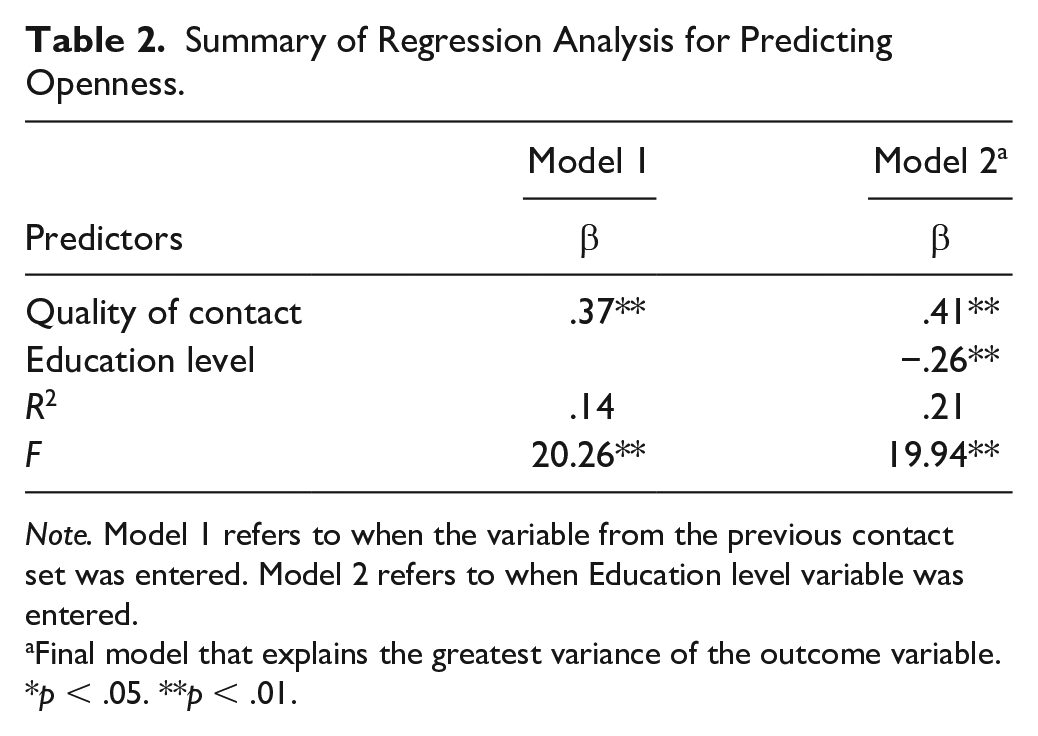
Note. Model 1 refers to when the variable from the previous contact set was entered. Model 2 refers to when Education level variable was entered.
Final model that explains the greatest variance of the outcome variable.
p < .05. **p < .01.
Summary of Regression Analysis for Predicting Social Distance.
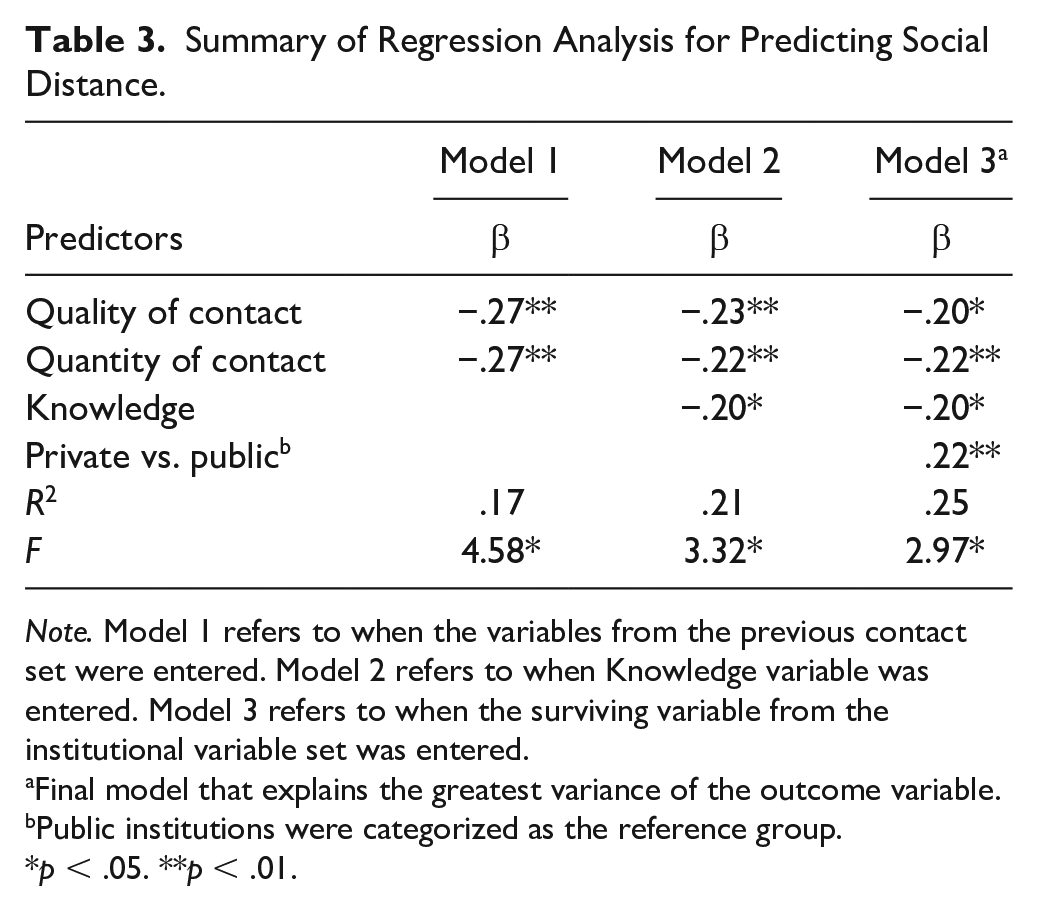
Note. Model 1 refers to when the variables from the previous contact set were entered. Model 2 refers to when Knowledge variable was entered. Model 3 refers to when the surviving variable from the institutional variable set was entered.
Final model that explains the greatest variance of the outcome variable. bPublic institutions were categorized as the reference group.
p < .05. **p < .01.
Summary of Regression Analysis for Predicting Knowledge.

Note. Model 1 refers to when the variables from the previous contact set were entered. Model 2 refers to when the surviving variables from the demographic variable set were entered. Model 3 refers to when the surviving variables from the institutional variable set were entered.
Final model that explains the greatest variance of the outcome variable.
p < .05. **p < .01.
Discussion
This study explored the attitudes and knowledge about autism of DSO staff members and examined which variables uniquely predicted the knowledge of DSO staff members and the two types of attitudes toward autism.
Predictors of Attitudes About Autism
Openness
Consistent with previous research using the openness measure (Gardiner & Iarocci, 2014; White et al., 2019), quality of contact was associated with openness, indicating that DSO staff members who had more favorable experiences with autistic individuals reported more openness toward autistic individuals. Gardiner and Iarocci (2014) suggested that high-quality interactions with autistic individuals may lead to increased comfort and decreased anxiety, resulting in more openness toward autistic individuals. Similarly, high-quality in-person contact may have led staff members to perceive the similarities between themselves and autistic individuals, resulting in higher scores on the Openness Scale, especially in an item inquiring their perceptions of whether the autistic individual featured in a scenario was different from themselves.
Staff members with higher education levels reported less openness toward autistic individuals. This result may in part reflect responses to an item on the Openness Scale that measures the extent to which the respondent thinks an autistic person is as smart as him or her. It is possible that some staff members with higher academic degrees considered themselves more academically accomplished and therefore smarter than a hypothetical autistic character.
Social distance
Knowledge about autism, quality and quantity of contact, and private versus public status of the institution significantly predicted social distance. Staff members with inaccurate knowledge about autism were less willing to engage with autistic individuals. This finding points to the importance of dispelling inaccurate and negative stereotypes about autism in reducing stigma (Gillespie-Lynch et al., 2015). Similar to the significant association shown between quality of contact and openness, pleasant interactions with autistic individuals may have led to increased comfort and decreased anxiety (Gardiner & Iarocci, 2014), resulting in willingness to engage in more intimate interaction.
The Quantity of Contact Scale measures the extent to which participants have had frequent and intimate contact, and the SDS measures participants’ willingness to engage in personal and intimate interactions. Staff members who are already engaging in such personal and frequent interaction with autistic individuals may be more prone to agree to have a personal relationship with them.
Finally, DSO staff members working in public institutions reported less social distance from autistic individuals than those working in private institutions. This study is the first to identify this institutional pattern, and the factors that contribute to the differences in the social distance between DSO staff members working in public institutions and those working in private institutions must be explored in future studies.
Knowledge
As hypothesized and similar to the patterns shown with openness and social distance, DSO staff members with more high-quality contact with autistic individuals had more accurate knowledge. Low-quality contact may have reinforced the perception that the stereotypic and inaccurate traits of autism (e.g., “autism is an emotional disorder”) are true. Staff members working at institutions with a higher average annual cost and a larger student body had more accurate knowledge about autism. Institutions with lower average annual costs may not have the resources to have several DSO staff members on staff. They may have a few staff members who provide generic resources to all students (sending accommodation letters to faculty members) rather than attending to the unique needs of each student.
It is possible that staff members at a larger institution are working with more numbers of autistic students with diverse symptomatic presentations and thus have more knowledge about autism, considering that school size and staff-to-student ratio are positively correlated (McDonald, 2013). Larger institutions may also have more numbers of DSO staff members on staff, increasing opportunities for staff members to learn about autism from each other. At the same time, it is also possible that larger institutions tend to hire staff members who are more knowledgeable about autism and are better prepared to work with autistic students because there may be more autistic students with various characteristics in larger institutions. More studies examining the underlying mechanisms behind the significant associations between these institutional variables and knowledge about autism are needed.
Implications
The findings of this study have several implications. First, quality of contact was associated with all attitude and knowledge measures used in this study. However, this should not be interpreted as the immediate need for more social skill training for autistic individuals to enable high-quality interactions with nonautistic individuals. The findings may as well suggest that DSO staff members had a positive quality of contact because they had accurate knowledge and favorable attitudes about autism. Crompton et al. (2020) recently found that the interactional quality of autistic pairs may be higher than that of mixed (i.e., autistic/non-autistic) pairs, suggesting that differences in social interactional style may account for low interactional quality among mixed pairs. Therefore, if DSO staff members are trained to better understand the social interactional style of autistic students, their quality of contact may also improve. Future studies investigating the kinds of institutional support and resources that lead to cooperative and productive contact between DSO staff members and autistic students may inform such efforts to improve the quality of contact and, consequently, the attitudes and knowledge about autism of DSO staff members.
The findings of this study also raise questions in regard to what should be taught to DSO staff members to make meaningful changes in their attitudes and knowledge about autism. Training for DSO staff may need to be carefully designed to target knowledge about autism that is relevant and useful in college settings. For instance, Gillespie-Lynch et al.’s (2015) training included information on current autism research across the life span, associations between some autistic traits and what people consider giftedness in the general population, and intelligence as a heterogeneous concept. Training for DSO staff may also include difficulties autistic students experience on college campuses (e.g., sensory issues or disclosure of their diagnosis) and the perspectives of autistic students on how DSOs can better support them, rather than focusing only on the etiology or symptoms. Moreover, institutions should provide ongoing structured support, particularly in the form of educational resources, to DSO staff. In addition, the type of institutions matters, suggesting that the kinds of training given to DSO staff might have to be different depending on what kinds of institutions they work in. Future research should be conducted to make specific recommendations along these lines.
The Quantity of Contact scale used in this study may be inadequate to meaningfully capture quantity of contact because most DSO staff members are likely to have met and worked with at least one autistic student and some items on the scale are redundant given the nature of their jobs, for example, “My job involves providing services/treatment for persons with autism.” Using measures that are better tailored to understanding experiences relevant to DSO staff members (e.g., asking how many students they have worked with and what kinds of relationships they have had with autistic students) may reveal more useful information about the frequency of and context around the contact and inform the underlying mechanism that operates under knowledge about and attitudes toward autism.
Furthermore, the responses to the survey items do not capture how staff members actually conduct themselves with autistic students. Future research utilizing a combination of direct observation and clinical interview could explore how DSO staff members’ attitudes and knowledge translate into their actual behaviors around and interactions with autistic undergraduate students. Future studies must also explore how autistic students themselves perceive DSO staff members’ attitudes and knowledge about autism and how these relate to the actual experiences of autistic students.
Finally, the findings provide specific implications for transition services designed for autistic students, who are planning to pursue post-secondary education. Given the associations between staff members’ knowledge about autism and institutional variables, some autistic students, particularly those who are attending institutions with lower average annual costs or institutions with smaller student bodies, may need to educate the staff members about autism and self-advocate their needs more explicitly to receive needed accommodations. Therefore, developing self-advocacy skills, which include the ability to understand and communicate their own strengths, weaknesses, and needs, should be a part of the transition plan (Downing et al., 2007). Downing et al. (2007) argued that high school Individualized Education Programs (IEPs) are best suited to facilitate such transition process because students with disabilities are expected to self-disclose their disability and provide necessary documentation on their own once they are in HEI settings. As a part of the IEP, autistic students can construct a list of their strengths, limitations, and accommodations they need in college and practice how to communicate them with DSO staff members. If autistic students can effectively express their needs, staff members’ knowledge about autism may also increase, consequently resulting in reduced stigma toward autism.
Limitations
These findings should be considered in light of some limitations. First, although compensation was given to encourage participation, the response rate was low (see Note 5). A high nonresponse rate is a common limitation of web-based surveys as participants easily ignore email invitations (Yun & Trumbo, 2000), suggesting caution when interpreting the findings of the study. Staff members with relatively high personal interests in autistic students may have been more disposed to participate in the survey than those with less interest.
Second, it is noteworthy that all dichotomous demographic variables (i.e., gender, autism training, and race) were not equally divided between categories because the majority of the participants consisted of White female staff members without specific autism training. Because of this imbalance, some demographic groups (e.g., male staff members) did not have a sufficient number of participants to contribute sufficient variability in all other constructs to enable appropriate significance tests. For instance, only four male staff members had received autism training. In addition, because close to 80% of the participants did not have any training on autism, staff members who had attended a few workshops/conferences about autism and those who had specialized training in autism at bachelor’s, master’s, and doctoral degree levels were included in the same group (see Note 6). Moreover, the racial and gender composition of the respondents may also be representative of the demographic characteristics of DSO staff members working in U.S. HEIs. A status report by the American Council on Education reported that three-quarters of all office and clerical staff in U.S. colleges and universities identified as White (Espinosa et al., 2019). In addition, 71% of student affairs staff members have been reported to be women (Pritchard & McChesney, 2018). Rather than dismissing these variables, future studies will need to oversample non-White and male DSO staff members and staff members with various levels of autism-specific training to fully understand how these demographic variables are related to autism attitudes and knowledge.
Third, despite the anonymity and low demand characteristic of an online survey, participants may have been influenced by social desirability and provided responses that would be viewed favorably rather than responses that reflected their actual thoughts and feelings (Dalton & Ortegren, 2011); the actual attitudes of participants may be more negative than indicated in this study. Fourth, the scales included in this study did not call for the consideration of the full range of the support needs of autistic individuals. Because each individual has different support needs and presents distinctive autistic symptoms, the attitudes may differ depending on how an autistic individual is described in a vignette. Fifth, the AAS and the level of Contact Report had relatively low internal consistency.
Sixth, as the Openness Scale and SDS measure attitudes toward a hypothetical character who shows autistic symptoms and an unspecified autistic individual, respectively, how DSO staff members think about their own students might be different from what they report in this study. Finally, diagnostic status was not revealed in the Openness Scale although DSO staff members are almost always aware of the diagnostic status of autistic students they support. Despite the significant correlation between the Openness Scale and SDS, which explicitly provides diagnostic information, further studies are needed to determine how the information about diagnosis influences staff members’ attitudes about autism. Moreover, as previous studies using the Openness Scale were mostly conducted with undergraduate students (Gardiner & Iarocci, 2014; Nevill & White, 2011), future studies validating the Openness Scale in other population samples are needed.
Conclusion
This study utilized an online survey to determine predictors of DSO staff members’ attitudes and knowledge about autism. The quality of previous contact was shown to be relatively consistently associated with Social Distance, Openness, and Knowledge about autism, reinforcing the importance of high-quality contact. Furthermore, institutional variables mattered. Understanding what kinds of institutional supports and context-appropriate training should be provided, particularly to staff members at private institutions and institutions with low average annual cost and small student bodies, to promote collaborative relationships between DSO staff members and autistic students should be explored in future studies. Finally, this study preliminarily informed the types of variables to be considered to operationalize DSO staff members’ attitudes and knowledge about autism. Future studies with larger sample sizes should investigate causal relationships among the identified variables using hypothesis-driven latent structure analyses to further operationalize the attitudes and knowledge about autism.
Supplemental Material
sj-docx-1-rse-10.1177_0741932521999460 – Supplemental material for College Disability Service Office Staff Members’ Autism Attitudes and Knowledge
Supplemental material, sj-docx-1-rse-10.1177_0741932521999460 for College Disability Service Office Staff Members’ Autism Attitudes and Knowledge by So Yoon Kim in Remedial and Special Education
Footnotes
Acknowledgements
I would like to thank Dr. Kristen Bottema-Beutel for detailed feedback throughout the analysis and write-up process.
Author’s Note
So Yoon Kim initially worked on this study as a doctoral candidate in the Lynch School of Education at Boston College. She is an assistant professor at Duksung Women’s University in South Korea.
Declaration of Conflicting Interests
The author(s) declared no potential conflicts of interest with respect to the research, authorship, and/or publication of this article.
Funding
This study was funded by the Lynch School of Education Doctoral Dissertation Fellowship, Boston College.
Ethics Approval
All study procedures, including informed consent, were approved by the Institutional Review Board (IRB) office of the author’s institution (IRB No. 19.139.01).

Data Availability
The group-level data are available from the author upon reasonable request.
Supplemental Material
Supplemental material for this article is available on the Remedial and Special Education website with the online version of this article.
Notes
References
Supplementary Material
Please find the following supplemental material available below.
For Open Access articles published under a Creative Commons License, all supplemental material carries the same license as the article it is associated with.
For non-Open Access articles published, all supplemental material carries a non-exclusive license, and permission requests for re-use of supplemental material or any part of supplemental material shall be sent directly to the copyright owner as specified in the copyright notice associated with the article.
