




Abstract
The present study identified emerging adults’ self-generated sexual values and sources of sexual values upon entering college and a year later to assess how these values and sources may have changed. Participants included 148 college students (86 women and 62 men) who were 17 to 19 years old at Time 1 (M = 18.1). Generative coding revealed seven thematic sexual values: casual versus relational criteria for sexual intercourse, respect, giving or obtaining consent, pleasure for self and partner, intimacy, trust, and physical safety. Regarding sources of values, participants reported interpersonal, intrapersonal, and societal sources. Analyses revealed few gender differences in sexual values. Valuing casual criteria for sexual intercourse increased in frequency from Time 1 to Time 2 and valuing relational criteria decreased. Peers and dating partners increased in frequency and parents decreased in frequency as sources of sexual values.
Experiences in the areas of love and sexuality are generally considered important aspects of emerging adults’ development (Arnett, 2004; Lefkowitz, 2005). Not surprisingly, researchers have extensively explored adolescents’ and young adults’ sexual attitudes and behavior. However, despite the vast literature on sexual attitudes, few studies have focused specifically on assessing sexual values. Although sexual attitudes and sexual values may overlap, values are understood as moral convictions regarding what is right and wrong, are typically thought to be more stable than attitudes, and are linked strongly with sexual behavior (Richey, Knox, & Zusman, 2009). For example, although higher levels of general communication about sexuality from parents has often been associated with greater sexual activity, when parents communicate the specific value that premarital sex is wrong or undesirable, their adolescent children are less likely to be sexually active (DiIorio, Pluhar, & Belcher, 2003; Usher-Seriki, Bynum, & Callands, 2008). Thus, understanding the sexual values that college students hold and the sources and origins of these sexual values will expand our knowledge of sexual development during emerging adulthood in important ways. This exploratory study used qualitative methods to analyze college students’ reports of their sexual values and the sources of these values.
In addition to identifying and describing emerging adults’ self-reported sexual values and sources of sexual values, this study also sought to identify potential changes in these values and sources during the 1st year of college. As such, participants were surveyed at the beginning of both their 1st and 2nd years of college to assess potential changes in these values and their sources during this important developmental transition. The 1st year of college is generally understood as an important transitional period for emerging adults, particularly with regard to sex and dating (Lefkowitz, 2005). Most notably, many 1st-year college students are likely engaging in exploratory sexual and dating behavior (Lefkowitz & Gillen, 2006; Siegel, Klein, & Roghmann, 1999), which may foster personal reflection on and reassessment of their own sexual values and beliefs. Furthermore, interpersonal and social contexts shift dramatically during this time, with less parental contact and increased peer contact (Lefkowitz & Espinosa-Hernández, 2007). As such, it is likely that this brief, but significant, transitional period would evidence shifts in sexual values and sources of sexual values as evidenced by changes from the beginning of the 1st year to the beginning of the 2nd year of college.
Sexual Values
Although researchers frequently assess college students’ sexual attitudes (Lefkowitz & Gillen, 2006), few researchers have specifically focused on college students’ sexual values. Those studies that have been conducted generally have a fairly narrow focus. For example, two recent studies investigating college students’ sexual values used a narrow definition of sexual values, namely, having participants self-select into one of three researcher-generated categories: absolutism (abstinence until marriage), relativism (sexual activity dependent on the relationship context), and hedonism (doing what feels good without hurting anyone; Knox, Cooper, & Zusman, 2001; Richey et al., 2009). The more recent study reported that over half of students placed themselves in the “relativism” category, followed by a quarter in the hedonism category and about 13% in absolutism (Richey et al., 2009). Other studies measuring sexual values have also focused mainly on whether participants value abstinence until marriage (De Gaston, Weed, & Jensen, 1996; Miller, Norton, Fan, & Christopherson, 1998; Petersen & Donnenwerth, 1997). On the other hand, some other studies speaking to sexual values among diverse populations have offered a slightly broader examination of sexual values, including the immorality of extramarital sex (Treas & Giesen, 2000), sexual acceptance, comfort and communication (Deardorff, Tschann, & Flores, 2008), and beliefs about society’s current level of sexual morality (Weeden & Sabini, 2007). However, none of these studies have allowed participants to generate their own sexual values, relying instead on a restrictive set of researcher generated items and topics.
As there is so little research on sexual values among college students, gender and age-related patterns in sexual values have yet to be established beyond assessing generally “permissive” versus “restrictive” sexual values. Richey et al. (2009) found that male college students were more likely than female college students to self-identify as “hedonistic,” indicating more permissive values. De Gaston et al. (1996) also found that female adolescents indicated greater commitment to abstinence. A recent literature review revealed similar results with regard to general sexual attitudes: Men generally hold more permissive sexual attitudes than women (Fugere, Escoto, Cousins, Riggs, & Haerich, 2008). Age-related patterns in sexual values have also been identified, such that older college students (e.g., those over the age of 19 or 20) were more likely to identify with hedonistic values (Knox et al., 2001; Richey et al., 2009). Other research on sexual attitudes has identified more permissive sexual values as students progress through college (Crawford & Popp, 2003; Knox et al., 2001; Lefkowitz, 2005; Morgan, Thorne, & Zurbriggen, 2010). Overall, it appears as though older students and men tend to endorse more permissive sexual values, although richer and more detailed information (beyond simple levels of permissiveness) is lacking.
Sources of Sexual Values
As few studies have specifically examined sexual values, information on sources of sexual values is even more scant. However, research on sexual attitudes offers some insight into potential sources of sexual values. Parental sexual socialization is frequently studied and findings suggest that parents more often relay messages about sexual morality than they relay explicit sexual information (King & Lorusso, 1997). Other sources of sexual socialization that can communicate either permissive or restrictive sexual values include close friends (e.g., Lefkowitz, Boone, et al., 2004), dating partners (Morgan & Zurbriggen, 2007), peers (e.g., du Bois-Reymond & Ravesloot, 1994), media (e.g., Hust, Brown, & L’Engle, 2008), schools (e.g., Chambers, van Loon, & Tincknell, 2004), and religious institutions (e.g., Lefkowitz, Gillen, Shearer, & Boone, 2004). However, while these individuals and institutions have been researched as influential sources for adolescents’ and young adults’ attitudes and behaviors, they have not been systematically analyzed regarding their potential roles as sources of sexual values.
Gender- and age-based differences regarding sources of sexual values have also not been examined, although patterns have been identified in research on general sexual socialization. For example, research indicates that young women typically hear more restrictive sexual messages from parents than young men (Morgan et al., 2010; O’Sullivan, Meyer-Bahlburg, & Watkins, 2001) and that female college students report talking with friends about sex-related topics more than male college students do (Lefkowitz, Boone, et al., 2004). Research also indicates that media present different messages to males and females and suggests that young women may be impacted more by media than men are (Ward, 2003). Although little research has examined how sources of sexual information change over time, one study identified that 1st-year college students reported talking more with friends than mothers about sexually related topics (Lefkowitz & Espinosa-Hernández, 2007). Lefkowitz, Gillen, et al. (2004) also found that older college students reported less religious influence and fewer negative sanctions against sexual behaviors from their religion than did younger college students. Overall, identifying which sources of sexual values are reported by emerging adults, and whether there are gender and age-related differences in their reporting of these sources, can help illuminate the origins of sexual values and suggest whether developmental processes or gender role socialization affects the adoption, rejection, or transformation of these values.
Present Study
We had three goals for this project. First, we were interested in reviewing changes in participants’ sexual and dating experiences during the 1st year of college as a backdrop to understanding changes in sexual values and sources of sexual values. Increased sexual and dating behavior from Time 1 to Time 2 would evidence developmental shifts in sexual experience that could provide emerging adults with the opportunity to reexamine their sexual values. As past research suggests that college is often a time of sexual exploration and dating experiences (Lefkowitz & Gillen, 2006), we anticipated that participants’ sexual and dating experiences would increase during this time period. We also explored gender differences in sexual behavior, but made no directional hypotheses because past studies of sexual behavior among college students have revealed varied findings regarding gender and sexual experience (e.g., Dalton & Galambos, 2009, Espinosa-Hernández & Lefkowitz, 2009; Paul, McManus, & Hayes, 2000).
Second, as the main focus of the study, we used an open-ended approach to identify themes in emerging adults’ self-generated sexual values and explored how these values change during the 1st year in college. This approach allows the full range of sexual values to be expressed, unconstrained by researcher preconceptions. Because of the focus in past research on sexual values related to premarital sexual intercourse and sexual permissiveness (e.g., Richey et al., 2009), we anticipated that participants may include responses that corresponded to these previously identified values. We also expected that other sexual values would be reported; however, because of the lack of prior research on a range of sexual values, we made no specific predictions about which other sexual values would be reported. Despite not having an expected set of sexual values, we nonetheless anticipated potential gender differences and changes over time, given both consistent gender differences in attitudes (Richey et al., 2009) and prior research indicated shifts in sexual beliefs during the transition to college (Lefkowitz, 2005).
The third research goal was to understand who and what late adolescents viewed as sources of their reported sexual values and whether these sources changed during the 1st year of college. Because prior research has identified interpersonal (Lefkowitz & Espinosa-Hernández, 2007) and social (e.g., Hust et al., 2008) sources of sexual attitudes, we anticipated that similar sources of sexual values would arise. Although we anticipated that there could be gender-related differences in reported sources of sexual values, we did not predict any specific differences due to the lack of prior research on sources of sexual values. However, we did anticipate that parents would decrease in frequency as reported sources of sexual values, while the frequency with which friends and peers were listed would increase over time.
Method
Participants
Participants were part of a larger two-wave longitudinal study on sexual socialization and sexual aggression in which multimethod assessments were conducted in the fall quarters of students’ 1st and 2nd years of college. Participants were a subset of the 184 participants (79 men and 105 women) who participated in the second wave of the study. Only participants who provided responses to the sexual values questions at both time periods were included in analyses. This resulted in a final sample of 148 (86 women and 62 men). Their ages ranged from 17 to 19 at Time 1 (M = 18.1) and their racial backgrounds included European American/White (n = 97; 65%), Mexican American/Latino/a (n = 16; 11%), Asian American/Pacific Islander (n = 15; 10%), bi-/multiracial (n = 12; 8%), and Other (n = 8; 5%). Participants’ self-identified sexual orientations at Time 1 included heterosexual (n = 126; 85%), gay/lesbian (n = 9; 6%), bisexual (n = 5; 3%), unsure (n = 6; 4%), other (n = 1; 1%), and prefer not to identify (n = 1; 1%).
The majority of participants’ parents were well educated, with 63% of participants’ mothers and 63% of participants’ fathers holding a bachelor’s degree; 24% of mothers and 32% of fathers also had a graduate degree. Participants’ religious backgrounds included Catholic (n = 26; 18%), Christian (n = 23; 16%), Jewish (n = 16; 11%), none (n = 60; 41%), and other (n = 21; 14%). Religiosity was fairly low; when asked “how religious are you,” the average response was 2.24 (SD = 1.15) at Time 1 and 2.13 (SD = 1.11) at Time 2 on a scale from 1 (not at all religious) to 5 (very religious). 1
Procedure
All participants were 1st-year college students at a public university in central California. For the first phase of the study, participants were recruited via tabling at orientation events, flyers posted around campus and delivered to campus mail boxes. Flyers noted that students could earn money “by participating in a research study on dating relationships” and stipulated that “You don’t need to be dating or in a relationship to participate.” During in person recruitment efforts, the study was described as being “about your experiences with dating and relationships, how you feel about dating and sex, and how you talk about these things with your parents and friends.” E-mails were sent to Time 1 participants for recruitment at Time 2. Time 1 participation took place between September and November in the participants’ 1st year at college and Time 2 took place between September and November in the participants’ 2nd year at college. Participants were compensated US$20-US$25 at Time 1 and US$25-US$40 at Time 2. At each time point, participation in the study included a consent process and completion of a computer word task, an individual interview, and a written questionnaire. Data from the computer word task and the individual interview are not analyzed for the present study. The entire data collection session took about 1.5 hours to complete.
Measures
The data analyzed for this study were collected through a written questionnaire. In addition to a demographic portion, participants completed measures of sexual and dating experience as well as open-ended questions regarding their sexual values and sources of sexual values.
Sexual and dating experience
Dating experience was assessed by asking participants how many dating relationships they have had that lasted for 1 month or more in high school (Time 1) and college (Time 2). Participants were also asked if they were currently in a dating relationship. Sexual experience was assessed through four questions. The first three included lifetime frequency ratings of kissing (extended kiss without body contact), oral sex (either performed on a male or female), and heterosexual intercourse. The rating scale included the following options: 0 (never), 1 (once or twice), 2 (3-5 times), 3 (6-9 times), and 4 (10 or more times). The fourth question regarded number of lifetime intercourse partners; only participants who indicated having had heterosexual intercourse responded to this question.
Sexual values and sources of sexual values
Narrative responses from two open-ended questions were used to assess sexual values and the sources of sexual values. The first question assessed sexual values and asked, “What are several current sexual values you have that are important in defining you as a sexual person?” The second question assessed sources of sexual values and differed slightly from Time 1 to Time 2. At Time 1, participants were asked, “What do you think has been important in developing your sexual values; how do you think they formed?” At Time 2, this second question was rephrased to, “In the last year, what do you think has been important in developing your sexual values; how do you think they formed?”
Coding Procedures
Preliminary analyses classified participants’ open-ended responses regarding sexual values and reported sources of sexual values using an inductive thematic analysis approach (Braun & Clarke, 2006). The process of identifying themes preliminarily included an entirely inductive review of the data set for patterns and themes to generate potential categories that were discussed and revised within the research team. Ongoing analysis included refining, defining, and naming these themes, which culminated in the production of a coding manual. The review of sexual values yielded seven non-mutually exclusive categories, including respect, consent, pleasure, intimacy, trust, physical safety, and intercourse permissiveness (casual vs. relational). The review of sources of sexual values yielded three overarching categories (interpersonal, intrapersonal, and societal) with several subcategories each. Sexual value categories and sources of sexual values categories were identical at Time 1 and Time 2, despite the researchers’ openness to changes. Once the categories were established and key terms and ideas were identified relevant to each category, responses from both Time 1 and Time 2 were intermixed and all responses were coded by two undergraduate research assistants with adequate reliability; Cohen’s Kappas ranged from .70 to .95. Discrepant codes were typically the result of lack of attention by the coder to an aspect of the narrative or a vague statement by the participant; disagreements were resolved through discussions between the first author and the research assistants.
Results
Sexual and Dating Experience
At Time 1, 83% of participants reported having had a romantic relationship during high school that lasted for 1 month or more, with an average number of 2.1 relationships. At Time 1, 45% of participants were casually dating or were in a monogamous dating relationship. The majority of participants (93%) reported having kissed a member of the other sex, and 76% of participants reported having engaged in oral sex. Over half of the participants (63%) reported having engaged in consensual heterosexual intercourse, with an average of 2.43 partners.
At Time 2, 76% of participants reported having had a romantic relationship during their 1st year of college that lasted for 1 month or more (12 were individuals who had previously not had any relationships longer than a month in high school). At Time 2, 48% of participants were in a dating relationship. Ninety-seven percent of participants reported having kissed a member of the other sex, and 86% of participants reported engaging in oral sex. Seventy-five percent of participants reported having engaged in consensual heterosexual intercourse, with an average of 3.94 lifetime partners.
A series of four 2 × 2 mixed-model repeated measures ANOVAs assessed the effects of time and gender in self-ratings of sexual experience (kissing, oral sex, intercourse, and number of intercourse partners). There were main effects of gender on three of the sexual experience variables (means by gender are presented in Table 1). In each case, women reported more experience than men. There was a main effect of gender for kissing, F(1, 141) = 4.52, p = .035, η2 = .031). There was also a main effect of gender for oral sex, F(1, 139) = 14.21, p < .001, η2 = .093). Lastly, there was a main effect of gender for intercourse, F(1, 141) = 4.08, p = .045, η2 = .028). Not surprisingly, there was also a significant main effect of time for all four sexual experience variables, with increases in the ratings for kissing, oral sex, intercourse, and number of intercourse partners from Time 1 to Time 2 (see Table 1). No significant Gender × Time interactions occurred.
Longitudinal Comparisons of Sexual Experience (N = 148)
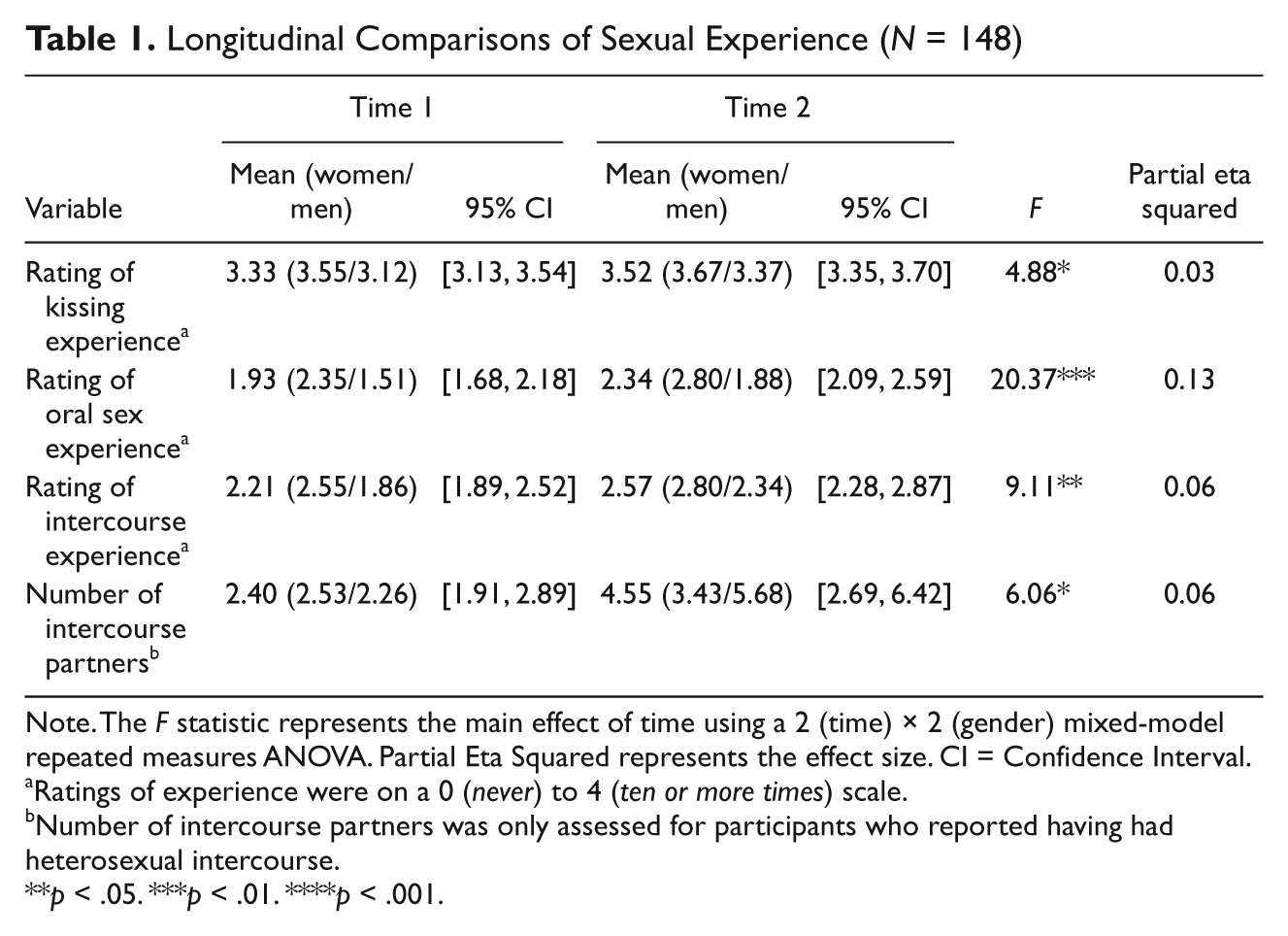
Note. The F statistic represents the main effect of time using a 2 (time) × 2 (gender) mixed-model repeated measures ANOVA. Partial Eta Squared represents the effect size. CI = Confidence Interval.
Ratings of experience were on a 0 (never) to 4 (ten or more times) scale.
Number of intercourse partners was only assessed for participants who reported having had heterosexual intercourse.
p < .05. ***p < .01. ****p < .001.
Sexual Values
Seven themes were identified within participants’ narratives of their current sexual values. Table 2 presents the overall frequencies of each of these themes at both Time 1 and Time 2. Table 3 reports the frequencies of each of these themes for men and women separately at Time 1 and Time 2. The first sexual value category, respect, included being respectful (or respected), expectations of faithfulness, and “being considerate” within a (sexual) relationship. This theme also included valuing equality between partners. Fifty participants (34%) included this as a sexual value at Time 1 and 39 participants (26%) included this as a sexual value at Time 2. In addition to simply listing the term “respect” or “respectfulness” within a list of sexual values, participants would also remark that it was important to, “respect your partner as you’d wish to be respected” and that both giving and getting respect is important. For example, an 18-year-old woman explained, “It’s important for me to be respected as well as to give respect.” Participants noted the importance of both relational and sexual respect, as evidenced in this 18-year-old man’s statement, “I want a meaningful relationship with a lot of respect, and a meaningful, respectful sex life.” Respect was also considered a relational element that would improve sexual interactions. For example, an 18-year-old woman explained, “I really like sex when it’s with someone who respects me, whether I’m in love or not.” A 20-year-old man wrote, “I think it’s important to be a kind, considerate, supportive, proactive lover.” Some participants noted that respect was a requirement for a sexual relationship, as evidenced in an 18-year-old woman’s comment, “Well, if a guy don’t respect me that just means they don’t love me. So if they don’t love me, why do I want to have sex with them?”
Percentages and Tests of Time Differences for Sexual Values

Note. N = 148; 86 women, 62 men. T1 = Time 1, T2 = Time 2. Likelihood ratio chi-square statistics compared T1 to T2 response frequencies for intercourse permissiveness. McNemar chi-square tests were used for all other T1 to T2 response frequency comparisons.
p < .10. ****p < .001.
Percentages and Tests of Gender Differences for Sexual Values
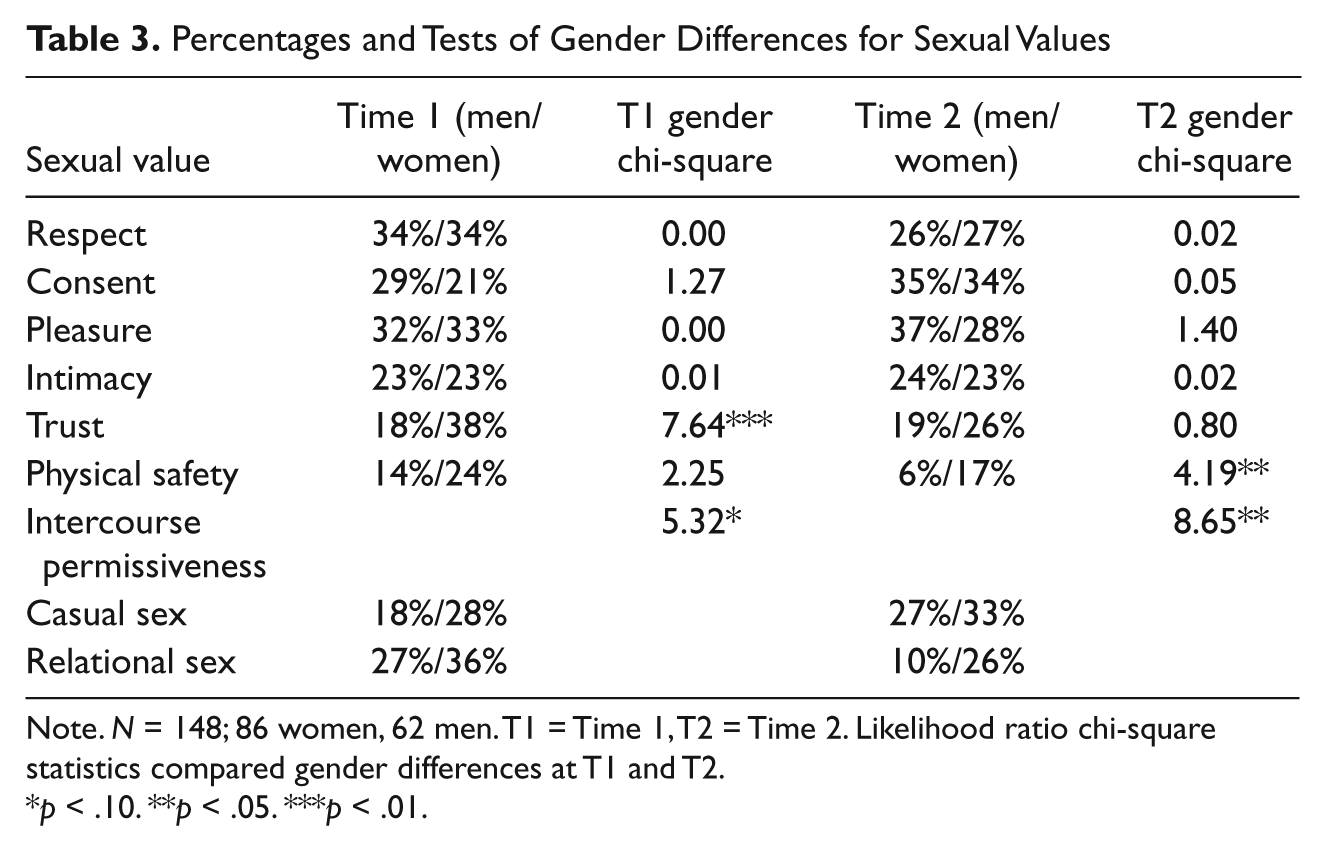
Note. N = 148; 86 women, 62 men. T1 = Time 1, T2 = Time 2. Likelihood ratio chi-square statistics compared gender differences at T1 and T2.
p < .10. **p < .05. ***p < .01.
The next theme, consent, included narratives that specifically noted the importance of giving or gaining consent for sexual activity to occur. Thirty-six participants (24%) included this as a sexual value at Time 1 and 51 participants (34%) included this as a sexual value at Time 2. For example, a 19-year-old man explained that, “consent is completely, unalterably, and in every single instance essential” and an 18-year-old woman wrote, “I believe strongly in mutual consent. I want to feel compassion and safety from my partner.” Participants also explicitly condemned sexual interactions without consent. For example, an 18-year-old man explained, “Taking advantage of some one that’s drunk is sick. If two drunk people hook up (have sex/whatever) and at the time it happens they both want to then it’s okay. Rape is terrible. Date rape is really terrible.” Another 19-year-old man wrote, “As a rule I don’t take advantage of girls be they drunk or anything else.” Consent was also used to define what makes sexual activities acceptable, as evidenced by an 18-year-old man who wrote, “As long as it involves consenting, mature people, any sexual act is okay (not immoral).” A 19-year-old woman also explained, “I believe that any sexual act should be consensual. I believe it is okay to engage in oral, manual, anal, or vaginal sex as long as both people agree.”
The third theme, pleasure, included the expression of positive feelings toward the act of sex, including experiences of pleasure, amusement, gratification, enjoyment, and delight. The value of physical attraction was also included in this category. Forty-eight participants (32%) included this as a sexual value at Time 1 and 47 participants (32%) included this as a sexual value at Time 2. Participants would typically simply state that “sex should always be fun and enjoyable.” Excitement or spontaneity was also occasionally described, such as in this 19-year-old woman’s narrative,
I believe that sex is meant to be shared between two people whom really love each other, and is very rewarding in that way. However, sexual attraction can be very intense and one-night stands or casual sex is sometimes rewarding, and definitely usually fun and exciting.
As with respect, mutual pleasure was important, such that “both sexual partners must be satisfied in order for sex to be good.” A 19-year-old man explained that, “sex is dependent on both partners. It’s about love and togetherness and being a part of a whole at that moment at time. If one person isn’t enjoying it, it’s not worth it.” Some participants specifically noted partner-focused pleasure was important. For example, an 18-year-old man wrote, “Enjoying sex itself, making it pleasurable for my partner” while another wrote that his sexual values included being “not greedy with pleasure. Not selfish with pleasure.” Other participants did describe more self-focused pleasure, including an 18-year-old woman who explained, “It’s good to indulge in sexual pleasure. When I did it, nothing bad happened to me because I was responsible. There’s nothing wrong with a woman feeling good about her body.”
Intimacy was another theme that emerged as a sexual value. This included the expression of some kind of emotional connection to one’s partner or the act of sex. Thirty-four participants (23%) included this as a sexual value at Time 1 and 35 participants (24%) included this as a sexual value at Time 2. Participants typically wrote about the importance of being loving, caring, or compassionate. For example, an 18-year-old woman wrote, “Desirable sexual behavior would probably be affection, intimacy, and caring in sex” while a 19-year-old man wrote, “I believe that there should be a personal investment, intimacy and caring behind sexual experiences.” Several participants explained the need for intimacy, including an 18-year-old woman who explained, “Intimacy is important because I’m not always trusting. Sex can have dangerous consequences.” Another 18-year-old woman explained, “Sex is better when it is intimate but within the confines of intimacy there needs to be a sense of comfort that allows for the exploration of wilder sides of sex.” Several participants also wrote about the strong connection between sex and emotion, including how sex can foster intimacy. For example, a 19-year-old woman wrote, “Sex unites a relationship and connects people if you are ready to commit and [have] such strong feelings.”
The next category, trust, included narratives in which participants noted the importance of trusting a partner or being comfortable with one’s partner or the situation. This category also included expressions of integrity and reliance, such as depending on or having confidence placed on one’s self or one’s partner. Forty-four participants (30%) included this as a sexual value at Time 1 and 34 participants (23%) included this as a sexual value at Time 2. Frequently, participants stipulated that trust must be present prior to sexual activity. For example, an 18-year-old woman wrote, “I do not participate in sexual activities with people I do not know, trust, or do not feel comfortable with.” Trust was sometimes stipulated on the basis that it would minimize potential physical and emotional risk, as with this 18-year-old woman who explained, “I believe that sex is natural, but should only be done with someone you love and trust, on account of all the risks involved.” Other participants explained that engaging in sexual activity helped to build trust. For example, an 18-year-old woman wrote, “I think that sexuality is a very important part of life and that sharing your sexuality in intimate relationships generates trust and love.” Another 18-year-old woman explained, “I will only have sex with someone who I know and I trust and love. Being naked and exposed with and to the person shows that you trust them and therefore create a special bond.”
The next theme, physical safety, included an expressed concern for the physical well-being of oneself or one’s partners, specifically regarding prevention of or protection against sexually transmitted infections and pregnancy. Thirty participants (20%) included this as a sexual value at Time 1 and 19 participants (13%) included this as a sexual value at Time 2. For example, an 18-year-old man wrote that “safe sex is extremely important” while a 19-year-old man listed one of his sexual values as, “being safe and using protection and taking necessary precautions.” The reasoning behind this value was typically the fear of pregnancy or of contracting a disease. One 19-year-old woman wrote, “I want to be safe. I don’t want to put myself into a position where I could be potentially harmed emotionally or physically. I don’t want an STD and I don’t want to get pregnant” while another explained, “I believe that sex is a very natural part of life but given the risks (pregnancy, STDs) needs to be taken seriously.” Safety was specifically used as a reason for avoiding certain types of sexual encounters as well. An 18-year-old woman noted that, “sexual behavior shouldn’t be with someone you don’t know because it’s not safe.” Another 18-year-old woman explained, “I think sex should be safe (protected and emotionally safe) and fulfilling, or a person shouldn’t go there. I have been in the position of feeling pressure and feeling ‘unsafe’ with a person. I didn’t think that was a good experience.”
The last category involved participants’ relational stipulations for engaging in sexual intercourse and included two potential options: casual sex or relational sex. Casual sex was typically represented by stating the acceptability or desirability of having multiple sexual partners or sexual activity outside of a relationship. Thirty-five participants (24%) included this as a sexual value at Time 1 and 45 participants (30%) included this as a sexual value at Time 2. For example, an 18-year-old woman wrote, “I feel that it’s okay to have many different sexual partners over a period of time. You don’t need to be romantically attached to them.” Another 18-year-old woman explained, “My sexual experience has been mostly casual without a lot of emotion and I am comfortable with that.” Other participants noted that some minimal level of connection or relationship must be present, including an 18-year-old woman who wrote, “Sex should be with someone you at least like.” An 18-year-old man further explained,
I believe that sex is an experience that should be treasured by both people, but love and relationships and sex are all separated. Sex is almost sacred and should be respected, but you don’t have to love your partner or be in a relationship with them.
Individuals who noted that casual sexual activity was acceptable or desirable would often endorse openness about sex in general (e.g., “Be experimental as long as both parties are comfortable and don’t force yourself on your partner if he/she isn’t comfortable.”). However, some participants specifically noted that while casual sex was acceptable, it was not preferable.
“Relational sex” required a committed relationship or marriage prior to having intercourse. Forty-eight participants (32%) included this as a sexual value at Time 1 and 28 participants (19%) included this as a sexual value at Time 2. While some participants did stipulate marriage as a requirement, other participants relied on love, commitment or the length of a relationship as a requirement. For example, a 19-year-old woman wrote, “I believe that you should have sex only in a long-term relationship when both parties love each other.” An 18-year-old woman also wrote, “I believe it’s ok to experiment, try new things, be kinky…whatever you want, with a partner who is committed to you and also willing. I don’t believe in promiscuity or casual sex.” An 18-year-old man wrote, “I believe two people should not engage in sex unless they love each other and have been in a relationship for at least several months.” An 18-year-old woman was more specific about her requirements: “Little to no ‘random hook-ups.’ Sex only after about 8 months being with someone, perhaps longer if not ready, earlier…MAYBE depends on how well the relationship is going/how well you know the person/feel around them.” Several participants offered reasons for their regulations, including the following 18-year-old woman who wrote, “I cannot have casual sex—I get emotionally attached” and a 18-year-old woman who explained,
An 18-year-old female also explained, “I think when you have sex you are giving up a part of your soul and taking part of theirs because of how physically and emotionally close you are to each other. Due to this fact, I think it’s wrong to treat sex like a toy, something you can just do without feeling different or suffering any consequences.”
Gender differences and changes over time
A likelihood-ratio chi-square test and McNemar tests assessing changes in sexual values from Time 1 to Time 2 are presented in Table 2. Frequencies of sexual values by gender, and likelihood-ratio chi-square tests assessing gender differences are presented in Table 3.There was one significant gender difference in sexual values at Time 1. Women (38%) were more likely than men (18%) to describe trust as a sexual value, χ2 (1, N = 148) = 7.64, p = .006. At Time 2, two significant gender differences emerged. Women (17%) were more likely than men (6%) to describe physical safety as a sexual value (χ2 (1, N = 148) = 4.19, p = .041) and the overall chi-square for intercourse permissiveness was also significant, χ2 (2, N = 148) = 8.65, p = .013. Follow-up analyses revealed that women (26%) were more likely than men (10%) to mention a value of relational sex, χ2 (1, N = 148) = 6.34, p = .012.
Analyses examining changes in sexual values over time for men and women (combined) revealed three findings. First, a McNemar chi-square test revealed a marginally significant result regarding physical safety (p = .082) with participants more likely to describe physical safety as a sexual value at Time 1 (20%) than Time 2 (13%). Next, there was a marginally significant increase in the frequency of valuing consent (p = .054), which increased from 24% at Time 1 to 34% at Time 2. Lastly, a likelihood ratio chi-square for intercourse permissiveness was significant (χ2 (4, N = 148) = 21.19, p < .001), with more individuals noting “relational sex” at Time 1 (32%) than at Time 2 (19%) and more individuals noting “casual sex” at Time 2 (30%) than Time 1 (24%).
Sources of Sexual Values
Participants’ nine reported sources of sexual values were grouped broadly into three overarching categories: interpersonal (parents, friends, dating partners, and peers), intrapersonal (self-experience and self-reflection), and societal (media, school, and religion). Table 4 reports the overall frequencies of each of these sources. Table 5 reports the frequencies of each of these sources for men and women separately at Time 1 and Time 2.
Percentages and Tests of Time Differences for Sources of Sexual Values
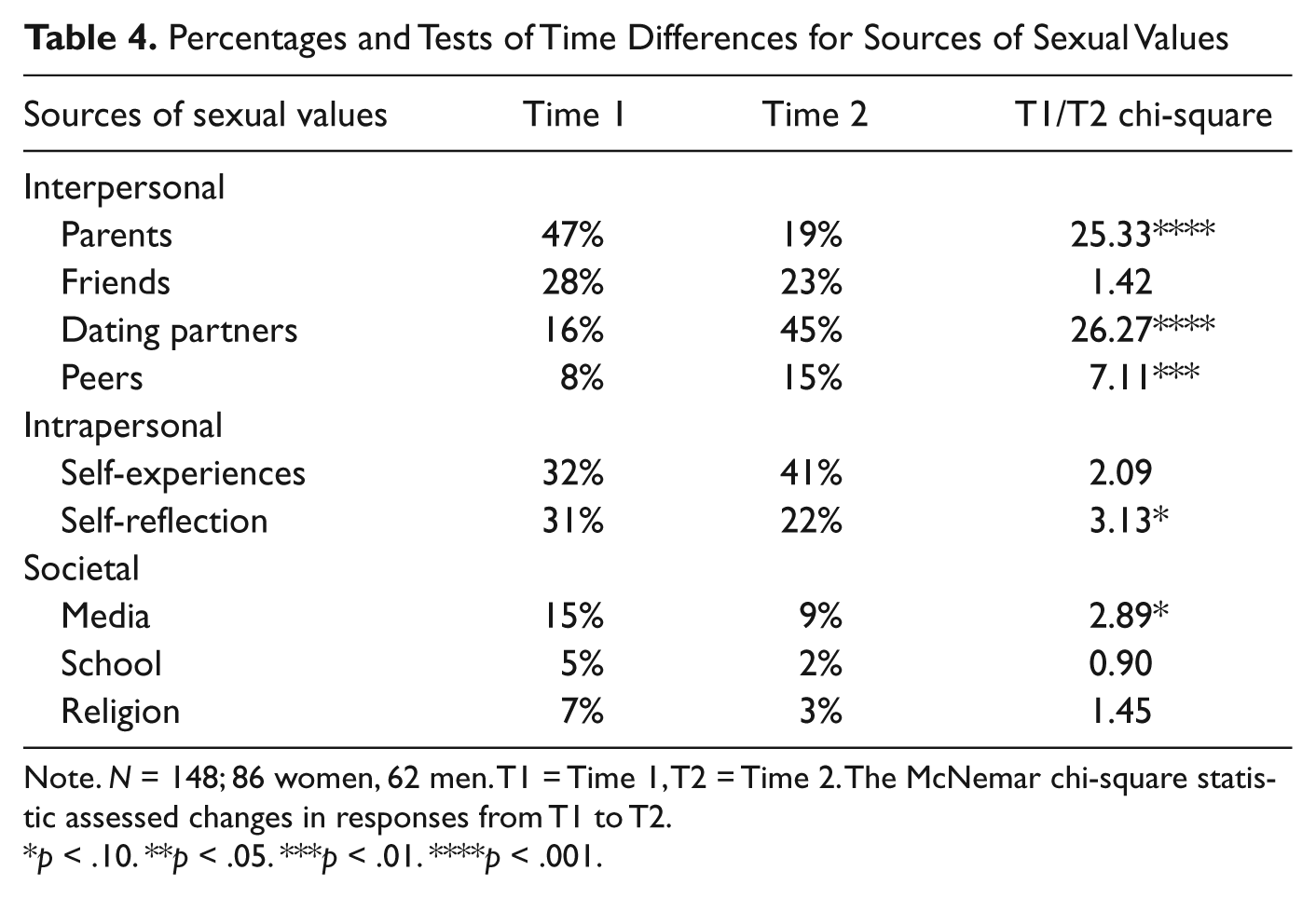
Note. N = 148; 86 women, 62 men. T1 = Time 1, T2 = Time 2. The McNemar chi-square statistic assessed changes in responses from T1 to T2.
p < .10. **p < .05. ***p < .01. ****p < .001.
Percentages and Tests of Gender Differences for Sources of Sexual Values
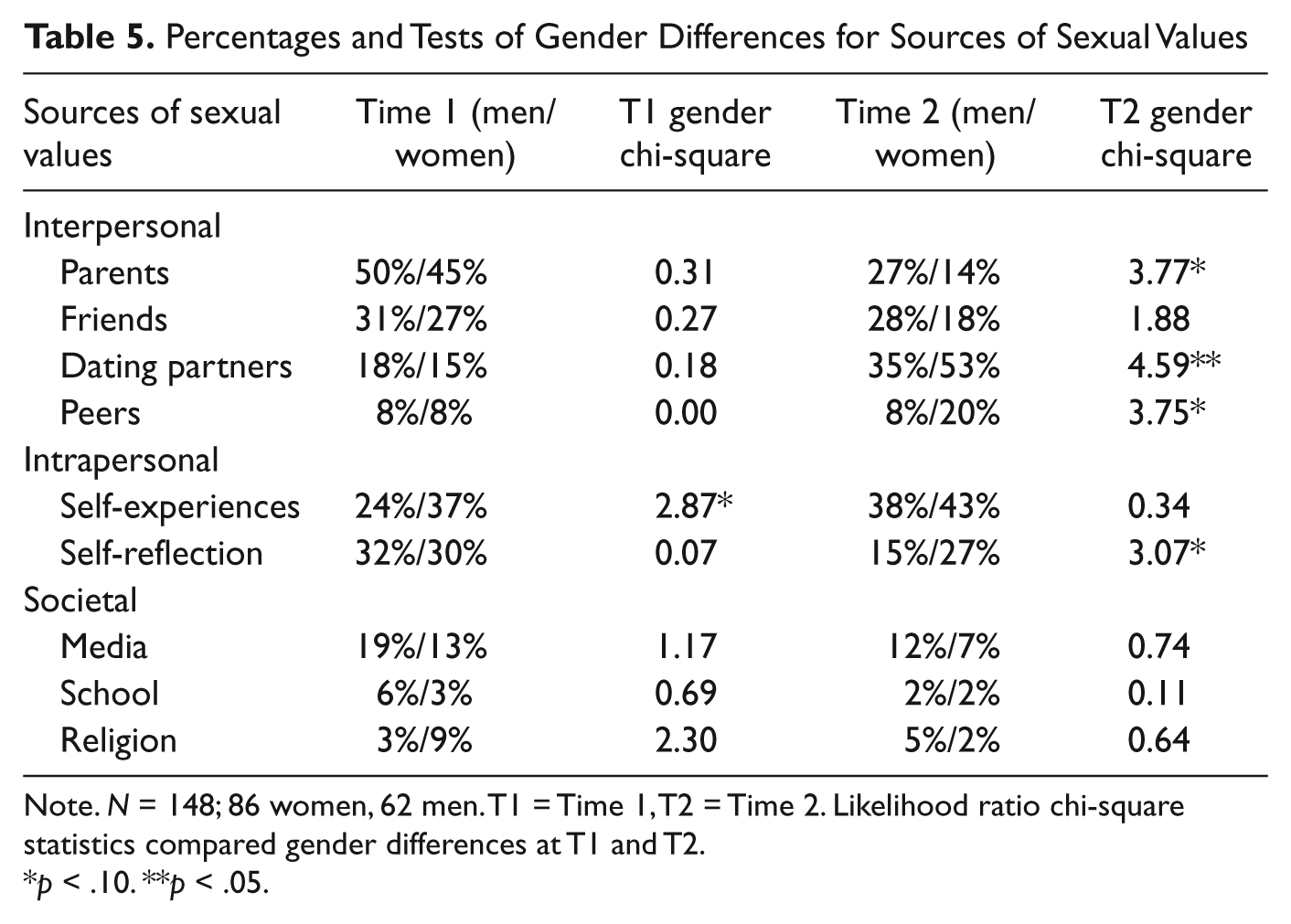
Note. N = 148; 86 women, 62 men. T1 = Time 1, T2 = Time 2. Likelihood ratio chi-square statistics compared gender differences at T1 and T2.
p < .10. **p < .05.
One interpersonal source of sexual values was parents. Seventy participants (47%) included this as a source at Time 1 and 27 participants (19%) included this as a source at Time 2. Parents were often cited as sources of sexual values that promoted restricting sexual activity. For example, an 18-year-old woman wrote, “My parents had a huge influence in developing my sexual values. They brought me up to believe that sex is a big deal and you should wait until marriage.” Another 18-year-old woman explained, “My parents have been important in developing my sexual values because they always told me to be careful who I give myself to and warn [sic] me of the emotional pain that may occur.” Other participants wrote about how parents were instrumental in their value of sexual safety. For example, an 18-year-old woman wrote, “I learned from my parents to take care of myself so I did when I made an appointment to get birth control and I educated myself on forms of protection.” Participants also reported that observing their parents helped shape their sexual values. An 18-year-old man explained, “I think I have these values because of my parents. They are very much in love and tend to show each other these values. I first remember thinking about them with the last girl I went out with. Our relationship was very equal.” Also, an 18-year-old woman wrote, “I think sexual values come primarily from your parents. You see their examples, how they act, the ways they show affection and you figure out how you should act.”
Another interpersonal source of sexual values was friends. Forty-two participants (28%) included this as a source at Time 1 and 32 participants (23%) included this as a source at Time 2. Friends, along with parents, were often cited as one of the most important sources of sexual values, such as in the following 18-year-old man’s narrative: “The way my friends expressed their own sexual values probably had the biggest impact on how mine are today.” Friends were reported as sources of information about appropriate or possible sexual behaviors as well as relational values. For example, an 18-year-old man wrote, “My friends mostly, especially in middle school where you learn everything there is to know about sex.” An 18-year-old woman also explained, “My best friend – she gives me confidence and the desire to stay away from controlling men.” As with parents, participants also reported forming their sexual values by observing friends’ experiences. For example, one 18-year-old man wrote, “Seeing my friends’ sexual experiences and relationships and observing what I like, don’t like, see virtue in, or disagree with, and figuring out if I would like to incorporate that into my life.”
Individual or multiple dating partners were the third source of interpersonal sexual values. Twenty-four participants (16%) included this as a source at Time 1 and 64 participants (45%) included this as a source at Time 2. For example, an 18-year-old man wrote, “My first and only sexual partner has helped shape much of my sexual values.” Dating partners could either be viewed as positive (i.e., providing values the participant wanted to emulate) or negative (i.e., providing values with which the participant did not agree). For example, a 19-year-old woman explained, “My current romantic partner has taught me how a healthy relationship is supposed to be” while a 19-year-old woman wrote, “Being in dating situations where the other person wasn’t in agreement with my sexual values because that just solidified them for me.”
The fourth interpersonal category included peers, or prevailing views among one’s social network. Twelve participants (8%) included this as a source at Time 1 and 21 participants (15%) included this as a source at Time 2. Often, participants simply listed “peers” as a source of sexual values. Others described that people who they were exposed to in middle school, high school, or college provided them with ideas of what was acceptable or not. For example, an 18-year-old woman wrote, “The common consensus of my peers has had the largest effect on my sexual values.” At Time 2, a 19-year-old woman explained, “The new people I’ve met while at college. Their morals are set higher and have made mine change as well (higher).”
The second overarching category of sexual sources was intrapersonal sources, and included one’s own sexual experiences and self-reflection. Self-experience was included as a source when the participants mentioned past or current sexual or relationship experiences that were sources of sexual values. Forty-seven participants (32%) included this as a source at Time 1 and 58 participants (41%) included this as a source at Time 2. For example, a 20-year-old man wrote, “Personal experience. Finally being in a relationship and having hook-ups have helped me to develop my values.” Self-experience often included having new experiences that led to greater acceptance of a variety of sexual activities. For example, a 19-year-old man wrote, “I have also gone from having no sexual experience to quite a variety of sexual acts and now understand that there is nothing wrong with them.” A 19-year-old woman explained, “being single three years has opened my eyes to new sexual experiences with people. I have realized that having several sexual experiences before marriage is a good thing.” Other participants explained that personal experiences taught them what they did not want within their sexual repertoire. For example, an 18-year-old woman wrote, “My own mistakes (engaging in sexual activities when I wasn’t quite comfortable) and my own experiences.” A 19-year-old woman also explained,
I have experienced having sex with someone I don’t love, or even like. I learned that this kind of sex only hurts others, and doesn’t emotionally satisfy you. I believe that having experience in a loving sexual relationship has shown me that sex with love is much more fulfilling.
In addition to experiences as an intrapersonal source of sexual values, participants also described self-reflection as important. Forty-six participants (31%) included this as a source at Time 1 and 31 participants (22%) included this as a source at Time 2. This included learning about or developing one’s own beliefs through reflection and analysis. An 18-year-old woman wrote, “Making up my own ideas about sex rather than simply listening to exactly what my parents or the Bible says. Spending a lot of time thinking about it.” A 20-year-old man wrote, “Taking time off from dating (although not on purpose) to really reflect on my sexual experiences and think about what I want in the future.” Often, this would accompany a discussion of personal experience that led to self-reflection, as evidenced in the following narrative from an 18-year-old man:
From the relationships I had in high school, I saw what made me comfortable and uncomfortable, what seemed right and what seemed wrong. I took these feelings, analyzed, questioned and interpreted them, and came up with what I have today.
The third overarching category of sexual values was societal sources, and included media, school, and religion. Participants mentioned a variety of media sources, including using the term “media” as sources of sexual values. Twenty-three participants (15%) included this as a source at Time 1 and 13 participants (9%) included this as a source at Time 2. Media types most often reported included television or movies, magazines, the internet, and books. Participants often explained that media offered information that was sometimes lacking from other sources. For example, an 18-year-old woman wrote, “The media also shaped my viewpoint because I learned more about sex through TV and media rather than my parents.” Another 18-year-old woman wrote, “They come from magazines and movies, TV. I love Cosmo! Cosmo is a good sexual teacher.” Some participants explained that characters in the media offered positive role models. For example, one 19-year-old man wrote, “The media, book sets on teenagers, and moves/television with admirable heroes are very important.” Another 18-year-old man explained that his predominant sexual value was to be considerate and then explained, “Mostly in media, the guy who is the ‘nice guy’ will be the one who is happy in the end. This has been the case ever since I was young.” Other participants noted the recreational portrayals of sex in the media. For example, a 19-year-old woman wrote, “The media especially makes one-night stands seem really hot.” A 17-year-old man also explained, “I think I am more willing to have sex because I don’t really comprehend the dangers and I don’t value virginity as highly as others. I probably base my sexual values unconsciously from the media’s portrayal of sex.”
Schools, or sex education classes, were also included as societal sources of sexual values. Seven participants (5%) included this as a source at Time 1 and 3 participants (2%) included this as a source at Time 2. Typically, participants indicated learning about safety from school, but other times more general sexual values were implicated as being derived from experiences at school or values passed on by teachers. An 18-year-old man wrote, “Sex ed in middle school was very good at pointing out what’s wrong and right” and an 18-year-old woman explained, “Growing up being a confident person with sexual education and values has made it easier to choose what I want in a sexual relationship.” Another 18-year-old woman explained, “Through education of birth control and STD’s I have learned to value safety and protection.”
Religion was also described as societal sources of sexual values. Ten participants (7%) included this as a source at Time 1 and 5 participants (3%) included this as a source at Time 2. Religious values were often described as a formative force from childhood, as evidenced in the following 18-year-old woman’s narrative: “I think that the influence of religion in my early life has contributed to my negative feelings about and inhibitions towards sex.” A 19-year-old male also wrote, “I have these values because of my Catholic upbringing.” Other participants described an ongoing role of religion in their sexual values. For example, an 18-year-old woman wrote, “My religion also has an influence because I don’t want to disappoint my God” and an 18-year-old man explained, “My values have evolved over time from a mix of religious background and modern open-mindedness.”
Gender differences and changes over time
A likelihood-ratio chi-square test and McNemar tests assessing changes in sources of sexual values from Time 1 to Time 2 are presented in Table 4. Frequencies of sources of sexual values by gender, and likelihood-ratio chi-square tests assessing gender differences are presented in Table 5. No significant gender differences in sources of sexual values emerged at Time 1, although there was a marginally significant difference regarding self-experiences with women reporting this more often. At Time 2, one significant gender difference emerged between women (53%) and men (35%) regarding dating partners as a source of sexual values, χ2 (1, N = 148) = 4.59, p = .032. Three marginally significant differences emerged regarding parents (men higher), peers (women higher), and self-reflection (women higher).
Analyses examining changes over time for reported sources of sexual values (for men and women combined) revealed three significant and two marginally significant differences. First, the frequency of parents as a source of sexual values dropped from 47% at Time 1 to 19% at Time 2 (McNemar’s p < .001). However, peers as sources increased from 8% to 15% (McNemar’s p = .004) along with dating partners, which increased from 16% at Time 1 to 45% at Time 2 (McNemar’s p < .001). Results also revealed a marginally significant decrease from 32% at Time 1 to 22% at Time 2 in self-reflection (McNemar’s p = .077) and a marginally significant decrease in media from 15.5% to 9.2% (McNemar’s p = .089).
Discussion
The primary goals of this study were to uncover the types of sexual values and sources of those values reported by college students, as well as to assess change in values and sources over time. Qualitative analyses revealed seven distinct sexual values and nine sources of sexual values generated by participants at both Time 1 and Time 2. Quantitative analyses of these categories revealed few gender differences in either sexual values or sources of sexual values, but did reveal some changes over time regarding sources of sexual values. Quantitative analyses of sexual experience also revealed increases in kissing, oral sex, heterosexual intercourse, and casual sex experiences, providing evidence that participants were indeed having new sexual experience that could provide the catalyst for reevaluations of personal sexual values. Overall, these results suggest that college students have specific sets of sexual values that they bring with them to college and that these values may undergo modest change during the 1st year at college. In addition, sources of sexual values occur at multiple levels (societal, interpersonal, and intrapersonal) and undergo more extensive change over time.
Prior research into sexual values has typically taken a narrow approach, defining sexual values as related to one’s beliefs regarding abstinence or premarital intercourse (e.g., Richey et al., 2009). Results from this study revealed that when college students are allowed to generate their own sets of sexual values, these values are much richer and more complex than had previously been demonstrated. As has been found in previous research (Knox et al., 2001; Richey et al., 2009) one sexual value concerns the regulation of sexual intercourse activities (whether permissive and permitting of casual sex, or more restrictive and requiring a relational aspect). The proportion of participants describing “hedonism” or “casual” sexual values to those describing “relativism” or “relational” sexual values in the present study as compared to Richey and colleagues (2009) study was generally similar at Time 1 (with more participants noting relational values than casual values), but by Time 2, a higher percentage of participants described casual sexual values. This difference could be due to regional or cultural differences in the student population, or potentially reflective of their advanced student status (e.g. all 2nd-year students). Other values that were reported in the present study included respect, intimacy, trust, physical pleasure, consent, and physical safety. Several of these sexual values were similar to those assessed in Deardorff and colleagues’ (2008) study with Latino youth, such as “satisfaction of sexual needs” and “sexual comfort.” The array of values identified in the present study broadens our understanding of emerging adults’ sexual value systems and suggests that values extend beyond decisions about intercourse to those focusing on mutuality and concern for one’s self and one’s partner in all aspects of sexual behavior and experiences.
Interestingly, few gender differences emerged in participants’ reported sexual values. Past research has established that men typically hold more permissive sexual attitudes or values than do women (e.g., Fugere et al., 2008; Richey et al., 2009), and indeed results indicated that women were more likely to stipulate the need for a relationship before intercourse than men were (at Time 2 only). Analyses also revealed that trust and physical safety were more often included in women’s narratives than in men’s (at Time 1 and Time 2, respectively). Otherwise, male and female participants tended to describe very similar sets of sexual values at both time points, perhaps suggesting that although sexual attitudes frequently vary between men and women, sexual values may be more consistent. It is possible that with more precise measurement (e.g., use of a Likert-type scale for these sexual values), more gender differences would emerge. However, it is noteworthy that overall, it appears male and female college students generated similar lists of sexual values.
As very little research has specifically identified sources of sexual values, the nine categories that emerged in this study provide a preliminary confirmation that general sources of sexual socialization examined by researchers extend to the socialization of sexual values. The interpersonal categories of parents, friends, dating partners, and peers along with societal categories of media, school, and religion support prior research (e.g., Chambers et al., 2004; du Bois-Reymond & Ravesloot, 1994; Hust et al., 2008; Lefkowitz, Boone, et al., 2004; Lefkowitz, Gillen, et al., 2004; Morgan & Zurbriggen, 2007), while the additional intrapersonal categories of one’s own sexual experiences and self-reflection suggest that emerging adults may be deriving their sexual values from some understudied sources as well. It is possible that participants frequently included these intrapersonal sources in their narratives because sexual values may be viewed as more personal, or individually defined, than sexual attitudes. Overall, it is important to recognize that emerging adults recognize that their sexual values are derived from sources at multiple levels, with the most frequently mentioned sources at the interpersonal and intrapersonal levels.
The general lack of gender differences in reported sources of sexual values suggests that a variety of similar sources are being perceived by both male and female emerging adults as instrumental in the development of their sexual values. It is important to note that reporting similar sources of sexual values does not necessarily mean that male and female participants are receiving similar messages from these sources. Indeed, research suggests that the messages youth receive about sexuality are frequently different for girls and boys (e.g., DiIorio et al., 2003). Also, given the need for participants to generate their own sources of values, relatively few male and female participants noted each sources, which reduces the power of these analyses. As a result, similar to the sexual values themselves, it is possible that a more precise (i.e., quantitative) measure may reveal gender differences in the frequency, quality, and content of information about sexual values from these sources. Regarding the time-related changes in sources of values, the findings that parents decreased and peers increased in frequency fits with general literature on amounts of sexual communication with parents and friends during the transition from adolescence to young adulthood (Lefkowitz & Espinosa-Hernández, 2007). The fact that dating partners were important sources of sexual values is corroborated with the quantitative data showing an increase in sexual and relational experience during the 1st year in college, and suggests that emerging adults are making use of these new experiences and relationships to gain information about appropriate sexual values.
Conclusions
This exploratory study offers important preliminary information regarding college students’ sexual values, the sources of these values, and gender and time-related changes in these values and sources during the 1st year of college. Results reinforced and extended past research on sexual values (Deardorff et al., 2008; Richey et al., 2009) and suggested that sources of sexual values are similar to general sources of sexual information and attitudes (e.g., Hust et al., 2008; Lefkowitz & Espinosa-Hernández, 2007). As all data were derived from participant-generated narratives, follow-up studies should specifically ask about these values and sources of values to better assess relative importance, more specific content, and demographic correlates. Furthermore, directed inquiry regarding the values and sources of values discovered from this study could reveal possible subtle changes in each during the transition to college. For example, developmental differences that either emerged or did not emerge in participants’ responses may have resulted from factors not specifically related to sexual values such as increased comfort answering questions about sexuality or having thought about and answered the same question the year before. In addition, because all participants were college students within their 1st year at college, broadening the population of study to include adolescents and other emerging adults, both in and out of college, would provide more information about the development of sexual values. In particular, non-college students may be at different stages in their sexual development (e.g., getting married and/or having children) that would alter their values and sources of values. In addition, as sexual values are highly influenced by both the micro- and macro-social context, hearing from emerging adults with different cultural backgrounds is necessary. Lastly, few sexual-minority participants were represented in this study, thus it would be important to hear more from this group as well. Nevertheless, this study provides important information about what appears to be a complex aspect of sexual development, namely sexual values and the sources from which emerging adults derive these values.
Footnotes
The author(s) declared no potential conflicts of interest with respect to the research, authorship, and/or publication of this article.
The author(s) disclosed receipt of the following financial support for the research, authorship, and/or publication of this article: Data collection was supported by a grant from the National Institute of Mental Health [R03MH071334] to the second author.