



Abstract
The purpose of this study was to use the social networking site Facebook to explore the relationship between religion and sex in emerging adults. Public profiles were examined at four Time points during freshman year. One hundred fifty profiles were analyzed for self-displayed religious affiliation, references to religiosity, and references to sexual behavior. Analyses included mixed-effects logistic regression, mixed-effects Poisson regression, and nonparametric Kruskal-Wallis test. Displayed religious affiliation and references to sexual behavior decreased over the year. References to religiosity slightly increased. Across all Time points, displayers of religiosity had 65% fewer sexual references compared with non-displayers. Facebook is a venue to evaluate how emerging adults are displaying the relationship between religion and sex over time.
Introduction
Overview
The greatest period of identity exploration occurs during emerging adulthood, between the ages of 18 and 25 years (Arnett, 2000). Emerging adults, including college freshmen, use social networking sites (SNSs) to create profiles that are personal expressions of their identity. These sites may provide a unique opportunity to learn how emerging adults display behaviors to their peers and a larger online audience (Egan & Moreno, 2011; Hinduja & Patchin, 2008; Moreno, Brockman, Rogers, & Christakis, 2010; Moreno, Parks, Zimmerman, Brito, & Christakis, 2009). Previous work demonstrates that religion is protective against engagement in sexual activity among adolescents (Gold et al., 2010; Lammers, Ireland, Resnick, & Blum, 2000; Meier, 2003; Sinha, Cnaan, & Gelles, 2007) and emerging adults (Ahrold, Farmer, Trapnell, & Meston, 2010; Earle et al., 2007; Lefkowitz, Gillen, Shearer, & Boone, 2004). To date, no study has utilized the unique opportunity to use a SNS to longitudinally analyze the relationship between religion and sex in emerging adults.
Identity Exploration in Emerging Adulthood
Emerging adulthood is a time of transition, when individuals are examining and exploring new beliefs and behaviors (Arnett, 2004). This transition is particularly significant during freshman year of college. College freshmen are influenced by their new social environment, their peers, and self-examination of their identity. As emerging adults mature, religion and sexuality may be particularly impressionable (Arnett, 1992; Centers for Disease Control and Prevention [CDC], 2000).
Social Networking Sites and Displayed Identity
Current data suggest that between 94-98% of college students have a SNS profile and most report daily use (Buffardi & Campbell, 2008; Christofides, Muise, & Desmarais, 2009; Ellison, Steinfield, & Lampe, 2007; Lewis, Kaufman, & Christakis, 2008; Ross et al., 2009). In 2009, 41.3% of 18 to 24 year olds attended an American college or university (Institute of Education Sciences, 2011); college students represent an accessible and interesting group for research using social networking sites. Facebook allows individuals to create personal profiles and to change their online identity on a daily, or even minute to minute, basis. A longitudinal study of Facebook allows the investigator to evaluate changes in emerging adults’ displayed behavior over time.
Computer use fosters self-disclosure and uninhibited personal expression (Fleming, 1990; Newman, Consoli, & Barr, 1997; Wallace, Linke, Murray, McCambridge, & Thompson, 2006; Walther & Parks, 2002). The extended real-life hypothesis predicts that a profile owner uses a SNS to communicate his real-life personality and an observer of the profile should be able to accurately infer the personality of that profile owner (Back et al., 2010). The Media Practice Model examines adolescents’ use of media and argues that adolescents interact with media based on who they are or who they want to be. Disclosures made on social networking sites may reflect actual behaviors or behavioral intent (Brown, 2000). It is important to understand that each profile owner interacts with SNSs differently; one profile owner may choose to display uninhibited, stigmatized behaviors, whereas another may display positive, socially acceptable information. The observation of displayed behavior on a profile is therefore distinct from the observation of real-life behavior.
Increasingly, SNSs are being used as a research tool to investigate adolescent and emerging adult behaviors and personality (Ackland, 2009). SNSs allow large amounts of identifiable information to be revealed, disseminated, and collected as data (Hoadley, Xu, Lee, & Rosson, 2009). Because Facebook profiles are often publicly available, these studies involve observation of public information (Moreno, Fost, & Christakis, 2008). Studies have evaluated profile owners’ display of health risk behaviors, mental health, and personality characteristics and found that these displays are associated with self-report (Christofides et al., 2009; Ellison et al., 2007; Lewis et al., 2008; Moreno et al., 2011; Moreno et al., 2009; Pempek, Yermolayeva, & Calvert, 2009). Social networking sites may provide an innovative method to evaluate the display of health risk behaviors (sex) and protective factors (religion) in emerging adults.
Religion and Sex in the Transition to Adulthood
Religion
Recent data from a national survey found that more than three quarters of U.S. adolescents ages 13 to 17 report a religious affiliation; protestant is reported most frequently (Denton, Pearce, & Smith, 2008). Religious affiliation is usually stable during freshman year. Most college freshmen report no change in affiliation (Stoppa & Lefkowitz, 2010).
Reporting a religious affiliation is only one component of being religious. Religiosity describes the quality of being religious, including an individual’s inner reflection on religion and outer expression of religion. Although there are numerous ways to define and measure religiosity, this study examined religiosity in terms of both behavior (such as church attendance and participation in bible study) and attitude (the importance of religion to the individual and personal reflection on religion, i.e., reading the bible).
Religion is an integral part of the lives of many adolescents and emerging adults. In a study by Leonard and Scott-Jones (2010) of 118 high school seniors, 82% reported that their religious beliefs are important and 69% reported that they sometimes or always apply religious beliefs to their lives. Among emerging adults, the majority report that religion is important in their lives (Arnett & Jensen, 2002; Harvard IOP, 2008); however, males report lower levels of religious beliefs (Knox, Langehough, & Walters, 1998) and engage in fewer religious practices compared with females (Barry & Nelson, 2008; Loewenthal, MacLeod, & Cinnirella, 2001). Among emerging adults, religious beliefs tend to be stable or increase (Arnett & Jensen, 2002; Lee, 2002). The increase in religiosity seen through young adulthood may be explained by increased maturity and a sense of control over beliefs (Denton et al., 2008).
Emerging adults’ expression of religiosity may change over time. Most emerging adults maintain their commitment to religious beliefs, but their frequency of attending religious services decreases (De Haan & Schulenberg, 1997; Kotesky, Walker, & Johnston, 1990; Stolzenberg, Blair-Loy, & Waite, 1995; Stoppa & Lefkowitz, 2010). It is possible that other expressions of religion, such as displaying religious items in dorm rooms or displaying religious ideas or behavior on social networking sites, may become more important to emerging adults.
Sexual activity
According to the National Youth Risk Behavior Survey, 46% of high school students have had sexual intercourse (CDC, 2010). More than 66% of college students report being sexually active within the past 12 months (American College Health Association [ACHA], 2010). Although slightly more college females report recent sexual intercourse, males report a higher average number of sexual partners during that time (ACHA, 2010). Exposure to the opportunity to have sex (Meier, 2003) and having positive or permissive attitudes about sex (Meier, 2003; Rostosky, Regnerus, & Wright, 2003) increases the likelihood of sexual activity.
Sexual activity can be consequential among adolescents and emerging adults. In a study by Gold et al. (2010) of 572 sexually active females between the ages of 13 and 21, 12% had been pregnant and 17% had a previous sexually transmitted infection. Though sexual behavior among college students is often considered less risky compared with younger adolescents, high rates of sexually transmitted infections and unwanted pregnancy make emerging adults a population at risk for negative consequences (Weinstock, Berman, & Cates, 2004).
Emerging adults use social networking sites to display references to sexual activity. A recent study of 500 eighteen year olds on the SNS MySpace demonstrated that 24% displayed references to sexual behavior; females were more likely to display these references (Moreno et al., 2009).
The relationship between religion and sexual activity
Previous studies demonstrate that religious affiliation is not associated with sexual activity in adolescents and emerging adults (Farmer, Trapnell, & Meston, 2008; Gold et al., 2010; Thornton & Camburn, 1989). In contrast, increased religiosity among adolescents is negatively associated with sexual intercourse (Gold et al., 2010; Lammers et al., 2000; Meier, 2003; Sinha et al., 2007). Ahrold et al. (2010) found that among emerging adults, religiosity was a better predictor of conservative sexual attitude than religious affiliation. Sexually abstinent emerging adults report religion has greater influence in their daily lives (Lefkowitz et al., 2004). Earle et al. (2007) found that among college undergraduates, religiosity and sexual intercourse were inversely related. This relationship appears to be more significant for females (Meier, 2003; Rostosky et al., 2003).
The relationship between religion and sex may also apply to displayed SNS content. A study of 18-year-olds on MySpace found that adolescents who displayed significant religious involvement, defined as displaying a religious affiliation and at least one other reference to religion, displayed fewer health risk behaviors, including sexual behavior (Moreno et al., 2009). However, the longitudinal nature of this relationship has not been explored.
Summary
During freshman year, emerging adults are exploring their identity, including religion and sexual activity. To date, no study has used a SNS as a means to evaluate emerging adults’ display of the complex relationship between religion and sexual activity over time. The purpose of this study was to evaluate emerging adults’ display of religious affiliation, religiosity, and sexual behavior on Facebook over freshman year of college.
Objectives
Because of the exploratory nature of this study, including the use of a new means to evaluate the relationship between religion and sex over time, we developed objectives to allow us to openly explore this topic. This study will investigate the following:
The prevalence and content of displayed religious affiliation, religiosity, and sexual behavior on Facebook in college freshmen.
Changes in the number of profile owners who display religion and sexual behavior during freshman year, as well as changes in the mean number of references to religiosity and sexual behavior per profile.
Whether the display of religious affiliation is associated with fewer references to sexual behavior and whether the display of references to religiosity is associated with fewer references to sexual behavior.
The effect of gender on the display of religious affiliation, religiosity, and sexual behavior.
Method
Participants
Data for this study were collected between May 2009 and May 2010. This study received an Institutional Review Board approval from the University of Wisconsin. Informed consent was not required for this study because all of the information collected was public and thus considered observation of public behavior. Profile owners were not notified that their profiles were being evaluated in this study.
The study used the SNS Facebook (www.Facebook.com) to collect publicly available data on undergraduate college freshmen from a large state university over the course of one year. The university involved in this study included approximately 5,000 freshmen; approximately half are female and approximately 20% are of minority ethnic background.
The profiles were selected between May and July 2009 (Time 1) using the Facebook search engine. Profiles were identified using the following search criteria: 2009 high school graduates and 2013 college undergraduates. To be included in this study, profile owners needed to have publicly accessible profiles at Time 1 and be at least 18 years old based on displayed dates of birth. To ensure the profile was actively used, the profile owner must have updated the profile within 30 days, as shown by the last date of activity. At the time of this study, most actions taken by a profile owner on the Facebook profile included a time stamp to indicate when that action (i.e., updating the profile with a status update) took place.
Our goal sample size was 150 profiles based on pilot data. Three hundred and eighty profiles were screened to meet this goal. The coder could not determine the proportion of freshmen with a private Facebook profile or the number of freshmen that had not set up a Facebook profile at the time of screening. Profiles were excluded if the profile owner displayed no date of birth (74% of excluded profiles), was younger than 18 years (19.1%), was not an undergraduate student (6.1%), did not have a completely public profile (0.4%), or had a profile that was not predominately in English (0.4%). Of the 150 included profiles, 97% of profile owners were 18 years old and 55% were female (Table 1).
Demographics and Display of Religion and Sex at Time 1.

Procedures
Data were collected at four Time periods during the 2009-2010 academic school year by a single trained coder. Time 1 was collected during the summer of 2009 (May, June, July). This collection included all profile information dating from the creation of the profile (when profile owners were juniors or seniors in high school as determined by the oldest time stamped piece of information on the profile) through the summer of 2009. Time 2 occurred after the profile owners completed the first two weeks of college (mid-September 2009) to evaluate changes during the initiation into college life. Time 3 was at the conclusion of fall semester (December 2009) and evaluated changes to the profile subsequent to the first two weeks. Time 4 was at the conclusion of the academic year (May 2010) and included changes during the spring semester of college. At Times 2 to 4, the coder evaluated each profile for added references (that were not previously present on the profile) or removed references (that were previously coded but no longer present). At Times 3 and 4, profiles were also evaluated for references that were made “private” (see privacy section below).
All publically displayed information posted on the profile by the profile owner was evaluated. If present, any identifiable information was removed from the reference. Information was categorized according to the section of the profile where it was found. The total number of references for each variable was recorded per profile at each Time point.
Measures
Demographics
Demographic information collected from the profiles at Time 1 included self-displayed gender and date of birth.
Religion
Religion was assessed using two factors: display of religious affiliation and display of religiosity. Religious affiliation was assessed by viewing a standard data field “Religious Views” on the information page that is provided by Facebook. This field is optional but frequently completed by profile owners. Responses were categorized based on pilot data demonstrating the most frequent affiliations reported on Facebook. Religiosity is commonly considered an act going beyond identifying oneself in a particular affiliation. Thus, we defined religiosity as an additional reference to religion other than affiliation.
Sexual behavior
References to sexual behavior were defined using the Kaiser Family Foundation criteria used to evaluate sexual content displayed in media (Kunkel, Eyal, Finnerty, Biely, & Donnerstein, 2005) and used in previous studies of SNSs (Moreno et al., 2010). The Kaiser Family Foundation defines a sexual reference as any depiction of sexual activity or sexually suggestive behavior (Kunkel et al., 2005). In this study, we use the term “sexual behavior” to describe all coded sexual references that meet this criterion.
Privacy
Profile owners have the discretion to make their profiles public (viewable to all Facebook profile owners) or private (only viewable to select profile owners, “friends”). Privacy settings are often dynamic. At Time 1, the 150 profiles were fully accessible to the public. At Time 2, 27 profiles (18%) were entirely private and therefore could not be evaluated by the coder. Prior to the data collection at Time 3, Facebook made changes to the privacy options on their website. At Times 1 and 2, profile owners could only apply privacy settings to their entire profile; thus a profile was either completely public or completely private. With the new privacy settings, profile owners gained the ability to make each section of their profiles (photos, status updates, etc.) private or public. Although Facebook provided the privacy options, the profile owners maintained control over how to apply the privacy settings to their profiles.
At Times 3 and 4, the coder needed to distinguish whether a profile owner had removed a particular reference but left the section of the profile where that reference was located public, versus whether the profile owner had made the entire section of the profile private. A reference was considered “removed” if the profile section containing the reference was still visible to the public (the coder) but the reference was no longer present. A reference was considered “private” if the entire profile section containing the reference was no longer visible to the public.
As this study only assessed public areas of the Facebook profile, we could not determine whether “private” references were still visible to Facebook friends. This study focused on the public display of behavior, therefore we considered a profile owner making a section of the profile private important data. At Time 3, only one profile (0.67%) of the original 150 profiles was completely private. At Time 4, two profiles (1.3%) were completely private. The remaining profiles at Times 3 and 4 were at least partially accessible to the public and provided data that could be evaluated.
Statistical Analysis
All statistical analyses were conducted using STATA version 11.0 (Statacorp, College Station, TX). Demographic characteristics and displays of religious affiliation, religiosity, and sexual behavior were summarized at each of the four Time points using descriptive statistics. Several approaches were used to determine changes over time in displays of religion and sexual behavior as well as relationships between them. First, to determine changes in reporting religious affiliation across the four Time points, mixed-effects logistic regression analysis was used in which the presence of religious affiliation was the dependent variable. Second, changes over time in the number of references to religiosity or sexual behavior were assessed using mixed-effects Poisson regression models in which a count of the references was the dependent variable. For each mixed-effect model, covariates included gender and Time point, and students contributed one observation for each Time point at which their profile or references were not made private. Each model also included a random effect for the student to account for the correlation between multiple observations on the same student. Finally, because the distribution of references was not normally distributed, comparisons of the number of references to sexual behavior by gender, religious affiliation, and the presence of references to religiosity within each Time point were assessed using the nonparametric Kruskal-Wallis test.
A 20% subsample was evaluated for interrater reliability. A second trained coder was recruited to complete the interrater reliability. Cohen’s kappa for categorization of references to sexual behavior was 0.71. Due to the infrequency of references to religiosity, we used interrater agreement to assess reliability. Interrater agreement was 96% for references to religiosity and 100% for references to religious affiliation.
Results
Display of Religion Over Freshman Year of College
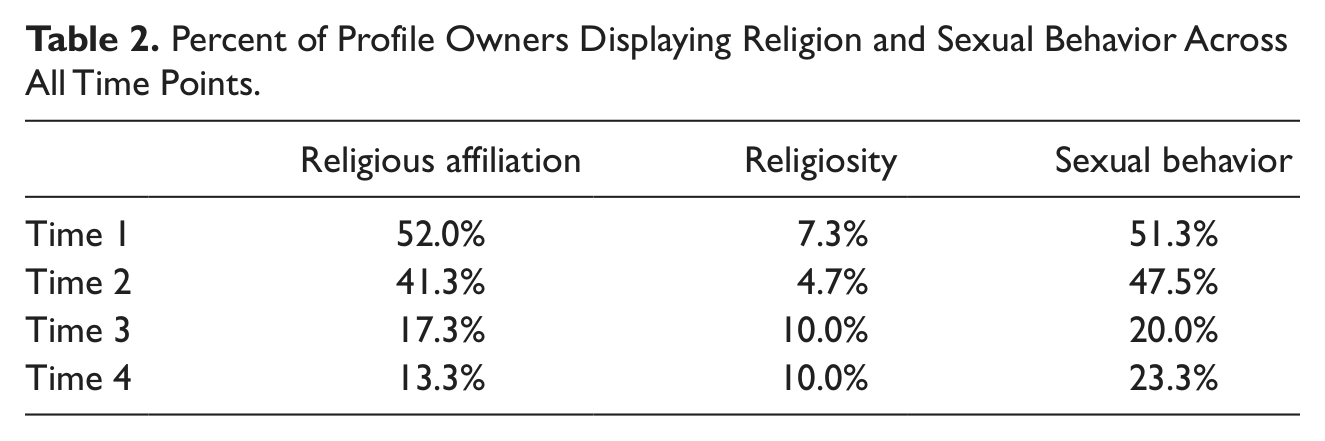
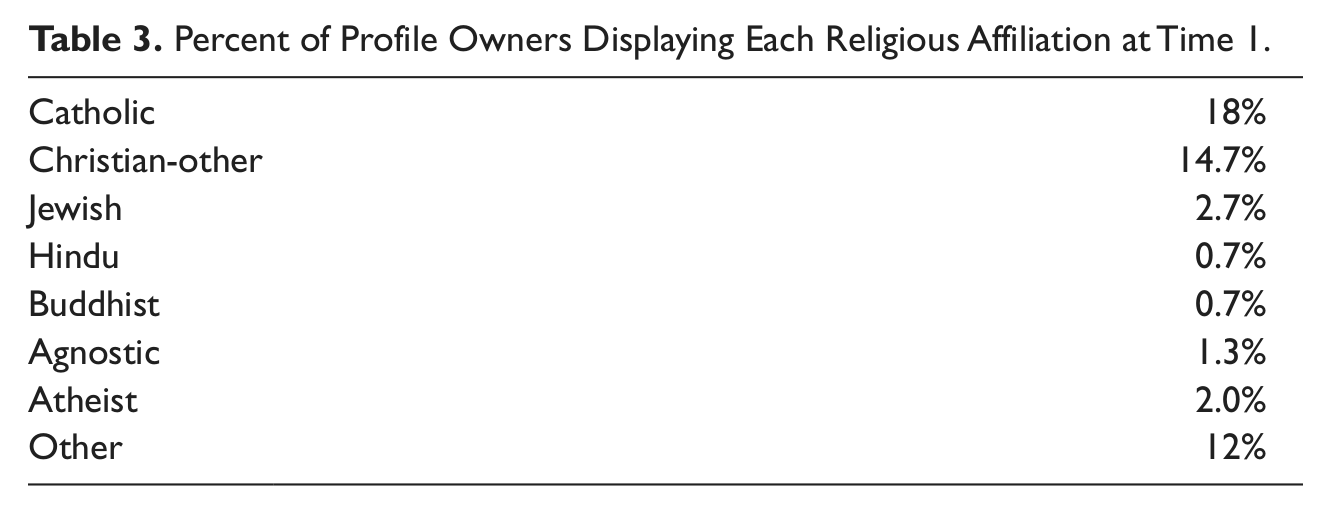
At Time 1, prior to entering college, 52% of profile owners displayed a religious affiliation on their profile (Table 2); the most commonly displayed affiliation was Catholic (Table 3). At Time 2, 41% of profile owners displayed a religious affiliation (OR = 0.3, 95% CI [0.13, 0.67]; p < .05) and by Time 4, only 13% of profile owners displayed an affiliation (OR = 0.01, 95% CI [0.002, 0.03]; p < .05). Only four students changed their religious affiliation during freshman year. Of the profiles owners who did not display a religious affiliation at Time 1, only three added an affiliation at a later Time period. The difference between men and women in the likelihood of reporting a religious affiliation was not statistically significant.
Percent of Profile Owners Displaying Religion and Sexual Behavior Across All Time Points.
Percent of Profile Owners Displaying Each Religious Affiliation at Time 1.
Commonly displayed references to religiosity (Table 4) included being a member of a religious Facebook group ( “University Prayer”), listing “bible study” as an activity, displaying religious bumper stickers, and writing status updates like “I see God in the love of my friends.” Overall, references to religiosity were uncommon. At Time 1, only 7% of profile owners displayed a reference to religiosity. By Time 4, 10% of profile owners displayed a reference to religiosity. The number of references to religiosity per profile increased over time among previous displayers. The difference between men and women in the likelihood of displaying a reference to religiosity was not statistically significant
Example References to Religiosity Displayed by College Freshmen on Facebook.

References to Sexual Behavior Over Freshman Year of College
Examples of references to sexual behavior (Table 5) included displaying “sex” as an interest, bumper stickers with sayings such as “Let’s quickly find someone to impregnant you,” and status updates such as “I wanna sex with everybody.” At Time 1, 51% of profile owners displayed at least one reference to sexual behavior. Over freshman year, more profile owners made their references to sexual behavior private than added or removed their references. By Time 4, 37% of profile owners with previous references to sexual behaviors made these references private; only 23% of all profile owners displayed references to sexual behavior. Among profile owners who displayed references to sexual behavior, the mean number of sexual references per profile decreased across Time periods, from a mean of 4.1 references per profile at Time 1 to a mean of 2.5 references per profile at Time 4 (p < .05).
Example References to Sexual Behavior Displayed by College Freshmen on Facebook.

The odds that female profile owners would make their sexual references private were four times higher compared with males (OR = 4.7, 95% CI [1.8, 11.5]; p < .05). However, among displayers of sexual behavior, female profile owners had on average more sexual references per profile than males at each Time point (p < .05). Before college, females displayed on average one more reference to sexual behavior than males (p < .05); at the end of freshman year, females displayed on average 0.7 more sexual references than males (p < .05).
The Relationship Between the Display of Religion and Sex Over Freshman Year of College
Displaying a religious affiliation on Facebook was not related to displaying a reference to sexual behavior. There was no significant difference in the number of references to sexual behavior per profile between profile owners who displayed a religious affiliation and those who did not. However, college freshmen who made their references to sexual behavior private were also more likely to remove their religious affiliation (p < .05). The Religious Views section of the profile is controlled independently from the sections of the profile containing sexual references. Therefore, the profile owner needed to make a conscious decision to hide each piece of information from the public.
Profile owners who displayed references to religiosity displayed fewer references to sexual behavior (Figure 1). At Time 1, profile owners without references to religiosity (non-displayers) made on average 2.2 sexual references, while those profile owners with references to religiosity (displayers) made on average 0.8 references to sexual behavior. When compared at each Time period, this relationship was not significant. However, when compared across all Time periods, which adjusts for students making their references private, profile owners with at least one reference to religiosity displayed 65% fewer references to sexual behavior than non-displayers (OR = 0.35, 95% CI [0.19, 0.67]; p < .05).

Mean Number of References to Sexual Behavior Among Displayers and Non-displayers of Religiosity.
To illustrate the varied presentations between the display of religious affiliation, religiosity, and sexual behavior among profile owners, we present three case examples (Table 6). This table demonstrates how three profile owners made changes to their reported affiliation, display of religiosity, and display of sexual behavior on their profiles over the course of freshman year. The table also illustrates which sections of the profiles were public, and therefore were able to be coded.
Case Examples of Facebook Profiles.

Discussion
The results of this study reveal interesting trends in how emerging adults change their public expression of religion and sex on Facebook throughout freshman year.
Decline in Religious Affiliation and Sexual Behavior
The results demonstrate a decrease in both the display of religious affiliation and the display of sexual behavior throughout freshman year. In the National Study of Youth and Religion (NSYR) the number of individuals self-reporting a religious affiliation decreased by 8% over the course of three years (Denton et al., 2008). As conventional religious practices decrease during college (Denton et al., 2008) profile owners may no longer feel the need or desire to label themselves as a given religious affiliation.
The reason for the decline in the display of sexual behavior is less clear. The number of students engaging in sexual intercourse increases from high school to college (ACHA, 2010; CDC, 2010); thus, the decrease in the display of sexual behavior seems unlikely to represent a true decline in sexual activity during freshman year. It may stem from a disinclination to display sexual behavior to the public. Profile owners were more likely to make their references to sexual behavior private rather than remove them. Thus, references to sexual behavior may be still visible to a select Facebook audience.
It is interesting to consider the reasons that would cause the public display of these variables to decline together. As emerging adults mature during freshman year, they may begin censoring the ideas and behaviors they once were willing to make public. In addition, college may provide guidance about the importance of limiting what information is displayed on social networking sites; freshmen may respond by hiding certain public references. Interestingly, female profile owners were more likely than males to make references to sexual behavior private, but equally as likely to remove their religious affiliation. Females may be more mindful of publicly displaying stigmatizing activities such as sexual behavior.
References to Religiosity
Only a small group of students displayed references to religiosity. This subset of displayers may represent a population of emerging adults who are more committed to their religious beliefs, or a group who is more willing to publicly display their religiosity. The number of profile owners with references to religiosity increased over freshman year despite the decrease in the display of religious affiliation. In the NSYR, individuals reported becoming more religious due to a life change or specific event, influential others or environment, and personal maturation (Denton et al., 2008). College encourages many of these changes, and thus the increase in references may reflect a true increase in religiosity among college freshmen. As the number references to religiosity per profile increased among previous displayers, freshman year may be reinforcing religiosity among emerging adults with established religious beliefs.
The Relationship Between Religion and Sexual Behavior
The results of this study support the need to distinguish religious affiliation and religiosity when examining the relationship between religion and sex. Although the display of religious affiliation was not associated with the display of references to sexual behavior, the display of references to religiosity was negatively associated with the display of sexual behavior. This is similar to previous studies in adolescents and emerging adults suggesting that a higher level of investment in religion is negatively associated with engagement in sexual activity (Ahrold et al., 2010; Earle et al., 2007; Gold et al., 2010; Lammers et al. 2000; Lefkowitz et al., 2004; Meier, 2003; Sinha et al., 2007).
According to Brown (2000), self-disclosure on social networking websites is associated with actual behavior or behavioral intent. Thus, the display of religion and sex on Facebook may represent true attitude and behavior, and Facebook may be a useful tool to evaluate changes in emerging adults’ religiosity and sexual activity over time.
Limitations
This study was based solely on public displays and we cannot speculate about profile information that was not accessible to the public. This study used only public profiles and further studies are necessary to determine if there is a difference in the display of behavior on private profiles. The changes in privacy settings created by Facebook required the coder to evaluate each section of the profile separately, and to classify each change in reference as removed versus private. The new settings gave profile owners more privacy options, but profile owners continued to maintain control over what to display publicly versus privately. The changes in privacy did not affect the intention of this study to observe public displays. We acknowledge that the change in privacy settings may have affected other displayed behaviors, but this study was limited to the collection of religion and sex displays.
Although the majority of college students have Facebook profiles (Christofides et al., 2009; Ellison et al., 2007; Lewis et al., 2008), we cannot speculate about emerging adults at other colleges, who do not attend college, or who do not have Facebook profiles. For instance, further studies are needed to determine how the display of religion and sex may differ among college freshmen who attend a private institution versus the large public university in this study. Also, 18- and 19-year-olds who are not exposed to the traditional college environment may display different behaviors on their profiles than the profiles owners in this study.
We acknowledge that the proportion of profile owners displaying references to religiosity was small and further studies should investigate this relationship with a larger sample size.
Implications
Despite these limitations, there are both research and practice implications for our findings. Because both religion and sexual activity are personal and often private, they can be challenging to research and to assess in clinical practice. Our study illustrates that emerging adults use social networking websites to express these variables and change their public display of religion and sex over time. From a practice standpoint, the results of this study support the idea that the inverse relationship between religion and sex continues throughout freshman year of college. Colleges may consider providing more opportunities for religious students to continue to express and explore their beliefs when they arrive on campus.
Further studies should investigate the relationship between religion and sexual activity on social networking sites among other populations of emerging adults. In addition, other studies should continue to investigate the correlation between online display and offline behavior by comparing Facebook data with other self-report data by college students.
In conclusion, our results illustrate that college freshmen use Facebook to publicly express their religious affiliation, religiosity, and sexual behaviors, as well as make changes in the display of these beliefs and behaviors over time. Our study opens the door for using Facebook as a tool to investigate emerging adults’ displayed beliefs and health behaviors over time.
Footnotes
Declaration of Conflicting Interests
The author(s) declared no potential conflicts of interest with respect to the research, authorship, and/or publication of this article.
Funding
The author(s) disclosed receipt of the following financial support for the research, authorship, and/or publication of this article: This project was supported by the University of Wisconsin-Madison Shapiro Summer Research Programs and by award K12HD055894 from the Eunice Kennedy Shriver National Institute of Child Health and Human Development.