




Abstract
In contemporary research on autonomy development, autonomy has been defined as independence (vs. dependence) or as self-endorsed (vs. controlled) functioning. Analogously, perceived parental autonomy support involves either perceived parental promotion of independence (PI) or perceived parental promotion of volitional functioning (PVF). The primary aim of the present study among Belgian and Greek adolescents (N = 658; 58% girls; M age = 16.3 years) was to examine associations between the two types of parental autonomy support, on one hand, and the two types of adolescent autonomy, on the other hand. The secondary aim was to investigate the moderating role of various background variables (i.e., gender, country of residence, and age) in these associations. As hypothesized, perceived parental PVF was related to adolescents’ self-endorsed (vs. controlled) motives. The relation between perceived parental PI and adolescent independence was qualified by an interaction with perceived parental PVF. Finally, although mean-level differences in the study constructs were found across gender, country, and adolescent age, the structural associations among constructs were invariant across these demographic groupings. These findings provide further insights in the complex dynamics involved in adolescent autonomy development in multiple national contexts.
Autonomy represents a central, yet ambiguous, construct in research on adolescent development. Indeed, researchers from various domains of psychology, including developmental psychology (e.g., Zimmer-Gembeck & Collins, 2003) and cross-cultural psychology (e.g., Rothbaum & Trommsdorff, 2007) do not agree on the exact definition, operationalization, and functional role of autonomy (Van Petegem, Vansteenkiste, & Beyers, 2013). In developmental psychology, for instance, the term has been used to refer to an amalgam of constructs, including independence, agency, separation, self-determination, detachment, self-governance, and self-assertion (Beyers, Goossens, Vansant, & Moors, 2003). As a consequence of such conceptual confusion, opinions also diverge on whether parental promotion of autonomy is desirable, or whether granting too much autonomy creates potential risks for adolescents (Dishion, Nelson, & Bullock, 2004). Similarly, some researchers conceive of autonomy as a developmental task that is particularly salient during adolescence (Steinberg, 2002), whereas others conceive of autonomy as a lifelong need inherent in the human experience (Deci & Ryan, 2000).
In the present study, we aimed to further clarify this confusion and to deepen our understanding of adolescents’ autonomy development by approaching the concept from two different angles that have been increasingly recognized in the field of developmental (e.g., Beyers et al., 2003; Van Petegem, Beyers, Vansteenkiste, & Soenens, 2012), cross-cultural (e.g., Kagitçibasi, 2005), and motivation (e.g., Ryan & Deci, 2006) psychology. In the first perspective, autonomy is defined as independence, as opposed to dependence or reliance on others (e.g., Smetana, Campione-Barr, & Daddis, 2004; Steinberg, 2002). In the second perspective, autonomy is defined as volitional or self-endorsed functioning, which involves acting upon personally valued interests and goals. This is contrasted with controlled functioning, which involves acting upon certain internally or externally imposed goals or demands. This latter perspective on autonomy is rooted in Self-Determination Theory (SDT; Deci & Ryan, 2000; Ryan & Deci, 2000; Vansteenkiste, Niemiec, & Soenens, 2010), a broad-band theory on motivation, personality, and social development that is increasingly being used as a guiding framework in developmental psychology (e.g., Soenens & Vansteenkiste, 2010). Paralleling this distinction at the personal level, at the contextual level, perceived parental promotion of independence (PI), which involves promoting adolescents’ independent expression, thinking, and decision making, has been differentiated from perceived parental promotion of volitional functioning (PVF), which involves fostering youngsters’ feelings of volition and psychological freedom (Soenens et al., 2007). Our main objective involved examining whether there exists a symmetrical relation (a) between perceived parental support for independence and adolescents’ actual independence and (b) perceived parental support for volitional functioning and adolescents’ self-endorsed functioning. In addition, we investigated the role of age, gender, and country of residence in these associations, as the study took place in two countries with a different cultural and family climate, that is, Belgium and Greece.
Greek culture is typically seen as rather traditional, primarily emphasizing close relationships and interdependence, whereas the Belgian cultural climate is assumed to be more independence-oriented and focused on self-assertion. Indeed, on Hofstede’s dimensions of national culture (Hofstede, Hofstede, & Minkov, 2010), the two countries differ mainly in terms of collectivism-individualism, with Greece scoring rather low on individualism and Belgium scoring relatively high. Given that some researchers argue that autonomy is only valued in individualistic cultures (e.g., Iyengar & Lepper, 1999; Markus & Schwartz, 2010), an in-depth examination of the role of country was deemed important.
A Differentiated View on Adolescent Autonomy
In mainstream cross-cultural and developmental psychology (e.g., Markus & Kitayama, 1991, 2003; Steinberg, 2002), adolescent autonomy is often defined as independence, that is, as the extent to which adolescents act or decide without the interference of others (Markus, Kitayama, & Heiman, 1996; Steinberg, 2002). The opposite of independence is adolescents’ tendency to rely on others, and on the parents in particular. This viewpoint focuses on the degree to which an adolescent depends on others or refrains from doing so. Normative physical, cognitive, and social changes during early and middle adolescence are said to trigger this development toward increased independent functioning (e.g., Paikoff & Brooks-Gunn, 1991; Steinberg, 2005).
One prototypical indicator of independence involves adolescents’ decision making (e.g., Smetana et al., 2004), which pertains to the question who decides about a range of daily issues (e.g., what clothes to wear, how much time to spend with friends). This hypothesized dimension ranges from decisions made by the youth on her or his own (representing total independence) to decisions made completely by the parents (representing total dependence). Although independent decision making has been related to higher personal well-being in some studies (e.g., Qin, Pomerantz, & Wang, 2009), such results have not been replicated in other studies (e.g., Fuligni & Eccles, 1993; Lamborn, Dornbusch, & Steinberg, 1996; Van Petegem et al., 2012). In some studies independent decision making even has been found to relate to more externalizing problems (e.g., Kuhn & Laird, 2011; Van Petegem et al., 2012).
Furthermore, it is argued that the development toward increased independence is mainly a Western-European and North-American phenomenon, whereas reliance on parental advice and guidelines in the realm of decision making would be normative in relatively more collectivistic and interdependent cultural contexts (Hasebe, Nucci, & Nucci, 2004; Markus & Schwartz, 2010). This is because, in such countries, conformity and loyalty toward the family are strongly valued (Hofstede et al., 2010). Hence, in relatively collectivist countries youngsters may desire relatively less independent decision making and may have a stronger preference to follow the parents’ advice. Moreover, parents’ decision making would not be as detrimental, or would even be positive for adolescents from collectivistic countries (Iyengar & Lepper, 1999).
A second approach to autonomy is rooted in SDT (Deci & Ryan, 2000; Vansteenkiste et al., 2010), where autonomy is considered to be a universal psychological need and is defined as volitional or self-endorsed functioning, that is, as the extent to which one willingly engages in actions and fully endorses the importance and value of those actions (Ryan & Deci, 2000). In this case, individuals act in accord with their authentic interests and personal values. The opposite of self-endorsed functioning is not dependence, but rather controlled or pressured functioning, a mode of regulation in which one feels coerced or forced to act, think, or feel in a prescribed way (Deci & Ryan, 2000). This viewpoint on autonomy pertains primarily to the underlying motivation behind certain behaviors (i.e., the reasons why one engages in a specific activity) and, more specifically, to the type or the quality of motives driving people’s behavior (Vansteenkiste et al., 2010).
SDT distinguishes between qualitatively different types of motives depending on the degree to which individuals have gradually accepted (i.e., internalized) the reasons underlying their behavior (Ryan & Connell, 1989; Ryan & Deci, 2000). Internalization involves a process in which externally offered attitudes, norms, and regulations are transformed into personally endorsed self-regulations and motives. External regulation refers to the engagement in an activity because of external pressures, such as obligations to meet demanding expectations or attempts to avoid undesirable and threatening external consequences (e.g., punishments). Because externally regulated activities are accompanied with the feeling that one is compelled by a force outside the self (i.e., one has an external perceived locus of causality; deCharms, 1968; Ryan, Deci, Grolnick, & LaGuardia, 2006), the reasons underlying the behavior have not been internalized, and the behavioral regulation is experienced as pressuring and as alien to the self. When acting on the basis of introjected motives, individuals engage in the activity to meet internal pressures, such as the avoidance of guilt or shame or the desire to bolster their ego (Assor, Vansteenkiste, & Kaplan, 2009). Introjection represents partial internalization, as the impetus for the behavior is literally inside the person but is not fully accepted as one’s own. As a result, this type of regulation is often characterized by feelings of inner conflict, pressure, and tension (Deci & Ryan, 2000). In contrast, when acting upon identified motives, one has come to understand the personal value and significance of the activity, such that one enacts the behavior more willingly. In this case, one has more fully internalized the behavioral regulation, because one endorses the reasons underlying engagement in the activity.
Several previous studies have shown that higher self-endorsement and internalization are beneficial for adolescents’ behavior and well-being in different life domains, including school (e.g., Aelterman et al., 2012), friendships (e.g., Soenens & Vansteenkiste, 2005), and health care (e.g., Ng et al., 2012). This is because, according to SDT, when adolescents have to come to fully endorse the reasons underlying their activity engagement, they are more likely to experience a sense of volition and psychological freedom, such that their need for autonomy would be satisfied (Deci & Ryan, 2000, 2011; Vansteenkiste et al., 2010). Because SDT posits that the need for autonomy is innate, autonomy need satisfaction is presumed to yield universal benefits. Consistent with this claim, self-endorsed functioning and autonomy need satisfaction have been found to relate to adaptive developmental outcomes in diverse collectivistic and family-oriented nations, including China (e.g., Vansteenkiste, Zhou, Lens, & Soenens, 2005), Korea (Jang, Reeve, Ryan, & Kim, 2009), Taiwan (e.g., Sheldon et al., 2004), Brazil (Chirkov, Ryan, & Wellness, 2005), and Jordan (Ahmad, Vansteenkiste, & Soenens, 2013).
Notably, it is emphasized increasingly that these two definitions of autonomy are clearly distinct and that, by crossing them, different combinations of autonomy-related orientations can be derived (Ryan & Deci, 2006; Van Petegem et al., 2012; Zimmer-Gembeck & Collins, 2003). That is, adolescents can decide independently because they personally value doing so (i.e., self-endorsed independence) or because their parents are not available, such that they have no other choice than to make their own decisions (i.e., controlled independence). Such controlled independence could also take the form of rebellion and defiance, in which case adolescents make their own independent decisions in an attempt to distance themselves from the requests and direction imposed on them (Van Petegem et al., 2013; Vansteenkiste, Soenens, Van Petegem, & Duriez, in press). Likewise, adolescents may rely upon parental advice or even leave the decision to their parents, because they personally endorse the input and parental guidance (i.e., self-endorsed dependence). Alternatively, adolescents may also take the parents’ opinion into account because they would feel guilty or ashamed for not being loyal to their parents (i.e., controlled dependence).
In line with this theorizing, Van Petegem et al. (2012) found that Belgian adolescents’ degree of independent (vs. dependent) decision making could be empirically distinguished from the self-endorsed versus controlled motives underlying both independent and dependent decision making. Interestingly, independent decision making was unrelated to adolescent well-being and intimacy, but was related to more externalizing problems, whereas adolescents’ self-endorsed (as opposed to their controlled) motives for acting either independently or for remaining dependent related to more favorable developmental outcomes. A similar pattern of relations was obtained by B. Chen, Vansteenkiste, Beyers, Soenens, and Van Petegem (in press) in a sample of Chinese adolescents. The present study aimed to extend this work by investigating parental antecedents of the two types of autonomy as well as by performing an in-depth investigation of the role of gender, age, and cultural background. As regards cultural differences, we used data from two countries with different cultural contexts, that is, Belgium and Greece.
Differentiating Between Types of Perceived Parental Autonomy Support
Paralleling the differentiated view on adolescent autonomy, parental autonomy support has been characterized as parental PI or as parental PVF (Soenens et al., 2007). Parents who promote independence encourage their children to become self-reliant, that is, to go their own way as much as possible without relying on others (Gray & Steinberg, 1999; Silk, Morris, Kanaya, & Steinberg, 2003; Steinberg & Silk, 2002). The opposite of PI would be an orientation where parents prefer to keep their children within close emotional but also physical distance, for instance, by encouraging the child to continue being reliant and dependent on the parents for advice and support (Steinberg & Silk, 2002).
According to SDT, PVF involves parents’ attempts to encourage their children to make self-endorsed decisions and choices, reflecting the adolescent’s personal values, preferences, and interests (Ryan, Deci, & Grolnick, 1995). Such a parenting style involves understanding the child’s frame of reference, providing meaningful choices whenever possible, encouraging initiative and exploration, and providing a relevant rationale when introducing rules or when choice is limited (Deci, Eghrari, Patrick, & Leone, 1994; Grolnick, 2003). Furthermore, the use of pressuring parental behaviors such as guilt-induction and love withdrawal is avoided (Grolnick, 2003; Soenens & Vansteenkiste, 2010).
Although PI may foster volitional functioning, this is not by definition the case, as some parents may force their children to act independently. Thus, such parents would score low on PVF, yet high on PI (Soenens, Vansteenkiste, & Sierens, 2009). Furthermore, parents may not only foster a sense of volition vis-à-vis acting independently, they could also allow their children to choose to rely on them with respect to certain issues. Thus, when promoting volitional functioning, it is critical for parents to be sensitive to the child’s preferences and interests as well as to the child’s capacity to act independently. Said differently, parents high in PVF are available, thereby providing the choice for the child to act independently or to remain dependent. With regard to the prediction of adolescents’ adjustment and developmental outcomes, perceived PVF has been established as a more critical predictor compared with the degree of perceived PI (Soenens et al., 2007, 2009).
Importantly, PVF does not imply a laissez-faire approach where parents follow their children’s preference for independent or dependent functioning all the time, as if the child is continually taking the lead in parent-child interactions. Under certain circumstances, the child can be required to act independently or the parent will make decisions for the child. When this is the case, a parent high in PVF would provide a meaningful rationale for why independent functioning is desirable or why choice is denied, and would then allow the child to voice her or his opinion on the issue at hand. This way, the child can come to understand and endorse what the parent is doing and, as a result, maintain a sense of personal choice in her or his actions (Vansteenkiste et al., in press).
The Present Study
The primary aim of the present investigation was to examine whether perceived parental autonomy support relates to adolescent autonomy. Although the answer to this question may seem simple from a lay perspective, this question is far from straightforward from an academic perspective, given the history of conceptual confusion in the literature on autonomy development. Accordingly, a differentiated viewpoint on both adolescent autonomy and parental autonomy support was adopted to provide more nuanced insight into the possible relation between parental autonomy support and adolescent autonomy. Specifically, we first assessed perceived parental PVF and PI, thereby tapping into adolescents’ perceptions of both mothers’ and fathers’ parenting styles. This was deemed necessary as mothers and fathers are sometimes argued to play a different role in adolescents’ autonomy development (e.g., Collins & Russell, 1991). We also measured adolescents’ degree of independent (vs. dependent) decision making regarding a diverse set of issues. Next, we asked adolescents (a) why they decide independently about certain issues, thereby tapping into the self-endorsed versus controlled motives for their independent decision making and (b) why they would leave the decision to their parents with respect to other issues, thereby tapping into the motives for dependent decision making. Thus, we assessed both the degree of independent (vs. dependent) decision making as well as the level of internalization of both independent and dependent decision making (see, for example, B. Chen et al., in press; Van Petegem et al., 2012). We expected that a set of symmetrical, that is, “point-to-point” associations would emerge, with perceived PI relating to more independent decision making and with perceived PVF relating to more self-endorsed motives for both independent and dependent decision making. In addition, we examined the interaction between perceived PI and perceived PVF in the prediction of adolescents’ autonomy. We particularly expected an interaction to emerge in the prediction of independent decision making, as perceived parental PVF might change the functional significance (Deci & Ryan, 1985) of perceived parental PI. For instance, when parents are perceived as promoting independence in a volitional fashion, adolescents might be likely to identify with the importance of independent decision making, thus displaying more independent decision making per se. Conversely, when parents are viewed as promoting independence in a controlling fashion, children may actually behave in a less (rather than more) independent manner because they lack the confidence and internal compass to make independent decisions (Assor, 2012).
The second aim involved investigating the role of gender and age. Prior research has shown that men display a more independent and less interdependent self-concept (Clancy & Dollinger, 1993; Cross & Madson, 1997; Josephs, Markus, & Tafarodi, 1992). Moreover, researchers postulate that, even in individualistic cultural contexts such as the United States, due to socialization men tend to be more independence-oriented than women (Cross & Madson, 1997; Gilligan, 1982; Sampson, 1988). Hence, we expected boys to score higher on both perceived PI and independent decision making compared with girls. Because previous research has not yielded clear-cut and systematic gender differences in volitional functioning, no specific hypothesis was forwarded regarding the effects of youngsters’ gender on perceived PVF and self-endorsed motives for decision making.
Furthermore, we tested for differences between Greek and Belgian adolescents, as Greece is typically seen as collectivistic and interdependent, whereas Belgium is usually considered to be more individualistic and independence oriented (Hofstede et al., 2010). Given these differences, we hypothesized that Belgian adolescents would score higher on parental PI, would display more independent decision making, and would report more self-endorsed motives for independent decision making. Given that Greek adolescents would be expected to value relatedness more strongly, they were predicted to score higher on self-endorsed dependence.
Because the development toward increased independent functioning is a major developmental task for adolescents (Zimmer-Gembeck & Collins, 2003), we also considered the role of age. In line with past research (e.g., Qin et al., 2009; Smetana et al., 2004), we expected older adolescents to perceive their parents as granting more independence and to display more independent functioning themselves. Furthermore, given that people would be increasingly oriented toward acting upon personally endorsed values as they grow older (at least when circumstances are supportive; Deci & Ryan, 2000; Sheldon & Kasser, 2001), we expected older adolescents to display more self-endorsed motives for both independent and dependent decision making.
In addition to testing the mean-level differences regarding gender, country, and age, we also examined whether the proposed structural relations between perceived parental autonomy support and adolescent autonomy would be moderated by gender, country, or age. In the light of developmental and cross-cultural scholars’ argument that the socialization into independence, relative to dependence, and its correlates differ by gender (Clancy & Dollinger, 1993; Cross & Madson, 1997; Josephs et al., 1992), cultural context (e.g., Markus & Kitayama, 1991, 2003; Miller, 2003; Oishi, 2000), and age of the adolescent (e.g., Dishion et al., 2004), the association between perceived PI and the degree of independent decision making may be stronger in Belgium as compared with Greece, in boys as compared with girls, or in older as compared with younger adolescents. However, SDT maintains that all adolescents should benefit when parents are perceived as promoting self-endorsed functioning (Deci & Ryan, 2000). Therefore, we did not anticipate moderation of the structural relations between perceived parental PVF and the motives underlying one’s decision making (Deci & Ryan, 2000; Vansteenkiste et al., 2010).
Method
Participants and Procedure
The study was conducted in a mixed sample of 681 Belgian (n = 309; 45.4%) and Greek (n = 372; 54.6%) high school students. Participants’ age ranged between 13 and 20 years (mean age = 16 years 4 months, SD = 1 year 2 months). Specifically, 47 participants (6.9%) were 13 or 14 years old, 104 participants (15.3%) were 15 years old, 213 participants (31.3%) were 16 years old, 190 participants (27.9%) were 17 years old, 88 participants (12.9%) were 18 years old, and 18 participants (2.6%) were 19 or 20 years old. Age information was not available for 21 participants (3.1% of the sample). In terms of gender, the sample comprised 395 girls (58%) and 269 boys (39.5%). Gender information was not available for 17 participants. The majority (83.4%) of the respondents reported being from intact families, 13.2% from divorced families and 3.5% reported having a different family structure (e.g., one parent deceased). Questionnaires were administered during a regular class period at two schools in Flanders (i.e., the Dutch-speaking part of Belgium) and at three schools from around Athens (Greece). Participation in the study was voluntary and anonymity was guaranteed.
Measures
All questionnaires were completed by the adolescents in their native language. All measures were available in Dutch. Questionnaires were translated into Greek through a procedure of back translation. Unless mentioned otherwise, adolescents answered items on a 5-point Likert-type scale, ranging from 1 (“completely untrue”) to 5 (“completely true”).
PI
Given that the original measure of perceived parental PI was constructed through post hoc analyses of items of a preexisting parenting battery, Silk et al. (2003) argued for the need to develop a new scale to more precisely measure the construct at hand. Therefore, we developed a new questionnaire to assess perceived PI. Specifically, items were initially created by formulating face valid items by one of the authors, and these items were then evaluated independently by the other authors. Through discussion, consensus was reached about the final version, which comprised six items (i.e., “My mother/father thinks it’s important that I can solve problems without him/her,” “My mother/father thinks it’s important for me to learn to stand on my own legs,” “My mother/father wants me to make decisions on my own,” “My mother/father thinks it’s important that I am independent,” “My mother/father wants me to make choices on my own,” “My mother/father thinks I should take care of my own business”). Adolescents filled out the questionnaire about their mother and father separately. The scale provided scores with good reliability (α = .83 and .86 for mothers and fathers, respectively). In addition, the new measure of PI correlated significantly with the original Silk et al. measure (r = .57 and .62, ps < .001, for mothers and fathers, respectively), which was also administered in this study, providing evidence for convergent validity. Moreover, there was high similarity in the correlates between the PI measures on the one hand and the other study variables on the other hand (i.e., PVF, independent decision making, the underlying motives for independent as well as dependent decision making), which further evidences convergent validity. The main advantages of the new measure for parental PI, as compared with the Silk et al. measure, are its higher reliability and its inclusion of items with stronger face validity.
PVF
Perceived parental PVF was measured through the Autonomy Support subscale from the Perceptions of Parenting Scale (Grolnick, Ryan, & Deci, 1991; Soenens et al., 2007, 2009). This questionnaire consisted of seven items (e.g., “My mother/father, whenever possible, allows me to choose what to do”; “My mother/father is usually willing to consider things from my point of view”; “My mother/father isn’t very sensitive to many of my needs,” reverse coded). Adolescents filled out the questionnaire about mother and father separately Soenens et al. (2007, 2009) have provided extensive validity information for the PVF measure. In the present study, the measure was found to be internally consistent as well (α = .80 for both mothers and fathers).
Adolescent autonomy
An integrated measure was used to assess the different aspects of adolescent autonomy (B. Chen et al., in press; Van Petegem et al., 2012). The Family Decision Making Scale (FDMS; Dornbusch et al., 1985) was used to assess the degree of independent decision making, whereas an adaptation of the Self-Regulation Questionnaire (SRQ; Ryan & Connell, 1989) was used to assess the underlying (self-endorsed vs. controlled) motives for both independent and dependent decision making. This integrated measure was developed and validated by Van Petegem et al. (2012). Specifically, youngsters first reported on the degree of independent decision making through the FDMS (Dornbusch et al., 1985). They indicated who decides (parent, adolescent, or both) about a range of 24 issues (e.g., what clothes to wear, how to spend free time, how much time to spend with friends) on a 5-point scale, ranging from 1 (“my parents alone”) to 5 (“I alone”). As in other studies (e.g., Hasebe et al., 2004), higher scores indicate more independent decision making.
Next, the motives for independent decision making were assessed through items from the SRQ that were adjusted to the theme of (in)dependence (Van Petegem et al., 2012). Specifically, the adolescent was first asked to select the three highest scoring items from the FDMS and to write these down, as these are issues about which they decide most independently. Then, adolescents were asked why they decide rather independently about these issues, thereby tapping into their underlying motives for independent decision making. Specifically, we assessed their identified motives (six items; for example, “because it is personally important to me”), introjected motives (six items; for example, “because I would feel bad if I didn’t”), and external motives (six items; for example, “because I am forced by others”) for independent decision making.
We then measured the adolescents’ motives for dependent decision making through a similar procedure. Specifically, participants selected and wrote down the three items with the lowest scores on the FDMS. Then they were asked why they tend to depend on their parents to decide about these issues, thereby tapping into their underlying motives for dependent decision making. The same 18 items were used, with only one difference; that is, the items for external motives now explicitly referred to the parents rather than to others in general (e.g., “because I am forced by my parents”). All subscales within this integrated measure were internally consistent, with Cronbach’s αs ranging between .79 and .87. Additional validity information for the scale is provided by Van Petegem et al. (2012).
Results
Plan of Analysis
The analytical strategy matched the two aims of the present study, that is, (a) to investigate the relation between parental autonomy support and adolescent autonomy and (b) to explore the roles of gender, country of residence, and age in the structural relations between these variables. We aimed to address these two aims through five steps. First, we performed a confirmatory factor analysis (CFA) to test whether all items loaded on their corresponding latent factors. Second, we tested for measurement equivalence across gender and country of residence. Two types of measurement invariance were tested, that is, metric invariance (i.e., equal factor loadings across groups) and scalar invariance (i.e., equal item intercepts across groups). When metric invariance is reached, it supports comparing the relations between latent variables across groups (e.g., through multigroup analyses). When scalar invariance is attained, it supports comparing (latent) means across groups (Dimitrov, 2010; Holland & Wainer, 1993). Third, we explored the main effects of gender, country of residence, and age on perceived parental autonomy support and adolescent autonomy. Fourth, we estimated structural models to test for the relation between perceived parental autonomy support and adolescent autonomy. In supplementary analyses, we tested for the interaction between PI and PVF in the prediction of adolescent autonomy. Fifth, we investigated whether gender, country of birth, and/or age moderated any of the associations between perceived parental autonomy support and adolescent autonomy.
Preliminary Analyses
We started by estimating a CFA model, where each item was modeled as an indicator of the corresponding underlying latent factor. Only for independent decision making, we made use of five parcels. This was deemed necessary as a high number of indicators (in this case, 24 items) for instance increases the odds of correlated residual terms, which would lead to poorer model fit (for an elaborate discussion on the advantages of parceling, see Kline, 2010; Little, Cunningham, Shahar, & Widaman, 2002). Furthermore, error correlations were allowed between indicators loading on same factor (which were mostly due to overlap in wording) and across corresponding items of the maternal and paternal parenting questionnaires. Analyses were performed using Mplus 7.00 (Muthén & Muthén, 2012). We corrected for the non-normality observed in some of the variables through robust maximum likelihood estimation. We evaluated model fit based on a combined consideration of the comparative fit index (CFI), the non-normed fit index (NNFI), the root mean square error of approximation (RMSEA) and the standardized root-mean-square residual (SRMR). A CFI value of .90 or higher indicates an acceptable fit, a CFI of .95 or higher indicates a good fit (Marsh, Hau, & Wen, 2004), the NNFI value should be .90 or higher (Kline, 2010), RMSEA should be .06 or lower, and SRMR .08 or lower (Hu & Bentler, 1999; Kline, 2010). The CFA model yielded a good model fit, χ2(1899) = 3,586.96, p < .001, CFI = .91, NNFI = .90, RMSEA = .04, SRMR = .06. Moreover, all items were found to load significantly on their corresponding factor (i.e., loadings of .40 or higher, p < .001).
Next, we performed a set of multigroup CFAs to test for measurement invariance (Byrne, 2004; F. F. Chen, 2007; Vandenberg & Lance, 2000) across gender and country of residence. We first tested for metric invariance by comparing an unconstrained model against a constrained model where the factor loadings of each item on their respective latent variable were set equal across groups. Then we tested for scalar invariance by comparing the metric invariance model with a model where the intercepts were set equal as well. Invariance of model fit of the unconstrained and constrained models was based on three difference-in-fit indices. The difference in chi-square (Δχ2) should be non-significant. However, the Δχ2 statistic is often seen as an elusive criterion, especially when sample size is large (F. F. Chen, 2007; Cheung & Rensvold, 2002). Therefore, two other statistics are also taken into account. Specifically, the difference in CFI (ΔCFI) should be lower than .01 and the difference in NNFI (ΔNNFI) should be lower than .02. Hence, we assumed equivalence when two of the three criteria were met (Cheung & Rensvold, 2002; Vandenberg & Lance, 2000).
As for gender, both metric invariance, ΔCFI = .001; ΔNNFI = .000; Δχ2(54) = 77.13, p = .02, and scalar invariance, ΔCFI = .003; ΔNNFI = .007; Δχ2(54) = 108.64, p < .001, were obtained, which indicates that factor loadings and intercepts are not significantly different between boys and girls. As for country of residence, we obtained evidence for metric invariance, ΔCFI = .005; ΔNNFI = .005; Δχ2(54) = 155.62, p < .001. However, scalar invariance was not obtained, ΔCFI = .058; ΔNNFI = .060; Δχ2(54) = 1,091.28, p < .001. We then tested for partial scalar invariance of each scale, by freeing the intercepts of the indicators, based on the modification indices (Hancock, Lawrence, & Nevitt, 2000; Vandenberg & Lance, 2000). We found evidence for partial scalar invariance across countries in the variables representing paternal PVF, independent decision making, identified independence, external independence, and external dependence, ΔCFI = .007; ΔNNFI = .006; Δχ2(19) = 132.22, p < .001, allowing us to perform latent mean comparisons for these variables.
Differences as a Function of Gender, Country of Residence, and Age
Next, we examined the main effects of gender, country of residence, and age on the variables of interest. Gender differences were examined through latent mean comparison using Mplus 7.00 (Muthén & Muthén, 2012), with the mean for girls set to zero as the reference category. To provide maximal insight into the findings, we present both latent and observed means in Table 1. Boys were found to score significantly higher on perceived paternal PI, whereas girls had significantly higher scores on both identified independence and identified dependence. Then, we tested for country differences through latent mean comparison in the variables for which partial scalar invariance was obtained, with the mean for Greece set to zero. The latent and observed means as a function of country of residence are presented in Table 1 as well. Greek adolescents scored significantly higher on independent decision making and identified independence, whereas Belgian adolescents had higher scores for external dependence.
Latent and Observed Means of the Study Variables as a Function of Gender and Country.
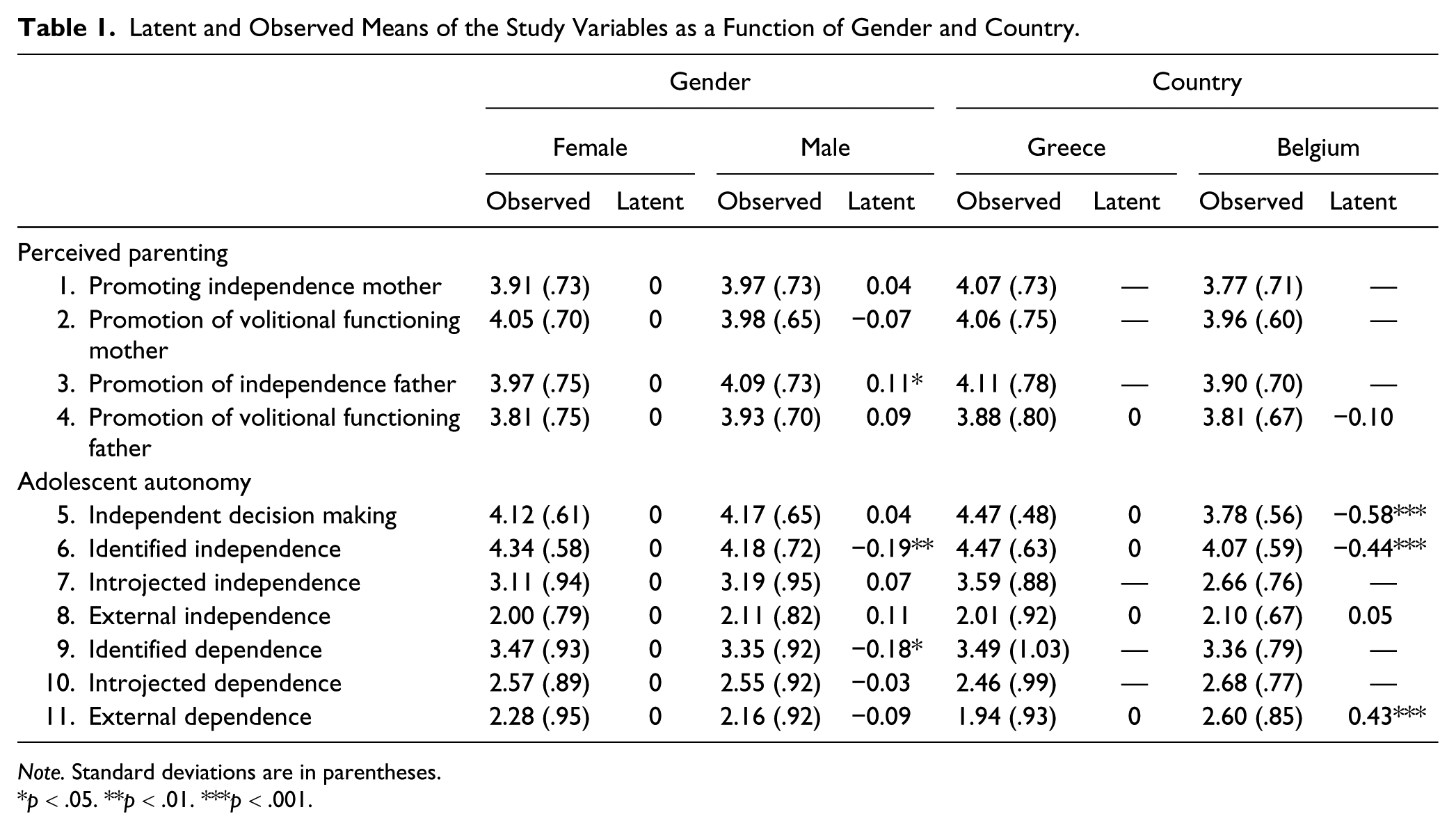
Note. Standard deviations are in parentheses.
p < .05. **p < .01. ***p < .001.
Age differences in perceived parental autonomy support and adolescent autonomy were examined through correlational analyses. Participants’ age was correlated positively with perceived maternal PI (r = .14, p < .001), perceived maternal PVF (r = .10, p < .05), and perceived paternal PI (r = .09, p < .05). As for adolescent autonomy, positive associations with age were found for independent decision making (r = .28, p < .001), identified independence (r = .18, p < .001) and introjected independence (r = .19, p < .001).
Structural Relations Between Perceived Parental Autonomy Support and Adolescent Autonomy
Correlations between the variables of interest are presented in Table 2. Similar to previous studies (B. Chen et al., in press; Van Petegem et al., 2012), the correlations among the motives for (in)dependent decision making showed a simplex-like pattern (Guttman, 1954), as the constructs more adjacent to each other on the underlying internalization continuum were positively intercorrelated (e.g., identified and introjected motives), whereas those further apart (identified and external motives) were unrelated. This was the case for the motives for independent decision making as well as the motives for dependent decision making. Hence, in line with previous studies (e.g., Neyrinck, Vansteenkiste, Lens, Duriez, & Hutsebaut, 2006; Vallerand, Fortier, & Guay, 1997), an overall Relative Internalization Index (RII) was created for both the motives for independent as well as dependent decision making (labeled RII-Independence and RII-Dependence) by weighing the standardized scores of identified, introjected and external as +3, −1, and −2, respectively. Higher scores reflect more self-endorsed (as opposed to controlled) motives for independent or dependent decision making.
Means, Standard Deviations, and Correlations Among the Study Variables.
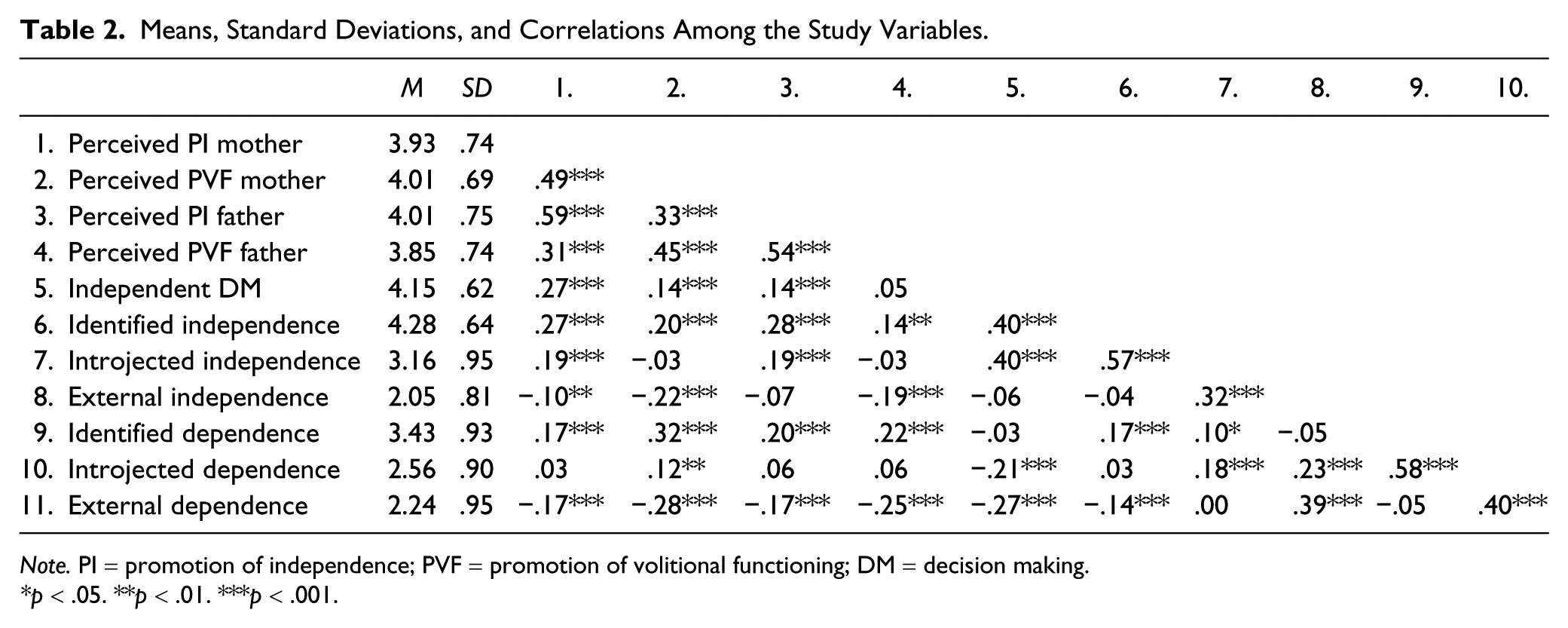
Note. PI = promotion of independence; PVF = promotion of volitional functioning; DM = decision making.
p < .05. **p < .01. ***p < .001.
We used structural equation modeling (SEM) to evaluate the structural relations between perceived parental autonomy support and adolescent autonomy. Specifically, perceived parental PI and PVF were modeled as predictors of independent decision making, RII-Independence and RII-Dependence. Each latent variable was represented by three randomly created parcels (cf. Little et al., 2002). Gender and age were entered into the model as covariates. Separate analyses were performed for maternal and paternal rearing style. The maternal model provided a good fit to the data, χ2(132) = 458.25, p < .001, CFI = .93, NNFI = .91, RMSEA = .06, SRMR = .05, and is presented in Figure 1. Specifically, perceived maternal PI uniquely predicted more independent decision making. Associations of perceived maternal PI with RII-Independence and RII-Dependence were not significant. Perceived maternal PVF, on the other hand, was unrelated to independent decision making, but related positively to RII-Independence and RII-Dependence. Then, we tested for the latent interaction between perceived maternal PI and PVF in the prediction of independent decision making, RII-Independence and RII-Dependence. The interaction was significant when predicting independent decision making (t = 2.27, p < .05) and is depicted in Figure 3A. Specifically, the positive relation between perceived maternal PI and independent decision making was stronger when scores on perceived maternal PVF were high. The interaction was not significant in the prediction of RII-Independence (t = 1.49, p = .14) or RII-Dependence (t = 1.91, p = .06).
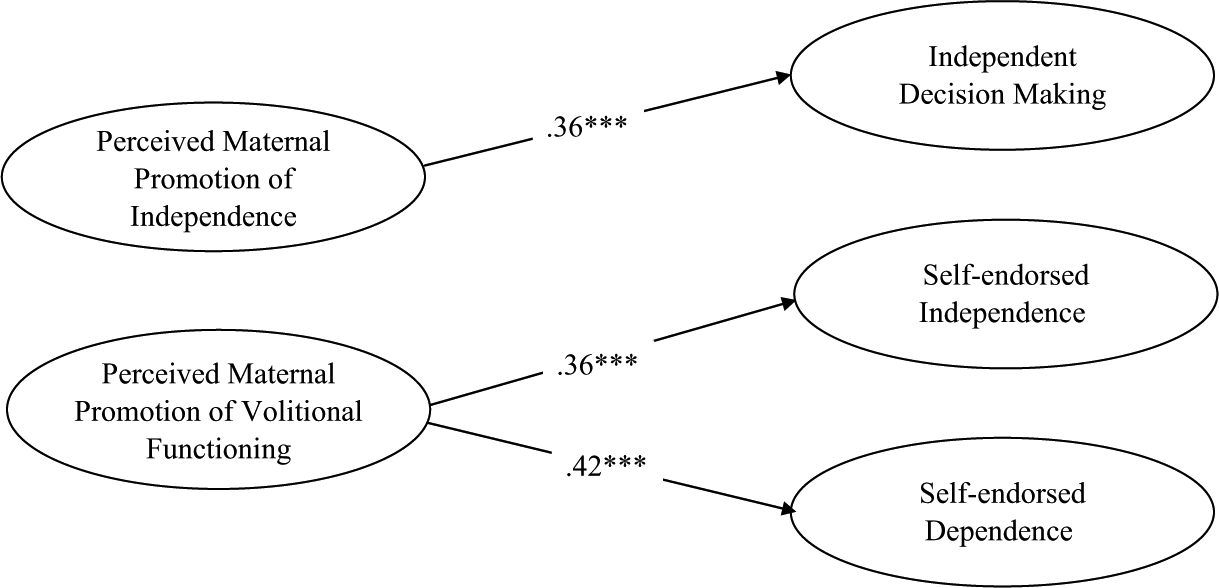
Structural model of the relation between perceived maternal autonomy support and adolescent autonomy.
The paternal model also provided a good fit to the data, χ2(132) = 383.82, p < .001, CFI = .95, NNFI = .93, RMSEA = .05, SRMR = .05, and is depicted in Figure 2. Perceived paternal PI predicted more independent decision making as well as higher scores on RII-Dependence. The relation with RII-Independence was not significant. As in the mother model, perceived paternal PVF related positively to both RII-Independence and RII-Dependence, whereas the association with independent decision making was not significant. Then we tested for the interaction between perceived paternal PI and PVF. As in the mother model, the interaction was only significant in the prediction of independent decision making (t = 4.61, p < .001). Specifically, the relation between perceived paternal PI and independent decision making was only positive when scores on perceived PVF were high (see also Figure 3B). The interaction was not significant when predicting RII-Independence (t = 0.64, p = .52) or RII-Dependence (t = −0.08, p = .94).

Structural model of the relation between perceived paternal autonomy support and adolescent autonomy.
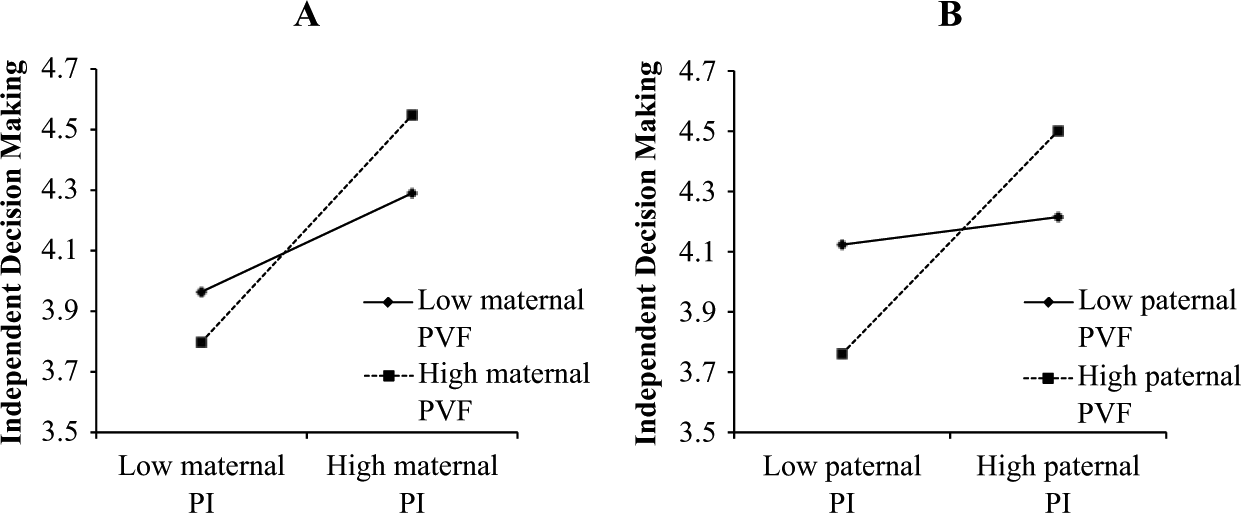
Interactions between perceived maternal PI and PVF (A) and perceived paternal PI and PVF (B) in the prediction of independent decision making.
Moderation by Gender, Country of Residence, and Age
Then we tested whether the obtained structural models of the relation between perceived parental autonomy support and adolescent autonomy were moderated by the adolescents’ gender, country of residence, and age. For gender and country, these tests were conducted through multigroup invariance testing. Specifically, we compared an unconstrained model (where all structural paths were set free) with a constrained model (where all structural paths were fixed across gender or country of residence). No significant differences in model fit emerged when comparing across gender—ΔCFI = .001; ΔNNFI = .005; Δχ2(6) = 2.62, p = 2.62, for the mother model and ΔCFI = .001; ΔNNFI = .002; Δχ2(6) = 2.42, p = .88, for the father model—or across country of residence—ΔCFI = .000; ΔNNFI = .002; Δχ2(6) = 2.82, p = .83, for the mother model and ΔCFI = .001; ΔNNFI = .002; Δχ2(6) = 3.71, p = .72, for the father model. Hence, this indicates that the structural relations between perceived parental autonomy support and adolescent autonomy were equivalent across boys and girls and across Belgian and Greek adolescents. To test for moderation by age, we investigated whether the interaction term between age and perceived PI and the interaction between age and perceived PVF were significant in the prediction of independent decision making, RII-Independence and RII-Dependence. However, none of the 12 interaction terms were significant (t-values ranging between −1.87 and 1.84, p values were .06 or higher).
Discussion
In adolescent psychology, two primary conceptualizations of adolescent autonomy have been advanced, that is, autonomy defined as independence and autonomy defined as self-endorsed functioning (e.g., Van Petegem et al., 2012). In the same way, two types of parental autonomy support are distinguished, that is, PI and PVF (Soenens et al., 2007). Taking both views on autonomy into account, the present contribution (a) aimed to explore the relation between perceived parental autonomy support and adolescent autonomy and (b) examined the role of gender, country, and age in mean levels of these variables and in the relations between these variables.
Relations Between Perceived Parental Autonomy Support and Adolescent Autonomy
For adolescents’ independent decision making, perceived PI was found to serve as the strongest predictor. Thus, if adolescents feel that their parents emphasize the necessity to make independent decisions and to be self-reliant in their functioning, the adolescents are more likely to actually act independently. Yet, interestingly, this association was qualified by an interaction with perceived PVF. Specifically, for perceived PI to relate to more actual independence, the independence needs to be encouraged in a volitional way rather than being experienced as pressuring and as imposed upon children. Presumably, the functional significance (Deci & Ryan, 1985) of perceived parental PI is different depending on the level of perceived PVF. That is, adolescents attribute a different psychological meaning to what the parents promote (i.e., independence or dependence), depending on how it is promoted by the parents (i.e., in a volitional or pressuring way; Deci & Ryan, 1987). When parents promote independence in a rather pressuring way (e.g., “When will you learn to take care of your own business?! I cannot be available for you all the time!”), children may feel insecure about acting independently, which may hamper their independent decision making. Instead, when parents promote independence in a volitional way, they will help adolescents to learn to act upon their emerging interests and personal values. Eventually, they may make more independent decisions because they have a stronger internal compass or inner foundation to rely on (Assor, 2012).
Furthermore, the findings concerning the motives underlying adolescents’ dependent and independent decision making were in line with our hypotheses, with perceived PVF consistently predicting more self-endorsed motives for both independent and dependent decision making. Such findings are in line with other SDT-based studies that have addressed the parents’ role in fostering adolescents’ endorsement and internalization of specific behaviors such as studying, friendships, or prosocial behavior (e.g., Grolnick & Ryan, 1989; Soenens & Vansteenkiste, 2005). The present study extends this body of work by focusing on the motives underlying adolescents’ independent and dependent decision making. It seems logical that adolescents stand behind and fully endorse the decisions they make themselves, even if the decision is to defer to parents’ wishes. This orientation of self-endorsed independence may reflect true independence, that is, a type of independence motivated by adolescents’ confidence in their belief that they are capable of making good decisions. However, adolescents can just as well willingly rely on their parents for advice or even willingly relinquish making certain decisions (i.e., choosing not to choose). This is an important conceptual point because the denial of choice as such does not preclude the experience of volition, given that one can concur with the decisions that are made jointly or even one sided by the parents (cf. Bao & Lam, 2008; Chirkov, Ryan, Kim, & Kaplan, 2003). Furthermore, although independent decisions are on average made willingly, this is not always the case. Adolescents can also feel forced to decide over certain issues themselves, for instance, when they would have preferred to consult with their parents. Alternatively, an orientation toward controlled-pressured independence may also reflect a rebellious type of independence where the adolescent is trying to break away from parental restrictions by doing exactly the opposite of what is expected. Such a defensive way of seeking independence from the parents has been referred to with the notion of oppositional defiance in SDT (see, for example, Skinner & Edge, 2002; Vansteenkiste & Ryan, in press) and it would reflect a defensive type of independence referred to as “negative identity” by Erikson (1968). Yet, adolescents may also remain dependent upon their parents because they feel pushed to stick to their parents’ preference and to follow their parents’ decisions out of enforced compliance. Interestingly then, the same parenting style, that is, the PVF, predicted more self-endorsed (vs. controlled) motives for both independent and dependent decision making. It is critical that adolescents acquire a sense of self-endorsement in both decision areas, as past work showed that both forms of self-endorsed functioning, that is, self-endorsed independence as well as self-endorsed dependence, uniquely explained variance in adolescents’ psychosocial functioning (B. Chen et al., in press; Van Petegem et al., 2012).
The present investigation is also important from a practical point of view. The consistent positive association between PVF and both types of self-endorsed functioning raises the question how exactly parents promote volition. Although future work may want to unravel this issue in greater detail, for instance, through observational studies, it seems that parents who promote independence in a volitional way would typically allow children the freedom to make their own choices, would give a meaningful rationale such that children see the value of making personal decisions, and would check whether adolescents feel capable to make independent decisions rather than prematurely forcing them into independence. As for the promotion of volitional dependence, parents would refrain from using guilt such that children would feel bad and disloyal when not relying on their parents. Instead, parents and children would engage in a meaningful dialogue to arrive at a consensual decision, and parents would give a clear rationale for decisions.
The Role of Gender, Country, and Age
We also investigated differences regarding gender, country of residence and age of the participants. As for country differences, the present study revealed some interesting and non-hypothesized differences between the two studied countries. Given that Belgium is considered to be a rather individualistic country (Hofstede et al., 2010), we expected Belgian adolescents to make more independent decisions, as compared with Greek adolescents, and to more strongly endorse this type of decision making. Surprisingly, exactly the opposite pattern of findings emerged. However, it can be questioned whether the individualism-collectivism distinction provides a sound theoretical basis to develop hypotheses. In fact, Oyserman, Coon, and Kemmelmeier (2002) have reviewed research suggesting that individualism and collectivism are rather vague constructs and are in need of clarification. Likewise, Taras and colleagues (in press) recently performed an in-depth investigation of the theoretical and methodological ambiguities of the individualism-collectivism construct, drawing upon original individual-level data from 50 studies and meta-analytic data from 149 empirical publications, and also came to the conclusion that further clarification of these constructs is required. For these reasons, it seems desirable to directly assess and focus on the prevailing family and societal practices and values rather than inferring individualism and collectivism based on countries of residence in future research (see Chirkov et al., 2003; Taras et al., in press).
As for the gender differences, in line with our hypotheses, as compared with girls, boys perceived their fathers as promoting independence more strongly. This finding fits with a stereotypical view of the child-rearing and socialization of boys (e.g., Cross & Madson, 1997; Gilligan, 1982). Given that, on average, males have a more independence-oriented self-construal (e.g., Clancy & Dollinger, 1993), parents—and especially fathers—may engage more strongly in independence-oriented child-rearing with boys. Furthermore, girls reported more self-endorsed motives for both independent as well as dependent decision making. This finding is different from previous studies (e.g., Van Petegem et al., 2012) and therefore would need further replication.
Furthermore, we found evidence for several age-related differences in our variables of interest. As for perceived parental autonomy support, older adolescents tended to perceive both their mother and father as promoting independence more strongly, and they also reported more perceived maternal PVF. Thus, parents seem to encourage older adolescents and emerging adults to fulfill the developmental task of attaining a sense of independence (Zimmer-Gembeck & Collins, 2003). Similarly, in line with previous studies (e.g., Qin et al., 2009), older adolescents were found to decide more independently compared with younger adolescents, indicating that youngsters seek to expand the boundaries of what they think should fall under their personal jurisdiction (Darling, Cumsille, & Martinez, 2008). In addition, older adolescents also reported more identified motives, as well as more introjected motives, for independent decision making. The increases in self-endorsed functioning may be reflective of a trajectory toward increased self-actualization and a greater awareness and understanding of one’s personal values and interests (Sheldon & Kasser, 2001; Vansteenkiste et al., 2010). The positive association with introjected independence has been observed elsewhere as well (e.g., Van Petegem et al., 2012) and may reflect an internal pressure in youngsters to meet the social expectations of being increasingly independent. However, such a hypothesis would require additional research.
Notwithstanding these differences regarding gender and age, it is important to note that none of the structural relations between perceived parental autonomy support and adolescent autonomy were moderated by gender, country, or age. Thus, the dynamics that were uncovered seem to generalize across age groups, across boys and girls, and across Belgian and Greek adolescents. These findings further stress the universally beneficial consequences of a parenting style focusing on the PVF (cf. Chirkov, Ryan & Sheldon, 2011; Deci & Ryan, 2000). The findings also underscore the notion that attaining a sense of volition and psychological freedom is a lifelong task that is important for everyone (Sheldon et al., 2004; Sheldon & Kasser, 2001), even if this would imply deferring to the parents.
Furthermore, we explicitly differentiated between mothers’ and fathers’ autonomy-supportive parenting style, as fathers are sometimes thought to play a more important role in adolescents’ autonomy development (e.g., Collins & Russell, 1991). However, the current results suggest similarity between mothers and fathers, as the structural relations between perceived autonomy support and adolescent autonomy were very similar across parents. There is only one notable exception; that is, perceived paternal PI was uniquely predictive of more self-endorsed dependence, which is a rather surprising and counterintuitive finding. This finding is reminiscent of a “dependency paradox” that was observed by Feeney (2007), who found independent goal striving to relate to more dependency acceptance in romantic couples. However, given the small effect size, future research needs to replicate this finding before reaching any definitive conclusions.
Limitations and Future Research
There are a number of important limitations to this study, including the use of self-report instruments, the reliance on a cross-sectional study design, and the absence of important demographic information (e.g., socioeconomic status) to determine whether the Greek and Belgian samples who participated in this study are fully comparable. First, the use of self-report scales for the assessment of both perceived parental autonomy support and adolescent autonomy may have led to an overestimation of the relation between these constructs. Future research should use multiple methods, including parent-report questionnaires. Second, longitudinal research is necessary to determine whether parenting practices do indeed lead to changes in the adolescents’ autonomous functioning, or whether the association operates in the other direction (or is bidirectional). Third, additional background information (including parental socioeconomic status, family size, and urbanization) should be obtained, which would allow us to better determine the comparability of the participating samples. Furthermore, as the Greek participants were recruited from schools around Athens, one may wonder whether different findings might have emerged in a less urban sample. Similarly, it is advised to include participants from more countries as well, to further test the generalizability of the findings across cultural contexts. Moreover, given the previously raised concerns about the individualism-collectivism construct (Oyserman et al., 2002; Taras et al., in press), it is important to directly tap into prevailing family and societal values, such as filial piety or communalism.
Taken together, the findings obtained in this study lend further support for the idea that autonomy as self-endorsement is distinct from independence, and is fostered by a parenting strategy that promotes volitional functioning rather than self-reliance as such. In addition, findings are generally in line with the notion that autonomy, when defined as self-endorsement and volitional functioning, is a universally critical dynamic that is not limited to boys, individualistic-oriented countries, or older adolescents. Experiencing a sense of psychological freedom and personal relevance and receiving support by one’s parents for such experiences seems critical for all adolescents.
Footnotes
Authors’ Note
The first two authors contributed equally to the manuscript. The second author is a doctoral researcher at the Fund for Scientific Research Flanders (FWO).
Declaration of Conflicting Interests
The author(s) declared no potential conflicts of interest with respect to the research, authorship, and/or publication of this article.
Funding
The author(s) disclosed receipt of the following financial support for the research, authorship, and/or publication of this article: This research was partly funded by the Research Foundation Flanders (FWO).