



Abstract
There is considerable interest in ways to support adolescents in their digital lives, particularly related to the relational challenges they face. While researchers have explored coping with cyberbullying, the scope of relevant digital issues is considerably broader. Through the lens of online peer responses to personal accounts posted by adolescents, this study explores recommended strategies for coping with different experiences of socio-digital stress, including both hostility-oriented issues and digital challenges related to navigating close relationships. A content analysis of 628 comments posted in response to 180 stories of digital stress reveals five common recommendations: Get Help from others, Communicate Directly, Cut Ties with the person involved, Ignore the situation, and Utilize Digital Solutions. The most common recommendation for hostility-oriented issues is to Get Help, while Cut Ties is most common for issues that arise in close relationships. Variations in the pattern of recommendations proposed for different digital issues and for each type of recommendation are described. The findings point to both practical implications for supporting digital youth and next steps for research.
Introduction
In 2010, a New York Times headline proclaimed, “If your kids are awake, they’re probably online” (Lewin, 2010). To be sure, the statement was a journalistic declaration, rather than an empirically grounded assessment of youth media use. Yet, the corresponding article discussed Rideout, Foehr, and Roberts’s (2010) nationally representative survey of 3rd to 12th grade students in the United States, which found that, on average, youth spent over 7 hours each day engaged with digital media. Although these data are now several years dated, markers of media access and use indicate that youth digital engagement has only escalated since the study’s release.
In the United States, more than three quarters of adolescents aged 12 to 17 own cell phones—nearly half of which are smart phones—and more than 90% have access to computers at home (Madden, Lenhart, Duggan, Cortesi, & Gasser, 2013). Teens send an average of 60 text messages per day (Lenhart, 2012) and manage increasing numbers of social media accounts (Madden et al., 2013). Digital tools and apps create opportunities for adolescents across multiple domains, including learning (Roschelle, Pea, Hoadley, Gordin, & Means, 2000) and civic engagement (Kahne, Middaugh, & Allen, 2014). They also allow adolescents to connect with friends (Reich, Subrahmanyam, & Espinoza, 2012) and express their identities (Boyd, 2007; Davis, 2013). Yet, as they navigate social lives in digital contexts, adolescents also face issues such as cyberbullying (Ybarra & Mitchell, 2004) and drama (Marwick & Boyd, 2011). Furthermore, while digital tools can certainly cause or contribute to social challenges, they also provide novel opportunities for youth to access social support and advice through online forums and communities (Gould, Munfakh, Lubell, Kleinman, & Parker, 2002).
In the current study, we explore the recommendations youth receive from anonymous peers on an online forum, in response to posts about socio-digital challenges. The phenomenon is therefore “doubly digital,” as adolescents receive digitally delivered advice for coping with social challenges that arise related to new digital technologies. Through the lens of these online peer responses, we describe the most common recommendations offered by peers for adolescents managing different kinds of socio-digital stress.
Theoretical and Conceptual Frameworks
Biologically and culturally, adolescence is a time when peer relationships take on unparalleled importance. Rapid yet asynchronous hormonal and neuronal changes contribute to heightened sensitivity and responsivity to interpersonal relationships, social feedback, and the dynamics of the peer group (Steinberg, 2014). Culturally, conventional theory suggests that adolescents in Western postindustrial societies increasingly seek autonomy from authorities, as they seek intimacy, support, and validation from peers (Erikson, 1968); they spend less time with parents and older adults and more time alone and with friends and romantic interests (Furman & Shaffer, 2003; Larson & Richards, 1991). Adolescents are also quite attuned to perceiving, managing, and trying to reconcile conflicts with peers (Brown, 2004). These conflicts include both challenges fueled by hostility (as in the case of traditional bullying) and challenges related to navigating closeness (as youth manage friendships and romantic relationships).
We further theorize that new media technologies play a role in both of these types of social challenges, and very likely heighten their intensity. With respect to hostility-oriented encounters, cyberbullying is now an oft-cited term, similar to its offline equivalent in that it is generally characterized by repetition, intent to harm, and an imbalance of power (Levy et al., 2012). Davis, Randall, Ambrose, and Orand (2015) indeed highlighted the magnifying role attributed to technology in cases of cyberbullying, which is linked to opportunities for anonymity, constant connectivity, and large audiences. With respect to close relationships, the potential of new technologies to support intimacy is well-realized both practically and empirically (Reich et al., 2012; Valkenburg & Peter, 2007). However, digital technologies can also play a role in challenges related to close relationships. Marwick and Boyd (2011) used the term “drama” to describe a breadth of social, digital issues that transpire between friends without an obvious power imbalance. In an investigation of adolescents’ accounts of socio-digital stress, we found that youth also describe digital challenges related to managing intimacy and close relationships, such as negotiating the quantity of digital communication and the bounds of digital privacy and access (Weinstein & Selman, 2014).
In light of questions about how best to support adolescents in the context of their socio-digital lives, we use a conceptual framework that enables us to explore and align adolescents’ recommendations to peers for coping with both hostility-oriented socio-digital challenges (which we call “Type 1”) and socio-digital challenges that arise in the context of navigating close relationships (which we call “Type 2”). However, before we turn to the specific case of coping with socio-digital stress, we begin by reviewing theory and research on coping from the offline context most pertinent to the current study.
Social Stress and Coping, Off- and Online
Coping With Social Stress
What do we know about coping offline, and how might it inform our exploration of how adolescents can manage distressing socio-digital experiences? In the 1980s, Lazarus and Folkman (1984; also reviewed in Folkman, 2008) focused on processes of stress management related to negative emotions and distinguished between two types of coping: problem-focused coping strategies, aimed at trying to directly change, eliminate or ameliorate the problem, and emotion-focused strategies, instead primarily aimed at changing or reducing the emotional distress and affective aftermath. Problem-focused coping strategies are used when individuals feel in control of a problem and can manage it, such as by learning new skills. In contrast, what were identified as emotional-focused coping strategies are designated as those negative emotion regulations associated with the kinds of stress over which individuals generally felt little control, such as avoiding, distancing and acceptance. Compas, Malcarne, and Fondacaro (1988) then documented the applicability of Lazarus and Folkman’s framing in their characterization of adolescents’ recommended coping strategies, including issues of social stress, such as conflicts with friends. Moreover, Compas and colleagues’ findings echoed Lazarus’s (1999) suggestion that problem-focused strategies are more effective; they documented the protective function of problem-focused approaches, whereas they found a positive correlation between emotion-focused strategies and emotional distress.
More recently, Mahady Wilton, Craig, and Pepler (2000) explored coping in the specific context of hostile offline experiences with bullying. They found that problem-solving strategies (rather than aggressive strategies) and, in particular, active problem-solving strategies, are most effective for reducing bullying and avoiding subsequent victimization. However, with respect to social stress that emerges in the context of adolescents’ close relationships, Remillard and Lamb (2005) found that seeking social support from other friends—though not typically characterized as a problem-focused approach—is the strategy best suited to maintaining and repairing friendships. For romantic relationships, Nieder and Seiffge-Krenke (2001) revealed that seeking social support from others is particularly common in earlier phases of romantic relationships, though adolescents shift to a more active, problem-focused style—direct communication—in later phases, seemingly both a contributor to and a product of more robust intimate connections with their partners. Taken together, these studies of offline coping raise intriguing questions about what strategies are most relevant in the context of different kinds of social stress generated or amplified by digital technologies.
Adolescents’ Coping With Socio-Digital Stress
To date, much of the research on adolescents’ coping with socio-digital experiences focuses specifically on hostility-oriented issues and, in particular, cyberbullying (Levy et al., 2012). Although some adolescents report that they are not personally bothered by cyberbullying, studies repeatedly find a link between cyberbullying and poor psychosocial outcomes (Smith et al., 2008; Ybarra & Mitchell, 2004). For instance, victimization and cyberbullying are associated with physical symptoms, such as headaches and abdominal pain (Sourander et al., 2010) and emotional issues, including depressive symptoms and suicidal ideation (AP-MTV, 2009; Perren, Dooley, Shaw, & Cross, 2010).
Among one sample of teens asked what they would do if harassed online, telling the bully to stop was the most favored solution (62% of respondents; AP-MTV, 2009). Consulting a friend was the second most reported option (59%), followed by ignoring the harasser (56%). Among the same teen respondents, 58% said that they would tell their parents if they were harassed online. This cluster of findings, however, varies from other studies’ results (e.g., Parris, Varjas, Meyers, & Cutts, 2012), in which teens indicate reluctance to report cyberbullying to adults. Other documented strategies for coping with cyberbullying include technical solutions, such as changing a password or removing the digital connection; retaliation or confrontation; seeking support; and ignoring (McGuckin et al., 2013; Parris et al., 2012).
With respect to the effectiveness of these strategies, conclusions are less easily drawn. In their review of the literature on coping with cyberbullying, McGuckin et al. (2013) highlighted mixed results regarding whether problem-focused coping strategies, including technical solutions and non-aggressive confrontation, are effective in the context of cyberbullying (e.g., Juvonen & Gross, 2008; Parris et al., 2012). In addition, doing nothing or ignoring the situation is a strategy often cited by teens for coping with cyberbullying, but there is a lack of empirical evidence confirming its benefit (e.g., Hoff & Mitchell, 2009; Livingstone, Haddon, Görzig, & Ólafsson, 2011). Lodge and Frydenberg (2007) found that avoidant coping strategies, such as ignoring, actually led to worse outcomes for participants’ well-being. On the other hand, McGuckin et al. conclude that emotion-focused coping, such as seeking help, is generally considered beneficial. The variability of these findings raises the question of whether frameworks that explore and distinguish strategies for adaptive coping with offline bullying are applicable to adaptive coping with bullying online.
Furthermore, our current understanding of strategies adolescents can use to cope with digital stress is constrained by the limited research focus on cyberbullying, to the exclusion of other types of socio-digital challenges. Moreover, although extant research on coping with cyberbullying provides a much-needed foundation, studies often rely on hypothetical questions or general self-reports about coping tendencies (e.g., AP-MTV, 2009; Parris et al., 2012); authentic, in-action data can more completely illustrate adolescents’ approaches to coping with socio-digital stress.
Adolescent Help-Seeking and Online Peer Support
In the current study, the content of the adolescent’s posts is related specifically to recommendations for coping with socio-digital challenges. Yet, it is also through the digital context of an online forum that adolescents share their personal stories, and seek and receive peer advice. A brief review of research on adolescent help-seeking underscores a strong preference for help from informal sources, rather than from health professionals and educational workers—particularly for interpersonal and emotional issues (e.g., Boldero & Fallon, 1995; Offer, Howard, Schonert, & Ostrov, 1991). In some cases, support from peers may even be the only source of help adolescents seek: Molidor and Tolman (1998) found that more than half of adolescents who experienced abuse by romantic partners shared it only with a friend.
While peer support may have once been confined to offline connections, the Internet enables novel contexts for reaching peers. For more than two decades, online forums have enabled around-the-clock access to communities assembled around a variety of topics (Nimrod, 2010; Valkenburg & Peter, 2009). Virtual communities are particularly well-suited for help-seeking related to sensitive issues: By enabling anonymity (Suler, 2004), online forums may diminish barriers, such as self-consciousness or shame, that often prevent help-seeking offline (Barker & Adelman, 1994). Previous studies of online forums used by adolescents indeed underscore their use for queries related to social and relational challenges (e.g., Gould et al., 2002; Suzuki & Calzo, 2004).
Research Context
The specific nature of the advice offered in one online forum, in response to posts about social challenges connected to digital technologies, is the focus of this investigation. The online forums in which adolescents solicit and exchange peer support related to digital stress hold considerable value for research. First, we currently lack an empirically based conception of the advice youth are likely to encounter when they seek help online related to digital stress. Second, research on adolescents’ coping with digital issues currently focuses heavily on cyberbullying, without distinguishing between kinds or considering other types of digital stress. Broadening the issues included would allow research to capture a broader swath of adolescents’ experiences. Third, commonly used strategies for coping with different kinds of digital stress are not yet well-defined or understood. Examining peer advice in online forums represents an authentic research opportunity, and one that enables documentation of a constellation of strategies adolescents describe in-context for real life events.
Method
Sampling and Previous Findings
We analyze an aggregated 628 comments posted in response to 180 distinct personal accounts of digital stress anonymously shared on MTV’s A Thin Line platform. “Over the line?” was launched in 2010, as part of a multi-year initiative to help young people who experience digital issues and abuse (AThinLine.org, 2014). Site users are encouraged to share personal experiences with “digital drama” and/or to provide feedback to peers’ accounts. Between March 2010 and July 2013, users collectively posted 7,146 stories and 24,409 comments to the site. In all, 4,417 (61.8%) include the poster’s age (Mage = 16.3 years; SD = 5.2), and 4,466 (62.5%) include the poster’s gender (86.2% reported they are female). Stories received an average of 3.4 comments (SD = 6.04); ranging from 0 to 312.
We purposefully selected the current sample of stories from an existing data set to represent six specific, previously identified digital stressors (Weinstein & Selman, 2014) described repeatedly in adolescents’ stories on the site: Impersonation, Public Shaming and Humiliation, Mean and Harassing Personal Attacks, Smothering, Breaking and Entering, and Experiencing Pressure to Comply (see Table 1). These stressors represent two distinct types of digital stress. The first three kinds of stressors constitute Type 1, generally fueled by hostility and echoing discussions of online harassment and cyberbullying. The latter three stressors constitute Type 2 stress, which arises related to navigating close relationships. The sample includes 30 personal accounts per digital stressor and all corresponding comments.
The Six Digital Stressors.

Note. The examples have been reproduced in verbatim.
We ask, “What strategies, actions, and reactions do commenters recommend for managing digital stress, and how do their recommendations differ for different kinds of digital stress (i.e., both across the six digital stressors, and for Type 1 vs. Type 2 issues)?”
The Data Set: Identification and Selection of Comments About Digital Stress
We initiated a series of analytic steps in order to explore the aforementioned research questions. We first organized the data set by digital stressor, based on our original thematic content coding (Weinstein & Selman, 2014). Specifically, we grouped stories by category, such that all accounts of each digital stressor (Table 1) comprised a distinct subgroup. We then used a random number generator to select 30 personal accounts from each stressor, resulting in a total of 180 personal accounts. Because of our interest in exploring differences among stressors, we re-selected any stories that involved two digital stressors or other predominant, but separate issues (approximately 18 accounts in total). For example, if a story of Smothering also focused on Impersonation or also involved an experience of physical abuse with the “smotherer,” we replaced the account with another randomly selected Smothering story. The resulting 180 personal accounts of digital stress and their corresponding comments (n = 628) comprise the data set.
Coding the Recommendations of Commenters: What Advice Do Adolescents Give?
The majority of personal accounts in our data set received peer comments, with an average of 3.47 comments per story (SD = 4.41) nearly identical to the average of 3.4 comments across the full data set; 17% received no comments, and 3.3% received more than 10 comments. Apart from a 250-character limit, there are no restrictions on the content of comments posted to A Thin Line. 1 Consequently, the comments vary in style and form. For example, the following are all comments posted in response to stories of digital stress: (1) “Tell. The. Police.” (2) “this is definitely over the line!” and (3) “I’ve been in this same situation.”
We defined recommendations as comments proposing advice and/or suggestions for actionable next steps. By this definition, the first comment above (“Tell. The. Police”) is considered a recommendation, as is a comment such as, “Keep ur self busy, do things to get ur mind off of it.” However, above comments (2) and (3) constitute reflections, rather than proposed actions (or inactions), and would therefore not be included in the current analysis of recommendations. Two coders achieved sufficient inter-rater reliability for identifying recommendations in one round of reliability testing, using a subsample of 30 comments (κ = .91). They then coded the remaining 598 comments to identify recommendations.
In total, 387 comments (61.6%) include at least one recommendation. Seventy-three of these comments include more than one recommendation, either by listing multiple options (“Involve the police, block them, or get parents involved”), proposing a multi-tiered plan (“Number one, tell him to stop all of this nonsense now; number two, report him immediately; number three, tell your friends; and number four, report the guy to the cops, that’s all the steps you need to take right here, right now”) or by providing a backup plan if the first recommendation is unsuccessful (“I think you should have a serious conversation with him to address the issue. If that doesn’t work then you will most likely have to let him go before the situation gets worse”).
Following initial recommendations coding, we began an emic code identification and development process for types of recommendations. We looked at the collection of recommendations for recurring themes and organized recommendations into propinquity groups based on emergent categories (as in Conventional Content Analysis, Hsieh & Shannon, 2005). We developed and refined these groupings through a discussion-based, open coding process using a subset of comments corresponding to 30 personal account stories (5 per digital stressor). For each group, we developed operational definitions with inclusion criteria for coding and anchor examples. Through this process, we identified five main types of recommendations for dealing with digital stress: Get Help from others, Communicate Directly with those involved, Cut Ties with those involved, Ignore or avoid the situation, and Utilize Digital Solutions (Table 2).
Five Recommendations for Coping With Digital Stress.
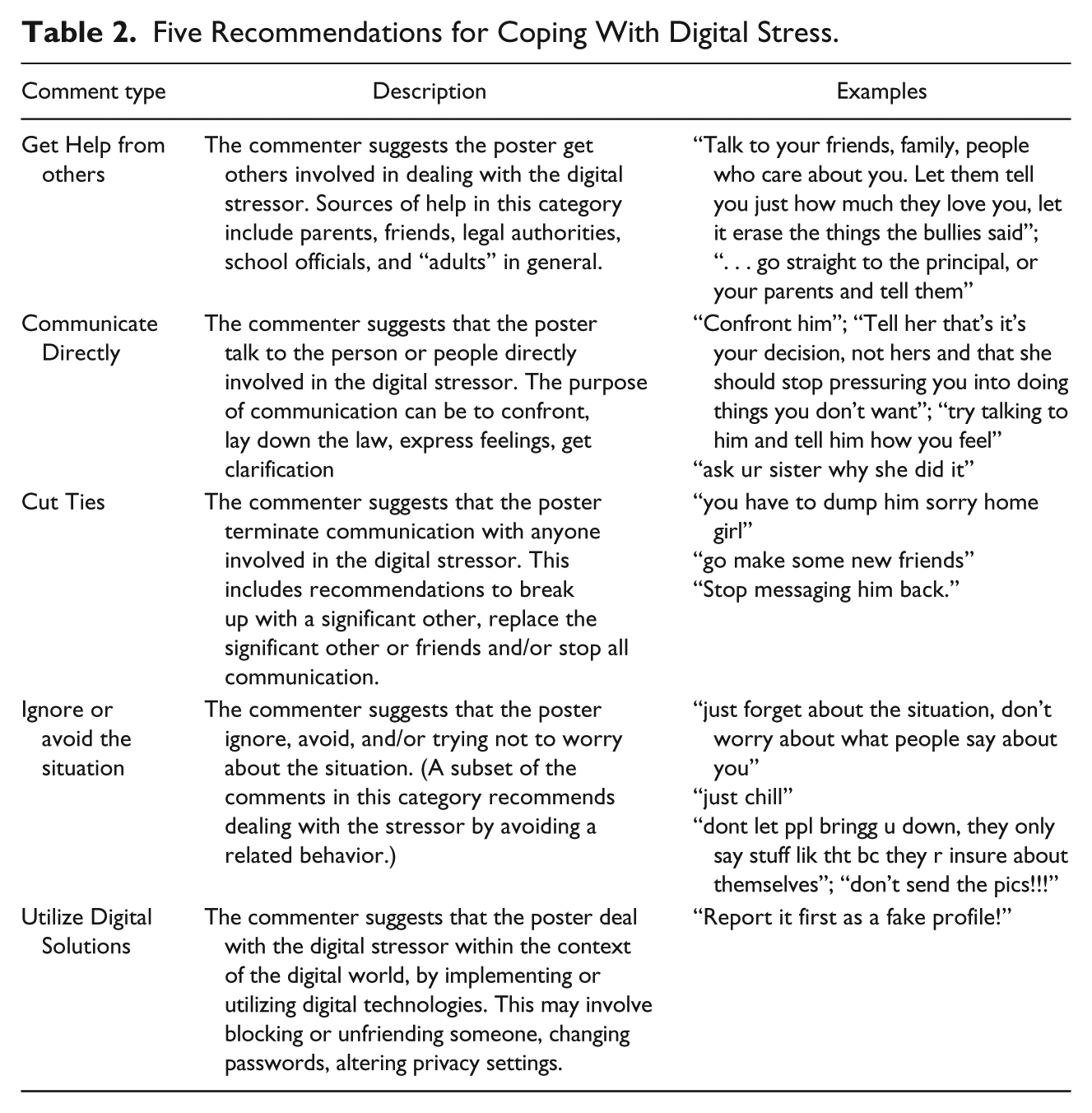
Two authors achieved sufficient reliability (κ > .93 for each of the five recommendations codes) through 1 round of reliability testing conducted with a randomly selected subset of 50 comments. They then used a primary coder/shadow coder approach for the remaining comments, with each coder serving as the lead coder for half of the sample.
Findings
We asked, “What strategies, actions, and reactions do commenters recommend in response to adolescents’ stories of digital stress, and how do their recommendations differ for different digital stressors?” Of the 628 comments posted in response to 180 stories of digital stress (30 per stressor, 90 each per Type 1 and Type 2) on the A Thin Line platform, 61.6% (n = 387) include at least 1 recommendation. As described above, some comments include more than 1 recommendation, resulting in a total of 475 recommendations.
Although there are slight variations in both the proportion of total comments and the proportion of recommendations for the six digital stressors (see Table 3), these differences are not statistically significant, F(5, 174) = 1.06, p = .38. We therefore present and discuss findings in terms of the relative frequencies of recommendations both within and across the six stressors. We begin by reporting the frequencies with which each strategy is recommended, by stressor (Table 3). We then consider each of the five common recommendations in greater detail, and we describe variations in their function across and within stressors. Finally, we summarize noteworthy differences between the strategies advocated for Type 1 stressors, compared with the set of Type 2 stressors. 2
Distribution of the Five Recommendations Across Six Digital Stressors.

Note. Total number of recommendations offered in response to posts of the corresponding stressor within the sample. The parentheses within the table indicate the frequency of the recommendation, as a percentage, for the digital stressor (i.e., corresponding column).
Strategies for Coping With Digital Stress
Across the data set, recommendations to Get Help from others, to Communicate Directly, to Cut Ties, and to Ignore the situation are advised with similar frequencies: Each comprises approximately one fifth of the recommendation comments (Table 3). Recommendations to Utilize Digital Solutions are somewhat less common (n = 33; 6.9%; Table 3). However, as indicated by the shadings in Table 3, the pattern of most common recommendations varies for each of the stressors.
For issues of digitally enabled Impersonation, the two most common recommendations are to Get Help from others (25.5%) and to Utilize digital strategies (27.3%). When peers are coping with Mean and Harassing digital encounters, adolescents most often recommend Getting Help from others (31.7%) or Ignoring the situation (28.0%). If an adolescent has been publicly shamed on social media, Getting Help from others is again the dominant recommendation (46.9%). For Breaking and Entering stories, which describe a friend or significant other reading personal communications without permission, Direct Communication (39.7%) and Cutting Ties (36.2%)—though seemingly opposite strategies—are both popular recommendations. When adolescents experience stress related to the Pressure to Comply, the most common recommendation is to simply Ignore the pressure and avoid complying (56.2%). For coping with a Smothering quantity of digital communications, the most common recommendation is to Cut Ties with the smotherer (47.9).
Figure 1 illustrates the most commonly proposed recommendations for each digital stressor. In addition, it organizes the stressors and their corresponding popular recommendations by overarching stress type (Type 1 stressors have hostile intent; Type 2 relate to navigating intimate relationships). In the next section, we explore the five recommendations in greater detail.
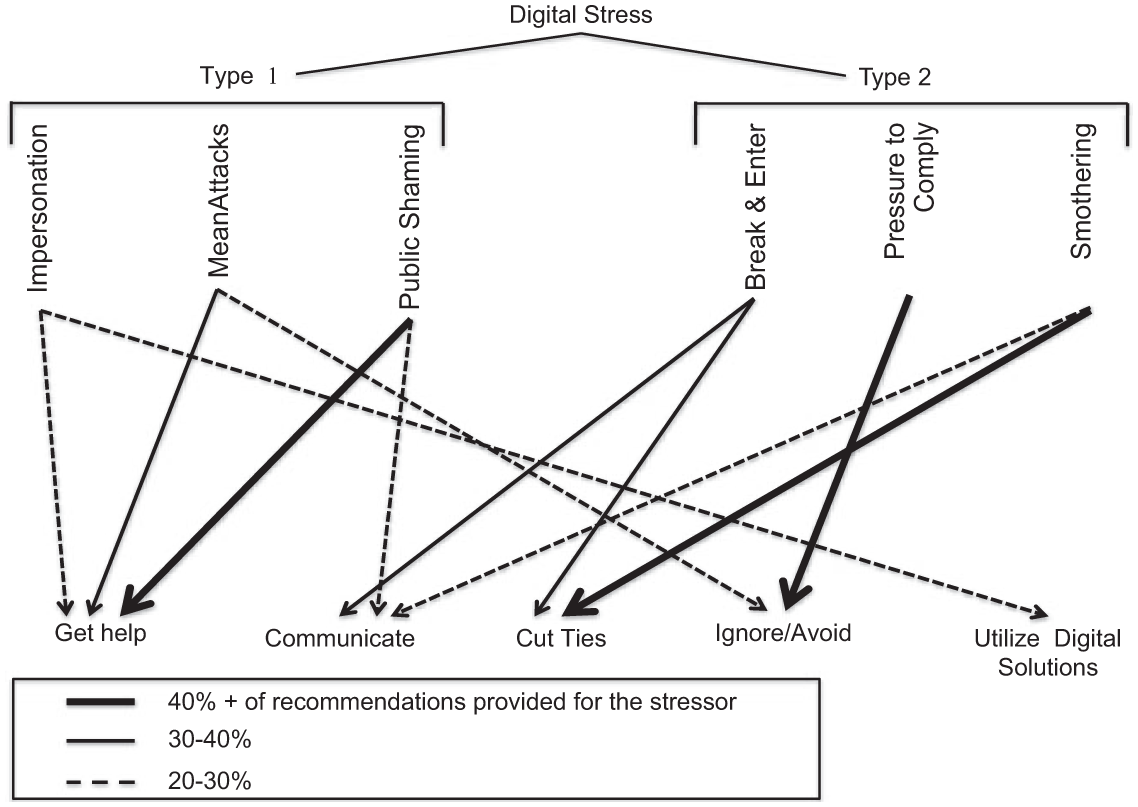
Major recommendations for each digital stressor.
Do not struggle alone: Get help from others
When commenters recommend getting help from others, they are advising that the poster cope by turning to people who are not immediately involved in the situation. For example, one commenter recommends, “go to your local police station and see if they can press charges against him.” Another commenter advises, “ . . . go straight to the principal, or your parents and tell them.”
In total, 17.9% (n = 85) of recommendations suggest getting help. Getting help from others is the dominant strategy for coping with Shaming and Humiliation, comprising nearly half of all recommendations posted in response (46.9%). Approximately one third of the recommendations for Mean and Harassing Attacks (31.7%), and one quarter of the recommendations for Impersonation (25.5%) also suggest getting help. In contrast, there is only one recommendation to get help from others in adolescents’ responses to each the Breaking and Entering and Pressure to Comply stories, and merely 5.3% of recommendations to Smothering issues (n = 5) suggest seeking help from others.
As in the aforementioned examples, adolescents who suggest getting help from others generally point to specific individuals or sources of proposed help (Table 4); only five comments refer to getting help in unspecified terms (e.g., from “someone”). As sources of help for digital stress, adolescents most often recommend those with power or formal authority: Of the 85 recommendations to get help from others, almost half (n = 40) specifically suggest going to the police or legal authorities to “report the situation,” “press charges,” or “consult a lawyer.” In particular, 20 such recommendations are advised in response to stories of Public Shaming and involve the dissemination of nude photographs. Thirteen recommendations suggest talking to parents, and 12 suggest adults who are not parents. School officials (n = 6) and peers (n = 6) are both less common. The Other category includes miscellaneous sources of help, such as the perpetrator’s parents or a witness.
Get Help From Others: Sources of Proposed Help.
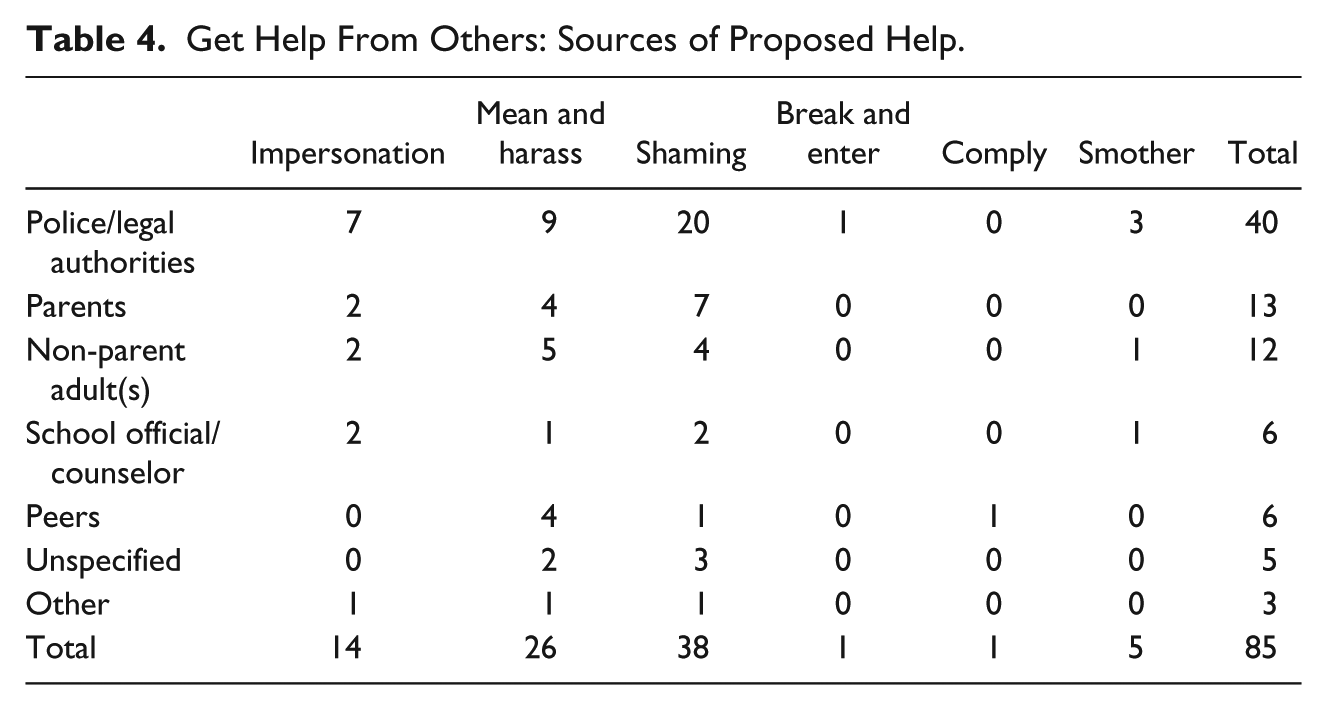
Recommendations to get help from others refer overwhelmingly to instrumental support. That is, getting help is suggested so that other people can get involved to take specific actions to change or improve the situation for the poster, such as tracking down the source of an issue (e.g. “i wudd ghett dha police involved so they can track down dha ristricted number”), enforcing consequences (e.g., “Tell. The. Police. From personal experience a good police officer will do anything he can to get justice for you—it happened for me!”), or ensuring personal safety (“you sould go to police and do you fell scared of him like he’s gonna hurt you cause if you do you have the right to say something”). Only one comment suggests seeking help from others for the purpose of getting emotional and/or psychological support: “Talk to your friends, family, people who care about you. Let them tell you just how much they love you, let it erase the things the bullies said.”
Talk it out: Communicate directly
Recommendations to Communicate advocate direct dialogue with the person or people involved in the situation. The suggestion to communicate directly comprises 21.3% of total recommendations, and communication is the most commonly advised strategy for Breaking and Entering (39.7% of recommendations for Breaking and Entering stories). Although communication is not the most common coping strategy for any of the other five stressors, it is suggested in between 13.3% and 23.5% of their respective comments.
Across the 101 recommendations that advise direct communication, it is most often for one of three purposes: to confront the other person and/or to lay down the law (n = 48), to express personal feelings (n = 23), or to get clarification or understanding of the other person’s perspective (n = 15; Table 5). For example, “tell your friend to knock it off” and “call him out” are both instances in which communication is recommended for confrontation. “Try talking to him and tell him how you feel,” is an example of communication to express personal feelings; “ask the person why he or she did so” advises communication for clarification. Less often suggested purposes of communication include retaliation, giving assurance, and apologizing.
Reasons for Communication.
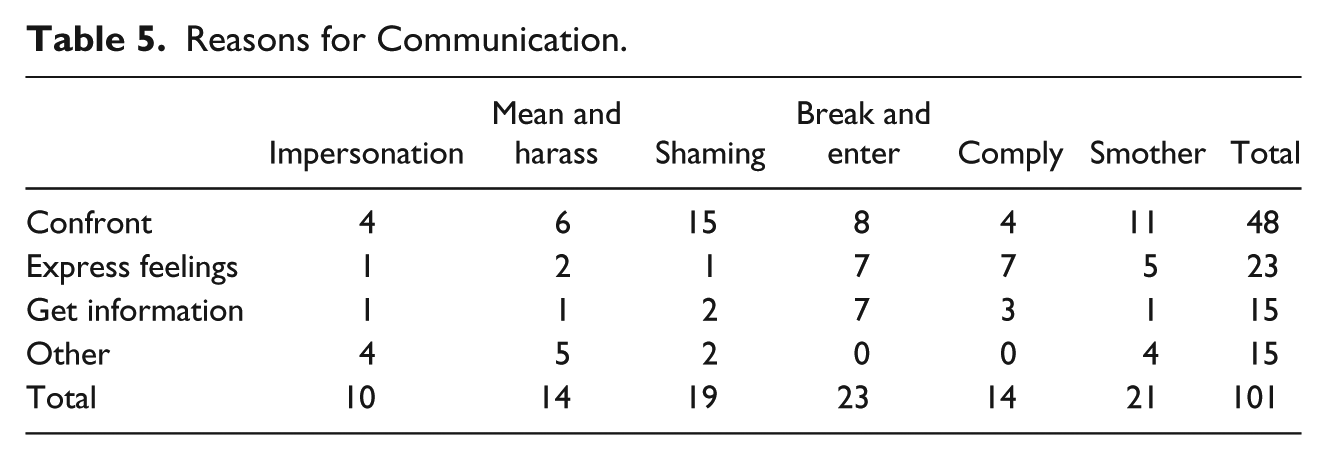
Just call it quits: Cut ties
Commenters who suggest cutting ties advise terminating communication or contact with the people involved in the situation. In total, 20.0% of the recommendations suggest cutting ties. Cutting ties is the most common strategy recommended for Smothering (47.9%) and is a close second for Breaking and Entering (36.2%; after communication, 39.7%), also a Type 2 stressor. The strategy is less commonly advised for Impersonation (5.5%), Mean and Harassing Attacks (6.1%), Public Shaming (4.9%), and Pressure to Comply (16.2%) issues.
The vast majority—94.7% of recommendations that suggest Cutting Ties—are for posts about digital stressors that transpire in romantic contexts, and the recommendation generally takes the form of advocating a break-up. For example, in cases of Smothering, commenters who suggest cutting ties (instead of more reconciliatory approaches, such as communication) link their recommendations to a concern that the behavior may escalate from too much digital communication to more dangerous or abusive behavior, and should therefore be preemptively terminated. (“this is gonna get worsee . . . just dump him hun he’s gonna get worse, i kno it.”) For commenters who recommend cutting ties for Breaking and Entering (again, instead of suggesting approaches that allow continuation of the relationship), it is either because Breaking and Entering is seen as a signal that the relationship is fundamentally flawed, or because something discovered in the process of Breaking and Entering is unforgivable (e.g., discovering evidence of infidelity). In the latter cases, cutting ties is not actually a response to the issue of Breaking and Entering, but instead to the stress of the information uncovered.
Let it go: Ignore or avoid the situation
Comments advising that the poster just simply ignore, avoid, or try not to worry, (e.g., “just forget about the situation, don’t worry about what people say about you”) comprise 23.4% of total recommendations. This category also includes recommendations that discourage any engagement in behavior related to the digital stressor. It is the most common recommendation in response to stories about feeling Pressure to Comply (n = 59, 56.2%). For instance, in response to a poster who feels Pressure to Comply with requests for nude photographs from a boyfriend she cares about, a commenter advises, “just don’t send the pics!” In fact, the sole advice offered in 52 of these comments is to not send photographs or give out passwords. Ignoring or avoiding the situation is the second most common recommendation for managing Mean and Harassing Attacks (28.0%; after getting help from others, 31.7%). Approximately half of the comments that propose ignoring mean messages (n = 12; 52.2%) do not include any additional advice or strategies. For example, “Ignore it. Don’t let that get you down. They are just sick people.” Others suggest ignoring as one of the available strategies, for example, “welll, just ignore the msgs yes they’re hurtful but what else can you do? Or you can confront the person who sent them.” Several commenters (12.3%) also advise ignoring situations of Public Shaming, explicitly suggesting that there are no other options once it has occurred: “all you can do is forget about the situation.”
Utilize digital solutions
Digital solutions, while less common than the four other, relationally oriented strategies, comprise 7.2% (n = 34) of the recommendations. In these recommendations, the commenter suggests that the poster deal with digital stressors within the context of the digital world, by implementing or utilizing relation management tools accessible through digital technologies. Digital solutions are the most common recommendation in response to Impersonation stories. The proposed digital solutions for Impersonation include straightforward actions, such as reporting content (“report it first as a fake profile!”), unfriending, blocking, changing passwords, making new personal accounts, or staying off of a particular platform. Commenters also propose more elaborate and creative digital solutions, such as one commenter who writes, “Take all your pictures down basically or edit them in a way that people know that it [is] you.”
For managing Mean and Harassing messages, blocking the harasser, reporting content, and modifying accounts so as to be less reachable (e.g, changing username, phone number) are proposed digital solutions. For Public Shaming, digital solutions are offered specifically in response to issues related to the dissemination of nude photographs and suggest deleting pictures and/or reporting content as inappropriate to the site. To cope with Breaking and Entering, commenters suggest changing or modifying passwords to make accounts harder to access, deleting content so that others cannot read it later, reporting content if Breaking and Entering uncovers inappropriate content, and even—in one case of a boyfriend who looks through the poster’s phone and gets angry if he sees any communication with males—changing male friends’ names to female versions to avoid raising suspicions. In the two cases of Smothering comments, digital solutions are recommended purely to cut off further communication, by either changing personal contact information (e.g., phone numbers) or blocking others.
Other
The “other” category encompasses 10.3% of total recommendations that are not appropriately captured by the five strategies described above. These comments account for between 7.3% and 12.7% of recommendations for each stressor. Examples in this category include a comment that suggests introspection (e.g., “maybe you need to take some time and figure out why you’re responding to this rude, vulgar, disgusting man’s messages”); a comment that proposes learning from the mistake (“my advice for you both is in the future think before you do something that can possibly back fire into something bigger then whats expected.”); and a comment to a poster who feels torn about letting her boyfriend browse through her phone that recommends that the couple give each other, “a chance to check things out.”
Type 1 Versus Type 2: Comparing Recommendations
As previously described, the six stressors (Table 1 and Figure 1) represent two distinct types of digital stress. Impersonation, Mean and Harassing Personal Attacks, and Public Shaming and Humiliation are all products of hostile motivations moving into the digital context and constitute Type 1 stress. Stress that stems from others Breaking and Entering into private accounts and devices, feeling Pressure to Comply with requests to grant access and share intimate photographs, and feeling Smothered by the quantity of communication from close others are instead related to the challenge of navigating intimacy in a digital world, Type 2 digital stress.
Considering the stressors in these subgroupings, there are significant differences in the prevalence of recommendations (Table 6). Getting help from others is recommended with significantly higher frequency for Type 1 issues than for Type 2 issues (p < .001). Indeed, getting help from others is the most common recommendation for managing Type 1 stress (27.1%), while lesser than 3% of recommendations in response to Type 2 stress suggest getting help. Recommendations to utilize digital solutions are also more common in Type 1 versus Type 2 cases (p = .01). On the other hand, peers are significantly more likely to recommend permanently cutting ties for Type 2 cases (p < .001).
Recommendation Counts and Percentages, By Stressor Type.

p = .05. **p = .01. ***p ≤ .00.
Overall, communication is recommended with similar frequencies for both Type 1 and Type 2 issues: 19.7% of Type 1 recommendations and 22.6% of Type 2 advocate direct communication. Yet, the purpose of the proposed communication differs (Table 5). For Type 1 cases, communication is most often recommended in order to confront the other person, rarely to express personal feelings or to get more information. For Type 2 cases, although confrontation is also common, so too is communication to express personal feelings or to get more information or understanding.
Discussion
Adolescent commenters on the A Thin Line platform propose five main strategies for peers to utilize in the management of stressful socio-digital experiences. They suggest posters can seek outside help from others; handle the situation directly by communicating with the person involved; cut ties and terminate the relationship with the person who is causing them distress; try to ignore or avoid further engagement in the situation; or utilize digital solutions such as blocking or de-friending. Although these courses of action highlight a constellation of viable strategies, the frequency with which they are proposed varies for the different digital concerns posted. That is, there is a differentiation of recommendations offered depending on the socio-digital stressor at hand.
Immediately notable is the distinction between the most common recommendations for Type 1 (hostility-oriented) issues versus Type 2 issues (transpiring in the context of close relationships). In Type 1 situations, the stressors (Public Shaming, Mean and Harassing Messages, Impersonation) comprise digital attacks, often from a former-friend, an ex-significant other, or an enemy. The most common recommendation for coping with these issues is to Seek Help from others, especially adults and/or authority figures. Type 2 stressors reflect stress that transpires as youth navigate close relationships in a digital ecology: Breaking and Entering to access private information; Smothering quantities of digital communication; and the Pressure to Comply, particularly with requests for nude photographs ostensibly sought in the spirit of intimacy. In contrast to Type 1 recommendations, Seeking Help from others is the least common recommendation offered for Type 2 issues. Similarly, the most common recommendation for Type 2, Cut Ties, is also the least common recommendation for Type 1.
The discrepancy between the predominant strategy for Type 1 issues to seek outside help from adults, and the preponderance of Type 2 strategies that suggest taking actions either alone or within the confines of the relationship, is interesting to consider in light of theories of adolescent development. In the introduction to this study, we highlighted early theories that posit adolescents’ increased desires for autonomy from adults (Erikson, 1968). However, we now know adolescents tend to desire autonomy in issues and decisions related to interpersonal domains (e.g., romantic relationships, friendships) more strongly than in those related to personal or physical security and safety (Collins & Steinberg, 2006; Smetana, 2002). Thus, adolescents may view hostile Type 1 threats as necessitating adult intervention, while they may more strongly prefer private approaches, autonomous from adults, for Type 2 issues.
With respect to the utility of the documented strategies, how do the recommendations advised by peers as ways to cope with socio-digital stress relate to previous research on adaptive coping? Where do they appear to align or misalign? It is important to remember that frameworks such as Lazarus and Folkman’s (1984) differentiation between problem-focused versus emotion-focused coping refer primarily to strategies used by individuals for their own stress and coping, whereas our analysis considers coping strategies recommended to individuals by others. Nevertheless, the framework still offers a useful interpretive lens. When recommendations are given, the strategies suggested on A Thin Line are predominantly problem-focused (rather than emotion-focused). Although we do not know whether the posters feel sufficiently in control of their situations to apply problem-focused approaches, these strategies reflect what would likely be considered adaptive according to the framework.
For instance, the most common recommendation for dealing with hostility-oriented Type 1 issues—Get Help—might at first glance be thought of as an emotion-focused recommendation for social support. However, a closer look at the recommendations reveals that the advisors predominantly suggest actively seeking instrumental help from adult authority figures who are in a position to take action regarding the problem. Thus, the recommendation to seek help from adults is an active, problem-focused strategy that is likely adaptive in that it links distressed youth to supportive adults. Yet previous investigations underscore teens’ preferences for informal supports for coping (e.g., Boldero & Fallon, 1995; Offer et al., 1991); and research on youth’s online social experiences indicates their reluctance to report cyberbullying to adults (Parris et al., 2012). Adolescents who receive the advice to Get Help from adults may therefore be hesitant or even resistant to implement it. Accordingly, a relevant question for further research is whether, when, and from whom adolescents coping with Type 1 digital stress are inclined to seek help.
With respect to Type 2 cases, we also classify the most common recommendation—Cut Ties—as an active, problem-focused approach, as it involves taking action to eliminate future stressful encounters (e.g., “get rid of” a smothering boyfriend). Indeed, Cutting Ties may be adaptive if the relationship in question is harmful or if it is moving in a harmful direction. However, as the stress related to Type 2 issues is often connected to the poster’s desire to maintain the relationship, the recommendation may be interpreted as off base or extreme. For example, Feeling Smothered occurs when the quantity of digital communication from close others becomes overwhelming, even though it is generally well-intended. The Pressure to Comply with requests for nude photos is often challenging because of the desire to impress and connect with the requester. And, Breaking and Entering transpires because curiosity and the quest for intimacy lead to violations of digital privacy. The suggestion to end the relationship would ostensibly stop the stress in each of these cases. However, if it is the poster’s goal is to reduce the stressor while preserving—and even enhancing—the relationship, then active, Direct Communication is likely a more beneficial problem-focused strategy (Nieder & Seiffge-Krenke, 2001).
The recommendation to Ignore the situation is the most common suggestion overall, and is advised for both Type 1 and Type 2 situations. Ignoring is cited by teens in previous studies as a preferable and practical way to cope with interpersonal issues such as cyberbullying (e.g., Hoff & Mitchell, 2009; Livingstone et al., 2011). Yet, Ignoring is an emotion-focused strategy, rather than a problem-focused strategy (Folkman, 2008). Moreover, ignoring a stressful experience can be quite difficult in practice (Hoff & Mitchell, 2009), and even if achievable, may be detrimental to the individual’s well-being (Lodge & Frydenberg, 2007). In other words, Ignoring the situation is a recommendation that may initially be considered viable to posters and recommenders, but which may prove difficult in practice for youth and less adaptive in the eyes of practitioners and researchers.
In applying previous frameworks and research on offline coping to the online peer recommendations for managing digital stress, one could interpret proposed approaches to Get Help, Communicate, Cut Ties, and Utilize Digital Solutions as adaptive in that they constitute problem-focused strategies. However, considering these strategies (particularly the recommendations to Get Help and to Cut Ties) in the context of Type 1 and Type 2 digital stressors, it is less clear whether they are approaches that teen recipients of the advice will consider appropriate and feasible. In contrast, Ignoring the situation may be interpreted as feasible advice to recipients and senders alike, but may be less adaptive. Our analysis therefore raises questions for future research about how recipients of online advice interpret and apply the suggestions they receive; to what degree are the recommendations robust and relevant to the situation? Which coping strategies reliably produce adaptive outcomes for adolescents coping with digital stress and, also of importance, which strategies do youth perceive as realistic and doable when they are in the midst of digital stress situations?
Notably, the recommendations in online forums such as A Thin Line are also exchanged in contexts characterized by anonymity, asynchronicity, and limited word space. Disclosing personal struggles in these online forums may be easier than sharing sensitive information about oneself with offline peers (Suler, 2004). However, we do not yet know how thoughtful the commenters are when delivering their recommendations in response. We still require systematic research on the comparative value of advice from faceless advisors who have less contextual information and likely less investment in their peers’ well-being than offline friends.
Limitations
The current study presents a depiction of adolescents’ recommendations for coping with digital stress, as portrayed on an authentic online platform. However, the study has methodological constraints, as well as limitations related to the generalizability of findings. The dearth of contextual information about commenters precludes a more nuanced exploration of important variations, for example by age or gender. The generalizability is also limited due to biases of self-selection, as certain types of youth are likely to post or comment on postings. The screening of potentially hostile comments by MTV, while socially responsible, is a limitation of the study in terms of assessing online communities. Relatedly, although the study’s methods are likely applicable to other digital forums, we cannot conclude that the findings apply to other online communities with differing practices and norms. Finally, the focus on advice for coping is itself a limitation, as we cannot claim that recommendations about how to cope are definitively representative of how the youth actually cope.
Conclusion
Returning to the notion that the current study is an investigation of a “doubly digital” phenomenon, first, it is digital insofar as it relates to the ways in which new media technologies contribute to social stress with which contemporary adolescents must cope. As technology becomes both more mobile and increasingly available to youth, adolescents’ access to digital life—and therefore the potential for socio-digital stress—increases dramatically. Supporting youth in these types of experiences will require exploring, documenting, and more deeply understanding relevant coping strategies. We therefore clearly require more research to delineate the coping strategies adolescents can use, their perceived feasibility, and their adaptive value.
As an analysis of peer recommendations exchanged in the context of an anonymous online forum, it is therefore also an analysis of advice that is exchanged digitally. In this vein, our findings raise questions about how digital forums fit into youths’ support seeking: Do adolescents turn only to anonymous digital communities, or are these platforms but one component in a fast moving evolution of access to a variety of networks and resources? How valuable do youth find the experience of sharing stressful experiences and receiving peer support in the digital context? We realize that beyond the utility of the specific recommendations exchanged online, there may also be value for youth in the opportunity online forums provide to express problems, read stories from others with similar struggles, and receive responses from well-intentioned, engaged peer listeners. This, too, merits further consideration as researchers, practitioners, and parents continue to explore contemporary youth’s social experiences. New media continue to pervade and shape daily life, and adolescents should not be left to navigate these seas alone.
Footnotes
Acknowledgements
The authors acknowledge the advice and support of Harvard Graduate School of Education faculty member Terry Tivnan. The authors are also grateful to Viacom/MTV for providing the opportunity to analyze the data set used in the current study, and to the editors and reviewers at Journal of Adolescent Research for the high quality feedback on earlier drafts of this manuscript.
Declaration of Conflicting Interests
The author(s) declared no potential conflicts of interest with respect to the research, authorship, and/or publication of this article.
Funding
The author(s) disclosed receipt of the following financial support for the research, authorship, and/or publication of this article: This research was supported, in part, by a fellowship awarded to the first author through the Harvard Graduate School of Education Dean’s Office.