



Abstract
Adolescents form their identities by both accommodating (endorsing) and resisting (challenging) cultural stereotypes. Most research on Black males focuses on how they accommodate to negative stereotypes (e.g., delinquency, aggression), but a growing literature emphasizes how youth resist stereotypes. Semi-structured interviews were analyzed to examine patterns of resistance and accommodation at the intersection of racial and gender stereotypes among Black adolescent males (N = 21). Findings indicate that, overall, Black males resist racial stereotypes more readily than gender. Using an intersectionality lens, we found three paths of resistance: (a) the “accommodators” endorsed racial and gender stereotypes, (b) the “resisters” resisted both sets of stereotypes, and (c) the “exceptions” resisted racial stereotypes but accommodated to gender. Implications for the study of resistance, identity, and intersectionality are discussed.
Adolescence is a developmental period when youth are preoccupied with their identities—who they are and who they will become. These identities are tied to social expectations and stereotypes, which function like “social mirrors” reflecting society’s image of who and what one should be (Erikson, 1968; Suárez-Orozco, 2004). Black males, for example, are routinely depicted as aggressive, hypersexual, and violent; they are gang members, criminals, or professional athletes. While this cultural image does not represent the vast majority of Black males, its dominance as a stereotype tangibly impacts how young Black males come to view themselves and make sense of their own identities (e.g., Davis, 2006; Ferguson, 2000; Nasir, 2011).
Decades ago, Erik Erikson (1968) articulated the influence of social expectations on identity processes, arguing that “a young person may well put his energy into becoming exactly what the careless and fearful community expects him to be” (p. 196). In other words, youth may accommodate to stereotypes, endorsing and reinforcing stereotypes in their own identities. A Black male, for example, in response to being stereotyped as threatening and aggressive reacts with violent outbursts of anger. Or, being viewed by his teachers as a troublemaker who does not value education, a Black boy drops out of school. This process of accommodation has been the focus of much research about Black males, with the questions centering on how and why they reinforce negative stereotypes in their behaviors and attitudes (e.g., Cunningham, Swanson, & Hayes, 2013; Ferguson, 2000; Spencer, Fegley, Harpalani, & Seaton, 2004). At the same time, there is growing evidence that youth desire not to be a stereotype and, in fact, often resist stereotypes in ways that are beneficial to their health and well-being (Chu, 2014; Gilligan, 1990; Way, 2011; Way et al., 2014; Way, Hernández, Rogers, & Hughes, 2013; Way & Rogers, 2014). An example of such resistance is when Black males cultivate “scholar identities” and resolve to excel in school despite the low expectations they face (Hrabowski, Maton, & Greif, 1998; Whiting, 2006).
Framing identity development as a process of resistance to stereotypes is an emerging area of study in human development (e.g., Brown & Gilligan, 1992; Nasir, 2011; Rogers & Way, 2015; Spencer, Dupree, & Hartmann, 1997; Way, 2011; Way et al., 2013; Way & Rogers, in press). In this framework, resistance and accommodation are theorized as the “tools” of identity construction which adolescents use to negotiate cultural stereotypes as they establish their identities (Anyon, 1984). There are only a few studies that attend to this process and the extant research that does examine resistance to stereotypes tends to focus on either race or gender, without explicit attention to the intersectionality of stereotypes and adolescents’ identities. In this article, we examine identity development using the resistance framework and an intersectionality lens. Analyzing in-depth interviews with Black adolescent males, we explore the prevalence and pathways of boys’ resistance to racial and gender stereotypes.
Resistance and Accommodation
Resistance and accommodation is a conceptual framework for understanding how individuals respond to and negotiate systems of oppression (Anyon, 1984; Brown & Gilligan, 1992; Chu, 2014; Gilligan, 1990, 2011; Robinson & Ward, 1991; Ward, 1996; Way, 2011; Way et al., 2014; Way & Rogers, in press). The literatures on slavery and other oppressed peoples have long noted how people not only accommodate but also resist their oppressions (Camp, 2004; Freire, 1970; Genovese, 1976; Marrus, 1995; Suhl, 1967). Genovese (1976) described how slaves both resisted enslavement (e.g., acquiring literacy) and accommodated to its constraints (e.g., a subservient gaze) in order to survive. Historians of the Holocaust describe the resistance, by both Jewish and non-Jewish people, to Hitler’s Nazi Germany (Marrus, 1995). The resistance framework simultaneously acknowledges oppression while privileging human agency.
Scholarship conceptualizes resistance as a two-pronged process, each leading to distinct outcomes. For example, Carol Gilligan (1990, 1996, 2011) and Lyn Mikel Brown (Brown, 1999; Brown & Gilligan, 1992) distinguish between political and psychological resistance to gender oppression. When girls “speak their minds” or express their genuine thoughts and feelings rather than cover them over with feminine niceties and goodness, their resistance is political. However, when girls silence the self and dismiss their own beliefs, ideas, and emotions in order to maintain the image of the “perfect girl,” their resistance is psychological (Brown & Gilligan, 1992). Gilligan and Brown also find that political resistance is more prevalent during late childhood, but as girls enter adolescence, their resistance often turns psychological and they silence themselves. It is psychological resistance, they argue, that leads to depression, eating disorders, and low self-esteem, but when girls stay connected to what they know and openly voice their thoughts and feelings, they retain a healthy psyche, a positive self-image, and meaningful relationships (Brown & Gilligan, 1992; Gilligan, 1990, 1991, 2011; Gilligan, Rogers, & Tolman, 2014).
Way (2011; Way et al., 2014) also examines resistance to gender norms but among Latino, Asian American, Black, and White boys. In Way’s research, resistance refers to challenging norms of masculinity (i.e., political resistance) and accommodation refers to reinforcing norms of masculinity (i.e., psychological resistance). Through in-depth interviews with hundreds of boys, Way (2011; Way et al., 2014) finds that adolescent boys, across race and ethnicity, resist masculine stereotypes of stoicism and autonomy in their friendships, divulging emotional intimacy with their close friends, feelings of sadness and loss over former “best friends,” and their desires for intimate male friendships. This resistance, Way (2011) finds, is most evident during early and mid-adolescence, but declines as boys approach late adolescence. In another study, following boys from 6th to 11th grade, Way et al. (2014) found varying patterns of resistance to norms of masculinity across adolescence. While most of the boys in the study, across race and ethnicity, illustrated a decrease in resistance over time, others were more stable (with high or low levels of resistance), or showed mixed patterns of resistance over time. Moreover, boys who maintained higher levels of resistance across adolescence fared better on measures of psychological adjustment (Way et al., 2014). Similar patterns of resistance to norms of masculinity have been found with younger boys as well (Chu, 2014). In early childhood, Chu (2014) finds both emotional and relational acuity among boys, and while some boys avoided activities that were “for girls,” other boys resisted such restrictions in their play choices and behaviors. But, as boys prepared to enter formal schooling (kindergarten), Chu observes a loss of resistance as they “become boys” in stereotypic ways, such as acting out and disrupting class.
Robinson and Ward (1991) also delineate two paths of resistance in their research on resistance to racial oppression among African American girls. Resistance for survival is marked by short-term solutions or “quick fixes” to systemic racism, which provide a sense of agency in the face of oppression, but ultimately reinforce the very stereotypes girls need to challenge in order to thrive. For example, when a girl drops out of school and becomes a teen mom, she may find purpose in motherhood but simultaneously reifies the stereotypes that oppress her. Resistance for liberation, in contrast, is long term and benefits the self and others by uplifting the collective. Examples include succeeding in school despite low expectations or maintaining strong spiritual and community ties even while society undermines these ideals (Ward, 2000). Resistance for liberation is rooted in an “inner strength” of hope in the self and others (Robinson & Ward, 1991). Suárez-Orozco (2004) similarly distinguishes between a resistance that is infused with hope for “a better tomorrow” and one that lacks hope for change. She finds that immigrant adolescents who respond to stereotypes with a hopeful resistance (i.e., resistance for liberation) defy the odds and achieve, but when youth resist without the belief that their actions can bring about lasting change (i.e., resistance for survival), it often leads to delinquent behaviors, such as failing out of school or joining a gang (Suárez-Orozco, 2004).
Spencer and colleagues (1997) propose two ways of responding to stereotypes. Reactive coping (i.e., resistance for survival) is acting “in the moment” without forethought of the costs, for example, reacting with violence. Proactive coping (i.e., resistance for liberation) is when youth thoughtfully and purposely employ relational resources and problem-solving skills to contest stereotypes. Overtime, these response patterns become identity, for “the self is constructed in response to stereotypes and biases” (Spencer et al., 1997, p. 87). Nasir’s (2011) empirical analysis of how African American adolescents negotiate racial stereotypes in school illustrates these two identity patterns: the “street savvy” youth in her study were characterized by “taking up and reifying stereotypical aspects of the African American identity,” acting out and failing classes, whereas the “school oriented and socially conscious” youth rejected these very stereotypes in order to excel (p. 87).
Although each of these scholars uses different terms to describe resistance, the similarity across them is the emphasis on how individuals respond to oppression in either productive or counterproductive ways. In this article, we use the term resistance (analogous to political resistance, resistance for liberation, proactive coping) to refer to challenging racial and gender stereotypes and accommodation (analogous to psychological resistance, resistance for survival, reactive coping) to refer to responses that reinforce racial and gender stereotypes (Rogers, 2012; Rogers & Way, 2015; Way, 2011; Way et al., 2014; Way & Rogers, in press). This resistance approach is valuable because it connects identity to outcomes. Accommodation seems to pave a path toward adverse outcomes—delinquency, depression, dropping out of school—whereas resistance has been found to be positively linked with numerous indicators of well-being (Barker, Ricardo, Nascimento, Olukoya, & Santos, 2010; Brown & Gilligan, 1992; Gilligan et al., 2014; Gupta et al., 2013; Way et al., 2014) and academic success (Nasir, 2011; Santos, Galligan, Pahlke, & Fabes, 2013; Spencer, Noll, Stoltzfus, & Harpalini, 2001).
Resistance and Intersectionality
To date, our understanding of resistance to stereotypes is based on studies that primarily focus on either gender oppression or racial oppression. However, adolescents belong to multiple social groups and therefore negotiate their identities in response to multiple social stereotypes simultaneously (Carter, 2006; Rogers, Scott, & Way, 2015; Shields, 2008; Way, 2011). We know little of how resistance unfolds across (or at the intersection of) stereotypes.
From an intersectionality perspective, the social categories “race, class, and gender . . . overlap, intersect and fuse with each other in countless ways” (Omi & Winant, 1994, p. 68), such that race is gendered and gender is raced (as well as sexed and classed; Crenshaw, 1991; McCall, 2005; Shields, 2008). An empirical question for identity research is where these identities intersect and how they develop in concert. While the theory of intersectionality is widely accepted and at times embedded in studies of resistance (e.g., Robinson & Ward, 1991), its use in empirical research remains scarce. This is partially due to unresolved tensions within the theory that limit its functionality in an empirical context (McCall, 2005; Nash, 2008; Shields, 2008). Our analysis of Black adolescnet males explores how a resistance framework responds to three of these tensions: (a) structure and agency, (b) identity union and distinctiveness, and (c) oppression and privilege.
The structure versus agency tension is principally an issue of power (Crenshaw, 1991; Phoenix, 2006; Prins, 2006), with the question being where intersectionality is located—at the level of the system or the individual. Structural intersectionality focuses on the systems that structure inequalities, viewing “power as unilateral . . . rather than relational” (Phoenix, 2006, p. 23). The consequence of this view is that individuals are “structured” into intersectional positions. Agency, in contrast, recognizes that individuals are active participants in their own experiences, choosing how to enact their social positions (Phoenix, 2006). Thus, while race and gender are structured positions, individuals may use the tools of resistance and accommodation (agenecy) to reconstruct these categories in different ways.
The second tension, identity union versus distinctiveness, asks what counts as an intersection. Identity union assumes unified identity labels as the unit of analysis, for example, “Black male.” However, such labels are also limiting as they reinforce an alternate fixed identity that then ignores other intersections, such as sexuality and social class (McCall, 2005; Phoenix, 2006). Yet, the numerous potenial combinations pose an empirical problem making identity arbitrary divisions necessary. Alternatively, one can view race and gender as distinct but overlapping social categories, pieces of the same puzzle. In this view, the purpose of intersectionality research is to examine the nature of the relationship between categories (McCall, 2005). For example, examining how Black males construct and experience the connection (or distinction) between their racial and gender identities.
Finally, there is tension between oppression and privilege (Nash, 2008; Wing, 1990). The study of intersectionality is rooted in oppression and grounded in the premise that Black women are “multiply oppressed” by their social position relative to race and gender (Crenshaw, 1991; Shields, 2008). Thus, there is question about whether intersectionality equally applies to positions of privilege (e.g., White male; Nash, 2008). Yet, to ignore privileged identities would be to ignore the essence of intersectionality, the built-in relationship between social categories. Moreover, because each social category holds a unique status in society, individuals may hold dominance along one dimension and subordination on the other (Verloo, 2006). For example, Black heterosexual men are privileged for their gender and sexuality and oppressed for their race, whereas White heterosexual women are privileged for race and sexuality and oppressed for their gender. Thus, if we ignore privilege in favor of oppression we ignore “the ways in which positions of dominance and subordination work in complex and intersecting ways to constitute subjects’ experiences . . . ” (Nash, 2008, p. 89).
In a resistance framework, structure and agency, and oppression and privilege can coexist. Anyon (1984) argued, “[a]ccommodation and resistance is a part of all human beings’ response to contradiction and oppression—of men, women, working-class and affluent; of white races and black” (p. 30). Furthermore, she underscores that resistance occurs alongside or often “in the palm of accommodation.” For example, girls in her study would resist gender stereotypes by claiming that they want to have a career in the future, but qualify such resistance by saying, “only if my husband lets me,” thereby accommodating to gender norms (Anyon, 1984). Acknowledging this play between resistance and accommodation allows one to explore how resistance operates across social categories with differing social positions. Among Black males, for example, where gender positions them atop the social hierarchy but their race places them at the bottom, do they resist racial and gender stereotypes similarly? Are they more likely to resist stereotypes related to positions of subordination (Blackness) than dominance (maleness)? Our analysis explores these questions with the goal of furthering our understanding of resistance and intersectionality.
Current Study
The current study examined identity development as a process of resistance and accommodation to racial and gender stereotypes among Black adolescent males. There are very few empirical examples of how Black males resist stereotypes, and none that explicitly examine patterns of resistance across racial and gender stereotypes. The purpose of this analysis was twofold: first, to extend the resistance framework by including the voices of Black adolescent males and using an intersectionality perspective, and second, to empirically examine how intersectionality shapes identity development. We examined three specific questions with Black males:
The decision to focus on Black males was threefold. First, there is a dearth of research on resistance to stereotypes among Black males who are, instead, often cast as monolithic and accommodating (for exceptions, see Way, 2011; Way et al., 2014). Second, there is a widespread concern about the social and academic pathways of Black males in America (Davis, 2006; Schott Foundation, 2012), and thus investigating pathways of resistance to racial and gender stereotypes helps us illuminate ways to support young Black males toward healthy outcomes. Third, Black males hold a uniquely perilous position in American society (e.g., Alexander, 2012; Noguera, 2008) and the racial and gender stereotypes that frame them are intimately linked (e.g., Ghavami & Peplau, 2013). As such, the experiences of Black males provide a unique and valuable lens for interrogating the nuanced ways in which multiple social positions operate in adolescents’ lives.
Method
Interview data for this analysis were drawn from the first author’s dissertation, a longitudinal mixed-methods study of racial and gender identity development among Black adolescent males. Data, including observations, surveys, and interviews were collected over 2 academic years (2008-2010): pre-entry (Wave 1) data were collected the summer prior to the start of 9th grade, post-entry (Wave 2) data were collected at the end of 9th grade, and follow-up (Wave 3) data at the end of 10th grade. Interviews were conducted at each time point.
Research Context
Data were collected at Black Male Charter School (BMCS), an all-Black, all-male high school located in a Midwest urban center. BMCS is a public charter school, with free tuition and lottery admission. At the time of data collection, the school was in its 3rd year of operation, serving approximately 400 students in Grades 9 through 11. The leaders describe BMCS as a space designed to provide its students with “positive counter-images of successful Black men” and give them a “vision for college.” They refer to the students as “scholars” and college graduation (not merely acceptance or attendance) defines the school’s primary mission.
Procedure
During summer orientation at BMCS, the first author gave a brief invitation speech about the study to the incoming freshmen class. An invitation letter was also mailed to all enrolled students’ homes along with parental consent forms describing the project. Additional recruitment materials were distributed at school, and students returned signed parent consent forms to their homeroom teachers or main office. All data collection occurred at the school. Interviews were conducted during non-academic periods (before or after school, during lunch). The first author conducted all of the interviews, which were audio-recorded and ranged in length from 39 to 110 minutes (M = 65 minutes). Each participant was informed that he had been selected to participate in an interview about “What it means to be a young, Black male” and “What it is like attending an all-boys school.” He was then given an assent form and told that any question could be skipped without penalty. Boys were given the opportunity to ask further questions at the end of interview.
Participants
A total of 183 Black males participated in the full study (see Rogers et al., 2015). All participants were members of the incoming ninth-grade class, ranging in age from 13 to 15 years at Wave 1 (Mage = 14.2, SD = 0.56). Based on school records, students were predominantly from low-income backgrounds. In the full sample, more than half (58%) of the students reported living in single-parent homes, and the majority of their mothers (75%) and fathers (66%) were employed. Approximately half (52.5%) had a parent who completed some college or earned a 4-year degree (Rogers et al., 2015).
A subsample of 21 boys participated in one-on-one interviews over the course of the study. Sixteen boys were selected by school administrators during the summer orientation program. Two of the boys interviewed during Wave 1 transferred out of the school before the second interview, and one participant declined subsequent interviews. During the third wave of data collection (the end of 10th grade), an additional five participants were interviewed to include more students’ voices, including those who transferred into the school after the first wave of data collection. Table 1 lists each interview participant and their interview schedule. A total of 42 transcripts were analyzed for this analysis. Longitudinal analyses were restricted to boys who completed interviews at the pre-entry period (Wave 1) and at least one of the post-entry periods (Wave 2 and/or Wave 3; n = 13).
Interview Schedule by Participant.

All names listed here and throughout are pseudonyms.
The question of sample size in qualitative research is what scholars refer to “data saturation”—the number of interviews, for example, at which no new information or themes emerge (Creswell, 1998; Glaser & Strauss, 1967). While a few scholars have recommended standards for sample sizes, ranging from 5 participants, on the low end, to over 100 at the high end (depending on the specific goals of the study), there is no set number. In one study, Guest, Bunce, and Johnson (2006) found that 12 subjects were sufficient to achieve data saturation. Our sample size of 21 (and longitudinal sample of 13) is within these guidelines.
Interview Protocol
The semi-structured interview protocol was designed to capture the subjective experience of identity via open-ended questions (Mishler, 1986; Rogers & Way, 2015). The protocol focused on boys’ understandings of race and gender, and covered a range of topics, including family structure and relationships, school experiences, self-descriptions, awareness of racial and gender stereotypes, racial and gender identity, friendships, and future aspirations (see the appendix).
Data Analysis
Interviews were transcribed verbatim by a professional company and then verified by the first author. We drew upon The Listening Guide Method (Gilligan, Spencer, Weinberg, & Bertsch, 2003) to guide our analysis. This technique emphasizes the relational quality of interviewing and the larger cultural context within which stories are shared. Thus, analysis does not focus on the interview transcript as an insular piece of data, but on the threads between what was asked by the interviewer as well as what was said by the interviewee and the meaning(s) within the larger cultural narratives of social stratification, norms, stereotypes, and expectations (Brown & Gilligan, 1992; Gilligan et al., 2003; Rogers & Way, 2015; Way, 2011). As such, an interview about racial identity is analyzed with attention to the “shared racial storylines” existing in the culture (Nasir, 2011) and the intersections of race with other social categories, including gender, sexuality, and social class (Crenshaw, 1991).
For the present study, we drew from the listening guide, grounded theory (Glaser & Strauss, 1967), and content analysis (Huberman & Miles, 2002) to develop a systematic reading for resistance and accommodation to racial and gender stereotypes (Rogers & Way, 2015; Way, 2011; Way et al., 2014). The process of developing this analytic technique entailed a team of graduate student researchers and the authors of this article meeting on a weekly basis for approximately 2 years in which we read over a hundred interviews with adolescents who had participated in another study of social and emotional development 1 to develop and refine a system of reading for resistance and accommodation to gender and racial stereotypes. Reading for resistance and accommodation involves moving back and forth between the micro-level of the interview and the macro-level of culture, and entails the following steps.
We first read the interview transcripts to take the perspective and social position of the speaker and listen to what stories the interviewee is telling. During this reading, we composed narrative summaries to outline the landscape of each interview (Way, 1998). Next, we created data matrices to “chunk” the transcripts into meaningful categories (Huberman & Miles, 2002) relevant to the research questions about race, gender, stereotypes, and intersectionality. Data within these matrices were then content analyzed to capture boys’ awareness of racial stereotypes and gender stereotypes. This phase of analysis drew principally from interview questions about racial and gender expectations such as, What do you think other people think about Black people/boys? Are there certain things you’re supposed to do just because you’re Black/a boy? The stereotypes boys articulated in their interviews alongside prevailing racial and gender stereotypes in society more broadly (Ghavami & Peplau, 2013) functioned as anchors for coding resistance and accommodation to stereotypes, thereby providing a context for interpreting boys’ ability to “oppose ideas that are disempowering to the self” (Ward, 1996, p. 87).
In the next phase of analysis, we focus on how the interviewee places himself into the culturally bound stories he is telling, specifically whether he aligns himself with stereotypes (accommodation) and/or rejects those stereotypes (resistance). Evidence of resistance and accommodation to racial and gender stereotypes was documented by highlighting interview excerpts in different colors. The interview questions for this step in the analysis focused on the meaning and experience of being Black and male: What are some of the good/bad things about being Black/male? What do you think it means to be Black/male? With regard to race, we coded resistance and accommodation to three racial stereotypes: intellectual inferiority (dumb or not smart), negative (violent, threatening, bad) behavior, and being unsuccessful (in school and life; Rogers, 2012). For example, the following response was coded as accommodation: “[Black people are] Followers. Like just whatever people say, they go for it and basically prove them right about what we really are as a negative people.” This response reinforces the stereotype that Black people are bad and usncessful. In contrast, the following description of being Black was coded as resistance because it challenges the idea that Blacks are unsuccessful: “Being Black means being successful . . . [be]cause a lot of people don’t think we can do it. They don’t think we’re capable of excelling. But, I believe we are.” With regard to gender, we coded for resistance and accommodation to three gender stereotypes: autonomy/independence, emotional stoicism, and heterosexuality (Way et al., 2014). For example, the following self-description was coded as accommodation: “I’m laid back . . . I’m not a follower. I don’t follow people around ’cause I’m my own person. I make my own choices.” This response repeats gender stereotypes of autonomy and emotional stoicism. In contrast, the response, “What’s most important about me is I have nice relationships with teachers and stuff,” was coded as resistance to gender stereotypes because of its focus on relationship and interdependence.
Finally, the analyzed sections were organized into matrices to evaluate patterns. Analysis across cases provided data on the prevalence of resistance and accommodation at the aggregate level. We examined change over time by evaluating prevalence in the pre-entry interviews compared with those in the post-entry. The within-case analysis enabled us to examine patterns of resistance across race and gender stereotypes within individuals. We used an intersectionality lens to interpret patterns in the data and explore whether boys who resisted racial stereotypes also resisted gender stereotypes or if their resistance was limited to one set of stereotypes.
Validity
The validity of qualitative analysis depends on staying close to the data, so that interpretation is empirically grounded (Maxwell, 2005). Lincoln and Guba (1986) address validity as “trustworthiness,” arguing that one must question the credibility, transferability, dependability, and confirmability of the analysis (p. 77). The issue of credibility is of particular concern as it deals with the “truth” of the findings. We applied three specific strategies for credibility offered by Lincoln and Guba: prolonged engagement, persistent observation, and negative case analysis. The credibility of data is strengthened by the researcher’s immersion in the data collection and analysis processes. Data collection occurred over the course of 2 years during which the first author spent over 300 hours at the school, roaming the hallways, shadowing students, observing classes, and talking with teachers. The first author then spent 2 years listening to voice recordings and coding transcripts. For each transcript, a “narrative summary” (Way, 1998) was written to establish the landscape of each subject’s life story. This preliminary analysis strategy serves to establish the credibility of interpretative analysis. During the coding phase, we employed negative case analysis by examining alternate patterns that emerged from the data as well as instances that countered theories of resistance and intersectionality.
Finally, the dependability and reliability (Lincoln & Guba, 1986) of our analysis were established through the use of an “interpretive community”—a group of scholars who reads and codes the data to provide alternative interpretations (Marecek, Fine, & Kidder, 2001). Our community was diverse in academic discipline (psychology, sociology, urban education, theater), academic level (undergraduate, graduate, and professional), and personal background (racial/ethnic, gender, sexuality, and social class). Such diversity was critical for “seeing” the data through multiple lenses, challenging assumptions, and drawing trustworthy conclusions.
Findings
Findings from the cross-case analysis answer our first two research questions about the prevalence of resistance and accommodation among Black males and how it changes over time. We answered the final research question using case studies to illustrate three paths of resistance at the intersection of racial and gender stereotypes. The findings illustrate the centrality of stereotypes in the process of identity formation and the diversity of Black males’ identities.
Evidence of Resistance and Accommodation
In our analysis, we found more evidence of resistance to racial stereotypes and more accommodation to gender stereotypes. Across the interviews, the majority of the boys (n = 18) were able to name and reject negative racial stereotypes in some form. For example, Monte, describing what other people think about Black people, said, “Society says that we are illiterate and that’s not true.” Boys readily named racial stereotypes and refuted their truth. In contrast, when talking about gender, two thirds of the boys (n = 14) either stated that there were no stereotypes about boys or reiterated the stereotypes as “natural.” Ronald, in response to whether there are certain ways he is supposed to act because he is a boy, said,
Not really, especially being a boy I guess you’re supposed to act in a certain way—Well, not supposed to, but it just comes naturally. . . . You know, just guys like to get into trouble . . . I like to do crazy things just for the adrenaline rush . . . Just like joking around, like to fight, make fun of each other, like women and flirt and stuff.
The idea that boys get in trouble, fight, and flirt with women was not seen as a gender stereotype but behavior that “just comes naturally.” Although boys readily challenged stereotypes about the intellectual inferiority and incompetence of Black people, they endorsed the idea that as boys they were to be independent, emotionally stoic, and heterosexual.
The pattern of more resistance to racial stereotypes and more accommodation to gender stereotypes became more prevalent over time. By the end of 10th grade, gender accommodation was more frequent than that in the 9th-grade interviews. Gender accommodation was expressed in the repetition of phrases “I don’t care,” which downplays emotion in alignment with masculine stoicism, and “I just do me,” which extols autonomy over relatedness. The following excerpt is from Devin’s 10th-grade interview:
I don’t want to say I really don’t care about stuff but I really don’t let stuff bother me. I just say, “yeah whatever.” It used to kind of offend me but since I’ve got this personality I’m like I don’t care; that’s what you think and I’m about to prove you wrong. . . . So that’s how I became me, you know, Mr. Don’t Care.
This process of becoming “Mr. Don’t Care” was coupled with an autonomous stance of “I just do me.” Like Franklin, who explained, “I’ve got to do this all by myself,” which he said, “is perfect! I’m a man because nobody is going to be there all the rest of your life.”
At the same time, boys’ awareness of and resistance to racial stereotypes have become more pronounced over time, as boys understood their potential to disrupt negative stereotypes. Michael described how he feels about the stereotype that Black people are seen as “unsuccessful”:
Sometimes it hurts a little bit, but then I don’t even think about it because as long as I know I’m not adding on to those stereotypes or adding a number to the statistics it doesn’t bother me [be]cause I know I’m doin’ my part.
Michael acknowledges the emotional impact of stereotypes (“it hurts”) and understands that his success in school can directly counteract racial stereotypes and make a difference (“I’m not adding on to those stereotypes . . . I’m doin’ my part”). It was this sense of agency in the face of racial stereotypes that seemed to sustain resistance over time. In sum, the prevalence of resistance and accommodation seems to vary over time and by stereotype (race vs. gender).
Three Paths of Resistance
Our third research question explores whether there are patterns of resistance and accommodation in response to racial and gender stereotypes within individuals. Our within-case analysis examined each subject along the dimensions of resistance (and accommodation) to racial stereotypes and gender stereotypes. This set up four potential groups: boys who were characterized by little to no resistance to either racial or gender stereotypes; those who resist only racial stereotypes; those who resist only gender stereotypes; and those who resist both racial and gender stereotypes. We found three groups: the “Accommodators” (n = 5; 24%), the “Resisters” (n = 4; 19%), and the “Exceptions” (n = 12; 57%) who were characterized by viewing themselves as exceptions to the stereotypes. Figure 1 represents the characterizations of three paths of resistance. For reporting purposes, a representative case study was selected from each group to highlight the distinctions in these resistance patterns. While differences between the case studies are emphasized, it is important to note the rich nuance and diversity across all of the boys’ identities.
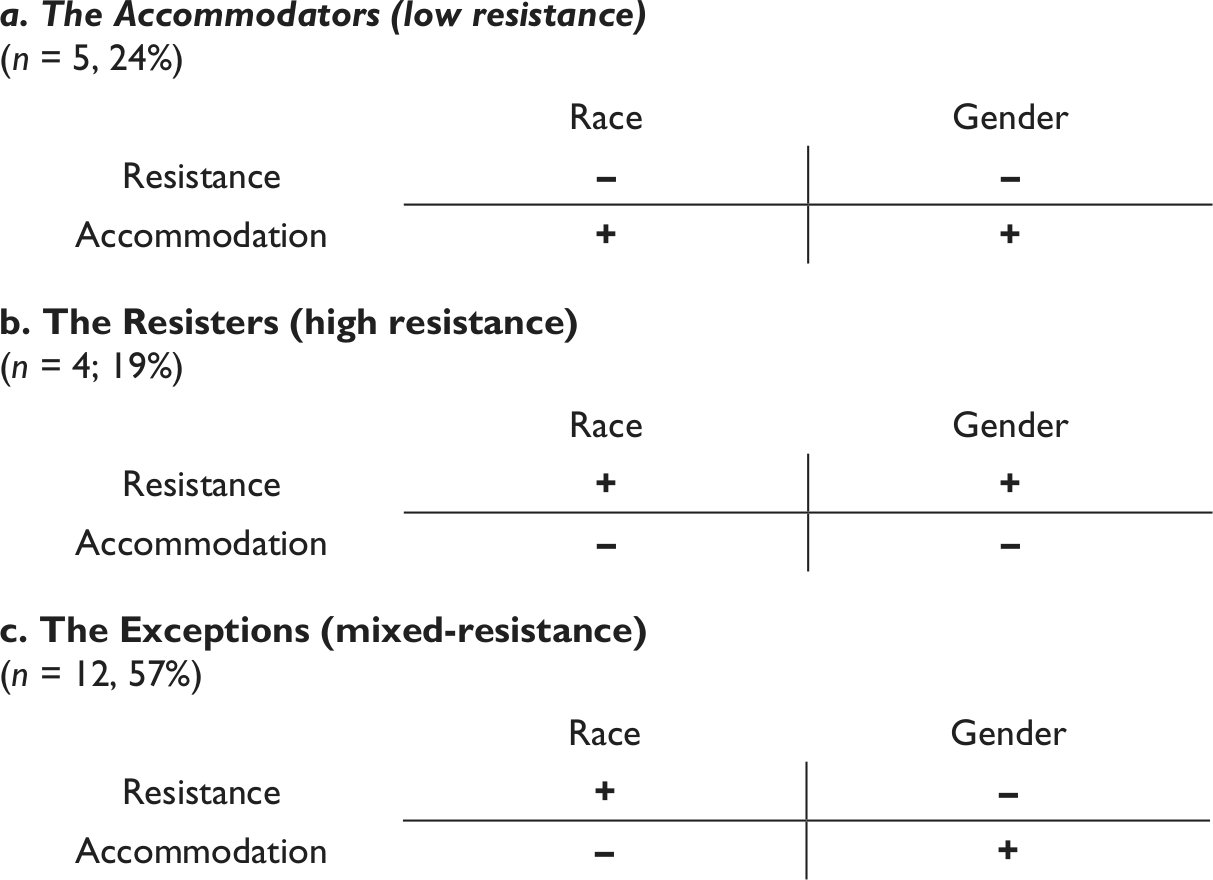
Paths of resistance to racial and gender stereotypes.
Omar is the case study for the “accommodators.” Omar has dark chocolate skin and a slender build. The shallow scars etched on his face convey a richly complex story before he even begins to share it. He lives with his mom, older sister, and nephew (his sister gave birth to a son during his freshman year). His father, who was in jail for most of his childhood, now lives nearby. Omar describes himself as “the hood guy” who is “trying to make it.” Asked to describe himself, he said, “I’m just a cool individual. Laid-back and down-to-earth, so I like to have fun, crack jokes now and then; that’s about it.” This laid-back humor was carried into his discussions of his racial identity:
What are some of the good things about being Black? Oh, like a lot of people are scared of us; that’s great. Okay, and why is that a good thing? Because sometimes it’s kinda funny to see that fear in people . . . “Oh no, I walked into the wrong neighborhood” [laugh]. They’re shaking; it’s funny to me. Almost everything be funny to me [laugh]. I could be in the craziest situation and still be laughing.
Omar likes being Black because he can incite fear in others, suggesting he has embraced the stereotypes that frame him as scary and dangerous. Yet, his laughter peppered throughout suggests that he knows such “fear” is not justified. Instead of challenging its truth, he articulates why he accommodates the stereotype into this identity: “Like if you’re too soft and you’re Black, man, everybody is going to mess with you no matter who it is, White people, Hispanics, I mean everybody is going to mess with you.” In response, Omar tries to “be in the middle” because being “too tough” also invites “more problems”—fights with peers, negative interactions with authority figures. The “accommodators,” like Omar, did not necessarily believe the stereotypes to be true, but instead of rejecting them, they tried to repurpose them in order to survive.
The “accommodators” were not, however, ignorant of the consequences of being stereotyped. When asked what he doesn’t like about being Black, Omar said,
Everybody think[s] you’re like the other Black person they see. They think if one Black person is bad they think every Black person is bad, no matter who you are, what you say or what you do. . . . And I’m like, don’t judge me; let me at least show you what I’m about before you judge me because you never know.
Contending with the idea that everyone already thinks you are “bad” is daunting:
When you think about your future, what do you hope for? Man, to be alive. Yeah because this is wild, I’ll be like man I hope I don’t get shot. Because I already know, I’m the hood guy . . . And what do you worry about when you think about your future? Man, I think I’ll worry about me being bad; I don’t know. I’ll be kind of tempted sometimes, like “man, you need that money dog”; I’m trying to be good now . . . I ain’t trying to be locked up [laughs]. I can’t do that, no, no, no. I’m too little to go to jail.
Omar does not believe that he is “bad” or scary, and yet his primary fear is that he will exactly confirm society’s expectations (“I’ll worry about me being bad.”).
Such vulnerabilities were rarely expressed among the “accommodators” because those who feel the most vulnerable often appear the most stereotypical as a means of self-protection (Majors & Billson, 1992; Spencer et al., 2004). Omar’s vulnerability is clear when he talks about violence: “Over by my house there’s been a lot of killing a lot of people getting killed or shot . . . about ten [shootings] in the last couple of days.” Asked how he felt about this, he said,
Well, it really don’t make me feel any kind of way. Because like it’s their fault; to me it’s their fault if they don’t know how to stay in the house and stop doing all that crazy stuff; if they do like me, they’ll be okay.
Omar uses masculine stoicism (“I don’t feel”) to shield the vulnerability he seems to experience living in the midst of violence. He focuses on the individual (“it’s their fault”) rather than the systemic factors that underlie the violence in his community; a strategy that offers him a sense of agency in ensuring his own safety (“If they do like me, they’ll be okay”). Thus, the “accommodators” were not ignorant or passive recipients of stereotypes, but they responded in ways that simultaneously fortified stereotypes about race and gender.
Marcus is the case study for the “resisters.” Marcus has chocolate brown skin and a wide smile. He talks rapidly and laughs heartily. He describes himself as “flamboyant—like colorful” and “really energetic.” He lives with his mom and step-dad and is a big brother to his three half-siblings. Marcus illustrates how some of the boys were able to stay connected to what they know and feel despite cultural pressure to disconnect—to not know, not feel, and not care. The “resisters” spoke of stereotypes as a system of oppression. Marcus explained,
[S]ociety has its boxes for everybody, and they don’t like it when you like jump outside of it. . . . The well-you’re-never-going-to-be-anything ’cause you’re in the “Black box” and I don’t think you can do this cause you’re Black . . . Like Black kids are always doing the drugs . . . and they’re always doing sports, or always the one that’s just trying to shoot somebody up, they’re always the violent ones. . . . You’re not supposed to be a bookworm, be feminine, be gay. Oh, you’re Black, you’re not supposed to be gay, you’re supposed to have like fifty women and you’re supposed to have a lot of girlfriends and get a lot of people pregnant and then leave them all.
The “resisters” were able to name the racial, gender, and sexuality stereotypes (as they intersect) and challenge them, as Marcus does: “My plan in life is to be as unique and extraordinary as possible . . . I have goals to prove all those people wrong and not fit into any one of those boxes.”
The “resisters” were also able to locate stereotypes in society:
Well I guess some people are so used to seeing the gang bangers and the gangsters and stuff like that on the outside, so they think that every Black male is like that. But that’s actually a stereotype. And, it’s just not—I’m not going to say it’s not fair because then again it kind of is because that’s all they see all the time, so of course they’re going to think that. So, we are trying to change their minds about Black men in general, being the best that we can be and getting our educations and proving them wrong.
Marcus not only knows that people see the stereotypes on a regular basis but also knows that this does not justify it or make it true. The “resisters” did not dismiss the stereotypes or assume they exist “out there” and therefore do not matter. Rather, the “resisters” believed that together with other Black males, they can shift how others view Black males (“We are trying to change their minds”).
This belief that they could change the stereotypes, however, did not mean that the stereotypes did affect them. Marcus explained how he feels about the stereotypes:
I actually get kind of mad but I try to keep that anger under wraps [be]cause, you know, you don’t want that anger coming out in the wrong way. So I try to focus it in, do my schoolwork, so I can break the stereotype. And, I’d like to get out into the community and like tell people that you know this is not how we act, you know, things like that. So I guess you could say that I’m kind of inspired, but then again I’m kind of like pissed off. That’s kind of how I feel about it.
Unlike the “accommodators” who tended to dismiss stereotypes by saying the the stereotypes “don’t matter,” the “resisters” acknowledge their impact. For example, Marcus names his emotions (“mad,” “anger,” “inspired,” “pissed off”) and articulates how he utilizes emotion to fuel a healthy resistance that can bring about systemic change.
The “resisters” also stood out for their resistance to gender stereotypes.
Are there things you feel like you’re supposed to do or ways you’re supposed to act just because you’re a boy?
Well, it’s not things that I think I’m supposed to do, it’s things that people think I’m supposed to do. Like guys aren’t supposed to be feminine or guys aren’t supposed to be sensitive or show their feelings, or cry. That’s a big one, like guys aren’t supposed to cry. . . . It’s like but if you get hit or you get a bone broken or your mama or someone close to you dies like, you know, of course you gonna cry cause that’s like human nature, you’re supposed to cry, that’s why you have tear ducts in your body.
In contrast to the “accommodators” who viewed gender stereotypes as natural and beneficial, the “resisters” questioned the assumed privilege of this gender ideology. Marcus explained,
’Cause, I guess society thinks that if men or boys act feminine that they’re gay or they just assume that they’re gay. And I think that’s a bad stereotype because guys need to express their feelings too. I’m not going to say that guys are supposed to be tough all the time . . . and they’re supposed to man up and cover that up with hardness or whatever. It’s okay to let yourself cry and be heartbroken. I don’t think that’s a good stereotype because that’s like telling kids not to care about anything that happens.
Marcus rejects the idea that emotion is feminine because he knows that emotion is “human nature” (see also Gilligan, 2011; Way, 2011). And he identifies stereotypes as the cause of carelessness (“That’s like telling kids not to care about anything.”).
The “resisters” were acutely aware of what society said they were supposed to be and challenged the expectations by questioning the truth of the “boxes.” This resistance is not about individual success; it is not about boys or girls, Black people or White; this is a resistance for liberation, a resistance for all (Robinson & Ward, 1991).
Jaire is the case study for the “exceptions.” At 13 years old, Jaire stood over 6 feet tall with a broad frame and dark brown skin. Both his parents passed away while he was young, so his grandmother has raised him as an only child, and he has “always been the man of the house.” He exerts great effort to present himself in what he describes as the “proper manner” because “appearance and acting right” are essential to his success: “I have to hold myself to a higher standard because people don’t think that African American males can do this and do that, like go to college, accomplish things.” The “exceptions” were acutely aware of the negative stereotypes that characterized their racial group and were determined to stand apart from them in order to prove them wrong. Asked to describe himself, Jaire said, “I would say that I’m a very intelligent, articulate young man . . . And someone who is genuinely a well-behaved person, a well-dressed or groomed person . . .” Jaire is articulate, and his self-description stands in direct contrast to how other people see Black people: “Just lazy and acting out and don’t care about their educations.” In response to this stereotype, Jaire strives to uphold a “higher standard,” to be “exceptional” and “not just a regular Black man.”
The “exceptions” sought to challenge racial stereotypes by separating themselves from other Black people. Asked what he likes the most about himself, Jaire said,
I love the fact that people think of me to be a more complex individual and a more intelligent individual. Because there’s no 14-year-old—let’s be real, no 14-year-old African American male that can use different words in different situations and give his opinion about Barack Obama or the state the economy is in, the Iraq war, and different situations or the lesbian movement.
Jaire resists the idea that because he is a Black male, he is unintelligent and informed. But, unlike the “resisters” who challenged the truth of the stereotype, the “exceptions” established their identities viewing themselves as an exception to it. In other words, Jaire’s self-description suggests that other Black boys might be dumb and uneducated, but I’m not.
For the “exceptions,” resistance was also limited to racial stereotypes. Their narratives about gender sounded more similar to the “accommodators”—reinforcing rigid gender ideology.
Are there certain things you’re supposed to do because you’re a boy?
Yes, there are certain things that males aren’t supposed to do because they’re males. Like playing, acting female-ish or acting feminine or something like that. A male isn’t supposed to do that. . . . You’re supposed to talk like men, not like women . . . Like, most women get real emotional in their decisions. Like men, there’s not supposed to be any emotion in your decisions. That’s why a woman isn’t fit to be President. That’s what I believe. . . . And that’s why a man is more dominant than a female.
While Jaire positioned himself in opposition to racial stereotypes, he aligns himself with gender stereotypes, framing gender norms as absolute and beneficial:
The best part about being a young man is that we’re like the trendsetters of the world. You know what I’m saying, like the government, the world is ran by men. Men run the world. . . . And I don’t think that a woman is fit to run a world. . . . Because men make hard decisions without emotion. And the women get emotional in certain situations. . . . Like their emotions are too high . . . We, we don’t express our feelings as much. We don’t talk about how we feel, you know.
Jaire reiterates the stereotype that women are emotional (and therefore weak), whereas men are stoic (and therefore strong). He goes on to explain, “We [males] get to set the tone or mode of our lives, we get to impact other peoples’ lives too . . . Because women, some women, like you know what I’m saying, can’t protect themselves like a man can protect them.”
Jaire’s interview reads like a contradiction, enacting resistance and accommodation. The “exceptions” were characterized by this duality in responding to oppression: Resisting the oppression of racial stereotypes (specifically for the self) while also accommodating to the male privilege of gender stereotypes.
Discussion
The purpose of the analysis was to examine the identity development of Black adolescent males within a framework of resistance and accommodation using an intersectionality lens. Our findings underscore that the process of resistance and accommodation to stereotypes plays a critical role in identity development (Anyon, 1984; Brown & Gilligan, 1992; Robinson & Ward, 1991; Rogers & Way, 2015; Way, 2011; Way et al., 2013; Way & Rogers, in press). Moreover, there are varying pathways of resistance that both converge and diverge across identities. Such diversity coupled with the evidence of resistance among Black males challenges monolithic representations of Black males’ identities as negative and accommodating. Here, we discuss how the findings speak to resistance, the intersectionality framework, and implications for research on adolescent identity development.
Resistance and Intersectionality
Overall, there was more evidence of resistance to racial stereotypes than to gender stereotypes. The boys in the study were more likely to challenge stereotypes about their intellectual and academic abilities than to contest gender expectations about their independence and stoicism. Likewise, the most common pattern of resistance was the “exceptions” where boys accommodated to gender stereotypes but resisted racial stereotypes (Figure 1c). Together, these findings raise the following question: Is it easier to resist racial stereotypes than gender stereotypes? Because race and gender are socially constructed, they derive meaning and significance from the sociopolitical and historical context. While both race and gender are similarly used to stratify, they do not function similarly for all groups. Consider the valence of racial stereotypes compared with gender stereotypes for Black males. A racialized system of oppression positions Black people at the bottom of the social hierarchy, and stereotypes about Blackness are, on the whole, explicitly negative, designed to position Black people as less than human (Lesko, 2001; Nasir, 2011). In this context, it is clear that one should want to distance the self from racial stereotypes; one would want to avoid being seen as “dumb,” “bad,” or “unsuccessful.”
Gender stereotypes, however, function differently. As males, their gender tops the social hierarchy where the norms of masculinity bring power, dominance and success. While there is growing evidence that adherence to traditional masculine norms is damaging to one’s physical, emotional, and psychological health (Barker et al., 2010; Gupta et al., 2013; Santos et al., 2013; Way et al., 2014), because these ideals are privileged in society, it is less obvious that one wants to avoid or resist them. Moreover, because gender stereotypes are intimately tied to sexuality, for Black males in particular (e.g., Ghavami & Peplau, 2013; Majors & Billson, 1992; Pascoe, 2007), when a Black male challenges norms of masculinity, his sexuality is also questioned—he is stereotyped as girly or gay (Pascoe, 2007; Way, 2011). In other words, to resist racial stereotypes would move a Black male up the social ladder, whereas to resist gender stereotypes would move him down the ladder. Given this structure, it may be easier to challenge racial stereotypes than gender stereotypes for Black males.
The school context is also relevant to the patterns observed in our data. BMCS, where these data were collected, is an all-Black, all-male school designed to counteract mainstream cultural beliefs about Black men. BMCS was explicit about challenging stereotypes through daily rituals, classroom practices, and academic assignments. For example, the teachers spoke candidly of the statistics about Black males—drop-outs, criminals, failures—in direct contrast to their expectations for the students, saying, “we are ‘scholars,’ ‘college-bound,’ ‘exceptional.’” Classroom observations captured in-depth discussions of Black history and conversations about what it means to be Black/African American. At the same time, gender was rarely integrated in these historical conversations of oppression and often went unquestioned. For example, the school uniform—a suit-and-tie—was chosen, according to the founder of BMCS, to communicate a message of “professionalism and success.” This image directly counters racial stereotypes, but simultaneously reinforces gender conventions of (White) masculinity. At the same time, the all-male context may prompt accommodation as the mere absence of girls poses a threat to boys’ masculinity and sexuality (Davis, 2006; Rogers & Nelson, 2010). Thus, both the macro-cultural construction of race and gender and the micro-level of the school context may explain why there was more evidence of resistance to racial stereotypes compared with gender.
These patterns also clearly point to the relevance and importance of employing an intersectionality perspective. Prior studies of resistance have mostly focused on two ways or paths of responding to stereotypes (e.g., Brown & Gilligan, 1992; Robinson & Ward, 1991; Way, 2011). Our data not only support these pathways (the “accommodators” and the “resisters”) but also show that adding the dimension of intersectionality complicates this dichotomous framework (revealing the pattern of the “exceptions”). For example, Jaire, the case study for the “exceptions,” identified himself as “not just a regular Black guy,” an identity that accommodates to masculine autonomy while attempting to resist negative racial stereotypes. It is an identity achieved by separation; it is self-focused rather than group-focused. It resembles what Robinson and Ward (1991) describe as “resistance for survival” rather than “resistance for liberation.” With an intersectionality view, one can interpret gender norms as a critical force in this identity strategy. That is, the accommodation to gender stereotypes exhibited by “exceptions” influenced how they then negotiated racial stereotypes. It is also interesting that while there was a group of boys who resisted only racial stereotypes, there was not a group that resisted only gender stereotypes; that is, each of the boys who resisted gender stereotypes also actively resisted racial stereotypes. This suggests that resisting gender stereotypes, in particular, may be essential for cultivating healthy identity pathways among Black males. In an intersectionality framework, gender identity is not only related to racial identity but also integral to understanding its development.
Our findings also extend intersectionality research by illustrating how unresolved issues or tensions in the theory may play out empirically. For example, both structural intersectionality and agency were evident in our findings. Black males are positioned uniquely in society because of the structural systems and stereotypes but they are not fixed or held there. They actively resist these structures, redefining them and deconstructing them. On the issue of identity union versus distinctiveness (Phoenix, 2006; Verloo, 2006), our data underscore the value of examining the relationships between identities (e.g., “Black” and “male”) rather than examining the blended identity label (i.e., “Black male”). If we only examined their resistance to “Black male” stereotypes, we may miss the nuance where boys actually resist race more readily than gender—not in isolation but with distinctiveness. At the same time, explicitly examining boys’ resistance and accommodation to Black male stereotypes may reveal different paths of resistance. Finally, our data support the claim that privilege and oppression coexist in intersectionality and must be considered jointly (Nash, 2008). We found that boys are more likely to resist their position of oppression than their position of privilege. This is noteworthy because if we only frame intersectionality as oppression we miss the ways in which privilege shapes how individuals respond to oppression. Moreover, in terms of intervention, it suggests that one must work more deliberately to foster resistance to privileged statuses, as youth may be less likely to challenge the stereotypes associated with these social positions.
Implications for Identity Development
The concept of resistance has important implications for identity development among Black males, first because it recognizes the agency that youth possess to respond to negative social forces, such as stereotypes. Moreover, prior research has established that resistance leads to positive outcomes and better adjustment (e.g., Brown & Gilligan, 1992; Gupta et al., 2013; Santos et al., 2013; Way et al., 2014). In this way, resistance is a tool for change. Likewise, employing an intersectionality approach shifts identity into the political and the practical. Crenshaw (1991), writing about the implications of an intersectionality worldview, argued,
The failure of feminism to interrogate race means that the resistance strategies of feminism will often replicate and reinforce the subordination of people of color, and the failure of antiracism to interrogate patriarchy means that antiracism will frequently reproduce the subordination of women. (p. 1252)
Speaking about Black women, Crenshaw suggests that intersectionality is essential for unraveling the web of inequality, and that intersectionality must be part of the intervention in order for it be “meaningful” and effective (Crenshaw, 1991, p. 1251).
We know that stereotypes profoundly shape how we view others but our findings underscore that stereotypes also shape how youth see themselves, which can pave vastly different identity pathways. The “accommodators” constructed their identities principally through reinforcing stereotypes, meaning that they in turn “act like stereotypes” (Nasir, 2011; Spencer et al., 1997; Suárez-Orozco, 2004), the consequences of which are well documented—delinquency, problem behaviors, and school failure (Ferguson, 2000; Majors & Billson, 1992; Spencer et al., 2004). Intervention for this group may focus on awareness and providing boys with alternative ways to see themselves and combat the stereotypes. The “exceptions,” on the other hand, while also accommodating to gender stereotypes, deliberately positioned themselves in opposition to racial stereotypes in ways that are likely to lead to academic success (Whiting, 2006), but their endorsement of masculine autonomy and stoicism may also place them at risk. For example, Steele’s (2011) stereotype threat research reveals how the pressure not to confirm a negative stereotype is a psychological weight that can undermine psychological well-being, and eventually performance, particularly when shouldered alone. Similar research on gender has shown that boys who believe that they ought to be autonomous and self-sufficient exhibit greater psychological distress (Gupta et al., 2013; Way, 2011; Way et al., 2014) and decreased academic performance (Santos et al., 2013). These potential risks, which may be overshadowed by their resistance to racial stereotypes, must also be attended to.
The “resisters,” in contrast, respond to negative stereotypes with liberation strategies that are likely to lead to positive adjustment (Robinson & Ward, 1991; Way, 2011). Studies show that youth who resist negative stereotypes that encourage disconnection are more likely to report higher levels of psychological and academic adjustment (Gilligan, 2011; Gupta et al., 2013; Santos et al., 2013; Spencer et al., 1997; Suárez-Orozco, 2004; Ward, 1996; Way, 2011; Way et al., 2014). Yet, such resistance is continually threatened by culture, which is evidenced in its general decline across adolescence (Brown & Gilligan, 1992; Chu, 2014; Way, 2011; Way et al., 2014). This is important because, as Ferguson (2000) found in her ethnography of Black boys, “the ‘schoolboys’ (i.e., those who resisted stereotypes) were always on the brink of being redefined into the ‘troublemakers’ (i.e., accommodators) . . . ” due to forces of race and gender stereotypes that are working against them (p. 10). In other words, the stereotypes and pull toward accommodation do not lesson but likely intensify over time, underscoring the importance of support networks, perhaps especially for those boys who are successful and overcoming obstacles.
Finally, it is noteworthy that these identity pathways are not fixed or stable. Our data suggest developmental patterns where accommodation to gender stereotypes increased over time and resistance to racial stereotypes increased. The increase in accommodation to gender stereotypes as boys progressed through adolescence parallels the developmental pattern found by Way (2011), showing that as boys reached the end of adolescence they sounded more like masculine caricatures: less expressive, more independent and more isolated. The increase in accommodation suggests a process of “becoming” that is learned but not necessarily immanent, as Way et al. (2014) show that some boys actually maintain and even increase resistance over the course of adolescence. At the same time, resistance to racial stereotypes increased during this time, further suggesting that adolescents are capable of resisting cultural oppression throughout adolescence. The increase in resistance may reflect scaffolding of the school context where boys received explicit messages and thus cultivated a language for counteracting racial stereotypes, indicating that resistance can be fostered and supported. It may prove useful to think of these resistance pathways as transitional stages, where youth can move from the “accommodators” to the “exceptions” and ultimately to the “resisters,” not necessarily in a linear fashion but by way of learning how to navigate stereotypes successfully. The question then becomes less about which path leads to negative outcomes and more about how we move youth from an identity that is grounded in accommodation to one that is rooted in a resistance that leads to liberation.
Limitations and Future Directions
The generalizability of the findings is limited to the sample size and location of the data. While the findings cannot be generalized to all Black males or all single-sex schools, they are relevant to the study of resistance and identity development in a context of stereotypes. They raise questions about how resistance processes unfold in other contexts (e.g., coeducational schools) and among other demographic groups and intersections (e.g., White males or Black females). A more extensive longitudinal sample can also shed light on the developmental trajectories of these resistance pathways, and there is more to learn about the factors that support and impede healthy resistance (Way & Rogers, in press), such as family. An important next question is what it looks like to teach resistance, how best to cultivate it during adolescence, and what interventions would look like to move youth from accommodation to resistance, from the “accommodators” and the “exceptions” to the “resisters.” Such research would be useful in a range of settings related to youth development, including families, communities, and schools.
Conclusion
Examining the ways that Black males engage in the process of resistance and accommodation makes evident the tangible impact that stereotypes have on their developing identities, as well as their ability to stand up to society’s negative expectations. Although not all boys were among the “resisters,” our data underscore the prevalence of resistance among Black males and call for further study of how to move boys from accommodation to resistance, and how to support boys in maintaining their resistance throughout adolescence. Focusing on the process of resistance shifts the scientific conversation from documenting how stereotypes impact outcomes to considering how resistance processes function to counteract their insidious effects.
Footnotes
Appendix
Interview Protocol

| Intro | |
| Intro question; salient self- descriptors; info to use throughout interview |
Tell me a little bit about yourself. |
| School | |
| Motivations, reasons for attending school; their choice, parents’ choice, academic, behavioral |
Tell me about how you ended up coming to BMCS, what was that process like? How did you hear about the school? What did your parents think about you coming to an all-boys school? |
| Perception of school | How would you describe BMCS to someone who has never been here? |
| What do you like most about BMCS? | |
| Why is that important to you? | |
| If you could change anything about BMCS, what would you change? | |
| Why is that important to you? | |
| Prove a counterpoint, a contrast |
Besides being all boys, how do you think this school is different from your last school? |
| Knowledge/awareness of “Black |
Do you think it is important to have schools like this one? |
| Student-teacher relationships; |
Tell me about your teachers, what are they like? |
| Sometimes the adults at school have ideas about their students. How do you think the adults at this school see you? | |
| Peers | |
| Student-student relationships | Tell me about the other boys at this school, what are they like? |
| How do the boys at this school get along with one another? | |
| General friends | Tell me about your friends. Who are they and what are they like? |
| Closest/best friend | Do you have a closest friend or a best friend? |
| Description of friend as a |
How would you describe [best friend], what is he like? |
| Good and bad of friendship | What do you like most about your friendship with [best friend]? |
| What do you like the least? | |
| When was the last time you saw [best friend]? What did you guys do? | |
| [probe for details] | |
| What kinds of things do you talk about with [best friend]? | |
| [probe for details] | |
| What kinds of things would you NOT talk about with [best friend]? | |
| Why not? | |
| Self | |
| Global self-descriptions |
How would you describe yourself? |
| What makes you feel really proud? | |
| Why? | |
| Is there anything about yourself that you are not proud of? | |
| Centrality; core sense of self | What would you say is most important about the person you are? |
| Understanding of own |
How do you think you have gotten to be the person you are? |
| Racial identity | |
| Self-identification; African American vs. Black | What would you say is your ethnicity or race? |
| Is being [race] important to you? In what |
|
| Good and bad about being |
What do you like about being [race/ethnicity]? |
| Tell me about a time when you felt this |
|
| What are some of the things that bother you about being [race/ethnicity]? | |
| Tell me about the last time you felt this |
|
| Meaning they attribute/assign to |
What do you think it means to be Black? |
| What do you think other people think about Black people? (i.e., stereotypes) | |
| Discrimination/unfair treatment |
Tell me about a time when you feel you were treated differently because you are Black |
| Gender identity | |
| Image of a typical boy; behavior, |
Describe the typical boy. What is he like? |
| How does that make you feel? | |
| Good and boy about being a boy; |
What do you like most about being a boy? |
| What do you like the least? | |
| Can you think of a time when wished you were not a boy? | |
| What do you think other people think about boys? (i.e., stereotypes) | |
| Differential treatment based on |
Can you think of a time when you feel you were treated differently because you were a boy? |
| What happened? | |
| Race/gender stereotypes | What are some of the benefits that Black boys have that maybe other boys do not? |
| Like what, can you give me an example? | |
| Why do you think that is? | |
| What are some of the challenges that Black boys face that maybe other boys do not? | |
| Like what, can you give me an example? | |
| Why do you think that is? | |
| Transition to manhood; notions of masculinity; what and how they are moving toward manhood | What do you think it means to become a man? |
| Tell me about a man, either in society or that you know personally, that you consider a role model | |
| What is he like? | |
| What does he do? | |
| Future | |
| Academic expectations/ |
How far do you expect to go in school? |
| What do you think it is going to take to get there? | |
| When you think about your future, what is the thing you worry about the most/what is the thing you hope for the most? | |
Source. Rogers (2012).
Note. BMCS = Black Male Charter School.
Declaration of Conflicting Interests
The author(s) declared no potential conflicts of interest with respect to the research, authorship, and/or publication of this article.
Funding
The author(s) disclosed receipt of the following financial support for the research, authorship, and/or publication of this article: This research was supported by fellowships awarded to Leoandra Onnie Rogers from the Spencer Foundation Dissertation Fellowship and the Ford Foundation Dissertation Competition.