



Abstract
Migration to a new country can be very difficult for adolescents as they are also experiencing a critical transition into adulthood. The current study investigates cross-cultural transition issues facing Iranian immigrant adolescents living in Malaysia. Data were gathered from individual interviews with 100 Iranian adolescents (ages 14-18 years), who have lived in Malaysia for between 2 months and 5 years. Descriptive phenomenology qualitative research was used to explore the impact of the migration process on Iranian adolescents. Analysis revealed five major themes regarding participants’ life experiences in Malaysia: (a) initial expectations; (b) differences in ethnicity, religion, and beliefs; (c) communication barriers; (d) differences in personal evaluations; and (e) psychological issues. The results of this study clearly show that migration for Iranian adolescents in Malaysia is a time of unexpected challenges that may not be experienced by other migrant adolescents in other countries. Our findings contribute to the literature on the unique experiences of Iranian adolescents living in Malaysia and also build on the current research on adolescents who have recently immigrated. In addition, our results further uncover the process of immigration for individuals who are moving from a monocultural society (such as Iran) to a multicultural context (such as Malaysia).
Adaptation to a new environment is an important transition for immigrants as they migrate to a new country for various personal, vocational, educational, and familial reasons (Berry, 1997). Adolescent immigrants, in particular, face unique social, cultural, psychological, and physical challenges after migration. Moreover, prior to feeling a sense of belongingness to a new environment, adolescents often experience great sadness in losing contact with their country of origin (Kroger, 2007). During the process of cultural adaptation, immigrant youth frequently must take on adult roles such as cultural and language brokering to support their family members (Yeh, Kim, Pituc, & Atkins, 2008). Hence, immigrant adolescents face complex challenges as they simultaneously navigate acculturative and developmental adjustments (Arnett, 2007; Britto, 2008; Yeh & Inose, 2002).
Research on cultural adaptation has also examined the specific difficulties faced by immigrant youth as they navigate to a new cultural context. Researchers have found higher rates of emotional, social, and behavioral adjustment problems among immigrant adolescents in comparison with native born participants as predicted by aspects of social class, adherence to traditional cultural values, residential location, and racial and ethnic background (Pong & Hao, 2007). Immigrants also face challenges in communication and in managing emotions (Hess, 1994), which may cause confusion (Phinney, Horenczyk, Liebkind, & Vedder, 2001), communication challenges (Mallett, Wilson, & Gilbert, 2008; Plant, 2004; Richeson, Dovidio, Shelton, & Hebl, 2007), acculturative stress (e.g., Ayers et al., 2009; Fischer, 2010; Yu, Huang, Schwalberg, Overpeck, & Kogan, 2003), isolation (Zheng & Berry, 1991), perceptions of low self-efficacy (de Saissy, 2009; Milstein, 2005), low self-esteem (Bhugra & Becker, 2005), anxiety, depression, suicidal ideation, behavioral problems (Aguilera-Guzmán, Salgado de Snyder, Romero, & Medina-Mora, 2004; Flores et al., 2002), worsened psychological adaptation (Sam, Vedder, Liebkind, Neto, & Virta, 2008), and developmental concerns (Skokauskas, Dunne, Gallogly, & Clark, 2010).
Prior research on cultural adaptation has often focused on teenagers who migrated at a young age, or on the experiences of individuals born in the host country and examined as second or third generation immigrants (Berry & Sabatier, 2010; Schachner, Schiller, Van de Vijver, & Noack, 2014; Stodolska, 2008). This body of work has focused on the role of family relationships (Kosner, Roer-Strier, & Kurman, 2014; Qin, Chang, Han, & Chee, 2012; Schachner et al., 2014), peers (Fandrem, Ertesvag, Strohmeier, & Roland, 2010; Qin, Way, & Mukherjee, 2008; Walsh, Harel-Fisch, & Fogel-Grinvald, 2010), parents and teacher (Walsh et al., 2010), perceived discrimination (J. Li, 2009; Patel, Tabb, Strambler, & Eltareb, 2015; Vedder, Sam, & Liebkind, 2007), peer victimization (McKenney, Pepler, Craig, & Connolly, 2006), differing expectations between home and school (J. Li, 2009; Qin, 2009), happiness (Neto & Pinto, 2010), gender (Kwak & Rudmin, 2014; Qin, 2006; Suárez-Orozco & Qin, 2006), age (Kwak & Rudmin, 2014), meaning of life (Pan, Wong, Chan, & Joubert, 2008), lifestyle and values of the host culture (Montaruli, Bourhis, Azurmendi, & Larranaga, 2011), ethnic identity and language proficiency (Pfafferott & Brown, 2006; Vedder & Virta, 2005), and social contact and friendship (Zhang & Brunton, 2007) on immigrant adolescents’ adaptation (Kosner et al., 2014; Patel et al., 2015). In addition, research on immigrants has also explored strategies for academic achievement (Liebkind, Jasinskaja-Lahti, & Solheim, 2004; Suárez-Orozco et al., 2010; Suárez-Orozco, Rhodes, & Milburn, 2009), life satisfaction (Abu-Laban & Abu-Laban, 1999; Oppedal, Røysamb, & Sam, 2004; Paterson & Hakim-Larson, 2012), sociocultural, psychological (Abu-Rayya, 2014; Tong, 2014; Vedder et al., 2007; Yeh et al., 2005), cross-cultural (Kuo & Roysircar, 2006), and successful adaptation strategies (Dimitrova, Chasiotisa, Bendera, & van de Vijvera, 2014; Lara, 2014; Mancini & Bottura, 2014; Schiefer, Möllering, & Daniel, 2012).
Immigrants must also attend to differences between themselves and people in the host country (Smith & Khawaja, 2011). For many individuals, this may be a stressful experience, especially when the new society is significantly different from their home country (Finch & Vega, 2003) such as the case of Iranians immigrants living in Malaysia. The current study investigates the cross-cultural challenges experienced by Iranian adolescents who have recently immigrated to Malaysia and how these experiences contribute to knowledge about the process of adaptation from a monocultural society (Iran) to a multicultural society (Malaysia). As much of the current research on immigrant adjustment has focused on the experiences of immigrants coming to the North America, Europe, and Australia, or on immigrants who have been in those geographical areas for a few years, this study extends the current literature on cultural adaptation and adjustment by focusing on (a) the unique experiences of Iranian adolescents living in Malaysia and (b) the process of immigration for individuals who are moving from a monocultural society (such as Iran) to a multicultural context (such as Malaysia).
Theoretical Framework
The adjustment theory of Searle and Ward (1990) has been widely used as a framework for research on cross-cultural transitions (A. Li & Gasser, 2005; Swami, 2009; Wang, 2009). Psychological adjustment, cognitive variables, expected difficulty, and cultural distance variables are important factors related to cross-cultural transitions (Ward & Chang, 1997; Ward & Kennedy, 1993a, 1993b; Ward & Searle, 1991). In particular, social difficulty factors in adjustment include changes in one’s cultural identity, lack of cultural knowledge, language competency, loneliness, social skills, the length of residence in the host country, the level of interactions with the host nationals, and acculturation strategies (Searle & Ward, 1990). The authors emphasized that adjustment through cross-cultural transitions may be conceptualized in two categories: psychological and sociocultural adjustment. Psychological adjustment may include perceived distress, self-reported psychological symptoms, life changes, personality factors, available social support, and homesickness (Ward & Kennedy, 1993a). Sociocultural adjustment may be explained in terms of a cultural learning paradigm or social skills for dealing with people in a new environment (Spencer-Oatey & Xiong, 2006).
According to previous research, prior experiences associated with living abroad (Klineberg & Hull, 1979) and general knowledge in relation to a new culture (Pruitt, 1978) have a significant impact on cross-cultural adjustment. Whereas, the lack of knowledge about a new culture may create cultural distance, which is associated with higher social difficulty (Ward & Kennedy, 1993a), and may cause marginalization due to exclusion or discrimination (Berry, Kim, Minde, & Mok, 1987). Ward and Kennedy (1994) stressed that marginalization and a moderate amount of adaptation problems may negatively affect adjustment.
Adjustment experiences that pose challenges to immigrant adolescents from various countries include unfamiliar cultural values and different ethnic backgrounds (Pearson et al., 2008; Qin et al., 2008; Suárez-Orozco & Carhill, 2008; Yeh & Inose, 2002), differences in beliefs (Ayers et al., 2009; Fischer, 2010; Yu et al., 2003), inability to understand and speak the dominant language (Kim, Suh, & Heo, 2012; Liebkind & Jasinskaja-Lahti, 2000; Suárez-Orozco & Suárez-Orozco, 2001; Telzer & Fuligni, 2009; Vedder, 2005), different physical appearances (Qin et al., 2008), strained relationships that contribute to feelings of insecurity (Berry, 2001), and loss of identity and confusion (Berry, Phinney, Sam, & Vedder, 2006). As little is known about the adaptation experiences of Iranian immigrant adolescents, this theoretical framework was utilized to explore participants’ perceptions of and influences on their sociocultural and psychological adjustment.
Iranian Adolescents in Malaysia
In 2012, there were approximately 10,000 Iranian adolescents in Malaysia who mostly lived in the city of Kuala Lumpur (Najafi, Jamaluddin, & Lea-Baranovich, 2012). Most Iranian adolescents ages 14 to 18 years immigrate to Malaysia to accompany their parents, some of whom were participants of Malaysia’s My Second Home Programme (MM2H), which is a 10-year temporary visa, business people, or graduate students. Others came to Malaysia only with their siblings or alone to study in international schools, which offered all lessons in English. Malaysia is an example of a pluralistic society in practice (Ibrahim, Muslim, & Hidayat Buang, 2011) as Malaysians have been exposed to cultural and religious diversity in the society (Ahmad, 2007). The major ethnic groups in Malaysia are Malays (50.3%), Chinese (23.8%), and Indians (7.1%). Most people in Malaysia are Muslim, but there are other religions such as Christianity, Buddhism, and Hinduism. While the official language is “Bahasa Melayu,” people also speak English, Tamil, Chinese, and Punjabi (Ibrahim et al., 2011). In contrast, Iran is a monocultural country that has diverse ethnic groups such as Azeris, Fars, Kurds, Balochs, Arabs, Turkmens, Pashtuns, Armenians, Georgians, and Assyrians, but they share a common nationality which is Iranian (Library of Congress—Federal Research Division: Country Profile [Iran], 2008). Most Iranians are Muslim, although they are from different ethno-linguistic groups. There are other religions in Iran, such as Christianity and Judaism, but these religions are not really visible because everyone in Iran has to abide by the Islamic rules of the country, including appearance and clothes.
Little is known about immigrant adolescents, especially Iranians, and their unique experiences of living in Malaysia. As most studies on immigrant adolescent adaptation have focused on youths who migrated to Western countries and few studies have examined non-Western countries as a host country, their challenges may be unique. Experiences of Iranian adolescents in Malaysia may also be different from those of Iranian youths in Western countries because Muslim is the dominant religion in both Iran and Malaysia. Hence, the story of Iranian immigrant adolescents is important to explore as it may embody many of the unique and shared experiences of youth as they navigate to a new cultural space with some salient similarities.
Present Study
The current research investigates the adaptation experiences and challenges that Iranian immigrant adolescents experienced during their adaptation process. In the present study, a qualitative approach was used in which it did not specify possible adaptation challenges, rather encouraged participants to identify factors that they felt were salient in their adaptation process. The research question of the present study is as follows:
Method
Participants
The sample includes 100 Iranian adolescent high school students, comprising 51 males and 49 females. The ages range from 14 to 18 years (M = 15.84, SD = 2.71). Participants were immigrants who have resided in Kuala Lumpur City in Malaysia for between 2 months and 5 years. At the time of data collection, 22 participants (15 boys, seven girls) stayed alone and had only been in Malaysia for between 2 and 7 months. Twenty-five participants (15 boys, 10 girls) lived with their siblings and had been in Malaysia for between 2 months and 1 year. The remaining participants (21 boys, 32 girls) stayed with their parents and had resided in the country for between 1 and 5 years. Our particular sample is representative of the Iranian adolescents who come from middle and upper class backgrounds. In addition, most of the students’ families came to Malaysia in pursuit of a better life.
Participants were students at two schools in Malaysia specifically for Iranians. At these schools, all students and most of their teachers are Iranians. However, there are some teachers from English, Malay, Chinese, and Indian nationalities. These schools are in Kuala Lumpur (capital city of Malaysia) and were established in an attempt to continue the educational system of Iran with some reforms.
Procedure
Participants were recruited via “snowball sampling” (Creswell, 2005; Polit & Beck, 2006). This type of sampling was chosen because of its effectiveness in obtaining the desired number of participants. As the study was to be conducted in two Iranian schools in Kuala Lumpur, a consent letter was sent to the Iranian Embassy to obtain permission to conduct the research, which was followed by a letter of request for permission from the schools involved. Once the permission was obtained, the researchers met with the school counselors who introduced them to students to participate in the study; these students later referred their friends to be interviewed.
All of the respondents gave their verbal consent regarding participation and audio recording. Next, parental and individual informed consent forms were completed. The duration of each interview was between 30 and 45 minutes, with an average of about 37 minutes. All interviews were recorded with a digital audio recorder and later transcribed verbatim. The transcripts were later translated from Farsi to English by the Iranian researcher and were sent to be reviewed by an Iranian who is proficient in both Farsi and English so that she would be able to detect any discrepancy in the translation. After that, the translation was then checked again by another independent English language expert. The English version of the data enables the other researchers to analyze the transcripts independently.
Interview Protocol and Process
Semi-structured interviews (Mason, 1996; Wengraf, 2004) were conducted to collect the data in order to help the researchers better understand the perspectives and experiences of different participants. This method also allows the interviewees to relate their accounts in their own words, and it enables the interviewer to collect information that cannot be observed efficiently (Maverick, 2011). The interview protocol that was used in the current study was developed using a few key sources: the previous literature on cultural adaptation among immigrant adolescents (i.e., Arnett, 2007; Britto, 2008; Yeh et al., 2008), discussions and feedback from experts, and the authors’ clinical and research experience in working with immigrant adolescents’ cultural adaptation. The interview questions focused on the following areas related to immigrating: reasons for coming to Malaysia, experiences in the new culture, academic goals and peer relations, self-perceptions, coping with problems, and quality of life in Iran versus Malaysia. A complete list of questions is in the appendix.
The first author, an Iranian woman, conducted all of the interviews to allow the adolescents to express themselves in Farsi, their native language. To make each interviewee feel as comfortable as possible, she adopted counseling interviewing techniques (Whiston, 2008) by “structuring” the interview session at the start of each interview. This is done by giving some of her background information, purpose of the study, and seeking verbal consent for the interview to be recorded. The issue of confidentiality was also discussed with participants. This procedure was especially important as the participants were introduced by their friends; hence, they may not have knowledge about the purpose of the interview. Structuring was also carried out to establish a good rapport between the researcher and the participants. Rapport is essential in facilitating honest communication during the interviews (Shenton, 2004).
Data Analysis
This study used the phenomenological approach (Creswell, 2007) in order to obtain a deep understanding about the participants’ experiences. For the purpose of this study, we chose descriptive phenomenology to suit our inquiry into discovering and conceptualizing universal aspects of Iranian adolescent migrants’ experiences, particularly the challenges they face in adjusting to the new culture of the host country (Beck, 1992; Lopez & Willis, 2004). Phenomenological methods allow for validation of qualitative research for better generalization and the syntheses of phenomena versus individuals as invariant structures (Sousa, 2014) and elaborates on reflective matters experienced by the researchers (Englander, 2012). The semi-structured interview method allowed the researcher to directly interact with the participants and use their descriptions about their life experiences to provide a universal description of the phenomenon (Husserl, 2001). The present study also adopted the bracketing procedure to ensure neutrality and openness to the reality of others (Husserl, 2001). This bracketing technique (Colaizzi, 1978) also entailed separating the phenomenon from the world; scrutinizing the phenomenon to identify, define, and analyze the structure; shelving all preconceptions regarding the phenomenon; and dealing with the subject matter on its own terms, while he or she is listening to and analyzing the stories of the participants (Giorgi, 1999; LeVasseur, 2003).
The data analysis was carried out according to the following steps by Colaizzi (1978): (a) reading through the whole of each transcript to explore the phenomenon, which was experienced by all the participants as a whole; (b) rereading the transcript to extract significant statements and phrases that were relevant to the challenges and psychological issues experienced by the adolescents who migrated to Malaysia; (c) continuing the process until the whole description was described by one significant statement; (d) obtaining formulated meaning from significant statements; (f) clustering formulated meaning into broader themes, each cluster of themes was coded, and all formulated meanings related to that group of meanings were included; and (g) developing a unique construct of themes from clusters of themes, at this stage of analysis, all emergent themes were defined into an exhaustive description, and repeated or overrated descriptions were eliminated from the general structure.
Trustworthiness
As presented in previous sections, several strategies (such as peer debriefing, audit trail, member checks, and independent auditor) were used to establish trustworthiness in providing validity and reliability to the study (Liu, 2008; Shenton, 2004). Peer debriefing was applied to decrease researchers’ bias in analyzing the data. When all researchers involved in data analysis (Creswell, 2007) were working independently, they continued to discuss their individual analysis to decrease bias. An audit trail was performed by the main researcher during data collection and analysis by recording all the research activities to help her keep track of the research progress as well as to remind her of her personal bias (Lincoln & Guba, 1985). Member checks were used during data collection and after the analysis in order to obtain agreement between the data and the emergent themes (Creswell, 2009; Marshall & Rossman, 2006; Speziale & Carpenter, 2007). Finally, the data were sent to independent auditors to verify the exhaustive descriptions (Creswell, 2009).
Results
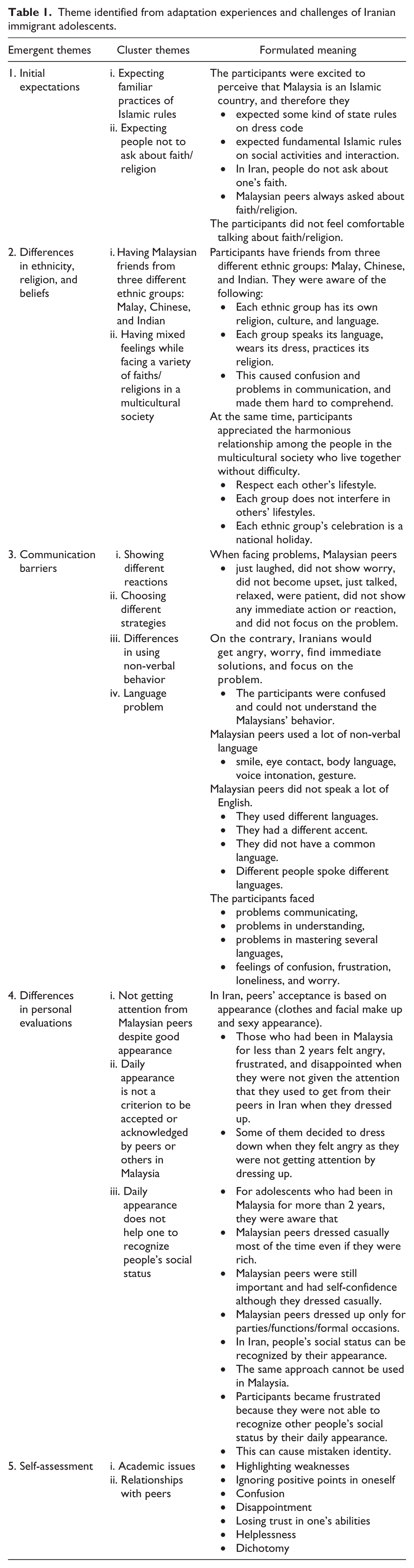
There were five major categories of challenges identified in answer to the research questions in this study: (a) initial expectations; (b) differences in ethnicity, religion, and beliefs; (c) communication barriers; (d) differences in personal evaluations; and (e) self-assessment. Under each category, a total of 15 sub-themes were built to further explain the complexity of the construct. The interactions among the themes were also presented. The magnitude of challenges faced by Iranian adolescent immigrants in adjusting to the culture of their host country was affected by multiple factors. These factors, which also interacted with each other, make the challenges that the participants perceived a more complex phenomenon.
Theme 1: Initial Expectations
In the first category, participants across age, gender, and duration of stay expressed their expectations about Malaysia when they first arrived. This category includes expecting a familiar practice of Islamic rules as carried out in Iran and expecting people not to ask about faith or religion (Table 1). They stated that they were excited when they first came to Malaysia because they had heard that Malaysia is an Islamic country. Therefore, they expected to see some kind of state rules on dress code and fundamental Islamic rules governing social activities and relationships between males and females, as practiced in Iran. This theme was especially relevant for male participants between the ages of 17 and 18 years. The themes were discussed as important but it did not depend on how long they had been in Malaysia. The following statements from two respondents represent most of the participants’ expectations concerning rules about social conduct in terms of dress and appearance, as one of them said, “It is terrific, Malaysian people are Muslims, the same as Iranian people but there is not any rule here for wearing clothes, make up, and the appearance” (an 18-year-old boy, who has lived in Malaysia for 2 years alone). In terms of personal entertainment and recreation, another respondent stated, “Malaysia is an Islamic country but everything is free such as going to clubs, drinking, dancing in the street, going out with friends of the opposite sex . . . ” (an 18-year-old girl, who has lived in Malaysia for 1 year with her sister).
Theme identified from adaptation experiences and challenges of Iranian immigrant adolescents.
The participants also expected people not to ask them about their faith or religion because they were not used to discussing such topics with friends back in Iran. However, in Malaysia, they were confronted by their Malaysian peers with such questions regarding their faith. They felt uncomfortable about this “curious” attitude.
Really I don’t know about the religious beliefs of my old friends in Iran but here, I have to talk about my belief with my Malaysian friends. I cannot understand these differences. I prefer to be alone most of the time. (An 18-year-old boy, who has lived in Malaysia for 2 months alone)
To the participants, it was an awkward question, as an 18-year-old male who has lived in Malaysia for 1 year admitted, “I don’t like to talk about my faith.” To avoid such a situation, they preferred to be left alone, especially when they first arrived in the country.
Theme 2: Differences in Ethnicity, Religion, and Beliefs
Participants across gender, age, and duration of stay highlighted two main issues related to differences in ethnicity, religion, and beliefs (Table 1). This theme was mentioned by participants of all ages and seemed equally important for girls and boys but was significantly discussed among adolescents who have been in Malaysia for more than 1 year. They mentioned the differences in ethnicities, religion, and beliefs with Malaysians as a whole, as well as among specific Malaysian ethnic groups. One of the respondents described spending time with friends of different ethnic groups and religious backgrounds and how they are able to live together and deal with any problem:
My friends here are different than my friends in Iran, most of them aren’t Iranian, and they are Malay, Chinese, and Indian. We have differences in ideologies and ethnicities. Here, Malay people with Chinese and Indians live together without any difficulties; it is wonderful in spite of their different religions. (A 17-year-old boy, who has lived in Malaysia for 2 years with his parents)
Another participant noted their good communication regardless of differences:
Here, I have some friends here, but I couldn’t recognize their differences in beliefs and ethnics at the beginning of my arrival. I am really surprised; Malaysians have a good relationship with each other regardless of the differences in ethnics. (An 18-year-old girl, who has lived in Malaysia for 5 years with her parents)
Although the participants knew that there were different ethnic minority groups in Iran, the number was small and not visible as everybody has to follow the same law and rules in their country. One respondent said,
In Iran, everybody from different ethnic backgrounds and religions follows the rule of the country (e.g., wearing Islamic clothes) and practices some essence instructions as Iranian culture generally. (A 17-year-old boy, who has lived in Malaysia with his parents for 3 years)
They were also delighted and amazed to find that Malaysian people from different ethnic groups live together without difficulty. As one respondent said,
They never interfere in other groups’ lifestyles, respectful of each other; free to practice one’s religion and culture, and each group’s celebration is a national holiday. (A 16-year-old boy, who has lived alone in Malaysia for 6 months)
The participants also expressed that these multicultural features “confused” them, affected their communication with their Malaysian peers, and made them feel awkward and lonely especially when they first arrived. As one respondent stated,
Diversity in cultural issues really was one of the most important reasons for my confusion in my arrival days, it caused, that I didn’t know how to behave with the others, or how can I prove myself to them, so rarely I could come out of my home alone. (A 15-year-old girl, who has lived in Malaysia for 1 year with her parents)
The participants’ challenges are due to not only the differences between Iranian culture and Malaysian culture in general but also the multicultural aspect of Malaysian society. As one respondent said,
First, one of the reasons for my confusion was multiculturalism, it caused, that I didn’t know how to behave with others, or how can I prove myself to them, so rarely I could come out of my home alone. (A 16-year-old boy, who has lived in Malaysia for 2 years with his parents)
They also noted that they could not have good communication with Malaysians, because of differences in beliefs and backgrounds.
Since I came to Malaysia, My communication with others was in trouble, and I felt so lonely afterwards. I had some friends but I couldn’t understand them in matters, such as differences in beliefs and ethnic background. (An 18-year-old girl, who has lived in Malaysia for 2 years with her parents)
Theme 3: Communication Barriers
The third emergent theme, communication barriers (Table 1), comprised four major issues in communications: language problems, non-verbal behaviors, showing different reactions, and choosing different strategies. Participants across gender, age, living arrangement, and duration of stay equally expressed concern that they had problems communicating with their Malaysian peers due to language barriers. As one respondent shared,
I cannot have good communication with them because they talk in a local language not English that is a different language from your mother tongue. (An 18-year-old boy, who has lived alone in Malaysia for 1 year)
The participants’ concerns about language were multiple. They were concerned about the absence of a common language as different ethnic groups speak in different languages. According to a 14-year-old female participant who has lived in Malaysia for 1 year,
I really . . . get confused with multi languages here . . . e.g., one of my Malaysian friends tried to teach me Bahasa Language, but yesterday he talked with one of his friends in another language with a different accent.
The different languages used by their different sets of Malaysian peers not only caused confusion but also posed the serious problem of mastering several languages if they want to communicate effectively with their Malaysian peers. At the time the interview was conducted, most participants stated that this issue affects their “power of communication” as described by one of the participants and also causes loneliness and frustration.
Another issue participants expressed was that they were surprised to find that their Malaysian peers used a lot of non-verbal behaviors such as smiling, eye contact, body language, and sound gestures. Among participants, this issue was seen as important for boys more than girls, especially the 16- and 17-year-olds, but it did not seem affected by duration of stay or living arrangement. As one respondent said,
They use gestures and smiles instead of talking in most situations. (A 17-year-old boy, who has lived in Malaysia for 3 years with his parents)
All the participants observed that non-verbal behaviors are a very important communication strategy for Malaysians. A 17-year-old male participant noticed,
The Malaysian peers talk among themselves using gestures and calling each other by sounds like kissing.
Non-verbal language, including smiling and eye contact, was highlighted in the interviews because it was a concern for the participants. They could not understand why Malaysians smile and make eye contact in communication. A 17-year-old female who has been in Malaysia for 5 years was still questioning why peers to whom she said “hello” would only look at her and smile without any verbal response,
. . . when I say to them “Hi,” they just look at me with a smile! Or when I phone them and I ask them “How are they,” they are silent, I think probably they are smiling again, I don’t know, but really they use non-verbal behaviors very much.
The participants were surprised about the stark differences in non-verbal behaviors between themselves and Malaysians. As one of the respondents stated, informal communication was different among Malaysian peers in comparison with his homeland, “Smiling to others is not always a good sign in Iran, but it is a good sign here, or eye contact means empathy or sympathy among Malaysian people but this meaning can be different among Iranians” (a 16-year-old boy, who has lived in Malaysia for 5 months with his brother), or a different respondent mentioned differences in showing respect to adults in Iran versus Malaysia, “Standing up in front of adults (parents, teachers) when they enter a room is a sign of respect among Iranians, while Malaysian people don’t practice this culture” (a 17-year-old boy, who has lived in Malaysia for 1 year with his sister).
The third issue related to communication barriers was that when participants came to Malaysia, they began to see the differences in the ways their Malaysian peers reacted to problems: their Malaysian peers would just relax, not get upset or take immediate action, and did not focus on the problem. Both male and female participants described these issues, especially older adolescents who were 17 to 18 years old and who lived with someone in Malaysia.
When they have a problem, they just laugh, I wonder and can’t understand them. (A 17-year-old girl, who has lived in Malaysia for 2 months with her brother)
They compared this attitude with Iranians in a similar situation: Iranians would get angry, upset, and look for solutions because to the Iranians, not reacting is a waste of time and is a big concern. They do not understand why wasting time is not an issue for their Malaysian peers. As one of the respondents stated, “They are relaxed; they just talk with their friends, laugh and don’t pay attention to wasting their time. While Iranians get angry and worry about wasting their time” (a 17-year-old boy, who has lived in Malaysia for 3 years with his parents). Participants also described reactions that Malaysian peers had in the face of difficulties, as one of them said, “. . . When they are faced with a difficult situation they wait only and do nothing for a long time, while Iranians look for several solutions . . . ” (a 17-year-old girl, who has lived in Malaysia for 5 years with her parents).
The fourth issue associated with the theme of communication barriers is that Malaysian peers use different strategies to deal with challenges in comparison with Iranian adolescents. These issues were mentioned more frequently by older versus younger adolescents, and especially by participants who have been in Malaysia more than 1 year. One of the respondents described his strategy for solving educational problems:
. . . yesterday one of my Malay friends got a bad score in English the same as me, I became upset and started to study hard, because we had an exam 2 days later, but he was neither upset nor worried, and he went to travel till the following day . . . (A 17-year-old boy, who has lived in Malaysia for 1 year with his sister)
A female participant further describes Malaysian reactions to difficulties:
When they have problem together they don’t fight with each other, but if they fight together seriously, it will be a bad and irrecoverable event. Actually I can’t understand them. (An 18-year-old girl, who has lived alone in Malaysia for 3 years)
Theme 4: Differences in Personal Evaluations
The fourth emergent theme (Table 1) was differences in personal evaluations. Three major issues pertaining to personal evaluations were raised in the interviews: not getting attention from the public despite being well dressed according to Iranian standards, different perceptions of one’s appearance, and failing to recognize people by their clothes. For Iranians, physical appearance (kind of clothes, facial make up, and “sexy” appearance) is an indicator of one’s social status, but the participants found that this was not the case in Malaysia. Most of the participants (girls and boys ages 16-18 years old, who lived with someone in Malaysia) expressed a concern about not getting attention in public places although being well dressed. For instance, one 18-year-old male respondent who has lived in Malaysia for 1 year with his sister wore clothes, in Iran, that caused other peers (especially girls) to give him a lot of attention when he went to public place or parties. However, here, he did not get nearly as much attention from peers as he had before. As he said, “. . . my appearance shines as a star in front of my friends in Iran, but here nobody pays attention to it.”
To some, this attitude in personal evaluations was annoying, especially for those who had been in Malaysia for less than 2 years. They could not understand the attitude shown by their Malaysian peers because they had previously received attention from peers when they wore nice clothes or make up. As one respondent said,
Today I would like to look sloppy and disorganized; I’m sure that nobody would pay any attention to me, because last night my appearance was charming, but no one cared about me. (A 16-year-old girl, who has lived in Malaysia for 3 months with her sister)
However, the participants who had been in Malaysia for 3 to 5 years observed that their peers in Malaysia, including the rich ones, would only dress up when they were attending parties. As one respondent shared,
My Malaysian friends usually care about their appearance only when they want to go party but my Iranian friends are regular (concerned about their appearance) always. (A 17-year-old boy, who has lived in Malaysia for 3 years with his parents)
In addition, these participants also raised another issue regarding appearance. In Iran, appearance is an indicator of one’s social status such as financial or educational status (e.g., when a person wears expensive or high class clothes, he or she is viewed as a rich person, or as highly educated), as well as the areas they come from (such as a city or a rural area). This has also become a challenge for them. A 17-year-old girl, who has lived in Malaysia for 5 years with her parents, said the following, which also represents the concern of the whole group:
I am confused because I can’t identify who has a high educational level; who is from an urban or rural area; who is rich or poor here, while it is easy to recognize [them] in Iran by looking at their appearance.
In this category, those who have just arrived and those who have been in Malaysia longer face different challenges. The first group is concerned that good appearance is not a criterion to be accepted or acknowledged by peers in Malaysia, and they do not get peer attention by having a good appearance. The problem faced by the second group is the unfeasibility of identifying people’s social status by the way they dress.
Theme 5: Self-Assessment
There are two major issues in the fifth category: academic issues and relationships with peers. Participants—across gender, age, and duration of stay—acknowledged some problems that caused them to fail to adjust to a new situation. Thus, they highlighted their weaknesses, ignored their positive points, and lost trust in their abilities.
The participants, girls and boys (typically around 14-16 years old) who lived in Malaysia for a short time, expressed their weaknesses associated with academic issues. As one of the respondents noted the importance of grade point average (GPA) said,
I feel a low sense of value, I cannot focus on my study . . . My friends are cleverer than me . . . I was among the best students with high GPA in Iran but here I don’t know why but I cannot study well . . . (A 14-year-old boy, who has lived in Malaysia for 2 months with his parents)
One of the participants mentioned the importance of the school environment:
Regarding the same environment of my school here compared to Iran (Iranian teachers, and Iranian students) but I don’t know why I cannot manage myself, I lost trust to my abilities, for example, for dissolving the mathematical problems, I have to spend more time on it, and most of the time I couldn’t drawing conclusion while this matter didn’t happen for me before coming to Malaysia. (A 16-year-old girl, who has lived in Malaysia for 3 months with her parents)
Another respondent discussed international competitions:
My GPA is 4 . . . I do not have many friends . . . I feel a sense of low confidence . . . I am afraid of failure in the Olympiad competitions . . . I am not satisfied with myself . . . I cannot manage myself when I confront unexpected events . . . I feel I am a weak person. (A 15-year-old girl, who has lived in Malaysia for 2 years with her parents)
They also stated that they were confused and felt disappointed after coming to Malaysia because of the differences between them and their Malaysian peers. This issue was mentioned by all age adolescents and seemed to equally affect both genders regardless of the duration in the country and living arrangement. As a participant mentioned the effectiveness of better communication,
. . . Differences in cultures and languages between us and Malaysians caused me not to guess others’ feedback in my communications, so I could not do my best in relation to my goals. Really I felt weak and a sense of low self-value here. (An 18-year-old boy, who has lived alone in Malaysia for 3 years)
Another participant stated the impact of those differences on their educational future:
. . . The university entrance examination in Iran was very hard, and caused me to come to Malaysia to studying in the medicine field. However, courses in the medicine field in the governmental university were in Malay language and are for Malaysians only. Really I felt disappointment and I didn’t know how I could deal with this matter. (An 18-year-old girl, who has lived in Malaysia for 2 years with her brother)
Some of the participants noted the dichotomy in their feelings when they compared their experiences in Iran and their new experiences in Malaysia. This issue was seen more among older adolescents who have been in Malaysia for a short time. As one respondent stated,
My friends were completely different in all fields such as intellectual, behavioral, and religious even in kinds of entertainments with my old friends. Therefore, I had a sense of duality and conflicts about the past and my new lifestyle. (An 18-year-old boy, who has lived in Malaysia for 3 months with his sister)
Discussion
Our findings suggest that Iranian adolescents in Malaysia experience unique challenges during immigration as a result of transitioning from a monocultural (Iran) to a multicultural (Malaysia) context. According to the theoretical framework of the current study, cultural adjustment conceptualized in two categories: sociocultural and psychological adjustment. In the present study, sociocultural adjustment examined through what that participants described struggling with differences in communication styles, dress, norms, behaviors, cognitions, feelings, and manners among Malaysian adolescents. This finding underscores previous studies that emphasize adolescents’ challenges during migration based on exposure to different ethnicities, values, and beliefs (Ayers et al., 2009; Fischer, 2010; Kim et al., 2012; Pearson et al., 2008).
Specifically, the cultural adaptation of our sample was challenged as they navigated moving from the dominant focus on Islamic religion in Iran to learning how to live in a society with cultural pluralism and respect for multiple faiths as is the case in Malaysia. The participants shared how Malaysia is comprised of three dominant groups: Malaysians, Chinese, and Indians. These ethnic groups each bring different religions, languages, and cultures that Iranian youth must learn to negotiate, as they immigrated from a culture where everybody shares the same religion, language, and cultural practices.
Previous and current research on cultural adaptation processes have not centered on the role of differences in religious background, personal appearance, personal evaluation, and other cultural interactions in immigrant adolescent adaptation in a new country. Whereas, our study provides an in-depth illustration and insight into the myriad of nuanced, specific differences beyond language or general cultural differences that influence how immigrant adolescents adapt to new cultural contexts. For example, our findings describe that differences in personal evaluations based on appearance may be a factor that causes confusion and creates conflicts among immigrant adolescents during their cultural adjustment process. This study also revealed that the stress of adapting to a multicultural society resulted in strict dichotomies in cultural decision making among Iranian adolescents. Hermans (2001) asserted that differences between the immigrant and host culture causes cultural contradictions, which are indicators of culture shock. We found that this challenge is further exacerbated when there is cultural pluralism and, hence, a great increase in cultural contradictions.
Participants also expressed concern with communication barriers, and these barriers made it difficult for them to build close friendships with their Malaysian peers. Iranian adolescents felt they needed more social connections with peers from the host country to help support their adaptation. However, language barriers and differences in communication styles across the different ethnic groups’ languages caused great confusion and anxiety. Specifically, most Malaysian adolescents can speak the different languages of the other dominant ethnic groups in Malaysia, and above all, they can all speak in “Bahasa Melayu” the official language of the country, whereas Iranian teenagers can only communicate with Malaysians using English.
The complex challenges of communicating with peers in a new country has been documented in previous research on the adjustment issues of adolescents after migration in various countries, such as Chinese, Japanese, Mexican, and Polish adolescents in the United States (Stodolska, 2008; Yeh, 2003; Yeh et al., 2008); Russian, Turkish, Somalian, and Vietnamese adolescents in Finland (Liebkind & Jasinskaja-Lahti, 2000); Turkish and Surinamese adolescents in the Netherlands (Vedder, 2005); immigrant children in the United States (Suárez-Orozco & Suárez-Orozco, 2001); Korean adolescents in the United States (Kim et al., 2012; Yeh et al., 2005); and Chinese and European immigrant adolescents in the United States (Telzer & Fuligni, 2009). However, our research extends the current literature with a specific focus on four aspects of communication barriers that emerge from living specifically in a pluralistic society: navigating multiple new languages, incongruent non-verbal behaviors, showing reactions that are difficult to discern, and choosing different strategies for communicating across the multiple ethnic groups living in Malaysia.
Moreover, our findings also underscore the degree of importance in the use of non-verbal behaviors in Iran in comparison with Malaysia. The non-verbal behaviors they are supposed to use with their new Malaysian peers are different (and differ across ethnic groups), which further exacerbates communication barriers and adjustment challenges. In some cases, these differences have prevented our participants from having stronger and more intimate relationships with peers in the host country. As found in previous research (Castillo & Mallard, 2012; Matsumoto, 2006), using different non-verbal behaviors can affect the quality of communication among individuals from different cultures.
The Iranian adolescents also acknowledged that navigating multiple cultures in Malaysia was so complex and difficult that many of them preferred to keep to themselves most of the time. This cultural alienation prevented participants from having good communication or meaningful relationships with their Malaysian peers. Consequently, Iranian immigrant adolescents tend to face two problems: They are not able to learn and adapt to new situations and cultures, and their interactions and relationships are limited to family members and Iranian friends (see Berry, 2001). Suárez-Orozco et al. (2009) stated that successful adaptation among immigrant adolescents may happen if they receive emotional support, positive feedback, and protective functions from peers. However, in the current study, Iranian adolescents faced confusing feedback and reactions from their Malaysian peers when they attempted to overcome their difficulties, making the adaptation process very challenging.
The Iranian participants stated that before they migrated, they had different expectations about Malaysia and its people. However, after migrating, they were confronted with some unexpected factors that they had not previously considered, which made them confused and surprised. This finding supports Noguchi’s (2005) and Tartakovsky’s (2008, 2009) statement about differences between pre-migration expectations and post-migration experiences creating barriers to the psychological well-being of immigrant adolescents. Our study contributes to the literature on the experiences of Iranian adolescents, an understudied group. Moreover, it also builds upon the body of literature that examines the ways that religion and faith may affect the cultural adaptation process.
The psychological adjustment in this study explored through issues that participants felt and perceived in Malaysia because of cultural challenges are issues related to the degree of their success in academics and in peer relations that categorized as self-assessment. They expressed that after migration, their positive sense of self decreased and they lost trust in their own abilities and felt disappointed, confused, helpless, and pulled in different directions. Overall, given the significant cultural distance between monocultural Iran and multicultural Malaysia, Iranian immigrant adolescents are confronted with ever-present cultural disparities and pluralism on a daily basis. These incongruencies are reenacted on a daily basis as they interact at home, where they are expected to respect and practice their own original tradition, and then in Malaysian society, they must learn to manage social issues with different and unfamiliar language, which is so distant from their values and language. All these reasons have caused immigrant adolescents to highlight their own weaknesses and ignore their positive cultural assets. As previous research has shown, when migrant adolescents face challenges in their effort to adapt to new situations, they often experience low self-efficacy and low self-esteem (Bhugra & Becker, 2005; Milstein, 2005; Phinney et al., 2001).
Limitations
There are a few key limitations in this study that should be noted. Specifically, the sample is limited in terms of geographic location, age range, and social class. Hence, generalizability to all Iranian immigrants is not possible. In addition, our primary method of data collection was individual interviews, which is subject to bias and individual interpretation. In addition, participants were students at two schools specifically for Iranians in Malaysia. As all students and most of the teachers at these schools are Iranians, students do not interact with Malaysian students at school. This setting poses interesting issues as they may not only have some protection from culture shock in the school setting but are also isolated from Malaysian peers and culture.
Implications
The current study was conducted in Malaysia, which is a unique setting for exploring cultural adaptation processes in a multicultural society. The data offer insights into the acculturation processes in a context where the migrating and native individuals are separated by significant cultural distance. The findings also enhance the current knowledge on how immigrant adolescents adapt themselves to the developmental and acculturative tasks that proceed in this pluralistic cultural setting. Our results provide insight for counselors, educators, and researchers to address the needs of Iranian immigrant adolescents or to immigrant adolescents who are adapting to a multicultural setting.
Future research efforts should consider multiple methods for understanding the adjustment process in culturally pluralistic communities. New investigative approaches could use longitudinal methods to understand the adjustment process over time which would provide insight into the duration and intensity of the culture shock period. In addition, future scrutiny could use mixed methods sequential design to allow for multiple data sources to triangulate the data. For example, previous research has used data from immigrant youth, their teachers, their parents, and their counselors to allow for a more in depth and complex holistic understanding of adolescent immigration (Yeh et al., 2008).
Footnotes
Appendix
Declaration of Conflicting Interests
The author(s) declared no potential conflicts of interest with respect to the research, authorship, and/or publication of this article.
Funding
The author(s) received no financial support for the research, authorship, and/or publication of this article.