




Abstract
Research shows that neighborhood safety is strongly associated with the health and well-being of adolescents. However, few studies examine what shapes these perceptions of safety, especially for adolescents who grow up in more dangerous neighborhoods. The present study explores what factors shape the neighborhood safety perceptions of a sample of low-income, African American adolescents aged 15 to 19 years (n = 46) from Baltimore who lived in public housing as children. The study reveals the complexity in how adolescents perceive safety, especially among those living in dangerous neighborhoods. The results highlight the importance of the type of danger (e.g., drug activity vs. gun-related violence) and social connections in shaping neighborhood safety perceptions. Sample youth are more likely to report feeling safe when there is little perceived danger. In more dangerous neighborhoods, youth feel safe where there is low violence, they have protective social ties, and they can avoid perceived danger. However, social connections can also tie youth to violence and victimization, which threatens their perception of safety. This more nuanced understanding of youth perceptions of safety has implications for the ways in which neighborhoods affect adolescents and the role of housing policy in improving the well-being of low-income youth.
Introduction
Neighborhood safety is strongly associated with the health and well-being of adolescents. In particular, living in a neighborhood perceived as unsafe is related to adverse mental and physical health outcomes among youth (e.g., Aneshensel & Sucoff, 1996; Campbell & Schwartz, 1996; Carver, Timperio, & Crawford, 2008; Datar, Nicosia, & Shier, 2013; Dias & Whitaker, 2013; Molnar, Gortmaker, Bull, & Buka, 2004; Nichol, Janssen, & Pickett, 2010; Weir, Etelson, & Brand, 2006). Feeling unsafe can lead to limited personal freedom, social isolation, and a lack of trust (Keane, 1998; Ross, 1993; Ross & Jang, 2000; Shuval et al., 2012), while feeling safe is linked with positive well-being (Farver, Ghosh, & Garcia, 2000).
Despite the importance of neighborhood safety, few studies have examined safety perceptions from the adolescent perspective, especially in more dangerous neighborhoods. Some research suggests that social ties may buffer the negative effects of violence for residents in these types of neighborhoods (Clampet-Lundquist, 2010; Pettit, 2004; Ross & Jang, 2000; Rountree & Land, 1996); however, this research is based largely on adults. Such ties may be especially important for adolescents, who are more likely than adults to have their social lives centered in the neighborhood (Aber, Gephart, Brooks-Gunn, & Connell, 1997; Duncan & Raudenbush, 2001; Roosa, Jones, Tein, & Cree, 2003; Sampson, Morenoff, & Gannon-Rowley, 2002; Spilsbury, 2005).
The present study explores the neighborhood safety perceptions of adolescents using qualitative in-depth interviews conducted with a sample of 46 low-income, African Americans, aged 14 to 19 years, from Baltimore who lived in public housing as children. This sample is well suited to this study as low-income, African American youth are more likely than most other low-income groups to grow up in poor urban neighborhoods with high levels of crime and violence (Ellen & Turner, 1997; Massey & Denton, 1993; Sharkey, 2013). The findings from this study allow us to explore what shapes adolescent perceptions of neighborhood safety, especially in neighborhoods perceived as having danger, and has implications for the future direction of housing policy.
Background
Neighborhood safety is often equated with exposure to danger. Neighborhoods with a low level of danger are usually perceived as safe. Dangerous neighborhoods, characterized by high levels of crime and violence, are often perceived as unsafe. Measures commonly used in research to capture neighborhood safety often rely on different aspects of danger, including exposure to violence, experience with victimization, and the presence of disorder. Disorder is theorized to make neighborhoods vulnerable to crime and instill fear in residents, and is often measured through the presence of incivilities—things such as broken windows that remain unfixed, or graffiti that is not painted over (Wilson & Kelling, 1982).
Few studies, however, examine what factors shape neighborhood safety perceptions. In particular, it is not clear what types of danger make an individual feel unsafe, or what contextual factors might make someone feel safe despite exposure to danger. One exception is a study by Austin, Furr, and Spine (2002), which examined the safety perceptions of about 300 mostly White adults from Louisville, Kentucky. The authors found that being victimized (or knowing someone who has been a victim) had a direct negative impact on feeling safe. In addition, the study suggested that housing conditions influence residents’ perceptions of safety by shaping their overall satisfaction with the neighborhood. Additional research shows that victimization and neighborhood disorder are associated with higher levels of fear (Ross & Jang, 2000; Rountree & Land, 1996; Skogan, 1987). The studies suggest that factors such as neighborhood disorder (e.g., poor housing conditions) as well as experiencing victimization may drive safety perceptions.
Additional research suggests that neighborhood socioeconomic status (e.g., Lee, 1981; Orr et al., 2003; Skogan & Maxfield, 1981; Toseland, 1982) and violence (Farver et al., 2000) may also be important factors shaping perceptions of neighborhood safety. For example, results from the Moving to Opportunity (MTO) experiment showed that moving from highly distressed neighborhoods to those with less than 10% poverty led to improvements in mothers’ perceptions of neighborhood safety (Orr et al., 2003). The design of MTO did not allow for an experimental examination of what aspects of the low-poverty neighborhoods led to improved safety perceptions, but additional research suggests that potential mechanisms are a significant reduction in danger and an increase in neighborhood satisfaction (Orr et al., 2003; Zuberi, 2012). Another study by Farver and colleagues (2000) found that children (aged 7-11) living in more violent neighborhoods felt less safe playing outdoors, highlighting the influence of violence on safety.
Taken together, the results of previous research suggest that several factors may influence perceptions of neighborhood safety. Living in neighborhoods with high levels of violence, victimization, and disorder is associated with perceiving a neighborhood as unsafe. Conversely, living in neighborhoods with little violence, few incivilities, and low poverty is linked with feeling safe. What is missing from this literature, however, is whether some residents feel safe while living in neighborhoods with perceived danger and, if so, what makes them feel safe.
Perceived Safety in Dangerous Neighborhoods
Perceptions of safety in a dangerous neighborhood may be more complicated. For instance, some aspects of danger may be more important than others in driving safety perceptions. Also, social connections may take on a greater importance such that people rely on others to provide important information about the dangers present in the neighborhood so that they may steer clear of them. However, few studies try and uncover what shapes perceptions of neighborhood safety despite being exposed to danger. The following elaborates on two ways that social connections may influence perceptions of neighborhood safety, especially in more dangerous neighborhoods.
Protective social ties
Being socially connected to others in the neighborhood may help individuals feel safe despite exposure to danger. In a qualitative study of public housing families from Boston, Merry (1981) described the concept of “stranger danger,” where residents felt more threatened by crime when it was conducted by people whom they did not know. In contrast, when they knew who was conducting the illegal activities, or were connected to someone who did, they felt less threatened. This buffering effect of social ties was also found in studies examining the relationship between neighborhood disorder and fear (Ross & Jang, 2000) as well as neighborhood social organization and perceived risk (Rountree & Land, 1996).
Social connections might be especially important for individuals who had previously been exposed to high levels of neighborhood danger. A study of public housing residents relocating from a notoriously dangerous development in Philadelphia found that residents often described feeling less safe after relocating—despite moving to a less dangerous area—because they lacked the social ties they previously used to help them feel safe (Clampet-Lundquist, 2010). Another study of a subsample of MTO mothers found that parents who had moved from public housing to somewhat less violent (though not low-poverty) neighborhoods had to contend with new dangers—such as a different set of gangs—that left them feeling less safe (Pettit, 2004). That the danger is unknown, even if there is less of it, may lead to feeling unsafe. Although virtually all of these studies examine adults, the findings suggest that social connections may be especially important to adolescents, for whom the neighborhood context is even more central to everyday life.
Social distance to danger
How closely an individual is connected to danger may also influence the degree to which it shapes his or her perception of neighborhood safety. For example, witnessing an incident or having a friend who was victimized may be more likely to threaten an individual’s perception of safety than hearing about it happening to someone else in the neighborhood. A study of middle school students found that being involved in a violent incident was linked with higher levels of posttraumatic stress symptoms as compared with more distant experiences with violence (Campbell & Schwartz, 1996). Furthermore, several studies show that contact with victims (i.e., vicarious victimization) is associated with negative attitudes toward crime and safety among adults (Austin et al., 2002; Skogan & Maxfield, 1981; Toseland, 1982), and one study finds this among a sample of teenage youth (Hartinger-Saunders, Rine, Nochajski, & Wieczorek, 2012). Having social connections with victims in a dangerous neighborhood may therefore make youth more vulnerable to feeling unsafe.
These studies suggest that social connections may be an important factor, in addition to danger, shaping safety perceptions in dangerous neighborhoods. It is unclear, however, whether these connections will be protective or more closely tie individuals to danger. Also, a majority of the prior studies focus on adults or younger children, leaving a gap in the literature for understanding what shapes the safety perceptions of adolescents.
Adolescent Perceptions of Neighborhood Safety
The factors shaping the neighborhood safety perceptions of adolescents may differ from what matters for younger children and adults. Adolescents usually have more autonomy and freedom to navigate the neighborhood than younger children, making the neighborhood context—and its dangers—more relevant to their perceptions of safety (Aber et al., 1997; Duncan & Raudenbush, 2001; Roosa et al., 2003; Sampson et al., 2002; Spilsbury, 2005). Adolescents also have different daily routines than adults, which may lead to differing neighborhood exposures and victimization experiences (Teixeira, 2015). Furthermore, adolescents are growing up in different neighborhood contexts than their parents, creating different reference groups for their perceptions safety.
These differential experiences may lead adolescents and adults to have different perceptions of what constitutes a danger and threatens their perception of safety. A report of the National Crime Victimization Survey showed that youth were more likely than adults to be victims of violence in their neighborhoods (Lauritsen, 2003; cited by Hartinger-Saunders et al., 2012). Furthermore, there is some evidence that parents and children living in neighborhoods have different perceptions of what is dangerous or what threatens their perceptions of safety. A study by Spilsbury, Korbin, and Coulton (2012) compares perceptions of danger among children (aged 7-11) and their parents, and finds that children are more likely than their parents to report danger in low-violence neighborhoods, while parents are more likely to report danger than children in high-violence neighborhoods. Farver and colleagues (2000) also found that parents and children often differed on perceptions of safety, in particular in high-violence neighborhoods. Forty percent of parents and children in high-violence neighborhoods disagreed on safety perceptions, compared with only 8% in low-violence neighborhoods. These findings highlight the importance of exploring the adolescent perspective separate from adults, especially for youth living in more dangerous neighborhoods.
Despite evidence of this difference in perceptions, few studies of safety perceptions focus on adolescents. The lack of an adolescent perspective has been pointed out as a gap in the literature on neighborhood research more generally (see Leventhal & Brooks-Gunn, 2003), even though adolescents are able to clearly convey neighborhood perceptions (Schaefer-McDaniel, 2007; Teixeira, 2015). Specifically, Burton and Jarrett (2000) argued that one of the reasons there is trouble explaining neighborhood effects is that parents are describing how their children perceive the neighborhood, instead of the children themselves. Most studies that examine the influence of age on safety perceptions, however, are focused on younger or older populations (e.g., younger children: aged 7-11; Farver et al., 2000; Spilsbury, et al., 2012; and the elderly: see Baba & Austin, 1989; Rountree & Land, 1996; Skogan & Maxfield, 1981).
Study Contributions
The present study makes two key contributions to the literature on neighborhood safety. First, it includes the adolescent perspective of neighborhood safety, which has previously been understudied. Second, it explores what makes adolescents feel safe even while perceiving danger, allowing for a more nuanced understanding of the role of different types of danger and the role of social connections in shaping perceptions of neighborhood safety. These findings have important implications for housing policies that aim to improve the well-being of youth.
Study Data
The present study analyzed 46 in-depth, semistructured interviews conducted with youth from Baltimore who lived in public housing as children and whose families participated in the MTO program. In the late 1990s, the MTO program offered 4,600 families living in public housing in five cities (Baltimore, Boston, Chicago, Los Angeles, and New York) the chance to use housing vouchers to move to neighborhoods with a poverty rate of less than 10%. Families were randomly assigned to one of three groups: experimental, Section 8, and control. The experimental group received a housing voucher and counseling assistance to support moving into a low-poverty neighborhood; the Section 8 group received a housing voucher to move into a qualifying unit in any neighborhood where they could secure housing; and the control group received no voucher or counseling assistance. All families, however, could take advantage of other relocation programs or opportunities external to the program to move.
Although MTO succeeded in moving families to neighborhoods with significantly lower levels of poverty, the treatment was diluted and inconsistent (Briggs, Popkin, & Goering, 2010; Orr et al., 2003). Fewer than expected families in the experimental and Section 8 groups ended up moving with a voucher through the program. In particular, about half of the experimental group moved to a low-poverty neighborhood, and two thirds of those families made secondary moves within a year (Orr et al., 2003). Many control group families also moved during this time, often to neighborhoods with less poverty than where they started (Orr et al., 2003). As a result of these circumstances, the experimental design is not the central focus of this study.
The study sample is comprised of 50 African American youth, aged 14 to 19 years, who were randomly selected from a set of MTO households in Baltimore with both children and adolescents. Data were collected between 2003 and 2004, approximately 6 to 9 years after families were randomly assigned in the MTO program. Although the sample was comprised of families from all three random assignment groups, by the time the in-depth interviews were conducted, most of the experimental movers had moved to new units and neighborhoods, and many of the control group youth were no longer living in the public housing developments where they started.
This data set provides a unique chance to examine perceptions of safety among a group of youth who lived in public housing as children, and are now living in neighborhoods with varying levels of poverty and danger. Baltimore consistently ranks as a city with one of the highest rates of homicide in the nation, and had the highest level of violent crime of all the MTO sites (Burdick-Will et al., 2011), making the sample particularly well suited to examining perceptions of safety for youth living in neighborhoods with perceived danger. Furthermore, the data provide perceptions from the perspective of youth, allowing us to capture the most accurate measure of each youth’s neighborhood exposure as well as including aspects of danger that may not be captured by crime data, such as fighting or hearing gunshots.
Interviewers conducted in-depth interviews with youth on several topics, asking questions about the youth’s neighborhood, social status, school, daily routine, networks, and health. Using a semistructured guide, the interviews flowed more like an informal conversation, allowing the discussion to diverge away from the guide, but attempting to answer each question before the interview ended. Interviews were taped and later transcribed verbatim. The interviews typically lasted 1½ to 2 hours, and youth were compensated US$35 for participating in the study. In order to preserve confidentiality, each youth was asked to choose a pseudonym in place of his or her name and other identifying information (e.g., street names) were deleted and replaced with pseudonyms.
The present study pays particular attention to the discussion generated by questions on neighborhoods and neighborhood safety. Examples of questions include the following: “Some people think their neighborhood is pretty safe, while others don’t feel safe. How about for you?”; “How do you stay safe?”; and “Has anything happened in the last 6 months that made you feel unsafe?” Interviewers were instructed to probe for safety strategies, differences in safety by day and night, and to specifically ask youth about potential dangers such as drugs, gangs, and violence in the neighborhood as well as other things that made them feel unsafe. In addition, interviewers asked youth to provide the full story of any incidents that made them feel unsafe. This allowed youth to expand on their perceptions of safety, describing not only whether their neighborhood was safe but also why they felt this way. Four youth were excluded from the sample because they were not asked about and/or did not discuss safety in their current neighborhood, resulting in a total of 46 youth in the final sample.
Analysis Methods
I used thematic analysis on the in-depth qualitative interviews to explore what shapes youth perceptions of neighborhood safety, with an emphasis on the role of danger. The process of thematic analysis involved consistently coding data across interviews for themes around neighborhood safety, and comparing across interviews as well as analyzing each narrative in the context of the individual interview (Denzin & Lincoln, 2000; Strauss & Corbin, 1990).
The coding occurred in two steps. The first step involved broad thematic coding of the interview transcripts by a research team of trained graduate students, who met weekly to ensure the reliability of the coding process and then entered the codes into a Microsoft Access database. The initial codes were primarily descriptive and were generated deductively based on the topics covered in the interview guide. For example, a large descriptive field called “HDDESC” included any general discussion about the youth’s own neighborhood. A smaller descriptive field called “HDSAFE” included any discussion about the safety of the neighborhood.
In a second stage of coding, I used Microsoft Excel to organize the data into small conceptual categories and looked for patterns among youth narratives of neighborhood descriptions, safety, and victimization experiences as well as demographic characteristics (e.g., age, gender, and length of time in the unit). Categories included assessments of neighborhood safety, stories of neighborhood violence, information on drugs, safety strategies, and other background information, most of which emerged from the coding process itself rather than from predetermined hypotheses or previously defined conceptual categories. Finally, I analyzed these categories for patterns and themes, as well as differences by gender.
The analysis centered on an exploration of factors that made youth perceive their neighborhood as safe and what threatened their sense of safety. First, I examined how youth perceived safety in their neighborhoods, allowing for complexities to arise in their descriptions. Second, I examined what reasons youth gave for feeling safe and what things threatened their perceptions of safety. Several themes were repeated by youth across the narratives, including the presence of drugs (e.g., drug selling, drug addicts, drug violence), fighting (e.g., among gangs, children), gun-related incidents (e.g., shooting, seeing someone with a gun), sexual harassment, and other crimes (e.g., burglary, mugging, arson, and vandalism). In particular, I focused on the characteristics of danger that accompanied youth perceptions of safety, as well as what made youth feel safe despite being exposed to danger. Sometimes youth described multiple reasons for feeling safe or unsafe in their neighborhood, or referenced a prior neighborhood in describing what made them feel safe. These reasons are all included in the present study, and as a result, the categories are not mutually exclusive.
The results begin with an overview of the sample youth’s perceptions of neighborhood safety to show the complexity present in these descriptions, followed by a description of the reasons youth attributed to feeling safe or unsafe. I use examples from youth to describe what factors shape safety perceptions, including what make youth perceive their neighborhood as safe even when describing higher levels of danger, and what threatens youth’s safety perceptions. Finally, I examine whether there are gender differences in reasons for feeling safe or unsafe.
Results
Complexities in the Safety Perceptions of Youth
Most of the youth in the sample reported that they, at least to some degree, felt safe; however, youth’s perceptions of safety were not always straightforward. More than half of the 46 youth (56.5%) reported that their neighborhood was safe, but only seven youth (15%) perceived their neighborhood as unsafe. Over one quarter of youth had mixed responses when describing their perceptions of safety. In most of these mixed responses, youth reported that while they felt safe during the day, they did not feel safe at night. Other youth said that their neighborhood was “a little bit safe,” “not very safe,” and “not safe, but I feel safe.”
Two additional youth struggled to describe their neighborhood as safe or unsafe. For example, 16-year-old Brook could not decide whether her neighborhood was safe or unsafe. She said, “I ain’t gonna say it’s safe or unsafe, ’cause I don’t know. We got drugs in the neighborhood so that’s not safe, but we don’t have shootin’, so that’s safe, so really I can’t tell.” Her quote suggests a variation in the way that different types and levels of neighborhood danger affect youth perceptions of safety. Another youth, 18-year-old Mary, said that her neighborhood is not safe because of a high volume of drug selling that occurs on the corners around the youth’s home. Despite that, she feels safe because she grew up there. “Yeah, I feel okay, I mean I don’t feel no way because I’ve been around here my whole life, it really don’t bother me, really.” She also noted the lack of violence accompanying the drugs. She said that there is some “arguing” over “drugs or money or whatever, but like other than that, don’t really be no violence that I know of.”
The mixed descriptions of safety, as exemplified by Brook’s and Mary’s responses, highlight the nuanced way in which youth perceive safety in their neighborhoods. It suggests that perceptions of safety are not always straightforward, especially in neighborhoods where youth are exposed to drug activity or violence. The following provides a more detailed exploration of what factors drive youth’s perceptions of neighborhood safety.
Reasons Youth Feel Safe
Youth provide many reasons for what makes them perceive a neighborhood as safe (see Table 1). Many youth in the sample connected a low level of perceived drugs and violence in the neighborhood with feeling safe; several others felt safe despite exposure to some of these potential dangers. Low levels of violence associated with perceived danger, protective social ties, the ability to avoid perceived danger, and effective social control were cited by some youth as reasons for feeling safe.
Neighborhood Safety Perceptions of a Sample of Low-Income Youth From Baltimore.
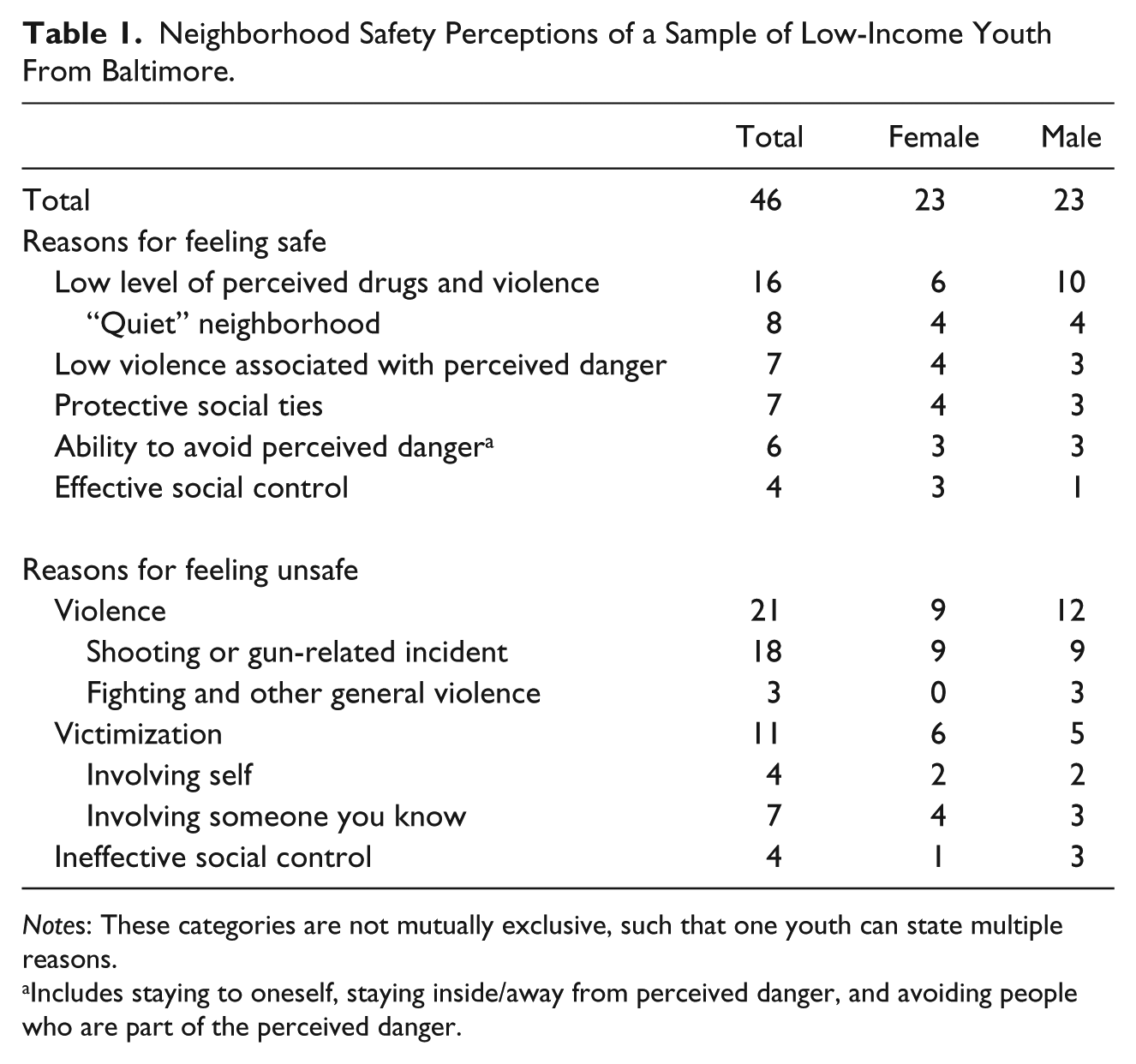
Notes: These categories are not mutually exclusive, such that one youth can state multiple reasons.
Includes staying to oneself, staying inside/away from perceived danger, and avoiding people who are part of the perceived danger.
Low levels of perceived drugs and violence
Sixteen youth link low levels of perceived drugs and violence in the neighborhood with feeling safe (see Table 1). Sixteen-year-old Kiara lives in a mixed-race neighborhood in the city where she describes no danger except for some drug activity nearby. About her neighborhood, Kiara said,
It’s safe. We have a neighborhood leader and he tries to keep the neighborhood clean. We have little neighborhood, community get-togethers and stuff. It’s nice, it’s different from where I used to live at.
She described a block leader who hosts a movie night, which takes place in a nearby parking lot with free popcorn and sodas for families. This is different from her old neighborhood where she lived in public housing, which had “ghetto-type block parties” with “music blasting” and “children dancing.” She also commented on the fact that her current neighborhood is “quiet”; this term was associated with neighborhood safety for a total of eight youth (see Table 1).
Ron also reported very little crime and violence in his neighborhood and perceived his neighborhood as safe. At 18 years, he lives in a middle-class suburb outside of Baltimore. He does mention a small presence of drug activity, but said, “Not really, it’s like a little bit, but that’s everywhere . . . everywhere you go.” He also noted the lack of violence when comparing his current neighborhood with his former public housing neighborhood in the city. Ron said,
It’s safer . . . it’s more guns and drugs out there [in the city] and people is more quicker to shoot you over something out there. And out here people just talk about it but they don’t never do nothin’. [Someone might say,] I’m gonna kill you, dah dah. But nothin’ ever happen. [In the city,] You gotta take it serious.
Similar to Kiara, Ron noted the low volume of drugs in his neighborhood as well as a lack of accompanying violence, as reasons he feels safe.
Feeling safe in a dangerous place
Contrary to expectation, many youth described feeling safe in their neighborhood despite noting the presence of drug activity or other crime and violence (see Table 1). Seven youth reported feeling safe despite some perceived danger as a result of the low level of associated violence or protective social ties. Six youth felt safe because they thought that they could avoid it. Four youth said that they felt safe because they had not yet been a victim of that danger or because they felt that there was an effective level of social control in the neighborhood.
Low levels of violence associated with perceived danger
The safety perceptions of many youth do not appear to be threatened by danger such as drug activity when there is not much violence. Seven youth make this distinction and report feeling safe as a result of a low level of violence associated with the danger. For example, 16-year-old Jay feels safe in his neighborhood despite the presence of drug activity and gangs. He lives near a main thoroughfare for selling drugs that the police are unable to shut down. Although he knows where the dealers stash their drugs, which is near where he plays basketball, he does not feel threatened by this knowledge. He said, “. . . they [dealers] don’t be worried about us ’cause they know we won’t say nothin’.” Despite the drug selling in his neighborhood, he emphasized the lack of violence accompanying the drugs and said, “It’s pretty safe . . . most of the people around here that sell [drugs] are real cool with each other . . . I ain’t never seen them argue around here.” Although there was a shooting that happened in the neighborhood during the last 6 months, Jay said he doesn’t know much about who was involved in the incident. “I just know it was two kids and the man just shot ’em. Like three and six, or something, three and nine. I had no idea why he shot them.” The lack of violence accompanying the drug activity, as well as only an isolated incident of violence in which he did not know the victims, appears to distance him from the danger and does not threaten his sense of safety.
Protective social ties
Other youth highlight the power of social ties for feeling safe in the neighborhood. Seven youth described the importance of knowing others in the neighborhood, or having others know them due to their longevity in the neighborhood, for attenuating the threat of danger and allowing them to feel safe. For example, 15-year-old Crystal lives in a public housing in an area with a high level of drug activity. Crystal explained that the media tries to make it look like there are gangs in the neighborhood, while these individuals are not gang members but had grown up in the area and wear t-shirts and have tattoos with the name of her public housing development on them. She knows this from having lived on this block for the past 13 years. She said,
I feel safe, because you know—we know a lot of people—we know no one’s going to do anything to us! Probably if I go to some other neighborhood—like Northview or something—like where I’m really not knowing the people, they probably try something.
Another youth, 19-year-old Jessica, highlighted the importance of social ties for feeling safe in a dangerous neighborhood. She has lived in her neighborhood for 12 years, and despite the drug activity and fighting, Jessica feels that her neighborhood is safe. She said,
Well, since I know everyone here, I’m pretty safe but if it was just someone outside coming to visit to stay, I mean they will be feeling probably uncomfortable because they don’t know who the people are. I feel pretty safe.
She noted that the fighting only occurs between people who know each other, and she does not fear the drug activity because some of the sellers are kids she grew up with. Thus, similar to Crystal, Jessica attributes her feelings of safety to her social connections and the knowledge that they bring about the potential danger in her neighborhood. Talking about an old neighborhood, 18-year-old Dante said that he felt safer there even though it was “rough” compared with his current neighborhood. He felt safe because he grew up there, had family there, and knew all the people there. In comparison, he does not feel safe at night in his current neighborhood even though the only issue he knows of is drug activity nearby, “up the street some. Like a couple of blocks up, but not down here.” The social ties with others in the neighborhood help these youth feel protected and safe from any crime and violence present within them.
Ability to avoid perceived danger
While some adolescents felt safe because they knew the drug dealers, other adolescents felt safe because they were able to avoid them. In particular, six youth in the sample reported feeling safe in the face of potential danger because they were able to avoid it. Hanna, who is 15 years and has lived in her unit for 5 years, described a high level of drug activity and gang fights, including shootings, in her neighborhood. About the drugs, Hannah said, “I mean I hate to see that. I mean, you know like sometimes when I can’t walk out my front without seeing drug dealers. That is what I like the least.” In addition to selling drugs, she notes that some of the youth in the neighborhood will throw rocks or eggs at cars. There was also a deadly incident of arson that occurred at the other end of her block where a man tried to set his girlfriend on fire, but she set him on fire instead. A family who lived on the top floor of the building jumped out the window to safety, except for the father, who died in the fire. Despite the high level of drug activity and other violence in her neighborhood, Hannah does not feel unsafe because she is able to disconnect from it. She said,
I know this might sound weird, but the neighborhood is not safe but I feel safe . . . the neighborhood is not safe because it’s, I mean, you know there is so much violence going on. And things like of that nature but I feel safe because I don’t feel as though, I have nothing to be scared of because I don’t do anything. Because I stay to myself so why should I be worried about anybody . . . To feel protected what I do is, . . . I stay to myself, then I stay out of trouble . . . Like I see a lot of guys on the corner then I know what’s going on and I know it’s not safe to be there right then. So I stay away from it.
Other youth described avoiding drug dealers and keeping quiet about drugs or other illegal activity that is going on in the neighborhood as strategies that allow them to feel safe. By staying to themselves, which often includes staying inside, and avoiding the people involved in drug activity or violence, these youth were able to feel safe despite the danger in their neighborhoods.
Effective social control
Four youth, the majority of whom were female, reported that the presence of effective social controls in the neighborhood allowed them to feel safe. Most of these youth described police riding through the neighborhood. Fifteen-year-old Tony, the only male in the group, said, “It’s safe ’cause they got the police officer. I think the housing police officers ride around all the time.” He sees them “riding by” when he is out front and sometimes officers ask about their safety. “They say, do you feel safe in all of this?” While Tony in general likes it, and thinks it is good, he noted that “sometimes they can get to be a nuisance. Coming over and coming over an’ all new difference officer and they just keep asking. Ain’t nothing happened.” He described fighting happening in his neighborhood about once per month but does not talk about the presence of drug activity or other violence. Another youth, 17-year-old Rebecca, noted that it was the property managers who kept the violence away. She said,
When I first moved out here it was kind of boring to me, but then I understood like it’s a peaceful neighborhood. Like it ain’t no violence that I see or anything, like but it has its little times when it can get—but like I guess the property manager tries to like prevent that. Like if one like fight or something break out, then it’s like that person is evicted, like ’cause they don’t want it to cause any commotion or anything. They wanna provide it to whereas though they can have people move in, not people wanting to move out because of the stuff that’s going on. So they keep it like low, they don’t have it.
By evicting tenants who bring problems and break the rules, the property managers are able to keep the violence out of their development. Together, the social control demonstrated by the presence of police and actions of the property manager help these youth feel safe.
Finally, although the presence of drug activity did not always threaten a youth’s perception of safety, I think it is notable that it did still bother many youth. A total of 28 youth reported drug dealers and/or users in their neighborhoods. Eleven of those youth mentioned that they do not like the drug activity in their neighborhoods, with most of those youth identifying drugs as the thing they liked the least about their neighborhood. However, six of these youth said this despite noting that they felt safe, or somewhat safe, in their neighborhoods.
Feeling Unsafe: What Threatens Safety Perceptions?
Table 1 also shows what threatened the neighborhood safety perceptions of youth. The most common reasons youth gave for feeling unsafe were violence, especially shooting or gun-related incidents, and victimization involving themselves or someone they know. Ineffective social control was also tied to feeling unsafe for some youth. Each of these major themes is explored in more detail in the following sections.
Violence
Twenty-one youth reported that violence threatened their perception of safety. Almost all of these youth (18 out of 21) described a shooting or gun-related incident that made them feel unsafe. Three other youth described other types of violence such as fighting or arson.
Fifteen-year-old Tyler, who had lived in his neighborhood for 7 years, felt it was safe, but “not very safe.” He described the kids in his neighborhood as “bad” because “they throw rocks . . . start fires . . . and fight people.” The neighborhood kids tried to pick a fight with his younger brother on two separate occasions the week before the interview:
First my little brother was on the porch and I came downstairs and then they was messing with him on the porch. Then my friend went to help him. They was going to beat them both up but then their mother came, then they left. That’s all.
The day before the interview, the youth came back to fight. He said, “We was coming from the library after reading books and they try to hit him with a bike . . . My friend cussed at them . . . and then they left us alone.” Tyler also reported that the presence of gangs and daily fighting that occurred at his high school also made him uncomfortable. There was also a lot of drug activity in the neighborhood, but he did not give this as the reason he felt unsafe.
Another youth, 14-year-old Ashley, attributed the lack of safety in her neighborhood to violence that is connected with drugs. The front door of Ashley’s house is in an alley and people line up outside to buy drugs from a house across the street. She said, “. . . because when you sell drugs, it start shooting.” Ashley described a recent shooting she heard about: “. . . this boy got shot down the street by our school.” Although she was not aware of exactly what happened, just hearing about this as well as other shooting incidents made her feel unsafe.
In general, anything involving a gun or shooting seemed to threaten youth’s perceptions of safety, even if it happened outside of the neighborhood. Sixteen-year-old Benji, who generally felt safe in his neighborhood where he had lived for the past 7 years, described a shooting incident in another neighborhood, where he spent time that made him feel unsafe. When asked if anything had happened in the last 6 months that made him feel unsafe, he replied,
Not in this direct area, but like directly across the street, someone had got shot . . . My cousin lives around there, so I used to go around there a lot, too, so I guess that kind of made me feel unsafe since, like it brought me out of this close-mindedness, that stuff actually happens, so like it brought it to reality, like something can happen around there, it’s not always safe.
Thus, even for a youth who feels safe in his own neighborhood, his safety is threatened when there is an incident of gun-related violence.
Victimization
Eleven youth described incidents of victimization (e.g., sexual harassment, armed robbery, and fighting) as threatening their perception of safety, and more often than not, these incidents involved someone they knew (seven youth) rather than the youth themselves (four youth). For example, 15-year-old Jasmine describes a gun-related incident that happened to her friends and made her avoid going out at night. She said,
’Cause one time the boy I was talking to . . . him and his two friends was walking, it was at nighttime, they was gonna get me and the girl somethin’ to eat, and when they was coming back, the boy had pulled a— got out of the car and pulled out the gun and ever since that night I don’t—I always been like kind of skeptical to walk places at night, but after this I was like I can’t be doing this.
The incident Jasmine describes happened around 11:00 p.m., and although no one was physically hurt in the altercation, just knowing someone who was stuck up with a gun threatened Jasmine’s perception of safety.
Being a victim yourself also is linked with feeling unsafe. Eighteen-year-old Emily was the victim of a hit and run accident while she was coming home from work on her bike late one night. She noted that her neighborhood is not safe for children to ride bikes because there are no speed bumps to slow cars in the road. Another youth described how she got sexually harassed while she was walking around the neighborhood at night. Tasha, a 14-year-old, explained,
I like to be out in the daytime where people can see me, instead of being out in the nighttime when you walking around and stuff and its all dark and people just hollering at you and stuff. I don’t like that.
She reported incidents where men “mess with” her—trying to touch her—when she walks to the store, and that the sexual harassment is particularly bothersome at night as she feels more vulnerable in the dark.
Victimization can also have long-term consequences on youth. Fifteen-year-old Terry had a gun pointed at him after he witnessed a man get shot in an alley in his old neighborhood. Despite moving to a new neighborhood where he reported less violence, when asked about safety, Terry says, “In a way you have to consider that no place is safe.” He said that he did not even feel safe at home because someone could break in. “I don’t feel its safe . . . I just can’t feel comfortable outside because anything can happen . . .” Thus, past victimization experiences may shape how youth perceive current neighborhood safety.
Ineffective social control
Four youth reported feeling unsafe as a result of ineffective social controls in the neighborhood. These youth, only one of whom is female, also describe neighborhoods with a general sense of chaos, where police and other adults are ineffective in controlling crime, as places that are unsafe. Jacob, a 15-year-old, has lived in his neighborhood for 6 years. When asked about safety, he replied,
No, it ain’t safe. If any time you could sit there and sell drugs and a jail sitting right down the street, not even a whole block down, they sitting there selling drugs. Central booking, right there . . . I don’t never be seeing ’em getting arrested.
Jacob reports a high volume of drug activity in his neighborhood, which is accompanied by violence. He describes two shooting incidents in which drug dealers were killed, one of whom he knew of through his father. Jacob has also witnessed drug-related violence firsthand. Recently, a childhood friend of his started selling drugs, and Jacob saw him running from the police. “He got chased by the police with a [night stick] ’cause he had a bag of weed.” He also saw a drug dealer with a gun chasing down an addict who stole from his stash. In addition to the drug activity, he describes an incident of arson in which he suspects that neighborhood children started a fire that burned a house down on his street. There is also fighting sometimes in the neighborhood among boys, and when it happens it involves weapons.
Even though he has friends and social ties in the neighborhood, they do not make him feel safe. Jacob and his friends are not involved in drug selling, but it is hard to avoid. He says that when the drug dealers call out to him, “I just don’t pay no attention to ’em and walk away when they ask me something.” Overall, the inability of the police or others to control the high level of drug activity, violence, and other crime in the neighborhood appears to threaten some youth’s perceptions of safety.
Gender Differences
Overall, there were few gender differences among the neighborhood safety perceptions for this sample of low-income youth (see Table 1). Both female and male youth describe the importance of low levels of violence, protective social ties, and the ability to avoid dangerous activities or people as reasons for feeling safe despite exposure to perceived danger. In addition, females and males alike describe incidents involving shooting or guns and victimization as threatening their perceptions of safety. The data, however, do suggest some gender differences. Although both males and females described “quiet” neighborhoods as places they felt safe, more males than females mentioned a low level of perceived drugs and/or violence as a reason for feeling safe. In addition, females were more likely to point to effective social controls as a reason they felt safe. Among the reasons that youth described as threatening their perceptions of safety, only males mentioned fighting and other violent acts (e.g., arson), and males were more likely to point to ineffective social controls as a reason for feeling unsafe.
Discussion
The present study explored what factors shape the neighborhood safety perceptions of a sample of African American, low-income adolescents from Baltimore. The results reveal the complexity evident in perceptions of safety, especially among youth living in neighborhoods perceived as more dangerous. As expected, exposure to low levels of drug activity and neighborhood violence is a top reason that youth give for feeling safe. However, some youth feel safe despite the presence of neighborhood problems. These include low levels of violence associated with drug activity, having protective social ties in the presence of drugs and violence, and a perception that they can avoid the perceived danger. The main reasons youth give for feeling unsafe include gun-related violence and victimization. Social control is also an issue that affected the safety perceptions of youth, with females more likely to report the positive presence of social control on safety, while males were more likely to note that the lack of effective social control made them feel unsafe.
Many youth, however, feel safe despite the presence of neighborhood crime, fighting or other danger. The results show that a low level of violence associated with the perceived danger, such as drug activity, does not usually threaten adolescent’s perceptions of safety. In addition, the results highlight the importance of social connections for feeling safe in the face of danger. Some youth describe protective social ties that allow them to feel safe, while other youth purposefully avoid dangerous situations or people—often at the cost of isolating themselves—in order to feel safe.
The study findings add to the previous literature by emphasizing that youth perceptions of safety are not always shaped by exposure to crime and violence alone, but that they are more complex especially in neighborhoods where there is some drug activity, gangs, and disorder. While the types of danger that threaten adolescents’ perceptions of safety (e.g., violence, victimization, and disorder) are consistent with past research on adults and children (Austin et al., 2002; Farver et al., 2000; Ross & Jang, 2000; Rountree & Land, 1996; Skogan, 1987), the results go beyond the prior literature by suggesting that adolescents may be particularly sensitive to gun-related violence and victimization. Virtually all incidents involving a gun—even those where no one was physically hurt—appeared to threaten the youth’s perceptions of safety and had the potential for long-term effects. In addition, exposure to drug activity—a crime often tied to the idea of safety—may not threaten perceptions of safety of youth if there is no accompanying violence. This distinction is important as it suggests current measures of violent crime, such as homicide rates, may be better at capturing adolescents’ perceptions of neighborhood safety than overall crime. Measures of violent crime, however, may still miss gun-related incidents that affect adolescent safety perceptions without resulting in violence.
The findings of this study also highlight the importance of social connections for shaping the neighborhood safety perceptions of youth. First, the findings support the idea that the social distance to danger matters. Being more closely connected to danger through witnessing an incident or knowing someone who was victimized made youth more likely to feel unsafe. This is consistent with prior research showing that witnessing violence is more influential than more distant experiences (Campbell & Schwartz, 1996) and that vicarious victimization also influences perceptions of safety (Austin et al., 2002; Hartinger-Saunders et al., 2012; Skogan & Maxfield, 1981; Toseland, 1982).
Second, some youth reported feeling safe by avoiding or maintaining social distance between themselves and the dangerous people or activities in the neighborhood. There is some evidence in the literature that adults shift their daily routines to avoid neighborhood danger (Carvalho & Lewis, 2003; Garofalo, 1979; Skogan, 1987). This is also consistent with literature on the geographies of youth, much of it drawing on small-scale studies in Europe, on how youth negotiate public spaces. Percy-Smith and Matthews (2001) suggested that, similar to the effect of bullying in schools, there are known spaces in the neighborhood that youth will avoid out of fear. More recent studies also find that young people actively navigate space in cities based on perceived fears in order to be safe (Bromley & Stacey, 2012; van der Burgt, 2015). The findings of the present study provide evidence that youth do actively avoid certain people or activities in the neighborhood that they perceive as potentially dangerous (e.g., drug activity or parties), and that the ability to avoid these spaces or people influences how they perceive neighborhood safety. While avoiding certain spaces may allow some youth to feel safe in a dangerous place, however, it is unclear whether this may in turn isolate them and have adverse consequences for their health and well-being.
Third, support for the idea that social ties are protective is mixed. Some youth cited the presence of social ties for helping them feel safe despite exposure to neighborhood danger. This is consistent with prior studies of adults who had lived in public housing (Clampet-Lundquist, 2010; Merry, 1981; Pettit, 2004), and a study of multicultural youth in England that shows when youth know people in a place, it makes that place feel more safe (Watt & Stenson, 1997). These findings suggest that it is important to consider the role of social networks in allowing youth to feel safe, especially in neighborhoods with crime and disorder. However, there were also youth who felt unsafe despite having social ties or longevity in the neighborhood. This finding goes against prior research showing that social ties buffered the relationship between disorder and fear or perceived risk (Ross & Jang, 2000; Rountree & Land, 1996). However, these youth were more likely to live in neighborhoods where they perceived the social controls to be ineffective at keeping crime and violence at bay. Perhaps it is the higher levels of violence in these neighborhoods, or the inability to avoid it, that makes youth feel more unsafe. Taken together, these findings suggest that the protective ability of social ties may depend on the level of disorder in a neighborhood.
Conclusions and Policy Implications
Understanding what shapes the safety perceptions of adolescents has important implications for the health and well-being of youth. The present study explored what shapes the safety perceptions of a sample of low-income, African American youth, contributing to the literature the perspective of adolescents living in dangerous neighborhoods. The results reveal that youth perceptions of safety are not always straightforward. Instead, they often depend on the types of danger youth are exposed to, with gun-related violence and victimization more likely to threaten perceptions of safety than drug activity alone. The results also show that many youth feel safe despite perceiving danger, relying on social ties for protection or through the ability to avoid more dangerous spaces to feel safe.
Future research is needed to more thoroughly examine these findings by incorporating objective measures of crime as well as linking perceptions of safety to the health and well-being of youth. First, how do the perceptions of safety differ for two youth who live in the same neighborhood? This can help us gain a deeper understanding of the individual-level variation in experiencing a neighborhood. Second, even when adolescents perceive themselves as safe, what impact does avoiding neighborhood danger have on their health and well-being? Third, we need to more thoroughly examine the dual role of social connections of being protective on the one hand, while on the other hand connecting youth with victimization.
The present study is not without limitations. This study relied on a small sample of youth in one city at one point in time, and the results are therefore not representative of all low-income, African American youth. Additional research is needed to test whether these findings generalize to low-income, minority youth populations from other cities. Also, although the first round of coding the data was conducted by a team of coders, the more granular level of coding was conducted by one researcher, increasing the chance of bias in the results.
Despite these limitations, the study findings have important implications for research in the areas of neighborhoods and housing. Instead of relying on neighborhood poverty or crime rates, measures of neighborhood disorder and the effectiveness of social control may be more important for capturing adolescent perceptions of neighborhood safety. Studies show that aspects of social organization, such as collective efficacy, can account for varying levels of violence in disadvantaged neighborhoods. A measure of social cohesion in the community and informal social control among neighbors, collective efficacy, is shown to mediate the relationship between neighborhood disadvantage and violence such that areas with higher collective efficacy have lower levels of violence, even among disadvantaged neighborhoods (Sampson, Morenoff, & Earls, 1999; Sampson & Raudenbush, 1999; Sampson, Raudenbush, & Earls, 1997).
In addition, the present study has implications for housing policy. In response to the alarmingly high levels of crime and violence in the 1990s, the federal HOPE VI program demolished public housing developments across the nation and thousands of low-income families were left to relocate into the private market using subsidized housing vouchers (Popkin et al., 2004; U.S. Department of Housing and Urban Development, 2000). Although families generally moved to less poor neighborhoods, many also lost important social ties that adults often relied on for feeling safe (Clampet-Lundquist, 2010; Curley, 2009; Greenbaum, Hathaway, Rodriguez, Spalding, & Ward, 2008). The findings of the present study also suggest that it is important to pay attention to the level of danger, and especially violence, victimization, and disorder, in the neighborhoods where youth relocate. Current relocation programs may therefore only be effective if they place families in neighborhoods with very low levels of danger and violence, and, perhaps more importantly, higher levels of collective efficacy. However, housing programs which attempt to improve neighborhood conditions while families stay in place (e.g., Choice Neighborhoods, Promise Neighborhoods) may not disrupt the social connections of youth. If these programs are successful at reducing social disorder and building social organization within the neighborhood, then youth may be more likely to feel safe, improving their overall health and well-being.
Footnotes
Acknowledgements
The author acknowledges Kathryn Edin, Mary Pattillo, and James Rosenbaum for their expert guidance on the development of this article, as well as Jessica Hardie and Kristin Turney for their helpful comments on later versions of the article. The author also acknowledges the other members of the Moving to Opportunity qualitative field research team for collecting the data, and especially thanks the youth in Baltimore for sharing their stories with us.
Author’s Note
The contents of this article are the views of the author and do not necessarily reflect the views or policies of U.S. Department of Housing and Urban Development (HUD) or the U.S. government.
Declaration of Conflicting Interests
The author(s) declared no potential conflicts of interest with respect to the research, authorship, and/or publication of this article.
Funding
The author(s) disclosed receipt of the following financial support for the research, authorship, and/or publication of this article: Support for this article was provided in part by a postdoctoral fellowship in the School of Social Work at the University of Pittsburgh and a Doctoral Dissertation Research Grant from the U.S. Department of Housing and Urban Development (HUD).