




Abstract
For street children in Mumbai, gambling is mostly a social and recreational activity. This study is based on data gathered from a survey of 70 youths aged 12 to 24, two focus groups, and participant observation. It offers glimpses into various facets of their gambling, including age patterns, games played, venues, and how group and street subculture strongly influence participation. Street children perceive gambling as a “game of chance,” implying it is a form of recreation, not to be taken seriously. Given the pervasiveness of gambling and the absence of other recreational and money-saving opportunities, there is a need to design educational and preventive interventions for street children.
Keywords
Street children represent a serious, urgent, and rapidly growing socioeconomic challenge globally (Le Roux, 1996). When their family and community supports disintegrate, often under the pressures of poverty, they migrate to the streets, landing inevitably in urban areas. With the parallel growth of urban poverty, an increase in competition for scarce jobs and other resources, their integration is fraught with numerous challenges. Even so, they quickly learn to be independent and self-sufficient, discovering creative ways to survive and negotiate the day-to-day risks associated with living on the streets (Webster, 2011).
To survive on the streets and escape victimization, street children cannot live alone. They must make friends and gain entry into a group (Rane, 2004; Webster, 2011), where they often acquire habits such as smoking, drinking, and using drugs (Beazley, 2003; Gaidhane et al., 2008; Willis, 1990). It is in this context that their involvement in gambling represents virtually a “rite of passage” into adulthood (Gambling Commission, 2007; Stinchfield & Winters, 1998) and offers status among their peers. But while studies exist about substance use, rag picking, and other stresses and coping strategies of street children in developing countries such as India (D’Souza, 2012; Gaidhane et al., 2008; Kombarakaran, 2004), to date, there is no study highlighting the gambling behavior of street children. Even a recent national survey of street children in India (Raghavan & Nair, 2013) mentions gambling only in passing, as one among other activities these children spend their money on, offering no further elaborations. We embarked on this study to explore the various facets of gambling, an aspect of addiction largely under-recognized in academic literature on street-involved youths.
Mumbai, formerly known as Bombay, is India’s business capital on the west coast of the State of Maharashtra. It is one of the largest cities with an ever-expanding population, currently about 21 million, about 314,000 of them street children (ChildLine, 2010). This exploratory study gathered general information about the gambling behavior of Mumbai’s street children in terms of age, games played, money spent, beliefs, and group influence. We also took a closer look at the environmental and developmental factors promoting gambling and the services needed for this vulnerable group.
Literature Review
The literature reviewed offered us background information about gambling, a relevant theoretical framework, and the comorbidity of gambling with other addictions, all specific to the adolescent developmental period. Youth involvement in gambling is not new, and in North America, it is a popular pastime for adolescents (Gupta & Derevensky, 1996; Valentine, 2008). Among middle and high school students, gambling has significantly increased over the past two decades with one in seven students reporting serious gambling-related problems (Jacobs, 2000). Research in Canada, the United States, and internationally suggests that approximately 80% of adolescents participate in gambling in some form (National Research Council, 1999; Shaffer & Hall, 1996; Valentine, 2008). Adolescents gamble through formal and informal avenues, including lotteries, casinos, sports betting, raffles, the Internet, cards, bingo, and board games.
The pathway of adolescents into gambling is explained both in terms of a social learning component and individual personal characteristics. An overwhelming majority of young people in North America have been introduced to gambling by their parents and older adults (Jacobs, 2000), but as they grow older they gamble with friends (Derevensky, Gupta, & Émond, 1995; Gupta & Derevensky, 1996; Ide-Smith & Lea, 1988). Griffiths (1990) reports that 44% of adolescents initiated gambling because their friends engaged in similar practices. Although being known as a gambler or risk taker can lead to social recognition and higher status among friends (Salaam, 2014; Smith & Abt, 1984), individual personality factors play a huge role in gambling among adolescents, and empirical research on the development of this relationship is in its beginning stages (Gupta & Derevensky, 1998a; Jacobs, 2000; Valentine, 2008).
General Addictions Theory and the Development of Adolescent Gambling
Although in gambling studies there is no agreement on a conclusive model to understand the development of gambling as an addiction, Jacobs’s (1986) general theory of addictions and Blaszczynski and Nower’s (2002) pathways model are two widely accepted theories. In terms of our adolescent population, we favored Jacobs’s (1986) theory, which supports the position that all addictive behavior, including pathological gambling, is the result of a person’s directly chosen path to escape from highly stressful internal and external reality conditions to an altered, much more pleasant state of consciousness, while indulging in an addictive activity. When highlighting how youths become serious gamblers, Nower’s theory postulates three distinct subgroups of pathological gamblers: behaviorally conditioned, emotionally vulnerable, and antisocial, impulsivist problem gamblers (Blaszczynski & Nower, 2002). Because we were interested in a broad understanding of gambling among street children and not any classification into subgroups, we leaned on the general addictions theory of Jacob, although we did take into consideration the risk factors outlined by Blaszczynski and Nower (2002) in understanding how gambling can progress to becoming a problem.
In general, Jacobs’s theory lends support to addictive behaviors not only enabling an individual to escape painful realities, but additionally fostering a sense of being highly successful, admired, and invincible (Jacobs, 2000, 2004). Jacobs cautions that the adolescent developmental period is a time of heightened vulnerability to developing serious addictions due to numerous psychological stressors and physical changes taking place. Gambling offers adolescents opportunities for risk taking or sensation seeking, which they crave.
Youth Gambling and Its Comorbidity With Other Addictions
Addictions research points out that adolescents with problem and pathological gambling habits have higher rates of participation in other addictive behaviors too (Gupta & Derevensky, 1998a). They are more likely to smoke, drink, and consume illicit drugs (Gaidhane et al., 2008; Gupta & Derevensky, 1998a; Wynne, Smith, & Jacobs, 1996). Adolescent alcohol and drug abuse is associated with low self-esteem, psychological distress, learning difficulties, anxiety, impulsiveness, antisocial behavior, suicide ideation, and a history of abuse (Gupta & Derevensky, 1998a; Volberg, Gupta, Griffiths, Olason, & Delfabbro, 2010); involvement in gambling follows and is similar to other potential addictive activities and patterns of behavior. In the many juvenile studies reviewed in a meta-analysis (Jacobs, 2000; see also Gupta & Derevensky, 1998a), a relationship was found to exist between serious gambling-related problems and the concurrent use of tobacco, alcohol, and illicit drugs.
A much earlier age of onset (well before 12 years of age) consistently distinguishes youths with serious gambling-related problems from those with no gambling problems (Jacobs, 2000, 2004). An early age of onset for gambling can also precede the expected age for using cigarettes, hard liquor, and marijuana (Gupta & Derevensky, 1998a; Jacobs et al., 1989). There is convincing evidence that an earlier onset of gambling is associated with later and greater gambling-related problems (Winters, Stinchfield, Botzet, & Anderson, 2002).
The proclivity for males to gamble is evident throughout the literature. Boys dominate the ranks of juveniles with serious gambling-related problems by ratios ranging from 3 to 1, to extremes as large as 5 to 1 (Gupta & Derevensky, 1998a; Hardoon & Derevensky, 2001; Jacobs, 2000; Salaam, 2014). Male juveniles tend to gamble earlier, participate in more games more often, spend more time and money, and experience serious gambling-related problems (Jacobs, 2000). Adolescent males gamble for reasons of competition, excitement, to escape problems, and to alleviate depression (Ellenbogen, Derevensky, & Gupta, 2007; Grant & Kim, 2002). Regarding the types of gambling, males tend to play games requiring skill and knowledge such as card games and board games, personal skill games, and sports betting. Girls partake in games of pure chance such as bingo, lotteries, and pull tabs (Jacobs, 2000). There is some evidence to suggest that female participation is motivated by a desire to escape personal problems (Ellenbogen et al., 2007; Grant & Kim, 2002). Adolescent males fit Jacobs’s general addictions theory better than females (Gupta & Derevensky, 1998b).
Of significant concern is the changing landscape of gambling that is due to the increased availability of technology and its attractiveness to youths (Griffiths & Parke, 2010; McBride & Derevensky, 2009; Thomas, Lewis, Westberg, & Derevensky, 2013; Valentine, 2008). These new forms of gambling, the Internet, online gambling, electronic gaming machines, and televised and mobile devices, capitalize on youths’ perceived skill and familiarity with technology. But as the landscape continues to change, further gaps in knowledge about the effect of technological advances on gambling emerge (Valentine, 2008). Underage gambling at commercial gambling venues exists in spite of age restrictions. Despite all the findings in this section, there is a paucity of empirical research on adolescent gambling, and problems go relatively undetected.
Although this literature is not based on the region or group we studied, it offered a context for understanding gambling among adolescents—the developmental period we were interested in, albeit for a different group from those who live on the streets. It also offered insights about gambling-related problems, the proclivity for males over females, and other background data for the study.
The Street Subculture and Gambling
The literature on gambling has to be understood in relation to the context of the streets. Streets provide an alternative social reality and a status system, rallying points and symbols of solidarity to street children (Beazley, 2003). For children on the streets, the group represents the most pervasive social influence they have access to (Rane, 2004; Webster, 2011). Although they have previously unsuccessfully encountered family, adults, and education, once on the streets, they gain not just anonymity and the opportunity for a new beginning or a clean break from their past, but affirmation from a new peer group. As street children then begin to construct a new, collective street identity, they are expected to assimilate group attitudes, values, perspectives, and street etiquette (Rane, 2004; Webster, 2011). Living on the streets also offers them freedom and fun, in variance with subordination, conformity, and adult and societal control (Webster, 2011).
A study mapping the socioeconomic realities of street children in Jaipur, India, reveals that the common modes of entertainment and recreation for street children include gambling, watching films/television, smoking, drinking, and drugs (Mathur, 2009). Participation in such behavior not only builds their street persona but offers an escape from anxiety, frustration, trauma, and victimization. Gambling often co-occurs with other risky behaviors and mental health problems, such as drug use and unprotected sex, and if unaddressed, may affect healthy adolescent development (Fong, 2005). A study conducted by Gaidhane et al. (2008) on 132 street youths who were substance users showed that youths living mainly on the streets are at greater risk than their peers who may hang out and live of the streets but are not chronically homeless.
In the general population, the outcomes of adolescent gambling are strained relationships, health problems, predisposition to crime and delinquency, depression, and suicide (Griffiths, 2015; Nower, Eyrich-Garg, Pollio, & North, 2015; Nower, Gupta, Blaszczynski, & Derevensky, 2004). Furthermore, an early introduction to gambling may develop into addictive gambling, paving the way to a difficult road ahead (Jacobs, 2000; Valentine, 2008). Because street children possess many of the characteristics outlined above—they are involved in drug and alcohol consumption, introduced to gambling at an early age, and lack any adult supervision—they constitute a high-risk group for developing gambling-related problems. But although our outreach teams observed that street youths are constantly engaged in gambling, we found little about gambling and street children in the literature and so decided to study it. This study is helpful to those concerned about protecting and improving the lives of street youths, helping them live to their fullest potential. Only a handful of studies are available that highlight substance, sexual, and physical abuse in adolescent street children; all of them indicate a dearth of effective education programs for this population and the need for research efforts focused on intervention (D’Souza, 2012; Gaidhane et al., 2008; Greene, Ennett, & Ringwalt, 1997). Hence, we decided to embark on a baseline study so that we could then move in the direction of designing interventions for street youths involved in gambling.
Method
The study design emerged from our reading of the literature highlighted above and reflecting on our experiences as service providers to street children for more than a decade (Van Maanen, 2011). We concluded that an optimal study design to investigate street children in a city like Mumbai would be a mixed-method research design, including a survey, even though we were aware of the limitations of the very survey tools available when used with investigating gambling among children and adolescents (Valentine, 2008). Based on feedback from a study we piloted to test the survey instrument, we decided to also include focus groups and ethnographic observations in the main study. Street youths are highly transient and hard to reach (Gaidhane et al., 2008; Mathur, 2009; Webster, 2011), so the study would need to be completed in a short timeframe.
Participants and Recruiting Methods
The present study surveyed 70 street youths, ages 12 to 24, who actively gambled. All participants were males, which follows the general patterns of visibility of street youths (not only in Mumbai but also other developing countries), where boys are the most visible (Beazley, 2003; Salaam, 2014; Webster, 2011). Younger girls who are street children live with their families, but girls of adolescent and older ages are mostly found in red light or sex trade areas or brothels where they are confined. A convenience sample was recruited from the following locations where street youths abound in the city: three major railway terminals, over/under flyover bridges, a popular public beach, an open playground, and a drop-in center. The sample included participants for whom the street was a home as well as a source of livelihood; that is, these children and youths were not slum dwellers or street families, both of whom are known to live and use the streets to supplement their income (Raghavan & Nair, 2013; Webster, 2011). All participants were well entrenched in street culture, having lived an average of 6 years on the streets.
Field assistants with firsthand knowledge of the streets and key places where youths hang out were recruited and trained for the study. They administered the survey, after explaining the nature of the study, obtaining informed consent, and finding a comfortable place where privacy could be maintained. The interview schedule, refined through the pilot study, was designed in two languages. Interviewers were fluent in both languages, one being Hindi, a language commonly spoken by most street youths in Mumbai. Each survey took an average of 45 minutes to be completed. A total of 24 questions were asked, including details about age, street involvement, daily/monthly earnings, perceptions of gambling, games played, reasons for gambling, time/money spent, and how winnings were disposed. Responses were gathered orally and simultaneously scribed during interviewers; no audio recordings were made. Following the survey, brief informal interviews were conducted with all survey participants. A few of the interviews were conducted at night while gambling games were in progress. In general, participants and the groups were positively disposed to the study, either briefly interrupting a game to facilitate an interview or inviting other youths to take the place of an interviewee while he stepped away for the study.
Field observations were also included in data-gathering procedures. Although some field assistants were also agency staff with outreach duties, during the study period, they were instructed to focus and write down observations about the gambling behavior of individuals and groups. This gave us a better understanding of the routine, types of gambling, group cultures, and other information useful to augment data from survey interviews. Recruiting street youths to participate in the study is extremely difficult due to their transitory patterns and the clandestine nature of gambling. All surveys were completed within a fortnight, thanks to the engagement and rapport-building skills of our outreach staff.
After completing the surveys and interviews, two focus groups with key informants were conducted. We used age ranges to split the groups: five respondents aged 12 to 17 were in one group, and four respondents between 18 and 24 composed the other. In addition to participants’ lived experiences, focus groups were designed to gather collective data (Auerbach & Silverstein, 2003) about gambling behavior, particularly the social realities of gambling. This technique enables researchers to delve into shared cultural aspects of a phenomenon and group thinking. With these ends in mind, focus groups took on a loose, open-ended format with semi-structured probes. Once again, field assistants were involved in taking notes, and we did not record and transcribe focus group proceedings. As focus groups were conducted after all individual surveys were completed and tabulated, we were able to present aggregate survey data for confirmation and further insight, as well as to initiate a discussion (e.g., what is the most popular game of cards that all know and play, other forms of gambling, why do street children like to gamble, and is gambling a game of luck or skill) with focus group participants. These two sources, nonparticipant observation and focus group interviews, assisted with triangulating the data.
Analysis
A social constructivist approach (Crotty, 1998) was selected for the analysis of this study because of the limited research available. In general, our approach was to integrate data gathered from multiple sources to let a picture emerge from all we gathered and observed in the field (Auerbach & Silverstein, 2003; Van Maanen, 2011). Initially, the surveys were analyzed through simple tabulations and cross-tabulations (such as found in Table 1). These findings were elaborated on by descriptions gathered from field observations. Some of these findings were then presented to the focus groups to enhance our understanding through group perspectives, and focus group responses were integrated into the analysis. Data for the analysis of the study included extensive field notes taken from individual interviews that immediately followed the surveys, focus groups, and ethnographic observations. A team of researchers with field assistants discussed memos from field observations, adding perspectives to the study that assisted in triangulating data from the surveys. Throughout the data collection and analysis, we recognized our limits in that our findings were based solely on participants we were able to meet during the fortnight, the gambling behavior they overtly participated in, the transience of street children individually and as groups, and the clandestine and illegal nature of gambling that makes participants very self-conscious and nervous to be observed, interviewed, or recruited for focus groups. Because of this latter aspect, no audio recordings were made of proceedings as audio equipment not only makes study participants uneasy but also makes other group members suspicious and on edge. Our interest was to obtain a general baseline picture with a view to understanding gambling among street children and then design interventions for this agency as part of our programming. Hence, our analysis method was to put all the data together and construct a descriptive portrait of the gambling behavior of street children (Crotty, 1998).
Age, Time, and Money Spent in Gambling.

Note. Rs = Indian rupees.
Findings
The descriptive portrait that emerged from the findings is organized around three main subsections. The first includes a summary description of the gambling patterns of street children in terms of ages, games played, venues, and the average time spent. The next section highlights the context of the group and street culture and how these two aspects lead to street children’s participation in gambling as a social activity. In the third and final section, we look at gambling from a more long-term view describing some negative aspects, including efforts to quit, the milieu of the streets, and how gambling brings about contact with the police.
Age Distinctions and Types of Games Played
Street children hang out and live in groups. A summary of the ages of study participants are included in Figure 1. The respondents of the current study were between 12 and 24 years of age. While 47% were 16 to 18 years old, about a third (31%) were aged 12 to 15 years.
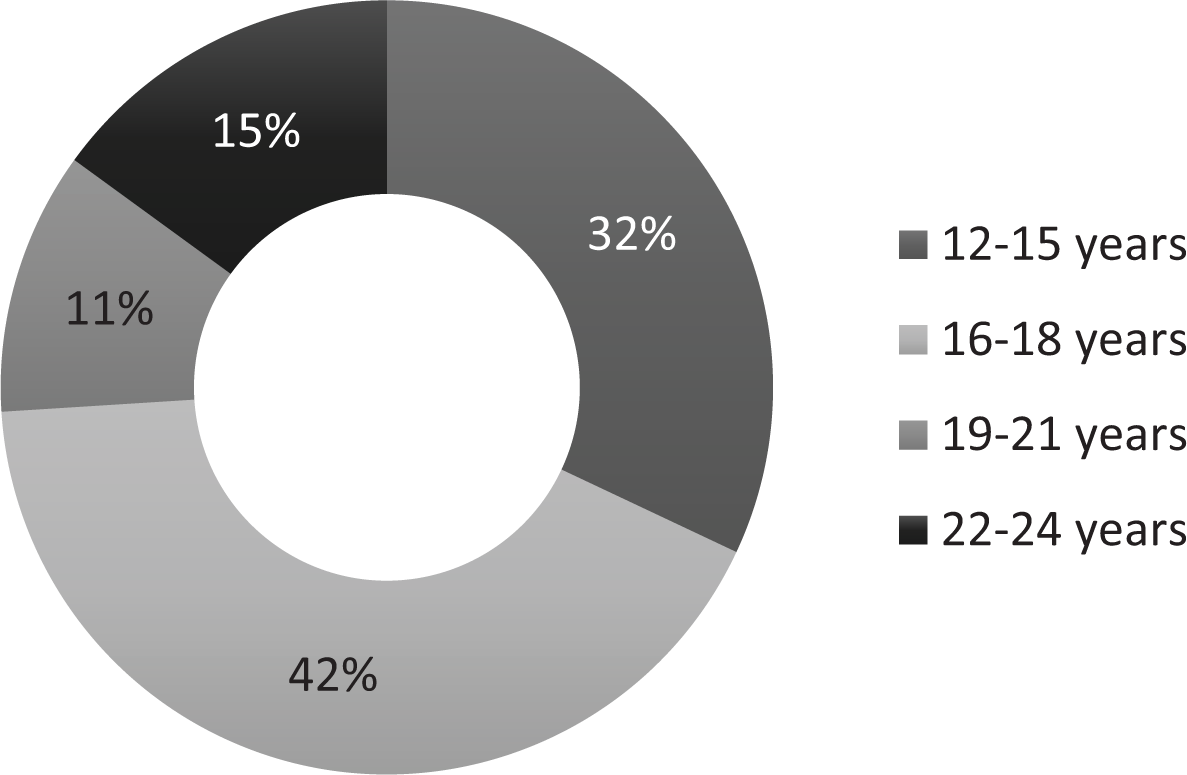
Age of respondents.
Gambling is a common activity participants indulge in; most of them mentioned being introduced to it at an early age. Our observations revealed that street youths are initially introduced as onlookers; over time, they assume more active forms of involvement. Our field assistants observed that games and participation patterns varied according to the ages of the youths—younger ones tended to watch, but when they participated they engaged in short games with small stakes. It was the older ones who tended to gamble continuously or until their money ran out. Age is clearly an influencing factor in transitioning from covert participation to overt gambling. The amount of money wagered and risk-taking strategies pursued increased with age. It is known that older youths, who have spent more time on the streets, initiate newcomers into street norms and activities (Beazley, 2003; Gaidhane et al., 2008), and we observed similar initiation patterns related to gambling. In the study, we observed that younger children were cautious and much more fearful of getting caught while gambling; it seemed as though for the older ones gambling had become an acceptable way to spend time, and they openly played and even boasted about their participation and winnings. While age-related distinctions were highlighted both in individual surveys and focus group discussions, field observations revealed gambling to be a part of the daily routine of street children. Just as they go about their day looking for work and food, during some part of the day, they gather together and settle down to a routine of playing cards and gambling.
The most popular form of gambling among street children was playing cards. They played games such as rummy, teenpatta, jodpatta, and mendicot. 1 Rummy is the most popular and commonly played card game. Besides card games, youths also mentioned playing games of skill (such as carom, marbles), video games at video parlors and amusement arcades, sports/cricket betting, and purchasing of lottery and Play Win tickets. Younger children also played games of “heads and tails” with coins. Focus group participants confirmed that most street children gamble by playing cards. While this keen interest in card games is similar to other adolescents (see Gambling Impact and Behavior Study, 1999), it is the visibility of groups of street youths that are seen playing cards in unregulated public spaces that makes them stand out.
Venues Where Street Children Gamble
The settings where street children hang out are the same venues where they gamble. In Mumbai, many street children migrate from other parts of the country to the city, arriving at one of the four major railway terminals. The terminal becomes a portal to a strange and bustling city that they know nothing about. Faced with a new and unknown environment upon arrival and having no idea of where to stay or how to earn an income, children continue to hang out and stay in and around these busy terminals, which are microcosms of their own. They offer some sort of a shelter, a somewhat safe environment, an anonymity among scores of commuters/travelers constantly coming and going, and an opportunity to earn quick money through begging, shining shoes, selling trinkets, or hustling. Newcomers settle in rather quickly, first by making a new friend, and through this friend they are introduced to some street group or other. They find sporadic work that lasts at the most for a few hours each day. In the absence of a structured work routine, with huge amounts of time to spare, a need develops to find something to occupy their time. Initially, they are introduced to playing coin games like “heads and tails” or some card games; over time, this playing for fun and to spend time leads to gambling.
Eighty percent of the respondents cited gambling venues connected to railway stations: playing on the platform when there were no trains during off-peak times or at night, and playing away from the platform but still at the railway station, such as on the roof top or some corner. Besides the different nooks and spaces of railway stations, the other venues mentioned by study respondents included pavements/sidewalks, street corners, under bridges, public parks, open playgrounds, beaches, parked taxis or train compartments, and parking garages. On some levels, though not entirely, these venues can be construed as unregulated spaces, depending on how one escapes from the police.
Participation in Group Activities, Including Gambling
Making strategic friendship alliances and belonging to a group are significant to a street child in order to survive. When it comes to gambling, we found that the group, particularly the older members and leaders, are responsible for newcomers being introduced and initiated to gambling. We observed this taking place in different ways. Younger children initially learn the ropes just by observing older youths play. At some stage, they are more actively introduced by being invited to join a game of cards when the group may be missing a player to make a required quorum. We also observed newcomers given the role of a kind of apprentice to the older youths, sitting behind them, collecting and holding on to their earnings, and listening to lengthy explanations about game strategies. On the streets, there exists a distinct pecking order and a social learning component, and consequently, many behaviors including gambling are learned through imitation of older bullies and group patterns. When specifically asked who their partners were, all our survey respondents mentioned friends or older street youths, indicative of the strong influence of these members on newcomers and younger children. Loyalty is extremely important on the streets, and initial friendships and relationships are never forgotten.
Groups on the street develop an identity and distinct subculture of their own. Assimilation into a group offers street youths membership in this counterculture, a set of norms, values, and hierarchies that are different from what they were used to before becoming street-involved. To belong to the group and be accorded membership and status requires full participation in all group activities, including gambling. Given that street children champion their own freedom and are proud of their outcast status against mainstream, adult society (see Beazley, 2000; Webster, 2011), they are proud to acquire a group identity and status, which in turn assists in the construction of a new self-image and street persona. To this end, they easily accept the group’s culture and participate in gambling as well as other facets of this street group’s subculture including drug use, drinking, vagrancy, thieving, petty crimes, and prostitution. Once the rules and patterns of the group have been adopted, it becomes extremely difficult to break free of them. Furthermore, if individuals are rejected by the group or move away, they risk losing status, acceptance, and identity, all of which they worked hard to establish.
Social recognition and status are important in the adolescent developmental period. Besides group acceptance and status, what also emerged from the various sources of data in this study is that gambling makes street youths feel good—the time goes by faster and a high or buzz is experienced each time they win. Continuously being on a winning streak leads other members to refer to a youth as a gambler, which is considered an honor. As Munaf, a respondent in the study said, “When people refer to me as a gambler or a risk taker, I feel proud and [feel] a sense of social recognition.” Another youth, Vinod, remarked, “Once you win, then everyone comes after you and you become the leader.”
Our study probed the reactions of the youths when they lost and had no money left to play. While 40% reported that they borrowed money and continued to play even after losing, there were some (20%) who mentioned that they had to run away to escape retribution when in debt. At such times, some seek the anonymity of other streets of this large metropolis (Mumbai), attempting to join another group, while others seek the protection of a group home or institution. But in general, there exist certain unwritten street norms in relation to gambling. For example, gambling debts have to be honored. Participants even mentioned an unwritten code that debts had to be settled as soon as money became available, even before buying food. Even younger youths are required to follow these norms. In addition, when players are caught cheating or being disloyal, the group immediately ostracizes them, and they can never rejoin the group. In a culture of intense loyalty, individual loyalty then conflicts with group loyalty. But it is also true that many attempts are then made to undo the banishment and rejoin the group. This is related to the fact it is hard to survive on the streets as a solo person, as also extremely difficult for a newcomer or younger youth to live on the streets without the support of a group. Shyam, a 20-year-old respondent said,
Once I witnessed a fight when an older boy was trying to rejoin our [gambling] group. The leader was determined to keep him out as he had cheated during a game, but the boy was desperate to rejoin and none of the others would even admit him.
According to focus group participants, the two main reasons why street youths gamble are recreation, which they specifically called a “pastime” or “timepass” in the vernacular, a word very commonly used, and the social dimension or the opportunity to strengthen bonds among members of the group.
Time and Money Spent on Gambling
While gambling is a source of acquiring money quickly, it is an activity in which large amounts of money are spent daily. How money is spent on other pastimes that could be construed as vices similar to gambling was not gathered in this study. Table 1 depicts an age-wise distribution of the amount of time (daily) and money (monthly) spent on gambling.
Although from our observations it seemed that younger children participate by observing more than playing, reports of younger survey participants aged 12 to 15 indicated a matter of concern—half of them gambled for 2 to 4 hours daily; others for more than 4 hours. This could be because there are limited options for younger children on the streets, and so after working individually or begging for food, the rest of their time is spent mostly with the group. On the contrary, older youths know how to make themselves scarce and disappear without telling the group, perhaps partaking in other activities such as prostitution, visiting clandestine adult gambling venues where a younger adolescent would instantly stand out as being out of place, or partaking of more serious drugs. For a young adolescent, spending more than 4 hours daily in gambling has a potential risk of turning into problem gambling. The duration of time spent continuously gambling depends on the availability of money and time, the turn of the dice (meaning if a player was successively on a winning or losing streak), and the nonproximity of the police.
In terms of money, close to 60% of the youths spent between Indian Rupees (Rs.) 1,000 to 1,500 a month on gambling. About 31% of participants spent between Rs. 1,500 to 2,500, half their monthly income. Some study participants did mention budgeting the day’s wages—spending on essentials like food and a daily quota of cigarettes—before using the rest of the money to gamble. When asked about daily amounts spent on gambling, respondents reported spending between Rs. 50 and Rs. 400. Each player stakes between Rs. 50 and Rs. 400 at the start of the game, and a player can win up to Rs. 4,000 from a single card game. The words of 19-year-old Suraj expressed the cyclical and addictive nature of events once money is invested in the game: “Once you put in Rs. 100 in a game, you stubbornly refuse to quit until you win back Rs. 200. So you continue to play and you start losing.”
Returns From Gambling Alongside Other Income-Generating Activities
When respondents mentioned the benefits of gambling, they spoke of it not just as a stand-alone activity but alongside other pastimes and income-generating activities. When children arrive on the streets, they find some sort of work immediately, even if it is not steady, and they lose jobs often. But they learn to live off the street, pursuing a variety of activities and occupations such as collecting and selling waste paper, plastic, and scrap metal; cleaning cars and two-wheelers; selling newspapers, trinkets, and flowers on the streets; working in roadside food stalls/carts or repair shops; polishing shoes; coolie/porter work at the railway stations; busking and conducting live entertainment through juggling or singing and dancing to popular Bollywood songs; working in small hotels (kitchens), eateries, or catering duties at huge marriage celebrations; and begging, pimping, pick-pocketing, and stealing. Most work is seasonal, the monsoon being the most difficult season to find work. In terms of gambling, participants mentioned the following rewards: physiological, like getting a rush or thrill; psychological, like a boost in self-esteem; social, like praise/acceptance from peers/group; and financial, such as winning money. And then, of course, they were able to have something to do to escape boredom and cope with the long stretches of time available.
The idea of the potential monetary gains, the thrill of winning as well as almost winning, have been reported elsewhere as motivations reinforcing gambling (Hardoon & Derevensky, 2002; Wood & Griffiths, 2002). In terms of outcomes of gambling specifically reported in this study, about 30% of the respondents mentioned money, drugs, and respect from peers. The reason most cited was money (28%), and a slightly lower percentage (22%) cited both money and drugs as being the rewards from gambling. A number of participants almost unanimously said, “Ten rupees can turn to one hundred rupees in a few minutes!” Focus group participants enumerating the advantages of gambling highlighted an ability to earn quick money, improve skills, make new friends, be a part of the group, and enjoy some form of entertainment or recreation.
Street children are aware of the negative aspects of gambling and are quick to point them out. According to participants, gambling is associated with greed and constantly wanting to make money quickly. They also alluded to the fact that money acquired from gambling cannot remain for a long time, as it is not considered “good” money (not earned through effort and hard work). Other negative consequences included losing all the money that a youth had worked hard to earn, being remanded into police custody, becoming a victim of cheating and fraud, increasing stress from needing to constantly be successful and win to maintain their pecking order, fights with peers, and the realization that losing means losing time as well as having to go hungry until they were able to earn money again.
The Urge to Quit
Survey participants were asked about giving up gambling. Thirty percent revealed that their efforts to quit were fueled because they were continuously losing hard-earned money and then left with no money to spend on food. Other reasons for wanting to quit were because they had to struggle and work hard to earn money to survive on the streets, but they then lost it very easily in gambling. In terms of obstacles to quitting, participants mentioned peer influence and the environment of the street. Shafiq, a 17-year-old respondent, clearly indicated that the social dimension is a major obstacle to quitting: “I have lost a lot of money to gambling, but what can I do? It has become a habit and if I think of giving it up, I will lose all my friends.”
Most participants mentioned making some attempts to quit—only 19% of the respondents said that they had not made any attempt. But participants mentioned that their efforts in general were sporadic and largely unsuccessful. A few respondents also indicated that even though they were aware that gambling was wrong, they had become so habituated that they felt helpless when it came to giving it up. But successful attempts to quit were also cited mostly in terms of some examples of other street youths who were successful (and not themselves). The motivations to give up included starting a family of their own, such as having a child or partner, being in regular contact with their family of origin, and heeding the advice of an outreach worker or nongovernmental organization (NGO) staff person.
The Vagaries of the Streets as Risk Factors for Gambling
Both survey and focus group participants indicated that it is not just their peer group, but the very environment of the streets and limited options for saving money that constitute the biggest risk factors for gambling. Respondents in this study had lived on the streets for an average of 6 years. Whatever the reasons they take to the streets or the types of work street children engage in, they mentioned how once they are on the streets any money earned must be disposed of immediately. The environment of the streets is uncertain, and youths are required to guard their earnings from theft and physical attack. Field observers noted that a number of street children kept their money with the owner of the betel leaf kiosk from whom they purchase cigarettes or betel leaf products, or with the scrap merchant to whom they sell scrap metal. While these shop keepers assured them of the safety/security of their money, participants also told field assistants many stories of how this money was withheld, they were cheated of the correct amount, or became trapped in a cycle of substance use because the betel leaf kiosk owners often offered them addictive substances in exchange for their deposits. These circumstances fuel the urgency to spend money immediately before it is stolen.
Another factor further confounding the situation is that street youths have not been taught how to save and there are no long-term saving options available to them. Without any proof of identity or a permanent address, children living on the streets have no access to bank accounts. In the study, only a single participant mentioned making an effort to save the money earned; all others revealed that they spent it immediately on themselves, their friends, or in gambling. Mindful of the fact that they need to immediately use/spend what they earn, after food is taken care of, street children tend to gamble away the rest of their money or spend it on going to the movies, visiting sex workers, or acquiring drugs. Living on the streets makes gambling both a way to earn money quickly and a channel to immediately dispose it.
Gambling, a Game of Chance or Skill, and Conflict With the Police
In this study, participants mentioned that both luck and skill play important roles in gambling. About 56% of the respondents aged 12 to 15 believed that luck was an important factor in gambling. Ramu echoed the words of many others: “If you are lucky on a particular day, you can instantly win a lot of money. But if you are not so lucky, it could take the entire day and you might just not win.” Gambling for younger children was in many ways thought of as a game of chance, the outcome determined by luck. On the other hand, about 22% of the respondents were convinced that skill was required to master the game and to avoid constant losses—but these responses were offered by 17- to 24-year-olds. Thus, although a larger percentage of younger participants believed that luck played a role in gambling, the older youths felt that skill could influence their outcomes. According to their perceptions, to be skilled, implies some sort of control over the outcome/winning from gambling, but it also implies that gambling then is not to be considered as a risky or problem behavior. In addition, many participants also mentioned that a good memory is needed to be successful. But the most common phrase heard from participants was “It’s only a game of chance.” When pressed further as to what they meant by this phrase, participants indicated that they perceived gambling to be only a game, a recreational activity where the outcome was determined by chance, and so they did not take it seriously. But, overall, we found that survey respondents had difficulty differentiating between luck, chance, skill, and fate, and used these terms interchangeably. This seems aligned with Jacobs’s (2000) conclusions that from a developmental point of view, a cognitive understanding of gambling increases with age.
Street children believe in superstition and luck. We observed interesting superstitious rituals associated with gambling. Groups had designated spaces to play, which were guarded possessively with fistfights to remain there. Even in these spaces, certain spots were favored as lucky, and everyone wanted to occupy them. When questioned, youths said that they “felt lucky” in these areas and the likelihood of winning seemed much higher. A few younger children, observing the games from a distance, described how they tried to get as close as they could to the winner, in the hope that his luck would rub off on them.
Although one of the perceptions of gambling that emerges from the study is that of a leisure activity, respondents were in agreement that it is illegal. Gambling is yet another facet of the street lifestyle that brings youths into conflict with the police. If street children are caught gambling they are beaten, locked up, or sent to juvenile homes. Children are required to pay hafta, or protection money, to the police to continue playing and not be arrested. Similarly, these children are required to pay money to get around the minimum age requirements to obtain a porter’s license or be engaged in other work, as it is considered illegal for children to work at railway stations. In this study, much fear related to gambling came from the fact that this activity constantly brought children into contact with the police. According to 15-year-old Milind, “Often the police catch us while we are gambling, force us to pay them money, and still lock us up in jail.” Brutal violence from the authorities, mainly the police, is known to be a core theme underpinning the lives of street children, shaping their experiences in public spaces and influencing their (in)visibility (Human Rights Watch, 1996). Interacting with the police is extremely stressful to these children and keeping away from them is an integral part of surviving on the streets.
Discussion
This exploratory study gathered information about gambling among street children in Mumbai. The collective understanding of this behavior and the motivations to gamble as a form of group participation and leisure calls for interventions to be designed on behalf of these children who are at risk for problems associated with adolescent problem-gambling behavior, as identified in the literature.
The Social and Group Dimensions of Gambling
Street children live in groups with a rather well-defined structure of leadership, common activities, and interpersonal interaction. Group bonds and cohesion develop through shared spaces, activities, routines, and even humor. Focus group participants were in agreement that the two main motivations influencing gambling for street youths are recreation or to pass the time, and the social dimension or the opportunity to strengthen group bonds. There is empirical evidence that gambling is a communal/group activity that strengthens social bonds (Jacobs, 2000; Salaam, 2014; Thomas et al., 2013).
Although in other studies very few participants refer to themselves as gamblers and prefer to be called players, gamers, or punters (Thomas et al., 2013), it was different in terms of this study. We found that on the streets, calling oneself a gambler (or jugari in the vernacular) is a term used to imply someone who is brave and takes risks; it gives increased social status in the pecking order of the streets. Even though both survey respondents and focus group members in this study did not construe gambling as a problem-related behavior, having peers engaged in gambling activities and indulging in other addictive behaviors have been found to be risk factors for developing gambling problems (Gupta & Derevensky, 1998a; Jacobs, 2000, 2004). As adolescence is a very impressionable developmental period, if gambling becomes habituated, normalized, and reinforced by one’s peers and daily routine, it can lead to serious problems.
On the streets, gambling becomes normalized and acceptable as an everyday recreational and communal activity. Life on the streets is filled with hardships and victimization, and street children have little time and no opportunity to let down their guard and relax. However, this does not appear to be the case when it comes to gambling. It was clearly noticeable that when playing cards, players were having a lot of fun, and were engaged and stimulated on many different levels. Playing cards is the most common form of leisure to help youths cope with the stresses that come along with living on the streets. It requires little investment beyond a pack of cards and can be organized almost anywhere. Gambling thus reinforces street life in as much as it normalizes yet another facet of street culture: leisure through gambling. As a result, youths are less motivated to pursue educational and employment opportunities beyond the streets.
The Nonavailability of Options for Recreation and Saving
Gambling among street children is looked at as recreational rather than addictive. More than 70% of study participants described their gambling behavior as temporary. It was seen as part of their “live for the day” philosophy, stemming from an innate tendency to continuously keep moving, take chances, and accept what fate brings across their path. Street children are known to seek excitement and continuously explore multiple sources of livelihood and entertainment. On some levels, not being able to engage in the same activity for an extended period deters them from becoming compulsive gamblers; in addition, they are transitory and belong to groups that are constantly being reconfigured. However, given what we know about the risk factors for developing an addiction from general addictions theory, namely, a physiological state that is chronically excessively excited or hypertensive (Jacobs, 1986, 2000), we must be concerned. With the presence of this predisposing factor and a past history replete with rejection, abuse, and childhood trauma, the environmental conditions of the street (groups, time available, comorbidity of other addictions) become ideal pathways to developing a gambling addiction.
One cannot definitively conclude from this study whether street children gamble to make money, or gamble to spend the money they earned. We need to study further whether wanting to have money to gamble serves as the very motivation to get complacent with menial and illegal jobs. Authors such as Beazley (2003) speak of a hierarchy of work that accords low to high status to certain street jobs. This hierarchy of work, specifically what types of work become tolerable and acceptable to earn money for gambling, needs to be further studied. At the same time, one finding that emerged clearly from this study was that gambling is also fueled by the inability of street children to save money effectively. The immediate disposal of money in gambling, rather than having it stolen or extorted, is a logical use of spending money earned in daily wages in the absence of other alternatives. Unless street children are able to explore different forms of leisure and offered options to save money and have access to it later, they will mostly turn to gambling, which is reinforced by the street and group subculture. What emerges from the findings of this study is the need to develop saving options and alternate forms of recreation, and create an awareness among street youths about how gambling can turn into an addiction. Street children in other developed countries also engage in gambling (Beazley, 2003; Mathur, 2009; Salaam, 2014), but this behavior is understudied, and the findings and methods of this study will be useful to these other countries.
This study has several limitations. Although our agency and the field assistants/staff have been engaged with these youths for a prolonged period of time and are familiar with the locations where they hang out, the study is based on self-reports of individual street children and focused on common public venues where cards, board games, and some other forms of gambling take place. Although the availability of video parlors and the Internet for online gambling options has now become widespread, we did not access and highlight these forms or venues of gambling. With more time and resources, an ethnographic study highlighting the influence of different types of games and various other details of the subcultures of these groups that gamble would provide supplementary and interesting details of the behavior of members and the relation of gambling to alcohol and drug use.
Conclusion and Implications
We embarked on this study because of the lack of published research on gambling behavior among street children, particularly in developing countries such as India. The findings revealed that regardless of the reasons they leave home and take to the streets, many street youths spend a lot of their daily time and money gambling as a result of the influence of their peer group. In this study, many risk factors outlined in the literature for adolescents becoming problem gamblers with serious gambling-related problems were found to be present in participants. These include early onset of gambling (Winters et al., 2002), influence of peers (Salaam, 2014; Smith & Abt, 1984), personality factors (Gupta & Derevensky, 1998a; Jacobs, 2000), comorbid use of alcohol and other substances (D’Souza, 2012; Wynne et al., 1996), and the subculture of the streets (Webster, 2011). What is not a part of the literature and found in this study is the fact that it is not just the influence of peers (Salaam, 2014; Smith & Abt, 1984), but the strong pressure from the group and the requirement of all its members to participate in group activities that makes gambling a common pastime among street youths. Furthermore, the nonexistence of saving and recreational options serves only to reinforce gambling behavior among street children.
We need targeted outreach efforts and enhanced educational, counseling, and preventive interventions for this high-risk group of youths. Given the all-pervasive group culture observed among street children and the absence of other forms of recreation, interventions should focus on strategies to minimize gambling from becoming the sole option for recreation. We must simultaneously create options for saving money for street children. As life skills training and instruction are presently offered to these youths on topics such as substance use, hygiene, and medical and sexual health (Gaidhane et al., 2008; Greene et al., 1997), these preventive and educational initiatives should also include components targeting the effects of gambling and problem-gambling behavior. There is thus a need for agencies and governmental organizations to immediately improve recreational activities, offer awareness programs, and create saving opportunities among their services to street children.
With regard to street youths, in cities similar to Mumbai, our research highlights that an early onset of gambling behavior is influenced by the street environment, especially the strong influence of groups and daily gambling routines among them. Yet, participants also mentioned being in regular contact with family members or heeding the advice of outreach workers or staff from a nongovernmental agency as successful strategies to end gambling. There is thus a role for practitioners to offer counseling and initiate referrals for these youths, as well as develop preventive awareness programs. An understanding of Jacobs’s (1986, 2000) theory highlighting the predisposing factors leading to serious gambling-related problems may offer counselors, psychologists, social workers, outreach workers, and other professionals engaged with this group a deeper understanding about why adolescents (including street youths) engage in addictive behaviors, not just gambling.
When it comes to street youths, the role that peers can play in awareness and intervention in terms of serious gambling-related problems should not be underestimated. Outreach initiatives must include a peer mentorship component with such services made available right on the streets. An outreach program, including a peer support component will play an important role not just in awareness of the effects of gambling, but peer leaders will help identify and refer at-risk street youths to agencies offering additional services. At these agencies, professionals should be available to manage the psychological challenges associated with problem gambling as well as other risks emerging from having to terminate group membership, a vital aspect of street survival.
Participants’ perceptions of gambling were that “it’s only a game of chance,” and they do not take it seriously. They seemed less aware of the potential addictive aspects of gambling. The irony behind the symbolism of these youths calling gambling a game of chance was in some respects not wasted on the authors. Taking chances and tempting fate is very much a part of the lives of street youths, in keeping with their philosophy of living each day as it comes and truly having fun no matter what comes across their path, rather than planning or saving for some nonexistent future. Notwithstanding abuse and trauma endemic to pathways to running away, street children decide to courageously tempt fate and take a chance when they leave their families of origin and come to live on the streets in an unknown urban metropolis such as Mumbai. Once on the street, every decision and action of theirs seems more a matter of taking a chance in that very little is premeditated. They are constantly making instinctual and survival-based snap decisions, most often simply trusting and taking another chance, attempting to make the best of every situation, and rarely if ever thinking through the pros and cons of alternatives. Hence, in many ways street children can truly be referred to as “children of chance.” However, social services and the rest of society cannot allow the attending to the needs of these youths to remain a matter of chance, with very little planning and analysis on the part of service providers . We have to be clear in our understanding of their plight in relation to their involvement in gambling and develop interventions that bear in mind that, although vulnerable, street children are extremely astute, intelligent, and mature, and their future development and growth should not be left to chance.
Footnotes
Declaration of Conflicting Interests
The author(s) declared no potential conflicts of interest with respect to the research, authorship, and/or publication of this article.
Funding
The author(s) received no financial support for the research, authorship, and/or publication of this article.