




Abstract
Dealing with environmental issues requires citizens who adopt conservation behaviors, influence those around them to follow suit, and lead local and global policy initiatives. The purpose of this study is to advance our understanding of the developmental processes that undergird young people’s emergence as conservation leaders with the capacity to take on these roles. A qualitative, grounded theory analysis of transcripts from focus groups and interviews with 76 adolescent and young adult participants of a national conservation leadership program provided the empirical foundation for a developmental model of conservation leadership. The model has four phases: seed, sprout, bloom, and propagate. Within each phase, there are three qualitatively distinct and integrated domains: action, motivation, and understanding. Data in this study indicate that conservation leadership development is ongoing and cumulative, with subsequent developmental experiences promoting new capacities and propensities that expand young people’s conservation repertoires within each domain. The emergent developmental model of conservation leadership proposed in this article puts forth a comprehensive theory about how conservation leadership unfolds in adolescence and young adulthood. This model serves both to instigate further research and provide insights on how youth programs might intentionally promote the development of conservation-oriented action, motivation, and understanding.
Climate change, drought, deforestation, and loss of biodiversity—these are just a few of the large environmental issues facing our planet that will require conservation leadership to address. It will require conservation leaders who conduct research, develop and implement new policies and programs, do what they can to conserve resources in their own lives, and influence the behaviors of those in their social networks.
Redressing these issues is not solely the work of adults. The second decade of life is recognized as critical in the development of environmentally responsible behaviors and an environmental identity (Horwitz, 1996; Kellert, 2002; Matsuba & Pratt, 2013; Thomashow, 2002). Adolescents see the world through “fresh eyes,” informed by increased opportunities and capacity for autonomy (Zimmer-Gembeck & Collins, 2003) and an increased capacity for cognitive complexity (Smetana & Villalobos, 2009). Together, these new opportunities and capacities allow them to explore, interact, and understand the world and issues around them in new ways. For some adolescents and young adults, this includes actively grappling with who they are in relationship to the natural environment. This includes consideration of what, if any, responsibility they have for protecting the planet (Matsuba et al., 2012). Interview narratives shared by young adults in environmental occupations, graduate programs, or involved in serious environmentally based leisure activities often hint at this developmental trajectory. Such narratives showcase the transformative role of an early sense of connection to the environment in shaping an environmental identity and, ultimately, environmental action and participation in early adulthood (James, Bixler, & Vadala, 2010).
Despite the developmental promise of adolescence for establishing a commitment to the environment, trends are disconcerting. Leveraging data from the national Monitoring the Future project, Wray-Lake, Flanagan, and Osgood (2010) found that, compared with 1976, recent high school seniors were less likely to recognize that environmental resources are diminishing, more likely to consider solving environmental issues as primarily the job of government, and less likely to report engaging in conservation behaviors. Facing this trend, it is critical to invest in programs and policies aimed at disrupting these patterns and intentionally cultivating young conservationists to ensure there is a pipeline of leaders willing and able to competently tackle the tough environmental issues facing our planet. The current study seeks to advance our understanding of the developmental processes that undergird young people’s emergence as conservation leaders. The developmental model put forth here is based on learning from a rich qualitative study of diverse adolescents and young adults participating in immersive conservation experiences.
Developmental Roots of Conservation
Previous research has posited broad stages in the development of conservation leaders, defined as those who actively work to preserve, protect, and restore the natural environment (Chawla, 1999; Horwitz, 1996; James et al., 2010; Kellert, 2002; Louv, 2012; Mainella, Agate, & Clark, 2011). In much of this work, childhood is recognized as a critical period when play and exploration in nature, along with influence from family members, all contribute to an early sense of environmental connection. These experiences are fundamental for inculcating a sense of comfort, security, affection, and curiosity about nature. Longitudinal studies reinforce the importance of early environmental experiences, showing positive associations between favorable nature experiences in childhood and adult environmental attitudes and behaviors (Chawla, 1999; Wells & Lekies, 2006).
James and colleagues (2010) put forth a four-stage, age-bound model depicting the development of environmental professionals and enthusiasts from childhood, through adolescence, and into young adulthood. This model emphasized (a) unstructured play in nature as foundational in early childhood—Stage 1; (b) increased involvement in structured programs and activities that promote outdoor skill development (e.g., clubs, sports) in middle childhood—Stage 2; (c) awareness of, and experimentation with, conservation roles and activities in adolescence—Stage 3; and (d) an emerging sense of identity as an “outdoor person” or environmentalist in adolescence and early adulthood expressed and developed through recreation and/or career aspirations—Stage 4.
While questions remain about whether the development of an environmental identity is as age-bound as suggested by James and colleagues’ (2010) model, research demonstrating how adolescent cognitive, moral, and civic development incrementally unfolds across this age period would suggest that advances in these other developmental realms may bolster the emergence of environmental identity. For example, adolescents’ increased capacity for complex thinking allows them to begin to ponder ever-more complex relationships between humans and nature (Smetana & Villalobos, 2009), which supports developing a sense of “kinship” with nature, allowing youth to understand ideas like environmental stewardship that motivate them to protect and preserve the natural environment (Clayton & Meyers, 2015; Gallay, Marckini-Polk, Schroeder, & Flanagan, 2016; Horwitz, 1996; Kellert, 2002; Nisbet, Zelenski, & Murphy, 2008; Schultz, Shriver, Tabanico, & Khazian, 2004; Thomashow, 2002). There is also a burgeoning literature on social responsibility demonstrating that adolescents feel increasingly connected to the greater good (Wray-Lake & Syvertsen, 2011; Wray-Lake, Syvertsen, & Flanagan, 2016) and the environment as a shared public space/resource as they get older (Flanagan, Gallay, Byington, & Sambo, 2016).
Some studies have identified other antecedents to environmentally responsible behavior, including knowledge, attitudes, and values. For example, Markowitz, Goldberg, Ashton, and Lee (2012) found that people can value nature because it benefits them and/or for its own sake. Other studies have shown that valuing nature makes us more likely to want to protect it (Nisbet et al., 2008; Schultz et al., 2005). Schultz and colleagues (2005) found the association between values and environmentally responsible behavior to be moderated by awareness of the harmful consequences of environmental inaction and a feeling of responsibility. Other studies have identified a sense of environmental efficacy, or the degree to which people feel their actions can benefit the environment, as critically impacting the environmental behaviors in which they do and do not engage (Kaplan, 2000). While these and other studies have highlighted the importance of factors that are, at least in part, based in emotions, too often this part of the equation is overlooked (Nisbet et al., 2008).
Kaplan (2000) asserted a critical need for moving beyond individual action to policy change that addresses macro conditions at the core of conservation issues faced by our planet. While existing studies offer insight into why youth come to appreciate and protect nature (e.g., Gallay et al., 2016), there is an obvious dearth of studies focused on the development of what youth do or what they believe stewardship entails as they develop from individuals who care about the environment to people who practice conservation to conservation leaders who leverage their individual efforts to influence multitudes to preserve, protect, and restore the natural environment.
There are related studies in the field of youth development that can provide valuable insights. For example, Sullivan (2009) developed an empirically based taxonomy of youth sociopolitical change strategies and behaviors that delineates a continuum of self-transforming behaviors (individual, direct action), other-transforming behaviors (efforts to influence others), and formal systems–transforming behaviors (to affect program or policy change). Development along this continuum was found to be based on age and experience. There has not been a study of conservation behaviors that spans this range of actions.
This study aims to harness existing research, along with rich qualitative narratives from young people about their development as conservation leaders, into a cohesive model that articulates the interplay of behavioral, affective, and cognitive factors that are central to developing conservation leaders. The goals of presenting this model are to advance theory and guide practitioners in the intentional development of the next generation of conservation leaders.
Current Study
The current study was part of a multiphase partnership with the Student Conservation Association (SCA), a national organization that annually provides approximately 8,000 adolescents and young adults with opportunities for hands-on conservation service in more than 500 parks, forests, and wildlife refuges across the United States. This study aims to elucidate a developmental model of conservation leadership to inform future research and practice, based on a series of qualitative focus groups and interviews with 76 SCA participants and alumni about their conservation experiences, ideas about conservation leadership, and how both impact their relationship with the environment. The developmental theory posited in the model of conservation leadership put forth in this article is based on (a) developmental differences among adolescents and young adults with varying exposure to conservation ideas and experiences that were identified in the analysis of the qualitative data, and (b) participants’ personal narratives about how they have grown as conservation leaders.
Method
Sample
Working in partnership with national SCA staff, we recruited 76 youth participants. Careful attention was paid to inviting participants who represented a range of ages and levels of experience in nature settings. Sixty-six percent were female. Forty-nine percent were adolescents, age 15 to 17 years. Fifty-one percent were young adults, age 18 or older. SCA offers a range of programs, which tend to stratify participants based on their level of experience in nature. These programs, along with the ages and samples from each, are listed in Table 1, beginning with the program engaging participants with the least conservation experience, following in order of increasing conservation experience prior to joining the program. We did not have access to the specific ages of the interns interviewed; however, all were recent high school and/or college graduates. Recruitment focused on a subset of sites selected to represent a diverse mix of urban, front-country, and back-country placements.
Overview of Student Conservation Association Programs and Membership.

Note. The list above begins with the program engaging participants with the least conservation experience, following in order of increasing conservation participant experience prior to joining the program. SCA = Student Conservation Association.
As most of our data came from focus groups, we did not have individual data from study participants. As such, we were not able to analyze the data by individuals’ age and levels of experience. However, because participants in particular programs were of similar ages and experience levels, we used the program in which they were enrolled as a proxy for these variables.
We did not collect individual data on race, ethnicity, or urbanicity. Interns and most participants in the National Crews and Corps were Caucasian. The more urban Community Crews were made up predominantly of youth of color, most of whom had limited experience in wilderness settings. Of the 76 focus groups participants, 20 were members of these urban Community Crews.
Data Collection
Authors of this article each conducted focus groups with Crew and Corps members at their work sites. Focus groups with alumni and four of the interns took place at SCA office locations and local internship sites. Eight of the 12 interns in the study were interviewed individually over the phone. All study participants signed assent forms. For those under age 18, a parent signed forms consenting to their participation. Crew leaders, program staff, and supervisors were not present for participant focus groups or interviews. All conversations were digitally recorded and transcribed.
Qualitative Protocol
A similar protocol was used for interviews and focus groups across program types and for alumni. It was designed to unpack participants’ perceptions of ways in which they grew and changed as a result of their immersive conservation experience and elements of the experience that were important to producing that impact. Research questions for the current study focused on the development of conservation leadership, which emerged after seeing patterns surface in a first round of qualitative data analysis focused on program outcomes more broadly. Guiding questions for the current study include the following: (a) Do youth and young adults with more conservation experience think, feel, and engage with the environment differently than those with less experience? (b) Do those with more experience describe more frequent, more complex, more committed, and/or more leveraged forms conservation leadership? (See Table A1 in the online appendix for a list of the questions we asked interview and focus group participants.)
At the beginning of each interview and focus group, participants were asked to think about ways they were affected by their immersive conservation experiences. To facilitate this reflection, participants were given a document with a generic outline of a person. Participants were then invited to draw or write on or around the head things that they learned or think about that they did not know or think about before their SCA experience. On or around the hands and feet, participants were invited to draw or write things they do because of their SCA experience, that they were not able to or simply did not do before that experience. Finally, participants were invited to draw or write around the heart things that are different about them as a person as a result of their SCA experience. This delineation of outcomes is common in the service learning field (Billig, 2004). The purpose of this activity was to immediately engage all participants and to prime reflection before a subsequent discussion of ways they were affected by their immersive conservation experiences.
Qualitative Data Analysis
All transcripts were analyzed using a grounded theory (Strauss & Corbin, 1998) or data-driven (Boyatzis, 1998) approach, facilitated by NVivo 10 software. Rather than constraining interpretation of the data by theoretical frameworks borrowed from other disciplines or other age groups, this approach allowed us to explore our research questions from the perspective of the participants. We then did a literature review and considered the data-driven findings from the perspective of existing theories.
The analysis began as part of a program evaluation study, with authors of this article each independently doing line-by-line open coding (Strauss & Corbin, 1998) of one transcript. Open codes included excerpts from individual statements in the transcript reflecting participants’ perceptions of the impact the SCA conservation experience had on them, as well as their current behaviors, ideas, and feelings related to nature, conservation, and/or conservation leadership. We each independently grouped open codes conveying similar ideas, and developed “focused” codes (Charmaz, 2014). These are labels encapsulating the phenomenon that open codes in each group have in common. For example, open codes such as “don’t litter,” “don’t kill insects,” “pick up trash,” “recycle,” “leave no trace,” and “live sustainably” were organized within the focused code individual action. The authors then met to compare focused codes and the open codes within them for that transcript, discussing differences in our coding and coming to consensus on the concepts, articulation, and organization of the codes.
We then used and built upon focused codes from the first transcript as we independently coded two additional transcripts. When a statement fit within a focused code that emerged from the first transcript, we attached it to that code. Statements describing phenomena that did not emerge in the first transcript were captured as new open codes. If multiple open codes described similar phenomena, a new focused code was created. Again, the two authors came together to compare, integrate, and refine our codes until we had consensus on coding for these three transcripts. We used the coding scheme developed in this process to then each independently code another four transcripts, following the same procedure to come to consensus on a coding scheme for these seven transcripts. One of the authors then used the emergent coding scheme to code the remaining transcripts, continuing to create open codes when participants’ statements did not fit with existing codes. The authors together discussed new codes created from these remaining transcripts, and agreed upon a complete coding scheme representing the full data set.
Within this broader evaluation study, we found patterns among the codes that suggested a range of conservation leadership development among participants. This motivated the current study, through which we revisited the coding scheme post hoc.
In this secondary analysis, three categories of phenomena emerged across the codes: actions, motivations, and understanding. We used these post hoc theoretical codes to organize existing focused codes. As Charmaz (2014) described, “Theoretical codes underlie your substantive codes and show relationships between them, rather than replace the substantive codes with ones constituting your theory” (p. 150).
Within these theoretical codes, which we came to call the domains of conservation leadership development, we also saw patterns of comments that were more common among participants in programs populated by those with more and less conservation-related experience. With focus group data gathered at a single time point, we were not able to measure developmental change over time for individuals or identify individual-level data by age and/or experience. Rather, our model is based on an analysis of developmental differences between participants by program (with program, as noted earlier, being a close proxy for both age and conservation experience). Therefore, this analysis by program gave us a sense of how commonly certain kinds of statements were made by participants of different age and experience levels about their own development.
The two authors and a research assistant then conducted a review of literature on the development of conservation attitudes, behaviors, and leadership. We compared our emerging theoretical model with those put forth from past research, validating some of our theories and challenging others. That process often sent us back to ask new questions of the data, which iteratively informed the evolving model.
For example, the three domains that emerged in our study did not neatly fit the organizing constructs we found in adolescent development research or conservation development research. For example, our action domain included elements that others divided between behaviors and skills (Chawla, 1999; James et al., 2010; Kaplan, 2000; Wells & Lekies, 2006). This informed the organization of elements within the domain in our model. We named two distinct but highly interwoven “strands” of development within our action domain, which we labeled capacities and behaviors. This iterative process ultimately yielded the model of conservation leadership development described below.
Results
A multidimensional model of conservation leadership development (see Figure 1) emerged through the qualitative analysis described above. The model delineates three qualitatively distinct but integrated domains of development: action, motivation, and understanding. This model posits, with qualitative empirical support, that conservation leadership development within each of these domains is cumulative. That is, rather than replacing those found earlier in the process, new capacities and propensities add to one’s repertoire within each domain as young people mature, interact with nature and other emerging leaders, and learn about conservation. In addition, the model posits that the development of conservation leaders is continuous. As demonstrated in the qualitative conservation narratives shared across participants, there is a predictable and ordered pathway through which conservation leadership appears to unfold. The more experience participants had, the broader and deeper their repertoires in each domain. Their capacities and propensities within each domain also proceeded from simple and concrete to more complex. Based on this evidence, the phases identified in the model are labeled seed, sprout, bloom, and propagate. The metaphorical parallel reflects the continuous organic processes that define the growth of both conservation leaders and plants. There is not one point in time when it is clear that a seed has “sprouted,” for example. And, the sprouting process will take place on different timelines for different individuals of the same species, based on a complex interplay of factors.
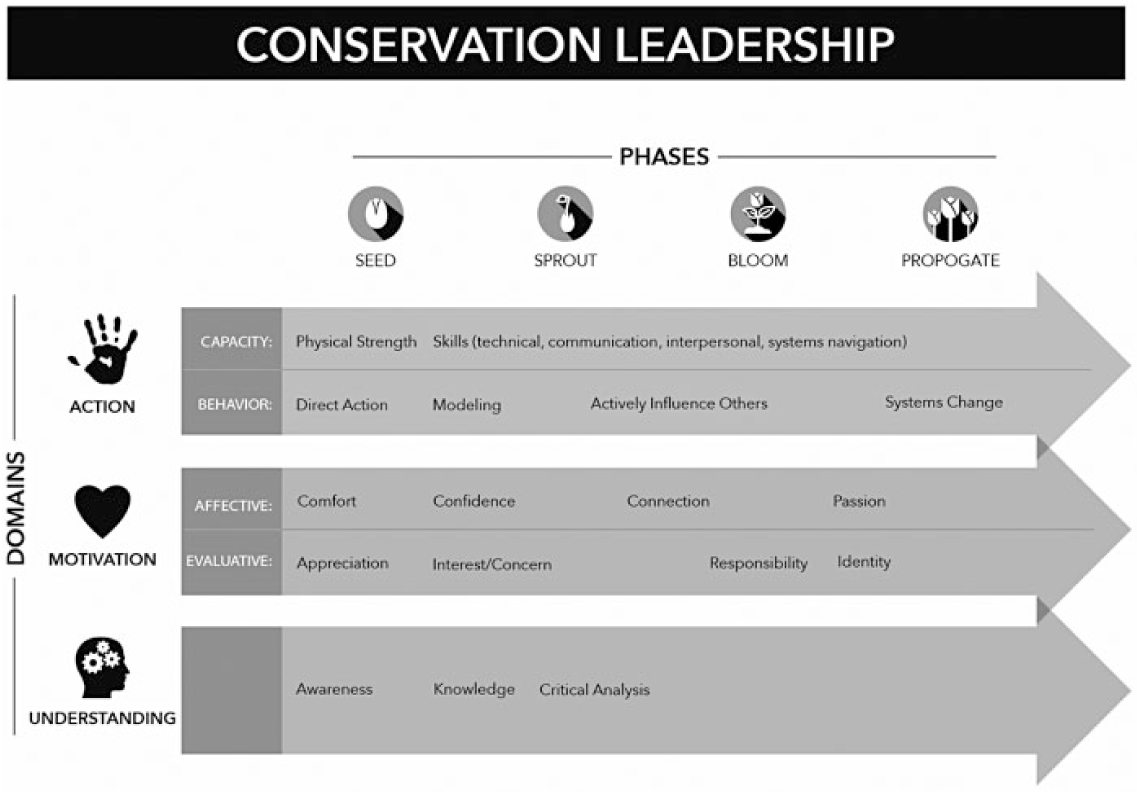
Developmental model of conservation leadership.
For the sake of clarity, the domains appear separately in the model illustration (see Figure 1), and yet they are all intertwined within the same forward trajectory of development. That said, there is heterogeneity in the rate and trajectory of conservation leadership development predicated on each individual’s conservation experiences.
To operationalize our emergent developmental model of conservation leadership, we begin by explicating the qualitative evidence of developmental phases within the action, motivation, and understanding domains. The order in which these domains are presented reflects our desire to begin with the most concrete domain and should not be construed as reflecting temporal ordering or importance. The findings are organized by domain rather than phase because our data suggest the developmental continuum of conservation leadership does not have clear lines of delineation between the phases, as described above, thus making it difficult to discuss them discretely. The presentation of results is organized to parallel the organization shown in Figure 1.
Action Domain of Conservation Leadership Development
Within the action domain, participants described two distinct yet related phenomena: behaviors and capacities (see Figure 1). Both are interdependent, because skills and other capacities are built through behavior, and behavior is facilitated by new capacities. And yet they are distinct. Young people can learn skills and build capacities and still choose not to use them to protect and preserve nature. And they can certainly act without skill, albeit less effectively. In the sections below, we draw upon the narratives shared by participants to describe both the behaviors and capacities adolescents and young adults described along the continuum from seed to sprout to bloom to propagate.
Behavioral elements
Participants offered rich examples of behaviors aligned with the general categories of direct action, influencing others, and systems change. Participants with limited nature and conservation experience discussed direct actions they were taking to protect and preserve the environment (e.g., recycling). They also talked about influencing others by modeling these behaviors. Therefore, we placed direct actions and modeling in the seed phase of the model. More experienced participants also talked about direct actions. However, they tended to describe broader repertoires of action, adding actions to actively influence the perspectives and behaviors of others, and systems-changing actions that have the potential to influence the perspectives and behaviors of many. These appear in our model beginning in the sprout and propagate phases, respectively.
Direct action
In their qualitative narratives, all participants, including those with the least experience, talked at length about ways in which they had and/or were planning to change their behaviors to directly protect the environment. Therefore, we posit that direct action begins in the seed phase of the model. For the urban, less conservation-savvy adolescents in Community Crews, these behaviors were fairly basic. They no longer litter. They recycle more. One crew member said, “Normally, if an ant was in my way, I would step on it. But now I try to avoid it.” Other direct actions more experienced participants reported included commuting via bicycle instead of using a car, eating less meat, or “reducing the amount of things” they have as a strategy for protecting the environment. These latter direct actions require greater understanding, effort, and/or sacrifice than the more basic actions described above, highlighting the interplay of motivation and understanding with direct actions.
Modeling
In addition to directly impacting the environment in some way, adolescents and young adults across the programs, including the Community Crews, talked about influencing the conservation ideas and behaviors of others through modeling, which they described as “leading by example” and “showing people by doing.” Therefore, modeling also begins in the seed phase of the model. Although the intent was explicit to include influencing others, the action was often the same as the kinds of direct actions described above.
Actively influence others
Adolescents in National Crews and young adults in National Corps, both of which tended to be more experienced than those in Community Crews, talked about actively influencing others. One said, “I used to litter. And now I tell people not to litter.” Another said, “I was talking to my aunt . . . and I was, like, ‘Look at that! You have garlic mustard in your front yard!’ And she was, like, ‘What’s that?’ I’m, like, ‘It’s an invasive species.’ I told her to pull it!” These participants sought to influence others by telling them what to do. Some also talked about tailoring their teaching based on what they know about their audience, “learning all the different ways that you have to respond. And being able to, like, switch between them.” This desire to go beyond telling others what to do to more strategically teach others in informal and formal settings was most common among young adult participants in National Corps and internship programs. Because these actions were discussed by all but the least experienced participants in our study, we posit actively influencing others begins in the sprout phase of the model.
Systems change
A young adult National Corps member said, he or she was interested in doing “bigger picture conservation—like land easements and things like that—which I think are more effective ways of achieving what I think is conservation.” Other young adult National Corps members and interns expressed similar interests in promoting conservation through policy and formal system change. One young adult said, “I’d like to do watershed and water rehabilitation . . . especially hydroelectric dam removal in places like Washington and in South America where it’s affected native communities.” Kaplan (2000) aptly highlighted systems change efforts as critical to addressing conservation issues facing our planet that cannot be addressed by individual action alone.
Because these strategies were only articulated by the most experienced participants, we placed systems change actions in the propagate phase of our model. Systems change strategies require complex analysis of conservation issues, as well as social and political systems, highlighting the interplay with critical analysis, an element of the understanding domain that is found in this same phase.
Another young adult participant said, “Scientists don’t see the power of getting people on board to increase the amount of money you can put toward a problem.” This highlights the importance of being able to influence others in order to affect systems change, suggesting the former must be developed to be effective at the latter. Another said, “Conservation is interdisciplinary. You have to be open-minded with other people’s ideas and concerns, and collaborate with many fields to solve [a] problem,” highlighting a more complex understanding of the mutual influence required for collaboration, which he or she deems critical for systems change.
Aptly, this continuum of behaviors, from direct action to systems change, also parallels that identified by Sullivan (2009) when discussing youth sociopolitical change strategies.
Capacity elements
As adolescents and young adults develop as conservation leaders, they report marked growth in their physical, technical, communication, interpersonal, and systems navigation capacities. The following sections draw on youths’ own narratives that illustrate this growth. Participants at all experience levels talked about growth in their physical capacity, technical skills, communication, other interpersonal skills, and systems navigation. Therefore, all of these begin in the seed phase of the conservation leadership model, and continue to grow throughout the subsequent phases.
Physical strength
One intern commented, “I got really a lot stronger and healthier from this internship.” This idea was echoed by participants in all of the SCA programs. An adolescent National Crew member said, “This experience, it definitely made me stronger physically just from all the work. . . You gain this confidence in yourself that you know you can accomplish anything that you kind of put your mind to.” Comments such as these illustrate the association between physical strength and confidence (located in the motivation domain).
Technical skills
Participants across programs described technical skills they learned as they deepened and honed their abilities as conservation leaders. Adolescents participating in Community Crews, the least experienced in our sample, said they learned “how to use the tools,” “pull plants,” “find trails,” and “sleep in tents.” More experienced adolescents in National Crews and young adults in National Corps said they learned some of these same things. These members also said they learned “knots, tarp setup,” “how to leave no trace . . . how to hang a bear bag,” how to “build stuff,” and do “rock work.” This suggests all participants learned new skills required for conservation work, with those with more experience learning additional, more advanced skills.
Below, one of the young adult interns, the most experienced group in the study, describes a relationship between learning technical research skills and being able to change systems, an action in the propagate phase: We get dead turtles washing up, we’ve been using data from that to regulate shrimping offshore . . . There’s a project to put up a marina on the mainland. We proved how many turtles were killed by boat strikes . . . so they were limited in how many ports they could build.
Similar to building physical strength, developing technical skills helped participants gain confidence, in the motivation domain. For example, one young adult gained confidence from the “ability to know that you can be out in the middle of friggin’ nowhere in the wilderness and take care of yourself and be okay.”
Communication skills
Through their engagement with others in conservation work, adolescents and young adults across programs learned and practiced how to “express [themselves] more,” “give [their] opinions,” “become a better listener,” “speak in front of people,” and “retain myself . . . instead of just lashing out at someone.”
In addition, young adult interns learned how to communicate with many, by writing reports, conducting focus groups, building a website, and conducting a social media campaign. Young adult corps members said they learned “to listen to other people’s point of views, and kind of integrate that . . . communicating with people in all different types of departments and organizations, and trying to bring it all together.” Adolescent crew members did not describe these more complex communication skills.
Other interpersonal skills
Adolescents and young adults across programs said they learned to work with people who were different from them. An adolescent Community Crew member said, “You gotta know what the other person’s talkin’ about . . . You try to ask questions and understand ’em more.” Another said, “We have to put all of our minds together to come up with a workin’ idea.” A young adult intern said learning to work well with other people was new terrain: As a field biologist, I’m focused on the critters I’m working with. Now there’s this whole human part to deal with . . . [You need to know] how to communicate to keep them on board, enjoying what they’re doing, and getting things done.
Together, these comments support the notion that, at all phases of their development as conservation leaders, participants were building interpersonal and communication skills critical to expanding their action repertoires.
Systems navigation skills
Adolescent Community Crew members, the least experienced participants in our study, described learning basic skills for navigating systems, like being on time for work, dressing appropriately, time management, “keeping things organized,” writing a resume, and interviewing for a job. National Crew members, the more experienced adolescent participants, and young adult participants developed networking skills and relationships with those who can connect them to other opportunities to further their conservation goals. Like other young adult Corps members and interns, the intern below was learning to navigate political systems to get things done within a conservation organization. He or she said, One of the bike trails is being reconstructed during off-season and we went on a walkthrough to see what needed to be done, make notes. And there were representatives from Natural Resources, from an environmental perspective, from an archaeological perspective. There were maintenance people, the project planners were there, the safety people were there. . . Everything that’s looked at has so many different things to take into consideration . . . because everyone has . . . their own thing they’re looking for when things are done within the park.
Motivation Domain of Conservation Leadership Development
Adolescents and young adults described emotions, interests, attitudes, and beliefs that motivated them to seek out opportunities to learn about conservation and take action. Like those in the action domain, these motivational factors were continuous and cumulative, with older and more experienced participants describing motivations in addition to, not instead of, those described by younger, less experienced participants. As with the action domain, two separate and allied strands of motivation emerged (see Figure 1): one driven by affect, feelings that are positive in and of themselves: comfort, confidence, connection, and passion. The other strand includes an evaluative component, in which conservation is deemed worthy of appreciation, concern, or responsibility.
We separated these strands because leaders can grow in one without necessarily growing in the other. For example, while comfort and confidence helped adolescents and young adults appreciate nature, some appreciated nature without being particularly comfortable in it. This was reflected in comments, like this one: “Yeah, I do appreciate it more. But I’d rather have air conditioning.”
Affective motivations
Participants across programs described feelings akin to what Kals, Schumacher, and Montada (1999) called emotional affinity, a term they used to describe feeling safe in nature, a oneness with nature, and a love of nature. While other models suggest these emotional factors emerge through childhood play in natural settings (Chawla, 1999; Horwitz, 1996; James et al., 2010; Kellert, 2002; Mainella et al., 2011), factors like comfort, confidence, connection, and passion were also emerging in adolescence and young adulthood for participants in this study, particularly among those who had limited prior exposure to nature.
Comfort
Novice adolescent Community Crew members expressed no longer being “afraid of the wilderness” after immersing themselves in nature and difficult conservation work. Adolescent Community and National Crew members expressed new comfort dealing with bugs, “gettin’ dirty,” and “going to the bathroom” in the woods. Therefore, comfort begins in the seed phase of the conservation leadership model. Ideas like these were not heard from young adult participants, who had more previous experience working and living in nature.
Confidence
An adolescent member of a Community Crew said, “Some of the things we do, we wouldn’t think we’d be able to do it before. . . Like cuttin’ a tree down.” Because it emerged among these participants with the least experience, we posit that confidence begins in the seed phase of our model. And, yet, it is important to note that participants at all levels of experience gained new confidence through these immersive conservation experiences. An adolescent National Crew member reflected, “You gain this confidence in yourself that you can accomplish anything that you put your mind to.” A young adult Corps member said, “I feel really happy that I can use an axe and a pulaski. . . and use that confidently.” Another Corps member said he or she became “confident in my ability to teach this person the things that I had learned two months prior.” An intern described confidence in highly technical skills, saying, “I think I have a lot more confidence in my abilities as a field biologist, as a person who is capable of catching snakes and not getting bit.”
These narratives highlight the interplay of the action and motivation domains. As they mastered new and more complex skills, participants became more confident in a broader array of situations.
Connection
Adolescent National Crew members, young adult Corp members, and alumni said they gained a new sense of connection with nature. As this was not articulated by those with the least experience in our sample, connection begins in the sprout phase of our model. An adolescent National Crew member said, My favorite experience—maybe in my whole life . . .was one night [when] it was particularly quiet and no one was around. . . I could hear . . . a family of deer, literally right outside my tent, just walking around doing their thing. And I felt part of that.
A young adult Corps member said, So the challenge of being in nature . . . trying to reconcile this need to be in control with being out of your element, is what can build you into something that is more connected. . . . The way you don’t feel overwhelmed by it is you realize how you’re connected to it. . . Everything is connected to everything.
This sense of universal interconnectedness is an oft-cited motivating factor for environmentally responsible behavior (Horwitz, 1996; Kellert, 2002; Nisbet et al., 2008; Schultz et al., 2004; Thomashow, 2002). Another young adult Corps member noted insightfully, “Well, we are nature. . . in harming our natural resources, we are harming ourselves.”
Passion
Alumni and young adult Corps members talked about finding a new passion for the outdoors. Because this was not discussed by either of the less experienced adolescent groups, passion was placed in the bloom phase of our conservation leadership model. A National Corps member said, “You have to do what’s going to make your heart swell. . . I have to do this to be myself and to be happy.” For this young adult, passion was playing into a burgeoning sense of identity.
Evaluative motivations
The other motivational strand that emerged in our model of conservation leadership includes evaluative aspects. For example, while the emotional strand includes feelings of oneness and connection with nature, this strand includes an appreciation of nature, a belief that nature is good and worth preserving. Two elements that emerged within this strand, including appreciation and interest and concern for environmental issues, were discussed by even the least experienced participants. Therefore, these begin in the seed phase of the conservation leadership model. Broader and deeper versions of these elements were articulated by those with more experience. A sense of responsibility and identity as a conservationist were far more commonly discussed among more experienced participants, placing them in the bloom phase of the model.
Appreciation
Adolescent and young adult participants across programs described developing new appreciations for the natural world. An adolescent Community Crew member shared, for example, “In the city . . . it’s not as peaceful as it is out here.” An intern said, “you . . . see really beautiful places and things, and get an appreciation for this place.”
A young adult Corps member reflected, “This entire summer was probably one of the better experiences of my life. And I think that it was entirely facilitated by nature. And I want other people to have the opportunity, if they choose to seek it.” As with this participant, appreciation for nature has been found by others to motivate conservation action (Markowitz et al., 2012; Nisbet et al., 2008; Schultz et al., 2005).
Interest and concern
Participants across programs described new interest in and concerns about conservation issues. These new interests were often tied to specific conservation challenges, like water quality, sea level changes, erosion, invasive species, and endangered species. When an adolescent was asked if he or she will interact with the environment in new ways because of the experience on a Community Crew, he or she said, “Once you’re there pickin’ up trash . . . you start feelin’ bad that you litter. ‘Cuz somebody somewhere is gonna be pickin’ up that trash!” In this case, direct action led to concern. A young adult Corps member said, “I’ve opened up all of these new doors. And it’s super-super-exciting. So I have a general idea of, like, the area I want to go into.” This statement suggests expanded interest among this more experienced participant fueled a new passion that is motivating the kind of action he or she wants to take.
Responsibility
A new sense of social and/or moral obligation for preserving and protecting the environment emerged across adolescent and young adult narratives about their experience as a conservation leader. This kind of statement was most common among young adult Corps members, placing it in the bloom phase of our model. One such member said it is important to “pursue what you know is right . . . like serious environmental and social issues that seem like it’s gonna be pretty difficult to change. Just fighting for what you believe is right, and never compromising that.”
An intern articulated how understanding and confidence can make it possible for someone to be responsible in new ways: I can be responsible. Before I cared, but I didn’t know how to camp, for example. I didn’t do it because I was afraid I’d mess it up. Learning ‘leave no trace,’ things like that, have created a solid base for me to jump off from professionally and personally. Sometimes you want to know WHAT to do. I work with incredibly committed people who have taught me so much about how to be responsible.
Identity
An alumnus said conservation experiences “made me realize more who I was. . . You want to be that guy who does . . . the right thing all the time . . . You’ll think back later like, ‘I did this. And that’s me.’” For this participant, responsibility became central to identity. This topic was broached most commonly by young adult Corps members and alumni. Therefore, it too begins in the bloom phase of our model.
Understanding Domain of Conservation Leadership Development
A tripartite mix of awareness, knowledge, and critical analysis emerged as core understanding-based elements of conservation leadership development (see Figure 1).
Awareness
Participants across programs demonstrated awareness of their impact on the environment, conservation issues, and conservation practices. Therefore, awareness begins in the seed phase of the conservation leadership model and continues to grow throughout the other phases. An adolescent said he or she learned through a Community Crew experience that “invasive species . . . they’re bad for everything around here.” A young adult Corps member said interacting with nature builds awareness “that you’re not the center of the universe. . . I think with that comes respect for nature, which makes me strive to protect it in any way that I can.” This statement illustrates that awareness can lead to appreciation and action.
Knowledge
The least experienced participants, adolescent Community Crew members, said they learned about “animals and bugs” and “different plants.” They said they learned that ticks can give you Lyme disease and “that bears can smell from far distances.” Therefore, building knowledge also begins in the seed phase of our model. Older and more experienced participants gained more complex forms of knowledge. For example, a young adult Corps member said, “I learned. . . the importance of rainwater and groundwater supply and not being wasteful.”
Adolescent and young adult participants across programs said they learned important and tangible environmental protection strategies. An adolescent Community Crew member learned “how to . . . use stuff that’s already here instead of overpaying and overbuying, when you can get stuff that’s local.” An adolescent National Crew member said he or she learned to “Leave no trace . . . seven key philosophies to reducing your impact on the environment.” A young adult Corps member said he or she learned “a lot about waste management.”
Young adult Corps members and interns said they gained understanding and insight into the systems that dictate environmental policies. For example, participants said they learned “how much work goes into it behind the scenes” and “how big this whole wildland fire system is, how many agencies and organizations it encompasses.” Along the way, they also learned “there’s a lot more career options than just, say, the trail work stuff.”
Critical analysis
Adolescent National Crew members, young adult Corps members, and interns actively grappled with conservation issues that were often intimately tied to their current conservation experiences. For example, a National Crew member talked about “how we rearrange and maintain the forest, make it appeasing and walkable and doable for man. But that comes at a price of altering the forest.” We did not see evidence of this kind of analysis among less experienced Community Crew members. Therefore, critical analysis was placed in the sprout phase of our model of conservation leadership development. Members of a young adult Corps together grappled with the notion of painting park buildings as conservation work. One reconciled the paradox in this way: There are people who live in the inner cities, and they really don’t interact with nature much. . . So you have to bring them to state parks in order to show them that it’s okay to interact with nature and that it’s a good thing! And by painting these buildings, if you can make them look new, it can help bring more people to spend more money to see something as gorgeous as this.
Another reconciled discomfort in a way that fueled interest in finding new solutions that may lead to broader systems change efforts. He or she said, “I guess it’s led me to . . . keep thinking if there are . . . better ways to do it . . . like land easements and things like that.”
Discussion
The model that emerged from our rigorous qualitative investigation of adolescents and young adults engaged in immersive conservation experiences illuminates a complex, interdependent array of factors that join forces in the development of conservation leadership. It delineates three domains (i.e., action, motivation, and understanding) in which conservation leaders develop over time. And yet, it is evident from the findings of this qualitative investigation that any teasing apart of developmental factors falsely separates phenomena that, in the real world, are inextricably linked. There was a complex interplay across all three domains, with factors in each affecting and being affected by factors in the other two. In this way, the domains were not related to each other in a way that is easily depicted in a two-dimensional model. A more accurate depiction of what we observed in this study is a triple helix, with three strands of development—action, motivation, and understanding—evolving together over time as conservation leaders move through the four phases of development in our model (see Figure A1 in the online appendix).
Developmental Phases Within Domains
There was evidence in the data of general growth in conservation leadership along a continuum from participants with the least to the most experience. Our model lays out four phases along a developmental journey, which we describe as an organic unfolding as seeds are sown, and elements sprout, blossom and, ultimately, propagate the development of many others. We intentionally refer to these as phases rather than stages because they are part of a continuous and cumulative process in which new developments build upon and add to those that came before. With plants, there is not a clear moment when a seed has sprouted. It is a continuous process. Similarly, we did not see evidence of clearly delineated “steps” in which participants moved from one phase of conservation leadership to another.
While some model elements were only discussed by more experienced participants, several elements in the model were found across all or most age and experience levels in our sample. Types of actions, motivations, and understanding that were articulated in some form across all groups were often qualitatively different for older and more experienced participants. This indicates that these elements are “seeded” early in prospective and new leaders’ experience, and continue to deepen and expand as leadership sprouts, blooms, and propagates. For example, participants of all ages and experience levels said they gained technical skills. However, the least experienced youth said they learned how to use tools, pull plants, find trails, and sleep in tents. Adolescents and young adults with more environmental experience learned some of those same things and also learned more advanced skills like how to leave no trace and how to do rock work. Interns, the most environmentally experienced young adults in our sample, learned highly technical skills, like collecting data on dead turtles and using it to advocate for regulations to limit boat traffic. This evidence supports the notion that conservation leadership development is ongoing and cumulative, rather than metamorphic.
It is important to note that ongoing experiences on their journey did not lead all of the most experienced conservation leaders to the propagation phase. For example, one said, For me, it’s not so much the “I want to change the world.” It’s “I want to be able to change even just one person’s life.” I want to be able to help someone realize that the environment is an awesome thing and so much can be done to help it and so much can be done just to have fun in it!
We purport this does not make this person less of a conservation leader. Rather, it represents a choice for how this person leads.
Age and Experience
Our model does not align phases with age groups, as past models have done (e.g., James et al., 2010). Limitations of this study make it impossible for us to empirically tease apart the full effects of age and experience, as noted earlier. However, our analysis within and across conservation programs did allow us to somewhat isolate differences based on these factors. While age may play a role, our data suggest that experience may be a more critical element in promoting forward growth through the phases. More experienced adolescents in National Crews described actions, motivations, and understandings that were broader, deeper, and/or more complex than those of adolescents in Community Crews. The same distinction was true among young adult interns, who were commonly pursuing conservation careers, and young adults in National Corps, where there was greater variation in experience levels.
In James and colleagues’ (2010) model, Stages 1 and 2 are said to be most evident in childhood, when unstructured play in nature and structured programs and activities promote outdoor skill development. The model contrasts this with experimentation with conservation roles in adolescence or young adulthood. Adolescents in our study who came to the program with limited prior experience were developing outdoor skills for the first time. The degree to which adolescents and young adults in our study were ready to explore environmental issues and conservation roles by the end of the program (the markers of James and colleagues’ Stage 3) or take on an environmental identity (the marker of Stage 4) varied widely among participants of approximately the same age with more and less conservation experience.
Development Across Domains
This study presents clear evidence of interplay across the three domains of conservation leadership development: action, motivation, and understanding. For example, consistent with past research, knowledge about the negative impact their actions can have on the environment informed participants’ concern that motivated them to adopt conservation behaviors (Schultz et al., 2005).
Separating the three domains of development reveals new layers of complexity in the development of conservation leaders. For example, in their model, James and colleagues (2010) placed the exploration of environmental ethics and issues prior to the emergence of an environmental identity. Data here suggest these pieces evolve simultaneously, with identity also fueling critical exploration of issues.
The data indicate that the interplay among domains was not always unilateral. Within the action domain, for example, physical strength allowed youth to try out different actions and build new skills. This built their confidence, in the motivation domain, which spawned further action. As one participant said, “I get that feeling now that I can accomplish these things. And it makes me want to go out and try new things and learn about new things.” Another participant said, “The internship was a driving point for me getting back into school” which, like the prior quote, suggests that knowledge can lead to action, just as action can lead to a desire for more knowledge.
Limitations and Future Research
The developmental model posited here emerged from qualitative data gathered at one time point from a sample of diverse adolescents and young adults with a wide range of experience in nature and conservation settings. This qualitative data set and analysis offers a rich, detailed snapshot of a group of adolescents and young adults at varying places in their development as conservation leaders, at one point in time, demonstrating a range of conservation development across multiple domains. Some ideas were heard more often from those in a particular age group and/or participants in a particular program catering to those with a particular experience level. However, without individual, longitudinal data, there is no way to know how these factors come together over time for individuals, or the degree to which variation in developmental progress is based in age, conservation-related experiences, or other individual differences. With these limitations, the model’s hypotheses about which elements emerge alongside others in a particular phase of development, within and across the domains, are necessarily imprecise.
The exploratory process and descriptive findings in this study are appropriate to the early levels of theory development. A longitudinal study, incorporating quantitative metrics and a path analysis, is required to fully test the validity of constructs that make up our model, and their association to each other over time. In addition, a person-centered analysis could illuminate the role of age and different kinds of experience in conservation leadership development. The veracity of this empirically informed developmental model must be the subject of future qualitative and quantitative work that delves deeply into the unpacking of both developmental and cross-domain relationships in the full model over time.
Implications of This Study
In the meantime, the evidence and model presented here offer insights to inform conservation leadership programming. There are a number of studies and models that point to critical factors for promoting environmentally responsible behaviors and/or an environmental identity (e.g., Gallay et al., 2016). Our model builds on these, integrating a full range of factors that impact adolescent and young adult development, not just as actors but also as conservation leaders. Building on past work, this model attempts to organize developmental factors in a way that makes it easier for practitioners to integrate them into programming.
In previous studies (Sullivan, 2009), we found that participants in a program designed to develop young agents of change expanded their strategic and behavioral repertoires in ways that were specifically scaffolded by the program and for which participants were developmentally ready. In addition to tailoring programming to meet participants where they are in their development upon entering a program, this study suggests the utility of attending to all three domains (i.e., action, motivation, and understanding) in order to catalyze and support movement along the developmental path of conservation leadership (i.e., from seed to propagate).
This will require assessment tools to identify where young people are in their development when they begin a program, and to assess progress along the developmental continuum from seed to sprout, bloom, and propagate. It will be aided by program tools designed specifically to expand and deepen participants’ actions, motivations, and understanding in ways that fit their developmental readiness. But, tools are not enough. A recent study of program elements that impact outcomes from these same conservation programs showed the importance of participants’ relationship with crew leaders in producing conservation outcomes (Syvertsen, Sullivan & Wu, 2016). This suggests the importance of working with crew leaders in ways that help them understand the developmental process, meet participants where they are in that process, and ensure that participants get the experiences they need to grow as leaders.
Together, these approaches will help to make the most of the resources employed to develop the leaders needed to combat global conservation challenges, while continuing to build a global culture of conservation attitudes and behaviors required to protect, preserve, and enjoy the many fruits of a thriving planet.
Supplemental Material
JAR752638_Online_appendix_CLN – Supplemental material for Conservation Leadership: A Developmental Model
Supplemental material, JAR752638_Online_appendix_CLN for Conservation Leadership: A Developmental Model by Theresa K. Sullivan and Amy K. Syvertsen in Journal of Adolescent Research
Footnotes
Authors’ Note
Search Institute is an applied research organization dedicated to discovering what all kids need to succeed. It is based in Minneapolis, MN.
Declaration of Conflicting Interests
The author(s) declared no potential conflicts of interest with respect to the research, authorship, and/or publication of this article.
Funding
The author(s) disclosed receipt of the following financial support for the research, authorship, and/or publication of this article: This study was funded by the Student Conservation Association.
Author Biographies
References
Supplementary Material
Please find the following supplemental material available below.
For Open Access articles published under a Creative Commons License, all supplemental material carries the same license as the article it is associated with.
For non-Open Access articles published, all supplemental material carries a non-exclusive license, and permission requests for re-use of supplemental material or any part of supplemental material shall be sent directly to the copyright owner as specified in the copyright notice associated with the article.
