



Abstract
In this study, we investigate how Black early adolescents describe the influence of systems and individuals on sociopolitical conditions in their schools, neighborhoods, and communities. Scholars suggest critical reflection of sociopolitical conditions, an analysis that considers the role of institutional and systemic bias on the social conditions of marginalized groups, promotes long-term civic engagement to address those inequitable conditions. Through a qualitative investigation (N = 36) we find Black early adolescents engage in critically reflective discourse regarding their sociopolitical environment and consider both system and individual attributions for problems in and solutions for their schools and communities. These early adolescents consider their own role in constructing positive change as well as the roles of public servants, parents, and community members. Taken together, this research broadens our understanding of the capacity for racially marginalized early adolescents to engage in analysis of systematic bias and individual responsibility in relation to inequitable social conditions in their schools and communities.
Keywords
Institutional violence against people of color in the United States negatively impacts their lived experience. Since the Civil Rights Act of 1964, Black Americans still experience racial discrimination in schools, communities, and institutions (Cohen, 2005; Fine, Burns, Payne, & Torre, 2004; Williams et al., 2012). To counter interpersonal and institutional discrimination, individuals and programs work to increase respect for diversity, uncover the nature and consequence of social injustice, and promote critical reflection of sociopolitical inequity (Aldana, Richards-Schuster, & Checkoway, 2016; Bowman, 2011; Ginwright, 2010; Kumagai & Lypson, 2009). Scholars posit that for people from marginalized groups there is a recursive relationship between a dialectic understanding of how sociopolitical systems function to disenfranchise their communities and engagement in civic action to promote social justice (Freire, 1970; Watts, Diemer, & Voight, 2011). In this article, we use qualitative focus group interviews to explore the content and quality of Black early adolescents’ critical reflection—analysis of systemic bias and individual responsibility within the context of their local sociopolitical environment. This research will aid scholars and practitioners who engage adolescents in a critical reflection of their communities and justice-oriented citizenship.
Civic Engagement and Early Adolescence: A Participatory Niche
Early adolescence is a critical period for civic development given an onset of abstract thinking, perspective-taking, and moral identity development (Hart, Atkins, & Ford, 1999; Piaget, 1964). With these cognitive skills, early adolescents initiate an exploration of their social values and develop ideological stances that guide civic engagement or disengagement. Early adolescents question how societies and institutions function, and the injustices that occur therein (Mitra & Serriere, 2012; Sherrod, 2003). Furthermore, civic responsibility and civic commitment are generally malleable during early adolescence; civic agency and civic competence develop as early as the fifth grade (Eckstein, Noack, & Gniewosz, 2012; Mitra & Serriere, 2012).
Torney-Purta and Amadeo (2011) argue that adolescents become participatory citizens via the civic skills and attitudes they form in their home and school contexts, which are developmental niches for civic engagement. These socialization channels teach youth civic customs and expectations and model adult approaches to civic life. Middle school is one such developmental niche that fosters early adolescent civic development (Guillaume, Jagers, & Rivas-Drake, 2015) where early adolescents can develop a critical awareness of social issues, political efficacy, and willingness to act to address social injustice in their communities. Understanding early adolescent critical reflection within the middle school developmental niche is significant as adolescent civic engagement is related to lifelong civic engagement (Chan, Ou, & Reynolds, 2014; Hart, Donnelly, Youniss, & Atkins, 2007; Reinders & Youniss, 2006).
Civic development is a consequential task for Black adolescents given historical and contemporary marginalization of racial groups in the United States. Racially charged political disenfranchisement of Black youth, including gerrymandering and voter suppression, dampens the voices of Black constituents and limits political power of the Black community. This is juxtaposed against the perception of a participatory democracy, where individual and community needs are met through participation in traditional political systems (e.g., voting for elected officials; contacting elected officials). Furthermore, institutional discrimination through politics is reinforced through other institutions and interpersonal interactions. Black youth consistently report experiences of racial discrimination in their schools and communities (Cohen, 2005; Fine et al., 2004; Hope, Skoog, & Jagers, 2015). Scholars suggest that youth of color participate less through traditional political avenues due to this history of political marginalization, lack of government trust, and the perception that the government will not respond to their political interests (Diemer & Li, 2011; Watts & Flanagan, 2007).
Given the established importance of early civic engagement and the contemporary political disenfranchisement faced by Black people in the United States, it is vital to understand civic development among Black early adolescents. Black adolescents contend with political alienation and marginalization that includes limited access to political power, economic resources, and social capital, and being positioned as an outsider in traditional political systems. Even still, recent research finds that Black youth voted at higher rates than any other racial or ethnic group in 2008 and 2012 (The Center for Information & Research on Civic Learning and Engagement, 2014). Furthermore, young Black people are civically engaged beyond the polls (Guillaume et al., 2015; Hope & Jagers, 2014; White-Johnson, 2012), including political activism against racial/ethnic injustice (e.g., advocacy for Black Lives Matter and Deferred Action for Childhood Arrivals; Hope, Keels, & Durkee, 2016). While we know more about civic engagement among Black late adolescence and emerging adults, the present study contributes to scholarship on Black early adolescent civic development, with a focus on experiences of marginalization.
Critical Consciousness: A Road to Transformative Civic Engagement
Paolo Freire proposed critical consciousness and suggested that disenfranchised groups of people are best able to be active participants in their own liberation if they have engaged in critical reflection to understand the sociopolitical systems that oppress them (Freire, 1970). By extension, psychologists have proposed three components of critical consciousness: critical reflection—analysis of the structural causes of inequitable sociopolitical conditions; political efficacy—perceived ability to enact social change; and critical action—actions taken within or outside of traditional political structures to address systemic inequality (Watts et al., 2011). These components are reciprocal such that one may begin to understand how oppressive conditions are systematically developed and maintained which then fuels social action to change those conditions, which can lead back to further analysis of sociopolitical conditions. This process is also understood as sociopolitical development (SPD; Watts & Flanagan, 2007; Watts, Williams, & Jagers, 2003).
SPD theory contends that adolescents develop civic attitudes, beliefs, and behaviors from the socialization they receive from their family, school, and community contexts. Early life socialization in these proximal and distal contexts directly influences critical consciousness of social issues and inequality. SPD is transactional and dynamic and should not be conceived as a linear and hierarchical process that follows a path from acritical to fully critical (Watts et al., 2003). Furthermore, a critical consciousness that considers both structural and individual explanations for societal inequality is not guaranteed as an outcome. SPD is partly a collective and dialectic process that should include the deliberate healing of marginalized youth (Sánchez Carmen et al., 2015). In addition, local and distal sociocultural contexts, the people within them, the historical moment, and the domain under study shape SPD and critical consciousness. For example, a Black male adolescent may experience racial socialization that facilitates discussions and cultural exploration of the structural constraints African Americans face, but may not have socialization or education opportunities that consider the sexism and misogyny that women face.
Critical Reflection
Critical reflection is one dimension of critical consciousness and refers to an individual’s understanding of and beliefs about cultural, political, social, and economic systems—locally, nationally, and internationally (Watts et al., 2011). This also includes beliefs about how microsystems (e.g., individuals, families) and macrosystems (e.g., culture, government, school) influence one’s own family, community, and personal life chances. Micro-attributions include system justifying beliefs such as the belief in meritocracy and equality of opportunity. Macro-based attributions suggest that social issues are caused by systemic historical and contemporary inequality (Godfrey & Wolf, 2016). Macro-based attributions, or structural attributions, are indicative of a more developed critical consciousness, whereas micro-attributions, or individual-based attributions, are considered less developed critical consciousness (Watts et al., 2011). Through critical reflection, youth have an opportunity to analyze the social and political conditions within their environment, especially conditions that may inhibit political participation, education opportunities, and economic advancement. By developing a critical understanding of sociopolitical conditions, youth are in turn empowered to act politically and civically to express their own political voice. Furthermore, through political activism and civic engagement, youth can continue to reflect critically on the state of injustice and oppression.
We consider critical reflection along a continuum of system justification and system blame attributions. On one end, system justifying view uses individual attributions to contend that people determine their own destiny; they earn what they get and get what they deserve (Godfrey & Wolf, 2016). According to a system justification perspective, society is fair and individual circumstances are solely the reflection of personal capabilities, fate, and unforeseen forces beyond one’s control (Jost, Banaji, & Nosek, 2004). This analysis does not consider the ways systems may disproportionately and negatively influence some communities. The system blame perspective maintains that the structure of political, economic, and social institutions is centrally and causally related to personal circumstances and misfortunes at disproportionate rates for marginalized people; no matter what a person may do individually, there are some things that are systematically out of one’s control. From this perspective, institutions are strategically and purposefully designed to benefit some members of society to the detriment of others. A system blame perspective does not guarantee more system challenging social action, however, critical consciousness and SPD suggest that a system blame perspective indicates greater critical reflection and should be related to more social action for social justice (Watts et al., 2011).
The extent to which youth utilize system justification and system blame attributions to explain sociopolitical phenomena is a developmental process (Diemer, Rapa, Voight, & McWhirter, 2016) that is stimulated by youth’s experiences in their developmental niches over time (Torney-Purta & Amadeo, 2011). Adolescents learn how to understand sociopolitical processes within the context of local education, socialization, and cultural norms regarding justice, equality, and myths of meritocracy. It is unclear whether one dimension of critical consciousness is especially catalytic in the SPD process (Diemer, McWhirter, Ozer, & Rapa, 2015), but it is well established in the motivation literature that attitudes precede behaviors (Fazio, 1986). Adolescents’ critical reflection is a likely building block to critical social action.
Study Aims
Among the growing literature on critical consciousness, the critical reflection dimension requires a more nuanced investigation to better understand how youth construct meaning from their own lived experiences. We, therefore, examine how Black early adolescents describe their proximal sociopolitical context as an indicator of critical reflection. We explore the ways that Black early adolescents understand their world, problems they view as salient, attributions they make for the causes of problems, and responsibility they assign for creating and implementing solutions. We employed qualitative focus group interviews to capture how Black early adolescents think about the sociopolitical health of their local communities and the most salient factors they attribute to the existence of local problems and solutions to those problems. Many quantitative measures of explanatory judgments are limited in their capacity to capture the logic and inconsistencies of individuals’ reasoning (Hewstone, 1989). Qualitative examination allows us to determine whether and in what ways youth engage in the continuum of critical reflection from system justification to system blame attributions. This research contributes to current theory on critical consciousness by providing nuance regarding the complex ways that Black early adolescents critically reflect on their own communities.
Method
The data for this study were collected as part of a multimethod investigation of early adolescent civic development during the 2012-2013 school year. Participants were sixth-, seventh-, and eighth-grade students from two middle schools in the Midwest (see Table 1 for a comparative description). Pseudonyms for the schools and students are used throughout the article to preserve anonymity. Mwangaza Learning Center (Mwangaza) is a public charter school located in a major metropolitan area (The City) that serves students from kindergarten through eighth grade. At Mwangaza, the emphasis is whole child development for global citizenship through the curriculum, extracurricular activities, and family engagement. The City, a once thriving major metropolitan area, faced economic decline and political corruption with many natives migrating to nearby suburbs. Woodland Mills Middle School is a traditional public school located in a smaller city (Woodland Mills) approximately 35 miles from The City. Woodland Mills faced economic decline, due in part to the loss of an automotive plant that provided employment. Woodland Mills serves fifth- to eighth-grade students and had a separate program for students identified as talented and gifted. During the study, Woodland Mills was preparing for consolidation with a neighboring school district due to financial issues in the school system.
Description of the Research Settings.
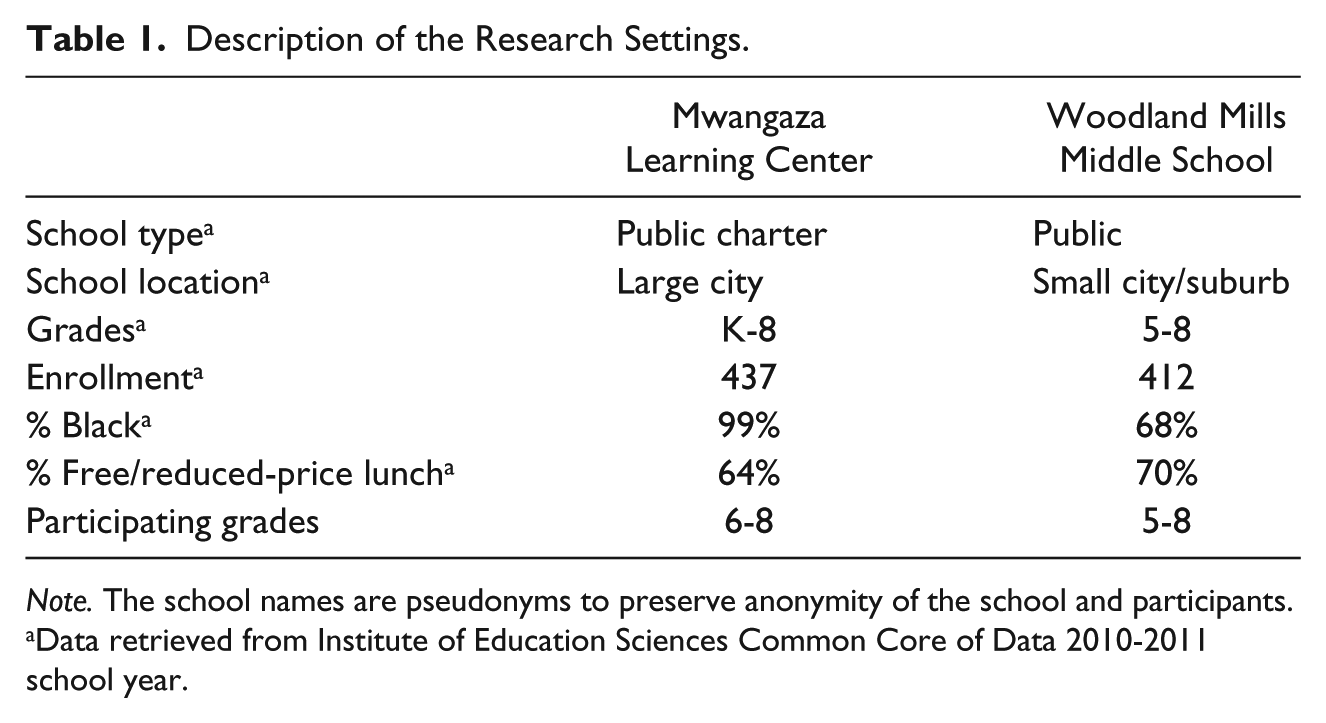
Note. The school names are pseudonyms to preserve anonymity of the school and participants.
Data retrieved from Institute of Education Sciences Common Core of Data 2010-2011 school year.
Procedure
After obtaining Institutional Review Board approval, the first author distributed parental consent forms at each school. Consented students completed a 40-minute civic development survey questionnaire. Following the survey, a subset of students was selected to participate in in-depth semistructured focus group interviews. At Mwangaza, four focus groups of three to five students were conducted during lunch periods (34-57 minutes long). Four focus groups were conducted at Woodland Mills, with four or five students in each focus group. The focus groups were conducted during the elective period and ranged from 37 to 43 minutes at Woodland Mills.
At Mwangaza, students were selected to participate in focus groups based on past civic engagement as reported in the survey. Civic engagement was measured using a modified version of the Youth Involvement Inventory (Pancer, Pratt, Hunsberger, & Alisat, 2007) that included items specific to legal activism and to distinguish prosocial civic and political activities that may be more relevant during early adolescence. Students indicated participation in each of 30 civic engagement activities during the past 12 months. At Mwangaza, the average civic engagement was 14.1 activities. Civic engagement was below average for Focus Group 1 (M = 10.3) and Focus Group 2 (M = 13.4). Civic engagement was above average for Focus Group 3 (M = 18.8) and Focus Group 4 (M = 21.6). At Woodland Mills, student schedules prevented the selection of students based on reported past civic engagement and instead we randomly selected students using a random sample generator to participate based on their elective class period. The average number of civic engagement activities at Woodland Mills was 12.6 activities. Civic engagement was close to the mean in Focus Group 6 (M = 12) and Focus Group 7 (M = 13.8). Civic engagement was below average in Focus Group 5 (M = 10.8) and Focus Group 8 (M = 9.4).
Participants
Thirty-six students participated in eight focus group interviews (see Table 2 for participant demographics). Seventeen students participated in four focus groups at Mwangaza and 19 students participated in four focus groups at Woodland Mills. Twelve focus group participants were males and 24 were females. All students self-identified as Black or African American, with the exception of one male student who identified as Latino. The students ranged in age from 10 to 14 years, with the average age being 12.35 years. The majority of the students (66%) qualified for free or reduced-price lunch, indicating lower socioeconomic status.
Description of Focus Group Participants by School.
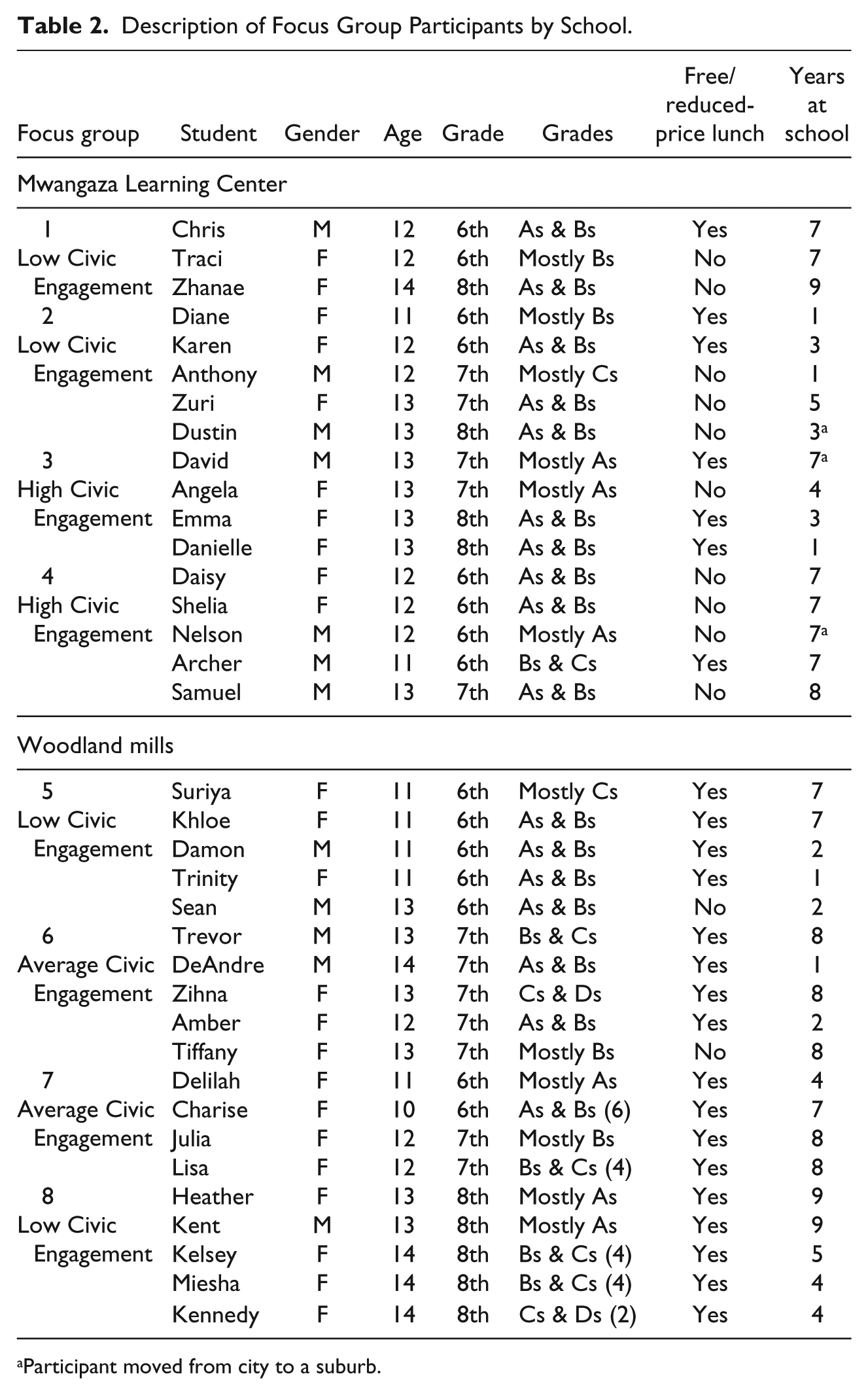
Participant moved from city to a suburb.
Instrument and Rationale
Critical reflection can be a dynamic process, where one seeks to gain an understanding of systemic inequality through considering multiple perspectives and grappling with new ideas (Watts et al., 2011). We used semistructured focus group interviews to make room for consensus and disagreement within the group discussion around local problems, attributions of their causes, and responsibility for solutions. This dynamic process allowed youth to consider alternative hypotheses and reassess their original conclusion—critical reflection in vivo. In addition, focus groups can provide a space for youth who feel less comfortable in one-on-one conversation to participate and to give opportunities for the students to collaborate on ideas, elaborate on each other’s points, and talk through contradicting ideas (Clark, 2009; Hoppe, Wells, Morrison, Gillmore, & Wilsdon, 1995; Russell, Muraco, Subramaniam, & Laub, 2009).
The focus group protocol was designed to capture Black early adolescents’ critical reflection of challenges in their most proximal sociopolitical context, as well as their attributions of the causes of these challenges. Researchers examining how youth understand and analyze the world typically give youth a topic and ask youth to respond with their attitudes and perceptions (Flanagan, 2013). While this approach informs regarding youth comprehension of civic issues and political processes, it does not uncover what issues are most salient to youth and how they make sense of those most relevant concerns. Thus, we asked the youth to identify the challenges most salient in their local context. We then asked each focus group to describe the nature and causes of that challenge, to articulate solutions that address that challenge, and to explain who is responsible for the existing issues and who is responsible for addressing those challenges.
The students described local problems within two contexts: school and community (see Table 3). Mwangaza students lived in The City and focused exclusively on citywide issues, most often naming crime, violence, and gang activity as prevalent community problems, along with education and the economic recession. At Woodland Mills, the students’ discussion centered around the school, implicating school food, bullying, student misbehavior, teachers’ attitudes, and school-district consolidation as the most prominent concerns. The students also discussed gang violence within a particular subcommunity of Woodland Mills.
Community and School Problems Identified by Focus Group.

Note. FG indicates Focus Group.
Positionality
One best practice of qualitative research among racially marginalized communities is positionality—where researchers consider their relationship to the community, the history of the community, and the broader sociopolitical reality of the community (Milner, 2007). The first author, a young Black woman, gained access to each school while she was a graduate student at a local university and was introduced to the school leadership at both schools through colleagues who were establishing university-school partnerships. She had worked on several projects within each community, including a service-learning course that connected university students with local schools. She shared racial background with many of the school administrators and student participants but was not a member of the geographic communities or the generational community of the middle school students. The second author joined this project for data analysis during her first year of graduate school. She is a young Latinx woman who does not identify as Black or African American. She led several research projects that focus on Black middle school students in neighboring geographic areas. Both authors spent time observing classrooms and talking informally with school and community members to better understand the geographic and generational nuances of Black youth discourse among this population. The first author served as the primary researcher for data collection and sought assistance from colleagues who were native to the geographic area. The second author joined the study given her expertise with Black early adolescents in the Midwest, which increased our confidence in interpreting students’ discourse.
Data Analysis Strategy
While the research questions were guided by existing theory and research on critical consciousness and SPD, we used an inductive thematic analysis approach to analyze the focus group data (Braun & Clarke, 2006). We became familiar with the data by reading each focus group transcript and making notes regarding the types of community problems identified, and critical reflection of these challenges. Next, using Dedoose (2015), each author independently generated initial codes beginning with the high engagement focus groups and the low engagement focus groups from Mwangaza, followed by the focus groups at Woodland Mills until all focus groups were coded. We discussed our initial codes and combined them to generate our codebook. In our discussions, we determined whether our codes captured the nuances in how students discussed blame and responsibility across ecological levels. Through our discussions, we recognized that students who talked about the individual ecological level were not inherently implicating individual blame, and likewise, discussions of the macrosystem were not inherently reflective of system blame. This discussion led to the inclusion of codes that captured individual and systems blame at various ecological levels (individual, microsystem, macrosystem). The final codebook reflected community problems, system justifying and system blame attributions of those problems, and responsibility for the community issue. Following the generation of initial codes, we coded the interviews independently. After we coded each interview, we reviewed the coding for consensus and reviewed the themes to determine coherent patterns within the data.
To organize the data, we used an unordered meta-matrix (Miles & Huberman, 1994), which is useful to see patterns and points of departure across sites in a multisite design. We entered each theme into the meta-matrix organized by focus group. We then organized evidence from the focus groups into the matrix by theme and focus group, which aided in reviewing themes for consistency within and across settings. Next, we completed a within-school comparison to interpret thematic patterns among focus groups from the same school and looked across schools to interpret any patterns in critical reflection that differed by school.
Results
Discourse about local school and community challenges and related solutions manifested in four ways: System Attributions—Macrosystem, System Attributions—Microsystem; System Justification & Individual Blame; and Critically Reflective Discourse. These themes represent attributions to social inequality at multiple ecological levels as well as instances that consider both system attributions and system justification. Given differences in the ways that students in both schools talk about their communities, we include comparative analysis within each theme.
System Blame Attributions—Macrosystem
System blame attributions referred to social conditions on an institutional level, placing the onus on macro-level society structures such as government offices or officials (Watts et al., 2011). For example, Zhanae, from Focus Group 1, focused on failures of the criminal justice system as reasons for persistent crime and violence throughout The City, emphasizing how the police do not arrest criminals for serious crimes which impact future crimes:
I think it’s not protected enough. Or just some people need to be locked up for actual crimes instead of these other crimes like, uh, like I said; tickets and stuff the police get people on instead of actually getting the real murderers . . .
Zhanae later connects how a poor economy directly relates to the loss of jobs, which makes crime a more likely occurrence.
. . . well I think we still are in a recession. We are kinda getting out of it and like, not many people have jobs and I think that’s the main problem with the crime too or the main cause of it.
Zhanae contends that citywide crime is perpetuated by failures in both the economic system and the criminal justice system with regard to policing priorities. Her use of the term murderers highlights her understanding that an individual commits a crime. But her analysis of policing and connection of wide-spread crime to the failing economy suggests that she locates the reasons for crime within her community at the level of political systems and institutions.
Mwangaza students also implicated the role of the economy in relation to challenges in education, specifically teacher layoffs. Emma from Focus Group 3 discussed how macro-level issues within the school system impact students’ education and classroom experiences:
Okay, so teachers are being laid off so there’s not anyone to teach the students. There are too many students in the classrooms so we can’t really learn. Some schools aren’t teaching the students at what they’re supposed to be teaching, like they’re teaching on lower levels than what they’re supposed to be learning. And, it’s a whole bunch of other stuff, but I don’t really know how to explain that, so.
Nelson from Focus Group 4 also incorporated system blame explanations in his attributions of the cause of teacher layoffs, assigning blame to elected city officials, and connecting these system-based issues to classroom functioning and student learning outcomes:
Like (clears throat) like my dad is a teacher in The City and like the govern . . . the Mayor or somebody I guess, that’s like running The City and stuff, they like always laying off teachers and um taking down schools and stuff like that. And then let’s say like next year, classes can be like up to 40-something people or 50-something people so then that’s just gonna cause the kids not to learn nothing because they can’t get no attention to learn what they need to know.
At Woodland Mills, students described system blame attributions of sociopolitical issues in their schools through an explanation of the classroom practices. The students in Focus Group 8 described a practice of combining classrooms at their school, where two teachers bring their classrooms together and co-teach. Miesha characterized the joint-classroom as “The bad and a good class together.” Kelsey and Kennedy then explained their perceptions of how the decision to combine classes affects student behavior and learning opportunities in the classroom:
Cuz all the bad people get to sit on one side, mostly and then they stick some bad people over there and they steady talking.
It’s not necessarily about good and bad because, I mean, you’re gonna have, even if you have a good class you’re gonna have a certain student, it’s just certain amount of students that are bad in one class. It doesn’t really matter about that part, it’s just it’s whether they’re learning good enough or not. That’s what it is.
Kelsey describes students who sit on one side of the classroom as talkative and “bad.” Kennedy adds to this, suggesting that the characteristic of good and bad students is inadequate and that it is more important to consider the learning outcomes that result from the combined classroom. To further complicate the discussion, Miesha goes on to say that “It’s kinda hard for us to learn when half the class is talking and the other half is tryna concentrate,” noting the relation between student behavior and learning. Kennedy ends the discussion with a statement about the top-down approach for classroom decisions in the school that limit the voice and choice of students.
They just went ahead and did it without even asking us if we wanted to do it. They was like, oh ummm, when we come back from break we are colliding the classes. We was like, No, why would you do that? That’s stupid. And then they did it anyway.
In this example, the students analyze student behavior and learning outcomes in the context of teacher and administrative decision making. The students acknowledge that the decisions made by school leadership have practical implications for their lives and that they were not consulted regarding these decisions. It is unclear from the student perspective whether the decision to combine classes was an attempt by the school to reduce educational inequality through de-tracking, a behavior management strategy, or a combination of both. What is clear, from the student perspective, is that the decision was abrupt (coming after a break), ineffective, and that the adults made the decision without responding to concerns from students—whom the decision effects. The students highlight that they have insights regarding the relationship between student behaviors and learning the teachers did not consider. This is an important facet of a system blame perspective, wherein people in a position of power do not consider the voice and expertise of subordinate communities throughout decision-making processes.
Along with system blame attributions for the causes of sociopolitical problems, the students in our study voiced critical reflection with regard to solutions and responsibility for enacting change to address local sociopolitical issues. Many of the system blame solutions had implications for policy and program reform. Students assigned responsibility for these problems to public officials such as the President (Focus Groups 2, 3, & 4), the Mayor (Focus Group 1, 2, & 4), the Superintendent (Focus Groups 5, 6, 7, & 8), the Principal (Focus Groups 6, 7, & 8) and others including the Governor, Congress, the Board of Education, and City Council.
The students provided examples of macrosystem solutions that would require adjustments to the current policy within various economic and political systems. With regard to violence, crime, and homelessness, students in Focus Group 2 suggested fixing abandoned houses and organizing a program to place homeless people and families into temporary housing. In Focus Group 4, students at Mwangaza suggested that more police officers are needed to decrease violent crimes in the city, while simultaneously implicating the struggling economy as a deterrent to sufficient policing. They said,
We need more officers . . .
1 : More officers, what’s that mean?
Like the police to like stop the violence and the killing.
Okay.
They can’t because of the economy. I mean they don’t have enough money to pay everybody, but they don’t have to pay some people, because some people can just volunteer to do it. They just don’t have to get paid and people don’t understand that. You don’t have to get paid to do everything.
In Focus Group 1, Zhanae and Chris debated the best way to change the police department and have a positive impact on the community. This discussion was qualitatively different than in any other focus group as they considered merits and disadvantages to various solutions. They considered both increasing the number of and presence of police and reform regarding policing priorities. While the students did not agree on a specific solution, each suggestion incorporated system reform.
Okay, so Chris why do you think we need more police?
Because um, like, uh there’s a lot of, like, robberies, um stuff like that. Like robberies, um, robberies, carjackings, people get kidnapped, killed. Uh, they uh, police need to be like, like in the streets, like not 24/7 like, like most of the time, be there, be there for um like if there’s a crime happening let there be uh, police there.
Okay, okay. And Zhanae?
Um, I don’t think there needs to be more police or less police, I think they need to focus on the right things. Like, they’re, the police are busy worrying about people wearing seatbelts and giving out tickets, but there are still people getting murdered and shot like, um, like Chris had said, but they’re more focused on getting money out of the people instead of actually solving crimes.
Students at both schools also expressed a system blame perspective with regard to issues in education and schooling. Students connected a lack of physical and personnel resources in the schools to low academic achievement and poor academic attitudes among the students. Zhanae from Mwangaza expressed, “I think um, we need a better education system too. Just because it’s in a bad neighborhood, I don’t think they should have a bad school.” The students also suggested solutions to poor quality schools that would challenge the current school system to provide quality education in their underserved communities.
Students at both schools also suggested school-wide reform to increase teacher quality. At Mwangaza, Samuel explained, “I believe the school system, they should hire more teachers that are more serious teachers. Some teachers don’t really teach you, they just play around and laugh and like to talk to students.” At Woodland Mills, students raised similar concerns regarding the hiring and vetting of their teachers. Sean suggested, “If they’ll like check the teachers before they like hire the teachers to like see if they got anger issues or something. See how they act.” Samuel and Sean both recommended that the superintendent and/or principal should implement a more rigorous hiring process to help ensure quality teachers in their schools.
System Attributions—Microsystem
Within Bronfenbrenner’s ecological systems theory, the microsystem represents the ecological system most proximal to the individual, including family, friends, and classrooms (Bronfenbrenner & Morris, 2006). When discussing their local community and school issues, students at Mwangza and Woodland Mills implicated the microsystem—namely, parents and families. While not indicative of broader social and political institutions, these attributions still connected individual behavior to a larger system that the individual navigates. For example, in Focus Group 3, students offered microsystem attributions for violence in the community, specifically implicating the role of parental and familial influence. In this discussion, Angela, Emma, and Danielle describe parent socialization and how children may make individual decisions within the context of their family norms and expectations.
So, you [parent] going to jail in these gangs, your child is most likely gonna be like that.
. . . Yes and you going out there and making a bad influence they gonna do the same thing; “I wanna be like my daddy, I wanna be like my mamma.”
Yeah and these fathers need to take . . . (saying loudly) MORE INITIATIVE WITH THEIR CHILDREN!
Zhanae from Focus Group 1 had a similar explanation for crime and attributed kids’ involvement in crime to their parents:
Because you can’t make someone do something that they don’t want to do. I think we need to instill it in the kids first, because they are the next generation. Then the actual adults, because well, I think most of the kids, they turn out bad because of their parents . . .
The students also gave examples of microsystem attributions that located solutions to and responsibility for sociopolitical issues at the level of the family. Students implicated parent involvement as a solution that considers the role of families but does not consider the role of larger sociopolitical systems on the family. Students at Mwangaza suggested parents, especially fathers, hold significant and primary responsibility for the actions of their children, particularly as those actions negatively affect the community and contribute to the on-going problems within The City. The students expressed that while good parenting does not guarantee children will avoid violence and criminal activities, children with positively involved parents have a better chance to succeed at life, particularly if both the mother and father are involved.
Anyways, but yeah, the fathers need to take more initiative um with their children because not all the problems are from that, but I’ll say a good amount is from . . .
I agree. Actually.
. . . their fathers not being in their life or their mother. It could be in effect with their mother too because it’s not just the father, so actually both the parents, they need to be together. [Focus Group 3]
Angela continues by bringing up the importance of good mothering for children’s well-being and the group finishes this discussion with the conclusion that parents’ positive interactions with their children coupled with good role modeling are in the best interest of the child and overall, parents should be more responsible for their children.
I said mothers have a big, um have a big you know role in their children’s life, but in most cases the father is always gone and there’s the mother taking care of the child, you know what I’m saying. And if they’re doing it wrong, I mean like you can take care of your child really good and they can still grow up to be disrespectful or in gangs and in jail and stuff like that.
Yes, most of the time, if you grow up and have your parents teach you right or discipline you right, you don’t grow up to be like that; you want to make them proud. And if you don’t have a mom like that, that doesn’t really care, and then she doing whatever she want to do and she just can’t wait until you get 18 and get out of her house . . . (laughter) then what you gonna do? You just gonna go run the streets.
Angela and Danielle both emphasize the importance of parents in adolescent social development. Danielle’s statement that youth with parents who do not provide discipline are “just gonna run the streets” suggests that parents are significant contributors to adolescent development. Angela acknowledges the importance of parenting, but argues that a child can still join a gang or go to jail despite involved parenting. This exchange highlights that Black early adolescents understand microsystem influence on social issues, in this cases parents, but vary in the extent to which microsystems are deterministic of child outcomes.
System Justification and Individual Blame
System justifying attributions are explanations that blame individuals for the development and maintenance of social issues, and are representative of a less developed critical consciousness (Watts et al., 2011). Mwangaza students from each focus group described individuals who were culpable for crime in their community. Students in Focus Group 2 expressed that one possible explanation for violence in their community was individuals’ innate predispositions, and lack of concern for the consequences of their behavior.
Maybe just cold blooded . . .
. . . or don’t care how what they do affects other people.
Similar sentiments were expressed in Focus Group 3 in a discussion about why violence exists. Devin explains that violence can be innate within the individual, but if individuals are willing and able to be nonviolent, there can be improvements within the community.
If someone doesn’t have violence in them or maybe like violence or if they aren’t willing to do violence, people will get along more. And when you get along with someone you can create a better bond with someone. Once you have people who have a better bond with one another, you will eventually succeed.
These students described individual attributions such that people will commit violence if they have the innate traits or are predisposed to do so. These examples did not include discussion of macro- or microsystem contributions that might connect individual decisions and individual choices within a broader system. Similarly, Woodland Mills students attributed the poor conditions of their school facilities to the actions of students as opposed to macro-level factors, such as inadequate school resources. These system justifying attributions are evident in Kelsey’s and Miesha’s (Focus Group 8) discussion of the poor state of their school’s bathroom:
I don’t know. Some kids are childish and they kick the little soap thing off the wall . . . Some kids in the sixth grade.
Well yea, if they keep pushing it, it will fall on the floor and stuff . . .
No, no, they kicked it off the wall . . . Out of the main hallway bathroom. They just kicked it off and then threw it away. And then the garbage got taken out and they never seen that soap thing again.
Kelsey’s analysis of poor bathroom conditions does not take into account the school administration’s role in providing new soap dispensers, or macro-level factors, such as inadequate school funding, which might lead students to undervalue their own school property. Instead, this student focused on the individual behavior of her peer in the destruction of the soap dispenser as an explanation for inadequate school resources.
The students also gave examples of system justifying attributions that located solutions to and responsibility for sociopolitical issues at the individual level. The students identified decision making among youth as a solution that could alleviate the problems and challenges faced in their schools and communities. The students felt that by listening to parental advice and staying out of the streets, young people could avoid being associated with victims of crimes and violent acts. As the students in Focus Group 1 describe:
Hmm. I think um, if we like get young people out of . . .
The streets.
. . . yeah, the streets, like they can actually have a friend; a friend that’s in a gang and as they’re walking home they could get attacked by another person’s gang because their gangs are enemies and have wars. So, that person gets, he’s just an innocent bystander while somebody else, while he pays for someone else’s doing.
That’s what my mom said, know who your friends are and watch who you hang out with. Because like it’s so much crime going on, like, some, like I said, some people my age are in gangs. Like, I have a friend who’s in, that’s in one, but I know not to hang out with that person because, say if we’re out in somewhere and they want to fight; I’m just an innocent bystander like Chris said, that just got hurt, because of someone else and me knowing um, that they’re in a gang and me still going along with it; that’s like me putting myself into a dangerous situation before it even happens. Like some things I know young people can prevent from happening, but they just want to do whatever they want to do.
These adolescents, again, emphasize the importance parents have in socializing their child’s attitudes, beliefs, and behaviors (Maccoby, 1992). Here, the message is to consider the sociopolitical environment and make wise decisions in relation to personal safety. These messages may promote critical reflection among adolescents, as they consider the need to be safe, who is safe, and the precautions they have to take to navigate their community.
Critically Reflective Discourse
The final theme, critically reflective discourse, represents instances where the students make attributions that consider the individual’s role in decision making nested within broader sociopolitical systems. These examples represent a sociopolitical analysis that recognizes the interconnected nature of individuals within communities and broader sociopolitical systems. For instance, when discussing the causes of crime, students in Focus Group 1 referenced how a poor economy limits individuals’ access to medication for mental illness, which leads to crime:
Like, some people actually have mental problems, like schizophrenia and stuff and since we’re such in a recession, most people can’t afford the medicine or the proper treatment for their illnesses, so they’re just either robbing people to get money for their illness, or they’re just crazy and they need a lot more medicine than they can afford.
Um, I was just going to say that they’re crazy. Like, Zhanae said, like they’re just like, like she said they have problems and they need medication and they can’t afford it so they go ahead and rob people.
In Focus Group 3, students talked about implementing more programs for children so they have positive things to do during outside of school time, rather than be lured by the prominence of gangs, crime, and violence.
Oh, more um, for the kids? More programs. Have their parents put them in programs so they don’t have time to go out and do all these gangs.
Keep them busy.
Yeah keep them busy and have them dong this and doing that so that way they won’t have time; when they come home, they’re not trying to get their guns they’re hiding, They want to take a nap cause they’re tired from all the things that they’re doing. You know things like that.
Emma also reminds the group that while Mwangaza has substantial student programs, other schools are less resourced. This dearth of alternative activities contributes to the violence problem at large. She explains,
You know we’re able to do these things, but most of the schools and most of the parents don’t care. And like yeah, like how they’re trying to do The City public system and all that type of stuff because of the problem that they’re having, because they don’t have that many things going on at the schools.
Woodland Mills students express awareness that the personal experiences students have with their teachers along with the schools’ access to resources have implications for their academic success.
umm, I think my math teacher does a good job. She teaches us the right things and if we’re not getting something we can ask her. I think that the low test scores really do have to do with their teachers.
I agree.
We’re a part of the WINGS program and people think that we learn so advancedly, but we don’t. Our teachers just teach differently. Not how their teachers teach.
Our math teacher told us that our umm math books aren’t even up to . . .
Up to date, yea up to date.
So, do you guys think that has anything to do with the low test scores?
No. Yes. That has everything to do with the low test scores.
Yes.
Yes
Students at Mwangaza, and less so Woodland Mills, demonstrated critical reflection through integrative explanations of how both individuals and systems can contribute to solutions within their community. Students suggested several system-based social programs that should be created or implemented more effectively. In these examples, the students did not consider individual attributions as excuses to justify faulty systems and blame community members. Rather, they proposed programs and policies to help support individuals and thereby contribute to positive shifts in the community. For example, students in Focus Group 2 talked about the importance of mental health-related interventions, as they saw mental health problems as comorbid with violence in the community and student struggles in the schools.
What else? What are some solutions to the violence problem and the drug problem?
Um, let me think. Giving everybody the right education, don’t make people feel lonely, you know um, making everybody feel like a somebody.
Uh huh. Anybody else have something to add? Solutions?
. . . like say if they had like social problems, like whenever they were like young, then they grew up to be like crazy, but just give them somebody to let all of their anger out on, without using violence.
When asked to identify people responsible for solving the community or school problem, students at both schools implicated themselves and their generation. At Woodland Mills, Trevor said, “Us. Because we make the community. We [are] the future.” This sentiment was expressed across each focus group; students identified the community as responsible for making local improvements, emphasizing that community members can impact each other and that when one person begins to do well there can be a chain reaction of positivity throughout the community.
[The community is responsible] because their community is the one being jacked up, messed up, so they need to take things in their own hands.
Okay. And you said . . . you said us and then?
I said, um, everyone . . .
Everyone, okay. So why is it everybody’s responsibility?
Because like, everything you do has a chain reaction. So when you like forget to do something or mess up or like go mess with somebody, then that’s going to have a chain reaction on your life and theirs and the whole community. So say like, TaRondo was picked on like his whole life, then he grew up just, out of the ordinary just there and he’s like insane. And then, now, the people who mess with him are regretting it and then just, like, like . . . How do I put this? Like his community . . . like you know community has to make it better, like since everyone caused the problem, everyone has to work together and fix it.
Discussion
We investigated how Black early adolescents interpret their sociopolitical environment in terms of system blame and system justifying attributions. Critical consciousness theory suggests that a deep analysis of sociopolitical structures is an essential component of civic participation of disenfranchised people, especially toward justice-based change (Watts et al., 2011). Our research extends this growing body of research (see Diemer & Rapa, 2016; Godfrey & Wolf, 2016) and clarifies how critical reflection manifests among Black early adolescents who contend with racial and economic marginalization. Our findings reveal that critical reflection can and does occur during early adolescence. These early adolescents engage in four types of critical reflection: system blame at the macrosystem level, system blame at the microsystem level, system justification, and an analysis that integrates and connects both individuals and systems. Critical reflection among Black early adolescents is complicated and demonstrative of the recursive nature of critical consciousness development, wherein youth cycle between experiencing the world and making sense of that world through critical reflection.
Expanding Definitions of Critical Reflection
Current mainstream approaches in critical consciousness research use quantitative methodology to capture critical reflection (Diemer, Rapa, Park, & Perry, 2017; Shin, Ezeofor, Smith, Welch, & Goodrich, 2016; Thomas et al., 2014), and assign numeric values to denote the extent to which youth perceive inequality and endorse egalitarian beliefs. There is a need to understand the complexity of youth’s critical reflection through qualitative methodology (Diemer et al., 2016; Hope et al., 2015), and our study addressed this call by employing semistructured qualitative focus groups to expand our understanding of critical reflection. At the same time, researchers have noted, “youth’s sociopolitical wisdom are difficult to capture . . . and may not always be discrete and clearly political to observers” (Sánchez Carmen et al., 2015, p. 835). Critical reflection and SPD during adolescence are dynamic, contradictory, and context-dependent.
The current findings highlight the complex nature of critical reflection among Black early adolescents. Scholars posit critical reflection is a fundamental component of the civic development process, particularly with regard to action toward social equality (Watts et al., 2011). Responsible social justice-oriented citizenship is, in part, built on a foundation of consciousness of systems that create and sustain oppressive sociopolitical conditions. When asked to describe the identified community problems and solutions, the early adolescents in our study gave examples that suggested a more developed critical reflection, as evidenced by system blame perspectives and attributions that connected individual behavior to constraints within the microsystem and macrosystem. This held true for youth in both urban and rural environments, who described individual attributions in addition to system attributions, rather than in contrast. System justification theory suggests that people seek to justify current social and cultural systems in order to make sense of the inequitable way our society functions (Jost et al., 2004). This work, however, does not regularly attend to how citizens who are disenfranchised by inequitable systems make sense of those systems. In our findings, and contrary to theoretical assertions, students attributed individuals and groups of individuals alongside and not in contrast to systems attributions. This finding adds to our current literature to suggest we might consider hybrid attributions which acknowledge systems and the role systems have on individual behavior, but also consider the roles of individuals within systems.
Our findings also broaden definitions of critical reflection by elucidating early adolescent attributions of social responsibility. The students embrace the concept of social responsibility and implicated different stakeholders as holding the burden of responsibility. Most groups expressed that youth should be responsible for the civic well-being of the community. Other groups articulated that members should be responsible for investing in their own communities, and should not wait for politicians to make positive investments on behalf of the community. Our participants asserted politicians and public officials (e.g., Mayor, President, Superintendent) should be responsible for improving social conditions, particularly because it is their job. The students were clear that someone is and should be responsible for these social issues, though they express multiple and varied expectations regarding the distribution of that responsibility. At times, social responsibility aligned with attribution of the sociopolitical issue, such that a mayor should be responsible for issues with crime. In other instances, social responsibility fell to the individual despite system or integrated individual and system attributions. This suggests that a conceptualization of critical reflection that includes both the systemic roots of racial and economic oppression alongside social responsibility can deepen our understanding of SPD among adolescents from marginalized groups.
Context Matters for Critical Reflection
In the current literature, critical reflection is often described as perceptions of inequality in society, the extent to which they assign blame to individuals or systems for these disparities, and support for equality and justice for all groups (Diemer et al., 2015). These conceptualizations of critical reflection are oriented within the broader society and not the adolescent’s most proximal sociopolitical contexts. Our findings extend previous accounts by emphasizing that youth’s perceptions and attributions of social inequality in their sociopolitical contexts are situated in and framed by their proximal and distal contexts. In The City, the students interpreted the entire city as their local context, with crime and violence being the most salient issues. At Woodland Mills, the students focused on the school district as their proximal context. The delineation of students from The City describing community-level problems and students from Woodland Mills describing school-level challenges provides evidence that point-of-reference dictates sociopolitical salience. In previous work, scholars have provided students with a list of problems; it seems that researchers might consider broad methodological parameters that allows students to define geographic and relational community to add to our understanding of the development of critical consciousness, and thus civic engagement (Flanagan, 2013). Scholars posit that oppressive circumstances in urban communities, such as many of those identified primarily by students in The City, can contribute to declines in civic engagement and programs that promote and support civic growth (Ginwright, 2010). Less is known about how oppressive circumstances in suburban and rural communities might impact critical consciousness and civic development among Black youth. By understanding the sociopolitical environment that youth are most familiar with, we can also begin to understand the nature of critical reflection, and the political knowledge necessary to effectively navigate municipal systems toward social change.
Another aspect of context that we must consider is relational community. Peers, family, and community members support youth critical reflection of inequality and social action to address these injustices (Diemer, Kauffman, Koenig, Trahan, & Hsieh, 2006; O’Connor, 1997). In the current study, youth implicated parents, teachers, and peers as important socializing agents. Students noted that “fathers need to take more initiative with their children,” and “kids should listen to their parents.” While our data did not focus on the socializing role of adults and peers with regard to critical reflection, relational community and socialization may have differential impacts on youth critical consciousness. Research finds that when youth do perceive social injustice, they turn to trusted adults and peers for advice on how to cope with oppression (Thomas & Blackmon, 2015). Parents, peers, and mentors provide opportunities for stimulating conversations about injustice, which may influence how youth describe the presence, causes, and responsibility of social inequality in their lives (Watts & Flanagan, 2007). The Black early adolescents in the current study who made more system attributions may have benefited from influential peers, parents, and teachers who facilitate critical reflection of structural oppression.
The political and racial socialization youth experience in their social contexts might also contribute to their critical reflection of social inequality. There is evidence to suggest that school race relations, an implicit form of racial socialization, positively contribute to youth’s political sense of self and motivation (Diemer, Hsieh, & Pan, 2009; Hope et al., 2015). Furthermore, a common form of socialization practiced within African American families is racial socialization (Tamis-LeMonda, Briggs, McClowry, & Snow, 2008). While the students in our study did not directly connect their race with the messages they receive from their parents about safety and dangers within the sociopolitical environment, this discussion is suggestive of preparation for bias messages, which parents use to warn a child about potential discrimination (Hughes et al., 2006). In fact, Black adolescents who receive more explicit racial socialization messages that emphasize Black pride participate in more prosocial behaviors in the community (Lozada, Jagers, Smith, Bañales, & Hope, 2016). The Black youth in the current study who engaged in critically reflective discourse and system blame attributions may have received parental political and racial socialization that included cultural knowledge, preparation for discrimination, a greater understanding of the causes of structural oppression, and awareness of the individuals considered responsible for addressing oppression.
Limitations and Future Directions for Research
This research adds complexity to the critical consciousness and SPD literature but is not without limitations. Caution should be exercised when generalizing these findings beyond Black early adolescents in the economically declining Midwest. This setting provided a fertile environment to deepen our conceptualization of critical reflection and findings revealed the relevance of context. Thus, future work should consider experiences of Black early adolescents in other locations, to include geographic, municipal, economic, and ethnic variation.
The nature of the current research methodology, that is, one-time focus groups, does not allow for determinations of causality for youth’s critical reflection. It is unclear whether youth will follow a linear progression of critical reflection, developing a more complex analysis of social inequality in their schools and communities over time. Linear development of critical reflection from acritical to more critical, however, is unlikely as adults, similar to adolescents, rely more on individual attributions to explain life circumstances as opposed to system attributions that acknowledge the interplay between institutions, opportunity, and success (Jost & Hunyady, 2005). Future research should employ longitudinal qualitative analysis to carefully analyze the causal precursors and outcomes of Black adolescents’ critical reflection.
Our findings confirm the need to develop reliable measures of adolescent critical reflection. Current quantitative measures are generally abstract and capture an ideological stance (e.g., egalitarianism), rather than the nature or type of critical reflection in relation to specific issues (Bañales & Rowley, 2016). This method elucidates general equity beliefs, but does not consider differences in egalitarian beliefs across domains (e.g., race, gender, class). Measures should capture the range, depth, and intersections of youth critical reflection. Moreover, historical knowledge of social movements is a theoretically meaningful aspect of critical reflection that should be considered (Sánchez Carmen et al., 2015).
Finally, future research should consider schools as socializing agents. Our participants demonstrated between-school differences with regard to complexity and nuance of analysis. Researchers might consider schools as an organizational setting that provides opportunities for critical reflection and civic engagement. Results also indicated gaps in civic knowledge where descriptions of political processes were inaccurate. Through further education and socialization, it is possible that early adolescents who are capable of discussing sociopolitical issues at various systems levels can grow and develop with regard to critical reflection and other dimensions of critical consciousness. Future research should, therefore, explore the quality, quantity, and content of civic education to understand how schools teach citizenship to students who face political disenfranchisement. Equally, researchers should investigate how Black students interpret the civic curriculum. Schools function as “mini-polies” that replicate the civic and political structures and practices of broader society (Fine et al., 2004; Flanagan, 2013). Thus, it is important to understand what Black students learn about citizenship through the curriculum, classroom dynamics, and social interactions.
Implications for Policy and Practice
This research has implications for youth practitioners who aim to support critical reflection of Black early adolescents. Critical consciousness is iterative, relational, dialectical, and contextual (Freire, 1970) and practitioners may implement community-based intergroup dialogues with Black early adolescents from different demographic regions and social class backgrounds to allow youth to explore and question diverse perspectives on social inequality in their communities and society (Aldana et al., 2016). Our research contributes evidence that these types of discussions and programs are developmentally appropriate for early adolescents, as young as the sixth grade. Intergroup dialogues and youth civic development programs should intentionally leverage discussions of past, present, and future sociopolitical experiences as SPD rests on integrating historical experiences with current realities for an understanding of the sustained nature of oppression (Sánchez Carmen et al., 2015). Youth intergroup dialogues and other programmatic efforts that incorporate critical consciousness pedagogy extend beyond the community level and show promise in increasing youth’s academic achievement (Luter, Mitchell, & Taylor, 2017). Given the capacity of early adolescents to consider various system justification and blame attributions and engage in critically recursive dialogue that simultaneously considers multiple attributions, the promise of critical consciousness pedagogy can and should be extended to early adolescence.
The cognitive and social-emotional maturity that our participants demonstrated through discussion of program and policy initiatives invites the possibility of including adolescents more regularly in policy reform and program implementation decision making. Indeed, research has found that youth as young as 12 years old can participate successfully in local policy decisions (Checkoway, Allison, & Montoya, 2005). Participants demonstrated complex thinking and imagination to describe how youth can contribute to their community through program and policy solutions. Many of the solutions integrated system responsibility and individual responsibility, describing how system-based policies and programs might help address specific individual issues that contribute to broader community problems. This type of critical analysis and discussion are skills that are regularly used in political and civic activities, including participation in city councils, voting, and debating political issues. As we scaffold these critical reflection skills, we prepare future community and political leaders that are committed to civic engagement and equipped with skills to impact social change.
Summary and Conclusions
Altogether, this work highlights the vast and distinct ways that Black early adolescents engage in critical reflection. We find that Black early adolescents are able to articulate and describe salient local sociopolitical issues with a range of complexity. They consider systems and individual contributions to local problems discretely, and via integrated processes. These early adolescents also discuss social responsibility among youth, communities, and public officials, implicating each party as accountable for community well-being. Our participants are aware of the sociopolitical challenges in their communities, as young as 10 years old. They offer complicated analyses to address the systemic and individual roots of such challenges. The youth also articulate their responsibility, along with community and public officials’ responsibility to alleviate both the symptoms and root causes of such community problems. Within the Black community, there is a historical narrative of against-the-odds political and civic participation despite political marginalization. In the context of this history, it is important to understand how Black youth develop a civic identity, understand their sociopolitical context, and act therein. Researchers, educators, and policymakers should continue to support these processes that contribute to lasting civic participation among the Black community.
Footnotes
Declaration of Conflicting Interests
The author(s) declared no potential conflicts of interest with respect to the research, authorship, and/or publication of this article.
Funding
The author(s) disclosed receipt of the following financial support for the research, authorship, and/or publication of this article: The authors received funding from the University of Michigan Rakham Graduate School for the research conducted in this article.