



Abstract
A promising approach to support positive youth development is having adolescents serve as teachers for younger children. Through a qualitative interview study, we explored adolescents’ development in their role serving as teachers for younger elementary-age children during out-of-school time; programs were managed by the University of California 4-H Youth Development Program. We interviewed 32 teenagers (median age 15; 27 female, 5 male) about their experiences, growth, and learning. Through consensus-based inductive thematic analysis, we identified 26 codes that we analytically sorted and found they aligned with the six indicators outlined by the Five Cs of the positive youth development model. Adolescents reported positive experiences and their own growth in competence, confidence, connection, caring, character, and contribution. Furthermore, data indicated that contributing in a meaningful way was developed in tandem with the other Cs.
Background
Positive youth development (PYD) is an approach to understand, research, and guide program practice (J. V. Lerner, Phelps, Forman, & Bowers, 2009; National Research Council and Institute of Medicine [NRCIM], 2002). A promising program practice to support PYD is having adolescents serve as teachers of younger children, known as teenagers-as-teachers (Murdock, Lee, & Paterson, 2003), cross-age teaching (Shanahan, 2015), or youth as teachers (National Commission on Resources for Youth, 1974). This article reports on adolescent outcomes from five teenagers-as-teachers programs. We conducted semistructured interviews with the adolescents and asked them to describe their experiences, what was important to them, and what they thought they learned. We analyzed interview transcripts using inductive thematic analysis.
Theory of PYD
PYD has gained momentum as an asset-based alternative to prevailing deficit models of adolescent development (R. M. Lerner et al., 2011). A primary assumption is that positive development is promoted across the life span when the ecological assets surrounding an individual are arranged well, by oneself and/or others (R. M. Lerner, Bowers, Geldhof, Gestsdottir, & DeSouza, 2012). PYD promotes a holistic perspective of youth well-being and thus integrates multiple outcome indicators (J. V. Lerner et al., 2009; NRCIM, 2002). As a whole, PYD frameworks promote holistic viewpoints of well-being while emphasizing the interdependent role of individual agency and supportive environments (Heck & Subramaniam, 2009). A plethora of PYD frameworks exist with multiple definitions, lists of outcomes, and practices; see Heck and Subramaniam (2009), R. M. Lerner et al. (2011), and Synder and Flay (2012).
The Five Cs of PYD is a prominent model advancing five outcome indicators: competence, confidence, connection, character, and caring (R. M. Lerner, 2004, 2007). The Cs represent an integrated list of positive indicators that are mutually reinforcing, do not have an upper limit, and are hypothesized to lead to the manifestation of a sixth C—contribution. Together, they describe a thriving life trajectory (R. M. Lerner, 2004). While the literature refers to the model as Five Cs, here we integrate contribution and refer to the set of indicators as just the Cs. The Five Cs of PYD model hypothesizes that contribution emerges when the other Cs are present (R. M. Lerner, 2004), thus young people who display the Five Cs will become active contributors to themselves, their families, communities, and the world (J. V. Lerner et al., 2009). Contribution takes many forms such as contribution to family by helping with chores, to schools by participating in school government, and to communities by volunteering.
Teenagers-as-Teachers Program Model
Having adolescents serve as teachers of younger children is a promising approach to support PYD. Adolescents are well-situated for teacher roles due to their cognitive and social-emotional development and readiness for independence. The teenagers-as-teachers model places adolescents in the role of teacher, providing an opportunity to learn about themselves in a new context. Teenagers learn child development, engage in real-time problem solving, and gain practice evaluating their own teaching skills (Emil, Dworkin, & Skelly, 2007; Murdock et al., 2003). Teenagers often relate well with children, and children often look up to teenagers, thus helping to establish a positive learning environment (Ponzio & Peterson, 1999). Programs provide opportunities for adolescents to be engaged in a socially meaningful and useful way in their own development and the growth of the younger age children (Shanahan, 2015).
Previous empirical work demonstrated that these roles provide benefits to the teenagers and the children. Dean and Murdock (1992) conducted a study with 14 adolescents to assess outcomes from teenagers teaching science to fifth-grade students. Academic behaviors remained constant (e.g., participating in class activities, missing homework), half reported increased science interest, and all reported willingness to participate again. Jorgensen (2000) interviewed 89 teenagers implementing science lessons with elementary children. Teenagers reported gaining insights into teaching and dynamics of working in teams, along with developing a more positive view of science. Murdock et al. (2003) theorized that teenagers-as-teachers programs support the advancement of abstract thinking, identity work, provide a sense of autonomy, improve academic achievement, and support youth into their transition to adulthood. Hammond-Diedrich and Walsh (2006) utilized interviews and field notes to explore a program involving 11- to 15-year-olds teaching physical education to fourth-grade students. They found that teenagers improved their teaching skills, performance in school, and sense of responsibility. Bird and Subramaniam (2011) surveyed 44 teenagers responsible for teaching science lessons at an overnight environmental educational camp. Participants reported improving their organizational abilities, skills working with children, and public speaking, in addition to feeling as though they contributed to their community. Other researchers demonstrated that teenagers improved their teaching skills (Ripberger, Devitt, & Gore, 2009), social and emotional learning (Shanahan, 2015), and a greater understanding of child development (Schine & Campbell, 1989).
Despite these empirical efforts, teenagers-as-teachers has not received as much attention as cross-age tutoring (Devin-Sheehan, Feldman, & Allen, 1976) and mentoring (DuBois, Holloway, Valentine, & Cooper, 2002; Karcher, 2005; Karcher & Nakkula, 2010). Teenagers serving in a teacher role differ from that as a peer mentor or tutor because in a teacher role, youth assume a larger responsibility for the program’s success (Shanahan, 2015). Adolescents are the lead teachers of a subject matter curriculum where they introduce new information. This is in contrast with mentoring or tutoring where teenagers review previously taught concepts, assist adults, or informally share experiences. In a teacher role, adolescents are responsible for working with groups of students, rather than the one-on-one experience typical of tutoring or mentoring.
Methodologically, previous research on adolescent outcomes in youth development programs has often employed a priori constructs relying on quantitative measures (R. M. Lerner, 2007). Within the Cs framework, there has been very little qualitative empirical work to understand experiences from young people’s point-of-view (but see Hershberg, DeSouza, Warren, Lerner, & Lerner, 2014) and why they thought these experiences were (or were not) significant or meaningful. In addition, there is limited empirical research demonstrating adolescent outcomes from participating in teenagers-as-teachers programs utilizing a PYD framework. Furthermore, PYD research has mostly been conducted in White, middle-class populations and not in culturally diverse groups (Benson, Scales, Hamilton, & Sesma, 2006; J. V. Lerner et al., 2009). The present study addresses some of these concerns.
Method
We conducted this study to address the question, What do adolescents describe as their own growth through participating in a teenagers-as-teachers program? The question supported an exploratory approach, so we employed a multisite, semistructured interview design to solicit adolescent experiences from their participation in teenagers-as-teachers programs (Seidman, 2013). We analyzed interviews using inductive thematic analysis and did not initially rely on an established coding scheme. We then analytically sorted the resulting 26 codes and found that they aligned with the six indicators in the Five Cs of PYD (J. V. Lerner et al., 2009).
Participants
Participants were selected from five teenagers-as-teachers programs operated by the University of California 4-H Youth Development Program. Programs provided elementary-age children with experiential opportunities related to science, environment, and gardening. Programs utilized a similar program model, although they varied in the demographics of elementary students, the curriculum, training provided to teenagers, and support provided by adults (see Table 1). Adult program leaders invited all adolescents from each program to participate in the study. We obtained parental consent and youth assent prior to the interviews. We interviewed approximately half of the program participants; however, program participation was calculated for school-year enrollment and some youth only participated in the first of two program cycles. Interviews were conducted in the second cycle, so only youth who were participating in both (or the second) cycle would have been offered an interview. Of those, a few youth declined to be interviewed, some youth did not provide a parental informed consent form, and there were scheduling conflicts where the young person was not available on the day the interview team was present at the program site.
Research Site Descriptions and Sample Demographics.

We conducted 24 interviews with 32 youth (ages 11 to 19; median age = 15; 27 female, 5 male; 18 Latino, 8 White, 4 Asian, 2 Black) in two waves during the spring of 2013 (n = 9) and 2014 (n = 23). The sample demographics were generally representative of adolescent program participants on gender, age, and race (see Table 1). Participation duration for youth in the sample ranged from brief (3 months) to long-term (4 years), which was representative of all youth participants at three of the five sites. Sample youth at the other two sites were generally involved in the program for longer than their counterparts. Youth were given the option to be interviewed individually or in pairs to decrease anxiety, establish trust, bridge cultural differences, and lessen inherent power imbalances between interviewer (adult) and respondents (youth; Bassett, Beagan, Ristovski-Slijepcevic, & Chapman, 2008). Eleven youth were interviewed in pairs (average length = 33 minutes) and 13 youth were interviewed individually (average length = 20 minutes). While interviews with pairs resulted in longer transcripts, we did not detect any significant differences in the content generated compared with single interviews.
Procedures
The semistructured interview protocol consisted of 21 prompt stems designed to elicit participants’ experiences in the program, motives for becoming involved, reflections on working with children, thoughts about their own development, contemplations on relationships, and programmatic supports (e.g., training and curriculum). The interview team consisted of the first author (White male, conducted 14 interviews), second author (White female, conducted seven interviews), and the Science Program coordinators (Latino female, conducted two interviews; and White female, conducted one interview). We conducted 22 interviews in English and two in Spanish. We recorded and transcribed interviews. Participants’ names are pseudonyms.
Analysis
We applied inductive thematic analysis “without trying to fit it into a pre-existing coding frame” (Braun & Clarke, 2006, p. 83) to search “across a data set . . . to find repeated patterns of meaning” (p. 86). The research team analyzed interview transcripts collaboratively, through a consensus-based and systematic process designed to emphasize diverse perspectives. Through this consensus-based process, codes were anchored to the transcript. By defining each code from excerpts, the emerging codes served to mediate our interactions. Our process of establishing a coding scheme was less about data reduction and more about making meaning from an individual’s narrative. We applied attribute coding to each transcript to record pertinent information (Saldaña, 2016), for example, site, single or pair interview, age, gender, ethnicity.
Specifically, to begin, we employed initial coding (Corbin & Strauss, 2015; Glaser & Strauss, 1967). The team (all authors) coded the longest transcript; we developed our own codes, applied to the transcript, and then, as a group, discussed our reasoning and evidence. We sought evidence of youth outcomes, that is, searching the transcript guided by the prompt, What did the participants say they had learned, gained, improved, or recognized about themselves in this program? The outcome from this process was a list of 38 initial codes. The lead and second authors then independently coded two additional transcripts and reached consensus on code application: the code list was modified. The full team reviewed code applications and reached agreement; this resulted in a slightly revised code list. To analyze the remaining transcripts, each author was randomly assigned a subset of transcripts and worked independently. A researcher was assigned as an auditor to review the coder’s completed transcript. This approach—primary coder and secondary auditor—was a form of accountability seeking to reach intercoder agreement (Cornish, Gillespie, & Zittoun, 2013).
After all transcripts were analyzed, we prepared analytical memos representing patterns within each code. Through an iterative process, each of us searched for trends supported by transcript data, actively searched for negative cases, and came to consensus regarding the evidence-backed claim. Excerpts were often marked with multiple codes, which revealed the complexity in studying young people’s perceptions of their experience. This process involved merging of codes with similar excerpts or conceptual similarities, which resulted in a final list of 26 codes (see Table 2). The first transcript was coded by hand while the remainder were coded with computer assisted qualitative coding software (Dedoose, 2016).
Our Emergent Codes Grouped Into Themes: Motivation and the Six Cs of Positive Youth Development.
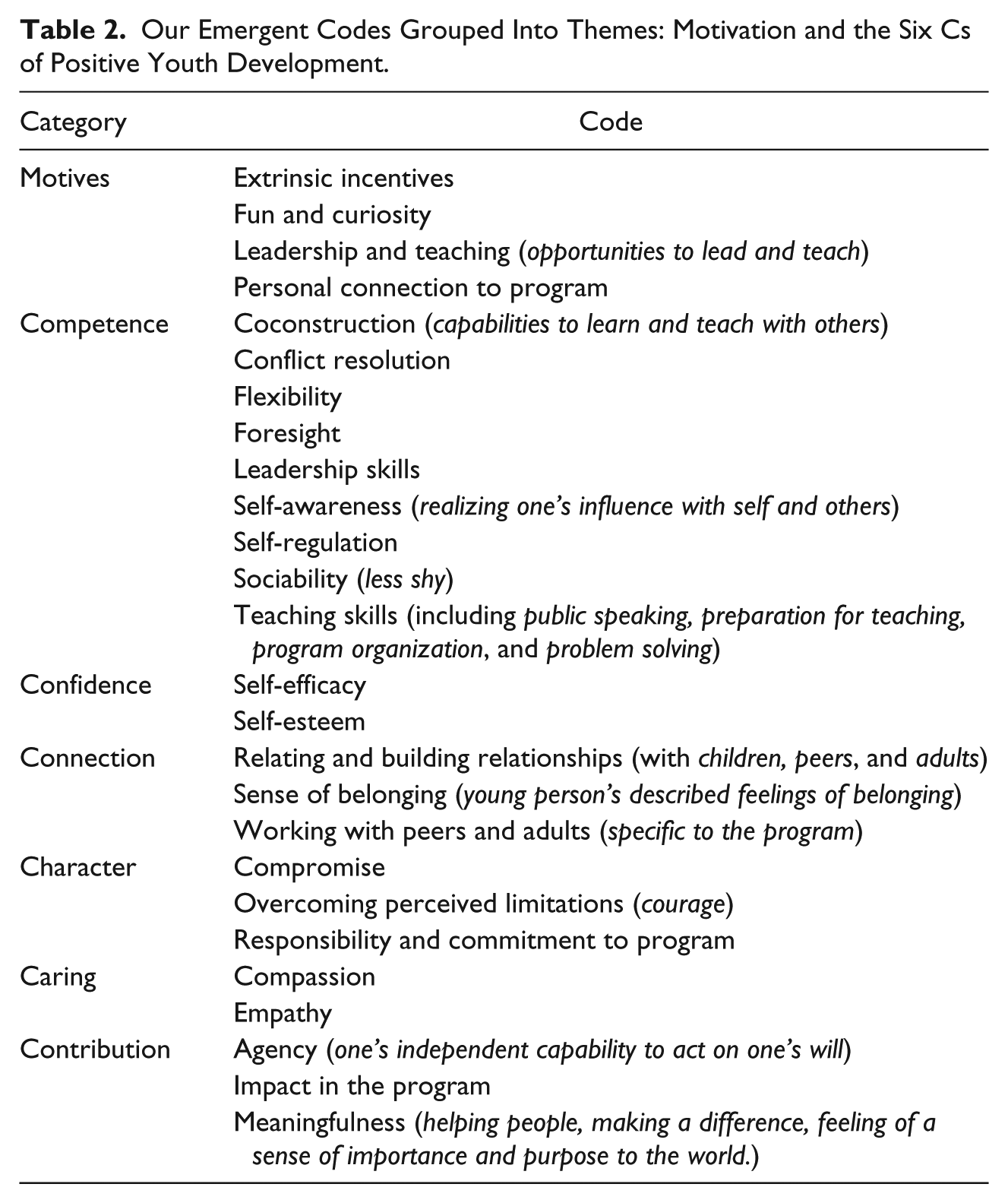
As a next analytical step, we reviewed excerpts and organized codes into similar groupings, based on group consensus. As codes were grouped, we observed that groupings reflected an existing theoretical framework, the six indicators of the Five Cs of PYD (e.g., R. M. Lerner, von Eye, Lerner, Lewin-Bizan, & Bowers, 2010). We moved forward with analytically sorting each code into a C based on the construct definitions (e.g., R. M. Lerner et al., 2010). When disagreements arose on the organization of a handful of codes into a specific category, we discussed disagreements until reaching a consensus. The result was most codes being associated with a C (see Table 2). Several codes related to motivation were categorized under a separate theme.
Trustworthiness was strengthened, in part, by bringing four perspectives to bear on representations of data. Our research team’s background was diverse, including experience in informal learning contexts, program evaluation, and child and human development. In addition, we employed two forms of triangulation: data triangulation (multiple interviews from multiple sites) and analyst triangulation (four investigators analyzing data; Patton, 2015).
Findings
Transcribed narratives provided a rich tapestry of data grounded in the participants’ experience. While our task was identifying emergent themes in perceived learning and development across sites, there was ample variation in how youth reflected upon, made sense of, and articulated their experience. As we analyzed, coded, and interpreted transcripts, we found evidence for growth in each C for every participant common across sites. We present our findings, first briefly describing the motives for youth to join, and then by each respective C.
Almost all (28 of 32) teenagers had a personal invitation from a friend or adult. While socializing with peers and satisfying school community service requirements may have been initial reasons cited for joining, adolescents reported that they continued for other reasons, including personal enjoyment, opportunities to work with peers, building connections with the children they taught, receiving positive reactions by the younger children, and feelings of importance and meaningfulness in practicing and mastering their roles.
Competence
All 32 teenagers interviewed discussed developing leadership skills as it related to a host of abilities including teaching, public speaking, organizing activities and logistics, planning and preparation of lessons, speaking in front of others, issuing instructions, and posting questions. When asked what advice they would give to other youth leaders, Gloria said,
Probably to just plan. . . . like have lesson plans all ready and stuff because at the beginning we wouldn’t really have that many ideas so we would sit at our meeting and we’d be like, “Oh, what are we going to do?” Now we just get the hang of it and we’re just like, “Oh, we should do this, this, and this.” (Gloria, age 15, Science Program)
These words show Gloria’s growing competence serving in a teaching role. Teenagers also spoke about program organization, group management, logistics, and transportation. Problem solving during the sessions was also noted, for example, splitting children into groups when an activity was not working as intended, adapting curriculum before sessions or during the implementation, discussing activities and plans with each other, and trying to find solutions to shared challenges.
Teenagers spoke about leadership using the words “role model,” “teamwork,” and “determination” in relation to their role as a teacher and leader, while describing the balance between “being fun” and “being in charge” with respect to younger children. Concurrently, teenagers reflected on their growing sense of leadership in relationship to the children.
When we first started, they [children] didn’t think of us as a leader, they thought of us as one of their peers, ’cause we’re only a few years older than them. So then, after a few weeks they would start to understand that we’re there teaching them something and they would listen. (Miyu, age 14, Youth Experiences in Science)
Like Miyu, teenagers (24 of 32) reported a growing realization that children would treat them with respect, even given only a few years difference in age. Although two sites provided multiple-day training sessions to prepare teenagers in the use of pedagogical methods, the interviews demonstrated that at all sites competence arose from issues of practice, that is, teenagers described their growing competence because of the teacher role and not the training itself.
Confidence
Adolescents (24 of 32) reported growing more comfortable and confident over the course of the program in connection with teaching and working with younger children. Participation as a teacher led adolescents to recognize that they served as role models and that children were looking up to them. This also helped teenagers feel more secure and confident. Many participants (20 of 32) described initial anxiety, introversion, and/or nervousness and, through serving as a teacher, becoming more comfortable and confident over time. Alejandro (age 14, Nature Club) stated, “I’m not really that nervous going in front of people anymore.” Like other adolescents, Mason described what he reflected as the most difficult activity.
Getting up in front of people and talking. I’m generally an introvert; I’m not a talking-in-front-of-people kind of guy. But that program forced me to . . . go up in front of people and talk and work with kids and be in a leadership position where all eyes are on me . . . that was a small way, a building block. . . . like a starting point for me as far as taking on leadership positions and having responsibility. (Mason, age 19, Farm to Fork Program)
A handful of adolescents reflected on how their growing confidence influenced their career goals. They recognized that the role forced them to move outside their comfort zone, be present in front of people, and employ public speaking skills. Teenagers also attributed this teaching role to improving their confidence to assume other leadership positions. While teenagers described their confidence building mostly in relation to the teaching role, as opposed to other areas in their lives, the teaching role and the skills that are part of it (e.g., public speaking, leadership) will be useful in future educational and career endeavors. Thus, by participating and growing these skills, teenagers may be more confident in future situations where they are required to manifest similar skills.
Connection
All 32 participants described working with others and most (27 of 32) discussed relationships they built with the children they taught, the adults they worked with, and their peers. Strengthening connections related strongly to what teenagers reported enjoying about the program. Participants described their work with children as fun and enjoyable. They repeatedly mentioned being, and bonding, with the younger youth as a positive aspect.
I felt admired because when they had a question toward me, I would see the shine in their eyes and I was like, “Okay, so they’re looking up to me; I’m not going to let them down.” So that was probably one of the best experiences of my life and I want to continue doing it next year. (Adelia, age 18, Science Program)
Connection between teenagers and children emerged as a powerful experience. Teenagers felt special because of their status and they also felt the authority in their role. Several adolescents voiced trepidation in working with the younger children and wondered whether children would respect them. Teenagers occasionally struggled to gain respect from the children they taught, and identified circumstances, such as age and familiarity, that influenced their ability to form respectful teacher–student relationships. Baako (age 12, Youth Experiences in Science) said, “I think the hardest part was trying to talk to them, because everyone knows that I’m the youngest one here.” Kanya (age 13, Youth Experiences in Science) shared, “Well, I already knew half of them so it was already challenging ’cause they saw me as a peer, not as an authority.”
Teenagers (31of 32) described working with adults where adults supported, coached, and encouraged their involvement in decision making. Teenagers found experiences meaningful when adults displayed a personal connection through support, respect, equality, and mutuality for them in their role as teachers. Adults filled supportive roles including handling practical tasks, assisting in organizing lessons, and helping teenagers reflect upon their experience.
I’m really fascinated about how we talk about what we do during spring break or what’s our summer plans. I really like that. I mean, getting that personal connection with them [adults] kind of feels, it makes you feel more comfortable working with them especially. (Yuri, age 15, Youth Experiences in Science)
Establishing friendships with peers was both a motivating and important outcome. The program provided opportunities for teenagers to meet, work with, and rely on peers. Teenagers commonly reported volunteering for the program because their friends were involved. Over time in the program, they reported deepening their connections with new peers. A group of teenagers expressed concern or fear of not knowing others, or being left out, when starting their project.
To be honest, at first I was really nervous too, because I didn’t know anyone also. My stepdad came with me, though, like for the beginning for a little bit because I was nervous and didn’t want to be by myself. (Kiku, age 17, Youth Experiences in Science)
Adolescents mentioned intentional activities designed to promote group cohesion as effective in helping them become more comfortable with each other and their role as teachers. They spoke positively of their interactions within their teams. There was a sense of respect as evidenced in their planning and working together, that they felt listened to, and that their ideas were valued.
Character
Teenagers (17 of 32) described aspects of developing character: compromise, growth in responsibility, courageous behavior, and a growing commitment to the program. Although these aspects are not in exact alignment with the theoretical definition for Character, we believed they fit, for example, respect for norms (compromise), correct behaviors and integrity (responsibility and commitment to program), and integrity (evidenced by courage). Telma described compromise as an integral component of working with peers.
Well, after a while of arguing, you just have to be like, okay. We’ll let the other people know what’s best for the little kids because it’s not always about us; it’s about what they want to do and what’s fun for them, too. (Telma, age 15, Science Program)
Participants (13 of 32) also reflected on a sense of responsibility to both the children and their peers. Teenagers described their feelings of responsibility as a commitment to the program, such as fulfilling expectations, regular attendance, and preparing for lessons in advance. They also discussed responsibility around feeling relied-upon by adults and peers for critical functions.
I felt very honored because at the beginning our advisor gave me the master folder and so. . . . although all of the girls in [the program], we did the activities together, but I felt honored because she gave me the folder as me being the responsible one. And so I found to be a very big responsibility. (Teresa, age 16, Science Program)
Teenagers demonstrated responsibility when talking about feeling such as that the children were depending on them, and thus that they needed to prioritize their participation in the program. Adolescents (22 of 32) communicated another aspect of character development, that is, displaying courageous behavior to overcome perceived limitations.
I honestly think that I have gained more leadership skills. Definitely. I have gained also more responsibility, more capacity for myself, and more determination . . . Before I knew what I was capable of, but I know that I can go beyond. Beyond my limitations, beyond what I dream of. (Teresa, age 16, Science Program)
Teresa articulated a realization of moving beyond her perceived limitations. Other teens shared this perspective, that they were shy and had to “put myself out there” in front of children, peers, and adults. Although these teenagers described being nervous at the beginning of the project, they tell how the teacher role helped them overcome this perceived limitation.
I would definitely consider myself as an introvert, for sure, but I think that being in front of a group and having to present a lesson several times over the course of the weekend. . . . I think it’s definitely helped me be less shy and every year you meet new people with the program and I think you have to put the shyness aside. (Ashlyn, age 17, Environmental Education Camp)
Adolescents like Ashlyn, who considered themselves as “shy” or “an introvert,” described their experience being more social and talked about overcoming this self-perceived limitation. While sorted into competence as social competence, it was also interconnected to character development, particularly when it manifested as what we understood as courageous behavior.
Caring
Teenagers (12 of 32) reported both empathy and compassion through their experience working with younger youth. Many teenagers could identify when children were in need.
One time this kid’s grandma had passed away and so I had to be there for him. I was like, “You know what? I’m here for you. If you want to cry.” (Adelia, age 18, Science Program)
Other transcripts reflected a growing sense of caring toward other children, peers, and adults. Although a strong theme was caring about children, this was also perceived as a detractor for other teenagers’ involvement. For example, when asked why they thought more teenagers were not involved, a teenager responded,
Cause it involves little kids. . . . . like the kids get these stereotypes saying they’re bratty, they’re this, they’re that. But honestly if you really get to know a kid, they’re really fun. They can be just like your best friend too and you can have the greatest fun with them. (Boitumelo, age 14, Youth Experiences in Science)
Overall, the teenagers’ descriptions provided evidence of their positive attitudes and empathy toward others. This relationship between caring and connection demonstrated a strong link between growing connections and a sense of empathy.
Contribution
Teenagers (30 of 32) expressed having an impact in the program and a sense of meaningfulness—and frequently described this as unexpected and novel compared with their participation in other out-of-school time programs. When initially joining the teenagers-as-teachers program, they perceived the work as a physical or academic task, not an emotional one. Through their experience in teaching, they began to recognize that a major element was supporting the development of children. Teenagers enjoyed helping children have fun, learn, and grow. When we asked what it was like to work with children, Leticia said,
So you feel kind of like you’re maturing during the process and you help [children] a lot and make them learn. . . . We help them a lot and it feels really nice to help them. (Leticia, age 12, Nature Club)
Teenagers recognized that while ostensibly serving as teachers of younger children they themselves were learning and growing from the experience.
I went there with the intention of volunteering, of helping others. But I didn’t think that that was going to help me. I’m getting so much in return rather than giving. And it’s something that I wasn’t expecting. (Teresa, age 16, Science Program)
Like Teresa, others found this a surprising discovery. By providing an opportunity to engage with peers and adults, make decisions, and help others, teenagers began to sense that their contributions were important and valued. Almost all participants (30 of 32) described experiencing a sense of meaningfulness that came from serving in an authentic role. Adolescents (22 of 32) relayed their sense of growing agency, described often as feeling “like I had a voice” (Ashlyn, age 17), being able to “come with some of our own [activities]” (Adelia, age 18), “when we choose a lesson and we teach it” (Jen, age 16), or when “we plan ideas that we should do [with children]” (Leticia, age 12). Teenagers indicated that the opportunity to contribute in a meaningful way provided space to practice and grow.
I got to [the program] because I wanted to help them out. . . . I feel that I have that connection to help somebody. It’s just not the connection, it’s the willingness that I want to help somebody accomplish something. I want to see them succeed. (Teresa, age 17, Science Program)
Overall, interviews demonstrated that teenagers believed they could contribute and acted on that belief by serving in teaching roles. Teenagers felt a sense of responsibility as the teacher, the person(s) primarily responsible for the program’s outcomes, and perceived they were making authentic contributions to the program and to the children they served.
Discussion
The objective of this research was to explore adolescents’ experiences in teenagers-as-teachers program to better understand youth development outcomes when placing adolescents in the role of a teacher for younger children. Adolescents reported positive experiences and their own growth in competence, confidence, connection, caring, character, and contribution. These findings provided evidence that the teenagers-as-teachers program model was a method for structuring authentic service that adolescents found meaningful. Here we discuss implications for teenagers-as-teachers programs and then revisit PYD theory.
Implications for Teenagers-as-Teachers Programs
Our study provided evidence for the constructs proposed by Murdock et al. (2003) for addressing adolescent development through teenagers-as-teachers programs: development of abstract thinking, support for identity formation, development of behavioral and emotional autonomy, preparation for achievement-oriented environments, and development of skills for transition to adulthood. Although the analysis did not identify these exact constructs specifically, the emergent codes connected to and reinforced this framework. Particularly, in serving as a teacher, teenagers described aspects of planning and self-reflection, how trying the teacher role required new ways of thinking and being; addressing issues in-the-moment while working with children, which afforded teens a degree of independence; serving in a role with natural scaffolding that afforded teenagers low-entry barriers and opportunities to feel moments of achievement; and an environment to build public speaking, teamwork, and other important life skills. Another strand of teenagers-as-teachers research focuses on academic achievement and reduction in alcohol and drug abuse (e.g., Dean & Murdock, 1992; Hedin, 1987). Although we did not specifically inquire about these outcomes, it is noteworthy that they did not emerge through open-ended interview questions (e.g., “How have you changed through participating in this program?” or “How are you different now because of this program?”). Although school performance and reducing risky behavior may be important outcomes, the youth we interviewed did not mention these as outcomes they attributed to the program.
Previous research for cross-age mentoring, a program model sharing similar characteristics yet quite distinct, suggested outcomes vary depending on program practices (e.g., supervision, training) and whether programs pursue promoting PYD or a more focused goal such as education or employment (DuBois et al., 2002). It is highly likely that adolescent outcomes in teenagers-as-teachers programs would vary similarly; however, there is a lack of research on the effect of program practices for teenagers-as-teachers programs. Our work revealed tremendous youth development benefit for teens participating; however, we did not interrogate program practices to the degree necessary to identify relationships. Our study examined five teenagers-as-teachers programs within one organizational context and there was minimal variation (although some with respect to curriculum, training, and adult support). Future research would help provide an understanding of what teenagers-as-teachers program practices influence youth outcomes, under what conditions, and for whom.
Relationships were a vital factor as both a program emphasis and outcome. Similarly, relationships are a key element in cross-age mentoring and seen as a best practice in supporting high-quality interactions (DuBois et al., 2002; Karcher, 2005). We found that relationships were a strong component of program enjoyment, a contributor to success, and took place on three levels: with adults, with teen peers, and with the children. This is one area of differentiation between teenagers-as-teachers and cross-age mentoring: in the former, teenagers are able to work with and develop connections to adults, with adolescent peers, and groups of children, whereas in the latter, teenagers acting as mentors develop relationships with just one (or a few) children. Being able to connect with multiple people provides a valuable developmental experience, where adolescents have to learn to navigate multiple personalities, manage conflicting ideas, engage in compromise, and display and show compassion and empathy. This reinforces and builds not only teamwork competencies and connection but also aspects of character and caring.
Youth development programs may struggle to find ways to incorporate young people into decision making; however, our findings demonstrate that teenagers-as-teachers programs provide a role seen as relevant, authentic, and meaningful to adolescents. Engaging youth in meaningful leadership roles produces stronger programs and affords opportunities for growth in adolescents as well as the younger participants. Our work also demonstrated that benefits are realized through sustained, ongoing programs that meet regularly (every week). Although training was important, teenagers reported gaining competence and confidence serving in the role itself. Organizations wanting to promote youth development for adolescents will need to provide support and a space for them to practice, self-reflect, and learn through sustained engagement.
Finally, younger participants (aged 11 and 12 years; four in total in our study) may have been too close in age to the children to realize the benefits reported by older adolescents. These younger teenagers generally had shorter interviews and provided less evidence, seen in their interview transcripts, for growth in the six Cs. This developmental difference between early adolescents and the mid- to late-adolescents may mean younger teenagers did not have the developmental competences to self-reflect or articulate their experiences. On the contrary, it might indicate that teenagers-as-teachers programs provide greater developmental benefits to 13- to 19-year-old adolescents.
Revisiting PYD Theory
The prevailing PYD literature employs a priori constructs and there has not been much qualitative empirical work to understand experiences from young people’s point of view. We did not design our study initially around a theoretical framework (e.g., the Cs), but rather identified codes that emerged as young people spoke of their experiences, and then observed that groupings reflected the Cs (e.g., R. M. Lerner, 2007; J. V. Lerner et al., 2009). In addition, subset of codes tended to converge, overlap, and enhance each other. For example, developing competence in public speaking was associated with feelings of improved confidence. We found that teenagers reported strong evidence for development of the Cs grounded in the context of our study. The emergent codes from this study contrasted with previous empirical efforts to operationalize and assess each C (e.g., Bowers et al., 2010). We see this contextual influence in mapping the codes onto the Cs. Although we were able to fit each of our emergent codes into a specific C construct because the high-level definition is broad, not every emergent code mapped onto the operationalized constructs used in PYD quantitative surveys (e.g., the Short Measure of PYD; Geldhof et al., 2013). Conversely, the operationalized quantitative constructs assessed additional attributes and outcomes we did not find (or necessarily look for) in our qualitative data. In general, our emergent codes, contextualized to the program and setting, identified specific learning and growth reflected from teenagers-as-teachers program activities.
Competence is the ability to act effectively in social, academic, cognitive, health, and vocational components (R. M. Lerner, 2007). The Short Measure of PYD (Geldhof et al., 2013) assesses scholastic competence, physical competence, academic grades, and social acceptance. Within the teenagers-as-teachers context, we found evidence primarily for what was defined as vocational competence in the forms of leadership, teaching, and planning skills; some evidence for social competence (e.g., conflict resolution, sociability); and cognitive competence (e.g., foresight, self-regulation, self-awareness). We found evidence of confidence represented as young people described self-efficacy and self-esteem growing over time as they continued in their teaching role. However, we did not identify strong evidence for confidence around self-worth or physical appearance as included in the Short Measure of PYD (Geldhof et al., 2013). Teenagers expressed developing strong connections between people by being role models to younger children and building relationships with peers and adults. Although we found evidence of connection to peers, we did not find direct evidence for improved connections to family, neighborhood, or school, three constructs assessed by the Short Measure of PYD (Geldhof et al., 2013). Character is respect for norms, sense of right and wrong, integrity, and understanding of standards for correct behavior (R. M. Lerner, 2007). Identifying specific examples of character in the interview transcripts were more challenging than for the other Cs. Our emergent codes for character differed from the theoretical definition and focused on instances where teenagers described fulfilling responsibilities and overcoming perceived limitations. However, we believe that our emergent codes still fit, because by describing their growing sense of responsibility and commitment, teenagers were “respecting the balance between serving oneself and acting selflessly for the good of other individuals” (R. M. Lerner, 2007, p. 139). Adolescents described caring, a sense of sympathy and empathy, as compassion for and understanding the feelings of the children they were teaching. The Short Measure of PYD assesses these attributes. Finally, contribution was evident within the nature of the program (i.e., teenagers were serving in a role that afforded contribution) and teenagers spoke about their sense of purpose, feelings of meaningfulness, and developing a sense of agency.
These findings, and the notion for the importance of contextualized program outcomes, are important because the Five Cs of PYD model posits that youth need opportunities to grow and strengthen each of the Cs to be on a path of thriving, and that the emergence of the Cs leads to contribution. In our discussion here, we did not identify every operationalized construct from the Short Measure of PYD; however, we found evidence for each C fitting with its broad definition. The concern is that if the assessment methodology is not sensitive or contextualized enough to measure attributes affected by the program, the program may indeed be contributing to PYD (in ways important to the people and community) but policy makers, funders, and others responsible for decision making may be led to believe that the program has little or no positive impact. Providing strong evidence for what works, and for whom, in youth development programs will require methodological pluralism.
The Five Cs of the PYD model posits that contribution emerges after the other Five Cs are present (R. M. Lerner, 2004, 2007). However, in this study, interviews with teenagers suggested that contribution was a precursor, not a product of the other Cs. The act of contributing, as teenagers did in a volunteer teacher role, led to the development of the other Cs. The teenagers-as-teachers program model may provide adolescents not only extended learning opportunities for individual growth, but also an avenue for contribution in meaningful and valuable ways alongside adults. The model creates spaces for novel and challenging experiences that are not only developmentally appropriate, but also an enhancement to individual and community growth. Thus, contribution may not be an outcome, not emerging when the other Cs are present, but part of a reciprocal process. This may be a circular relationship, and contribution may be a critical formative element, as well as an outcome of youth development programs. The reciprocal relationship between contributing and the development of competence, confidence, connection, caring, and character is evident in the teenagers we interviewed. Other researchers have found similar patterns (e.g., Wilson et al., 2017), so we suggest that the relationship between the five Cs and Contribution is an important process to study in the future.
Limitations
There are several limitations to note in this study. Methodologically, interview prompts may have suffered from affective momentum, that is, led participants to respond in a positive manner; that is, we generally asked positive questions, such as, “Provide an example of a time you felt you had a voice in program planning” instead of critical questions, like “Provide an example of a time you felt left out in program planning.” We conducted both individual and paired interviews, and thus, loquacious youth may have unduly influenced their perspectives in the data. In addition, we interviewed only half of the participating teens, leaving many voices unheard, which may have contributed to selection bias in our analysis. Theoretically, we mixed epistemologies, combining both inductive (within a constructivist paradigm) and deductive (within a positivistic/realist paradigm) reasoning; however, we strived to be pragmatic, and believed fitting emergent codes into preexisting theory adds to the research base. We do note that our findings may have looked different if we developed our own themes.
Footnotes
Acknowledgements
We acknowledge Rebecca Rodriguez, Linda Corrales, and Sue Manglallan for their support conducting this research. We thank Kendra Lewis, Heather Worker, the editor, and anonymous reviewers for their thoughtful comments on earlier versions of this manuscript.
Declaration of Conflicting Interests
The author(s) declared no potential conflicts of interest with respect to the research, authorship, and/or publication of this article.
Funding
The author(s) disclosed receipt of the following financial support for the research, authorship, and/or publication of this article: This work was supported by Children, Youth, and Families At-Risk (Grant Numbers 2009-41520-0540 and 2011-41520-30430) from the U.S. Department of Agriculture National Institute of Food and Agriculture.
