



Abstract
Third-party adolescents (those aware of peer conflict as neither aggressors nor victims) can help shape their peers’ emotional responses to perceived victimization. Emotion regulation promotes resilience for those who have been victimized, and heightened anger can exacerbate negative outcomes. This study sought to understand how ethnically diverse victimized adolescents described third-party actions that amplified their anger and calmed their emotions—and whether there were gender, racial/ethnic, or school-level patterns. Data were drawn from 264 structured interviews using a multi-method, repeated measures design. Participants were 66 African Americans, 57 European Americans, 64 Mexican Americans, and 77 Native Americans from the Northwest United States. Open- and process-coding identified 16 themes that described third-party actions, and pattern coding provided insight into why particular actions may be perceived as anger-amplifying or calming. Wilcoxon Signed Rank tests on action frequencies revealed five actions (e.g., co-ruminating) that were associated with amplifying victims’ anger and eight actions (e.g., reassuring) that were associated with calming victims’ emotions. Group patterns were examined using chi-square and Mann-Whitney tests. Programs and interventions may draw on these qualitative accounts of victimized adolescents’ experiences to illustrate how third-party actions might differentially impact peers during or after aggressive incidents.
Considerable research attests to the threat that peer victimization poses for adolescent development and well-being. Over the course of adolescence, victimized youth are susceptible to internalizing symptoms, weakened social integration, and loneliness (Benner, Boyle, & Bakhtiari, 2017; Felmlee, McMillan, Inara Rodis, & Osgood, 2018). Despite evidence that peer victimization declines from the beginning of middle school to the end of high school (Nishina & Bellmore, 2010), vulnerability to internalizing symptoms may increase over early adolescence (Theurel & Gentaz, 2018; Yeung Thompson & Leadbeater, 2013). While anger is a natural response to unjust treatment (Watson, Rapee, & Todorov, 2017), unregulated anger is associated with damaged social relationships, antisocial behavior (Roberts, Strayer, & Denham, 2014), and increased peer victimization (Cooley & Fite, 2016). Heightened emotions can also lead to retaliation and impulsive actions (Smith, Guller, & Zapolski, 2013). Conversely, youth who are calmed by their peers during or after a victimization event report higher levels of positive emotion and social well-being compared to when their anger is amplified (Frey, Higheagle Strong, McMain, Chiu, & Pearson, 2019).
Because peer relationships and social well-being are vital to adolescent development, it is important to understand how to bolster these relationships in ways that help regulate victims’ emotion and promote resilience (Benner et al., 2017; Yeung Thompson & Leadbeater, 2013). The aggression literature provides evidence that peer involvement can contribute to reductions in victimization and improvements in adjustment (Casper, Card, Bauman, & Toomey, 2017; Salmivalli, Voeten, & Poskiparta, 2011). Most of this work is quantitative with predominantly European or European American samples. In-depth examination of ethnically diverse adolescents’ lived experiences is needed to understand how peer actions contribute to adjustment. While our study draws from peer aggression and victimization literature, we also relied on our participants’ perceptions of what they described as peer victimization events (e.g., bullying, racism, physical or relational aggression, evenly matched aggression). By extending our analysis beyond just “bullying” events, we acknowledged potential gender- and ethnicity-related differences in how adolescents perceive and report victimization (e.g., Lai & Kao, 2018) that is most common and salient in their daily lives. We use the term “third-party” to refer to youth who took action during or after a peer’s perceived victimization.
Theoretical Framework
Resilience theory (e.g., Masten, 2018; Zimmerman, 2013) provides a strengths-based framework for exploring adolescent development as a system open to positive change. As a systems concept, resilience can be defined as “the capacity of a system to adapt successfully to significant challenges that threaten its function, viability, or development” (Masten, 2018, p. 12). Systemic contributors to resilience following peer victimization include coping behaviors, emotion regulation, and supportive peer relationships (Stumblingbear-Riddle & Romans, 2012). Although resilience theory has contributed to the clear understanding that social relationships can support positive youth development, there remains a need for strengths-based research that examines the nuances of how adolescents perceive and experience their peers’ actions in the midst of stress and vulnerability (i.e., peer victimization). When considering the emotional factors that may protect against or increase the risk for negative outcomes of victimization, it is important to consider peer social processes that influence emotions, such as the regulation or amplification of anger.
Third-Party Influences on Victims’ Emotion
Emotions play a strong role in cognitive and behavioral responses to peer conflict (Baumeister, Vohs, DeWall, & Zhang, 2007). Research on emotion regulation and emotion-based coping mostly examines regulation and coping as executed by individuals (see review, Compas et al., 2017). Research on peer emotion socialization indicates that adolescent social partners engage in real-time co-regulation strategies (Lougheed et al., 2016) that contribute to emotional adjustment concurrently and over time (e.g., Klimes-Dougan et al., 2014). Interpersonal emotion regulation (e.g., Butler, 2015) is likely to be especially influential after emotionally arousing social threats, acting to both calm or amplify emotions. Even when the goal is to support victims, third-party actions may exacerbate threat over time or promote resilience and well-being.
Youths’ socioemotional well-being is linked with how others respond to their negative emotions (Borowski, Zeman, & Braunstein, 2018). Third-party influences may have positive, negative, or mixed effects. For instance, a strategy called magnifying support, which includes matching or mirroring a peer’s negative emotions (Klimes-Dougan et al., 2014) could amplify a victimized peer’s anger if the third-party is equally “amped up” toward the aggressor. The third-party may engage in excessive problem talk (i.e., co-rumination), which often occurs among adolescents who have experienced peer conflict, especially girls (Rose, 2002). Talking excessively about the aggressor (e.g., “She talks behind my back too!”) or replaying the victimization event (e.g., “I can’t believe they embarrassed you in front of everyone!”) may increase victims’ anger. Another form of problem talk that may be inflammatory is gossip that magnifies the apparent threat or informs a peer of a threat (e.g., “Did you see what they said about you on Instagram [social media]?”). Third-parties may misconstrue or exaggerate the threat. Sometimes youth perceive that sharing “important pieces of information” will increase their own importance to that person, or they may use it as a manipulation strategy to start drama or sway the person to think negatively about someone they don’t like (Marwick & boyd, 2011). Some peer actions may directly or indirectly encourage victims to retaliate, a response that predicts increased victimization and negative self-evaluations.
Third-party actions categorized as reward support (e.g., reassuring, comforting, validating) are generally considered to promote adolescents’ well-being (Klimes-Dougan et al., 2014). Victimized youth, who are positively rewarded by their peers through affirmation (e.g., “You handled that situation perfectly. He or she should be embarrassed”), comfort (e.g., “I am here for you”), or validation (e.g., “You have every reason to be mad”), could de-escalate their anger or heightened emotion enough to allow for more rational and prosocial responses. Actions known as override support (e.g., distracting or minimizing the negativity) appear to have more mixed effects (Klimes-Dougan et al., 2014). In contrast to reward support, override tactics urge peers to disengage from their negative feelings. Youth who are advised to avoid an incident of victimization may evade conflict escalation (Watson et al., 2017), and avoidance strategies have also been linked with higher levels of happiness (Zelic, Ciesla, Dickson, Hruska, & Ciesla, 2017). Downplaying the severity of a problem may allow adolescents to share their experiences with others while “saving face” or avoiding the stigmatic label of “victim” (Korobov & Thorne, 2007; Marwick & boyd, 2011). While distracting or minimizing a peer’s emotions can be useful in the short-term, these strategies may impede adolescents’ effective emotion regulation over time (Klimes-Dougan et al., 2014). For instance, victimized youth may have a difficult time forgiving and moving on, yet feel too embarrassed or afraid to appear weak if they seek help (Way, 2013)—which could lead to co-rumination or antisocial responses. A combination of override and reward support, however, such as empathizing while helping a peer move on from a negative experience, may have positive emotional outcomes (Klimes-Dougan et al., 2014).
In the current study, we were interested in two emotional contexts: anger amplification and the calming of heightened emotions. Calming or down-regulation of heightened emotions is linked with less internalizing and externalizing symptoms (Compas et al., 2017). We consider amplifying anger (up-regulation) to be a risk factor in the context of peer victimization, whereas we consider calming to be a protective factor. Under the umbrella of resilience, we were interested to learn more about the creative strategies that third-party adolescents use in response to the victimization of their peers, and how (and why) those interactive strategies may be perceived to amplify peers’ anger or calm peers’ emotions.
Contextual Considerations: Gender, Race/Ethnicity, and School Level
Adolescent interactions are bound to cultural norms, whether that “culture” is related to gender, racial/ethnic identity, or school level. Thus, it is important to examine how a diverse group of adolescents discusses third-party actions following their own victimization.
Gender
The majority of friendships are same-sex in adolescence (see review, Rose & Rudolph, 2006), and gendered patterns emerge in the ways peers help one another in times of stress. Over the course of adolescence, girls tend to have fewer but more intimate friends whereas boys tend to become part of larger but less intimate friendship groups (Helsen, Vollebergh, & Meeus, 2000). The level of intimacy among peers may influence third-party actions in response to peers’ victimization, and recipients’ appraisals of those actions. For example, greater intimacy among girls might encourage more emotional self-disclosure and co-rumination in response to conflicts (Rose, 2002). Furthermore, boys are more likely than girls to be physically victimized (Rose & Rudolph, 2006), which may merit more direct, immediate intervention from third-parties (e.g., physical restraint, explicit discouragement of aggression).
Race/Ethnicity
Although African American, Mexican American, and Native American youth experience especially high rates of victimization (Felix, Furlong, & Austin, 2009), little is known about the factors in their lives that may protect against peer aggression. The majority of research in developmental psychology (Quintana et al., 2006; Sugden & Moulson, 2015) and peer relationship processes in particular (Graham & Echols, 2018) does not adequately represent ethnically diverse populations. We know of no work that considers how diverse youth might respond to third-party actions. Despite the occasional finding of ethnic group differences in emotion regulation (e.g., Gross & John, 2003), the literature has not thoroughly explored differences (or similarities) among the particular emotion regulation strategies used by marginalized groups, or how those strategies may extend beyond the individual to peer processes. Due to predominantly WEIRD (White, educated, industrialized, rich, democratic) samples, the generalizability of past work is also problematic for diverse populations. The intent of our study was not to make predictions based on sparse literature, but to increase the peer aggression literature with a more generalizable sample that better reflects the ever-growing diversity of U.S. schools and society. Our approach in this article was exploratory, seeking potential similarities and differences among racial/ethnic groups that may inform future research. This study was framed with the recognition that race/ethnicity is likely to influence the ways in which peers interact, but there is limited evidence of what this looks like for different groups (Graham & Echols, 2018). There are also likely to be similarities among racial/ethnic groups (and intra-group heterogeneity) in terms of emotional support and regulation (Feng, 2014; Gross & John, 2003).
School Level
While emotion regulation is important for social functioning, little is known about its development across adolescence (Theurel & Gentaz, 2018). Most of the studies that examine emotion regulation focus only on the individual, ignoring relationship processes in emotion regulation and socialization. Peer support tends to increase and peer dynamics can change from early adolescence to late adolescence (Helsen et al., 2000). Qualitative findings suggest that high school students perceive bullying to be “so middle school” and something that they themselves have “grown out of,” yet there is evidence that while attitudes toward gossip, rumors, being “picked on,” and exclusion have changed from middle to high school, the actual behaviors persist (Marwick & boyd, 2011, p. 18). While peer support increases during adolescence, there is no evidence of age differences in the links between peer support and emotional reactions (Helsen et al., 2000). Nor are we aware of any literature that examines how increased support might manifest in high school. Specifically, we wondered whether middle and high school students’ responses rely on different emotional socialization strategies following a peer’s victimization. Given high school students’ dismissive attitudes toward bullying and peer/societal pressures to “toughen up” or inhibit expression of negative emotions (Way, 2013), we thought it possible that high school students might act to minimize the problem more than middle school students.
The Current Study
The purpose of this multi-method study was to identify third-party actions that amplify and that calm victim emotions, and to provide the victim perspective regarding why those actions were perceived as amplifying or calming. In structured interviews, we employed a priming paradigm that is common in social psychology. Adolescents were asked to recount actions that occurred during two different emotional contexts: (a) a time when a peer’s action amplified their anger and (b) a time when a peer’s action calmed their heightened emotion during or after a peer aggression incident. Actions and reasoning were coded inductively.
We examined the following questions:
Method
Participants and Context
Our goal was to include adolescent perspectives from three historically marginalized communities who experience high rates of victimization: African American, Mexican American, and Native American (Felix et al., 2009). To accomplish this, 289 adolescents were recruited from a geographically wide range of the Pacific Northwest United States over a 3-year period (2015-2017). Overall, 25 interviews were excluded based on audio file errors or failure to meet grade and ethnicity criteria. This study comprised 264 adolescents (54.2% girls, 45.8% boys) who attended middle school (41.7%) and high school (58.3%) and were between the ages of 12 and 18 years. Of these, 34.5% lived on or adjacent to tribal lands that belonged to Native American people of the Columbia Plateau and the interior Salish. Due to the lack of consensus on how to best collect and report ethnicity, race, and multiracial identities, we asked students to report their primary ethnic/racial identity. If they stated more than one, we coded their first response (see Hirschman, 2016). While we utilized suggested practices in this study, we acknowledge that ethnic identification is highly complex. Our sample included 66 (25.0%) African Americans, 57 (21.6%) European Americans, 64 (24.2%) Mexican Americans, and 77 (29.2%) Native Americans. This study did not examine multiracial/ethnicity (30.6% of participants) in the analyses.
Procedures
Recruitment took place in youth community centers and summer school classrooms. We obtained active assent and permission from the participants’ parents. Tribal and community members were consulted to establish appropriate research protocols. This study was approved by the university’s Human Subjects Division, and research permits were obtained from tribal authorities when requested. Participants received US$20 in compensation for audio-recorded interviews that averaged 75 minutes. Researchers, graduate students, and community members were trained to conduct these structured interviews, and in most cases were the same ethnicity as participants. Interviewers received 16 hours of training and practice to follow ethical guidelines and adhere to a sequential, scripted protocol.
To develop our interview protocol and gain an initial understanding of third-party strategies adolescents use during or after peer victimization events, we undertook school observations and pilot interviews with 57 adolescents. Pilot data suggested that four broad types of third-party action were common among adolescents: calming the victim’s emotions, amplifying the victim’s anger, seeking revenge on behalf of the victim, and encouraging reconciliation. The entire interview script included questions about each of these four third-party actions. This study, however, focused on participants’ descriptions of calming and anger-amplifying third-party actions, in order to investigate the more specific ways in which third-parties may influence victims’ emotions.
Participants were asked to describe examples of two actions that peers had taken during or after a peer aggression event—one in the context of calming their emotions (“Tell me about a time that a person your age tried to help you calm your emotions”) and one that amplified their anger (“Tell me about a time that a person your age made you more upset with another student—like making you angrier or keeping you from calming down.”). These two paradigm prompts appeared in the first half of the interview. We defined “peer” as “a person about your age” (i.e., a few years older or younger) to solicit examples of peer influences rather than adult interventions. Early in the interviews, we established the context of peer aggression by listing ways in which “young people can be hurtful to one another” (e.g., physical fighting, arguing, insulting, gossiping, excluding people . . . either online or in person) and asked participants to provide their own examples of aggression.
Data Analysis
Qualitative coding and analysis
Audio-recorded interviews were transcribed semi-verbatim (removing “ums,” “likes,” etc.) by trained college students who signed confidentiality forms. Transcriptions were then imported into Dedoose Version 8.0.42 (2018), a web-based multi-method software. Two leading researchers and three graduate students applied four different coding strategies, in two cycles (Saldaña, 2013). The first coding cycle focused on data organization, data file preparation, and initial inductive open-coding for the two types of third-party action. Attribute codes were assigned for demographic data, question prompts, and “contexts” (i.e., amplifying victims’ anger, calming victims’ emotions). To establish initial themes for the two types of third-party actions, coders were assigned a subsample of transcripts and utilized inductive open-coding. Coders convened after each round of independent coding (n = 3) to discuss agreements and disagreements (n = 24 initial codes established).
In the second cycle, an inductive and iterative coding process was used to (a) reduce and specify the initial action codes to align more with prior research and (b) examine participants’ reasons for why these actions amplified their anger or calmed their emotions. First, process coding (n = 6 rounds) was used to assign codes with action terminology (e.g., “minimizing the threat” or “reassuring”). Action codes were partly informed by past literature: for instance, we considered the concept of co-rumination (Rose, 2002) and the strategies of distraction and minimizing within “override support” (Klimes-Dougan et al., 2014). Taking care to not over generalize emerging themes, we also assigned code names based on more specific recurrences (e.g., “reassuring or comforting” was a code based on “reward support” but also informed by specific definitions of “reassure” and “comfort,” which aligned more closely with the data). The codes were mutually exclusive. Extended utterances often described more than one third-party action and all actions were coded: for example, “let it go because it’s not worth it” was coded as minimizing the situation (“it’s not worth it”) and encouraging the victim to ignore the situation (“let it go”). After each round, the coders met with the first author to discuss agreements, disagreements, and distinctions among the emerging codes. A codebook was finalized, and 16 process codes remained.
A pooled Cohen’s kappa (e.g., De Vries, Elliott, Kanouse, & Teleki, 2008) was calculated in the testing center on Dedoose to determine interrater reliability after the seventh round of process coding. Coders (n = 3) achieved a .79 kappa, exceeding the team’s .75 benchmark, indicating excellent agreement (Cicchetti, 1994). All remaining transcripts were divided among the coders. The research team met regularly to discuss any anomalies and establish agreement on unassigned codes. In the last phase of the second cycle, coders utilized pattern coding (i.e., explanatory or inferential codes) to examine participants’ understanding of why a peer’s third-party action amplified participant anger or calmed emotion. For feasibility, we used pattern coding to examine only the three most frequently reported actions in each emotion context.
Quantitative analyses
We used quantitative techniques to determine which third-party action codes were associated with amplifying victims’ anger and which were associated with calming victims’ emotions. Due to the nominal nature of the variables, nonparametric statistical methods were considered in the current study to examine reported actions between contexts and demographic groups. Specifically, Wilcoxon Signed Rank tests for dependent samples were used to investigate differences in the frequencies of students’ reported actions (Lomax & Hahs-Vaughn, 2013). Similarly, chi-square tests of association were used as omnibus tests to examine differences in the examples provided across four ethnic groups (i.e., African American, European American, Mexican American, and Native American). The significance level of all tests was set to be p < .05. A phi coefficient (φ) indicated the effect size for each test. In addition, Mann-Whitney tests for two independent samples were conducted to compare actions reported by girls versus boys and middle versus high school students.
Results
In the first subsection of results, we present the qualitative themes of third-party actions adolescents recounted that amplified their anger and calmed their emotions after victimization (RQ1). We also present analyses of the frequencies of each specific action reported in the two emotion contexts (amplifying anger and calming; RQ2). In the second subsection, we present analyses on demographic group differences (RQ3). Finally, we discuss adolescent victims’ reasons for why a particular third-party action may have amplified their anger or calmed their emotions (RQ4).
Qualitative Themes and Quantitative Associations of Third-Party Actions
The 16 specific types of third-party actions are shown in Table 1. Recipients reported six third-party actions (i.e., A1-A6) more often in the “amplifying anger” context and 10 third-party actions (i.e., A7-A16) more often in the “calming emotions” context. Wilcoxon Signed Rank tests indicated significant differences (p < .001) in the frequencies of these specific actions associated with amplifying versus calming emotions (13 out of 16 actions, see Table 1). Three actions (i.e., confronting/retaliating against the aggressor, encouraging reconciliation, validating victim’s emotions) were not statistically significant. Emergent themes and exemplars of the third-party actions that were frequently reported in each emotion context follow.
Frequencies and Associations of Third-Party Bystander Actions by Conditions (Total N = 264).
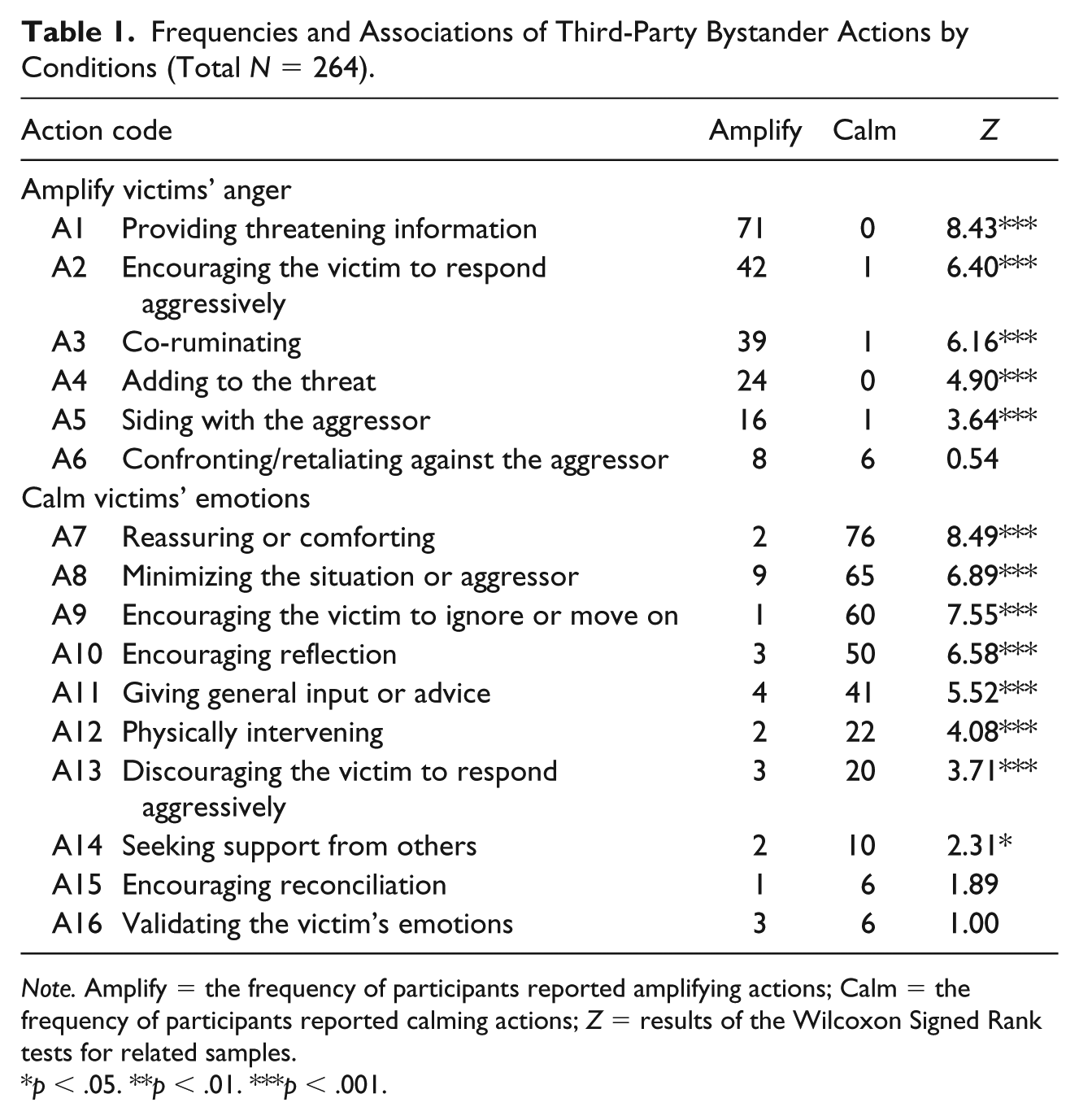
Note. Amplify = the frequency of participants reported amplifying actions; Calm = the frequency of participants reported calming actions; Z = results of the Wilcoxon Signed Rank tests for related samples.
p < .05. **p < .01. ***p < .001.
Amplifying third-party actions
Six third-party actions were described more frequently in the context of amplifying anger than calming emotions: (A1) Providing threatening information to the victim. This code primarily involved telling a peer about gossip (e.g., “She was telling me that my friend was talking about me and stuff, and I was getting mad”), or showing the recipient hurtful information on social media. (A2) Encouraging the victim to respond aggressively. This included all instances in which recipients were urged to retaliate (e.g., “if she’s being mean to you, just like cut her out, don’t talk to her,” “you should yell at them,” “break his bone”). (A3) Co-ruminating. This code was applied to excessive, negatively focused conversation about the aggressor or the act of aggression (e.g., “we were just kind of ranting about [the aggressor] and how they’d treated us. And in the end, we’d both . . . got angrier at that person,”). (A4) Adding to the threat. Third-parties joined in with the original aggressor by teasing the victim, either intentionally or unintentionally (e.g., “I think that [the third-party] just thought it was funny, too,” “I was mad at somebody and one of my friends was making jokes at the situation.”). (A5) Siding with the aggressor. The victimized adolescent perceived the third-party to be taking the aggressor’s side (e.g., “agreeing with” or “fighting for” the aggressor). (A6) Confronting or retaliating against the aggressor (e.g., “[my friend said to the aggressor], ‘we’re gonna beat you up and you are gonna pay for this’”). The latter action was reported only marginally more in the amplifying anger context than the calming emotion context.
Calming third-party actions
In total, 10 third-party actions were described more frequently in the context of calming emotions than amplifying anger. (A7) Reassuring or comforting. The most commonly reported third-party action took the form of physical comfort (“we hugged it out”), reassuring remarks (“It’ll be alright”), and encouraging emotional disclosure (“She’ll let me talk and explain everything that I’m feeling”). (A8) Minimizing the situation or aggressor. This code was applied to scenarios in which third-parties downplayed the entire situation (e.g., “it’s not that big of a deal”) or belittled the aggressor (e.g., “you’re better than them”). (A9) Encouraging the victim to ignore or move on. Participants received various suggestions from third-parties (e.g., “just go for a walk,” “avoid them,” “forget about it,” “move on”). (A10) Encouraging reflection. Recipients were encouraged to consider consequences, self-reflect, reappraise or consider another perspective, or focus on the positive (e.g., “It doesn’t matter what people think of you; it’s what you think of yourself”). (A11) Giving general advice or input. Recipients reported advice or input from peers but did not provide specific detail (e.g., “[they] threw out some ways that could fix the problem,” “She suggested to me how to handle the situation.”). (A12) Physically intervening. Third-parties restrained victims (e.g., “He held me back”) or planted themselves between the victim and the aggressor (e.g., “They jumped in front of the other person and stopped them”). (A13) Discouraging the victim to respond aggressively. This code was applied to explicit verbal discouragement of aggression (e.g., “He tells me fighting is no good thing”). (A14) Seeking support from others. This code was applied to third-party efforts to seek help from others on the victim’s behalf (e.g., “My friend told the principal”). (A15) Encouraging reconciliation. The third-party tried to advise or facilitate the adversaries coming together to work things out (“go talk to her about it,” “bringing us together”). (A16) Validating the victim’s emotion. Third-parties affirmed victims without rehashing or adding to the threat (e.g., “You should be upset. That’s a really hard thing for someone to go through”). Although the last two actions were reported more in the calming contexts than amplifying anger contexts, it was only by a trivial amount.
Gender, Ethnicity, and School-Level Differences
Table 2 presents the frequencies associated with each action by gender, ethnicity, and school level, along with results of the chi-square tests of association and Mann-Whitney tests. Results indicate few statistically significant differences (ps = .018) between participant groups across third-party actions. In the amplifying anger context, girls reported A1 (providing threatening information) more than boys (z = 2.38, f = 43 vs. 26, p = .018). Girls also reported A7 (reassuring or comforting; z = 2.13, f = 45 vs. 29, p = .033) and A11 (giving general input or advice; z = 1.97, f = 26 vs. 14, p = .049) more frequently than boys in the calming context. European Americans reported significantly more A3 (co-ruminating) than African American, Mexican American, and Native Americans (φ = .18, f = 17 vs. 9, 8, and 6, p = .045) when amplifying anger, whereas African Americans reported physically intervening (A12) as a calming strategy more than any other ethnic group (φ = .18, f = 11 vs. 3, 4, and 3, p = .045). The only difference between middle and high school students was in reports of minimization of the threat (A8), which high school students reported more frequently (z = 2.05, f = 39 vs. 24, p = .040).
Group Patterns of Reporting Frequencies of Third-Party Bystander Actions Under Each Emotional Context (Total N = 264).
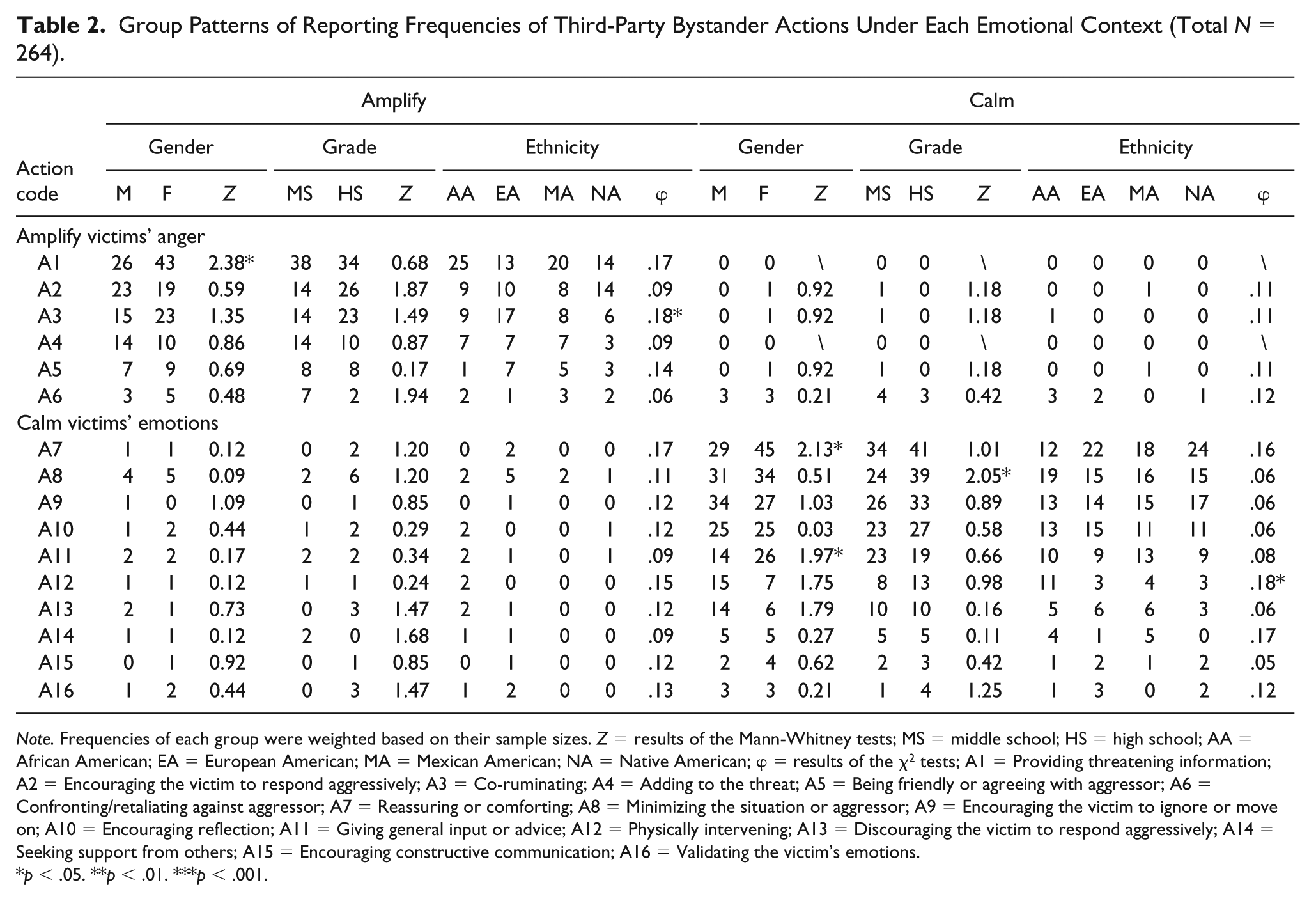
Note. Frequencies of each group were weighted based on their sample sizes. Z = results of the Mann-Whitney tests; MS = middle school; HS = high school; AA = African American; EA = European American; MA = Mexican American; NA = Native American; φ = results of the χ2 tests; A1 = Providing threatening information; A2 = Encouraging the victim to respond aggressively; A3 = Co-ruminating; A4 = Adding to the threat; A5 = Being friendly or agreeing with aggressor; A6 = Confronting/retaliating against aggressor; A7 = Reassuring or comforting; A8 = Minimizing the situation or aggressor; A9 = Encouraging the victim to ignore or move on; A10 = Encouraging reflection; A11 = Giving general input or advice; A12 = Physically intervening; A13 = Discouraging the victim to respond aggressively; A14 = Seeking support from others; A15 = Encouraging constructive communication; A16 = Validating the victim’s emotions.
p < .05. **p < .01. ***p < .001.
Why Might Certain Third-Party Actions Amplify or Calm Youth?
Our RQ4 sought to move beyond identifying the specific actions that victims perceived as calming or amplifying negative emotions to examining victims’ explanations for why those actions had those perceived emotional effects. The following emergent themes resulted from pattern coding analysis on the three actions in each emotional context that were most frequently reported by participants.
Why would you even tell me that?
Receiving threatening information from a third-party (often about rumors or a threatened physical attack) was one of the most common peer actions (27%) reported in the amplifying context. A key theme was that recipients’ anger was sometimes directed more toward the initial aggressor, and other times more toward the third-party informant. Youth often reported becoming angrier when third-parties told them about a new threat (e.g., discovering that they were the object of gossip or that an enemy wanted to fight them). Some respondents wished to remain ignorant of gossip directed toward them: “I’m the kind of person that doesn’t want to know what people say about me because I think it just makes the whole thing a lot worse.” Others believed that the third-party wanted them to be angry with the aggressor, perhaps because fights and drama are seen as exciting: “I got into a fight with one of my friends, and my other friend, I could tell she was kinda happy that I got in a fight with her. She kept instigating it and saying like ‘did you see how she was snubbing [talking about] you on Instagram?.’” Another boy said, “my friend pretty much got us two into a fight because he wanted to see one.” Some youth mentioned that informing peers of aggression was “none of their business” or “not their place,” and others expressed frustration at having to deal with the consequences of being “amped up”: “You’re not supposed to tell me that until I’m not angry so then I can forget it. I mean, you could get me in serious trouble because I’m very upset.” Importantly, several youth discussed wanting or trying to calm down before third-parties amplified their anger (“after I tried to calm down, [the third-party] said [the aggressor] was talking more crap. So, it kind of made me more angry”).
Fighting back is wrong, but revenge is sweet
Encouraging the victim to respond to a threat with physical, verbal, and/or relational aggression was the second most common third-party action youth reported (16%) that amplified anger. Many recipients appeared to view aggression as “bad.” One girl discussed how her friends encouraged her to fight someone and she “went along with it,” but then she “felt like we shouldn’t be doing bad . . . that I need to be like a person that people looked up to.” This quote, and others, indicate that some youths’ anger may be raised by aggressive advice because they perceive it to be immoral. Other adolescents described how the aggressive encouragement was two-sided (“we were riling each other up”), and the anger seemed to be directed more toward the aggressor than the third-party: “he was encouraging me to fight her and I was all for it.” Still, others indicated that third-parties did not have their best interests in mind and were “instigating” them in ways that could lead to harmful consequences. As one boy said, “I did want to [fight] at the moment, but my morality once again got ahold of me and gave me my better judgment [. . .] if I get into this fight, you know, what’s going to come of that?” Many participants recounted situations when third-parties told them that revenge was necessary and that failing to retaliate was a sign of weakness and/or failing to regain respect (e.g., “you need to beat him up,” “you’re going to let them disrespect you like that?”).
The more I talk about it, the angrier I get
Co-rumination was the third most common action that youth reported (15%) in the anger amplification context. Co-rumination was often perceived to increase the salience of a threat and heighten anger. Sometimes this happened when adolescents learned that their aggressor did the same thing to others: “[My] other friend that I’ve been talking to about this problem was like, ‘yeah, [the aggressor] did the same thing to me too, I can’t believe she’s doing this to us.’” Even third-party sympathy sometimes raised anger: “I was talking about how the person who stole from me was a bad friend, and they were sympathizing with me, they were saying the same thing. And I was getting more angry as we talked about it.” As with receiving threatening information, a key theme for co-rumination was that anger appeared to be split between the aggressor and the third-party. Still, at times, co-rumination strategies were perceived as partly helpful because victims reported feeling “validated” or appreciated that someone else could “understand their hurt.” Sentiments of co-rumination as “helpful but not helpful” appeared in several examples. As with receiving threatening information, co-ruminating sometimes seemed to impede youths’ desire to move past a conflict (“when someone is supporting you, you’re less inclined to forgive and forget”).
Everything is going to be OK
“Reassuring and comforting” was the most common peer response that youth reported (29%) in the calming context. Third-party efforts, such as physical comfort (e.g., “she gave me a hug”), reassuring remarks (e.g., “It’ll be alright”), and encouraging emotional disclosure (e.g., “She’ll like let me talk and explain everything that I’m feeling”) appeared to alleviate recipients’ stress or doubts, at least momentarily. The notion of karmic justice was also mentioned—for example, “The person will get what’s coming to them.” Many of these reassuring actions involved a sense of optimism (“things will get better”) or emphasis on the fleetingness of a situation (“it won’t last forever”), and many co-occurred with attempts to minimize the situation or aggressor. However, we differentiated reassurance and minimizing by observing that reassurance did not necessarily involve downplaying the significance of the situation, only stating that it would resolve. Many participants discussed how their peers were “just listening” or “just being there,” which shows that some calming third-party actions may not involve any words at all. As one participant said, “sometimes you just really need to tell people what’s going on. Even if they don’t say anything back, it’s still helpful.”
It’s not worth my time and energy
The second most common action (25%) that recipients described as calming was to minimize the situation or antagonist. Youth described being calmed by peers who decreased the importance of the threat in a variety of ways. Often, third-parties used language like “it’s not worth it [to retaliate]” or “that’s a waste of your time.” Other times, third-parties denigrated aggressors (“they’re acting childish”). Third-parties often invalidated the threat by saying “that’s not true” or “it doesn’t matter.” As a caveat, a few adolescents reported that third-party minimizing amplified their anger. Sometimes third-party statements implied that the victim was overreacting or being manipulated (“[one of my friends was saying], ‘you can see that [the aggressor is] doing this to see your reaction’, and although that was true, it didn’t help [. . .] it made me look dumb.”). Third-party efforts that decreased the salience of a threat seemed to be calming, except when efforts failed to validate the victim.
It’s time to move past this
The third most common strategy (23%) that recipients recalled as calming was when their peers advised or encouraged them to ignore and/or move on from a situation. Distraction emerged as a prominent reason for why adolescents may be calmed by this tactic. Third-parties initiated distraction in a variety of ways: encouraging the victim to physically leave an inflammatory situation, suggesting that the victim engage in another activity such as listening to music, using humor, or spending quality time with the victim (e.g., going out to eat). It appears that sometimes having time and distance away from the threat allows the victim to maximize on his or her own coping skills. A middle school boy described a time when his friend stepped in and helped him to “take a cooling break” by telling him to “chill, chill, chill, you’re OK, she’s stupid.” This “break” (which also involved minimizing the aggressor) helped the respondent to think about what to do or not do, recollect himself, and abandon the impulse to retaliate. We found that advice to “move on from” a negative situation sometimes co-occurred with self-disclosure and discussion (which were most often coded under “reassuring and comforting”). In several instances, adolescents described how, through “talking it out,” “letting it out,” or “processing,” they were able to move on from a negative experience or to ignore a threat. For example, “[W]e went and drove around and looked at the stars late at night and just got my mind off of it and talked about it so I can get all my emotions out and not bottle them up.”
Discussion
Resilience theory indicates that peer support and emotion regulation are powerful influences on youths’ well-being (Stumblingbear-Riddle & Romans, 2012). Despite generally wanting to support their peers (Frey et al., 2019) and wanting to maintain emotional equilibrium after emotionally arousing events, adolescents face developmental struggles in turning these desires into outcomes. This study explored how diverse victimized adolescents describe third-party actions in two emotional contexts. A theme across the most commonly reported actions is that youth anger is amplified after actions that increase the salience of a threat and calmed by actions that dampen the salience of a threat. Actions that were commonly reported to amplify anger included relaying information about social threats, co-ruminating, encouraging retaliatory aggression, and acting in non-supportive ways (e.g., teasing). These actions map onto strategies in past research that are linked with exacerbated conflict (Marwick & boyd, 2011), internalizing and externalizing problems (Klimes-Dougan et al., 2014; Rose, 2002), and increased victimization (Frey & Higheagle Strong, 2018). Conversely, adolescents often reported being calmed by actions that align with Klimes-Dougan et al.’s (2014) descriptions of override support (e.g., distraction, minimizing the negativity), reward support (e.g., reassurance, comforting), and a mixture of override and reward support (e.g., acknowledging negative thoughts and feelings in order to move past them). Simply overriding a peer’s negative emotion may be less helpful than rewarding it with reassurance or empathy, but a combination of the two is linked with adjustment (Garside & Klimes-Dougan, 2002).
Group Differences in Third-Party Action Frequencies
Most third-party actions did not show group differences, with some exceptions. Girls, more than boys, reported receiving threatening information from a peer. Such information was usually about relational aggression (gossip, exclusion) and “drama,” which are deeply gendered in adolescence—girls tend to engage in discussion of social conflict more often than boys (Marwick & boyd, 2011). Girls also reported higher frequencies of being reassured/comforted and receiving general advice. The former finding aligns with past evidence that girls’ relationships feature more emotional provisions than boys’ (Rose & Rudolph, 2006). Considering that the “general advice” reported in interviews was typically vague, it is difficult to speculate on why girls may have reported receiving it more often. However, it could relate to girls’ greater tendency than boys to discuss problems with peers (Rose & Rudolph, 2006).
Contrary to prior research (Rose, 2002), we did not find gender differences in co-rumination. Instead, co-rumination emerged as one of two differences between ethnicities. European Americans reported co-rumination more often than did any other group. Although past research on co-rumination has featured relatively diverse samples (e.g., Rose, Schwartz-Mette, Glick, Smith, & Luebbe, 2014), none has explicitly examined ethnic differences. One potential explanation for our finding is that people with highly individualistic beliefs (like many European Americans) are more likely to seek out and deliver emotional, individual-focused actions (Feng, 2014). Co-rumination, which entails excessive personal problem talk, may be more common or at least more salient among European American youth. We also found that African American participants more often reported physical intervention (e.g., being restrained by a third-party). Without knowing more contextual details (e.g., type or intensity of victimization, peer network and norms), it is difficult to explain why African American youth described physical third-party interventions as calming more frequently than youth of other ethnicities. African Americans are [inaccurately] stereotyped as being physically aggressive (Clemans & Graber, 2016). Perhaps being swayed by this stereotype, their peers may be more apt to use physical intervention over other strategies. Or, victims (especially boys) may feel pressure to assume a tough facade when they feel vulnerable (Cassidy & Stevenson, 2005; Way et al., 2014), thus a friend’s restraining intervention may enable them to maintain this perceived normative posture with less risk of escalation. Results on ethnic differences should be interpreted cautiously, and findings warrant further research.
Although peer relationship structures undergo changes from middle to high school (Felmlee et al., 2018), we found only one school-level difference. High school students were more likely to minimize the impact of the victimization experience. This appears consistent with high school students’ dismissive terminology for bullying as mere “drama” (Marwick & boyd, 2011). There is evidence that mid-adolescents are no more likely to use effective coping strategies than are younger adolescents (see review, Zimmer-Gembeck & Skinner, 2011), but little is known about the development of emotion regulation in adolescence or how peers may be involved in that regulation (Theurel & Gentaz, 2018). It is plausible that a finer-grained analysis of peer actions (e.g., the types of reassurance and co-ruminating) would reveal additional developmental patterns. It could also be the case that the general themes we observed extend across adolescence (and across gender and ethnicity).
Explanations for Peer Influences on Emotions
The youth in our study often expressed a desire to “get over” or “calm down” from a perceived threat, and third-party actions can impede or aid in these attempts. Our data suggest that the most calming third-party actions may be those that are delivered with sensitivity to victims’ individual needs for (a) processing or expressing their thoughts and feelings about a situation without dwelling on it, (b) restoring a sense of agency without relying on revenge as a means to do so, and (c) feeling as though the third-party has their best interests in mind. Conversations that feature self-disclosure and reflection on a negative event may be helpful, but conversations that remain rooted in negativity can be harmful (Rose et al., 2014). Furthermore, victims of perceived injustice have a strong need to regain a sense of respect and agency (Tov-Nachlieli, Shnabel, & Nadler, 2013). Third-party peers may attempt to address these needs with various strategies, some more successful than others. For instance, peers may encourage retaliation (which could restore a victim’s social status; Frey, Pearson, & Cohen, 2015) or they may minimize the threat as “not worth it” to help the victim maintain agency yet avoid escalation (I choose not to retaliate). Victims may perceive their peers as thriving on the excitement of “drama” (Marwick & boyd, 2011), even at the victim’s expense. We observed this sentiment in participants’ indications that their peers may have purposefully exacerbated fights and conflicts.
While quantitative and qualitative analyses show that most third-party actions were strongly linked with one emotional context or another (amplifying or calming), some actions may have tradeoffs. For instance, although co-rumination can increase the salience of a negative situation and lead to internalizing and externalizing symptoms, particularly for girls, it can also promote social connectedness (Rose et al., 2014). Although boys engage in co-rumination less often than girls (Rose, 2002), boys who share their feelings with their friends may experience greater friendship quality and psychological well-being than boys who do not (Way et al., 2014). In this vein, emotion validation, which is similar to but distinct from co-rumination, may calm victims by providing them with justification, acknowledgment, and acceptance of their emotions. While our findings suggest that validation can sometimes fall into co-rumination, it is a strategy often absent in emotion regulation literature (which focuses heavily on reduction and rationalized control) and should be more closely explored in future work. Further, avoidance-based coping strategies such as ignoring an aggressor may calm situations immediately but still have long-term repercussions such as increased victimization and only fleeting emotion reduction (Houbre, Tarquinio, & Lanfranchi, 2010). Individuals may respond differently to these strategies, which our results suggest are often combined (e.g., advice to avoid mixed with a reflective discussion of the problem). Rather than labeling strategies like “advice to ignore” or “co-rumination” as purely helpful or unhelpful, stakeholders such as teachers, parents, and school counselors should recognize that these actions may be beneficial in some contexts (and for some people) and harmful in others.
Limitations and Future Research
As with all studies that rely on self-reported behavior, there are limitations. Without observational or experimental data, we cannot claim that certain third-party actions truly amplified anger or calmed emotion. Adolescents may have recounted their emotional responses to third-party influences differently after taking time to reflect on the event (Opotow, 2004) or were influenced by social desirability concerns. Interviewers, however, informed participants that they could skip questions and use aliases to reduce potential bias.
The frequencies of third-party actions reported in this study were based on inductive coding from structured interviews, which may impact the generalization of the results to reflect actual frequencies within or outside of our sample. Some actions may have been more recent and/or salient to participants. The large number of statistical analyses used to explore gender, school level, and ethnic differences may also impose limitations on generalization of the findings, in particular to third-party actions that were infrequently mentioned. We recommend that evidence from different perspectives and methods be considered to further confirm the central findings of this study. For instance, with the identification of common emotion socialization strategies, future research could examine strategy preferences and decision-making with multiple examples of each strategy.
While we utilized recommended practices (Hirschman, 2016) to gather information on racial/ethnic identities, race/ethnicity is complex and merits further exploration in future research, particularly for those who identify as multiracial. Despite these limitations, qualitative methods allowed us to learn from ethnically diverse adolescent perspectives on peer actions that may not be captured through observational methods or quantitative surveys.
Conclusion
Our aim in this study was to use multiple methods to produce more nuanced understandings of the ways in which ethnically diverse adolescents interact with their peers in the face of perceived victimization, and how those actions may calm and amplify victims’ emotions. In recent years, researchers have illuminated the importance of peers in shaping so-called “individual” processes such as identity formation (Santos, Kornienko, & Rivas-Drake, 2017), and we sought to extend this social focus to emotion regulation. Rather than trying to “teach” adolescents how to engage in relational emotion regulation, we were interested in how adolescents are already calming (and, at times, amplifying) one another’s emotions. We took a strengths-based approach to peer victimization, focusing on how adolescents might utilize their social relationships to recover from social conflict—and where they might be falling short. Our results shed light on the types of third-party action that were reported to occur and also help explain why commonly reported actions may have heightened anger or dampened emotion. We have moved beyond more general categorization models of peer support (e.g., emotional, instrumental, informational, and appraisal support; House, 1981), noting the complexity and tradeoffs of many specific third-party actions.
The findings from this study are intended to drive further research that explores how peer emotion socialization strategies are linked with short- and long-term markers of resilience (e.g., retaliation attempts, continued victimization, coping strategies, social networks, and well-being) for diverse adolescents. Our findings may inform programs that aim to help adolescents reflect on why some behaviors (even when well-intended) may compromise victim resilience, and why others are working well. Across ethnicity, gender, and grade, peers shape adolescents’ emotions after victimization experiences, and in doing so, shape both internal and external outcomes in response to peer aggression. By building on the voices of adolescents, this study provides new insights on how emotion socialization processes occur and what they might mean for resilience from peer aggression.
Footnotes
Acknowledgements
We were fortunate to have collaborators, interviewers, and community partners who care deeply about young people: Adaurennaya Onyewuenyi, Daisy Ward, Robyn Pebeahsy, Veneice Guillory-Lacy, Ian Waller, Rusty George, Avalon Valencia, Abby Brown, Monette Becenti, Joyce McFarland, Karin Jones, Eligio Jimenez, Evan McKittrick, Joyce McPherson, Shauna Moore, and tribal communities.
Declaration of Conflicting Interests
The author(s) declared no potential conflicts of interest with respect to the research, authorship, and/or publication of this article.
Funding
The author(s) disclosed receipt of the following financial support for the research, authorship, and/or publication of this article: This research was supported by grants from the National Institute of Justice (2015-CK-BX-0022). Opinions or points of view expressed are those of the authors and do not necessarily reflect the official position or policies of the U.S. Department of Justice.
