




Abstract
This study aimed to identify factors that contributed to adaptive coping young people of color engage and rely on to navigate racial stressors in the public education system and to persist into college. The study included 20 undergraduate college students between 18 and 22 years who participated in retrospective interviews documenting critical incidents of racial stressors and coping. Participants self-identified as majority Black/African American (68%) and other nationalities including Honduran, Mexican, and Sudanese. A socioecological systems framework guided in-depth coding of interviews and identified college-going cultural ethos, relational ties, sense of agency, and emotional acuity themes. Findings suggest participants existed in an interdependent system of affirmation and validation that geared them toward college aspirations amid racial stressors encountered in the U.S. public education system. Discussion centers on the value of building the capacities of youths’ social ecologies to affirm their identities and validate their presence in the U.S. education system.
Youth of color endure racial stressors in the U.S. public education system (Henderson et al., 2019; Hope et al., 2015; Umaña-Taylor, 2016). For instance, public schools continue to enforce school policies that disproportionately discipline youth of color and use discretionary referral practices to exclude them from gifted programs (Diamond, 2006; Kohli et al., 2017; Skiba et al., 2011; Umaña-Taylor, 2016). The rise in reports of racial harassment in public schools and persistent encounters with racial microaggressions and exclusion agitate the lives of youth of color further (Griffith et al., 2017; Tobler et al., 2013; U.S. Department of Education, 2016). Nevertheless, these young people continue to persist in the public education system despite racial stressors experienced at the systemic and interpersonal level. For instance, McFarland and colleagues (2018) posit that there has been a decrease in the dropout rate gap between students of color and their White peers. Although Black/African American and Latinx students are disproportionately represented, the high school dropout rate declined from 13.1% to 6.5% for Black/African American students and 27.8% to 9.2% for Latino/Hispanic students between 2000 and 2015 (National Center for Education Statistics, 2018a). An ability to adapt, cope, and persist in the presence of racial stressors in the public education system is evident in high school completion but also in the number of young people who continue to pursue higher education (National Center for Education Statistics, 2018b).
What do youth of color engage or rely on to remain resilient and persevere in the public education system? An established body of research identifies a positive racial identity and academic self-efficacy can buffer racial adversities and increase education persistence (Butler-Barnes et al., 2013; Jimerson et al., 2016; Marsh et al., 2012; McGee & Pearman, 2014). Other scholars note how parental socialization and other relational resources present in the lives of youth of color can promote positive educational beliefs (Anderson & Stevenson, 2019; Huerta et al., 2018; Jimerson et al., 2016). This body of research is highly valuable but falls short by minimizing the interplay between macro- and microlevel forces in adaptive coping. Spencer and Swanson (2013) argue for the need to account for culture and context-linked systems in researching adaptive coping among youth of color in the face of racialized experiences. Consequently, a socioecological framework of adaptive coping embeds the resilience of youth of color in a cultural ethos of interdependence, highlighting how assets and resources across contexts buffer racial stressors. This study, therefore, applies a socioecological systems framework in the analysis of interviews with 20 young people of color who reflect on racial stressors encountered in their public school experiences and how they were able to cope and persist. Discussion centers on the value of building the capacities of youths’ social ecologies to affirm their identities and validate their presence in the U.S. education system.
Theoretical Framework
Youth of color are resilient because they exist in a context of racism that has a negative impact on their daily living, their families, and communities in both systemic and interpersonal ways (Henderson et al., 2019). Acknowledging how a history of racism enacted in the public education system in the United States and its harm on the psyches and bodies of youth of color requires investigating coping with racial stressors from an adaptive and socioecological context. That is, a socioecological systems framework acknowledges youth of color exist in an interdependent system, inclusive of both macro- and microlevel forces driving the presence of racial stressors and presence of positive adaptation (Henderson et al., 2016; Spencer et al., 1997; Spencer & Swanson, 2013).
As young people transverse across social systems, they interact in a cultural ethos defined by symbolic interactions, messages, and models that shape how they construct meaning and adapt to their social world (Spencer et al., 1997). Symbolic interactions found in images of what it means to be Black, Latino/a, or “other” in the United States plays out in media depictions and visual portrayals that can either be negative or positive. Moreover, individual messages youth receive and observe from others inform the schemas they rely on to shape self-perceptions, make decisions, and solve problems (Anderson & Stevenson, 2019; Hughes et al., 2006; Umaña-Taylor et al., 2009). Youth then begin to learn to perceive interactions as a threat or harmful when they experience negative emotional salience, dissonance, and tension between how they see themselves and how society perceives them (Masten, 2014; Masten & Powell, 2003; Winders, 2014).
Framing adaptive coping among youth of color embeds meaning-making, appraisal, and coping with racial stressors in a socioecological systems framework (Spencer et al., 1997). Such a framework acknowledges a cultural orientation embedded in values of harmony, faith as a macrolevel factor that shapes how youth of color adapt and cope with racial stressors like racial discrimination (Henderson et al., 2016; Theron et al., 2011; Umaña-Taylor et al., 2009). Such values may be evident through the relationships youth access in their families and community. Reliance on familial and communal adults, cultural resources can help young people minimize potential threats and respond to racial stressors in ways that promote a positive sense of self (Anderson & Stevenson, 2019; Sellers et al., 2006; Wang & Hughley, 2012). Applying a socioecological systems framework to investigate factors that promote adaptive coping young people of color engage and rely on can explicate how macro- and microinteractions reinforce favorable self-beliefs and build college aspirations.
Defining Racial Stressors
A socioecological systems framework defines racial stressors as macro- and microstress-induced interactions that disrupt access to resources, a positive sense of self and safety (Bryant-Davis & Ocampo, 2005; Harrell, 2000; Henderson et al., 2019). Macro- and microracial stressors are extensions of one another. Racist ideas and notions have been embedded in American society and maintained through educational institutions’ policies and practices (Tobler et al., 2013; Turner & Avison, 2003). According to Omi and Winant (2014), mental and moral frameworks of racial ideology are used to place and navigate how the world is and ought to be; thus, it affects the consciousness of all individuals. Notably, individuals will compare their ideological positions based on the dominant race (e.g., Whites), which then fosters a “common sense” understanding of relating and being that places people of color in deficit positions (Bonilla-Silva, 2001; Omi & Winant, 2002). Ways of being and relating to others through microinteractions can reinforce racial inequities and contribute to racial stressors. For instance, microinteractions that occur through individuals that use racial slurs, negative messages about behavior, and invalidations toward young people only affirm a macroideology and system of racism (Cammarota, 2006; Hope et al., 2015; Reyes & Elias, 2011). Both macro- and microracial stressors can have direct effects on well-being when youth have a conscious awareness of them.
Several scholars note racial stressors include racial discrimination, forms of exclusion, and racial harassment that exist in both blatant and subtle ways (Henderson et al., 2019; Kohli et al., 2017; Ladson-Billings & Tate, 1995). Conscious awareness of such stressors can take an emotional toll and lead to a heightened state of anger, confusion, and feelings of inferiority (Carter & Forsyth, 2010; Carter & Reynolds, 2011). When youth of color report more encounters with racial stressors in school they are at risk for exhibiting negative externalizing behaviors and school disengagement (Bodkin-Andrews et al., 2013; Hatt, 2011). Negotiating a positive sense of self in a public education system where messages may depict otherwise or feeling as if one’s identity and expression is under threat can lead some young people to disengage from school entirely and find acceptance elsewhere (Hatt, 2011; Huerta et al., 2018). The consequences of racial stressors, for some, can contribute to maladaptive coping and higher levels of anxiety, substance use, and disengagement (Henderson et al., 2019; Lambert et al., 2009; Tobler et al., 2013). However, some youth of color may engage more adaptive coping in response to racial stressors.
Adaptive Coping in Response to Racial Stressors
The mechanisms youth engage in preserving a positive sense of self and overall well-being function as adaptive coping (Vaillant, 2000). Coping processes are, more broadly, metacognitive strategies and behaviors youth of color use to manage stress and mitigate racial stressors. Such processes require young people to use conscious and deliberate effort to manage stressors (Cramer, 1998; Vaillant, 2000). Notably, youth may appraise an experience as a threat to their racial self but reappraise the experience to deescalate emotional salience and reduce stress (Carver et al., 1989; Winders, 2014). There is evidence that reveals young people use such cognitive processes as having a positive racial regard or destigmatized beliefs to reduce the internalization of negative stereotypes (Williams et al., 2012). For example, Butler-Barnes and colleagues (2013) found that African American youth often activate a higher sense of racial pride and strong self-efficacy beliefs to become more academically engaged despite self-report encounters with racial discrimination. Relying on metacognitive factors to reappraise the experience, minimize negative emotions, and reduce internalization is a highly useful coping process for youth of color (Anderson & Stevenson, 2019).
Young people may also rely on specific behaviors and resources to alleviate the stress associated with racial stressors. Reliance on a family system and a broader relational network with other adults and peers can build psychosocial assets (Henderson et al., 2016). The earlier work of Hughes and colleagues (2006) positions parents as a proximal source in building positive cultural values and racial attitudes in youth. Several other scholars document how parents convey racial pride and positive regard through messages they give to their children and the behaviors they model (Sellers et al., 2006; Williams et al., 2012). Another body of work also suggests that young people who have access to cultural traditions through their family or membership in faith-based communities exhibit a more positive sense of self, belonging, and develop a set of expectations to succeed in school (Kuperminc et al., 2009; Theron et al., 2011; Umaña-Taylor et al., 2009; Williams et al., 2012). Learning to rely on this relational network to deal with disparaging racial comments or discrimination for support, acceptance, and validation can help youth adapt and buffer racial stressors (Case & Hunter, 2012; Henderson & Greene, 2014; Henderson & McClinton, 2016; Payne & Brown, 2010). Theoretically, social ecologies that allow youth to access positive and affirming relationships with others allow young people to draw upon cultural traditions and develop a positive racial regard to promote adaptive coping in the presence of racial stressors.
The Current Study
The study seeks to answer the primary question of interest: What factors promote the adaptive coping youth of color engage and rely on to persevere and buffer racial stressors in the public education system? The exploratory nature of this study is interpretative, modeling methodological approaches of qualitative inquiry used with youth of color in understanding resilience (Creswell, 2006; Haffejee & Theron, 2019; Pietkiewicz & Smith, 2012; Theron et al., 2011). Reliance on the self-system and a broader socioecological system to ascribe meaning positions subjectivity as a critical process in constructing meaning. The socioecological systems framing used in this study requires a more inductive and phenomenological approach in understanding adaptive coping from the perspective of groups who have historically and continue to be the most marginalized through racism. For this study, young people of color recruited from a university setting serve as critical agents in naming and describing experiences that are most salient, memorable to them, and in identifying factors they rely on to manage racial stressors.
Method
Participants
The complete protocol and research design for this study received approval by an institutional review board. Twenty participants were recruited from an undergraduate pool of students of color enrolled in college. The purposeful sampling aimed to recruit young people who demonstrated a degree of persistence through the U.S. public education system. Participants were recruited from a university with a student population of mostly first-generation (50%), and whom the majority self-identified as a person of color (81%) located in the Southeast region of the United States. Flyers were posted throughout the university and sent via faculty in the Department of Psychology. To be eligible for the study, participants had to (a) self-identify as a person of color, (b) have attended public school in the United States for at least 50% of their K-12 experiences, and (c) be between the ages of 18 and 22. The majority of participants self-identified as Black/African American (68%) and the remaining self-identified as Latina, Mexican, mixed race, and Sudanese. Participants’ classification ranged from a first-year college student to college seniors. Sixty-eight percent spent most of their K-12 experiences attending schools in the south that were predominantly White. Seventy-seven percent self-identified as female, and the average age of participants was 20 years (SD = 1.48). All student participants in this study were assigned pseudonyms. Table 1 provides a short description of participants and their identities.
Description of Participants.
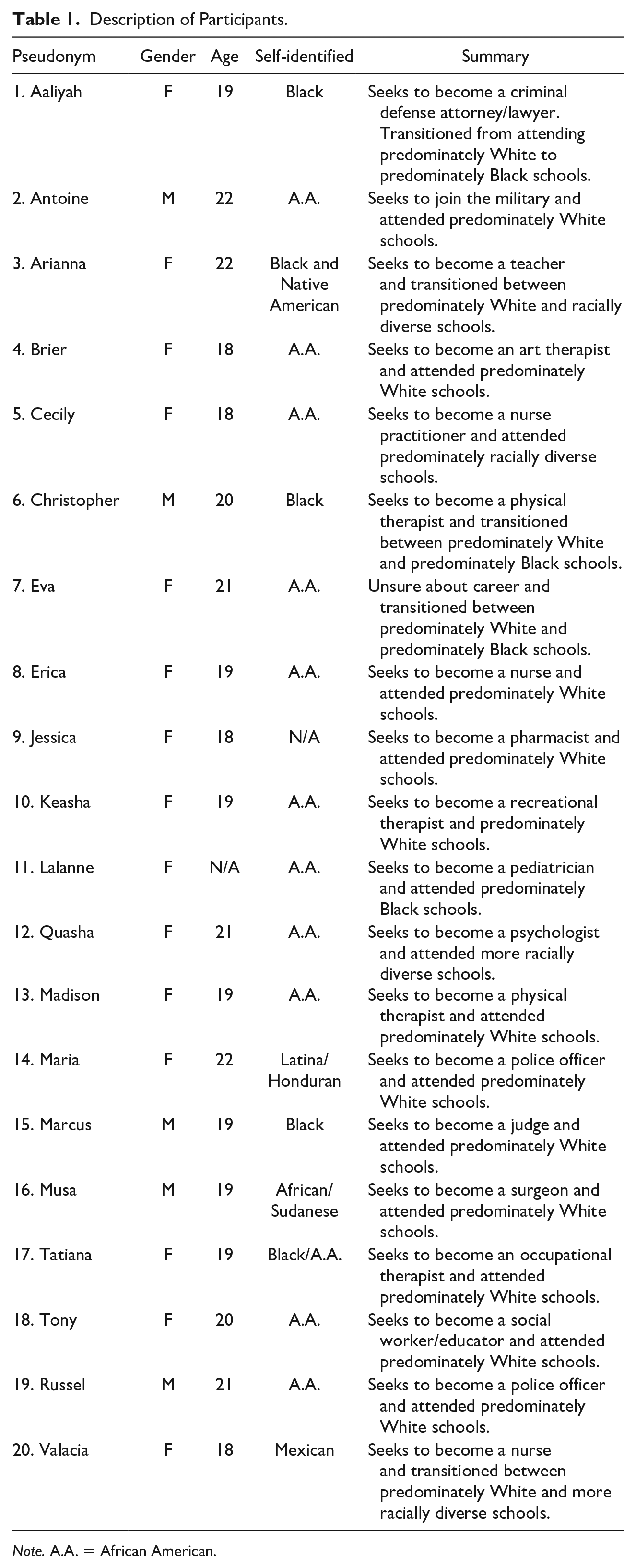
Note. A.A. = African American.
Data Collection Procedures
Data collection through interviews occurred across a period of 1 year. The lead author conducted interviews in an intimate office setting where interviews were audio-recorded. Prior to the interview, all participants received an overview of the study and were informed about their rights. Interviews occurred between 35 minutes and 1 hour, and all participants provided consent and received compensation in a US$25 gift card or opted to earn participation credit for a psychology course. The semi-structured interview protocol was designed to gain insight into participants’ goals and aspirations in life and to use critical incidents to frame their K-12 experiences (Kirby, 2010). The protocol included questions prompting participants to reflect on their broad backgrounds in public schools in the United States and incidents described as isolating, threatening, or harmful due to their race. Participants were also asked follow-up prompts to describe how they felt after the incident and what they relied on to get through the incident. The protocol concluded with a prompt asking participants to reflect on those factors that supported their continued persistence in education. Participants who expressed experiencing distress or discomfort at any point in the study were provided an informational brochure for counseling services.
Data Analysis
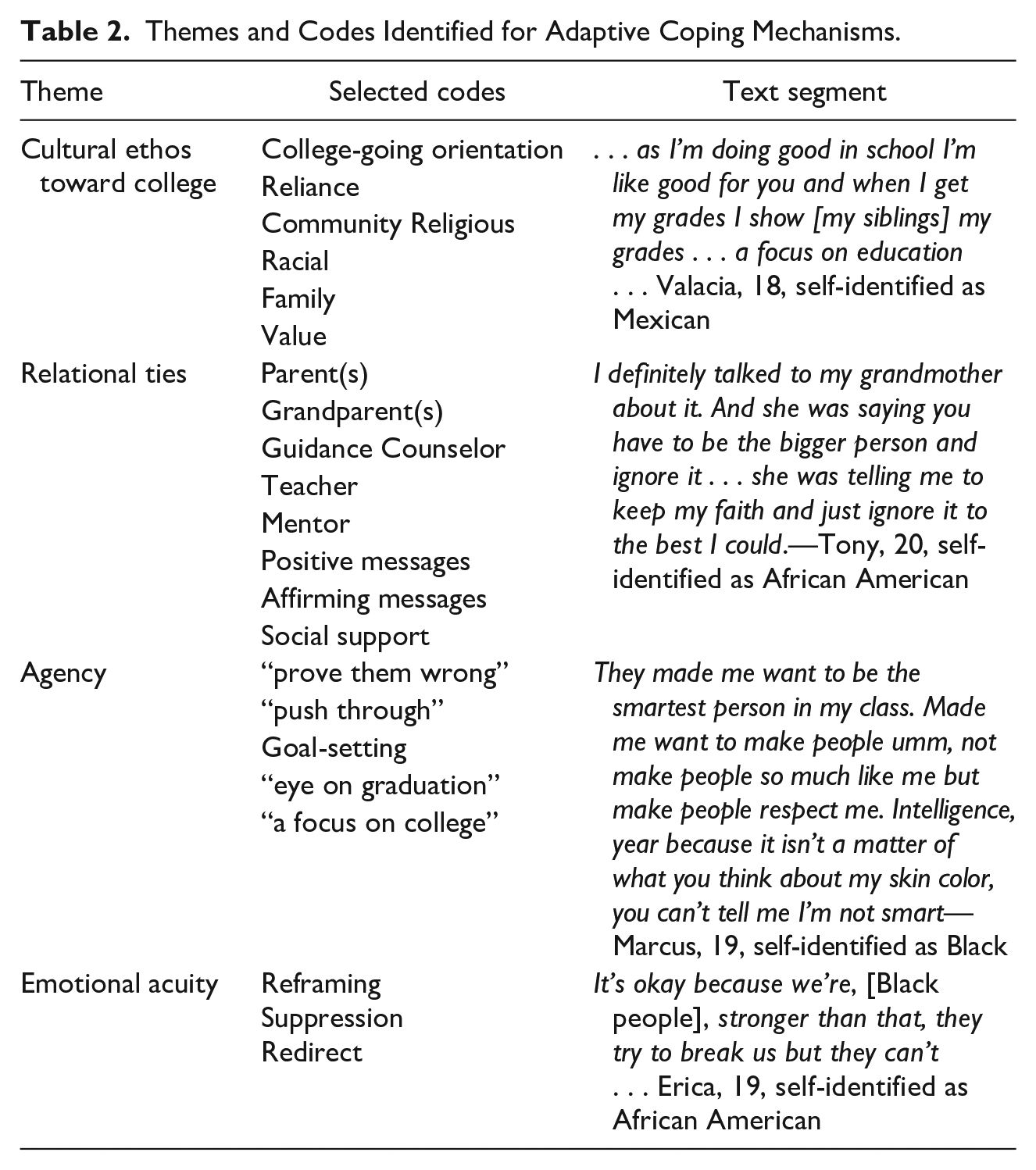
All audio files were transcribed and reviewed by a research assistant for accuracy. A research assistant and the lead author used Harrell’s (2000) definition of racial stressors to review each transcript and identify exploratory codes (Pietkiewicz & Smith, 2012). Note-taking during the replay and reading of interviews helped inform a coding schema associated with racial stressors. A return to the literature on racial stressors in school helped to confirm and organize exploratory codes into three broad categories to include racial alienation, discrimination, and harassment. To establish trustworthiness, a research team consisting of three coders independently reviewed 10 transcripts randomly selected from the transcripts. Coders were informed to identify codes that articulate any form of coping. The research team used the question “how do these participants describe how they were able to push through racial stressors” in an inductive coding process. The lead author conducted an audit trail to document where codes appeared in the transcripts and frequencies. Afterward, codes were reviewed to discuss discrepancies and convergences. The research team then used axial coding to identify common patterns across the transcripts (Creswell, 2006). Inferences were made to categorize codes based on the degree to which participants indicated a positive outcome or result and to organize codes into clusters under a broad scheme called adaptive coping (Pietkiewicz & Smith, 2012). Intercoder reliability indicated that 85% of codes were consistent across coders and represented more than 80% of agreed codes across participants. The remaining 10 transcripts were uploaded into NVivo® to mine text related to the adaptive coping scheme and to affirm the scheme (Bazeley & Jackson, 2013). The text mining function in NVivo supported code identification, clustering, and organization of emergent themes (Guest et al., 2012). Table 2 describes the codes and themes.
Themes and Codes Identified for Adaptive Coping Mechanisms.
Positionality
Consistent with phenomenological research is acknowledging the role of the researcher and their subjectivity in data interpretation and analysis (Pietkiewicz & Smith, 2012). Bourke (2014) argues that researchers must include a statement of positionality to articulate prior experiences and knowledge frameworks that influence design and analysis. This study’s research team consisted of four undergraduate research assistants and research faculty who self-identified as Black/African American. Members on the team acknowledged they shared similar experiences and identities with participants. Notably, the undergraduate research assistants offered an insider perspective by affirming how the incidents identified in the transcripts reflected their own experiences in public schools. The research assistants became critical to the research team in coding transcripts and ascribing meaning to the text (Corbin & Strauss, 2008; Hodkinson, 2005; Smith & Osborn, 2008). The research faculty had prior experience researching the combined effects of racism on the well-being and health of Black men and Black/African American and Latino adolescents. The research team used value judgments in the analysis phase that emphasized assets, strengths, and capacities of youth of color rather than deficits (Garcia & Guerra, 2004).
Findings
The findings from our analysis highlight that an interdependent system of macro- and microlevel resources and assets promote adaptive coping. At the microlevel, analysis revealed that participants possessed a sense of agency and emotional acuity to buffer racial stressors. Relational structures accessed between the immediate family and broader community and a broader college-going cultural ethos affirmed and validated a positive sense of self and college aspirations. We share findings through all (100%), most (between 60% and 95%), and some participants (less than 60%) under each theme to demonstrate the frequency of responses.
A College-Going Cultural Ethos
A cultural ethos includes a repertoire of practices, shared traditions, understandings, and observable behaviors across time (Gutierrez & Rogoff, 2003; Parsons, 2008). We define a college-going cultural ethos as a repertoire of messages, expectations, and models found in participants’ social ecologies that communicate, express a value for education and college aspirations. This ethos encompassed the view that obtaining an education for participants combats negative stereotypes, exclusion, and connects aspirations to a responsibility to one’s family and community. In this study, there was evidence of values, beliefs, and motivations toward college in participants’ interviews. In addition, all participants embedded their success in school in relation to a racial, religious group, and family. In the interview with Russel, a 21-year-old African American male, he described how his teachers’ behavior in his schools and the curriculum lacked culturally affirming content and were often degrading to Black people. He mentioned he was able to get through these experiences by affirming a belief that he had a responsibility to break a cycle for Black males in his family.
Well, I look at it it’s kinda’ like I might be the first male to go to college and I just like kinda’ want to break a trend in my family has. I just do it more for not only me and my family, but I do it mostly for my younger brother and my younger sister so that [they] have somebody like he’s doing this and he’s pretty successful, and you don’t have to do all the negative stuff to make a living.
In the interview with Maria, a 22-year-old Latina from Honduras, she discussed how her schools were insensitive to non-White cultural identities and language and labeled her as “special needs” since she was struggling with learning English. The combination of being bullied by other students due to her inability to speak English and feeling excluded by school personnel as a Latina were distressing. She relied on a responsibility to honor her mother’s journey to the United States to keep her motivated in school.
. . . you know the American dream, and I knew my Mom like worked really hard for us to come here. So I’ll get that in my mind, like my Mom did this for me. So I might try my best to stay in school and just ignore the people even though [it] hurt . . . She did everything she could to bring us here and for me to just drop out of school and do nothing . . . that was her dream for me to come in school, to stay in school.
Musa, a 19-year-old male that identified as Sudanese, mentioned how he had to deal with name-calling and racial profiling in school due to his religion and race. In the quote below, Musa reflected on how his ability to get through racial stressors was dependent on connecting his success in school to his religious community: I believe in my religion, and I’m very strong in it. And, at the time I continued to keep going forward, because it’s not just me going through it, it’s all Muslims basically. And I can’t see myself like giving up because of what is going on.
Schools tend to privilege and conform students to values, moral, and habits of White norms and culture (Adams, 1995), no participant indicated how completing high school and going to college would help them assimilate into the dominant culture; instead, participants expressed their desire to persevere as a responsibility to their families and broader community. Our findings suggest that a college-going cultural ethos stemmed from messages communicated across social ecologies and from the relational ties expressed with others. This cultural ethos became important in minimizing the immediate effects of racial stressors into passing moments in time that did not define participants but, instead, shifted their orientation toward college aspirations.
Relational Ties
Analysis revealed a college-going cultural ethos in participants’ interviews and we theorize that the relational ties evident in their social ecologies helped to shape this ethos. Relational ties characterize validating and affirming relationships participants sought and held with others (Cotterell, 2013). Many participants were able to articulate how the relational ties they held with adults conveyed positive messages about education. Antoine, a 22-year-old male who self-identified as African American, mentioned the struggle of being the only Black male in gifted programs since elementary school and feeling like he did not belong. By the time he began attending middle and high school, he was getting suspended for acting out in class because he perceived the work in school as easy and not relevant. For him, there was an initial desire to leave school. However, his mother and grandmother reiterated the importance of education.
School, school they [mother and grandmother] would always say do school and do your education. So, I wouldn’t go, they said I would . . . well actually, my grandmother was shovin’ it down my throat every day. Any chance you got she would tell you about school. That is all we talk about really to this day, really is school, we don’t talk about nothin’ else.
Many participants described how they confided and relied on others to share their emotional vulnerability and gain advice. Family and extended family were evident in how participants relied on their parents or a grandparent to talk about the stressor and get through it. Madison, a 19-year-old female who self-identified as African American, discussed numerous times she experienced discrimination in her classes from teachers. She turned to her mother as a constant source of support.
I guess like I said kind of being the only Black student in my class has a lot of the time you just feel kind of like alone and because there’s nobody really in class that looks like you and then sometimes you know, you feel like the teachers treat you different because you are the only Black student in class and stuff like that. And I said my senior year that teacher that tried to try to ruin my life. I always return to my Mom with my problems. Okay, anything I went through, like my mama always been here.
Arianna, a 20-year-old female who self-identified as Black and Native American, dealt with racial stressors stemming from multiple aspects of her identity. She mentioned a principal in her high school using disparaging comments about Native Americans and referring to them in derogatory ways. She did not feel she could address the issue and turned to her grandfather.
I told my granddad I didn’t know what to say because I was kind of offended, and of course he got upset . . . my granddaddy he’s like so like so passionate about this . . . he doesn’t even like you know when people say Indians and he hates that like he thinks that so offensive so he gets really angry about anything like anything to do that’s offensive and he was really upset he wanted to go to the school and everything and talk to this man . . .
In these quotes, both participants reached into their family system to rely on a supportive adult who would offer insight. In both quotes, participants talk about these individuals as supportive, an adult they recognized as advocates on their behalf.
Other adults found in some of the participants’ schools served as an advocate and also an affirming relationship. For instance, Lalanne, a female who self-identified as African American, discussed a teacher in her advanced placement courses.
I remember one day, I was feeling bad about one of my A.P. classes, and her name is Miss [X]. She was the best teacher I’ve had. I remember I was feeling a little depressed about certain things, and I just didn’t want to do any more work, and she talked to me, she always pulled me aside, encouraged me you can do it, you can do it . . . You goin’ to study, going to keep doing it, going to keep doing it.
Christopher, a 20-year-old male who self-identified as Black, experienced many racial stressors from being teased and profiled for being Black, poor, and having to go from predominately diverse to predominately White schools. He talked about losing confidence and how his high mobility between family members often led him to identify other adults in his schools for support. In the quote below, Christopher mentioned how an adult in school helped him feel accepted and provided him with opportunities to serve in leadership roles.
My um mentor which I’m really cool with today . . . when I first got into his group, into his uh club, I was just a regular you know a regular person in the club. And then the next year we got so cool and close, he ended up making me president of his club. And um I ended up we had like a committee, and everything like that vice president, treasurer, and everything like that and it was just a legit feeling of involvement and inclusion. So, that really helped me out a lot.
The relational ties with other adults in school and beyond the family were crucial in helping participants realize they were not alone and could find affirmation in school. Marcus, a 19-year-old male who self-identified as Black, mentioned his transition from attending schools on a military base to public school. In the majority-White school he attended, he shared his experience of dealing with derogatory and racist comments from White students, such as the first time he heard someone call another student the N-word, and feeling excluded. Marcus found a guidance counselor in his school to provide a safe place for him.
Yeah ‘cause I mean I feel like you know I don’t feel like I need to be here with you all if you’re going to keep staring at me . . . Well, I had a guidance counselor at my high school and she was really really nice. She really helped me through a lot. She, you know, I went to her office when I felt like you know I was going to get upset or if I felt like something was going on I just went to her office, and it was like a safe place for me.
Agency
Agency is a cognitive capacity to identify a goal or task and engage the needed actions and behavior to achieve the goal (Bandura, 2006). We propose the presence of others in participants’ lives and a broader cultural ethos affirmed and reinforced this sense of agency. All the participants appeared to organize racial stressors in the immediate experience and were able to articulate how a focus on completing high school helped to minimize the negative effects of the experience. Participants also expressed a need to preserve a positive sense of self by making distinctions between an immediate self and a possible self. For instance, Aaliyah, a 19-year-old female who self-identified as Black, had to deal with discrimination due to her race and feeling excluded throughout most, if not all, of her K-12 experiences attending school in the rural south. She connected going to college in these situations as the only option for her to persevere.
. . . knowing that I can’t get anywhere without it [education] that if I just quit then what am I going to do? And I don’t know anything else. I’ve always been taught that you’re going to go to college. You’re going to get an education. You’re going to get a good job. And so if I [had] quit [school], I don’t know what I’m going to do. I have no backup plan. And so this has to be the road that I stay on.
Brier, an 18-year-old female who self-identified as African American, discussed racial stressors across her school experiences from teachers and peers who questioned her intelligence in gifted classrooms and in the continuous subtle racial slights experienced in these spaces. She mentioned she did not feel insecure in these spaces but instead used it is a source to exercise her power.
. . . well it [reflecting on being in classes where people questioned her intelligence] kind of at the time it didn’t really push me to want to be smart it was kind of guess I’ll always be like this [Black] . . . it like drives you because you know you can do it but it’s a matter how far you can, you can go, how bad do you want [it]? . . . I’m going to asking for help. I’m doing all I [can] and then I better. If anything, because I’m taking a timeout to improve myself.
Quasha, a 21-year-old female who self-identified as African American, mentioned her placement into advanced courses became a point of contention when she would see the affluent and White students receive preferential treatment and getting support from teachers while she did not. These stressors were quite persistent as she transitioned from middle to high school. In this quote, she discussed self-reliance and directing her actions toward working harder to get out of high school and into college.
I do motivate myself a lot . . . that’s something I’ve always had to do you know to keep my spirits up because I realize that if I just sit and stay comfortable where I am, then I may become depressed or you know not even be successful . . . so with those [teachers] or being in those situations where it’s just predominately White students is like OK that means I have to work a little bit harder . . . I just have to work a little bit harder . . . I need to and move to the next level . . .
In Russel’s interview, his interactions in majority-White schools included individuals questioning his presence and intelligence. He discussed how he quickly realized that the public schools were flawed and catered to White students. For him, he was able to direct energy toward his academic success rather than focus on the stressor.
. . . it made me feel like they [schools and teachers] cater to who they want to cater too. So if you want something you’re going to have to go out there and get it . . . Yeah, you gotta’ go out there and get it because nobody’s going to give it to you.
Emotional Acuity
Our findings identified an emotional structure in participants’ agency. We define this emotional acuity as participants’ ability to articulate a negative emotional reaction from encounters with racial stressors accompanied by an ability to renegotiate this emotion and use it as a source of motivation. Gentsch and Synofzik (2014) indicate that the affective dimension of agency can include shame or pride and help individuals cipher through appropriate actions and act on them. Tatianna, a 19-year-old female who self-identified as both Black/African American, discussed how encounters with numerous forms of exclusion and bullying related to her ability and racial features led to her low self-esteem. In her quote below, Tatianna discusses how she reflected on her negative experiences and emotional response, finding moments of perseverance where she could reset and gain control over self-perception.
I had a really low self-esteem problem, so I would always try to stay under the radar and just, I was never outgoing. I would never do things that would be outspoken. Like it just made me want to be in the shadows because I would look at people and like “well stuff’s wrong with them too, but nobody talks about them”” . . . So I just died down.[But] I could kinda’ start over. Like I was a fresh start. Every time I went to elementary school to middle school, I could start over. From middle school to high school I could start over, so every time it was that reset. Just like I’m here now. It’s that reset. I can change the way I look at myself . . .
In Marcus’s quote, he mentioned how he was unable to share the discrimination and exclusion experienced in school with his mother; however, he was able to use those experiences to assert his intelligence.
Umm I didn’t really talk to my Mom a lot about it because my Mom she doesn’t see clearly . . . she would fly off the handles yeah so I didn’t want her to get upset about some things . . . Yeah, [but] they made me want to be the smartest person in my class. Made me want to make people umm, not make people so much like me, but make people respect me.
Tony, a 20-year-old female who self-identified as African American, shared her experience of being excluded in her high school science course by a White male teacher. In this quote, she says that although this experience made her want to quit, she redirected her emotions to make her stronger.
High school that was my 9th-grade year. I was the only Black child, well the only Black female only in the computer engineering science class. And the teachers wouldn’t help me, he kind of pushed me through the side and he’s always like you can figure it out . . . But when I raised my hand, he would overlook me . . . at first it made me feel like I wouldn’t be able to get through class. Maybe I’m not smart enough for the class, so I wanted to quit but I have nothing else to do. So I had to prove a point. It made me stronger . . .
Recognition of a negative emotion also became crucial to driving some participants to find the support needed to address the negative emotion. Cecily, an 18-year-old female who self-identified as African American, shares her experience of hearing a racist joke from a classmate about hanging Black people from a tree. Although she found herself shocked and confused, she was able to articulate her emotional response and identify girlfriends to build the necessary relationships she needed to support her through this experience.
. . . well I do remember this one time my freshman year at the school I wasn’t a fan of. There was a girl . . . Well, there was a girl and she made a comment, or well a joke . . . and it just stuck with me . . . Umm, I was kinda’ confused. You know like most of the time most people go off or I was like, I was so confused because I didn’t even have any words for it . . . It just made me feel like, like I was less . . . Yeah, I was ready to go that first week [in school] . . . Well, I connected with a few girls, and I just had to push through.
Across participants, their ability to express anger, sadness, and confusion after the racial stressor appeared to become a source of strength, a factor that drove them to think about the other assets they could engage such as projecting a positive self or accessing supportive relationships. Engaging an emotional acuity to buffer the negative emotions associated with racial stressors thus depended on the relational ties evident in participants’ social ecologies and a broader college-going cultural ethos.
Discussion
The findings from this study have valuable implications for parents, educators, and other adults seeking to become better youth practitioners. Results offer insight into the unique factors that promote adaptive coping among youth of color in the U.S. public education system. We chose to focus our analysis on applying a socioecological systems framework to highlight the social ecologies of youth of color in one that acknowledges how cultural assets, expectations, and relationships affirm their identities and aspirations. Simultaneously, our findings reframe the cultural ethos of youth of color from a harmful narrative that indicates they and their communities devalue education. Our findings suggest a college-going cultural ethos encapsulates how relational ties with others and an interdependent system of positive messages, expectations, and beliefs can promote college aspirations and perseverance for youth of color. Reliance on this interdependent system became essential to how participants constructed their resistance against racial microaggressions, invalidations, and negative stereotypes to persist into college. These findings reflect what scholars note in communities of color as a strong value orientation toward education, an orientation that positions education as a pathway to freedom and equality (Franklin, 2002; Valencia, 2002). Franklin (2002) previously suggested that a history of exclusion through enslavement and discrimination contributes to a high value for literacy and education among African Americans. In fact, according to Franklin, African Americans perceive educational attainment as one way to access the same resources and advantages afforded to Whites. Similarly, Latinx communities view educational success as an essential cultural asset (Valencia, 2002). Like African Americans, Latinx Americans have led numerous movements advocating for equality and inclusion in education. The participants in our study, encompass Black, African American, and Latinx identities, they speak to and honor values and expectations through the various themes highlighted: college-going cultural ethos, relational ties, agency, and emotional acuity.
Theron and colleagues (2011) propose that young people rely on a cultural ethos comprised of language, values, and expectations to overcome specific challenges they encounter in life. The language used in communities of color, such as “get an education or you gotta’ go to college,” communicates specific values and expectations about finishing high school and obtaining a college degree. Such expectations may be driven by a cultural ethos that situates educational aspirations to strong ties to one’s family and community. Previous studies conducted with youth of color found that those who express a familial and communal orientation often connect their success to success for their family and community (Cardoso & Thompson, 2010; Villenas & Deyhle, 1999). A literature review conducted by Cardoso and Thompson (2010) found that those Latinx youth who choose to be successful in school displayed a high commitment to social and economic stability for their entire family. Responsibility to one’s community and family may be in misalignment with a society that emphasizes individualism and merit, but crucial in anchoring youth of color in a cultural ethos that affirms and reinforces the attainment of education to a broader responsibility to one’s community. Participants reiterated their ability to persist in public school was not about an individual goal but a broader collective responsibility. Honoring and reminding youth of color about such cultural expectations and traditions can increase their educational and college aspirations and may be crucial in designing interventions that focus on college readiness (Butler-Barnes et al., 2013; Umaña-Taylor et al., 2009). For example, college readiness programs designed for youth of color should include connectiong college aspirations to a history of political advocacy, movements, and direct ties to freedom, economic, and social mobility.
In addition, our findings indicate relational ties with significant adults prepared and affirmed participants’ orientation toward college and adaptive coping. The literature documents how accessing and forming relational ties with adults who promote a sense of cultural, racial pride and competence becomes essential buffers in mitigating racial stressors, particularly such stressors that lead to invalidation and mistreatment (Cardoso & Thompson, 2010; Haffejee & Theron, 2019; Huerta et al., 2018). For instance, Griffith et al. (2017) found that Black undergraduate students enrolled at predominately White higher education institutions sought the presence and support of others to process through racial stressors and affirm their decision to stay in college. Our findings suggest that young people may begin to develop these strategies of securing affirming relational ties early in navigating K-12 institutions. Family members, allies, or other adults in school settings who provide less tenuous and more supportive interpersonal interactions may be essential in supporting help-seeking behaviors. For example, those relational ties with adults that build spaces for participants to share emotional vulnerability and to gain an advocate, particularly in spaces where few share similar racial identities, can build positive and trusting adult-youth interactions (Reyes & Elias, 2011; Wittrup et al., 2016). In addition, the processing of pain, anger, and confusion to others can attenuate the internalization of such emotions in ways that promote more positive well-being (Anderson & Stevenson, 2019).
Relational ties with adults in our study also demonstrate how affirming socialization messages and models can help young people build a sense of agency and emotional acuity. Positive messages promoting a high degree of self-regard, pride, and affirmation allowed participants to buffer those stressors that appeared to attack their intellectual abilities and presence in schools. Our findings corroborate previous work that documents when relational structures affirm and validate youth of color positive self-beliefs and begin to build an optimistic perspective toward their future, they begin to construct educational aspirations (Henderson & Greene, 2014; Henderson & McClinton, 2016; Umaña-Taylor et al., 2009). Several bodies of work further demonstrate that positive racial socialization from adults is an essential process in building the cognitive structures youth need to reduce the internalization of negative racial stereotypes and discrimination (Hughes et al., 2006; Sellers et al., 2003, 2006; Wang & Hughley, 2012). Anderson and Stevenson’s (2019) review further indicates that parents’ racial socialization practices that convey messages and models that affirm cultural values, racial pride, increase positive racial awareness. Consequently, when young people of color encounter experiences that communicate racist notions and beliefs, discrimination, or exclusion, they may view such encounters as temporary and not something that defines them.
The emotional acuity identified in the participants’ interviews suggests that these young people possess an ability to evaluate negative emotions and renegotiate these emotions to sources of motivation. Bandura (2006) further articulates that the ability to distinguish between an immediate self and a future self can drive young people to alter their behavior in ways that align with a future self. Both participants’ agency, accompanied by an emotional acuity, appeared to allow them to regain control of their life and project a future self. The emotional acuity identified in participants’ interviews guide the high degree of optimism and hope older African Americans have expressed in the face of racism (Baldwin et al., 2011). The findings from our study suggest that this emotional acuity can be present early in life. In the interviews, there was a consistent pattern of participants envisioning high school graduation and college as an end goal and using this goal as a source of motivation to drive their persistence and adaptive response to racial stressors. Participants used feelings of anger and sadness to activate a personal strength, other assets, and to seek out others for emotional support. There is some documentation in previous studies noting how emotionally salient encounters that are negative can motivate youth of color to exercise personal power and seek help from others (Haffejee & Theron, 2019; Lamont, 2009). Other studies note the importance of feeling one has control over a racial stressor can also motivate young people to seek the support needed to address it (Lambert et al., 2009).
Last, our findings inform how researchers need to take an optimal view of youth of color and a need to work with school leaders and teachers to reduce racial stressors by improving how they model and practice positive racial socialization, structurally sustaining and culturally affirming and responsive practices. Positive racial socialization and culturally affirming and responsive practices may be particularly valuable in improving racial literacy among both youth and adults (Carlisle et al., 2006; Paris & Alim, 2017; Stevenson & Stevenson, 2014). Continuing to leverage cultural values that see education as a pathway for liberation and equality, accompanied by improving how adults validate and affirm youth of color can build the psychosocial assets youth need to navigate negative experiences within racialized systems, such as the public education system (Ray, 2019). Seeing a possible future, accompanied by experiences and messages that affirm such a future, can support youths’ educational aspirations (Henderson & Greene, 2014; Henderson & McClinton, 2016; McGee & Pearman, 2014; Reyes & Elias, 2011). Masten (2014) further argues that building positive self-beliefs in youth requires working with adults to affirm such beliefs and granting youth opportunities to put these beliefs into action. Moreover, increasing opportunities for youth of color to model these beliefs through leadership, increased engagement and participation in school may provide value in shaping college aspirations. Ensuring the persistence of youth of color in the U.S. public education system must infuse positive racial socialization through family and school interactions as well as address inequalities in school policies rather than a focus on changing youth themselves (Khanlou & Wray, 2014).
Limitations
There are some limitations well noted in the results of this study. First, there was a low number of males represented (25%), and this percentage was consistent with the enrollment of the university. This study did not explore gender differences among the participants and this may have limited our ability to capture more nuanced and gendered factors that contribute to adaptive coping. Extending this study to include more racially diverse males may either corroborate or expand our findings. This study also did not consider the participants’ unique racial or ethnic identities; for example, we did not consider how racial and ethnic identities offer divergent perspectives. Focusing on the collective assets and resources found in the social ecologies of participants may oversimplify other aspects related to their unique sociocultural identities and histories. Although we were intentional in our recruitment of participants enrolled in college, we suggest future studies should consider replicating the interview protocol with participants who may have dropped out or at earlier points in development to determine whether findings remain consistent or vary. Future studies should possibly consider taking a developmental approach to examine how young people across elementary, middle, and high school begin to conceptualize racial stressors and those factors that promote adaptive coping earlier. Last, we acknowledge biases in the analysis of interviews by focusing on adaptive coping rather than maladaptive coping. The research team bracketed assumptions, acknowledged them, yet using an asset-based lens possibly diminished our ability to understand the interplay between adaptive and maladaptive coping in response to racial stressors.
Conclusion
Prolonged encounters with racial stressors in the public education system can “break” some youth of color and make them susceptible to engage more maladaptive coping such as disengagement from school. Participants in this study model resilience for youth of color and demonstrate a capacity to persevere and overcome racial stressors in the public education system by their presence in college. The responsibility participants oriented toward their families and broader communities, as well as the assets adults in their lives affirmed and reinforced, validate socioecological framing of adaptive coping among youth of color. A socioecological framing of adaptive coping provides insight into the interdependency of cultural values, expectations, relational structures youth of color engage and rely on. It is imperative to address how we reduce the presence of racial stressors and build up the social ecologies of youth of color in ways that promote their capacity to navigate the U.S. public education system successfully.
Footnotes
Acknowledgements
The authors would like to thank Dr. Berdine Gorden-Littrean, Dr. Jackie Flemming, Samuel Baxter, and Stacey Lawson in serving as members of the research team. Their work was instrumental in preliminary analysis of all transcripts.
Declaration of Conflicting Interests
The author(s) declared no potential conflicts of interest with respect to the research, authorship, and/or publication of this article.
Funding
The author(s) received no financial support for the research, authorship, and/or publication of this article.
