




Abstract
The aim of this study was to examine how mentors provide social capital to Latinx adolescents in science education. Participants were drawn from a long-term, comprehensive science support program at a medical university in the Midwest. Using a case study approach, various stakeholders participated in one-on-one, in-depth qualitative interviews: 11 Latinx high school and college students, three staff members, 12 graduate student mentors, and 13 faculty mentors. Protocols were approved by an Institutional Review Board. The qualitative analysis was guided by a modified grounded theory approach, which involved three steps: initial coding, focused coding, and modified axial coding. Participants described how mentors promoted youth’s social capital through bridging and bonding behaviors, which were related to students’ (a) enhanced professional development, (b) broadened perspectives about science specifically and education broadly, (c) exploration opportunities, and (d) increased interest in science. This study fills gaps in the literature by showing how bridging and bonding social capital are provided in mentoring relationships and by examining STEM mentoring in a Latinx adolescent sample. Study findings have implications for increasing Latinx students in the science education pipeline. Future directions for research on STEM mentoring and social capital are discussed.
The development of a diverse science, technology, engineering, and mathematics (STEM) workforce is critical to our nation’s global competitiveness and a national priority (National Science Foundation, 2018). STEM jobs are projected to grow at a significantly faster rate than non-STEM occupations (8.8% growth vs. 5.0% growth), and the median annual wages for STEM jobs are more than double than non-STEM jobs ($87K vs. $38K; U.S. Bureau of Labor Statistics, 2020). However, slow progress has been made over the past decades to broaden the involvement of underrepresented groups in STEM disciplines (U.S. Department of Education, National Center for Education Statistics, Integrated Postsecondary Education Data System, 2016), particularly Latinxs. Latinxs only comprise 6% of the STEM workforce compared to Whites (67%) and Asian Americans (21%; Society for Advancing Chicano/Hispanic & Native Americans in Science [SACNAS], 2019), but Latinxs make up 18% of the U.S. population (Noe-Bustamante et al., 2020). Among Latinx college-aged students, they are equally as likely as White students to major in STEM subjects but less likely to persist and earn a degree or certificate (Chang et al., 2014; Crisp & Nora, 2012) showing both an interest and need for supporting the completion of STEM degrees among Latinx students. Of all STEM degrees awarded in 2015 to 2016, 15% were awarded to Latinxs (U.S. Department of Education, National Center for Education Statistics, Integrated Postsecondary Education Data System, 2016). More efforts are needed to develop the STEM pipeline at all stages to increase the participation of Latinxs, the largest and one of the fastest growing racial/ethnic groups in the United States (Noe-Bustamante et al., 2020).
In comparison with other U.S. racial/ethnic groups, Latinxs are among the least educated and poorest (Creamer, 2020; Pew Research Center, 2019), which presents challenges to Latinx youth with STEM interests and talents, as they may not have the resources at home or in their schools to enrich their learning in STEM subjects (Navarro et al., 2007). Additional barriers to STEM participation for Latinx youth include limited social support, social networks in STEM, family members or role models who have attended and graduated from college, and financial resources for attending college (Navarro et al., 2007). Cumulatively, these environmental and sociopolitical factors influence Latinx youth’s pursuit of STEM majors (Navarro et al., 2007) and their persistence in STEM (Garriott et al., 2019). Prior research indicated that family support or social support were related to STEM academic engagement or STEM academic persistence (Navarro et al., 2019; Talley & Ortiz, 2017). The current study examined how mentors support Latinx students in the sciences in a program that began in high school, which is an understudied developmental period in the STEM mentoring literature.
Theoretical Framework
A theory that has been used to understand the underrepresentation of people of color in STEM fields, including Latinx students, is social cognitive career theory (SCCT; Garriott et al., 2019; Lent et al., 1994). This theory posits that environmental supports and resources, namely, contextual variables, shape individuals’ career choices and interests. Contextual variables include both background and proximal factors. Background contextual variables consist of financial and emotional support in one’s career, cultural and gender socialization, and past exposure to role models. Proximal contextual factors are closer to goals and actions in the SCCT model, and comprise the supports and barriers that individuals believe will impact their career-related pursuits (Lent et al., 1994). The focus of this study was on the mentoring relationships and interactions, a proximal contextual variable, that low-income, Latinx students experience in a summer science program.
Mentoring as Social Capital
Mentoring is an important intervention for low-income, Latinx students interested in STEM fields because of its potential to enhance their social capital, which is defined as the resources and support provided by network members (Bourdieu, 1986; Stanton-Salazar, 2011). A key resource for working-class, youth of color is institutional agents, who are high-status individuals in a hierarchical position (e.g., teachers, counselors) and provide the necessary resources and support for students to succeed (Stanton-Salazar, 2011). Theorists have further conceptualized social capital as being composed of two forms: bonding and bridging. Bonding social capital refers to within-group connections between members in dense networks comprised of trust and support typically found in communities with a shared identity (e.g., family, ethnicity; Lancee, 2010; Varga & Zaff, 2018). The relationships in these networks are characterized as reciprocal, emotionally supportive, much time spent together, and intimate (Lancee, 2010). Bridging social capital refers to between-group connections which provide access to economic, social, and educational resources (Lancee, 2010; Varga & Zaff, 2018) that may not be available in the within-group network. For low-income, Latinx youth, access to institutional agents in the sciences is a form of bridging social capital.
Unfortunately, low-income, Latinx students typically have little access to bridging social capital, particularly institutional agents (Stanton-Salazar & Spina, 2003). When Latinx adolescents report natural mentors in their lives, they tend to report family members (e.g., older sibling, aunt/uncle), consistent with the cultural value of familism (Adames & Chavez-Dueñas, 2016) and reflective of bonding social capital, but who generally do not have the knowledge, educational level, or resources needed to succeed in their education or career (Anderson et al., 2019; Stanton-Salazar, 2011). Hence, mentoring interventions can increase Latinx students’ access to bridging social capital through the provision of support and guidance from institutional agents (e.g., faculty and graduate student mentors, science technicians) in STEM. Bonding social capital, however, may also be needed for STEM mentoring programs to be effective.
Volunteer mentors, often from more privileged backgrounds, can expand networks of underresourced youth to include other professionals and to provide information that could assist them in learning about their fields of interest (Albright et al., 2017). Some of these resources may consist of helping students navigate the sciences or their respective disciplines (Aikens et al., 2016; Crisp & Cruz, 2009; Stanton-Salazar, 2011). However, this bridging social capital may be insufficient in low-income adolescents’ social mobility as researchers have argued that developing a close mentoring relationship is just as, or perhaps more, important in promoting the positive development of youth who have been marginalized by society (Albright et al., 2017). In one of the few mentoring studies using a social capital framework, Gaddis (2012) found that time spent with and trust in volunteer mentors, which are forms of bonding social capital, predicted an increase in GPA over time among 355 White, Black, and Hispanic adolescents (mean age = 12 years) in Big Brothers Big Sisters. However, mentors’ social class (i.e., bridging social capital) was not significantly related to GPA. These findings show the importance of bonding social capital in this sample, and Gaddis explained that perhaps, the social class of the mentor is more important later in adolescence when youth are considering work and college opportunities and thereby need bridging social capital. Furthermore, bonding social capital is even more relevant when serving Latinx youth, as personalismo (also called simpatía) is an important Latinx cultural value, which places an emphasis on warm, supportive, and smooth interactions in relationships (Adames & Chavez-Dueñas, 2016). Thus, getting to know an adolescent and their social context and developing a close relationship (bonding social capital) is important in promoting positive outcomes in low-income, Latinx youth.
Mentoring in STEM
One of the ways that educators and researchers have attempted to increase the number of underrepresented people of color in STEM is by implementing mentoring initiatives. Out-of-school-time STEM programs have been found to increase youth’s interest in STEM and to help them connect with adult role models in STEM (National Research Council, 2015). The key aspect of successful out-of-school-time programs, including those in the sciences, is developing high-quality relationships with adult staff (Price et al., 2019). In the sciences, out-of-school-time program staff may pair youth with a volunteer mentor who is a faculty researcher, post-doctoral researcher, graduate student, or another professional in the field.
The research on STEM mentoring reveals positive gains for students. For example, in a study of undergraduate students of color, researchers found that reporting more instrumental mentoring, defined as support from a mentor in learning essential tasks for science career development, was significantly related to higher science self-efficacy and their identity as a scientist, which were related to an increased commitment to a science career (Chemers et al., 2011). In a qualitative study of ethnically diverse women undergraduate students interested in STEM careers, results revealed that mentoring relationships developed in intensive summer research programs were important in students’ career-related possible selves and in their subsequent career plans (Packard & Nguyen, 2003).
Researchers have also found that Latinx students in middle school through college benefit from STEM mentoring. Peer and faculty mentors can serve as critical sources of professional knowledge and opportunities (e.g., working in a lab, presenting at conferences, publishing), connect Latinxs to professionals who support their academic and career advancement, while at the same time providing necessary emotional support. It was found that Latino middle-school students in a summer STEM program formed relationships with their program teachers, who provided them with emotional and moral support and gave them access to information and skills (Scinski, 2014). A mixed-methods study of Latina high school students revealed that a mentoring intervention led to meaningful, long-term relationships with faculty, a supportive peer learning community, and enhanced their academic confidence and socialization into STEM fields (Burke & Sunal, 2010). A qualitative study of primarily Mexican American undergraduate students in STEM summer research programs showed the importance of developing relationships with faculty mentors who made them feel comfortable in their STEM program and discipline (Daniels et al., 2019). A longitudinal study of Latino STEM college majors revealed that reporting more faculty support and encouragement in their first year of college predicted higher grade point averages (GPAs) in their fourth year while controlling for demographic characteristics, high school GPA, and whether they lived on campus (Cole & Espinoza, 2008). Finally, a study found mixed findings regarding the effects of faculty mentoring on academic outcomes of STEM students attending a Hispanic-serving institution. Specifically, mentoring experiences were related to more publishing opportunities for non-first-generation college students (FGCS) majoring in STEM, but this relation was negative for STEM FGCS students (Grineski et al., 2018), suggesting that both faculty and FGCS may benefit from training on developing and sustaining mentoring relationships. Altogether, these studies reveal the importance of bonding and bridging social capital for Latinx students in STEM, but further research is needed.
Current Study
The importance of the role of institutional agents in low-income and Latinx youth’s education is clear. Mentoring researchers have situated their mentoring studies and writings within a social capital framework (e.g., Albright et al., 2017; Ashtiani & Feliciano, 2018) and have conceptualized young people’s relationships with institutional agents (e.g., teacher mentors) as forms of social capital (Ashtiani & Feliciano, 2018; Gaddis, 2012). However, past research on youth-adult relationships has not focused on how social capital is formed in these relationships (Varga & Zaff, 2018). Furthermore, given the interest in increasing the number of individuals from underrepresented backgrounds in STEM fields and the importance of out-of-school-time programs in promoting the STEM interest of youth of color (Price et al., 2019), it is crucial to examine how an out-of-school-time mentoring program in the sciences benefits Latinx adolescents specifically. Little is known about how mentoring increases Latinx students’ social capital in STEM and the outcomes of such social capital. Given the limited STEM mentoring research during adolescence in general and on Latinx students specifically, and that few STEM mentoring program evaluations have focused on the mentoring component of these programs (Kupersmidt et al., 2018), we examined the role of mentors for Latinx students in a science mentoring program through two research questions: (a) How do mentors promote Latinx students’ social capital in their science education? and (b) How is social capital related to the science education outcomes of Latinx students? We focused on two forms of social capital in our research: bonding and bridging social capital. Qualitative interviews were conducted to investigate the perspectives of mentors, staff, and Latinx students who participated in a long-term, intensive science mentoring program that began while students were in high school and continued through the college years.
Method
STEMulate Program
The STEMulate 1 program was a 6-year summer program that took place at a medical university in the Midwest. The program’s aim was to increase the number of Latinx students who completed advanced degree health and science programs. Students engaged in applied research experiences in the field of biomedical science while receiving mentoring from faculty and graduate students. Areas of study included biophysics, physiology, neuroscience, pharmacology, psychology, podiatry, molecular biology and genetics. Students also received a stipend, math and science coursework, life skills training (e.g., CPR, emergency response skills), information about science careers and educational trajectories that lead to those careers, and guest speakers from professionals in different science and health careers. Students typically began the program in the summer after their sophomore year of high school and continued each summer until they graduated from college. The program was full-time for 8 weeks and took place Monday through Thursday from 9:00 a.m. until 4:00 p.m.
STEMulate students were recruited from local underperforming high schools and had to have at least a 3.0 GPA and be a sophomore in high school. Prospective students participated in an admissions interview individually in the primary language of their choice, typically in English, and then an interview with family members was conducted in both English and Spanish to accommodate both parents’ and students’ language preferences. Parents participated in the admissions interview to evaluate their level of commitment to the program, gain their trust, and to ensure that parents understood students’ program responsibilities and expectations. Due to the high cost and intensive nature of the program, about four students were accepted each year until the maximum number of students, 15, were in the program.
Each summer, STEMulate students were matched with a faculty mentor, whose lab they worked in daily, and with a graduate student mentor, who sometimes worked in the same research lab. All students and mentors participated in orientations and a training session. Mentors were trained on program expectations and received some training on Latinx culture and the Latinx student population served. Faculty mentor expectations were to meet regularly with mentees, provide a research project to the student, help to immerse the student into the laboratory life of the team, and review their mentees’ work. Graduate student mentor expectations were to supervise the mentee on a daily basis, ensure that the mentee is fully engaged in the research project, and assist the mentee in developing their final research presentation. In addition to working in the research lab with their graduate student mentor, other graduate students, and/or laboratory technicians, students were expected to meet at least weekly with their graduate student or faculty mentor for lunch. Students also developed natural mentoring relationships with other graduate students and technicians who worked in the same research lab because of the time spent together. Depending on students’ research and career interests, students were given the option to change or stay in the same research lab every summer.
Research Approach and Participants
The small (e.g., only 15 students were in the program at the time of the study) and intensive nature of the program influenced the qualitative methodology and sampling strategy. A qualitative case study (Yin, 2009) approach was used, which is an in-depth investigation of a case or “bounded system” (bounded by time and space); data are collected from multiple sources, and data are rich in context (Yin, 2009). Purposive sampling strategies were used to recruit participants, and thus, all individuals ever involved with the STEMulate program were targeted for the study. That is, in line with the case study approach and to maximize the sample size, all of the currently enrolled STEMulate students, a few students who previously dropped out of the program, current and former faculty and graduate student mentors, and program staff were invited to participate. Presentations were made at program orientations for each stakeholder group (i.e., STEMulate students, graduate students, faculty) about the current study, and flyers and consent/assent forms were distributed to all potential participants. Parental consent forms were distributed in English and Spanish. Former students and mentors were contacted via email. Of the 57 people who were currently or formerly involved with STEMulate, 39 (68%) chose to participate.
The study included 11 current STEMulate students, three staff members, 12 graduate student mentors, and 13 faculty mentors. The participants are presented in Table 1 by their assigned triadic relationship. Of the graduate student and faculty mentor participants, 89% were current mentors. STEMulate students’ mean age was 18 years (SD = 1.84); over half (55%) was male. Most (82%; n = 9) reported their race/ethnicity 2 as Mexican/Mexican American, one (9%) as Puerto Rican, one (9%) as Belizean, and one (9%) as Salvadoran. All of the students in the STEMulate program were eligible for free and reduced lunch at their school, and thus were from lower socioeconomic families. The majority (67%; n = 7) of students reported that their mother had less than a high school education, while three (27%) reported that their mother had a high school degree. One reported that their mother had a technical school or 2-year college degree. While three (27%) did not know their father’s level of education, four (36%) reported that their fathers had less than a high school degree, three (27%) had a high school degree, and one had a technical school or 2-year college degree. The average time students were involved in the program at the time of the interview was 2.55 years.
Demographic Characteristics of Mentee, Graduate Student Mentor, and Faculty Mentor Participants by Triads.
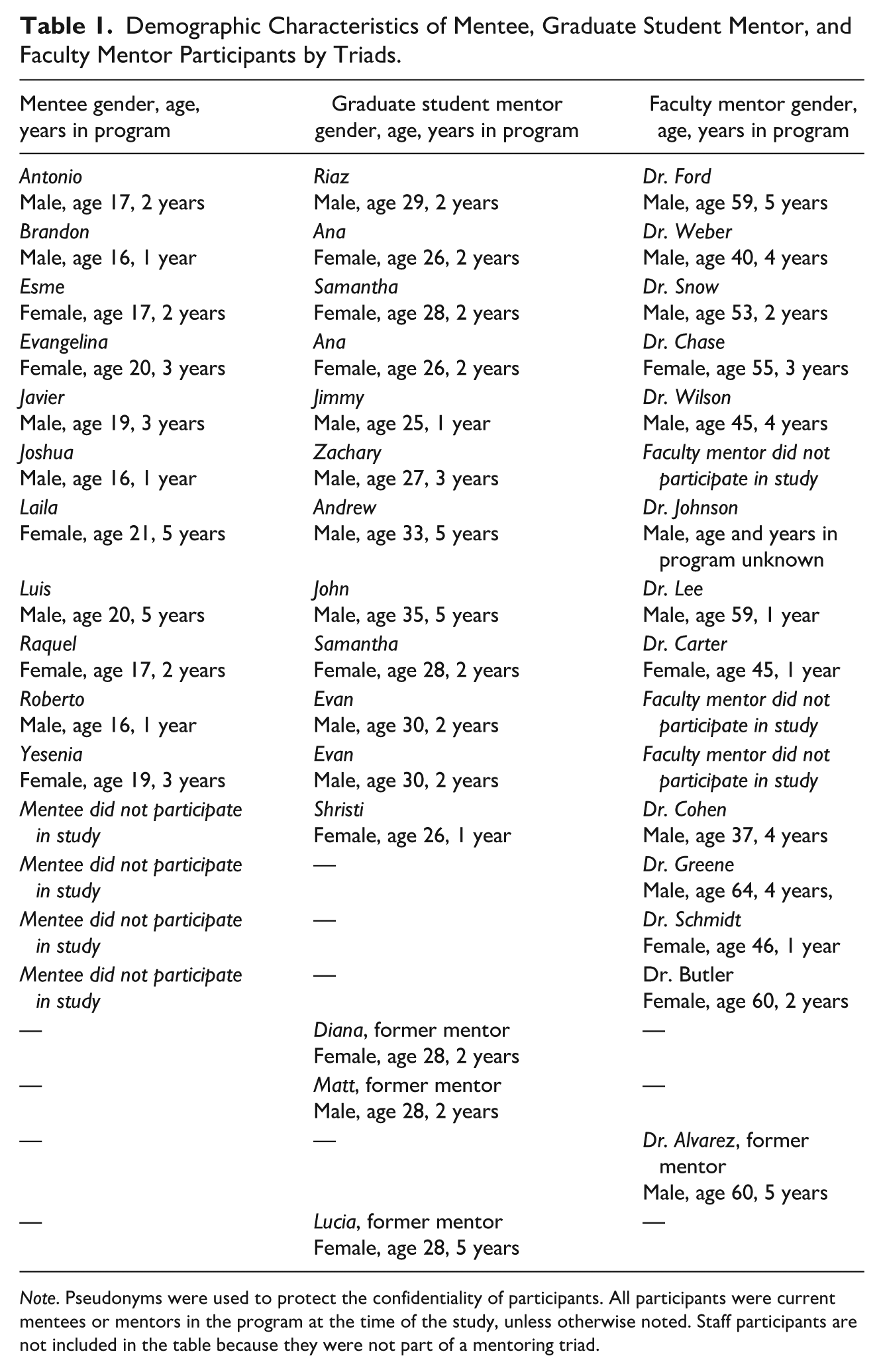
Note. Pseudonyms were used to protect the confidentiality of participants. All participants were current mentees or mentors in the program at the time of the study, unless otherwise noted. Staff participants are not included in the table because they were not part of a mentoring triad.
The three STEMulate staff members were women. One staff member (33%) identified as White and Native American, one (33%) as White, and one (33%) identified as Mexican/Mexican American. One staff member declined to provide their age, but the mean age of the other two staff members was 38.50 years (SD = 2.12). The mean number of years that the staff members had been involved in the program was 3.67 years (range = 3–5).
Most (75%; n = 9) of the graduate student mentors identified as White; two (17%) were Asian/Pacific Islander, one (8%) was Mexican/Mexican American, and one (8%) did not specify their race/ethnicity. Over half of the graduate student mentors were men (58%). The mean age of the graduate student mentors was 28.92 years (SD = 3.06), and the average time that graduate student mentors were involved in the program was 2.67 years.
The majority of faculty participants were men (69%). Most (77%; n = 10) identified as White, one (8%) as Asian American, one (8%) as Mexican/Mexican American, and one (8%) as African American/Black. The mean age of the faculty advisors was 51.92 years (SD = 8.96), and the average time that the faculty advisors were involved in the program was 3.00 years.
Procedures
Throughout the research process, STEMulate staff members were consulted upon to ensure that the appropriate language (i.e., English or Spanish) was used in all research materials (i.e., consent/assent documents, interview guides). Approval was obtained from the Institutional Review Board at DePaul University, and informed consent was conducted with participants. Participants were interviewed one-on-one; interviewers were the first two authors and two graduate research assistants. All interviews took place at the university where the program took place in private offices or conference rooms and ranged from 30 to 150 minutes. Given that all of the mentees were fluent in English, the interviews were conducted in English, as recommended by STEMulate staff. The interviews were audio-recorded and transcribed verbatim. After participants completed the interview, they completed a brief survey about their demographic information and were given a $25 Target gift card for participation.
Interview Guide
A set of semi-structured interview guides was developed based on the study aims and past research on STEM mentoring. The guides began with a series of background questions to get to know the participant, their role in the program, and their general experiences in the program. After establishing rapport with the participant, questions were asked about interviewees’ perceptions about benefits from participating in the program. Specifically, we asked about the technical and “soft” (e.g., communication, leadership) skills that students developed, students’ attitudes toward science and school, students’ confidence and science self-efficacy, and students’ interest in science. Then, we asked about the relationships that participants had with their respective mentors or mentees and the various ways that mentees benefited from the mentoring relationships. Participants were asked to describe their mentoring relationships, their experiences in the relationships, and the specific ways that mentors influenced students in science, their education, and future career. The interview ended with reflective questions about how to improve the STEMulate program itself and final thoughts.
Data Analysis
Data analysis was guided by modified grounded theory (Charmaz, 2006), which is an inductive approach that allows themes to emerge from the data. In this approach, there is an emphasis on diverse worldviews, multiple realities, and the influence of the researcher in steering the coding process rather than an emphasis on the adherence to strict coding methods. The social capital themes emerged from this data analytic method.
Modified grounded theory involves three steps: initial coding, focused coding, and modified axial coding (Charmaz, 2006). Transcripts were coded in Dedoose, a web-based qualitative analysis software program. In the initial coding phase, the second author and two research assistants, who were trained in this analysis read each line of text in every transcript and coded any text that referred to a mentoring interaction, which included interactions between the student and their assigned current or past mentor (faculty or graduate student mentor) or with another adult (e.g., lab technician, graduate student who worked in the lab but was not assigned as the student’s mentor) with whom they developed a mentoring relationship. Although the interview guide also inquired about topics that were beyond the scope of the current study, each transcript was read in its entirety to identify all data relevant to this study. Furthermore, each transcript was reviewed and coded individually regardless of whether the mentoring triad was in the study. The researchers met weekly to discuss their codes and resolve any coding disagreements that may have arisen. If the disagreements could not be resolved, then the text and potential codes were discussed with the larger research team (typically the first author) until a decision was made about how to code. The end result of the initial coding phase was a coding framework that was developed using this inductive approach. In this phase, themes related to bonding and bridging social capital emerged from the data as well as mentee benefits (e.g., increased science interest) from participating in STEMulate.
Then, in the focused coding phase, the first and second authors and the research assistants reread and coded each transcript using the coding framework that was developed in initial coding, particularly the codes on bonding and bridging social capital and on mentee benefits. This second phase of coding provided the researchers with the opportunity to think critically about the codes, revise the code definitions to more accurately reflect the data, and to delete and combine codes into larger themes and subthemes. Furthermore, we compared the codes and transcripts of the mentoring triads (i.e., students and their assigned faculty and graduate student mentors) that participated in the study. Finally, in the modified axial coding step, we examined connections between themes by creating charts in Dedoose to examine themes of social capital (i.e., bonding or bridging) that co-occurred with student benefits in the program. These charts allowed us to further examine text that was coded as bonding or bridging by the mentor and what students gained from this social capital (e.g., increased science interest).
Several steps were taken to establish the credibility of the research findings, to ensure that the findings reflected participants’ experiences. First, the coding team included two Latina women, a White woman, and a South Asian woman, and we acknowledged and engaged in constant reflection on how our various social identities, including education, class, gender, and race/ethnicity, influenced the research process, particularly data collection and analyses. Thus, we kept memos and journals about what we were experiencing in the research process, our research perspectives and reactions, our own personal experiences in the sciences, and our interpretation of the data and themes. We also shared our perspectives with one another throughout the process. Second, we conducted a series of member checks (Lincoln & Guba, 1986) after the initial coding phase, which involved sharing the initial findings in feedback sessions, one with each group of participants (i.e., students, faculty, graduate students, staff), during which we shared the emerging benefits/outcomes of participating in the program and activities that were identified as related to those outcomes. In each of the feedback sessions, participants tended to validate the emerging findings and confirmed that they were indeed reflective of their experiences. Although participants asked some clarification questions, there were no instances in which participants disagreed with the benefits and activities that had emerged. Third, we conducted peer debriefings (Lincoln & Guba, 1986), a process in which we discussed the emerging results with “disinterested professional peers,” specifically other researchers, who were not directly involved in the research process. Finally, we conducted negative case analysis (Lincoln & Guba, 1986), in which we actively searched for examples in the data that contradicted our interpretation of the data.
Results
Participants described how mentors promoted youth’s social capital through bridging and bonding behaviors and how these behaviors led to benefits for students, particularly in their science education. As stated earlier, participants discussed current and past assigned mentoring relationships in the STEMulate program as well as other mentoring relationships that were naturally formed in the program because of its small and intensive nature. Finally, where possible, quotes from students and mentors in the same triad are presented, but when the transcripts of the members of the same triad were compared, participants may have discussed the same themes but did not necessarily the same mentoring examples or benefits.
Promoting Social Capital: Bridging and Bonding
Bridging
Bridging behaviors referred to connecting students to resources (e.g., books, journal articles), people, and/or opportunities for development that students may not have been able to access without the intervention of the mentor. Bridging behaviors increased students’ access to resources and expanded their social networks. Examples of opportunities included invitations to present at conferences, opportunities to publish their research, summer research opportunities, and job offers. Mentees discussed the value of gaining access to information and resources, such as journal articles. For example, Javier
3
stated that a graduate student mentor: really made me open my eyes to see the different things of the science world, like just how everything connects together and the different—there’s just lots of different things about science. He brings articles about—science articles about different things, about energy, DNA, all different type of things. Then he shows us how it combines together. That just made me open my eyes like, that’s what I’m interested in.
A graduate student discussed the accomplishments and connections that a STEMulate student developed because of bridging behaviors in the program: We have another student who’s very, very interested in research and has actually had two abstracts presented at national research meetings. As well as an ongoing collaboration with graduate students at [another] University . . . Basically we can connect them with people. (Evan)
Dr. Butler, a faculty mentor, made it a priority to expand her mentee’s social network and provided her with various professional development opportunities: One of the things that I did with Victoria was I hooked her up with a nurse anesthetist. All day long, she was side-by-side in scrubs in the operating room with this nurse anesthetist. They did a couple of total joint cases. She wound up presenting on the total joint case. There is no doubt she got exposure to what the profession, at least nurse anesthesia, looks like. In the anatomy lab at her table, where her cadaver was, there were five other students. Those five students came from physical therapy, from the physician assistant, the pathologist assistant, and the nurse anesthesia program. She got exposure to all of them.
Victoria had aspirations to become a nurse, and her faculty mentor helped her to learn more about the nursing profession by connecting her to nursing professionals and graduate students and with opportunities to work alongside graduate students from other health fields. Another mentee, Estela, got the chance to interact with podiatry patients because of her mentor: The fact that he let me have the opportunity to go with him and deal with patients, he would be like, “Okay, I’m gonna do the first five and then you get two, and then I do.” We kinda took turns. That made me feel . . . okay well, I got this.
Another example of a mentor’s bridging behavior was to connect students with individuals who provided information about specific colleges. Raquel explained how her mentor engaged in this behavior: Dr. Carter, she has helped me with . . . colleges, too. I ask her questions, and she got me to talk to this girl who works in the same building . . . She told me that I should talk to her about the college that she goes to. That it’s a smaller college . . . Because of her, I learned about the other school.
Finally, a mentee, Antonio, and his mentor each explained in their respective interviews how the mentor provided the opportunity to participate in a local TED talk. Antonio said: I was invited to the TED talk back in September . . . . but [my mentor] went up to the podium, introduced himself, and then said, “Well, I’m not going to speak very much,” and then just handed it to me. I just went through my research with the people there, explained my time here in the [STEMulate] program, and how my curiosity and my interest in science allowed me to take different routes.
Antonio made several references to this TED Talk experience throughout his interview and reiterated his gratitude toward his mentor for providing him with that opportunity, which suggested that it was a particularly impactful experience for him.
In our analysis, we noticed several examples of graduate student mentors also serving as “bridges” and increasing mentees’ social capital within the STEMulate program. Some mentees expressed that they were initially intimidated by faculty mentors and tended to first develop relationships with the graduate student mentors. Because the graduate student mentors worked more closely and year round with the faculty mentors, they were able to facilitate interactions between the mentee and the faculty mentor, which paved the way for mentees to warm up to the faculty and become comfortable approaching them. For example, Evan, a graduate student mentor, stated: Obviously like in Roberto’s [mentee] case I have the ability to introduce him to all these different professors that he would want to talk to. Where he might be interested in their work, but he might not know how to go about setting up these meetings if I wasn’t able to help him . . . and that’s a more general thing is just facilitating these students’ goals.
As demonstrated above, the graduate student and faculty mentors helped to increase mentees’ social capital by engaging in bridging behaviors that connected them to resources, people, and/or opportunities that the students may not have been able to access otherwise. Although a close bond was certainly not necessary for the mentor to engage in bridging behaviors, participants sometimes referred to a certain level of comfort or closeness that they shared with their mentor or mentee when describing how they engaged in bridging behaviors.
Bonding
Bonding behaviors referred to the emotional support that mentors provided that strengthened their relationships with mentees. It also included spending time together, sharing personal experiences, talking about other topics besides science, and providing mentees with encouragement. The structure of the program created repeated opportunities (e.g., working in labs together daily; lunches) for mentors and mentees to spend time together, during which they had one-on-one conversations with one another. These conversations allowed them to get to know each other and develop a closer relationship. A graduate student mentor, Matt, reported that through working in the lab and having lunch together over time, his mentee became comfortable with him and started asking questions; she began to think critically about their research and questioned what they were doing: The more that we interacted and spent time working together and having lunch together . . . she just opened and got a lot more comfortable. That’s when she really started asking questions . . . when she [first] entered the lab she was overwhelmed and quiet and shy . . . [we] just built a relationship where she was not afraid to ask questions and not afraid to come to me and ask to have something explained or whatever . . . Then that went onto . . . That to me was even more important, that she was comfortable enough to go to the highest authority, the department chair, and to my advisor, and have conversations about the research and to be able to ask questions.
This mentee’s comfort with the graduate student mentor also increased her confidence to go to faculty and ask them questions. Thus, she accessed additional support as a result of the bond she developed with her graduate student mentor. Samantha, a graduate student mentor, also encouraged her mentee to get to know other graduate students and faculty in the program: Although we’re close, I wanna try to get her to see if she can like . . . branch out to other people in the lab . . . I don’t want her to just always be talking to me. We have already established a relationship. I . . . want her to get to know everybody else, since she’s only here for a couple more weeks.
Thus, after Samantha and her mentee bonded, Samantha engaged in bridging behaviors by encouraging the mentee to meet other mentors.
Although the conversations between mentors and mentees varied greatly in content, a common theme was that mentors and students engaged in face-to-face, one-on-one conversations, thereby communicating that mentors cared about their mentees and were interested in their thoughts and opinions. Students talked to their mentors not only about science but also about their interests, personal problems or concerns, and major life decisions (e.g., choosing a college). In return, mentors provided information, listened to students, shared personal experiences, gave advice, and encouraged and reassured them. Laila talked about her conversations with her grad student mentor: I’ve never been really comfortable around people . . . we were talking about lobsters . . . I think I told him that I hated lobsters, that I just hate lobsters. He’s like, “Oh, if you go into the sea one time and there’s a huge lobster, it’s probably gonna eat you because they never die.” I’m like, “Oh, thank you. Thank you for that. That’s great.” He’s like, “Yeah, so just when you swim, make sure that you’re not with that lobster next to you.” I’m like, “Ah, I don’t know how to swim, but thanks” . . . Yeah, so that’s how he got me—and then after that, we would have . . . it’s a tradition that we have lunches with our mentors. Every Wednesday, he would talk to me. We would argue actually. We would argue about the dumbest things sometimes. That’s how we got along.
Raquel also shared that she talked to her graduate student mentor, Samantha, about her personal life: “[She] was a person you can talk to. Everything I told her, she would give me really good advice. Especially when I tried to tell her about my mom . . . She told me things to help her.” Raquel also shared with her mentor that “me and my mom didn’t have a really good relationship.” These conversations about her relationship with her mother made her closer to her mentor.
In his interview, Dr. Ford explained the important role of the one-on-one conversations he had with a previous mentee in developing their bond: I would be talking to him about things that I had done in my life and he would just stop the conversation and say, “Wait a minute. I’ve never heard anything like that. It never even occurred to me that I could do that too.” I said, “Man, you can do anything.” Those kinds of conversations, where you can do anything. Once I realized that he’s starting to—he’s having an experience of doors opening, paths opening, now I wanna pour in and show him as many as possible. That’s seminal kind of moment, then I decided this guy is responsive, he’s appreciative. I watch his eyes when I’m describing something really new . . .
These kinds of banter and conversations allowed mentors and mentees to become more comfortable with one another and develop a closer relationship. Furthermore, mentees appreciated their mentors’ encouragement and support, especially when they had trouble with their research. Esme stated that her mentors “were always very supportive in the sense that ‘oh, no, it’s okay, try it again’,” and did not express frustrations with her when she had trouble with lab experiments.
When asked if there was a moment when he felt like he was making a difference for his mentee, Evan, a graduate student mentor explained: We were talking and she was saying that she wasn’t sure if she wanted to go to college or if she wanted to go to college right away. She wasn’t sure if she wanted to take a year off and work and earn some money. I really encouraged her that I felt like she should go to college and I felt like she should go to college right away. I told her that I felt she was very academically gifted . . . I shared my experiences where I’m one of the few from my community that went to college and basically I told her I didn’t wanna scare her. It was very easy if you just stay in your hometown and don’t go to college. It’s very easy to fall into just survival mode. Just getting an easy job and working and all of a sudden you turn around and . . . ten years later they’ve got two kids and they’re working a minimum wage job or two or three jobs. I mean we had a really long conversation about that . . . She and I were talking the first day that she got back. She was saying how she was very excited that this year we’ve got college visits set up and that she’s really excited about learning more about colleges and starting to get into applying for scholarships and looking at applying to colleges and stuff.
Evan engaged in a one-on-one conversation with a mentee, listened to her reservations, shared his personal experience, gave her advice, and provided her with significant encouragement and support as she considered her options. His mentee, Yesenia, reiterated the importance of her time spent with Evan and his encouragement. She stated that if she “needed something, he was always there. Or when I had a problem, I went to him, he always made time for me.” She also talked about benefiting from learning about his personal experience: With Evan, it was more like college advice or just personal life. ‘Cuz he told me some of his personal experiences and how he got through them. It makes you realize, everybody has hard times, but they all get through it. They work just as hard as anybody else, and eventually be somebody.
Spending time together allowed Evan and Yesenia to bond and form a closer relationship and discuss her concerns and aspirations about college.
How Social Capital Promotes Science Education Outcomes
The social capital that mentors provided to mentees was related to science education outcomes: (a) enhanced professional development, (b) broadened perspective of science specifically and education broadly, (c) exploration opportunities, and (d) increased science interest.
Professional development
Mentors’ social capital behaviors helped mentees to develop professional maturity and the language and behaviors to succeed in science. Examples of professional maturity and behavior included becoming comfortable working with scientists and professionals, taking on more responsibilities in the lab, being punctual, and communicating when there were changes in their schedule, and improving their time management and leadership skills. Students also gained professional accomplishments, such as conference presentations, internships/jobs, trainings, and certifications. By spending time (bonding) with their mentees, mentors showed them the language and behaviors in the scientific community, explains Lucia, a graduate student mentor: We teach them very specifically, how do you approach your advisor? How do you speak so that people will listen? How do you ask questions so that they’re respectful? You try to teach them professional skills that will enable them to really be a part of that scientific community . . . they realize that you’re not only becoming a scientist, you’re becoming a professional scientist, and what goes along with that is that you represent yourself well . . .
When the students first entered the program, they were typically quiet because they were nervous about being in a science research environment, but over time, students became more comfortable in their surroundings as they gained a better understanding of the culture and expectations. They also became more comfortable with their mentors, asked questions, and spoke up, and they realized that their mentors were real people just like them. For example, Esme reported she learned the importance of asking questions because of the graduate student mentors in her lab: my first year, I assumed it was really bad for me to ask questions, but I realize . . . especially in lab, if you don’t get it, ask the question cuz you will screw up, so it’s like they really—[the graduate students] probably the ones that helped me the most with asking questions.
Meanwhile, her faculty mentor, Dr. Snow, observed that she learned how to work independently over time. He said that she “learned more degree of independent activity. Although she was supervised, she wasn’t coddled all the time. She was able to work independently,” which is part of developing professional maturity.
Students demonstrated increased responsibility inside and outside of the lab. They communicated via email with their mentors, were punctual, and informed their mentors and staff members of any schedule changes. Students also demonstrated improved time management, increased conscientiousness, and leadership skills. Participants credited students’ professional development with their immersion in a research lab and bonding with mentors. Lucia, a graduate student mentor, shared her expectations for her students: I do expect them to be on time. I expect them to always be honest. I expect them to turn in work to me on time. I also expect them to do their best work. I don’t want to see sloppy mistakes. Those are the type of skills that when I expect it of them, then they take it in later, and because they’ve already been honest, they’ve been on time, those are things that really help them in the long run. I push them to be adults, but then within that, obviously, we have fun and I try to cheerlead them on, but I do expect them to grow up and take on this responsibility.
The combination of mentors’ high expectations and bonding and immersion in a research lab contributed to students’ increased professional development.
Students also acquired certifications, training opportunities, internships and jobs, conference presentations, and publications while in STEMulate. For example, a student was offered a job working in a research lab, another student co-authored a conference presentation and an empirical journal article, others completed HIPAA training, research and ethics training, and as part of a program requirement, all students earned First Aid certification in CPR. Most of these accomplishments were obtained because of mentors’ bridging and bonding behaviors. Dr. Greene, a faculty mentor, explained how a collaboration with a colleague from a neighboring university resulted in two conference presentations for his mentee: We were working with a professor . . . she did the testing with these chemicals that [Luis] identified and got the result. She went and presented at a meeting. Luis was on the list as a co-author of . . . two presentations.
Not all students attained all of these professional accomplishments; some were opportunities that were unique to particular labs or faculty mentors, and thus were only made available to the student(s) who happened to work with a particular lab or faculty mentor.
A broadened perspective
Mentors’ social capital broadened mentees’ understandings of both education and science. Mentors played a key role in helping students gain a better understanding of college and graduate school options. Students spent a lot of time with mentors, observed mentors in their work, and had conversations with mentors about post-secondary education and science fields. Students realized that science is expansive, and they were exposed to science fields beyond what they were taught in school, such as neuroscience, psychology, and pathology. For example, Matt, a graduate student mentor, discussed the various career options that students learn in STEMulate program: I think the [STEMulate] program does a great job of also exposing [mentees] to some of the other branches of science, interacting with physical therapists or a [physician assistants], or some of the other career paths that you can have . . . You see these people who are doing well for themselves and they really enjoy their jobs . . . without that interaction with someone right in front of you who is telling you, “If you do well know, you can have my job.” I think that that’s so powerful and that something you just can’t be told verbally that that’s the case.
Similarly, several mentees explained that participating in the program and observing their mentors opened their eyes to the broad range of careers and activities that exist within the sciences, which propelled them to reassess their future selves in science. Esme said: I’ve always wanted to go to med school, but it was never—it was always in the back of my mind. I was never pushed to it. Then I went to the Pathology lab this year. I was just like yeah, I really want to do med school, and it really opened—because whenever I thought science . . . I wasn’t aware of what you could do in science. Then I came here, and I was like you could work in a lab . . . you could work in a Pharmacology lab. You could be a lab technician. It just opened up so many jobs that exist inside the whole general science area . . .
Through conversations and getting to know one another, mentees also learned about the different trajectories their mentors pursued to become scientists. Antonio also discussed his broadened understanding about post-college options as a result of learning about his mentors’ experiences: At first, college was the first and biggest step for me. Being here with them [mentors], I’ve come to the conclusion that college is just the first step, and that there are so many more things that I can pursue later on . . . after college. College doesn’t necessarily seem like the biggest thing to me now. It seems just like something that I need to overcome first, in order to reach the next stage.
Many students had no knowledge of graduate programs in STEM fields before entering STEMulate. Mentees gained most of their information about graduate school through mentors’ bonding behaviors, specifically by working alongside their graduate student mentors, observing their daily activities, and asking questions and having conversations with them. When asked what the most beneficial part of the program, Dr. Carter, a faculty mentor, replied: having the exposure to research and doing medical research, spending time in the lab, and also being around students, graduate students and postdocs that have decided to pursue a career in the sciences, and understanding what that entails, and the possibilities that are out there for them.
It is likely that the sustained daily interactions between mentees and their mentors greatly contributed to students’ increased knowledge about post-secondary options because they got to experience a part of graduate school by working alongside graduate students.
Exploration opportunities
Bridging and bonding with mentors enabled students to explore their interests, science careers, and their own identities. Bridging behaviors allowed students to explore their various interests. Most mentees worked in at least two labs during the course of the program, and some students were assigned to work in a new lab every summer. Lucia, a graduate student mentor, explained how the lab experience helps students to explore science fields: We see it as our job in STEMulate to continually offer options to them . . . year after year because what they may be interested in one year will change. That’s why we also change the labs. One student was like, “You know what? I really want to be a doctor.” We put her in a certain lab. Then after that, . . . she said, “I’m really interested in forensics.” We said, “Okay. What about this?” We put her in a lab that was molecular, and then it turns out she’s interested in psychological forensics. Then we put her in a PhD psych research group. Year after year, they build upon it, but we do our best to align them with a lab they want. We always give them the same options every year, and as well as new options . . .
The access and exposure to different labs were critical in helping students assess and explore their science interests. The opportunity to explore their interests also influenced students’ course selections in high school and college, helped them to choose a major in college, and shaped their career aspirations.
Mentors’ bridging and bonding behaviors also increased students’ career exploration; they learned about various careers in the sciences. Mentors provided students with a real-life example of a science professional and helped to deconstruct preconceived ideas of scientists based on stereotypes that students had before joining the program. Raquel, a STEMulate student, knew little about the wide range of science career opportunities. Her faculty mentor, Dr. Carter, explained how she helped Raquel to learn about science education and career opportunities: She was really interested actually in my pathway to get where I got . . . I think she was very interested in how you could go on to graduate school and beyond that, a post doc. I got the sense that she might not have been really familiar with an academic pathway and the different outcomes or professions that you can pursue. I went through and told her how I got where I am basically, and also where at different points along my career I could have chosen a different path as a lot of my colleagues have done, whether it be going in an industry, or going to teach at a four-year college versus having a research career, and so sort of trying to give her an overview of all the different options once you pursue a scientific career or any type of career.
Dr. Carter played an important role in Raquel’s career exploration by telling her not only about her own job as a science researcher but also about her colleagues’ science career paths. By spending time with their mentors, students also gained a better understanding of the roles and day-to-day responsibilities associated with their mentor’s career. These interactions and experiences helped students to explore their science career interests.
Through bonding with mentors, students engaged in identity exploration by thinking more deeply about their possible selves. They began to envision themselves in science careers and to believe that studying science and attaining careers in STEM fields was a realistic possibility for them. Antonio, a STEMulate student, credited his mentor’s encouragement in nurturing his science interest and helping him to recognize that he could be successful in science: Dr. Ford would encourage me to continue asking questions and being curious about things and how things worked . . . I was very scared of the unknown, when I first came here. I wasn’t sure how I’d fit in in this type of environment. Dr. Ford reassured me that I have potential, which was very encouraging. He allowed me to process that I have this talent and this knack for science that I didn’t realize, and that’s something that has helped me look towards the future and think about pursuing this later on in life. It’s something that I’m very interested in.
Without the influence and encouragement of Dr. Ford, it is possible that Antonio would have shied away from science given his initial discomfort in a science research environment.
Bonding with mentors helped students to see their mentors as role models, which influenced their own future identities as scientists. As a result of spending time with their graduate student mentors, students gained an understanding of how one goes about working toward a graduate degree in science, and by spending time with their faculty mentors, students gained an idea of what a science research career entailed. Laura, a STEMulate staff member, explained: “I’ve heard time and time again that what they say about their mentors is that, ‘I can see somebody who has done it, and I now know that I can do it’.” Joshua, a STEMulate student, similarly stated: “When I was younger, I used to see myself working at a grocery store. Like just at the checkout. Now, I know I can definitely get my degree. Some way or another, I will do it.” Exposure to scientists and working in a science research setting was enough to radically expand the range of possibilities for Joshua’s future self.
For Evangelina, a STEMulate student, being surrounded by other women scientists in her research lab made a career in science a realistic possibility: Mainly because they’re all female, it really has inspired me to continue what I’m doing, and that it actually is achievable. I really like the fact that my lab is all women. I was actually talking to them the other day about it. I was like, “It’s surprising because, when I think of science, I don’t think of this many women in a lab. I just think of guys.” She’s like, “Yeah, we probably have all the women in that department.” Just being surrounded by that, it really makes it seem like something I can do, and that it’s possible.
Her faculty mentor, Dr. Chase, reiterated Evangelina’s views and experiences. She stated: [Evangelina] said, “Well, I just see the graduate students and what they’re doing and the things that they’re doing to pursue a degree.” She goes, “I like the whole process of working on a degree . . . That seems to be interesting to me.” I think just being exposed—I mean, it’s not necessarily just gonna be studying brain, neuroscience, but the fact that she sees graduate students going on and doing something different with education and an advanced degree.
For Evangelina and other students, the access and exposure to scientists granted by STEMulate and the relationships the students developed with their mentors, who they considered role models, helped to make the prospect of a career in science a reality.
Increased interest in science
Mentors’ bridging behaviors also increased students’ science interest. Mentors connected students with resources (e.g., books, documentaries) and experiences in science (e.g., research) about topics that were of interest to students, and mentors served as role models about what it means to be a scientist, which then deepened students’ interest in science. For example, Raquel talked about her graduate student mentor’s enthusiasm for research, which made her more interested in science: before I wasn’t really into research. Seeing all the stuff [Samantha] does really got me into doing it . . . Seeing her doing all her stuff and being—she’s always talking about it. She seems like she’s so in love with research. She got me into it, too. She seems really enthusiastic about what she does.
Mentors’ bonding behaviors also increased students’ interest in science. Students and their mentors had conversations about science topics that they both found interesting. Antonio, a STEMulate student, explained how his faculty mentor, Dr. Ford, inspired his interest in science: I have had a rather interesting experience in STEMulate, especially last year. Last year I was with Dr. Ford in the neuroscience department. We focused on . . . a sea slug that has very simple systems. Its brain is visible, and we can detect where its neurons are. That was extremely fascinating. I talked to Dr. Ford about so many different aspects of science. We just sat down and discussed many different things, which grew my interest in the field of neuroscience.
Dr. Ford positively impacted Antonio’s science interest in two ways. First, he worked side-by-side with Antonio conducting hands-on science research with animal models in the research lab, and second, he had one-on-one conversations with him about different science topics in which he also provided information. Together, these activities increased Antonio’s interest in science.
Discussion
This investigation showed how mentors promote social capital in science education for Latinx adolescents and the outcomes of their social capital. Given the underrepresentation of Latinx students who pursue and stay in STEM fields (SACNAS, 2019), educators and researchers are interested in mentoring as an intervention to increase the number of underrepresented students of color in STEM education and careers (Chemers et al., 2011). Most of the research on mentoring in STEM has focused on undergraduate students while fewer have examined younger students, particularly during adolescence (Kupersmidt et al., 2018). Adolescence is an important period for STEM mentoring because it has the potential to not only get teens interested in STEM, but it also helps them to develop a STEM identity, to engage with the STEM field, and to develop STEM skills (Kupersmidt et al., 2018), which may increase the likelihood that they enter and stay in STEM. Furthermore, there is a paucity of research on STEM mentoring in Latinx adolescents specifically. Our study filled these gaps in the literature by examining a long-term, comprehensive, science mentoring program targeting Latinx high schoolers.
Researchers have found that Latinx students have less access to institutional agents (Stanton-Salazar & Spina, 2003), who may benefit low-income, Latinx adolescents in their education (Stanton-Salazar, 2011). In fact, past research on low-income, Latinx adolescents revealed that they mostly report family members as natural mentors (Anderson et al., 2019; Sanchez et al., 2008; Stanton-Salazar & Spina, 2003), who tend to have relatively lower educational attainment. Within the context of STEM, Latinx students are less likely to have role models and family members who study or work in STEM (Navarro et al., 2007) and are likely to experience racism and sexism in STEM disciplines (Garriott et al., 2019). Thus, understanding how to increase access to STEM through social capital interventions, such as mentoring, is needed to help Latinx students overcome these social and contextual barriers.
We found that volunteer mentors in a science mentoring program provided social capital via bonding and bridging behaviors, consistent with past research on Latinx students in STEM (Burke & Sunal, 2010; Cole & Espinoza, 2008; Daniels et al., 2019). Social capital theorists have conceptualized bonding social capital as occurring in within-group networks in which individuals in those networks share similar identities (e.g., family, race/ethnicity), whereas bridging social capital takes place across social networks (Lancee, 2010). Hence, bridging occurs across people of different identities. Mentoring programs, like STEMulate, are designed to offer bridging social capital by matching Latinx students to faculty and graduate student mentors in the sciences, who are outside of their networks. STEMulate program characteristics further enabled bridging social capital. Program staff and mentors provided students with information about science education and careers, guest speakers visited the program to talk about their science and health careers, and students got the opportunity to work in multiple research labs and with multiple mentors.
Although past research showed limited effects of social capital in mentoring relationships on adolescents’ GPA (Gaddis, 2012), our study findings suggest that both bonding and bridging social capital are necessary in STEM mentoring programs and perhaps in any mentoring program that targets Latinx adolescents’ educational pursuits. While Latinx students in STEMulate were provided access to science opportunities, information, and resources that were not available in their schools and community, their mentors also provided bonding social capital. For some mentors, bonding with their mentees is what led them to offer bridging social capital. These mentors got to know their mentee, learned about their mentees’ interests, developed a liking for the mentee, and saw their potential, which led mentors to offer certain information, resources, and opportunities (bridging) based on the mentees’ needs and interests. Although researchers have discussed alignment between mentors and youth (i.e., Supportive Youth Systems; Zaff et al., 2015), few researchers have shown the value of spending time in the development of the mentors’ perspective in the relationship in order to align their bridging social capital to the mentees’ needs and interests. Furthermore, STEMulate program characteristics facilitated bonding; mentors and students spent time together through working daily in the lab, weekly lunches, and the ability for students to come back every summer for multiple years. Our findings are consistent with past mentoring frameworks and research indicating that developing a close relationship comprised of emotional support, encouragement, and spending time together is also important for adolescents to reap the rewards of mentoring (Rhodes, 2005). Nonetheless, both bonding and bridging social capital are important for effective mentoring programs.
STEMulate students developed multiple mentoring relationships with both graduate student and faculty mentors, which allowed all students in the study to experience both bridging and bonding social capital. Depending on the mentoring style of the mentors, however, some mentors provided both bridging and bonding social capital, whereas other mentors who were less available, such as some faculty, provided more bridging than bonding social capital. Experiencing both bridging and bonding, social capital may be more likely in a team or group mentoring structure rather than in a one-on-one youth mentoring approach. In a one-on-one mentoring program, it is up to the mentor to provide both bridging and bonding social capital, but mentors’ skills and program characteristics vary which could enable or constrain mentors in the social capital they provide. For example, a mentor might be connected to a lot of resources and other professionals but may not have the time or skills to form a close relationship with their mentee which would limit the bonding and/or bridging social capital offered to the mentee.
Similar to past research on STEM mentoring in university settings (Aikens et al., 2016), graduate student mentors sometimes served as links between students and faculty mentors. Working on a daily basis in a research lab with a graduate student mentor, who was closer in age to mentees compared to faculty, allowed Latinx students to develop a closer bond with graduate students and gain confidence in their ability to connect with researchers. With graduate student mentors’ encouragement and guidance, Latinx students became more comfortable approaching their faculty mentors or simply interacting with them and engaging in conversation. Forming these mentoring relationships with faculty mentors is key in science. A study revealed that undergraduate students with faculty mentoring relationships reported increases in thinking and working like a scientist, science self-efficacy, and research satisfaction than those who only had connections with postgraduate researchers (Aikens et al., 2016).
Our study also revealed the types of science outcomes that are related to bonding and bridging social capital. Researchers have critiqued past mentoring studies for not investigating what mentors specifically do with mentees that lead to positive developmental outcomes (McQuillin et al., 2020); that is, little research has uncovered the black box of mentoring. This investigation examined the specific bonding and bridging behaviors of mentors in a science mentoring program. We found that mentors’ social capital was related to mentees’ increased professional development; perspectives about science and education; exploration of their science interests, careers, and identities; and science interest. These are important proximal outcomes as they may be related to more distal outcomes in STEM, such as skills, academic performance, persistence, and degree attainment. It is important to note that mentors were more likely to discuss traditional science education outcomes, such as achieving certain accomplishments in science (e.g., conference presentations, publications) compared to the Latinx students. Both students and mentors, however, discussed other science education outcomes, such as a deepened interest in science and broadened perspectives about science and education. Given that the Latinx students in this study were generally the first in their families to graduate high school and attend college and the limited science opportunities available for low-income, Latinx students, simply learning about the various trajectories in education and science and jobs that can be pursued in science was an eye-opening experience for mentees.
The STEMulate mentoring relationships occurred within the context of a comprehensive science support program, in which students work in a laboratory to learn and practice science research skills, take science and math coursework, and participate in professional development trainings and field trips. In some ways, this program is similar to other out-of-school time programs that use multi-pronged strategies and a holistic approach to youth development (Kuperminc et al., 2005). In a literature review of mentoring programs that take place within the context of multicomponent programs and services, Kuperminc and colleagues (2005) argued that mentoring relationships may serve as a safe space for youth to practice and reinforce the skills they learn in didactic instruction. STEMulate students experienced didactic instruction in their coursework and laboratory, and over time, students became comfortable asking questions and practicing what they learned in didactic instruction with their mentors as they developed a bond with them. Mentors may also help to teach youth about the patterns of behavior and language of the formal aspects of the program (Kuperminc et al., 2005). Consistent with this idea, mentors in STEMulate taught Latinx students the behavior and language about what it means to be a scientist (e.g., that it is expected to question others in the sciences). Perhaps, it is the combination of mentoring and other services provided in STEMulate that leads to more positive science outcomes in Latinx students in the sciences.
Limitations and Future Directions
The current study has limitations. First, STEMulate served Latinx students who are highly motivated, have an interest in the sciences, and whose families support their participation in the program. Findings may not reflect other Latinx adolescents who do not have the support of their families or are less motivated and interested in the sciences. Second, our study was unable to isolate the effects of mentoring versus other components of STEMulate, and thus it is unclear the extent to which mentoring alone led to the reported positive science outcomes. Third, STEMulate is unique in its long-term (i.e., 6 years) and comprehensive nature, and study results may not reflect other STEM programs that are short-term. Finally, we were unable to recruit Latinx students who dropped out of the program and thus the findings may not reflect the experiences of students who had less positive experiences in STEMulate.
Future investigators should tease out the effects of mentoring versus other components of STEM programs to determine the unique contribution of mentors’ social capital that lead to positive STEM outcomes and to examine whether it is the combination of various services that lead to outcomes. Mixed-methods approaches are recommended to better understand the nuances of how the various program components influence outcomes. We also recommend that longitudinal research is conducted to examine how mentoring relationships in STEM programs change over time and to understand whether there are long-term benefits to participating in such programs. Finally, we suggest that researchers quantitatively examine the effects of mentors’ bridging and bonding social capital behaviors on students’ STEM outcomes.
Footnotes
Acknowledgements
We would like to thank the MIC-Psych research team who provided feedback on previous versions of this manuscript. We appreciate the support of the program staff, mentees, and mentors during the research process.
Declaration of Conflicting Interests
The author(s) declared no potential conflicts of interest with respect to the research, authorship, and/or publication of this article.
Funding
The author(s) disclosed receipt of the following financial support for the research, authorship, and/or publication of this article: This research was funded by two internal collaborative grants from DePaul University and Rosalind Franklin University.
