



Abstract
Authoring Action (A2) is a youth-focused, arts-based, afterschool and summer program. A2’s mission is “to transform the lives of youth and the world through the power of creative writing, spoken word, visual and media arts, film-making and leadership education that promotes positive systemic change.” Using in-depth interviews, this study aimed to understand how this arts-based program affects youth development. Participants in this study (N=36) were alums of Authoring Action (A2), interviewed when they were between the ages of 17-32. Over half identified as female (N=21). Most A2 participants were youth of color and participated in A2 between ages 13-17. Interview data were coded following several steps: generating initial codes, searching for themes, reviewing themes, defining and naming themes, and generating a report. Four themes describe the impacts of A2 for program participants: communication, cathartic and transformative experiences, connection, and critical consciousness. Programmatic features—getting paid to participate, shared group identity, and open access to program leaders and peers – were meaningful to youth participants. The mission and programmatic features of A2 support youth development; we discuss practices that may benefit other arts-based youth programs and the implications of such practices for youth development.
Keywords
Many programs are available outside of school to support youth development. Traditionally, programs that aim to support youth development create opportunities for young people to use their “outside-of-school time” in constructive ways (Durlak et al., 2010). Previous models of youth development programs focused on preventing negative behaviors while, more recently, many of these have shifted in focus to creating developmental settings that promote positive youth development by empowering youth, fostering positive relationships with adults, and building skills (Lerner, 2004; Roth & Brooks-Gunn, 2003, 2016). Youth programs focused on creating positive community change via promoting positive youth development are less common, although developmental theory supports programs that afford young people meaningful roles and authentic opportunities to exercise voice (Eccles et al., 1993; Ozer, 2017). The present study examines one such model, an arts-based youth program called “A2,” to understand how youth experience the program and how the program affects youth development.
Out-of-School Time (OST) Youth Programs and Youth Development
Over the last decade, OST programs have gained momentum for providing opportunities for positive youth development (e.g., Zarrett & Lerner, 2008). Policy makers, educators, and community stakeholders have expressed interest in OST opportunities due to their potential to support academic achievement (Pierce et al., 2013; Vandell et al., 2020) and to promote developmental outcomes among young people (Durlak et al., 2010). OST contexts share some similarities with school contexts while at the same time offering opportunities with regard to promoting youth development that are distinct from school contexts (Noam & Triggs, 2017). OST programs that support key areas of youth development, such as active engagement, assertiveness, belonging, and reflection, are especially promising (Malti & Noam, 2009). Youth seem to experience authority in after-school programs differently than authority in school settings, perhaps because after-school settings are viewed as having a more relational climate compared with school (Deutsch & Jones, 2008). Deutsch and Jones found that youth report that feeling respected in after-school programs is critical, which aligns with broader principals of adolescent development (e.g., Yeager et al., 2018). Additionally, Jones and Deutsch (2011) discuss specific relational strategies that help staff develop relationships with youth such as minimizing relational distance between adults and youth and practicing active inclusion. Thus, there is an emerging evidence base for best practices for youth programs to support positive developmental outcomes.
More specifically, there is a subset of programs and academic literature focusing on the potential of arts-based youth programs. Arts-based youth programs engage youth, prevent negative outcomes such as school dropout (Charmaraman & Hall, 2011), and bolster positive outcomes such as empowerment, mental health, sense of belonging, and skill-building (e.g., Zarobe & Bungay, 2017). Many people have argued that there is a powerful connection between art and empowerment (e.g., Gude, 2007), and arts-based drama and visual arts programs (e.g., Dutton, 2001; Wallace-DiGarbo & Hill, 2006; Wright et al., 2006) have youth engagement and empowerment as central to their purpose. Some research finds that such programs are associated with gains in confidence, art skills, and interpersonal skills (e.g., Wright et al., 2006). The present study explores the potential of one arts-based youth program and explores specific features that support positive youth development.
Youth programs at the cutting edge are pushing practice forward by moving beyond a focus on transforming youth toward a focus on how to transform systems and institutions (Zeller-Berkman, 2019). The concept of Critical Youth Development (CYD) emphasizes how youth programs can be structured to challenge “dominant social narratives about race, gender, and class and reimagine a more equitable future for youth” (McGee, 2019, p. 96). Although the practical focus of CYD is on changing the settings and practices of youth programs to be more conducive to CYD (McGee, 2019), implicit in such programs and practices is the need to support youth in thinking about community- and system-level change.
The Potential of Emphasizing Community Development Alongside Youth Development: Aligning Youth Programs With Developmental Needs
During early and middle adolescence, young people have specifically developmental needs. For example, adolescents have increased needs for belonging, relating to, and connecting with others; exercising autonomy and feeling respected; and increased desires to contribute to the world around them (Fuligni, 2019; Lerner et al., 2009; Ryan & Deci, 2000; Yates & Youniss, 1999; Yeager et al., 2018). The developmental settings of adolescence, such as schools and families, are often highly structured and may not afford opportunities to fulfill these needs, resulting in a mismatch (e.g., Eccles et al., 1993) that may hinder positive youth development. OST programs that emphasize what youth can contribute to others rather than on providing services to youth might be especially suited to fulfilling the developmental needs of early and middle adolescence by providing young people with the chance to exercise autonomy, feel respected, and contribute in a meaningful way while connecting with others. There are many applications of this idea in practice; for example, service learning programs and youth engagement programs and policies such as youth organizing and youth participatory action research (YPAR) are based on promoting development at multiple levels, among individuals, communities, and society (Kirshner & Ginwright, 2012; Ozer, 2016; Ozer et al., 2020). Evidence suggests that these approaches support aspects of youth development such as agency (i.e., the feeling that one has independence and control in their life), leadership, and academic outcomes (Anyon et al., 2018). Evidence also points out how youth engagement can affect community development, for example, by affecting policies (e.g., Conner et al., 2013). Furthermore, the need for belonging and relatedness are also central for adolescents (Lerner et al., 2009; Ryan & Deci, 2000). Youth programs may best support adolescents’ social developmental needs when they offer youth the latitude to develop social relationships with peers as well as implementing strategies to facilitate genuine connections with adult mentors (e.g., Jones & Deutsch, 2011).
Arts-based OST youth programs that focus on social belonging and provide enrichment for youth by treating youth as assets to community are less common in practice and in terms of empirical research. This is especially acute for youth of color and/or from lower socioeconomic backgrounds in urban settings, often referred to as “disadvantaged” youth. OST programs for these youth are often framed in terms of fulfilling needs for skill development, forming positive relationships, and accessing constructive ways to use their time as opposed to being framed in terms of fulfilling the needs of youth to use their skills and voices and contribute to their communities (Kirshner & Ginwright, 2012; Mitra, 2004). Advances in asset-based approaches to youth development theory and programming, rather than deficit-based approaches (e.g., Lerner et al., 2009), coupled with an expanding evidence base about best practices to maximize OST have helped re-frame and advance OST programming (Hill & Vance, 2019). We offer that OST programs that further focus on community development via youth development may provide a promising model. We posit that OST programs can serve the dual purposes of fulfilling youth developmental needs and promoting community development when they focus on providing youth with opportunities to meaningfully contribute to their communities through developing their skills and talents.
Authoring Action
Authoring Action (A2) is an arts-based OST program that embodies a dual focus on youth and community development. A2 is a youth-focused, arts-based organization in Winston-Salem, North Carolina, with a mission to transform the lives of youth and the world through the power of creative writing, spoken word, visual and media arts, film-making and leadership education that promotes positive systemic change. It was founded in 2002 to provide tools to youth for their personal success in any career, calling, and life path. Through developing their artistic skills, A2 asks youth to think analytically about issues in their lives and communities through self-reflection, critical thinking, and self-expression skills and to use analytical skills to foster positive systems change in their communities (Muhammad, 2019).
A2’s specific program language reflects their intentionality in how they view program participants as well as how they build identity. For example, they call their teen participants “authors” and provide them with the requisite skills to develop as authors with full ownership over their work. When authors recite poems or spoken word pieces at community events, A2 leadership and staff refers to these as engagements rather than performances reflecting their view that the teens’ role is more active than performing; the teens are meant to connect with and move their audiences.
A2 uses a curriculum written and developed by the co-founder and artistic director, called the A2 Creative Writing Process (formerly called Writing to the Senses; Freeman, 2019). In this curriculum, which is aligned with North Carolina’s standards for Writing, teens learn to use grammatical rudiments, vocabulary, and comprehension to create stories, monologues, raps, and lyrics. The first piece of the curriculum is the “first ink discussion,” in which discussion leaders start with a question (e.g., What is courage?) and later introduce a synonym (e.g., What is the difference between courage and bravery?) with discussion based on the Socratic method (Freeman, 2019). Importantly, there is no didactic teaching in this method; rather, the emphasis is on sharing and clarifying one’s own perspective and developing opinions.
Based on the curriculum, A2 offers programs with different levels of involvement for youth. In the shortest iteration, A2 offers a 5-week Summer Intensive program (Authoring Action, 2019, Programs). This is a full-day program meant for teens ages 13 to 17 years, although the program sometimes accepts teens slightly outside this age range, and teens are paid for their active participation. The Summer Intensive programs are structured by a theme—such as violence as a health disparity, trauma transformation, and racism—typically chosen by the directors in advance of the summer. The 5-week program unfolds in a series of steps in which A2 youth write spoken word pieces about issues in their own lives and then collaborate with local artists to turn their writing into an engagement for community audiences. Each summer group (typically between 18 and 25 participants) creates a name, designs a t-shirt, and builds group identity as they work together throughout the summer. The Summer Intensive program culminates in a final public engagement that weaves together their original spoken word pieces, songs, and dances; participants perform at a local art venue multiple times for family, friends, and community audiences.
A2 also offers a year-round program—called the Outreach Ensemble—for youth who complete the Summer Intensive (Authoring Action, 2019, Programs). The year-round program builds on the A2 Creative Writing Process curriculum used during the summer and involves twice weekly after-school meetings centered on writing and creating new works, either as part of their own development as authors or in response to commissioned invitations for community organizations. For example, multiple times during the year, community organizations such as the Wake Forest University School of Law, or other community leaders chairing events such as the National Black Theater Festival, hire A2 teen authors to engage their audiences about specific topics. Teen authors then create and prepare original content about the specific topics to deliver for each event. Audience evaluations, collected right after many events by A2 staff, have consistently indicated that the teens are perceived as highly impactful and the engagements are emotionally affecting and help audiences to think about social issues. Audiences were overwhelmingly positive about the A2 engagements, workshops, and events they attended (first author, unpublished evaluation data).
One important component of A2 is their “Just Us” program (Authoring Action, 2019, Programs). A subset of teen authors come to A2 through a court-referral or judicial or personal preventive referral. The Just Us program is court-approved, and teens begin with participating in the Summer Intensive and focus on producing films based on their interests and stories. Through each of the A2 programs, the focus is on youth gaining skills and empowerment through the arts with the ultimate goal of “building youth as authors, community leaders and advocates for social change—redefining learning through the arts and supporting stronger communities” (Authoring Action, 2013, Mission).
The Present Study
The present study examines the experiences youth retrospectively report as participants in A2, highlighting the unique features of this program and the contributions of these programmatic features to youth development. Specially, we aimed to understand how youth talked about both their own development through participation in A2 and their broader understanding of their communities and their potential contributions, both short and long term, to society.
Method
The primary data source in the present study was individual interviews completed with A2 participants conducted by the researchers, in partnership with A2 (Ballard et al., 2020). The interviews were part of broader program evaluation efforts.
Participants
The research team and A2 program staff recruited participants through the A2 network of current and past program participants. Several recruitment methods were used. First, A2 program directors created a video explaining the evaluation project and inviting current and past program participants to participate in interviews. This video was shared through their A2 social media accounts. Second, A2 program staff utilized contact information records to contact participants. Third, A2 staff hosted three events to convene their network and used this opportunity to recruit participants. Finally, we used a snowball sampling approach where interview participants shared the names and contact information for A2 participants in their network of cohort who might be interested in participating. Participants completing the interview received a US$10 token of gratitude. This study was conducted under the purview of the Wake Forest Health System Institutional Review Board (No. IRB00047943).
Participants (N = 36) ranged in age from 17 to 32 at the time of their interview. Over half (21 participants) identified as female. Two thirds of participants (N = 24) who were college eligible reported that they had gone to or were currently in college, and two thirds reported being currently employed (some participants were both in college and employed). Table 1 provides a full description of the sample. We did not explicitly ask participants to indicate their race/ethnicity, but A2 works primarily with African American youth.
Demographics.
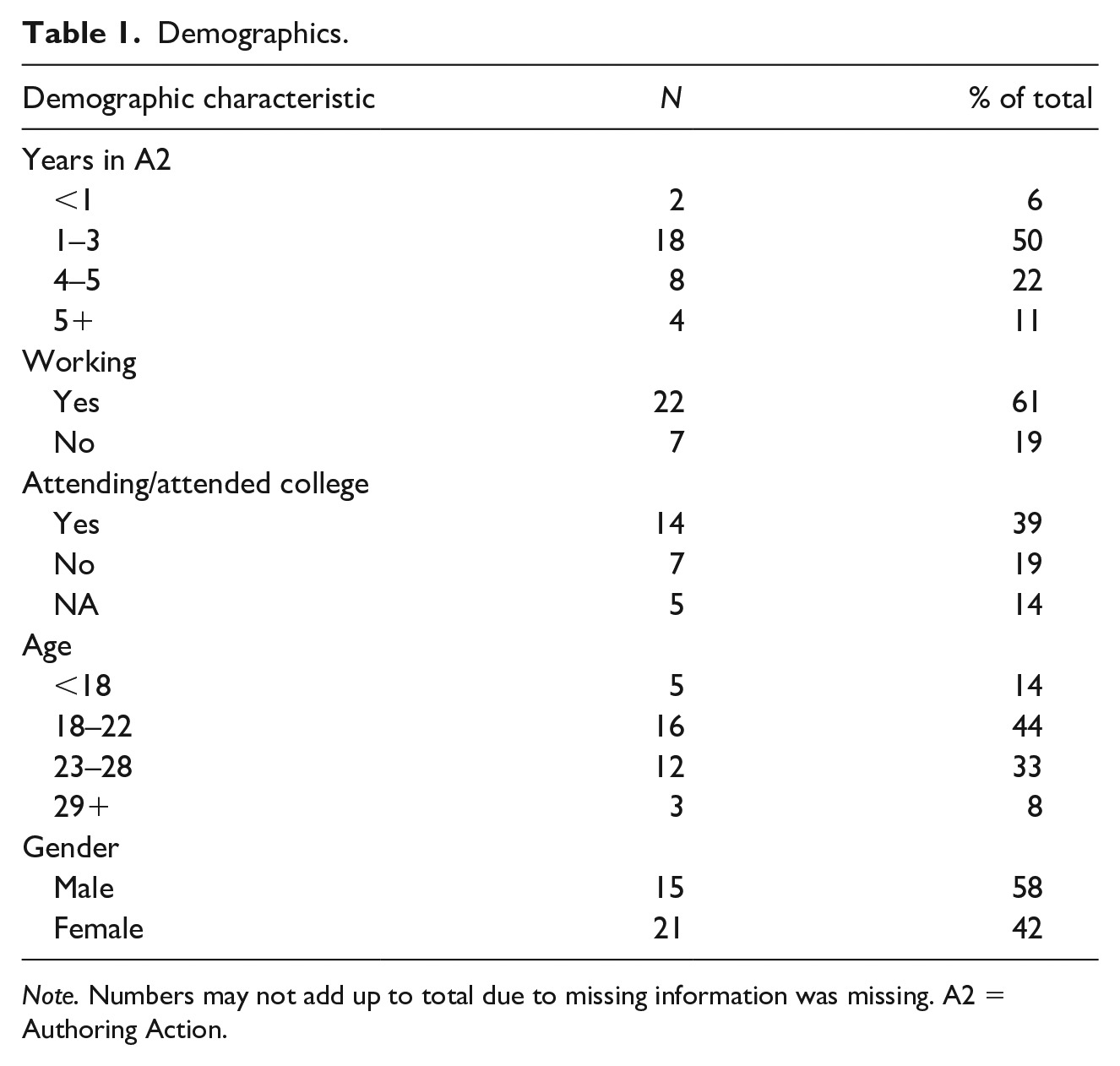
Note. Numbers may not add up to total due to missing information was missing. A2 = Authoring Action.
Measures
A semi-structured interview script was developed and revised in collaboration with A2 program directors and staff, who were also past program participants. Interviews were conducted in person or by phone (when needed) and all participants consented to their interview being recorded. Participants were asked a series of questions regarding the duration and quality of their experiences at A2 and how participating in A2 affected their lives. Three A2 staff, who had also participated in A2 as teens, and the first author conducted interviews. A2 staff met with the first author and were trained to conduct the semi-structured interviews. After each interviewer had conducted their first interview, the first author provided individualized feedback. This process was for quality assurance and standardizing the interview procedure across interviewers, and also an effort to provide research training to A2 staff involved in the project. Each of the four interviewers followed the same script (see the appendix). Each interview took between 15 and 45 minutes to complete. Interviews were transcribed verbatim by an independent transcriber, and coders used transcriptions for analyses.
Analysis
Interview data were approached first through a thematic analysis (Braun & Clarke, 2006). We followed the six suggested phases of familiarizing ourselves with the data, generating initial codes, searching for themes, reviewing themes, defining and naming themes, and generating a report. We used a realist theoretical framework, treating interviews as direct reflections of participants’ experiences, and our analysis was both deductive (themes were informed by our specific topics of interest) and inductive (themes were informed by the data; Terry et al., 2017). The first and second authors read and reviewed five interviews at a time to determine broad themes that appeared across the interviews. For each interview, each coder wrote a brief memo about what stood out and what major themes arose. Each coder identified appropriate quotes for each of these themes. We repeated this process until each coder had read all of the interviews. After each round of five interviews, the coders discussed their notes on the interviews.
Once the coders had discussed each interview, the coders discussed the broad themes they had identified and created a list of codes. Departing from a thematic analysis approach (now referred to as a “reflective thematic analysis,” Braun & Clark, 2019), the first and second authors then developed a codebook, which included the code, a thorough definition of the code, a guide for “when to use” the code, a guide for “when not to use” the code, and an example of how the code had been used in an interview (Table 2). After revising the codebook, the researchers imported all of the interviews and codes into a qualitative analysis program, Atlas.ti. Each coder independently read and coded three interviews. Coders discussed each interview in depth to see which codes they agreed on and which codes to modify, and repeated this process with two more sets of two interviews, each time discussing discrepancies in coding until reaching 100% agreement. The coders then met with the last author for an outside perspective on the clarity of codes. Each coder then read and independently coded 10 interviews; after reaching 80% agreement, the secondary coder coded the rest of the interviews. As additional data quality checks during our coding process, the first and second authors discussed interview findings with a researcher outside the research team early in the process and with A2 leadership later in the process.
Codes and Quotes.

Researcher Positionality
It is important to note several aspects of researcher positionality with regard to this study. The first author, who also conducted some of the interviews in the present study, is Iranian American by background and identifies as White and is a cis-gendered, heterosexual, highly educated woman. These identities inform her orientation and approach to this project, which primarily worked with teens and young adults from Black and Latinx backgrounds. The author notes that her approach to research is informed by her own multicultural background and she attempts to center the voices of people across communities, to form partnerships to improve the quality of research, and to investigate issues related to social justice, equity, and youth civic engagement and empowerment.
Our team implemented many strategies to address what we see as potential pitfalls of a primarily White research team in a study of youth of color. First, we built a team diverse with regard to racial/ethnic background that included A2 program alums. Second, through our community-partnered approach, the first and last authors spent many hours observing the A2 program and getting to know the program leaders before designing and conducting the interview study (Ballard et al., 2020). Third, we chose the interview methodology to center youth—and minimize adult researcher—voice. Fourth, the study was developed alongside A2 project leaders and alums through a collaborative approach to designing the interview guide in a way that would reduce biased or leading framing of the interview questions. Fifth, we made an explicit effort not to use a deficit lens in this research; this was heavily informed by A2’s own approach to their program participants, which we discuss at length in this manuscript. Finally, A2 project alums were trained to be the leaders in recruiting and conducting interviews. The A2 project alums who conducted the majority of interviews were all younger (closer to the age of study participants), all Black/African American, included both women and men, and had many shared lived experiences with study participants. This was intended to increase the quality and validity of interviews compared with having the Iranian American and White, older, researcher(s) conduct interviews. In particular, it is possible that participants would have been more hesitant to discuss issues related to race/racism/agism/classism/gender bias with the first author compared with how comfortable they would have felt when participating in interviews with peers closer to their age and (in many case) their own racial/ethnic backgrounds.
Analyses, on the contrary, were primarily conducted by the first and second author (one from an Iranian American background, both identify as White), who brought our own experiences and views into analyses. As an example of potential bias we brought to analyses, in an initial pass at coding interviews and writing about the A2 program and our study results, we did not directly address issues regarding race. This “avoidance of racialized issues in the study” is discussed as color- and culture-blind research in education settings, a “danger in education research” according to Milner (2007) in a manuscript about race, culture, and positionality. Not directly addressing the race of A2 participants (primarily Black and Latinx) and aspects of the racial issues that arose in the interviews reflects our position of racial privilege; a revision of our analysis and findings encouraged us to draw more on critical frameworks that have race at the center (e.g., CYD), to directly address how A2 views program participants (which we believe differs from many existing youth programs), and to surface findings where race were central to what study participants were saying about their experiences in A2. Importantly, we also discussed findings with the A2 program leaders (White woman, Black man, both older compared with study participants) periodically to share our learnings and get their perspectives. These discussions informed our analysis as well.
Results
Results from the primary data source, the interviews, are summarized below. Table 2 presents a detailed description of the final codes, code definitions, number of quotes identified for each code, and the number of participants for whom each code applied. After coding the full set of interviews for the eight codes identified during the coding process, we organize our results into the following four themes that describe the types of impacts the A2 program had on the lives of participants: communication, cathartic and transformative experiences, connection, and critical consciousness. Each theme is described in detail below.
Communication
When asked about the personal developmental skills they learned and gained from participating in A2, participants overwhelmingly identified impacts that fell in the category of communication: communicating effectively and developing a voice/sense that they were heard. In our coding, we distinguished between these two. The first coding category, communicating effectively, included technical skills such as projecting one’s voice, how to have a presence in a room full of people, and how to write effectively. Expressions related to A2 having helped participants with communication, specifically writing and verbal skills, were also included in this code category. We also included communication skills regarding leadership and working in groups and developing the ability to persuade others, but did not include the emotional aspect of leadership such as feeling confident. We identified 56 instances of this type of communication skill building across 22 participants. For some, it was the writing practice and technical skill building; for example, one young woman who participated in A2 for 5 years as a teen said, I started to write more. When I started, I could only write a 2-3 sentence poem. I actually had to merge my pieces together because they were too short. I have really grown as a writer. I still use certain things that I learned from WSYAI [Winston-Salem Youth Arts Institute]
1
and apply it now. (ID 040)
Many others talked about the specific A2 curriculum called the A2 Creative Writing Process (formerly called Writing to the Senses). For example, one participant said the thing that stood out the most was learning to write through the curriculum: Well, the thing that stands out the most for me was learning to write with my senses. It’s the most important thing I learned there. That has to be it. Sensory writing. I remember my second year in, we really dove into it, it was a real big thing. It was a little complicated at first, but writing with your sense was what stood out the most. (ID 030; woman, 4 years in A2)
Others talked about how A2 helped them gain the capacity to write and communicate about emotional topics. For example, one young woman who participated in A2 for 3 years recalled the following: At first, I was petrified to talk about, like love, in a deeper way, and it was something that came up a lot whether it was romantic love, or family or friends . . . We would have individual sessions sometimes, everyone would come in and talk about problems. One of his things is you get stuck, because you say the right amount of things but you don’t put the depth that I know that you have. I was so scared but I didn’t know that. As soon as [Mr. Nathan] pointed it out to me I was able to say exactly what I meant instead of precoding it sometimes. (ID 056)
Thus, many teens attributed A2 with their growth in technical skills and general communication abilities in speaking and writing.
The second theme related to communication had to do with the psychological and emotional experience of developing a voice and feeling heard. Interview responses coded in this category were about participants understanding the power of their own voices as well as sharpening their points of view and methods of expression. In our coding, we did not include technical skills when coding this category. We identified 64 instances of this code across 25 participants. Participants noted feeling powerful in their own identities and learning to use their voices and identity to be powerful. One participant explained that A2 taught me how to have a voice. To make sure that I speak because that’s the most powerful tool and weapon, and that I’m not shunned because I’m the only woman in the room, the only African American in the room, the only one from the projects in the room, to forget all that. Because none of that really matters. But to understand my power that is within me and use that as way to articulate the needs of the communities I come from even when I’m in a room full of millionaires or a room full of people considered to be playmakers and shot callers. To not shy away and be afraid because everybody in the room doesn’t understand where I’m coming from or they disagree. (ID 002, woman, did not report number of years in A2)
Many of the teens connected their voice with a feeling that they matter. For example, when asked what they learned from A2, one young woman who had participated in A2 for 7 years responded that “no matter who you are or where you come from you have a voice and people deserve to hear you” (ID 026). Many echoed this and even explained how the communication skills they developed in A2 changed their trajectories. For example, I learned that my voice matters. The words that come out of my mouth can make change. Just by speaking it. Not just talking, you can’t just say things and change happens but after being in A2 I did see that what I say can invoke change. It’s funny because I ended up going to college and I majored in communications, so now I have a voice and I know that it matters and I know that I have a purpose and now I’m in school studying the skill of communication. (ID 007, woman, participated in A2 for 1 year)
Interestingly, some participants discussed a disconnect between A2 offering the opportunity to develop voice and a platform to share it where they felt as though people were listening to them on the one hand, and the fact that they still did not necessarily translate to effective changes on the other hand. For example, one young woman explained that A2 gave us a voice, it prepared me a lot for what I’m experiencing now. I would say the only drawback, not from A2 but from the vision it created for me, was that when we were 12 or 13 speaking our minds, people where there, and people clapped. My question is were they listening? A lot of things we talked about back then is still happening now. I’m still using the power I identified when I was 12 but I’m saying the same things now that I’m 26, no one wants to clap because I’m an adult. So there is a lot more work that needs to be done. Sometimes I struggle a little bit, because I’m saying the same thing I said then, but the reaction is different. We’ve got to find new and creative ways to engage adults that are kind of stuck, stuck in their ways. It’s yeah, I’ve been trying to find ways to be strategic about it, I have to remain emotional and I have to remain passionate but I to a certain degree have to remain strategic. I think A2 was perfect for me at a young age because it was raw fire. Now it’s more refined but now I have to find a way to still keep it and be effective at the same time. (ID 002)
In sum, participants discussed many aspects of learning communication, including learning skills for expression, the important experience of using their voice, and even the limits of their own voices.
Cathartic and Transformative Personal Experience
Another major theme from these interviews was that A2 was often a venue for catharsis and transformative personal experiences. Two codes we identified in the interviews were opening up and transformative personal experience, which together communicate the deeply emotional and impactful nature of A2 participation. Text was coded as opening up when participants indicated that A2 helped them feel safe to express themselves and/or how using art and participating in A2 helped the person move through difficult life experiences. Codes in this category (38 total across 19 participants) tended to be about how A2 helped teens express vulnerability, for example, one young man who had participated in A2 for 5 years expressed that A2 was one of the most exceptional experiences I’ve ever had in my life. It taught me so much. Mr. Nathan [A2 artistic director] taught me how to write, he taught me how to speak, how to stand up to myself. He taught me how to open up. (ID 020)
For many teens, this was among their first experiences being emotionally vulnerable with others. This helped some clarify and express their own feelings. A young woman who participated in A2 for 3 years reported that “It gave me confidence, and one particular time . . . a documentary where I had a breakthrough and finally expressed how I feel outside of being afraid” (ID 033). Some participants explicitly noted that A2 allowed them a way to deal with difficult feelings and others even described what they perceived as therapeutic benefits of A2 for them. One young woman who had participated in A2 for 3 or 4 years explained, It’s a program that . . . it set the youth up in a way that is so hard to find in other programs. You can’t go to a therapist and get what you get from this program. You can’t go to a psychologist, a psychiatrist. It truly transforms. I don’t care what path you are on, when you come in, this program will show you your path and make that path so desirable that you will do whatever it takes to get on that positive path. It’s just life-changing. (ID 038)
This last quote speaks to a related but distinct concept that was very evident from these interviews: A2 was transformative for so many participants. We identified a code for transformative personal experience and coded this when participants described any of the following: personal growth and identity change because of the A2 program; meaning and purpose; taking oneself seriously; and confidence. This code captured participants’ stories about maturing and learning to understand oneself internally. We coded this 67 times across 30 participants, and this code captured many ways through which A2 transformed the lives of teen participants. Some teens, when asked to describe their experience with A2, made very general statements, for example, one young woman who participated in A2 for 1 year said, . . . It really shaped the way I looked at myself and how I looked at the world and how I looked at myself in the world. After being in A2 it really made me feel that I had a purpose . . . (ID 007)
Other times, the participants summarized long and personal stories about their lives and the role they believe A2 played in shaping their lives. For some, A2 transformed their lives by raising their awareness of the active role their own decision-making and actions would play in their lives. For others, A2 was transformative in part because it helped them realize the broader structural forces at play in society that in turn shaped their own life prospects. In a particularly powerful exchange, one participant was asked whether she believed her life would be different if she had not participated in A2 and she responded, Very different. If I left it up to society I wouldn’t be here. Once again I’m a young African American woman who grew up in the projects. Everybody around me has a child, right now. I have brothers who are still stuck in an underground economy, a mother who was affected by drugs, a father who was affected by drugs. I’m a product of the juvenile system here in [Winston-Salem, North Carolina]. I was expelled from school in 8th grade. I was thrown in jail in 8th grade. I suffered the collateral consequences of making bad decision and getting a criminal record. I’m a victim of sexual abuse. I’m a walking checklist of everything that’s supposed to stop you. If you go read an article now, when it talks about what stops African Americans from continuing to move forward and succeed in society, all the things that are said to you are the things that were supposed to stop me. But the only thing that saved me was that at the end of the day I had two people and this organization, Miss Lynn and Mr. Nathan, of course my family, and A2 who told me that those things are not to stop you. I grew up with [list of names]. . . I saw at a young age all those people affected by the criminal justice system. But I managed to see the sparkle in their eye and to see how special they were. So I knew at a young age that even if I got caught up in the wrong things due to my circumstances, my circumstances do not define me. I’ve partnered with great people over the years, that have exceptional stories, and I have [been] giving a voice, and A2 helped me find that voice. I wouldn’t be this [names current occupation] standing before you right now if it wasn’t for A2. I owe it to a lot of people, but A2 was an integral part of that. (ID 002)
Although just one example, this quote illustrates several ways that participants experienced A2 as transformative. At its core, the experience of A2, in many instances, transformed how people viewed themselves and the world around them. Through these interviews, it is apparent that A2 was a transformative experience in the development and trajectories of many participants.
Connection
Another theme that we identified from these interviews is that A2 played a major role in fostering connections among A2 youth participants and with A2 staff. We identified three different types of connections that we coded separately: social connections (coded 72 times across 29 participants), connecting to different people and ideas, coded as broadened perspective (coded 55 times across 22 participants) and instrumental connections, coded as resources, connections, and opportunities (coded 12 times across 12 participants).
Overwhelmingly, participants talked about the sense of connection they had, and many still have, with A2 program participants, leaders, and affiliates. Many used the strongest possible language to describe these connections, such as “family.” One young man who participated in A2 for 2 years said simply, “A2 impacted my life because they are basically like a family that held me. I had a shoulder to lean on and vent to” (ID 017). Another young man who had also participated in A2 for 2 years elaborated on the feeling of responsibility to others in A2 by saying, “They’re definitely my family. If anything happens to them and I could help them in any way shape or form I would . . . Those are definitely my brother and sisters. I am my brothers and sisters keeper” (ID 055). Others talked about how the relationships may fade over time, but there is a strong sense that people are “there for each other” and that the connection to A2 remains so strong that people feel that can re-connect seamlessly. For example, a young woman who had participated in A2 for 3 years reported, “I feel like even former members of A2 have a real loyalty to the organization and would want to do whatever we could. It’s more than an organization, it’s a family. A very large family” (ID 056).
Many specifically talked about connectedness in the context of their ensemble. This was expressed in terms of both what participants received (e.g., one young man said, “I’m going to say my ensemble gave me the support I needed” [ID 021]) and what they learned to give to others; for example, another young man said, It birthed in me an obligation to make sure that my peers succeed, I had the obligation to make sure that my Ensemble members succeeded. This made me a really generous and brother’s-keeper type of person. I am always doing things in the interest of my friends and family . . . I’m generous at heart, more than ever before because of A2. (ID 024)
These touch on the emotional connections to the others, but many also talked about A2 helping them build social skills to connect with others. For example, a young man who participated in A2 for 2 years explained that A2 “gave me the tools to where I can build bonds with people, where if I wanna start a movement I can build bonds with people who also have the same thing in mind” (ID 055).
The broaden the perspectives of participants’ code captures A2 youth’s connections with others from different backgrounds and deeper connections with themselves. Many participants described the experience of being in the program with people from different backgrounds and learning about common experiences across backgrounds. One young woman who had participated in A2 for 7 years said, . . . I was a regular normal student . . . I felt like I was just living a regular life. And then I got to A2 and I was exposed to so much. So many like, um, I can’t remember how many kids there were but the things that these kids had experienced and the stories they were telling and the things they’d gone through, I felt out of place. I felt like I wasn’t even supposed to be there. I took in every single thing. I absorbed it all because it all because it was like “this is the real world.” We had kids that had eating disorders and had been went through extremely traumatic things that some of them if I looked at them and had known them I would have no idea they had experienced the things they went through and they came from all kinds of families. It was really crazy to see how you just got this group of kids and they had so many different experiences. It was a big overload but like I said I absorbed all of it and it opened my eyes to how the world is. (ID 026)
Others described how connecting with people from different backgrounds also made people better able to connect with themselves and their own stories. For example, one young woman noted, “My experience with A2 was very eye-opening only because you meet so many people who have different stories and different situations and you have the opportunity to become more in-tune with yourself” (ID 006). Some participants described how they learned through A2 to connect with people more authentically, based on their humanity as opposed to a more superficial level.
Finally, some explained that A2 changed their perspective and allowed them to see how all people are interconnected. In response to the question about how their life is different today because of A2, one young woman who participated in A2 for 1 year explained, I think one big thing is my perspective is so different now. It is constantly, I’m stepping out moving further back and back to see the picture as a whole and not the little tiny circle lens that I think I have. It’s like we’re all connected and I feel like everybody has an answer a purpose, everybody has something inside them that their supposed to do and I see that in everybody, everybody I talk to, I come across. I’m like “they have something in them” and it’s so exciting to ask “what could that be?” (ID 007)
Many participants articulated how A2 changed how they were able to connect with others, and with themselves, by changing and broadening their perspectives.
The third code in this theme of connection had to do with the fact that A2 provided more concrete forms of connections for program participants. We created a code for every time participants mentioned gaining resources, connections, and opportunities. In general words, participants described A2 as “a stepping stone” (ID 029) and a program that “opened a lot of doors” (ID 063). Others specifically mentioned important opportunities instrumental to connect with community members and have the opportunity to network. For example, one young woman said, “They probably provided more opportunities for me to be involved . . . A lot of people that I know are through Miss Lynn or Mr. Nathan . . . They have actually provided me a pathway to meeting members of the community” (ID 002) and another young woman expressed appreciation that “Networking was taught really well with A2. I networked to get [my current] job” (ID 029). Participants also noted the resources available through A2, including access to information: “I mean they are still in my life so I still have really good resources, if I need help researching something or need knowledge on something” (ID 026). Another resource mentioned was connections to people with instrumentally valuable skills, as one young woman who participated in A2 for 5 years explained, I have so many ties to the community because of them. Like if I needed funding for something I know how to write a grant because I had Ms. Lynn. Like I wanna shoot my film on deployment, I have Mr. Nathan. Like I don’t necessarily have to buy the things that I need because I have the people I need. (ID 058)
Finally, A2 is a paid program. This was absolutely instrumental in both recruiting young people who could benefit from A2 but could likely not afford to participate in an unpaid program and in communicating that A2 sees its program participants as people with great value to add to society. One interviewee described how important the compensation was for their participation by saying, I started straight out of middle school going into the 9th grade, it was great money. I was hooked with money and singing and those were two of my favorite things at the time in my youth. That was the reason I got started and once I got started I made myself. It pulled things out of me that I didn’t know I had in me. (ID 029)
The money got them in the door, and then the program had a positive impact on their development. Getting paid also clearly communicated to the authors that their time, effort, and skill are valuable to the community.
Critical Consciousness
Although infrequent, a powerful idea we identified from this set of interviews was that some participants described developing critical consciousness. We coded critical consciousness when participants discussed being concerned with social justice issues in his or her community and realizing systemic injustices that victimize members of his or her community. This code came up infrequently (10 times across seven participants). Nonetheless, when it did arise, it was very central to the interview, highlighting the expressed impact A2 had on participants and adding much needed examples to the critical consciousness empirical literature about how such attitudes develop.
We identified several instances of interview participants describing how A2 taught them about systemic issues in their community and encouraged them to reflect critically about the causes of issues they experienced or noticed. For example, some participants were able to understand some of their own difficult experiences in a larger context through their work in A2. One young woman explained, I learned that I was hurt as a child. But I also learned about the systemic factors involved in my hurt . . . About how certain schools are not being funded like other schools. At a basic level l learned about that. I learned about housing and why my housing was different from everybody else’s. Those systemic factors were important to me, but I realized that there were people I could go to to talk about that. Whether it be the school board, whether it be the housing authority at the actual management levels. I understood that there were people that ran those things and as a beneficiary so to speak, or a person that lived in the community that I had a voice. That I could change it by letting them know “hey what you’re were doing isn’t working,” and this is how it’s affecting me . . . A2 exposed that to me. (ID 002)
Others expressed that A2 shaped their views on major social issues. For example, one participant explained that A lot of my views come from the work I did in A2. Specifically pertaining to issues of poverty and racism, systemic injustice those sorts of things. We really had to dig deeply and research a lot to bring these topics to the people . . . (ID 056)
Another participant noted that he was not particularly active in his community currently, although he was critically aware and informed about issues and traced this awareness back to his involvement in A2. When asked about what he learned from A2, he responded about how he learned to use his voice and skills to response to issues he became aware of in his community: One of the things I feel like I learned is that the power of your voice, and being able to, I guess you could call it . . . call [others] to action when you see something that is an injustice or something that is wrong. Or you get together with people in your community that have a concern and seeing those concerns from real people in the city and my experience engaging in the city . . . (ID 049)
As illustrated through these quotes, some interviewees discussed how A2 affected both their critical action and motivation and their action in their communities.
Discussion
The interviews reveal many important insights about how A2 supports youth development and meets their development needs. As with many youth programs, A2 has a mission to support youth and specifically to do so using the arts. Unlike some youth programs, A2 focuses on supporting youth not because they are “in need” or lacking skills or supports, but because they are powerful and necessary for positive community change. In this way, A2 joins with youth programs that “focus change efforts on transforming not just young people, but the adults that work with youth at the point-of-service as well as implementing institutional and systemic change” (Zeller-Berkman, 2019, p. xi). This is significant as the A2 program participants fit the descriptions of youth often described as “disadvantaged” or “at risk”: they are primarily youth of color, many from low-income backgrounds, living in an urban setting. Many are referred to A2 from the juvenile justice system. Yet, this study does not focus on A2 as a program for “disadvantaged” or “at-risk” youth because that is not how A2 views their program. Their fundamental philosophy is evident in how the leadership structures, discusses, and organizes A2. The present study illustrates how the teen authors receive this powerful message in ways that affect their own development. A2’s philosophy and orientation were evident in each of the four themes that describe the types of impacts the A2 program had on the lives of participants (communication, cathartic and transformative experiences, connection, and critical consciousness).
Authoring Action Supports Youth Development
A2 youth developed important individual and interpersonal skills through participating in A2. Youth specifically reported how much they learned about communication. This was both in terms of technical skills in verbal and written expression and in less tangible skills such as developing a voice and feeling heard. A2 leadership and teens are quick to explain that A2 does not give you a voice, reflecting the view of A2 leadership that youth already have a voice and that A2 provides the tools and opportunities to use it. The participants in this study seemed to pick up on this in noting the specific skills they learned and also describing, in a more psychological sense, realizing the power of their own voices. This power is documented in the developmental psychology literature as centrally important during adolescence, especially for youth from marginalized backgrounds who face a lack of opportunity to have their voices heard (Kirshner & Ginwright, 2012; Mitra, 2004). Although it is subtle, it seems that A2’s focus on “changing the world” by providing opportunities for youth (rather than focusing on youth development per se) contributed to fulfilling the A2 teen authors’ developmental needs for autonomy, respect, and contributing to others (Fuligni, 2019; Yeager et al., 2018).
Study participants also summarized how transformative A2 was for their lives. They described their transformations in terms of opening up and in terms of personal growth and self-perceptions. Many of the A2 youth described the powerful experience of feeling safe to be vulnerable; for many, this was a new experience. This sense of emotional safety supports emotional competence, which is an important aspect of positive youth development (Catalano et al., 2004) and allows youth to feel belonging and social connectedness (Lerner et al., 2009; Ryan & Deci, 2000). Many also described identity change attributed to their participation in A2, which aligns with the notion of identity development as a major task of adolescence (e.g., Crocetti, 2017). Specifically, A2 participants described developing a sense of meaning and purpose, learning to take themselves seriously, and developing confidence. These aspects of self-perceptions are central to how youth programs support positive youth development (Durlak et al., 2010). We also found that youth report increased sense of connection to others with an emphasis on the closeness of the “A2 family.” A2 implements relational strategies that promote closeness such as making it clear that A2 youth have access to leadership and staff any time of day and regardless of how long it has been since the youth were active program participants. Thus, A2 seems to support the developmental needs of adolescents for belongness and relatedness by utilizing some of the strategies suggested in the literature to support youth development such as minimizing relational distance between adults and youth and practicing active inclusion (Jones & Deutsch, 2011).
Our analysis revealed that many of the most powerful discussions of how A2 shaped the lives of participants came from young women. Although this study was not designed to test differences across gender or other demographic characteristics, it is worth further examining in future studies whether, and why, young women may be especially affected by A2 or other similar arts-based OST programs. Alternatively, it may be that the young women interviewed were more forthcoming and prepared to discuss the emotional and developmental impacts of A2. Unrelated to differences across gender in the present study, we have also learned in personal conversations with A2 leaders that they are increasingly focusing outreach efforts toward young men, as they sometimes meet challenges in recruiting young men into their program.
Authoring Action Supports Youth in Order to Promote Community Development
The mission and philosophy of A2—communicated from the leadership and staff, through the programming, and in the language the program uses—convey a belief that A2 exists to improve the community and the world and that their goal of community development is achieved through work with youth development. A2 “engagements” exemplify this philosophy. A2 is often commissioned for their engagements and the teen authors write original pieces, often based on a theme or topic as requested by community members. Preparing for and participating in the community engagements are a major undertaking that gives teen authors the chance to develop and hone their artistic skills as well as their voices. Importantly, teen authors get paid for their work, which communicates clearly to them that their skills and time are valuable. In turn, the engagements themselves are impactful and moving for community audiences. Audience surveys after community “engagements” make it clear that the A2 teens have a tremendous impact on audiences who report being emotionally moved, having greater understanding of issues facing teens, and feeling that the A2 engagements are a worthwhile investment of their time (first author, unpublished evaluation data). Future research evaluating the impact of A2, and similar programs, on communities (e.g., how engagements influence public conversations or lead to policy changes) would be helpful to further document how focusing on community impact via youth development programs can impact communities.
Consistent with our belief that A2 is based on a unique programmatic dual focus, we also found that A2 participants discussed their individual growth in ways that we believe support community development and their own individual development. For example, they described their growth in their connections to others and their sense of understanding of society and their place within it. They sometimes recognized potential constraints placed on them by society and sometimes recognized that they were not confined to a place within society because of those constraints. Some participants discussed developing a critical understanding of society and the structures that contour their worlds, which is indicative of a developing critical consciousness (Watts et al., 2011). As with many youth programs, A2 youth participants noted an increased sense of their own efficacy. Beyond this, some recognized the tension between an internal sense of voice and self-efficacy (e.g., realizing that one’s voice was powerful and people listen to them) and external self-efficacy (e.g., realizing that the world still may not change). This distinction is noted in the literature on civic development, and it is important to think about the potential risks of increasing youth internal self-efficacy in a world where their power is limited by structural realities (Kahne & Westheimer, 2006). The evolving understanding of oppression and how it operates, coupled with examining the tension between voice and structural realities while remaining engaged in voicing their opinions through A2, evidences developing critical consciousness. Although we coded instances of critical consciousness among a minority of participants, we believe that A2 potentially provides a powerful model for fostering critical consciousness, which is worth of future exploration in research studies.
The authentic experience that A2 teen authors have connecting with people across diverse backgrounds is uncommon. While many teens may be exposed to diversity, fewer have access to the experience of being with people from diverse backgrounds in a way that is authentic and allows teens to understand the basic humanity and stories of people who are not from the same social groups. Furthermore, A2 teens rely on each other as they work toward a common goal of designing audience engagements, thus invoking conditions recognized to lead to successful intergroup dynamics (Pettigrew, 1998). A2 intentionally cultivates understanding across diversity through practices such as creating a safe space for teens to share stories, fostering a shared group identity within A2, and building common goals into the curriculum. This is a potentially powerful developmental experience for adolescents as they form social beliefs and values and develop an understanding of their own identity in relation to others.
Limitations
The findings of this study should also be understood in light of limitations. The major limitation for both the interviews and audience surveys is the potential bias due to self-selection. Self-selection is always a concern in research that draws on self-report via interviews and surveys. Although we tried to specifically recruit A2 past participants who may not have had a positive experience in A2, we were not successful at this because of the nature of recruiting through the A2 network: Those who are still connected are more likely to have had a positive experience. The findings are not necessarily generalizable to all A2 youth participants. The interviewers may have had a positive bias as well, especially the former A2 participants who conducted many of the interviews. The authors also recognize their own positionalities with regard to socioeconomic states, age, race, and gender, which affect their interpretation of interview data.
Implications for Youth Development and OST Youth Programs
These findings have implications for understanding youth development as well as implications for OST youth arts-based programming. Our analysis revealed several features of A2’s goals, approach, and programming that seem to support youth development. First, the impacts A2 has on youth development seem to stem from the mission and philosophy of the program that youth are not problems to be fixed or even assets to be developed, but are change agents that society needs. The careful language of the program reinforces this view (e.g., youth are “authors” and they showcase their work through “engagements”). In turn, the early and middle adolescent A2 program participants seemed to receive this message, which might especially fulfill their developmental needs for autonomy, feeling respected, having a voice, and connecting with and contributing to others. The A2 program thus aligns with existing youth development OST programs at the cutting age of supporting CYD (McGee, 2019) and provides a powerful example of using an arts-based approach that views youth development as a way to positively impact communities.
Second, youth discussed several specific programmatic practices of A2 that were important to their positive experience. Notably, youth were paid for their participation and for their work. The financial support likely made participation possible for youth who need an income, and also signals to them that their voice and skills have value. A2 purposely builds group identity through practices such as working toward shared goals (an end-of-summer production that they co-create) and having each ensemble have a name and design a t-shirt. This seemed to allow youth to connect across diverse backgrounds and life experiences. Often, OST programs are offered to young people as a free service, but there are still many barriers that prevent youth from participating (Hill & Vance, 2019). Although acquiring organizational funding is a barrier for youth organizations, the ability to fund youth may overcome some of the barriers youth face in participating (Hill & Vance, 2019). In addition, the A2 youth have open access to each other and the program staff and leaders, fostering development of deep connections and bonds that many described as feeling like family.
Finally, A2 youth discussed how they gained important communication skills and many pointed to specific features of the curriculum that they remember being impactful. This organization uses a specific curricular approach called the A2 Creative Writing Process, which was developed by the artistic director (Freeman, 2019). Other arts-based OST programs who want to support communication skill development could consider this curriculum in their programming.
Conclusion
Many specific features of A2 support youth development, but the goal of A2 to improve communities by working with youth to promote positive systemic change seems fundamental in driving many aspects of the program. This goal and underlying philosophy differs from many youth programs, which often aim to improve the lives of youth by providing resources and support to youth. The present study reveals how this philosophy is brought to life through programming and how youth perceive that their experiences in A2 affected their own positive development, which offers insight for other OST youth development programs.
Footnotes
Appendix
Acknowledgements
We would like to thank Nathan Ross Freeman and Lynn Rhoades for their partnership in the evaluation project that we drew from for this study. We also thank the A2 alumni who participated as study staff and those who were involved as research participants. We thank Dr. Christy Buchanan for providing early feedback as we discussed the interviews. This study was supported by the Kate. B. Reynolds Charitable Trust. We would also like to acknowledge the Program in Community Engagement of the Wake Forest Clinical and Translational Science Institute (WF CTSI), which is supported by the National Center for Advancing Translational Sciences (NCATS), National Institutes of Health, through Grant Award Number UL1TR001420.
Declaration of Conflicting Interests
The author(s) declared no potential conflicts of interest with respect to the research, authorship, and/or publication of this article.
Funding
The author(s) disclosed receipt of the following financial support for the research, authorship, and/or publication of this article: This study was supported by the Kate. B. Reynolds Charitable Trust. We would also like to acknowledge support from the Program in Community Engagement of the Wake Forest Clinical and Translational Science Institute (WF CTSI), which is supported by the National Center for Advancing Translational Sciences (NCATS), National Institutes of Health, through Grant Award Number UL1TR001420.
