



Abstract
American racism is deeply engrained in the nation’s ecology including its chronosystem and contributes to the nation’s unavoidably shared vulnerability. Interrogating an accurate portrayal of the nation’s history is informative for securing anti-racist research. This special issue commentary discusses the role of Spencer’s phenomenological variant of ecological systems theory (PVEST) as a means of providing an epistemic framing for disentangling and directly addressing the problem of structural racism in the conduct of science. Additionally it demonstrates the efficacy of PVEST and offers conclusions as opportunities for achieving anti-racist scholarship especially significant to adolescents’ well-being and the improved conduct of developmental science.
Keywords
American racism is deeply engrained in the nation’s ecology—particularly at the chronosystem level contributed to by the cumulative impact of history. An accurate portrayal of the nation’s history is informative for securing anti-racist research. Authentic representations mirror at least 400 years of uneven and dissonance producing interactions between the races. Blacks survived the Middle Passage from Africa as captives (enduring estimates suggest a 2 million death toll) and were forced to Virginia with an immediate entrance into slavery. The recently acknowledged Juneteenth holiday and the reactions to it illustrate efforts to manipulate truth and demonstrate the “long arc” of racism and responsive fight for racial justice. Given attempts to silence the acknowledgment of history’s influences into contemporary life continue, the current Special Issue of the Journal of Adolescent Research is particularly prescient for its emphasis on anti-racist research with adolescents.
Centuries of structured inequalities and inequities remain alive, vigorous, and empowered given long-term national, professional, community-level, and individual behavioral orientations and decision-making practices, which includes the conduct of science. The process and long-term impact are suggested from Marx’s (1852) assessment of Louis Napoleon’s (1851/1852; Napoleon III) coup: Men make their own history, but they do not make it as they please; they do not make it under self-selected circumstances, but under circumstances existing already, given and transmitted from the past. The tradition of all dead generations weighs like a nightmare on the brains of the living. (https://www.marxists.org/archive/marx/works/1852/18th-brumaire/)
The character of late 20th-century and first-quarter 21st-century social science assumptions and traditions are no exception to Marx’s quote. Chronosystem-level conditions of bias contribute to statuses of vulnerability, resilience, and privilege.
Representing a particular theoretical stance, human vulnerability is viewed as the balance or imbalance between varied everyday risks and protective factors. Thus, it is critical to acknowledge vulnerability status normalcy as a human condition particularly relevant to and present in, as well, the conduct of science (Spencer, 1995, 2006). Science contributes to policies, practices, the representation of historical traditions, and broad opportunities and experiences. Thus, acknowledging and analyzing the ever-presence of vulnerability status and its normalcy is critical for effective and successful efforts in the creation of anti-racist science.
Accordingly, for assisting the volume’s goal of producing anti-racist research, this commentary provides a particular framing. First, background is provided as an overview of the dilemma addressed and speculated contributors to same. Following the background and introduction, second, Spencer’s phenomenological variant of ecological systems theory (PVEST) as linked to intersectionality is provided, which affords an epistemic framing for disentangling and directly addressing the problem of structural racism in the conduct of science. Third, the efficacy of PVEST for demonstrating the increased high vulnerability status implications of noncritical approaches and “inequality presence denial” perspectives is emphasized. Finally, conclusions are offered as opportunities for achieving anti-racist scholarship especially significant to adolescents’ well-being and the improved conduct of development science.
Background
Ongoing and deeply internalized misrepresentations of Black and Brown people remain unabated as social science traditions in the conduct and interpretation of research. Especially for the adolescent period, conceptual shortcomings abound. Important to acknowledge is that dehumanizing assumptions about youth of color—particularly Blacks—persist in the theoretical framing, undergirding assumptions enacted, design decisions determined, processes implemented, and data interpretations offered. They require attention in any effort to assist the production of anti-racist research. New theorizing inclusive of the experiences of People of Color and their experiences in diverse ecologies of human development are critical assets to anti-racist research.
Accordingly, a candid unraveling of the nation’s history represents an epistemic context and opportunity; its acknowledgment and inclusion is salient to the design, conduct, interpretational character, and impact of the social sciences as contributors to conditions of structured inequities, experienced inequalities, and impervious like circumstances of unquestioned privilege. Frequently left invisible in the conduct of research are individual and group mores adopted for short-term reactive coping (e.g., assumptions of homogeneity and failure to acknowledge the humanity of People of Color) and long-term evolved identities (e.g., privilege-based assumptions of superiority for those posing the research questions and interpreting findings). Published resistance to racist social science traditions is generally ignored; for example, there are too few indicators of actual internalization of critiques provided minimally during the late 20th and early 21st century as racism critiques (see, for example, Allen et al., 1985; Fisher et al., 2002; Guthrie, 1970/2004).
Inadequately critiqued and recognized dehumanizing conditions associated with People of Color imply “normalized ecologies” observed throughout slavery, reconstruction efforts, the Jim Crow era, and continuing unabated into the 21st century. They exist and continue their impact simultaneously with the structuring, operating, and silencing of systems that bring attention to the human cost of their existence. Thus, it is not surprising that for many of America’s citizens, the formal recognition of Juneteenth as a federal holiday on June 19, 2021, implied admitting to the long-term oppression of People of Color. As a fact, Juneteenth’s significance was unknown to many Black and White communities, thus encouraging inequality presence denial for Whites (see Nichols Lodato et al., 2021; Spencer et al., 2019). At the same time for Blacks, it was a missed benefit for cultural socialization opportunities (e.g., Stevenson, 1997).
Systems of inequities and inequality are impactful for the conduct of basic social science research and traditions having implications for practice and policies. Chronosystem sourced historical facts of Black dehumanization and trauma too frequently are muted, and research traditions narrowly focus on risks for People of Color and ignore their strengths under untoward conditions for 400 years (refer to Figure 1). At the same time, normalizing unacknowledged contexts of privilege for Whites encourage particular realities to be suppressed. The centralizing of biological factors in developmental science further complicates and often exacerbates assumptions of immutability assigned to particular outcomes (e.g., school achievement and test performance). The conceptual orientation may function as amorphous risks for People of Color and sources of privilege for Whites. Consistent with Bronfenbrenner’s (1979) Ecological Systems Theory (EST) and given the Marx’s quote underscores the intergenerational impact of history as underanalyzed chronosystem effects, thus, the situation contributes to academic research and practice in multiple ways.
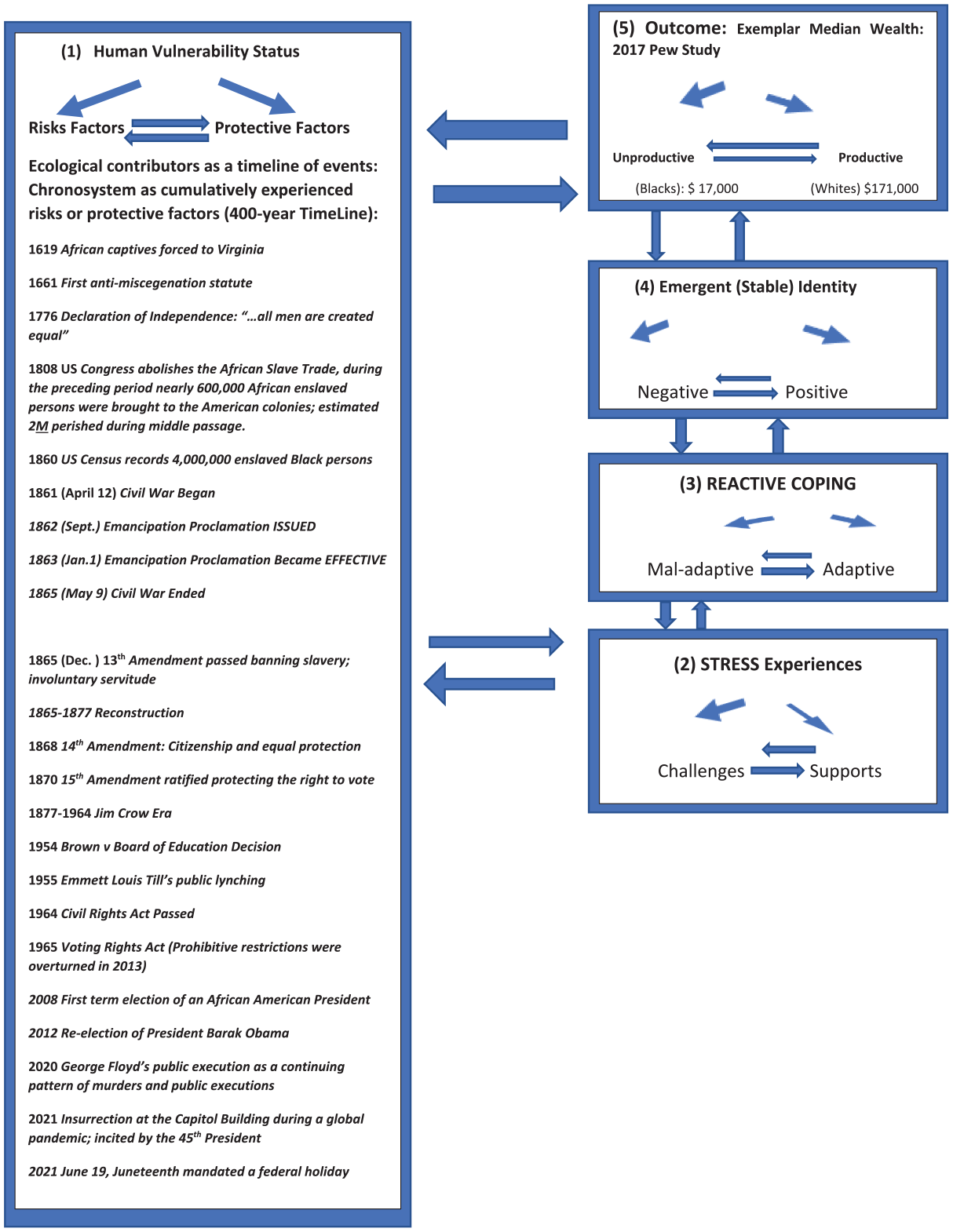
PVEST emphasizing chronosystem events as sources of human vulnerability (see Spencer 2006, 2008) as linked with wealth outcome group differences.
Redundant inequalities “normalize trauma experience” for some while functioning as “accumulated privileges” for others, potentially resulting in poorly designed research. Subsequent inferences of superiority for the latter and inferiority of the former permeate ecologies of learning and development. The situation fuels stereotypes and assumptions of inferiority at the macrosystem level (i.e., as ontologies about groups reflecting attitudes, beliefs, and assumptions concerning differences); exo-system contributors are no less impactful (e.g., decades of employment practices and criminal justice policies); meso-system practices also matter (e.g., historic community-level health delivery practices that precipitate subsequent distrust of proffered care; home-school collaboration differences, for example, “learning pod participation options” observed during COVID-19 for privileged families although unavailable for others); and microsystem level individual experiences (e.g., variously implemented “stop and frisk” police traditions or “police stops” encountered when “driving while Black”). Not generally included as ecologies of development in research, trauma is normalized for some individuals and ignored for others. For example, for White Americans, the impact of divorce has received attention but not from a pathology perspective (e.g., Hetherington, 1979), whereas for youth of color, “broken homes” is normalized and problematized for Black families without attention to strengths and sources of support (e.g., extended family). Research inattentiveness to the differences and patterns noted function under the amorphous category of “structured inequalities”; however, the label itself does little for articulating the needed mindfulness of researchers, malleable “decision relevant opportunities,” and awareness of bias contributions to the conduct of research. Good theory provides direction and a frame for understanding diverse experiences and life course processes and outcomes.
PVEST and Intersectionality
Spencer’s PVEST is an identity-focused cultural ecological perspective that integrates issues of social, historical, and cultural context with normative maturational and developmental processes that individuals undergo across the life course (Spencer, 1995, 2006, 2008). By situating youth identity formation within context, it provides an attentiveness to phenomenological interpretations and responses to the “how” and “why” of the process. It was formulated as a needed critique of traditional developmental theories that were deficit-focused and ignored the role of context. It emphasizes the individual’s meaning-making processes that underlie identity development and responsive behavioral processes and outcomes. The PVEST framework represents dynamic processes that continue throughout the life span as individuals encounter and balance new risks against protective factors.
As a field of philosophy, phenomenology has a long and nuanced history and use. From our incorporation of the term for its conceptual efficacy and use in an identity-focused cultural ecological perspective, the undergirding philosophical assumption of intentionality also affords a critical conceptual asset for its foundational contributions to and use in a development, culture, and contextually sensitive framework (Spencer, 1995, 2006, 2008; Spencer et al., 2015; Spencer & Harpalani, 2004); the salience of its incorporation and utilization has to do with its focus on the individual’s subjective experience. Because there are conscious processes involved that are associated with an individual’s meaning-making or first-person experience, the perspective is particularly sensitive to biology-based maturation—especially salient at adolescence—which unavoidably links with affective and cognitive processes. Relatedly, noted processes vary as a function of bidirectional and recursive links with context character. Together, it is the combination of the term’s attributes that have made it foundational to the life course processes represented by a theoretical perspective offered in this paper.
PVEST combines an emphasis on individual perceptions with Bronfenbrenner’s EST (1979). Bronfenbrenner’s EST provides a framework to engage the contextual factors that inform human development over the life course. EST articulates a series of nested systems in which individuals are embedded that are constituted by the proximal and distal components that interact with individuals’ developmental milestones and trajectories. Most immediately located around the individual is the microsystem that is primarily occupied by familial and home context. Adjacent to the microsystem is the mesosystem, which establishes the connection to the broader exosystem where more remote, disparate networks, such as neighbors and social services, reside. The outer bands are where Bronfenbrenner situates culture and values (macrosystem) and the broader events occurring over time envelop all of these nested systems (chronosystem). This includes the environmental, sociohistorical events and transitions that can occur throughout someone’s life.
PVEST is conceptualized as five basic components linked by bidirectional and recursive processes, thus, providing a dynamic and cyclic model. The first component, net vulnerability level, essentially consists of the contexts and characteristics that can potentially pose challenges thus requiring coping during an individual’s development at any life stage. Risk contributors are factors that may predispose individuals for adverse outcomes during particular developmental stages and function as liabilities that may be offset by corresponding stage-specific protective factors. Self-appraisal is a key factor in identity formation; perceptions of the risks one faces and the protective resources available are central to identity processes and development. The second component of PVEST, net stress engagement level, refers to the actual experience of situations requiring coping, and which challenges an individual’s well-being; these are risks that are actually encountered and that are juxtaposed against available supports. In response to the challenges noted and in conjunction with available supports, the net level of stress experienced requires that reactive coping methods, the third component, are deployed as adaptive or maladaptive strategies and over time morph into or yield stable emergent identities (fourth component), which defines how individuals view themselves in and between their various contexts of development. Consequent problem-solving and decision-making behavior then yield the fifth component that represents either adverse or productive life-stage-specific coping outcomes.
PVEST provides opportunities for understanding bidirectional, recursive, and systemic linkages that contribute to and aid in an appreciation of the “how” and “why” of productive and unproductive patterned outcomes. PVEST links context and experience with individual meaning-making and identity formation, all from the perspective of human development. While ecological systems theory provides a means for describing hierarchical levels of context, PVEST directly illustrates life course human development as influenced by these multiple levels of context. PVEST provides a systems framework for understanding all possible variability and this approach can be contrasted with those that anticipate homogeneous group outcomes that are generally assumed to represent either deficits or inferred privilege. It provides a vehicle for self-interrogation, awareness, and critically important opportunities for moving forward an anti-racism developmental science and generated policies for providing authentic sources of support for obtaining authentic change in the face of 400 years of established practice.
Efficacy of PVEST for Demonstrating Ecology Linked Vulnerability Contributors
The injustices inherent in developmental science are particularly troubling given the field’s committed scaffolding of learning traditions, programming efforts intended as supports, and seeking to represent the role of biological processes particularly for learning science. The role of biology is salient given technology breakthroughs in brain science, insights about neuroplasticity, and, particularly, given the bidirectionality assumptions between social, cognitive, and biological processes. As illustrated in Figure 1, the noted themes are critical when exploring the contributions of unique stress conditions, reactive coping responses and identity processes; accordingly, representing racism, power-needs, social control preferences, and basic hatred of those “othered” given 400 years of under-interrogated group relations is a necessity.
As represented and described by those empowered through privilege to designate (i.e., by omission or the character of commission) whose development is fore fronted as normative exemplars of humanity appears central to the conduct of science. Referenced here are individual and group members’ everyday experiences as investigated, interpreted, and approached from a “normative” human development stance. Particularly, given that biological determinism has been a contributor to negative assumptions about those “othered” in the conduct of scientific research, it is consequential that in most basic texts—no matter whether Black and Brown children are included on the volume’s cover—People of Color are frequently present mainly under index entries reviewing and providing exemplars of pathology, problems, deficits, and deficiencies (if referenced at all). Untoward outcomes associated with oft-traumatizing and everyday injustices are generally represented and included as index entries for minorities as their behavioral norm. Acknowledged is that youths’ meaning-making processes of such events associated with everyday 21st-century American life for People of Color are seldom included (refer to Figure 1, component one listing). The omission supports the inference that ecologies experienced by minority youth precipitate dissonance and challenge requiring constant reactive coping responses, which are not equivalent to those privileged by Whiteness. Considering Lerner’s “best fit” theoretical perspective, it would appear that everyday life in myriad ecologies for youth of color is fraught with dissonance and a lack of “best fit” conditions. At the same time, the characterization of “best fit” is in sync with the everyday consonance or matched contextual conditions experienced by White youth; significantly, these “best fit” contexts are the settings within which developmental tasks are addressed and met. Given standard research strategies, which assume equivalence of conditions for racially diverse research participants, the omission or failure to describe “best fit” differences may not merely communicate an innocent conceptual failing but—alternatively—suggests “motivated obliviousness.” Accordingly, this special issue and its rationale for an anti-racist developmental science, quite appropriately, resists conceptual and methodological shortcomings, strategies and narratives that support White supremacy.
Underinterrogated privilege of scholars matters deeply and has implications for “meaning making” about others with whom one shares physical and social space but often represents unequal access to resources (i.e., increased human vulnerability). The problem is overlooked particularly in the implications for “self-construal” and responsibility taken for the fair scientific representation of all humans. Referred to are those empowered for determining the research designs implemented, questions posed, and interpretations made of findings. Any efforts to implement anti-racism developmental science must consider those privileged to conduct and interpret research outcomes. Moreover, from a life course perspective and consistent with Bronfenbrenner’s EST—which acknowledges unfolding lives in contexts and the chronosystem—individual-context interactions matter. As interpretational processes—and as suggested by Spencer’s PVEST that forefronts an unavoidable, cognition-dependent and context-linked phenomenological effort as sense making—consequential are self-motivating and self-sustaining core elements fundamental to and scaffolding of life’s information garnering and problem-solving struggles. Thus, when combined, affective and cognitive development, biological maturation, and context-linked social experiences make the process unavoidable. The process represents cumulative, dynamic, bidirectional activity, and is infused with meaning making; this has implications for vulnerability status, inferred stress, coping efforts, identity processes, and—as outcomes potentially having significance for stereotypes—may contribute to the viability of systems that maintain and/or are further advantaged by the oppression of others.
Also ignored—and functioning either as a reactive coping method or specific outcome from a PVEST perspective—is the problem of “inequality presence denial” (Nichols Lodato et al., 2021; Spencer et al., 2019). Its status, proliferation and protection by traditional scientific strategies, particularly developmental science, is highly effective. Dehumanization and “othering status” traditions provide exemplars as decision-making and patterned research implementation efforts. These include research design decisions, variable selection, questions pursued, data interpretation decisions, and implications concluded for policy and practice.
We posit that to pursue the authentic recognition of shared humanity as the orientation of one’s research agenda, that is, independent of research participants’ skin color, economic status, ethnic and racial group membership, and national origin—requires acknowledging and resisting normative academic scholarly traditions. The pursuit of social justice in the conduct of developmental science is linked with a “price tag”; it requires a self-sustaining professional and personal identity that functions beyond one’s academic role. Inferred and required is an identity inclusive of an internalized purpose and sense of responsibility to represent and pursue a shared view of humanity.
The Black Lives Matter movement communicates the inferred blatant absence of functioning shared humanity beliefs. Empowered social actors— including researchers and professors—create, contribute to, and maintain minority targeting social inequality proliferating social structures (e.g., developmental science scaffolds the training and practices for policing, teaching, health professionals, social service delivering professionals, the characterization of parent and teacher adequacy, and recommendations of policy makers). Patterned limitations regarding the conduct of science reinforce the perspective that minorities are not human and reinforce the practiced viewpoint that Black life does not matter. This lack of a critical perspective has implications for research designs selected, question-asking traditions, variable selection choices, and data interpretation processes—all of which are eventful for maintaining the status quo; in fact, there are “wages (earned statuses)” for the maintenance of Whiteness superiority beliefs, which have consequences for academic success and the character of one’s professional life.
Scholarly “customs” too frequently “other” youth of color by (a) communicating assumptions of group homogeneity (e.g., pathology/problem assumptions); (b) associating and anticipating “delinquent orientations” as outcomes manifested under unequally resourced conditions; (c) omitting the reality and viability of social and cultural capital as resources historically used for productive reactive coping among oppressed peoples; and (d) failing to recognize behavioral orientations and outcomes that are associated with long-term demonstrations of resilience and thriving under conditions of systemic racism (i.e., assets and protective factors are ignored). The professional habit of “inequality presence denial” deepens and facilitates racism’s impact and persistency given the imposed invisibility and ease of deniability (Nichols Lodato et al., 2021; Spencer et al., 2019).
Accordingly, systems of prejudice continue virtually “unchecked,” highlighting the timeliness of this Special Issue. It is not that efforts have been absent in the past (Allen et al., 1985; Fisher et al., 2000; Guthrie, 1970/2004; Spencer & McLoyd, 1990). There have been multiple efforts provided across the few decades, as well. What is different is that the current historical moment is infused with multiple blatant “data points,” including now tens of injustices perpetrated as public executions of Black individuals, dehumanizing warehousing of Brown immigrants, and thousands of reported hate crimes against Asian American and Indigenous People. Illustrative has been the noticeable and differential impact of a global pandemic—COVID-19—on communities of Black and Brown people. Of course, representing an unusual psycho-historical moment and reactive coping to same for a particular segment of Whiteness-privileged individuals, the January 6th insurgency at the Capitol Building was eventful. It suggests White fears and reactions to inferred “loss of power” for some benefiting from “inequality presence denial.”
Consequentially, “inequality presence denial” beliefs, practices, and linked decisions generate untoward developmental science traditions that impact child and adolescent research, practice, and policy. It is particularly salient for late middle childhood through emergent adulthood periods when youth are expected to navigate diverse contexts with independence. The noted independence requirement is associated with the development of specific behavioral orientations and social experiences with linked tasks and expectations critical for accruing specific competencies (see, for example, Havighurst, 1953). The “problem-focused developmental science themes” are too frequently the norm and focus for youth of color who are compared against those privileged by historical conditions such as racism and systemic inequality. For example, how often are community-level data on policing included in research as mediators or moderating factors? Are youths’ experiences with law enforcement officers the same for Black and Brown versus White youths? As adolescents navigate myriad contexts and address developmental tasks, are the publicly paid agents of the social justice system similarly experienced as resources and supports versus adversaries and sources of trauma? Unfortunately, law enforcement training programs are prey to the same assumptions and stereotypes about youth of color as are other professionals, including the areas of education leadership, teaching, health, and social service. Salient to youths’ ecologies with socializing adults intended to support development, unavoidable and cognition-based meanings made from interactions with “intended supports,” instead, may be perceived as sources of risk and challenge. Generally, variables that represent cognition-based inferences about assumed assets are not incorporated into research designs; accordingly, adolescent inference making about contextual character and functioning is assumed to be congruent. From a developmental contextualism perspective as described by Richard Lerner’s developmental contextualism theorizing, there lacks a “best fit” between youth of color and the context. The situation suggests a “good fit” for White youth (i.e., consonance or a seamlessness between individuals and the character of contextual experiences). However, dissonance precipitating experiences too frequently exist for youth of color given the history of housing, education, and employment policy inequities.
Most significant, context-responsive reactive coping may result in particularly patterned outcomes, which may reproduce and reinforce stereotypes and bias. It is for this reason that a study’s acknowledgment of “structured inequities” or “social structural” factors often provided as an explanatory and framing device is not only inadequate but fails to fairly represent the dynamic character of youths’ everyday context-linked experiences that dramatize the lack of fit described in Lerner’s developmental contextualism theoretical perspective. Salient, as well, is that challenges, coping requirements and patterned outcomes associated with untoward thriving efforts for Whites—e.g., a lack of “best fit” conditions in the lives of privileged youth—at the same time, are often overlooked although efforts by Suniya Luthar provide a valued exception (e.g., Luthar 2013). Thus, challenges confronted, and coping processes utilized by privileged youth are ignored in research designs, impact attendant questions, limit variables included for analysis and, in sum, provide a limited picture of the “downside of privilege.”
A significant and long-term personnel problem remains and requires acknowledgment. Developmentally focused academic departments continue to be disproportionately White and male with low senior minority presence; the stable personnel standing compromises collaborative opportunities and modeling for those responsible for the inclusive and authentic representation of research. As suggested, entrenched “inequality presence denial” perspectives as a maladaptive coping reaction to a risk of presumed loss of academic representation and linked privileges—given population shifts—may remain irrespective of hiring changes; that is, even with more diverse faculty representation, it is not the job of minority faculty members to provide the professional development of colleagues. However, along with collegial partnerships of socially aware faculty allies, collectively, subsequent collaborations may well provide greater opportunities for emergent changes in the academy itself; ideally, outcomes may decrease current high vulnerability faculty status situations that contribute to the maintenance of stereotypes, bias and misperceptions imbued in the problem of “inequality presence denial.”
Conclusions and Opportunities of Inclusive Theory
As a shared human vulnerability scaffolded framework, PVEST links context and experience with individual meaning-making and identity formation. It provides a culturally sensitive perspective of cognitive, affective and biological processes as individuals cope with developmental tasks. Associated with specific stages and developmental tasks addressed across the life course, the inclusive human development framework’s utility includes individuals occupying minority and non-minority statuses. While ecological systems theory provides a means for describing hierarchical levels of context, PVEST directly illustrates life course human development as influenced by these multiple levels of context as differentially experienced by diverse individuals given human vulnerability level differences and diverse coping efforts (i.e., both risks and myriad protective factors are interrogated for appreciating vulnerability status). This approach is quite different from perspectives that anticipate homogeneous group outcomes that are generally assumed to represent either deficits (i.e., frequently assumed for negatively stereotyped communities) or inferred privilege (i.e., given historically significant conditions of inequality and structured inequities). PVEST provides a systems framework for understanding variability. As such, it provides a vehicle for self-interrogation by researchers about questions posed of research efforts, cultural awareness sensitivities, and critically important opportunities for moving forward anti-racist developmental science. Also impacted and generated are authentic policies for providing impactful sources of support for the nation’s diverse societal members. As opposed to linear research designs that reifies a “what” or a narrow outcomes focus, making use of PVEST provides opportunities for understanding bidirectional, recursive, and systemic linkages that contribute to and aid in an appreciation of the “how” and “why” of productive and unproductive patterned outcomes (i.e., for Figure 1, see the bidirectional and systemic links between Components 1 and 5). In sum, PVEST affords opportunities for identifying, appreciating and operationalizing “wedges of impact” influencing systemic processes. The strategy is critical for determining levels of support required for obtaining authentic changes and especially those representing 400 years of static, dehumanizing and oppressive traditions of myriad social and economic inequities.
Footnotes
Declaration of Conflicting Interests
The author(s) declared no potential conflicts of interest with respect to the research, authorship, and/or publication of this article.
Funding
The author(s) received no financial support for the research, authorship, and/or publication of this article.