




Abstract
In this study, we drew on the m(ai)cro framework, which centers racism as a macrosystem, to examine how college-going emerging adults made meaning about society and themselves during the 2020 U.S. presidential election and 2021 inauguration. This period was marked by racial justice protests, a global pandemic, anti-Asian violence, and the storming of the U.S. Capitol by predominantly white Trump supporters. Using the constructs of critical consciousness and racial identity meaning making, we analyzed participants’ reports of recent race related conversations. Our sample included 47 students (Mage = 19.71, SD = 1.72; 81% female, 17% male, 2% other; 45% Asian/Asian American, 30% white, 13% Latinx/Hispanic, 4% Black/African American, 4% Multiracial, 2% Middle Eastern/Arab) at a private, predominantly white university in the U.S. Midwest. Hybrid inductive-deductive analysis showed that a majority reported conversations with peers, focused primarily on racial inequity and justice. For many participants of color, conversations about topics including protests and anti-Asian violence were woven into their racial identities. In contrast, although many white participants discussed events such as the Capitol insurrection, none made links to their racial identities. Our findings highlight connections between critical consciousness and racial identity, and the importance of context and participant positionality in developmental research.
Keywords
Young people in the United States (U.S.) are growing up in a tumultuous sociocultural context marked by racial violence, inequity, and political polarization. Although activism against anti-Black police brutality has deep roots (Hoffman et al., 2016), the murders of George Floyd and Breonna Taylor sparked racial justice protests in the summer of 2020 on a scale not seen since the Los Angeles Uprising in 1992 (Buchanan et al., 2020). In the wake of the 2020 protests, discussions related to race and racism were prominent in media, politics, education, and between everyday individuals. At the same time, the COVID-19 pandemic exposed and deepened societal inequities, casting light on how racism and white supremacy—the systematic privileging of whiteness and white people (Feagin, 2020)—shape systems including education, housing, and healthcare (Bowleg, 2020). Moreover, anti-Asian racism and violence in the U.S. rose exponentially after the onset of the COVID-19 pandemic, bringing to the fore deeply rooted stereotypes of Asian Americans as “perpetual foreigners” (Armenta et al., 2013; Li & Nicholson, 2021). These events were framed by the contentious presidential election in November 2020, after which a group of predominantly white Trump supporters stormed the U.S. Capitol on January 6th, 2021, following Trump’s false claims of victory. For young people growing up in such a hostile and polarizing context, the perspectives they internalize and actions they take can have cascading effects on their identities, beliefs, and behaviors, with implications for their own development (Williams et al., 2020) and society at large (Rogers, 2018; Syed & McLean, 2021).
In the current study, we draw on the recently introduced m(ai)cro framework (Rogers, Niwa et al., 2021), which centers racism as a macrosystem shaping human development, to examine how college-going emerging adults made meaning about society and themselves during this sociocultural moment. We asked our participants to report and reflect on recent race related conversations, using an online open-response format at two time points surrounding the U.S. presidential election in November 2020 and inauguration in January 2021. We analyzed their accounts through the dual lenses of critical consciousness and racial identity meaning making, examining if and how these racially diverse young people engaged critically with societal events and structures and their own racial identities.
This qualitative, context-based study responds to a call to investigate the links between critical consciousness and racial identity development (Mathews et al., 2020). In recent years, a growing number of studies have investigated various aspects of these interrelated constructs across racially minoritized adolescents and emerging adults, using both qualitative (Golden et al., 2022) and quantitative (Banales et al., 2020; Hope et al., 2020; Kiang et al., 2021) methods. Building on this work, we focus on emerging adulthood (18–29 years of age), which represents a period of ongoing cognitive growth and identity development (Arnett, 2015; Syed & Mitchell, 2013). We include participants of color as well as white participants, with awareness that positionality within social systems shapes the process and content of development (Garcia-Coll et al., 1996; Spencer, 2021). Privilege is the counterpart to oppression; though often un(der)examined, it is imperative to understand both ends of this spectrum of inequity if we are to dismantle it (Helms, 2020; Moffitt & Rogers, 2022; Rogers, 2019; Spencer, 2021). In the following sections we discuss research on critical consciousness and racial identity to situate our study of young people’s race related conversations.
Critical Consciousness
Recognizing and taking action against societal inequity are key aspects of critical consciousness, a construct put forth by Brazilian scholar-activist Freire (1970, 1973). Freire conceptualized critical consciousness as a relational process among oppressed people and their oppressors, calling it, “the incessant struggle to regain their humanity” (1970, p. 48). Freire also described how those positioned on the side of the oppressor can engage critical consciousness, writing, “true solidarity with the oppressed means fighting at their side” (Freire, 1970, p. 49). This aligns with research that situates resistance to societal oppression as normative to human development—those experiencing oppression resist in order to survive and thrive, while those experiencing privilege can also resist by, “disentangling their identities from the power hierarchies that dehumanize themselves and others” (Rogers & Way, 2021, p. 6).
To measure critical consciousness as a psychological construct, researchers (Diemer et al., 2017; Watts et al., 2011) divided it into three broad facets: awareness of societal inequity (critical reflection), belief in the possibility of effecting sociopolitical change (political efficacy), and sociopolitical engagement aimed at dismantling inequity (critical action). While questions remain regarding when and under which circumstances each of these facets may interrelate (e.g., Diemer, 2020), a recent study among racially diverse emerging adults found that participants who cited racism as a key concern prior to the 2020 presidential election were likely to report engaging in general activism and activism specifically to support the Black community, while those citing social justice (but not racism in particular) were likely to engage in more traditional critical action behaviors such as calling political representatives (Kornbluh et al., 2022). This study highlights the nuanced and domain specific nature of critical reflection and action. Moreover, it underscores the role of racism and need for further research into the diverse ways in which young people are socially and politically engaged, which may be overlooked in research focused only on traditional avenues of political engagement.
In another study conducted early in the COVID-19 pandemic (Maker Castro et al., 2022), all three facets of critical consciousness related positively with anxiety among racially diverse college students from across the U.S. Though this may seem troubling, it is not surprising. In a white supremacist society, awareness of and resistance to systemic racial oppression are not valued. Instead, racial colorblindness predominates, downplaying and denying the existence of race and thus racism (Bonilla-Silva, 2012; Neville et al., 2013). Relatedly, meritocracy offers a guise of equal opportunity based on hard work, prompting individualistic explanations for academic success or failure, for instance, rather than recognition of the deeply rooted social, economic, and political systems that privilege whiteness, maleness, and wealth (e.g., Clycq et al., 2014). One effect of colorblind and meritocratic socialization may be that young white people, in particular, often condemn blatant and interpersonal racism without acknowledging or addressing systemic racism (e.g., Desante & Smith, 2020). Thus, because young people are actively socialized out of critical consciousness by a society that normalizes and protects this status quo, confronting systemic racism is neither easy nor comfortable (Helms, 2020; Pauker et al., 2015; Rogers & Way, 2021).
For this reason, while resisting the dehumanization of racism is intrinsic to human development, enacting critical consciousness becomes an act of resistance, which can alternately be fostered or thwarted as young people develop their identities and worldviews. For instance, a recent systematic review (Heberle et al., 2020) highlighted parental and peer socialization during childhood and adolescence as important factors predicting youths’ critical reflection. Additionally, adolescents’ perceptions of their schools’ racial messaging predicted their critical action, such that greater critical consciousness socialization from the school related positively to both interpersonal and communal/political actions against racism (Bañales et al., 2021). Critical reflection was also found to mediate the link between school racial socialization and critical action among Black and Latinx high school students (Golden & Byrd, 2022); how young people make sense of their socialization matters for how they respond to it.
Among emerging adults, a qualitative study with Black immigrant college students attending predominantly white institutions found that, although most participants entered college with an uncritical perspective, many shifted toward critical reflection and action after experiencing interpersonal racism and gaining awareness of structural racism in the U.S. (Mwangi et al., 2019). In a mixed-methods study with a racially diverse sample of emerging adults (Monjaras-Gaytan et al., 2021), the more conversations participants had with mentors (who included teachers and others giving guidance) about civic engagement and social justice issues, the greater perceived inequality and critical action they reported. In another qualitative study (Taylor, 2021), racially diverse undergraduates in a semester-long course on U.S. poverty reported that peer discussions linking coursework to participants’ lived experiences helped foster critical reflection on both economic inequality and other forms of societal injustice.
These studies highlight the situated nature of critical consciousness and make clear the importance of micro-level interactions during adolescence and emerging adulthood, including race related conversations. Such conversations can be promotive, pushing young people to think and act critically, but they can also reinforce macro-level inequity. For example, in a qualitative study of race related conversations between emerging adult friend pairs (Moffitt & Syed, 2021), some white participants in cross-race conversations made problematic statements that prompted their peers of color to educate them about race and racism. While perhaps helpful for the white participants, this showed evidence of undue burden on the participants of color. When young People of Color are tasked with being experts on race, including in interpersonal interactions, this can be tokenizing, demanding emotional labor that adds up over time (e.g., Shim, 2021). Although cross-race interactions are touted as a marker of racial progress (Dovidio et al., 2017), the possibility of harm for People of Color in such conversations is rarely considered in psychological research.
Moreover, when race related conversations occur, it is often in racially segregated spaces (Barroso, 2019). This can include settings sought out for solidarity or community, as well situations of racial homophily due to ongoing racial segregation in U.S. schools, neighborhoods, and workplaces, resulting from decades of white flight and structural racism shaping the possibilities for where People of Color can learn, live, and work (Bonilla-Silva, 2021). As developmental psychologist Beverly Tatum has pointed out, one result of widespread racial segregation is that, “most Whites are not ‘socially positioned’ to understand the experiences of people of color” (2017, p. 45). Given this context, examining the content of race related conversations occurring in racially segregated spaces may offer a window into emerging adults’ everyday engagement with critical consciousness and their own racial identities.
Racial Identity Meaning Making
Racial identity can broadly be defined as attitudes, beliefs, behaviors, and sense of self related to one’s racial group (Williams et al., 2020). Early models of racial identity (Cross, 1971; Helms, 1990; Sellers et al., 1998) focused on Black Americans, aiming to understand how a positive sense of group belonging is formed in the context of white supremacy. Like critical consciousness, early racial identity models centered interpersonal and societal events as catalysts for reflection and growth (e.g., Cross, 1971). Despite their overlap, only recently was a theoretical model put forth for how these constructs may develop in tandem (Mathews et al., 2020). Focusing on Youth of Color, Mathews et al. (2020) name discrimination and racial socialization as factors likely to prompt critical reflection and racial identity exploration. They also argue that resolution, or clarity about one’s racial identity, may link to greater critical action, while high private regard, or a positive perspective on one’s racial group, may foster political efficacy. These predictions build on previous research arguing that civic engagement can be situated as an adaptive coping response to systemic racism among racially minoritized youth, who develop heightened awareness of inequity through the interrelated experiences of racial discrimination, racial socialization, and racial identity formation (Anyiwo et al., 2018; Hope & Spencer, 2017).
Kiang et al. (2021) tested these and related links quantitatively among racially minoritized adolescents, finding that the centrality of youths’ ethnic-racial identity predicted higher critical reflection and political efficacy (operationalized as critical motivation), but less critical action. In another quantitative study among Black and Latinx adolescents, Banales et al. (2020) found that ethnic-racial identity resolution predicted greater civic beliefs, which they define as beliefs advancing the justice, fairness, and wellbeing of their communities. These findings highlight the interconnectedness of racial identity, critical consciousness, and related constructs, underscoring the need for research attuned to context and content to elucidate how, when, and among whom these developmental processes occur.
To our knowledge, no research has examined the context and content of critical consciousness and racial identity meaning making among emerging adults. Both the theoretical model and empirical application of the links between critical consciousness and racial identity focus on adolescents, but identity development remains a key process in emerging adulthood (Arnett, 2015). Additionally, although the Mathews et al. (2020) model focuses specifically on racially minoritized youth, the imperative for social change does not rest with Youth of Color alone (Spencer, 2021). Thus, these constructs and related processes should also be studied among white emerging adults. Rather than asking whether there are differences across racial groups, the m(ai)cro framework (Rogers, Niwa et al., 2021) prompts recognition that racial identity development among white people necessarily differs from People of Color, because of their racial privilege in a white supremacist society (Helms, 1990, 2020; Moffitt & Rogers, 2022). With this as a foundation, the current analysis explores these differences in context, asking if and how participants are making meaning about their racial identities.
As a construct, racial identity meaning making stems from a narrative identity approach, which uses interview-based and written accounts to understand how participants make sense of who they are (Syed, 2015). In relation to racial identity, meaning making occurs at the group level, for instance as individuals reflect on what it means to be Black, white, or Multiracial (e.g., Rogers, Moffitt, & Foo, 2021), and at the individual level, as people make sense of what an experience means to them as a member of their racial group. By delineating between these levels, we do not intend to draw artificial lines between personal and social identities (Azmitia et al., 2008), but instead aim to capture a nuanced picture of meaning making in reference to the self, the racial group, and the sociocultural context—with acknowledgment of the inextricable links between all three (Rogers, 2018). Gaining greater understanding of critical consciousness, racial identity meaning making, and the relations between the two, can shift developmental science toward fostering these processes among all young people.
The Current Study
We draw on qualitative, open response data to investigate racially diverse emerging adults’ race related conversations in a sociocultural context of heightened racial tension and public discussion of race. We focus on the content of these conversations and how participants made sense of them, using the dual lenses of critical consciousness and racial identity meaning making. Specifically, this research is guided by three research questions:
Who are emerging adults’ having race related conversations with and what are they talking about at each data collection wave?
How are emerging adults making sense of their race related conversations in relation to societal inequity and their own identities?
How do these race related conversations differ between emerging adults of color and white emerging adults?
Method
The qualitative data analyzed in the current study were drawn from a larger, mixed-methods project titled Politics, Activism, and Identity, led by the first author. This study received ethics approval via the Institutional Review Board at the co-authors’ university. The full study included four waves of data collection, with two waves of surveys book-ending two waves of qualitative, open-response data collection. Only the qualitative data were used in this analysis.
Participants and Procedure
Participants were recruited from a mid-sized, private, predominantly white institution in the Midwestern U.S. via social media and listserv emails, and through an introductory psychology class. All participants received $15 at each of the two waves of qualitative data collection. Using a daily experiential sampling method, Wave 1 (W1) took place during the 10 days surrounding the U.S. presidential election, from October 29th through November 7th, 2020, and Wave 2 (W2) took place during the 10 days surrounding the presidential inauguration, from January 15th through January 24th, 2021. Participants were emailed a link via Qualtrics each day at 3 pm, with two reminders sent to those who had not yet responded. The links contained primary and follow-up prompts each day related to race, gender, nationality, politics, activism, and current affairs. Participants were instructed to write at least two to three sentences in response to each prompt. Only responses to the race related prompts were analyzed in the current study. These prompts were tailored to participants of color and white participants based on their self-reported race. They included:
Think about a recent conversation you had with another Person of Color/other People of Color [another white person/other white people] in which race came up. Briefly describe what happened, including where you were and who you were with.
a) How did you feel during this conversation?
b) Does this type of conversation come up often? Describe why or why not.
c) How do you feel right now, in this moment, writing about this?
A total of 87 students took part in W1 (meaning they took part in at least two of the 10 days), and 66 took part in W2. The attrition rate was not surprising, given the time-intensive nature of open-response prompts, as well as the stressful sociocultural period during which data were collected. There were 47 students who responded to the race related prompts at both waves. These students comprise the final sample for the current study (Mage = 19.71, SD = 1.72; 81% female, 17% male, 2% other; 45% Asian/Asian American, 30% white, 13% Latinx/Hispanic, 4% Black/African American, 4% Multiracial, 2% Middle Eastern/Arab).
Researcher Positionality and Reflexivity
All data were gathered online, meaning no face-to-face interaction occurred between participants and co-authors. That said, our experiences, identities, and positionalities in our inequitable society impact all aspects of how we conduct research, from which questions we deem important to how we collect and analyze data (Ali & Sichel, 2018). The first author, a white, U.S. American, cisgender woman, who was a Postdoctoral Fellow during data collection and analysis, drafted the open response prompts and led participant recruitment and data analysis. The other co-authors include an Associate Professor who is a Black, U.S. American cisgender woman, as well as two undergraduate students, a Black, South African cisgender woman, and a white, U.S. American cisgender woman. Throughout the research process, an interpretive community (Marecek et al., 2001) was also engaged, consisting of all co-authors and members of the lab in which we work and study. This involved discussion of our aims, methods, research questions, and analysis with undergraduate and graduate students with diverse gender, race, sexual orientation, socioeconomic, and other identity factors impacting lived experience. Engaging this community shaped how we approached this project and made sense of our data.
Coding and Analysis
Participants’ responses were exported from Qualtrics into Microsoft Excel then NVivo (version 12 for Mac) for coding and analysis. The first and third authors read all responses and wrote memos for each participant, an analytic technique that helps researchers gain familiarity with the data and reflect on links between data and theory (Birks et al., 2008). We took notes on (a) if and how participants conceptualized race as part of their identity; (b) if conversations focused on inequity, discrimination, or white privilege; (c) if societal events were mentioned, including the election, Black Lives Matter movement, and Capitol insurrection; and (d) if conversations and meaning making seemed similar across W1 and W2. We then reflected on our memos, discussing the applicability of multiple theoretical frameworks.
We decided to code our data through the lenses of critical consciousness and racial identity based on their relevance to what participants wrote about in response to the prompts. We therefore engaged a hybrid deductive-inductive coding structure, following the three levels of coding and analysis outlined by Wolcott (1994) and expanded on by Rogers, Moffitt, and Jones (2021), with an emphasis on analyzing and interpreting participants’ stories in relation to their sociocultural context. Each round of coding included an iterative process: going back and forth between the data and our codebook as we worked to comprehensively code all responses. All coding decisions were made collectively. Disagreements resulting from differing interpretations of our codebook were resolved through discussion until we reached consensus.
Level 1 of the coding and analysis process involves description. We conducted open coding, with each author noting who participants were talking to and what their conversations were about, in response to our first research question. Following the principals of thematic analysis (Braun & Clarke, 2013), we generated codes based on similarity (e.g., “classmate” and “roommate” were consolidated into “peers” in the who list; “colorism” and “model minority myth” were consolidated into “racial inequity” in the what list). We then created a codebook and returned to the data, independently coding all responses. Because we were interested in overall patterns in conversation partners and topics, we did not divide this coding by racial group. Figure 1 contains an overview of the resultant coding related to who participants were talking to, and Figure 2 offers an overview of what participants were talking about. While doing this coding, we noticed that among participants talking to similar people about similar topics (i.e. talking to peers about racial justice), the content and interpretations of these conversations varied widely. Analyzing such variation required additional coding, which we outline below.

“Who” coding: conversation partners at Wave 1 and Wave 2.
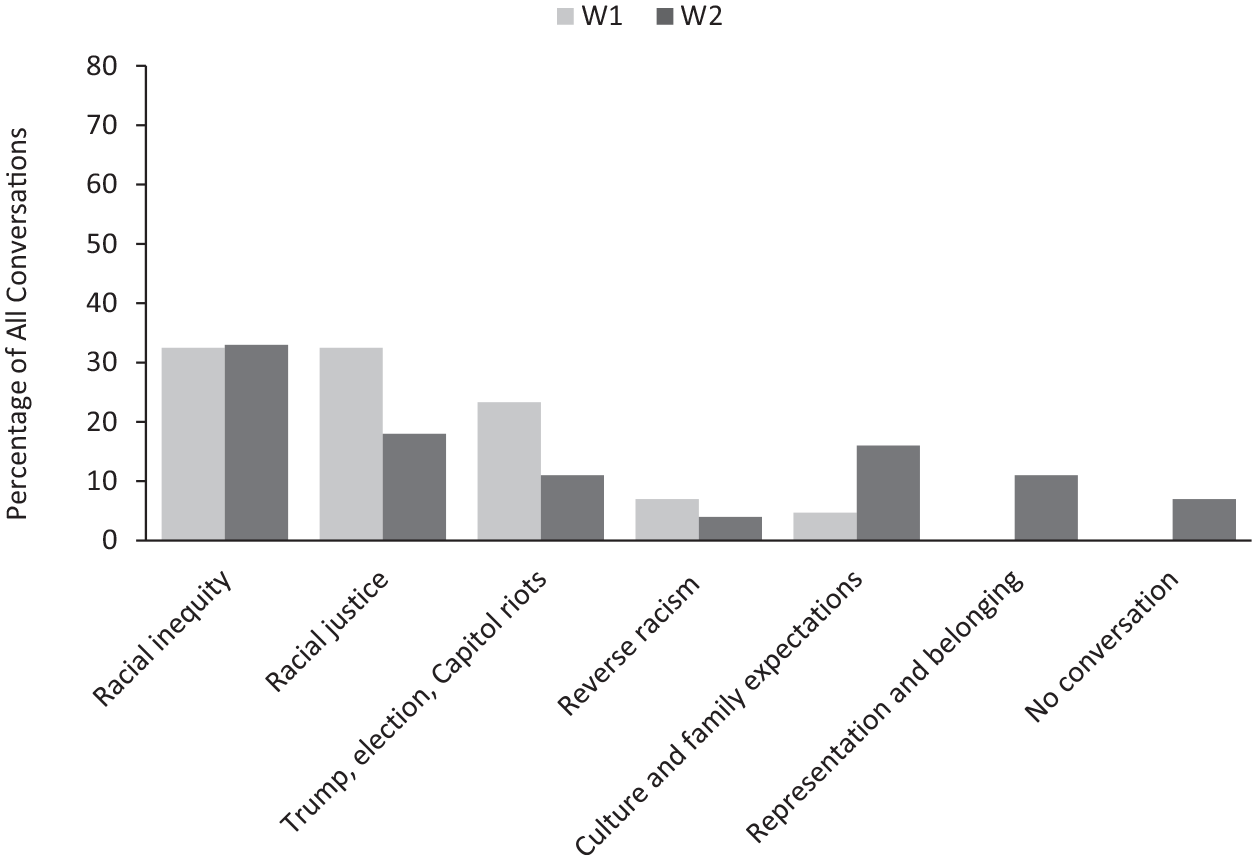
“What” coding: content of race related conversations at Wave 1 and Wave 2.
Level 2 includes analysis, which highlights patterns, links, or types among narratives (Wolcott, 1994). In this level of coding, we first drew on the critical consciousness framework. We began coding deductively to situate participants’ responses based on evidence of critical action, critical reflection, or political efficacy (Diemer et al., 2017). We focused on participants’ responses to the primary prompt describing their race related conversations. Coding was not mutually exclusive, meaning a given response could be coded for multiple facets of critical consciousness. As we began coding, we found there were responses that did not fit into these three facets. We therefore created a code titled uncritical reflection, which encompassed instances in which participants mentioned inequity without critically reflecting or acting on it. We also created a cultural code, which included conversations about cultural practices or communities, all of which occurred among participants from immigrant families. After updating our codebook, we comprehensively coded all responses. We focus on the critical reflection, uncritical reflection, critical action, and political efficacy codes in our interpretation. Adequately interpreting the small cultural code would require theory related to ethnic and cultural practices, rather than race and racial equity, and is thus beyond the scope of the current study.
To capture participants’ racial identity making meaning, we conducted a second round of deductive coding, focusing in particular on the follow-up prompts regarding conversation frequency and participants’ feelings. We decided not to limit our coding to mentions of a specific racial group, instead leaving it open regarding how participants self-defined racial group boundaries. If meaning was made at the group level, whichever group was centered, we included that in our group-level (we) coding, while if meaning was made at the personal level, we included that in our individual-level (I) coding. These codes were not mutually exclusive.
Finally, we analyzed the intersections between the critical consciousness and racial identity meaning making codes using the matrix coding feature in NVivo. This offered us insight into relations between awareness of and action on societal inequity and reflection on individual and group-based racial identity. Unlike in the Mathews et al. (2020) theoretical model, which situates diverse aspects of racial identity development as prerequisites or catalysts for the three facets of critical consciousness (with recognition of the cyclical nature of these constructs), the structure of our prompts was such that critical consciousness tended to be evident in the conversations being reported, whereas when racial identity meaning making occurred, it tended to occur in participants’ reflections on their conversations. This offers initial evidence for critical consciousness as a communal, relational process, whereas meaning making about racial identity may be more individual, although contingent upon a relational catalyst. We interpret this analysis by examining our findings in sociocultural context.
Level 3 of Wolcott’s (1994) analytical process includes interpretation. In this level we aimed to situate our coded data in relevant literature and in context. In this way, while Level 1 and Level 2 help illuminate patterns and structures within our data, Level 3 pushes us to make sense of our findings, which we do in the sections below.
Results and Discussion
We report our findings in the order of our first two research questions regarding (1) conversation partners and topics, and (2) critical consciousness and racial identity meaning making. We use excerpts from participants’ responses to flesh out what these coded data looked like, engaging the m(ai)cro framework (Rogers, Niwa et al., 2021) to interpret racial group differences and situate them in sociocultural context. Totals and percentages are reported in the figures, while in text we focus on variability. All quotes are written as participants typed them, with content only redacted for confidentiality. This means no grammar or spelling were changed, and although we intentionally capitalize racially minoritized groups including “Black” and “Latinx” in our own writing of the manuscript, we did not amend participants’ responses if they did not do so. Names are omitted to preserve confidentiality. We use the terms “woman,” “man,” and “non-binary” based on participants’ self-reported gender, but want to emphasize that many participants were teenagers at the time of data collection, and these terms are not meant to wash over their age and position as young emerging adults.
The Who and What of Participants’ Narratives
To answer our first research question, we conducted open coding of who participants were talking to and what they talked about. A clear majority reported talking to their peers at both waves (see Figure 1). This finding aligns with developmental expectations, as emerging adulthood is a time when many young people move out of their family homes and peers are of central importance (Arnett, 2015). At the same time, because of the context of the COVID-19 pandemic when we gathered these data, many participants were either still or again living at home, thus we were somewhat surprised that so few participants reported conversations with parents. From a developmental perspective, greater research is needed on peer racial socialization during emerging adulthood, which remains scant compared to parental racial socialization research. Moreover, although far fewer conversations occurred with others including professors or non-parent family members, the growing body of work on race related conversations highlights the need to examine these multiple relevant sources of socialization.
Based on our coding of what participants talked about, it was clear that the macro-level context shaped participants’ micro-level discussions, as even just 2 months apart, conversation topics shifted in meaningful ways. The most common topics at W1 were racial justice, which focused on the Black Lives Matter movement and (student) protests to defund the police, and racial inequity, which included conversations about one’s own and others’ experiences of racism. At W2, conversations about racial justice were far less frequent, reflecting the waning protests on campus and in the community, though discussions about racial inequity remained common. Across time points, discussions related to race and racism were prevalent, which could be interpreted as evidence of high critical consciousness. Yet, the conversation content varied widely, making clear that just measuring frequency of race related conversations is insufficient.
Interestingly, discussions of cultural and family expectations and representation and belonging increased at W2, specifically among participants of color. These conversations often highlighted the “everydayness” of racism while centering community and connection. For example, an 18-year-old Black woman wrote, “I met someone in a dining hall, and we talked about how we felt a sense of community with other people of color on this campus. The person was an old roommate.” She went on to say, “I felt excited to have another person in my life who I could discuss current events with, and who understood me.” She was not excited to discuss “current events” in general, but to do so with someone “who understood” her—someone with similar lived experience. Positionality, in this case of racial marginalization on a predominantly white campus, can shape how macro-level events are engaged with at the micro-level. Without explicitly naming the whiteness of the university space, this participant underscores the importance of community for unpacking the sociocultural moment.
Interestingly, when examining the who and what coding in tandem, we found that while conversations with peers covered the full range of topics shown in Figure 2, most conversations with parents centered on Trump and the Capitol insurrection. Across waves, white participants reported most conversations with parents, and in each instance, they mentioned that such race related conversations were uncommon. For example, a 19-year-old white woman wrote: About 2 weeks ago, my dad and I discussed the January 6th coup at the Capitol, noting that all the protestors were white. We also talked about a lot of the differences between how this situation was handled compared to how the BLM protests this summer were treated.
In response to whether this type of conversation comes up often, she noted, “My dad and I talk about politics a lot, but usually don’t talk a ton about race. We’re both white so it’s usually just a bit uncomfortable for everyone.” Her reference to discomfort aligns with substantial literature on the racial silence most white people in the U.S. practice (Helms, 1990, 2020; Moffitt et al., 2021), including white parents with their children (Hagerman, 2018; Simon, 2021).
As in the above quote, references to whiteness as a reason for not often having race related conversations came up frequently throughout white participants’ responses, regardless of topic or conversation partner. When analyzed through the lens of societal white supremacy, this type of explanation underscores that, for a conversation to be deemed “race related” by many white people, race must be explicitly named. A conversation about politics, for example, may reference solely white politicians (who remain hugely overrepresented in the U.S.; Barr & Pae, 2013) whose policies differentially impact People of Color and white people (as most policies in a society structured on white supremacy do; Ray et al., 2021; Romer et al., 2021), yet without reflecting on these realities, it is possible to draw lines between conversations about “politics” and about “race,” as the participant quoted above did. Additionally, by engaging the logic that race related conversations are uncommon because of one’s whiteness, this reinforces the notion that race is something “other people” have, indicating a lack of awareness of one’s own racial positionality (Helms, 1990, 2020) and working to uphold whiteness as normative (e.g., Bonilla-Silva, 2012). In contrast, many participants of color made clear links between societal events and structures and their own racial identities. We delve more deeply into these and related differences in the following sections.
Critical Consciousness and Racial Identity Meaning Making
Our second research question focused on if and how these emerging adults were making meaning about society and about their identities. To explore this question, we comprehensively coded participants’ responses, first through the lens of critical consciousness (are they engaging critically with racial inequity?), then racial identity meaning making (are they reflecting on their own racial identity?), conducting separate coding among participants of color and white participants. Using the matrix function in NVivo, we then examined the intersections between these two layers of coding. A breakdown of racial identity meaning making coded nested within the critical consciousness coding can be found in Figure 3. Presenting these findings together elucidates their intertwined nature, as critical consciousness was generally evident in response to the main prompt, then racial identity meaning making, if it was found, was generally in response to a follow-up prompt. Interestingly, levels of critical consciousness and racial identity meaning making changed minimally across waves, indicating that even as the topic of conversation shifted, the ways in which participants made sense of their conversations remained similar over time. For this reason, we present the findings from W1 and W2 together.
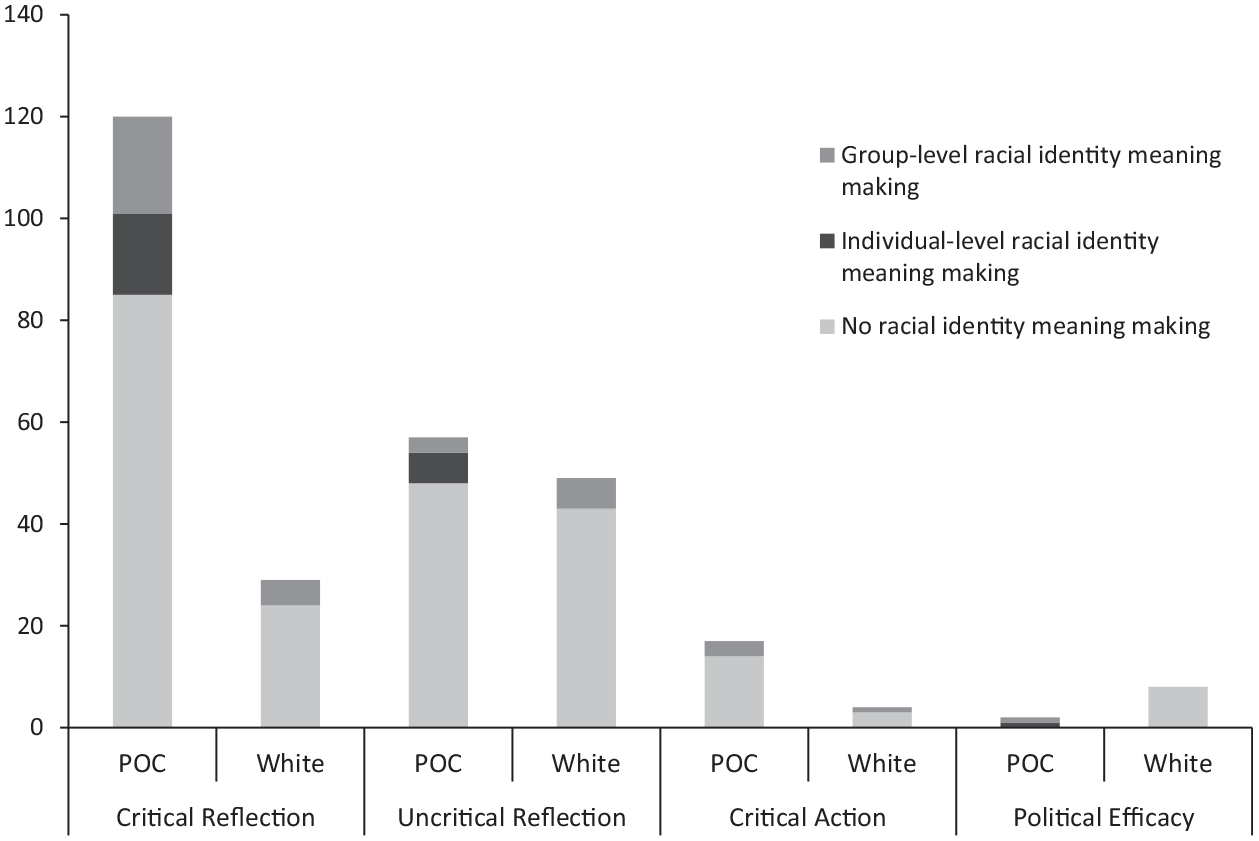
Total critical consciousness coding with nested racial identity meaning making totals.
Critical reflection
Responses coded for critical reflection included evidence of participants’ active reflection on and/or critique of the nature and impact of white supremacy and racism at both the interpersonal and structural levels.
Participants of color
Critical reflection was the most common critical consciousness code among People of Color in this sample, and racial identity meaning making was most frequently found in responses coded here, offering initial evidence for links between these two constructs. As participants reflected critically on society, many also reflected on their own racial group and individual identity, underscoring the intertwined nature of society and self. For instance, a 19-year-old Latina woman wrote in response to the primary prompt: Last week my dance team had a meeting about [University’s] horrible response to the student activism and protests that have been happening in response to police brutality against the Black community. Our team is overwhelmingly made up of minorities, most of which are Asian, and we agreed that we wanted to show support to the organizations on campus that are fighting for change as well as the individuals who are having these traumatic encounters with police.
This response shows evidence of inter-ethnic solidarity among Black and Latinx students on campus and the catalyzing impact of the 2020 racial justice protests for both critical reflection and critical action; the participant names and critiques injustice at the university and societal levels and describes a collective response. Her description makes clear the fluidity of where and when collective action can occur, exposing a potential difficulty of survey measures that may not capture activism in a dance team, for instance. Her follow-up answer regarding the frequency of this kind of conversation was coded for group-level racial identity meaning making. She wrote: I think this comes up more often now because of the racist rhetoric that has only gotten worse these past 4 years. My family has even begun to have some discussions about race because, as Latinos, they often focus on the discrimination they have faced but don’t acknowledge how they continue to perpetuate stereotypes against the Black community.
This nuanced response highlights the sociocultural context of the Trump presidency (“these past 4 years”) as a catalyst for more race related discussions within her family, including greater reflection on the ways in which anti-Black racism is also embedded within other communities of color. Although she does not reflect on her individual racial identity, she is making critical connections between societal inequity and group belonging.
A number of responses from participants of color described similarities in experience across racially minoritized groups. For example, an 18-year-old Black woman wrote: I was in a meeting and we were discussing ‘Out of Darkness,’ a documentary the person I was talking to recommended I watch. We had about a half hour long conversation about how the media, education system, and basically every institution in the U.S. continues to fail black people and other minority populations.
Her follow-up response, coded as individual-level racial identity meaning making, encapsulates racial solidarity and sense of community, which were often framed as acts of resistance within the white space of the university or in society at large. She wrote: I felt empowered by this conversation. I was able to speak freely, and I felt that I was learning so much in addition to sharing my knowledge. Oftentimes I am positioned as the teacher instead of the student during conversations about race, even when I was very young.
This response calls out the harm of being tokenized, as she names the burden of regularly being situated as “the teacher”—the one responsible for educating others about her own racial experiences and race and racism more broadly. This typical experience is contrasted with her mention of being directed by someone else to watch a relevant documentary about structural inequalities, an opportunity to be positioned as student and collaborator in this conversation.
COVID-related inequity also came up in several conversations. For instance, a 20-year-old Chinese American woman wrote about a conversation with another Chinese American friend, which she described as having taken place in her majority white hometown: She asked me whether people had been racist to me about COVID in terms of it being associated negatively with China. I responded that I actually hadn’t, but that I had been expecting it ever since I had come home just before Thanksgiving. She said that something had happened to one of our mutual friends, where someone in a supermarket freaked out and started yelling stuff at her. I remember thinking how sad that made me.
This participant’s narrative brings up an element of critical consciousness rarely discussed—not only is she reflecting on an instance of anti-Asian racism and situating it in relation to the sociocultural context, but she is also naming the experience of expecting a similar incident to happen to her, resulting in heightened vigilance. Hearing about or witnessing racism against members of one’s racial group is called vicarious racism (Harrell, 2000). Both vicarious racism and vigilance related positively to symptoms of depression and anxiety among both Black and Asian American adults in a study conducted in the summer of 2020 (Chae et al., 2021), making clear the micro-level harm of macro-level racism and racist discourse. As this participant reflected on how writing about this conversation made her feel, she noted, “It helps me to realize how important these conversations with this particular friend are, and I’ve never fully reflected on how valuable they are until now.” Being prompted to write about this conversation allowed her space and time to reflect on the importance of community, highlighting writing as a possible catalyst for critical reflection, while making clear that it is an ongoing process that may develop over time.
While the above participant did not discuss the specific targeting of Asian American women, multiple other participants did, underscoring the relevance of intersectionality to critical consciousness. Intersectionality makes explicit the inextricable links between systems of oppression and privilege, offering a critical lens through which to examine interlocking positionalities (Hill Collins, 2019). For example, another 20-year-old Chinese American woman wrote: I was with a friend who is the same race as me in our dorm lobby. We were talking about our families, specifically our moms. This led us to talk about how people in cities we live in/have been to tend to fetishize Asians and how we have both been in situations in which we worry about how others have treated our mothers.
She went on to write, “This conversation made me feel disappointed and worried that the stereotypes assigned to Asians, particularly Asian women, can leave us in dangerous situations when alone.” In this follow-up response, which was coded as group-level racial identity meaning making, she calls out intersectional stereotypes as sources of danger for her mother, herself, and her community. In the face of rising anti-Asian violence, this nuanced reflection lays bare the daily harm of racism, including in intersection with sexism, while highlighting the banality of this experience—it is not abstract or distal for this participant, but a lived reality (Bowleg, 2020).
White participants
Among white participants, critical reflection was the second most prevalent code, though it was notably less prevalent than among participants of color (see Figure 3). Because of the systemic privileging of whiteness in our society, white people do not experience racial tokenization, vicarious racism, or other forms of racist discrimination, meaning that the white participants who reflected critically on societal inequity did so from a perspective of racial privilege, rather than oppression, within the racist hierarchy. This often took the form of expressing frustration or anxiety about community or societal events, which tended to be described from a distance rather than as something influencing participants’ everyday lives. For instance, a 19-year-old white woman wrote: I was talking to my best friend about what has been happening on campus regarding the [student led] protests. We were also worrying about the election and frustrated that so many people continue to support Trump despite his blatant racism.
In response to how this conversation made her feel she noted: I was relatively comfortable, and it gave me a chance to vent about my feelings in a space where I didn’t need to worry about what exactly I said (like in terms of not phrasing things correctly and being misunderstood). The conversation itself was fine but reminded me of problems that make me sad and angry.
With this follow up, she focuses on her feelings, including her implied worry about “being misunderstood” in race related conversations. Such centering of one’s own emotions, which is also seen when she states that writing about this conversation, “reminded me of problems that make me sad and angry,” is common among white people who have not actively engaged in racial identity work (Helms, 1990, 2020). Without a clear understanding of and commitment to racial justice, one’s emotions can become the primary focus, undermining the intent of critical consciousness (e.g., Spanierman & Soble, 2010).
Other white participants reflected on the presidential election specifically, citing both hope and fear about the future. For instance, a 20-year-old white non-binary participant wrote: I talked with my roommate about Joe Biden’s inauguration and the responses from other politicians to his speech talking about white supremacy. We discussed how it was refreshing to hear the president acknowledge that white supremacy is a problem that needs to be addressed, even if we think that he probably will not go far enough in dismantling its foundations, instead of refusing to condemn the Proud Boys and inciting a white supremacist riot.
As they reflected on how they felt while writing about this exchange, they wrote: I still feel both frustrated and hopeful. I believe that change is possible, and though it will take a lot of work and it is horrible how long these institutional, racist harms have been going on, I am hopeful that people will step up to address it.
Of note in this reflection is the reference to a vague notion of “people” needing to address systemic racism. In fact, no white participants engaged in individual-level racial identity meaning making in which they actively reflected on their personal experiences through the lens of whiteness. Instead, many white participants made this type of general statement after a response coded as critical reflection, citing hope for change without reference to individual or collective action. This finding underscores the importance of examining these constructs in tandem, illuminating how emerging adults are (or in the case of white participants, importantly, are not) linking societal inequity to their own identities and how they experience the world.
Some white participants did make concrete links between the macro- and micro-levels, however, such as this 19-year-old white woman: This happened last week when I was having a conversation with my cousin. I was talking about the protests that were happening at [University] with [Student-led movement to create a community-oriented group to replace campus police]. My cousin said she supported black lives matter, but didn’t understand the purpose of riots and destroying property. I was trying to explain that riots happen when people are angry and there isn’t yet an organized protest, and that property is not worth more than innocent black and brown lives. She then, however, said that black people tend to put themselves in those situations where they are going to get killed by police. I tried to demonstrate that this was a stereotype and to give examples of how her sister, who has multiple DUIs and has taken hard drugs, has never been arrested, most likely because she was white. Meanwhile, there are countless black men in prison for small amounts of drugs. It is the system, not the people, that is messed up.
In this response, this participant describes playing the role of educator with her cousin. She uses personal examples to enact group-level racial identity meaning making and expose the ways in which white racial privilege has allowed her cousin’s sister to engage in behaviors which would likely have resulted in arrest if she were not white (and female). Although not a common finding, this engagement with personal experience as a way to highlight systemic racial inequity offers an example of what the intertwined processes of critical reflection and racial identity meaning making can look like among white emerging adults.
Uncritical reflection
Similar to other qualitative work on critical consciousness (e.g., Mwangi et al., 2019), our uncritical reflection code captures instances in which participants engaged in reflection about their race related conversations but did not make meaningful connections to societal inequity. Conversations in this code highlight the possible disconnect between awareness of race and racism and critical reflection on it. In certain cases, participants engaged explicitly racist reasoning, actively reinforcing the inequitable status quo rather than critiquing it.
Participants of color
Uncritical reflection was the second most prevalent code among participants of color. For instance, a 20-year-old Asian American woman wrote: I had a conversation with a close friend about interracial dating and what we think the response of our moms would be on the subject. We were just in a private space, with nobody else around us. We talked about the possibility of falling in love with/dating a person of another race our parents would slightly frown upon, why we think this is the case and how it has/has not worked out in the past.
In response to whether this type of conversation comes up often, she noted: Not really, in the climate of a college campus/setting it’s like walking on eggshells all the time and you always need to watch what you say in fear of getting mildly cancelled, or at least being called out and debated with. You never know what opinion someone has so its always precarious before you find out.
Her “fear of getting mildly cancelled” mirrors the white participant from the previous section, highlighting the highly contentious sociocultural climate. Across response types, many participants reflected on the importance of being able to talk openly to other people about race related issues, regardless of their stance or experience. This further makes clear the relational nature of these constructs—young people are not making sense of their contexts and identities on their own, but in community.
Other participants of color included in this code discussed racism and its impacts without reflecting on it as a systemic issue. For instance, a 21-year-old Chinese American man wrote: My roommate (Korean American cis-man) and I have been watching Cobra Kai, a show that follows the characters from the Karate Kid in the present. He mentioned how he hasn’t seen any bullying as blatant as depicted in the show (throwing backpack in a trash can, beat up in the locker room, etc.) I didn’t know he was mentioning the physical aspect and I said, “Wait. What do you mean? Hasn’t everyone Asian kid that grew up in a white school been bullied? Isn’t that why we’re either funny or white-washed?” And then he clarified that he was referring to the physical aspect, not just the verbal abuse/jokes to which I was referring.
In his follow-up response he wrote: At first, I was surprised. I knew my roommate was more “white-washed”/assimilated that I was, so I was surprised when he said he wasn’t bullied. After he clarified, I still felt validated, justifying that the reason I faced more bullying when I was younger was a lack of sufficient assimilation.
This response is coded for both group-level and individual-level racial identity meaning making, as the participant describes racist bullying as a common occurrence for an “Asian kid” while reflecting on his own identity. Yet, as he situates his experience in societal context, he cites “a lack of sufficient assimilation” as a reason for being bullied. Without critiquing existing social hierarchies, this perspective reflects “resistance for survival” (Robinson & Ward, 1991), a “short-term solution to the menace of white supremacy” (Rogers & Way, 2021, p. 4). This participant is naming and discussing anti-Asian racism, but by promoting assimilation as a solution he is also reinforcing the inequitable status quo.
White participants
Among white participants, uncritical reflection was the most common code. For some white participants, their reflection aligned with and bolstered white supremacy. For instance, an 18-year-old white woman wrote: Me and a friend of mine have talked about race a little bit, but it’s not a topic I talk about a lot in general. She agreed with me that people are too hard on “white people” and she doesn’t like all the divisiveness or criticism based solely on race. That was mainly what we talked about. She also agreed with me that she didn’t really think white privilege exists (wealth privilege obviously does, but being white doesn’t inherently give you money).
This response exemplifies a lack of understanding regarding societal systems, which is a prerequisite for critical, anti-racist identity development among white people (Helms, 1990, 2020). Beyond racial colorblindness, this participant grossly underestimates and argues against the existence of white privilege. In making a distinction between white privilege and wealth privilege, she fails to see the myriad ways in which whiteness in our society leads to the inequitable accruement of economic wealth by white people (Kraus et al., 2019). In response to how this conversation made her feel, she responded, “It made me feel good, because it’s always nice to know other people share your opinion.” While this sentiment parallels responses by participants of color who emphasized the importance of shared experience, this participant is finding community via an actively harmful perspective. This type of white solidarity situates her in opposition to critical consciousness, as she actively pushes against critically reflecting on the societal implications of whiteness and racism.
Interestingly, more white emerging adults engaged in racial identity meaning making in relation to responses coded as uncritical reflection than critical reflection. For example, a 20-year-old white woman wrote, “Race came up during MLK day. We talked about how we need to learn more about racial equality and how we have some privileges because of our race.” In response to whether such conversations come up often she wrote: No, because we normally do not talk about race. It is a hard conversation for us to have as white people because we do not know the true experience and hurt of racism. We need to talk about it more so that we are more aware of the current racial issues in our country.
Coded as group-level racial identity meaning making, this participant is equating talking about race with talking about “the true experience and hurt of racism.” Although she mentions “how we have some privileges because of our race,” she does not critically reflect on the systemic nature of such racial privileging or its effects. Instead, she situates white people as outside of the system of racism—she makes group-level meaning by claiming, “It is a hard conversation for us to have as white people,” reflecting an understanding of racism as something that happens to People of Color, rather than as a system with structural and interpersonal consequences for all people. Like many white participants, she cites a goal (“We need to talk about it more”) without naming specific action or contemplating what this would mean for her as a white person.
Critical action
When participants referenced individual or communal actions to combat racial inequity, they were coded as critical action. Because our prompts centered on conversations, however, the findings reported below should not be taken as a full picture of participants’ behavior, as they were not explicitly asked to report actions. Interestingly, among participants who did report critical action, very few engaged in racial identity meaning making. In line with previous research (Kiang et al., 2021), this suggests that while action against societal inequity has clear positive implications, critical reflection may be more salient to identity relevant processes.
Participants of color
Among participants of color, critical action was the third most prevalent code. Most responses coded here centered on participation in university-related activities. For instance, an 18-year-old Asian American man wrote: In a recent club that I joined that was based on Asian American Christians, we mentioned about race and how our race plays a role in justice and injustice. Our continuing theme is on these topics, and we often discuss about them weekly.
Interestingly, this participant is highlighting a club that was not founded to focus on activism and social inequity, but has pivoted to do so, capturing an important shift occurring in this sociocultural moment. In his follow-up response, this participant wrote, “The conversations were helpful as they were discussions and not debates. Having a space to share experiences while also listening to others was a helpful way to not feel alone.” This response shares similarities with others, again underscoring the importance of community and having a space to share thoughts, while also reminding us of the importance of interpreting such statements in relation to participants’ positionality within the macrosystem of racism.
Other responses were coded as critical action because they specifically referenced groups or events centered on racial justice and equity, as demonstrated in the following response from a 20-year-old Asian American woman: I recently had a conversation with another person of color about micro aggressions during a social justice workshop. The other person was also a college student, but we had not met before. We were talking about micro aggressions we have experienced or witnessed others experience. We also discussed how we reacted to and responded in these situations and how these experiences impact our everyday lives.
This response spans critical action and critical reflection, as the participant describes her participation in this workshop and the introspection it prompted on her own experiences with microaggressions. In response to how frequently such conversations occur, she wrote: In my experience, this type of conversation is coming up more often since issues of racial and social justice have been discussed in the news and by the people around me more frequently, particularly in the last two years.
Like others, she is naming how macro-level discourse shapes the content and frequency of conversations happening around her. This supports the argument that critical consciousness is a normative aspect of human development, which the social context can either support or thwart.
White participants
Among white participants, only one response was coded as critical action, which included an individual act. No white participants mentioned clubs or workshops. Because of the limited nature of these data, it is difficult to speculate on why this might be. In their theoretical model, Mathews et al. (2020) suggested that strong awareness of history and a politicized racial identity may be antecedents for critical action—when Youth of Color have clarity about the role of race in their lives and in society, they are motivated toward action and activism. Although these links were less clear when empirically tested (Kiang et al., 2021), it is possible that this theory holds for white young people. Our data show preliminary support for the notion that, without critical interrogation of one’s own whiteness, reflection on societal inequity may feel distant or like someone else’s issue, leading to inaction.
The sole response from a white participant included in this code was from a 20-year-old woman who explained: A couple of nights ago, my neighbor complimented the BLM sign in my apartment. I said thanks, but noted that it was a pretty awful sign (black Sharpie on a pulled-apart Amazon cardboard box). He laughed and remarked that the content of the sign matters (and black lives matter) way more than the aesthetic.
In her follow-up response she wrote: I felt happy to know I have a neighbor who supports a movement I support and believe in. I was initially embarrassed by my sign (made in June for the protests, but I was in an unstable living situation and didn’t have the resources to make a nice sign), but I felt validated by my neighbor.
This participant states that making this sign was an act of solidarity with “a movement I support and believe in.” However, the conversation she reports and her reflection on it include minimal discussion of the Black Lives Matter movement and no meaning making about her racial identity.
Political efficacy
The final critical consciousness code is political efficacy. Reflecting its operationalization in previous literature (e.g., Diemer, 2020), statements coded here included mentions of believing socio-political change is possible. As with critical action, had we phrased our prompts differently, we may have captured this facet of critical consciousness more comprehensively.
Participants of color
Among participants of color, only one response was coded as political efficacy. Unlike the other critical consciousness codes, the single response coded here occurred in a follow-up response. Specifically, the 19-year-old Latina woman who described the conversation with her dance team then wrote: This conversation made me feel more connected to my peers even when I’m not physically close to campus. It gave me hope that our generation can truly make a change because we aren’t even letting a pandemic get in the way of our fight for equality. I also felt relieved that my friends aren’t seeing themselves as not “political” but rather as members of a society who are affected by policies on a daily basis.
This participant is hopeful for change because she sees and is part of the concrete actions her peers are taking. She recognizes that they are “affected by policies on a daily basis”—that the personal is inherently political (and vice versa).
White participants
Among white participants, political efficacy was the second least common code, and the sole aspect of critical consciousness in which white participants were coded with more frequency than participants of color. A 28-year-old white woman described a conversation with her partner about racism against Kamala Harris and wrote that, “if BIPOC, women, or LGBTQ+ individuals mention their excitement over an elected official representing their identity, they’re immediately criticized for endorsing or enjoying the representation.” In response to how she felt writing about this conversation she said, “I still feel hopeful and worried. Even though there’s a lot that Biden and Harris have previously done that I don’t agree with, I’m hopeful that there will be change within the next two years.” In contrast to the excerpt above, this participant states that she is hopeful “that there will be change” on a societal level without discussing acts of change on a local, community, or peer level. This reflects the broadness of this construct. Whether young people believe political change is possible because they see their peers taking action or because they feel connected to a political party or politician can yield different personal and societal outcomes. Based on the limited instances in our data, it seems that the more traditional definition related to one’s connections to political parties and politicians better captures how white emerging adults understand political efficacy. No participants of color made such statements, possibly reflecting low levels of political efficacy in a system that has historically and continues to perpetuate racist harm.
General Discussion
In the sociocultural context of a polarizing 2020 presidential election, when race and racial justice were at the forefront of discussions in media, politics, and everyday life, many emerging adults of color in our sample were looking to their peers as sources of support as they navigated a predominantly white university that in many ways mirrored the broader societal context. Many of these participants engaged in critical reflection on racial inequity, and many subsequently made meaning about how such inequity shaped their own identities, on both the group and individual levels. Solidarity across racially minoritzed groups was evident in a number of participants’ narratives, underscoring the value of examining racial equity related processes beyond the Black/white binary. This finding also makes clear the need for more developmental research into the role of inter-group solidarity within critical consciousness and racial identity. Among participants of color, clear links were drawn between events and issues such as the Black Lives Matter movement, anti-Asian violence, or the presidential election, and their own daily lives. For many of these students, talking about race in society was inextricable from talking about their own racial identities and experiences.
Mathews et al. (2020) hypothesized that Youth of Color who experience racism and/or racial socialization may be prompted toward critical reflection, which may be strengthened by racial identity exploration. Our analysis indicated that, for many young People of Color, conversations with peers offered space for critical reflection, which led to meaning making about their racial identities. By examining our participants’ responses, however, we could see how these processes are interwoven, with reflections on individual experiences often embedded in reflection on sociocultural issues. When the political is personal (Bowleg, 2020), disentangling critical reflection and racial identity meaning making becomes difficult. Thus, future longitudinal research should examine the reciprocal nature of these processes, paying attention to the role of the macrosystem in spurring critical reflection on the self, group, and society.
In the current study, participants of color displayed a greater degree of critical reflection and action than white participants, a finding that may be unsurprising, but is consequential. Power and one’s positionality in relation to it influence how individuals makes sense of and engage with social structures, including their responses to racial inequity (Hill Collins, 2012). Freire (1970, 1973) conceptualized critical consciousness as a key capacity for liberation among oppressed peoples, but he also wrote of the importance of and possibility for solidarity among those benefiting from systems of oppression. Yet, for solidarity to move beyond a broad hope for change, as referenced by many of our white participants, critical reflection on one’s own racial identity and positionality is necessary (Helms, 1990, 2020). We did not find evidence of such racial identity meaning making among white participants. Instead, most white participants situated race as outside of and disconnected from their own lives—a concept that was either not relevant or only relevant to “other” people. While many white participants wrote about their hopes, fears, or frustrations, especially related to the political sphere, whiteness generally remained unnamed and unexamined. In the rare cases in which white participants did name whiteness, it was only at the group level, and often involved critique of or questions about other white people’s behaviors, rather than their own. Recent research has highlighted formal channels, such as classes on social and racial justice, as one avenue for fostering critical reflection, including among white emerging adults (Kornbluh et al., 2020). To prompt racial identity development, such socialization likely needs to make explicit the ways in which white people, like all people, are impacted by and in turn influence systems of racial inequity. Race and racism cannot be viewed as issues relevant only to People of Color.
Relatedly, our findings show that more work is needed to better understand the nuanced ways in which positionality shapes developmental processes related to critical consciousness and racial identity development. Without taking the macrosystem into account, group-based differences can seem static and neutral—occurring because of one’s racial group membership—rather than in relation to the racialized systems of power and oppression shaping our society. That white young people are largely unreflective about their own whiteness is in line with a growing body of research on white racial identity (e.g., Grossman & Charmaraman, 2009; Helms, 1990, 2020; Moffitt et al., 2021). What our findings highlight, however, is that even as white participants made societal critique of white supremacy as they talked about police brutality or the Capitol insurrection, for example, none turned their gaze inward to reflect on how the system of white supremacy shapes their own opportunities, experiences, and identities.
This finding may be particularly important when considering the lack of critical action reported among white participants. Even if white participants engaged in critical action beyond what was evidenced in these data, if such action is not coupled with critical interrogation of whiteness, white supremacy, and one’s own racial positionality, the likelihood of meaningful, sustained engagement is nominal. Bringing together Mathews et al.’s (2020) theorization with models of white racial identity development (e.g., Helms, 1990, 2020), it may be that a full embrace of critical consciousness is only possible among white people who have also engaged in high levels of critical, anti-racist identity development. That is, for white young people to reflect on why societal change is needed, believe it is possible, and work toward enacting it, they must first understand the ways in which the system they are fighting has and continues to benefit them; they must engage in racial identity meaning making that critiques whiteness. This is the driving assertion of the m(ai)cro perspective: recognizing that the macro is micro is key to building a more equitable and justice society (Rogers, Niwa et al., 2021).
Limitations and Future Directions
Mirroring much of the previous research on critical consciousness, the framing of our study primarily focused on reflection rather than action (Watts & Hipolito-Delgado, 2015). Although we coded for critical action, we did not specifically probe for whether or how often participants engaged in resistance to oppression through actions such as participation in clubs, demonstrations, or other in-person or online activities. That some participants mentioned such actions organically offers evidence for the importance of critical action, as well as its links to critical reflection and racial identity meaning making, particularly among participants of color. In future research, however, explicitly asking about critical action would be helpful for understanding the development and directionality of these links.
Additionally, future studies should probe the scope of political efficacy to examine the ways in which this aspect of critical consciousness may be differentially interpreted and operationalized, by both researchers and participants. Although we found little evidence of political efficacy overall, interesting group differences emerged, such that participants of color tended to focus on peer, grassroots action, whereas white participants tended to reference belief in change within the political establishment. Similar differences have been found in research on civic engagement among racially diverse emerging adults (Kornbluh et al., 2022; Wray-Lake et al., 2020). It may be that the link between critical reflection and action tends to be direct among young People of Color, following Freire’s original conceptualization (1973) rather than going through political efficacy. The utility, content, and operationalization of each of these facets of critical consciousness should be explored further in future research.
Finally, due to our relatively small sample size, we were unable to examine the experiences of participants of color in relation to their racial groups. While anti-Black and anti-Asian racism share characteristics within a society structured on white supremacy, there are important historical, cultural, and policy-related differences that should be examined in future studies. Racial identity development can vary across groups of racially minoritized youth (e.g., Umaña-Taylor et al., 2014), so gaining a contextually situated understanding of these processes in relation to critical consciousness as well would strengthen developmental theory.
Conclusion
The current analysis examined how college-going emerging adults in the U.S. talked about and made sense of race in the midst of a sociocultural context and presidential election characterized by political polarization and racism. We used critical consciousness and racial identity meaning making as conceptual frameworks to understand how micro-level conversations were related to and shaped by this macro-level context. Overall, our participants’ responses were thorough and nuanced. Their level of openness and engagement underscored the need for outlets to talk about and reflect on race, racism, and societal inequity during this sociocultural moment, while also reiterating the utility of written narratives for examining identity related processes (Syed, 2015). Our findings reinforce the need for schooling models, curricula, and student leadership opportunities that center critical consciousness and equip emerging adults with the tools to challenge systemic inequity (e.g., Diemer et al., 2021). We can begin by expanding educational practices and pedagogy that promote critical reflection, which may be tied to increased sociopolitical action for young people (Banales, Mathews, et al., 2020). This might include structured opportunities for inter-group dialogue, which can help dismantle stereotyped and inaccurate beliefs borne of systemic racial segregation and discrimination (Nagda et al., 2009). Through institutional changes in higher education, emerging adults of all positionalities can develop the skills to transform the contexts in which they live.
Viewed through the lens of the m(ai)co framework (Rogers, Niwa et al., 2021), our findings push back on the tendency to situate the macrosystem as distal in developmental research. Racism is not just something “out there”—societal events occurring in response to and as a result of systemic racism, including the Black Lives Matter movement, the storming of the U.S. Capitol, and the rise in anti-Asian violence, affect the lives of young people in intimate, meaningful ways (Bowleg, 2020). By moving beyond how much of these constructs were evident in participants’ race related conversations, we could examine how positionality shapes development in ways meaningful at both the individual and societal levels.
Footnotes
Acknowledgements
We would like to thank all members of the Development of Identities in Cultural Environments (DICE) lab at Northwestern University for their support and feedback on early drafts of this manuscript.
Declaration of Conflicting Interests
The author(s) declared no potential conflicts of interest with respect to the research, authorship, and/or publication of this article.
Funding
The author(s) disclosed receipt of the following financial support for the research, authorship, and/or publication of this article: Funding for this manuscript was supported by a postdoctoral fellowship awarded to Dr. Moffitt from the National Science Foundation (NSF) SBE (#2005052).
