




Abstract
This article examines the experiences of three families who were unable to secure mentors through a Youth-Initiated Mentoring (YIM) program. YIM is an emerging mentoring model that invites youth to identify adults in their existing networks and nominate them as mentors. The emerging evidence on YIM has been largely positive; however, important opportunities remain to explore potential risks. Data were collected from six participants, who included youth (n = 3) and their caregivers (n = 3). Participants were involved in a YIM program at a Big Brothers Big Sisters agency in Canada. Data were collected via observations and interviews and analyzed using qualitative coding procedures. Results indicated families participated to be matched with a mentor they knew and trusted, and to expedite their matching process. Nominees were youth professionals and adults closely connected to the family, who were described as caring, knowledgeable, and playful. Two families engaged in unstructured mentor-nominations without program support. Risk-mitigation strategies helped set expectations and prepare families. Participants reported disappointment and frustration after not successfully recruiting mentors. Directions for future research and practice are discussed. This article addresses the critical need for research on the risks of YIM, contributing to a more balanced discussion of the emerging mentoring model.
Keywords
Introduction
Youth-initiated mentoring is an innovative mentoring model that invites youth and their primary caregivers to nominate their own mentors rather than being matched with a mentor by a mentoring program (Schwartz & Rhodes, 2016). To date, youth-initiated mentoring has been implemented with youth aged 10 to 25, with an average age of 16.93 (Dantzer & Perry, 2022). The emerging evidence on youth-initiated mentoring has been largely positive – highlighting the promise and utility of the approach. For example, research has discovered that youth often appreciate the opportunity to nominate their own mentors (Spencer et al., 2018, 2019; Van Dam et al., 2019). Furthermore, youth sometimes select adults with similar cultural and demographic backgrounds as themselves, which they describe as increasing the quality and practicality of the support that they receive (Schwartz et al., 2013; Spencer et al., 2016, 2018, 2019). In addition to increasing the sense of trust between mentors and mentees (Spencer et al., 2019), youth-initiated mentoring programs have also been shown to increase the overall length and durability of mentoring relationships (Schwartz et al., 2013; Spencer et al., 2016, 2018). Finally, in a recent meta-analysis of youth-initiated mentoring (Van Dam et al., 2021), the average effect size (g = 0.30) on youth outcomes was larger than other forms of mentorship (g = 0.19; Christensen et al., 2020; d = 0.18; DuBois et al., 2002; d = 0.21; DuBois et al., 2011; d = 0.21; Raposa et al., 2019).
Taken together, the early research on youth-initiated mentoring has indicated that inviting youth to select their own mentors brings a multitude of benefits. This mounting evidence has justifiably elevated the awareness and enthusiasm for youth-initiated mentoring among practitioners and researchers (current authors included). However, there remain important opportunities to critically explore the potential challenges and risks associated with youth-initiated mentoring programs (Dantzer, 2024). Although inviting youth to select their own mentors can lead to feelings of autonomy and empowerment, this very feature also holds the potential for youth to experience feelings of disappointment, frustration, and distress if they are unable to successfully recruit mentors (Dantzer, 2024). Similarly, although youth-initiated mentoring is designed to celebrate youths’ social networks and their existing relational assets, these programs may also amplify youths’ deficit-based narratives about their social networks if their nominated adults are unable to serve as their mentors (Koper, 2021). Therefore, considering and examining how youth-initiated mentoring programs may elevate certain risks compared to more traditional mentoring models that do not invite youth to engage in the vulnerable act of nominating their own mentors is important. This article addressed this opportunity by examining the experiences of three families who were unable to secure mentors while participating in a youth-initiated mentoring program.
Literature Review
Mentor-Nomination Process
The hallmark of youth-initiated mentoring is inviting youth to identify and nominate their own mentors. To accomplish this, youth are often invited to work with mentoring professionals and their primary caregivers to explore their existing social network and identify the supportive adults in their lives through an activity often referred to as eco-mapping or social capital mapping (Spencer et al., 2019; Van Dam et al., 2019). In general, this activity often involves helping youth identify the various adults that have had a positive impact on their lives, consider which adults they would be comfortable and happy connecting with more regularly, and identify which adults have the necessary knowledge, experiences, and skills to help them achieve their goals (Spencer et al., 2019; Van Dam et al., 2019). Studies suggest that most youth receive guidance from their caregivers during the mentor-nomination process, which can increase caregivers’ investment in their child’s mentoring relationship (Spencer et al., 2019). Research has also documented that most youth can identify and nominate at least one mentor (Koper et al., 2023; Spencer et al., 2016, 2021; Van Dam et al., 2017).
Roles and Qualities of Nominated Mentors
Youth often nominate adults who are closely connected to their families (e.g., family friends, extended family members) and/or professionals they have encountered in their daily lives (e.g., teachers, coaches, religious figures, after-school staff; Schwartz et al., 2013; Spencer et al., 2016, 2018, 2019; Van Dam et al., 2019). While nominating adults from these two groups, youth sometimes select adults who share the same race, culture, and/or ethnicity as themselves (Schwartz et al., 2013; Spencer et al., 2018). These results are mixed, however, as some youth participating in youth-initiated mentoring programs also nominate adults who do not share their socio-demographic characteristics (Dantzer & Perry, 2022). When youth do nominate adults similar to themselves, this finding is often cited as a strength of youth-initiated mentoring, as youth in formal mentoring programs are often matched with volunteers from very different social and demographic circumstances (Schwartz & Rhodes, 2016). When meaningful to youth, being matched with a mentor who shares the same race, culture, and/or ethnicity can help strengthen rapport, increase opportunities for more contextually sensitive and attuned forms of guidance, and increase relationship satisfaction (Sánchez et al., 2025).
Several studies have documented the various qualities that youth and caregivers search for while nominating mentors. Youth often nominate mentors who are non-judgmental, trustworthy, knowledgeable, empathetic, and playful (Koper, 2021; Spencer et al., 2019). For example, given some of the challenges faced by families involved in youth-initiated mentoring programs, families tend to search for adults who are capable of supporting them unconditionally and creating a safer space for them to receive mentorship (Koper, 2021; Spencer et al., 2019). Families also tend to search for mentors who are knowledgeable and can help them navigate their current challenges, provide them with helpful information, and take concrete steps toward their goals (Koper, 2021). Some families also seek mentors who are empathetic and active listeners who can provide them with opportunities to share their experiences and feel supported by a caring adult (Spencer et al., 2019). Finally, youth have also expressed a desire to nominate adults who are playful and capable of helping them relax and have fun (Koper, 2021).
Positive Reactions to Youths’ Nominations
Research has documented that adults often react favorably to youths’ invitations, yet carefully consider whether they can serve as their mentors. Most adults report feeling a sense of honor and pride (Spencer et al., 2019; Van Dam et al., 2019). In addition, adults tend to take the responsibility of mentoring seriously and report feeling the need to carefully consider whether they have the capacity to serve as a mentor (Spencer et al., 2019; Van Dam et al., 2019). This hesitation often stems from adults’ current schedules and whether they have the time to serve as mentors (Spencer et al., 2019; Van Dam et al., 2019). Some nominated adults also express concerns about the shift in boundaries (e.g., from teacher to mentor) and potential conflicts of interest that would arise if they accepted the youth’s nominations (Spencer et al., 2019). Nevertheless, studies have documented that the majority of nominated adults accept youths’ nominations (Spencer et al., 2019, 2021; Van Dam et al., 2017, 2019). Adults often report that they ultimately agreed to serve as mentors because they were personally asked by a young person to do so (Spencer et al., 2019; Van Dam et al., 2019).
Reasons for Not Accepting Youths’ Nominations
To date, only one study has formally documented why certain adults are unable to accept youths’ nominations to become their mentors (Spencer et al., 2021). This study identified two general patterns by which nominated adults informed mentoring organizations that they could not accept youths’ nominations. In the first pattern of responding, adults directly informed mentoring organizations that they were unable to accept youths’ nominations. In the second pattern, adults indirectly informed the mentoring organization that they were unable to accept the youths’ nomination by not responding to their communication attempts. Among the adults who responded to the mentoring organization’s request, the majority declined youths’ nominations due to time constraints (Spencer et al., 2021).
Experiences of Youth Unable to Secure Mentors
Four studies have formally documented that a small percentage of participating youth were unable to successfully secure their own mentors (Koper, 2021; Spencer et al., 2016, 2021; van Dam et al., 2017). Three of these studies (Koper, 2021; Spencer et al., 2016; Van Dam et al., 2017) provided data on the number of youth who were unable to secure mentors, which ranged from 6.66% (n = 2; Spencer et al., 2016) to 17% (n = 13; Van Dam et al., 2017). Two of these studies briefly documented and reported on the experiences of these youth. In the first study, researchers reported that 2 out of the 15 (13.33%) participating youth were unable to secure their own mentors. Because of this experience, these youth later self-reported negative perceptions about youth-initiated mentoring and beliefs that they could not trust others, including supportive adults and potential natural mentors (Koper, 2021). These youth also reported a belief that adults lack the necessary education to adequately support them, and that they did not want to burden others with their challenges (Koper, 2021).
In the second study, researchers also reported that 2 out of the 30 (6.66%) participating youth were unable to secure their own mentors. For one of these youth, their mentor initially agreed to serve as their mentor, wrote them supportive letters while they were in a residential care program, but failed to attend a significant event in the mentoring relationship. This resulted in the youth feeling “really upset” and led to a rupture and eventual deterioration of their previously positive relationship with the supportive adult (Spencer et al., 2016, p. 414). For the second youth, although their nominated mentor initially agreed to become their mentor, they proceeded to avoid contact with them and not respond to their phone calls. Describing this experience, the youth said, “It was horrible. It was like getting your back stabbed” (Spencer et al., 2016, p. 416).
On balance, research on youth-initiated mentoring indicates that it is a relatively small proportion of youth who experience challenges securing their own mentors. However, considering the general vulnerability of youth involved with mentoring organizations (DuBois et al., 2002, 2011), it seems important to examine the experiences of youth and caregivers who are unsuccessful in this regard. In addition, from a developmental perspective, youth involved in formal mentoring programs have sometimes experienced unreliable, unstable, and even harmful relationships with adults – which may make them more sensitive to rejection by adults and have impacts on their identity development and self-concept (DuBois et al., 2002, 2011; Jarjoura et al., 2018; Keller, 2007; Poon et al., 2022; Spencer, 2006). As such, investigations into unsuccessful youth-initiated mentoring experiences can help anticipate and mitigate potential harm that can accrue, even for one youth, from an unsuccessful attempt to find a mentor. The current study addressed this opportunity by deeply investigating the experiences of three youth who did not secure a mentor. This article surfaces significant risks and ethical considerations that can inform and advance future research and practice in the field of youth-initiated mentoring to protect youth and families.
Current Study
In this article, we report findings from a larger study that took place at a Big Brothers Big Sisters (BBBS) agency located in Canada, which provides mentoring for young people aged 7 to 17. The larger study involved 11 participants and utilized Community-Based Participatory Research (CBPR) to co-design, implement, and evaluate a youth-initiated mentoring program (Dantzer, 2024). The BBBS agency was interested in pilot-testing the youth-initiated mentoring program as a strategy for reducing the number of youth who were waiting to be matched with volunteer mentors. The youth-initiated mentoring program was offered to youth in the agency’s community-based mentoring program. In this mentoring program, youth who were able to secure a mentor met with their mentors once a week, for 2 to 4 hr, for a minimum of 12 months. Here, we report on the experiences of three families who participated in this larger study and the agency’s youth-initiated mentoring program but were unable to secure their own mentors. Three research questions guided data collection and analyses:
Why did these families decide to participate in the youth-initiated mentoring program?
Who did these families nominate to become their mentors, and why?
What were the outcomes for these three youth and their caregivers when they were unable to secure their own mentors?
Method
A case study design was used to address the research questions (Merriam, 1998; Miles et al., 2020). Case studies are adept at providing rich and nuanced descriptions of participants’ experiences (Merriam, 1998; Yazan, 2015), which supports this article’s purpose of illuminating the experiences of participants who were unable to secure their own mentors.
Participants
Staff members invited youth (aged 12–17) who had been placed on the waitlist for a mentor to participate in this study. Staff invited youth and their caregivers to participate by emailing them a letter of initial contact from the researcher that contained information about the study. The letter directed families interested in participating in the study and youth-initiated mentoring program to email the lead author, who then conducted information sessions with each family. Participants who returned a signed consent and assent form within 7 days of the information session became participants in this study. In total, (N = 6) participants agreed to participate in this study, which included youth (n = 3) and their primary caregivers (n = 3). Youth were 12 to 15 years old (M = 13.33, SD = 1.25). Caregivers were 42 to 51 years old (M = 46.00, SD = 3.74). Participants were racially and ethnically homogenous, with 100% of caregivers self-reporting that both they and their child were “White,” “Canadian,” and/or “Caucasian.” Two youth lived in a dual-parent household with their mothers and fathers. One youth lived in a single-parent household with their mother. Youth had been placed on the waitlist between 4 and 41 months (M = 19.25, SD = 17.57) before participating in the youth-initiated mentoring program. Table 1 provides a summary of participant demographics. Participants elected to either use their real first names or create pseudonyms.
Participant Demographics.
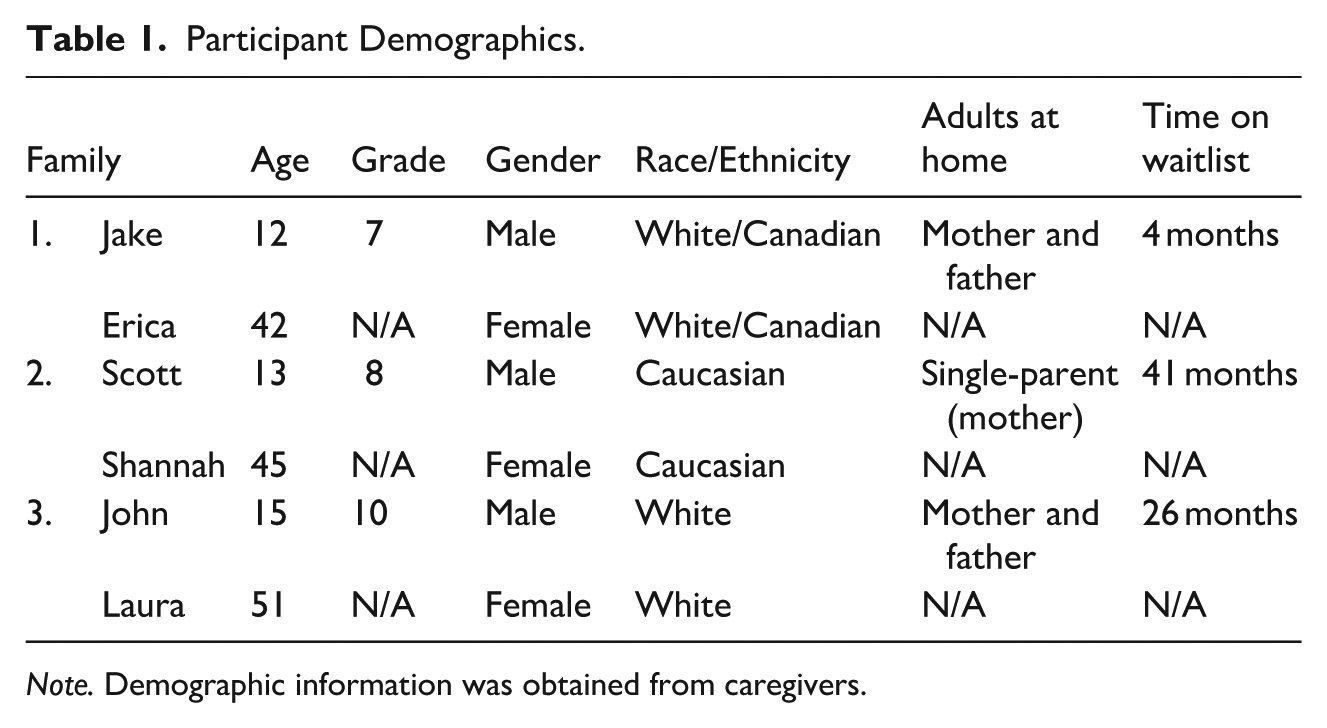
Note. Demographic information was obtained from caregivers.
Procedures
Mentor Identification and Nomination Process
Youth and their caregivers were invited to engage in a four-step mentor nomination process that the lead author co-designed with mentoring professionals at the BBBS agency. The process was inspired by other similar resources and protocols (Mentoring Partnership of Southwestern PA, 2021; The Pearls Club, 2021) and was facilitated by an experienced mentoring coordinator. Free meals were provided to each family as they engaged in the four-step process.
Step #1: Be Confident in Who You Are
To begin, youth were invited to identify up to five strengths and things that they liked about themselves. This activity aimed to create a strengths-based environment. For example, before identifying their strengths, youth were informed that, “Even though you may be the one asking for help, friendships are always a two-way street . . . you have a lot to offer just by being who you are.”
Step #2: Let’s Take a Look at Who Could be a Potential Mentor
This step invited youth to collaborate with their caregivers to create a visual representation of their current social network and the various caring adults in their lives. This “Circle of Support” activity was designed to help youth celebrate their existing relationships and begin identifying possible mentors. To accomplish this, youth were invited to “think about all the adults in your life who could become potential mentors” and map them out on three concentric circles. The innermost circle represented “the most important people” in youth’s lives (such as their parents/primary caregivers, grandparents, siblings, or other close family and friends). The middle circle represented the “important people” in youth’s lives (such as extended family members, neighbors, teachers, coaches, or older friends). The outermost circle was for “other people” in youth’s lives (such as friends of friends, community elders or leaders, or parents’ friends).
Step #3: My Choices
In step three, youth were invited to identify at least three adults from their existing social network that they would like to nominate as their mentors. Youth were invited to select at least three adults to increase the chances that one of their selections would accept their invitation and become their mentor. Using various prompts, this step encouraged youth to elaborate on their selections and describe how their nominated mentors could help support their learning and development. These prompts were designed to encourage youth to select adults who would be more suitable as role models and mentors (i.e., adults who possessed certain qualities, skills, and forms of knowledge that they valued and wanted to obtain for themselves). This third step also employed four strategies to mitigate potential harms for youth who were not able to secure their own mentors. This was accomplished by: (a) helping families set realistic expectations by understanding that their nominated mentors may not be able to accept their invitations at this current time, (b) providing plausible reasons as to why nominated mentors may not be able to serve as their mentors, (c) de-personalizing the experience by highlighting how mentors’ possible reasons for unavailability were not connected to youth and their various qualities and strengths, and (d) reassuring families that if they were unable to secure a mentor, the mentoring organization would continue to support them by searching for a suitable volunteer mentor outside of their social network.
Step #4: Stay Positive
In this final step, the youth were reminded of the personal strengths that they identified in Step 1. This brief reminder was implemented to maintain a strengths-based environment as the mentor-nomination process concluded. Youth were again informed that some or all of their nominations may not be able to accept their invitation. Youth were also reassured that if their nominations were unable to accept their invitation, the mentoring organization would be there to support them and find them a mentor.
Mentor Invitation Process
After families identified and nominated their mentors, the mentoring coordinator was responsible for contacting these adults and inviting them to accept the family’s nomination. The mentoring coordinator contacted nominated adults one at a time via email. If the mentoring coordinator did not receive a response via email, they contacted nominated adults via phone call. During these contacts, the mentoring coordinator provided nominated adults with a two-page information letter describing the youth-initiated mentoring program and accompanying research study. This letter introduced nominated adults to youth-initiated mentoring, described why they were being contacted, who they were nominated by, and the rationale for their nomination (e.g., direct quotes from youth explaining why they chose them as their potential mentor and what they wished to do and learn with them if they accepted the nomination). If nominated adults were interested in participating, they were informed to email the lead author.
Process for Informing Families of Mentor Unavailability
The mentoring coordinator was responsible for informing families that they were unable to successfully secure a mentor via phone call. The mentoring coordinator followed a structured process during these conversations to ensure that this process was implemented in a responsible and caring manner. This process involved three steps. First, youth were reminded of their current strengths and abilities, which they documented during the mentor-nomination process. Next, the youth were informed that although their nominated mentors were unable to accept their invitation, the reasons provided had absolutely nothing to do with them and their respective qualities and strengths as a young person. Finally, the youth were informed that the mentoring organization would continue working hard to match them with a volunteer mentor from outside their social network and community. Families were also invited to identify and nominate additional mentors if they wished to do so. As discussed in the results section, none of the families decided to nominate additional mentors through the youth-initiated mentoring program, preferring to be placed back on the organization’s waitlist to be matched with a volunteer mentor from outside their social network. The authors do not have information on whether these families were successfully matched with a mentor after returning to the waitlist.
Measures
Observations
During each mentor-nomination meeting, the lead author collected data by observing and documenting participants’ behavior and experiences using their laptop. Observations were informed by a classroom observation instrument (Perry, 1998) with demonstrated utility for uncovering how adults interact with youth and provide them with support. During observations, the lead author created a detailed running record of each meeting, which included: (a) verbatim dialog, (b) participants’ body language, (c) who families nominated and why, and (d) the general flow, timing, and structure of the meeting. After the mentor-nomination meeting, the lead author immediately reviewed their running record, adding clarifications and elaborations to create a detailed and comprehensive observational record.
Interviews
All youth and caregivers participated in separate individual interviews after not securing a mentor. One family was interviewed in person in a private room at the BBBS agency. Two families were interviewed via Zoom. All interviews were audio-recorded and lasted approximately 60 min each. Youth and caregivers were each invited to respond to a set of questions designed to capture their perceptions regarding: (a) their motivations for participating in the youth-initiated mentoring program, (b) who they nominated as their mentors and why, and (c) the outcomes they experienced as a result of not being able to secure their own mentor. On average, participants were interviewed 7.33 months after they were unable to secure their own mentors. Each participant received a $40.00 gift card for their participation in the interview.
Data Analysis
The lead author was responsible for data analysis. This researcher initiated the data analysis process by familiarizing themselves with the data (Clarke & Braun, 2021). This was accomplished by personally transcribing all audio recordings from interviews and repeatedly reading interview transcripts and observational records. Data were then analyzed in two cycles.
Researcher-Led Analysis
In cycle 1, data were analyzed using in vivo, descriptive, and pattern coding (Miles et al., 2020). In vivo coding uses the exact words or phrases that participants use and applies them as codes. This method honors participants’ voices, grounds the analysis in their own language, and ensures their perspectives are seen and heard in the final reporting of outcomes. Next, descriptive coding was implemented, which invites researchers to summarize and explain qualitative data using simple and direct codes (Miles et al., 2020). Descriptive coding is useful for creating preliminary summaries of the data by allowing others to “see what you saw” in their data, which helped the lead author facilitate a more participatory approach to data analysis (Miles et al., 2020, p. 71). After applying descriptive codes, the lead author used pattern coding to re-analyze all in vivo and descriptive codes and organize them into smaller and more focused patterns (Miles et al., 2020). Pattern coding is an exploratory coding method that helps researchers organize their individual codes into overarching patterns, or hunches, about what they think might be emerging in the data (Miles et al., 2020). Pattern codes are often used to facilitate a more collaborative and participatory approach to data analysis, where the researcher “tries out the code” with participants during their next interaction (Miles et al., 2020, p. 81).
Participant-Led Analysis
In cycle 2, participants engaged in member reflection meetings to review the lead author’s analyses and provide their own elaborations, feedback, and critique. Inspired by traditional member-checking procedures, member reflection meetings invite participants to help shape the emerging interpretation of their data (Tracy, 2020). During member reflection meetings, participants reviewed and helped analyze 100% of their data. In preparation for each meeting, the lead author completed a template they created to guide the process. The first section was titled “Things I Have Learned from You,” which helped initiate the conversation by revisiting some of the things that each participant said during the study (e.g., they were shown some of their direct quotes). The lead author then presented participants with some of the pattern codes that they developed to help them understand each participant’s “mentoring story.” In general, the purpose of this first section was to refamiliarize the participants with their data and introduce them to some of the salient patterns that the lead author saw emerging in their data. After introducing participants to their “raw data” and the lead author’s subsequent coding decisions, each participant was presented with the author’s preliminary findings as a narrative description. This second section of the template was titled “Your Mentoring Story So Far” and described what the lead author had learned from each participant by weaving together their pattern codes and supporting them with direct quotes. After reading the lead author’s interpretation, participants were invited to provide their own interpretations of their mentoring stories. This final section was titled “I Still Need Your Help” and was designed to help the participants analyze their own data by telling the lead author what they got right and what they missed, overlooked, or got wrong. This part of our conversation was the lead author’s attempt to avoid any blind spots or personal biases by actively inviting the participants to correct their interpretations and suggest alternative explanations. To conclude our conversation, participants were invited to rephrase the lead author’s codes and create their own. This final activity created the opportunity for the participants to author their own mentoring stories and ensure their voices were seen in the final results. The lead author encountered one coding disagreement during this process, which they were able to reconcile during the member reflection meeting. Participant feedback was immediately incorporated during the member reflection meeting. All member reflection meetings were audio-recorded. Participants received a $40.00 gift card for their participation.
Results
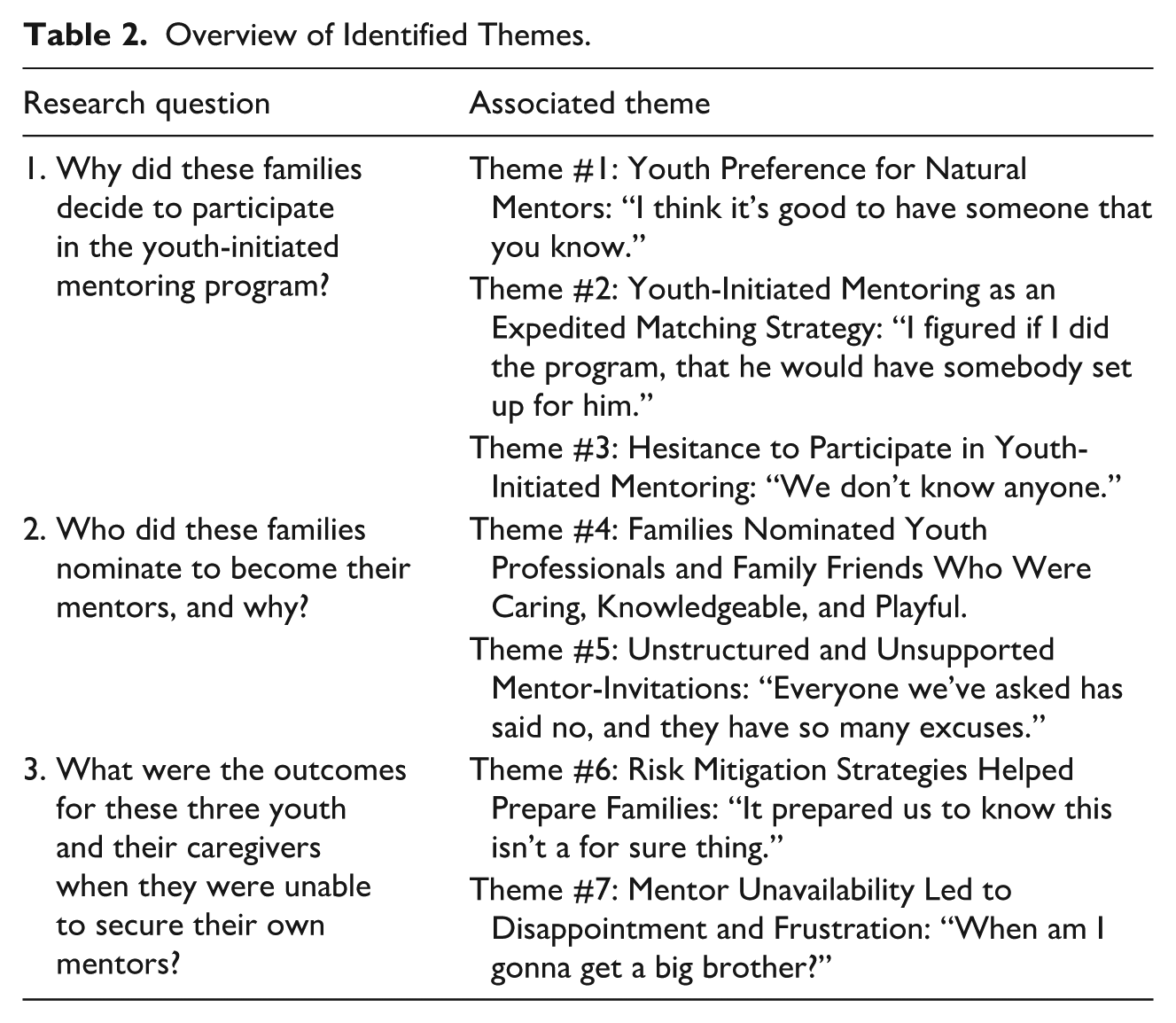
Seven themes were identified through qualitative coding. All themes were corroborated and advanced by participants, helping to increase the overall authenticity and trustworthiness of the results. Table 2 provides a summary of identified themes and their connection to the three research questions that guided this study.
Overview of Identified Themes.
Family Motivations for Participating in Youth-Initiated Mentoring
Theme #1: Youth Preference for Natural Mentors: “I Think It’s Good to Have Someone That You Know.”
While explaining why they decided to participate in the youth-initiated mentoring program, all three youth expressed a preference to nominate and be matched with a natural mentor from their existing social network. As a key example of this theme, when Jake explained why he decided to participate in the youth-initiated mentoring program, he said: Because I think for me it would be easier to get along with someone that I share a lot in common with, rather than just a random person. It will help a lot more to be able to pick a mentor that will be good for me, so you’re not with a random person that you don’t really share much with.
Scott and John similarly reported that they appreciated the opportunity to nominate their own mentors. In large part, youths’ appreciation was driven by their desire to be mentored by someone whom they trusted, shared interests with, and had developed a sense of familiarity and rapport with. This theme corroborated previous research indicating that youth often appreciate the opportunity to nominate their own mentors while participating in youth-initiated mentoring programs (Spencer et al., 2018, 2019; Van Dam et al., 2021). This theme also helped advance this research by surfacing some of the factors that contribute to youths’ appreciation.
Theme #2: Youth-Initiated Mentoring as an Expedited Matching Strategy: “I Figured If I Did the Program, That He Would Have Somebody Set Up for Him.”
All families reported being motivated to participate in the youth-initiated mentoring program to expedite their matching process. For example, Laura said: I figured if I did the program, that he would have somebody set up for him and he wouldn’t be on the waiting list anymore. Because he’s getting up there in age. He’ll age out, and then he won’t have a mentor.
Similarly, when Shannah was asked why she and her son, Scott, participated in the youth-initiated mentoring program, she said, “I thought, actually, it was a good idea. I figured it would be worth a shot. To get him one [a mentor], because he needs one.” Jake also referenced this motivation while explaining why he and his mother, Erica, decided to participate in the youth-initiated mentoring program: “It will help. Probably help get one faster. If I can get there quicker, it’s better than having to wait for a long time for one.”
This theme suggests that youth-initiated mentoring is an appealing mentoring model for families who have been placed on a waitlist for a volunteer mentor by a BBBS agency. However, given that the families in this study were unable to secure their own mentors, this theme also raises some ethical considerations for future research and practice. For example, based on the ethical principle of do no harm (Rhodes et al., 2009), it is reasonable to question whether it is ethical to invite families on waitlists to participate in a mentoring model that they inherently value and need, given their preference for natural mentorship and desire to expedite their matching process, but may not be able to successfully engage in, given their barriers to natural mentorship. This consideration is explored more deeply in the general discussion section.
Theme #3: Hesitance to Participate in Youth-Initiated Mentoring: “We Don’t Know Anyone.”
Two families (Shannah/Scott and Erica/Jake) reported that they were initially hesitant to participate in the youth-initiated mentoring program. For these families, their hesitation stemmed from a belief that they did not have any supportive adults to nominate. Speaking on this hesitation during her interview, Shannah said: He was hesitant at first [referring to Scott]. Cause I don’t take him out much, and he doesn’t know many people because he doesn’t go anywhere, really. So, he was hesitant at first, but as soon as we started talking about who he could pick, he was all for it.
Offering a similar explanation for her family’s hesitancy to participate in the youth-initiated mentoring program, Erica said: [Jake] didn’t think he knew anybody, just as I didn’t think so either. At first, he was like, “We don’t know anyone,” so it took a bit for us to think of people. It wasn’t until after, we were like, ok maybe? And we can just write down the maybe’s, I don’t know. I didn’t think it was gonna work because I figured if we knew someone who was gonna hang out with him already, then we wouldn’t need Big Brothers Big Sisters.
This theme aligned with previous research on youth-initiated mentoring. For example, families in other studies have reported enrolling in youth-initiated mentoring programs with a general sense of caution due to their perceptions of a lack of supportive adults to nominate (Spencer et al., 2021; Van Dam et al., 2019). Although this hesitancy has outright prevented some families from participating in youth-initiated mentoring programs (Spencer et al., 2021), Shannah and Erica decided to continue with the program after identifying a few supportive adults that they could possibly nominate. Importantly, although Erica decided to continue in the youth-initiated mentoring program, she expressed her doubts about the likelihood of the program’s success. Erica reported that she approached the BBBS agency to be matched with a volunteer mentor because her son, Jake, lacked access to natural mentors in his existing social network. This theme surfaces deeper considerations about the potential suitability of youth-initiated mentoring programs for families involved with BBBS agencies who may be facing barriers to natural mentorship.
Roles and Qualities of Nominated Mentors
Theme #4: Families Nominated Youth Professionals and Family Friends Who Were Caring, Knowledgeable, and Playful
While participating in the youth-initiated mentoring program, all families nominated youth professionals and/or family friends to become their mentors (see Table 3).
Roles of Nominated Mentors.
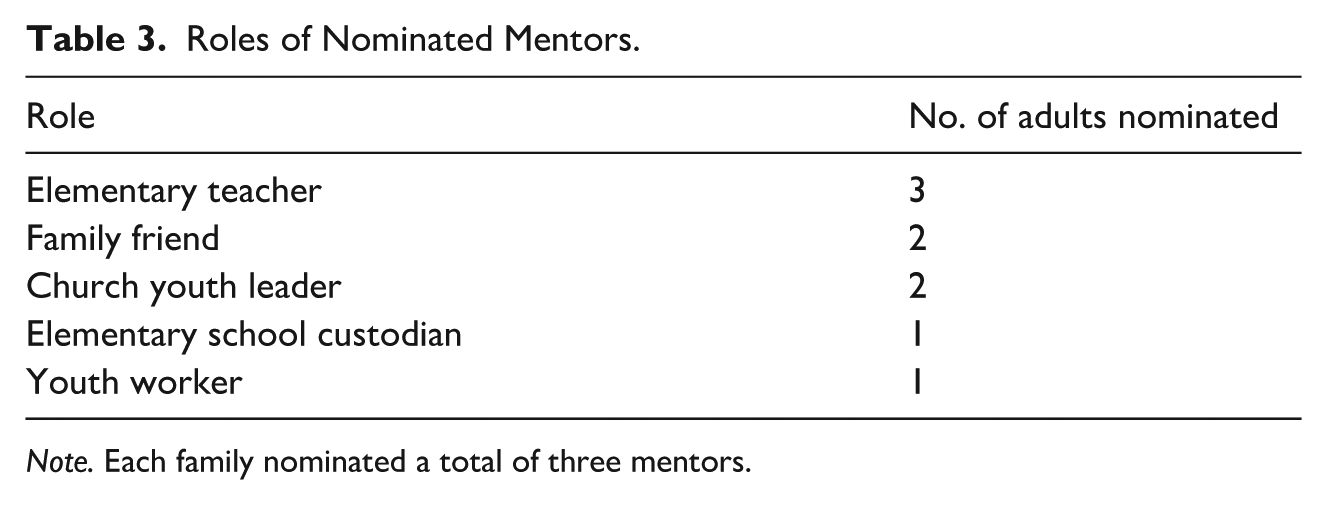
Note. Each family nominated a total of three mentors.
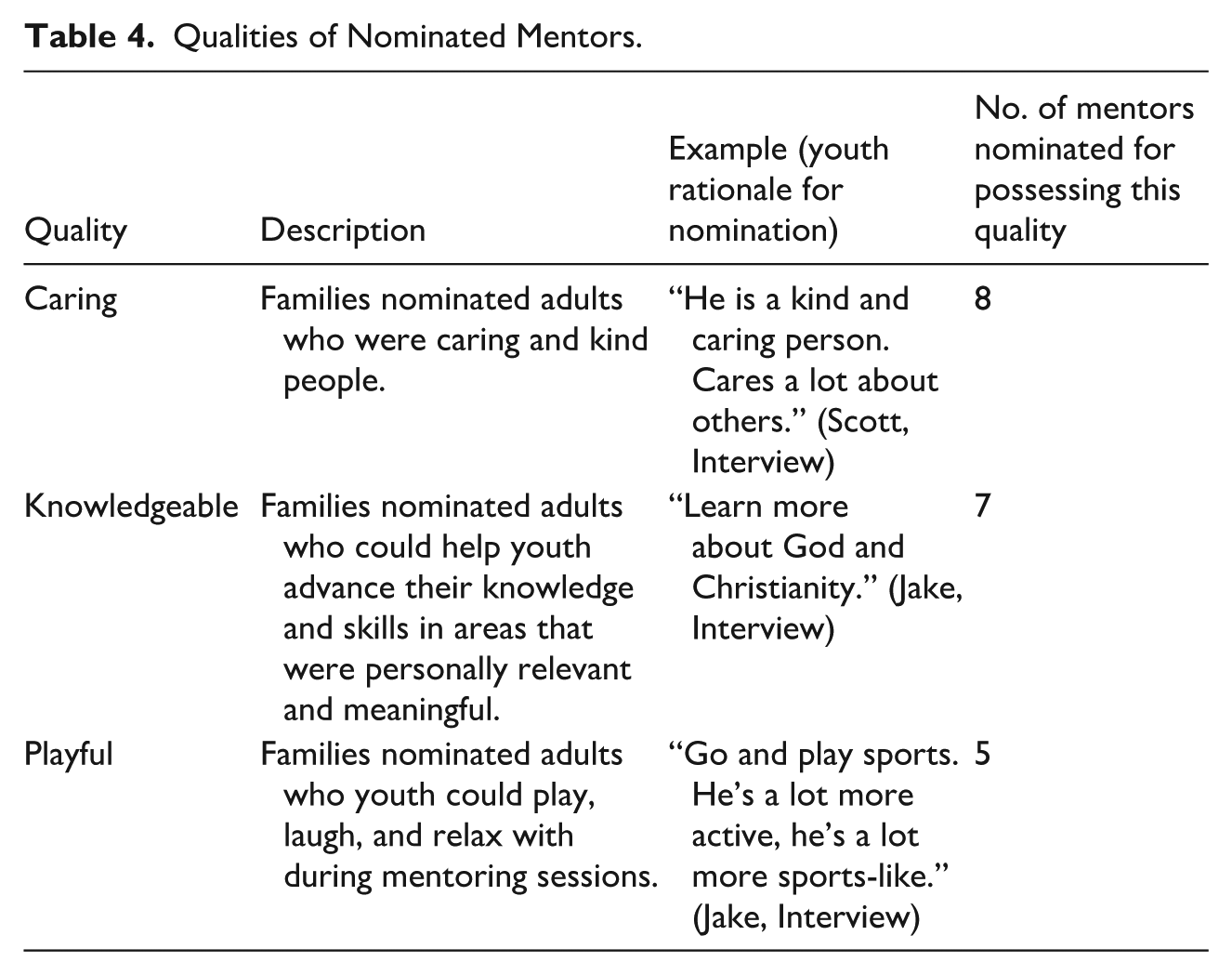
While explaining why they nominated these adults to become their mentors, all families reported that they nominated them because they were caring, knowledgeable, and playful (see Table 4).
Qualities of Nominated Mentors.
Theme #5: Unstructured and Unsupported Mentor-Invitations: “Everyone We’ve Asked Has Said No, and They Have So Many Excuses.”
In addition to discovering who families nominated and why, data analysis discovered a previously undiscussed issue related to the mentor-nomination and invitation process. For example, during the youth-initiated mentoring program, two families (Scott/Shannah and Laura/John) engaged in an unstructured mentor-nomination and invitation process by personally contacting their nominated adults and inviting them to become their mentors. In Scott and Shannah’s case, this unstructured process occurred before they attended the mentor-nomination meeting at the BBBS agency. Specifically, Shannah explained that she had already invited two adults via phone call to become Scott’s mentor and that neither adult could accept his invitation. When the lead author invited Shannah to explain how she approached these conversations, she said: “I just told them that it’s to take my son, do one-on-one, [and] spend time with him. Help him with his interests and just give him that extra male figure that he needed.” Explaining how these adults reacted to her invitation, Shannah said, “They took time to think about it, they both looked at their schedules. But with schedules and everything, unfortunately, it didn’t work out. They said they would if they could.” Expressing his frustration toward this outcome, Scott then said, “Everyone we’ve asked has said no, and they have so many excuses.” Shannah and Scott’s experience highlights the potential risks involved when caregivers engage in unstructured and unsupported mentor invitation procedures.
Laura and John attempted to contact their nominated adults after participating in the structured mentor-nomination meeting at the BBBS agency. Explaining this process, Laura said: The problem was we gave the information on our part. When you guys [referring to the BBBS agency] were trying to get a hold of them, you weren’t getting anywhere. So, I went in person to the school to talk to them about it [the family-nominated adults from John’s previous elementary school]. I tried my part by going over there, but the school was on lockdown, so they wouldn’t let me come in.
After visiting her son’s previous elementary school, Laura reported that she sent John to try to speak with his nominated mentors. Explaining this, Laura said, “John went over there and waited for them to get off [work]. He waited outside the school in the front parking lot area.” Laura did not report how long John waited in the parking lot, only that he could not speak to his nominated mentors as he did not see them leave the building. During his own interview, when I invited John to recall this experience and how it made him feel, he said, “I don’t remember.”
These results indicate that some caregivers may engage in unstructured and unsupported mentor-invitation procedures while participating in youth-initiated mentoring programs. Although caregivers were informed on two separate occasions that it was the BBBS agency’s responsibility to contact the nominated adults, to reduce the burden on families and minimize their risk, two out of three families disregarded or forgot about this policy. As supportive caregivers, Shannah and Laura likely engaged in this process to support their children, advocate on their behalf, and find them a supportive mentor. Despite these benevolent intentions, by engaging in this unstructured process, Scott and John were exposed to the elevated risk of personally experiencing rejection by their nominated adults in a manner that may not have been strengths-based and constructive. This theme highlights the need for future youth-initiated mentoring programs to develop clear and specific protocols for helping families debrief and constructively navigate their experiences and emotions if they decide to pursue unstructured nominations.
Outcomes for Youth and Caregivers After Not Securing Mentors
Theme #6: Risk Mitigation Strategies Helped Prepare Families: “It Prepared Us to Know This Isn’t a for Sure Thing.”
As previously discussed, the mentor-nomination protocol developed for this study attempted to mitigate risk by helping families set realistic expectations, providing plausible reasons for mentor unavailability, de-personalizing the potential for mentor unavailability, and reassuring families that they would be supported if they were unable to secure a mentor.
Participants were invited to describe their general reactions to these risk-mitigation strategies and whether they helped them prepare for the possibility of not securing a mentor. In response to this question, Jake said, “Yeah, it did prepare me. It was ok. I kinda accepted it.” Jake’s reflection indicated that the risk-mitigation strategies helped him understand and accept the possibility that he may not be able to secure a mentor. Explaining her overall reaction to the strategies, Erica said: “It was ok. I knew that was a possibility for sure.” Jake and Erica’s reflections suggested that the risk-mitigation strategies helped them understand and accept the risks associated with youth-initiated mentoring, which helped them set realistic expectations.
When Scott was asked whether the risk-mitigation strategies helped him prepare for the possibility of not securing a mentor, he said, “Yeah, sort of. It kinda helped. Cause they have their jobs to do, they have their families to look after. As far as I know, I was perfectly fine with that.” For Scott, the risk-mitigation strategies seem to have been useful as they allowed him to understand some of the plausible reasons his nominated mentors may not be able to serve as his mentor. Scott’s suggestion that the risk-mitigation strategies “sort of” helped him also indicates that future youth-initiated mentoring programs may need to advance or adapt the strategies used in this study to improve their overall effectiveness for certain youth.
Explaining her overall reaction to the strategies and whether she found them helpful, Shannah said, “Yep. It prepared us to know this isn’t a for sure thing. I understood. Cause, you know, you can’t always expect people to do it.” Scott and Shannah’s responses indicated that the risk-mitigation strategies helped them understand some of the plausible reasons for mentor unavailability and set realistic expectations.
When John was asked whether the risk-mitigation strategies helped him prepare for the possibility of not securing a mentor, he said, “Probably. I’m not sure.” John’s response suggested that the risk-mitigation strategies may have prepared him for the possibility of not securing a mentor, further indicating that future programs may need to evolve the strategies used in this study. Explaining whether she found the risk-mitigation strategies to be useful, Laura said: “Yeah. It had a fifty-fifty chance. We knew that. We went in knowing the consequences.” Taken together, although John was unsure whether the risk-mitigation strategies benefited him, Laura reported that the strategies helped her and John set realistic expectations for the youth-initiated mentoring program.
These results highlight the benefits and importance of employing multiple risk-mitigation strategies while preparing families to participate in youth-initiated mentoring programs. The participants in this study reported that these strategies helped them: (a) gain a more informed understanding of the potential risks associated with youth-initiated mentoring, (b) recognize some of the plausible reasons for mentor unavailability, and (c) set realistic expectations for whether their nominated mentors would be able to accept their invitations to become their mentor.
Theme #7: Mentor Unavailability Led to Disappointment and Frustration: “When Am I Gonna Get a Big Brother?”
Results discovered that all participants experienced a general sense of disappointment and frustration after not securing mentors through the youth-initiated mentoring program. Participants’ disappointment was driven by their unfulfilled desire to be matched with a supportive mentor. Participants’ frustration was driven by their long-term placement on the BBBS agency’s waitlist.
Family #1: Jake and Erica
The BBBS agency contacted caregivers via phone call to inform them that they were unable to secure mentors through the youth-initiated mentoring program. Describing her reaction to this conversation, Erica said, “It was ok. A little disappointing because it would have been nice for him to find somebody. He could really use one. But I knew people were busy.” Explaining how he personally reacted to this outcome, Jake said, “I was fine. It’s not personal or anything. It was ok. It’s just like ‘ok,’ then I moved on. A little disappointed but not overly. It was ok.” Erica and Jake’s comments indicated that they were disappointed after not securing a mentor, but navigated the experience effectively by recognizing that their nominated adults were busy, and their decisions were not personal.
After not securing a mentor, Jake and Erica decided to be placed back on the agency’s waitlist rather than identify and nominate additional mentors. Explaining this decision, Erica said, “Those were our only options. It was hard enough to come up with those three. If there was anybody that I could think of, then I would. But we just couldn’t really think of anybody.” Similarly, when Jake was asked if he wanted to nominate additional mentors, he said, “Not really, no. If it’s probably gonna happen with the same outcomes, what’s really the point, you know?”
To conclude their interviews, Jake and Erica were asked if they regretted participating in the youth-initiated mentoring program. In response to this question, Jake said, “No, I don’t have any regrets.” Erica said: No, I don’t think so. Just the fact that we still don’t have one [referring to a mentor]. He still doesn’t have one. I know that’s tough on him. It sucks. He gets so excited to come here [referring to the BBBS agency], and when the phone rings, because he thinks that they found him one, so it’s tough to say, “No, it’s not for you.” It’s tough, right? It’s hard on him. We’re constantly hearing, “When am I gonna get a big brother? When am I gonna get a big brother?” So, it’s tough.
Erica’s final comments highlighted Jake’s sense of discouragement and disappointment due to his long-term placement on the agency’s waitlist. At the time of the family’s interview, Jake had been on the agency’s waitlist for 20 months. Speaking on the disappointment he felt about his experience on the waitlist, Jake said: “It’s just kind of like a little annoying being so long. Disappointing, yeah. I would say disappointing.” In conclusion, neither Jake nor Erica regretted participating in the youth-initiated mentoring program but felt disappointed and frustrated with their long-term placement on the waitlist – feelings which may have been exacerbated by their participation in the youth-initiated mentoring program.
Family #2: Scott and Shannah
After being informed by the BBBS agency that they were unable to secure a mentor for Scott, Shannah said, “I was kind of bummed. I was disappointed. I was not surprised, like I figured they might be busy with their life and stuff. Kind of expected.” Shannah’s comments indicated that although she was not surprised that Scott could not secure a mentor, she was disappointed by this outcome. Explaining how he reacted after not securing a mentor, Scott said: I didn’t care. I didn’t really care. I was expecting them not to be able to because they have their own life. They have their jobs to do; they have their families to look after. They have a lot of things to do. It made sense that they weren’t able to. They were just random people that came out of my head. I was fine, I was ok, I was good. It was expected.
According to Scott, he responded apathetically after not securing his own mentor due to his expectation of this outcome. Although Shannah agreed with Scott’s description of his response, she suggested that he may have been disguising deeper emotions, such as a general sense of disappointment. For example, while describing Scott’s reaction after not securing a mentor, from her perspective, Shannah said: He was ok. Understanding really. He brushes off news. Depending on the news, he’s just like, ok, I’ll go to my next thing. I think it’s a mask. He hasn’t shown; he doesn’t show emotions too much right now. He was disappointed, like he was hoping, right?
Shannah and Scott’s results revealed that the family experienced a general sense of disappointment after not securing a mentor through the youth-initiated mentoring program. Based on Shannah’s comments, Scott may have also experienced additional and unacknowledged emotions that he disguised by his apathy as a coping mechanism.
Shannah and Scott decided to be placed on the waitlist for a mentor rather than nominate additional mentors. Explaining this decision, Shannah said, “I was trying to think of some, but I couldn’t think of anybody else because we don’t have a big social circle anymore.” Similarly, when I asked Scott if he wanted to nominate more mentors, he said, “No. Because I know people are busy.”
Explaining whether he regretted participating in the youth-initiated mentoring program, Scott said, “No. I’m fine. It was fun. I just don’t want to go back on the waiting list. This is the second time that I’ve been on a waitlist.” Scott’s final comments highlighted his sense of frustration with his long-term placement on the agency’s waitlist. Shannah also reported a general sense of frustration with Scott’s long-term placement on the waitlist. For example, when asked if she regretted participating in the youth-initiated mentoring program, Shannah said, “No. I just wish we had more friends and family to help. I’m still fighting to get him one. He’s been on the waitlist forever. It’s so frustrating.”
Family #3: John and Laura
After speaking with the agency and learning that John was unable to secure his own mentor through the youth-initiated mentoring program, Laura said: I was kind of disappointed that nobody stepped up. I guess it just didn’t pan out. When an idea is a great idea [referring to youth-initiated mentoring], you’re hoping to have a great outcome. When it doesn’t pull through, it’s disappointing. I wish it would have went more positive.
Laura’s comments indicated that she experienced a general sense of disappointment after not securing a mentor for John. Explaining how John reacted after not securing a mentor, from her perspective, Laura said: He got disappointed. It was a letdown, but not overly, because he was waiting so long for a big brother. He’s very laxed, like real laid back. He just wanted somebody to hang out with. Somebody to go to the movies with, ya know? That’s all.
John agreed with Laura’s assessment of how he felt after he was unable to secure a mentor. For example, during his interview, John said that he felt “not sad, but not happy” after not securing a mentor. When John was asked whether his response indicated that he was disappointed after not securing a mentor, he said, “Yeah.”
John and Laura decided to be placed back on the agency’s waitlist rather than nominate additional mentors. Explaining this decision, Laura said: As soon as we found out that the youth-initiated program was not going to work out, we immediately put him on the list. But like I said, it takes a while to get a big brother because there’s not too many people that wanna volunteer. I was kind of frustrated. We put him back on the list, but I don’t think he’s going to get a big brother before he turns eighteen. He’s already accepted the fact that he will probably age out before a big brother becomes available. He’s given up on it.
Laura’s comments highlighted the family’s frustration with their long-term placement on the waitlist. Explaining whether he regretted participating in the youth-initiated mentoring program, John said, “No.” In response to the same question, Laura said: No, I don’t. It was a good program to be a part of. We gave some names and some numbers, and I guess it just didn’t pan out. I wish it would have went more positive. But that’s ok, it doesn’t mean that it’s a failure.
Discussion
This study was among the first to explore the experiences of youth and caregivers who were unable to secure their own mentors while participating in a youth-initiated mentoring program. Data analyses identified seven themes that deepened our understanding of youth-initiated mentoring and surfaced critical implications for future research and practice in this field (see Dantzer, 2024, for additional implications and recommendations that emerged from the larger study).
Family Motivations for Participating in Youth-Initiated Mentoring
The results of this study uncovered two underlying factors that motivated families to participate in the youth-initiated mentoring program. First, it was discovered that all youth were interested in the youth-initiated mentoring program due to their general preference for natural mentoring. Specifically, all youth reported an interest in youth-initiated mentoring because it afforded them the opportunity to nominate their own mentors and be matched with an adult from their existing social network rather than a volunteer mentor. These results supported previous research indicating that youth often decide to participate in youth-initiated mentoring programs to nominate their own mentors and reconnect with influential adults in their lives (Spencer et al., 2018, 2019; Van Dam et al., 2019).
The second factor that motivated families to participate in the youth-initiated mentoring program was their interest and desire to expedite their mentor-matching process. In other words, the families in this study viewed youth-initiated mentoring as an appealing mentoring model, as it created the opportunity to actively recruit and match themselves with a mentor rather than wait to be matched with a volunteer mentor. This motivation was predictable, given that the youth-initiated mentoring program targeted families on the waitlist. Despite youth-initiated mentoring’s potential for expediting the matching process, it is important to note that youth-initiated mentoring introduces additional responsibilities and tasks during the mentor recruitment process, which can sometimes prolong the matching process rather than expedite it. For example, due to challenges locating the contact information of nominated adults and managing communication efforts with them, previous research has discovered “large gaps in time” between youth enrollment in youth-initiated mentoring programs and when staff were able to successfully match them with their nominated mentors (Spencer et al., 2021, p. 2788). Furthermore, as shown in this study, youth-initiated mentoring programs do not guarantee that youth will be matched with their nominated mentors. It is important to help families and mentoring organizations understand these risks. Given that the majority of mentoring organizations struggle with mentor recruitment, youth-initiated mentoring’s unique feature of inviting youth to recruit their own mentors is understandably appealing. Considering this appeal, it is essential to help future families and practitioners temper their excitement for youth-initiated mentoring by engaging in a realistic assessment of youth-initiated mentoring’s capacity to expedite the matching process.
Finally, results discovered that two families were initially hesitant to participate in the youth-initiated mentoring program. These families’ hesitation stemmed from a belief that they did not have any natural mentors to nominate. Although both families decided to continue in the youth-initiated mentoring program, one parent expressed their doubt about the likelihood of the program’s success. This parent’s doubt was driven by their family’s involvement with the BBBS agency. In other words, the family approached the BBBS agency to be matched with a volunteer mentor because they lacked access to natural mentors in their existing social network. These results mirror the findings of Scafe (2022), who collaborated with a BBBS agency to pilot-test a Caregiver-Initiated Mentoring (CG-IM) program. Scafe (2022) discovered that some caregivers experienced hesitations about being responsible for identifying and nominating their own mentors. In part, caregivers’ hesitations stemmed from the belief that they did not have the required social connections and relationships to successfully recruit their own mentors. While explaining these beliefs, caregivers reported that their financial situations limited their children’s participation in extracurricular activities, significantly reducing the number of natural mentors in their lives.
Considering the potentially inequitable access to natural mentors among families involved with BBBS and other agencies, this study surfaces the critical need to assess the suitability and appropriateness of using youth-initiated mentoring as a strategy with particular families. There may be a need to consider who is best suited for youth-initiated mentoring and most likely to be successful in this approach.
Roles and Qualities of Nominated Adults
During the mentor-nomination process, all families nominated youth professionals and/or family friends to become their mentors. Families’ nominations were consistent with previous research, which has also discovered that youth and caregivers often nominate youth professionals or adults closely connected to their families while participating in youth-initiated mentoring programs (Schwartz et al., 2013; Spencer et al., 2016, 2018, 2019; Van Dam et al., 2017). Existing research on the qualities of effective mentors also indicated that the families in this study nominated suitable adults to become their mentors. For example, data from two meta-analyses have consistently documented that adults from “helping professions” (e.g., teachers, youth workers, etc.) are often more effective as mentors given their formal training and experiences supporting youth (DuBois et al., 2002; Raposa et al., 2019).
While explaining why they nominated certain adults, all families reported that they nominated them because they were caring, knowledgeable, and playful. Two of these qualities (e.g., knowledgeable and playful) have been previously documented as reasons families select and nominate mentors while participating in youth-initiated mentoring programs—reinforcing them as desired qualities for youth-initiated mentors (Koper et al., 2023; Spencer et al., 2019). To our knowledge, however, mentors who are caring have not been discussed. Although it’s not overly surprising, this theme introduces a new quality that families might consider when nominating mentors during youth-initiated mentoring programs. Furthermore, although the families in this study were unable to secure their own mentors, research has consistently documented that mentors who are caring (Ahrens et al., 2011; De Wit et al., 2020), knowledgeable (Ahrens et al., 2011), and playful (Karcher & Nakkula, 2010) are effective in their roles as mentors. As such, the families in this study nominated adults who possessed some of the common traits of effective mentors, reinforcing their selections and capabilities to competently engage in the mentor-nomination process.
Unstructured and Unsupported Mentor Invitations
While participating in the youth-initiated mentoring program, two families personally contacted their nominated adults and invited them to serve as their mentors. It is likely that caregivers engaged in this process to advocate for their children and attempt to aid in, or further expedite, the mentor-nomination and recruiting process. Despite their good intentions, these unstructured conversations may have exposed youth to the elevated risk of personally experiencing the rejection of their nominations. These conversations also presented risks and challenges for nominated mentors (i.e., potentially feeling pressured or coerced into accepting the youth’s nomination). These results highlight the need for future youth-initiated mentoring programs and practitioners to inform families about the risks of these unstructured conversations and repeatedly reinforce the importance of having mentoring staff contact nominated adults. In addition, these results suggest that future programs may need to develop clear, developmentally appropriate, and culturally responsive protocols for helping families navigate the potential negative emotions associated with personally experiencing the rejection of their nominations.
Risk-Mitigation Strategies
Results indicated that the risk-mitigation strategies employed in this study helped youth and caregivers prepare for and navigate the experience of not being able to secure their own mentors. As such, the current study provides a model by which future practitioners can continue mitigating risk for youth involved in youth-initiated mentoring programs. As previously mentioned, future programs are encouraged to adapt and evolve the strategies used in this study to potentially improve their effectiveness for preparing and supporting families.
Outcomes for Youth and Caregivers
This study is among the first to document the experiences of youth and caregivers who were unable to secure their own mentors while participating in a youth-initiated mentoring program. Results discovered that participants experienced a general sense of disappointment after not securing their own mentors. Participants’ disappointment was driven by their unfulfilled desire to be matched with a supportive mentor. In addition to experiencing a sense of disappointment, results indicated that participants experienced feelings of frustration after not securing their own mentors. Participants’ frustration was driven by their long-term placement on the waitlist for a mentor. These results make a significant contribution to our understanding of the emotions that youth and caregivers experience after not securing their own mentors in youth-initiated mentoring programs.
These results also reinforce the question of whether future youth-initiated mentoring programs should be offered to youth currently placed on mentor waitlists. Although disappointment and frustration may not be considered as overly harmful emotions for youth to experience, these emotions gain a sense of significance when considering the individual and contextual vulnerabilities of the youth in this study. For example, research has documented that youth involved in formal mentoring programs are often more vulnerable than the general population and have often experienced unreliable, unstable, and sometimes harmful relationships with adults, which may make them more sensitive to relational rejection (DuBois et al., 2002, 2011; Jarjoura et al., 2018; Keller, 2007; Poon et al., 2022; Spencer, 2006). In addition, the youth in this study had also been placed on the waitlist for a mentor. Although research has not documented the impact of being placed on a mentoring waitlist, it is reasonable to assume that this experience could further contribute to youths’ risk, vulnerability, and sensitivity to rejection. For example, research has discovered that unreliable experiences with adults (i.e., such as waiting on a waitlist for an extended period) can lead youth to develop expectations that adults are untrustworthy and incapable of providing them with care and support (Kanchewa et al., 2018). From this vantage point, the significance of youths’ emotions in this study becomes more pronounced. Put simply, by inviting youth to engage in youth-initiated mentoring, mentoring organizations may be inadvertently exposing them to yet another negative relational experience and the possibility of being rejected by an adult that they personally nominated to support them during a time of need. Considering this risk, future researchers and practitioners are strongly encouraged to consider whether the benefits of inviting youth on waitlists to participate in youth-initiated mentoring programs outweigh the potential risks.
Limitations and Considerations
This study had several limitations. As is characteristic of case-study designs, the sample size for this study was small. The lead author selected a case study design as it allowed for the collection of data from multiple sources and participants, who could provide detailed descriptions of their experiences of critical youth-initiated mentoring processes – a focus recommended in the literature. In the future, scaled-up versions of the study should allow for a more generalizable understanding of participants’ experiences. Replication studies could also contribute to achieving this generalizability goal. This study also included a largely homogenous sample of participants. This homogeneity may limit the applicability and relevancy of the results to other youth-initiated mentoring programs involving participants from other cultural, racial, and/or ethnic backgrounds. Similarly, all youth in this study identified as male, potentially limiting the applicability of results to youth with other gender identities. Future research should study youth-initiated mentoring with diverse populations. Finally, it is possible that participants featured in this article were impacted by recall bias during their interviews. On average, participants were interviewed 7.33 months after they were informed that they were unable to secure their own mentors – potentially limiting the accuracy or completeness of participants’ recollections and/or reducing participants’ emotionality during their interviews. This occurred because the original study did not include interviewing the unsuccessful families. However, when we observed that three youth, each nominating three possible mentors, were unsuccessful in securing any, it seemed potentially beneficial to do so. The amendment to the study required additional ethical approval, and this took time. However, what was revealed in this addendum contributes significantly to considerations of who can benefit from the youth-initiated mentoring approach and what conditions and supports should be in place to mitigate potential harms to already vulnerable youth.
Directions for Future Research
This study also points to several directions for future research. First, researchers should continue investigating and documenting the risks, as well as benefits, associated with youth-initiated mentoring programs. Developing more balanced and nuanced understandings of the mentoring model can advance future practice. Although this study makes a significant contribution in this regard, additional research with larger and more diverse sample sizes is needed.
Interviewing nominated adults who decline to accept youths’ nominations could also advance our understanding of who might not be suitable for nomination, but also what individuals need to know/understand to make an informed decision about whether they are right for the role. The goal should be to protect youth and caregivers from the potentially negative emotions and experiences of not securing their own mentors. The lead author attempted to interview the adults who declined youths’ nominations, but none of them agreed to be interviewed, highlighting the potential challenges involved with this line of research. Since it may be uncomfortable for adults to explain their rationales for not accepting a youth’s nomination via interview, researchers might need to consider more indirect and less personal or anonymized methods (i.e., perhaps they could provide written descriptions of their rationales or answer a brief survey).
Finally, future researchers should pilot-test innovative mentor invitation strategies. For example, the results of this study contradict research on volunteerism, which has shown that people are more likely to volunteer when they are asked directly rather than through less personal recruitment campaigns (Musick & Wilson, 2008). Of relevance to mentoring, adults in Canada (with no previous experience serving as a mentor) have also reported that they could be persuaded to become mentors if they were asked directly by a young person (Church-Duplessis & Hackett, 2021). Furthermore, previous research on youth-initiated mentoring has documented that being nominated directly by a young person influenced some adults to accept their nominations (Spencer et al., 2019; Van Dam et al., 2019). The results of this study indicate that, at least for some adults, being asked directly to serve as a mentor may not always serve as an effective mentor recruitment strategy. As such, future research on youth-initiated mentoring may need to pilot-test mentor recruitment strategies that go beyond relying upon the potential persuasiveness of a direct ask. Existing research on the functional approach to volunteerism may serve as a productive starting point for this line of research (Clary et al., 1994, 1998; Stukas et al., 2013). Over several decades of scholarship, this body of research has identified six core motivations that drive adults to volunteer in their communities. Based on this research, future scholarship could test the effectiveness of recruitment messages that specifically identify how adults can fulfill their internal motivations for volunteerism by accepting youth’s nominations. By combining the persuasiveness of a “personal ask” with recruitment messages that appeal to adults’ core values and motivations for volunteerism, future research may discover a fruitful strategy for increasing the number of adults who accept youth’s nominations in youth-initiated mentoring programs.
Implications and Recommendations for Future Practice
The results of this study prompt five recommendations for future practice.
Recommendation #1: Consider Youth Vulnerability and Context
This study has shown that youth-initiated mentoring programs may harm youth if they experience increased feelings of disappointment and frustration, and may serve as another reminder that adults are not trustworthy and reliable sources of support and mentorship. Given that youth on mentoring waitlists may have already developed deficit-based narratives about themselves and/or the availability and supportiveness of adults, practitioners are strongly encouraged to perform risk assessments to determine who would be good candidates to participate in youth-initiated mentoring programs.
Recommendation #2: Conduct Nuanced Consent/Assent Conversations With Families
This study discovered that two families were hesitant to participate in the youth-initiated mentoring program – believing that their existing social network was not strong enough and did not contain natural mentors. Despite this hesitation, both families decided to participate in the program, in part because they saw it as an opportunity to expedite their mentor-matching process. Since these families were ultimately unable to secure their own mentors, their experiences raise important considerations for future practice. First and foremost, future practitioners need to be aware that some families may decide to participate in youth-initiated mentoring programs despite believing that they are unlikely to successfully engage in the program and secure their own mentors. Equipped with this knowledge, practitioners should work with families and realistically assess the program’s goodness of fit. As this study has shown, youth-initiated mentoring programs can elevate the risks for youth and their caregivers by inviting them to engage in the vulnerable act of nominating their own mentors, so a key consideration is whether and how to create a successful experience.
Recommendation #3: Continue Mitigating Risk and Help Families Anticipate and Prepare for Feelings of Disappointment and Frustration
As previously discussed, mitigating risks associated with youth-initiated mentoring programs is essential. This study provides an initial model that future programs can use, adapt, and advance for accomplishing this recommendation. This study also discovered that youth and their caregivers experienced disappointment and frustration after they were unable to secure their own mentors. These results could be used by future youth-initiated mentoring programs to better prepare youth and their caregivers during the mentor-nomination process. For example, future practitioners could help families anticipate these emotional reactions and learn how to constructively manage them using evidence-based strategies. In addition, practitioners could also provide families with referrals and links to free services in the local community that could help them cope with and navigate their potential feelings of disappointment and frustration. Practitioners may also consider partnering with local organizations capable of providing free counseling and mental health services to families who are unable to secure their own mentors.
Recommendation #4: Protect Youth and Mentors From Unstructured Mentor-Invitation Experiences
Two families engaged in unstructured and unsupported mentor-nomination procedures during this study. As a result of this, youth were exposed to the elevated risk of directly experiencing the rejection of their nominations in a manner that may not have been constructive and strengths-based. Caregivers may perceive it to be more efficient to contact nominated adults on their own or feel compelled to explain their need for mentorship during their organic interactions with nominated adults, so practitioners should educate families about the possible risks of these unstructured conversations and continually reiterate the importance of organization-led mentor-invitation procedures. This recommendation can also help protect nominated mentors from potentially feeling pressured or even coerced to accept youths’ nominations despite not having the capacity or interest in doing so. As mentioned previously, practitioners are also encouraged to develop protocols for helping families navigate their unstructured nomination experiences, if they decide to pursue them despite program policies. This could involve helping families constructively process their emotions, explore why mentors may have been unavailable, and highlight youths’ strengths. Future research is required to determine effective approaches to these protocols across various contexts and developmental stages.
Recommendation #5: Consider Adapting Program Structure and Mentor Expectations
In BBBS community-based mentoring programs, mentors are expected to meet with their mentees once a week, for 2 to 4 hours, for at least 12 months. Although youth-initiated mentoring programs have been successfully implemented within similar parameters (Spencer et al., 2016, 2021), future youth-initiated mentoring programs may need to adapt this structure, given that many potential mentors may view this level of commitment as a barrier to participation. This may be especially true in the case of youth-initiated mentoring programs, where the mentors themselves do not approach the mentoring organization of their own volition.
Conclusion
As an emerging mentoring model, youth-initiated mentoring has gained significant traction, interest, and support among mentoring practitioners and scholars (current authors included). Despite the excitement and growing evidence base for youth-initiated mentoring, there has been comparatively little focus on the potential risks associated with the mentoring model. This study addressed this critical need by examining the experiences of three youth and their caregivers who were unable to secure their own mentors while participating in a youth-initiated mentoring program. This study helps ground the growing enthusiasm for youth-initiated mentoring by offering a more nuanced appraisal of the mentoring model and its associated benefits and barriers. It is our hope that this study will help future researchers and practitioners carefully consider risks, as well as benefits, associated with the mentoring model in their implementation of youth-initiated mentoring programs. This study offers practical recommendations that can help protect youth and increase the likelihood of programmatic success.
Footnotes
Acknowledgements
The authors acknowledge the contributions of each participant in helping to advance knowledge of Youth-Initiated Mentoring. The lead author also expresses their sincere gratitude to the Big Brothers Big Sisters agency who hosted and supported this research.

Ethical Considerations
The study was approved by the Behavioural Research and Ethics Board at the University of British Columbia (Reference Number: H20-03228) on November 21st, 2021.
Consent to Participate
All participants provided written informed consent prior to participating. All youth provided written informed assent. Participants were provided with two opportunities throughout the study to provide their ongoing verbal consent and assent.
Author Contributions
BD and NP conceived the study. BD collected and analyzed the data. BD wrote the first draft of the manuscript. NP reviewed the manuscript several times VCD reviewed the manuscript once. NP and VCD approved the final version of the manuscript.
Funding
The authors disclosed receipt of the following financial support for the research, authorship, and/or publication of this article: This research was supported by the Social Sciences and Humanities Research Council of Canada [6567].
Declaration of Conflicting Interests
The authors declared the following potential conflicts of interest with respect to the research, authorship, and/or publication of this article: Reasons for Not Accepting Youths’ Nominations
Data Availability Statement
The datasets generated during and/or analyzed during the current study are available from the corresponding author on reasonable request.*