




Abstract
A preponderance of research suggests that adolescents’ participation in structured after-school activities is linked to academic benefits, yet less is known about the educational effects of different types of after-school engagement. This mixed methods, two-wave longitudinal study examined associations between school-, community-, and home-based after-school activities and academic outcomes among Latino adolescents. The quantitative sample included 416 Latino adolescents at Wave 1 (Mage = 15.5) and 335 who participated at Wave 2 one year later (Mage = 16.6), serving as the analytic sample. A subsample of 45 adolescents participated in semi-structured interviews. Overall participation in structured activities was low, with unstructured home-based activities reported most often. Longitudinal path models indicated that greater breadth of structured community-based activity participation was associated with higher educational expectations one year later. Greater breadth and intensity of unstructured community-based activities were associated with lower subsequent GPA. Home-based activities showed no main effects but exhibited gender-differentiated associations with school effort and belonging. Qualitative findings contextualized these patterns, highlighting perceived academic benefits of tutoring, sports, and mentoring, alongside time constraints and family responsibilities that shaped adolescents’ engagement. Together, findings underscore the importance of activity structure and context in understanding how after-school experiences are linked to academic outcomes.
Introduction
For the past several decades, researchers have documented the myriad benefits of adolescents’ participation in extracurricular activities. Adolescents’ participation in structured, organized activities is linked to numerous positive outcomes, including greater self-esteem (Bohnert & Garber, 2007; Fredricks & Eccles, 2006), reduced engagement in risky behaviors (Farb & Matjasko, 2012; Meier et al., 2018), and improved academic performance (Camacho & Fuligni, 2015; Mahoney et al., 2006; Neely & Vaquera, 2017). However, prior research among Latino adolescents, particularly those from low-income urban communities, shows they often face significant structural barriers, such as cost, limited transportation, and scarcity of local programs, that constrain their access to structured activities compared to affluent or suburban peers (Fauth et al., 2007; Pedersen & Seidman, 2005). Rather than framing Latino adolescents’ after-school participation in comparison to white, middle-class norms, the present study centers Latino youth as the population of interest and examines how structural conditions and cultural assets shape their educational experiences. In addition to structural conditions, Latino adolescents’ after-school experiences are shaped by culturally grounded values that organize family roles, expectations, and daily routines. One such value, familismo, emphasizes family cohesion, obligation, and interdependence, and has been shown to influence how youth allocate time, interpret responsibilities, and engage with educational goals (Cahill et al., 2021; Stein et al., 2015). Guided by Bronfenbrenner’s (1988) ecological systems framework, these cultural values can be understood as macrosystemic processes that shape adolescents’ daily routines, expectations, and opportunities for engagement across home, school, and community contexts (Vélez-Agosto et al., 2017).
Relatedly, gendered expectations within family systems may differentially shape adolescents’ participation in after-school contexts, particularly with respect to caregiving and household responsibilities. From an ecological perspective, these macrosystemic cultural processes are not peripheral but central to understanding how Latino adolescents navigate opportunities, constraints, and meanings attached to after-school activities. An ecological and strengths-based perspective suggests that despite these structural constraints, Latino youth often adapt by engaging in alternative forms of participation that are less frequently captured in traditional models, such as home-based responsibilities and informal community networks. A strengths-based perspective emphasizes adolescents’ agency, resourcefulness, and capacity to adapt within constrained environments, highlighting how youth actively draw on relational, cultural, and contextual assets to support their development (Zimmerman, 2013). Scholars have increasingly called for research that centers Latino adolescents’ after-school experiences within their structural and cultural contexts (Camacho & Fuligni, 2015; Camacho-Thompson & Vargas, 2018). The present study responds to this call by examining which types of school-, community-, and home-based activities are linked to academic outcomes for urban Latino youth from low-income households.
After-School Activities
To date, no established consensus exists about the best measurement of youth’s after-school activity involvement. Bohnert and colleagues’ (2010) framework highlights four dimensions of activity involvement: (a) breadth (number of different activities), (b) intensity (time spent per week), (c) duration (years of participation), and (d) engagement (cognitive, emotional, and behavioral). Breadth and intensity have both been associated with improved academic adjustment. For instance, adolescents who participate in a broader range of activities tend to report stronger academic commitment and educational aspirations (Haghighat & Knifsend, 2019; Modecki et al., 2018). A greater intensity of involvement may indicate deeper skills development and stronger connections to academic supports, while also limiting time for less structured or risky activities (Bohnert et al., 2009). While many studies have assessed breadth and intensity separately, few studies have assessed breadth and intensity of participation simultaneously. Denault and Poulin (2009) provide an exception as they annually surveyed 299 socioeconomically diverse, Canadian youth from grades 7 to 11 and found that both the intensity and breadth of their activity participation declined over time. However, youth with initially high levels of both participation breadth and intensity demonstrated greater academic commitment in later adolescence. The present study examines both dimensions of activity participation using a comprehensive assessment of after-school participation across school, community, and home contexts.
School-Based Activities
Participation in school-based after-school activities has been associated with better academic performance, including higher grades, increased school attendance, and reduced dropout rates (Camacho & Fuligni, 2015; Eccles & Barber, 1999; Farb & Matjasko, 2012; Fredricks & Eccles, 2006). These findings hold across nationally representative samples and appear robust over time (Haghighat & Knifsend, 2019). Not surprisingly, these associations may differ for adolescents whose access to school-based programs is shaped by structural inequities, including funding disparities and limited extracurricular offerings. For instance, Fredricks and Eccles (2006) found that school club participation was associated with positive outcomes for African American adolescents, though not for white peers. Further, different types of school-based activities may yield different effects (Eccles et al., 2003). Sports, for instance, are often associated with academic motivation and school connectedness (Eccles & Barber, 1999) but may also correlate with increased engagement in risk behaviors (Fauth et al., 2007). In contrast, participation in school-based arts activities or governance clubs tends to be more consistently associated with positive academic behaviors and attitudes (Farb & Matjasko, 2012; Fauth et al., 2007). These findings highlight the importance of disaggregating activity types to better understand their differential associations.
Community-Based Activities
Another strength of the present study is its inclusion of adolescents’ participation in two forms of community-based activities: structured and unstructured. Structured community-based programs—such as organized sports, religious groups, or volunteering—offer adult supervision and are often tied to institutional support systems. Participation in structured, community-based activities is associated with stronger achievement-related values and higher academic aspirations, particularly among Latino adolescents and other racially marginalized youth in under-resourced communities (Eccles & Barber, 1999; Fredricks & Simpkins, 2012). By contrast, unstructured community-based activities (e.g., informal sports, hanging out) are often unsupervised and linked to weaker academic engagement. For instance, higher participation in unstructured activities has been associated with reduced parent-child communication, parental monitoring, and trust (Bohnert et al., 2009; Mahoney & Stattin, 2000). However, some findings suggest that the impact of these activities depends on neighborhood context. In high-risk areas, unstructured community-based activities were linked to weaker academic outcomes, whereas in less violent neighborhoods, the negative effects may be less pronounced (Mora et al., 2023).
Home-Based Activities
Prior studies indicate that anywhere from 25% to 40% of youth do not participate in any structured activities (Fauth et al., 2007); these youth may spend their after-school hours in their homes or participating in unstructured activities in their communities. Home-based activities range widely—from completing homework and providing care to family members to using social media. Home-based activities have received relatively little empirical attention in the academic literature, yet they may play a meaningful role in academic outcomes, particularly for youth in communities where extracurricular offerings are limited. For many Latino adolescents, home-based after-school activities represent culturally grounded forms of engagement shaped by family obligation, care, and mutual support rather than disengagement from academic priorities. From a positive youth development perspective, these home environments are not merely places of confinement but potentially rich contexts for development, where youth navigate distinct cultural expectations, such as familismo, which shapes how family responsibilities are understood as meaningful forms of engagement rather than obstacles to academic success. Moreover, it is essential to include home-based activities in analyses of how adolescents allocate their after-school time.
The Role of Gender
Gender is a central organizing dimension of adolescents’ after-school experiences, shaping not only patterns of participation but also the meanings and academic implications attached to different activities. Prior research suggests that girls generally participate in a broader array of activities and at higher overall rates than boys (Springer & Diffily, 2012), yet the academic benefits of participation appear to be uneven and context-dependent. For example, sports participation has been linked to higher academic performance among boys, whereas similar activities have been associated with greater exposure to risk behaviors among girls in some samples (Fredricks & Eccles, 2006; Salmela-Aro et al., 2021). Other studies indicate that the academic benefits of after-school engagement, such as increased connectedness, effort, or access to tutoring, vary by gender depending on the structure and demands of the activity context (Frazier et al., 2021). Still, evidence of gender moderation remains mixed, with some studies finding no differences at all (Bohnert et al., 2009).
Importantly, much of this literature is grounded in relatively socio-economically resourced populations and gives limited attention to how gender intersects with structural constraints and cultural expectations. For Latino adolescents in low-income families, gendered norms may shape access to activities, expectations for family contribution, and the distribution of time and responsibility after school. Girls, in particular, may experience heightened expectations around caregiving and household labor (Longoria et al., 2020), increasing their engagement in home-based responsibilities that are rarely conceptualized as developmental or academically meaningful. Boys, conversely, may have greater access to certain community-based or sports activities but may also encounter neighborhood safety concerns and peer norms that influence the academic relevance of participation (Riggs et al., 2010). These gendered patterns suggest that the academic meaning of after-school activities cannot be understood independently of the cultural and structural contexts in which adolescents are embedded.
Accordingly, the present study conceptualizes gender as a contextually embedded dimension of after-school engagement that may shape both the form and function of activity participation. Given mixed prior findings and the distinct structural conditions facing low-income Latino youth, we examine whether associations between after-school activity participation and academic outcomes differ by gender, with the expectation that gendered roles and responsibilities may differentially condition the academic utility of structured community-based activities, home-based responsibilities, and informal supports.
Taken together, these structural and cultural conditions suggest that after-school activity participation among low-income Latino adolescents must be understood within culturally embedded systems of family obligation, gendered expectations, and community resources, which may shape both access to and meaning of participation. As a result, we would expect structured community-based activities, home-based responsibilities, and informal supports to show distinct, and potentially non-normative, associations with academic outcomes compared to those observed in more resourced populations.
Current Study
The current study examines how the breadth and intensity of after-school activity participation are associated with academic outcomes among urban Latino adolescents from low-income households. We assess a comprehensive range of after-school activities, including school-based, structured community-based, unstructured community-based, and home-based activities, and examine how participation across these contexts is linked to multiple indicators of academic functioning, including school effort, school belonging, educational expectations, and GPA. Guided by ecological and strengths-based perspectives, the current study is organized around three primary research questions:
To address RQ1, we test a series of theory-driven hypotheses. We hypothesize that greater breadth and intensity of school-based activities (H1) and structured community-based activities (H2) will be positively associated with academic outcomes over time. In contrast, we hypothesize that greater participation in unstructured community-based activities will be associated with lower academic performance (H3), given prior evidence linking unstructured time to weaker academic engagement (Vandell et al., 2022). Given the limited empirical work on home-based activities and the mixed evidence regarding gender differences in after-school participation and outcomes, analyses involving home-based activities and gender moderation are treated as exploratory and address RQ2. These analyses examine whether gender moderates the academic associations of activity participation across contexts, recognizing that gendered roles and expectations may shape both access to activities and their academic meaning (Longoria et al., 2020). Finally, to address RQ3, we draw on qualitative interview data to explore adolescents’ own perspectives on how their after-school activities support or hinder their academic achievement. The qualitative analyses are used to contextualize and elaborate the quantitative findings, shedding light on the mechanisms, trade-offs, and meanings adolescents attribute to their after-school experiences.
Method
The present study employed a convergent mixed methods design (Creswell & Plano Clark, 2018), in which quantitative survey data and qualitative interview data were collected during a similar time period, analyzed independently, and integrated during interpretation to examine how after-school activities are linked to academic outcomes.
Participants
Four hundred and sixteen Latino high school students with a mean age of 15.5 years (SD = 1.0) participated in the After-School Activity Study (ASAS), a 2-wave study focused on adolescents’ after-school activities and community violence. Adolescents in the first wave of data collection consisted of 53% girls and 47% boys, 87% qualified for free and reduced lunch, and 84% were born in the US. The sample was primarily Mexican (88%) and Puerto Rican (11%). Moreover, Latino identity in this sample reflects shared cultural and linguistic experiences rather than racial homogeneity, and participants likely represent diverse racial backgrounds within Mexican and Puerto Rican communities. The students in the sample attended two charter high schools located in Detroit, MI (47%) and Chicago, IL (53%). Both schools are highly accessible to low-income, Latino families, requiring entrance in a state-wide lottery system or completion of a short admission form. Of the initial 416 Latino participants, 335 participated in Wave 2, resulting in an 80% retention rate.
All longitudinal analyses were restricted to adolescents with complete data at both waves of data collection (N = 335). While descriptive statistics for Wave 1 variables are reported for the full baseline sample, all inferential and longitudinal models use the consistent two-wave analytic sample. The adolescents in Wave 2 had a mean age of 16.6 (SD = 1.0), were 45% girls and 55% boys, 42% from the Detroit school, 89% qualified for free/reduced lunch, and 85% were born in the US. The sample remained primarily Mexican (87%) and Puerto Rican (12%). A subsample of 45 Latino adolescents who indicated interest in the qualitative portion participated in audio-recorded, semi-structured individual interviews. These students were on average 16.1 (SD = 1.2) years old; 61% were girls, and 39% were boys, and 56% were from Chicago. Thirty-three of the participants were eligible for free or reduced lunch.
Procedure
The principal investigator of the study obtained permission from school administrators at each school before the research team began in-person recruitment. The research team attended classroom and after-school activities to build rapport with the students before actively recruiting students. Eligible students were recruited by trained graduate students during class time, lunch hours, and immediately after school, wherein they explained the study, answered questions, and provided recruitment letters and consent forms. Students who provided written parental consent completed a series of measures in an online survey, administered during school hours. After the first survey, participants received a $25 gift card, and a $30 gift card after the second survey as expressions of appreciation. The Institutional Review Board at the University of Michigan and both schools approved all recruitment and data collection materials and procedures.
Students who completed the ASAS survey were then eligible to participate in the interview, with a signed parental consent form. Interviews were conducted by trained graduate research assistants in empty classrooms or rooms that provided enough privacy in students’ respective schools. Interviewers were instructed to prompt participants with additional questions as needed, to solicit further details about their experiences, and to clarify responses as needed. Interviews were conducted in the students’ preferred language, resulting in one interview that was conducted in Spanish and the other forty-four in English. Prior to beginning the interview, students completed a brief demographic background questionnaire and listed their after-school activities in school, community, and home settings over the past year. Interviews were audio-recorded and ranged in length from 1 to 1.5 hours.
Measures
After-School Activities
Students’ total number of after-school activities (breadth) and frequency of involvement (intensity) in activities were measured using 23 items drawn from previous studies that examined adolescents’ involvement in extracurriculars (Brown & Evans, 2002; Kennedy & Ceballo, 2013; Shanahan & Flaherty, 2001). For the current study, a comprehensive variety of activities was assessed, including school-based, structured community-based, unstructured community-based, and home-based after-school activities. These measure composites have previously demonstrated good reliability in prior work (Ceballo et al., 2021).
Number of After-School Activities (Breadth)
The number of after-school activities was calculated by dichotomizing whether adolescents participated in each of the 23 activities at least one time per week in the past academic school year. Each item was scored as (0) Did not participate in the activity or (1) Did participate in the activity. The items for each type of activity were summed, with greater scores indicating that adolescents participated in a greater total number of activities. The total number of school-based activities ranged from 0 to 6 activities; structured community-based activities ranged from 0 to 5 activities; unstructured community-based activities ranged from 0 to 4 activities; and home-based activities ranged from 0 to 8 activities.
Frequency of Involvement in After-School Activities (Intensity)
Frequency of participation in after-school activities was measured by asking students to report how many times they engaged in each of the 23 activities on a scale that ranged from (0) Never to (5) More than 5 times per week during the academic school year. The frequency of school-based activities consisted of 6 items, such as organized sports, academic mentoring, and school clubs or organizations. Frequency of structured community-based activities consisted of 5 items and included organized community sports, music and art lessons or other theater activities, community clubs or organizations, volunteer work or community service, and religious groups or activities. Frequency of unstructured community-based activities consisted of 4 items and included playing sports with friends, hanging out with friends, going to parties or social events, and riding around in a car with friends. Frequency of home-based activities consisted of 8 items, such as hanging out with family at home, doing chores at home, and hanging out with friends at home. Each activity was mean-scored, with higher scores indicating greater frequency of participation in the after-school activities (see Table 1).
Frequency of Adolescent Participation in After-School Activities.

Note. Values represent the mean frequency of participation in each activity. Bolded values reflect composite mean scores for each activity domain, calculated by averaging adolescents’ reported frequency across activities within each category. As such, domain-level means are not intended to equal the sum of the individual item means. Frequency of participation ranged from (0) Never to (5) More than 5 times per week. All descriptive statistics are based on the same analytic sample.
Gender
Adolescents self-reported their gender as either (0) boy or (1) girl.
Educational Outcomes
School effort, sense of school belonging, educational expectations, and grade point average (GPA) were used to assess adolescents’ educational outcomes at Wave 2. School effort was measured with six items that asked, for example, how often students “complete all assigned readings and homework before quizzes and tests,” “really pay attention in class,” and “study before a quiz or test.” Students’ responses ranged from (1) Never to (5) Almost Always. This measure has been previously reliably used with adolescents (Chao, 2001; Steinberg et al., 1992) and demonstrated adequate reliability in the current sample (α = .88). School belonging was assessed with 10 items, such as “I feel close to people at this school” and “I am proud of belonging to this school.” Students’ responses ranged from (1) Strongly Disagree to (5) Strongly Agree. This measure has been widely used (Anderman, 2003; Goodenow, 1993) and was reliable in the current sample (α = .70). Students’ expectation for educational attainment was measured using one item that asked, “How far do you actually think you will go in school?” (Fuligni et al., 1999). This construct of expected educational attainment is conceptually distinct from educational aspirations and is commonly operationalized using single-item ordinal indicators that capture adolescents’ perceived likely attainment rather than idealized goals (Carpenter, 2014; May & Witherspoon, 2019). Students’ responses ranged from (1) Finish some high school to (5) Graduate from law, medical, or graduate school. Students’ GPAs were measured by obtaining their year-end cumulative grade point average as reported by their school administration. GPA ranged on a continuous scale from (0) F grade to (4.0) A grade.
Control Variables
Two demographic characteristics that have been previously linked to academic outcomes in the current study were used as controls: adolescents’ age and eligibility for free or reduced lunch (0 = not eligible, 1 = eligible), as a proxy for socioeconomic status (SES). Age and free/reduced lunch were included to account for developmental differences in both activity participation and academic outcomes across adolescence (Meier et al., 2018). To account for structural differences in extracurricular availability, academic policies, and institutional context between the two school sites, we also controlled for school site (0 = Detroit, 1 = Chicago).
Qualitative Interview Protocol
The interview protocol included questions on the following topics: school-based, community-based, and home-based after-school activities, academic support, experiences with neighborhood violence, and attitudes toward violence. For the current study, we focused on questions pertaining to adolescents’ experiences with their after-school activities and academic performance. Example questions included: Which of your [school-, community-, home-based] after-school activities is most important to you? Why?, and Does this activity help you do well or make it harder to do well in school? How? All interviews were transcribed verbatim and checked for accuracy by trained research assistants. Coding was conducted by the research team following conventional content coding analysis (CCC; Hsieh & Shannon, 2005), employing a hybrid inductive-deductive approach. Initial readings of the transcripts were conducted to allow themes to emerge from the data, consistent with an inductive analytic process. At the same time, coding was guided by sensitizing concepts derived from the study’s research questions (e.g., academic support, motivation, time demands) and prior literature, reflecting a deductive orientation grounded in theory-informed coding (Proudfoot, 2023). Through iterative team discussions, these emergent themes and theoretically informed categories were refined into a coding scheme that captured recurring patterns across interviews. Once consensus was reached, transcripts were double-coded in teams of two, yielding an inter-rater reliability above 85% across all interviews.
Analysis Plan
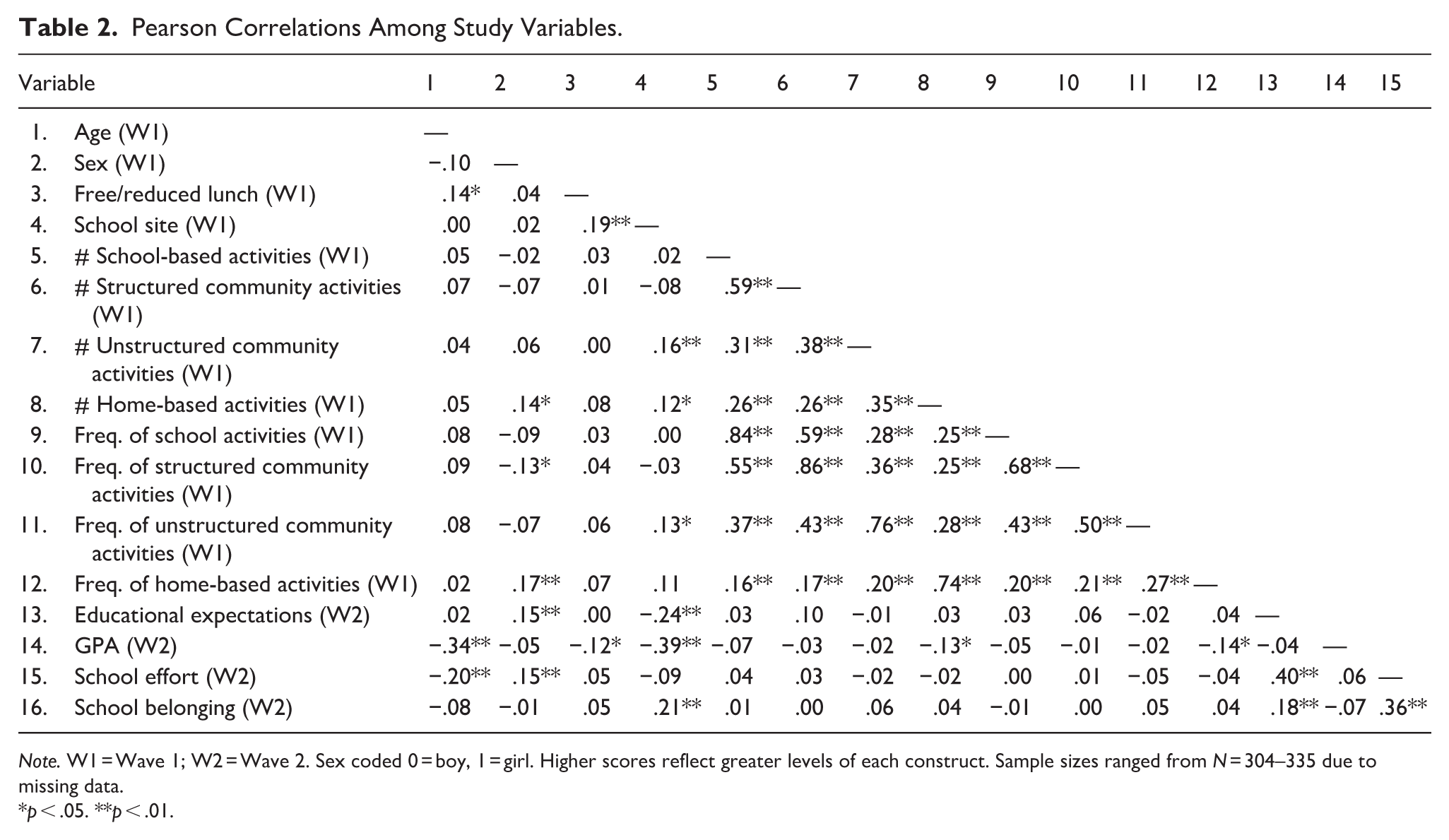
For the quantitative survey data, we first examined descriptive statistics and frequencies of after-school activity participation by gender (Table 1). Bivariate associations among study variables were then examined using Pearson correlations (Table 2) to provide an initial overview of relations among activity participation, academic outcomes, and covariates. To examine longitudinal associations between after-school activity participation and academic outcomes, we estimated a multivariate structural equation modeling (SEM) path model in Mplus. This approach allowed us to simultaneously model multiple academic outcomes—school effort, school belonging, educational expectations, and grade point average (GPA)—while accounting for their intercorrelations and improving statistical efficiency. All longitudinal analyses were conducted using a single, consistent analytic sample of adolescents who participated at both Wave 1 and Wave 2 (N = 335).
Pearson Correlations Among Study Variables.
Note. W1 = Wave 1; W2 = Wave 2. Sex coded 0 = boy, 1 = girl. Higher scores reflect greater levels of each construct. Sample sizes ranged from N = 304–335 due to missing data.
p < .05. **p < .01.
In each path model, Wave 2 academic outcomes were regressed on after-school activity participation at Wave 1, either breadth (number of activities) or intensity (frequency of participation) across four domains: school-based, structured community-based, unstructured community-based, and home-based activities. Age, eligibility for free or reduced-price lunch, and school site attended were included as covariates. To examine gender differences in the associations between after-school activity participation and academic outcomes, interaction terms between gender and each activity domain were included in the model. All continuous predictors were mean-centered prior to the creation of interaction terms. Significant interactions were probed using simple slopes analyses and plotted at ±1 SD of the focal predictor. We used full information maximum likelihood (FIML) to account for missing data, allowing all available data to contribute to parameter estimation.
For the qualitative interviews, students were asked to list all school-, community-, and home-based after-school activities in which they participated during the school year. Participants then identified the most important activity in each context and described whether and how that activity helped or hindered their academic performance. Qualitative data were analyzed using conventional content analysis to identify recurring themes related to academic support, motivation, time demands, and emotional regulation. These findings were used to contextualize and elaborate on the quantitative results.
Quantitative Results
When examining frequency of participation, adolescents reported the highest engagement in home-based after-school activities such as social media use, spending time with family, and completing homework (typically 1–3 times per week). In contrast, participation in school-based after-school activities was infrequent, with most activities reported less than once per week, with the exception of organized sports activities. Community-based activities were also limited, with unstructured forms (e.g., hanging out with friends and playing sports with friends) occurring more often than structured ones (e.g., engaging in volunteer work and playing organized sports). Overall, adolescents reported low levels of structured extracurricular involvement.
As shown in Table 2, Pearson correlations examining associations between Wave 1 activity participation and Wave 2 academic outcomes revealed a largely nonsignificant pattern at the bivariate level. The number of school-, structured community-, unstructured community-, and home-based activities at Wave 1 was not significantly associated with adolescents’ educational expectations, school effort, or school belonging one year later. With respect to academic performance, modest negative associations emerged between home-based activity participation and GPA. Specifically, both the breadth of home-based activities (r = −.13, p < .05) and the intensity of home-based activities (r = −.14, p < .05) at Wave 1 were negatively associated with GPA at Wave 2. No other activity domains—school-based, structured community-based, or unstructured community-based—were significantly correlated with GPA at the bivariate level. Notably, the Wave 2 academic outcomes were moderately intercorrelated. Educational expectations were positively associated with school effort (r = .40, p < .01) and school belonging (r = .18, p < .01), and school effort and school belonging were also positively correlated (r = .36, p < .01), suggesting coherence among adolescents’ academic motivational and engagement-related constructs.
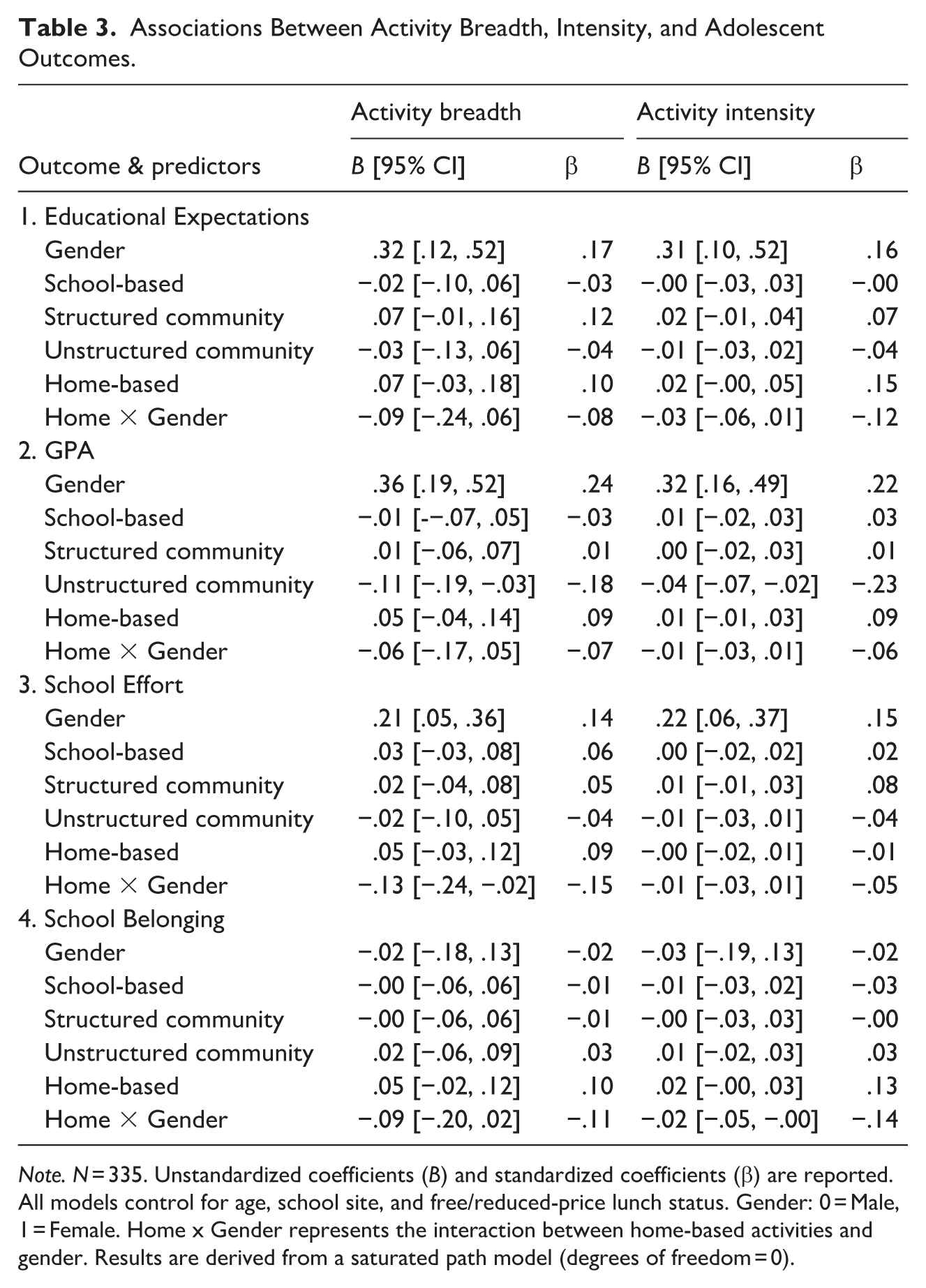
To longitudinally examine the relations between after-school activity participation and academic outcomes, we conducted a saturated SEM path model in Mplus. As shown in Table 3, a greater breadth of structured community-based activities significantly predicted higher educational expectations one year later (β = 0.12, p < .05). However, the breadth of school-based and home-based activities did not significantly predict longitudinal changes in academic outcomes. Notably, the breadth of unstructured community activities was significantly associated with a decrease in GPA (β = −0.18, p < .01). When examining the frequency of participation (intensity), unstructured community-based intensity emerged as a significant negative predictor of GPA one year later (β = −.23, p < .001). No significant longitudinal associations were found for the intensity of school-based or structured community-based activities.
Associations Between Activity Breadth, Intensity, and Adolescent Outcomes.
Note. N = 335. Unstandardized coefficients (B) and standardized coefficients (β) are reported. All models control for age, school site, and free/reduced-price lunch status. Gender: 0 = Male, 1 = Female. Home x Gender represents the interaction between home-based activities and gender. Results are derived from a saturated path model (degrees of freedom = 0).
Although few significant main effects emerged for home-based activities, the SEM path model revealed two significant interactions between home-based participation and gender. Specifically, a significant interaction was found between home-based breadth and gender on school effort (B = −0.13, p < .05). Simple slopes analyses (Figure 1a) indicated that for boys, a greater breadth of home-based activities was associated with a slight increase in school effort. In contrast, for girls, a greater breadth of home-based activities was associated with a notable decrease in reported school effort. Additionally, a significant interaction emerged between home-based intensity and gender on school belonging (B = −0.02, p < .05). As illustrated in Figure 1b, simple slope analyses revealed diverging patterns: for boys, higher intensity of home-based activities was associated with an increase in school belonging. Conversely, for girls, a higher intensity of participation in home-based activities was linked to a decline in their sense of belonging at school.

Simple slopes analyses for significant interactions.
Qualitative Findings
Qualitative findings are organized by after-school activity context (school-based, community-based, and home-based), but are analytically anchored in adolescents’ descriptions of how these activities shaped educational processes, including academic effort, motivation, emotional regulation, time management, and educational expectations. This structure allows for direct comparison with the quantitative findings and facilitates identification of convergence, divergence, and complementarity across methods. Importantly, the qualitative interviews offered critical context for interpreting null and gender-differentiated quantitative results, suggesting that low levels of participation and variability in activity conditions, rather than the absence of benefit, may underlie several nonsignificant associations. Consistent with a strengths-based perspective (Zimmerman, 2013), adolescents’ narratives also revealed how youth actively leveraged available opportunities, navigated competing demands, and drew on relational and cultural resources to support their academic engagement.
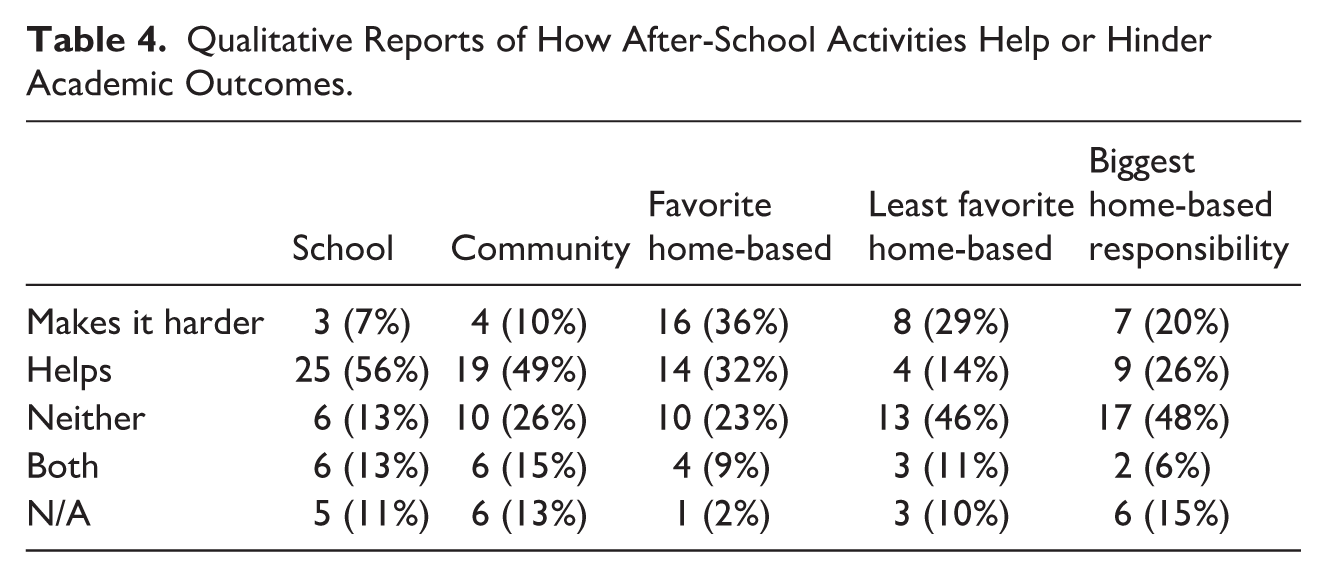
At a descriptive level, when asked about their most important after-school activities, adolescents most commonly reported tutoring, volunteering, and sports for school-based activities; hanging out with friends, community service, and sports for community-based activities; and taking care of siblings, using social media, and doing chores for home-based activities. Table 4 displays adolescents’ reports of whether their after-school activities supported, hindered, or had mixed implications for academic outcomes. Percentages are provided to convey the relative prevalence of themes within the qualitative sample and are intended to support mixed methods integration rather than statistical generalization. As shown, the majority of students reported that their most important school-based (56%) and community-based (49%) activities helped them do better in school, whereas responses regarding home-based activities were more mixed. To understand these patterns more deeply, we examined adolescents’ narratives describing how and under what conditions after-school activities shaped their academic engagement.
Qualitative Reports of How After-School Activities Help or Hinder Academic Outcomes.
School-Based Activities
Narratives about school-based activities primarily centered on academic effort, accountability, and access to instrumental academic support, helping to contextualize the null longitudinal associations observed in the quantitative models. Although the SEM path models did not identify statistically significant longitudinal links between school-based activity breadth or intensity and academic outcomes, a majority of adolescents (56%) subjectively described these activities as academically beneficial. Nearly half (42.2%) attributed this benefit to instrumental academic support, such as tutoring or extended access to teachers. Carmen, a 16-year-old from Detroit, explained how tutoring reinforced classroom learning: After tutoring I go home and I do the rest of the work that was left for me to do on my own, and then the next day I go, and we’re given work that’s. . . similar. . . And I actually understand it, so. . . it makes it easier for me to learn after school, and I come back the next day and I understand it fully.
Another prominent theme was academic accountability through eligibility requirements. About 18% of students noted that maintaining good grades was a condition for participating in sports or clubs. Mia, a 17-year-old volleyball player in Chicago, described how this requirement supported sustained effort: Yeah, so I feel like that helps me kinda keep on track. Like if I want to play, I gotta have my academics high, and that’s actually been working out for all four years. I’ve managed to keep my GPA at a 3.5 or above.
Despite these perceived benefits, approximately one-third of students expressed ambivalence, describing school-based activities as both supportive and burdensome. Some noted that tutoring alone was insufficient to fully address academic challenges. Tomas shared: “I think tutoring helps me. . . But sometimes I still get confused even with tutoring.”
Across narratives, a recurring tension emerged between motivation and time scarcity. While school-based activities fostered effort and accountability, they also competed with homework demands and family responsibilities. Victoria, a 16-year-old from Detroit, reflected, “It’s, sometimes I have so much homework and so many chores that, ya know an hour away from that kind of just bulges in with everything else I have to do.” Similarly, Nayali, a 17-year-old robotics team member, described the dual demands of extracurricular participation and household responsibilities: Sometimes it could get hard because I have a lot of homework, and sometimes, we do not get [back] to school until like 8:00 or 9:00, and then I have to go home and eat, and I, like, have to do homework and study for tests. So it kinda gets hard. But it’s nice though because we kind of don’t start robotics until like 4:00. So I have like an hour there to do homework or I could ask someone there for help with the homework, since they’re engineers, they’re good at the math.
Together, these accounts help explain why school-based participation was experienced as academically meaningful by adolescents but did not translate into consistent longitudinal effects.
Community-Based Activities
Community-based activities were most often discussed in relation to educational expectations, emotional regulation, and motivation, aligning with the quantitative association between structured community-based participation and higher educational expectations. Nearly half (49%) of participants reported that their most important community-based activity supported academic engagement, particularly when activities included adult mentorship and explicit academic norms. Felipe, a 16-year-old involved in Jiu-Jitsu, shared: I would say it would push me to do well. Because my coach always said jujitsu shouldn't be an excuse for me failing in school, not getting my work done. 'Cause he says school is priority. If you are not doing it, you're not allowed to train until you get yourself back on track and you're able to do both.
Many adolescents described community-based activities as supporting emotional regulation and stress relief, which they perceived as indirectly beneficial for academic functioning. Elena, 15, explained: Being with, like, being with kids or whatever just like makes me, uh, like less. I guess less like. . . it teaches me, like, you know how to keep my, hold my, you know, emotions. . . just makes me like, you know, keep it down a notch.
At the same time, students acknowledged trade-offs. Some described the challenge of balancing academic demands with structured community commitments. Alissa, 17, noted: Um, at first it was really, it wasn’t really hard, but it was challenging to like, um maintain both. Have like a good GPA and also do good at rowing and um, learn how to focus on one thing and the other. Um, but now, I like. I know what to do and when not to do it. So yeah.
Others were more candid about distraction. Luisa, 18, reflected: “It is a little hard sometimes because I have—I should be doing homework, but instead I am playing with the puppies.”
Although unstructured community-based activities emerged as a negative predictor of GPA in the quantitative models, adolescents’ narratives revealed more heterogeneity. Some students described peer interactions as academically supportive, particularly when friends shared academic goals. Enid, 17, explained: One of my friends, in the group, she’ um, let’s say the smartest person in the whole class. . .She is ranked #1 in our class. . .She for sure always helps us. We always make each other have like a 3.0 or higher, like we always succeed together.
Others emphasized conditional access to peer time, contingent on completing schoolwork. Ximena, 17, shared: My parents let me go out once everything is done with school work or everything at home. . . So they’re like, ‘Oh, you need to do this in order to go out’, so it’s like I’m, I need to make sure everything is correct so they could, I could be able to go out.
Overall, students’ accounts suggest that the academic implications of community-based activities depend on structure, peer norms, and competing demands, helping to contextualize both significant and null quantitative findings.
Home-Based Activities
Home-based activities revealed gendered and emotionally nuanced patterns linked to school effort and belonging, offering insight into the interaction effects observed in the quantitative models. Although no main effects emerged for home-based activities in the SEM models, qualitative narratives demonstrated substantial variability in how these activities were experienced. Some adolescents described home-based activities, particularly caregiving and family conversations, as sources of motivation, emotional grounding, and stress relief. Lucas, 18, reflected on conversations with his grandmother: I’d say it helps me because even though she didn’t go to school, she knows what the hardships, she knows the effort, and the risk it takes. She knows that I wake up early every day to try to achieve a dream I have set.
Mia, 17, described sibling caregiving as a source of purpose: “They’re my motivation to do good in school. . . I have to set the example.”
Others highlighted the instrumental and organizational benefits of certain home-based activities, including technology use for schoolwork. Rosa, 15, explained: I say it’ll be beneficial by one side because I get to use it for like resources as homework in this, but then like, if I were to be too much on my phone and not focus on my homework, I’ll. . .it’ll make me drop in school. . . I usually download like, like for math, I have like some math apps. So I have like different kinds of apps.
However, approximately one-third of students described home-based activities, particularly video games and chores, as interfering with academic performance. Alberto, 17, stated, “[Playing video games] kind of harms me ‘cause it’s wasting more time when I could just do my homework.”
When discussing their largest home-based responsibility, adolescents again offered mixed reflections. Some emphasized responsibility-building and motivation, while others described time scarcity and academic strain. Liseth, 15, shared, “[caring for my brother] makes it harder because then I have even less time to do homework, and then I’m just rushing or not finishing things.” Taken together, these findings clarify why home-based activities showed gender-differentiated and null quantitative associations, underscoring the importance of emotional meaning, cultural expectations, and time demands in shaping academic engagement.
Discussion
Participation in structured after-school activities has long been associated with positive developmental outcomes, including academic engagement. Yet, much of this evidence is drawn from primarily white youth from middle to upper-income families, with limited attention to the lived realities of Latino adolescents navigating under-resourced urban contexts. Likewise, most studies do not comprehensively assess a range of after-school activities that include structured as well as unstructured community-based activities and activities done at home after school. This study contributes to the growing body of research on after-school activity participation by examining how Latino adolescents engage with school-, community-, and home-based activities in low-income, urban communities, and how these activities may support or hinder academic performance over time. This mixed methods study incorporated both breadth and intensity of activity participation and drew on students’ own reflections, contributing nuanced insight into how context and structure shape academic engagement.
Beyond structural constraints, the present findings highlight the strengths and resourcefulness of Latino adolescents. Youth described actively leveraging available opportunities, navigating competing demands, and drawing on culturally grounded values such as familismo to support their academic engagement. These patterns do not reflect passive adaptation, but active meaning-making, persistence, and relationally grounded motivation, underscoring the importance of conceptualizing adolescents as agents within their ecological contexts (Zimmerman, 2013). Importantly, these patterns must also be understood within culturally grounded frameworks that shape adolescents’ daily experiences. Values such as familismo and culturally embedded gender roles influence how youth allocate time, interpret responsibility, and derive meaning from after-school activities. As such, the academic implications of participation cannot be disentangled from the cultural contexts in which these activities are embedded. Overall, findings suggest that structured community-based activities, in particular, are associated with adolescents’ educational expectations, while other types of activity participation showed limited or inconsistent associations with academic indicators. Consistent with a strengths-based and ecological perspective, null associations should not be interpreted as evidence of disengagement, but rather as reflections of constrained access to high-quality opportunities.
School-Based Activities
Contrary to our hypothesis, participation in school-based after-school activities was not significantly linked to improvements in school effort, school belonging, educational expectations, or GPA at Wave 2. Although prior research consistently links extracurricular participation with academic and psychosocial benefits among adolescents (Bohnert & Garber, 2007; Camacho & Fuligni, 2015; Meier et al., 2018), this unexpected finding must be interpreted within the ecological context of the opportunity gap facing low-income Latino communities. The limited overall engagement likely reflects structural scarcity rather than a lack of student motivation. Indeed, the qualitative data revealed that when youth did have access to high-quality, structured environments, they actively leveraged them for academic support, demonstrating agency and strategic use of resources to support their academic goals. Although this study did not assess access or availability, prior research suggests that low levels of participation in under-resourced communities often stem from a lack of meaningful and accessible opportunities (Cornelli Sanderson & Richards, 2010). Thus, disparities in opportunity, rather than the absence of benefit, may be a contributing factor for the lack of significant associations observed in our sample.
Students’ qualitative accounts offer insight into the complexities behind low levels of after-school engagement and its academic effects. Although most adolescents reported that school-based activities, particularly tutoring and sports, helped them academically, they also described the time burden of these commitments. Some students viewed GPA requirements as motivation to perform well (e.g., to remain eligible for sports), while others struggled to balance extracurriculars with homework and family obligations. These tensions may be gendered, as boys more often described sports-related eligibility pressures, whereas girls more frequently emphasized competing family responsibilities, underscoring how school-based activities can differentially support or strain academic engagement depending on gendered role expectations.
Community-Based Activities
Structured community-based activities were the only activity type significantly associated with improved academic outcomes in our models. Specifically, a greater breadth of structured community-based activity participation was associated with higher educational expectations one year later. Given the low levels of structured community-based activity participation in our sample, the significant link to educational expectations is particularly notable. This finding suggests that even modest engagement in structured, supervised activities can be academically meaningful for Latino adolescents in under-resourced urban contexts. This aligns with prior literature highlighting the role of structured programs, such as volunteer work, religious groups, and organized sports, in fostering goal-setting and long-term academic aspirations among racially/ethnically minoritized youth (Eccles & Barber, 1999; Fredricks & Simpkins, 2012). Qualitative responses further reinforced this finding. Adolescents frequently described their structured community-based activities as sources of motivation, focus, and emotional regulation. Many referenced adult mentors or programs that emphasized academic priorities, reinforcing the idea that structured guidance and accountability can positively shape adolescents’ school-related attitudes and behaviors (Apsler, 2009). At the same time, several students acknowledged the challenge of balancing schoolwork with community commitments, suggesting the importance of flexibility and support in these programs.
As hypothesized, unstructured community-based activities—such as hanging out with friends or riding around in a car—were not significantly linked to academic outcomes in our longitudinal models. However, bivariate correlations indicated small negative associations between unstructured activity participation and GPA, suggesting potential academic risks when these activities dominate after-school hours. Qualitative data offered more complexity. Some students described unstructured peer interactions as sources of academic support (e.g., study help from friends) or as incentives to complete schoolwork before socializing. Interestingly, then, peer dynamics and the context of unstructured time may influence whether such activities hinder or support academic engagement. Future work should address the influence of peers in the links between structured and unstructured after-school activities.
Home-Based Activities
There were no significant associations between home-based activities and any academic outcomes in our quantitative models. Yet, the qualitative interviews revealed that many adolescents viewed home-based activities, particularly family caregiving and conversations with relatives, as emotionally supportive and academically motivating. These themes are consistent with familismo, a central cultural value in many Latino families emphasizing family unity, obligation, and support (Halgunseth et al., 2006; Stein et al., 2015). These narratives challenge deficit-oriented views that frame family responsibilities solely as competitors for academic time (Hill & Torres, 2010). Notably, these home-based responsibilities were often described in gendered terms, with girls more frequently recounting caregiving and emotional labor within the household. This pattern reflects broader gendered expectations embedded in familismo and helps explain why home-based activities may foster responsibility and motivation without yielding direct associations with conventional academic indicators. Taken together, findings suggest that gender is not merely a moderator of after-school activity effects, but a structuring force that shapes access, time demands, and the developmental meaning of participation (Simpkins, 2015). Gendered expectations intersect with structural constraints to produce different configurations of opportunity, responsibility, and support for Latino adolescents (Cammarota, 2004). As a result, academic benefits may emerge in gender-specific ways that are not fully captured by traditional indicators such as GPA, underscoring the importance of interpreting gendered patterns within culturally and structurally grounded frameworks.
Collectively, our findings underscore the importance of structure, supervision, and alignment with academic goals in shaping the benefits of adolescents’ after-school activity participation. This study also highlights the unique value of mixed methods approaches in adolescent research. Youth voices revealed emotional, logistical, and cultural nuances that shape whether and how after-school activities support academic performance. Although participation alone was not uniformly associated with improved academic outcomes, structured community-based activities emerged as both statistically and experientially meaningful. Youth shared that these programs often included adult mentorship, clear expectations, and a sense of purpose—qualities that students themselves identified as motivating and academically supportive. Notably, the most common activity reported was unstructured time spent on social media at home. This pattern reiterates an important finding: rather than a lack of benefit from participation, our results point to a broader issue of under-participation. In turn, these findings challenge assumptions of uniform benefit and suggest that what matters most is not simply whether adolescents participate in activities, but where, how, and under what conditions participation occurs.
An important conceptual contribution of this study lies in the distinction between what was directly measured and what adolescents themselves identified as meaningful. Although our quantitative measures captured participation breadth and intensity, they did not assess specific activity characteristics such as adult supervision, relational quality, or program structure. However, adolescents’ qualitative narratives repeatedly highlighted these features as central to whether after-school activities supported or hindered their academic engagement. Youth described adult mentorship, clear expectations, emotional support, and flexibility as key mechanisms shaping motivation, effort, and educational expectations. Rather than representing an inconsistency, this gap between measurement and lived experience underscores a critical need in the literature: future research must move beyond participation metrics alone to systematically assess the quality and contextual features of after-school activities.
Strengths and Limitations
This study offers a comprehensive examination of how Latino adolescents from low-income, urban communities engage in a range of after-school activities across school, community, and home contexts, and how these activities may be associated with their academic performance. Consistent with a strengths-based and ecological perspective, adolescents’ narratives emphasize not disengagement, but constrained access to high-quality opportunities and variability in the conditions under which participation occurs. A key strength of our study is its mixed methods design, which integrates longitudinal survey data with qualitative interviews. This approach not only allowed us to identify statistically significant associations but illuminated the lived experiences of adolescents, capturing the ways students perceive after-school activities as either supporting or hindering their academic efforts. Another strength lies in the breadth of activity types examined. By distinguishing between structured and unstructured community-based activities and including home-based responsibilities and routines, our study expands the scope of after-school activity research to better reflect the lived realities of Latino youth in low-income families.
Nevertheless, several limitations warrant consideration. First, our measures of activity participation did not assess activity characteristics such as adult supervision, activity structure, or relational quality. Future surveys could ask whether an activity includes a regular adult mentor, has set goals or expectations, or allows youth to provide input in decision-making. These details would allow for a more nuanced analysis of how specific features of an activity shape academic engagement. In addition, overall activity participation levels were low across several domains, which may have limited our ability to detect associations with academic outcomes. This under-participation likely reflects broader structural barriers, including limited availability and accessibility of after-school programs in low-income communities. Additionally, the generalizability of findings is limited to urban, Latino adolescents from low-income households. Further research is needed to determine whether similar patterns hold in other geographic regions or among adolescents from different racial/ethnic groups or socioeconomic contexts.
Implications and Future Directions
The present study offers several implications for researchers, educators, and community organizations. First, the findings emphasize the importance of structured, community-based programs as a promising avenue for promoting academic engagement among Latino adolescents. Adolescents who participated in a greater breadth of structured community-based activities reported higher educational expectations over time, highlighting the potential of these settings to foster long-term academic aspirations. Community-based organizations serving urban, low-income Latino youth should consider expanding access to structured programs that incorporate adult mentorship, goal-setting, and academic support—features that adolescents themselves consistently identified as motivating and academically meaningful in the qualitative interviews. Importantly, these recommendations are grounded in youth narratives and highlight priorities for both program development and future empirical measurement of activity quality. Second, findings complicate the assumption that all structured activities, particularly school-based ones, are uniformly beneficial. While many students appreciated the academic support and accountability provided by school-based activities, others described the logistical strain and time pressures that these activities introduced. For adolescents managing household responsibilities or limited after-school time, rigid activity schedules may inadvertently create barriers to academic success. These findings underscore the need for flexible, culturally responsive programming that accommodates the competing demands faced by low-income youth.
Third, the study highlights the academic significance of home- and family-based contexts, even in the absence of statistical associations. These findings suggest that interventions that ignore culturally embedded family roles may mischaracterize adolescents’ time use, whereas approaches that engage familismo and family systems may better align with youths’ lived realities and promote academic engagement. Indeed, adolescents described caregiving and family encouragement as meaningful sources of motivation. These narratives speak to the cultural strengths embedded in familismo (Stein et al., 2015) and illustrate how youth draw on relational responsibilities as sources of persistence and meaning-making. Accordingly, future interventions may be most effective when they build on these existing strengths, integrating family engagement, affirming culturally grounded values, and recognizing adolescents as active contributors to their own academic trajectories rather than passive recipients of support. From a research perspective, future studies should examine the mechanisms through which structured community-based programs influence educational trajectories. For example, do adolescents in these programs report stronger academic self-concept, greater school belonging, or enhanced time-management skills? In addition, future work should assess the relational and structural features of activities, such as adult-to-youth ratio, mentorship quality, and cultural relevance, to identify what aspects of program design are most impactful. Finally, given the low levels of activity engagement observed, future efforts should examine structural barriers to participation and consider how to make high-impact, structured programs more accessible. Doing so could enhance academic outcomes among youth who currently have limited opportunities for enrichment.
Footnotes
Acknowledgements
We wish to thank the high school teachers, administrators, and students who made this research possible in Chicago and Detroit, as well as all the members of the Resilience in Context lab for their enduring hard work and dedication to research.

Ethical Considerations
This study was approved by the University of Michigan Institutional Review Board (IRB) and the administrations at each school.
Funding
The authors disclosed receipt of the following financial support for the research, authorship, and/or publication of this article: This research was supported by grant 1348957 from the National Science Foundation awarded to the last author.
Declaration of Conflicting Interests
The authors declared no potential conflicts of interest with respect to the research, authorship, and/or publication of this article.
Data Availability Statement
The data are not publicly available but can be shared upon request to the last author.