




Abstract

Research on food and food waste has been receiving growing attention. Indeed, the topic is well-suited for the Journal of Public Policy & Marketing. What consumers buy, eat, and discard is substantially affected by food marketing—a complex system that exerts its influence in myriad ways, from agricultural decisions that affect food production and availability to advertising and promotion aimed at what consumers buy and eat. Moreover, public policy plays an important role in the food marketing system: it provides farming incentives, sets food quality standards, and determines how food is labeled, for example. Although marketing and public policy appears to focus largely on food rather than food waste, concern about the latter is growing due to its environmental and economic impact—and governments have begun to set explicit policies targeting food waste (e.g., U.S. 2030 Food Waste and Reduction Goal announced by the U.S. Department of Agriculture and Environmental Protection Agency in 2015).
The special section in this issue comprises three articles that examine different facets of food and food waste. First, Birau, Hildebrand, and Werle (2022) examine how consumers react to the portrayal of unhealthy food consumption in food advertising, demonstrating that consumption-focused imagery reduces unhealthy food intake among consumers chronically concerned with dieting. This counterintuitive finding seems likely to lead to follow-up work to further understand the mechanisms and boundary conditions but, more broadly, also points to the powerful impact of food marketing on consumers’ food intake. Second, Werle et al. (2022) draw on existing evaluative nutrition labeling systems (i.e., traffic-light style) to compare their effectiveness, demonstrating that a five-level label enhances healthy choices over a three-level label due to increased consumer ability to discriminate food healthiness. This finding has implications for food policy regarding front-of-pack labeling and, again, points to the powerful impact of food marketing and food policy on consumer food decisions. Lastly, Mesiranta, Närvänen, and Mattila (2022) examine how different food system stakeholders are held responsible in the policy debate over food waste. They identify four framings—eco-efficiency, solidarity, safety, and appreciation—that affect how food waste is viewed as part of policy discussions and address the implications for food waste solutions of each of these framings. This important work not only illuminates the complexity of the food marketing system but also sheds light on how various actors in the system together inform food policy debate. When considered together, these articles also illuminate three important facets of food-related research.
Food and Food Waste Are Two Sides of the Same Coin
Put simply, food is what we eat, and food waste is food that was not eaten. This relationship exists at all stages of the food marketing system, from agricultural production to consumer disposition. As a result, food consumption and food waste are closely intertwined—influenced by actors (e.g., farmers, retailers, government, consumers) and their decisions (e.g., what to grow, sell, buy, eat, and dispose; how to transport, package, store, and prepare) within this system and the broader sociocultural environment. Given this backdrop, recent conceptual articles on food well-being (FWB) and food waste provide an opportunity to integrate our thinking about the two sides of the food/waste coin.
Block et al.’s (2011) article “From Nutrients to Nurturance: A Conceptual Introduction to Food Well-Being,” proposes a helpful pinwheel framework for thinking about FWB. Each arm of the pinwheel reflects a FWB domain: food policy, food availability, food socialization, food literacy, and food marketing (for further details, see Block et al. 2011). While the authors focus on food consumption and well-being, this framework could readily be applied to food waste. For example, food literacy affects the food we buy (and do not buy) and how we prepare our food (and handle leftovers), food policy touches on these decisions via nutrition and expiration labels, and so on. Three of the frames suggested by Mesiranta, Närvänen, and Mattila (2022) readily overlap with arms of the FWB pinwheel: appreciation onto food socialization, safety onto food policy, and eco-efficiency onto food availability. The fourth frame, as described by Mesiranta, Närvänen, and Mattila (2022, p. 151), “stems from the principles of the Nordic welfare state” and suggests the potential need to expand the FWB framework to more explicitly include the political and cultural environment as an important dimension for FWB (e.g., state vs. individual responsibility for health and well-being). We encourage future research to investigate our understanding of food and food waste using the pinwheel framework.
“The Squander Sequence: Understanding Food Waste at Each Stage of the Consumer Decision-Making Process” (Block et al. 2016) provides a valuable framework for thinking about food waste. The authors break out major sources of food loss by stage: agricultural production, storage/transport, processing/packaging, point of sale/preacquisition, consumer acquisition, consumption, and disposition. Although this framework is focused on food waste, it could readily be applied to the flip side of the food/waste coin given its articulation of key elements of the food marketing system. At the acquisition stage, for example, consumer lay theories about what is healthy (e.g., pretty foods; Hagen 2020) and what is a good deal (e.g., larger packs) affect what we buy and consume and what ends up as food waste, at both the household and retailer levels. In this example, lay theories can be tied back to food literacy on the FWB pinwheel; indeed, the FWB pinwheel can be spun along each stage in the food marketing system to illuminate various influences on food and food waste (see Figure 1).
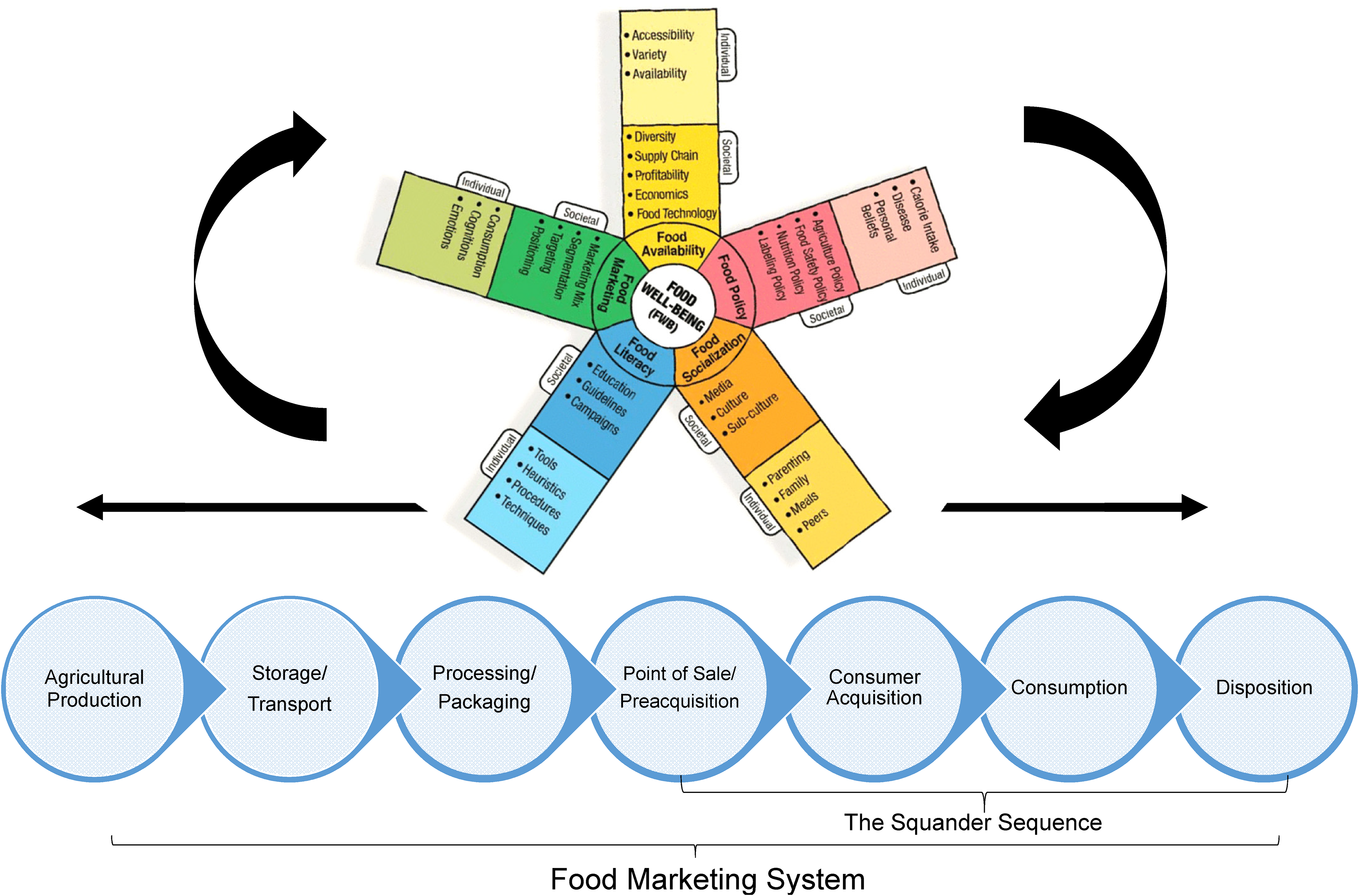
Integrating the FWB pinwheel and the squander sequence.
Multiple Lenses Affect Our Approach to Food and Food Waste
Consumers, firms, and policy makers approach food with multiple goals in mind (related to health, sustainability, safety, etc.). This notion is evident in the framings that emerge from Mesiranta, Närvänen, and Mattila’s (2022) research and contrasts with the health lens adopted in Birau, Hildebrand, and Werle (2022) and Werle et al. (2022). Indeed, a great deal of prior research on health marketing and nutrition adopts a health lens (i.e., how can we encourage healthy food consumption?), which is useful but raises the possibility of inadvertent consequences when viewed through an alternative lens. For example, might an emphasis on health concerns (e.g., access to fresh food, food safety) increase retailer and consumer generation of food waste (e.g., unnecessary food loss, spoilage)? And how does food literacy (lay beliefs about, e.g., fresh vs. frozen food, composting) and food policy (e.g., nutrition and expiry labels, waste management practices) affect both food consumption and waste at the household and retailer level? We encourage researchers to broaden the lenses through which food/waste are investigated to better understand their interrelationships. This work has already begun. For example, Mugel, Gurviez, and Decrop (2019) identify a quest for sustainability (posteating) as part of the consumer’s lived experience of FWB (and food waste), and Raghunathan and Chandrasekaran (2020) document a link between food waste aversion and body mass index.
A Macro Through Micro Perspective Needs Greater Consideration in our Understanding of Food And Food Waste
Consumer research on food and food waste tends to adopt the micro perspective and examine individual behavior, as exemplified by Birau, Hildebrand, and Werle (2022) and Werle et al. (2022). But, as Mesiranta, Närvänen, and Mattila (2022) demonstrate, shifting to a meso and macro perspective helps illuminate important aspects of the food marketing system and their impact on FWB and food waste. For example, producers and retailers set standards for sellable food that can drive food waste; these standards are intertwined with food policy (e.g., regulations) and also consumer literacy (e.g., lay beliefs about food safety). Indeed, the food marketing system involves multiple actors and complex interrelationships. Individual consumers’ decisions about what to consume or discard affect both their well-being and that of the planet—but so too do the decisions of other actors within the food marketing system. Recent research aimed at increasing purchases of “ugly” produce by consumers illustrates the importance of understanding the perspective of these other actors; both Grewal et al. (2019) and Mookerjee, Cornil, and Hoegg (2021) show that marketing managers fail to intuit the effectiveness of specific successful interventions (e.g., labeling ugly produce as “ugly”). As these examples attest, future research is needed to better understand and improve the food marketing system in order to enhance consumer well-being and minimize food waste.
Footnotes
Editors
Kelly D. Martin and Maura L. Scott
Declaration of Conflicting Interests
The author(s) declared no potential conflicts of interest with respect to the research, authorship, and/or publication of this article.
Funding
The author(s) received no financial support for the research, authorship and/or publication of this article.
