




Abstract

Our world is becoming more polarized than ever before, with a growing number of extremist groups spreading radical worldviews. Here, we adopt a broad definition of radicalization. For the purpose of this special issue, radicalization is viewed as a process leading to one's socialization into an extremist belief system that then sets the stage for violence or intolerance toward individuals with a different worldview (Baugut and Neumann 2020; Borum 2011; Helfstein 2012). Although there are countless examples of events linked to radicalization, the riots at the U.S. Capitol on January 6, 2021, struck the public's consciousness with extreme sadness and disbelief. On this infamous day, which has changed the United States for generations to come, political radicalization turned deadly as groups of armed individuals climbed up the walls and then poured through the windows of the U.S. Capitol. Although this example is particularly striking, it is not an isolated event by any stretch. Mass media in different countries bring daily examples of radicalization and violence. For instance, in June 2021 in London, Ontario, a brutal attack resulting in the death of a Muslim family sent shock waves across Canadian Muslim communities. In another example of terrorist attack, an 18-year-old white man shot 13 individuals, killing 10 of them, at a grocery store in Buffalo, New York, in May 2022. In light of these horror studies, the current special issue aims to start a discussion about the place of marketing—and its related implication for policies—in understanding and preventing violent acts motivated by extremist beliefs.
Though extreme, these examples all point to an increasing polarization in public opinion across a wide range of religious or sociopolitical issues. Different state and nonstate actors seem to be losing the notion of compromise and middle ground. A recent survey reports that one in five Americans believes that political violence may be necessary for some issues (Wintemute et al. 2022). Another U.S. survey about political violence indicates that 40% of respondents view retaliatory violence as justified under some circumstances (Carey et al. 2020). This strong support of “occasional” violence is concerning, given the potential of online platforms to quickly disseminate information of a radical nature.
Disturbed by this uncomfortable new reality, we set out on a mission two years ago to add marketing voices to the conversations about radicalization issues. The Journal of Public Policy & Marketing (JPP&M) was a natural fit given its editorial orientation of examining issues that “make a difference” (Martin and Scott 2021, p. 1). Because the topic of radicalization has been rarely addressed in our discipline—at least not directly—we asked ourselves the following questions: What can we do in marketing to address radicalization issues? How can marketing help policy makers and society prevent acts of violence, which are motivated by radicalization, especially online radicalization? Where should we start? Answering these questions is the specific purpose of the special issue, titled “Marketing to Prevent Radicalization: Developing Insights for Policies.”
In this special issue, we claim in the strongest possible terms that marketing has an important role to play in understanding, preventing, and decreasing the occurrences of events motivated by radicalization. Although marketing is rarely consulted in the study of radicalization issues—letting other disciplines in social sciences “do the talking” (see, e.g., Neumann and Kleinmann 2013)—we believe the time is ripe for the marketing discipline to get involved and be part of the discussion. We have the means to do so given our expertise in social media, persuasion, communication, activism, transformative services, and other fields. So, our intent with this special issue is to get marketing involved in the discussion about radicalization occurring in our society. To do so, we propose a first attempt at organizing the emergent field of “Marketing to Prevent Radicalization” and delimiting its domains.
This effort of organization relies on six insightful articles: two invited commentaries from researchers in criminology and political science and four research articles from marketing scholars. These articles are used to identify four specific domains of interest to “get ourselves started” on the topic of radicalization as marketing scholars. These four domains are (1) misinformation, disinformation, and conspiracy; (2) violence, hate, and terrorism; (3) discrimination, exclusion, inequity, and racism; and (4) lack of confidence in institutions and controversial nature of advocacy. Please see Table 1 for an overview of these domains with the contribution of this issue's articles to each.
Key Domains Delimiting the Field of “Marketing to Prevent Radicalization.”

*Social media theory is a foundational theoretical lens that applies to all domains.
Notably, we do not suggest that the list of domains in Table 1 is exhaustive. Rather, we see them as the logical starting points of the field we aim to advance with this special issue. Here is a brief presentation of the components of Table 1. First, we identify the articles or commentaries that address each of the domains, knowing that a given article can touch different domains simultaneously (this point will be discussed further). Then, we enumerate useful theoretical lenses that can be used to document a given domain. Finally, we identify key, actionable implications for policy makers and marketers.
The Common Ground: The Omnipresence of Social Media
Before presenting the different domains, it is important to discuss the central role that social media and online platforms have played in radicalizing people. 1 As eloquently explained by Lantz and Shaw (2023, p. 15), “One of the defining characteristics of contemporary radicalization is the role that online interaction frequently plays in facilitating extremist radicalization processes.” Indeed, the vast majority of radicalization stories share the same beginning and common ground. An individual is exposed to online content promoting violent radicalization through an online “echo chamber” (e.g., Diaz Ruiz and Nilsson 2023; Hamm and Spaaij 2017; Lantz and Shaw 2023; Piazza 2023). In this echo chamber, this individual is exposed to content—a convincing mixture of biased and misleading statements—that contributes to forging their self-identity, which they may be willing to defend at any cost (Diaz Ruiz and Nilsson 2023). For instance, the 18-year-old gunman in Buffalo spent hours immersed in the white supremacist conspiracy theory “The Great Replacement,” a racist ideology originally disseminated in fringe websites that eventually found its way to more mainstream platforms. Motivated by this view, the man targeted a neighborhood with a high proportion of Black residents to carry out his attack (National Terrorism Advisory System 2022; Wilson and Flanagan 2022; Yousef 2022). The Buffalo attack was preceded and followed by others motivated by similar grievances related to racist ideology (National Terrorism Advisory System 2022).
As we highlight in Table 1, it is important to employ social media theories developed in marketing (e.g., Appel et al. 2020) to understand the different domains of radicalization. In many ways, extremist groups seem to be adept in using sophisticated social media techniques in reaching, converting, and mobilizing their targets (Frazer 2023). As marketing scholars, we should not be afraid to “dig deep” in the social networks used by extremists (Lantz and Shaw 2023; Piazza 2023) or activists providing solutions (Brouard et al. 2023). At the end of the day, policy makers and marketers need to be able to develop effective counterarguing campaigns with the same level of sophistication as the campaign used by those who aim to radicalize individuals into their beliefs (Diaz Ruiz and Nilsson 2023; Frazer 2023). When studying radicalization issues, there is no such thing as too much social media research.
First Domain: Misinformation, Disinformation, and Conspiracy
Diaz Ruiz and Nilsson (2023) directly address the issues of misinformation, disinformation, and conspiracy, and these challenges are also approached in the commentaries in this issue (Lantz and Shaw 2023; Piazza 2023). Using the “flat Earth theory” echo chamber on YouTube as an empirical context, Diaz Ruiz and Nilsson (2023) study the process of disinformation occurring in online echo chambers. Although it is not a new phenomenon, the flat Earth theory and its proponents have experienced a surprising resurgence in recent years. 2 To understand this phenomenon, Diaz Ruiz and Nilsson (2023) propose an online process comprising two key phases: seeding and echoing. Importantly, this two-phase process can also be employed to explain the recent popularity of many other conspiracy theories (Lantz and Shaw 2023).
In the “seeding” stage, malicious actors begin spreading blatant disinformation on social media platforms (e.g., YouTube videos, discussion forums). As the authors note, setting this strategic deception is just the first phase. The “echoing” phase is even more crucial in explaining the spread and solidification of a conspiracy theory. Once in the echo chamber, its members vividly engage in the cocreation of confrontational fantasies, which allows them to reassert their values and self-identity. At this stage, it becomes a matter of defending one's beliefs and protecting a group to which one strongly identifies. It is no longer a matter of facts or true or false information. Rather, it becomes a matter of values and ideology—that is, a matter of defending a group's identity and ideology against any forms of threat.
A thorough understanding of the echoing stage is crucial given the decline in citizens’ confidence in institutions (Piazza 2023). As citizens’ trust in and the perceived credibility of public officials’ information decline, they may spiral into alternative sources of information, which can easily lead to dangerous echo chambers (Piazza 2023). Diaz Ruiz and Nilsson (2023) underscore the importance of deterring malicious actors from seeding disinformation by using approaches such as content flagging and fact checking. However, such techniques are poorly adapted to the echoing stage, and they could even backfire by generating a values-based confrontation, worsening the situation. Accordingly, the authors urge policy makers to develop counterstrategies that are specifically adapted for the echoing phase. Given that echo chambers are resistant to outside voices, Diaz Ruiz and Nilsson recommend referring to credible “insiders” who could speak the “language” of a chamber. Combatting disinformation smartly—by considering two different phases—is important to effectively counter the development of conspiracy beliefs, a key driver of political violence (Piazza 2023).
In turn, Lantz and Shaw (2023) approach the role of online echo chambers by using a criminology perspective, which relies on social learning and association theories. In such an environment, the members are only exposed to opinions and beliefs that reflect and reinforce their own. Specifically, Lantz and Shaw note that “the defining characteristic of an echo chamber is the expansion and repetition of singularly focused viewpoints” (p. 16) that completely overlook the presentation of contrasting worldviews. In simple terms, the members of echo chambers only learn one side of the story. To support their point, Lantz and Shaw explain that right-wing extremist online spaces present only the side of the argument that “glorif[ies] and gamif[ies] acts of extreme violence” (p. 16) To counter this phenomenon, recent research has shown the virtuous effects of developing strong critical thinking skills about media content, which robustly reduce maladaptive persuasion (Radanielina Hita et al. 2022).
Second Domain: Violence, Hate, and Terrorism
Frazer (2023) and Piazza (2023) directly address the issues of violence, hate, and terrorism. While Frazer studies jihadist radicalization, Piazza examines domestic terrorism and political violence. Based on the current models of radicalization (e.g., Baugut and Neumann 2020; Helfstein 2012), the development of extremist beliefs is a key antecedent leading to violent actions. Although not all radicalized individuals would commit heinous terrorist attacks, these individuals are much more likely to engage in proextremist activism on social media, thus contributing to the sustained interest in extremist ideology (Lakomy 2021; Nilsson 2021). As previously noted, groups aiming to radicalize people into their extremist beliefs (racism, jihadism, extreme right movements, etc.) are very skilled at using persuasive communication on social media. Accordingly, policy makers would be in a better position to design effective prevention strategies if they had a deeper understanding of the communication strategies used by extremists.
Frazer (2023) answers this call by using a well-established framework, selective moral disengagement (SMD), to better comprehend the messages published in the Islamic State's magazine Rumiyah. The SMD theory suggests that even if moral individuals are driven to avoid harmful behaviors, other factors, such as exposure to harmful communication, may disrupt these morality codes. This disruption may then encourage individuals to disengage from self-sanctions of unethical behaviors, which leads them to rationalize and support harmful behaviors. Frazer's analysis shows how Rumiyah predominantly uses the following five mechanisms: (1) moral justification, (2) displacement of responsibility, (3) dehumanization of victims, (4) attribution of blame to victims, and (5) humanization of perpetrators. The first four mechanisms are proposed by SMD. As her main contribution, Frazer uncovers the last mechanism (i.e., humanization of perpetrators) as a strategy regularly used by jihadist extremists, and she discusses how these mechanisms are strategically used in combination with one another. Then, she derives from her analyses important implications to enhance countermessaging. She argues that policy makers should counter jihadist propaganda with specific moral engagement strategies focusing on the five mechanisms at play. Inoculation-based training—through which at-risk youth are trained to identify moral disengagement tactics—is also described as a promising strategy.
In turn, Piazza (2023) examines homegrown terrorism by proposing an effective “big picture” framework, which highlights the key drivers of political violence in the United States. Starting his commentary with the U.S. Capitol riots, Piazza notes that support for political violence is on the rise in the United States, and that this situation has become a growing concern for a majority of Americans. He then identifies and explains four key drivers of political violence, which reflect the topics covered in this special issue. These drivers are (1) toxic political polarization; (2) toxic, identity-based ideologies; (3) assaults on democratic norms; and (4) disinformation and conspiracies. Interestingly, Piazza notes that formerly fringe ideologies have been manipulated by some politicians to deepen the division in public opinion and increase toxic environments; these political shenanigans represent the source of the problem. Efforts to reduce support to political violence, Piazza argues, should carefully and simultaneously address each of these four main drivers of interest.
Third Domain: Discrimination, Exclusion, Inequity, and Racism
Brouard et al. (2023) examine the important issue of racism and one of its outcomes: the exclusion of racialized actors in the marketplace. Events from recent years, such as the murder of George Floyd, brought the realities of systemic racism into the forefront of national conversations. However, despite the growing understanding of the detrimental effects of racism and discrimination in marketing (Bone, Christensen, and Williams 2014; Crockett, Grier, and Williams 2003; Peterson and Mann 2020), the struggles for racial equality and full participation in the marketplace remain unresolved issue (Ray 2019). Addressing this point, Brouard et al. study the ways that racialized actors use online networks to enhance their participation in the marketplace via digital enclave movements.
Specifically, the authors focus on the “#MyBlackReceipt” (MBR) movement. At the height of recent antiracism movements, the MBR initiative sought to push that momentum further by encouraging consumers to buy from Black-owned businesses. These consumers were then asked to upload their receipts onto the movement's website as evidence of the wealth that could be retained in the Black community. The research views digital enclaves as a contemporary, savvier alternative to “geographically based Black enclaves.” Indeed, Brouard et al. (2023) suggest that this newer form of enclaves can help expand the networks of its members, which reduces a perceived lack of participation in the marketplace. The authors contribute to the literature on countering exclusion by showing how digital enclaves can complement other actors’ efforts to reduce stigma, promote market diversity, and enhance equitable participation. In terms of core contribution, Brouard et al. document five tactics that could help racialized actors develop successful digital enclaves: (1) legitimizing, (2) communitarian delimitation, (3) vitalizing, (4) manifesting, and (5) bridging.
The research also provides important public policy implications. The existence of digital enclaves creates an opportunity to complement existing “color-blind” policies (Wise 2010) with what the authors call “color-conscious” policies. In this latter case, policies specifically account for the ethnoracial identity of market actors and aim to develop socioeconomic structures that address the specific needs and challenges of excluded minorities. In doing so, color-conscious policies complement color-blind policies in producing positive transformative changes for ethnoracial minorities. Here, the challenge for policy makers is to strike the right balance between color-blind and color-conscious policies, so that all citizens are treated with consideration, regardless of their backgrounds.
Another point of this article is worth highlighting: Compared with the negative use of social media in the three other domains of Table 1, Brouard et al. (2023) show how social media can facilitate positive transformative changes—that is, a greater participation of Black actors in the marketplace. Here, we wish to underline that social media is more than just a contributor to radicalization. When properly used—such as in the case of the suggested digital enclave—social media becomes an essential part of a winning strategy to counter exclusion and radicalization. Given the digital expertise of the marketing scholarly community, we advance the idea that marketing could play a key role in designing successful social media strategies.
Fourth Domain: Lack of Confidence in Institutions and the Controversial Nature of Advocacy
As of late, the last domain—taking a stand on political and social issues—has become an important component of brand building. The increasing popularity of corporate advocacy (or activism) is somewhat linked, in part, to the growing lack of confidence in institutions (Piazza 2023). As more citizens have lost confidence in institutions, some corporations feel compelled to enter the political arena and engage in concrete actions to support their values. In their article, Weber et al. (2023, p. 81) capture this aspect by accounting for the effects of political efficacy, defined as “the extent to which one believes that political institutions are responsive to citizen demands.”
In their framework for understanding marketing and political activity, Korschun, Martin, and Vadakkepatt (2020) identify companies as one of the three potential actors that engage in political activism. Indeed, many companies in recent years have engaged in corporate activism by supporting a variety of sociopolitical causes (e.g., climate change, the #MeToo movement, antiracism; see Eilert and Nappier Cherup 2020; Maicon 2020; Moorman 2020; Vredenburg et al. 2020). The active participation of firms in the political realm seems to have been received well by most consumers: a survey shows that 62% of customers now expect companies to take a stand on social issues (Accenture 2018).
However, responses toward corporate activism are not always positive, and as Weber et al. (2023) argue, firms need to be aware of corporate activism's controversial nature and potential backlash. In support of this view, the same Accenture (2018) survey indicates that 53% of consumers are likely to complain if they are unhappy with a brand's actions on a social issue, and 47% of consumers report walking away from the brand in this situation. Weber et al. tackle this specific issue by comparing the effects of corporate political advocacy (CPA) with those of corporate social responsibility (CSR) measures, which are viewed as being safer and more neutral.
Specifically, Weber et al. (2023) make two core contributions. First, the researchers show that CPA consistently leads to more negative and polarized sentiments and attitudes, compared with CSR. The findings from a field study (using Twitter data) and two experiments consistently support that CPA is associated with more controversial and negative responses compared with a CSR approach. As CPA is viewed as especially risky, the effects of misalignment between brands’ political actions and consumers’ political orientation become especially strong and negative. Second, the authors conduct a study (i.e., Study 3) in which they integrate political efficacy as a critical moderator. Interestingly, they find that the misalignment between CPA and political orientation leads to extreme negative responses for individuals low on political efficacy—that is, people who have little faith in the institutions in place. To the best of our knowledge, this the first time that researchers have integrated this important boundary condition in the literature on corporate activism.
We believe that two central conclusions can be drawn from Weber et al.'s (2023) results. First, firms need to be aware of the polarizing and controversial nature of advocacy. According to the authors’ findings, CSR is more likely than CPA to lead to positive, steady responses while minimizing the risk of polarization. In other words, advocacy should be carefully considered by managers given its associated risks. Second, the lack of confidence in institutions (i.e., from consumers low on political efficacy) is an important factor explaining polarization and extremely divergent responses. For this aspect, current institutions and political parties have a role to play in bringing back a form of decency in their actions to restore people's confidence in these institutions’ ability to do the “right thing.” As clearly highlighted by Piazza (2023), the lack of confidence in institution is an important driver predicting violence.
Intersection of the Different Domains and Multidisciplinary Background
Our first objective was to present the four domains and to discuss the articles that best correspond to a given domain. Next, we wish to highlight that the different domains should not be considered in isolation, and that most domains tend to overlap to a great extent. Indeed, the most appropriate way to understand these domains is to consider their intersections with one another (see Figure 1). A given article rarely belongs to a unique domain, and it usually integrates notions associated with many domains.

The Intersection of the Domains and Their Multidisciplinary Background.
Here are some examples of what we mean by “intersections” between domains. For instance, the first two domains, “Misinformation, Disinformation, and Conspiracy” and “Violence, Hate, and Terrorism,” share many commonalities. The conspiracy theories discussed in echo chambers are important drivers of violence, hate, and terrorism (Piazza 2023). In turn, the acts of violence committed for a given ideology create content that is shared in the echo chambers. There is a strong mutual connection between these two domains.
As another example, both Brouard et al. (2023) and Weber et al. (2023) study activism and investigate how different actors use digital networks to bring their voices in the marketplace. Here, Weber et al. bring a much-needed empirical investigation into an important phenomenon in marketing: the potential backfiring effects of brand activism. This concern is echoed in Brouard et al. Although Brouard et al. emphasize the benefits of digital enclaves to combat marketplace exclusion, they also acknowledge that this initiative could irritate mainstream players and create backlashes in the marketplace. In some ways, both articles answer the call of Korschun, Martin, and Vadakkepatt (2020, p. 383), who state that the “dark side of marketing and political activity is a critical yet understudied element.” These last two cases are mere examples, among countless others, of the intersections that can exist between the four domains of interest (Figure 1).
Importantly, as illustrated in Figure 1, researchers need to study the broad issue of radicalization—and its four domains and their intersections—by emphasizing multidisciplinary collaboration. Based on their analysis of the 2011 edition of the “Combating Violent Extremism: Radicalization Literature Archive,” 3 Neumann and Kleinmann (2013) highlight important points on the origin of 260 scholarly articles studying terrorism and counterradicalization. First, only 25% of this research was classified as collaborative (as opposed to single-authored) work. Second, Neumann and Kleinmann conclude that most research typically belongs to one specific discipline, the following being the most popular: political science (36%), sociology (23%), history (11%), philosophy (11%), and psychology (7%). Unfortunately, the authors did not find any articles inspired by marketing or related disciplines (e.g., communication, management information system, management). Despite the increasing interest in extremism, terrorism, and violent radicalization by different academic disciplines, scholars rarely collaborate across fields (Ellis et al. 2022; Hearn et al. 2022), which is unfortunate and unproductive.
In Figure 1, we argue that different forms of radicalization should be studied by combining the contribution of multiple disciplines, including marketing. Various perspectives may sometimes be seen as competing against each other; as a result, these viewpoints are often developed in near total disciplinary isolation. This special issue (see Figure 1) aims to bridge these disciplinary canyons by inviting researchers from different disciplines to interact and show openness to each other's ideas. We tried to do so by inviting commentaries from researchers in political science (Piazza 2023) and criminology (Lantz and Shaw 2023).
Implications for Marketing: “Getting Involved” in the Discussion of Radicalization
Because of their nature, radicalization issues traditionally have been addressed in disciplines other than marketing, which we find disappointing and unnecessary. Fortunately, the articles of the current issue make a strong case for the place that marketing could occupy in documenting radicalization issues and helping prevent the development of radical beliefs. To help marketing researchers get involved in the examination of the four identified domains, in Table 2 we present a series of unresearched marketing topics for each domain. 4 We provide a brief description of some of these promising topics next.
Potential Topics in Marketing and Radicalization.
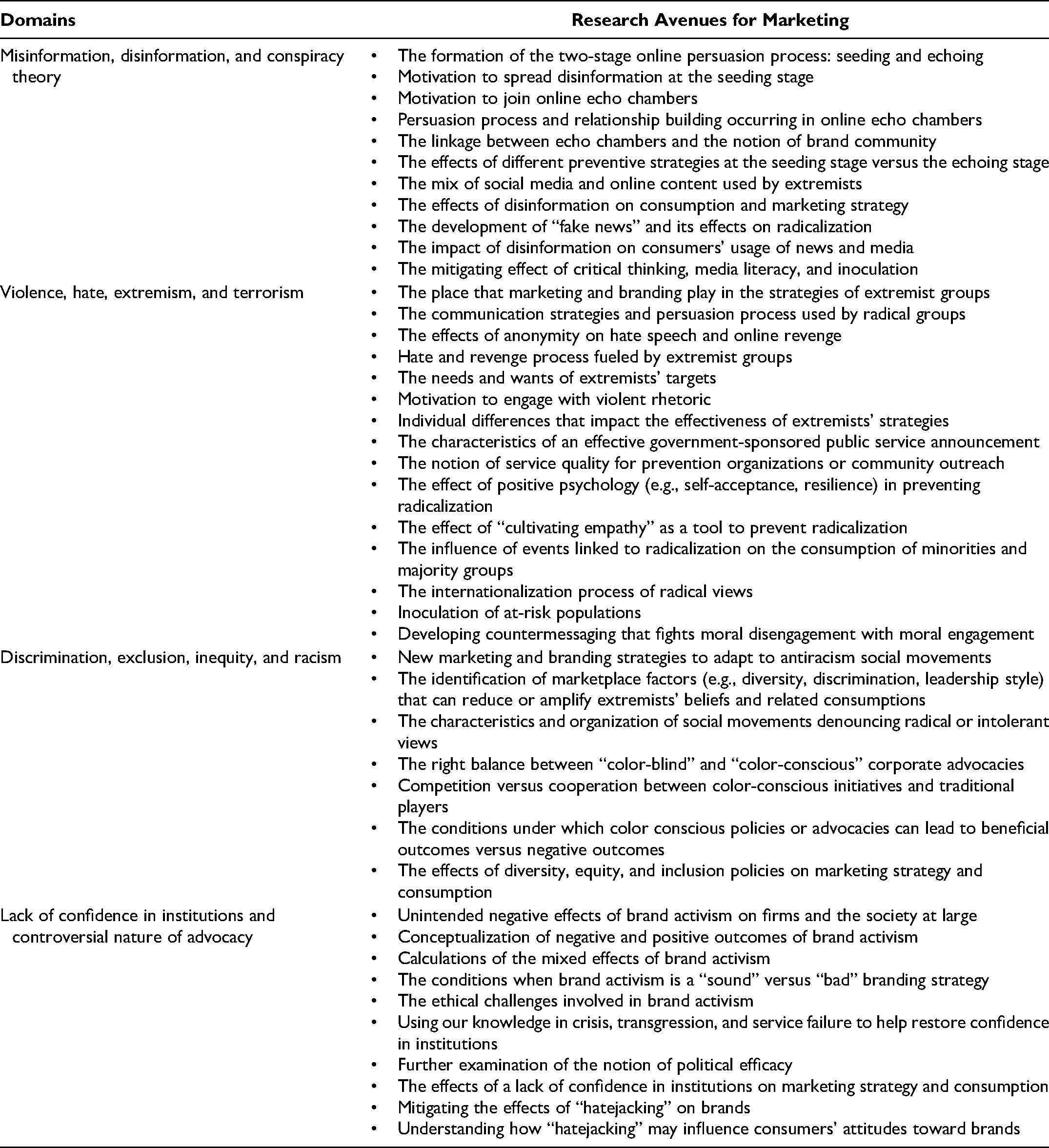
First, given the expertise of our discipline in persuasion and communication, it seems that much more could be done to understand the processes leading to the development of conspiracy theories. Here, Diaz Ruiz and Nilsson's (2023) proposed persuasion process of seeding and echoing is particularly insightful. At the seeding stage, individuals with malicious intent spread disinformation knowing that this information is false and unreasonable. As a fruitful research avenue, it would be important to understand the motivation of these individuals to spread blatant disinformation. Is it popularity, money, or impact on social media? Then, the second stage of echoing becomes even more crucial. At this stage, members of an echo chamber start truly believing the false information created at the seeding stage; here, it becomes a case of misinformation. Members of the echo chamber believe this information because it reinforces their core values and self-identity. In terms of promising future research, we propose that researchers apply the notion of brand community to echo chambers to better understand the relational and identity dynamics occurring at this stage.
Second, it is quite disturbing to uncover how much extremist groups intensively resort to marketing and communication tactics to promote their “product”—that is, radical ideologies. Therefore, it is important to use a marketing lens to deconstruct their strategies and design effective countermeasures. For instance, we need to comprehend the place that branding plays in the development and rising popularity of extremist groups. These groups possess a “strong brand,” and they often use branded products to reassert their uniqueness and differentiation in their competitive landscape. At its height, the Islamic State's effective use of branding helped it secure its position as the “global premier terrorist organization … well above other competing terrorist organizations” (Simons 2018; p. 332). As evidence of its brand recognition and awareness, the terror group's brand components such as its logo and symbols were among the most recognized when compared with organizations or nations. Referring to a 2017 study by the Leaders in Nation Branding, Simons reports that IS's branding elements were more recognized than the Vatican's branding elements.
In terms of a recommendation, we propose that researchers use their marketing knowledge to better understand the branding and communication strategies of extremist groups. Then, they would use this same knowledge to develop superior marketing counterstrategies to prevent the rise of violence, hate, and extremism. In our opinion, the work of Frazer (2023) represents an insightful blueprint to accomplish such a process.
Third, there are many unresearched marketing issues that are related to the notion of discrimination, exclusion, and inequity. On the one hand, in the wake of global antiracism movements, many firms have changed part of their branding (e.g., names, logos) to avoid perceived racial bias (e.g., Aunt Jemima, Eskimo Pie, Uncle Ben's). These types of initiatives show that many managers are aware of the connections between their business and societal issues. On the other hand, consumers with a far-right extremist orientation may consider it a betrayal when national brands take a stance on inclusion or diversity through multiculturalism (Ulver and Laurell 2020). These unintended effects on consumers may be unsettling for brands, which can struggle to find the proper ways to adapt to recent social movements. It remains important to determine how brands can constructively engage in potentially divisive social issues in a way that balances both economic implications and societal well-being. Here, we join Chisam, Germann, and Palmatier's (2022) call for more scholarly work on brand activism. These researchers report, for instance, that in the last five years, only 8% of the work published in JPP&M focused on corporate activism.
Relatedly, another area that needs more academic attention would be brand “hatejacking” (Benton and Peterka-Benton 2020; Buntain et al. 2022; Siano et al. 2021). Hatejacking occurs when extremist or hate groups co-opt a brand against their will. For instance, in the lead-up to the 2020 U.S. elections, proponents of the QAnon conspiracy theory hijacked the #SaveTheChildren hashtag campaign to gain exposure (Buntain et al. 2022). More recently, Bucky the Beaver, mascot of the Texas gas station chain Buc-ee's, has been hijacked by the Proud Boys (Holley 2022). Hatejacking is concerning for brand managers, as they do not want their brand to be associated with hate or radical ideology. However, engaging in public exchange with these extremist groups may also increase public awareness or attention to the group and its ideology. What can a brand do in this case? Change its name? And how does such an event influence consumers’ opinions of these brands?
Fourth, the lack of confidence in institutions and political parties is a key factor explaining the rise in extremism and radical beliefs. Because people no longer trust institutions to “do the right thing,” these individuals may feel they have to “take laws into their own hands” and get information from sources other than governments. In simple terms, policy makers, institutions, and governments are currently facing major reputation crises. Here, we invite marketing scholars who specialize in service crisis, transgression, and failure to use their knowledge to help institutions rebuild their reputations among citizens (Weber et al. 2023). It should be noted that these previous examples are just a sample of new radicalization topics that marketing could tackle. For a more exhaustive list of potential topics, see Table 2.
Conclusion
Two years ago, we set out on a mission to add a marketing voice to the discussion about radicalization. We feel that the publication of this special issue is a big step forward in what will likely be a long and important journey for us and the academic community. As a complement to the work of our excellent contributors, the current editorial aims to delimit the domains in which marketing knowledge can be used to prevent radicalization. Specifically, we identified four domains in which marketing research could play such an important role: (1) misinformation, disinformation, and conspiracy; (2) violence, hate, and terrorism; (3) discrimination, exclusion, inequity, and racism; and (4) lack of confidence in institutions and controversial nature of advocacy (see Table 1). We believe that the articles and commentaries nicely set the stage for a field titled “Marketing to Prevent Radicalization.” In our opinion, the content of this special issue represents an effective starting point to get marketing involved in the discussion about radicalization. This editorial also acts as a form of research manifesto. We use this opportunity to claim in the strongest terms possible that marketing has an important role to play in understanding, preventing, and decreasing the occurrences of events motivated by radicalization. We sincerely hope that many marketing researchers will answer this call.
Footnotes
Declaration of Conflicting Interests
The author(s) declared no potential conflicts of interest with respect to the research, authorship, and/or publication of this article.
Funding
The author(s) disclosed receipt of the following financial support for the research, authorship, and/or publication of this article: Our research on the use of marketing to prevent radicalization has been made possible with the funding from the Social Sciences and Humanities Research Council (SSHRC) of Canada.