




Abstract
Despite the ubiquity of celebrations in everyday life, little is known about how celebrations may contribute to consumer well-being. In the current work, the authors propose that celebrations promote perceived social support, which prior work has conceptualized as the belief that others will be there for you for future negative life events. The authors further theorize that celebrations require three key characteristics that, in combination, are necessary for increasing perceived social support. Specifically, celebrations must (1) mark an individual's separate positive event and (2) involve consumption (3) with others (i.e., social). They test this theory across eight studies and demonstrate a process mechanism for this effect: these characteristics lead to increases in enacted support and perceived responsiveness, which in turn lead to increases in more general perceived social support. They then extend these findings by investigating virtually held celebrations, the individual's role at the celebration, and a downstream prosocial outcome. By doing so, this work highlights the broader benefits of celebrations beyond the focal individual and the immediate experience. Finally, specific policy implications and suggestions for enhancing consumer well-being are provided.
Perceived social support is the belief that others will be there for you, as needed, for future life events (Barrera 1986; Cohen 1988). It has been consistently and reliably shown to be associated with many positive physical and mental health outcomes, including better coping with disease (Edens, Larkin, and Abel 1992; Fong et al. 2017) and reduced symptoms of depression (Rueger et al. 2016). Conversely, a lack of perceived social support or feelings of loneliness have been associated with increased drug and alcohol use, high blood pressure, stress, and even premature death (Cacioppo and Patrick 2008; House, Landis, and Umberson 1988; Pieters 2013). Despite the consistent and repeatedly shown well-being benefits of perceived social support, little is known about how perceived social support originates (Feeney and Collins 2015). Thus, understanding the factors that influence and contribute to perceived social support is an important task for researchers and policy makers.
In the present research, we posit and provide initial evidence for one way in which individuals may increase perceived social support: through celebrations. Celebrations can be defined as the action of marking an important event or occasion. They play an integral role in culture and society, with their many traditions serving as a “social glue” to bind social groups (Etzioni and Bloom 2004). Celebrations can therefore be thought of as contributing to the health of a society through connection and cohesion. For example, think of a recent positive event you experienced. Perhaps it was a job promotion, an article published, or a graduation achieved, or you merely survived another year of life (i.e., had a birthday). What, if anything, did you do to mark that event? What, if anything, did you want to do? For many, celebrations serve as a way to highlight life events. Despite the prevalence of celebrations in society, little is known about celebrations or how they contribute to individual well-being. Moreover, although extensive research has focused on the benefits of perceived social support during times of adversity (e.g., Andrade and Cohen 2007; Cohen 1988; Cohen and Wills 1985), little research has examined social support during positive life events. Some researchers have even called attention to the lack of research on social support during times of nonadversity and emphasized the importance of this type of supportive function in helping people thrive. They note that “very little theoretical or empirical work has focused on the factors that promote or hinder effective social support processes in close relationships” (Feeney and Collins 2015, p. 130). In the present work, we examine celebrations and argue that they are crucial from both marketing and policy perspectives because they can increase perceived social support and serve as a potentially powerful public health tool for policy makers.
The COVID-19 pandemic further highlights the importance of studying celebrations and their impact on individual well-being. During a time in which social distancing and quarantining were essential to public health and the efforts to mitigate the impact of the pandemic, celebrations large and small were altered. Graduations, weddings, Pride marches, birthday parties, and many more celebrations had to be canceled, postponed, or moved to a virtual format due to public health concerns. Not being able to celebrate in person was a consequence of the pandemic that was acutely felt by many; people have even anecdotally reported feelings of grief from losing the ability to celebrate in the traditional way (Varma-White 2020). Ironically, the very public policy measures (e.g., physical distancing) introduced to keep the public safe could have unintended consequences. As stated by Scott et al. (2020, p. 263), “Decisions made by policy makers in response to the COVID-19 pandemic must begin with the well-being of constituents (consumers) in mind,” and we argue that this should include mental health considerations. Consequently, understanding the ways in which social interactions benefit individuals is an important issue for policy makers to consider, especially given that implementing regulations that restrict such interactions could inadvertently affect well-being.
We posit that to increase perceived social support, a celebration must have three key characteristics: it marks a separate positive event, it involves others (i.e., social), and it involves consumption. We systematically test each of these characteristics to show that their combination, as opposed to just one or two of the characteristics, leads to increased perceived social support. We further suggest that these characteristics jointly enhance perceived social support by allowing one's social network to successfully enact an instance of support for the individual. This show of support regarding a specific event increases the perception of responsiveness from one's social network, which we propose, in turn, increases perceived social support more broadly, thereby illustrating a process mechanism. Prior literature has referred to taking advantage of positive life events, for example, telling others about personal positive events (Gable et al. 2004), as capitalization (Langston 1994). We therefore refer to a celebration that has these three characteristics as a capitalization celebration because we theorize that this type of celebration most effectively capitalizes on the positive event and produces increases in perceived social support. We test our theory across eight studies, including two studies examining virtually held celebrations to better understand how celebrations influence perceived social support in today's rapidly changing environment and one study that examines a downstream prosocial outcome to highlight the broader implications of celebrations and perceived social support.
Theoretical Background
Perceived Social Support
Perceived social support is an important and meaningful construct that has a long history within the health and social psychology literatures. Perceived social support is defined as the belief that others will be there for you during future times of adversity (Cohen and Wills 1985). Dating to the 1970s (e.g., Rabkin and Struening 1976), with researchers at the time calling for a better understanding of the relationship “between stressful life events and symptomatology” (Procidano and Smith 1997, p. 94), an abundance of work has investigated this construct over the years. Due to the immense interest, researchers have put forth different theories regarding how and why social support might impact well-being. Some of this work has proposed and focused on the buffering hypothesis, which is the expectation that social support might buffer or moderate the impact of stressful events (Barrera 1986; Cohen and Wills 1985). However, significantly more research has demonstrated social support's direct effect and contribution to well-being (Procidano and Smith 1997). Specifically, perceived social support has been consistently associated with decreased morbidity and mortality rates (Adams, King, and King 1996; Cohen and Wills 1985; Cox 2012; Kaul and Lakey 2003; Turner 1981; Uchino 2009), better mental health outcomes (Wang et al. 2018), better coping with disease (Fong et al. 2017; Holahan et al. 1997), reduced levels of anxiety and depression (Fleming et al. 1982; Rueger et al. 2016), reduced heart rate and blood pressure (Uchino, Cacioppo, and Kiecolt-Glaser 1996), and better quality sleep (Pow et al. 2017).
However, there is a surprising contradiction in this literature in that although perceived social support is positively related to health and well-being outcomes, enacted support, or the actual receipt of support, has shown mixed results. Some research has suggested weak positive associations between enacted support and health and well-being measures (Kaul and Lakey 2003; Knoll et al. 2007; Lakey et al. 2010), whereas other research has shown them to be unrelated (Bolger and Amarel 2007). Worse yet, some research has suggested that enacted support is associated with negative outcomes (Barrera 1986; Bolger, Zuckerman, and Kessler 2000; Fisher, Nadler, and Whitcher-Alagna 1982; Marigold et al. 2014; Shrout, Herman, and Bolger 2006). That is, although perceived social support (the belief that others will be there for you for future negative life events) has consistently been shown to have positive outcomes for individuals, enacted support (i.e., actual received support) has shown, in some cases, to have no effects and, in other cases, to have negative effects.
Several explanations have been put forth to explain these contradictory findings, such as the suggestion that receiving social support (i.e., enacted support) can cause feelings of dependency, indebtedness, and increased distress (Gleason et al. 2003). Another explanation for the ambivalent responses to enacted support is that providing high-quality support during negative life events is challenging and can often backfire (Kaul and Lakey 2003); indeed, recent research shows that people often find it easier to give gifts rather than in-person support during negative life events (Wiener, Howe, and Chartrand 2022). In addition, the literature on social support has highlighted our current lack of understanding about how enacted support contributes to perceptions of social support (Gable et al. 2012; Haber et al. 2007), meaning that the two are not consistently correlated. Furthermore, and relevant for this research, little is known about how perceptions of social support originate (Feeney and Collins 2015). In summary, although it is evident that perceived social support (i.e., the belief that others will be there for you for future negative life events) is repeatedly associated with positive health outcomes, enacted (or received) support is associated with mixed outcomes. In addition, how individuals build social supportive resources is still unclear.
These findings leave researchers with two critical research tasks: (1) to determine how perceptions of support originate, or how they can be influenced, and (2) to understand why enacted support does not function in the same manner as perceived support (Coyne and DeLongis 1986; Gable et al. 2012). In the present research, we focus on these tasks and suggest that one way that individuals may build perceptions of social support is by means of a particular type of celebration.
Conceptualizing Celebrations
Celebrations come in many shapes and forms, but we argue that not all are equal in terms of their potential to increase perceptions of social support. We theorize that all celebrations entail the intentional marking of a separate life event (represented by the circle in Figure 1) but can vary in meaningful ways. We conceptualize celebrations as varying across several key dimensions: the valence of the separate life event that is being marked (depicted by the two halves of the circle in Figure 1), the involvement of consumption (depicted by the dotted oval in Figure 1), and the involvement of others (depicted by the dashed oval in Figure 1). These dimensions overlap to create distinct consumer experiences. We next discuss each of these combinations to develop our proposition that celebrations that involve the combination of marking a positive separate life event with social consumption (depicted by the shaded area D in Figure 1) increase perceived social support.

Conceptual Representation of Celebrations.
We place celebrations in the larger context of consumer experiences. First, it is important to note the definitional feature of marking a separate life event that distinguishes celebrations from other consumer experiences. Experiences can loosely be categorized into two different types: (1) those in which the experience occurs because of a separate event (i.e., a celebration) or (2) those in which the experience is the focal event. Situations in which the experience is the focal event (represented by A, B, and C in Figure 1) occur frequently throughout consumers’ day-to-day lives. In these types of situations, the experience itself serves as the central reason for taking part (e.g., Ratner and Hamilton 2015). Going to the movies because you wanted to see the movie and going to a concert are examples in which an experience is the focal event.
The present work highlights experiences that occur because of a specific separate event (i.e., celebrations, as depicted by the circle in Figure 1). We suggest that experiences marking a separate event can stem from a separate event that has either an overall positive or negative valence. Imagine receiving a promotion or having a paper accepted. Conversely, imagine getting fired or having a paper rejected. Now imagine choosing to mark that event, such as by getting a drink. Whereas much of the prior literature has focused on responses to negative life events (e.g., coping; Carver, Scheier, and Weintraub 1989; Folkman and Moskowitz 2004; Pearlin and Schooler 1978; Stanisławski 2019), in the present research we focus on responses to positive life events to underscore the importance of such understudied experiences in consumers’ lives.
Continue to imagine the positive separate event example of receiving a promotion and choosing to mark that event. How does one mark the event? One could choose to use consumption (as depicted by the “consumption” oval that overlaps with the circle in Figure 1). Using consumption to mark a promotion could involve going out to eat by yourself or buying a gift such as chocolates for yourself (i.e., self-gifting; Mick and Demoss 1990). Each of these examples represents a form of solo celebratory experience (reflected by E in Figure 1). One could also choose to involve others (as depicted by the “social” oval that overlaps with the circle in Figure 1). Involving others to mark a promotion could involve going on a walk and could also be construed as a celebratory experience (reflected by F in Figure 1). These choices reflect the characteristics of involving consumption and being social, respectively. However, because these experiences only have two of the three proposed necessary characteristics (marking a separate positive event with either consumption or being social), we propose that they will not lead to the same increases in perceived social support that experiences having all three characteristics will (i.e., marking a positive separate event with social consumption, reflected by D in Figure 1). For simplicity, we refer to these types of celebrations as capitalization celebrations. We chose this term to be consistent with prior work on verbal responses to positive life events (Gable et al. 2004; Langston 1994).
Capitalization Celebrations and Increased Perceived Social Support
Unlike experiences that only have one or two of the proposed key characteristics, we theorize that celebrations that involve all three (i.e., capitalization celebrations) uniquely increase perceived social support because the characteristics, combined, serve as a tangible signal of effort, responsiveness, and connection with others.
As previously mentioned, a celebration, by definition, must mark a separate event. Importantly, we propose that the valence of the separate event matters. Research has examined how individuals cope with negative events (Andrade and Cohen 2007; Rick, Pereira, and Burson 2014), and we suggest that just as responding when something goes wrong is important, so too is responding when things go right. We suggest, along with previous researchers, that providing support during times of stress (or in response to negative life outcomes) can be difficult for both the giver and receiver (Bolger and Amarel 2007; Rafaeli and Gleason 2009), and individuals may fail at providing this support. However, providing support when things go right, or in response to positive life events, is easier and may pose fewer risks to the provider and recipient. This has been shown in research focusing on verbal responses to positive and negative life events (Gable et al. 2012).
Research on verbal responses to positive life events has demonstrated the importance of sharing positive news with others. Specifically, research has shown that when people verbally shared news of a positive event with others, they experienced greater positive affect (Langston 1994). The positive affect was found to be above and beyond the increases associated with the valence of the positive event itself. Importantly, how people respond to an individual's positive news matters. When others are perceived to respond actively and constructively (as opposed to passively or destructively), the affective benefits are enhanced (Gable et al. 2004). Specifically, the benefits of sharing with others are best achieved when the responder is positive, engaged, and interested (Gable et al. 2012; Gable and Algoe 2010). This type of received support (i.e., close others’ verbal responses to a person sharing good news) has been termed “capitalization support” (Gable et al. 2004; Langston 1994). We therefore theorize that marking a positive event is a necessary (but not sufficient) condition for celebrations to reliably foster perceived social support.
We further theorize that social consumption must be layered onto the positively valenced celebration in order to increase perceived social support. We build on prior research to suggest that using social consumption to respond to someone's positive life event should serve as an even greater form of active, constructive responding above and beyond verbal responding. This is because consumption, in the form of food and drink, to mark an individual's positive separate event requires more effort than a verbal response. For example, others must plan, in advance, to gather for the social consumption, which constitutes spending additional time on the focal individuals. Others must be present to participate. Participation involves actively engaging in the consumption experience, including spending physical and other resources such as time and money, as these experiences often involve indulgent food and beverages, the consumption of calories, expenses, and effort. Through the effort involved in joint consumption marking a positive separate event, participants signal support, not only for the specific separate event, but also for the relationship more broadly.
This theorizing is also in line with research demonstrating that consumption with others has been shown to be important for enhancing relationships (e.g., “Sharing (in consumption) tends to be a communal act that links us to other people” [Belk 2010, p. 717]). It not only connects us with others but also can create feelings of bonding, belongingness, and solidarity (DeVincenzo and Scammon 2015); it is through consumption that companionship arises. “Companionship is derived from the Latin pannis or bread. Companionship is the consequence of a shared meal” (Turner and Rojek 2001, p. 28, quoted in Belk 2010, p. 717). This reasoning is further in accord with anthropological and sociological research, which have long identified consumption as a common ritual in holiday gatherings (for a review, see Etzioni and Bloom [2004]). This body of research shows that the consumption of food on holidays plays an important role in society by acting as a “social glue” to unite both family groups and the larger society together under a common set of traditions (Schoonmaker 2006).
Finally, consider the theoretical importance of marking a separate positive life event. By marking a preceding, separate positive life event with social consumption at a later time, capitalization celebrations can create a secondary experience that is then shared with others and has a purpose: to reinforce the positive life event. This purpose gives meaning to the shared experience, creating an amplifying effect for the celebrant similar to the broaden-and-build theory of emotions (Fredrickson 2013). The celebrant has the initial positive separate event and then can magnify and expand this event through the secondary social consumption event. In addition, consuming together can extend one member's personal separate event to include others through companionship and “shared bread,” thereby strengthening the “social glue” and potentially providing benefits for others.
We posit that the combination of these key characteristics (i.e., engaging in social consumption to mark an individual's separate positive event) allows participants to successfully demonstrate support for that individual. That is, this specific type of celebration, a capitalization celebration, should be perceived by the focal individual as a successful form of enacted support. Consequently, this perception of successfully enacted support should increase the focal individual's perception of the responsiveness of others to that individual. Perceived responsiveness has been defined as an individual's perceptions about the extent to which other people are cognizant of, sensitive to, and behaviorally supportive of that individual (Ibarra-Rovillard and Kuiper 2011). Previous research has suggested that there must be a match between the situation and the resources provided by others in order to see an effect on perceived social support (i.e., the matching hypothesis; Cutrona and Russell 1990), and we suggest that this occurs in a capitalization celebration.
In summary, we theorize that a capitalization celebration will lead to views of others as successfully enacting support for a specific life event, which will lead to increases in perceived responsiveness, which will, in turn, lead to the belief that others will be there for you for future life events (i.e., increased perceived social support). See Figure 2.

Overall Model of How a Capitalization Celebration Increases Perceived Social Support and Prosocial Intentions.
In addition to the benefits of this specific type of celebration for the individual who had the positive separate event (i.e., the focal celebrant), we theorize that there may also be benefits for others. First, we posit that this type of celebration may increase perceived social support for those who participate in the capitalization celebration (i.e., celebration organizers, attendees). Research has shown that spending money on others and doing nice things for others leads to greater happiness (Dunn, Aknin, and Norton 2008). Doing nice things for others can also increase feelings of belonging in a social group (Nelson et al. 2016), and giving to others is associated with positive outcomes such as increased self-esteem (Piferi and Lawler 2006) and feelings of social connection (Inagaki and Eisenberger 2012). Therefore, we investigate whether supporting others by participating in this type of celebration can lead to positive outcomes for the participant in the form of increases in perceived social support on the part of the participant. Second, because perceived social support has been associated with many positive outcomes, including playing an important role in the development of socially responsible behavior among consumers (Ali and Mandurah 2016), we explore whether there are additional downstream consequences of celebrations for others who are not directly involved in the celebration. Specifically, we examine whether increased perceived social support as a result of participating in this type of celebration will lead to a greater willingness to give back to others, thereby demonstrating broader policy implications of this work.
Current Research
The present research tests our theory of the importance of capitalization celebrations for increasing perceived social support, defined as the belief that others will be there for you for future negative life events (Cohen 1988). The first set of studies (Studies 1, 2a, 2b, and 3) begins by systematically testing each of the three characteristics (social consumption, marking an individual's separate, positive event) of capitalization celebrations we propose are necessary for increasing perceived social support. In addition, Study 3 tests our proposed process, namely that a capitalization celebration is associated with views of successfully enacted support, which leads to greater perceived responsiveness, which in turn leads to greater perceived social support. By doing so, this study directly examines a way in which enacted support, or the actual receipt of support for a specific life event, can lead to increases in perceptions of social support more broadly.
While the first set of studies focuses on the perspective of the focal celebrant to establish a connection between capitalization celebrations and perceived social support, the next set of studies (Studies 4a–6) broadens our investigation to examine policy-relevant factors and downstream consequences. Specifically, Studies 4a and 4b examine whether capitalization celebrations must be held in person or whether they can be virtual, an important consideration given the alterations and policy restrictions due to the COVID-19 pandemic and changing consumer landscape (e.g., the increase in the use of virtual technologies for socializing). Study 5 then examines how an additional feature of capitalization celebrations, namely the role of the participant, can influence perceived social support. In other words, we examine benefits beyond the focal individual. Finally, Study 6 examines a prosocial downstream consequence of increased perceived social support resulting from celebrations, highlighting the importance of celebrations more generally.
Study 1
In each of the first set of studies (Studies 1–3), we compare a capitalization celebration condition (i.e., a condition in which all three characteristics are present) to conditions lacking one or more of those key characteristics. Study 1 begins by testing the positive separate event and social characteristics while consumption is held constant. Specifically, we examine whether going to a restaurant to mark a promotion with friends (i.e., a capitalization celebration; D in Figure 1) leads to greater perceived social support than going to a restaurant just because it's Friday (solo consumption; A in Figure 1), going to a restaurant with friends just because it's Friday (i.e., social consumption but no separate event; C in Figure 1), or going to the restaurant alone to mark a separate event (solo consumption marking a positive event; E in Figure 1).
Method
Three hundred seventy-four participants (204 men, 168 women; 2 participants did not identify) from Amazon Mechanical Turk (MTurk) successfully completed the study in exchange for financial compensation. Participants ranged in age from 19 to 70 years (M = 35.86 years, SD = 10.36).
This study had a 2 (separate event vs. no separate event) × 2 (social vs. solo) between-subjects design. Participants were randomized to one of the four conditions. Participants in the no separate event conditions were asked to imagine that “it is a Friday evening and you just got off work.” Then, depending on whether they were in the solo or social consumption condition, participants were told, “You decide to get dinner and drinks at a restaurant by yourself/with friends.” Participants in the separate event condition were asked to imagine that “it is a Friday evening and you just got a promotion at work.” Participants in the separate event conditions were also asked to imagine that they decided to get dinner or drinks by themselves/with friends, depending on social condition, to celebrate. To make the scenario more immersive, we used a photo-essay approach. See the Web Appendix for the images and scenario used. After they responded to a series of items about the experience and some filler items, participants next completed the Multidimensional Scale of Perceived Social Support (MDSPSS; Zimet et al. 1988; α = .94), our focal measure of perceived social support. This is a well-established measure that is commonly used in research on social support and has been shown to be associated with other well-being outcomes (Clara et al. 2003; Dahlem, Zimet, and Walker 1991; Khan and Husain 2010). It includes items such as “There is a special person around when I am in need” and “I can count on my friends when things go wrong.” We chose this measure because it captures different types of relationships and assesses perceptions of support for future negative life events.
Results and discussion
To test whether social consumption to mark a separate positive event (i.e., a capitalization celebration) was associated with greater increases in perceived social support than just social consumption or consumption alone to mark a separate event, we conducted a two-way analysis of variance (ANOVA) on perceived social support. Results revealed a significant interaction effect (F(1, 370) = 5.46, p = .020), a marginal main effect of the separate event condition (F(1, 370) = 5.29, p = .058), and a nonsignificant main effect of social condition on perceived social support (F(1, 370) < 1.00, p > .25). Importantly, and in line with predictions, planned comparisons revealed that participants in the capitalization celebration condition (i.e., separate event, social consumption condition) reported significantly greater perceived social support (M = 5.83, SD = 2.40) than those in each of the other three conditions (vs. no separate event, social consumption: M = 5.30, SD = 2.36, t(370) = 3.06, p = .002; vs. no separate event, solo consumption: M = 5.47, SD = 2.32, t(370) = 2.06, p = .040; vs. separate event, solo consumption: M = 5.42, SD = 2.51, t(370) = 2.26, p = .025). The other three conditions did not differ from one another in terms of perceived social support (ps > .25). See Figure 3.

Interaction of Social or Solo Consumption and Presence of a Separate Event.
In this study, we examined two of the characteristics of celebrations that we propose are necessary to build perceived social support, namely marking a separate event and involving other people (i.e., social), holding consumption constant. In line with our theorizing, we find that celebrations that both involve social consumption and mark a separate event are associated with greater perceived social support than just social consumption (i.e., without a separate event) and solo consumption (whether it is celebrating a separate event or not). Thus, we show that both being social and marking a separate event are jointly key contributors to increasing perceived social support.
Studies 2a and 2b
In Studies 2a and 2b, we experimentally test the valence of the separate event. We theorize that social consumption is more effective at increasing perceived social support after a positive life event (capitalization celebration; D in Figure 1; Studies 2a and 2b) compared with support after a negative life event (Dʹ in Figure 1; Studies 2a and 2b) or a positive life event without consumption or possible companions (positive control; Study 2b). By including a positive control condition with no mention of social consumption, Study 2b further tests the social and consumption characteristics.
Study 2a method
Two hundred fourteen MTurk participants (134 men, 79 women; 1 participant did not identify) successfully completed the study in exchange for financial compensation. Participants ranged in age from 18 to 70 years (M = 33.53 years, SD = 10.10).
Participants in this two-cell between-subjects study were randomized to one of two conditions: positive separate event condition (i.e., social consumption to respond to a positive life event; D in Figure 1) or negative separate event condition (i.e., social consumption to respond to a negative life event; Dʹ in Figure 1). That is, in this study, we keep social and consumption constant and vary whether the separate event had a positive or negative valence. In the positive separate event condition, participants were asked to recall and describe a time when something positive happened to them and they responded to the positive event by engaging in a consumption activity with others. Participants in the negative separate event condition were asked to recall and describe a time when something negative happened to them and they responded to the negative event by engaging in a consumption activity with others. As the focal dependent measure, participants completed the same measure of perceived social support as in the prior study (MDSPSS; Zimet et al. 1988; α = .94). See the Web Appendix for additional measures and details.
Study 2a results
Results revealed a significant difference between the conditions in terms of perceived social support (t(212) = 2.01, p = .046). The positive separate event condition reported greater perceived social support (M = 5.70, SD = 1.14) than the negative separate event condition (M = 5.39, SD = 1.06). That is, participants believed more people would be there for them for future negative life events after recalling a positive life event than after recalling a negative life event. Although these results might seem surprising, this is in line with our theorizing that it is harder to provide support after a negative life event than after a positive one. Consequently, individuals believe that others will be more likely, or more able, to be there for them for a future life event after experiencing support from others in response to a positive life event (i.e., after a capitalization celebration).
However, it is possible that these results are driven by a mood effect; perhaps recalling any positive event, regardless of whether it is celebrated, would have the same effect on perceived social support. We aim to rule out this possibility in Study 2b.
Study 2b method
Two hundred seventy-one MTurk participants (146 men, 121 women, 4 nonbinary participants) successfully completed the study in exchange for financial compensation. Participants ranged in age from 18 to 74 years (M = 39.78 years, SD = 11.40).
Participants were randomized to one of three conditions, two of which were the same as in Study 2a: positive separate event condition (i.e., social consumption to respond to a positive life event; D in Figure 1) and negative separate event condition (i.e., social consumption to respond to a negative life event; Dʹ in Figure 1). The third condition was a positive control. As in the previous study, participants in the positive (and negative) separate event condition were asked to recall and describe a time when something positive (negative) happened to them and they responded to the positive (negative) event by engaging in a consumption activity with others. Participants in the positive control condition were asked to recall a time when something positive happened to them. Participants completed a filler item and then completed the same measure of perceived social support as used in the previous studies (MDSPSS; Zimet et al. 1988; α = .94). As this was a recall study, we asked participants how difficult it was to recall an experience (to rule out differences in recall as a possible alternative explanation) on a five-point scale (1 = “Extremely difficult,” and 5 = “Extremely easy”). Participants then completed demographic items.
Study 2b results
Results revealed a marginally significant main effect of condition on perceived social support (F(2, 268) = 2.63, p = .074). In line with predictions, planned comparisons indicated that those in the positive separate event condition reported significantly greater perceived social support (Mpos_event = 5.88, SD = .82) than those in the positive control condition (i.e., those who just recalled a positive event without others or consumption; Mcontrol = 5.55, SD = 1.20; t(268) = 2.05, p = .042) and marginally greater support than those in the negative separate event condition (Mneg_event = 5.55, SD = 1.33; t(268) = 1.91, p = .058). The positive control and negative separate event conditions did not differ from one another (t(268) = .01, p > .25).
There were no differences between the conditions in terms of how difficult it was to recall a recent experience (Mpos_event = 4.51, SD = .79 vs. Mneg_event = 4.38, SD = .99 vs. Mcontrol = 4.61, SD = .77; F(2, 268) = 1.71, p = .18), ruling this out as an alternative explanation.
Discussion of Studies 2a and 2b
In Studies 2a and 2b, we find that recalling social consumption to mark a positive separate event (i.e., a capitalization celebration) leads to greater perceived social support than merely recalling a positive event or recalling social consumption to cope with a negative separate event. That is, we find evidence to suggest that people are more likely to believe they will have support for future negative life events after thinking about consuming with others for a positive event compared with a negative one or just thinking about a positive event. Thus, our findings suggest one important way individuals may build social supportive resources (via capitalization celebrations) and demonstrate the value of consumers’ marking their positive life events with social consumption.
Study 3
As previously mentioned, some research suggests the importance of verbally responding to others after a positive life event (Gable et al. 2004; Langston 1994). In the present research, we expand on these findings to suggest that responding with consumption to a person's positive life event (capitalization celebration; D in Figure 1) may be even more effective at increasing perceptions of perceived social support than social responding without consumption (F in Figure 1). Therefore, in Study 3, to test whether consumption contributes to perceived social support, we hold the social characteristic (via verbal responses) and the positive separate event characteristic constant and manipulate whether the event is also marked with consumption or not. Importantly, in this study, we also test our proposed process for how celebrations lead to increases in perceived social support: by increasing perceptions of both enacted support and perceived responsiveness.
Method
Two hundred fifty-eight MTurk participants (146 men, 112 women) from the United States successfully completed the study in exchange for financial compensation. Participants ranged in age from 19 to 64 years (M = 34.54 years, SD = 8.72).
This study had a two-cell (consumption vs. control) between-subjects design. First, to establish a positive, separate event worth marking, all participants were asked to imagine that they had just completed a difficult project at work that they had been working on for weeks. They were told that the project was a success and were asked to describe how they would feel. All participants were told that as they were leaving the office, they saw their coworker, Chris. To make the scenario more immersive, we again used a photo essay approach in which they were shown an image of Chris and were told that they shared their good news with Chris and that Chris was happy for them. (See the Web Appendix for images and scenario.) Next, participants were told that it was the following day and they found out Chris had shared their good news with a group of coworkers. Half of the participants (control condition) were randomly assigned to imagine that their coworkers responded with positive verbal responses. The other half of the participants (consumption condition) were asked to imagine the same thing, but in this condition, participants were also told that two of their coworkers brought in cookies to celebrate.
Participants then completed a series of unrelated filler items before completing the focal measures of enacted support, perceived responsiveness, and perceived social support. Enacted support was measured by three items designed to assess the extent to which individuals believed that their coworkers successfully enacted support for the promotion. It was measured with three items (“I would feel like my coworkers supported me,” “I would feel like my coworkers showed support for my positive event,” and “I would feel like my coworkers put effort into showing support”) on a nine-point scale (1 = “Strongly disagree,” and 9 = “Strongly agree”; α = .92). Our measure of perceived responsiveness was based on the active-constructive subscale of Gable et al.’s (2004) Perceived Responsiveness to Capitalization Attempts scale. It consisted of three items (“I would feel that my coworkers responded enthusiastically to my good news,” “I would feel that my coworkers were excited for me,” and “I would feel that my coworkers showed interest in my positive event”) rated on a nine-point scale (1 = “Strongly disagree,” and 9 = “Strongly agree”; α = .92). Participants also completed the same measure of perceived social support as used previously (MDSPSS; Zimet et al. 1988; α = .95).
Results and discussion
One participant incorrectly completed the scenario (e.g., wrote nonsense in the open response items) and was excluded from the analyses, leaving 257 participants. We first examined whether consumption in response to an individual's positive life event (i.e., a capitalization celebration) was associated with greater enacted support than verbal responses alone. In line with predictions, a t-test revealed that individuals in the consumption condition reported significantly greater perceptions of enacted (i.e., received) support (M = 8.31, SD = 1.15) than individuals in the control condition (M = 8.01, SD = 1.14; t(255) = 2.08, p = .039). Enacted support positively and significantly predicted perceived responsiveness (β = .90, t(255) = 33.54, p < .001), and perceived responsiveness significantly and positively predicted perceived social support (β = .43, t(255) = 7.62, p < .001).
To test for serial mediation, we used the PROCESS macro (Model 6; 10,000 bootstrapped samples; Hayes 2013) with consumption condition as the independent variable, enacted support as the first mediator, perceived responsiveness as the second mediator, and perceived social support as the outcome variable. This analysis supported serial mediation (Figure 4), with consumption leading to greater perceptions of enacted support, which led to increases in perceptions of responsiveness, which in turn led to greater perceived social support (indirect effect: .049; 95% confidence interval [CI]: [.004, .261]). In further support of the serial mediation model, all other models (i.e., switching the order of the mediators and single-mediator models) were not significant (all confidence intervals contained zero).

Serial Mediation Model.
In this study, we build on the literature on capitalization (Gable et al. 2004) and show that responding with consumption may serve as an even more active and visible sign of support than positive verbal responding alone. These findings further demonstrate the importance of social consumption in capitalization celebrations. Specifically, we find that social consumption to mark a positive separate event led to increases in views of enacted support, which subsequently led to increases in perceived responsiveness, which, in turn, led to increases in more general perceived social support. Note that throughout this work, we focus on joint consumption in the form of food, as it is a common occurrence in celebrations. Future research could examine whether other types of joint consumption, such as watching a slideshow of the celebrant or going to a concert, produce similar effects.
Overall, these findings demonstrate how actual, or enacted, social support may contribute to broader perceived social support, and thus begin to fill an important gap in the extensive literature on perceived social support.
Study 4a
In the next set of studies, we examine broader context and policy-relevant considerations for capitalization celebrations. First, Studies 4a and 4b examine virtual capitalization celebrations. Celebrations are often conceptualized and practiced as in-person gatherings. However, as a result of many of the regulations implemented due to the COVID-19 pandemic (National Governors Association 2020), celebrations were largely altered as in-person gatherings were restricted and social distancing practices were put in place. As individuals tried to find creative ways to still mark their positive life events, virtual celebrations increased, becoming almost commonplace. Indeed, with the proliferation of virtual socializing technologies, such virtual events remain commonplace even after pandemic-related restrictions were loosened. Therefore, in the next two studies we explore virtual celebrations and perceived social support. We hypothesize that as long as virtual celebrations have the same three characteristics of capitalization celebrations that we propose are important (i.e., social consumption marking at least one member's separate positive event), then they should also lead to greater perceived social support than a virtual gathering that does not have these characteristics.
Method
Participants from a southeastern university were recruited online to participate in a virtual lab session in which they completed a series of unrelated studies run in conjunction with one another in exchange for financial compensation. It is important to note that this study was conducted in April 2020, at the very beginning and height of the pandemic, when lockdowns were being implemented across the country. One hundred seventy participants (51 men, 118 women, 1 nonbinary participant) successfully completed this study. Participants ranged in age from 18 to 65 years (M = 27.49 years, SD = 9.47).
All participants were told, “People often have celebrations to mark positive life events. For example, people may go out to eat to celebrate a birthday, someone might invite friends to celebrate a new job or a promotion, or people might have a party as a housewarming celebration. Recently, because of current events, some people are choosing to celebrate virtually instead of in person. For example, some people are organizing video calls or video meetings where several people are online at the same time. We would like to ask you some questions about these virtual celebration experiences.”
We next asked if they had participated in a virtual celebration via video (yes/no). If they said no, they were asked if they had participated in a virtual gathering of any kind via video (yes/no). Next, all participants answered the same scale of perceived social support as used in the previous studies (MDSPSS; Zimet et al. 1988; α = .91). We also included a subjective happiness scale (Lyubomirsky and Lepper 1999; α = .87) and a meaning-in-life measure (three items, with one adapted from Steger et al. [2006]; α = .87) to see if virtual celebrations influence other well-being outcomes.
Participants who said yes to participating in either a virtual celebration or a virtual gathering were asked to describe the event and answer a series of questions about the experience. These items included whether there was consumption during the event (yes/no), the number of people who attended the event (free response), to what extent it felt like a celebration (1 = “Not at all,” and 9 = “Very much so”), how obligated they felt to attend the virtual event (1 = “Not at all,” and 9 = “Extremely”), and how this virtual experience compared with an in-person experience (1 = “Much worse,” and 7 = “Much better”). See the Web Appendix for more details.
Results and discussion
Out of the 170 participants, 100 participants (59%) said they had participated in a virtual celebration. Sixty-two participants said they had participated in a virtual gathering, and only eight (out of 170) said they had not participated in a virtual event of either kind. Again, this study was conducted during the height of the COVID-19 pandemic, when individuals were restricted in their ability to gather in person. This study was conducted as a means of assessing whether and to what extent people were using virtual technology to adapt to the restrictions in place. Consequently, these results are meaningful in that they suggest that many people immediately sought virtual ways to connect with others when in-person gatherings were severely restricted.
Participants who had recently participated in a virtual celebration, regardless of whom the celebration was for, reported greater perceived social support (M = 5.90, SD = .97) than those who had not participated in a virtual celebration (M = 5.58, SD = 1.15; t(168) = 1.94, p = .054). Those who had participated in a virtual celebration were significantly more likely to report that consumption had occurred (χ2 = 4.61, p = .032) than those who had participated in a virtual gathering, and consumption during the event was associated with marginally significantly greater perceived social support (t(160) = 1.91, p = .057), highlighting the importance of social consumption even during virtual events.
Although there was no difference in the number of people who participated in the virtual event or in the degree to which they felt obligated to participate (ps > .25), there was a marginally significant difference in how participants thought the virtual celebration (vs. the gathering) compared with an in-person event. Specifically, participants believed the virtual event was worse than an in-person event to a greater extent when it was a celebration (M = 2.47, SD = 1.03) than when it was a virtual gathering (M = 2.79, SD = 1.06; t(160) = 1.90, p = .059). Taken together, these findings indicate that even though participants believed a virtual celebration was worse than a virtual gathering when compared with an in-person event, they still reported, on average, greater perceived social support when describing a virtual celebration versus a virtual gathering. These findings thus highlight the positive health and well-being benefits of celebrations for building social capital, even in a virtual format. Interestingly, there was no difference between those who reported participating in a recent virtual celebration and those who did not in terms of subjective happiness or meaning in life (ps > .25), suggesting that the benefits of virtual celebrations may be specific to social, or interpersonal, well-being outcomes.
Study 4b
Study 4b expands on Study 4b by manipulating (as opposed to allowing participants to self-select) whether participants recalled a virtual social experience to mark a separate event (or not). In addition, we measured whether it involved social consumption (or not). This study therefore used a 2 (separate event vs. no separate event, manipulated) × 2 (social consumption: yes vs. no, measured) between-subjects design. Like the previous study, this study was conducted at the height of the pandemic (May 2020), when restrictions were in place to prevent in-person gatherings. However, since this study occurred a month after Study 4a, more people had experienced both virtual gatherings and virtual celebrations. Therefore, we could more reliably manipulate the type of virtual event. Doing so allows us to examine the characteristics of capitalization celebrations in a virtual setting with more precision.
Method
Participants from Prolific completed this study in exchange for compensation. To participate, participants had to be from the United States, not have taken the survey before, and recall a recent virtual experience. Five hundred thirty-one participants (221 men, 302 women, 8 nonbinary participants) completed the study in exchange for financial compensation. Participants ranged in age from 18 to 75 years (M = 31.79 years, SD = 12.00).
Participants were randomized to recall either a recent virtual experience that involved marking a separate event or not. We used language similar to the previous study to describe the virtual experience and asked people to describe it in as much detail as possible. We asked participants to describe the virtual experience through more questions, including whether consumption of food or drink was involved (yes/no) and what platform they used. (See the Web Appendix for more information.) Participants next completed the same measure of perceived social support as used previously (MDSPSS; Zimet et al. 1988; α = .92) and demographic items.
Results and discussion
We conducted an ANOVA with separate event condition, consumption condition, and their interaction on perceived social support. Results revealed a marginally significant interaction (F(1, 527) = 4.66, p = .056) on perceived social support. Neither the main effect of separate event nor that of consumption was significant (F(1, 527) = .17, p > .25; F(1, 527) = 2.22, p = .14), respectively). A planned contrast revealed that those who recalled a virtual experience marking a separate event that also had consumption (i.e., a capitalization celebration) reported significantly greater perceived social support than those in the other three conditions (t(527) = 2.23, p = .026). Planned comparisons revealed that those who recalled a virtual capitalization celebration reported significantly greater perceived social support (M = 5.66) than those who recalled a virtual experience marking a separate event without consumption (M = 5.33; t(527) = −2.32, p = .021). Those who recalled a capitalization celebration also reported marginally significantly greater perceived social support than those in the no separate event with consumption condition (M = 5.44; t(527) = 1.71, p = .089). Those in the capitalization celebration condition reported directionally, but not significantly, greater perceived social support than those in the no separate event, no consumption condition (M = 5.48; t(527) = 1.38, p = .17). Notably, none of the noncapitalization celebration conditions were significantly different from each other (all ps > .25), further highlighting the necessity of all three key characteristics occurring in combination. These results again indicate the importance of consumption during a social, positive celebration in increasing perceived social support, even if that celebration is a virtual one.
Study 5
In Studies 4a and 4b we used a prompt that allowed for any type of participation in a celebration; that is, participants did not have to be the focal celebrant. We still found that, on average, capitalization celebrations led to increases in perceived social support. These findings suggest that there may be broader benefits of capitalization celebrations. Study 5 builds on these findings by exploring how an individual's role (focal celebrant, attendee, organizer) in a capitalization celebration influences perceived social support.
Method
Four hundred fourteen participants (249 men, 165 women) from MTurk successfully completed the study in exchange for financial compensation. Participants ranged in age from 18 to 67 years (M = 32.67 years, SD = 10.25).
Participants were randomized to one of four conditions in a 2 (organizer) × 2 (focal person) design. Participants were asked to describe a recent celebration (not related to a holiday) that was “for you [not for you]” and that “you helped [did NOT help]” organize. (Note that in this study all participants described a capitalization celebration and we varied their role in this type of celebration.)
Participants were asked some filler items before completing the measure of perceived social support as used in the previous studies (Zimet et al. 1988; α = .94), a meaning-in-life measure (presence subscale, Steger et al. 2006; α = .94), the Satisfaction with Life Scale (Diener et al. 1985; α = .91), and a measure of self-esteem (Rosenberg 1965; α = .92). We included these additional well-being items to see whether the effects are specific to perceived social support or whether they increase positive outcomes in general. Participants also completed additional questions about the celebration, including how difficult it was to recall an event, the extent to which indulgent and healthy food consumption was involved, and the extent to which rituals were involved. Finally, participants answered demographic questions.
Results and discussion
A 2 (role: focal celebrant vs. not) × 2 (organizer vs. not) ANOVA on perceived social support revealed nonsignificant main effects of the focal celebrant (F(1, 410) = .35, p > .25) and organizer (F(1, 410) = .16, p > .25) conditions and a significant interaction effect (F(1, 410) = 5.85, p = .020). Planned comparisons revealed that individuals who were not the focal celebrant but organized the capitalization celebration for someone else reported significantly greater perceived social support (M = 5.89, SD = 2.08) than individuals who organized their own capitalization celebration (M = 5.59, SD = 2.14; t(410) = 2.04, p = .042). Planned comparisons also revealed that participants who were the focal celebrant and did not organize the capitalization celebration reported marginally significantly greater perceived social support (M = 5.87, SD = 2.03) than individuals who organized their own capitalization celebration (t(410) = 1.89, p = .059). Although the means were directionally different between those who organized a capitalization celebration for someone else and those who merely participated in the event (M = 5.69, SD = 1.95), this difference was not significant (t(410) = 1.41, p = .16). See Figure 5.
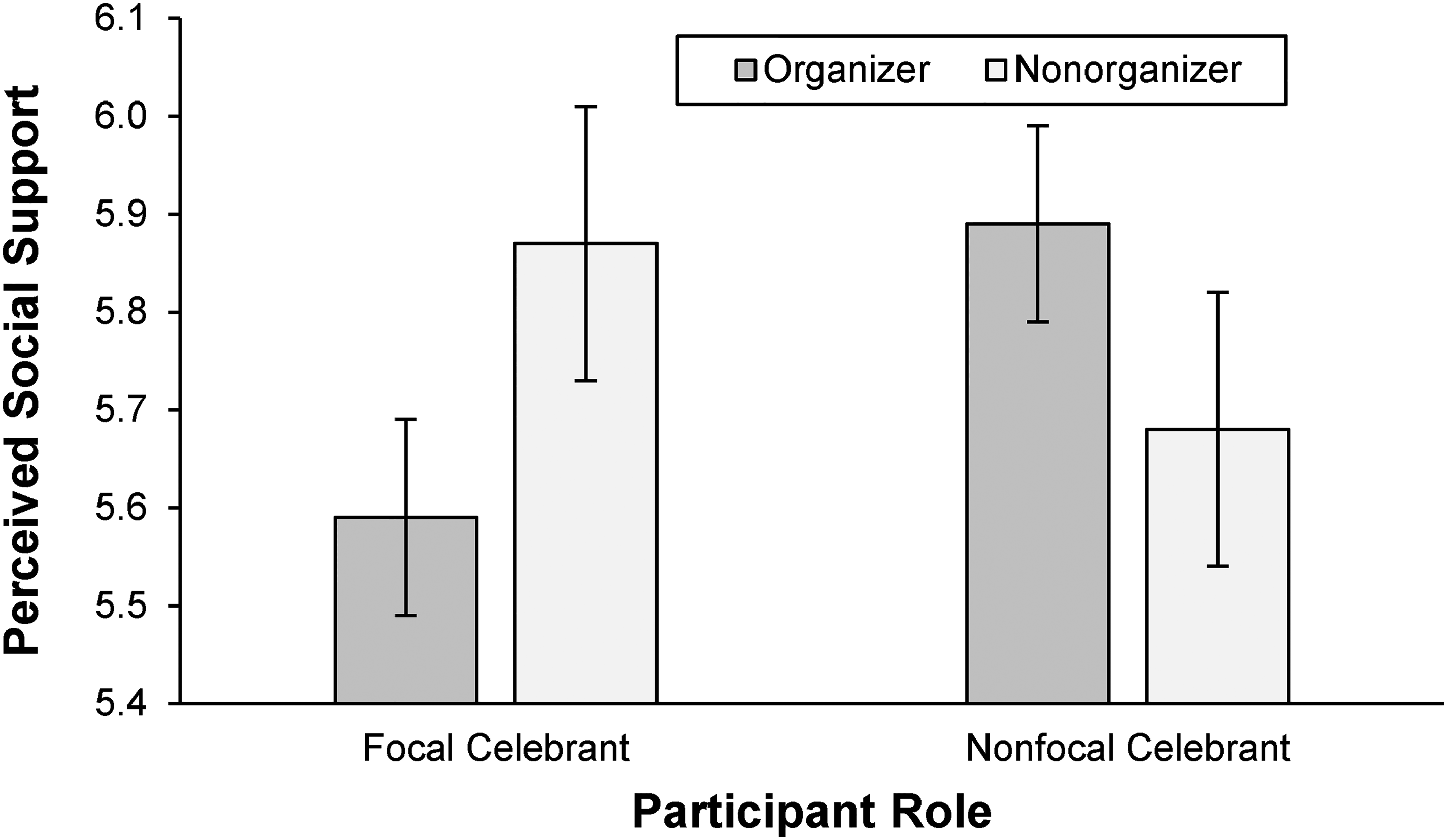
Perceived Social Support as a Function of Participant Role.
Importantly, there were no differences between the conditions in terms of how difficult it was to recall an event (ps > .39), the extent to which indulgent or healthy food was involved (ps > .50 and .39, respectively), meaning in life (ps > .19), or satisfaction with life (ps > .25). There was a marginal interaction effect on self-esteem (F(1, 410) = 2.92, p = .09), but planned comparisons revealed only a marginal difference between the organizer–nonfocal condition (M = 3.95, SD = 1.44) and the organizer–focal condition (M = 3.76, SD = 1.49; t(410) = 1.83, p = .067) with no other differences between conditions. Finally, there was not a relationship between rituals and perceived social support (β = .043, p = .38).
These results suggest that aspects such as who the event is for and, interestingly, who organizes the event can influence outcomes of a capitalization celebration, specifically in terms of increasing perceived social support. Having someone else organize the capitalization celebration is better in terms of building perceived social support if you are the one who had the positive separate event. Conversely, if you are not the one who had the separate positive event, it is relatively better to be the organizer, even more so than having to organize your own party. The findings highlight the benefits of capitalization celebrations to individuals and organizations who promote celebrations for others, and the specificity of these benefits in terms of social or interpersonal (as opposed to intrapersonal) outcomes. Public messaging designed to educate consumers on how best to gain the well-being benefits from celebrations should emphasize the importance of the focal celebrant not organizing, and the benefits to the people who organize and participate in an experience for someone else.
Study 6
In our final study, we explore whether participating in a capitalization celebration (in any role), and the subsequently increased perceived social support, can contribute to positive outcomes for those not involved in the capitalization celebration. Specifically, we examine prosocial intentions as a downstream consequence of increased perceived social support.
Method
One hundred sixty-nine participants (98 men, 70 women, 1 nonbinary participant) from a northeastern university successfully completed the study in exchange for course credit. Participants ranged in age from 19 to 24 years (M = 20.40 years, SD = .75).
Participants were randomized to either a capitalization celebration (social consumption marking a separate event) or a gathering (social consumption not marking a separate event; C in Figure 1) condition. We used the same prompts as in Study 4b (Web Appendix) in which we asked participants to recall and describe, in as much detail as possible, a recent celebration or gathering that they had participated in. That is, in this study we kept the social and consumption characteristics constant, but varied whether or not there was a positive separate event. Participants were asked some additional questions before completing the same measure of perceived social support as used in previous studies (Zimet et al. 1988; α = .91).
Next, participants were told, “We are considering partnering with a local middle school to increase middle school students’ connections with others. We would be asking [university name] students to volunteer to spend time virtually with a middle school student.” They were asked how interested they would be in volunteering in this program (1 = “Not really interested,” and 6 = “Extremely interested”). (We specified that it would be a virtual connection because of concerns related to COVID-19 and the restrictions that were in place at the time on the campus.) Finally, participants answered demographic questions.
Posttest
To rule out differences in difficulty of recall as a possible explanation of the results, we conducted a posttest with the same pool of participants. Ninety-five participants (36 men, 59 women) from the same northeastern university as in the main study completed this posttest for credit. Participants were randomized to one of the two conditions (capitalization celebration vs. gathering) used in the main study. They were asked demographic questions and then asked how difficult it was to recall the event they described earlier (1 = “Not at all,” and 5 = “Extremely”). Results revealed there were no differences between the conditions in recall difficulty (Mcelebration = 1.71 vs. Mgathering = 1.49; t(93) = .97, p > .25).
Results and discussion
Replicating the previous findings, results revealed that participants in the capitalization celebration condition reported significantly greater perceived social support (M = 5.98, SD = .84) than those in the gathering condition (M = 5.69, SD = .95; t(167) = 2.08, p = .039).
We next examined whether greater perceived social support—as a result of a capitalization celebration—leads to increased prosocial intentions. Although there was not a significant direct effect of capitalization celebration condition on prosocial intention (Mcelebration = 3.33, SD = 2.21 vs. Mgathering = 2.95, SD = 2.08; t(167) = 1.64, p = .10), results supported an indirect effect through perceived social support. Specifically, a mediation analysis (PROCESS macro; Model 4; 10,000 bootstrapped samples; Hayes 2013) with condition as the independent variable, perceived social support as the mediator variable, and prosocial intention as the outcome variable supported mediation (indirect effect: .098; 95% CI: [.0004, .2558]).
The results of this study extend our findings and demonstrate that increased perceived social support because of capitalization celebrations can have positive downstream consequences. These findings highlight the potential importance of celebrations and possible contribution of celebrations beyond those involved in the event, demonstrating that heightened feelings of perceived social support can translate into interest in socially beneficial acts. It is worth noting that in this study we asked college students to donate their time to middle schoolers. These are clearly distinct social groups that were not part of the recalled experience (either capitalization celebration or gathering). These results suggest that there are benefits to capitalization celebrations for individuals outside of the celebration and outside of the individual's social network. These findings highlight the broader, positive potential consequences of celebrations. In addition, these findings suggest that policy makers should coordinate messaging about prosocial behavior (e.g., voting, volunteering, reducing carbon emissions) to occur after common reasons to celebrate, such as in May or June after local school or college graduations.
General Discussion
Celebrations are a common and important cultural phenomenon, and yet they have received little attention from marketing and policy researchers. In the present research, we begin to fill this gap by investigating the effects of celebrations on well-being, specifically in terms of increasing perceived social support, which is the belief that others will be there for you for future negative life events (Cohen 1988) and has been consistently associated with positive psychological and physical outcomes (Fong et al. 2017; Lakey and Orehek 2011; Rueger et al. 2016). Across eight studies, we demonstrate that celebrations with social consumption marking one member's separate positive event (i.e., capitalization celebrations) lead to increases in perceived social support. In addition, we find evidence to suggest that a capitalization celebration leads to greater perceptions of successfully enacted support and perceived responsiveness, which, together, drive the increase in more general perceived social support. Importantly, we also investigate virtually held celebrations, finding that the observed benefits of capitalization celebrations on perceived social support are not limited to in-person experiences. Finally, we examine how capitalization celebrations affect others at the experience beyond the focal individual and how they contribute to a downstream prosocial outcome, highlighting the broader benefits of celebrations for society.
Policy Implications
Previous research has shown that social connection is a significant contributor to overall health and well-being. Indeed, a lack of social connection (i.e., loneliness and isolation) is a major risk factor for negative health outcomes (Holt-Lunstad, Smith, and Layton 2010; Holt-Lunstad et al. 2015), with policy makers calling it an “epidemic” and citing a recent statistic that an individual feeling loneliness has morbidity rates as high as someone who smokes 15 cigarettes a day (Health Resources & Services Administration 2019). The current research further highlights the importance of social connection and demonstrates how social consumption to highlight one person's positive life event can build perceived social support, which has been repeatedly shown to have positive health and well-being outcomes (e.g., Gallagher and Vella-Brodrick 2008; Rueger et al. 2016).
The COVID-19 pandemic resulted in unprecedented times of stress and uncertainty. Although the lockdowns have subsided, researchers have warned that the COVID-19 pandemic will have further ramifications for society, marketing, and public policy for years to come (Wiener, Ellen, and Burton 2020). This most likely includes affecting the way in which we socialize and gather with other people. As the present work demonstrates the value of capitalization celebrations, an important implication of this work is that policy makers at both the national and local levels should recognize and encourage various forms of capitalization celebrations, particularly at times when the risk of social isolation is high (e.g., during a pandemic). In other words, public health officials should be cognizant of the fact that capitalization celebrations provide needed social support and a lack of them can have negative consequences on consumer well-being and hence public health. Our findings suggest that although people believe virtual celebrations are worse than in-person celebrations, virtual celebrations still contribute to individual well-being. The important feature is that people are consuming at the same time to mark (at least one) member's separate positive event. This allows policy makers to encourage safe celebrations in ways that promote social support, but do not put people at increased physical risk. For example, New York City's health department put out a series of guidelines and tips for staying safe during the COVID-19 pandemic that included the recommendation of “Enjoy(ing) sex virtually, such as video dates, sexting, sexy Zoom parties” (NYC Health 2020). Similar educational messaging of both the benefits of virtual celebrations and how best to conduct them may be effective. Specifically, policy makers should encourage virtual celebrations that involve attendees simultaneously consuming and that mark a separate, positive life event, and, importantly, highlight the important well-being benefits of virtual celebrations even if such celebrations may seem worse than in-person ones.
In addition to the general public, policy makers, including public health officials and administrators, should focus on promoting capitalization celebrations among populations who are at higher risk of loneliness and isolation. For example, research has shown that loneliness is common in older people and has been associated with negative health consequences, both mental and physical, for this population (Luanaigh and Lawlor 2008). This research suggests a potential two-pronged approach for helping to enhance social connections via capitalization celebrations in those that may be most at risk of loneliness and isolation. First, screenings for social connection should be implemented into health care visits, and simple fact sheets or signs could be posted in medical facilities, such as assisted living facilities or Veterans Health Administration hospitals, to help communicate the importance of joint consumption that marks an individual's own life event or to encourage organizing on behalf of someone else. Second, for those who are at risk or who are already demonstrating negative consequences of reduced social connection, programs to foster capitalization celebrations should be developed and implemented. These could be new community programs or could be added to community-run programs in which joint consumption already exists. For example, senior community centers, soup kitchens, or other community-organized meal centers could promote celebrations within their organizations as a simple way to increase perceived social support and promote the known mental and physical benefits associated with it.
Food is a fundamental research area within marketing and public policy (e.g., Block et al. 2011; Scott and Vallen 2019); thus, policy makers should be cognizant of the type of consumption occurring during celebrations. Anecdotally, celebrations often feature indulgent consumption. If indulgent or hedonic consumption frequently co-occurs with celebrations, then individuals should be cautioned about “too much” celebrating as it could have negative physical or financial consequences, such as decreased self-control (Lowe and Haws 2014), overconsumption and overspending (Parker, Umashankar, and Schleicher 2019), and food waste (Block et al. 2016). Note that we did not see any differences in the effects of healthy versus indulgent consumption on perceived social support in Study 5, which suggests that interventions could promote capitalization celebrations in a healthy way (e.g., emphasizing consumption of healthy foods) that would still build perceived social support but not involve excess calories or unhealthy eating.
Capitalization celebrations offer positive benefits beyond those immediately involved in the experience. These findings suggest that charities and nonprofits could engage in campaign efforts at certain times of the year when celebrations naturally occur. For example, organizations should consider timing requests for local food/clothing drives or volunteering opportunities to coincide with high school or college graduations. Further, nonprofits seeking to increase charitable intentions should focus their marketing communications on activating perceived social support. These messages should remind potential donors about past instances of social support in their own lives to encourage these individuals to give back to others more broadly.
Theoretical Contributions
This research also makes several theoretical contributions. Although marketers have long emphasized the notion of celebrations in advertising and packaging, little empirical research has investigated their value. In the current research, we identify, develop a framework for, and systematically test characteristics of celebrations to better understand this commonplace, yet understudied, cultural phenomenon. We further identify how a specific form of joint consumption uniquely contributes to both consumer well-being and downstream prosocial outcomes. By doing so, this research highlights the importance of examining social influences and interpersonal perspectives in marketing (e.g., Grier and Perry 2018; Hamilton et al. 2020; Lamberton, Naylor, and Haws 2013; Legocki, Walker, and Kiesler 2020; Testa et al. 2018) to better understand factors influencing health and well-being (e.g., Fredrickson and Joiner 2002; Major et al. 2018).
Moreover, the current work begins to fill two important gaps in the literature regarding (1) how perceived social support is influenced and (2) how enacted social support, or the actual receipt of support, can contribute to perceptions of social support (Feeney and Collins 2015; Gable et al. 2012). Although extensive research has focused on social support during difficult times (e.g., Bolger, Zuckerman, and Kessler 2000; Cohen 1988; Lakey et al. 2010), limited empirical work has examined social support during positive life events (see Gable et al. 2004; Reis et al. 2010 for notable exceptions), and almost no work has focused on the role of consumption during positive life events. Researchers have called attention to the lack of research on social support during times of nonadversity and emphasized the importance of this type of supportive function in helping people thrive (Gable et al. 2012). By connecting celebrations with increased perceptions of social support, the current research addresses the first of the two critical tasks researchers are faced with: determining where perceptions of support originate or how they can be influenced.
Further, this research fills the second important gap in the social support literature by demonstrating how enacted social support, or the actual receipt of support, can contribute to perceived social support (Gable et al. 2012). Previous research has reliably demonstrated a contradiction in that perceiving social support in times of stress is associated with positive outcomes (Holahan et al. 1997; Kaul and Lakey 2003; Lakey and Orehek 2011; Siedlecki et al. 2014) yet receiving social support during times of stress is associated with mixed or negative outcomes (Bolger, Zuckerman, and Kessler 2000; Gleason et al. 2003; Shrout, Herman, and Bolger 2006). In the present research, we demonstrate that joint consumption to mark an individual's separate, positive life event is associated with greater enacted, or actual, support. This enacted support was positively associated with increased perceived social support, thereby providing initial empirical evidence to suggest when and how enacted support can successfully contribute to perceived social support.
Conclusion
While it is important to be there for people during times of life stress and adversity, in the present research, we demonstrate that it is also important to be there for others during positive life events. In fact, showing support for someone by consuming together with them to mark a positive life event can build social supportive resources and enhance the belief that people will be there for you in the future when things go wrong. In turn, this belief that others will be there for you encourages greater prosocial intentions, which highlights how celebrations can contribute to society more broadly. It seems that fair-weather friends may be beneficial to individuals and the greater good after all, as long as they show up for the party and eat cake.
Supplemental Material
sj-pdf-1-ppo-10.1177_07439156221145696 - Supplemental material for Celebrate Good Times: How Celebrations Increase Perceived Social Support
Supplemental material, sj-pdf-1-ppo-10.1177_07439156221145696 for Celebrate Good Times: How Celebrations Increase Perceived Social Support by Danielle J. Brick, Kelley Gullo Wight, James R. Bettman, Tanya L. Chartrand and Gavan J. Fitzsimons in Journal of Public Policy & Marketing
Footnotes
Editor
Maura L. Scott
Associate Editor
Rebecca Walker Reczek
Declaration of Conflicting Interests
The author(s) declared no potential conflicts of interest with respect to the research, authorship, and/or publication of this article.
Funding
The author(s) received no financial support for the research, authorship, and/or publication of this article.

References
Supplementary Material
Please find the following supplemental material available below.
For Open Access articles published under a Creative Commons License, all supplemental material carries the same license as the article it is associated with.
For non-Open Access articles published, all supplemental material carries a non-exclusive license, and permission requests for re-use of supplemental material or any part of supplemental material shall be sent directly to the copyright owner as specified in the copyright notice associated with the article.
