



Abstract
In limited-information environments like restaurants, consumers are forced to make health inferences by drawing from the menu or promotional materials or by using their intuition. Understanding such health inferences related to plant-based meat alternatives (PBMAs), which are available at a rapidly growing number of restaurants, is increasingly important. In addition to their clear environmental benefits, PBMAs are widely promoted as being healthier than traditional meat. Across five experiments, results illustrate that although some perceptions of PBMAs are aligned with reality (e.g., environmental friendliness), consumers greatly underestimate calories and nutrition (e.g., fat, sodium) relative to objective values. Additionally, consumers believe PBMAs are substantially healthier than, and decrease disease risk relative to, traditional meat, which is not always true. The currently accepted interventions of calorie labeling and nutrition information disclosure are not enough to attenuate this “health halo.” However, ensuring that consumers actively compare menu items realigns perceptions with reality. The health halo resulting from inferences formed with the limited information available at the point of purchase has numerous implications for public health, sustainable consumerism, and public policy decisions.
We hope our plant-based meats allow you and your family to eat more, not less, of the traditional dishes you love, while feeling great about the health, sustainability, and animal welfare benefits of plant protein.
Plant-based meat alternatives (PBMAs) have seen a recent surge in popularity. In addition to their clear environmental benefits (Good Food Institute 2019), we argue that this popularity is fueled by potentially exaggerated claims like the preceding one (used in promotions for Beyond Meat from 2014 to 2021), which position PBMAs as healthier alternatives to traditional meat. PBMAs are gaining rapid mainstream traction in both chain and local restaurants in the United States. For example, table-service and fast-food chains that offer PBMA burgers nationally include The Cheesecake Factory, TGI Fridays, Burger King, and Hardee's; others, like Qdoba, Little Caesars, and Starbucks, offer PBMAs in other food products, such as tacos, pizzas, and breakfast sandwiches. Impossible Foods and Beyond Meat are the driving forces behind the widespread availability of PBMAs in the United States, partnering with restaurants to create cobranded offerings and scale up distribution of their products.
Only recently have researchers begun to explore consumer associations with meat alternatives (e.g., Michel, Hartmann, and Siegrist 2021; Spendrup and Hovmalm 2022), but existing research has not yet linked these associations with marketplace intentions. From a policy perspective, there is also a need to better understand how to regulate this emerging industry. In the United States, the Department of Agriculture (USDA) is currently responsible for regulating animal meat products, while the Food and Drug Administration (FDA) regulates meat alternatives, making the development of a cohesive regulatory strategy challenging. Thus, the current research seeks to answer several questions: (1) Are PBMAs perceived to be healthier (i.e., fewer calories, less fat, less sodium) than they objectively are (suggesting the presence of a health halo) and relative to traditional meat? (2) Are PBMAs perceived to decrease disease risk more than traditional meat? (3) If so, are there downstream effects of protein type (i.e., PBMA or traditional meat) on purchase intentions, attitudes toward the products, and disease risk through perceptions of healthfulness? (4) Are predominantly accepted food-policy-based interventions in a restaurant setting (i.e., calorie labeling alone or calorie labeling with additional nutrition information) effective at attenuating the perceived differential healthfulness of PBMAs (vs. traditional meat)? (5) If not, what might be a more effective approach?
To first assess the objective healthfulness of PBMAs versus traditional meat, we examined the objective nutritional content from the top ten restaurants (in terms of revenue) that offer PBMA burgers, which revealed that PBMAs are relatively comparable to their traditional meat counterparts, offering trade-offs across nutrients (see Table W1 in Web Appendix A). 1 That is, PBMAs do not appear to be objectively healthier than comparable options made from traditional meat. Yet, in an initial pilot study (see Web Appendix B and Web Appendix C), we find that consumers believe PBMAs are healthier than, and decrease disease risk relative to, traditional meat. We follow these observations by investigating PBMA perceptions in five studies, first confirming in Study 1 that a health halo indeed exists for PBMA burgers as reflected by a drastic misestimation of nutrition values. Next, Study 2 demonstrates that a standard calorie labeling intervention does not attenuate these health and disease risk perceptions when burgers are examined in isolation. Study 3 uses realistic restaurant menu stimuli and illustrates that PBMAs’ inflated healthfulness perceptions persist even when objective calorie information and additional nutrition information are provided. Study 4 further manipulates the nutrition information of both a PBMA burger and a beef burger, making them equivalent in terms of calories and nutrients, yet finds evidence that the health halo persists. Finally, Study 5 provides an alternative approach to the existing policy of passively providing nutrition information by encouraging active comparison between options prior to decision making, which attenuates the health halo surrounding PBMAs.
Background and Conceptual Development
Growth of the Alternative Meat Industry
The rise in demand for PBMAs is evident, as sales rose to $29.4 billion in 2020 and are predicted to reach over $160 billion by 2030, nearly 10% of the global meat industry (Elkin 2021). This acceptance of modern forms of meat alternatives is primarily attributed to the use of innovative food technology to close the taste and perception gaps with traditional meat. For example, Impossible Foods pioneered the use of heme, a compound synthesized from soybeans, to simulate the appearance, flavor, aroma, and texture of red meat (Simon 2017), while Beyond Meat's addition of red color from beet juice extract gives the appearance of a “bleeding” ground beef burger (Judkis 2019). These advancements have led to almost imperceptible differences from traditional meat, allowing for a nearly seamless transition to meat alternatives (Curtain and Grafenauer 2019).
Concurrent with this growth of the meat alternatives market is an increased amount of consumer spending on food away from home. Expenditures at restaurants and other food-service outlets in the United States have steadily grown as a percentage of both average income and total food expenditures (USDA 2020). Indeed, expenditures on food away from home have exceeded food-at-home expenditures each year since 2010, except 2020 (due to the COVID-19 pandemic; USDA 2020). Meat alternatives’ growing prevalence on restaurant menus only serves to suggest continued development of this market: the number of restaurants offering such products grew 26.4% from 2017 to 2019, and sales of meat alternatives at restaurants grew 268% from 2018 to 2019 (Dining Alliance 2019). The surge in offerings appears to have succeeded, as 71% of consumers in a recent survey knew of plant-based alternatives in restaurants, with 54% having tried these products (Stanton 2022).
To support this growth in availability and sales, PBMA producers highlight numerous benefits over traditional meat, including a lower carbon footprint (Khan et al. 2019). For example, Beyond Meat claims that its products use 46% less energy, 99% less water, and 93% less land and produce 90% less greenhouse gas emissions than beef products (Heller and Keoleian 2018). Similarly, Impossible Foods states that its burgers use 87% less water, use 96% less land, and create 89% less greenhouse gas emissions than ground beef (Impossible Foods 2019a). Thus, consumers have reason to hold the perception that PBMAs are more environmentally friendly than beef (Michel, Hartmann, and Siegrist 2021).
Healthfulness of PBMAs Versus Traditional Meat
Aside from taste and environmental friendliness, perhaps the most salient benefits promoted by PBMA producers are those related to health. Beyond Meat, for instance, asks, “What's it missing? Aside from animals? All the bad stuff, including saturated and trans fats, cholesterol, gluten, dairy, and GMOs” (Beyond Meat 2018a). Although health experts tend to agree that consumers should seek alternatives to meat to optimize health outcomes (Stubbs, Scott, and Duarte 2018), the promoted health benefits of PBMAs may not align with their actual nutritional content. Some scholars have argued that replacing red meat with certain meat alternatives is associated with “lower risks of chronic diseases and total mortality” (e.g., Hu, Otis, and McCarthy 2019, p. 1547) and that certain meat alternatives can provide greater amounts of some vitamins and nutrients than traditional meat (Gelsomin 2019). Conversely, other scholars have argued that replacing meat with novel plant-based substitutes can unintentionally increase consumption of (potentially) detrimental nutrients (i.e., nutrients that are harmful to health if consumed too much, such as saturated fat, sodium, and sugar; Cornwell et al. 2018), while reducing the overall nutrient density of one's diet (Tso and Forde 2021). The highly processed nature of PBMAs can result in the loss of important nutrients, potentially leading to excess calorie, carbohydrate, and fat intake as well as weight gain (Hall et al. 2019). Likewise, excessive intake of heme (the “secret” to the Impossible Burger's sensory experience) has been linked to an increased risk of developing Type II diabetes (Hu, Otis, and McCarthy 2019). Thus, the long-term overall health benefits of PBMAs compared with traditional meat remain in question (Toh, Akila, and Henry 2022), as they involve trade-offs across several nutrient categories.
An examination of the six most commonly reported nutritional values of PBMA and beef burgers (i.e., calories, fat, saturated fat, sodium, cholesterol, and protein) available at major chain restaurants across the United States illustrates these trade-offs (see Table W1 in Web Appendix A). PBMA burgers have, on average, less saturated fat (14 g vs. 15 g), cholesterol (27 mg vs. 96 mg), and protein (28 g vs. 34 g), but more calories (780 vs. 730), fat (48 g vs. 42 g), and sodium (2,027 mg vs. 1,555 mg) than their traditional meat counterparts. Although additions to a burger (e.g., sauce, cheese, onion) do change nutritional content, similar additions are made to both PBMA and beef burgers. In restaurants that only report the nutritional values for patties, PBMA patties remain nutritionally comparable to beef patties, further highlighting similarities between the two.
Proposed PBMA Health Halo
Given the possible discrepancies between how PBMAs are portrayed and their true nutritional content, it is imperative to understand consumer perceptions surrounding them. If the general perception of PBMAs’ overall healthfulness is exaggerated, this could be evidence of a “health halo” (Chandon and Wansink 2007; Roe, Levy, and Derby 1999), which is defined as a biased inference about a product's broader healthfulness based on incomplete information (Peloza, Ye, and Montford 2015). Examples of such health halos for food products include overgeneralizations based on brand positioning (e.g., Subway's offerings being seen as healthier than they are; Chandon and Wansink 2007), package and advertising claims (e.g., inferring healthfulness from natural claims; Berry, Burton, and Howlett 2017), or symbolic information (e.g., adding the word “fruit” to “sugar” increases health perceptions; Sütterlin and Siegrist 2015). Although health halo effects have been uncovered for many existing product categories, the current work is unique in that it is focused on identifying and addressing a health halo for an innovative product category that has only recently gained mainstream acceptance.
We suggest that exposure to promotional claims exaggerating the health benefits of PBMAs, coupled with the awareness of PBMA manufacturers’ positioning, has led to inexact perceptions of PBMAs’ overall healthfulness. For example, Beyond Meat has made various health claims since its launch in 2013, including “Upgrade your plate with complete nutrition and complete enjoyment from Beyond Meat” (Beyond Meat 2013) and “One of the great things about building a burger from the ground up is you can leave in the good stuff (protein) and leave out the bad (cholesterol)” (Beyond Meat 2018b). Other firms have made similar claims, such as Impossible Foods’ statement: “By understanding meat at the molecular level, we made a juicy burger that's delicious, yet nutritious” (Impossible Foods 2019b). Given the prevalence of such claims related to this novel product category, we suggest that consumers’ perceptions of PBMA healthfulness at the point of purchase are likely based on inaccurate overgeneralizations (Roe, Levy, and Derby 1999) from the attributes specified in the claims (e.g., low cholesterol) to attributes that are not (e.g., sodium, therefore, must also be low). Importantly, when comparing PBMAs with traditional meat, consumers exposed to exaggerated claims may hold some perceptions that are generally accurate (e.g., lower cholesterol), some that are inaccurate (e.g., lower sodium), and others where the accuracy is unclear (e.g., disease risks).
Although previous research has not directly tested for the presence of a health halo related to PBMAs, evidence shows that consumers generally view PBMA products as healthier than traditional meat. For instance, consumers are significantly more likely than nutrition professionals to agree with the statement that PBMAs “are more nutritious than traditional meat” (Estell, Hughes, and Grafenauer 2021). More relevant to the conceptualization of a health halo, healthiness ratings are higher when PBMAs are marketed as a “plant-based product” rather than a “meat alternative product” (Sucapane, Roux, and Sobol 2021). These preliminary findings, along with those of our pilot study, suggest that consumers may systematically overestimate the healthfulness of PBMAs due to their marketplace positioning, indicating the possible presence of a health halo.
Such biased perceptions are particularly impactful in limited-information environments like restaurants, where discernment of healthier and lower-calorie options can be difficult (Berry et al. 2019; Burton and Kees 2012) due to incomplete or limited information (Berry, Burton, and Howlett 2017). Consumers consequently have to use the limited information in front of them (e.g., menu product description) and their existing perceptions to make inferences about a product's healthfulness (Peloza, Ye, and Montford 2015). If existing perceptions are inaccurate, this could potentially lead to erroneous conclusions and suboptimal evaluations, such as choosing a product believed to be healthy, even if it is not objectively so. Without fully understanding the objective nutrition information prior to purchase and consumption (Burton, Howlett, and Tangari 2009; Howlett et al. 2009), consumers may perceive PBMAs as being substantially more healthful relative to traditional meat (or PBMA's objective nutritional values). These inaccurate perceptions are a critical consideration for policy makers, such as the FDA, which is currently drafting guidance on the labeling of PBMAs in an effort to enable consumers to make informed and healthy food choices (FDA 2023).
From this conceptualization and the results of our pilot study, we posit that PBMAs will be perceived by consumers as (1) more healthful than they are objectively (i.e., consumer-estimated nutrient values compared with objective nutrient values) and (2) overall more healthful than traditional meat. To examine perceived versus objective healthfulness, we explore nutrient estimate accuracy (estimated vs. objective nutrient values). When discussing and examining perceived healthfulness, we consider several related constructs from extant literature. First, we consider overall perceived product healthfulness, a construct that has been studied extensively in the nutrition labeling literature and referred to using such terms as nutrition attitude (Garretson and Burton 2000; Kozup, Creyer, and Burton 2003), nutrition level evaluation (Newman et al. 2018), perceived nutrition level or nutrition perceptions (Howlett, Burton, and Kozup 2008), and perceived healthfulness (Berry, Burton, and Howlett 2017); for consistency, we use the latter term. Second, we examine more specific consumer perceptions of nutrient content, including calories, fat, and sodium (Andrews et al. 2021; Newman et al. 2018). Finally, we explore consumers’ longer-term perceived disease risks as reflected by evaluations of the likelihood of developing specific diseases if the food is included in their diet (Andrews et al. 2021; Burton et al. 2015; Howlett, Burton, and Kozup 2008; Kozup, Creyer, and Burton 2003).
Drawing from a framework developed and supported in extant literature, we anticipate that perceptions of longer-term disease risk are formed from perceived healthfulness (Burton et al. 2015; Howlett, Burton, and Kozup 2008). That is, theory suggests that overall perceived healthfulness extends to perceived disease risk. Given this relationship, we also expect that perceived disease risk will be lower for PBMAs compared with traditional meat and that product healthfulness will mediate this effect on perceived disease risk.
2
More formally, we hypothesize:
We are also interested in examining whether these hypothesized health perceptions positively extend downstream to attitudes toward the product and subsequent purchase intentions, which extant literature suggests should be the case. That is, food's perceived healthfulness has a strong, positive influence on attitudes, purchase intentions, and consumption (Berry et al. 2015; Berry and Romero 2021; Garretson and Burton 2000; Newman et al. 2018; Rybak et al. 2021). Consistent with the theory of planned behavior (Ajzen 1991) and the communication–human information processing model (Wogalter 2019), we expect that attitude toward the product will strongly and positively extend to purchase intention. Accordingly, we propose that PBMAs (vs. traditional meat) will have an indirect effect on purchase intention through perceived healthfulness and subsequent attitude toward the product:
Addressing the Health Halo Surrounding PBMAs
Having predicted the presence of a health halo and its impact on marketplace intentions, we next turn to how such a health halo could be addressed. In the current restaurant environment in the United States, restaurant chains with 20 or more locations are required by the FDA to disclose calories on their menus and menu boards, and many other smaller restaurant chains choose to do so voluntarily (Berry, Burton, and Howlett 2018). The goal of this policy is to enable consumers to make more informed, healthful food purchases in limited-information environments (FDA 2017), and similar regulations apply in countries outside the United States. For example, since 2022, England requires menu calorie labeling for food prepared for immediate consumption (UK Statutory Instruments 2021), and comparable legislation is being reviewed in other countries (e.g., Australia; Obesity Evidence Hub 2021). Thus, calorie labeling will be a menu feature in many restaurants worldwide.
Despite its increasing prevalence, prior research has found mixed results for the effects of menu-based calorie and nutrition information on the number of calories ordered in restaurant settings, depending on study context and other factors (e.g., Berry et al. 2019; Burton and Kees 2012; VanEpps, Downs, and Loewenstein 2016). However, nutrition information disclosures on restaurant menus can be effective in influencing consumers’ product evaluations, health perceptions, calorie and nutrient evaluations, and disease risk perceptions to be more in line with objective healthfulness (Burton et al. 2006; Howlett et al. 2009). This is particularly true when consumers’ calorie and nutrient expectations deviate from objective levels (i.e., disconfirmation of consumer expectations; Burton, Howlett, and Tangari 2009).
Therefore, we posit that objective nutrition information (i.e., calorie labels and additional nutrition information) presented on or with restaurant menus has the potential to moderate the proposed effect of protein type on evaluations of calorie levels, perceptions of overall healthfulness, and other health- and nutrient-related outcomes. Specifically, we aim to test the effects of presenting objective nutrition information to uncover whether it can attenuate the health halo surrounding PBMAs. We thus assess the effects of protein type on these health-related outcomes and any resulting serial indirect effect(s) on attitudes and purchase intention. Our conceptual framework is illustrated in Figure 1.

Conceptual Framework.
Study 1: Identifying the Health Halo with Calorie and Nutrient (Mis)Estimates
Study 1 examines whether consumers underestimate objective calorie and detrimental nutrient (i.e., fat and sodium) values in PBMAs (H1a).
Method
Participants and design
We used panel data (i.e., PrimePanels; Berry, Kees, and Burton 2022) to recruit a national sample that was census-matched to the U.S. population in terms of age, gender, race, and ethnicity. Although 100 participants were requested, complete responses were obtained from 116 (51.5% female, 48.5% male; Mage = 48.0 years, SD = 18.70). The median household income of the sample was $30,000 to $39,999, and 21.5% of the sample had obtained a four-year college degree. This study utilized a repeated-measures design with two conditions (protein type: beef, PBMA).
Procedure
Participants were first provided with a description and a photo of a burger from a major fast-food chain restaurant. The description stated, “The burger features a ¼ lb. flame-grilled [beef patty/patty from plants] topped with juicy tomatoes, fresh lettuce, creamy mayonnaise, ketchup, pickles, and sliced white onions on a soft sesame seed bun.” These descriptions for both the beef and PBMA burgers were obtained from Burger King's Whopper and Impossible Whopper, and the photo provided was of the Impossible Whopper for both conditions (see Web Appendix D). Participants were then asked to estimate calories, fat (in grams), and sodium (in milligrams) for the burger. Estimates were restricted to two times the FDA recommended daily value for each nutrient. Participants viewed and estimated values for both PBMA and beef burgers, but the burgers were shown separately and counterbalanced to control for order effects.
Results and Discussion
We tested underestimation by comparing the accuracy scores (estimate minus objective value; Burton, Howlett, and Tangari 2009) for each nutrient to zero using three one-sample t-tests. For the PBMA burger, participants underestimated calories by 216 calories (SD = 432; t(115) = −5.39, p < .001), fat by 9.75 grams (SD = 26.36; t(115) = −3.98, p < .001), and sodium by 853.31 milligrams (SD = 556.51; t(115) = −16.51, p < .001), all supporting H1a. Although calories, fat, and sodium were also underestimated for the beef burger, results of the repeated-measures analysis of variance (ANOVA) revealed that the values were underestimated to a significantly greater extent for the PBMA (vs. beef) burger (Wilks’ lambda [Λ] = .63, F(3, 113) = 22.65, p < .001). For example, the calorie underestimate for PBMA (216 calories) was nearly double the underestimate for beef (109 calories; F(1, 115) = 13.85, p < .001). These results exemplify a health halo associated with the PBMA by both demonstrating the underestimation of the calories and detrimental nutrients in a PBMA burger and showing that these values are underestimated to a significantly greater extent for PBMA (vs. beef) burgers.
Study 2: Potential Moderating Role of Calorie Information Provision
Extending these findings, Study 2 further tests our conceptual framework by considering the direct and indirect effects of PBMA (vs. traditional meat) promotions on perceived healthfulness, perceived disease risks, nutrient content judgments, attitude toward the product, and purchase intention. In addition, Study 2 examines whether a currently accepted policy (e.g., menu calorie labeling) can mitigate the health halo surrounding PBMAs.
Method
Participants and design
Four hundred fifty participants were requested through Amazon Mechanical Turk (MTurk) using the CloudResearch Approved list and a 95% approval rating (Berry, Kees, and Burton 2022), resulting in a final sample of 451 U.S. participants (42.0% female, 57.3% male, .4% prefer not to answer; Mage = 41.2 years, SD = 11.8). The median household income of the sample was $50,000 to $74,999, and 58% of the sample had obtained a four-year college degree. This study utilized a 2 (protein type: beef, PBMA) by 3 (calorie label: no calorie information [control], low calories [630 calories], high calories [1,030 calories]) between-subjects design, resulting in six total conditions.
Procedure
Participants were told to imagine that they walked into a restaurant and saw a poster for a burger. Participants were randomly shown one of the six poster iterations that depicted either a beef burger or a PBMA burger, labeled with either no calorie information, 630 calories, or 1,030 calories (Web Appendix E). The calorie information was drawn from major chain restaurants offering PBMA burgers and represented approximately low and high levels of such offerings identified (see Table W1 in Web Appendix A). The last two digits of the calorie labels were held constant to control for potential numerosity effects.
Measures of intention to purchase and attitude toward the product were adapted from the food labeling literature. Other measures include perceived healthfulness, environmental friendliness, perceived disease risk (i.e., cancer, heart disease, diabetes, weight gain, and stroke), and a detrimental nutrient index (comprising fat, calories, and sodium). See the Appendix for all items used to assess each multi-item measure and index, as well as the source of each measure and their reliabilities.
All participants then responded to an awareness check to ensure that they remembered which burger they viewed (i.e., “The burger presented appeared to be:” [beef burger, plant-based burger, I am not sure]; 92.2% of the sample passed). Subsequent analyses were performed with and without those who did not pass this awareness check, and the results were consistent with those reported for the entire sample (see Table W3 in Web Appendix F). Therefore, all participants were retained in the sample irrespective of their response to the awareness check. The survey concluded with demographic and classification-based questions. 3
Results and Discussion
Main effects and interactions of protein type and calorie labeling
Given that we found support for the calorie labeling manipulation, 4 we used a factorial ANOVA to examine the main and interaction effects of protein type and calorie labeling on the focal outcomes (see Table 1, Panel A, for the F- and p-values for these main and interaction effects).
Factorial ANOVA Results for Main and Interaction Effects.
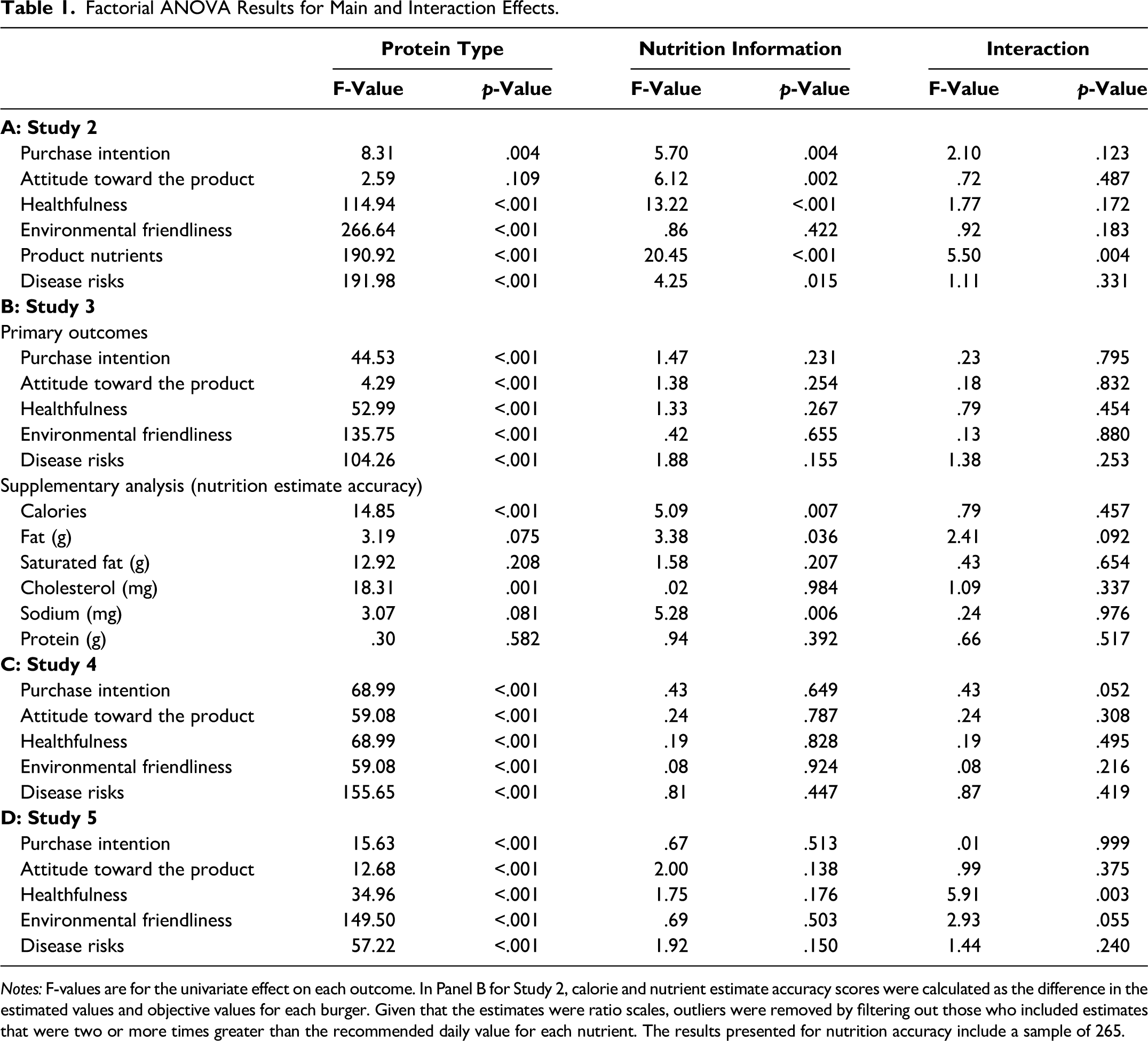
Notes: F-values are for the univariate effect on each outcome. In Panel B for Study 2, calorie and nutrient estimate accuracy scores were calculated as the difference in the estimated values and objective values for each burger. Given that the estimates were ratio scales, outliers were removed by filtering out those who included estimates that were two or more times greater than the recommended daily value for each nutrient. The results presented for nutrition accuracy include a sample of 265.
Supporting H1b, ANOVA results for the main effect of protein type revealed significant differences between the protein types on perceptions of healthfulness, nutrient content, and disease risk (see Figure 2; ps < .001 for each outcome). More specifically, those rating the PBMA burger (collapsed across calorie conditions) perceived it to be healthier and lower on the detrimental nutrient index (i.e., fat, calories, and sodium) than did those evaluating the beef burger. Participants who were exposed to the PBMA burger promotion also believed that this option, if consumed regularly, would decrease disease risks (i.e., developing cancer, heart disease, diabetes, weight gain, and stroke) when compared with those rating disease risks in relation to consuming beef burgers regularly.

Means for Dependent Measures in Study 2.
The main effect of calorie label was also significant for many of the dependent measures, including purchase intention, attitude toward the product, perceived nutrient content, and perceived disease risk. 5 Additionally, the PBMA burger was rated as more environmentally friendly than the beef burger (MPBMA = 4.83, SD = 1.44 vs. Mbeef = 2.54, SD = 1.54).
These main effects on the detrimental nutrient index were qualified by a protein type by calorie label interaction (p < .05). Planned contrasts reveal, for the PBMA burger, that the provision of low calorie information (vs. no calorie information) increased the nutrient content index (Mcontrol = 3.45, SD = 1.18 vs. Mlow calories = 3.86, SD = 1.46; p = .049); the provision of high (vs. low) calorie information further increased this index (Mhigh calories = 4.76, SD = 1.52; p < .001). For the beef burger, calorie information (high or low) did not affect the nutrient index (vs. no calorie information). All other interactions were nonsignificant, indicating that the calorie information did not moderate the effects of protein type.
Of particular interest, the calorie level of the burger did not attenuate the differences found across protein type for overall healthfulness perceptions or the disease risk index (ps > .05). Therefore, while H4a through H4c proposed that providing objective nutrition information would attenuate the differences between protein types, our results suggest that calorie labels alone only attenuate nutrient perceptions and do not fully reduce the health halo (i.e., perceived healthfulness and decreased disease risks) associated with PBMAs.
Indirect effects of protein type on purchase intention, attitude toward the product, and disease risk
We tested the hypothesized indirect effects through perceived healthfulness and attitude toward the product (in serial) on purchase intention (H3) using Model 80 of the PROCESS macro with 10,000 bootstrap samples (Hayes 2017). Given the corresponding importance of environmental friendliness of PBMAs, we included this measure as a parallel mediator. The unconditional indirect effects were examined because the protein type by calorie label interactions on these outcomes were nonsignificant. Protein type was the independent variable and coded using indicator coding (beef = 0, PBMA = 1).
As demonstrated in Figure 3, protein type had a significant effect on perceived healthfulness (b = 1.40, t(449) = 10.14, p < .001). In turn, perceived healthfulness was positively associated with attitude toward the product (b = .51, t(447) = 7.69, p < .001), which positively extended to purchase intention (b = .97, t(446) = 37.16, p < .001). In support of H3, we found a significant indirect effect of protein type on purchase intention through perceived healthfulness and attitude toward the product (in serial; indirect effect [IE] = .70, 95% bootstrap CI: [.49, .94]), while controlling for the indirect effect through environmental friendliness (IE = .44, 95% CI: [.14, .74]).

Mediation Results for Study 2.
To examine the indirect effect of protein type on disease risk through perceived healthfulness (H2), we used Model 4 of the PROCESS macro with 10,000 bootstrap samples (Hayes 2017). 6 As predicted, the positive effect of protein type on perceived healthfulness, in turn, negatively extended to the disease risk index (b = −.55, t(448) = −12.88, p < .001). This resulted in a negative indirect effect of protein type on disease risk (IE = −.77, 95% CI: [−.99, −.57]), but the direct effect on disease risk remained significant (b = −1.21, t(448) = −8.73, p < .001).
Study 2 reveals that PBMAs are viewed as being healthier overall and lower in detrimental nutrients, along with decreasing disease risks (heart disease, diabetes, weight gain, and stroke) relative to traditional meat, providing further evidence of a health halo. Study 2 also demonstrates how these biased perceptions of healthfulness (1) increase positive attitudes toward the product, which, in turn, increase purchase intention, and (2) decrease perceived disease risk. In essence, although objective evidence agrees with consumers in relation to the relative environmental friendliness of PBMA (vs. beef) burgers, consumers’ unrealistic expectations of PBMAs’ healthfulness have a strong effect on attitudes and purchase intention toward these products, potentially leading consumers to make unknowingly unhealthy choices.
This study also examined the potential moderating role of nutrition information provision in the form of menu calorie labeling on the direct and indirect effects of protein type. Interestingly, despite the two products being equivalent in terms of calorie content, calorie information did not fully attenuate the differences in consumers’ health-related perceptions, with the important exception of perceived nutrient content, across the two products. These results indicate that calorie information disclosures do not fully offset the potentially unwarranted health halo associated with PBMAs. As a result, we next look at whether the inclusion of additional nutrition information (i.e., nutrient values) that is available upon request at chain restaurants as part of the national calorie labeling mandate (FDA 2017) will attenuate these healthfulness perceptions.
Study 3: Potential Moderating Role of Nutrition Information Provision
Consumers tend to be inaccurate in their estimates of calories, fat, sodium, and other nutrients (Burton et al. 2006), making them poor judges of the objective healthfulness of food products. Calorie information disclosures on restaurant menus and menu boards were mandated in the United States explicitly to “provide consumers with nutrition information so they can make informed choices for themselves and their families” (FDA 2017, p. 20827). Yet, a body of prior literature has highlighted consumers’ troubles with utilizing raw calorie information (Berry et al. 2019; Burton and Kees 2012). Without an understanding of how a product's nutrient content compares (e.g., calories for PBMAs compared with beef), calorie information disclosures alone may not be informative enough to offset the effects of a health halo, as evidenced by the findings from Study 2. Extending research on calorie labeling and nutrition information disclosures, we go a step further and posit that additional objective nutrition information—currently mandated to be available upon request at chain restaurants with 20 or more locations (FDA 2017)—will be more effective in mitigating the health halos associated with PBMAs. We suggest that this approach could be more effective because the nutrition information is broken down by nutrient and contextualized by including the nutrient values of different offerings side by side.
Given the novelty of PBMAs and their often misleading promotion as a healthier option than traditional meat, accurately assessing the healthfulness, nutrient values, and disease risks of PBMAs may be especially challenging for consumers in a limited-information environment like a restaurant. We predict that making nutrition information available in a format where consumers can make comparisons between products made with PBMAs and traditional meat may provide the contextualized information necessary to allow consumers to make more accurate judgments of the healthfulness of a PBMA burger. Some preliminary support has been found for the effectiveness of objective nutrition information provision (i.e., calorie labels plus additional nutrition information) in influencing consumer outcomes (e.g., Vanderlee and Hammond 2014).
Drawing from these findings, we aim to examine whether disclosures presenting calorie and nutrient information for all products on the menu, thus enabling comparisons, will be more effective in moderating the effects of protein type on perceived healthfulness; calorie, sodium, and fat evaluations; and perceptions of disease risk (cancer, heart disease, diabetes, weight gain, and stroke). That is, we expect additional nutrition information disclosures, which allow for the comparison of products with different protein types side by side, to attenuate the health halo observed in Study 1 and Study 2. Further, we aim to examine whether this additional nutrition information disclosure (i.e., providing information regarding calorie and nutrient values for all menu options side by side) will attenuate the indirect effects of protein type on (1) purchase intention and (2) attitude toward the product through perceived healthfulness.
In summary, Study 3 aims to build on the previous studies by testing the potential moderating role of a nutrition information disclosure (available upon request at chain restaurants), when calorie information is accompanied by nutrient values, on perceptions of overall healthfulness, nutrient content, and disease risks. To accomplish this, we use true calorie and nutrient values for Burger King's Whopper and Impossible Whopper offerings because Burger King has the largest number of chain locations that sell PBMA burgers across the United States.
Method
Participants and design
Three hundred participants were recruited from across the United States via MTurk using the CloudResearch Approved list and a 90% approval rating (Berry, Kees, and Burton 2022). Complete responses were obtained from 297 participants (48% female, 51% male, 1.0% prefer not to answer; Mage = 39.5 years, SD = 11.4). The median household income of the sample was $50,000 to $74,999, and 66% of the sample had obtained a four-year college degree. The study utilized a 2 (protein type: beef, PBMA) by 3 (nutrition information: no nutrition information [control], calorie label, calorie label plus additional nutrition information) between-subjects design, resulting in six conditions.
Procedure
Participants were told to imagine they walked into a restaurant considering the purchase of a burger and looked at the burger section of the menu. The name of the restaurant and the burger names were modified from Burger King to eliminate brand recognition and related effects (see Web Appendix H). Participants were then presented with the menu that was randomly assigned to include either no nutrition information, calorie labels for the burgers on the menu, or calorie labels for the burgers on the menu along with calorie and nutrition values shown in a separate table. To increase realism, participants were exposed to information about several burgers simultaneously. For the participants in the calorie label plus additional nutrition information condition, nutrient values were provided after the presentation of the menu by asking those participants to imagine that they had decided to request additional nutrition information from the restaurant. This process mimics the current calorie labeling mandate in which additional nutrition information must be made available upon request.
All participants were then randomly assigned to respond to dependent measures for either the beef burger or the PBMA burger. These measures included the same multi-item measures used in Study 2 (i.e., purchase intention, attitude toward the product, perceived healthfulness, perceived environmental friendliness, and perceived disease risk; see Appendix for measures and reliabilities). In this study, participants also estimated the nutrient levels for their assigned burger. These estimates included calories, fat (grams), saturated fat (grams), cholesterol (milligrams), sodium (milligrams), and protein (grams). 7
All participants then responded to an awareness check to ensure that they saw the calorie information (87% passed). Participants also responded to another awareness check to ensure that those in the calorie labeling with additional nutrition information condition were aware of the additional nutrition information (88% passed). 8 The survey concluded with demographic and classification-based questions.
Results and Discussion
Main effects and interactions of protein type and nutrition information
Factorial ANOVA was used to examine the main effects and interactions of protein type and nutrition information on attitude toward the product, purchase intention, perceived healthfulness, and perceived disease risk. As shown in Table 1, Panel B, protein type had a significant main effect on all outcomes (ps < .05 for all). The main effects of protein type replicated the results of the previous study, such that the PBMA (vs. beef) burger was perceived as being significantly more healthful (Mbeef = 3.45, SD = 1.30 vs. MPBMA = 4.58, SD = 1.36), despite purchase intention (Mbeef = 5.16, SD = 1.65 vs. MPBMA = 3.64, SD = 2.27) and attitude toward the product (Mbeef = 5.58, SD = 1.44 vs. MPBMA = 4.36, SD = 2.18) being significantly lower for the PBMA (vs. beef) burger. Further, the PBMA (vs. beef) burger was believed to, if consumed regularly, result in a lower disease risk (Mbeef = 6.55, SD = 1.34 vs. MPBMA = 4.65, SD = 1.80).
The main effects of nutrition information and the protein type by nutrition information interactions on all outcomes were nonsignificant. These nonsignificant interactions indicate that the main effect of protein type was not qualified by exposure to nutrition information. In other words, the PBMA burger was consistently perceived as healthier, and as presenting lower disease risk (vs. the beef burger), regardless of whether participants were presented with calorie or nutrient values.
Indirect effects of protein type
Next, we tested the hypothesized indirect effects driven by perceived healthfulness and environmental friendliness (as parallel mediators) positively extending to attitude toward the product and purchase intention (as serial mediators) using Model 80 of the PROCESS macro with 10,000 bootstrap samples (Hayes 2017). Protein type was examined as the independent variable and coded using indicator coding (beef = 0, PBMA = 1), and the reported indirect effects are the effects collapsed across nutrition information conditions. Nutrition information was not included in the model as a moderator, given that all interactions were nonsignificant.
Similar to Study 2, protein type had a significant effect on perceived healthfulness (b = 1.13, t(295) = 7.32, p < .001), which was positively associated with attitude toward the product (b = .29, t(293) = 2.67, p = .008) and extended to purchase intention (b = .89, t(292) = 23.64, p < .001). Supporting H3, this led to a significant indirect effect of protein type on purchase intention through perceived healthfulness and attitude toward the product (in serial; IE = .29, 95% CI: [.07, .54]), while controlling for the parallel indirect effect through environmental friendliness (IE = .55, 95% CI: [.19, .93]). 9
To further examine the indirect effect of protein type on disease risk through perceived healthfulness (H2), we again used PROCESS Model 4 with 10,000 bootstrap samples (Hayes 2017). As predicted, the positive effect of protein type on perceived healthfulness, in turn, negatively extended to disease risk (b = −.56, t(296) = −7.08, p < .001). This resulted in a negative indirect effect of protein type on disease risk (IE = −.51, 95% CI: [−.76, −.31]), but the direct effect on disease risk remained significant (b = −1.41, t(296) = −7.65, p < .001).
Overall, these findings illustrate the resiliency of the health halo surrounding PBMAs, even in the presence of objective nutrition information.
Study 4: Potential Moderating Role of Nutrition Information Provision for Nutritionally Equivalent Products
Although Study 3 introduced a realistic context for participants as well as using objective calorie and nutrition values for the two focal burgers, the PBMA burger did have fewer calories than the beef burger, along with other nutritional trade-offs. Therefore, consumers could simply be inferring broader healthfulness from the PBMA offering's lower calorie content (or fat, or cholesterol). Alternatively, the trade-offs inherent in the PBMA versus beef burger comparison may result in consumers attending more to comparisons that happen to (slightly) favor the PBMA offering. Study 4 addresses these concerns by creating a menu with PBMA and beef offerings presented as equivalent in nutritional value. If consumers still perceive the PBMA burger as more healthful, despite seeing that it is nutritionally equal to a beef burger, this will provide even stronger evidence of the health halo's resilience.
Method
Participants and design
Three hundred participants were recruited from across the United States via MTurk using the CloudResearch Approved list and a 90% approval rating (Berry, Kees, and Burton 2022). Complete responses were obtained from 301 participants (45.5% female, 53.5% male, 1.0% prefer not to answer; Mage = 39.9 years, SD = 12.4). The median household income of the sample was $50,000 to $74,999, and 61% of the sample had obtained a four-year college degree. The study utilized a 2 (protein type: beef, PBMA) by 3 (nutrition information: no nutrition information [control], calorie label, calorie label plus additional nutrition information) between-subjects design, resulting in six conditions.
Procedure
The same stimuli used in Study 3 were again used in this study, with one important difference: instead of using calorie and nutrient values drawn directly from a major chain restaurant (i.e., Burger King) for two focal burgers, calorie and nutrient values were averaged across the PBMA burger and the beef burger (see Web Appendix J). This allowed us to directly compare perceived healthfulness, and the other dependent measures, in a context where the calorie content and nutrient values for the burgers were ostensibly equivalent. The calorie and nutrient values for the other two burgers, the restaurant name, menu layout, and so forth remained the same as in Study 3.
By random assignment, participants were then asked to respond to dependent measures for either the beef burger or the PBMA burger. These measures were the same as those used in the previous studies (i.e., purchase intention, attitude toward the product, perceived healthfulness, perceived environmental friendliness, and disease risks; see the Appendix).
Participants responded to awareness checks to ensure that they saw the calorie information when it was assigned to them (89.0% passed) and that those who saw calorie labels plus additional nutrition information were aware of the additional nutrition information (88.0% passed). The survey again concluded with demographic and classification-based questions.
Results and Discussion
Main effects and interactions of protein type and nutrition information
Factorial ANOVA was used to examine the main effects and interactions of protein type and nutrition information on attitude toward the product, purchase intention, perceived healthfulness, and perceived disease risk. As shown in Table 1, Panel C, protein type had a significant main effect on all dependent measures (ps < .05). The main effects of protein type replicated the results of the previous study, such that the PBMA (vs. beef) burger was perceived as being more healthful (Mbeef = 3.28, SD = 1.04 vs. MPBMA = 4.63, SD = 1.13), despite purchase intention (Mbeef = 5.52, SD = 1.49 vs. MPBMA = 3.74, SD = 2.20) and attitude toward the product (Mbeef = 5.93, SD = 1.19 vs. MPBMA = 4.55, SD = 1.83) being significantly lower for the PBMA (vs. beef) burger. Further, the PBMA (vs. beef) burger was believed to, if consumed regularly, result in a significantly lower likelihood of developing disease (Mbeef = 6.47, SD = 1.41 vs. MPBMA = 4.31, SD = 1.59). These results provide additional support for H1b, again demonstrating that PBMA (vs. beef) burgers are perceived to be healthier and associated with less disease risk, even when nutrition information was manipulated to be equivalent between the two product options.
The main effects of nutrition information (collapsed across protein type) on the outcomes were nonsignificant. The protein type by nutrition information interaction was also nonsignificant for all outcomes, providing no support for the attenuation effects predicted in H4a through H4c. In other words, the PBMA (vs. beef) burger was consistently perceived as being healthier and presenting lower disease risk, regardless of the identical nutrition information participants were presented with (if any).
Indirect effects of protein type
Next, we again tested the hypothesized indirect effect driven by perceived healthfulness positively extending to attitude toward the product and purchase intention (as serial mediators) using Model 80 of the PROCESS macro with 10,000 bootstrap samples (Hayes 2017). Nutrition information was not included in the model, given that all interactions were nonsignificant. As before, protein type was examined as the independent variable using indicator coding (beef = 0, PBMA = 1), and the reported indirect effects are the effects collapsed across nutrition information conditions.
Protein type had a significant effect on perceived healthfulness (b = 1.35, t(299) = 10.78, p < .001). In turn, perceived healthfulness (b = .30, t(297) = 2.99, p = .003) was positively associated with attitude toward the product, which positively extended to purchase intention (b = .99, t(296) = 23.67, p < .001). This led to a significant indirect effect of protein type on purchase intention through perceived healthfulness and attitude toward the product (in serial; IE = .40, 95% CI: [.12, .70], while controlling for the indirect effect through perceived environmental friendliness. This result provides additional support for H3. Note that, in this study, the mediation path through environmental friendliness was not significant (IE = .24, 95% CI: [−.13, .63]). The direct effects of protein type on both attitude toward the product (b = −2.04, t(297) = −8.84, p < .001) and purchase intention remained significantly negative (b = −.67, t(296) = −3.59, p < .001).
To further test H2, we used PROCESS Model 4 with 10,000 bootstrap samples (Hayes 2017). Again, the positive effect of protein type on perceived healthfulness, in turn, negatively extended to disease risk (b = −.70, t(298) = −10.09, p < .001). This resulted in a negative indirect effect of protein type on disease risk (IE = −.95, 95% CI: [−1.26, −.66]); the direct effect remained significant (b = −1.21, t(298) = −6.88, p < .001). These findings further illustrate the resiliency of the health halo surrounding PBMAs.
Study 5: Potential Moderating Role of Actively Comparing Nutrition Information
As observed in Study 3 and Study 4, the currently accepted policy (i.e., calorie labeling and additional nutrition information in the form of nutrient values) to enable consumers to make more informed and healthful choices did little to offset consumers’ erroneous health and disease risk perceptions, demonstrating the strength of the health halo surrounding PBMA products. Owing to many consumers’ inability to accurately discern the healthfulness of options when ordering from menus (Berry et al. 2019), there is the possibility that the passive provision of nutrition information goes largely unnoticed. Indeed, Burton and Kees (2012) note this as a key to the potential effectiveness (or lack thereof) of menu calorie labeling.
In the marketplace, how consumers learn depends on multiple situational factors (Hutchinson and Alba 1991), which can vary depending on whether the consumer passively observes or actively explores their environment (Custers and Aarts 2003). Given the amount of uncontextualized nutrition information being provided (such as the several hundred different product options listed in The Cheesecake Factory's nutritional guide) consumers may become overloaded, leaving them passive and inattentive (Walker 2016) rather than motivated to actively process the provided information (Moorman 1996). Active attention to menu-based nutrition information has been identified as the first criterion for effective nutrition information disclosures (Breck et al. 2017; Burton and Kees 2012). Consequently, passive processing can lead to inferior understanding and recall of presented information compared with active processing (Belanche, Flavián, and Pérez-Rueda 2020).
Thus, in Study 5, we offer an intervention in which consumers are encouraged to actively compare the objective nutrition information of PBMAs with that of traditional meat. Our aim is to attenuate the health halo prior to consumers’ evaluation of PBMAs in a restaurant context.
Method
Participants and design
Two hundred forty participants were recruited from across the United States via MTurk using the CloudResearch Approved list and a 90% approval rating (Berry, Kees, and Burton 2022). Complete responses were obtained from 241 participants (40.5% female, 58.3% male, .8% other, .4% prefer not to answer; Mage = 39.9 years, SD = 11.4). The median household income of the sample was $50,000 to $74,999, and 62% of the sample had obtained a four-year college degree. The study utilized a 2 (protein type: beef, PBMA) by 3 (nutrition information: no nutrition information [control], comparison of nutrition information, reversed-values comparison of nutrition information) between-subjects design, resulting in six conditions.
Procedure
Participants in the comparison of nutrition information condition were asked to first imagine they were reading an article that actively compared beef and PBMA burgers averaged across ten major chain restaurants. Average values of calories and nutrients across these restaurants were provided in a table for the beef and PBMA burgers (see Web Appendix K), allowing us to accurately assess perceived healthfulness and other dependent measures. Because the PBMA burger was slightly higher in calories (50 calories) on average, and this is not the case for every chain, we included a condition in which the nutrition values were reversed (i.e., reversed-values comparison of nutrition information condition, where averages for beef burgers were presented as averages for PBMA burgers and vice versa). Participants in the no nutrition information (control) condition moved directly to the subsequent section without exposure to the additional nutrition information.
All participants were randomly assigned to see either the PBMA burger or the beef burger. Similar to Study 3 and Study 4, the descriptions and photos were drawn from Burger King's Whopper and Impossible Whopper. Participants then responded to the dependent variables for their randomly assigned burger (i.e., purchase intention, attitude toward the product, perceived healthfulness, perceived environmental friendliness, and disease risks; see the Appendix).
Participants then responded to the awareness checks to ensure that they recognized their assigned burger (i.e., PBMA or beef; 92.9% passed). Participants then indicated whether they read an article comparing beef and PBMA burgers at restaurants (1 = “definitely no,” and 7 = “definitely yes”). One-way ANOVA results show a significant difference across the nutrition information conditions (F(2,238) = 49.31, p < .001), such that participants in both the comparison of nutrition information (M = 4.23, SD = 2.57) and reversed-values (M = 5.11, SD = 2.29) conditions agreed to a greater extent than participants in the control condition (M = 1.79, SD = 1.69; ps < .001 for both). Participants also indicated that they believed PBMA and beef burgers to be more equivalent in terms of calories and nutrients after viewing the information provided in either of the comparison of nutrition information conditions. 10 The survey concluded with demographic and classification-based questions. 11
Results and Discussion
Main effects and interactions of protein type and nutrition information
Factorial ANOVA was used to examine the main effects and interactions of protein type and nutrition information on attitude toward the product, purchase intention, perceived healthfulness, and perceived disease risk. As shown in Table 1 (Panel D), protein type had a significant main effect on these outcomes (ps < .001 for all). The main effects of protein type replicated the results of the previous study, such that the PBMA (vs. beef) burger was perceived as being more healthful (Mbeef = 3.35, SD = 1.18 vs. MPBMA = 4.43, SD = 1.43), despite purchase intention (Mbeef = 5.25, SD = 1.66 vs. MPBMA = 4.26, SD = 2.11) and attitude toward the product (Mbeef = 5.54, SD = 1.45 vs. MPBMA = 4.76, SD = 1.94) being significantly lower for the PBMA (vs. beef) burger. Further, the PBMA (vs. beef) burger was believed to, if consumed regularly, result in a significantly lower likelihood of developing disease (Mbeef = 6.44, SD = 1.41 vs. MPBMA = 4.80, SD = 1.68). These results provide additional support for H1b, again demonstrating that PBMA (vs. beef) burgers are perceived to be healthier and associated with less disease risk.
The main effects of nutrition information (collapsed across protein type) on the outcomes were nonsignificant. However, the effect of protein type on perceived healthfulness was qualified by the protein type by nutrition information interaction (p = .003; Figure 4). Specifically, relative to the no nutrition information control (M = 4.92, SD = 1.23), the comparison of nutrition information (M = 3.84, SD = 1.51; p < .001) and reversed-values (M = 4.23, SD = 1.40; p = .017) conditions both decreased perceived healthfulness of the PBMA. These effects, relative to the control, were nonsignificant for the beef burger (comparison of nutrition information: p = .26; reversed-values comparison of nutrition information: p = .76). When protein types were compared across the nutrition information conditions, the contrast of beef versus PBMA became nonsignificant when the comparison of nutrition information (but not the reversed-values comparison) was provided (p = .30).

Perceived Healthfulness Means Across Conditions in Study 5.
Indirect effects of protein type
Next, given the significant interaction, we tested the conditional indirect effect of protein type by nutrition information → perceived healthfulness → attitude toward the product → purchase intention using PROCESS Model 83 with 10,000 bootstrap samples (Hayes 2017). Protein type was examined as the independent variable using indicator coding (beef = 0, PBMA = 1), and nutrition information was coded using indicator coding such that each comparison of nutrition information condition was compared with the no nutrition information control. As evidence of attenuation of the indirect effects, the indices of moderated mediation were significant for both comparison of nutrition information conditions (comparison of nutrition information: index = −.74, 95% CI: [−1.26, −.29]; reversed values: index = −.40, 95% CI: [−.85, −.01]). Thus, although the indirect effect of protein type on purchase intention through perceived healthfulness and attitude toward the product was significant when no nutrition information was provided (b = .89, 95% CI: [.55, 1.29]), this indirect effect became nonsignificant with the inclusion of comparison of nutrition information (b = .16, 95% CI: [−.17, .49]). When the reversed-values comparison of nutrition information was included, the indirect effect was reduced but remained significant (b = .49, 95% CI: [.18, .85]). We conducted additional analyses to examine the model controlling for the influence of environmental friendliness on the downstream outcomes of attitude toward the product and purchase intention, and results remained consistent.
Given the significant interaction on perceived healthfulness, we used PROCESS Model 8 with 10,000 bootstrap samples (Hayes 2017) to test the attenuation of the indirect effect on perceived disease risk. Consistent with the indirect effects previously noted, the indices of moderated mediation were significant for both comparison of nutrition information conditions (comparison of nutrition information: index = .65, 95% CI: [.24, 1.18]; reversed values: index = .36, 95% CI: [.02, .79]. Thus, although the indirect effect of protein type on disease risk was significant when no nutrition information was provided (b = −.79, 95% CI: [−1.24, −.40]), this indirect effect became nonsignificant with the inclusion of the comparison of nutrition information (b = −.14, 95% CI: [−.46, .15]). When the reversed-values comparison of nutrition information was included, the indirect effect was reduced but remained significant (b = −.44, 95% CI: [−.81, −.14]). Environmental friendliness was additionally examined as a covariate (on perceived disease risk), and results again remained consistent. Given these results, it appears that consumers must be nudged to actively compare PBMAs’ nutritional content with that of traditional meat items to attenuate the health halo.
General Discussion
Considering the increasing availability of PBMAs at both chain and local restaurants, it is exceedingly important for the marketing and public policy communities to explore the perceptions surrounding these products. The results presented herein provide a foundational understanding of consumers’ product and disease risk (mis)perceptions associated with PBMAs, in comparison to objective values (Study 1 and Study 3) and traditional meat (Study 2 to Study 5). While some of these perceptions and beliefs appear to be accurate, like the clear environmental advantages of PBMAs, others—particularly related to the healthfulness of PBMAs—are not in line with reality (see Table W1 in Web Appendix A and Study 1 results). Thus, the results of our pilot and five studies provide evidence of a robust health halo associated with these products, encompassing not only overall healthfulness but nutrient content and disease risk perceptions as well. This health halo also has repercussions for downstream attitudes and purchase intentions.
Interestingly, exposure to objective calorie information (e.g., low or high calories; Study 2) or more-detailed nutrition information (e.g., calorie and nutrient values; Study 3 and Study 4) does not mitigate this persistent health halo. In other words, these interventions (i.e., calorie labeling and additional nutrition information being made available), which are mandated for the menus of restaurants in the United States with 20 or more locations, are ineffective at attenuating differences in consumer perceptions of health, nutrient content, and disease risks between PBMAs and traditional meat. Indeed, attenuation of this health halo requires consumers to actively compare nutrition information (Study 5), though as further evidence of the health halo's persistence, the attenuation effect is less consistent when a PBMA option is slightly more healthful compared with a traditional meat option (e.g., approximately 6% fewer calories). Drawing from these findings, we outline and discuss several implications for theory and public policy.
Theoretical Implications
Producers of PBMAs aim to create alternatives that are indistinguishable from traditional meat. In pursuit of this objective, these products include some of the less healthy aspects of traditional meat, including relatively high calories and fat, along with notably greater sodium levels (Webster 2020). However, our results suggest that the average consumer believes PBMAs to be much healthier than they objectively are, providing strong evidence of a health halo, a bias likely to disproportionately affect choices in limited-information environments (e.g., restaurants). Our results also demonstrate that healthfulness perceptions positively relate to perceived lower disease risk, attitude toward the product, and purchase intention. Promotional materials from PBMA producers likely contribute to this health halo, as they exaggerate health-related aspects by claiming that consumers should feel “great about the health, sustainability, and animal welfare benefits of plant protein” (Beyond Meat 2019).
These findings are particularly concerning considering that health-related product perceptions associated with PBMAs appear, from these findings, to be less accurate relative to perceptions of environmental friendliness. Indeed, one of the most notable advantages of PBMAs (vs. traditional meat) is the environmentally friendly production process (Singh et al. 2021), whereas the health advantages of PBMAs are not as evident and will (at minimum) require longer-term study to be understood (Hu, Otis, and McCarthy 2019). Yet, based on these findings, perceptions of product healthfulness have stronger and more consistent downstream effects on product attitudes and purchase intentions. In other words, health perceptions have at least as strong, and potentially stronger, influence on purchase-related outcomes than environmental friendliness has. These findings provide great impetus for nutrition labeling to mitigate this effect. However, as an aside, these findings also demonstrate the need for further research to understand the strength of environmental versus healthfulness perceptions (and claims) in influencing consumers’ food evaluations, especially as the food labeling literature considers differential effects of food healthfulness, environmental friendliness, and processing (e.g., Rybak et al. 2021).
In service of this, we investigated the efficacy of two typical interventions used in restaurant and retail settings: calorie labeling and nutrition information disclosures. However, neither of these approaches were enough to meaningfully reduce consumers’ biased healthfulness perceptions of PBMAs. Given that consumers are poor judges of nutrient content and its implications for their health (e.g., Burton et al. 2006), it is important to recognize that calorie and nutrient values presented in a restaurant setting alone are likely not enough to educate consumers to form accurate perceptions. Further, although perceptions may not be expected to be accurate when products are judged in isolation, the findings of Study 3 and Study 4 suggest that passively providing the nutritional profiles of all the items on a menu may not be enough to correct inaccurate beliefs about products’ healthfulness. It is possible that this is too much information for consumers to process at one time, especially in an environment like a restaurant. An active, one-to-one comparison based on objective information prior to entering the restaurant appears to be a relatively effective solution (Study 5). This finding should continue to motivate additional research to understand for which conditions and products detailed nutrition information is (in)effective in influencing perceptions and evaluations. In part, we posit that the ineffectiveness of passive nutrition information provision herein is due to the strength of the halo. However, given the relative effectiveness of the active, one-to-one comparison in shifting perceptions (Study 5), this intervention warrants consideration and attention in the food labeling literature. For example, is an active, one-to-one comparison effective in other contexts and for other products?
Although not the focus of this research, the current findings raise interesting questions regarding perceptions of meat alternatives’ authenticity. As stated before, recent technological advances have allowed manufacturers to create plant-based products that look, taste, and feel ever closer to traditional meat. But will consumers ever see any meat alternative as truly interchangeable with the real thing? Recent perspectives on authenticity (Newman 2019) might suggest that although the experience of eating PBMAs may soon become indistinguishable from traditional meat (e.g., blind taste tests), consumers are unlikely to see PBMAs as having the true “essence” of meat. However, Impossible Foods has recently released a plant-based pork alternative, and although it does not contain any pork, the Orthodox Union decided against certifying it as kosher due to the reactions the product elicited from observant consumers (Gurvis 2021). Thus, additional research that delves deeper into consumers’ perceptions of meat alternatives would be valuable as the market continues to grow.
Policy Implications and Considerations for Future Research
Consumers view PBMAs as more healthful than traditional meat and, perhaps more importantly, more healthful than they objectively are, likely due to PBMA manufacturers marketing their products as healthier alternatives to traditional meat. Despite the clear environmental benefits PBMAs offer, consumer misperceptions related to the healthfulness of these products is quite concerning. This is especially true as overall health perceptions are associated with perceived disease risks, product attitudes, and purchase intentions, and these relationships could grow even stronger as such products become more mainstream. Thus, unsubstantiated and/or misleading health claims in restaurant promotions, advertising, front-of-package claims, and the like should be addressed. Considering this, recent litigation has challenged the labeling practices of these products. For example, a consumer class action lawsuit was filed in May 2022 in the U.S. District Court for the Northern District of Illinois (Roberts et al. v. Beyond Meat Inc. 2022), alleging that the company engaged in deceptive labeling by exaggerating their protein content. In a similar suit, the plaintiff alleged that Beyond Burger used deceptive labeling and marketing practices through claims of being “plant-based” and “all-natural,” despite its products using synthetic ingredients (Don Lee Farms v. Beyond Meat Inc. 2022). Beyond Meat denies the merit of these claims.
Processed foods can be more difficult for consumers to categorize (Leme et al. 2021) because they are not intuitively similar to any food category exemplars (Rioux, Picard, and Lafraire 2016). There is the possibility that the inclusion of “plant” in the label “plant-based meat alternatives” may be causing erroneous categorization of PBMAs. For example, PBMAs may be categorized as a “vegetable” or “salad” according to the ingredients, instead of “meat” according to the nutrition and taste/flavor. Given that “plant-based” labels increase healthfulness perceptions relative to “meat alternative” labels for the same PBMA product (Sucapane, Roux, and Sobol 2021), this additional process explanation is plausible and could be an avenue for future research. In doing so, dietary preferences (i.e., vegan, vegetarian) could be further explored as a potential segmentation (or moderating) variable for these effects.
Furthermore, the FDA was tasked by the U.S. Congress to provide food labeling guidance for meat alternatives and is currently scheduled to issue this draft guidance by the end of 2023 (FDA 2023). Our research indicates that, in drafting this guidance, the FDA should examine what can be stated in the labeling of PBMAs. Considering that PBMA products’ nutrient content may be above acceptable levels, the FDA could consider disqualifying these producers from making health claims (FDA 2022). Similarly, the Federal Trade Commission (1994) evaluates the substantiation of health claims based on “reliable and competent scientific evidence,” notable in the current context given PBMA manufacturers’ use of self-funded research in promotions (e.g., Beyond Meat 2020). Thus, we strongly recommend that the substantiation of PBMA's health claims be evaluated in comparison to objective scientific evidence, as our results illustrate that consumers drastically underestimate calorie, fat, and sodium content.
Given that passive provision of calorie labels and additional nutrition information, as mandated by the FDA since 2018, seems to be ineffective at attenuating the health halo associated with PBMAs, more needs to be done to adequately inform consumers of PBMAs’ objective calorie and nutrient levels. Our findings indicate that active consumer education through direct comparison of products prior to ordering may be an effective strategy. This could be achieved through the actions of individual consumers actively comparing choices, waitstaff and restaurants taking a more active role in informing consumers, or governments educating their populace. For example, the FDA disseminates its Consumer Updates to help educate consumers, offering these updates for an array of products and situations (e.g., calorie labeling, COVID-19 vaccines). We believe that Consumer Updates could be utilized to encourage active comparison and attenuate the health halo surrounding PBMAs, though future research can explore different modalities of active comparison to increase healthful choices.
We also believe that our conceptual framework can be used to guide several exciting future research streams. For example, affirmative or triggered disclosures (e.g., if cholesterol is mentioned, saturated fat levels must be disclosed; Andrews 2011), similar to those examined for other types of food products (e.g., natural products; Berry, Burton, and Howlett 2018), could be a means to inform consumers when direct and indirect health claims of PBMAs are being made. More broadly speaking, and grounded in the findings of Study 5, educational campaigns and public service announcements providing consumers with objective information regarding the healthfulness and environmental friendliness of PBMAs could be considered to inform consumers of the potential trade-offs between different nutrients (i.e., lower cholesterol but higher sodium than traditional meat), but also their merit as a more environmentally friendly choice. Future research can also examine whether extra-attribute misestimations (e.g., believing food products are healthy on the basis of a company's reputation for corporate social responsibility; Peloza, Ye, and Montford 2015) of PBMAs’ healthfulness stems from being produced by prominently sustainable companies. Clearly, our findings indicate that consumers need to be better informed that even though PBMAs are a more sustainable alternative to traditional meat, they are not necessarily a more healthful alternative, and the status quo policies of calorie labeling and additional nutrition information are ineffective means to do so.
Although not directly examined in this research (but still related to consumer misconceptions of PBMAs), there is growing debate surrounding how PBMAs should be labeled. For example, legislation from several states has prohibited products from using descriptors such as “meat” or “sausage” unless the product was derived from animals, claiming that these terms mislead consumers when used on plant-based products. Our findings suggest that consumers are clearly able to differentiate between plant-based and meat-based options despite animal-related names being used. That is, we find a number of meaningful differences in consumer perceptions of traditional meat and PBMAs. However, just because consumers are able to recognize that plant-based products differ from traditional meat products does not definitively mean that such labels are appropriate. Additional research should thus address the labeling concerns around PBMAs to inform future policy.
The conceptual framework and policy implications discussed here (e.g., correct vs. incorrect health and environmental perceptions, labeling, disclosures to inform consumers) may also generally apply to other more sustainable food forms (e.g., insect flour, algae in butter) and contribute to a better understanding of attitudes toward, and purchase intentions of, these products. It is also important to note that differences in price perceptions are likely to impact purchase intentions for PBMAs, at least partially explaining the negative direct effects of protein type on attitudes and purchase intentions in our studies. Although we made the intentional decision to not include price in our conceptual framework to isolate the effects of nutrition information in addressing this health halo, there is an opportunity for future research to examine price perceptions in relation to the trade-offs between PBMAs and traditional meat. Our work has thus laid the foundation for a fruitful area of new research focused on the emerging topic of PBMAs and their substantial implications for consumers and the marketplace.
Supplemental Material
sj-pdf-1-ppo-10.1177_07439156221150919 - Supplemental material for Identifying and Addressing the “Health Halo” Surrounding Plant-Based Meat Alternatives in Limited-Information Environments
Supplemental material, sj-pdf-1-ppo-10.1177_07439156221150919 for Identifying and Addressing the “Health Halo” Surrounding Plant-Based Meat Alternatives in Limited-Information Environments by Gabriel E. Gonzales, Christopher Berry, Matthew D. Meng and R. Bret Leary in Journal of Public Policy & Marketing
Footnotes
Appendix: Measures and Reliabilities
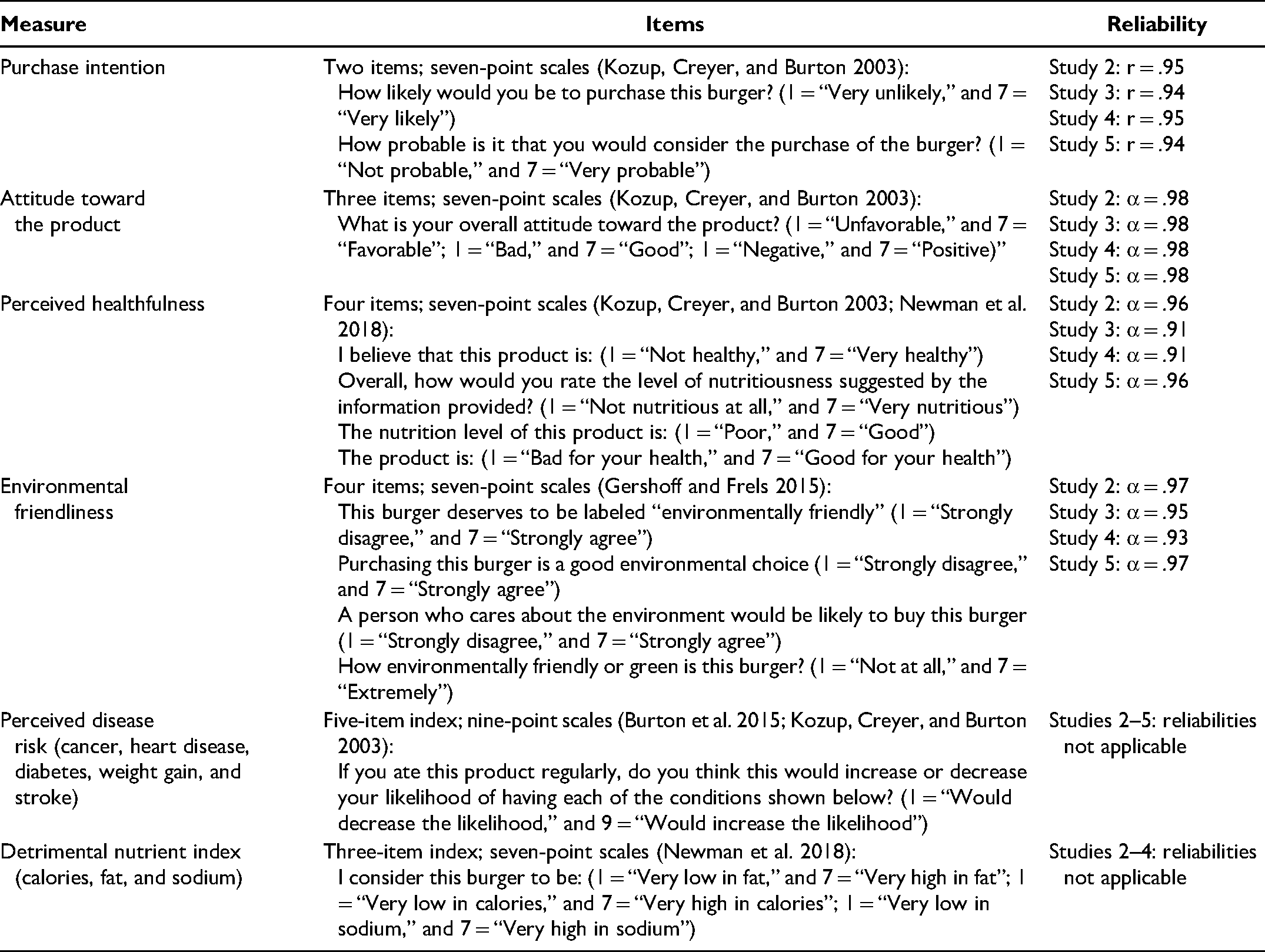
|
|
|
|
|---|---|---|
| Purchase intention | Two items; seven-point scales (Kozup, Creyer, and Burton 2003): How likely would you be to purchase this burger? (1 = “Very unlikely,” and 7 = “Very likely”) How probable is it that you would consider the purchase of the burger? (1 = “Not probable,” and 7 = “Very probable”) |
Study 2: r = .95 Study 3: r = .94 Study 4: r = .95 Study 5: r = .94 |
| Attitude toward the product | Three items; seven-point scales (Kozup, Creyer, and Burton 2003): What is your overall attitude toward the product? (1 = “Unfavorable,” and 7 = “Favorable”; 1 = “Bad,” and 7 = “Good”; 1 = “Negative,” and 7 = “Positive)” |
Study 2: α = .98 Study 3: α = .98 Study 4: α = .98 Study 5: α = .98 |
| Perceived healthfulness | Four items; seven-point scales (Kozup, Creyer, and Burton 2003; Newman et al. 2018): I believe that this product is: (1 = “Not healthy,” and 7 = “Very healthy”) Overall, how would you rate the level of nutritiousness suggested by the information provided? (1 = “Not nutritious at all,” and 7 = “Very nutritious”) The nutrition level of this product is: (1 = “Poor,” and 7 = “Good”) The product is: (1 = “Bad for your health,” and 7 = “Good for your health”) |
Study 2: α = .96 Study 3: α = .91 Study 4: α = .91 Study 5: α = .96 |
| Environmental friendliness | Four items; seven-point scales (Gershoff and Frels 2015): This burger deserves to be labeled “environmentally friendly” (1 = “Strongly disagree,” and 7 = “Strongly agree”) Purchasing this burger is a good environmental choice (1 = “Strongly disagree,” and 7 = “Strongly agree”) A person who cares about the environment would be likely to buy this burger (1 = “Strongly disagree,” and 7 = “Strongly agree”) How environmentally friendly or green is this burger? (1 = “Not at all,” and 7 = “Extremely”) |
Study 2: α = .97 Study 3: α = .95 Study 4: α = .93 Study 5: α = .97 |
| Perceived disease risk (cancer, heart disease, diabetes, weight gain, and stroke) | Five-item index; nine-point scales (Burton et al. 2015; Kozup, Creyer, and Burton 2003): If you ate this product regularly, do you think this would increase or decrease your likelihood of having each of the conditions shown below? (1 = “Would decrease the likelihood,” and 9 = “Would increase the likelihood”) |
Studies 2–5: reliabilities not applicable |
| Detrimental nutrient index (calories, fat, and sodium) | Three-item index; seven-point scales (Newman et al. 2018): I consider this burger to be: (1 = “Very low in fat,” and 7 = “Very high in fat”; 1 = “Very low in calories,” and 7 = “Very high in calories”; 1 = “Very low in sodium,” and 7 = “Very high in sodium”) |
Studies 2–4: reliabilities not applicable |
Editor
Maura Scott
Associate Editor
Donnel Briley
Declaration of Conflicting Interests
The author(s) declared no potential conflicts of interest with respect to the research, authorship, and/or publication of this article.
Funding
The author(s) received no financial support for the research, authorship, and/or publication of this article.

Notes
References
Supplementary Material
Please find the following supplemental material available below.
For Open Access articles published under a Creative Commons License, all supplemental material carries the same license as the article it is associated with.
For non-Open Access articles published, all supplemental material carries a non-exclusive license, and permission requests for re-use of supplemental material or any part of supplemental material shall be sent directly to the copyright owner as specified in the copyright notice associated with the article.
