Abstract
This paper investigates the threshold effects of the interaction between subsidy policy and inflation on social welfare in the Sub-Saharan Africa (SSA) countries over the period 2000–2020. In order to investigate the aforementioned relationship, the methodology employed involved cross-referencing an indicator of subsidy policy with an inflation indicator, with the objective of subsequently estimating a two-stage least squares (2SLS) regression and a Panel Threshold Regression (PTR). The results show that subsidy policy has a negative effect on social welfare depending on the inflation regime. When inflation rates remain below the threshold of 14.47%, this effect is less pronounced. Above this threshold, any subsidy policy harms the well-being of people in sub-Saharan Africa. The robustness test confirms the consistency of the results obtained under various specifications: adding control variables, using an alternative dependent variable, changing the measure of welfare, using a different threshold variable, comparing with a competing variable, and excluding outliers, particularly countries experiencing hyperinflation. From a policy perspective, this study recommends that SSA countries must improve welfare by merging subsidy policy with a less level inflation.
Introduction
In economic literature, the concept of price stability is a fundamental element in the promotion of economic growth and welfare. Indeed, price stability contributes to increase productivity by facilitating a more accurate estimation of costs and goods accessibility for consumers, which in turn improves people’s welfare.1–3 The concept of welfare has been defined in terms of Pareto efficiency. Indeed, the optimal allocation of resources is one in which no individual can be made better off without at least one other being made worse off. Consequently, governments endeavour to achieve this Pareto-efficient state. However, the inverse relationship between inflation and welfare is very pronounced in the case of an ineffective economic policy framework, including fiscal and monetary policies. 4 According to this reasoning, the subsidy policy increases consumer income. Therefore, this situation can mitigate the impact of inflation on social welfare. Furthermore, Meng et al. 5 posit that a subsidy policy is fundamental to increasing consumer demand for low-carbon products and goods supply, which is necessary for economic development.
The analysis of the relationship between welfare, inflation, and subsidy policy is of particular significance for countries of Sub-Saharan Africa (SSA), which have endured a dearth of welfare across all domains for several decades. While the benefits appear substantial in terms of enhanced living standards, the population of SSA countries is among the most impoverished globally, exhibiting the lowest levels of welfare and experiencing heightened prices. In this regard, the 2021 SSA recorded the lowest human development index (HDI) score (0.547), in comparison to 0.685 for developing countries, 0.754 for Latin America and the Caribbean, 0.632 for Southeast Asia, 0.749 for East Asia and the Pacific, and 0.796 for Europe and Central Asia. 6 Indeed, the HDI is a composite index that measures the average achievement in three fundamental dimensions of human development: longevity and health, knowledge, and a decent standard of living. This low level of welfare is associated with a correspondingly low gross national income (GNI) per capita. In 2021, the figure for SSA was $3699, compared to $10704 for developing countries, $15580.4 for East Asia and the Pacific, $19352 for Europe and Central Asia, $14521 for Latin America and the Caribbean, and $6481 for South Asia.
Concurrent with the observed decline in welfare, there has been a notable inflation in this region from 2010 to 2022. According to the Ref. 7, the annual growth of consumer prices remains elevated in the SSA countries like the global average. The global figures show an increase from 4.03% in 2010 to 9.39% in 2022. For the World, the figures are 3.32% in 2010 and 8.27% in 2022. During the same period, the annual growth of inflation for other regions ranged from 3.05% to 5.40% for East Asia and Pacific, 1.52% to 8.39% for the Euro area, 3.49% to 8.30% for Latin America and the Caribbean, and 3.74% to 4.99% for the Middle East and North Africa. Concerning the question of subsidies, the countries of the SSA region continue to perform less well. For the World Bank, 7 the proportion of subsidies and other transfers (as a percentage of expenditure) in the SSA region was 27.23% in 2012 and increased to 28.54% by 2020. However, Lastunen et al. 8 indicate that consumer welfare is even worsening in developing countries, including those in the SSA region, as a consequence of the distributional effects of the coronavirus.
In response to this situation, some SSA countries have initiated fiscal reforms to enhance social welfare. The rationale for these measures is that reform efforts for price stability are insufficient to ensure social welfare. These measures need appropriate fiscal policy reforms. 9 Nevertheless, the reforms have not yielded the desired results concerning price stability and welfare in SSA. Kanu 10 identifies significant discrepancies in the price stability of these countries. These disparities are justified, at least in part, by the international challenge of responding to demand and supply shocks resulting from the coronavirus crisis. This pandemic affected economic growth and, consequently, social welfare.
It is, therefore, crucial to identify the factors that have contributed to the success of reforms to achieve price stability in some countries, and to examine the reasons for the failure of similar initiatives in others, 11 and to consider the implications for welfare. It is necessary to analyse the impact of the interplay between inflation and subsidy policy on welfare, with a particular focus on the theory of optimal subsidy (TOS). This theoretical framework constitutes a body of work that encompasses research on the role of government policy in economics. The TOS indicates the presence of domestic distortions in the case for free trade, thereby disproving the prevailing wisdom of the time that in the presence of distortions such as externalities, wage rigidities, and distorted factor and product markets, a move from free trade to autarky might improve welfare. 12 This article examines the impact of the interplay between inflation and subsidy policy on welfare in countries in the SSA region. This relationship assumes that price stability will have a positive effect on the economy, if the subsidy policy in question is efficient. It is the responsibility of governments to implement fiscal policy.
This paper makes two key contributions. Firstly, this research contributes to the economic literature on developing countries. It uses social welfare (HDI) as the outcome, instead of economic growth, which earlier studies used. Indeed, previous studies have considered economic development as the dependent variable. This study selects social welfare as the dependent variable, given that economic development does not necessarily result in social welfare. Conversely, social welfare can facilitate economic development. In light of the above, we emphasise the general standard of living. Furthermore, this research extends the analysis beyond the effect of subsidy policy on social welfare to encompass a broader range of factors. The second contribution pertains to an empirical analysis. A threshold panel was employed to cross the inflation and subsidy policy indicators. In this regard, the Panel Threshold Regression (PTR) model has been subjected to empirical testing. The primary findings indicate a nonlinear relationship between inflation and social welfare.
The research is organised as follows. The literature review examines the relationship between inflation, subsidy policies, and social welfare. The methodology section describes the approach employed in the analysis. The econometric analysis section presents and discusses the results. Finally, the conclusion summarises the main findings and outlines their policy implications.
Inflation, subsidy, and welfare: A literature review
This section presents a theoretical review and empirical literature on the relationship between welfare, threshold inflation, and subsidy policy.
Welfare and inflation
Welfare represents the set of factors by which a person has a need to enjoy a good standard of life. 13 Furthermore, there are two main groups of studies: welfarism and the critical of welfarism. The first one considers welfare as a subjective indicator of social choice. 14 This theory connects social preferences to all individual decisions. 15 Rawls 16 and Arrow 17 criticised welfarism. For them, economic freedom, individual autonomy, and property rights are some values in social choice. They noticed that using a subjective measure of social welfare posits a problem because of a possible adaptation of each agent. People’s behaviours depend on the level of satisfaction. In addition, the taste of luxury contradicts the welfarism approach. It leads to need more resources to reach satisfaction. 17 Therefore, the welfarism approach presents some limits, and the comparison between subjective indices of welfare and individual behaviour is impracticable. According to Easterlin, 18 when countries become rich over time, people’s stand on happiness is no longer increasing. Besides, if rich people are happier than the poor are, once their basic needs are satisfied, the increase in income does not necessarily result in an increase in happiness. 19
The theoretical basis of the relationship between inflation and social welfare in a country is rooted in utility theory in microeconomics. Indeed, this theory concerns the value associated with a particular good or service. 20 Each individual strives to maximise his utility through his actions and consumption choices. The interaction of buyers and sellers within competitive markets, governed by the laws of supply and demand, generates consumer and producer surplus. Besides, two assumptions can be highlighted: the “consumer’s welfare” and “producer’s welfare.” The consumer welfare hypothesis posits that inflationary pressures have an effect on consumer welfare in developing countries with high price regulation. Indeed, high prices affect present and future consumption. 21 Consequently, there is potential for arbitrage in intertemporal expenditure. The assumption regarding producer welfare suggests that high price affects the rents of production. Inflation increases production costs. Danziger 22 posits that inflation may also positively affect a producer’s profit.
The veracity of this hypothesis has been subjected to scrutiny in several empirical studies. The results of these studies show that inflation has a detrimental impact on social welfare in countries. Del Granado et al. 23 examined the impact of fuel price on household welfare. They show that a direct effect is observed as households that consume fuel are confronted with elevated prices following a reform, which subsequently diminishes their real income. Consequently, Buljan and Badovinac 24 investigated the spillover effects of oil price fluctuations on the consumer prices of transportation services in 27 European Union countries, utilising fixed effects panel data estimation over the period from 2020 to 2023. The results show the recent oil price shock had a limited impact on consumer prices of transport services in the EU. This can be attributed primarily to the implementation of targeted policy measures across the EU to mitigate the inflationary effects of the global energy crisis. Some studies have indicated that inflation has a detrimental impact on the welfare of producers. Massel 1 analysed the implications of price stabilisation achieved through an international buffer stock. He investigated the effects of the buffer stock on the variance of a producer’s income. These effects are contingent upon the extent to which inflation is reduced by the buffer stock.
Literature on subsidy policy
To enhance social welfare, governments frequently implement economic policies, including fiscal policy. It is, therefore, postulated that there is a relationship between subsidy policy, the level of inflation, and social welfare. This analysis is grounded in the theory of optimal subsidy. As Panagariya 12 posits, in the presence of distortions such as externalities and wage and price rigidities, the role of government policy in economics is indispensable. Nevertheless, there has been a paucity of research examining the nexus between subsidy policy, inflation, and social welfare, and the efficacy of subsidy policy in enhancing social welfare, particularly in the context of global challenges to the efficiency of macroeconomic policies.
In the context of consumer welfare, Groot and Oostveen 25 examine the potential implications of energy subsidy reforms in developing countries. Income distributions for 11 developing countries from disparate geographical regions are simulated on the assumption that income is log-normally distributed. The concept of the compensating variation is employed to ascertain the extent of compensation required to offset the impact of inflation on consumers of formerly subsidised goods. They show that when a nonlinear model is employed, a proportion of consumers’ income is allocated to the purchase of subsidised goods, which remains constant even when prices are increased. In contrast, a quasi-linear model indicates that the optimal quantity of the subsidised goods remains constant with respect to income, but is sensitive to price fluctuations. It is possible to set the required compensating variation below the saved expenditures on subsidies, thereby ensuring that a budget-neutral reform has a positive effect on social welfare. Similarly, Zhang 26 employs a general equilibrium model with two-stage skill formation, to show that in an economy with unemployment, a public education subsidy will narrow the wage differential in the initial stage. However, in the subsequent stage, the wage differential may widen if the ratio is sufficiently large.
In examining the cost-effectiveness of government subsidies for producers, Fujin et al. 2 considered a production subsidy, an investment subsidy, and an entry subsidy. Using panel data of 10 Midwestern states from 1995 to 2009, and a dynamic model of subsidies, they show that investment subsidies and entry subsidies are more cost-effective than production subsidies for inducing investment that would otherwise not have occurred within the ethanol industry. Similarly, Shin and Kim 27 conducted an analysis of the effects of government subsidy policies on the incentive of a domestic firm to improve the quality of a product. A dynamic profit maximisation problem was simulated for the firm, and the optimal path for product quality development was derived. They show that the provision of subsidies does not necessarily guarantee the advancement of product quality, even when the same amount is allocated.
Literature on threshold inflation
Theoretical literature on inflation highlights three main views. The first one assumes there is not a threshold level of inflation because inflation is harmful to economic growth. This neoclassical view assumes that inflation is a distortion of relative prices. It does not affect real growth. The second view from Keynesian economists assumes that inflation can contribute to economic growth. They assume a threshold inflation. For them, a low level of inflation may stimulate demand and investment. The third view assumes that inflation can undermine savings and investment. This view from monetarists posits that inflation is always a monetary phenomenon. There is a short-run effect of inflation on economic growth but the long-run effects depend on real factors. There is a threshold level where the effects of inflation on economic growth become negative. Therefore, inflation can reduce productivity growth by discouraging consumption and capital formation.
On the basis of the threshold level of inflation, some empirical studies show a possible threshold following different regions. Khan and Senhadji 28 estimate threshold inflation in developed and developing countries. Using threshold autoregressive methods, they show that threshold inflation is less than 3% in developed countries and comprise between 11 and 12% in developing countries. Besides, some studies focused on Sub-Saharan Africa.29,30 Using a GMM, Bobbo 29 shows that inflation volatility negatively affects governance and capital inflows in Sub-Saharan Africa. By contrast, Seraphin 30 analyses threshold inflation in 13 African countries and BRICS by using Panel threshold regression. The results show that the estimated threshold inflation in BRICS countries is 7% and 11.3% for the West African economic and monetary union. Overall, the results show that moderate inflation can support growth and the threshold inflation depends on the region.
This literature reveals the relation between inflation, some subsidy policy, and social welfare. However, countries in the SSA region exhibit distinctive characteristics with regard to both their economic status (developing countries with relatively low incomes) and inflation, which is largely attributable to international demand and supply shocks. In light of the aforementioned considerations, this research aims to contribute to the existing literature by examining the role of global subsidy policy and threshold inflation on social welfare in SSA.
Methodological approach
Theoretical model
The strategy of modelling is based on an analysis of the effects of subsidy policies on social welfare, with a particular focus on the inflation level in the SSA region. Indeed, the importance of people’s well-being as one of the development policy’s objectives was recently emphasised in the context of economic growth. 31 The theory of optimal subsidies4,12 forms the conceptual basis of our analysis. Whilst the TOS suggests that subsidies can improve social welfare, its predictions regarding the thresholds of macroeconomic variables, such as inflation, are not directly tested in this study. Instead, we adopt a reduced-form empirical approach designed for policy-oriented investigation. Specifically, we employ a threshold model 32 to explore how inflation levels interact with the effectiveness of subsidies. The observed inflation thresholds are consistent with the predictions of TOS, highlighting the conditions under which subsidies may be more or less effective, but this study does not attempt to test the structure of the theory. This parametric approach which employs a sudden transition mechanism is adapted to the homogeneous panel. The approach to capabilities proposed by Sen also enriches our conceptual framework by emphasising the role of individual capabilities in mediating the effects of policies. However, it is not directly incorporated into the empirical specification, and its analysis serves primarily to contextualise the implications of subsidies for well-being.
Empirical and estimation model
In accordance with the findings of the literature review, the empirical model demonstrates a linear correlation between subsidy policy and welfare.13,33

In this equation (1) without inflation, we introduce inflation as a threshold variable to test the effect of subsidy policy on social welfare following the inflation regimes. Following Chiu and Yeh,
34
the threshold model with different regimes is given by equation (2):

In order to ensure the control of endogeneity analysis, the square of inflation is introduced in order to verify that no linear hypothesis is being tested. We introduce two external instruments: the income group level (low income, lower middle income, and upper middle income) average of subsidies, and the number of incidents of political violence, serving as a proxy for regime change, which is likely to be correlated with subsidy policy without affecting the error terms of the HDI. We validated our instruments to ensure they satisfy the two conditions required by Wooldridge
35
: first, the correlation of the instruments with the endogenous explanatory variables, and second, the absence of correlation between these instruments and the error terms. To this end, we used the statistical test developed by Kleibergen and Paap
36
to verify whether the instruments are related to the endogenous explanatory variables. Next, the Cragg-Donald F Wald statistic was used to determine whether the instruments are weakly identified or weakly correlated with the endogenous variables. The linear model that is to be bootstrapped with two-stage least squares (2SLS) is as follows:

Following preliminary tests, including panel homogeneity, stationarity tests of the variables and statistical inference tests, the PTR estimator is applied to equation (2) and 2SLS regression is employed for equation (3), to determine the effects of the subsidy policy on social welfare while taking into account the nonlinearity of the inflation rate.
Variables and sources of data
According to economic literature, some indicators are employed to measure welfare. This study considers the social welfare indicator. It is a human development index. Indeed, this indicator, from UNDP, is the most comprehensive indicator of a population’s well-being. It is a composite index that assesses the average achievement in three fundamental dimensions of human development: longevity and health, knowledge, and a decent standard of living. Consequently, this indicator is an aggregate composite of measures of social welfare.
With regard to the variables of interest, the first is the inflation rate. The consumer price index (CPI) is a measure of the cost of living and thus provides insight into the evolution of the general price level. For Del Granado et al., 23 an elevated inflation rate is detrimental to social welfare. Therefore, the expected sign of this variable on social welfare is negative. The second variable is subsidy policy, proxied using the World Development Indicators measure “Subsidies and other transfers (% of expenses).” It measures the share of government total expenditure devoted to subsidies, grants, and social transfers. It captures how much of public spending goes to non-repayable transfers rather than direct consumption or investment. Indeed, in order to enhance the quality of life for human beings by reducing the cost of living, states implement some policies. According to these policies, there are transfers to households, some reallocation of resources, and a move towards a Pareto-efficient situation. For Meng et al., 5 the anticipated sign of this variable is positive. The third variable is the interaction between inflation threshold and subsidy policy.
In regard to the control variables, these factors are considered: (i) Population: This variable is the logarithm of the population for each country, and represents population size. Chukwu et al. 37 show a negative effect of this variable on welfare. (ii) Inequality: This variable is measured by the Gini index, which serves as indicators of income inequality. This indicator pertains to the unequal distribution of valuable and scarce resources within nations. As Nel 38 asserts, the anticipated sign of this variable coefficient is negative. (iii) Trade: serves as an indicator of economic openness. It represents the sum of exports and imports of goods and services, expressed as a percentage of gross domestic product. An increase in economic openness has been demonstrated to have a positive effect on the well-being of the general population.39,40 (iv) CO2: This variable serves as an indicator of carbon emissions. A high level of carbon emissions has an adverse impact on human well-being, 41 and thus a negative effect of this variable on social welfare is expected. (v) (Cons.) Potential drawbacks: this indicator represents the final consumption of a household. As evidenced in the literature review, the expected sign of the coefficient is positive.42,43
Descriptive statistics.
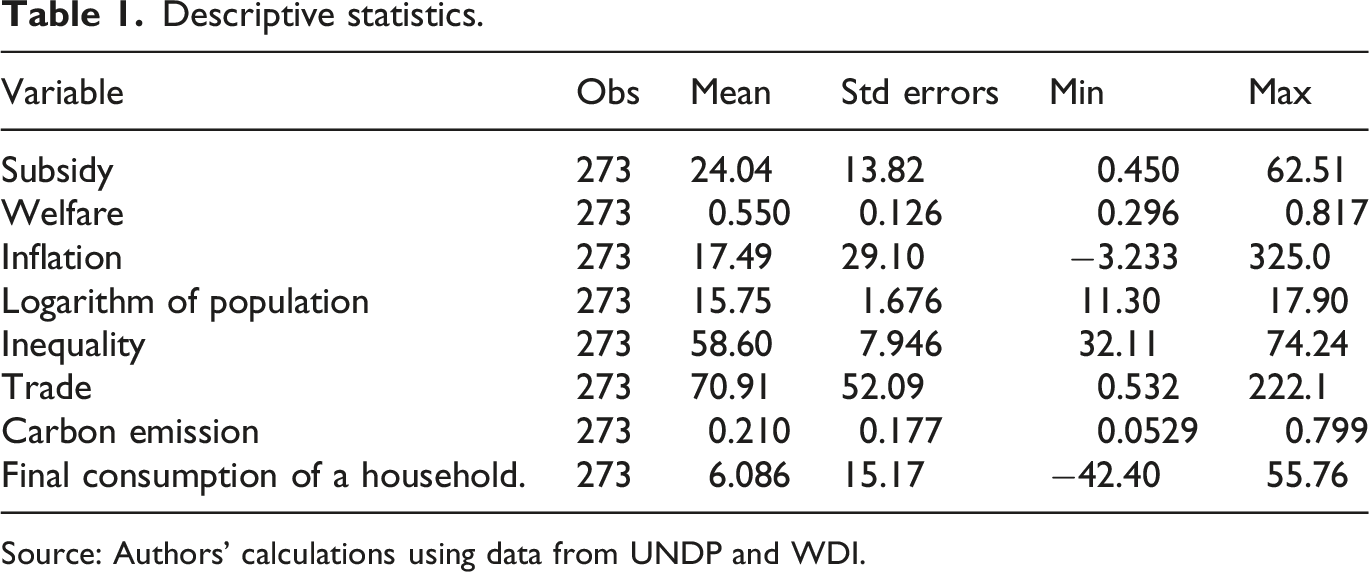
Source: Authors’ calculations using data from UNDP and WDI.
Pairwise correlations.
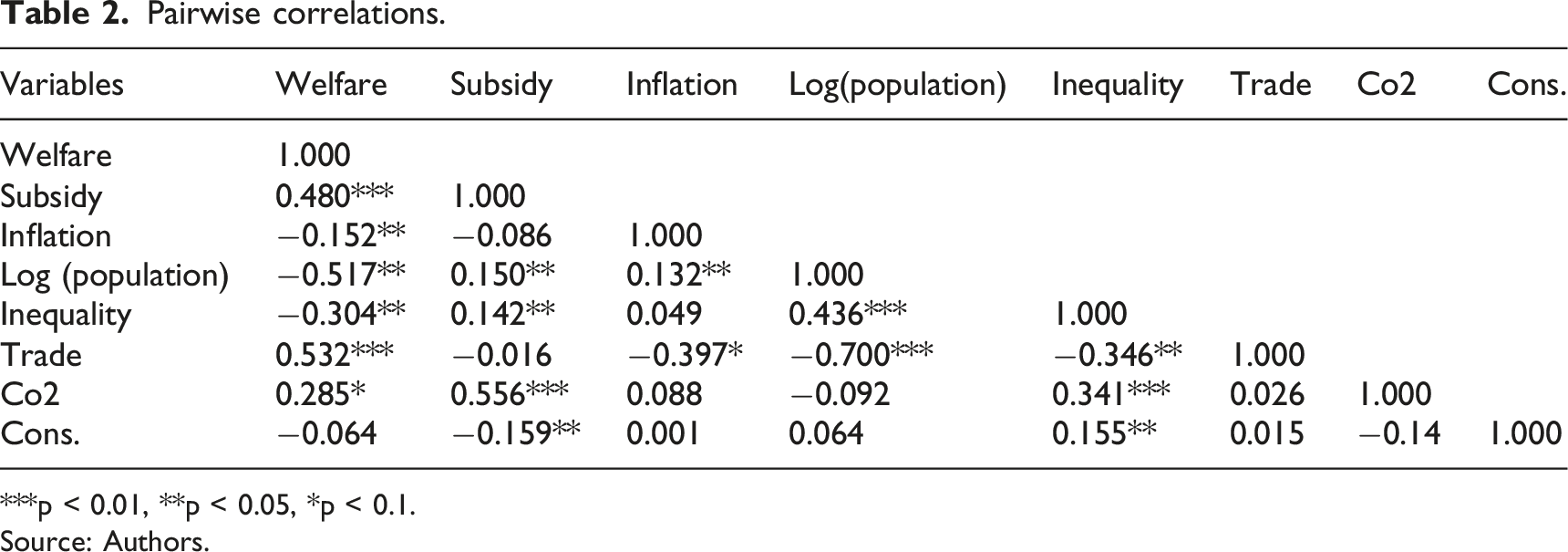
***p < 0.01, **p < 0.05, *p < 0.1.
Source: Authors.
Pesaran unit root test.
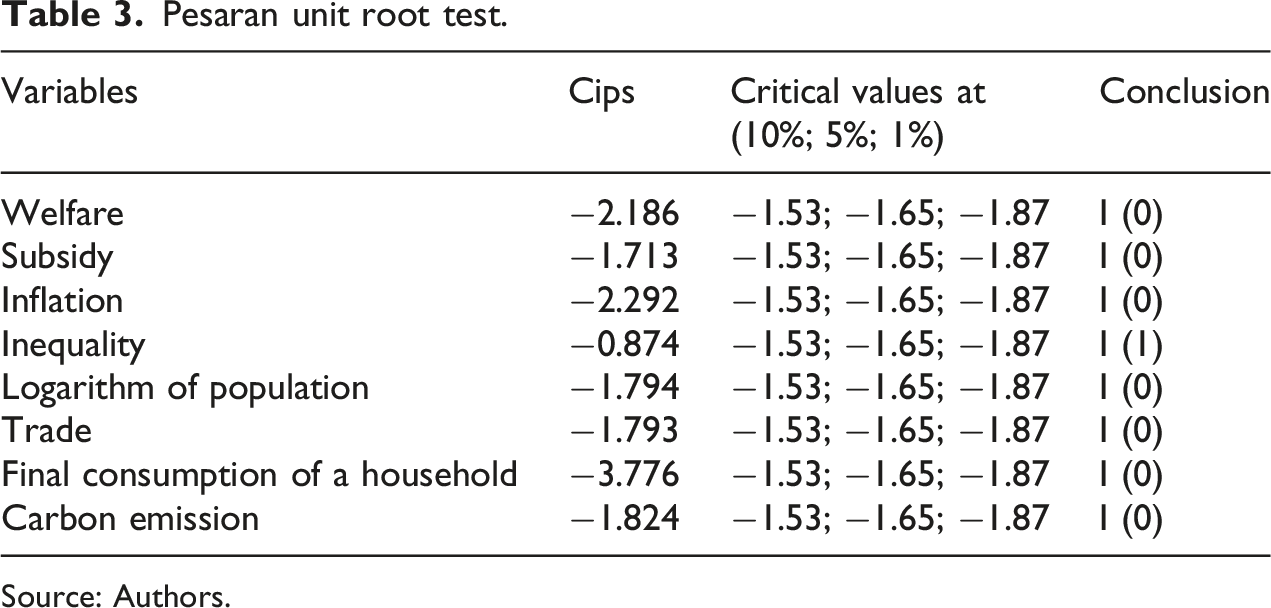
Source: Authors.
Results and discussion
This section presents and discusses the principal findings of the preliminary and estimation tests. The findings for the basic model and the results for robustness are presented.
Preliminary tests
Results of preliminary test.
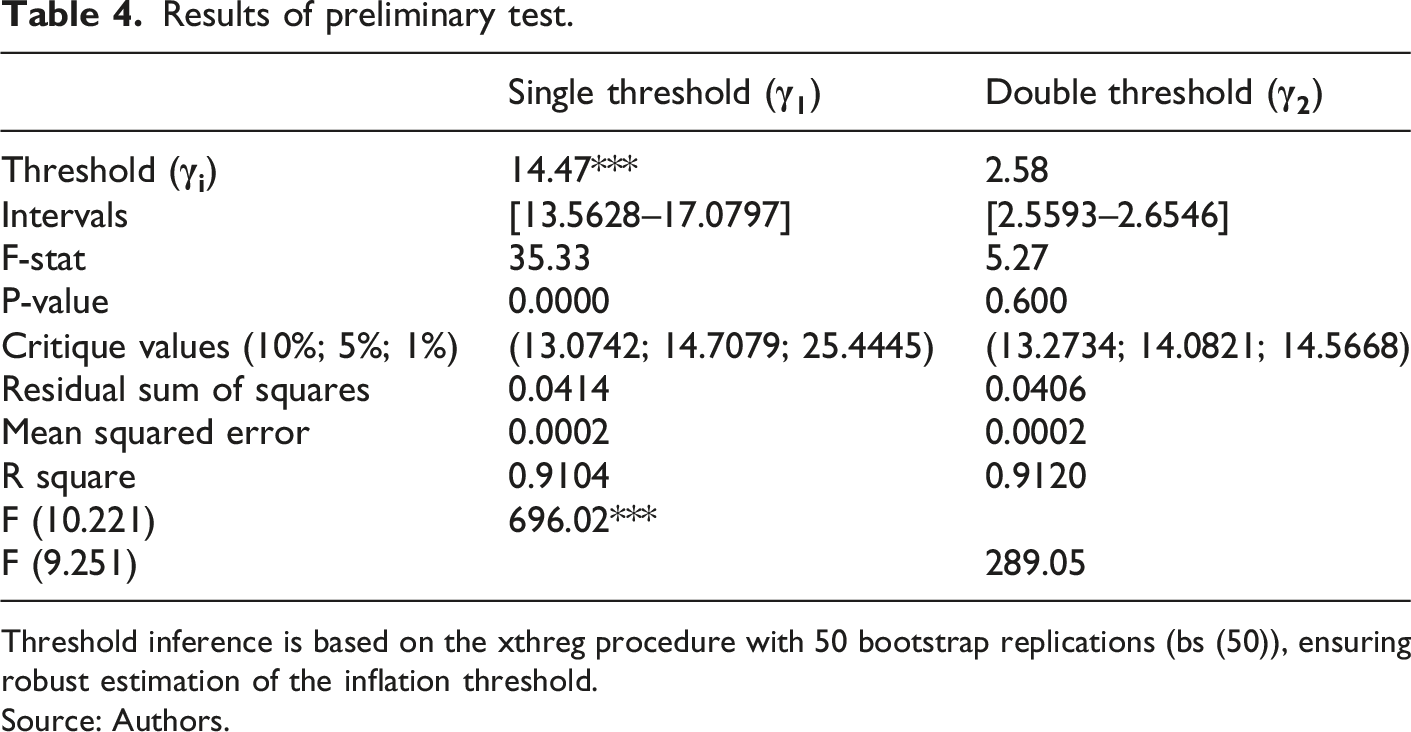
Threshold inference is based on the xthreg procedure with 50 bootstrap replications (bs (50)), ensuring robust estimation of the inflation threshold.
Source: Authors.
Table 4 indicates that the minimal values of the residual sum of squares and mean squared error suggest that our model is an accurate representation of the data. Consequently, there is a reduction in the dispersion of data points around the mean, as well as a decrease in the deviation of the dependent variable from the values predicted in the regression analysis. Additionally, the high R2 values indicate that the number of variables included in the regressions is sufficient to explain the variations in the dependent variable, the HDI.
Results of basic model
Results of estimation.
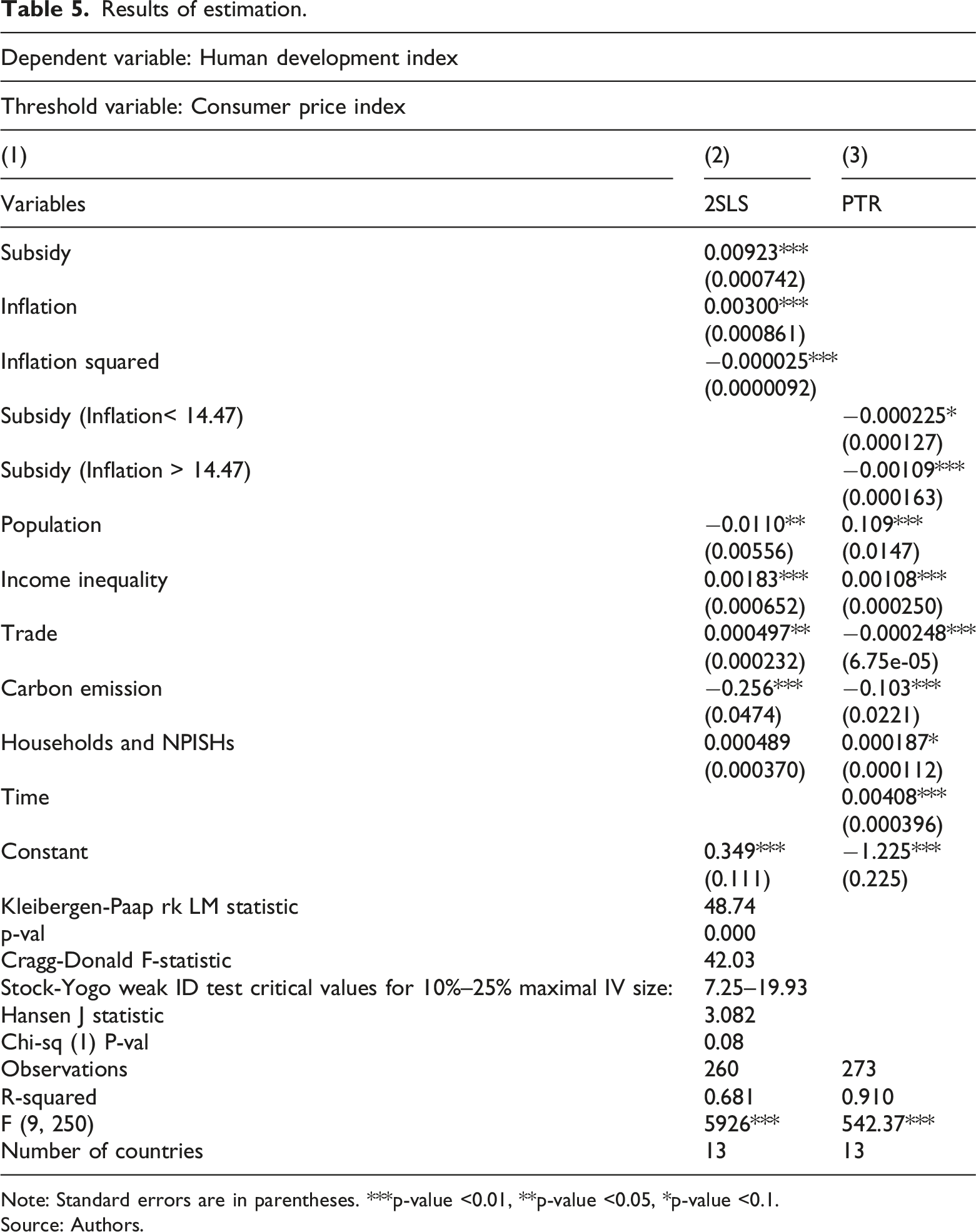
Note: Standard errors are in parentheses. ***p-value <0.01, **p-value <0.05, *p-value <0.1.
Source: Authors.
The under-identification test based on the Kleibergen-Paap rk LM statistic indicates that the instruments are significantly correlated with the endogenous variable (subsidy), suggesting that the model is not under-identified. The Cragg-Donald F-statistic exceeds the critical values of the Stock-Yogo test for a maximum IV size of 10%–25%, implying that the instruments are sufficiently powerful and relevant to avoid weak instrument bias. Finally, the Hansen J statistic from the over-identification test for the set of instruments yields a p-value greater than 0.05, confirming that the instruments satisfy the exclusion hypothesis and are exogenous.
The 2SLS results indicate that the subsidy policy and inflation have a dual impact on social welfare in SSA, exhibiting both positive and negative effects. The inclusion of the square of inflation reveals a sign opposite to that of the linear variable, confirming the existence of two distinct inflation regimes (Table 5, column 2). In this context, the application of the PTR model, via the logarithmic transformation proposed by Wang, 46 highlights this relationship. The model estimates the effect of the subsidy policy on social welfare under two inflation regimes, with a threshold identified endogenously to 14.47% (in Table 5, column 3). These results support the hypothesis that the relationship between subsidy policy and social welfare varies depending on the inflation intensity in SSA.
The results in Table 5 show that the probabilities (p-values) of the F-statistic tests rejecting the null hypothesis of spurious regression are all equal to zero. Additionally, the R-squared = 0.91, of which 91% of the intra-group variation is explained by the model. It can therefore be concluded that the model is adequate and that the interpretation derived from the estimation results is that inflation acts as a channel for reducing the subsidy policy.
The results reveal that subsidy policy contributes to deteriorate social welfare under the two inflation regimes. When the inflation rate is below 14.47%, a one-unit increase in subsidies is associated with a 0.000225 unit decrease in social welfare. This effect is amplified when inflation rate is above the threshold of 14.47%. Indeed, the subsidy policy has a detrimental impact on the population’s well-being. In addition to representing a cost of living, inflation also has a detrimental impact on welfare. This is particularly evident at high levels, where it reduces the effectiveness of subsidies. The inhibitory effect exerted by high levels of inflation may be attributed to the nature and extent of subsidies employed in SSA countries, which are often inadequate and misdirected. Consequently, the elevated cost of living exerts a direct reduction in the impact of the subsidy policy on welfare in SSA countries.
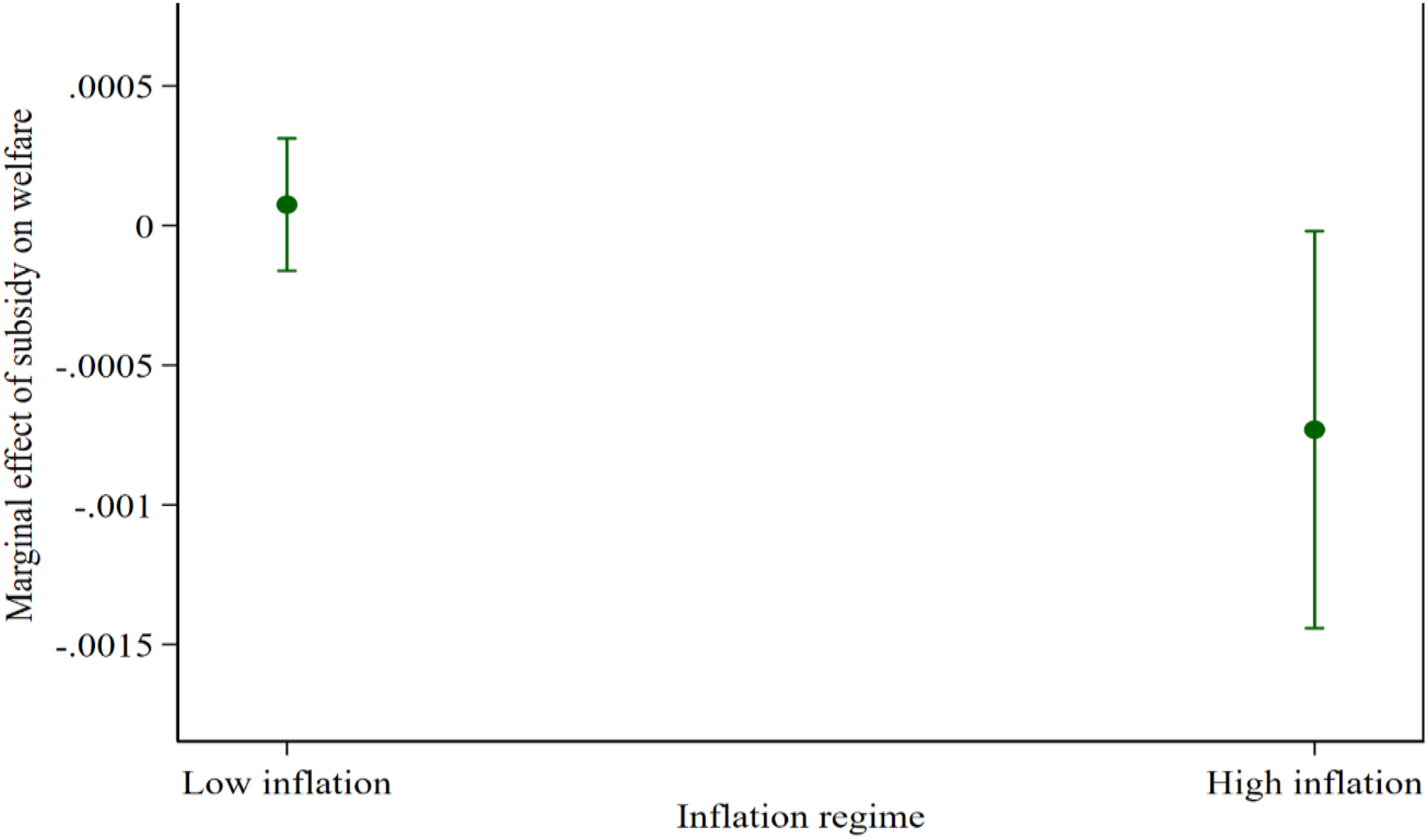
Accordingly, to optimise the efficacy of subsidy policy in the SSA, it is imperative to reduce inflationary pressure. All subsidy policy, in the presence of inflation, becomes ineffectual, detrimental, and futile in the SSA region. Therefore, in the context of exceptionally high inflation (above of a threshold of 14.47%), subsidy policy does not significantly contribute to enhancing social welfare. These results corroborate those previously established by Bental and Spiegel, 45 which demonstrate that subsidies financed through money creation are, at best, neutral in their effect and, at worst, such a subsidy is Pareto non-optimal. However, this threshold of 14.47% is different of those found by Khan and Senhadji 28 and Seraphin. 30 These authors focused on GDP growth as a dependent variable instead of HDI. The present study uses HDI variable which take account GDP, education and health. This threshold can also be explained by the fact that a subsidy policy alters the marginal effect of inflation. Furthermore, it depends on the intensity of inflation in each country in the sample. Graph 1 in the appendix shows the conditional marginal effect of subsidies on welfare under two inflation regimes: low and high. It confirms that the impact of subsidies appears to vary depending on the inflation environment.
Overall, the results of 2SLS and PTR confirm the heterogeneity of subsidy policy. In contrast the negative marginal effects of subsidy policy on welfare via its interaction with the inflation rate in the interactive model (PTR), positive average effects are observed in the simple model (2SLS). This shows that the effects of subsidy policy depend on the inflation rate. It appears as inflation offsets the impact of subsidies on social welfare.
It was observed that the population growth has a detrimental impact on social welfare (column (2)). A 1% increase in population, there is a corresponding decrease in well-being of 0.0110%. These findings indicate that in developing countries, there is a high population density, and the majority of states are unable to meet the basic needs of their citizens, including access to education, healthcare, and food. Similarly, a proportion of the population exerts control over the national income, thereby reducing the standard of living of the remainder. In contrast, the benefits of subsidy policies are generally accessible to both poor and rich populations. These findings on social welfare are analogous to those reported by Chukwu et al. 37 However, it was observed that the population growth has positive impact on social welfare (column (3)). The difference in sign observed between the 2SLS and PTR estimates stems from the specific characteristics of these two econometric approaches. The 2SLS model provides a linear average effect across the entire sample, whereas the PTR model takes into account the nonlinear effects and regime shifts associated with the inflation threshold. The results therefore suggest that the impact of population on welfare may vary depending on the level of inflation. It can be reasonably deduced that income inequality and final consumption of household on the one hand, carbon emission and trade and other hand are some of the key determinants of social welfare in sub-Saharan Africa. In fact, a one-unit increase in each of these variables is associated with a respective increase and decrease in population well-being of 0.00108, 0.000187, 0.103, and 0.000248 units. The estimated coefficient for the “time” variable is statistically significant at the 1% level. This indicates that, on average, social well-being increased by approximately 0.0043 per year during the period studied.
Robustness
Robustness results.
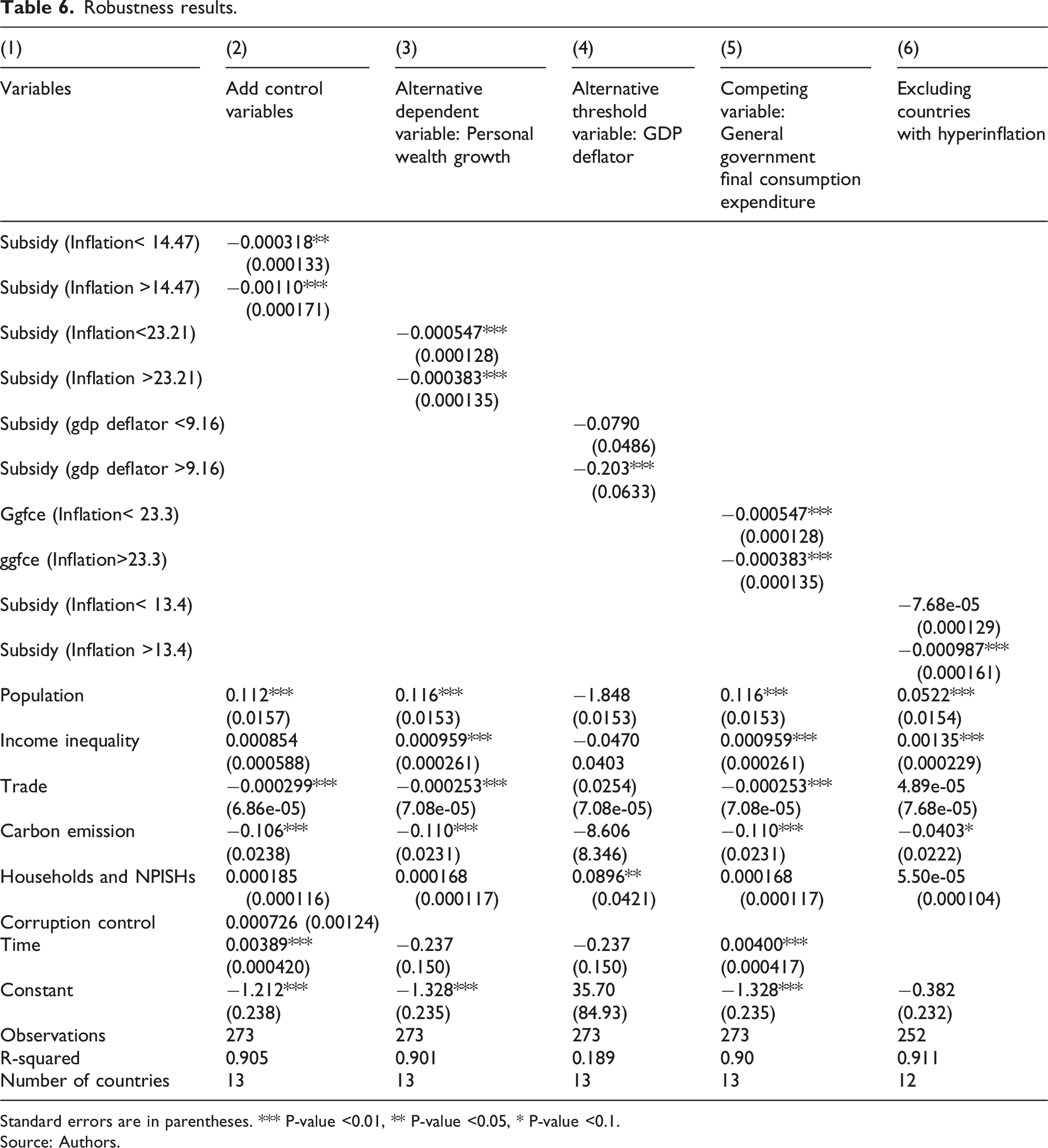
Standard errors are in parentheses. *** P-value <0.01, ** P-value <0.05, * P-value <0.1.
Source: Authors.
We also conducted robustness checks to ensure that the threshold is not driven by extreme episodes. Specifically, we performed a stability test by excluding Angola country that experienced hyperinflation from the dataset, to verify that the observed effect is not determined by these extreme cases. The results confirm that the main findings hold regardless of the sample countries. These checks increase our confidence that the threshold is stable and not driven by outliers. The results are in column (6) of Table 6.
We have substituted the original well-being indicator, the Human Development Index (HDI), with the growth of individual wealth, proxied by the growth rate of GDP per capita, whose results are reported in column 3 of Table 6. As emphasised by Boarini et al. 48 and Lee and Goh, 49 measures of GDP per capita and economic growth continue to play a central role in the evaluation of well-being. Additionally, we have refined our measure of inflation by replacing the Consumer Price Index (CPI) with the GDP deflator (column 4 of the same Table 6. Malenković 50 notes that, in certain macroeconomic analyses, the GDP deflator exhibits a stronger relationship with economic growth than CPI-based inflation.
We have carried out alternative re-estimations by replacing the variable relating to subsidy policy with a concurrent variable, namely Gross Government Final Consumption Expenditure, to verify that the estimated threshold effect is not simply capturing overall social spending or the size of government, presenting the results in column 5 of Table 6. This variable demonstrates that subsidy policy differs from the size of the public budget, but also reflects specific choices regarding redistribution and economic intervention. According to Schwartz and Clements, 51 subsidies differ from general public expenditure in that they target specific sectors or agents and produce specific redistributive effects that are not captured by traditional budgetary aggregates. This would support the interpretation that the result is linked to subsidy-oriented fiscal policy rather than broad transfers or public expenditure.
The results of the robustness tests generally corroborate the hypothesis that the impact of the subsidy policy on social welfare is contingent upon the prevailing inflation threshold in sub-Saharan Africa. The findings indicate that sub-Saharan African countries can enhance the well-being of their citizens through the implementation of a subsidy policy coupled with a moderate inflation rate, with a threshold that varies slightly depending on the specification method used. Although corruption does not significantly affect the marginal effect of subsidies on welfare, this is consistent with the literature on institutional quality, where the effects of governance are often mitigated in short-term policy interventions, particularly when subsidies are targeted or well-controlled. 52 The inclusion of this variable, as well as the replacement of the GINI coefficient with the Palma ratio, shows that this does not significantly alter the observed threshold effects. A subsidy policy is ineffective in improving welfare in countries below this threshold. The aforementioned results are therefore stable and robust, confirming the reliability of the analysis performed on the basic model.
Conclusion
The global challenge for developing countries, particularly those within the SSA, is the potential distortion of social welfare resulting from inflation. Indeed, the underdevelopment of social safety nets and the fragility of their healthcare systems, as well as the inefficiency of their economic policies distinguish countries of SSA. The present study assesses the impact of subsidy policy on welfare, with a focus on the interplay between subsidy policy and inflation on social welfare in sub-Saharan Africa over the period 2000 to 2020. The results demonstrate a nonlinear relationship in relation between subsidy policy, inflation and social welfare, as estimated using 2SLS and a PTR. The findings indicate that the inflation pressure has a negative moderating effect on the relation between subsidy policy and social welfare in SSA. When inflation rates remain below the threshold of 14.47%, the effect of the subsidy on welfare is less pronounced. Beyond this threshold, any subsidy policy is detrimental to the SSA population’s well-being starting at an endogenous threshold detected. These results suggest a threshold level of inflation is a prerequisite for an effective global subsidy policy on social welfare in SSA. SSA countries should prioritise subsidies targeting inflation’s sensitive aspects of human development rather than blanket transfers. This is designed to maximise the benefits to people’s well-being whilst keeping inflationary pressures in control. Governments must coordinate the implementation of subsidies with monetary stabilisation measures to ensure that high inflation does not erode the real value of transfers. They should implement subsidies during periods of monetary stabilisation (when inflation is zero or remains below the 14.47% threshold) and reduce or delay subsidies when inflation exceeds the estimated threshold, in order to avoid counterproductive effects.
In line with United Nations sustainable development goals, the African Union’s Agenda 2063 and the promotion of an African Continental Free Trade Area (AfCFTA), the suggestions aim to promote inclusive and sustainable prosperity, while taking into account administrative capacity constraints and political realities. The article thus contributes to the debate on the improvement of well-being and the effectiveness of subsidy policies in a context of macroeconomic volatility. It offers concrete avenues for better coordination between economic stabilisation and social protection. Although our study is limited by the small sample size, the findings can be generalised to other SSA countries. This is particularly applicable to fragile states which face subsidy policies combined with high inflation.
Footnotes
Funding
The authors received no financial support for the research, authorship, and/or publication of this article.
Declaration of conflicting interests
The authors declared no potential conflicts of interest with respect to the research, authorship, and/or publication of this article.
Data Availability Statement
The data that support the finding of this study are openly available from https://hdr.undp.org/data-center/human-development-index#/indicies/HDI and  .
.
Note
Appendix
Conditional marginal effect of subsidies across inflation regimes. Source: Authors.