



Abstract
This study provides evidence for the structural validity of the Juvenile Offender Parent Questionnaire, developed by Rose, Glaser, Calhoun, and Bates. Data analysis indicates that the model does have an adequate level of fit, providing cross-validation for the original exploratory model. Clinical implications are also discussed.
Parental contributors to adolescent delinquency are a topic is well documented in the literature (Hoeve et al., 2009). Although much of the literature regarding the assessment of antisocial behaviors focused on characteristics of the child, previous researchers consistently demonstrated a strong association of family variables with childhood antisocial behavior (Hoeve, Dubas, Gerris, van der Laan, & Smeenk, 2011; Kazdin, 1994). According to statistics provided by the Office of Juvenile Justice and Delinquency Prevention (Puzzanchera, 2009), juveniles accounted for 16% of all violent crime arrests and for 26% of all property crime arrests. The murder arrest rate (3.8 arrests per 100,000 juveniles) of juveniles ages 10 through 17 years demonstrated a 17% increase since 2004 (3.3 per 100,000). Additionally, the report states that in 2008, a total of 3,340 juveniles were arrested for rape, 56,000 arrested for aggravated assault, 84,100 arrested for burglary, 324,000 arrested for larceny, and 35,350 arrested for robbery. Identification of factors that contribute to the development of delinquency in children and adolescents presents undeniable benefits to families, communities, and society as a whole.
Consistent with Bronfenbrenner’s (1979/2005) social ecology model, later expanded on by Berry (1995), the family should be considered a microsystem providing the main influence on a child’s life. Understanding, measuring, and addressing the parenting factors that both inhibit and exacerbate delinquency are of utmost importance when planning effective treatment strategies for children and adolescents. For example, Webster-Stratton (1998) described family characteristics such as low income, low education, teenage pregnancy, level of stress, isolation, single parenthood, parental psychiatric illness, parental criminal history, substance abuse, marital discord, and depression as possible factors that place a child at risk for developing behavioral problems. In thinking consistent with the social ecology theory, exploration of the various roles parents play in the development of delinquent behaviors and subsequent development of valid measurement tools to aid clinicians in assessment and intervention is important.
Current literature suggests several possible factors that contribute to adolescent conduct problems in the home, school, and community. McCabe, Lucchini, Hough, Yeh, and Hazen (2005) demonstrated that exposure to violence in the home and in the community each contributes independently to issues with conduct in adolescence. The notion of child exposure to violence is a topic that has been well documented in the literature. Kracke and Hahn (2008) discussed some of the detrimental effects this exposure can have on the behavioral development in children, and identified the necessity for further research on this topic. Obtaining an accurate understanding of the level of and type of violence that children have been exposed will aid counselors in understanding the etiology of problematic behaviors.
Shaw, Dishion, Supplee, Gardner, and Arnds (2006) suggested a link between parental involvement and monitoring with the development of delinquency in children and adolescents. Frick et al. (1992) found that maternal supervision and persistence in discipline, in addition to paternal antisocial personality disorder and substance abuse, were predicting factors in the development of oppositional defiant disorder and conduct disorder in boys. A more recent study assessed parental work schedules and the existence of risky behaviors in adolescents (Han, Miller, & Waldfogel, 2010). Through the use of structural equation modeling, these researchers demonstrated the relationship between work schedules that limit the parent’s ability to monitor their child (e.g., working at night) and the presence of risky behaviors.
In addition to the detrimental effects that negative parenting can have on children, positive parenting can serve as a protective factor. Effective boundary setting in the home, respect for the child’s individuality, family stability, parental expectations of academic performance, and a home environment free from chronic abuse were found to contribute to positive behavior and school performance (Herrenkohl, Herrenkohl, & Egolf, 1994). Previous research indicated that parents, parenting styles, and parental involvement have a profound effect on behaviors in children and adolescents (Gardner, Shaw, Dishion, Burton, & Supplee, 2007; Joussemet, Landry, & Koestner, 2008; Shaw et al., 2006).
A possible barrier to this protective influence is the parents’ level of fear of their child. Parental abuse is a topic that has received limited exposure but is becoming illuminated in recent research. According the U.S. Department of Justice (Puzzanchera, 2009), 52% of victims of violence older than 30 years were either the offender’s parent or the offender’s stepparent. In crimes committed by juveniles, family members accounted for 28% of victims of sexual assault and 24% of victims of simple assault. Kennedy, Edmonds, Dann, and Burnett (2010) found that juveniles who assault their parents typically do not come from intact homes and have difficulties relating to their parents and household members. Additionally, they are significantly more likely to associate with peers who own guns and are in gangs. These factors may lead parents to feel afraid of their own children and feel as though they are prisoners in their own homes, which would hinder their ability to provide effective parenting practices.
Finally, another factor salient to the understanding of parenting influences on adolescent offenders is level of trust of the justice system. Sprott and Greene (2010) examined this issue and determined that initial perceptions of the legitimacy of the justice system and views of the judge and lawyers significantly affected an offender’s final view of the legitimacy of the court setting. Other researchers suggested that individuals who feel unfairly sanctioned can lead to defiance and increased likelihood of future offending (Piquero, Gomez-Smith, & Langton, 2004; Sherman, 1993). From these data, a parent’s level of mistrust or disdain for the legal system may influence the child’s perceptions and lead to behaviors in defiance of the court-imposed sanctions.
In an attempt to address some of the concerns raised by studies such as the ones already listed, Rose, Glaser, Calhoun, and Bates (2004) developed the Juvenile Offender Parent Questionnaire (JOPQ) to assess specific attitudes of the parents of juvenile offenders. Exploratory factor analysis with principal axis factoring was used to evaluate the structure of the JOPQ; this yielded a seven-factor structure (six clinical scales and one validity scale). The factors are explained as follows and sample items are presented in Table 1 (Rose, 2004):
Proposed Factors and Sample Items
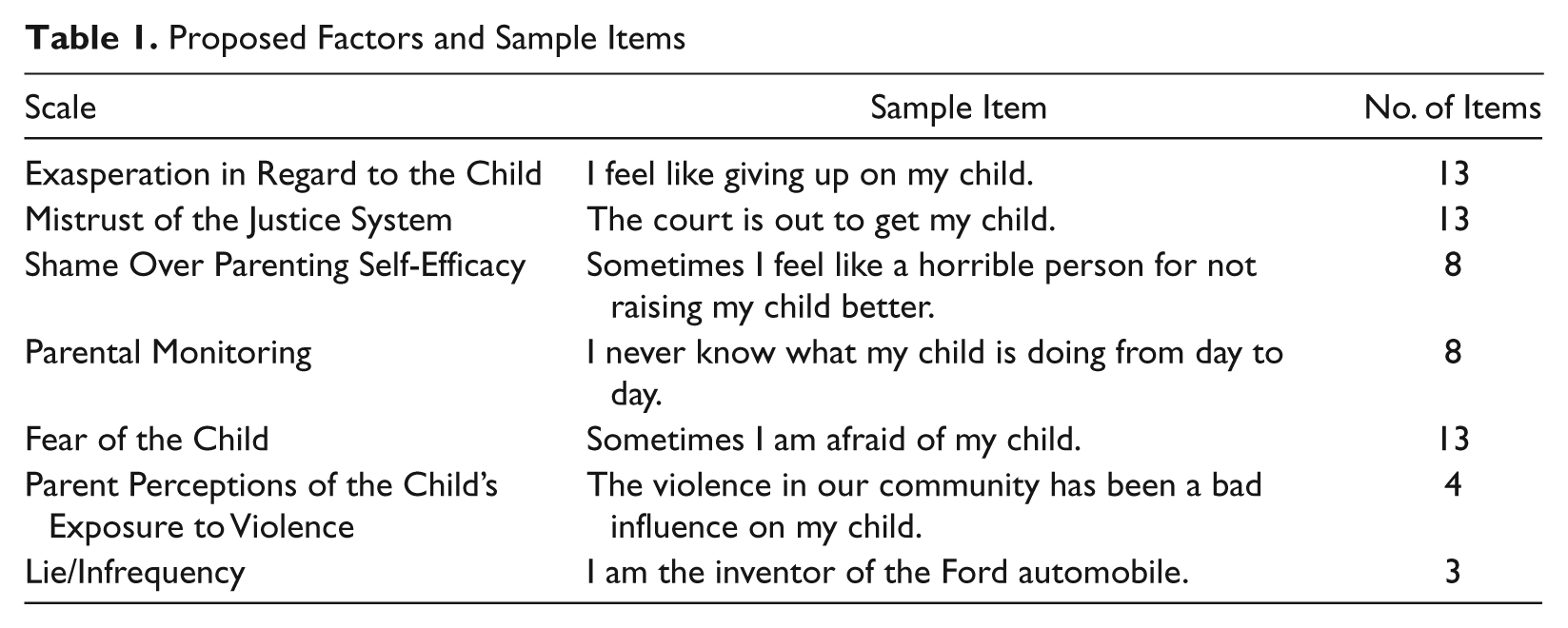
Exasperation in Regard to the Child (PE): Items are reported to measure a parent’s hopelessness, frustration, resignation, and/or readiness to give up on his or her child.
Mistrust of the Juvenile Justice System (MJS): Items focus on court, probation officers, police, the judge, and the system as a whole to provide a measure of trust (or lack thereof) that a parent may have concerning his or her child’s involvement in the justice system.
Fear of the Child (FC): Items on this factor are reported to measure the parent’s fear of some kind of physical violence being perpetrated on them by his or her child.
Shame Over Parenting Self-Efficacy (SPS): Self-efficacy refers to the degree to which the parent feels competent in raising his or her child. Items on this factor are reported to measure feelings of shame, humiliation, embarrassment, and discouragement in regard to parents’ perceived ability to raise their children.
Parent Perceptions of the Child’s Exposure to Violence (EV): Items on this factor are intended to measure the parent’s perception of the amount of violence to which the child has been exposed.
Parental Monitoring (PM): This factor is intended to illuminate the parent’s level of monitoring the child’s behavior in the home, school, and community environments.
Lie (L): These items are intended to measure infrequently endorsed responses and to illuminate possible validity problems on individual administrations.
The Office of Juvenile Justice and Delinquency Prevention’s paradigm for addressing juvenile delinquency suggests that bolstering the influence of protective factors while also minimizing the child’s exposure to risk factors provides the greatest defense against continued offending. The JOPQ could be an invaluable tool in the treatment of delinquent behaviors. Walther et al. (2012) suggested that parental knowledge, consistency, and support are protective influences from development of antisocial behaviors. The JOPQ could provide the parents of offenders with knowledge of how their own behaviors can have a profound impact on their child’s development, which may in turn help clinicians and families work collaboratively to address the problem of delinquency.
The clinical utility of the JOPQ can be understood in terms of its ability to illuminate factors that may place a child/adolescent at risk of developing delinquent behaviors or recidivating; however, evidence for the validity of the scores from this scale is missing in the literature. The goal of the current study is to provide evidence for the structural validity of the scores of this scale. To do this, confirmatory factor analysis (CFA) will be used to analyze the latent structure of the instrument to determine if the proposed factor loadings are appropriate. Figure 1 demonstrates the hypothesized factor loadings for the scale.
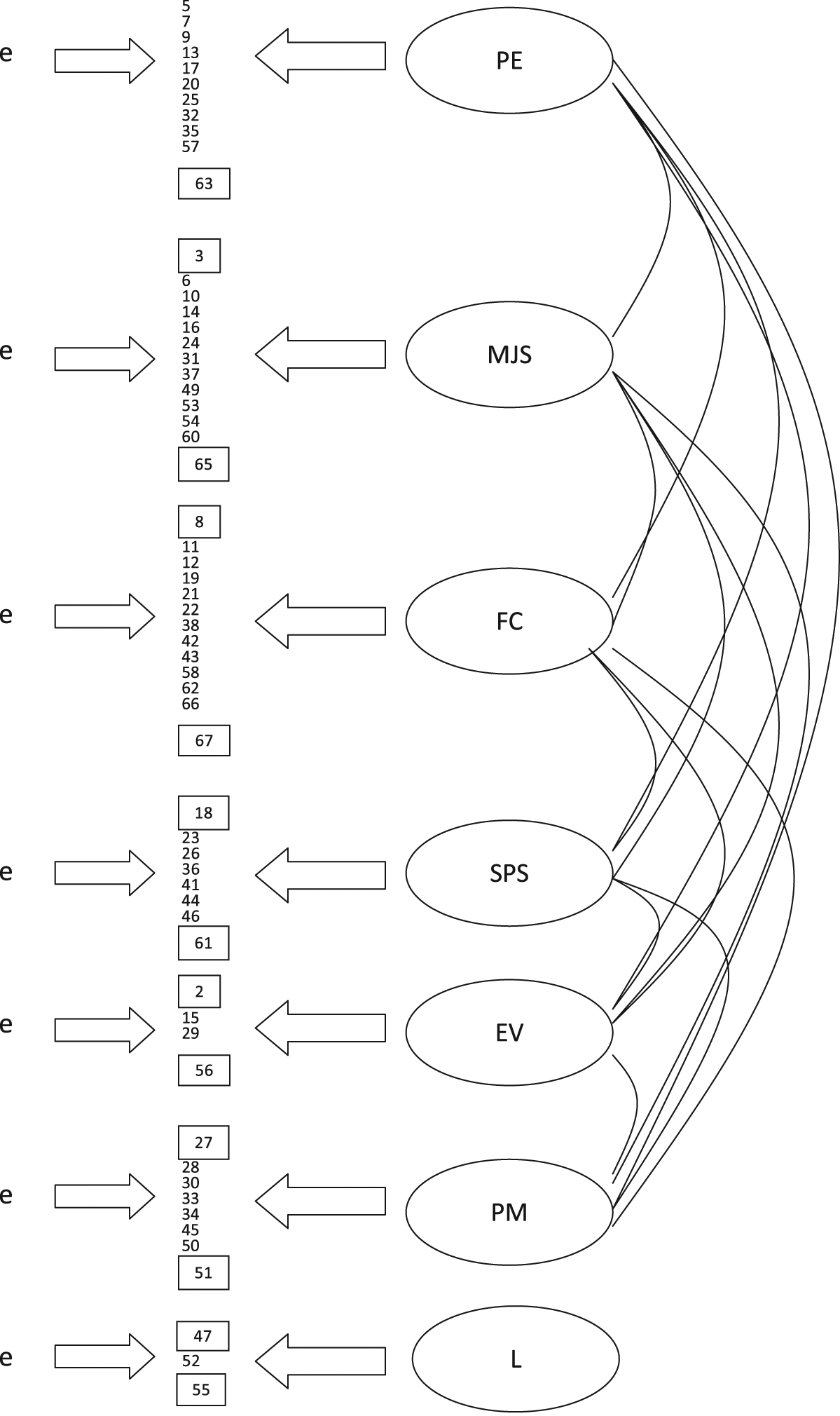
Hypothesized factor structure
Method
Participants
The JOPQ was administered to 327 parent(s)/guardian(s) of children who were court referred to receive counseling services. The instrument is completed as part of the general clinical intake. These intakes were primarily completed in the juvenile court facilities of a midsized southeastern city.
The majority of respondents were female (87.4%) compared with males (12.6%) and majority self-reported as African American (86.3%) compared with Caucasian (10%), Hispanic/Latino (2.5%), and not reported (1.3%). When asked to report their relationship to the child, 77% responded mother, 12.6% father, 6.9% grandmother, and 3.4% guardian. The children ranged from 8 to 17 years in age and included 54.7% males and 45.3% females.
Instrument
The Juvenile Offender Parent Questionnaire
The JOPQ is a 67-item questionnaire designed to provide a profile for parents of juvenile offenders across six factors. Each item was associated with four Likert-type response options: completely false = 1, mostly false = 2, mostly true = 3, and completely true = 4. The factors are labeled as Exasperation in Regard to the Child, Mistrust of the Juvenile Justice System, Shame Over Parenting Self-Efficacy, Parental Monitoring, Fear of the Child, and Parent Perceptions of Child’s Exposure to Violence (Rose et al., 2004). Values of Cronbach’s alpha for scores from this scale previously established by Rose et al. are as follows: Exasperation in Regard to the Child, .92; Mistrust of the Juvenile Justice System, .82; Shame Over Parenting Self-Efficacy, .71; Parental Monitoring, .83; Fear of the Child, .92; and Parent’s Perception of the Child’s Exposure to Violence, .82. These reliability values support the homogeneity of the scales and demonstrate a modest to adequate reliability of the total scale. Also included in the JOPQ is a Lie/Infrequency (.31) scale, which is intended to measure infrequently endorsed responses and illuminate invalid response patterns. As previously mentioned, apart from the original exploratory factor analysis, evidence for the validity of scores from this scale is missing from the literature.
Procedure
The research was conducted within the juvenile court setting of a midsized southeastern city. The participants completed the assessment as part of a clinical intake for counseling services. All of the youths were court ordered to receive counseling services, and both the child and the parent were provided an institutional review board–approved informed consent form. The parents were then asked to complete the JOPQ. The data were screened for outliers and none were detected, and questionnaires with missing values (n = 79) were excluded from the analysis through listwise deletion. The relative multivariate kurtosis statistic (1.107) supports approximate multivariate normality of the scores. Descriptions of the data (N = 248) are included in Table 2.
Juvenile Offender Parent Questionnaire Descriptive Statistics
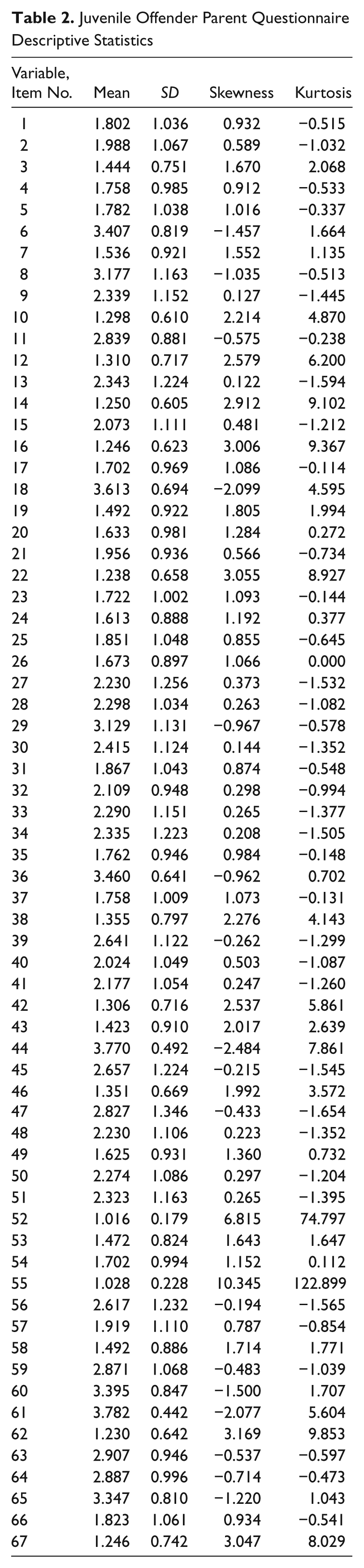
Investigation of the data reveals some possible concerns with individual items. Kline (2005) recommended cutoff values of |3| for skewness, and |8| for kurtosis. Using these values, it can be seen that Items 16, 22, 52, 55, 62, and 67 have skewness values outside of the recommended cutoff, whereas Items 14, 16, 22, 52, 55, 62, and 67 have kurtosis values outside the recommended cutoff as well. Examination of these items illuminates possible explanations for some of these concerning values. High values for skew and kurtosis for Items 52 and 55 are to be expected since these items are used in the lie scale to illuminate random endorsement of items. Items 22, 62, and 67 are reported to load to the FC factor (Rose et al., 2004) and seem to be worded as critical items. Endorsement may indicate impending danger to the parent, which could require immediate clinical intervention. Because of this, the response patterns seem logical. Rates of parental abuse by their children were reported to range from 5% (Evans & Warren-Sohlberg, 1988) to 29% (Livingston, 1986); therefore, the base rate of respondents who are in danger of this type of abuse may be quite low. These rates suggest that the majority of respondents would endorse these items as either mostly or completely false.
Items 14 and 16 are both reported to load to the Mistrust of the Juvenile Justice System factor and may have been affected by environmental variables. As noted earlier, each of the families are referred for counseling services by either juvenile court of the Department of Juvenile Justice. The JOPQ is completed by the parent during the intake session, which is often completed at the juvenile court. These variables may make it difficult for the family to see the counselor separate from the juvenile justice system, which could influence the way the parents respond to the instrument.
Additionally, of the questionnaires with missing values, the most commonly skipped questions were Items 31 (“If they will leave us alone, then things will turn out okay for my child”; n = 15) and 60 (“The probation officer cares about my child”; n = 23). When examining these items, it should be noted that both of these items also load onto the Mistrust of the Juvenile Justice System factor. Although this may indicate a need to revise these items, it could also be possible that these omissions are the result of the environmental factors noted above. Individual item statistics for these two items present no problematic values, and all other item omissions appeared random.
Results
Maximum likelihood estimation was used in this CFA model for parameter estimation. This method was chosen because of the acceptable level of multivariate normality and the unbiased, consistent, and efficient estimates it produces. Also, because of the limited sample size of the current study, Hu and Bentler (1998) suggested using this estimation method to minimize errors in the calculation of the fit indexes. The hypothesized CFA model was analyzed using LISREL 8.71 (Jöreskog & Sörbom, 1993), with a covariance matrix generated by PRELIS 2.71 (Jöreskog & Sörbom, 1996). An analysis was also conducted using polychoric correlations because of the 4-point scaling of the items; however, no substantive differences were noted in the analyses. Therefore, the results and discussion represent the original maximum likelihood estimation. No irregularities were noted in the analysis.
The fit indexes chosen in this analysis include the chi-square statistic (χ2), the comparative fit index (CFI), the nonnormed fit index (NNFI), the root mean square error of approximation (RMSEA), and the standardized root mean square residual (SRMR). These fit indices were chosen from the suggestions of previous literature and their sensitivity to model misspecification (Hu & Bentler, 1998). A significant chi-square statistic indicates that the estimated covariance matrix produced by the hypothesized model differs significantly from the original covariance matrix, indicating a lack of model fit. Hu and Bentler (1998, 1999) recommend cutoff values of .95 or higher for the CFI and NNFI, .06 or less for the RMSEA, and .09 or less for the SRMR. In addition to the fit indexes list above, inspection of the standardized residuals will also be carried out to determine appropriate model fit. Standardized residual values greater than |2| are considered to be problematic, and approximately 20% or more problematic residuals provide evidence for model misspecification.
Interpretation of the values of the fit indexes provides mixed results. The values for the RMSEA (.061; 90% confidence interval = 0.058–0.064) and the SRMR (.084) indicate good fit for the CFA model, whereas the values for the CFI (.93) and the NNFI (.93) fall slightly below the suggested cutoff. The chi-square statistic, χ2(1637) = 3102.28, p <.01, supports the conclusion for lack of model fit; however, the problem of relatively well-fitting models being rejected by the chi-square statistic has been well documented in the literature (Bentler & Bonett, 1980; Gerbing & Anderson, 1993; Marsh, Balla, & McDonald, 1988). Inspection of the standardized residuals does provide additional evidence for good overall model fit. Although some problematic values were noted (largest positive = 5.90; largest negative = −5.44), these accounted for less than 10% of all residuals. This indicates that more than 90% of the reproduced covariances were not significantly different from their original values.
In addition to fit indexes, it is also important to examine path values for each factor. Parameter values, standard errors, t statistics, error variance, and R2 per factor are included in Table 3. Negative factor loadings are indicative of reverse scored items. Although the majority of the path values do not seem problematic, some of the values are concerning. Of particular concern are Item 60 (R2 = .097) and Item 36 (R2 = .055). In addition, the proportion of factor variance explained by Items 8, 17, 18, 31, 36, 44, and 61 appear to be very low. These values may indicate that these items are not very highly related to the factors where they are expected to load. Apart from these items, the R2 values for the remainder of the indicator variables demonstrate an acceptable proportion of explained factor variance.
Path Values per Factor

The data seem to indicate that the fit of this model is acceptable; however, some modifications may need to be considered for the model to perform at its optimal potential. The values of the RMSEA, SRMR, and the standardized residuals all point toward good fit; and, although the CFI and the NNFI are outside of the a priori cutoffs for these indices, these values are approaching significance. The individual path values are appropriate for the most part, but some items may need to either be modified or omitted to improve fit.
The modification indices provided by LISREL 8.71 suggest allowing several items to load onto multiple factors to decrease the chi-square statistic and increase the overall fit of the model. The suggested modifications may result in decreases in chi-square, ranging from 8.1 to 45.8. The largest of these include creating paths between Item 21 and PE (Δχ2 = 45.8), Item 11 and PE (Δχ2 = 37.6), Item 31 and PE (Δχ2 = 31.6), Item 23 and PE (Δχ2 = 28.6), and Item 29 and PE (Δχ2 = 28.2). The modification indices also recommend allowing several of the error covariances correlate, with changes in chi-square ranging from 7.9 to 34.9. These values suggest that it may be beneficial to theorize about the possible causes for these values and test additional models to determine the best overall factor structure.
Conclusions
The present study sought to provide evidence for the structural validity of scores for the JOPQ. Data analysis indicates that the model does have an adequate level of fit, providing cross-validation for the original exploratory model. However, reevaluation of theory may suggest modifications that will improve model fit. For example, the modification indices state that several items should include an additional loading to the PE factor. Conceptually, this makes sense. It seems logical to think that items that point to a parent who is afraid of his or her child, is unable to monitor the child, or is frequently involved with the juvenile court indicate a parent who would be exasperated with his or her child. More problematic appear to be the items that demonstrated very low values for R2. These items may need to be modified or omitted from the JOPQ for improved model fit. Future studies may want to synthesize the information gathered from the present study and theorize additional models to test for improved fit. However, it should be reiterated that the hypothesized factor structure provided an adequate model fit, and therefore additional modifications may be unnecessary.
Additional research addressing validity evidence for scores from the JOPQ is needed. Although the current study provides construct validity evidence based on the factor structure, it does not fully address the validity of the constructs it is reported to measure. Correlational analysis using other measures or specific populations would help provide this type of evidence and bolster the clinical utility of the scale.
A possible limitation of this study is that it used a self-report measure, and as previously mentioned, the majority of respondents completed the instrument in the juvenile court setting. This may have made it difficult for the parent(s)/guardian(s) to view the researcher as separate from the court system, which could have resulted in response patterns that the participants felt were more socially desirable. Conversely, Bradshaw, Glaser, Calhoun, and Bates (2006) found that parents may overendorse certain critical items as an indication of exasperation with their child’s behavior. This pattern of responding may lead to elevated scores on factors that the parents believe will result in immediate assistance with their child. An additional limitation of the study is that the sample came from a single county, which could make the results difficult to generalize.
The effect parenting can have on the behavioral development of children cannot be understated, especially within the offender population. The literature is rich with studies indicating specific risk and protective factors associated with parenting practices and familial issues. Instruments used to identify specific parenting factors that can either hinder or exacerbate conduct problems are needed to help clinicians, courts, and juvenile justice systems design and implement improved individualized prevention and intervention programs. In addition, instruments such as this allow for increased awareness for parents/guardians of how their attitudes affect their child’s functioning. This study provides psychometric support for the use of the JOPQ by counselors to identify areas of parenting that need to be addressed in therapy. Treatment planning using this instrument provides counselors with a more comprehensive conceptual frame, which can then more effectively guide intervention.
Footnotes
Declaration of Conflicting Interests
The author(s) declared no potential conflicts of interest with respect to the research, authorship, and/or publication of this article.
Funding
The author(s) received no financial support for the research, authorship, and/or publication of this article.