




Abstract
This study used latent profile analysis (LPA) to identify acculturation profiles. A three-profile solution fit the data best, and comparisons on demographic and psychosocial outcomes as a function of profile yielded expected results. The findings support using LPA as a parsimonious way to model acculturation without anticipating profiles in advance.
It has been repeatedly demonstrated that an individual’s behavior is strongly influenced by culture. However, this impact is complicated, and when one’s culture of origin and culture of residence are not the same, the result is commonly acculturative change. Acculturation has been defined as the alterations that result from continuous, direct contact between two or more different cultural groups and/or individual members thereof (Berry, 1997; Cabassa, 2003; Redfield, Linton, & Herskovits, 1936). It was originally conceptualized as a group phenomenon, as it commonly leads to a shift in social structures and normative practices at the macro level (Berry, 1992; Berry & Sam, 1997). At the individual level, the definition has been expanded to include psychological acculturation (Graves, 1967), which encompasses the change in an individual’s psyche as a result of cross-cultural contact, as well as alterations in daily behavior patterns (Berry, 2005). Acculturation is a long-term, lengthy, fluid process that can result in lasting change across multiple dimensions to involved members of the minority culture, as well as the aspects of the dominant society involved in the interaction (Berry, 2005). For example, cross-cultural contact, which contributes to acculturative change, may lead to one or both cultures altering their behaviors and expectations with regard to food, dress, language, and communication patterns, among other social activities (Berry, 2005; Berry & Sam, 1997). There are a number of different theories of acculturation that attempt to explain the mechanisms thereof. The aim of this investigation was to explore and demonstrate the relevance of using person-centered statistics, specifically Latent Profile Analysis (LPA; Lanza, Flaherty, & Collins, 2003) to examine the relevance of predominant acculturative theory in a large multi-ethnic sample of college students.
Park (1928) first postulated a unidimensional theory of acculturation by considering the process as it occurs to entire cultures through invasion and migration. He theorized that acculturation exists along a continuum in which relationships with ethnic cultures are broken, thus emancipating individual members of a minority cultural group to align themselves with the new, dominant society. According to this theory, greater acculturation is both the result and cause of loss of one’s culture of origin. This notion of a direct, linear change occurring along a spectrum of cultural identities has since become known as the unidimensional or bipolar model of acculturation (Berry, 2003; Ryder, Alden, & Paulhus, 2000; Zane & Mak, 2003).
Conversely, many researchers have argued for a multidimensional model of acculturation in which changes occur in more than one domain. For example, Redfield et al. (1936) suggested that assimilation, or departing from a culture of origin and integrating oneself completely into a dominant culture, is simply one aspect of acculturation rather than the sole method thereof. Since this idea was first introduced, many researchers have put forth multidimensional models. Such theories are generally based on two underlying principles (Ryder et al., 2000). First, these models assume that different individuals’ identities and senses of self may vary with regard to how heavily they are influenced by their cultures. Second, these models assume that individuals can have multiple cultural identities simultaneously rather than needing to lose their original ethnic affiliation in order to obtain a dominant society membership.
One of the most widely studied of the multidimensional theories of acculturation is Berry’s (1997) bidimensional model (Cabassa, 2003; Matsudaira, 2006; Schmitz, 1994; Schwartz et al., 2011; Thomson & Goetz-Hoffman, 2009; Ward, 2008; Ward & Kus, 2012). Berry proposes four possible strategies/outcomes of acculturation: assimilation, separation, integration, and marginalization. In assimilation, individuals adopt the practices and outlook of the dominant culture and eschew their culture of origin, often by seeking regular contact with the dominant society and avoiding maintenance of their original identity. Individuals who fall into the separation category are essentially the opposite of those who assimilate; they reject or avoid the new, dominant culture in favor of preserving their ethnic identity, often by highly valuing their original cultural practices and avoiding contact with dominant society individuals. In integration, individuals embrace both cultures; such individuals value their original cultural identity and try to maintain it while simultaneously pursuing regular contact with the dominant society. Integration is also frequently known as biculturalism (Schwartz & Zamboanga, 2008). Last, individuals who are categorized as marginalized are those who lose all cultural affiliation, both rejecting their culture of origin and failing to adopt the practices of the new, dominant culture. Such individuals develop a de-identified personality resultant from superficially inhabiting two cultures at once, but feeling like a relative stranger in both (Park, 1928; Stonequist, 1935). This in turn can lead to psychological distress. These are the individuals who begin the acculturation process by entering a period of cultural transition, but are never able achieve a new, clearly defined cultural affiliation, and thus are never able to leave the transitive state.
A number of researchers have examined the relationship between different acculturation styles and psychosocial health outcomes. Studies to date have suggested that integration will lead to the most adaptive functioning, whereas those who inhabit either one culture or the other will be slightly worse, and those who are unable to effectively affiliate with any cultural group have the worst outcomes (Berry, 2003, 2005; Berry & Kim, 1988; Berry & Sam, 1997; López & Contreras, 2005; Phinney, Chavira, & Williamson, 1992; Schmitz, 1992; Torres, 2010; Wei et al., 2010). Furthermore, studies have shown that individuals in the integrated group experience less psychological distress (López & Contreras, 2005; E. P. Vasquez, Gonzalez-Guarda, & De Santis, 2011; Wei et al., 2010), less anxiety (López & Contreras, 2005), higher levels of self-esteem (Berry, 2005), better coping efficacy (Torres & Rollock, 2007), and better psychological adjustment (Berry, 2005; López & Contreras, 2005). For example, Wei et al. (2010) found that ethnic minority college students who were able to function in both their ethnic and dominant cultures had better health outcomes and experienced less depressive symptoms and stress than students who were unable to do so.
Prior research has also examined the differential impact of acculturation on health within distinct racial and ethnic groups. For example, a review by Suinn (2009) demonstrated that increased acculturation to the United States has been linked to decreased smoking among Asian American men, whereas the inverse is true for Asian American women. Acculturation to the United States was also linked to increased binge drinking as moderated by social context, increased depression and suicidality and worse academic performance as moderated by familial context, and more positive views on seeking mental health services (Suinn, 2009). Among Hispanic Americans, acculturation has been associated with increased alcohol consumption in women but not men (Zemore, 2007). It has also been linked to lower consumption of fruit, rice, and beans and greater consumption of sugar and sugared beverages across genders (Ayala, Baquero, & Klinger, 2008), as well as decreased psychological distress (Thoman & Suris, 2004), and depression among older Hispanic American adults (González, Haan, & Hinton, 2001).
Less research has been conducted examining the impact of acculturation on African Americans. This may be because of an extensive history of viewing this group as a distinct race but not a distinct ethnicity (De La Rosa, Vega, & Radisch, 2000; Landrine & Klonoff, 1994). Other possibilities include a perceived lack of importance, or excessive difficulty articulating the distinguishing features of the African American culture (De La Rosa et al., 2000). The little research that has been conducted in this group suggests that rejection of African American culture in favor of European American culture has been linked to decreased likelihood of smoking (Klonoff & Landrine, 1999) and greater likelihood of quitting smoking after participating in a group-based intervention (Hooper, Baker, de Ybarra, McNutt, & Ahluwalia, 2012). It has further been shown that higher levels of acculturation may be linked to increased alcohol consumption, as moderated by gender and religiosity (Abdullah & Brown, 2012), as well as healthier diet (Ard, Skinner, Chen, Aickin, & Svetkey, 2005). With regard to psychosocial distress, Obasi and Leong (2009) found that traditionalism was linked to diminished distress, whereas integration was associated with greater psychological distress.
Some investigations have examined acculturation among multiple ethnic groups simultaneously. For example, a recent examination conducted by Schwartz et al. (2011) found that acculturation variables were related to distinct risk behaviors for individuals from different ethnic groups. Specifically, acculturation was associated with dangerous alcohol consumption for Black, East Asian, and South Asian participants; illicit drug use for Black, Hispanic, and East Asian participants; sexual risk taking behavior for Hispanic and East Asian participants; and reckless driving behavior for White and Black participants. Additionally, behavioral acculturation to the United States has been linked to fewer adjustment problems for Asian participants and more adjustment problems for Hispanic participants (Sue & Chu, 2003). A review by Koneru, Weisman de Mamani, Flynn, and Betancourt (2007) suggested that acculturation might be linked to increased substance use and abuse across multiple ethnic groups, including Asian Americans and Hispanic Americans.
Across different racial and ethnic groups, one population that has received a great deal of attention with regard to acculturation is college students. A recent review by Yoon, Langrehr, and Ong (2011) found that more than half of the studies completed in the past 22 years were conducted with college students. College students in general, and particularly those earlier in their college careers, encounter challenges that often contribute to elevated psychological distress (Pritchard, Wilson, & Yamnitz, 2007; Watson, 2012). Students may experience chronic role strain and added stress related to the responsibilities of being a student and a young adult, such as academic, romance, personal and familial demands, adjustment to college, instability of neighborhood or living situation, financial problems, extracurricular activities, and friendships (Smedley, Myers, & Harrell, 1993). Such stressors coupled with the aforementioned negative outcomes associated with certain acculturation styles put minority individuals at this stage of life at particular risk, underlining the importance of examining this population.
Many studies analyze the bidimensional theory of acculturation in which dominant and ethnic society affiliation are recognized and treated as two distinct concepts that can coexist. However, researchers frequently attempt to study this model by using continuous measures of acculturation and deriving Berry’s four categories based on obtained results, or by splitting obtained scores at the median (Giang & Wittig, 2006; Schwartz & Zamboanga, 2008). Such approaches are misleading because they assume the presence and comparable validity of Berry’s factors prior to actual analysis.
Furthermore, many frequently used acculturation scales measure a single factor rather than exploring two distinct cultures along different continuums. Zane and Mak (2003) determined that 14 of 21 analyzed acculturation measures were actually unidimensional in nature. Examples of such measures include the Behavioral Acculturation Scale (Szapocznik, Scopetta, Kurtines, & de los Angeles Aranalde, 1978), the Short Acculturation Scale for Hispanics (Marín, Sabogal, VanOss, Otero-Sabogal, & Perez-Stable, 1987), the Brief Acculturation Scale (Norris, Ford, & Bova, 1996), the African American Acculturation Scale (Snowden & Hines, 1999), and the Suinn–Lew Asian Self-Identity Acculturation Scale (Suinn, Rickard-Figueroa, Lew, & Vigil, 1987). Using such measures runs the risk of unintentionally analyzing a unidimensional model in which adoption of dominant culture and maintenance of ethnic culture are pitted against each other as opposing poles of a continuum.
Latent variable model techniques such as latent class analysis (LCA; Roesch, Villodas, & Villodas, 2010) or LPA (Lanza et al., 2003) may be useful in empirically evaluating the interactive absence or presence of Berry’s typologies within a given study sample. Both are person-centered data analytic techniques that can be applied to observed categorical (LCA) or observed continuous (LPA) variables to find subtypes of related cases. That is, such analysis helps researchers define mutually exclusive taxonomies of people based on common characteristics. When applied to acculturation, these subtypes will reflect profiles of ethnic minority individuals with similar patterns of acculturation strategies and outcomes.
LCA/LPA also affords some benefits over more variable-based approaches such as factor analysis (FA). In FA observed variables indicate a continuous factor or latent variable. In contrast, in LCA/LPA observed variables indicate a categorical factor or latent variable. FA models are limited in two fundamental ways relative to LCA/LPA because of the nature of the latent variable. First, the latent variable(s) in FA represent an underlying continuum for the construct of interest. Thus, the latent variable can only represent an increasing function of the construct of interest (low to high scores). This approach precludes the possibility that observed variables might represent a latent variable in a nonlinear fashion. Specifically, in LCA/LPA higher-order interactions are implicitly modeled (Lanza, Rhodes, Nix, & Greenberg, 2010). Although interaction terms are not explicitly incorporated as observed variables, the class profiles themselves can conceptually reflect interaction effects, and thus are reflective of Berry’s typologies. Second, FA models the common variance of observed variables, with no additional provision to classify (or categorize) individuals based on values for the underlying latent variable. These two limitations are exceedingly crucial to practitioners who are attempting make diagnostic decisions faced with multiple sources of information about people.
Schwartz and Zamboanga (2008) have previously used LCA to evaluate the extent to which different acculturation styles emerged from measures of ethnic culture retention and dominant culture adoption in a sample of 436 undergraduate Hispanic American students. They found partial support for Berry’s model, uncovering six rather than four categories of acculturation, which they titled undifferentiated, assimilation, partial biculturalism, American-oriented biculturalism, separation, and full biculturalism. The authors specified that these classes were derived based on participants’ responses to the Stephenson Multigroup Acculturation Scale (Stephenson, 2000), which evaluates dominant society and ethnic society immersion, and also the Acculturation, Habits and Interests Multicultural Scale for Adolescents (Unger et al., 2002), which evaluates the degree to which participants rate their preferred ways of performing cultural practices as most consistent with the United States, their ethnicity of origin, both, or neither. Of the six classes uncovered, three mapped onto the integration, separation, and assimilation categories from Berry’s model. Schwartz and Zamboanga (2008) brought specific attention to the mixing of biculturalism and separation, as seen in their separation class, and of biculturalism and assimilation, as seen in their American-oriented biculturalism class. Berry’s marginalization group was not found to be present in their sample, though the undifferentiated group most closely approximated such an acculturative style. By using this approach, Schwartz and Zamboanga (2008) were able to better describe the acculturation processes of their sample.
One of the primary limitations of the analysis performed by Schwartz and Zamboanga (2008) was the absence of assessments measuring standard dimensions of psychosocial adjustment, such as measures of depression or self-esteem. A second limitation is that only Hispanic American students were included in recruitment and analysis; therefore, it is unknown if the acculturation profiles they uncovered would apply to other ethnic groups. An earlier study conducted by Schwartz, Zamboanga, Rodriguez, and Wang (2007) did use cluster analysis to derive acculturation groups of multicultural college students. However, though they did examine students from varied ethnic backgrounds, they had inadequate representation of Asian Americans, and again did not examine psychosocial outcomes. Phinney and Devich-Navarro (1997) also attempted to explore the ethnic breakdown of Berry’s typologies within their sample of African American and Mexican American adolescents; however, they too did not examine Asian Americans, and they characterized participants by qualitative and subjective analysis, thus calling into question the reliability of their acculturation profiles.
Building on the approach of Schwartz and Zamboanga (2008), the present study aimed to further examine the applicability of LPA for use in analyzing acculturation styles. Specifically, using continuous measures of dominant culture affiliation and alignment with ethnicity of origin, LPA was used to determine if Berry’s typologies would be supported in a large, multiethnic sample of college students. After establishing reliable acculturation groups, comparisons among these acculturation groups were made with regard to target psychosocial outcomes (e.g., depression, anxiety, self-esteem, and coping efficacy).
Method
Participants
Two hundred and twenty-seven ethnic minority college students (freshman = 35.2%, sophomore = 15.4%, junior = 20.3%, senior = 29.1%) from a large, western, federally designated Hispanic Serving Institution comprised the sample. This designation specifies that at least 25% of undergraduate full-time equivalent students must be Hispanic or Latino. Ages of the present sample ranged from 17 to 25 (M = 20.20, SD = 2.14). More than half of the sample was female (female = 71.4%, male = 28.6%). Participants identified as Asian American (50.2%), Hispanic American/Latino (33.5%), or African American/Black (16.3%). Socioeconomic status was measured by annual family income (<$24,999 = 10.2%, $25,000-$49,999 = 25.7%, $50,000-$74,999 = 20.4%, $75,000-$99,999 = 16.8%, $100,000-$149,999 = 18.0%, >$150,000 = 4.9%). Data were also collected regarding generational status (born outside the United States = 28.6%, born in the United States to foreign-born parents = 40.5%, born in the United States to U.S.-born parents with foreign-born grandparents = 16.7%, fourth generation or higher = 14.1%). The sample represented a cross-section of majors at the university, with larger percentages of students studying Business (24.0%) or Psychology (15.9%).
Procedure
This investigation took place within the context of a larger, Internet-based daily diary study examining stress and coping strategies. A multifaceted recruitment strategy including flyers, course/club presentations, and university seminars was employed from September to November 2008. Interested individuals contacted the research team to arrange participation, and each participant provided written, informed consent. Surveys including demographic questions, and measures of acculturation and psychological health (described below) were administered. On completion of the 5-day daily diary study, participants completed a second written questionnaire assessing psychosocial health. Approval for human subjects research was obtained from the institutional review board at San Diego State University prior to consenting individuals to the study, and subjects received $25 for their participation.
Materials
Stephenson Multigroup Acculturation Scale (SMAS; Stephenson, 2000)
This 32-item measure was used to evaluate a two-factor structure of acculturation. Dominant society immersion (DSI), or orientation to American knowledge, behavior, and attitudes, is measured by 15 items, while 17 items are used to assess ethnic society immersion (ESI), or orientation to cultural heritage. Participants rate each of 32 sentences along a Likert-type format with four response options: false, partly false, partly true, and true. Though the SMAS has yet to be empirically validated across ethnic groups, it is commonly used to evaluate multidimensional acculturation in various groups (Yoon et al., 2011) and was included in the present analysis based on such practice. Cronbach’s alpha values for the current sample demonstrated good reliability (DSI: α = .89, ESI: α = .86).
To confirm the factorial validity of the SMAS with the present sample, a two-factor model was examined using confirmatory factor analysis. Statistically significant multivariate skewness and kurtosis (all ps < .01) were found in the present data. Therefore, the MLM estimation procedure employed by MPlus (Muthén & Muthén, 1998-2011) was used to estimate model parameters. This estimation procedure also provides the Satorra–Bentler scaled χ2 (S–Bχ2; Satorra & Bentler, 1988), which was evaluated instead of a nonscaled χ2 test statistic. The root mean square error of approximation (RMSEA; Steiger, 1990) and the standardized root mean residual (SRMR; Hu & Bentler, 1999) were used as descriptive indices of overall model fit. This two-factor model did not fit well statistically (S–Bχ2[463, N = 227] = 1154.80, p < .01), but the descriptive fit indices did indicate that the two-factor model was reasonable, RMSEA = .080, SRMR = .086. Additionally, all standardized factor loadings demonstrated statistical significance for both the DSI (mean factor loading = .54, all ps < .05) and ESI (mean factor loading = .65, all ps < .05) factors. The interfactor correlation was statistically significant and negative (r = −.32, p < .01).
Brief Symptom Inventory (BSI; Derogatis & Spencer, 1982)
The depression and anxiety subscales from the BSI were used for the current study. Using a 5-point scale (ranging from 0 = not at all to 4 = extremely), participants rate the degree to which each identified symptom has caused them distress over the five days prior to test administration. Higher scores indicate greater levels of anxiety or depression. The factor structure of the BSI has been previously validated with a sample of African American, Hispanic American, and Caucasian individuals (Hoe & Brekke, 2009), and in a sample of Spanish college students (Pereda, Forns, & Peró, 2007). Although the factor structure of the English language BSI has not been empirically examined with Asian Americans, the measure has frequently been used with this population and has demonstrated strong reliability and validity in the past (Cheng, Leong, & Geist, 1993; Hwang & Ting, 2008; Wang & Mallinckrodt, 2006). Cronbach’s alpha values for the current sample were adequate (Depression: α = .85, Anxiety: α = .83).
State Self-Esteem Scale (SSES; Heatherton & Polivy, 1991)
The SSES contains 20 statements; participants indicate their level of agreement on a 5-point scale (1 = not at all, 2 = a little bit, 3 = somewhat, 4 = very much, and 5 = extreme). Seven items correspond with performance-related self-esteem, seven with social-related self-esteem, and six with appearance-related self-esteem. Higher scores indicate more self-esteem. The SSES has been used in multiple recent investigations with ethnic minorities, including Asian American, African American, and Hispanic American participants (Armitage, 2012; Mendoza-Denton, Goldman-Flythe, Pietrzak, Downey, & Aceves, 2010; Paukert, Pettit, Perez, & Walker, 2006; Townsend, Markus, & Bergsieker, 2009; Zeigler-Hill, Besser, & King, 2011). Cronbach’s alpha indicated excellent reliability (α = .92).
Coping Efficacy
An adaptation of the questions composed by Sandler, Tein, Mehta, Wolchik, and Ayers (2000) was used to measure coping efficacy. Specifically, eight items (e.g., “Overall, how successful have you been in handling your problems?”) were selected to quantify participants’ self-assessment of their ability to tolerate and handle stressful situations. Each of these items is rated on a 4-point scale (1 = not at all, 4 = very) and higher scores indicate greater general coping efficacy. The original publication sample for these questions included both Hispanic American and Black participants, and the questions have been used in additional recent investigations examining ethnically diverse samples, including individuals of African, Hispanic, and Asian descent (Gonzales et al., 2012; Mosher & Prelow, 2007; Swenson & Prelow, 2005). Cronbach’s alpha for the current sample was good (α = .88).
Data Analysis
Exploratory LPA was used to derive categorical latent variables that represent profiles of individuals who score similarly on the SMAS (Stephenson, 2000) subscales. The probability that an individual was properly classified, which enables each person to be categorized into the best-fitting class, is estimated simultaneously within the overall model (Hill, Degnan, Calkins, & Keane, 2006). Models are estimated with classes added iteratively to determine which model is the best fit to the data. For this study, LPA was conducted using MPlus 6.1 (Muthén & Muthén, 1998-2011), and there were no missing data. It was hypothesized that a four-profile solution comparable to Berry’s typologies would be derived. To determine the optimal number of profiles for the sample, each model was evaluated using the Akaike information criteria (AIC; Akaike, 1974), sample size-adjusted Bayesian information criteria (sBIC; Schwarz, 1978), the Lo–Mendell–Rubin Adjusted Likelihood Ratio Test (LMRT; Lo, Mendell, & Rubin, 2001), and Entropy (Ramaswamy, DeSarbo, Reibstein, & Robinson, 1993). The AIC and sBIC are descriptive fit indices wherein smaller values indicate better model fit. The LMRT compares the fit of a target model (e.g., a two-profile model) to a comparison model that specifies one less profile (e.g., a one-profile model). The p value generated for the LMRT indicates whether the solution with more profiles (p < .05) or less profiles (p > .05) fits better. Entropy is a measure of how well profiles can be distinguished, or the percentage of individuals in the sample that were correctly classified given the specific model. In addition to these indices, each model was evaluated on interpretability.
After the best-fitting model was determined, a chi-square test of independence was conducted to determine and interpret the relationship between profile membership and ethnic group. In addition, multinomial logistic regression analyses were conducted to examine differences in the profiles as a function of ethnicity, gender, family income, and generational status. All covariates/predictors were entered simultaneously. Ethnicity was dummy-coded with the Asian American ethnic group serving as the reference group, and family income and generational status were added as quasi-continuous covariates. Finally, analysis of variance (ANOVA) was conducted to evaluate potential differences on the target validity measures (depression, anxiety, self-esteem, coping efficacy) as a function of profile. Post hoc comparisons were conducted using Tukey’s Honestly Significant Difference test.
Results
Latent Profile Analysis
Models containing one, two, three, and four profiles were fit to the data. The model fit indices for each exploratory LPA are presented in Table 1. All indicators of model fit suggested that Model 2 fit better than Model 1. However, the three-profile solution was deemed superior to the two-profile solution because of a statistically significant LMRT value (p < .001) and substantially lower AIC and sBIC values. Although the four-profile solution revealed slightly lower AIC and sBIC values relative to the three-profile solution, the LMRT indicated that it was not statistically different from the three-profile solution (p = .230). Moreover, the entropy value for the four-profile solution was lower than that for the three-profile solution. Therefore, the three-profile solution was considered the best fit to the data.
Model Fit Indices.

Note. AIC = Akaike information criterion; sBIC = sample size-adjusted Bayesian information criterion; LMRT = Lo–Mendell–Rubin test.
The overall sample means and conditional response means used to substantively interpret the three-profile model are presented in Table 2. Profile 1 was composed of 40% of the sample (n = 91) and represents individuals with relatively high levels of both DSI and ESI. Profile 2 was composed of 43% of the sample (n = 98) and represents individuals with relatively high levels of DSI but low levels of ESI. Profile 3 was composed of 17% of the sample (n = 38) and represents individuals with relatively low levels of DSI but high levels of ESI. Each profile was then labeled and referred to as integrated (Profile 1), assimilated (Profile 2), or separated (Profile 3).
Overall Sample Means (SDs) and Acculturation Profile Conditional Response Means (SDs).
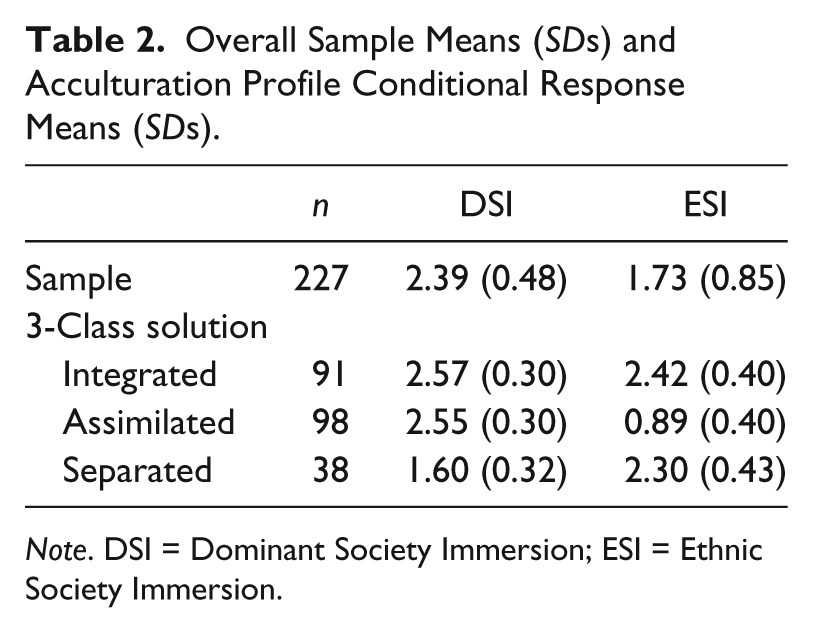
Note. DSI = Dominant Society Immersion; ESI = Ethnic Society Immersion.
A chi-square test of independence revealed a statistically significant association between profile and ethnic group, χ2(df = 4) = 29.04, p < .001, Cramer’s V = .25. The percentage of each ethnic group in each profile is presented in Table 3. Both African Americans and Hispanic Americans were more frequently categorized as integrated (and to a lesser degree assimilated). Asian Americans were primarily categorized as assimilated, but this group did also compose the majority of the separated profile group.
Percentage of Ethnic Group Members Within a Given Profile.

Multinomial logistic regression analyses demonstrated differences in likely profile membership based on ethnicity, gender, and generational status; family income was not found to be a significant predictor of profile membership for any comparison examined. For the comparison between Profile 1 (integrated) and Profile 3 (separated), both generational status and ethnicity were significant predictors/covariates. Longer generational status was associated with a higher likelihood of being in the integrated profile relative to the separated profile (odds ratio [OR] = 7.03, p < .001; 95% confidence interval [CI] = 3.00, 16.48). Asian Americans were more likely than Hispanic Americans to be in the separated profile relative to the integrated profile (OR = 0.21, p < .001; 95% CI = 0.07, 0.63).
For the comparison between Profile 2 (assimilated) and Profile 3 (separated), both generational status and gender were significant predictors/covariates. Longer generational status was associated with a higher likelihood of being in the assimilated profile relative to the separated profile (OR = 11.52, p < .001; 95% CI = 4.85, 27.39). Males were more likely than females to be in the separated profile relative to the assimilated profile (OR = 0.27, p < .001; 95% CI = 0.10, 0.73).
For the comparison between Profile 1 (integrated) and Profile 2 (assimilated), both generational status and ethnicity were significant predictors/covariates. Longer generational status was associated with a higher likelihood of being in the assimilated profile relative to the integrated profile (OR = 1.64, p = .015; 95% CI = 1.10, 2.45). More African Americans (OR = 5.93, p = .001; 95% CI = 2.04, 17.23) and more Hispanic Americans (OR = 4.18, p < .001; 95% CI = 2.05, 8.53) relative to Asian Americans were likely to be in the integrated profile relative to the assimilated profile.
Validation Analysis: Testing Differences on Psychological Outcomes as a Function of Profile
ANOVA was used to characterize each profile group by examining differences among the three profiles on the psychological outcomes of depression, anxiety, self-esteem, and coping efficacy. As shown in Table 4, significant differences were found among acculturation profiles for all four validity measures. Post hoc comparisons revealed statistically significant differences among acculturation groups. For depression, the separated group had significantly higher depression scores relative to the integrated group (d = .60). For anxiety, the separated group had significantly higher anxiety scores relative to the integrated group (d = .65) and the assimilated group (d = .49). For self-esteem, the integrated group had significantly higher self-esteem scores relative to the assimilated group (d = .37). For coping efficacy, the integrated group had significantly higher coping efficacy scores relative to the separated group (d = .65) and the assimilated group (d = .40).
Comparison of Acculturation Profiles on Psychological Outcomes.
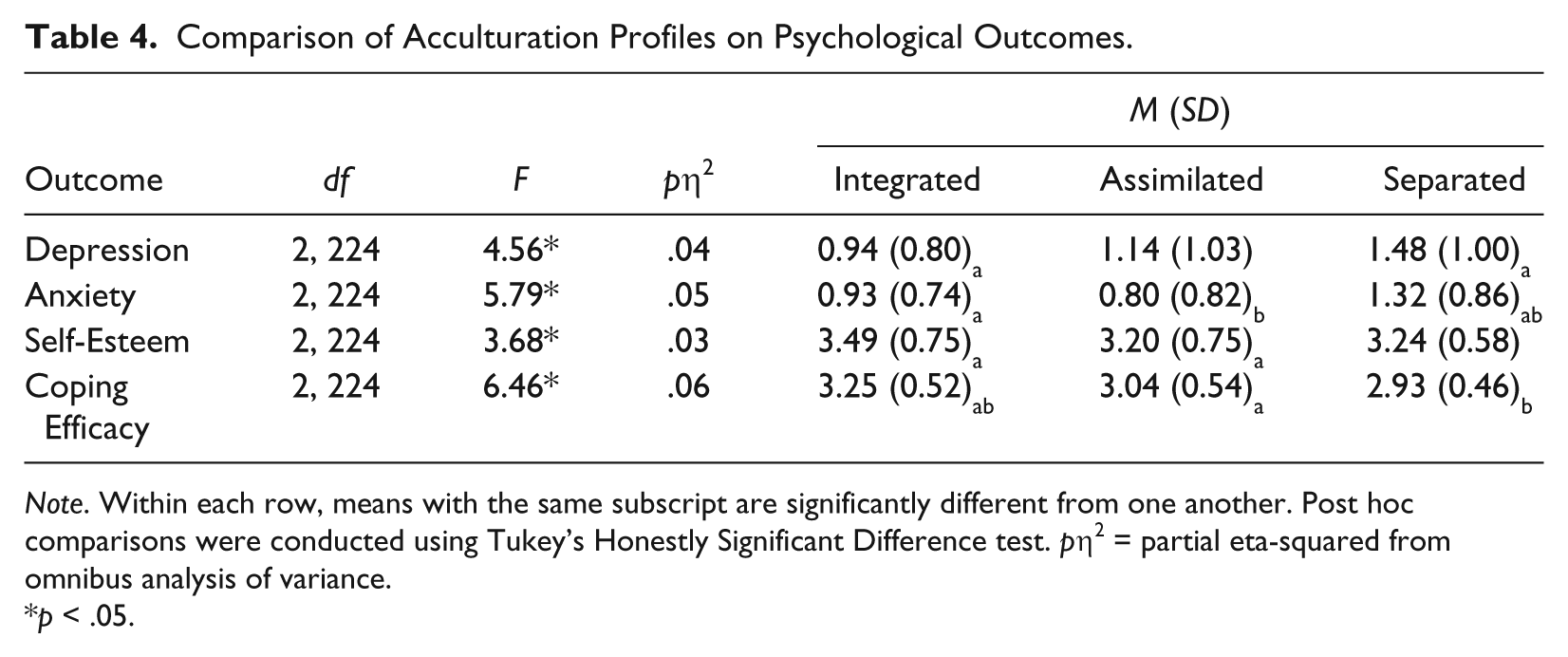
Note. Within each row, means with the same subscript are significantly different from one another. Post hoc comparisons were conducted using Tukey’s Honestly Significant Difference test. pη2 = partial eta-squared from omnibus analysis of variance.
p < .05.
Discussion
In this investigation, LPA was conducted to uncover acculturation profiles among a mixed-ethnicity sample of college students. Three latent profiles were derived, providing partial support for Berry’s four-factor model of acculturation. The integrated group was characterized by individuals high on both dominant society immersion and ethnic society immersion. Individuals in the assimilated group were high on dominant society immersion but low on ethnic society immersion. Conversely, the separated group was composed of individuals with low dominant society immersion, but high ethnic society immersion. These findings partially support Berry’s model of acculturation, with three of the hypothesized four typologies emerging. Marginalization did not emerge as an acculturation profile within the present sample, a finding that is supported by prior research. For example, del Pilar and Udasco (2004) specifically examined the lack of validity of the marginalization acculturation style (which they refer to as deculturation), challenging the notion that members of minority groups can become completely devoid of any culture through the acculturation and assimilation process.
The uncovered structure is also partially consistent with Schwartz and Zamboanga’s (2008) findings. The marginalization class was absent from their latent solution as well; however, as described above, they uncovered a six-class solution for acculturation groups. In addition to the assimilated and separated groups, as were found in the current analyses, they also found an undifferentiated group, which endorsed all four of Berry’s typologies. Additionally, they found three distinct subsets of integration, termed full biculturalism, American-oriented biculturalism, and partial biculturalism. Though Schwartz and Zamboanga (2008) used the DSI and ESI from the SMAS (Stephenson, 2000) to derive latent classes, they did not use the acculturation category variables from the Acculturation, Habits, and Interests Multicultural Scale for Adolescents (Unger et al., 2002), which they specifically noted differed considerably among the groups. This provides support for the possibility that the multiple versions of integration could be synthesized into a single class, as was found in the present investigation.
Examining the validation analysis elucidates significant psychosocial differences among the various acculturation profiles. In general, individuals in the integrated group demonstrated greater self-esteem and coping efficacy, whereas those in the separated group had more depression and anxiety than the other groups. Those in the assimilated group reported lower levels of depressive and anxious symptoms compared with the separated group; however, they also reported lower self-esteem and coping efficacy as compared with the integrated group. The findings from the present study tentatively support the hypothesis that integration is associated with better health outcomes (Berry, 2003, 2005; López & Contreras, 2005; Torres, 2010; Wei et al., 2010). Consistent with prior research, results from the present study showed that individuals in the integrated group experienced lower levels of psychological distress (López & Contreras, 2005; E. P. Vasquez et al., 2011; Wei et al., 2010) and less anxiety (López & Contreras, 2005) than those who were in the separated group. They also reported higher levels of self-esteem (Berry, 2005) than those who were in the assimilated group and better coping efficacy (Torres & Rollock, 2007) than those who were in both the assimilated and separated groups.
Additionally, notable differences in profile membership were found as a function of generational status and gender. Specifically, as would be expected given the theoretical basis of Berry’s model, longer generational status indicated a greater likelihood of being classified as assimilated, followed by integrated and separated. This is consistent with prior literature, which has demonstrated that increased length of time spent in the country of settlement and longer generational status are related to an increased likelihood of using an acculturation strategy in line with integration or assimilation (Berry, Phinney, Sam, & Vedder, 2006; Schwartz & Zamboanga, 2008). Coupled with the results of the validation analyses, this indicates that individuals of shorter generational status may be more likely to experience negative psychosocial outcomes. Group differences were also found by gender in that men were more likely to be classified as assimilated than as separated as compared with women. This is consistent with prior research demonstrating that men may be more likely to acculturate toward a dominant society than women (Farver, Bhadha, & Narang, 2002; Orozco & Lukas, 2000) and that women may be more likely to experience negative acculturation-related outcomes than men (Berry, 1997).
Examining the ethnic breakdown of each group also uncovered noteworthy differences. The majority of both African Americans and Hispanic Americans in the sample fell into the first profile (integrated), whereas the majority of Asian American participants were classified into group two (assimilated). These findings were further supported by the multinomial logistic regression analyses, which demonstrated that, even when controlling for generational status, African Americans and Hispanic Americans were more likely to be integrated rather than assimilated as compared to Asian Americans, and Asian Americans were more likely to be separated rather than integrated as compared with Hispanic Americans. Of note, the separated group did not absorb the majority of any ethnic group; however, this may be due to the comparatively small number of individuals in this profile.
Prior research has demonstrated that it is not uncommon for African Americans and Hispanic Americans in the United States to develop an integrated acculturation style (Berry & Sam, 1997; Devos, 2006; Phinney & Devich-Navarro, 1997; Schwartz & Zamboanga, 2008). For example, in their investigation, Phinney and Devich-Navarro (1997) found that 79% of African American and 98% of Mexican American adolescent participants expressed bicultural beliefs about their ethnic identities. The prevalence of Hispanic Americans in the southwestern region of the United States and the designation of the university at which the present data were collected as a Hispanic serving institution may further help explain this ethnic group’s emphasis on integration in the present sample. A separate analysis conducted by Devos (2006) found that Hispanic American and Asian American students predominantly demonstrated an integrated sense of self. However, in that analysis acculturation was measured implicitly rather than by self-report. This indicates that perhaps Asian American students consciously view themselves as less affiliated with their ethnic heritage than they implicitly express themselves to be. Further research may be warranted to explore this phenomenon.
With particular regard to African Americans, research has demonstrated that this minority group has acculturated in such a way that biculturalism is both necessary and inevitable (Phinney & Devich-Navarro, 1997). This could help explain the notable portion of this group that fell into the integrated profile category. Although these findings provide preliminary insight into the acculturative styles of these three minority groups, given the unique sociopolitical histories of each group it may also be beneficial to analyze Berry’s model as it applies to a homogenous African American sample and a homogenous Asian American sample, as Schwartz and Zamboanga (2008) have already done for Hispanic Americans. It may be additionally beneficial to conduct such analyses with students from a historically Black college or university, and an institution at which Asian Americans are the majority, as was done in the present analysis at a federally designated Hispanic serving institution. Such an examination may provide further insight into the appropriateness and relevance of Berry’s typologies for these distinct racial and cultural populations from varying college contexts.
The current results must be interpreted within the context of relevant limitations. Primarily, the data were collected from a convenience sample of undergraduate students. Although the university population from which the sample was drawn is quite diverse, generalizability of the current findings is limited given that the sample was composed of college students. Given this, the educational level of the sample is not representative of the population at large. Additionally, it is likely that all participants had a relatively high level of English language proficiency. Prior research has demonstrated that English-language mastery is correlated with acculturation in the United States (Derose & Baker, 2000; Marín, 1992). It is possible that there would not be as many individuals in the integrated and assimilated acculturation groups if this study was repeated with a sample of individuals who have lower English proficiency. Additionally, the majority of the sample reported an annual family income of more than $50,000, which is also not representative of the greater population. Place of education and recency of immigration, which could affect an individual’s level of dominant society immersion, were not considered in the present analysis. Furthermore, there was no cross-validation sample in the present investigation, which permits the possibility that these findings are sample specific and limits generalizability. The limited sample size may have also affected the results. Specifically, this may have contributed to inadequate representation of certain ethnic groups and/or acculturation categories. Additionally, because of sample size restrictions, the 32-item SMAS (Stephenson, 2000) was collapsed into two composite scores to enable a sufficiently powered analysis. Examining each profile with regard to these two scores demonstrates that the DSI and ESI scores for all three profiles, although distinct from each other, fall close to the middle of the four-point range. In the present investigation, the profiles have been named so as to reflect which of Berry’s typologies they most closely resemble. However, given the average nature of all scores, it is possible that these profiles may not be as different from each other as those in the acculturation structure originally theorized by Berry.
The breakdown of ethnic groups within each level of generational status must also be considered. In the present sample, the majority of African American participants (75.7%) were third or fourth generation, whereas most Hispanic American participants (73.7%) were second or third generation and most Asian American participants (85.1%) were first or second generation. Thus, it is possible that generational status may be influencing the results by affecting the ethnic breakdown of the uncovered typologies. For example, it follows that Asian Americans comprised the majority of the separated group, as Asian American participants belonged to families that had generally spent the least amount of time in the United States. Additionally, the longer generational status of African American and Hispanic American participants may be contributing to the strong representation of both of these ethnicities in the integrated group. It must be noted that ethnicity was found to significantly predict profile membership even when controlling for generational status; however, the discrepancy in the representation of ethnicities across generational status must nonetheless be considered when interpreting the present results.
Follow-up research examining acculturation measured by multiple assessments may elucidate if the discovered profiles are measure-specific or generalizable. Examination of the impact of subgroup membership within each ethnic minority, as well as skin pigmentation, on acculturation may further clarify the present findings. Future analyses should be conducted with a larger sample and additional variables. This will hopefully enable utilization of each item of the acculturation scale independently so as to consider additional information in this analysis, as well as provide a more representative sample to improve generalization of the findings. Additionally, an expanded sample size would enable empirical investigation of the factorial validity of the measures used in this analysis, many of which have not been examined across cultures. Such analysis would increase confidence that these measures do in fact evaluate comparable constructs and factor structures in multicultural samples, such as the one examined presently.
Implications for Counselors
These findings have important implications for counseling practice. Cataloging interactive characteristics as categorical profiles is practical in that it offers a brief and simple summary of complicated relationships (Herzberg & Roth, 2006; Robins, John, & Caspi, 1998). Even the Diagnostic and Statistical Manual of Mental Disorders−(4th ed., text revision; American Psychiatric Association, 2000) employs a categorical approach for mental health symptoms and, as such, simplifies complicated interactions to create a nomenclature that can be used to inform diagnosis, make clinical predictions, and match clients to appropriate interventions. Although a number of empirically supported treatments have been adapted for use with different cultures (Bernal, Jiménez-Chafey, & Domenech Rodríguez, 2009; Lau, 2006; Whaley & Davis, 2007), the present findings highlight the importance of considering individual acculturation patterns in addition to cultural background when devising treatment plans. This is further supported by the finding that no single ethnic group completely comprised a given profile. Furthermore, the current findings can help provide a deeper appreciation of the impact of acculturation on psychosocial outcomes and the provision of counseling services.
Additionally, cultural sensitivity and an understanding of a client’s unique acculturation profile may benefit both the case conceptualization process and development of a therapeutic alliance (Sue, 2006; M. J. T Vasquez, 2007). For example, making assumptions about clients based on culture alone may contribute to misconceptions about a client’s perspective if an individual no longer adheres to the norms of their ethnicity of origin (Ruelas, Atkinson, & Ramos-Sanchez, 1998). Furthermore, clients may view culturally sensitive counselors as more competent than those who do not recognize a client’s culture and unique history (Gim, Atkinson, & Kim, 1991; Worthington, Soth-McNett, & Moreno, 2007). If counselors recognize the importance of individual acculturation style in addition to cultural background in development and wellness, clients may view counselors as more credible. This in turn can increase clients’ willingness to actively engage in treatment, and subsequently it can improve client outcomes (Worthington et al., 2007).
Prior research has demonstrated that differing acculturation styles are related to different levels of acculturative stress, an umbrella term subsuming the negative outcomes that occur when the process of acculturating causes an individual distress (Berry, 2006). It has been shown that individuals who favor integration often experience less acculturative stress, whereas those favoring separation or assimilation may experience more (Berry, 2006). In the present analysis, both of these latter groups consisted of predominantly Asian Americans, indicating that this group may be at heightened risk for acculturative stress in the present sample. It has also been theorized that, due to the stigma of seeking mental health services within certain cultures such as the Asian American culture, individuals who are assimilated may be most willing to seek services whereas those who are separated may be least likely, with integrationists possibly experiencing mixed feelings on the topic (Leong, Kim, & Gupta, 2011). Furthermore, identification with the dominant society, as is observed in integration and assimilation, has been linked to less distress, less depressive symptomatology, and increased social adjustment (Ryder et al., 2000).
In aggregate, these findings indicate that integrationists may be less likely to pursue services though they are simultaneously less likely to experience distress, and assimilationists may be more likely to pursue counseling and are also less likely to experience distress. However, those Asian Americans who comprised the majority of the separated group may be experiencing elevated levels of distress and simultaneously be less likely to pursue counseling services. Thus, utilization of culturally sensitive treatments with this population, such as implementation of psychological and career counseling services via the cultural accommodation model (Leong & Lee, 2006) or cultural formulation approaches (Leong, Hardin, & Gupta, 2010) and consultation of culture-specific treatment manuals (Kurasaki, Okazaki, & Sue, 2002; Sandhu, 1999; Suzuki, Casas, Alexander, & Ponterotto, 2010), is of heightened importance. Such action may work to combat the factors at play that may impede provision of services to those in great need. Additionally, research has demonstrated that Asian Americans who are less acculturated to the United States and identify more closely with the Asian culture may prefer a more directive therapy style and anticipate having a less active role in treatment (Yuen & Tinsley, 1981). Thus, establishing mutual expectations early in treatment may be of heightened importance, in that it may avoid future unnecessary emotional discomfort between the client and the counselor.
In summary, these results provide strong support for the use of LPA in classifying acculturation styles. The use of this data-driven statistical approach yielded a model consistent with prior research. Furthermore, these profiles were validated by their relationships with demographic and psychosocial outcomes, as is supported by extant literature and theory. Further research is warranted to examine the use of this statistical approach with a more generalizable sample, as well as the ways in which acculturation profiles may reflect and contribute to other health-related behaviors and psychological outcomes.
Footnotes
Authors’ Note
The funding organizations are public institutions and had no role in the design and conduct of the study; collection, management, and analysis of the data; or preparation, review, and approval of the article. The views expressed herein are those of the authors and do not necessarily reflect the view of the National Institute of Mental Health (the funding agency).
Declaration of Conflicting Interests
The author(s) declared no potential conflicts of interest with respect to the research, authorship, and/or publication of this article.
Funding
The author(s) disclosed receipt of the following financial support for the research, authorship, and/or publication of this article: Funding for this research was provided by the National Institute of Mental Health (Grant No. MH065515).