



Abstract
The Forgiveness Reconciliation Inventory is a theoretically derived instrument. Participants included individuals from clinical and nonclinical populations. Confirmatory factor analysis along with correlational designs and between-group comparisons indicate strong psychometric properties of the Forgiveness Reconciliation Inventory. The authors address applications for use within counseling practice.
The role of counseling in assisting clients who struggle with issues of forgiveness represents a growing body of research in the counseling field (Wade, 2010). Elliott (2011) suggested that forgiveness interventions might affect treatment and management of chronic illnesses, such as obesity, addiction, and other mental health issues. Macaskill (2005) identified a range of mental health issues in which processing issues of forgiveness may be helpful including with particular attention to psychological hurt and maltreatment. Addressing issues of forgiveness is an integral aspect of counseling when working with couples (Bischoff, 2008), particularly with issues of infidelity (Olmstead, Blick, & Mills, 2009).
The majority of extant research related to forgiveness in counseling appears to be conceptual, but some empirical studies were evident in a review of the literature with an emphasis on assessment of the forgiveness construct related to forgiveness models. Hargrave and Sells (1997) developed the Interpersonal Relationship Resolution Scale to measure feelings of rage, shame, control, and chaos when working through a forgiveness process identified by two major processes: exoneration (e.g., insight and understanding in to the nature of the offense and the offender) and the overt act of forgiveness. Subkoviak et al. (1995) developed the Enright Forgiveness Inventory, which contains 60 items that measure the presence of positive and negative cognitions, affects, and behaviors related to forgiveness. These popular instruments are each aligned with forgiveness models that provide an opportunity to assess a range of feelings and behaviors associated with the forgiveness process. These instruments are helpful in identifying feelings and personality aspects related to forgiveness but may be limited in utility with respect to providing information that guide the client toward working through issues of forgiveness and conflict.
The Forgiveness Reconciliation Model
Balkin, Freeman, and Lyman (2009) developed the Forgiveness-Reconciliation Model (FRM), which emphasized a process of collaborative exploration and decision making based on a Jewish conceptualization of forgiveness. Although the concept of the FRM was derived from examination of religious/spiritual dimensions of forgiveness specific to Judaism, Balkin et al. (2009) identified the generalizable nature of the FRM that takes into account multicultural aspects of forgiveness. The FRM is a conceptual model derived from a review of the literature and made up of four sequential stages that counselors can use with their client to examine clients’ viewpoints of forgiveness and how they might view a relationship. The first aspect of the model is “collaborative exploration” (p. 157). Here, the client and counselor are free to discuss different perspectives that a client might have with regard to forgiveness. Clients will be able to openly share their thoughts and feelings on forgiveness and how forgiveness relates to their welfare. The collaborative exploration between a client and counselor can take anywhere from a few minutes to a few sessions. Emphasis in this stage focuses on clients being able to fully voice their true perspectives of forgiveness so the counselor has an understanding of their client’s worldview. Some questions that a counselor could use in the collaborative exploration stage to help guide the process could be “What are your views of forgiveness?” “To what extent do you feel forgiveness is an obligation?” “How is forgiveness related to your feelings toward yourself and toward the perpetrator?”
With this background information the counselor can assist a client in processing the “role of reconciliation” (Balkin et al., 2009, p. 157). An important issue in this stage is the client’s orientation toward reconciliation with the perpetrator as beneficial or harmful. For example, if a client has incurred some form of abuse, reconciliation with the perpetrator may be harmful. On the other hand, reconciliation may be another option when, for example, couples are in conflict but willing to address issues and transgressions. Counselors may help weigh options regarding the benefit or lack thereof with respect to reconciling their relationship.
The anticipation of reconciliation stems from clients evaluating whether or not the person who caused harm has remorse or expressed change in behavior, indicating the third stage in this model (Balkin et al., 2009). This stage represents a decision for the client. If a client feels as though a perpetrator is remorseful and has changed, they can move toward “renegotiation of the relationship” (p.157). In this respect, the client has chosen a path toward interpersonal forgiveness, in which a relationship with a perpetrator may be healed or simply maintained.
However, if a client believes that a perpetrator is not remorseful and/or remains unchanged, the client may believe that reconciliation is in fact not beneficial, therefore leading the client to intrapersonal forgiveness. Balkin et al. (2009) referred to this stage as “mechila” (p. 155), a Hebrew term that literally translates to forgiveness of debt (Blumenthal, 1998). “In mechila, the victim has not offered reconciliation; rather the victim has concluded that the perpetrator no longer owes the victim for whatever wrongdoing occurred” (Balkin et al., 2009, p. 155). At this point the counselor and client can process any unpaid debt, perhaps related to emotional pain that is connected to the person or the event. To help guide the counseling process, counselors can start implementing interventions to address why the client found the relationship beneficial/nonbeneficial and facilitate the client moving toward interpersonal or intrapersonal forgiveness. Interpersonal forgiveness involves both the victim and perpetrator to work together toward reconciliation. With intrapersonal forgiveness, clients who were harmed reflect on their feelings and emotions related to the event/perpetrator that result in moving forward without negative reactions or feelings and may be deemed harmful or self-destructive. Intrapersonal forgiveness does not involve perpetrator but rather is an individual process.
The FRM incorporates forgiveness theory but lacks empirical data to support the model. Additionally, we sought to develop a therapeutic tool that may be used within counseling to address the various dimensions of the FRM and be utilized as a guide for addressing issues of forgiveness. Whereas previous measures of forgiveness were related to addressing the likelihood of forgiveness, the extent to which one forgives an offender, or behaviors that lead to forgiveness (e.g., Rye et al., 2001; Subkoviak et al., 1995), an instrument focused around the elements of the FRM may be beneficial when clients feel conflicted regarding issues of forgiveness and reconciliation in order to assist clients through this process.
The purpose of this study was to validate and demonstrate the use of an assessment instrument, the Forgiveness Reconciliation Inventory (FRI), which was derived from the FRM to address issues of forgiveness and conflict (Balkin et al., 2009). Specifically, we addressed the following research questions:
Do scores on the FRI provide evidence of internal structure?
Do scores differ between clinical and nonclinical participants?
To what extent do scores on the FRI correlate with scores on other instruments that measure a similar construct (i.e., forgiveness)?
Consistent with standards for instrument development, we address in this study an explanation of item content and response processes, along with procedures to demonstrate evidence of internal structure, evidence of relationship to other variables, and evidence of consequences of testing consistent with American Educational Research Association (AERA), American Psychological Association (APA), & National Council of Measurement in Education (NCME) (1999). In addition, we demonstrated how scores on the FRI could be used to promote growth and wellness for clients who struggle with issues of forgiveness and conflict.
Method
Participants
Two hundred participants from the United States were solicited from nonclinical and clinical settings; the nonclinical setting included undergraduate and graduate students on a university campus in the South and consenting professionals from a community-based education program (N = 131, 65.5%), and the clinical settings included a correctional setting, outpatient women’s recovery center, and domestic abuse shelter in the Northeast, and a domestic abuse shelter in the South (N = 69, 34.5%). Participants were 35 (17.5%) males and 165 (82.5%) females with the following ethnic breakdown: White (n = 115, 57.5%), Latino/a (n = 47, 23.5%), African American (n = 18, 9.5%), Asian (n = 8, 4%), other (n = 8, 4%), and missing (n = 4, 2%). Mean age was 33.33 (SD = 14.21).
Measures
Forgiveness Scale
The Forgiveness Scale (Rye, 2001) was designed to measure forgiveness toward a particular offender and was developed as part of an earlier study involving college women who were wronged in a romantic relationship. The measure consists of 15 items using a Likert-type format with response possibilities ranging from 1 (Strongly disagree) to 5 (Strongly agree). Respondents are instructed to think about how they have responded to the person who wronged or mistreated them. Sample items include “I spend time thinking about ways to get back at the person who wronged me” and “If I encountered the person who wronged me I would feel at peace.” Higher scores on this scale reflect greater forgiveness toward an offender. The Forgiveness Scale consists of two subscales in which the normative scores were indicative of strong reliability evidence: Absence of Negative (α = .86) and Presence of Positive (α = .85).
Forgiveness Likelihood Scale
Like the Forgiveness Scale, the Forgiveness Likelihood Scale (Rye, 2001) was developed as part of an earlier study involving college women who had been wronged in a romantic relationship (Rye, 2001). In this instrument, 10 scenarios were developed involving hypothetical wrongdoing. Scenarios were designed to assess a variety of types of wrongdoing (e.g., infidelity, slander, theft) to which college students would likely be able to relate and provide a meaningful judgment. Respondents were instructed to imagine that the scenarios happened to them and then consider the likelihood that they would be willing to forgive the offender. The scale uses a Likert-type format with response possibilities ranging from 1 (Not at all likely) to 5 (Extremely likely). Sample items include “One of your friends starts a nasty rumor about you that is not true. As a result, people begin treating you worse than they have in the past. What is the likelihood that you would choose to forgive your friend?” and “Your significant other has a ‘one night stand’ and becomes sexually involved with someone else. What is the likelihood that you would choose to forgive your significant other?”
Higher scores on this scale reflect increased willingness to forgive. The instrument produces one scale score with strong reliability estimates on the scores for the normative sample (α = .81).
Forgiveness Reconciliation Inventory (FRI)
The FRI was developed by the lead author and was based on the FRM of Balkin et al. (2009) related to the Jewish conceptualization of forgiveness. As the analysis of the psychometric properties of this instrument is a component of this study, the following section describes the item development. The FRI utilized semantic differentials (Osgood, 1957), establishing dichotomous choices of opposing adjectives that represent each stage and are aligned with the FRM. Between each of the dichotomous adjectives are five points that represent the respondent’s agreement with one or the other differentials. Thus, two points lie close to one adjective, two points lie close to the opposing adjective, and the midpoint is neutral. Under each of the four stages respondents select a point of agreement for each pair of dichotomous adjectives presented. Each stage consists of a preliminary statement followed by six adjective pairs. A sample item not included in the instrument was provided to explain how to complete the FRI. Instructions for the instrument are as follows: Below you will find a statement written in bold and a list of word pairs. Between each word pair are several Example:
So, you would check the box above if you felt strongly that most people are trustworthy. The extent to which you feel different could be represented by checking one of the boxes to the right of the present mark.
For the collaborative exploration stage, participants are asked to identify adjectives for the following statement: “Regarding the person who harmed me, I feel . . .” A sample adjective pair includes peaceful–hostile. For the role of reconciliation stage participants are asked to identify adjectives for the following statement: “Reestablishing a relationship with the person who harmed me would be . . .” A sample adjective pair includes compassionate–unfeeling. For the remorse/change stage participants are asked to identify adjectives for the following statement: “The person who harmed me is . . .” A sample adjective pair includes honest–deceitful. For the final stage, outcome, participants are asked to identify adjectives for the following statement: “In the future, my relationship with the person who harmed me is likely to be . . .” A sample adjective pair includes beneficial–useless. With each of the scales, lower values were connected with more positive feelings or attributes; higher values were connected with stronger negative feelings or attributes.
Two additional expert reviewers with publications in areas of counseling and forgiveness evaluated the items. Feedback from the reviewers was incorporated into the formation of the items. Minimal changes were made to the items, as the items appear clear, concise, and aligned with the aforementioned FRM model, thereby demonstrating some evidence of test content (AERA, APA, & NCME, 1999).
Procedure
The university institutional review board of the lead author approved this study (#104-09). Volunteer participants were recruited from undergraduate and graduate students on a university campus in the South, consenting professionals from a community-based education program, and from clinical settings including a correctional setting, outpatient women’s recovery center, and domestic abuse shelter in the Northeast, and a domestic abuse shelter in the South. Participants completed the FRI, Forgiveness Scale, and Forgiveness Likelihood Scale. Analyses were conducted using IBM SPSS 17.0 and Mplus version 6.
Results
Based on a preestablished theoretical framework of the four-stage Forgiveness-Reconciliation Model (Balkin et al., 2009), four factors were identified a priori to evaluate item fit with each theoretically proposed stage. Reliability estimates in the normative sample (N = 200) were evaluated using Cronbach’s alpha to assess internal consistency for the scores in each of the four factors, consisting of seven items each. However, one item was removed from each of the four factors due to decreasing the reliability estimate of the scale and thereby resulting in a 24-item instrument. Reliability estimates were strong for the scores on each of the subscales: collaborative exploration (.90), role of reconciliation (.88), remorse/change (.92), and outcome (.93).
To demonstrate evidence of internal structure (AERA, APA, & NCME, 1999), a confirmatory factor analysis (CFA) was conducted to evaluate factor structure of the FRI. The hypothesized model included four first-order latent variables: collaborative exploration, role of reconciliation, remorse/change, and outcome. Each of the four aforementioned latent variables included six indicators. The χ2 was significant for the hypothesized model, χ2(246) = 693.17, p < .001. The fit indices indicated a mediocre (comparative fit index [CFI], Tucker–Lewis index [TLI]) to good fit (standardized root mean square residual [SRMR]) for the data, CFI = .88, TLI = .87, SRMR = .069 (Dimitrov, 2012). SRMR was selected in lieu of the root mean square of error approximation, which tends to be overestimated with models that include fewer factors (Dimitrov, 2012).
An alternative model was tested to identify if a better model fit could be attained (Dimitrov, 2012). Modification indices were examined, and similar theoretical content was identified. Two pairs of error variances were correlated:
Pair 1: “nurtured–abused” with “well-treated–exploited” (collaborative exploration subscale)
Pair 2: “remorseful–unapologetic” with “modest–shameless” (remorse/change subscale)
The χ2 was significant for the hypothesized model, χ2(244) = 598.49, p < .001. The model appeared improved, χ2diff = 94.68, p < .001. The fit indices indicated an acceptable model fit for the data, CFI = .91, TLI = .90, SRMR = .069 (Dimitrov, 2012). Table 1 provides the standardized estimates for the factor pattern coefficients and correlations for the paired variables, as the alternative model appeared to be a better fit.
Standardized and Unstandardized Estimates for Factor Pattern Coefficients and Correlations for Paired Variables for the FRI.
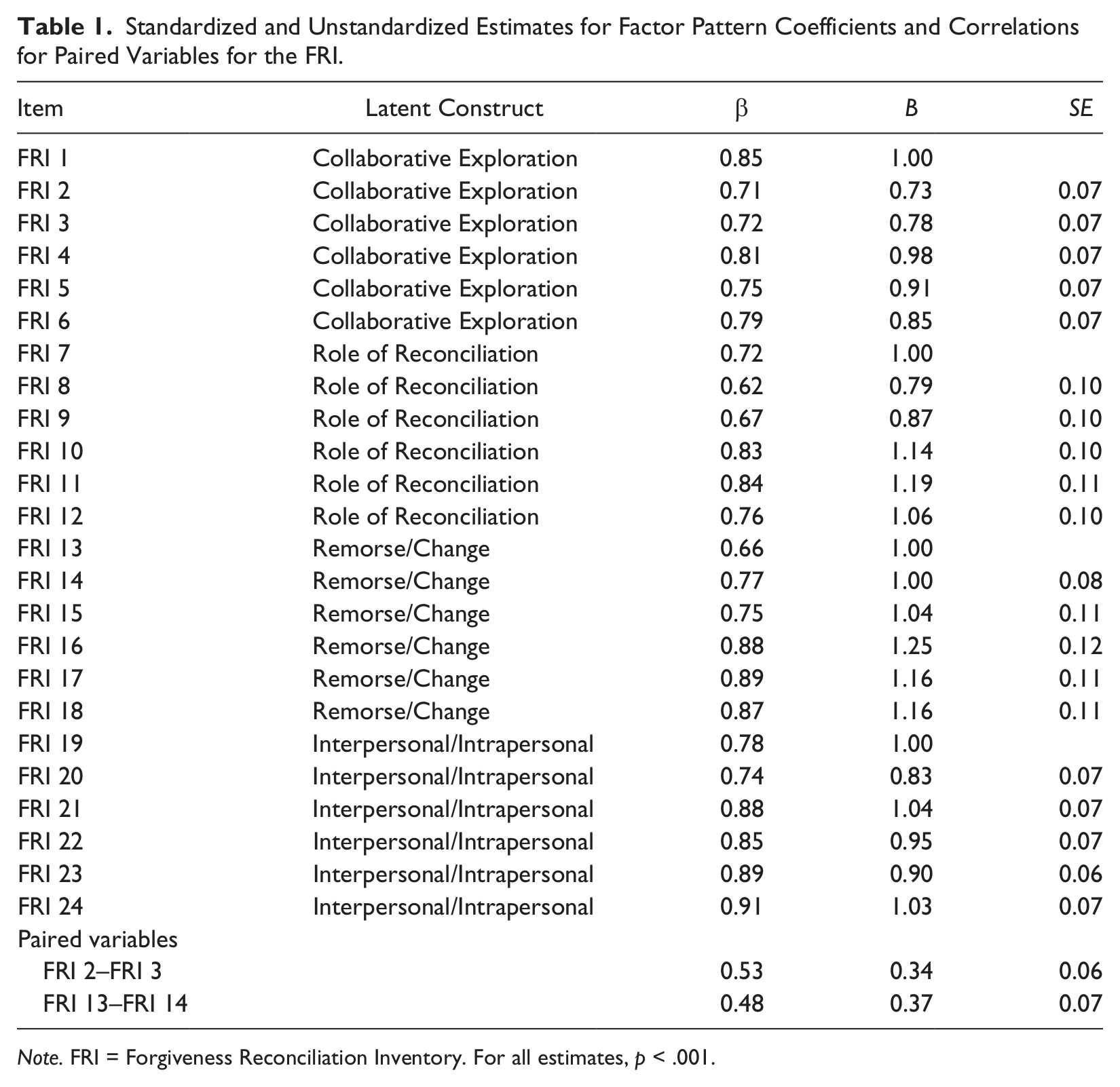
Note. FRI = Forgiveness Reconciliation Inventory. For all estimates, p < .001.
Further evidence of internal structure was examined through differential item functioning, a process of evaluating differences among subgroups (AERA, APA, & NCME, 1999), for clinical and nonclinical participants who completed the FRI. Clinical participants included individuals who completed the FRI while receiving treatment in a correctional setting, outpatient women’s recovery center, or domestic abuse shelter. Nonclinical participants included undergraduate and graduate students on a university campus and consenting professionals from a community-based education program. To address differences between clinical and nonclinical subgroups, a MANOVA was conducted using the four subscales of the FRI. Mean and standard deviations of the clinical and nonclinical subgroups are provided in Table 2. A statistically significant difference was noted between clinical and nonclinical participants, λ = .885, F(4, 195) = 6.22, p < .001. A moderate effect size was noted, accounting for 11.5% of the variance in the model. Centroid means for the discriminant functions indicated that the clinical group (.49) had significantly higher values across the four FRI subscales than the nonclinical group (−.26), suggesting that participants in the clinical group identified more negative feelings or attributes toward those that harmed them.
Descriptive Statistics and Correlations for the FRI, Forgiveness Scale, and Forgiveness Likelihood Scale.

Note. Exploration, Role, Change, and Outcome represent the subscales on the FRI. FSneg = Forgiveness Scale Absence of Negative; FSpos = Forgiveness Scale Presence of positive; FLS = Forgiveness Likelihood Scale.
p < .001.
To address evidence of relationship to other variables (AERA, APA, & NCME, 1999) for the FRI, correlational analyses were conducted with the Forgiveness Scale (Rye, 2001) and the Forgiveness Likelihood Scale (Rye, 2001). Table 2 provides the descriptive data and correlations for each of the instruments.
Listwise deletions were used to eliminate observations with missing data, yielding a sample size of 169 and 170 for analyses with the Forgiveness Scale and Forgiveness Likelihood Scale, respectively. An a priori power analysis indicated a sample size of 98 to find statistical significance with a moderate effect size (f2 = .15) and adequate power (1 − β = .80), thereby providing evidence of the sufficiency of the sample size used for this analysis.
To evaluate the relationship between the FRI and the Forgiveness Scale, a canonical correlation was conducted. Canonical correlation was selected due to the multivariate nature of the instruments. Canonical correlation may be used to evaluate the relationship between two or more sets of variables. In this study, we investigated the correlation between the four subscales on the FRI and the two subscales on the Forgiveness Scale. A statistically significant relationship was found between the FRI subscales and the Forgiveness Scale subscales. The first canonical root was significant, λ = .49, F(8, 326) = 17.62, p < .001, accounting for 49% (rc = .70) of the variance in the model. The second canonical root was not significant, λ = .96, F(3, 164) = 2.22, p ≤ .087, accounting for 4% (rc = .20) of the variance in the model. Therefore, only the first canonical variate was interpreted. The first canonical variate included scores on the all four subscales of the FRI, with correlations ranging from −.63 to −.97 and both subscales of the Forgiveness Scale, with correlations ranging from .69 to .97. Based on this analysis and as expected, endorsement of positive attributes on the FRI was correlated with higher degrees of forgiveness toward an offender. Table 3 provides the correlations and standardized canonical variate coefficients for each of the subscales.
Correlations and Standardized Canonical Variate Coefficients on the FRI and Forgiveness Scale for the First Canonical Variate and Regression Results Between the FRI and Forgiveness Likelihood Scale.

Note. COR = correlations to the canonical variate; COE = standardized canonical variate coefficient; FRI = Forgiveness Reconciliation Inventory.
p < .05.
To evaluate the relationship between the FRI and the Forgiveness Likelihood Scale, a multiple regression analysis was conducted. Multiple regression was selected due to the unidimensional measure of the Forgiveness Likelihood Scale. A statistically significant relationship was found between the FRI subscales and the Forgiveness Likelihood Subscale, F(4, 165) = 4.54, p = .002 with a small to moderate effect size, R2 = .10, account for 10% of the variance in the model. Similar to the results on the Forgiveness Scale, increased positive attributes on the FRI correlated with higher likelihood to forgive. In particular, scores for exploration, change, and outcome were stronger predictors of the likelihood to forgive (see Table 3).
Scoring and Interpretation of the FRI
Scoring on the FRI can be accomplished by summing the respective items for each subscale and noting the score, ranging from 6 to 30 on each subscale, on the profile form. Figure 1 displays an example of three separate profiles for three different clients. Client 1 was indicative of an individual who viewed the perpetrator in a more positive light, viewed reconciliation as beneficial, indicated that the person who harmed him/her was remorseful and changed, and was moving toward reconciling the relationship. Client 2 was much more conflicted. Client 2 was indicative of an individual who had mixed feelings about the perpetrator and identified more negative feelings. Client 2 identified some benefit to reconciliation but also indicated that the perpetrator was unlikely to have changed or exhibit remorse. However, Client 2 was still open to reconciling the relationship. Client 3 was indicative of an individual who viewed the perpetrator in a more negative light, viewed reconciliation as nonbeneficial, indicated that the person who harmed him/her was not remorseful and unlikely to have changed, and was moving toward a more intrapersonal view of forgiveness, or what Balkin et al. (2009) referred to as mechila.
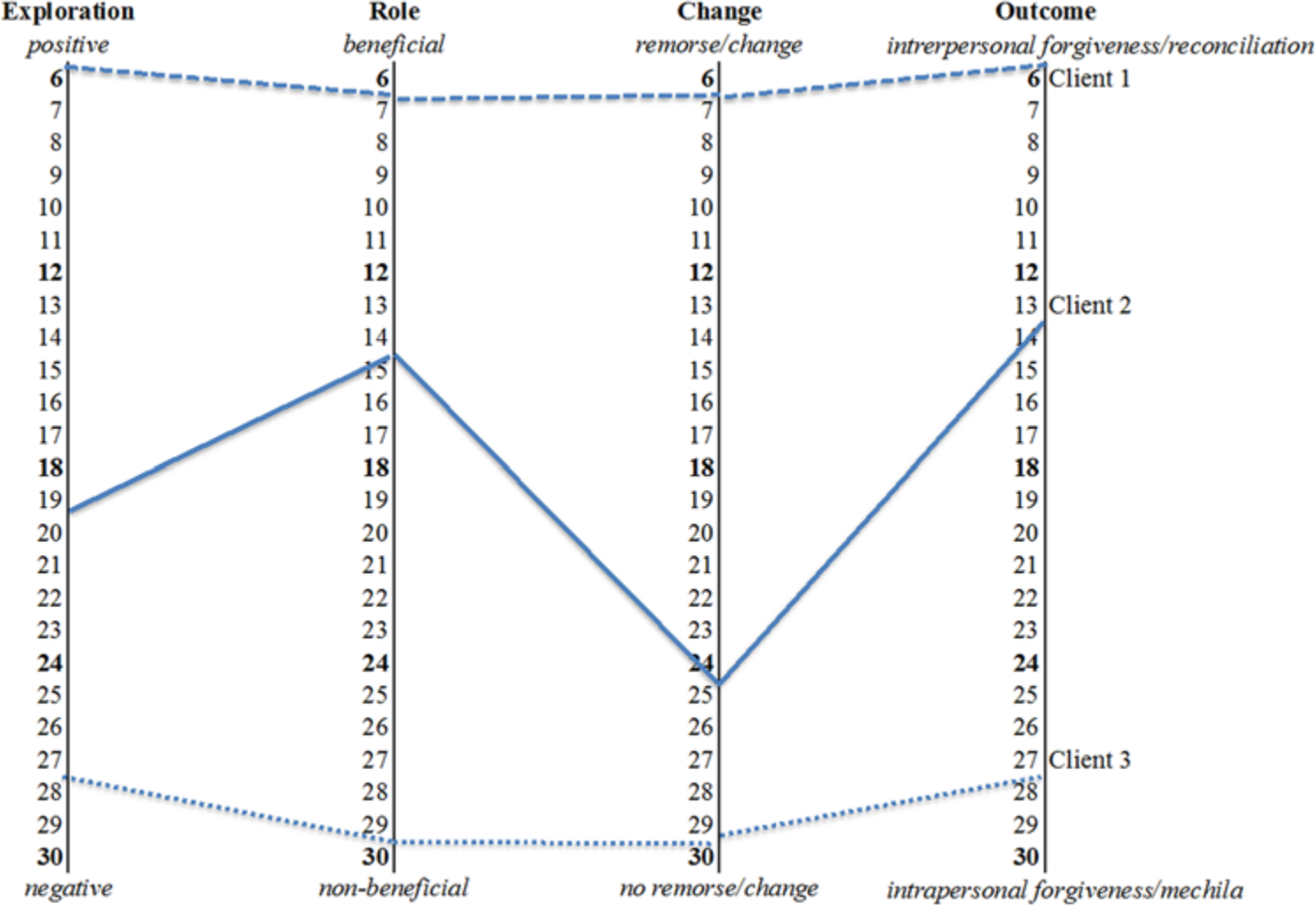
FRI sample scoring profile.
Discussion and Implications
The scores for the normative sample on the FRI appear to have strong psychometric properties, which provide evidence for validity including internal structure and relationship to other variables (AERA, APA, & NCME, 1999). The items were derived from a theoretical base (Balkin et al., 2009) and the response processes required for the instrument are in line with other types of self-report inventories (e.g., Adjective Checklist). The FRI has a sound internal structure and correlates well with other validated measures focused on the forgiveness construct. Reliability estimates for the scores on each of the subscales were strong.
An important facet for establishing validity evidence of an instrument is the manner in which the scores on the instrument are interpreted and used (AERA, APA, & NCME, 1999). Perhaps this area is where the FRI is more distinct. The FRI is not a diagnostic instrument or problem inventory. Rather, the FRI may be used as part of the process in counseling. The FRI is very brief (approximately 5 minutes) and easy to score. Counselors are encouraged to process the score profile with the client in order to illustrate if the client is moving toward interpersonal forgiveness, intrapersonal forgiveness, or is conflicted. For example, Client 2 identified that the perpetrator was unlikely to show change or remorse, yet was considering reconciling the relationship. The score profile of the FRI may be helpful in providing a visual representation of the conflict to assist the client in problem solving and decision making. Hence, counselors may find that the FRI is a process instrument designed to provide both the client and the counselor with information to enable clients to make choices that may influence their health and well-being.
The normative sample included a variety of clinical and nonclinical settings. Hence, the FRI may demonstrate generalizability across many subgroups. As expected, differences between clinical and nonclinical subgroups were noted, with the clinical sample showing more likelihood to endorse negative connotations of forgiveness, viewing reconciliation as nonbeneficial, identifying the perpetrator as less likely to demonstrate remorse or change, and indicating a stronger likelihood of pursuing an intrapersonal model of forgiveness.
Limitations
The FRI is a self-report inventory, and therefore has limitations consistent with any self-report inventory, that is, individual bias and the propensity to fake responses. With these limitations in mind, we feel confident that the FRI provides information that may be useful to clients, given the nature of scores from both clinical and nonclinical subgroups.
Most social science research relies on participants who volunteer for a study and therefore represent some cooperativeness or interest in the study that may compromise a truly random sample, and this study is not an exception. Hence, the generalizability of the findings may be called into question. The representation of ethnically diverse clients is a strength of this study, but the study includes an overrepresentation of female participants.
A CFA was conducted to establish evidence of internal structure (AERA, APA, & NCME, 1999). For the CFA, the clinical and nonclinical subgroups were combined to due to sample size considerations and the difficulty in collecting data of this nature from clinical populations due to the sensitivity of the population, HIPAA regulations, and informed consent/institutional review board procedures from both academic and service-providing institutions. Despite the limitation of combining the samples, we assert the instrument has utility with both clinical and nonclinical populations given the common nature of issues related to forgiveness and conflict. Future researchers might address other methods of instrument validation, such as using item response theory procedures. Internal consistency estimates for the scores from the normative sample were strong, but further research related to test–retest reliability estimates would be beneficial. Counseling researchers may wish to consider utilizing the FRI with other subgroups, such as adolescents, couples, and families.
Conclusion
The FRI was developed using the FRM model (Balkin et al., 2009) for processing issues of forgiveness and conflict in counseling. Data were collected to demonstrate initial validation of the FRI. The FRI appears to indicate strong psychometric qualities of reliability and validity based on scores from clinical and nonclinical subgroups. The scoring profile of the FRI may be useful to counselors and clients when processing issues of forgiveness and conflict. In particular, the FRI is an instrument that may be associated with the counseling process by providing a mechanism to explore feelings and attributes that influence counselors’ approach the issue of forgiveness with their clients.
Footnotes
Declaration of Conflicting Interests
The author(s) declared no potential conflicts of interest with respect to the research, authorship, and/or publication of this article.
Funding
The author(s) received no financial support for the research, authorship, and/or publication of this article.