



Abstract
In this paper, we introduce R.TeMiS, a free software solution aimed at exploring new dimensions in text mining with a particular focus on media framing analysis. R.TeMiS is especially designed to provide help in a) the automation of corpus construction and management procedures based on the use of large media content data bases, and b) the extension of the range of statistical tools available to social scientists exploring texts through R coding (one and two-way tables, time series, hierarchical clustering, correspondence analysis, geographical mapping…). A case study on the media framing of Julian Assange from January 2010 to December 2011 is conducted. It is based on the analysis of a corpus of 667 news dispatches published in English by the three top international news agencies: Agence France-Presse (AFP), Reuters and Associated Press (AP).
Introduction
The methodology of applying statistics to large-n text corpora 1 – which we will here refer to as “text mining” – has gained legitimacy in every field of the humanities and social sciences (HSS) since the 1960s. Simultaneously, significant changes have occurred in the way that social sciences access and store textual data. The digitalization of text corpora in many fields of social activity has for instance produced a deluge of available new documents to the social scientist, a phenomenon that has been referred to as a “data deluge” (Abbott, 2000; Hey and Trefethen, 2003).
Due to the digitalization of newspaper archives on the web, the availability of articles on platforms such as Lexis-Nexis or Factiva, the slow but growing textualization of audio-visual media, scholars working in media studies have particularly benefited from this new abundance of research materials and promising shift in methodologies. 2 Conventional content analysis – a method consisting of sampling newspaper archives and assigning abstract categories to passages of these articles in order to measure the recurrence of “themes” or “issues” within that content – has experienced a decline in this field of research. It is increasingly challenged by new corpus-driven text mining techniques based on an exhaustive analysis of digitalized corpora extracted from databases, using keywords searches to select the material and inductive methods based on semantic (instead of thematic) fields identification within the corpus (frequency, concordances, collocation analysis). 3
Unfortunately, the evolution of the software market has produced an abundant, intimidating and often obscure maquis of text mining solutions (Demazière and Brossaud, 2006): each program is conceived as a black box, a world apart with its own peculiar customs, vocabulary and paradigms. As a consequence, text mining appears as a clustered methodology, divided into the competing theoretical paradigms behind each software program, and detached from mainstream statistical analysis frameworks.
This black box phenomenon obviously has some advantages when a researcher knows his box (the diminution of learning costs is one). But it clearly has also many disadvantages when it comes to the availability of such methods for researchers, the comparability of research results and the issue of controlling one’s work in a way that helps, rather than hinders, the “sociological imagination” (Demazière, 2005; Mills, 1959).
The R statistical framework (R Core Team, 2013) has long been acknowledged to empower the social scientist with control over his or her work in every kind of statistical research. Thanks to the tm package (Feinerer, 2008; Feinerer et al., 2008; Feinerer, 2014), but also to other packages dedicated to advanced text mining operations as well as to general purpose packages which can be used for this particular application, R is a very fruitful environment for text mining. Yet, the power and the flexibility of this environment include the disadvantage that beginners can become confused due to the lack of a graphical user interface in the original R software (a feature that is especially interesting in text mining, in particular because text mining requires frequent close examination of the original corpus to contextualize statistical results).
In this article, we present R.TeMiS, a new R package that intends to fill this gap by providing users with a graphical interface (Bouchet-Valat and Bastin, 2013a, 2013b). 4 Even though R.TeMiS is a general purpose text mining tool, we will focus in this article on its use in media studies. The argumentation will thus be illustrated with a study on the media framing of Julian Assange from January 2010 to December 2011. This study is based on the analysis of a corpus of 667 news dispatches published in English by the three top international news agencies: Agence France-Presse (AFP), Reuters and Associated Press (AP). 5 We do not aim here at a comprehensive analysis of this corpus but only to provide the reader with a good overview of R.TeMiS's possibilities using a real case study of media framing issues. 6 This case study has been chosen because the name of Julian Assange was associated at that period with competing “frames” in the news: the whistleblower who initiated the Wikileaks public scandals was one; the sexual offender who was facing a private scandal another. 7
Moreover, analysis of dispatches offers a good challenge for text mining tools. Because news agencies provide news to other media outlets (newspapers, TV stations, radio, websites, etc.) they are essential actors in the early framing of social and political problems. At the same time, since they do it in very routinized forms – in very “objective” forms to use the journalistic vocabulary – their coverage of breaking news stories like the one we study is very similar. Thus, identifying the frames they produce requires precise scrutiny of the vocabulary employed in their dispatches. Briefly, elucidating framing issues in news agencies’ coverage of topics like Julian Assange is a good way to test the ability of text mining tools to identify small but meaningful differences in large-n corpora that are easily constituted from existing electronic sources. This facilitates discovery of what contemporary media studies can expect from text mining.
This paper is composed of six sections. In the first section, we highlight three reasons to choose free software in the field of media corpora text mining. In the second section, we introduce the importation, coding and management of media text corpora in R.TeMiS. In the third section, we illustrate the package’s variables visualization features. The fourth section is devoted to elementary statistics with R.TeMiS. The fifth section addresses hierarchical clustering and correspondence analysis. The sixth section provides an illustration of the advantages of R for extending the range of statistical procedures that are currently available (with a focus on geographical mapping of term frequencies).
Advantages of a Free Software Text Mining Approach to Media Studies
Opting for free software or open-source statistical solutions has not only to do with broad preferences for costless software solutions. It has also to do with workflow choices that have an effect on the results produced. Three main reasons can be identified for preferring an open-source approach: free cost, robustness and reusability.
The first advantage of open-source text mining is free cost. Most available text mining software solutions are sold at a high price point, whether as stand-alone processing solutions or as add-ons to general purpose – and expensive – statistical software solutions. This is clearly a limitation for their use, and obviously presents difficulties for researchers without access to financial resources. Free cost also presents another advantage. Whereas proprietary software solutions tend to be arbitrarily limited in their processing capacities (according to the kind of license paid), free software solutions do not represent such limits outside the user’s hardware processing capacity and time available. This is a big issue in media research where corpora can be significant in size. This is evident in situations where researchers adapt the size of their corpus to fit the software’s own limitations, rather than research questions.
Another interesting feature of open-source text mining is robustness. Most packages in R have been created by very experienced researchers in their field. They are constantly scrutinized and improved by users’ communities. In contrast, closed source text mining software solutions do not benefit from this kind of community-driven improvements. Each proprietary text mining application must include its own implementation of fundamental statistical methods. This results in a risk of introducing bugs that can go unnoticed since the code cannot be checked.
The third key feature of free software text mining is reusability. Integration with a free general-purpose statistical framework such as R means that all the methods developed for this environment are made available to text mining. By default, R.TeMiS makes use of many free software packages 8 , which have in some cases been modified by their authors to better suit their needs. Even more features are offered to advanced users by giving them access via manual code edition to any method they want. This is congruent with the spirit of free software, and contrary to proprietary software solutions that do not allow users to modify software code to fit specific scientific needs (outside the usual parameters toolboxes). Following the general principle adopted by the R Commander, the commands generated by the user’s actions in R.TeMiS’s dialog boxes are printed in a script box and can be edited and run as plain code. This allows users to check what is being done by the software and optionally extend standard analyses with custom R commands most fitted to their needs.
Importing, Coding, Managing Large-N Media Corpora with R.TeMiS
An important feature of the R.TeMiS approach to media studies is to facilitate the constitution of media corpora. Handling and coding corpora is a key moment in media research. Yet, too often, it is considered only as a preliminary step, and not part of the analysis. Text mining solutions typically require the researcher to produce specific types of documents (or files) with a specific formatting that can only be obtained manually. Consequently, researchers have to perform operations such as copy/paste chunks of text in order to transform many documents into one (e.g., many newspaper articles pasted in one single document in a chronological order), insert code lines within the corpus to introduce contextual variables (e.g., date of publication, source, author), suppress certain undesired recurring words, or expressions that hinder the analysis (such as the title of the source media).
The disadvantages of such handmade corpora are evident. The first is the vast amount of time needed to constitute the corpus. Time considerations may compel researchers to outsource this analytical step and thus, at least partially, surrender control. A second disadvantage is the high probability of error during manual manipulation of the corpus (e.g., deletion of documents, errors in automatic replacement formulas, etc.) or losing track of the changes performed (because users modify their source corpus, changes cannot be undone unless a very precise record has been kept). Last but not least, such corpora produce locked-in effects due to dependency on the software used. 9
The integrated approach that has been adopted in R.TeMiS consists of providing the user with corpus importation filters that allow the use of many kind of corpora without customized intervention by the researcher. These filters simplify the characterization of the contents with relevant metadata (date, author, source, etc.) by automatically retrieving variables when they are available (as is often the case in structured media contents databases) or by allowing the researcher to document his corpus without modifying it. Whenever necessary the R.TeMiS package provides tools for traceable corpus changes from within the software (i.e. without manually modifying the corpus).
To do so, R.TeMiS supports different kinds of structured source files corresponding to various kinds of research materials:
series of plain text files (.txt) contained in a directory (typically the result of audiovisual media materials transcriptions or a sociological interviews campaign);
spreadsheet-like files (.csv, .ods, .xls) with one line per document/person. The first column containing the text to analyze and the remaining columns providing information about the document (typically the answers to a free-form question in a survey research or tabulated lists of newspaper articles containing columns for text and relevant variables);
structured files (.xml or .html) exported from the Dow Jones Factiva content provider (typically the result of a media content analysis process using keyword search);
Twitter searches on hashtags, authors or full text, or more complex queries using the Twitter API. 10
The Assange corpus has for instance been downloaded from Factiva as a series of seven structured .html files containing dispatches by bunches of one hundred. All files have been saved in one directory on the computer. The R.TeMiS ‘Import corpus’ dialog box (Figure 1) is used to process the documents (the dispatches). This action produces the document-term matrix (DTM) that is the basis of all further statistical treatments. Documents can be split into smaller ones that are defined as a number of adjacent paragraphs (every dispatch would then be separated into many documents). This feature can be useful for relatively long and potentially heterogeneous documents. 11 Documents can also be processed to make them more suitable for statistical analysis: conversion of the text to lower case, punctuation removal, stopwords removal, and finally stemming that is carried out using language-specific algorithms derived from the work of Martin Porter. 12 This processing option is most interesting for small corpora since slight grammatical variations can then reduce the number of co-occurrences between two documents. While importing the corpus, R.TeMiS automatically retrieves variables from the Factiva .html files and asks the user which should be retained. Only two are kept in the following: the Origin (AFP, AP or Reuters) and the Date (in a YY-MM-DD format).

The “Import corpus” dialog box while importing the Assange corpus and the results of the corpus importation procedure
After this step, a summary of the DTM is printed on the screen (see Figure 2). The number of documents (lines of the DTM) and the number of terms (columns of the DTM) are printed, as well as a measure of the matrix sparsity (% of cells with zero occurrences) and the weighting unit. Later analyses are performed using the ‘Text mining’ menu in the Rcmdr window.
Visualizing Relationships among Variables within the Corpus - The Time and Source Structure behind the Coverage of the Assange Case
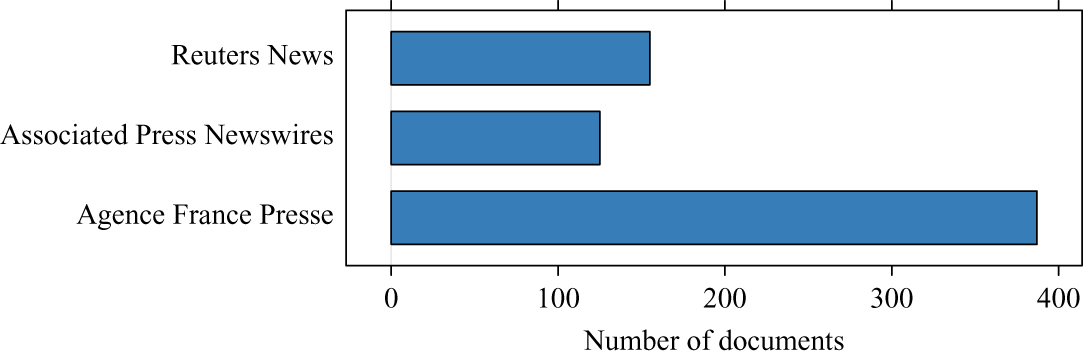
Media analysis often requires the manipulation of contextual variables describing the documents before launching textual data exploration within documents. For that purpose, R.TeMiS provides users with meta-data visualization tools such as one- and two-way tables using meta-data variables (with optional plotting of the results). Plotting the number of dispatches produced by each news agency is interesting for the Assange case (Figure 3). This plot clearly shows that AFP devoted far more coverage than Reuters and AP to Julian Assange in 2010-2011. Whether this is due to editorial choices putting Assange on the media agenda more often or artifactual factors linked to different dispatches publication policies is of course impossible to say without further qualitative analysis of the corpus. However, as far as the raw number of dispatches is concerned, AFP clearly gave more visibility to Julian Assange than did its competitors.
Coverage of the Assange case by the three agencies
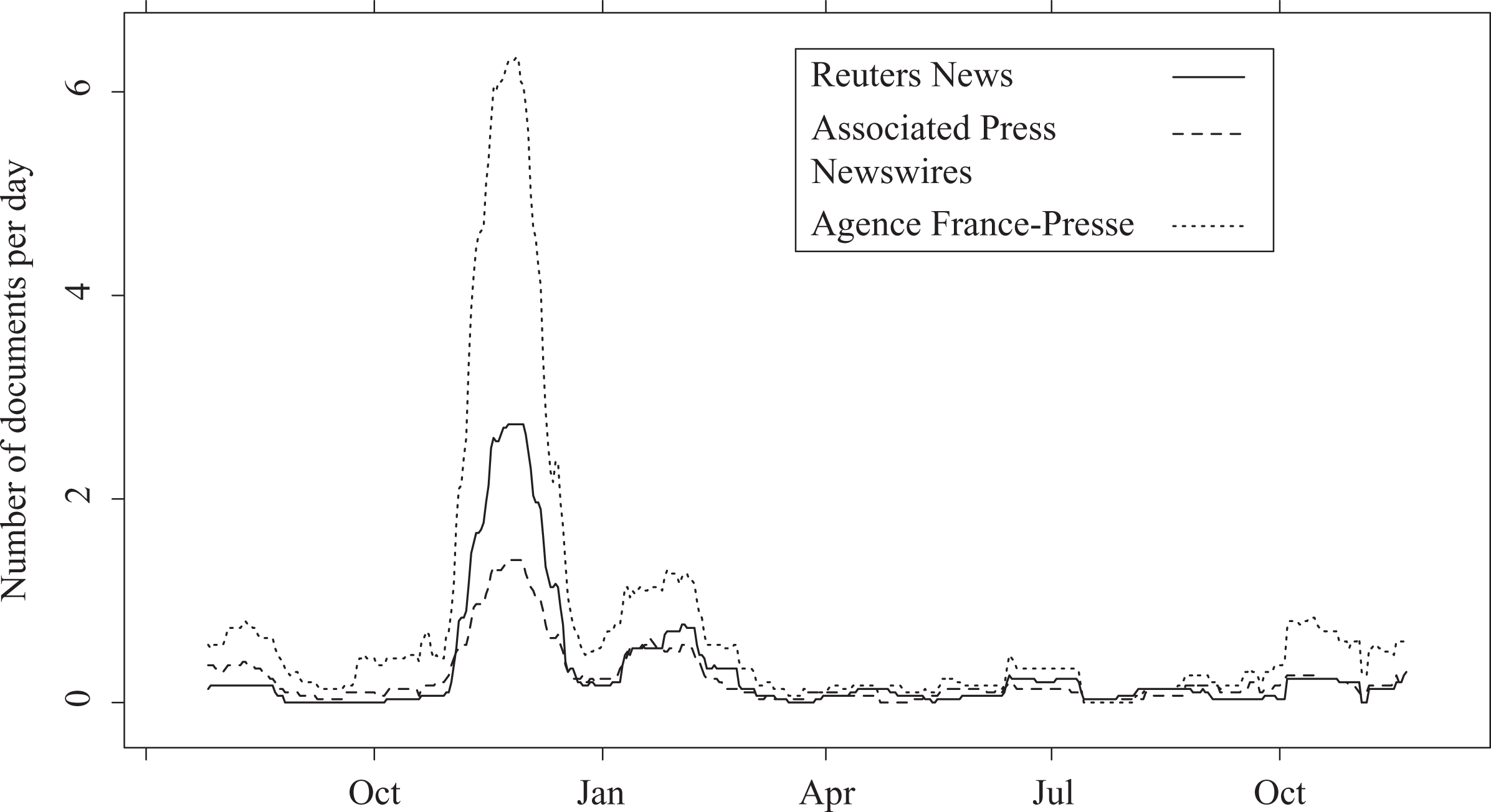
The same menu also makes it possible to plot time series representing the number of documents over time, using a single curve, or one curve for each level of a variable. A rolling mean can be computed over a configurable time window. 13 The Assange corpus already contains date information imported from Factiva, which is very useful in studying media cycles around this subject. For example, the following figure clearly shows a concentration of media attention in December 2010, when Assange was arrested in Great Britain, and not in August when the sexual assault case began in Sweden (Figure 4 includes a rolling mean to attenuate the very important daily variations of such kind of media contents). This Figure clearly shows the “episodic” nature of the media framing of Julian Assange. 14
A time series of all documents in the Assange corpus by source with a 30 day rolling mean
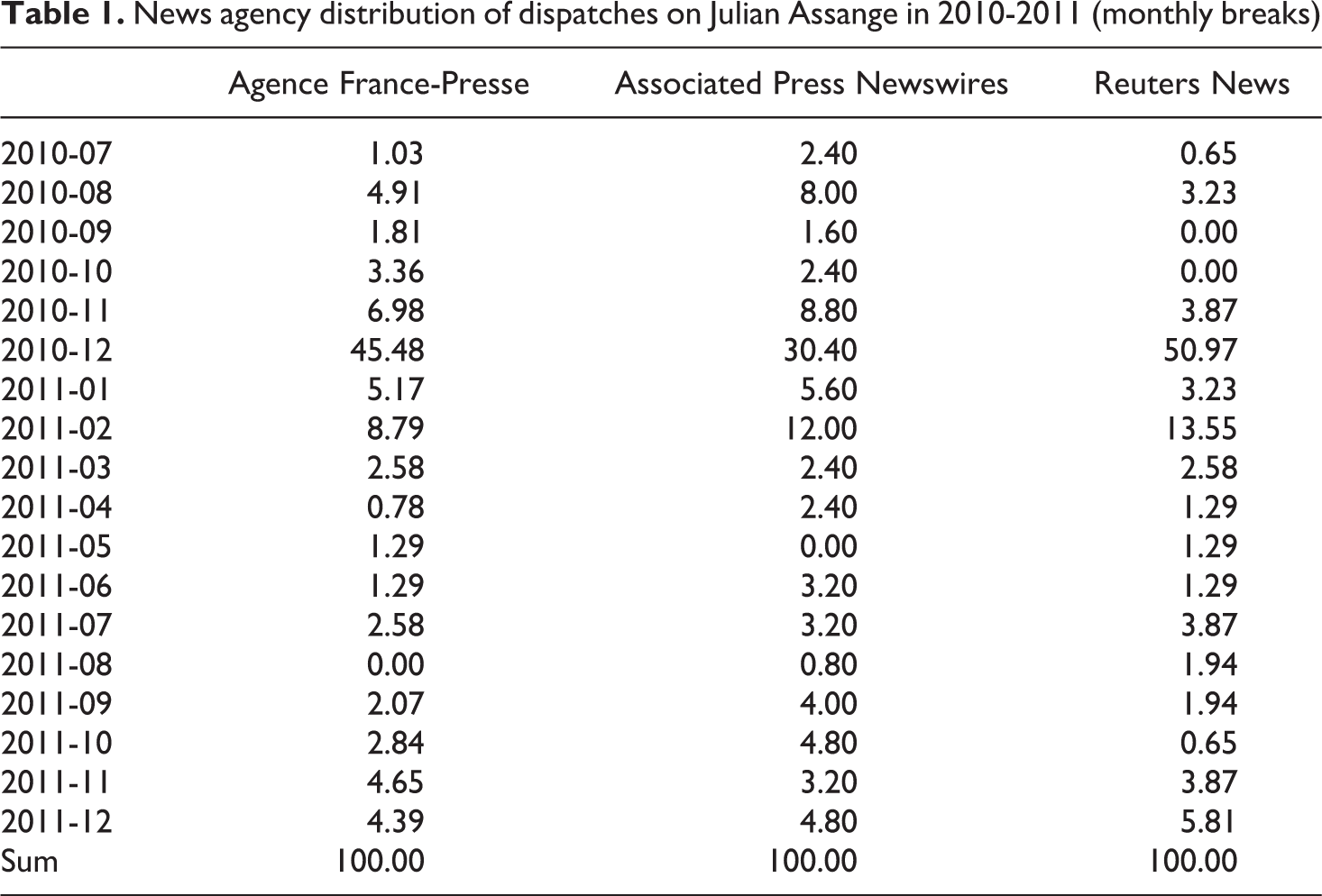
A more conventional two-way table representation of the media chronology using a recoding of the Date variable to monthly breaks instead of daily ones is also very useful to assess the level of episodicism of every news agency. 15 As can be observed in Table 1 below, Reuters demonstrated the most concentrated time structure among the three agencies. The coverage for December 2010 (Julian Assange's surrender to the London police and granting of bail by the High Court) and February 2011 (a District Judge in south London ruled that Assange should be extradited to Sweden) accounted for 65% of the overall coverage (54% for AFP and 42% for AP). AP seemed to provide the most consistent coverage.
News agency distribution of dispatches on Julian Assange in 2010-2011 (monthly breaks)
Identifying Media Frames through Elementary Corpus Statistics
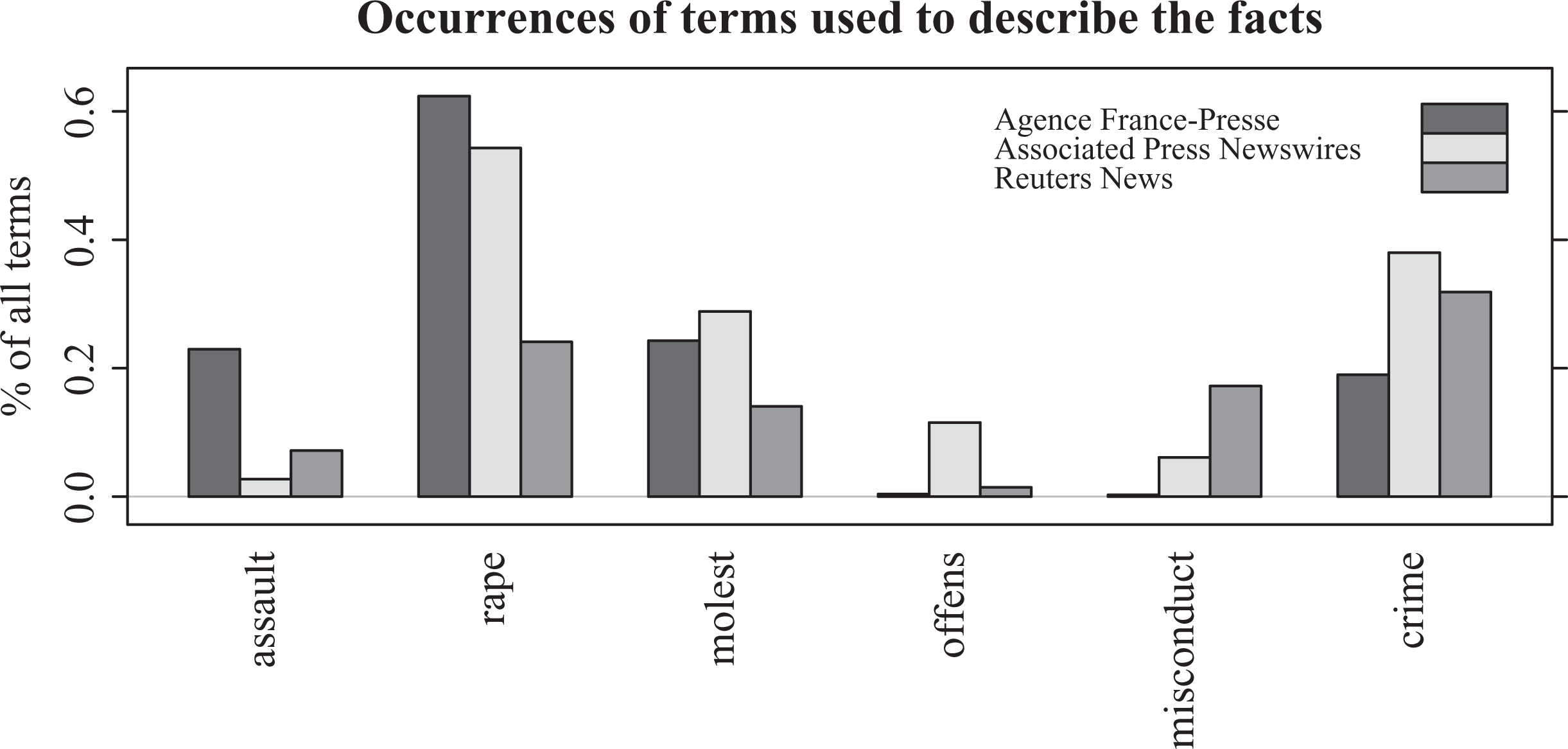
Media frames can be identified in a corpus by finding those terms that are very specific of a given level of a contextual variable – i.e. terms whose observed frequency in each level is either too high or too low compared to what would be expected given the documents’ lengths and the global distribution of terms in the corpus. If we consider for instance the three different sources gathered in the Assange corpus, some meaningful differences arise from specific terms analysis (see Appendix 1 of Bastin and Bouchet-Valat (3 April 2014) at https://listes.services.cnrs.fr/wws/arc/bms-rc33). 16 The use of “whistleblower” for instance is very specific to AFP (referring to Assange’s role as leader of Wikileaks) and is specifically absent from the two other sources. The different terms used to describe the alleged rape (“assault” and “rape”) were specific to AFP in contrast with “offense” (specific to AP) and “misconduct” or “crime” (specific to Reuters). Some secondary stories within the Assange story also seemed to have stronger connections with a specific other agency: AP for instance showed significant use of “Mayawati”, the name of Uttar Pradesh's chief minister who was involved in the Cablegate leak. Reuters significantly mentioned “Elmer”, the name of a former Swiss banker who collaborated with Wikileaks and even gave a press conference with Assange in January 2011. This interestingly suggests that press agencies have some autonomy in choosing angles and framing what happened when compared to the “primary definition” (Hall, 1978) performed by the Swedish prosecutor Marianne Ny. The fact that her decision was written in Swedish of course opened up space for interpretation, notably of the Swedish term “sexuellt ofredande” that can be translated many ways.
Instead of focusing only on statistically specific terms, researchers working in media studies can preferentially examine only those terms that are relevant to their research question and hypothesis. Indeed, such terms can be sociological artifacts (like the very specific occurrence of press agencies acronyms in their dispatches), and with large corpora there are so many significantly specific terms that the researcher cannot analyze all of them. R.TeMiS offers interesting features for a deductive approach based on analyzing terms chosen by the researcher as well. The previous measures can be computed for chosen terms by levels of a variable and a plot can be drawn (see Figure 5 here, and Appendix 2 of Bastin and Bouchet-Valat (3 April 2014) at https://listes.services.cnrs.fr/wws/arc/bms-rc33 for an application on terms used in the accusations against Assange). For instance, the terms “molestation”, “molested”, “molesting” – stemmed as “molest” – weren’t specific enough to appear among the 25 most specific terms in the previous treatment. They can still be considered interesting because they are closest in meaning to the terms used by the Swedish prosecutor. 17 This analysis strongly contrasts with AFP and Reuters which did not use a similar vocabulary to describe the charges.
Framing the facts in the Assange corpus
Inductive Approach to Media Framing - Correspondence Analysis
Hierarchical Clustering (HC) and Correspondence Analysis (CA) are two very popular ways of handling text corpora and trying to reveal their structure directly from the kind of vocabulary employed. But performing such analysis with big media corpora that has been automatically retrieved from databases or web archives induces some methodological peculiarities due to various sources of heterogeneity and redundancy within the corpus. R.TeMiS provides many computing and visualizing parameters that have been designed to help the user create the best possible representation of his corpus (not taking into account the unlimited possibilities offered by a direct access to the R code). In what follows CA will be used to illustrate an inductive way to identify frames within the Assange corpus. 18
A first issue in large-n Factiva corpora is the artifacts created by the presence of irrelevant terms in parts of the corpus. In the Assange corpus it appears that the recurrence of the term “ID” in Reuters documents (a reference to other dispatches identification number within the database) produces artifactual results that are very obvious in the first CA produced if one does not intervene on the corpus. Previously excluding the term is of course the best thing to do. When dealing with large corpora, it can also be very useful to limit the number of terms taken into account and thus dramatically reduce the computing requirements of CA and HC in terms of both memory and time. R.TeMiS thus offers an option to exclude terms that are not present in more than a given percentage of the documents (sparsity level). For instance, using a 96 percent sparsity parameter leads to omitting terms absent from more than 4 percent of the documents – meaning 27 in the Assange corpus – in the DTM. The user can also limit the number of terms plotted on a CA graph to the most contributing ones. 19
Figure 6 shows the result of a CA conducted on the Assange corpus (with deletion of all terms mentioned in note 18), a 96 percent sparsity parameter and selection of the 30 most contributing terms to both axes only. The first plane of this correspondence analysis, despite the low level of total variance explained (which is due to the large amount of information contained in a large corpus), highlights the presence of three main media frames influencing Julian Assange's media coverage during the studied period: the Swedish “rape” case and (essentially) its British and Swedish judiciary consequences (the ten most contributive terms on the positive side of axis 1 are “court”, “appeal”, “swedish”, “extradit”, “sweden”, “lawyer”, “judg”, “hear”, “rape”, “suprem”); the Wikileaks context is behind the most contributive terms in the top left quadrant (“document”, “war”, “pentagon”, “afghan”, “man”, “civilian”, “iraqi”, “militari”, “classifi”, “afghanistan”); the financial surroundings of the Wikileaks issue and the attempts of the American administration to block Wikileaks’ financial resources is suggested by the most contributive terms in the bottom left quadrant (“attack”, “mastercard”, “visa”, “bank”, “paypal”, “anonym”, “cyber”, “payment”, “swiss”, “compani”). 20 This third frame would have been very hard to identify in the corpus without fine tuning of the sparsity permitted by R.TeMiS.
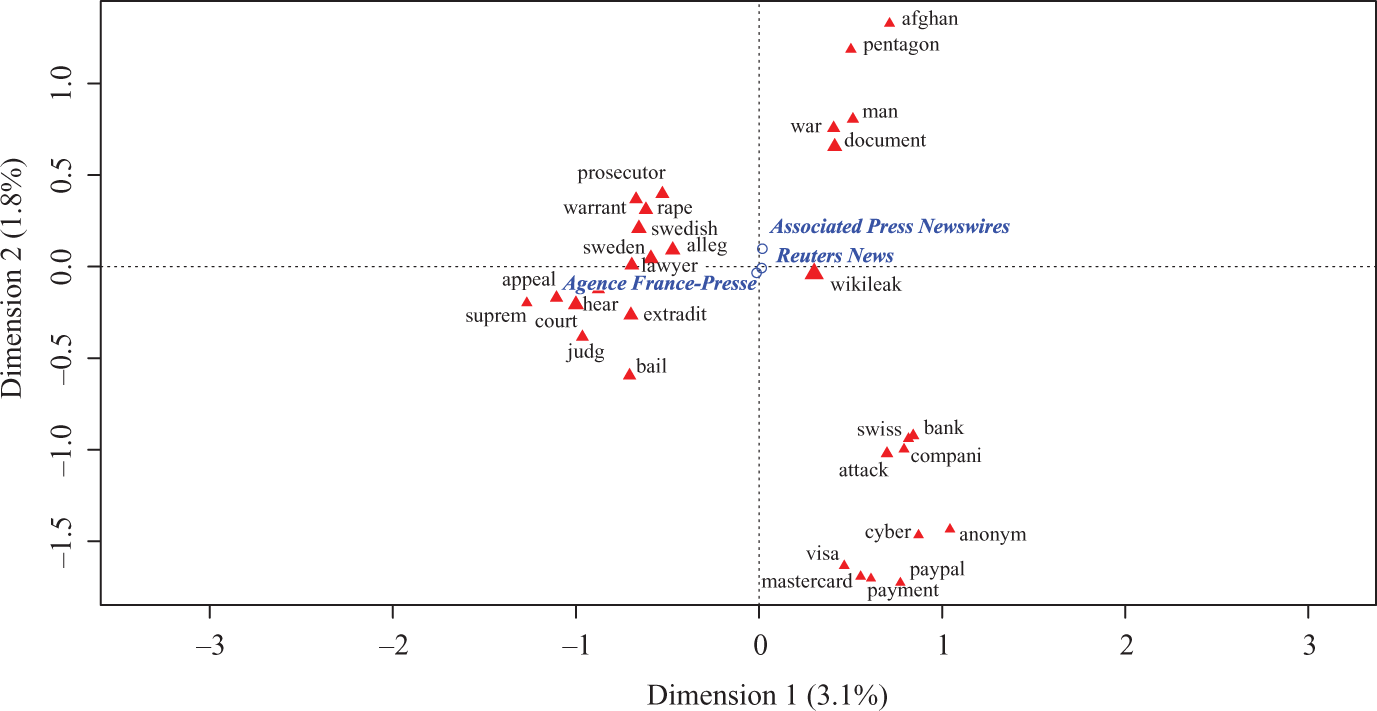
The three frames identified by CA on the Assange corpus
News agencies do not really differentiate on this first plane. When plotted as levels of a supplementary variable, they are located right in the middle of the first plane. A way of trying to find differences between agencies is to produce a new CA based on a version of the DTM aggregated by the levels of the Origin variable, a feature that is proposed in R.TeMiS's CA menu. This classical method allows imposition of an interpretation framework defined a priori, making more apparent the differences that are of interest for the question at hand.
The first axis of this new CA clearly opposes AFP on the negative side to Reuters and AP on the positive side (see Figure 7 below). AFP contributes to 45 percent of the construction of this axis and has a 100 percent representation quality on it. AP contributes to 30 percent of the axis construction and has a 47 percent representation quality. Reuters contributes to 25 percent and has a 42 percent representation quality. 21

CA on DTM aggregated by Origin (terms most contributive to axis 1)
Terms that stand on the negative side of this axis with AFP are “whistleblow” (3.09%), “assault” (1.68), “organis” (1.04), “websit” (0.97), “warrant” (0.82), “rape” (0.78), “claim” (0.76), “australian” (0.76), “dollar” (0.72) and “enrag” (0.69). In addition to translation choices concerning the facts (“rape” and “assault”) and the already mentioned use of “whistleblower” to describe Assange and his “website” and “organisation”, these terms express the pressure directed at Assanges by the judiciary process (“warrant” but also “arrest” (0.66)) and a personal account of his situation with the use of references to his being Australian. His family (“son” 0.63) and “mother” (0.48) appear on this side of the axis due to dispatches mentioning statements made by his mother concerning various aspects of the case. “dollar” has been used by Assange himself to blame the US for the losses in financial support to Wikileaks following the funding blockade. AFP also published numerous dispatches mentioning that Assange had “enraged” US authorities by releasing classified documents.
AP and Reuters are positioned on the positive side of axis 1 with the following contributive terms: “sex” (2.33), “misconduct” (2.00), “organ” (1.76), “assang” (1.23), “investig” (1.17), “volunt” (1.17), “offens” (0.97), “defens” (0.79), “offici” (0.78). The two agencies are connected to a different frame concerning the facts. The terms chosen to describe them differ with an emphasis on the sexual nature of those facts and a more moralistic perspective (“consensual”, “misconduct”, “offense” but also “wrongdoing” (0.52)). “Volunt” stands for “volunteers” and describes the status of the two women inside the Wikileaks organization. The legal procedure is also highlighted with references to “investigations” and Assange's “defense”. By comparison with the personal tone used on the negative side of this axis, here “officials” (and “official” statements) are more present.
The second axis opposes Reuters and AP (see Figure 8 below). Reuters contributes to 51 percent of the axis construction and has a 58 percent representation quality on this axis. It stands on the positive side with terms like “volunt” (2.63%), “bank” (1.95), “word” (1.78), “misconduct” (1.47), “femal” (1.24), “cabl” (1.20), “author” (1.06), “add” (0.94), “websit” (0.81), “cach” (0.76) 22 . AP contributes to 49 percent of this axis and has a 53 percent representation quality. It stands on the negative side with significant terms like “spill” (1.98) 23 , “offens” (1.76), “women” (1.55), “organ” (1.52) 24 , “stockholm” (1.36), “stem” (1.30), “rape” (0.98), “spokesman” (0.83), “claim” (0.73). In addition to a clear focus on Sweden, this side of the axis is more concerned with the sexual case and expresses a formal use of objectivity “rituals” (Tuchman, 1972) like mentioning sources and using quotes (“spokesman”, “claim”, “document” (0.67), “say” (0.61). “Pentagon” also appears there, which is congruent with AP's national origin.

CA on DTM aggregated by Origin (terms most contributive to axis 2)
Mapping Julian Assange?
Due to the fact that R.TeMiS edits plain R code at every step of the lexical analysis, it enables using this code to extend the range of statistical procedures applied to the document-text matrix beyond classical text mining. Every kind of statistics or visualization method can be applied to the DTM. The Assange corpus offers a good example of this feature. The framing of Assange by the three news agencies entails a geographical dimension: media frames, in this case, are also about drawing a world map to portray Assange. The rape case for instance mostly connects Assange to Sweden and Great Britain. Other frames such as the Wikileaks context connect Assange to other parts of the world: Australia where Assange was born, Iraq and Afghanistan referring to Wikileaks’ massive leaks of classified information in 2010, the United States due to its determination to stop Wikileaks from operating, etc. Plotting a world map of the Assange case according to the three agencies provides an interesting way to visualize this corpus. 25
Frequencies of terms referring to a country can of course be tabulated within R.TeMiS. After identifying those terms using the ‘Terms dictionary’ menu (a menu that is also useful to check how words have been stemmed), their frequencies can be computed using the ‘Descriptive analysis of vocabulary -> Analysis of chosen terms.’ menu. Appendix 3 (in Bastin and Bouchet-Valat (3 April 2014) at https://listes.services.cnrs.fr/wws/arc/bms-rc33) contains the results of this analysis for each level of the Origin variable. 26 Some interesting things appear clearly in this table such as the importance of references to Sweden (“sweden”, “swedish”, “stockholm”) and Great Britain (“britain”, “british”, “london”, “england”, “english”, “uk”) that exceed every other geographical denomination and exceed 0.3 percent of the occurrences at least one news agency. The only other term that shows the same level of frequency is “australian”. The t-values can be used in these tables to identify significant over- and underrepresented terms in the three agencies. The three terms referring to Sweden are for instance under-represented in AFP (that strongly contrasts with AP on this point). To the contrary, AFP makes significant use of terms referring to Australia – hence to Julian Assange’s biography – in comparison to both AP and Reuters.
These tables have strong limitations. The first involves the various terms used to refer to the same country (country names, city names and adjectives). The second involves the fact that comparisons are hindered by the production of three different tables instead of one. A little piece of R code, written directly in the Rcmdr script window, can help by constructing groups of terms and calculating frequencies for these groups. In Table 2 for instance, terms have been grouped using two-digit country names as level. 27
The geography of the Assange corpus (frequencies by country)

Small differences can be observed in Table 2 in the way that news agencies mapped the Assange case. When compared to its European counterpart Reuters, AFP highlighted countries such as Afghanistan, Iraq, Australia, Iceland, Russia, France, Pakistan, Ecuador and Spain. But it relatively under-reported for Sweden, Great Britain, the US and Germany. AP over-reported the U.S. as could be expected but under-reported Great Britain (on the contrary, Reuters over-reported both the US and the UK). A little R coding can help to geographically plot these data. R provides packages, like the maps package (Becker et al., 2013), that can easily draw maps and plot points using standard geographical coordinates. Transforming Table 2 into a data frame and adding two new variables (a latitude and a longitude for each country) is all we require. It can be done manually but the risk of making errors would then be significant. Instead, finding a data frame with country centroïds coordinates and importing it in R to merge it with the frequencies data frame is a better option. 28
Figure 9 represents the resulting maps (the areas of circles are proportional to frequencies). It helps in figuring out the geographical dimension of the way news agencies framed the Assange case. Similarities between the three agencies are very striking. No alternative geographical framing occurred during the two studied years outside the episodic frame focusing mainly on Sweden and the UK, secondarily on the US and Australia and only thirdly on other countries mostly connected to Julian Assange due to various Wikileaks operations (Iraq, Afghanistan, Switzerland, Russia, Germany, etc.). But when looked closely at those maps slightly differ. For instance, over-reporting of agencies' origin countries is observable, as well as some peculiarities such as the importance of references to Iran in Reuters' dispatches, Pakistan in AFP's ones, etc. 29

Mapping J. Assange in the three agencies
Conclusion
Due to the peculiarities of news agencies dispatches that obey a very routinized production process and reach a global audience, the coverage of Julian Assange in 2010-2011 is very similar among the three world agencies. 30 This of course is an interesting result if one looks at broad differences in the way that news is shaped at the global level for events with a clearly episodic nature. But it is also very interesting to notice that using sophisticated tools with fine tuning options can help to identify differences in the dispatches of the three agencies. These small differences tend to oppose AFP on one side and mostly AP on the other. The French agency tended to be less concerned with the legal procedure and the sexual case and more with the geopolitical and financial aspects of the whistleblower's situation. It also provided a more personal description of Assange, relying less on official reports and more on accounts by his relatives.
We hope to have provided with this corpus analysis evidence that opening the black box of proprietary text mining solutions is of major interest for media studies. With R.TeMiS we propose to explore two new dimensions in text mining. The automation of corpus construction and management procedures is first: easily gathering media content with relevant metadata in a reliable way is key to successful text mining in media studies. The extension of the range of statistical tools available through R coding is the second one. Providing the social scientist with standard statistical methods developed in R and facilitating the invention of new tools based on other R packages is also something that media studies – and every other field of the HSS – can benefit from.