




Abstract
Paul Felix Lazarsfeld was a major figure in the development of modern empirical methods in sociology and the social sciences. He laid many of the foundations for social survey techniques and other empirical methods for understanding key aspects of contemporary society, such as voting studies, opinion polling, panel studies, and mass media research. The American Sociological Association Methodology Section honors each year a distinguished sociologist with the Paul F. Lazarsfeld Award for a career of distinguished contributions to the field of sociological methodology. Paul Lazarsfeld’s methodological work that he was most proud of was his introduction of the concept of latent classes, latent class analysis, and latent structure analysis. We consider in this paper Lazarsfeld’s institutional impact through this ASA award though we focus our discussion on his work and his impact on the development of latent class/structure analysis.
Introduction
Paul Felix Lazarsfeld was a monumental figure in sociology, especially in sociological methodology. As such, he has left a lasting legacy and an indelible institutional as well as methodological impact on the discipline of sociology, in particular American sociology. In this paper, we consider two areas where his impact has been the strongest, in the discipline of sociology as an institution and in sociological methodology, notably, his seminal work on latent class analysis and his impact on the methodological research published in English.
This paper was originally presented at a conference organized by Professor Hynek Jerabek of Charles University commemorating Lazarsfeld’s methodological inspirations and networking activities in September, 2011, in Prague, the Czech Republic. The conference had the three foci of the social science research methods influenced by Lazarsfeld, his personality and intellectual style, and his impact on current social science research. For more details about the conference, see Balazova and Marsalek (2012). Furthermore, the paper concentrates on Lazarsfeld’s institutional and intellectual impact in the English-speaking world. He also had major impact in the Francophone world, in particular through his work with Raymond Boudon, and the reader is referred to Boudon (1997) and Pollak (1979).
Lazarsfeld’s Institutional Impact
It is a well-known fact that Paul Lazarsfeld was instrumental in institution building. He built research institutes in Austria and the US, in particular the Bureau of Applied Research at Columbia University. It is much less mentioned how he impacted the discipline of sociology with his namesake award, the American Sociological Association (ASA) Methodology Section’s Lazarsfeld Award, which recognizes a scholar’s contribution to sociological methodology, often the contributions made over one’s career. All ASA presidents may not have an award named after them. Lazarsfeld is an exception. In this section, we briefly consider his impact through the award on the discipline of sociology.
Since the year 1986, there have been altogether 25 Lazarsfeld award winners, who have made fundamental contributions to sociological methodology over the past half a century at least. Some of the distinguished sociologists so honored so far were, for example, Hubert M. Blalock, Clifford C. Clogg, Leo A. Goodman, Robert M. Hauser, Nathan Keyfitz, Leslie Kish, Stanley Lieberson, Peter H. Rossi, Howard Schuman, Arthur Stinchcombe, among other luminaries of American sociological methodology. We list their names, their home institutions, and the year in which an award was given in Table 1.
Lazarsfeld’s institutional impact on methodology, ASA lazarsfeld award winners
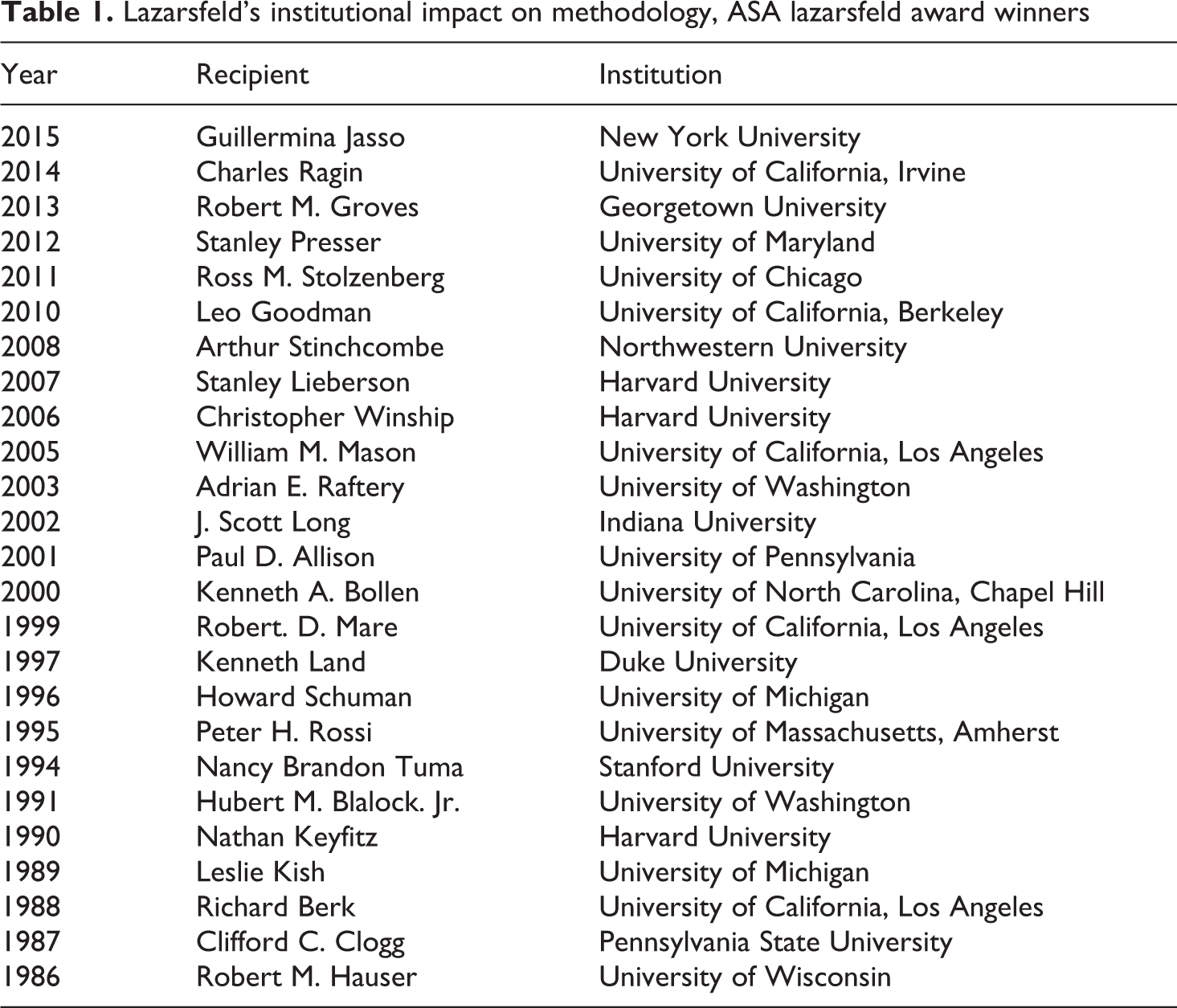
As the names indicate, the scholars recognized span the entire spectrum of methodology, from data collection (Groves, censuses; Kish, sampling; Rossi, vignettes; Presser and Schuman, surveys) to various aspects of data analysis and related theoretical and analytical issues (all the other scholars). The breadth and the depth of this field of scholarship are impressive indeed. We note that while the selection criteria do not exclude non-American scholars, the institution that gives out the award and the selection process that often considers a scholar’s domain of academic activities could bias the list of awardees toward American scholars. Regardless, Lazarsfeld’s impact on the creation of a tradition in American sociology is clear: The achievement in sociological methodology one could make only receives institutional recognition when one’s name is forever attached to Lazarsfeld’s, and as such the award may be considered an indicator of the zenith of a methodologist’s career.
Lazarsfeld’s Impact on Sociological Methodology
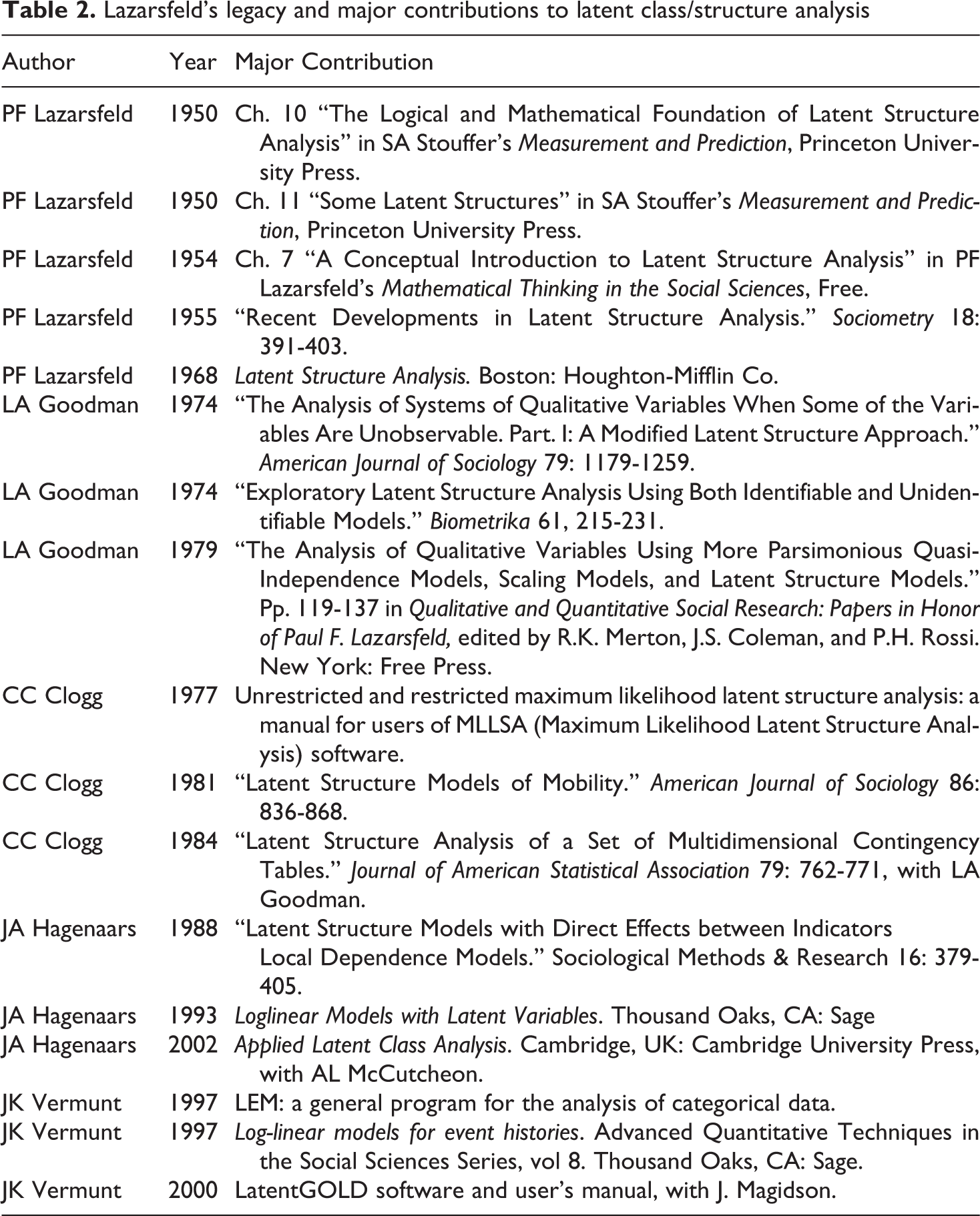
Paul Lazarsfeld made contributions in multiple areas of sociological methods, including social surveys, panel analysis, and latent class/structure analysis. His contributions to the first two areas are well recognized: His survey of radio listeners in 1930-1931 was groundbreaking, and the panel design of surveys that he used in 1940 in Ohio was innovative. Because of our own research interests, in this section we focus on Lazarsfeld’s contributions to latent class/structure analysis as well as the ensuing developments of such analysis by other scholars. To highlight the most important contributions in this area of sociological methods and to describe the trajectories of the developments, we present in Table 2 a list of major contributions to latent class/structure analysis and in Figure 1 the major pathways of developments in this research area. These visual means are meant to serve as a guide and an aid to our detailed discussions below instead of a complete inventory of all contributions to and developments in latent class/structure analysis.
Lazarsfeld’s legacy and major contributions to latent class/structure analysis
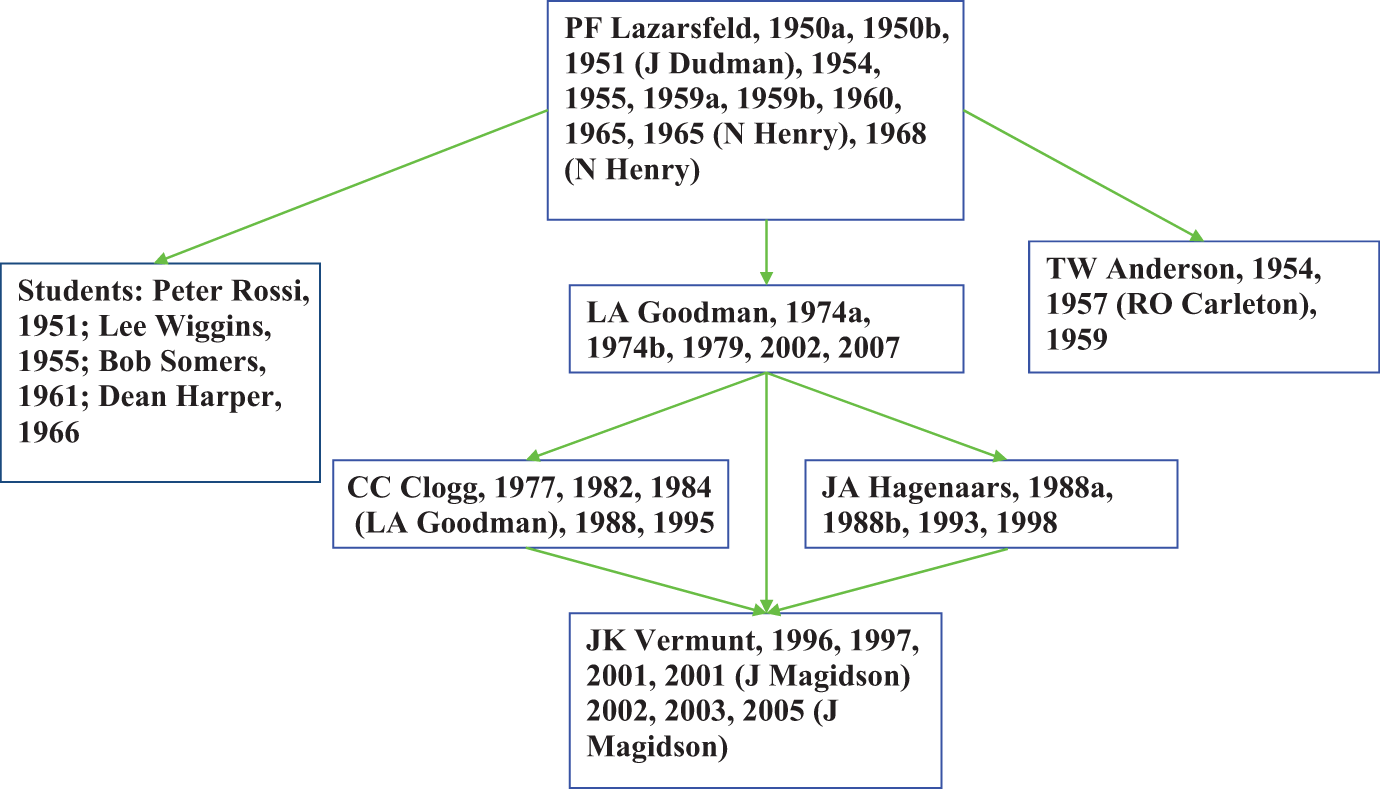
Lazarsfeld’s centrality in the development of latent class analysis (coauthor’s name in parentheses)
Paul Lazarsfeld introduced and considered the concept of latent classes, latent class analysis, and latent structure analysis in many different articles (1950a, 1950b, 1954, 1955, 1959a, 1959b, 1960, 1965), and in a joint article with Jack Dudman (1951) and a joint article with Neil Henry (1965), and in a book written jointly with Neil Henry (1968). During the time when Lazarsfeld was a professor in the Sociology Department at Columbia University, he also encouraged some graduate students in the Sociology Department there to write their Ph.D. theses on this subject: These graduate students were Peter Rossi (1951), Lee Wiggins (1955), Bob Somers (1961), and Dean Harper (1966). In addition to encouraging these graduate students to write their theses on this subject, Lazarsfeld also told Ted Anderson, who was in the Department of Mathematical Statistics at Columbia at that time (from 1946 to 1957), about his concept of latent classes, latent class analysis, and latent structure analysis, and his many articles on the subject. This stimulated Anderson to do research work on the subject, and he then published three articles on the subject: (1954, 1959, and a joint article with R. O. Carleton, 1957). Additional research work on this subject was also done by Bert Green (1951, 1952), W. A. Gibson (1955, 1959), R. B. McHugh (1956), and Al Madansky (1960).
In Anderson’s 1954 article on this subject, he developed a method for estimating the parameters in the latent class model (i.e., the latent probabilities in the model) by equating the parameters to the roots of certain determinantal equations. In the Lazarsfeld/Dudman 1951 joint article, they proposed using the roots of determinantal equations; and this was extended and developed in Anderson’s 1954 article.
In 1957, in order to obtain further information about the sampling errors of the estimates obtained using the determinantal method for estimating the parameters in the latent class model, Anderson and Carleton carried out a random sampling experiment in which very large samples were drawn from a given latent class model. It turned out that the estimates of a given parameter varied considerably, when the determinantal method was applied to the data in each sample in order to estimate the parameter. In addition, many of the estimates obtained using this method could not actually be estimates of the parameter (i.e., many of the estimates of a parameter – a latent probability in the latent class model – did not even lie in the interval between 0 and 1). It is also the case that the parameter estimates in the latent class model obtained with this estimation procedure are not efficient (see Anderson and Carleton, 1957; Anderson, 1959). With the results obtained in 1957 by Anderson and Carleton, we conclude that the determinantal method for estimating the parameters in the latent class model is of no practical value.
It then turned out that Goodman (1974a, 1974b) introduced a relatively simple iterative procedure for obtaining maximum-likelihood estimates of the parameters in the latent class model and in some more general latent structure models. With this new estimation procedure, the practical application of these models by researchers in various fields of inquiry became a realistic possibility. Latent class analysis then became a statistical form of analysis that could be more routinely applied when appropriate. We refer the interested reader to, for example, Goodman (2002) and the other fourteen articles published in Applied Latent Class Analysis, edited by Jacques Hagenaars and Allan McCutcheon (2002), and we also refer the reader to Magidson and Vermunt (2001) and Vermunt and Magidson (2005), and to Goodman (2007).
In commenting on the new methods introduced in Goodman (1974a, 1974b) for the analysis of latent classes and more general latent structures, Otis Dudley Duncan, who was one of the most important quantitative sociologists in the second half of the twentieth century, wrote as follows in 1974: “Goodman has provided a substantial statistical foundation for the latent structure model of Lazarsfeld…. Now, thanks to Goodman, [by using the methods presented in Goodman’s statistical foundation] we can begin to understand correctly what is at stake when using these models in a serious way.” And, in 1981, Duncan wrote as follows on the methods introduced in Goodman (1974a, 1974b) and on some extensions of these methods presented in Goodman (1979): “We are … [now] in a position to exploit latent structure models in serious empirical research…”
Latent class analysis has great potentials for many interesting applications. One area is in analyses including (partially) missing data. In a study of household structure (simple versus complex household structures), Liao (2004) demonstrated that the degree of missingness or observability of data can be modeled in a latent class analysis, together with observed indicators, and as such, all standard missingness mechanism assumptions can be made. By including partially missing data, a loss of information is avoided and better knowledge is gained. This study merely illustrates one of the many potential applications of latent class analysis.
We conclude by reiterating the seminal nature of Lazarsfeld’s contributions and his lasting legacy, in latent class/structure analysis as well as more generally in the sociological discipline. His name is forever tied to sociology, especially American sociology, and his impact on sociological or social science methodology will be felt for a long time to come.