



Abstract
This paper presents the most significant results of a study into the political communication of the Rome branch of the M5S, or Five Stars Movement, conducted through analysis of its blog, a big text corpus, comprising posts, comments and images, which brought together between the period immediately prior to the May 2013 administrative elections and the present day. This corpus was subjected to advanced statistical text analysis, and targeted hermeneutic and content analysis. Semiotic analyses of visual material were also performed, in addition to network analyses of blog contributors and analyses of communicational efficacy. Research team members from several disciplines and a variety of institutions, worked in constant collaboration, adopting a mixed-method approach.
Cognitive Objectives and Research Strategy
Today’s technological resources, available in the public and private contexts where empirical social research is usually carried out, allow downloads of large, even immense masses of data, in the present case textual databases, which can be analyzed fairly quickly and efficiently thanks to automatic features built into the powerful software in use. In our view, however, such resources and capabilities should by no means be considered the only possible modus operandi or even, on their own, a viable work strategy. Indeed, the wealth of data that can be handled should call for a varied and complex program of research and analysis that moves toward a periodically calibrated and custom-tailored combination of a number of investigative tools and techniques, both traditional and newly developed. Implementing a study of vast quantities of data gathered online, and especially on social networks, clearly poses a problem of theoretical as well as technical data management (cf. Di Giammaria and Faggiano, 2016). Adopting the view that it is not possible to describe, interpret and explain a phenomenon exclusively through big data, we maintain that small data is also essential and equally important to scientific research. In this regard, empirical bases of limited size, usually obtained through the use of classic techniques such as the questionnaire, take on an essential role in opening the way to the thematic exploration of a wide range of phenomena of sociological interest.
As an example of this research ideal, a case study is presented in which the team involved benefited from the fruitful interaction between qualitative and quantitative research, both extensive and intensive, automated and otherwise, based on a rich and stimulating big text corpus (Faggiano and Nobile, 2016). The most significant results are presented from an exploratory study of the political communications of the Five Star Movement (5SM) of Rome (Corbetta and Gualmini, 2013) through its institutional blog (http://www.beppegrillo.it/listeciviche/liste/roma/). This search experience is part of a series of studies focused on observation of the political communication (on and offline) of the main Italian political forces, in the election campaign period and not, at local and national level.
More systematically than other political forces active in Italy, 5SM (Roman and national), makes use of the web to communicate with its constituents and with citizens in general, through both its institutional blog and the other social media linked to it; eliminating physical distance and at zero cost, the Movement publicizes its identity, initiatives and objectives, and at the same time helps foster and strengthen new and traditional forms of political participation, both on and offline (Campus, 2008; Bentivegna, 2012; Pasquino, 1997; Fici, 2002; Raniolo, 2007). The Roman blog is distinguished by the breadth of its contents and targets, and serves as the specific virtual space for the communications of the movement’s spokespeople, its local and city council members.
The empirical base, including posts, comments and images, consists of almost 1700 posts published on the platform between the beginning of the electoral campaign and August 2015, just before the fall of mayor Marino. There are precisely 1684 posts, of which 236 are from the pre-electoral period, with an average of 26 posts per month and a peak of 48 in the final month, and 1448 from the post-electoral period, averaging 55 per month. The use of the instrument clearly expanded with the passage of time. During the first five months of institutional activity the average number of posts was 33.6, while in the following period, from November 2013 to July 2014, the number of monthly posts never fell below 60.
The research group set itself a number of cognitive objectives: reconstruction of the content and themes conveyed in the posts of the Roman 5SM, the overall communications strategy, and the different ways of managing communication with their recipients (focus, writing mode, images, links, etc.) classification of relevant Internet political communications from the point of view of effectiveness and elements transmitted (knowledge, expertise, awareness, etc.) investigation of the mechanisms of political consensus generation and consolidation, of on and offline participation, and of mobilization studying the dialogue between spokespeople and citizens and the interactions between the blog and other social networks.
In the overall research design different forms of analysis of the empirical material appear in combination (Krippendorff, 1980; Losito, 1993; Lancia, 2004; Giuliano and La Rocca, 2008; Nobile, 2012; Cardano, 2001; Greimas and Courtés, 1997): analysis of the contents as a case study; study (supported by Taltac, Spad-T, and IraMuteQ software) of the lexicon, the communicative tone, and the attribution of titles (following a statistical approach to the analysis of text-words-topic and in the study of the adjectives/verbs, as of rhetoric); analysis of keywords and blog themes (with T-Lab software, which is useful to perform semi-automatic statistical-textual analysis, simple and complex, such as: the study of concordances and lexical specificity, identification of conceptual maps and dominant words, the analysis of lexical correspondences and cluster analysis), by means of which the texts themselves were analyzed in the light of both a temporal key (the distinction between a pre- and a post-electoral period, and the division of the two-year period into manageable 6-month semesters) and a spatial key (the subdivision of Rome into municipalities, all covered by a single blog); ethnographic analysis of online issues and conversations through links between the blog and other social networks; analysis and categorization of images included in posts.
The research team was composed of experts from different disciplines (sociology, semiotics, computer science, statistics, economics) who synergistically adopted a mixed-methods research perspective (Tashakkori and Teddie, 2003; Burke Johnson, 2007; Gobo and Mauceri, 2014; Bidart and Dupray, 2014), which not only made it possible to explore a case indicative of institutional communications in the Italian political landscape, but also to pursue the ideal of obtaining quality data while at the same time achieving significant results at many levels regarding cultural products, individuals, groups/institutions and relational systems.
The Analysis of Blog Content - The Benefits of an Integrated Approach
On the quantitative front, a broad content analysis produced interesting and internally coherent results. Through a structured and user-friendly survey form (analysis of the contents as a case study), the posts were initially classified taking account of two dimensions: the relevance of the content and the positivity or negativity of the tone conveyed. This resulted in the identification of four macro-functions of institutional communication via blog, by which the posts were organized in the following grid: articles aimed at citizen participation, news about the local area, reports of activities in the area, and opinions or news whose scope was outside the area.
Significant results were also achieved using a lexicometric approach. After careful evaluation - through appropriate statistical indices - of the richness and complexity of the vocabulary used in the blog, a reconstruction of the actual language in use on the basis of its main theme-words revealed that the supporting pillars of the communicative process were the 5SM and Roman citizens, the sender and the recipient. The text corpus under analysis was compared with the lexicon of everyday language and that of the political sector, and in both cases the results obtained were in many ways original and in line with the specific historical, cultural and geographical nature of the context under analysis and the movement itself.
An exploration of the emotional tone conveyed by the blog – generally more positive than negative – was conducted using automated tools able to process and classify the idiomatic adjectives and verbs included in the data set.
A specific analysis was also undertaken of the subset of post titles which, closely linked to their texts and summarizing their contents, allowed a mapping of the municipalities on the basis of similarities and differences in the contents of their communications. All the analyses show that some issues are crucially important and cut transversally across the blog. These include protection of the environment, relations between politicians and citizens based on values of transparency and participation, and urban mobility and safety.
Subsequently, a semi-automatic statistical-textual analysis was carried out highlighting the temporal and spatial keys and using them as a basis for empirically evaluating the texts with a mix of techniques, instruments and software, from the simplest to the most complex levels of data processing. But it is nevertheless certain that without quality in the quantity, without using semi-automatic and hermeneutic analysis in combination with automation, and without contextual insights and close scrutiny of targeted text excerpts, individual images and conversational sequences, the same level of detail and familiarity with the object under study would not have been achieved.
Numerous additional quantitative analyses were undertaken with a view of reconstructing the blog’s thematic framework and included the analysis of words and key expressions, the generation of semi-annual conceptual maps, the modelling of emerging themes, and the identification of discourse axes and thematic clusters through multidimensional analysis (the labels attributed to the clusters that emerged are briefly reported as follows: Cl 1 – 13,2% - Right to education and public school safety; Cl 2 – 22,1% - Costs of bad policy and the role of the Commission for the Rationalization of Expenditures; Cl 3 – 15,9% - Five star activism and network functions; Cl 4 – 22,4% - Environment, mobility, public safety; Cl 5 – 6,3% - Institutional activities and procedural rules; Cl 6 – 20,1% - Suggest, vote, discuss, oppose). All of these point consistently to the following picture: constructive proposals mixed with heated criticism, demolition of an antagonist balanced by good intentions, clear and unambiguous reference to the kinds of action plans typically favoured by the 5SM (environment, security, mobility)/factual explication of the problems of the local area (also in terms of actions to be taken and plans for the future), and the fundamental link between the necessary reduction of waste through a change of course and open and transparent institutional behaviour.
Based on the most evident statistical associations, the temporal and spatial keys used (the division of Rome into Municipalities) seem to have a secondary character. Concerning 5SM’s favourite issues, the set of posts under consideration appear to be a monolithic, organic block. At a second analytical level, however, where qualitative analysis combined with a distinctly intentional attitude played a key role, spatial and temporal variations become clearly visible, allowing the Roman picture to be broken down into a complex puzzle made up of more or less serious problems and issues, opportunities and resources, specific stakeholders, and concrete actions and constraints.
In essence and aside from the numbers, the most noteworthy analyses and qualitative controls in the area of research on the content of the communication are: In-depth analysis of a sample of hypertext links in the posts (the thousands of examples of this category in the corpus may be defined as links for further information). This further highlights the importance of the internet for 5SM, beyond its intentional use, in communicating with citizens and providing them with information (at the same time, it is not only through the institutional blog that 5SM reaches its constituents, but also through personal blogs and the Facebook pages and Twitter profiles of its spokespersons and activists (cf. Corbetta and Gualmini, 2013; Lanzone, 2015). Every post, even when fairly brief, contains one link or more leading to a personalized reading experience (what/how much/how to read), downloads of various types of materials through which the subject of the post can be further explored (legal texts, articles, brochures, programs, etc.), news of an event/demonstration/initiative/public meeting, or data/survey results, etc. All this serves not only to inform, but also to promote and strengthen political participation in its various forms. Examination and study of the contexts of use of verbs, adjectives and nouns specifically linked to the implemented communication strategy. Some examples would be: complaint, participation, opening, closing, management, judgement, impediment, damage, organization, honesty, openness, concern, project, rebellion, reduction, waste, renewal, respect, mistake, safeguard, hope, cuts, ban, violation, rule.
Manual (in addition to automatic) operations aimed at detecting and organizing into robust semantic categories key words and expressions – often at different levels of generality – related to current political issues, urban problems/social emergencies, areas for intervention: public transport, city parks, nursery schools, school construction, metro lines, garbage collection, recycling, bicycle paths, quality of life, sustainable transport, health, kindergarten, government limousines, quality of services, social services, environmental impact, housing emergency, jobs, construction speculation, public lighting, land protection, civil unions, basic income, asset management, road maintenance, urban renewal, overbuilding, cronyism, public sports facilities, Roman Mafia, suburbs, public school, illegal construction.
Work on the text aimed at identifying groups, institutions, government agencies (security, information, citizens’ services, etc.) and reconstruct related references, actions, actors. Actions aimed at exploring the many territorial indications found (municipalities, urban areas, villages, streets, monuments, bridges, metro stations, parks and villas, stadiums, etc.), or the political leaders and political forces mentioned (5SM council members, the mayor, MPs, etc.).
The logic of mixed methods, interpreted as a constant search for the best combination of methodological choices and technical and theoretical skills, also made itself felt in the area of analysis dedicated to the hermeneutic reading of text excerpts, selected based on certain keywords that proved particularly significant in the course of quantitative analysis. The words selected on this basis are environment, child, park, neighbourhood, suburb, etc. Reading these segments of the corpus allowed us to: 1. semantically explore some of the empirical evidence that had already emerged; 2. experience hands-on the connection between topics, conceptual categories, communicative tools; 3. gather evidence on communicative style and explore modes of expression and argumentation; 4. reconstruct ideas, values, and direct messages to the citizen.
Take for example the environment category. For the present purposes it is organized into several dimensions: energy conservation, sustainable consumption, material recycling/recovery, sustainable urban mobility, public parks, waste management. This general theme is quite often presented in connection with other relevant issues such as the housing crisis, urban maintenance and renewal, and degradation and neglect of the suburbs. This is also confirmed statistically by the associations between the term environment and other entries like protection, preservation, infrastructure, landfills, health, waste, facility, mobility, park, authorization, etc.
Text excerpts regarding the word environment: (pre-electoral period) (…) it is critical to combat territorial segregation and energy insufficiency with better housing, not only to make the city and urban area more interesting and liveable, but also more competitive and environmentally friendly; to make the city more “green and healthy” it is not enough to reduce CO2 emissions (…). (Municipality VI, second half of 2014) (…) With differentiated waste collection in Municipality IV, we were hoping to be able to live in a healthier environment, to recycle valuable materials that the recycling industry could bring back to life with negligible environmental impact, but obviously we were wrong to put our faith in the disappointing Marino administration (…).
Text excerpts regarding the word child: (Municipality V, first half of 2015) (…) attention to the needs of children and their families is also an indicator of the degree of evolution reached by society. The centrality of the child established in the documents of Roma Capitale [the city administration] must be translated into concrete actions consistent with the goal of improving and developing services for children, (…) in the improvement of the quality of education and scholastic services (…). (Municipality X, first half of 2014) (…) In the neighbourhood there are schools that are closed and not in use—for example, the kindergarten at the end of Mellano St., which is completed and ready for use; in Maccari St. there is another under construction and still another next to the schools in Signorini St.; but the administration prefers to have new ones built, in parks, while the private interests who manage the parks probably count on the subsidy that the city administration gives them for every enrolled child. Now the only option left to the citizens is to turn to the appropriate authorities to prevent the project from being carried out (…)
All the analyses converge in the direction of reconstructing a true ideal city according to the standards of 5SM, very distant indeed from the one that actually exists. The city envisioned by 5SM should be cleaner and less polluted, efficient in its services and infrastructure, a city where people can move about easily, offering equal opportunity in access to citizens’ resources along with greater safety (road safety, safety from crime, widespread economic well-being, etc.), a city that respects the environment and focuses on sustainability of investment and consumption, and whose inhabitants are actively seeking the common good.
As mentioned, the temporal and spatial keys play a rather secondary role in the quantitative part of the analysis. The two-year period covered appears as a single block in terms of the main themes considered (Environment, Mobility, Asset Management and Safety are the constants in 5SM discourse). But at a second level of analysis, bringing in qualitative exploration and “hands-on probing” of the text, variations in these dimensions emerge more distinctly, revealing large and small “openings” in the jagged and multi-faceted Roman picture: old unresolved questions, new problems, potentialities, specific items.
Beyond the Text - The Web Survey and the Face of the Message Sender
The quali-quantitative processing of thousands of words and occurrences with the aim of studying topics and meanings would not be complete without an analysis of the producers of these texts using a traditional research tool distributed via internet, the questionnaire. The development of a web survey targeting 5SM council members led to an analytical reconstruction of their socio-demographic, cultural and professional profiles. An account will be given of the additional system of tools by which, alongside the institutional blog, the elected council members converse with citizens, from Facebook pages and Twitter accounts to personal blogs and groups. In addition, we shall address the working style most significantly adopted in the activity of blog posting, usually the result of joint efforts on the part of spokespeople, activists and sympathetic experts in various fields.
The council members were contacted by email and provided with a link to an electronic form, which they were requested to fill out. Responses were received from 20 of the 33 5SM council members (obviously, as public information, the strictly social and personal characteristics in the data are complete).
The following data are offered in evidence to highlight once again how productive this mix of techniques is for empirical research: A substantial gender balance among the spokespeople (also supported by the voting procedure); The youth of the respondents: over half the council members are less than 40 years old. Specifically, six are under 30 and three of these are very young (26 years old), and only five are over 50. Their high level of education: the majority of the 5SM council members are university graduates (of whom three have post-graduate degrees).
The presence of so many young and highly educated people is a distinctive feature not only of the list of candidates in Rome, but also of the local lists of other Italian towns, as well as of the five-star spokespeople elected to Parliament. The internal rules of the movement (not more than two terms of office) and its origin (the internet) are crucial factors determining the importance of the connection between the use of technologies and the web, on one hand, and age and level of education on the other, a point also highlighted in other studies of the sector.
As mentioned, the blog is the vehicle for official Movement communications, given that only elected spokespeople are formally allowed to post there, but it is not the only means of expression used. A variety of online media is also available, personal and otherwise. Every municipal group has its own Facebook page and Twitter account, and in addition there are the pages and accounts of the individual council members and countless groups, open, closed or secret, that are utilized syncretically to share information and activities connected with the Movement and/or for group discussion (Giansante, 2011 and 2014).
For the purpose of investigating the 5SM council members’ web communication aptitude, we asked them to indicate what other instruments they used besides the institutional blog. Predictably enough, almost all of them (31 out of 33) use their personal Facebook profile and a little over half have a public page on the same platform. Twitter is used by two out of three, and less frequently the spokespeople have their own sites or blogs. Not infrequently these are also linked to Google+, LinkedIn, and/or YouTube.
The most relevant and interesting point to emerge from the questionnaire concerns the presence of co-authors in postings. The signatories of the posts are not in fact always the authors of the published content. The documents and activities of the spokespeople are very often the product of a joint effort carried out in conjunction with 5SM activists and sympathizers, but also with committees and associations.
The responses gathered reflect the qualities of openness and sharing that represent the distinctive features of this political force. In most cases the individual spokespeople write in collaboration with others, and the most frequent partners in the writing of published messages are activists who take part in thematic or municipal working groups.
5 Star Movement communication does not spring from centralized management or supervision; on the contrary, it is almost entirely run by people who are in especially direct contact with the population they are called upon to represent, in this case the citizens of Rome. On the other hand, the council members in question define themselves as “spokespeople”, citing the words of the blog page: “citizens elected within the Institutions who achieve, on the one hand, transparency (reporting to non-elected citizens everything that goes on within the Institutions themselves), and on the other, participation (bringing the voice of the citizens into the Institutions)”.
Ethnographic Study of Facebook Conversations - Small Data and Possible Micro-mechanisms
The ethnographic analysis of online interactions/conversations is derived from an approach that aims on one hand at the reconstruction of mechanisms underlying the linguistic structure of discourse, and on the other at the processes of decision making/action taking of social agents (cf. Pink et al., 2016).
Regarding the first of these, the basic hypothesis is that both the frequency of certain terms and concepts and their connection with other words can be considered as the result of interactive processes located at different levels of stability/repetitiveness. Equally, a decision that points toward a possible action is seen as the result of interactive dynamics, conversational processes in particular. It is also precisely on the basis of the effect of social network conversations, especially on Facebook (henceforth Fb), that it may be possible to account for certain terminological/semantic frequencies and interconnections, and for decision-making processes that are presumed to point toward further actions both on and offline.
As indicated earlier (cf. sections 1 and 2) the terminological frequencies and the interconnections between words taken from the 5SM institutional blog can be viewed as macro phenomena involving significantly large quantities of aggregate data. The possibility of identifying the interactive dynamics that can lead to more or less frequent references to certain topics involves hypothetical micro/meso-level mechanisms that are then attributable to individual attitudes and patterns of interaction between individuals. In this respect, the integration between big and small data leads to the connection between micro and macro levels of analysis (cf. Giammaria and Faggiano, 2016; Coleman, 1990; tr. it., 2005).
The selection of the conversations examined, 70 in all and taken from a cross-section of the profiles of the 5 Star city and municipal council members, was prompted by the absence of published conversations on the blog. This led to a search for other possible contexts of online interaction where it might be possible to account for the relation between the issues covered in the blog and the capacity of those issues to stimulate interaction. This connection between topics found on the blog and their becoming the subjects of Fb conversations is the starting point of the analysis.
The criteria taken into account in the detection of textual material were the following: Reference to issues that were relevant in the analysis of the posts on the institutional blog, so that a direct connection could be established between Fb conversations and blog contents. Specifically, the topics selected following statistical-textual analysis (cf. sec. 2) were: a) environment and refuse management, b) use of public property, c) transparency and combating waste, d) mobility, e) citizens’ services. The presence of at least 4 comments on selected posts. Publication during the year 2014, the central year in the administration led by mayor Marino and the year in which the 5SM organized a large demonstration that proved particularly significant for its future course.
A first example that can be reported (cf. Table 1), reflecting the continuity between the blog and Fb, concerns the question of the potential construction of a new stadium for the AS Roma football club in the Tor di Valle area of west Rome. This is a case that touches on issues of legality and safeguarding of the public interest, along with environmental protection; the conversation on Fb is highly detailed, consisting of 58 comments from 18 users, some of whom were directly called to account by the author through the use of ‘mentions’. The post in fact takes on a strongly interactive connotation, considering that it contains 7 mentions of city council members from the majority party and 18 mentions of institutional figures (city and municipal council members) from 5SM. To these may be added an explicit reference, though not in ‘mention’ form, to 15 institutional representatives from the opposition party.
Conversation 1. Original post and lines of conversation
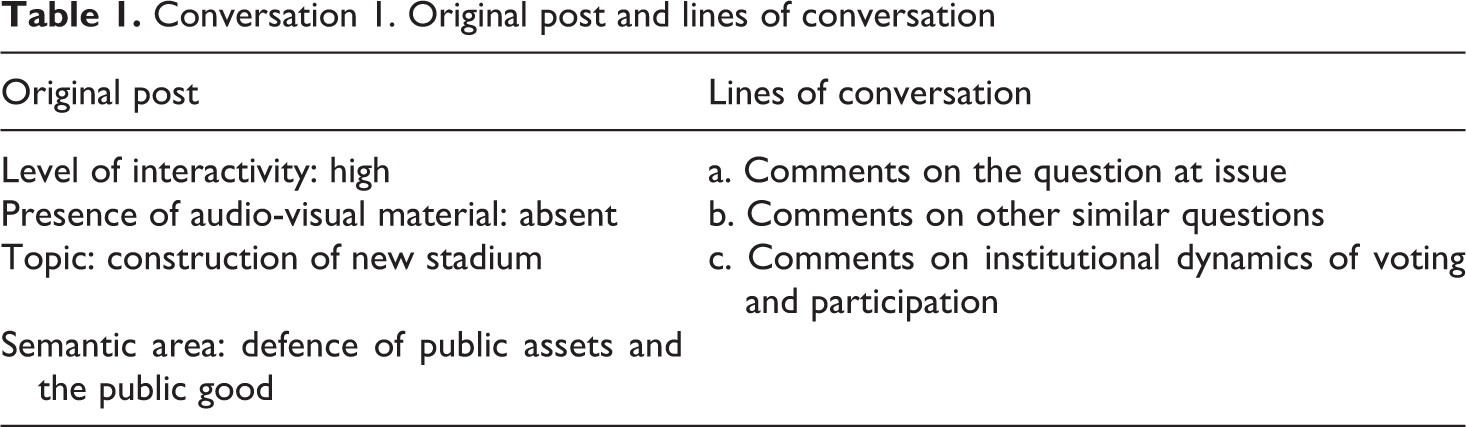
The long post published by the 5star representative, presenting the premise that launches the discussion, is particularly important insofar as it directly points to what is published on the institutional blog, where the debate that took place about the case in the social media is noted. Yes to the AS Roma stadium but the fans and citizens shouldn’t be fooled: who pays the bill for Tor di Valle? Our first statement on the AS Roma stadium at Tor di Valle sparked an interesting debate in the social media and among the comments on our post Yes to the stadium, no to speculation greater clarity was requested about the costs of the operation, and about why – in our opinion – it will also be the public that foots the bill. (5SM Blog – City of Rome) Now we’ve exposed the trick: 86% of the project isn’t about the stadium; it’s about 1 million cubic metres of cement! We were in favour of a stadium for the Rome team. In favour of a stadium built following the legal formalities and in the interests of the public. We cannot be in favour of a project under which the stadium is only a pretext for making a new 1 million cubic metre business headquarters. (City Council member)
A further aspect to note is the possibility of talking/arguing directly with representatives of political forces other than those of 5SM.
Here the conversation hosts a number of contributions consistent with the original post. Some users are easily recognizable as 5star representatives holding positions on the City Council; other comments cannot be attributed to any of the listed authors of 5SM blog posts. In this regard it is worth noting generally that the conversation includes various voices not clearly identifiable with any institutional position. A: I address myself to these council members and invite them to muster up some courage! To allow themselves an attack of conscience! To cast a vote instead of running out of the room! To show their worth! To consider the public interest! Not to be cowed by “their” mayor if they honestly don’t agree with his choices. I address these councillors who always have plenty to talk about when the subject is the world of Roman associationism. The sort of talk that when it comes to action turns out to be nothing but “Bla Bla Bla”…How will you vote, councillor X? Or will you vote at all? And afterwards where will you find the nerve to go and talk to your associations?!? (5star City Council member) B: I will not timidly leave the room. For months I’ve been calling attention to the serious problems affecting the area in question and since I live there I know them very well, and neither I nor 300,000 other citizens get any benefit whatsoever from them, but rather endless distress. Everyone knows I oppose the Tor di Valle stadium. I have even signed the appeal with 2000 signatures that was delivered to the mayor. Go to Tor Vergata where you will create less trouble (…) I hope to be able to vote during the hours when I’m at the Capitoline Assembly. Private matters stay private and I don’t have to account for them to anyone. Everyone who knows me knows this. (City Council member from another political group) A: Hello X, I’m glad to read your position. I think it also applies to R. I said what I did because I’ve sometimes seen you leave when there were important votes; and also because the leader of your party (X) has already announced his vote in favour of a project that cannot be fixed by adding a “palliative” amendment (…). So I understand you correctly that you’ll be there to vote, right? If, as you say, you’re against it, there’s only one way to show it: no opinions, appeals, signatures, or chit-chat, just that vote! All the rest isn’t worth…It’s pointless to sign appeals if then your opposition isn’t confirmed in the chamber. I hope your group X is there to express their position as well! Or are X, Y and Z also not likely to be there? What do [list of 5 names, ed.] think? Ps, X my attendance at the council is 100% and our urban planning commission member is X, who is very very good at his job (5star City Council member). C: The fact is, all the group leaders as well as the mayor received a letter of formal notice from lawyer Z on behalf of those who will be expropriated (this is the purpose of the vote on the “declaration of public utility”)…Very clever, this letter, because in the case of an investigation for fraud, the expropriators will have their asses covered…why is no mention made of those who have received this formal notice?…Anyone who approves or who leaves to allow the resolution to be approved will be complicit in fraud. X and the others know this perfectly well and this is the behaviour of the real MAFIA of the capital (unidentified subject). B: A, you asked me this question in front of the group leaders, and I answered an emphatic no! You were there. On the contrary, I didn’t know about the letter to the group leaders from X notifying them on behalf of those to be expropriated. I will demand an explanation! (City councillor from another political force) C: Ok B, you can start demanding explanations for a lot of things and if you want the rest of the letter you can find it here (link). And you can also start asking yourself what the point is of voting for the “declaration of public interest” and you will realize that they are having you vote for the urban planning procedure to nominate X as the licensor for the expropriation on behalf of the city and they will expropriate the areas of their friends, that they should have been the owners of…Tomorrow you will not approve scenario “A”, in compliance with paragraph 304, but scenario “B”, which is illegitimate. The council members can’t pretend they don’t know and anyone who votes in favour is complicit in a scam (unidentified subject).
The process of integration of information is carried out by a professional external to the institutions, who among other things supplies documentary materials during the conversation. Thus the process of influence goes from an exponent of civil society in the direction of an institutional representative. The opinion leaders are not necessarily identifiable as individuals with institutional positions. The flows of influence in the social structure move both horizontally and vertically, and in a descending as well as ascending direction.
Another case of a Fb conversation that to some extent points to action concerns an attempt to organize a group of citizens for the defence of Villa Borghese. In this case the post that appears on the blog does not strictly coincide thematically with what is addressed in the Fb post. Indeed, on the blog the topic is the general negligence of the city administration in the management of public parks, while the Fb post from the same period (late 2014-early 2015) instead carries an explicit reference to the case of the destruction of a hill in the heart of Villa Borghese to make room for a group of 38 carriage drivers.
The post presented on Fb contains 10 mentions of the same number of council members, activists and citizens. The post is therefore directed at both institutional representatives and others. The conversation includes 33 comments. Our city has the good fortune to be surrounded by many green areas: the large parks of Villa Ada and Villa Borghese as well as Villa Torlonia, real lungs not only for the neighbourhoods around them, but for the whole city. Additionally, other areas exist that are smaller but no less valuable, both for their historical importance and the richness of the tree species represented. (…) Unfortunately we are forced to witness how the capital’s administration and its municipal branches, far from implementing a rigorous program of conservation and protection for these precious assets, has over time favoured the progressive impoverishment of this green heritage, a steady erosion through acts and omissions that have entirely or partly deprived the citizens of the use of these areas in favour of private interests that have made exclusive use of them in defiance of laws and regulations (5star blog) It is difficult to suppress the shock felt at the destruction of a hill in the heart of Villa Borghese, protected as it is by numerous international laws (but the Florence Charter alone establishes that a historical park is equivalent to a monument and cannot be built upon, in addition to being a Site of Community Importance), alienated from the community and allocated for the exclusive use of 38 people (5star municipal council member). A: Get me all the documents and permits for putting on the horse show. Get all the consignment notices for the locations after the events. Get all the insurance guarantees. Find out how much the city made for every event in Piazza di Siena. Do this for at least the past 10 years. When you have all the documents we can talk again and see what can be done about the 2015 event. (unidentified subject) Conversation 3. Original post and lines of conversation B: I agree. Give us a hand. It’s not us and you. It’s (or it ought to be) us together. You know that access to the files has to be accounted for. I have very little time right now and it’s going to be like this until 18 January (various deadlines). We’re all volunteers here. We need help. What do you say? (5star council member) A: Where are you? I’ve already accessed the city documents twice and I have the copies at home. Let’s see if we can put together a dossier on the mess they’ve made of Piazza di Siena, Marino included. I had a meeting with X at City Hall last July about it…since then I’ve heard nothing…bla bla bla bla…. I don’t know what X is up to. From January 1st all the vehicles are supposed to be gone from the Villa. We haven’t heard anything further. The horse show is also supposed to leave and move to Tor di Quinto. Silence B: Let’s meet. Let’s talk about it. I can’t speak for X or for the others in the 5star municipal group. (…) If you have some action going on or coming up we would appreciate being informed so we could at least lend support. Have a good week. A: Ok, enough with the arguing. Let’s see if we can put together a civic front that would operate at the city and municipal level to stop the attacks on the villa. X, who maybe is reading this, has promised that from January 1st the rickshaws, electric cars, pedal go-karts and mobile bars will disappear. Let’s see if it happens, and if it doesn’t, demand to know why not. We will demand to know why X, the prefect, has not issued circulars concerning driving bans in the Villa Borghese ZTL [limited traffic zone] and why cars, motorbikes and these electric cars and rickshaws are still going around undisturbed (…). Close thematic continuity between the institutional blog and some Fb posts. Presence of conversations, some quite rich in participant comments, referring to issues addressed both on the blog and on Fb. Presence of moments in some Fb conversations when a decision regarding public initiatives was discussed.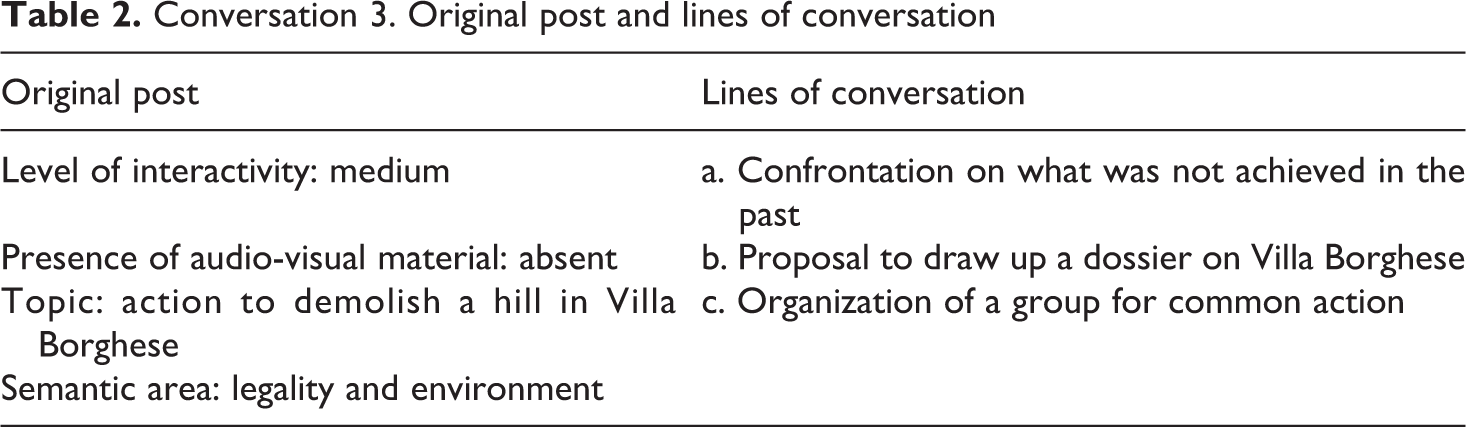
The first point recalls the multimedia orientation of the political activity of the activists/representatives of the movement in terms of information regarding their initiatives and the organization of such initiatives.
The importance of the second point, on the other hand, is to show that in some cases the interactive consequences of input on the blog are transferred to Fb, and conversely that some Fb conversations translate into posts presented on the blog.
The connection between the online presentation of topics considered important for Rome and the development of conversations useful in translating their emotional and cognitive aspects into action suggests that, in the case of 5SM, the employment of automatic or semi-automatic techniques of textual analysis may be particularly useful, even in possibly attempting to predict offline behaviour. It is in fact through reference to keywords that are clearly attributable to the active dimension of participation that the goal of predicting participatory behaviour becomes conceptually justifiable and thus perhaps more accessible.
The use of digital ethnography seems instead to enhance the explanatory dimension of political participation, highlighting the features of particular types of conversations as useful in accounting for certain online and offline implications. Some processes found on the Internet and especially on social networks, such as interpersonal influence, may indeed be traceable to additional processes internal to the web.
With reference to the third point above, it is possible in the final analysis to try and sketch out a preliminary evaluation of the communicative effectiveness of the blog, since it plainly exists in a network of media contexts on the web and may provide at least some marginal stimuli for interaction in the form of conversation. Through further research, quantitative included, aimed at both the on and offline dimensions, it should be possible to evaluate communicative effectiveness with greater precision and with increased attention to the underlying processes.
Visual Component of Political Communication - Integrating the Data with Photographic Material
From the viewpoint of an ethnographic report, photographic material may serve as a useful empirical supplement. Photography is used for example in a variety of ethnographic work, where an effort to reconstruct practices and the mechanisms that determine them makes use of faces, activities, pictures of objects and environments, etc. (cf. De Martino, 2010; Maurines and Sanhueza, 2004). An evaluation of the function of the photographic material found on the 5SM blog from the perspective of a digital ethnography may proceed along similar lines.
Meanings of daily practices that are not readily apparent can be reconstructed through the semiotic analysis of photographs, so as to produce hypotheses regarding possible repetitive patterns that bring order to the signs that appear in the images. In this sense, as in the case of the conversations presented in the previous section, the analysis of each photograph as a unique representation takes its place alongside the possibility of identifying general patterns. Signs in this way align themselves with a subtle, repeated watermark. The photographic images, categorized at the level of small data, can thus be useful in the formulation of interpretive hypotheses concerning the larger dimension of the textual data from the blog.
Most of the photographs published serve a clear “referentializing” function, bearing witness to the urban “reality”. These testimony-photos are made by amateurs. Their purpose in the context of the blog is to further explicate the contents of the posts, provide effective, direct and concrete communication, attract consensus and participation, and elicit collective action.
The photos that best represent 5SM online political communication are associated with the topics that emerged most forcefully, the most often repeated forms of complaint, the values embodied in the written words (openness, honesty, civic engagement), and the actors most often mentioned. For the purpose of illustration some appropriately selected photos are included here (along with the precise posts that contained them) showing largely degraded parks and public places, spaces and services whose rescue requires a commitment on the part of the citizens. And that means steadfast attention to questions of environment, urban maintenance and renewal, as well as care of public property.
An example is the post of 29 October 2014 (cf. Figure 1): “The response of the Environmental Protection Department to the access to 5SM records concerning the degradation of Centocelle park caused by the Roma Vintage association” (E. Guadagno).
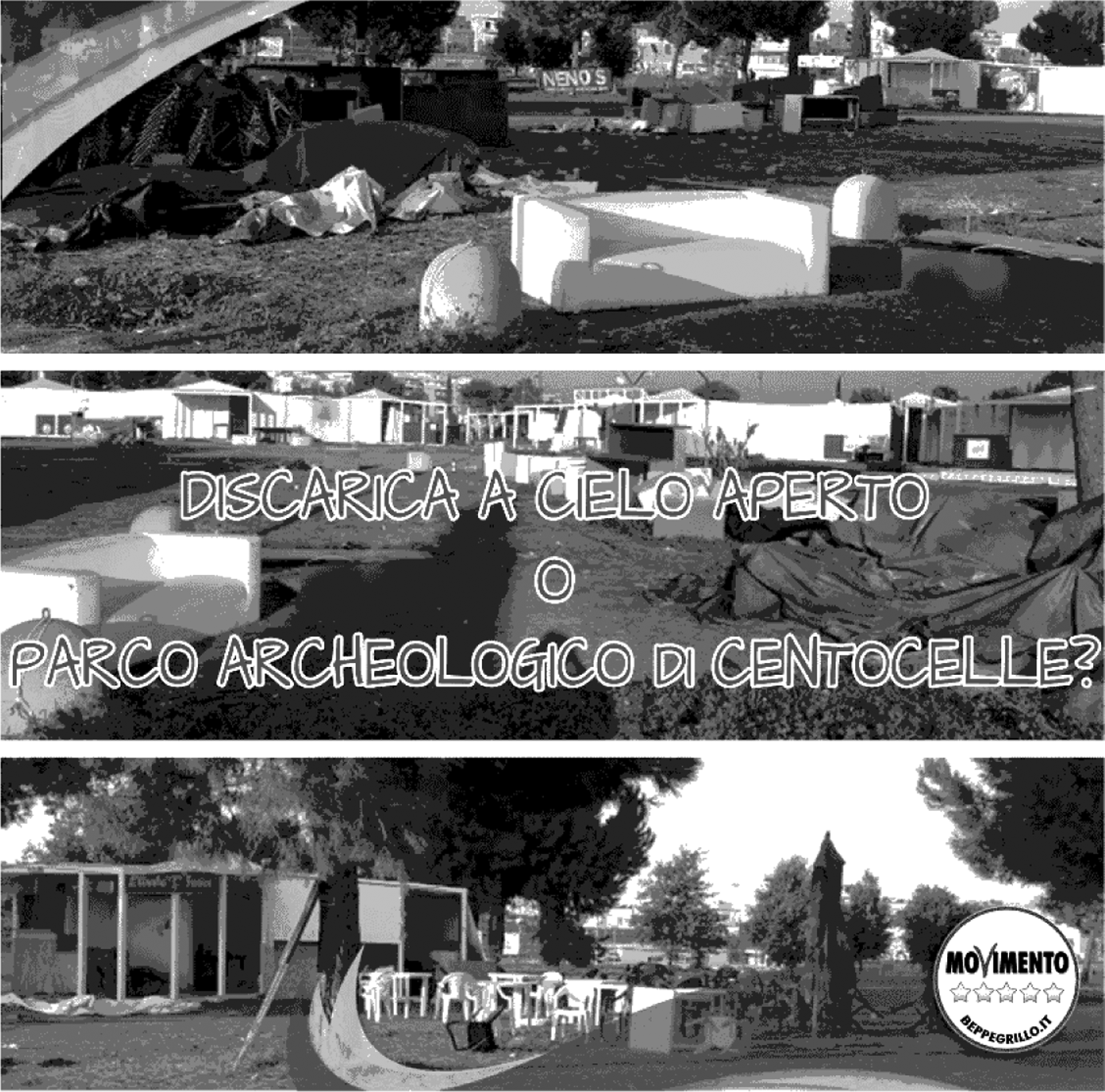
Centocelle archaeological park
The results of the 5SM action are neutrally reported along with a continuing commitment to follow future developments in the case. The post begins with a summary of the response of the Department, followed by their letter, quoted in full. The Environmental Protection Department, having noted the park’s serious state of disrepair, reports that some persons appointed ad hoc will be assigned to clean up the park and that an existing insurance policy will cover the damage caused by the organization.
The post of 7 April 2014, “The Papareschi community plan: we want a true public park!”, fits the themes of community planning and urban renewal, centrally important concerns for 5SM that have been the subjects of heated debates in various disciplinary fields. This is the context of the post concerning Papareschi park (XI Municipality), the first of a series of posts (cf. Figure 2). It opens with a picture of a fenced-in green area containing, among other things, an internal area surrounded by plastic and metal fencing and tape denoting a construction site. In the background is a densely built-up area with a factory and apartment buildings. The text following the picture notes the lack of green spaces in some of the densely inhabited parts of the city, the former Miralanza detergent factory next to the area selected for Papareschi park, and a plan that the Municipality claims involves community participation but which has nothing whatever to do with the needs of the citizens.
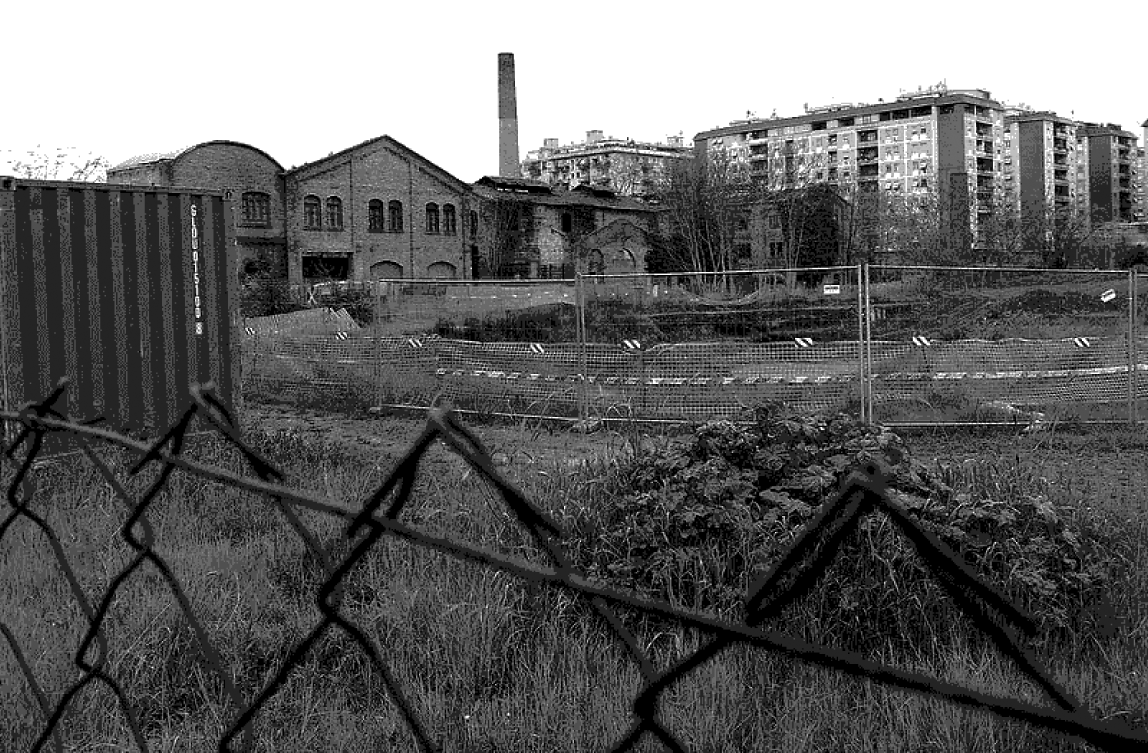
Papareschi park
Scrolling down the page reveals the preview of a document that can be browsed: the 5SM inquiry with written response concerning Papareschi park and the redevelopment of the ex-Miralanza area. This is followed by specific redesign proposals and a site inspection video of over an hour. Finally there is a critique of the method used to advance the community participation project (a series of questions proposed at a public event), followed by the presentation of an online questionnaire accompanied by satellite images of the area.
These are just a few examples that illustrate how visual material can be used to facilitate the impact of the message and the reformulation or strengthening/integration of the beliefs and desires of the blog’s users. The cognitive dissonance (cf. Hedström, 2005; tr. it., 2006: 64; Festinger, 1957) that may arise when previous beliefs come into contact with a representation of the facts that may contradict them, unequivocally linked to reality as in the case of photographs, can be a useful lever indeed in the creation of potentially stable structures of emotional and cognitive coordination (cf. Lombardo, 2006: 10; Bourdieu, 2000; tr. it., 2005: 58). In this regard, small data analysis may lead to the formulation of hypotheses regarding processes of attitude influence and transmission at the emotional and cognitive level.