




Abstract
Over the course of five decades, a social scientist can register many achievements – but can make many mistakes as well. This paper details some of those achievements but also admits to some of those mistakes and explains what can be learned from them over a career spent studying social movements, local politics, political parties, and contentious politics more generally. The underlying methodological strand in the work described below is to try to find ways of bringing qualitative-historical and systematic-quantitative materials together in a search for the tangled relationships between contentious and institutional politics.

Over the course of five decades, a social scientist can register many achievements – but can make many mistakes as well. This paper details some of those achievements but also admits to some of those mistakes and details what can be learned from them over a career spent studying social movements, local politics, political parties, and contentious politics more generally. 1
Not every part of this story will interest every reader of the Bulletin of Methodological Sociology – especially since I am a card-carrying political scientist and not a sociologist; but since I have worked on the frontier between sociology and political science, on movements and parties, and on both sides of the Atlantic, some parts of my experience should interest some readers, while other parts may be of interest to others, while some will be of interest only to me and to the numerous collaborators who have shared them. 2
Let me be clear at the outset: I do not recommend anybody take as many methodological turns – or make as many mistakes – as I did. But what follows may offer three lessons, especially to younger scholars: that no single method solves every problem; that comparison is a difficult but useful tool; and that embedding research in history can resolve questions that the primary data cannot answer. Although I was not always aware of it at the time, the underlying methodological strand in the work I describe below was to try to find ways of bringing qualitative-historical and systematic-quantitative materials together in a search for the tangled relationships between contentious and institutional politics.
Blending Methods, and Building Theories 3
When I wrote my first book, Peasant Communism in Southern Italy (1967a), there was no agreed-upon methodology for the study of social movements – and there still isn’t, which is one of the frustrations, but also one of the strengths, of the field (della Porta, 2014; Klandermans et. al., 2002). Although my future collaborator Charles Tilly was a forerunner for many of the developments that came later, at that time he was still known mainly as a scholar of urban sociology and historical conflicts – like the Vendée counter-revolution. 4 Much of the work on movements in that decade was still influenced by reactions to totalitarianism and the Cold War (Heberle, 1951), or by generic theories of collective behavior (Smelser, 1962).
This meant that movements were often seen as expressions of alienation, hysteria, and – in some cases – authoritarian instincts. Although Gabriel Almond had made his mark with a book based largely on interviews with Communist defectors (1954), using systematic methods to study communists – as I set out to do in my PhD dissertation (1965) – was almost unheard of at the time. 5
It was only in the wake of the civil rights, students’ and antiwar movements of the 1960s that American scholars awoke to the ‘normality’ of protest as a form of politics (Gamson, 1990, Keniston, 1968; Piven and Cloward, 1972). Until then, movements were regarded as “outsiders”, leading to their analytical separation from more institutional forms of representation and to mutual indifference between political scientists, who specialized on parties, and sociologists, who focused on movements (McAdam and Tarrow, 2018).
It was mainly because of the lack of available models for social movement research that I employed multiple methods in my work on the southern Italian peasant movement. This was a movement that had peaked in the late 1940s and early 1950s more than a decade before I set foot in the Mezzogiorno without a shred of historical training. 6 There were plenty of ideological studies of the Communist-led peasant movement at the time, but the only work by a social scientist – Rita Di Leo’s, I braccianti non servono (The Farm Workers Don’t Count, published in 1960) – was based on an intimate knowledge of the culture of the region that I could not hope to match. 7
With only a smattering of methodological training but a lot of chutzpah, I decided on a strategy of docking in every methodological port I could find in trying to understand how a working-class party from the industrial North had adapted itself to the peasant society of the South. Using a simple North/South dichotomy for analytical leverage, I carried out non-structured interviews with Communist cadres, sent out a mail survey – with the endorsement of the director of the party’s Gramsci Institute – to provincial party officials, used party statistics to analyze the party’s membership strength, its base organizations, and its social composition, and engaged with the work of the party’s major historical ideologue and theorist – Antonio Gramsci (1963). 8 In other words, without having ever heard the term used, I began my career as a firm believer in methodological “triangulation” (Tarrow, 2010a).
Employing Multiple Methods 9
By “triangulation”, I came to mean aiming different methods at the same problem where no single method is satisfactory (Tarrow, 2010a: 7). This was certainly the case in southern Italy, where the events I wanted to study were more than a decade old, where precise records had not been kept – except possibly by the police, who would have been loath to share them – where many participants had left the scene, and where deep ideological commitments guided what people said to me. To make things worse, for a scholar whose knowledge of Italian was rudimentary, regional dialects impeded communication with peasant activists. The risks of employing a variety of (imperfect) tools in combination seemed less great than relying exclusively on any one of them.
But there were still risks. One of them was that to gain access to the Communist cadres I interviewed in the South I needed introductions, and these I got from the (mostly reformist) PCI intellectuals I met in Rome. 10 These Communists introduced me to cadres whose views mirrored the party’s national strategy, which was parliamentary and electoral and had restrained the combativeness of the peasants during the latters’ struggle for the land in the 1950s (Tarrow, 1967a: chapter 13). With a sample that was thus heavily weighted towards the party’s moderate faction, my dissertation on the relationship between the party and the peasantry was heavily skewed by the party’s reformist Via italiana al socialismo [the Italian road to socialism] (Tarrow, 1965).
But here was where multiple methods helped: for when I looked at the demographic profile of the party in the South, I was struck by the solid weight of middle class intellectuals in its membership, compared to the peasants and workers who dominated its profile in the North (Tarrow, 1965: chapter 9). I also noticed that the party’s cells and sections were clustered in provincial capitals – and not in the agrarian borghi where most of the peasants lived. And when I looked back at the history of the peasant struggles in the South, I discovered that there had been a minority of cadres who wanted to assign a leading role for the peasants much closer to what Gramsci prescribed.
Gramsci’s essay, ‘Alcuni temi sulla quistione meridionale’ [Several themes on the southern question] had been re-published in 1963. In it, he had called for a revolutionary alliance between workers of the North and peasants of the South – and not the multi-class reformist alliance that was at the heart of the party’s strategy. The expansion of Gramsci’s bilateral strategy into a multifocal one was the result of the dominance of the northern – and more reformist – wing of the party. A biased interview sample almost led me astray, but I was saved from making a fatal error by triangulating my elite interviews with other methods.
Learning the Virtues of Comparison
In Peasant Communism I used the North as leverage to highlight what was special about Italian communism in the South, an analytical convenience that was familiar to all scholars of Italian politics at the time. The work that was most influential in how I structured my research was Joseph LaPalombara’s Interest Groups in Italian Politics (1964), which he was writing as I collected my data in Rome. 11 LaPalombara saw North and South, respectively, as ‘European’ and ‘Mediterranean’. This was a rough-hewn distinction that, in my first approximation, became an independent variable that determined the differences between the party in the two regions.
But this “structural” distinction – true as it was – elided the independent impact of the party’s national strategy on the weaker region. Two years later, and 3,000 miles from the scene of my research, I saw these conditions interacting with the party’s national strategy. I laid out the intersection of the two variables in a crude theoretical typology of the various forms of leftist parties in an article for the American Political Science Review (Tarrow, 1967b). The typology was meant to show how the same party strategy in two different structural contexts resulted in very different political models (see Figure 1). The party in the South, I argued, was more of a mass “movement” than the highly articulated mass party it resembled in the North. The interactions between movements and affiliated parties would become a red thread that ran through my work over the following five decades. 12
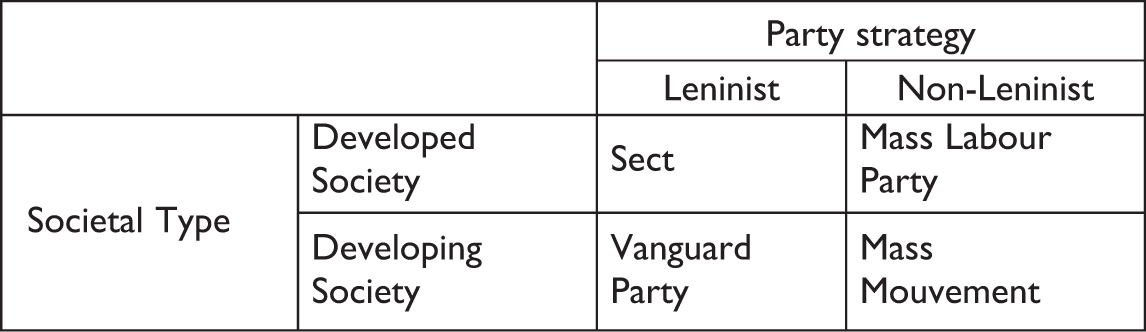
Structural/strategic typology of form of leftist parties (Tarrow, 2006: 9)
A Methodological Diversion
How else could I use comparison to gain analytical leverage over intractable realities? By this time, I was an Assistant Professor at Yale, where I met the distinguished Americanist, Fred Greenstein, one of the pioneers in research on political socialization (1969). Fred was about to set off for a sabbatical year in England, while I was headed for France to allow my francophone spouse to work on her PhD dissertation. Much influenced by his Children in Politics, we “triangulated” on a three-country pilot study of pre-teenagers’ perceptions of politics in England, France, and the US. 13 But rather than employ the tried-and-true survey methods that Greenstein had used in the US, we developed semi-projective tests that we hijacked from social psychology. The method we used came from a research report by Eugenia Hanfmann and Jacob W. Getzels (1955), who had studied matched samples of former Soviet and American citizens, asking them to speculate on the conclusions of a series of situational episodes, including interpersonal dramas in the family and the workplace. We adapted the technique of inventing ‘interpersonal dramas’ to the kinds of stories children would understand and respond to.
I learned a lot from Greenstein about how ideas about politics are shaped by modes of problem-solving, images of authority, and community association in different cultures. For example, when we asked our respondents how their parents would respond to the problem of where to site a park in their communities, and invited them to finish the story, the French kids were most likely to say that they would ask the mayor, who would ‘put them into agreement’, the British kids were more likely to say they would consult an expert, and the Americans were almost unanimous in saying they would hold an election. Although the comparative results were suggestive about how the kids we interviewed saw the political world, we both moved onto other things and never ‘finished the story’.
Comparing Local Elites in Italy and France
Comparison became an integral part of a second major study, but not in the form in which I imagined it. Having studied communist cadres in southern Italy, I thought that I would spend my time in southern France studying the French version of ‘peasant communism’. In Provence I expected to find peasants and communists resembling those I had met in the hardscrabble fields of southern Italy. I thought my stay in Provence could serve as the foundation for a comparison of grassroots activism in the two largest communist parties in the non-Soviet-dominated part of Europe.
I was wrong on both counts: nothing could have been further from those Italianate images than the politics I found in the village of Maussane-les-Alpilles in the year 1968. The farmers I met there had set their faces against the French left, and for the most logical of reasons; the national paroxysm of May had made it impossible for them to sell their primeurs (ie., early crops) in the high-priced markets of Paris and made them diffident to all forms of partisan politics. As for the local Communist party, it was only with difficulty that I could even find a PCF section, and there I met with a level of suspicion I had never encountered in Italy.
However, comparison is built not only on similarities, but also on differences, or – to be more precise – on differences that gain their importance from underlying similarities. The startling differences between the local elites I met in Provence and those I had interviewed in Italy led to a puzzle: when I asked the first mayor I met “How long, M. le Maire, have you been involved in politics?” and he responded “Moi, je ne fais pas de politique!” [I have nothing to do with politics!], I at first thought he was taking me for a ride. However, when the same declaration was repeated by mayors across the political spectrum, I began to take it more seriously. In a region of the country that had historically been part of la France rouge, what could it mean when local officials from left to right denied being in politics at all?
The comparativist in me asked if such a thing could have happened in Italy. Or even in more industrial parts of France? That was an empirical question and one that I thought I could answer with the techniques of comparative local interviewing I had learned studying northern and southern Italy. From 1969 through 1975, with a team of young French and Italian interviewers, I tried to find out whether my impressions from Provence were specific to mayors in that region, were general to France, or were typical of small-town politicians in centralized political systems in general (Tarrow, 1977).
What I found in the roughly 250 interviews I collected in four regions of both countries showed that the country variable explained the most variance in the results: Regardless of party, almost all the French mayors shared the apolitical discourse of my respondents in Provence; almost none of the Italians did, regardless of their regional political cultures, the size of their cities or their political affiliations. Moi, je ne fais pas de politique was the common coin of local elites in France; the equivalent was seldom uttered among the mayors interviewed in Italy. Table 1, from the book that resulted from this research, summarizes these results by measuring the majors’ level of political and administrative contacts and activities.
Mayors’ higher administrative and political contacts, France and Italy

Source: Drawn from the data in several tables in Tarrow, 1977: 149, 177
How could I explain this difference? The quantitative data on their own couldn’t answer the question. But placing the French and Italian mayors in their respective institutional contexts helped. My interpretation of the findings turned on the structural differences in the two systems of centre–local relations in which the mayors operated and on the strategies that connected them to the central state in each country. Small-town mayors in France gained the resources they needed through their contacts within the formal structures of authority: from the Interior Ministry down through the provincial prefects and cantonal sub-prefects, they sought approval for subsidies to finance their projects within the rigid, but efficient French state. The “apolitical” representations I had found in the mayors of Provence were neither a ploy to fool a gullible foreigner nor a deep-seated apolitisme; it was a structurally conditioned political strategy designed to gain leverage in a territorial system that rewarded good behavior and punished political activism.
In contrast, in a clientelistic center–local system like Italy’s, local officials used their ties with party and parliamentary officials to gain the resources they wanted. There, where the formal structure barely disguised – and indeed embodied – partisan politics, local officials reached upward to Rome through their party-political connections. Comparison – plus multiple methods – helped me to solve a riddle that immersion in French local politics alone would not have solved. I emerged a firm believer in paired comparison based on quantitative data embedded in institutional contexts (Tarrow, 2010b). When I turned back to study social movements, it was as a convinced comparativist.
Comparing Movements
But when I turned to the literature on movements in the late 1970s, there was little comparison to be found. Most studies of movements were conducted through monographic case studies of one movement in one country, and those that claimed to be comparative were more often sweeping global comparisons – like Heberle’s Social Movements: An Introduction (1951) or Smelser’s Theory of Collective Behavior (1962).
Responding to this lacuna, in 1988, Bert Klandermans, Hanspeter Kriesi and I tried to encourage more comparative work in a collective book called From Structure to Action (1988). We assembled a group of (mainly younger) European and American movement scholars in Amsterdam to see if we couldn’t encourage them to engage in sustained comparative work. But although others were also calling for comparison in the social movement field (McAdam et al., 1996), until the turn of the century there was little to show from these appeals. 14
Why was this? Apart from the sheer difficulty and expense of carrying out multi-country comparisons of evanescent forms of collective action, there was no consensually agreed-upon instrument that permitted scholars to compare their work systematically. In the 1970s, Samuel Barnes and Max Kaase had employed survey techniques to study “unconventional collective action” (1979) in six countries, but their surveys of what they called “political action” were not about action at all, but about individual perceptions of and predispositions towards action. 15 But movements are forms of action; how could they be compared systematically across countries and regions?
Two social historians – like Eric Hobsbawm and George Rudé – had used a kind of event analysis to study the Swing rebellion (1975). But it was mainly students of strikes (Ashenfelter and Pencavel, 1969; Perrot, 1974; Shorter and Tilly, 1974) who analyzed publicly-available records focused on single sets of claims. Students of the American urban riots of the 1960s added another body of work (Spilerman, 1970), using essentially the same techniques as strike students. But neither specialty gave us a purchase on the relationship between such events and the comparative study of social movements. The systematic study of contentious events offered a promising methodology.
The [Re-]discovery of the Event 16
The Oxford English Dictionary gives as its first definition of the term “event” “The (actual or contemplated) fact of anything happening; the occurrence of”. But the OED gives a second meaning of the term (ie., “anything that happens”), a third as “that which follows upon a course of proceedings”, a fourth as “what becomes of or befalls (a person or thing)”, and a fifth a combination of meanings two and three (OED, 1986: 338-339). A lot of meanings here, and not all of them easily operationable for empirical research!
Historians had even less consensus about the status of events than the dictionary. Fernand Braudel looked down his nose at events as “no more than surface disturbances, crests of foam that the tides of history carry on their strong backs” (1949, quoted in Appelby et al., 1994: 83). At the opposite pole, Philip Abrams assigned theoretical power to the event when he wrote that an event “is a transformation device between past and future…not just a happening to be narrated but a happening to which cultural significance has successfully been assigned”. Events, indeed, he wrote, “are our principal points of access” (1982: 191).
In the 1970s, sociologists began to use events as their main data points to analyze population ecologies, social conflicts, and political struggles. Once advanced computational tools became available, the method could be applied to a wide range of event series, using police records (Fillieule, 1997; Fillieule and Tartakowsky, 2008, 2013), newspaper records (Jenkins, 1985; McAdam, 1999 [1982]; Olzak, 1989), or – when machine-assisted coding methods became available – digitalized records of wire service dispatches (Imig and Tarrow, 2001). By the 1990s a group of far-sighted American sociologists recognized the advantages of collecting a long series of events from newspaper records and making them available to others for research. 17
Putting event analysis together with comparison, and spurred by the emergence of a wave of what were called “new social movements” in the mid-90s, Kriesi, with a team of collaborators, carried out a systematic comparison of protest events in four European countries (Kriesi et al., 1995). In a PhD dissertation at the European University Institute, Donatella della Porta carried out a paired comparison of movements and violence in Italy and Germany that was later published as her first book (1995). And at the University of Michigan, Tilly assembled massive resources to collect data on “contentious gatherings” in Great Britain from 1758 to 1834. 18
Events could be used to study short sequences of contentious action, like the 1960s riots, the “cycle of protest” in Italy (Tarrow, 1989), or the “new” social movements studied by Kriesi and his collaborators and by Dieter Rucht and his collaborators in Germany (Rucht, 1998). But events could also reveal long-term changes in what Tilly called “the repertoire of contention” to “describe what happens [in the ways that people act together in pursuit of shared interests] by identifying a limited set of routines that are learned, shared and acted out through a relatively deliberate process of choice” (1995: 41-42). By studying sequences of collective action, scholars could even tap into the evolution of the culture of contention and its relationship to social and political change, as Tilly did in his crowning work in the field, Contentious Performances (2008). And by using computerized coding of online press agency dispatches, as Doug Imig and I attempted to do, vast amounts of protest data could be assembled and analyzed (Imig and Tarrow, 2001).
Not everyone had Tilly’s resources or his persistence to carry out such a demanding research program – especially before the advent of computerized data collection and analysis. But if scholars using the same or similar methods of event analysis could ask the same questions in roughly the same ways, a set of cumulative comparative findings could emerge. This meant taking seriously the concept of “the event”, and deciding just how protest events could provide evidence about movements and contentious politics in general, and this turned out to vary widely.
Eventful Histories, Event Histories, and Events-in-History
Three roughly complementary approaches guided the return to the event:
First, the study of and implications of “eventful histories”, best reflected in William Sewell’s theorized narrative in his work on the French revolution. 19 Sewell focused on “great events” – like the taking of the Bastille (1996) and the passage of the Declaration of the Rights of Man under the influence of the Abbé Sieyes (1994). Both of these qualified as unpredictable ruptures, “moments of fluidity in which small and momentary causes may have gigantic and enduring consequences” (1994: 843-844). Together, such events constituted structural breaks or – in the language of David and Ruth Collier – “critical junctures” (1991).
Second, constructing “event histories”, a method developed in organizational ecology (Allison, 1982; Tuma and Hannan, 1979; Olzak, 1992). Here sophisticated statistical techniques allowed analysts to connect sequences of events to co-variates, such as demographic changes, socio-economic profiles, and political trends.
Third, “events-in-history,” best represented by Tilly’s books on France, and Britain. The Contentious French (1986), Popular Contention in Great Britain (1995), and Contentious Politics (2008) show the many ways in which Tilly built theories on “events-in-history”. Where Sewell focused on particular “great events” that broke the crust of convention, and Olzak and others laced time-series strings of events into “event histories”, Tilly gathered catalogues of events from multiple sources and sorted them into historical segments chosen for their importance in the history of, first, France, and then Britain.
Tilly broadened the boundaries of the events he studied from “protest”, “violence”, or “strikes” to what he called the “contentious gathering,” which he defined as “an occasion on which a number of people…gathered in a publicly-accessible place and made claims on at least one person outside their own number, claims which if realized would affect the interests of their object” (1995: 63). And he began to move towards what he later called “relational realism” – the attempt to use events to understand the interactions among contentious actors (Tilly, 2006).
Back to Italy
My work on Italian contention in the late 1960s and early 1970s built on all three approaches but connected the events I catalogued to other sources of data. Lacking Tilly’s resources or his patience for aggregating multiple sources, 20 I nevertheless adopted his definition of events and coded almost 5,000 contentious events and subjected them to an elaborate coding procedure (Tarrow, 1989). Like Olzak, who relied on a daily reading of the New York Times, I coded every conflictual event that appeared in a single national newspaper of record – in the event, the Milanese newspaper, Corriere della Sera. But unlike Olzak, and like Sewell, I was particularly interested in key turning points, like the bombing of the Bank of Agriculture in Milan in 1969, followed by the “accidental” death of the anarchist who “fell” out of a window of police headquarters when he was questioned about that bombing, and the murder of the police investigator who had been in the room when he fell.
But there were contentious issues: first, how could I recognize and analyze a key event in a dynamic sequence of happenings and how would I know if there was one? Second, how far was I willing to go in construing history as a series of events that are deeper than Braudel’s “crests of foam”, and find ways of linking them to the underlying structural issues that concerned him? Third, how could contentious events be related systematically to other kinds of events and to political institutions and processes? 21 Finally, where did protest events fit in the broader tissue of the struggle for power?
Cycles of Contention
In Democracy and Disorder (1989), I tried to make a contribution to this question with a concept that went beyond movements to broader waves of contentious politics. In that book, I saw the events I collected in Italy as parts of what I came to call a “protest cycle”, which I defined as: A phase of heightened conflict and contention across the social system that includes: a rapid diffusion of collective action from more mobilized to less mobilized sectors; a quickened pace of innovation in the forms of contention; new or transformed collective action frames; a combination of organized and unorganized participation; and sequences of intensified interaction between challengers and authorities which can end in reform, repression and sometimes revolution (Tarrow, 1994: 153).
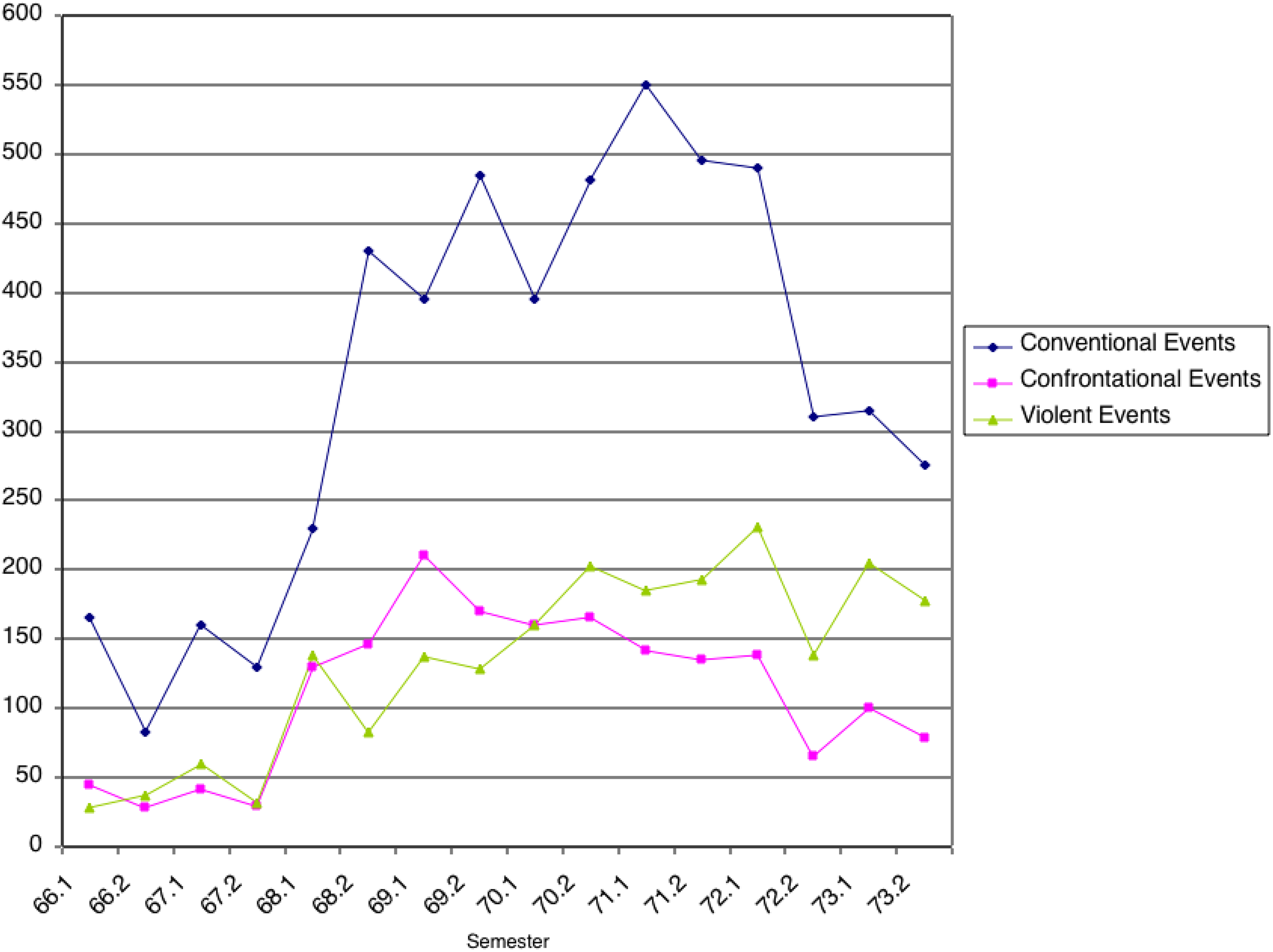
Italian contention, by forms of contention, 1966-73. Source: Charles Tilly and Sidney Tarrow, 2015: 129.
This image told me several things:
First, it told me that what happened in France in May 1968 was not the trigger for the period of contention in Italy, which began at least a year earlier and lasted much longer: Italy’s “May” was what economist Michele Salvati (1981) called a Maggio strisciante [a sliding May];
Second, despite the press’s tendency to highlight violent events, it showed that a large majority of the contentious events in Italy were neither disruptive nor violent but were conventional strikes and demonstrations;
Third, it showed that the early years of the cycle were the ones in which disruptive – but not violent – events came into their own, and that violence surged towards the end of the period as the vast numbers of protesters of the early years disappeared and those who remained adopted increasingly violent methods (Tarrow, 1989; della Porta and Tarrow, 1986).
Triangulating the event data with other sources deepened this finding: Merging my protest events data with the data on terrorism that della Porta had collected for Italy (1986), she and I came up with the following argument: Masses of ordinary people whose claims feed into cycles of protest are soon discouraged by boredom, repression, and desire for a routine life. Those who lead them respond to this decline in enthusiasm in one of two ways:
- by institutionalization: the substitution of the routines of organized politics for the disorder of life in the streets, buttressed by mass organizations and purposive incentives;
- or by escalation: the substitution of more extreme goals and more robust tactics for more moderate ones in order to maintain the interest of their supporters and attract new ones.
The bifurcation between these two processes, we reasoned, are exacerbated by a third – repression – which accelerates the demobilization of those with a low level of involvement and isolates those whose involvement is most intense. The result is polarization: increasing ideological distance between the wings of a once-unified movement sector, divisions between its leaders, and – in extreme cases – terrorism.
I learned a lot from interpreting these results but there was a lot I could not learn from them. First, why did Italy’s sessantotto drag on for so long, when France’s soixante-huit had ended so quickly? Second, what had happened to the thousands of workers and young people who engaged in disruptive protests during the early part of the cycle? Third, how could I explain the shift from a mass of conventional protests to the rise of violence towards the close of the period? It soon became clear that the simple enumeration and typologizing of the events I found in the newspapers were not – on their own – going to provide answers to these questions, all of which required a deeper and more searching examination of that period of Italian history.
More Multiple Methods
I thought that case studies of particular sectors could help, so I devoted separate chapters to students, workers, and to a dissident Catholic group in Florence, where I interviewed participants who had occupied a local church in a working-class district (1989: chs. 5-7). Informal interviews with former activists helped even more, particularly those whose activism spanned the entire period of study and could reflect on what had changed over that period. Organizational data, when compared to the time-series events, helped me to understand what had happened to the “early risers” who no longer appeared in disruptive street politics. They did not, for the most part, “drop out” as a certain kind of pop sociology maintained: Like McAdam’s “Freedom summer” veterans in the US (1988), a large number of them joined trade unions, civic associations, and political parties, thus helping to explain the numerical dominance of conventional events in the cycle even as violent terrorism dominated the headlines.
With della Porta, I had theorized that there was an interactive relationship between these two apparently opposing trends: as large numbers of “68ers” left the streets for more institutional forms of participation, those who remained were the most militant and adopted increasingly radical forms of action (della Porta and Tarrow, 1986). While della Porta had documented the second part of this bifurcation (1995), with Peter Lange and Cynthia Irvin, I documented the first part for the thousands of veterans of the 1968 period who moved into the ranks of the Communist party (Lange et al., 1989).
But there were problems that even this enriched approach could not resolve. First, I had relied on a single source of data – a Milanese newspaper, and one that was business-oriented and unfriendly to protesters. Second, like the New York Times in the United States, the Corriere provided far less information about protests in other regions and especially in rural parts of the country. Third, what of movement groups that were not inclined to engage in street protest? The women’s movement was a prime example (Hellman, 1987): by choosing protests as the central measure of movement activity, wasn’t I defining away all the other things that movements do – socializing activists, bargaining with elites, forming coalitions, and trying to convert opponents?
The gap between the method of protest event analysis and the concept of social movements was already evident in Kriesi’s work on “new social movements”, and remains a major lacuna in the study of contentious politics today. Unless of course, we decide that our interest is not only in movements but in contentious politics in general and in the relationships among varied actors within that broader framework. That was what happened in the 1990s when I began to think through my approach to contention together with Doug McAdam and Charles Tilly.
Dynamics of Contention
Tilly and McAdam were both pioneers in the systematic analysis of protest event data. Like me, both were restless with the state of movement research in the 1990s. For while movements were part of a churning, shifting, and exciting branch of social science in the 1960s and 1970s, by the 1990s they had become the center of their own sub-specialty. Moreover, the categories that scholars had put into play – political opportunities, mobilizing structures, collective action frames – had become somewhat reified. We felt – and so we argued in our book, Dynamics of Contention (2001) – that the problem lay in too narrow a focus on movements and an insufficient attention to other actors and with institutions. As McAdam, writing with a collaborator later, argued, movements needed to be “put in their place” (McAdam and Boudet, 2012).
One way to do this was to broaden the range of subjects to contentious politics in general – something that had been implicit in all three of our research efforts for years. Another was to infiltrate comparison into the fabric of research. But most important, we argued that a deliberate focus on the mechanisms and processes that produce change was the best way to escape what we saw as the static nature of existing social movement paradigms.
Dynamics grew out of the event-based methodology we had all three used in previous work. We began with “episodes”: “continuous streams of contention including collective claims-making that bears on other parties’ interests.” But rather than trace the lineaments of a single set of checkpoints – like opportunities, frames, and mobilizing structures – we looked at these episodes comparatively to identify the mechanisms and processes that drove change. By mechanisms, we meant “a delimited class of events that alter relations among specified sets of elements in identical or closely similar ways over a variety of situations.” And by processes, we intended “regular sequences of such mechanisms that produce similar (generally more complex and contingent) transformations of those elements” (McAdam et al., 2001: 24).
Within our cases, we looked for three kinds of mechanisms: environmental (those that were externally generated), cognitive (those that operate through alterations of individual and collective perception, and relational, those that alter connections among people, groups, and interpersonal networks (McAdam et al., 2001: 25-26). And rather than zero in on a few cases that we knew well, we extended our gaze in space and time to carry out paired comparisons of the dynamics of contention in 15 (count them!) cases, sorted by geography and forms of contention, as shown in Table 2.
Distribution of episodes in dynamics of contention by region and form of contention

Source: Doug McAdam, Sidney Tarrow and Charles Tilly, 2001: 76
We found that mechanisms concatenate in interesting ways. Take the factors that produced America’s civil war – the most extreme form of contentious politics in that country’s history. Historians have catalogued numerous structural and conjunctural factors that produced that war, but we argued that the three types of mechanisms sketched above could go a long way to explaining the country’s descent into internal strife:
First, an environmental mechanism – migration: in the decades preceding the outbreak of war, thousands of New Englanders – most of them farmers – migrated to the rapidly expanding West (what we today call the Midwest). Some were abolitionists but most were small farmers without the resources to invest in slaves (or indeed in farm workers of any kind); this made them suspicious of the ambitions they saw among southerners to colonize the West with slave-run agriculture;
Second, a cognitive mechanism: cultural studies had shown a growing gap in both the self-perception and the mutual perception of northerners and southerners and a growing gap between what they read and knew about one another. This was an early example of something we know much more about today – identity shift;
Third, a relational mechanism – brokerage. Between free soilers in the West and abolitionists in the North there was an objective coalition that became subjectively possible after compromise in Congress failed and a new political vehicle – the Republican Party – appeared in the mid-1850s to weave an alliance between them.
There were plenty of things to criticize in Dynamics of Contention – as our many critics soon made clear ( Mobilization, 2003). But we ourselves were conscious of lacunae, over-confidence, repetitiveness, and a tendency to imagine mechanisms and processes at the drop of a hat (as McAdam and I wrote in Mobilization, 2011). As Tilly and I wrote a few years after its publication, Dynamics “pointed to mechanisms and processes by the dozen without defining and documenting them carefully”. Moreover, “it remained unclear about the methods and evidence students and scholars could use to check out its explanations”. And, “instead of making a straightforward presentation of its teachings, it reveled in complications, asides and illustrations” (2007: xi).
If “DOC” had positive effects it was to challenge the narrow and static version of the social movement canon we had helped to build, to broaden it to contentious politics in general, and to connect the study of movements more firmly to political parties, elites, and institutions through the use of comparison, historical studies, and multiple methods. 22 This meant substituting what Tilly called “relational realism” for the “old structuralism” that had guided the first generation of work on social movements. 23
A Word for the Young 24
This recitation has been an object lesson that, in research, you can learn from your mistakes as well as from your achievements. But there are also some practical conclusions that you can draw from the chequered experiences of one scholar:
First, before you decide to analyze some contentious episode, describe the episode and its contexts carefully;
Second, don’t let the method you have been taught determine the problems you study;
Third, rather than trying to explain everything about a contentious episode, close in on its most surprising, interesting, or consequential features – for example, how the movement for marriage equality in the United States helped to move public opinion towards its acceptance (Dorf and Tarrow, 2013).
Fourth, don’t be afraid to use a variety of methods – even those that the latest vogue in methodology tells you are out of date. Where data are imperfect – which is more than likely the case – training a variety of methods on your subject is almost always superior to no matter how perfect the employment of a single method.
Fifth, even when you lack equivalently good data about all the units you examine, use comparison to single out similarities and differences between your episodes and others in the same general categories.
Sixth, try to embed your data collection in historical contexts – even when the period you want to cover is short, because only in that way will you guarantee that your work will endure. 25
Finally, don’t stop with actually occurring contention. Modern politics contains recurring streams of contention but it also includes oceans of apathy. We now know a lot about why citizens rise in resistance when dramatic windows of opportunities open. But why do citizens so often sit on their hands when they have the right to resist, when democracy depends on their active participation? Overlooking that question was the biggest missed opportunity in my fifty-year career as a scholar of contention; I invite you to take it.
Footnotes
Acknowledgements
I am grateful to Olivier Fillieule for daring me to undertake this methodological striptease, to Nonna Mayer, who provided a model for this difficult genre (2018), to Eitan Alimi, Donatella della Porta, Neil Ketchley, Kevin Mazur, and Laurence Whitehead for helpful comments on a version of the paper presented at Nuffield College, Oxford, and to Susan Tarrow, who has wearily followed all the twists and turns described in this article. I am also grateful to the collaborators who – over five decades – taught me so much and helped me to avoid even more mistakes than those I outline below – especially the late Charles Tilly, who was never so wedded to an idea that he was unwilling to discard it when it proved wanting.
Declaration of Conflicting Interests
The author(s) declared no potential conflicts of interest with respect to the research, authorship, and/or publication of this article.
Funding
The author(s) received no financial support for the research, authorship, and/or publication of this article.