



Abstract
Food poverty is multi-faceted. While it is certainly about having enough, nutritious food, it is also about the cultural acceptability of diet and the ability to participate in customary activities associated with food. Within the Irish Survey of Income and Living Conditions (SILC), there are deprivation indicators that make it possible to monitor many aspects of food poverty – nutritional adequacy, absolute deprivation, cultural acceptability and social inclusion. However, within the composite official food poverty indicator, only nutritional deficiency, absolute and cultural deprivation are included. Those households experiencing only social exclusion vis-a-vis food are classified as non-food poor households. This paper analyses this group of households using Irish Survey of Income and Living Conditions data for 2015. These households – households who are not officially classified as food poor, but who cannot afford to entertain family or friends with food and/or drink once a month – are much more likely than non-food poor households to be experiencing multiple deprivations, to be unable to afford many household amenities, and, if employed, to be employed in jobs often associated with the working poor.
Introduction
In choosing how we frame a public policy issue like food poverty, we dictate who is most likely to be impacted and the appropriate policy responses (Dowler and O’Connor, 2012; O’Connell et al., 2018). If food poverty is defined simply in terms of hunger and deprivation, then the appropriate response is to give people more food – a role that is currently being filled, to some extent, by food banks across rich, liberal economies. If, however, food poverty is linked more broadly to human rights, social justice and social exclusion, then the appropriate policy response is much broader and rests squarely with the government (Lambie-Mumford et al., 2014; Riches, 2011; Tarasuk, 2001). As of 2012, there was “no national definition or measure of food poverty in Ireland” (Carney and Maître, 2012: i). Without a national definition, it was not possible to monitor change in food poverty over time. Nor was it necessary for the Irish government to respond.
The term “food poverty” is relatively new. It is defined as “the inability to consume an adequate quality or sufficient quantity of food in socially acceptable ways, or the uncertainty that one will be able to do so” (Dowler, 2001: 12, see also Radimer et al., 1990; Riches, 1997). The phrase “socially acceptable ways” links this definition to relative deprivation and Townsend's often cited definition of poverty: Individuals, families, and groups in the population can be said to be in poverty when they lack the resources to obtain the type of diet, participation in the activities and have the living conditions and the amenities which are customary, or at least widely encouraged or approved in the societies to which they belong. (1979: 31)
As such, food poverty is not only about having enough food, it is also about cultural acceptability of diet and ability to participate in customary activities associated with food (i.e. social inclusion).
The term “food security” has been around longer, originating in discussions of hunger and absolute deprivation in the developing world. While some food poverty/insecurity scholars use the terms interchangeably (Dowler and Lambie-Mumford, 2015; Dowler and O'Connor, 2012; Pfeiffer et al., 2015), the Food and Agriculture Organization of the United Nations (2018) describes food security in terms of “healthy diets, safe nutrition and health” (vi), through food access, availability, utilisation and stability (xiv), though not really addressing issues of social participation. The Transmango project, a European Union project looking at global systems and food supply, also adds “agency” to that list, linking food security to entitlements (right to food) and to control at the individual and household-level, broadening the definition of food security to include food sovereignty, but again not to social participation (Brunori et al., 2013).
Within the Irish Survey of Income and Living Conditions (SILC), there are deprivation indicators that make it possible to monitor many aspects of food poverty – absolute deprivation, nutritional deficiencies, cultural deprivation and social exclusion. However, at the moment, only nutritional deficiency, absolute and cultural deprivation are included in a composite indicator of Irish food poverty (Carney and Maître, 2012), more reflective of historical measures of food security in the developing world, than of an indicator of food poverty that also acknowledges the importance of social inclusion. Those households that only experience social exclusion vis-a-vis food are classified as non-food poor households. This paper argues that to get a true sense of the prevalence of food poverty in Ireland, those who experience social exclusion vis-a-vis food also need to be included in official estimates. This paper analyses this group of households relative to non-food poor households and officially food poor households using Irish SILC data for 2015 and compares likelihood of experiencing other types of deprivation including access to household amenities related to food preparation and the social groups that are most vulnerable to this type of food poverty. These households – households who are not officially classified as food poor, but who cannot afford to entertain family or friends with food and/or drink once a month – are much more likely than non-food poor households to be experiencing multiple deprivations and to be unable to afford many household amenities that non-food poor households take for granted.
Literature
Early definitions of food poverty would have defined food poverty in terms of having access to and the ability to afford food in socially acceptable ways, thereby linking food poverty with income (absolute poverty) but also to cultural norms (relative poverty) (Dowler, 1998; Fitchen, 1998). Rosalind Sharpe (2003) of the Food Poverty Network further expanded the definition by saying that food poverty is: “…an inability to obtain an adequate and nutritious diet, because of lack of money, or physical difficulty in getting to (or back from) suitable shops, or lack of equipment or cooking skills, or linguistic or cultural barriers” (31). This definition brings in other issues related to social exclusion besides affordability and access to food such as appropriate housing and neighbourhood amenities.
Those who are experiencing food poverty are often experiencing multiple forms of deprivation. Living within a low-income household, trade-offs are often made between necessities. If one bill is paid, such as rent or mortgage, then other, more “flexible” expenses, such as food, may take the hit (Purdam et al., 2016; Riches, 2011). People go without food. Social activities related to food, such as eating out or entertaining at home, shrink leading to, “exclusion from social participation and social norms” (O'Connell et al., 2018: 12). In desperation, some are forced to get food through socially unacceptable ways, such as food banks, bin scavenging, soup kitchens, even prostitution and theft (Lambie-Mumford et al., 2014; Lambie-Mumford and Dowler, 2015; Purdam et al., 2016; Riches, 2011).
Activist literature about food poverty has discussed food in terms of human rights, linking food poverty to broader issues of social justice (see, for instance, Dowler, 2002; Dowler and O'Connor, 2012; Purdam et al., 2016; Riches, 2011). In their article on food poverty and a right-based approach to food in Ireland and the UK, Dowler and O'Connor (2012) clearly present the right to food as a human right vis-a-vis the United Nations Statement on the Right to Food and the failure of both the Irish and the British governments to recognise it as such. Instead there is a reliance on the market to control pricing and wages without consideration for food affordability or living wages (see also Dowler, 2002). Indeed, the resultant job market for many who are young and/or coming off of welfare in Ireland is made up of jobs that are precarious without opportunities for learning or training resulting in a “low-learning trap” with few options to move out of the lower end of the labour market (Ó Riain and Healy, 2018).
Initial Irish sociological research into food poverty came as a result of poverty studies with a focus on low-income and food poor households (Coakley, 2001; Daly and Leonard, 2002; Graham, 1994/5; McCashin, 1996, for instance). Many of these were qualitative studies that presented the lived experience of poverty. Household composition and gender were particularly relevant in presenting coping strategies in food poor households. Parents, usually mothers, described going without food or eating lesser quality food to insure that others in the household – husbands (if living with the family) and children – had enough. Other studies highlighted the experiences of particular groups at risk of food poverty, such as asylum seekers, the homeless, lone parents, students, large families, older people living alone, and families, especially large ones, with school-aged children (Fanning et al., 2001; Hickey and Downey, 2003; MacMahon and Moloney, 2016; Manandhar et al., 2006; Molcho et al., 2007; safefood, 2011; Share and Hennessy, 2017). Low-income households with older people still living independently have at times been presented as being able to eat relatively better than younger ones due to preferences for relatively less expensive, home-cooked meals and confidence in food skills that can be lacking in younger generations (see review in Healy, 2014b; safefood, 2011).
Early quantitative studies of food within Ireland, on the other hand, were often based within nutritional studies. They compared food intake by relevant socio-demographic characteristics of individuals (e.g. age, gender, social class, educational attainment, tenure, employment status, welfare receipt) to identify groups less likely to be consuming nutritionally adequate diets (e.g. Friel et al., 1999; Kelleher et al., 2003). They found that low-income households were not as able to comply with dietary recommendations, and that they had to spend a higher percentage of their household income on food than higher income households. These studies paved the way for initial quantitative studies of food poverty, such as Friel and Conlon's (2004) Food Poverty and Policy. Other critical research exposed the inability of low-income households, both those dependent on social welfare or low wages (i.e. “the working poor”), to afford a nutritious diet (Friel et al., 2006; Vincentian Partnership for Social Justice, 2002).
While much of the quantitative research focused on intake in terms of adequacy (both calorically and nutritionally), those interested in food poverty have also stressed the importance of social and cultural participation through food (Carney and Maître, 2012; Coakley, 2001; Friel and Conlon, 2004; MacMahon and Moloney, 2016). Qualitative research has shown that low-income households could not afford to socialise regularly with food (e.g. Coakley, 2001; McCashin, 1996), either through eating out or entertaining friends at home with food, both cultural norms across Ireland (Healy, 2014a, 2014b; MacMahon and Moloney, 2016). Kuhling and Koehane (2007), in their discussion of food and drink within traditional and modern Ireland, stress that shared drink and shared food are two very important and positive facets of traditional Ireland that have carried over to the modern day. Shared drinks and shared meals can be important means of celebrating and socialising. However, for some in today's Ireland, drinking with companions has been replaced with drinking alone; commensality at meal times has been replaced with unstructured/unregulated eating alone with, as Kuhling and Koehane suggest, associated physical and mental health problems such as obesity and alcohol abuse.
In presenting the cost of an average food basket for different household types across Ireland, MacMahon and Moloney (2016) acknowledge the importance of socialising through food and drink by including money for dining out and for entertaining visitors as a necessary expense. Social inclusion is an important aspect of the food baskets, as spending on restaurants and extra for visitors are included in the cost. This ensures that the social and cultural aspects of food are reflected in the “healthy” food baskets and that the households are able to participate in activities and practices considered to be a part of everyday life. (MacMahon and Moloney, 2016: 12)
Therefore, in defining and measuring a healthy diet, they believed it was necessary to consider all of the components of an individual's “food basket”: sufficient quantities, nutritional adequacy, cultural acceptability and social inclusion.
Measuring food poverty
Therefore, in defining food poverty, researchers have clearly linked food poverty to hunger and deprivation, to nutritional adequacy, to cultural norms and to social exclusion. In the developed world, some high-income countries such as the United States of America have initiated their own tools to monitor food poverty. For cross-national comparisons at the European-level and international-level, however, data are bit scarce.
In tracking food insecurity/poverty across Europe from 2004 to 2011/12 vis-a-vis the crisis of 2008, both Reeves et al. (2017) and Davis and Geiger (2017) found significant variations in changes in food insecurity across welfare regimes with Liberal regimes (i.e. Ireland and the UK) showing the largest increase and also experiencing more food deprivation vis-a-vis food price increases than more generous welfare regimes in Nordic and Continental Europe (Davis and Geiger, 2017; Reeves et al., 2017). However, both studies were only analysing one indicator – the inability to afford a meal with meat, or vegetarian equivalent, every second day. As such, both studies were only analysing one aspect of food poverty – nutritional adequacy (in this case, protein). However, as stated by Silver and Miller (2003), “exclusion exists along a continuum, rather than as an absolute condition of being an “outsider” or “pariah” (9). One indicator provides a very limited picture of exclusion via food.
Pfeiffer et al. (2015) compared food poverty/insecurity over time between the UK, Greece and Germany using the same meat or equivalent indicator, but also included an analysis of the family and friend indicator – “the ability to afford to have family or friends for a drink or for food once a month”, something they describe as “alimentary participation”. While their analysis of the variable that measured deprivation in terms of meat and its equivalent was not particularly interesting within the German context, they found that the family and friends indicator showed quite large increases in Germany post-recession. Had they only investigated the meat and/or equivalent indicator, it would have shown that the recession had no impact on food poverty/insecurity within Germany at all.
Within the Irish SILC, there are two additional food deprivation indicators. One is related to hunger and to absolute deprivation: doing without a meal once within a fortnight due to money. These respondents are going hungry on a regular basis due to inability to afford food. The second relates to cultural deprivation. The “ability to afford a roast joint or equivalent once a week” is linked very much with conceptions of what constitutes a “proper meal” (Murcott, 1982), although arguably a rather dated one. Summary data from the 2015 Irish Household Budget Survey indicate that only 2.6% of the average food expenditure for food eaten at home was spent on roast joints of any variety (Central Statistics Office, 2017b). As such, there are four variables within the Irish SILC that are relevant to food poverty: it can be defined and measured in terms of absolute deprivation (hunger), nutritional deficiency (protein), and relative deprivation, including cultural deprivation (roast joint) and social exclusion (entertaining family and friends).
Carney and Maître (2012: 7) have constructed an indicator for food poverty in Ireland that is currently used by the Department of Social Protection. It allows tracking of food poverty and identification of vulnerable groups in Ireland over time by combining three of the deprivation indicators from the Irish SILC into a composite indicator. Their indicator is made of the variable associated with absolute deprivation/hunger (missing a meal), nutritional deficiency (missing a meal with meat or equivalent) and cultural deprivation (roast dinner or equivalent). If someone is experiencing at least one of these forms of deprivation, then they are classified as food poor. As such, they conclude that approximately 10% of the Irish population were experiencing food poverty in 2010 (2012: 27). Their food poverty indicator was statistically associated with marital status, household composition, age, education, employment status, health, housing tenure and income. Specifically, heads of households were most at risk of food poverty if they were: under 40; single, divorced, widowed or separated, living in social housing; living with children under the age of 18; unemployed, working at home or ill/disabled; and/or in the lowest income quintile (2012: 43).
They did not include the deprivation indicator that measures the ability to afford to socialise with family and friends with food and/or drink once a month, thus excluding social exclusion from their composite indicator. Carney and Maître argue that the “family and friends” indicator is very different from the other three food deprivation indicators. First of all, since the word “drink” is included in the question, they feel that this makes it vitally different than the others which just refer to food, even though drink is not defined as alcoholic drink.
From a purely statistical perspective, inclusion of the family and friends indicator actually makes a stronger composite measure. In factor analysis, analysis of the four indicators results in a one factor solution. In evaluating the strength of the scale variable, the highest Cronbach's alpha is achieved when all four variables are included for five of the seven years that Carney and Maître review (and for 2015 SILC data as well [author's analysis]).
1
It also clusters with two of the others when measuring basic deprivation in Ireland (Maître et al., 2006). However, Carney and Maître state: The income and social class profile of those reporting the family and friends item differed to the profile of those reporting the other food deprivation items. This suggested that the populations reporting the family and friends items and the other food deprivation items were distinct and were experiencing a different form of deprivation. (2012: 22)
However, it could be argued that that is exactly the reason that the family and friends indicator needs to be monitored along with the other three, even if it is kept separate from the official food poverty indicator for Ireland (in fact, given the complexity of the concept, it may be wise to report the prevalence of food poverty in Ireland as a range of percentages based on a number of indicators). These respondents are experiencing social exclusion vis-a-vis food and/or drink. Therefore, they are experiencing a type of food poverty. To more fully understand food poverty in Ireland, it is important to determine which groups are the most vulnerable to all types of food poverty. Without this data, the current food poverty composite indicator underestimates the prevalence of food poverty in Ireland by ignoring the social aspects of eating and drinking, or “alimentary participation” as coined by Pfeiffer et al. (2015).
This research will compare and contrast updated Irish SILC data (2015) with Carney and Maître's findings from 2010 to track “official” food poverty. It will also analyse this additional category of food poverty: those who are not officially food poor, but are food poor due to inability to socialise through food and/or drink. (Note: Households that are officially food poor and cannot socialise with food are analysed here as officially food poor only.) This is a more inclusive definition of food poverty, and, therefore, will show a higher prevalence of food poverty in Ireland. However, it will still underestimate Irish food poverty because the same data set used is used as in Carney and Maître's analysis, the Irish SILC. The SILC data only include private households. Excluded are many groups that are arguably the most at risk of food poverty: the homeless (both sleeping rough and in accommodation that does not have cooking facilities – families in hotel rooms, for instance), travellers, asylum seekers (those in direct provision, those who are unable to access culturally acceptable food) and others in institutional care who cannot control their food choices (Fanning et al., 2001; Hickey and Downey, 2003; Manandhar et al., 2006; Share and Hennessy, 2017).
Methodology
The Irish SILC is undertaken annually using both a two-staged and a multi-staged stratified cluster sample (depending on wave) to achieve a random sample of Irish households. The survey is longitudinal (waves 2–4) and cross-sectional (wave 1) to help deal with attrition from the panel. Participation is voluntary (Central Statistics Office, 2017a). It is the source of data used by the Irish government to track poverty. As such, it includes many questions related to income, deprivation, living conditions and socio-demographic characteristics of household members. For 2015, the number of individuals who participated was 13,793; the number of households that participated was 5452 (Central Statistics Office, 2017a). For this paper, household-level analysis will be on data for person number one in each household (aged 18 or over) who has provided information for all variables included in the analysis, with the resultant number of households being 5239. (Note: While Carney and Maître defined the household reference person (HRP) as the oldest person in the household, the data available for this research did not provide that level of detail, presumably to protect the anonymity of participants.) 2
Within the Irish SILC, there are 39 questions related to deprivation (Maître et al., 2006). As described earlier, four questions deal specifically with food deprivation. In addition to the indicator that is included in the EU-SILC regarding access to meat or an equivalent every second day (nutritional adequacy of diet vis-a-vis protein), Irish households are also asked: whether or not there was a day where they did not have a substantial meal in the last two weeks due to lack of money (hunger and absolute deprivation), and whether or not they desire but are unable to afford: (1) a roast or its equivalent once a week (culturally appropriate diet/cultural deprivation) or (2) to host social occasions with family and friends with food or drink at least once a month (social participation vis-a-vis food/social exclusion).
The indicator designed by Carney and Maître (2012) makes it possible to track the percentage of Irish households experiencing food poverty based on food deprivation (no meal), nutritional adequacy (no meat, fish, chicken or equivalent) and/or the inability to afford to participate in a culturally acceptable food practice (no roast joint or equivalent). Their official food poverty indicator includes households as food poor if they answered yes to one or more of those questions. Inability to host social occasions with food and/or drink with friends and family (i.e. social exclusion) is not included in their official food poverty indicator. Arguably, it is also an important part of Irish life, reflecting relative deprivation and social exclusion. Therefore, this section will provide some descriptive analyses of both types of food poverty households. Households have been analysed based on food poverty status – non-food poor, officially food poor, and not officially food poor but experiencing food poverty due to social exclusion. “Non-food poor” are those households that do not experience any type of deprivation related to the four food indicators. “Officially food poor” are those that experience any one or more of the three indicators that are included in the Irish food poverty indicator: nutritional deficiency, absolute deprivation/hunger, or cultural deprivation. Those who will be referred to as food poor due to social exclusion only are household that are not currently included in the Irish food poverty indicator (i.e. they are not experiencing hunger, nutritional deprivation or cultural deprivation), but who said that they were unable to afford to invite family and friends for a drink or a meal once a month.
Analysis will proceed with individual- and household-level variables that have been shown to be significant in predicting those at risk of food poverty and include: economic strain (measured through the ability to cope on household income), the likelihood of experiencing other types of deprivation; the ability to afford household amenities associated with food preparation, storage and clean-up; and key socio-demographic characteristics including gender, economic status, age, social class (as measured by occupation), educational attainment, health status, marital status, household composition, risk of poverty and housing tenure (Carney and Maître, 2012; Coakley, 2001; Daly and Leonard, 2002; Friel et al., 1999, 2006; Friel and Conlon, 2004; Graham, 1994/5; Hickey and Downey, 2003; Kelleher et al., 2003; McCashin, 1996; MacMahon and Moloney, 2016; Share and Hennessy, 2017; Vincentian Partnership for Social Justice, 2002).
Findings
Food deprivation indicators (percentage), EU-SILC data for Ireland: 2004, 2010 and 2015.
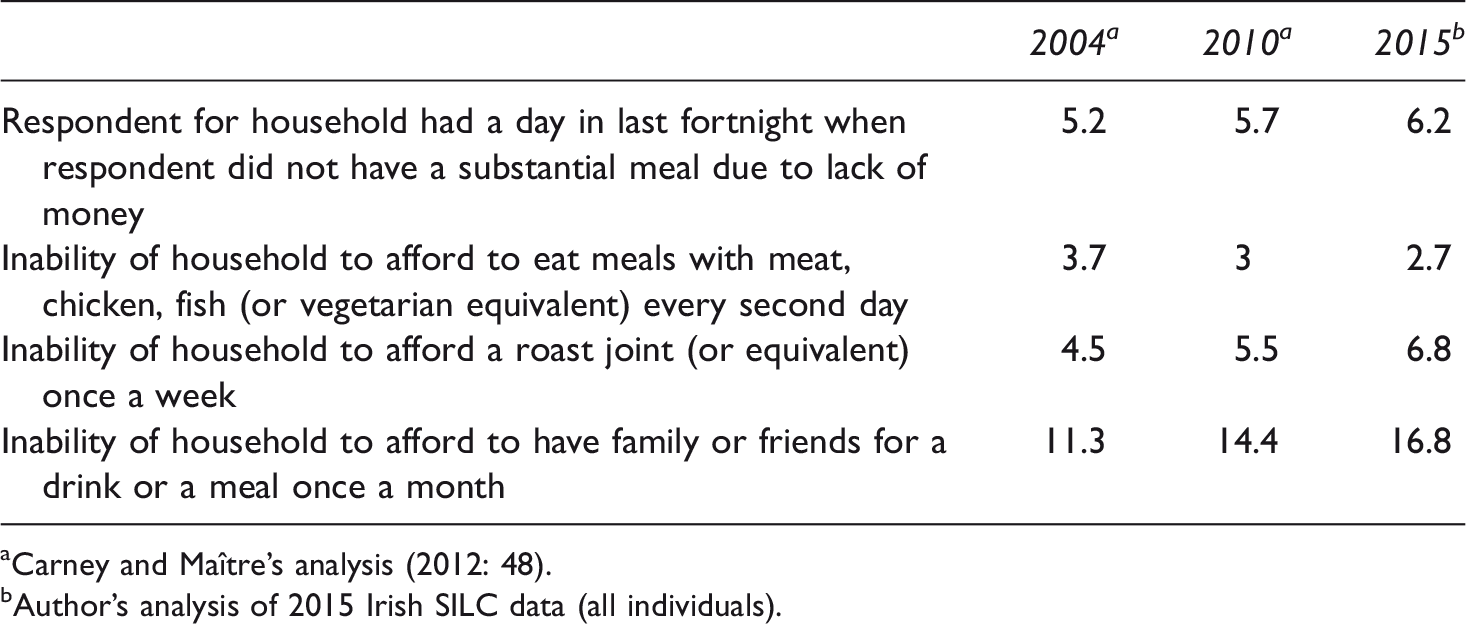
Carney and Maître's analysis (2012: 48).
Author's analysis of 2015 Irish SILC data (all individuals).
Percentage of population reporting food deprivation.
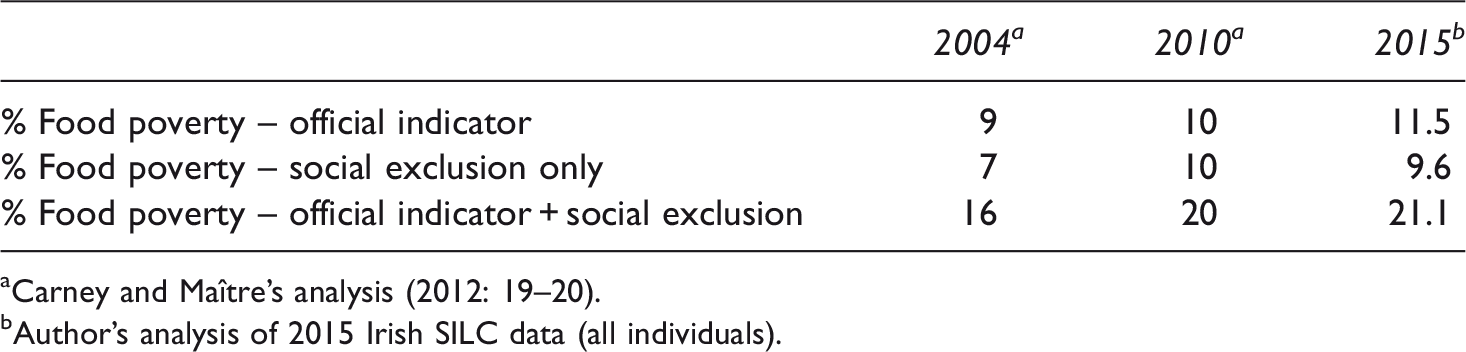
Carney and Maître's analysis (2012: 19–20).
Author's analysis of 2015 Irish SILC data (all individuals).
As is shown in Table 2, if those experiencing food poverty due to social exclusion were included in a composite indicator for “food poverty”, then the prevalence of food poverty in Ireland increases substantially. If the food poverty indicator included households as a food poverty household if they said yes to any one of the four food deprivation questions, instead of one of the three that are currently included, the prevalence of food poverty in Ireland nearly doubles; it would be 20% in 2010 and 21.1% in 2015, with an increase of 5.1 percentage points between 2004 and 2015 – the equivalent of a 32% increase (somewhat similar to what Pfeiffer et al. (2015) found in Germany using EU SILC data).
As stated before, one justification for not including the family and friend indicator in the composite measure was because the “the income and social class profile of those reporting the family and friends item differed to the profile reporting the other food deprivation items” (Carney and Maître, 2012: 22). To find out how different that group was, the following analyses separates them from the other two types of households – non-food poor and officially food poor – and compares their ability to cope on household income, their experiences of other types of deprivation, their access to household amenities related to food and key socio-demographic characteristics that are associated with risk of food poverty through social exclusion.
At the household-level, ability to make ends meet by food poverty status.
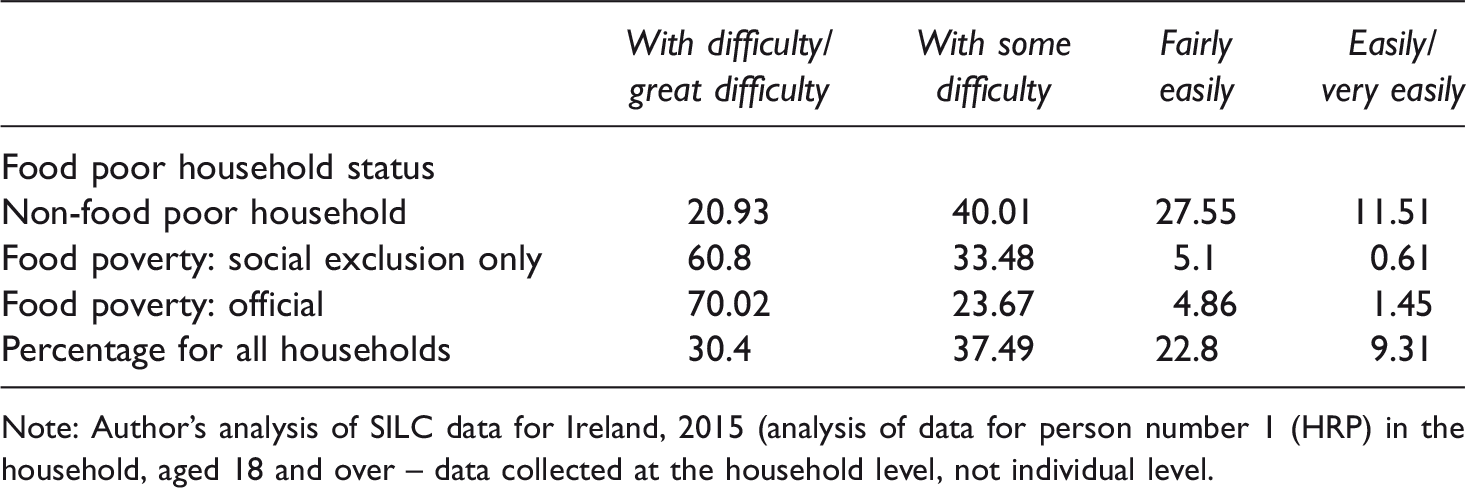
Note: Author's analysis of SILC data for Ireland, 2015 (analysis of data for person number 1 (HRP) in the household, aged 18 and over – data collected at the household level, not individual level.
For both types of households that are experiencing food poverty, approximately 60–70% are having difficulty/great difficulty coping on household income. Only 21% of non-food poor households fall into that category. Clearly, for this indicator, households that are experiencing social exclusion via food are more similar to households officially counted as experiencing food poverty than they are to non-food poor households.
Percentage experiencing other types of deprivation based on food poverty status.

Note: Author's analysis of SILC data for Ireland, 2015 (analysis of data for person number 1 (HRP) in the household, aged 18 and over – data collected at the household level, not individual level).
Generally speaking, non-food poor households are the least likely to experience any form of basic deprivation. Officially food poor households, on the other hand, are the most likely to experience all other forms of basic deprivation besides food, with those households experiencing food poverty due to social exclusion somewhere in between. The officially food poor are anywhere from 2.5 to 22 times as likely to experience the other types of basic deprivation as a non-food poor household. Those food poor due to social exclusion are anywhere from 2.5 to 8 times as likely to experience other types of basic deprivation as non-food poor households. The majority of both types of food poverty households were not able to afford to go out in the last fortnight (51–54%), were not able to afford to replace worn out furniture (52–58%) and could not afford an annual holiday (77–80%) – all very similar percentages. In comparison, in non-food poor households, only 1 in 13 could not afford to go out, 15 in 100 could not afford to replace worn out furniture and 3 in 10 could not afford an annual holiday. Overall, less than 10% of non-food poor households experience any of the remaining listed types of deprivation. Clearly, those who are food poor due to social exclusion are much more likely to be deprived than non-food poor households, providing further support that those experiencing food poverty, regardless of how it is defined, are likely to be experiencing multiple forms of deprivation (Lambie-Mumford et al., 2014; Lambie-Mumford and Dowler, 2015; Purdam et al., 2016; Riches, 2011).
Average number of other types of deprivation experienced (from remaining eight related to basic deprivation) by food poverty status (ANOVA).

Note: Author's analysis of SILC data for Ireland, 2015 (analysis of data for person number 1 (HRP) in the household, aged 18 and over – data collected at the household level, not individual level); differences significant at .001 level.
Inability to own a household appliance used for food storage or preparation due to affordability based on food poverty status.
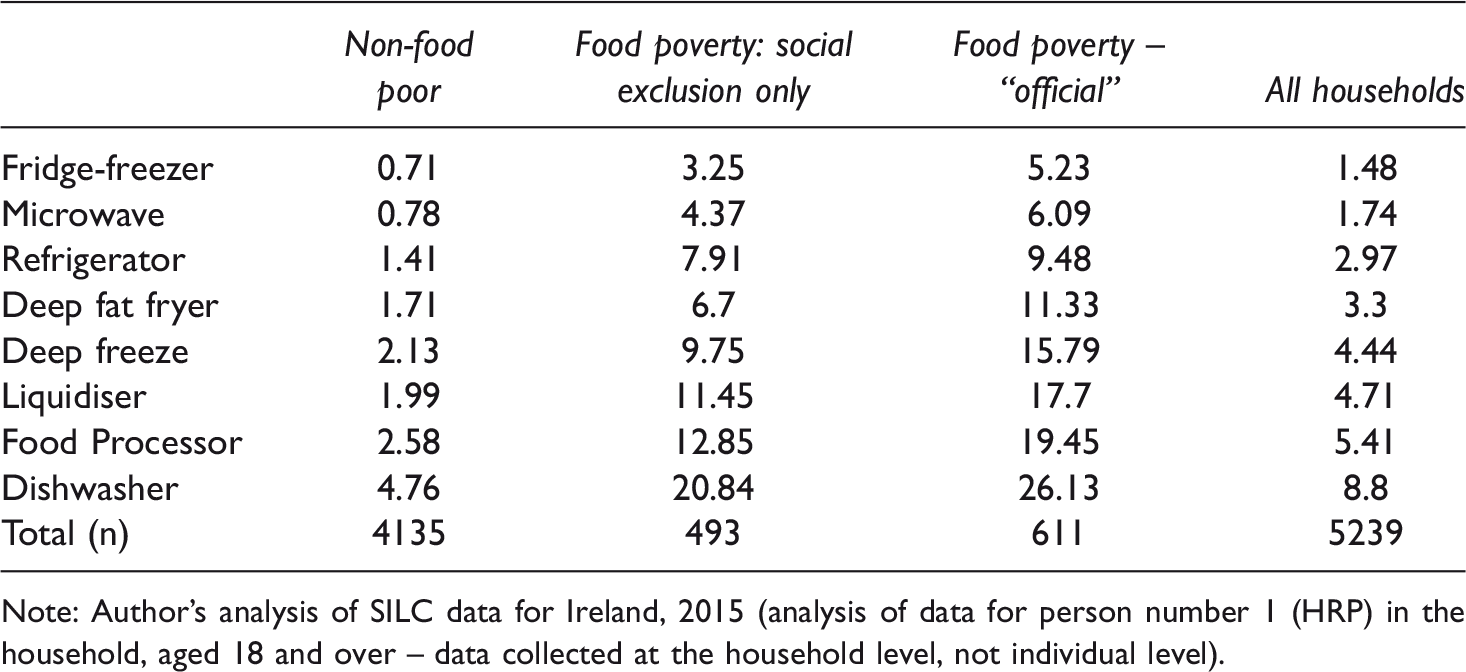
Note: Author's analysis of SILC data for Ireland, 2015 (analysis of data for person number 1 (HRP) in the household, aged 18 and over – data collected at the household level, not individual level).
From the analysis thus far, it is clear that both types of food poverty households are more likely to experience additional types of deprivation in addition to food poverty than non-food poor households, including the inability to afford desired household amenities. Therefore, from all of the analysis thus far, it is clear that officially food poor households and food poor households from social exclusion are quite similar to each other in terms of economic strain, experience of multiple deprivation and lack of household amenities for the storage, preparation and cooking/clean-up of food. They are certainly more similar to each other than they are to non-food poor households. However, according to Carney and Maître (2012), food poor households due to social exclusion were excluded from their analysis because these households are significantly different from other food poor households based on economic resources and social class. The following section presents analysis of each type of food poverty household by key socio-demographic characteristics to show which groups are most at risk. Non-food poor households are the reference category.
Results of multinomial logistic regression predicting type of food poverty household using Irish SILC data, 2015.
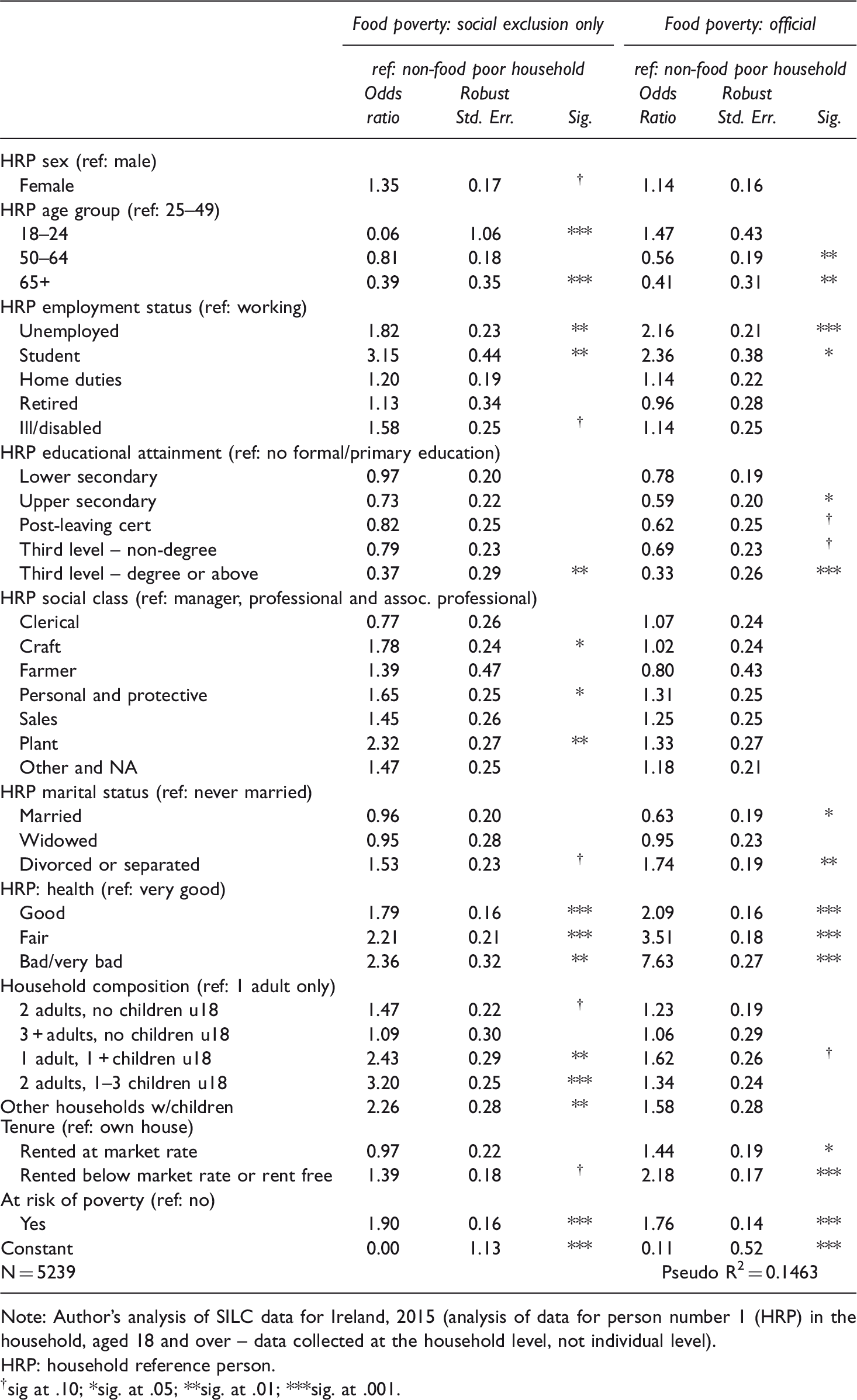
Note: Author's analysis of SILC data for Ireland, 2015 (analysis of data for person number 1 (HRP) in the household, aged 18 and over – data collected at the household level, not individual level).
HRP: household reference person.
†sig at .10; *sig. at .05; **sig. at .01; ***sig. at .001.
Starting with those who are “officially” food poor, i.e. those experiencing food poverty due to absolute, nutritional and/or cultural deprivation, the groups that seem most at risk are those under the age of 50, the unemployed, students, those who are divorced or separated, anyone whose health is not “very good”, single parents, those who rent or live in social housing and those at risk of poverty. Unexpectedly, from the literature, gender of the HRP is not interesting in differentiating this group from non-food poor households (Coakley, 2001; Daly and Leonard, 2002; Graham, 1994/5; McCashin, 1996). However, given that most single parents who live with their children are female, the risk to female single parents is most probably being captured in increased risk for single parents. The strongest risk factor for official food poverty is HRP's self-assessed health status with those reporting bad/very bad health over seven times as likely to be experiencing official food poverty as those whose self-reported health is very good. Households with an HRP aged less than 50 are more likely to experience official food poverty than households with an older HRP, possibly because of increased likelihood of children in the house, but also because older people may be able to eat better on fewer resources (safefood, 2011). Households where the HRP is a student or unemployed are more likely to experience official food poverty than households in which the HRP is working, retired, on home duties or ill/disabled. HRP's educational attainment is significantly related to likelihood of experiencing official food poverty with additional levels of education attained reducing the likelihood of experiencing official food poverty. Therefore, as would be expected, socio-economic status and education are negatively related to official poverty. Households in which the HRP is married are the least likely to experience official food poverty, while those with an HRP who is divorced or separated are the most likely. Lone parents are the only household composition that is significantly more likely to be experiencing official food poverty than a single adult household, as would be expected from literature on parenting and food poverty (Graham, 1994/5; McCashin, 1996; safefood, 2011). Households that own their own home are less likely to experience official food poverty than households that rent or are in social housing. Households classified as being at risk of poverty are also more likely than households not at risk to be experiencing official food poverty. Most of these findings are quite similar to Carney and Maître's analysis (2012), suggesting that many of the risk groups have not changed significantly in the past five years. However, what is different to Carney and Maître's analysis is that occupational groups are not significantly different from each other in predicting official food poverty status – the significant difference is between those working and those not working, specifically the unemployed and students.
The groups that are more at risk of food poverty due to social exclusion are somewhat different than those experiencing “official” food poverty relative to non-food poor households, but there is overlap. The strongest predictors associated with food poverty through social exclusion are household composition and employment status. Those having a household composition of two adults and children OR an HRP who is a student are over three times as likely to be experiencing food poverty through social exclusion vis-a-vis the reference category (single adult household and working HRP, respectively). The other groups that are most at risk include: women; adults aged 25–49; those who are unemployed or ill/disabled; the “working poor” including those working in craft, personal and protective services or plant jobs; divorced and separated heads of households; everyone with a health status less than “very good”; all households with children; those living in social housing; and those at risk of poverty. As opposed to those experiencing official food poverty, gender is interesting in differentiating food poor households through social exclusion from non-food poor households with female HRPs being more likely than male HRPs to suffer social exclusion due to food, as would be expected from the literature (Coakley, 2001; Daly and Leonard, 2002; Graham, 1994/5; McCashin, 1996). In terms of age, food poverty through social exclusion is most likely in households in which the HRP is aged 25–49 with the young (18–24) and the old (65+) being significantly less likely. In terms of employment status, in addition to HRPs that are students, HRPs that are unemployed or ill/disabled are also more likely to experience food poverty through exclusion than households with a working, retired, or at home HRP, highlighting the multiple types of exclusion that are often associated with food poverty. HRP's educational attainment is only interesting in differentiating those with third-level qualifications from all others; those with third-level qualifications are significantly less likely to experience food poverty through social exclusion. As opposed to officially food poor households, social class vis-a-vis occupation is a risk factor for food poverty due to exclusion; households with an HRP working in occupations often associated with the “working poor” – craft workers, personal and protective workers, plant workers – are all more likely to experience food poverty through exclusion than those in other types of occupations, supporting findings of earlier critical research (Friel et al., 2006; Vincentian Partnership for Social Justice, 2002). As with official food poverty, households with HRPs with very good health are less likely to be experiencing food poverty through exclusion than those in which the HRP's health is good, fair, or bad/very bad. All households with children are more likely to experience this type of food poverty than single adult and multiple adult (3+) households, similar to the “austerity effect” described by O'Connell et al. (2018), as are households living in social housing versus other types of tenancy. Unsurprisingly, those at risk of poverty are also more likely to experience food poverty through social exclusion than those not at risk, as was found with official food poverty.
Conclusion
Food poverty is a complex, multi-faceted concept that overlaps with other important issues such as food security, food sovereignty and, from an even broader perspective, social justice. While it is about insufficient calories and nutrients, it is also about not having secure access to enough culturally acceptable food in a culturally acceptable way. For people to escape food poverty, they need access to stores, to affordable foods, to income and to adequate housing that provides appliances necessary to store, prepare, cook and eat food. Given that food also plays an important role in social life, food poverty is also about the inability to participate in normal activities that include food, such as inviting friends and family over for a meal. Admittedly, it is challenging – probably impossible – to include all of the possible facets of food poverty in one indicator. As such, an argument could be made that different measurable facets or types of food poverty should be presented separately to give a more complete picture of food poverty in Ireland, though relevant data are sparse.
At present, there is one official food poverty indicator in Ireland that is used to track food poverty over time. Three indicators from the Irish SILC have been combined to make the official Irish food poverty indicator, indicators representing absolute, nutritional and cultural food deprivation. As such, the resultant indicator is focused on food consumption only, more reminiscent of food security indicators that are used to track absolute deprivation in the developing world than an indicator to track relative deprivation and social exclusion within the developed world. By focusing only on food consumption, the indicator ignores other important aspects of food poverty.
To provide a more comprehensive picture of food poverty in Ireland, this analysis has also analysed SILC data and has included an additional food deprivation variable – one representing social exclusion vis-a-vis food. Two types of food poverty households have been analysed: those considered food poor using the official Irish indicator and those not recognised as officially food poor households but who experience social exclusion vis-a-vis food. In comparison with non-food poor households, both groups are likely to suffer multiple socio-demographic deprivations in addition to food poverty. Both groups are also less able to afford many household appliances necessary for cooking, food storage and cleaning than non-food poor households. As such, individuals experiencing both types of food poverty are not able to access food in a way that is considered culturally acceptable and normal in Ireland. In terms of risk groups, the risks of both types of food poverty are higher in groups that are most often associated with poverty and social exclusion: those living on low income, the unemployed, students, single parents and those in social housing. However, there are other groups who are at risk of food poverty due to social exclusion that are hidden when only defining food poverty in terms of food consumption: women, all households with children, households with HRPs unable to work due to illness/disability, or (if working) with HRPs in occupations often associated with the working poor.
If official food poverty statistics also included those who experience social exclusion vis-a-vis food, then the prevalence of food poverty in Ireland would nearly double – from one in nine households to at least one in five – even though it still excludes groups like travellers, asylum seekers and the homeless, groups who are all considered to be at risk of experiencing food poverty. On statistical grounds, there is presumably a discomfort in building an indicator that is so dependent on one variable. On substantive grounds, even though it is only adding one element to the way that food poverty is measured in Ireland, it makes the situation regarding food poverty in Ireland appear much starker. Also, it would totally reframe the policy issue of food poverty in Ireland today. As discussed by food poverty scholars such as Dowler and O'Connor (2012), Lambie-Mumford et al. (2014), O'Connell et al. (2018), Riches (2011) and Tarasuk (2001), if we frame food poverty only in terms of food deprivation – sufficiency, adequacy, even cultural appropriateness – then the only necessary solution really is to give people more nutritious and culturally acceptable food, something that is currently being done to the best of their abilities in Ireland through voluntary food banks and redistribution networks (though tea bags, tinned beans and digestive biscuits replace roast joints in terms of cultural appropriateness). If, however, food poverty is framed in terms of social exclusion, rights, and social justice, then the solutions are much broader and inclusive, such as affordable food, adequate housing and living wages. We need to reframe the way we think about food poverty in Ireland.
Footnotes
Acknowledgements
Previous versions of this paper were presented at the Sociological Association of Ireland Conference at DIT Grangegorman, Dublin, Ireland, on 19 May 2018 and at the Midwest Simon Community's “Rise Together”, Thomond Park, Limerick, Ireland, on 18 November 2017. Many thanks to the anonymous reviewers who provided such valuable commentary and helped make this a better paper.
Declaration of conflicting interests
The author(s) declared no potential conflicts of interest with respect to the research, authorship, and/or publication of this article.
Funding
The author(s) received no financial support for the research, authorship, and/or publication of this article.