



Abstract
The aim of the current study was to explore bystander experiences during bullying episodes among children and youth attending a residential summer camp by investigating rates of witnessing and intervention, as well as individual motivations and characteristics associated with bystander intervention. The majority of children had witnessed bullying at least once in the past 3 weeks and reported intervening in some way. Among children who reported intervening, the strongest motivation appeared to be a sense of social justice. Among children who reported not intervening, the strongest motivation appeared to be the feeling that it was not their place to intervene because the bullying situation did not directly involve them and/or was not extremely severe. The determining factors for bystander intervention during bullying episodes differed between genders. Social self-efficacy predicted bystander intervention among girls, while empathy and attitudes about bullying predicted bystander intervention among boys. Implications for bullying prevention are discussed.
Bullying is common among Canadian children and associated with many negative outcomes. Roughly one third of children report each of bullying and victimization and most students in middle and high school (63%-73%) report witnessing bullying episodes (Molcho et al., 2009; Oh & Hazler, 2009; Rivers, Poteat, Noret, & Ashurst, 2009; Salmivalli, Lagerspetz, Björkqvist, Österman, & Kaukiainen, 1996). Bullying can take many forms including physical (e.g., hitting), verbal (e.g., name calling), and social (e.g., gossiping; PREVNet Assessment Working Group, 2008). Among school-aged children, verbal and social forms are most common (Scheithauer, Hayer, Petermann, & Jugert, 2006; Woods & White, 2005). Peer victimization is associated with internalizing and externalizing mental health problems, social problems, academic difficulties, and school avoidance (Delfabbro et al., 2006; Forero, McLellan, Rissel, & Bauman, 1999; Mitchell, Ybarra, & Finkelhor, 2007; Nansel et al., 2001; Ybarra & Mitchell, 2004, 2007).
Peer interventions are very effective during bullying episodes. Bystanders have the power to either stop or prolong bullying episodes (Craig & Pepler, 1995, 1997; Craig, Pepler, & Blais, 2007; O’Connell, Pepler, & Craig, 1999; Salmivalli et al., 1996). The more peers who gather to watch a bullying episode, the longer the episode tends to last, as the child who is bullying is reinforced by the bystanders’ attention (O’Connell et al., 1999). Observational research indicates that when bystanders stand up for the child being victimized, these peer interventions immediately stop the bullying over 50% of the time (Hawkins, Pepler, & Craig, 2001). Similarly, when victimized students report that peers intervened during a bullying episode, they rate the interventions as successful in stopping bullying almost half the time (Fekkes, Pijpers, & Verloove-Vanhorick, 2005).
Although children tend to want to help victimized peers during bullying episodes, they typically do not take action to defend the child being victimized. Most students hold antibullying and provictim attitudes as well as the belief that they would defend peers if/when witnessing bullying; however, only 17% to 46% of students report having actually intervened during a bullying episode (Nickerson, Mele, & Princiotta, 2008; Poyhonen & Salmivalli, 2008; Rigby & Johnson, 2006; Salmivalli et al., 1996). Helpful bystander behaviours tend to decline and proaggression attitudes tend to increase with age (Endresen & Olweus, 2001; Rogers & Tisak, 1996; Stevens, Van Oost, & de Bourdeaudhuij, 2000; Tisak & Tisak, 1996). Salmivalli and colleagues (1996) have found that most children play one of four participant roles during bullying episodes, in addition to the roles of bully and victim: assistant to the bully, reinforcer of the bully, outsider, and defender of the victim. These researchers found that among middle school students, the distribution of roles was as follows: 20% to 30% were assistants or reinforcers, 26% to 30% were outsiders, and about 20% were defenders (Salmivalli, Lappalainen, & Lagerspetz, 1998).
There is little research on individual motivations for bystander intervention during bullying episodes among children. There has been some speculation among researchers, however, regarding motivations for failing to intervene. Hazler (1996) asserted that passive bystanders tend to refrain from intervening because they are not sure what to do, they are afraid of becoming the focus of the child who is bullying, or they are afraid they will make the situation worse rather than better. Salmivalli (2010) has suggested that lack of intervention during bullying episodes may result from the “classical bystander effect,” whereby bystanders are less likely to intervene if other individuals are also witnessing the potentially harmful situation (Darley & Latané, 1968; Salmivalli, 2010). In the case of bullying among children, bystanders may feel that the presence of others absolves them from being responsible for intervening (i.e., “diffusion of responsibility” effect; Darley and Latané, 1968) or they may view the lack of action from others as a sign that intervention is unnecessary (Salmivalli, 2010). It may also be that when peers do not intervene, this modeling creates a group norm that would be difficult for some children to violate.
A number of individual characteristics have recently been identified as potential correlates and predictors of bystander intervention (or lack thereof) among youth. These constructs include empathy, social self-efficacy, and attitudes about bullying and victimization (Gini, Albiero, Benelli, & Altoe, 2008; Nickerson et al., 2008; Stevens et al., 2000). Empathy, also referred to as empathetic concern, refers to one’s ability to emotionally respond with feelings of concern for another and a desire to alleviate that person’s distress (Davis, 1983; Nickerson et al., 2008; Olweus & Endresen, 1998). Social self-efficacy refers to an individual’s belief in his or her ability to influence social relationships (Bandura, 1997; Gini et al., 2008). Attitudes about bullying refer to one’s sympathy (or lack thereof) for children who bully and one’s opinion (or lack thereof) that victimized children are weak. Conversely, attitudes about victimization refer to one’s empathy and supportive feelings toward children who are victimized (Andreou, Vlachou, & Didaskalou, 2005; Stevens et al., 2000). Although all of these characteristics have been found to be associated with bystander behaviour, they have not been investigated together to examine their relative (and potentially cumulative) contributions to bystander intervention among children.
The aim of the current study was to investigate bystander experiences, characteristics, and motivations during bullying episodes among children and youth. The first goal was to examine rates of witnessing for physical, verbal, and social forms of bullying. The second goal was to investigate bystander intervention rates and motivations during bullying episodes. The third goal was to explore the relative contributions of individual characteristics to bystander intervention behaviours among children and youth. There is a need for more research to help us understand what facilitates and hinders intervention during bullying episodes among children and youth to guide the development of bullying prevention programs that effectively support children to intervene.
Method
Participants
Participants included 108 children and youth ranging from 8 to 16 years old attending an overnight summer camp in Ontario, Canada (44 girls and 64 boys; mean age = 12.5 years, SD = 1.97 years). This summer camp has explicit policies about bullying as well as comprehensive bullying prevention and intervention education and programming for all staff, counsellors, and campers. With respect to bullying prevention, camp counsellors and staff attend an experiential precamp training workshop that focuses on raising awareness, understanding, and empathy regarding bullying, with a concentration on gender differences as well as prevention and intervention tools. The topics of bullying and social safety are also discussed frequently with the campers and confidential safety questionnaires are administered to campers during each camp session to ensure that everyone feels safe at camp. With respect to intervention, a stepwise protocol is in place that begins with soft “no-blame” relationship counselling and progresses (when necessary) through various consequences (e.g., loss of privileges).
Consent forms describing the current research project were sent to parents before their children attended camp. Children required active parental consent, as well as their own assent, to be eligible to participate in the current research. Every child with a returned parent consent form (regardless of whether or not the parent consented) was entered into a raffle for an iPod. Researchers visited the camp to administer the questionnaires to eligible children 3 weeks after the camp session had started. Due to the sensitive nature of the research, we included a question at the end of the package inviting children to indicate whether they would like to talk about issues raised in the questionnaires (Yuile, Pepler, Craig, & Connolly, 2006). Any questionnaire indicating that participants wanted to speak further about their bullying experiences with an adult was to be flagged and passed on to the camp director for follow-up.
Measures
Promoting Relationships and Eliminating Violence Network Assessment Tool—Child/Adolescent Version
The PREVNet tool assesses bullying, victimization, and bystander experiences among children and youth (PREVNet tool; PREVNet Assessment Working Group, 2008). The sections pertaining to bystander experiences were used for this study to assess rates of witnessing and motivations for intervening (or not intervening). The survey provides age appropriate definitions of each form of bullying (physical, verbal, and social). Physical bullying is defined as “when someone hits, shoves, kicks, spits at, or beats up on others.” Verbal bullying is defined as “using words to call someone names, make fun of them, or tease them in a mean way, humiliate someone or make them feel stupid, or threaten someone.” Social bullying is defined as “not letting someone join the group, gossiping or spreading rumours about someone or making sure others don’t make friends with the person.” Cyber bullying was not included because there are strictly enforced camp rules preventing the possession and use of communication devices at camp.
Children are asked to indicate how often they have witnessed each form of bullying in the past month by choosing one of five possible responses: never (0), once or twice (1), two or three times (2), once per week (3), and several times per week (4). In the current study, the time frame was “since camp started,” which was 3 weeks prior. Children are also asked the following question: “Think of the last time you saw or heard someone being bullied. Did you try to stop it?” For each answer option (i.e., yes or no), a list of potential reasons for the decision is provided and children are asked to check off all that apply as well as add any additional reasons not listed. Potential reasons for intervening (i.e., answering yes) include, “It was not fair,” “I wanted to help,” and “No one deserves to be bullied.” Potential reasons for not intervening (i.e., answering no) include, “I didn’t want to get involved,” “I was afraid,” “It wasn’t my problem,” and “I was worried I would get bullied next.”
Empathetic Responsiveness Questionnaire (ERQ)
This scale is a self-report questionnaire for children and youth that assesses empathy regarding bullying and victimization (Olweus & Endresen, 1998). The ERQ includes 12 items and three subscales: Empathic Concern for Girls (e.g., “When I see a girl who is hurt, I wish to help her,” “Seeing a girl who can’t find anyone to be with makes me feel sorry for her”), Empathic Concern for Boys (e.g., “When I see a boy who is distressed I sometimes feel like crying,” “Seeing a boy who is sad makes me want to comfort him”), and Empathic Distress (e.g., “It often makes me distressed when I see something sad on TV,” “Sometimes I feel a bit distressed when I read or hear about something sad”). Responses are indicated on a 5-point Likert-type scale ranging from not true (1) to very true (5). In the current study, a mean score was computed to create an overall empathy score, with higher scores indicating more empathy. Studies have indicated that the ERQ overall mean score has high internal consistency (alphas range from .92 to .95; Manger et al., 2001; Olweus & Endresen, 1998).
Social self-efficacy Scale
This scale measures children’s perceptions of their competence and assertiveness during social situations (Pastorelli, Caprara, & Bandura, 1998). The scale includes seven items (e.g., “How easy is it for you to say what you think, even if your friends do not agree with you?,” “How easy is it for you to express your personal opinions in a group?”) and responses are indicated on a 5-point Likert-type scale ranging from not able/easy at all (1) to very able/easy (5). In the current study, a mean score was calculated to index overall self-efficacy, with higher scores indicating higher levels of perceived self-efficacy. In past studies, internal consistency of the scale was adequate (α = .72; Pastorelli et al., 1998).
Probully and Provictim Scales
These scales index children’s attitudes about bullying and victimization (Stevens et al., 2000). The Probully scale includes nine items that reflect sympathy and understanding for children who bully (e.g., “It is fun to encourage bullying”) and an outlook that children who are victimized are weak (e.g., “Kids who are picked on annoy others”). The Provictim scale includes seven items that reflect empathy toward children who are victimized (e.g., “I’m upset when another kid is being bullied”) and an outlook that these children deserve to be supported (e.g., “Kids who intervene in bullying incidents are brave”). Responses are provided via a 5-point Likert-type scale that ranges from totally disagree (1) to unsure (3) to totally agree (5). In the current study, responses for the nine items in the Probully scale were reverse coded, that is, responses ranged from totally disagree (5) to totally agree (1), such that higher scores represented lower levels of probully attitudes. Mean scores were then calculated for the Probully and Provictim scales, with higher scores indicating more negative (i.e., lower levels of) probully attitudes and higher levels of provictim attitudes, respectively. Previous research indicates that internal consistency is adequate for both the probully and provictim scales (α = .71 and .69, respectively; Andreou et al., 2005).
Results
Rates of Bystander Experiences
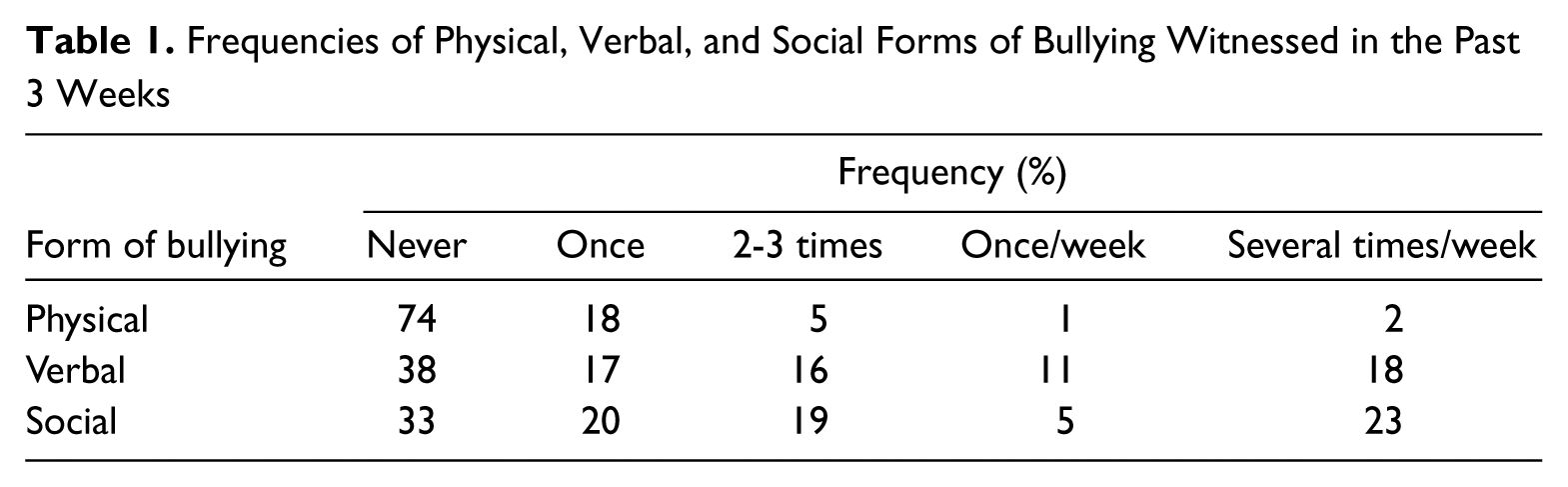
Social bullying was most common, witnessed by about 67% of children at least once in the past 3 weeks and 23% of children several times per week. Verbal bullying was also prevalent, witnessed by about 62% of children at least once and 18% of children several times per week. Least common was physical bullying, which was witnessed by about 26% of children at least once and 2% of children two to three times per week. Frequencies for each form of bullying witnessed at camp are presented in Table 1.
Frequencies of Physical, Verbal, and Social Forms of Bullying Witnessed in the Past 3 Weeks
Bystander Intervention Rates and Motivations
When asked whether they intervened during the last bullying episode they witnessed, about 80% of the children reported that they did intervene, while 20% reported they did not. Intervention rates were not associated with child age (r = –.17, p = .09) and did not differ between boys and girls, (χ2(1) = 2.03, df = 1, p = .15).
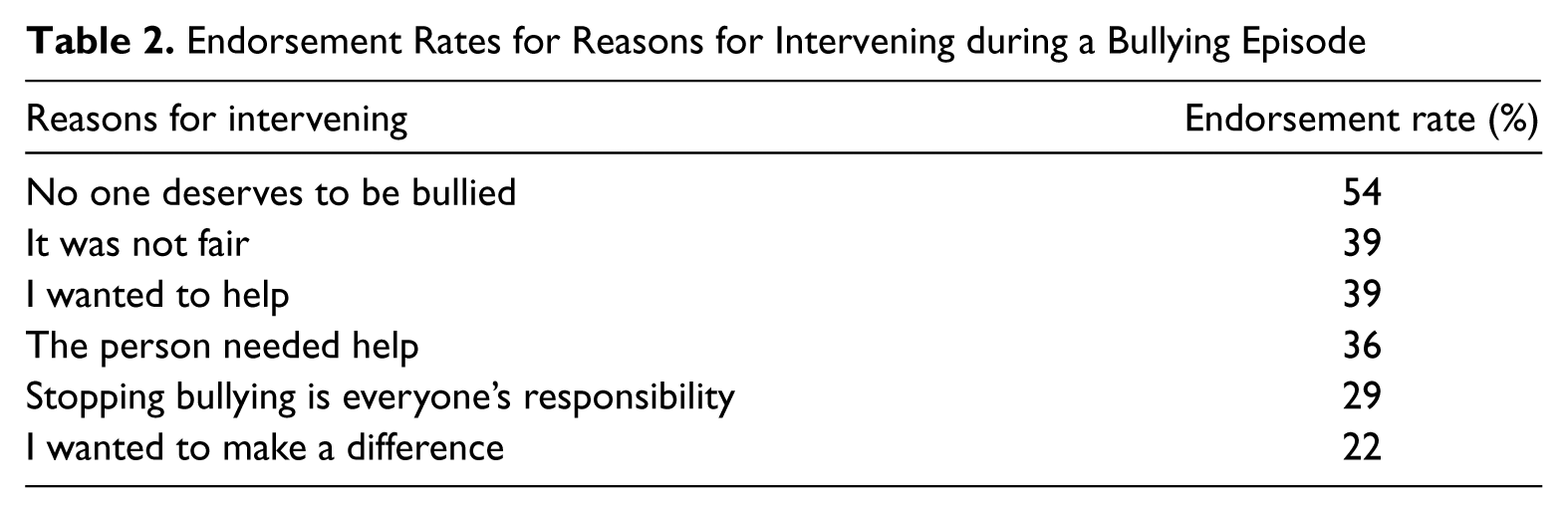
Children who reported intervening were provided with a list of potential reasons for their decision and asked to check off all that applied. Most (68%) agreed with the statement that no one deserves to be bullied and 50% agreed with the statement that bullying was not fair. In addition, 50% reported that they wanted to help and 45% reported that the person (i.e., the child being victimized) needed help. Endorsement rates for the listed potential reasons for intervening are presented in Table 2.
Endorsement Rates for Reasons for Intervening during a Bullying Episode
Children who reported not intervening were also provided with a list of potential reasons for their decision and asked to check off all that applied. Most (57%) of these children indicated they did not want to get involved and a roughly one quarter (24%) reported that they were afraid. Endorsement rates for the listed potential reasons for not intervening are presented in Table 3.
Endorsement Rates for Reasons for Not Intervening during a Bullying Episode

Predictors of Bystander Intervention by Gender
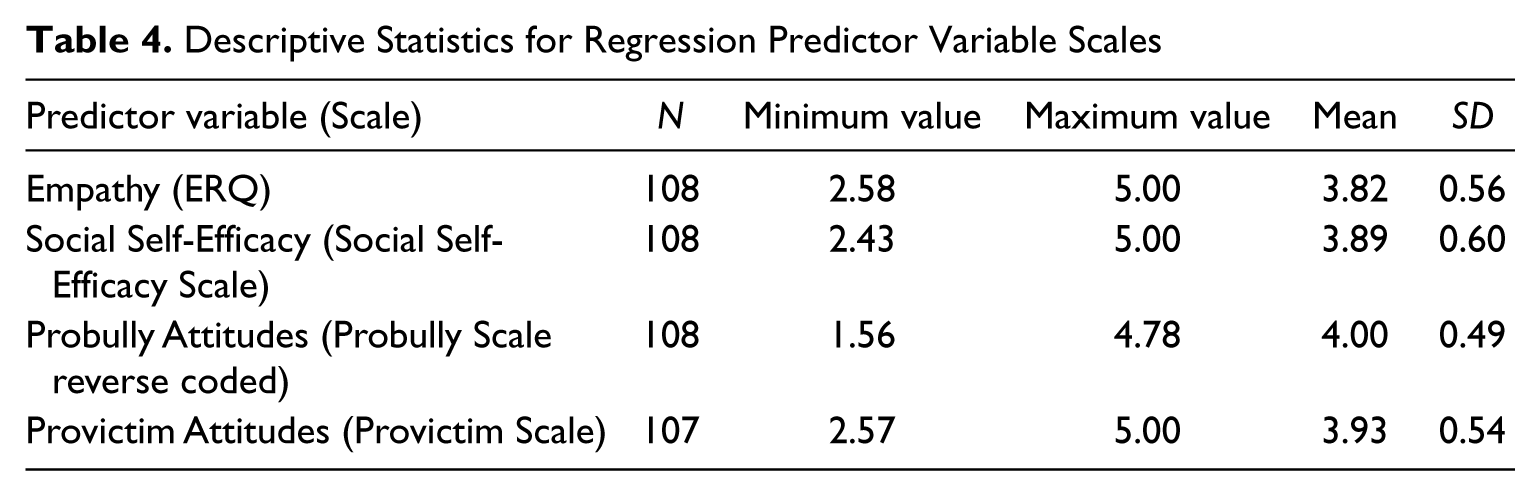
Binary logistic regression analyses were conducted to examine the prediction of bystander intervention by age, empathy, social self-efficacy, and attitudes about bullying and victimization. Descriptive statistics for the scales used to index these variables are provided in Table 4. The regressions were conducted separately for each gender because with respect to proportion of aggressive behaviours, girls and boys tend to engage in different forms of bullying (covert and overt, respectively) most frequently (Card, Stucky, Sawalani, & Little, 2008). All of the variables were entered simultaneously into one model for each gender. The models were significant for both girls, (χ2 = 11.89, df = 5, p < .05), and boys, (χ2 = 25.30, df = 5, p < .001). Regression results are provided in Table 5.
Descriptive Statistics for Regression Predictor Variable Scales
Binomial Logistic Regression Results for Predictors of Bullying Bystander Intervention for Girls and Boys
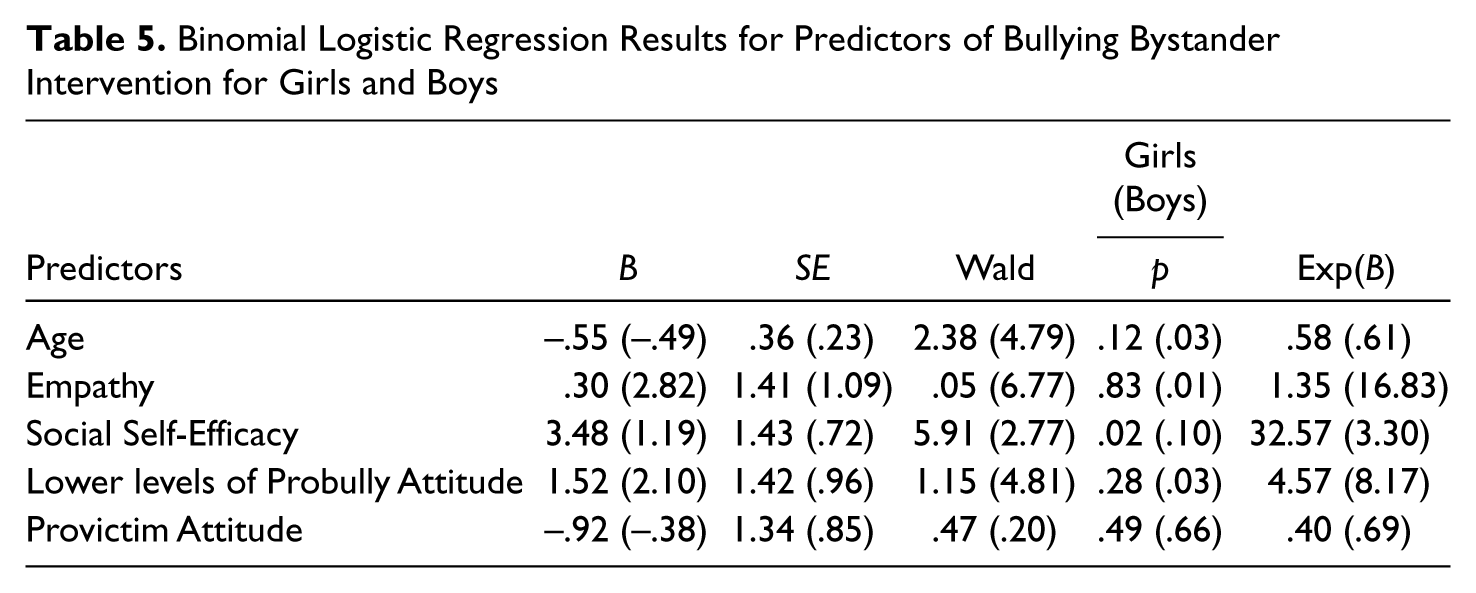
Girls who reported high levels of social self-efficacy were 32 times more likely than other girls to report that they had intervened during the last bullying episode they witnessed. When the roles of social self-efficacy, empathy, and attitude about bullying were all considered simultaneously, empathy and attitudes toward bullying were not significant in predicting intervention. Boys who reported high levels of empathy were about 17 times more likely than other boys to report that they had intervened during the last bullying episode they witnessed, and boys who reported low levels of probully attitudes were about 8 times more likely to report that they had intervened. When all three characteristics were considered simultaneously, the level of boys’ social self-efficacy was not significant in predicting intervention.
Discussion
The majority of children had witnessed bullying at least once in the past 3 weeks, and reported intervening in some way. Among children who reported intervening, the strongest motivation appeared to be a sense of social justice. Among children who reported not intervening, the strongest motivation appeared to be the feeling that it was not their place to intervene because the bullying situation did not directly involve them and/or was not extremely severe. The determining factors for bystander intervention during bullying episodes differed between genders. Social self-efficacy predicted bystander intervention among girls, while empathy and attitudes about bullying predicted bystander intervention among boys.
Almost 70% of the children reported witnessing at least one form of bullying at least once in the past 3 weeks. This rate is higher than those typically found in the bullying literature (Molcho et al., 2009). This may reflect the large amount of time spent with peers when attending overnight camp. At the time when this research was conducted, the children had been together (and observing peer interactions) all day, every day, over the past few weeks. Consistent with the literature, verbal and social forms of bullying were more common than physical forms, with more than 60% of children witnessing each (Craig & Pepler, 1997; Scheithauer et al., 2006; Woods & White, 2005). Verbal and social forms of bullying are predominant as children become older and realize that these forms are equally or more effective than physical forms for hurting others (Rivers & Smith, 1994; Woods & White, 2005). Verbal and social forms of bullying are also common because they are more likely to escape detection from adults than physical forms (Sutton, Smith, & Swettenham, 1999).
The rate of bystander intervention during bullying episodes (80%) was also high within this sample of children. Previous research studies using observational data, self-report surveys, and peer nomination procedures have all indicated peer intervention rates of 17% to 25% during bullying episodes (Hawkins et al., 2001; O’Connell et al., 1999; Salmivalli et al., 1998). The high rate of intervention in the current study (via self-report) is likely attributable to the particular camp setting, which has implemented a well-established bullying prevention program for more than 10 years. In addition, there has been considerable attention and strong messaging aimed at children and youth to stand up to bullying in the past 10 years. Thus this high rate of intervention may also reflect a historical effect, since children in the present study have likely received more education about bullying and may feel a greater sense of social responsibility to intervene when compared to children in previous studies conducted a decade ago.
Among the children who reported intervening when witnessing bullying, it appears that a sense of social justice is the strongest motive for standing up for others. When children who reported intervening were asked to indicate the reason(s) for their decision, most reported that they intervened because no one deserves to be bullied and/or bullying is not fair. The instinct to help others in distress also appears to be a powerful motivator, as many children reported they intervened because they wanted to help the child being victimized and/or that the child being victimized needed help.
Among the children who reported not intervening when they witnessed bullying, most reported that they did not act because they felt it was not their place because the bullying situation did not directly involve them and/or was not extremely severe. This finding speaks to the relevance of the classic bystander effect for bullying among children (Salmivalli, 2010). Many of these children also indicated that they did not intervene because they were afraid. The fear of standing up, and perhaps consequently becoming targeted or voicing a potentially unpopular opinion, likely prevents some children from intervening.
The determining factors for bystander intervention during bullying episodes differed for girls and boys. Social self-efficacy predicted bystander intervention among girls, regardless of empathy and attitudes about bullying. Girls who reported high levels of social self-efficacy were 32 times more likely than other girls to report intervening during the last bullying episode they witnessed. In contrast, empathy and attitudes about bullying predicted bystander intervention among boys, regardless of social self-efficacy. Boys who reported high levels of empathy were about 17 times more likely than other boys to report intervening during the last bullying episode they witnessed, and boys who reported low levels of probully attitudes were about 8 times more likely to report intervening in bullying. The different characteristics associated with bullying intervention behaviours for girls and boys may reflect well-established gender differences in aggression, since youth tend to intervene more often in same- than in opposite-sex bullying (Hawkins et al., 2001). As a proportion of aggressive behaviours, girls are more likely to exhibit more covert forms of aggression (e.g., social) and boys are more likely to exhibit overt forms (e.g., physical; Card et al., 2008).
Implications for Bullying Prevention Programs
These findings suggest that bullying prevention programs can encourage bystander intervention by addressing issues of social justice, emphasizing that no one deserves to be bullied and bullying is always wrong and unfair, as well as the importance of helping others when they are in trouble. It may also be effective to focus on bullying as a community problem (i.e., everyone’s business) and implement school policies that increase personal feelings of responsibility and accountability for intervening during bullying episodes in an effort to mobilize children who would not typically feel inclined to intervene.
These findings also suggest that bullying prevention programs would benefit from gender specific components that focus on empowering bystanders. Perhaps targeting social self-efficacy is the most effective intervention goal for the covert forms of bullying (i.e., social) predominant among girls, while targeting empathy and negative opinions of bullying are the most important intervention goals for overt forms of bullying (i.e., physical and verbal) predominant among boys.
Although empowering children to intervene during bullying episodes is important for bullying prevention, successful bullying prevention and/or intervention requires effective leadership and support from adults. Children cannot intervene successfully unless adults are actively and effectively supporting bystanders as well as children who are at risk for bullying others and/or being victimized. Research from across the world has indicated that teachers must be explicitly trained with respect to healthy and unhealthy peer relationships to be effective in promoting positive relationships and preventing negative peer dynamics such as bullying (Pepler & Craig, 2008). Effective prevention programs should include the following critical components for socializing adults (e.g., parents and teachers): scaffolding, social architecture, and self-awareness (Pepler, 2006; Pepler, Craig, & Cummings, 2009). Scaffolding involves coaching children and tailoring support as they struggle with complex social issues such as bullying others and/or being bullied (Pepler, 2006). Social architecture involves actively imposing organization and structure during children’s interactions and activities. Social architecture requires focusing on the social dynamics within children’s groups and creating social contexts that will likely promote positive peer interactions and reduce the potential for aggressive interactions (e.g., sports teams created at random by a socializing adult, rather than by team captains; Pepler, 2006; Pepler et al., 2009). Self-awareness is crucial among adults who interact with children, to ensure their social interactions and relationships with other adults and children are appropriate for modeling healthy and positive relationships (Pepler et al., 2009).
Study Limitations
The convenience sampling employed in this study limits the generalizability of the results. The sample includes children and youth attending a particular overnight summer camp in Ontario, Canada, which has a history of implementing formal policies about bullying for all camp community members (campers, counsellors, etc.). Although the generalizability of these results is limited, the findings provide preliminary information for future studies of bullying bystander intervention among children. Another limitation within this study is the exclusive use of self-report survey data. Children responded to closed-answer questions about bystander behaviours, which did not allow for further qualitative exploration. In addition, findings based solely on self-report data must be interpreted with caution because of shared method variance, given that students were the only ones reporting their own behaviours across all of the scales and items in the survey. Despite these limitations, self-report surveys are effective for assessing behaviours, feelings, and opinions among children. Since involvement in bullying represents a private experience that many students do not report to others, self-report data are essential for indexing these experiences.
Future Directions
Future research on bullying bystander behaviours among children should focus on comparing rates of bullying and bystander intervention at summer camps that have formal bullying prevention programs with summer camps that do not have these programs. The depth and scope of the bullying prevention program within the camp curriculum and the number of years the camp has employed the program should be considered. Future research should also look at the effectiveness of various intervention programs within summer camps based on intervention goals, focusing particularly on gender and age effects. More generally, future research on bullying bystander behaviours among children should include prospective data that index stability and change over several data points within a year and over the important developmental stages of childhood and adolescence. If this research is undertaken within overnight camps, the prospective data should index stability and change over several data points within the camp term (often 1 month) and across summers for each camper.
Summary and Conclusions
Most of the children in this study had witnessed bullying at least once in the past 3 weeks and reported intervening. A sense of social justice appeared to be the strongest motivation for intervention, while those who did not intervene tended to feel it was not their place. The determining factors for bystander intervention during bullying episodes differed between genders, indicating that bullying prevention efforts are likely most effective when gender is considered. It is important to note that although empowering children to intervene during bullying episodes is important for bullying prevention, it is not sufficient. Children cannot intervene successfully unless adults are actively and effectively supporting bystanders as well as children who are at risk for bullying others and/or being victimized.
Footnotes
Declaration of Conflicting Interests
The author(s) declared no potential conflicts of interest with respect to the research, authorship, and/or publication of this article.
Funding
The author(s) disclosed receipt of the following financial support for the research, authorship, and/or publication of this article: M. Catherine Cappadocia was supported during the preparation of this article by The Provincial Centre of Excellence for Child and Youth Mental Health at CHEO Graduate Award, Canadian Institutes of Health Research (CIHR) Frederick Banting and Charles Best Canada Graduate Scholarships Doctoral Award, and MITACS Accelerate Research Internship Award. Debra Pepler, Joanne G. Cummings, and Wendy Craig were supported by Networks of Centres of Excellence through its support of PREVNet (Promoting Relationships and Eliminating Violence Network). This research was conducted in collaboration with Family Channel and Camp Arowhon.
Bios
 ).
).