




Abstract
The aim of the current study was to examine the role of fluid intelligence, personality traits, and emotional intelligence (EI) in predicting female Year 9 students’ grade point average (GPA) and to determine whether any differences in scholastic performance were related to differences in EI or Personality. Two-hundred and forty-three female secondary students who were enrolled in Year 9 (age: M = 14.63 years, SD = 0.49) completed the Adolescent Swinburne University EI Test, Raven’s Standard Progressive Matrices, and the Mini International Personality Item Pool (Mini-IPIP) and a GPA was calculated from the core subjects. The results revealed that higher GPAs were related to higher levels of Emotional Management and Control (EMC), Conscientiousness, and lower levels of Extraversion. The stepwise regression analysis revealed that variation in GPA was accounted for by IQ (21.8%), Conscientiousness, Extraversion, and EMC. It was concluded that the consistent predictive efficacy of EI skills in relation to scholastic outcomes, although modest in comparison to IQ, should be considered important, especially in the context of students achieving grades appropriate to their intellect across their schooling experience.
Year 9 is considered the pivotal year in the determination of the relative success of students in their continuing education and the decision whether to continue on with high school education (Black, 2004). Performance in this year of high school (when students are aged 14-15 years) in Australia is particularly important, with performance in the core subjects contributing to students’ ability to select subjects for their final years of secondary school study, and thus inform their University study and career prospects. Much of this decision is based on the academic performance in the core subjects completed by students over the year, which can be further combined to produce a grade point average (GPA) for the year. The greater academic success as measured by GPA has been previously found to be associated with higher educational attainment (Lizzio, Wilson, & Simons, 2002), better employment outcomes (Hunter & Schmidt, 1996), and a range of life success and satisfaction measures (Suldo, Riley, & Shaffer, 2006). In comparison, lower GPA scores have been found to be associated with increased risk of suicide (Hacker, Suglia, Fried, Rappaport, & Cabral, 2006), unemployment (Bishop & Mane, 2004), clinical disorders (Shiner, Masten, & Roberts, 2003), and other less desirable life outcomes (Finn, Fish, & Scott, 2008). Given the importance of academic success with regard to the aforementioned life outcomes, research into the contributing predictors of academic success in adolescents is still necessary.
In the past 20 years, girls have been observed to outperform boys in regard to school-based achievement (Hicks, Johnson, Iacono, & McGue, 2008; Steinmayr & Spinath, 2008); the antecedents of these differences most likely lies in psychological factors that differentially affect learning. Numerous variables have been identified as affecting academic achievement including intelligence and personality (Chamorro-Premuzic & Furnham, 2003; De Raad & Schouwenburg, 1996), and there is emerging interest in the role of Emotional Intelligence (EI) in academic achievement (Di Fabio & Palazzeschi, 2009; Newsome, Day, & Catano, 2000; Parker, Creque, et al., 2004; Petrides, Frederickson, & Furnham, 2004). The current study will examine EI as a predictor of final Year 9 results, while also examining the roles of intelligence and personality.
Extant research suggests that cognitive intelligence explains approximately 25% of the variance in academic achievement, making it the most important predictor of academic achievement (Harris, 1940; Neisser et al., 1996). Numerous studies have investigated the role of intelligence in predicting school achievement, and the findings have been significant (Deary, Strand, Smith, & Fernandes, 2007; Di Fabio & Busoni, 2007; Furnham & Chamorro-Premuzic, 2004). Generally, intelligence correlates with years of education at about .55 (Neisser et al., 1996). The Standard Progressive Matrices (SPM; De Lemos & Raven, 1989) and Advanced Progressive Matrices (APM; Raven, 1962) have been used in a number of studies as a measure of intelligence in predicting academic achievement (Colom & Flores-Mendoza, 2007; Di Fabio & Busoni, 2007; Di Fabio & Palazzeschi, 2009; Laidra, Pullmann, & Allik, 2007). The SPM conceptualizes Spearman’s “g” factor, measuring the ability to think clearly and make sense of complex information (Pind, Eyrun, & Johannesson, 2003; Raven, 1962). The SPM and APM have been found to predict academic achievement above socioeconomic status, parental intelligence, income, and level of education (Colom & Flores-Mendoza, 2007). Other studies have found that the SPM reliably predicts academic achievement while controlling for personality (Farsides & Woodfield, 2003; Furnham, Monsen, & Ahmetoglu, 2009). While intelligence scores do predict a large amount of the variance associated with academic performance, girls commonly outperform boys in school-based assessment despite no difference in cognitive intelligence being evident (Kuncel, Hezlett, & Ones, 2004).
The role of personality in predicting scholastic success in high school and university samples has been an area of keen interest (Furnham et al., 2009; Steinmayr & Spinath, 2008). Using the five-factor model of personality (McCrae & John, 1992), the relationship between neuroticism, extraversion, openness, agreeableness, and conscientiousness with scholastic success has provided important information concerning academic success in addition to the wide literature on the predictive efficacy of cognitive ability. By far, the strongest and most consistent predictor of scholastic success with regard to personality is students’ levels of conscientiousness (Busato, Prins, Elshout, & Hamaker, 2000). This positive relationship is generally attributed to organized, hard-working, and motivated approach to study that more conscientious individuals display (De Raad & Schouwenburg, 1996).
The role of the other four personality dimensions is less clear in regard to their relationship with scholastic success (Poropat, 2009). Generally, weak positive relationships between extraversion, openness to experience, and agreeableness have been observed with academic achievement along with weak negative correlations with neuroticism. In regard to sex differences, females generally score higher than males on neuroticism (McCrae & Terracciano, 2005). Males have been also found to score higher in extraversion, openness, and lower on measures of agreeableness (McCrae & Terracciano, 2005). How these differences in personality profiles affect learning, and scholastic performance in turn, at particular stages of education (in the case of the current study, Year 9) is the focus of the current research in a cohort of female students. Of particular interest will be the relationship between these female students’ self-reported levels of neuroticism and GPA, as higher levels of neuroticism are generally thought to be debilitative with respect to the lower levels of emotional stability of more neurotic individuals. This effect is thought to be particularly relevant under exam conditions or conditions that induce stress or anxiety in less emotionally stable individuals (Bolger & Zuckerman, 1995). Neuroticism has been found to be negatively related to GPA scores previously (Bauer & Liang, 2003), but in some studies, no significant relationship with academic performance has been observed (Halamandaris & Power, 1999).
Recently, the role of students’ EI has garnered significant attention with respect to its role in predicting academic achievement (Agnoli et al., 2012; Di Fabio & Palazzeschi, 2009; Downey, Mountstephen, Lloyd, Hansen, & Stough, 2008; MacCann, Fogarty, Zeidner, & Roberts, 2011; Mavroveli & Sánchez-Ruiz, 2011). With a large amount of variation in academic achievement not accounted for by personality and IQ assessments, interest in the role of social and emotional factors such as EI have in predicting academic success has increased (Parker, Saklofske, Wood, & Collin, 2009). EI is considered to reflect aspects of social competence, whereby people’s capacity to monitor their own and other people’s feelings or emotions, to discriminate between emotions and emotional states, and to use this information adaptively to guide thinking and behavior represent their self-reported (“trait”) or “ability” with regard to being Emotionally Intelligent. “Trait” and “ability” conceptualizations of EI have demonstrated predictive efficacy with regard to academic performance in primary and secondary education (Billings, Lomas, Downey, & Stough, 2013; Perez-Gonzalez, Cejudo-Prado, & Duran-Arias, 2013), with the effect of trait EI being attributed to aspects of emotional self-efficacy, and this effect observed to be more pronounced in lower cognitively able students (Petrides et al., 2004). The effect of ability EI has been ascribed to higher ability in emotional perception, management, and understanding to facilitate the identification of emotional stressors and being able to adapt to stressful academic situations as a result of these higher competencies (Lyons & Schneider, 2005). While the predictive efficacy of EI measures has not been consistently observed in the literature with regard to academic success (Parker, Hogan, Eastabrook, Oke, & Wood, 2006), trait and ability measures have shown predictive efficacy with regard to individual scholastic subjects and GPA (Barchard, 2003; Di Fabio & Palazzeschi, 2009; Downey et al., 2008; Peters, Kranzler, & Rossen, 2009).
With respect to some “ability”-based findings, in a sample of undergraduate psychology students, the emotional understanding subtests, Blends, Transitions, and Analogies of the Mayer-Salovey-Caruso EI Test (MSCEIT) was found to be positively related to academic success as measured by GPA (Barchard, 2003). More recently, in an American school sample of students in Grades 4 to 12, Peters et al. (2009) identified significant relationships between branches of MSCEIT-Youth Version and a series of scholastic performance criteria. Overall, EI was associated with general intellectual ability, reading, and math performance (Peters et al., 2009). In terms of the four branches, all but the Managing emotions branch were associated with the performance criteria. Perceiving Emotions was associated with general intellectual ability and reading, Facilitating Emotions was associated with reading, and Understanding Emotions (UE) was associated with general intellectual ability, reading, and math marks (Peters et al., 2009), suggesting that ability EI subtests or skills are differentially related to adolescent academic performance and general intellectual ability.
With regard to some “trait” EI-specific findings, Parker and colleagues have conducted a series of studies concerning the role of EI predicting scholastic success, and successful transition between high school and university (Parker, Summerfeldt, Hogan, & Majeski, 2004) using the Bar-On EQ-I inventory (Bar-On, 1997). They identified significant relationships between the intrapersonal, stress management, and adaptability subscales with first year university GPA (Parker, Summerfeldt, et al., 2004). They also observed that more academically successful students’ EI scores were significantly higher than those of less successful students’. Using a similar statistical methodology, Downey et al. (2008) compared EI with scholastic achievement in an Australian high school student sample using the Swinburne University EI Test (SUEIT; Palmer & Stough, 2001). This assessment is based on the theoretical model of trait EI developed by Palmer and Stough (2001) to assess EI in the workplace, which after administration to a large sample of adolescent’s was modified to provide a reliable and valid measure of EI in adolescents (Luebbers, Downey, & Stough, 2007). The adolescent SUEIT provides scores on four factors of EI: Emotional Recognition and Expression (ERE; the ability to identify one’s own feelings and emotional states and the ability to express those inner feelings to others); UE (the ability to identify and Understand the Emotions of Others); Emotions Direct Cognition (EDC; the extent to which emotions and emotional knowledge are incorporated in decision making and/or problem solving); and Emotional Management and Control (EMC; the ability to manage positive and negative emotions within oneself and others and control strong emotional states). In this previous study concerning the relationship between EI and scholastic performance, the total EI score correlated positively with GPA, geography, and science marks (Downey et al., 2008), and again, more successful students reported significantly higher EI scores. The EMC dimension was also found to predict a significant proportion of science and math marks (Downey et al., 2008), two subjects that form the basis of Year 9 GPA scores within the current sample.
With the development of EI measures specific to adolescents (Luebbers et al., 2007; Mayer, Salovey, & Caruso, 2005), an understanding of how these measures interact with and predict variance in outcome measures such as GPA in addition to common psychological variables is necessary. Given the observed overlap between personality and IQ with scholastic success (Chamorro-Premuzic & Furnham, 2003; Neisser et al., 1996), and recent studies illustrating that EI, measured in “trait” and “ability” formats, can predict scholastic performance alone (Downey et al., 2008; Peters et al., 2009), and in addition to IQ and personality (Di Fabio & Palazzeschi, 2009), the current study aimed to examine role of EI in the prediction of scholastic achievement in conjunction with fluid intelligence and personality. Given that personality and IQ have already been found to be important predictors of academic achievement, the current study aims to investigate the incremental validity of EI in the prediction of GPA scores. It was hypothesized that EI would significantly contribute to the prediction of academic achievement above and beyond that of personality and IQ.
Method
Participants
The sample consisted of 243 female secondary students who were enrolled in Year 9 at a single high school in Victoria, Australia, with data being collected from three cohorts over the course of 3 years (2007-2009). Students ranged from 13 to 15 years of age; the mean age was 14.63 years (SD = 0.49).
Procedure
Participants were recruited from a Melbourne girl’s college via information letters that were sent home to parents inviting their daughters to participate in a study concerning “The Roles of School Engagement and Emotional Intelligence in Academic Achievement.” Students and their parents’ permission were sought via informed consent forms, and the project had been approved by Swinburne Universities Human Research Ethics Committee. Participants completed the Adolescent SUEIT, the Mini International Personality Item Pool (Mini-IPIP), and the Ravens SPM during a double-period of class time. The administration of the tests was counterbalanced with alternate classes completing the SPM first, then the questionnaire measures.
Measures
The Adolescent SUEIT (Luebbers et al., 2007) is a modification of the SUEIT (Palmer & Stough, 2001). The modification occurred in a two-stage process. First, the SUEIT was presented to a small sample of adolescents to assess the verbal accessibility of the items, such that rewording of “problem” items could be undertaken. Following these qualitative changes, the adolescent modified version of the SUEIT was administered to a larger sample of adolescents (N = 1,002) to gather information on internal reliability and to perform validity testing via exploratory factor analysis. The Adolescent SUEIT is a self-report questionnaire made up of 57 items, which correspond to four subscales: ERE (10 items), UE (19 items), EDC (10 items), and EMC (18 items). Participants use a 5-point Likert-type scale, ranging from 1 for “very seldom” to 5 being “very often” to indicate how they typically feel, think, and act.
Raven’s SPM (Raven, 2000) was designed to measure a person’s ability to form perceptual relations and to reason by analogy independent of language and formal schooling, and may be used with persons ranging in age from 6 years to adult. The SPM consists of 60 items arranged in five sets (A, B, C, D, and E) of 12 items each. Each item contains a figure with a missing piece. Below the figure are either six (sets A and B) or eight (sets C through E) alternative pieces to complete the figure, only one of which is correct. Concurrent validity coefficients between the SPM and the Stanford-Binet and Weschler scales range between .54 and .88, with the majority between .70 and .80 (J. Raven, 2000).
The Mini-IPIP is a 20-item scale, with four items measuring each of the five-factor models of personality traits: namely, extraversion, neuroticism, agreeableness, conscientiousness, and openness to experience (Donnellan, Oswald, Baird, & Lucas, 2006). Each item is a phrase describing behavior (e.g., “Am the life of the party”), and participants are instructed to indicate how accurate this phrase is for them, using a 5-point Likert-type scale. Scores for individual items from each scale were summed to produce a total score for each of the five scales. The Mini-IPIP has shown acceptable reliability and similar patterns of relationships with the longer IPIP (IPIP-Five Factor Model [FFM], 50 items) when correlating the measure with facets of the FFM and other relevant personality measures (Donnellan et al., 2006), as well as a replicable factor structure (Cooper, Smillie, & Corr, 2010).
Students GPA was calculated from an average derived from the Year 9 core subjects of English, maths, religious education, science, physical education, and health taken across the entire school year. The range of scores that could be attained for this measure was 0 to 10.
Results
The M and SD for the EI, IQ, Personality, and GPA measures appear below in Table 1, along with the results of a correlational analysis. The mean scores for the EI dimensions are similar to those previously reported (Downey et al., 2008), although the scores for the EMC dimension are noticeably higher than reported in the development study (Luebbers et al., 2007). No normative data exists for the Mini-IPIP, but the scores for the five dimensions were reliable in this sample, and of a comparable magnitude to those reported by Cooper and colleagues (Cooper et al., 2010).
Descriptive statistics and correlations among GPA, Ravens Standard Progressive Matrices, Emotional Intelligence, and Personality factors.
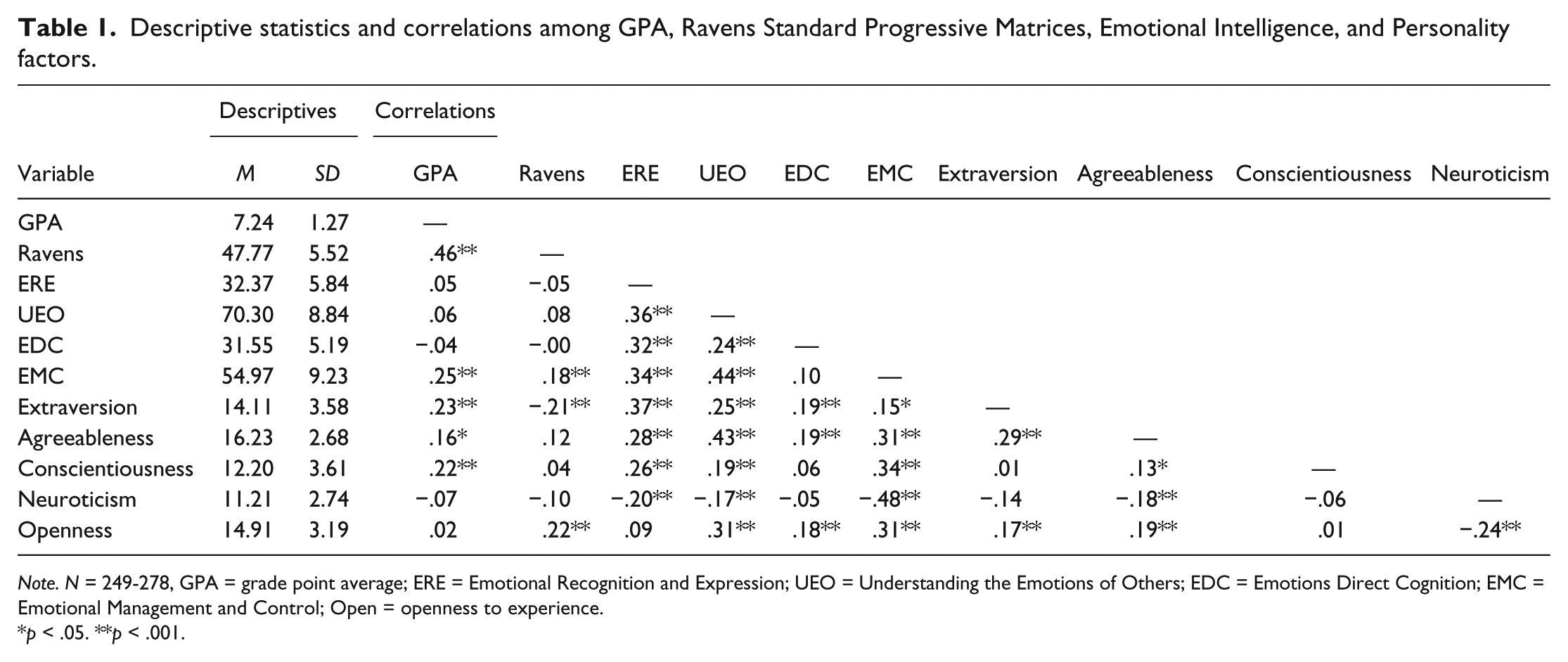
Note. N = 249-278, GPA = grade point average; ERE = Emotional Recognition and Expression; UEO = Understanding the Emotions of Others; EDC = Emotions Direct Cognition; EMC = Emotional Management and Control; Open = openness to experience.
p < .05. **p < .001.
Correlations between the GPA and EI, IQ, and personality measures appear in Table 1. As expected, fluid intelligence as measured by the ravens was most highly correlated with Year 9 GPA (r = .46, p < .001). Of the EI dimensions, EMC was significantly correlated with academic success (r = .24, p < .001). Consistent with the findings of Poropat (2009), of the personality dimensions, extraversion and conscientiousness showed the highest correlations with GPA (r = .23, p < .001 and r = .22, p < .001 respectively). Agreeableness was also found to be associated with academic achievement (r = .15, p < .05).
To assess whether EI would significantly contribute to the prediction of academic achievement in comparison to personality and IQ, a stepwise multiple regression was conducted with GPA as the dependent variable and IQ, EI, and personality dimensions as the predictor variables. Regression analyses identified five significant predictors, with IQ scores accounting for 21.8% variance in GPA, and Conscientiousness, Extraversion, and EMC also predicting additional significant amounts of variation in GPA scores (see Table 2).
Stepwise Regression of Academic Achievement IQ, Personality Factors, and EI.
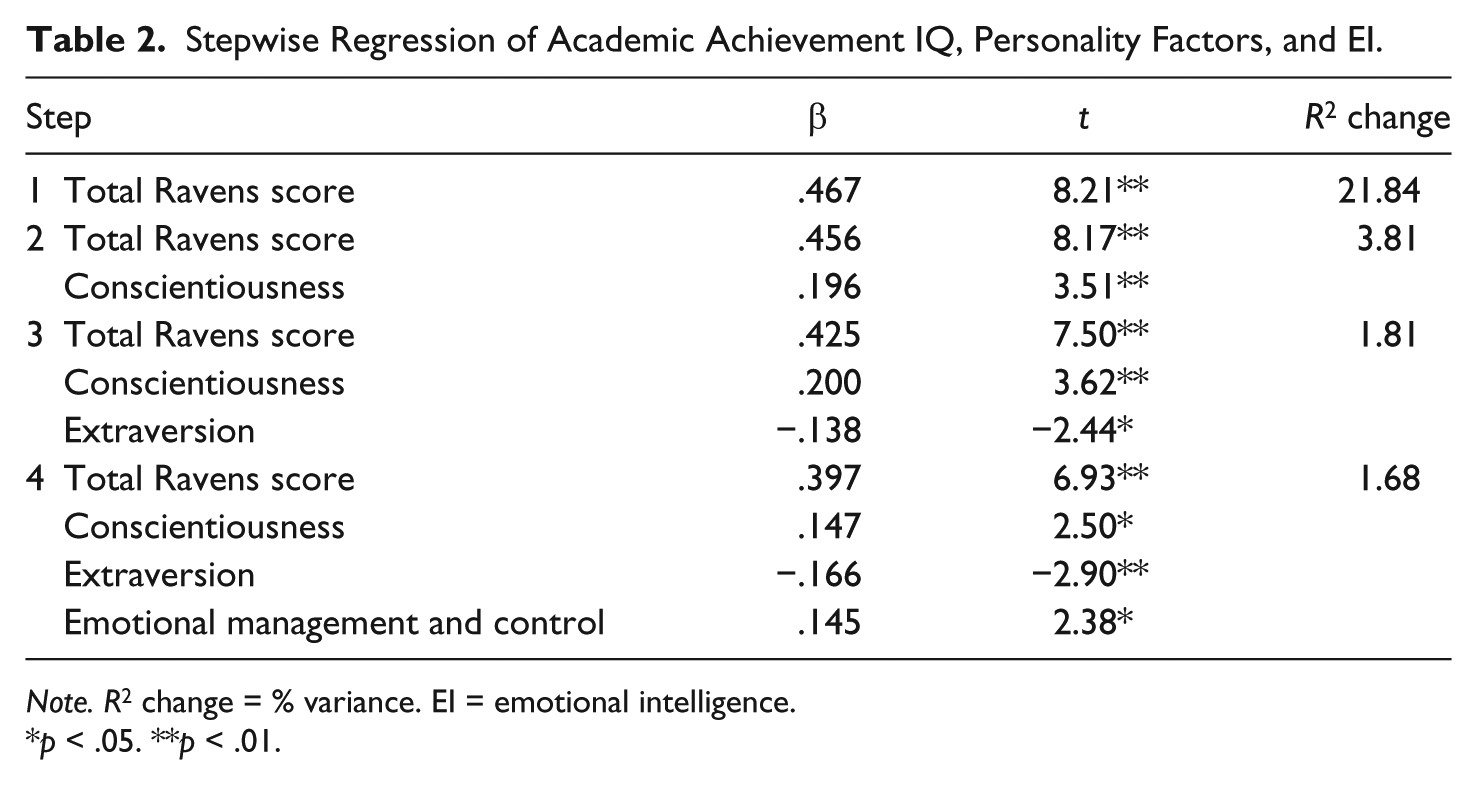
Note. R2 change = % variance. EI = emotional intelligence.
p < .05. **p < .01.
Discussion
The current study sought to examine the role of fluid intelligence, personality, and EI in the prediction of academic success in a sample of female secondary students. Assessment of ratings of personality and EI across different academic levels revealed that academic success was related to higher levels of EMC, Conscientiousness, and lower levels of Extraversion. This finding is consistent with the extant results (Barchard, 2003; Di Fabio & Palazzeschi, 2009; Downey et al., 2008; Peters et al., 2009) that have reported positive findings concerning the role of EI in scholastic environments.
That the EI competency, EMC was found to be an important predictor of academic success, confirms the importance of this competency given its previously identified relationship with academic success in a sample of Australian adolescents (Downey et al., 2008). Further to this, in the regression analyses, EMC was observed to predict a significant amount of variance in GPA after IQ and the Personality dimensions were considered. As expected, the strongest observed relationship with GPA was with IQ scores and explained over 20% of the variance in GPA scores (Neisser et al., 1996). Differences in ratings of Extraversion and Conscientiousness were also evident between the academic groups, with the lower achieving students reporting lesser Conscientiousness and higher levels of Extraversion. Interestingly, Conscientiousness and Openness scores were the most predictive personality dimensions in the regression analyses relating to GPA scores, with Extraversion scores not predicting a significant amount of variation in GPA.
The personality dimension Conscientiousness was found to predict variation in GPA scores in addition to the majority that was predicted by IQ scores. Differences between higher and lesser achieving students were also evident on Conscientiousness scores as expected. Given the previously identified relationship between conscientious behavior and scholastic success, this result was as expected, along with the predominance of predictive efficacy of IQ (Neisser et al., 1996). Utilization of better learning strategies has been previously associated with aspects of conscientiousness (Duff, Boyle, Dunleavy, & Ferguson, 2004), with these approaches to learning possibly contributing to greater scholastic success in comparison to lesser achieving Year 9 female students in the current study. This suggests that within this important cohort, reinforcement of an organized, hard-working, and motivated approach to study will benefit scholastic outcomes in addition to intellectual prowess.
The EMC dimension was found to differ between the higher and lesser achieving students, and predicted a significant amount of variance in GPA. Greater EMC has previously been linked to better identification of emotional stressors and being able to adapt to stressful academic situations (Lyons & Schneider, 2005; Parker, Summerfeldt, et al., 2004).The advantage of higher IQ, better study habits driven conscientious approaches to studying may be augmented by the students’ ability to understand what emotions they are experiencing and to be able to harness positive emotions or manage negative emotions in common scholastic environments such as exams. In the case of exams, all the advantage of greater intellectual capacity and good quality study can be lost if a student is overwhelmed by exam conditions, or unaware of the emotional experience of written or verbal examination. Given the importance of Year 9 for determining the relative success of students in their continuing education, and what subjects they will be able to undertake in their future studies, consideration of the EI abilities of students during this pivotal year (if not before) and therefore their ability to perform at the expected level during all forms of examination and learning activities should be an additional focus of educators.
The results of the current study indicate that the EI dimension, EMC did predict additional variance in GPA after consideration of IQ and significantly related personality dimensions. The incremental variance explained by the EI variable was only modest, but consistent with currently published research across high school students (Agnoli et al., 2012; Di Fabio & Palazzeschi, 2009; Downey et al., 2008; Parker, Creque, et al., 2004; Peters et al., 2009; Qualter, Gardner, Pope, Hutchinson, & Whiteley, 2012). In addition, the study population was made up exclusively of Year 9 female students from the same school over 3 years, possibly limiting the generalizability of the results to male or age disparate groups. Future studies concerning the ability of EI measures to predict scholastic success over IQ and personality could consider using EI scores from certain years (Year 9 for example) to predict scholastic achievement in years beyond the initial sampling (Qualter et al., 2012) in longitudinal studies to establish whether any moderating of predictive effect of EI scores exist over the course of high school education. This information could then be used to inform educators of the impact EI scores have on the scholastic achievements of students, and possibly used to identify relative shortfalls in predicted student performance academically.
Footnotes
Declaration of Conflicting Interests
The author(s) declared no potential conflicts of interest with respect to the research, authorship, and/or publication of this article.
Funding
The author(s) disclosed receipt of the following financial support for the research, authorship, and/or publication of this article: Prof. Stough received funding from the Australian Research Council (LP0882960). Dr. Luke Downey is supported by an NH&MRC (APP1054279) biomedical fellowship.