




Abstract
This cross-national research examined temperament style preferences among children in three sub-Saharan African countries (i.e., Nigeria, South Africa, and Zimbabwe) and possible differences between them on four bipolar temperament styles: extroverted–introverted, practical–imaginative, thinking–feeling, and organized–flexible. Children in these three countries overwhelmingly favor practical to imaginative styles as well as organized to flexible styles. They also generally favor feeling to thinking styles. Children’s preferences for extroverted and introverted styles are more balanced. Differences between countries and by gender are discussed. Implications for school psychology practice as well as viewing these four bipolar qualities as etic traits also are discussed.
Keywords
Psychology has had a long-standing interest in temperament. The scholarly foundation for this interest was established as early as 350 BC when Hippocrates (1923, 1994) described four humors or temperaments associated with body fluids thought to control or at least influence behavior. Later Galen (1992; Kagan, 1994) extended Hippocrates’s work by describing four pathological temperaments (i.e., choleric, melancholic, phlegmatic, and sanguine) derived from four bodily fluids. Temperament’s biological basis found its origin in these early Greek writings.
The foundation for modern temperament theory was established by Carl Jung (1921/1946, 1959) when he proposed a three-part model of temperament. His theory of temperament emphasized two attitudes (i.e., extroverted–introverted) together with four mental functions (i.e., thinking–feeling and sensation–intuition) that affect our interpretation and understanding of stimuli. Moreover, Jung characterized individual differences in temperament as inborn, possibly genetic or physiological personal qualities mediated by one’s environment.
Myers and Briggs extended Jung’s theory by adding a fourth bipolar quality, judging and perceiving, and by developing a measure based on this theory: the Myers-Briggs Type Indicator (MBTI; Myers & McCaulley, 1985). Thus, the MBTI assesses the following four bipolar styles: extroverted–introverted, sensation–intuition, thinking–feeling, and judging–perceiving styles. The MBTI reportedly is the most widely used measure of temperament in the world and has been translated into at least 16 different languages (Myers, McCaulley, Quenk, & Hammer, 1998).
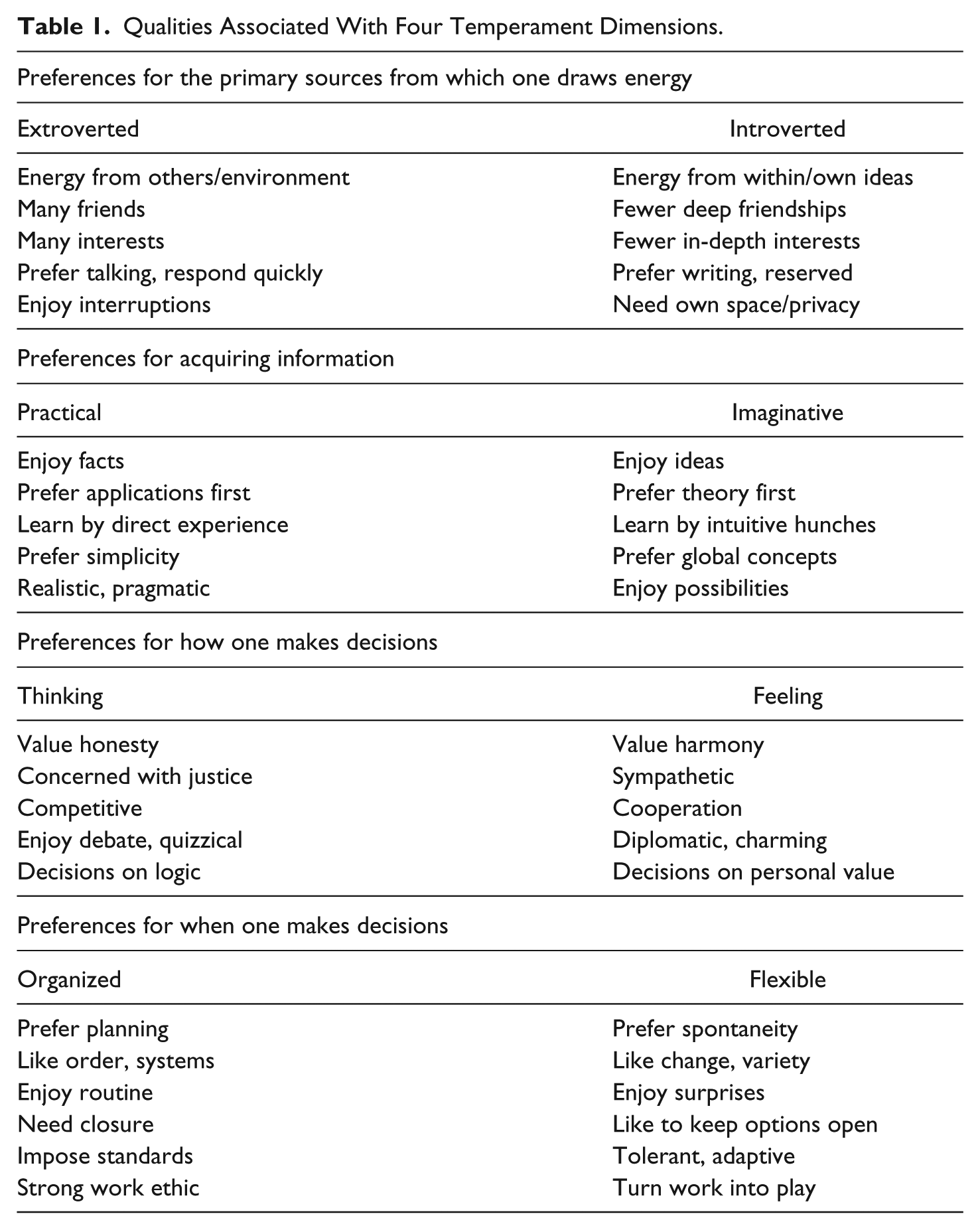
Oakland and his colleagues developed a measure of temperament for children and youth aged 8 to 17 years, the Student Styles Questionnaire (SSQ), based on the MBTI model (Oakland, Glutting, & Horton, 1996). The underlying premise of the SSQ is that temperament results from an interaction between biologically coded qualities, environmental qualities, and personal choices. As summarized in Table 1, temperament also is thought to reflect a source of children’s motivation; how they prefer to learn, retain, and retrieve information; how and when they prefer to make decisions; as well as how they relate to others and form values (Horton & Oakland, 1996; Keirsey & Bates, 1984; Lawrence, 1982; Oakland et al., 1996; Payne & VanSant, 2009).
Qualities Associated With Four Temperament Dimensions.
Current Beliefs Regarding Temperament
Temperament is described as a stylistic and relatively stable trait that subsumes intrinsic tendencies to act and react in somewhat predictable ways to people, events, and other stimuli (Teglasi, 1998a, 1998b). Temperament traits are thought to be preferences, predispositions to display behaviors, a blueprint for them, with no assurance that people, events, and stimuli always elicit the same responses.
Scholars generally agree on the following six points. Temperament reflects behavioral tendencies rather than specific behaviors. Temperament has an underlying biological base. Developmental qualities (e.g., social, motivational, and cognitive) influence the expression of temperament. The primary focus of temperament research is on individual differences, not on species-general characteristics. Temperament is considered relatively stable over time and displays some emotional reaction patterns. Temperament emerges prior to and remains a component of personality (Kagan, 1994; Prior, 1992; Teglasi, 1998a, 1998b).
Cross-Cultural and Cross-National Studies of Temperament
Oakland and his colleagues acknowledge emic and etic approaches (Berry, Poortinga, Segall, & Dasen, 1992) in their international studies of children’s temperament in 13 non-African countries: Australia (Oakland, Faulkner, & Bassett, 2005), Costa Rica (Oakland & Mata, 2007), Gaza (Oakland, Alghorani, & Lee, 2006), Greece (Oakland & Hatzichristou, 2010), Hungary (Katona & Oakland, 2000), India (Oakland, Singh, Callueng, Puri, & Goen, 2011), Japan (C. M. Callueng, de Carvalho, Isobe, & Oakland, 2012), Pakistan (Oakland, Callueng, Rizwan, & Aftab, 2012), People’s Republic of China (Oakland & Lu, 2006), Romania (Oakland, Illiescu, Dinca, & Dempsey, 2009), Samoa (C. M. Callueng, Lee Hang, Gonzales, Ling-So’o, & Oakland, 2011), South Korea (Lee, Oakland, & Ahn, 2010), the United States (Bassett, 2005; Bassett & Oakland, 2009; Oakland et al., 1996), and Venezuela (Leon, Oakland, Wei, & Berrios, 2009). Data also were acquired on children’s temperament styles from three sub-Saharan countries: Nigeria (Oakland, Mogaji, & Dempsey, 2006), South Africa (Oakland,Pretorius, & Lee, 2008), and Zimbabwe (Oakland, Mpofu, & Sulkowski, 2007).
Temperament Preferences for Children From Three Sub-Sahara African Countries (by percent).
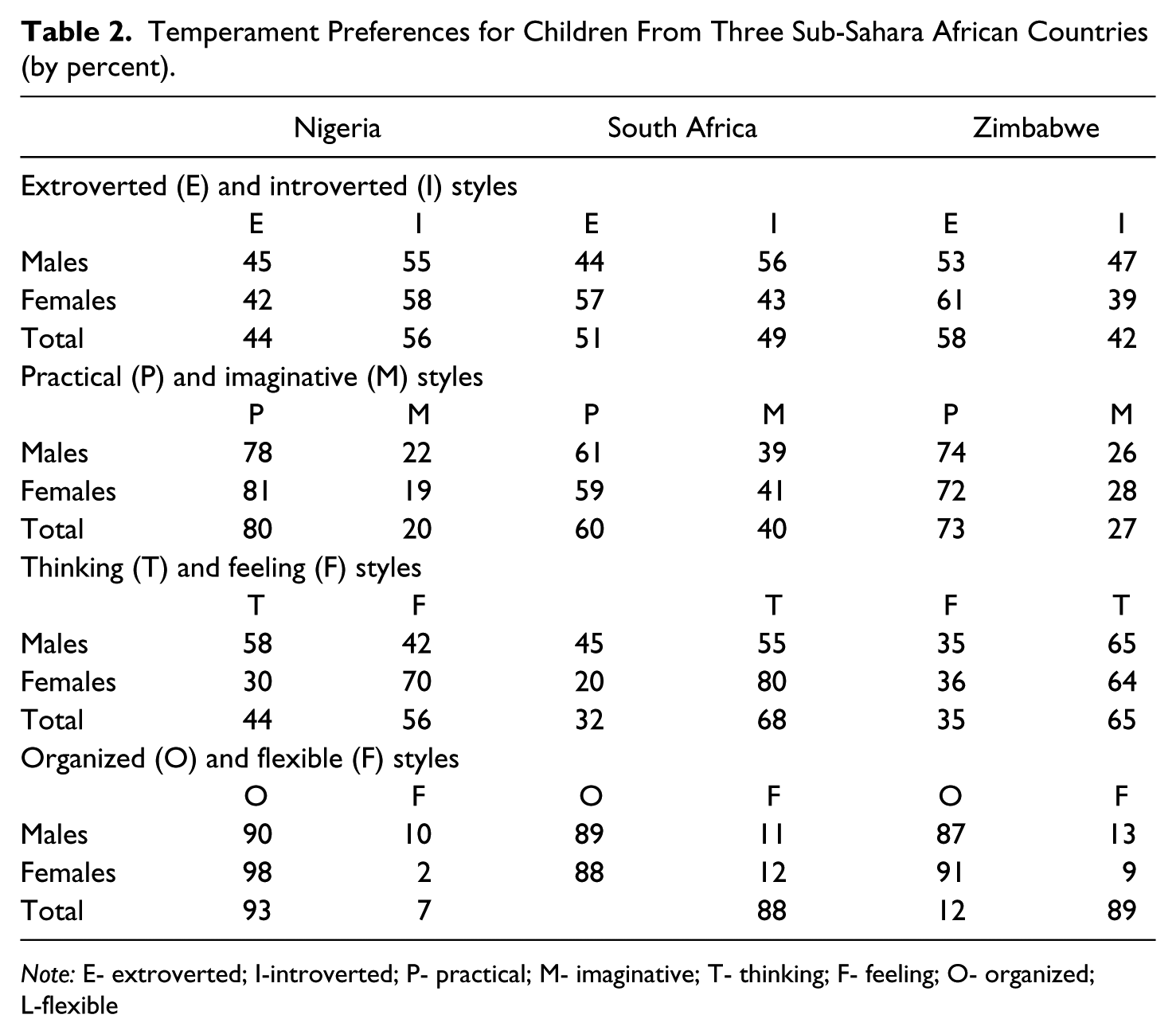
Note: E- extroverted; I-introverted; P- practical; M- imaginative; T- thinking; F- feeling; O- organized; L-flexible
Emic approaches examine culture-specific traits while etic approaches examine whether traits and behaviors are universal and independent of one or more cultures. Attempts to establish children’s temperament traits that are displayed within a country or region and then compare them with children from other countries or regions are consistent with efforts by McCrae and Costa (1997) and others (e.g., Berry et al., 1992; Macdaid, McCaulley, & Kainz, 1991; Plomin & Dunn, 1986) to examine the possibility of universal temperament and personality traits through cross-national studies.
Purposes of This Research
This research expands on previous research that described the temperament styles of children and youth from Nigeria (Oakland, Mogaji, & Dempsey, 2006), South Africa (Oakland & Pretorius, 2007), and Zimbabwe (Oakland et al., 2007) by examining possible country and gender differences. A review of data from three geographically similar countries enables us to better understand the degree the four bipolar traits may reflect emic or etic qualities. The following questions are addressed: Do children in Nigeria, South Africa, and Zimbabwe display dominant and similar temperament preferences, and are there between-country gender differences? The data in this study were previously reported separately and compared with age peers from the United States.
Method
Participants
Data were obtained from 400 Nigerian children randomly selected from a primary and a secondary public school located within the University of Lagos. Lagos, a multi-ethnic city, is the nation’s capital, and remains its commercial center. The sample included 100 participants in four different age groups: 9 to 10, 11 to 12, 13 to 14, and 15 to 17 years. Fifty percent of the participants in each age group were males. Moreover, the sample includes children from a wide range of social and economic classes as well as from the three major ethnic groups: Yoruba, Ibo, and Hausa/Fulani.
Data also were obtained from 800 South African children, drawn largely from urban schools. The children lived in the Vaal Triangle in South Gauteng, the most densely populated province of South Africa. It consists mainly of urban and suburban areas, with some rural areas. The sample consisted of 200 participants in four age groups: 9 to 10, 11 to 12, 13 to 14, and 15 to 17 years. Forty-nine percent of the participants were males. In addition, the sample was drawn to be representative of South Africa’s ethnically and culturally diverse population.
Data also were obtained from 600 Zimbabwean children from an elementary and a secondary public school located in an urban area that serve upper- and lower-middle-class families. Classes were randomly selected, and all children within the classes participated. The sample consisted of 150 participants in four age groups: 8 to 9, 10 to 11, 12 to 13, and 14 to 15 years. Fifty percent of the participants in each age group were males. Thus, the data from all three countries were obtained from children who display considerable similarities in their family’s socioeconomic status (SES) and urban residence.
Instruments
The SSQ is patterned after the Jungian constructs popularized by the MBTI. The SSQ, a self-report paper-and-pencil group that administered measure of temperament type for children aged 8 through 17 years, is completed within approximately 20 min. Each of its 69 forced-choice items has two alternatives that provide for an assessment of preferred behaviors associated with one of four bipolar traits: extroverted (E) or introverted (I), practical (P) or imaginative (M), thinking (T) or feeling (F), and organized (O) and flexible (L) styles. An example of an item assessing extroverted–introverted styles follows: After school, I most prefer to (a) spend time with others or (b) spend time alone. The EI scale has 23 items, the PM scale has 16 items, the TF scale has 10 items, and the OL scale has 26 items. In addition, six items provide information simultaneously on two scales.
The test–retest reliability coefficients, derived over an 8-month period, are .80, .67, .70, and .78 for EI, PM, TF, and OL, respectively. Results from factor analyses studies indicate the SSQ’s factor structure is consistent and stable for U.S. children who differ by age, gender, and racial-ethnic group (Stafford & Oakland, 1996a, 1996b). For example, within the United States, the constructs measured by the SSQ are stable and consistent for Whites and Blacks (Oakland, Stafford, Horton, & Glutting, 2001). Factor analytic studies of data from children from various countries generally found a stable factor structure and thus support the use of the SSQ internationally (Benson, Oakland, & Shermis, 2009; Primi, Wechsler, Nakano, Oakland, & Guzzo, 2014; Rowinski, Cieciuch, & Oakland, 2014). External validity, using contrasted groups, convergent validity and divergent validity, provides additional strong support for the SSQ’s validity (Oakland et al., 1996).
Procedures
The SSQ was reviewed for use with Nigerian (Oakland, Mogaji, & Dempsey, 2006), South African (Oakland, Pretorius, & Lee, 2008), and Zimbabwean (Oakland et al., 2007) children by researchers in and familiar with each culture. A review of the SSQ’s 69 items and directions found them to be suitable for children in these countries and consistent with their school cultures. English is used widely in the participating schools and thus is known to the children sampled. Therefore, a language translation was not needed. The administration protocol was consistent with the procedures described in the SSQ manual.
Data Analyses
Temperament typically is considered to be a type rather than a continuous quality (Bassett, 2005; Buss & Plomin, 1984; Hall & Lindzey, 1978; Jung, 1921/1946; Lawrence, 1982; Macdaid et al., 1991; Plomin & Dunn, 1986; Rothbart & Jones, 1998; Teglasi, 1998b; Thomas & Chess, 1977). Personality also can be and often is viewed in its type form (McCrae & Costa, 1997).
The frequency of Nigerian, South African, and Zimbabwean children who express a preference for each of the eight types was determined in the following fashion. Individual responses on each of the 69 items were examined to determine whether a child selected more options from one of the two bipolar types. For example, among the 23 extroverted–introverted items, children who selected more extroverted than introverted options were classified extroverted. Conversely, children who selected more introverted options were classified introverted. Children who selected approximately equal number of options on a scale (e.g., a one- or two-item difference) and thus displayed no discernible preference on that bipolar trait were excluded from subsequent analyses on that scale. On average, data on 3% to 4% of the children were excluded from an analysis on that bipolar trait.
Data were analyzed using frequencies and are reported using percentiles to promote understanding. Tests for significance of a proportion and chi-square (χ2) analyses were used to test whether the frequency of Nigerian, South African, and Zimbabwean children who preferred either extroverted or introverted, practical or imaginative, thinking or feeling, and organized or flexible styles differ significantly in comparison with preferences of children from the other countries or by gender. The z scores equal to or greater than 1.96 are considered to be significant. Possible differences between Nigerian, South African, and Zimbabwean children in reference to total group as well as for males and females are examined through chi-square analyses. A significance level of .05 was set for all analyses. Thus, p values equal to or less than .05 indicate groups differ statistically on a temperament dimension.
Results
Differences on Temperament Styles of Nigerian and South African Children
Preferences for extroverted and introverted styles
Nigerian and South African children display a somewhat balanced preference for extroverted and introverted styles. They do not differ in their preferences for these styles (χ2 = .98, p > .05). Gender differences are not significant for males (χ2 = .20, p > .05) and are significant for females (χ2 = 4.50, p < .05). More Nigerian females display a preference for an introverted style (58%), while more South African females display a preference for an extroverted style (57%).
Preferences for practical and imaginative styles
Nigerian and South African children display a discernible preference for a practical style (χ2 = 3.92, p < .05). Relatively more Nigerian (80%) than South African (60%) children display a preference for a practical style. Gender differences are significant for both males (χ2 = 6.82, p < .01) and females (χ2 = 11.52, p < .01). More Nigerian (78%) than South African (61%) males prefer a practical style. Similarly, more Nigerian (81%) than South African (59%) females prefer a practical style.
Preferences for thinking and feeling styles
Nigerian and South African children display a mild to moderate preference for feeling styles. They do not differ in their preferences for these styles (χ2 = 3.06, p > .05). Gender differences are not significant for males (χ2 = 3.38, p > .05) or females (χ2 = 2.67, p > .05).
Preferences for organized and flexible styles
Nigerian and South African children display a discernible preference for an organized style. They do not differ in their preferences for these styles (χ2 = 1.45, p > .05). Gender differences are not significant for males (χ2 = .05, p > .05) and are significant for females (χ2 = 7.68, p < .01). More Nigerian (98%) than South African (88%) females prefer an organized style.
Differences on Temperament Styles of Nigerian and Zimbabwean Children
Preferences for extroverted and introverted styles
Nigerian and Zimbabwean children generally display a somewhat balanced preference for extroverted and introverted styles. They differ in their preferences for them (χ2 = 3.92, p < .05). More Zimbabwean (58%) than Nigerian (44%) children display a preference for an extroverted style. Gender differences are not significant for males (χ2 = 1.28, p > .05) and are significant for females (χ2 = 7.23, p < .01). More Nigerian (56%) than Zimbabwean (42%) females display a preference for introverted style.
Preferences for practical and imaginative styles
Nigerian and Zimbabwean children display a discernible preference for a practical style. They do not differ in their preferences for these styles (χ2 = 1.36, p > .05). Children in both countries display a greater preference for a practical style. Gender differences are not significant for males (χ2 = .44, p > .05) or females (χ2 = 2.25, p > .05).
Preferences for thinking and feeling styles
Nigerian and Zimbabwean children display a mild to moderate preference for a feeling style. They do not differ in their preferences for these styles (χ2 = 3.06, p > .05). Gender differences are not significant for females (χ2 = .81, p > .05) and are significant for males (χ2 = 10.63, p < .001). More Nigerian (58%) than Zimbabwean (35%) males prefer a thinking style.
Preferences for organized and flexible styles
Nigerian and Zimbabwean children display a discernible preference for an organized style. They do not differ in their preferences for these styles (χ2 = .98, p > .05). Gender differences are not significant for males (χ2 = .44, p > .05) and are significant for females (χ2 = 4.71, p < .05). More Nigerian (98%) than Zimbabwean (91%) females display a preference for organized style.
Differences on Temperament Styles of South African and Zimbabwean Children
Preferences for extroverted and introverted styles
South African and Zimbabwean children generally display a somewhat balanced preference for extroverted and introverted styles. They do not differ in their preferences for these styles (χ2 = .99, p > .05). Gender differences are not significant for males (χ2 = 1.62, p > .01) or females (χ2 = .33, p > .05).
Preferences for practical and imaginative styles
South African and Zimbabwean children display a discernible preference for practical styles. They do not differ in their preferences for these styles (χ2 = 3.79, p > .05). Gender differences are not significant for females (χ2 = 3.74, p > .05) and are significant for males (χ2 = 3.85, p < .05). More Zimbabwean (74%) than South African (61%) males display a preference for a practical style.
Preferences for thinking and feeling styles
South African and Zimbabwean children display a mild to moderate preference for a feeling style. They do not differ in their preferences for these styles (χ2 = .20, p > .05). Gender differences are not significant for males (χ2 = 2.08, p > .05) and are significant for females (χ2 = 6.35, p < .05). More South African (80%) than Zimbabwean (64%) females display a preference for a feeling style.
Preferences for organized and flexible styles
South African and Zimbabwean children display a discernible preference for an organized style. They do not differ in their preferences for these styles (χ2 = .05, p > .05). Gender differences are not significant for males (χ2 = .19, p > .05) or females (χ2 = .48, p > .05). Males and females in both countries display a strong preference for an organized style.
Discussion
Organized–Flexible Styles
Children from Nigeria, South Africa, and Zimbabwe display a discernible preference for an organized style. Country and age differences are not significant. Children who prefer this style like to make decisions as soon as possible and prefer structure and organization. They do not cope well with surprises or changes to their routine. They like to rely on lists and are likely to respond well to a more structured and organized setting. Expectations others have for them should be communicated clearly and schedules clearly established and followed. They like to do things the correct way and enjoy receiving praise for completing work in a timely manner. These qualities may reflect national values (Mpofu, 1994).
Preferences for organized–flexible styles do not differ for males. However, although females from all three countries tend to strongly prefer an organized style, differences are apparent due to a decidedly strong preference for an organized style among Nigerian females (98%). Compared with females in Nigeria, fewer females in Zimbabwe (91%) and South Africa (88%) prefer an organized style.
Other cross-national comparisons
Children from 13 countries also display a general preference for an organized style—albeit with more males than females preferring a flexible style. Moreover, children in most countries display an early and strong preference for an organized style, one that becomes more balanced as children become older.
Practical–Imaginative Styles
Children from Nigeria, South Africa, and Zimbabwe display a discernible preference for a practical style. Preference for practical styles is stronger among children in Nigeria than in South Africa. Children with this preference focus their attention on what is seen, heard, or experienced through their other senses. They often base their decisions on facts and personal experience. They generally learn best using step-by-step approaches, when provided with many examples and hands-on experiences, and view what they are learning as directly applicable to their lives. They become discouraged when work seems complex.
Preferences for practical–imaginative styles differ for males in South Africa and Nigeria as well as in South Africa and Zimbabwe. For them, preferences for a practical style are highest in Nigeria (78%), slightly lower in Zimbabwe (74%), and lowest in South Africa (61%). Preferences for a practical style differ only in Nigeria (81%) and South Africa (59%) females.
Other cross-national comparisons
Children from seven countries also display a general preference for a practical style: Gaza, Greece, Hungary, India, People’s Republic of China, Romania, and Venezuela. Thus, the children from most countries on which we have similar data share these preferences displayed by children from sub-Saharan Africa.
Thinking–Feeling Styles
Children from Nigeria, South Africa, and Zimbabwe do not differ in their mild to moderate preferences for a feeling style: South Africa (68%), Zimbabwe (65%), and Nigeria (56%). Children who prefer this style tend to rely on their feelings and own subjective standards when making decisions. They generally are compassionate and sensitive to the feelings of others and value harmony. They tend to learn best when engaged in cooperative activities that help personalize their learning. In Zimbabwe (Oakland et al., 2007), both males and females prefer feeling styles; age differences are not significant. In Nigeria (Oakland, Mogaji, & Dempsey, 2006) and South Africa (Oakland, Pretorius, & Lee, 2008), males generally prefer a thinking style and females a feeling style; age differences are not significant.
Females in South Africa (80%), Nigeria (70%), and Zimbabwe (64%) display a discernible preference for a feeling style. A preference for a feeling style is greater among females than males in South Arica and Nigeria. Males in Zimbabwe (65%) display a stronger preference for a feeling style than those in Nigeria (42%).
Other cross-national comparisons
Children in Gaza, Hungary, and South Korea also generally prefer a feeling style. Children in six countries generally prefer a thinking style: Australia, Greece, People’s Republic of China, Romania, Venezuela, and the United States. Gender differences on thinking–feeling styles, with males more likely to prefer thinking and females more likely to prefer feeling styles, are more common among children from Australia, Costa Rica, Hungary, Greece, People’s Republic of China, Romania, the United States, and Venezuela.
Extroverted–Introverted Styles
Preferences for extroverted–introverted styles generally are the most balanced among the four bipolar styles. They range from 42% to 58%. Country differences are significant, with a stronger preference for an extroverted style expressed by children in Zimbabwe (58%) than in Nigeria (44%). Among females, preference for an extroverted style is highest in Zimbabwe (58%), lower in South Africa (51%), and lowest in Nigeria (44%). Differences exist between females in Zimbabwe (61%) and Nigeria (42%) as well as in South Africa (57%) and Nigeria. Males do not differ in their preferences for extroverted–introverted styles.
Other cross-national comparisons
Children from 8 of the 13 countries on which we have similar data also display a general preference for an extroverted style: Australia, Costa Rica, Greece, India, People’s Republic of China, Romania, South Korea, United States, and Venezuela. Thus, the children from most countries share these preferences displayed by children from sub-Sahara Africa.
Implications for School Psychology Practice
Elsewhere, we express the belief that understanding students requires knowledge of their temperament preferences (C. Callueng & Oakland, 2014). The temperament-based qualities summarized in Table 1 are well-known precursors to learning and personal development and thus should be assessed.
School psychologists and educators may be inclined to anticipate providing services to students from these three sub-Saharan countries consistent with their exceedingly strong preferences for organized and practical styles. However, when working with students who may not be native to their country, the practices of school psychologists and educators should be provided in light of an individual’s temperament styles, not those of a group to which an individual is a member. Thus, decisions about an individual should be based on his or her personal temperament styles. Knowledge of a student’s temperament, not modal qualities that may characterize a nation, is fundamental to the success of work by school psychologists.
Etic Traits
The high frequency that children in these three sub-Saharan countries endorse organized and practical styles provides some support for their forming a regional etic trait (i.e., independent of one culture). In addition, children from 13 other countries generally prefer an organized style, thus adding weight to an organized style being favored more universally. Children from 7 of the 13 other countries generally prefer a practical style, thus adding less weight to it being favored universally. Gender differences are apparent in children from Nigeria and South Africa, thus providing further support found in other countries that males are more likely than females to prefer a thinking style.
Limitations
Scholarship on temperament preferences among children from Nigeria, South Africa, or Zimbabwe is meager. Information from a broader range of children from these and other sub-Saharan countries would allow us to determine the reliability of the data reported in this study. In addition, the use of temperament scales developed in light of the sub-Saharan African cultures may be preferable to those that are adapted.
Footnotes
Declaration of Conflicting Interests
The author(s) declared no potential conflicts of interest with respect to the research, authorship, and/or publication of this article.
Funding
The author(s) received no financial support for the research, authorship, and/or publication of this article.