




Abstract
This study examined the influence of student–teacher relationships on children’s anxiety and its differential association according to children’s sex and academic achievement. The sample included 350 third- and fourth-grade students and their elementary school teachers. Results of multiple regression analysis indicated that student–teacher conflict at the beginning of the school year was associated with higher anxiety in students at the end of the year. The influence of conflict with teachers also varied for boys and girls, according to their academic achievement. Indeed, high-achieving girls reporting conflict with teachers presented more anxiety compared with boys and their low-achieving peers. This study highlights the influence of teachers on student anxiety, and brings attention to high-achieving girls, a group rarely considered at risk.
Introduction
Anxiety disorders are among the most commonly diagnosed mental health problems in children (Albano, Chorpita, & Barlow, 2003) and are related to several academic difficulties and adjustment problems later in life (Roza, Hofstra, van der Ende, & Verhulst, 2003; Van Ameringen, Mancini, & Farvolden, 2003). The developmental psychopathology perspective allows the study of these disorders by the simultaneous examination of several factors involved in the onset, maintenance, and improvement of anxiety symptoms (Vasey & Dadds, 2001). While past studies have explored the relationship between family background characteristics and anxiety in children (Rapee, Schniering, & Hudson, 2009), few have focused on the influence of teachers who are important attachment figures for children while in school (Pianta & Stuhlman, 2004). Considering that the relationship students have with their teacher can influence their emotional problems (O’Connor, Dearing, & Collins, 2011), it is likely that these relationships may also have a significant influence on the development of students’ anxiety (Drugli, Klokner, & Larsson, 2011). Unfortunately, the literature on this point is limited. Moreover, past research does not allow us to understand whether the influence of student-teacher relationships is the same for all students or whether it differs for boys and girls presenting academic difficulties. To address these limitations, the present study first aims to examine the influence of student–teacher relationships on the development of anxiety in elementary school students and further assess whether this influence varies based on student sex and academic achievement.
Definition and Trajectory of Anxiety
Anxiety symptoms refer to excessive and inappropriate anticipation of future threats, fears, worries, and concerns that create significant distress interfering with the child’s normal functioning (American Psychiatric Association [APA], 2013). Compared with fear, which is felt when facing imminent danger, anxiety can arise without the presence of an actual threat (Muris, 2007). Experienced at a low level, anxiety may be an adaptive emotion, but when experienced at a high level, it can be inappropriate and impairing (Endler & Kocovski, 2001). Anxiety symptoms are frequent, affect more girls than boys, and develop early in childhood, between the ages of 8 and 10 years (Costello, Egger, Copeland, Erkanli, & Angold, 2011). As they are often stable from childhood to adulthood (Rapee et al., 2009), these symptoms put the child at risk of developing a variety of disorders encompassing separation anxiety disorder, selective mutism, specific phobia, social anxiety disorder, panic disorder, agoraphobia, and generalized anxiety disorder (APA, 2013). These clinical disorders are sometimes difficult to distinguish from one another as they have many symptoms in common (Moretz & McKay, 2011). Children with high levels of anxiety are also at greater risk of developing various adjustment difficulties: they are more likely to experience academic difficulties and drop out from school (Van Ameringen et al., 2003), to develop relational difficulties with their family and peers (Kashani & Orvaschel, 1990), and to develop comorbid depression and psychiatric problems in adulthood (Roza et al., 2003). Despite the considerable number of children affected by anxiety symptoms and the serious consequences arising therefrom, anxiety remains poorly studied in comparison with other emotional problems (Vasey & Dadds, 2001), and especially in the school context. Moreover, although anxiety symptoms first develop in middle childhood (Keller et al., 1992), they are rarely studied in children under 12 years old. As such, authors stress the importance to study anxiety earlier and to consider younger children separately from preadolescents to identify their specificities (Cartwright-Hatton, McNicol, & Doubleday, 2006).
The Influence of Student–Teacher Relationships
To this day, research on anxiety has been mostly interested in the identification of risk factors in individuals (e.g., genetic determinants, inhibited temperament, attention bias) and their family environment (e.g., insecure attachment, overprotectiveness, control; Albano et al., 2003; McLeod, Wood, & Weisz, 2007; Rapee et al., 2009). Yet, school is also an environment of performance that can interfere with children’s functioning and favor the development of worries and concerns (Murberg & Bru, 2004). Accordingly, an increasing number of authors have shown that relationships with teachers may play an important role in students’ negative emotions and anxiety, and call for a better understanding of this role (Drugli et al., 2011; O’Connor et al., 2011).
According to Pianta (1999), the development of a high-quality student-teacher relationship allows children to explore their environment while feeling confident that they will be reassured and protected if necessary. Such a relationship is usually assessed along two dimensions, which can have a unique effect on students’ behaviors and emotions: warmth and conflict (Drugli et al., 2011). The level of warmth refers to the level of involvement, closeness, affection, and openness of the communication between a teacher and a student, while conflict refers to the degree that the relationship is negative and problematic (Pianta, 2001).
Research linking student–teacher relationships and student anxiety is scarce. To our knowledge, only cross-sectional studies have examined this link among elementary school children with inconsistent results. Using small samples or samples of students with disabilities, previous studies have shown that the student–teacher relationship quality reported by the teacher or the child was negatively correlated with the level of anxiety reported by fifth- and sixth graders (Murray & Greenberg, 2001; Rey, Smith, Yoon, Somers, & Barnett, 2007). Student-reported conflict or dissatisfaction with the teacher has also been positively linked to anxiety in third- to sixth-grade students (Jellesma, Zee, & Koomen, 2015). Finally, a study by Muris and Meesters (2002) found no significant correlation between student–teacher relationships reported by teachers and anxiety among a sample of 10- to 12-year-old children. However, this study only used a single item to measure teacher–student relationships.
Although not specific to anxiety, other studies have examined direct associations between student–teacher relationships and the presence of internalizing symptoms (including anxiety) in children. This literature indicates that when a student–teacher relationship is conflictual and lacks warmth, it is associated with more emotional distress in children (Drugli et al., 2011; O’Connor, Collins, & Supplee, 2012; Pianta & Stuhlman, 2004). Some authors have also found that conflict is more strongly associated with internalizing symptoms than warmth (Drugli et al., 2011), and that worsening student–teacher relationships can increase a child’s existing level of internalizing problems (Pianta & Nimetz, 1991).
The Influence of Students’ Sex and Academic Achievement
Across cultures, girls are often recognized as being more prone to develop symptoms of anxiety and worries than boys (Rapee et al., 2009), a difference appearing as early as 6 years old (Lewinsohn, Gotlib, Lewinsohn, Seeley, & Allen, 1998). Sex differences have also been established in terms of student–teacher relationships: elementary school girls report less conflict and more warmth in their relationships with teachers than boys (Jerome, Hamre, & Pianta, 2009). Girls are also more influenced by their teachers, being more inclined to please adults (Rudolph, 2002). As such, conflict is unusual for them and could be particularly stressful and make them feel marginalised, which may increase their feelings of anxiety.
The influence of the student–teacher relationship on children’s anxiety level could also differ according to their academic achievement. Children exhibiting low academic achievement have been reported to show higher levels of anxiety (Drugli et al., 2011; Ialongo, Edelsohn, Werthamer-Larsson, Crockett, & Kellam, 1995). As these students are not able to perform well in school, they are more likely to feel stressed and anxious when confronted with daily difficulties. It has also been found that children who perform poorly in school have lower quality relationships with teachers (McCormick & O’Connor, 2015) and are more positively influenced by these relationships than better achieving students (Fallu & Janosz, 2003).
In sum, girls and students with low academic achievement both seem to be more influenced by their relationships with teachers and more prone to anxious feelings than other students (Drugli et al., 2011; Ialongo et al., 1995). As a result, girls presenting academic difficulties represent a particularly vulnerable group, as they are more likely to experience psychological distress (Pomerantz, Altermatt, & Saxon, 2002). It is thus important to understand how students’ relationships with teachers can influence these girls’ anxiety to better orient differential actions that could help them, and also potentially help all students.
Study Objectives
The present study aims to evaluate the combined moderating effect of sex and academic achievement on the association between student–teacher relationships and children’s anxiety in elementary school. In accordance with this objective, our first hypothesis states that a close student-teacher relationship will generally be associated with lower levels of student anxiety at the end of the school year. Conversely, a conflictual relationship will lead to a higher level of anxiety. Our second hypothesis states that the association between student–teacher relationships and anxiety will vary according to student sex and academic achievement. Hence, we postulate that girls with low academic achievement will report more anxiety than their peers when their relationship with teachers is highly conflictual or low in warmth. Conversely, girls will report less anxiety when a low level of conflict or a high level of warmth characterizes their relationship with teachers.
Method
Participants
The sample used in this study is drawn from a larger sample of French-speaking students and teachers participating in a 3-year longitudinal study. The original study comprised 756 students from third to sixth grade from seven different elementary schools in the region of Montreal. The present study focused only on the 350 third- (41.7%) and fourth-grade (58.3%) students (52% boys) from regular classrooms. This specific group of students was selected considering that this age group has been less studied and forms a more homogeneous group developmentally different from fifth- and sixth-grade preadolescents (Cartwright-Hatton, 2006). This sample was quite homogeneous in terms of ethnicity (more than 70% Caucasian), which is representative of the population in Quebec’s schools, and the average age of the pupils was 8.98 years (SD = .75). The majority of these children resided with their two parents (62.1%), but a certain proportion of them lived in shared custody (19.4%). The 23 teachers (21.7% men) of these students were included in the study. Most of them had more than 10 years of teaching experience (65.1%) and worked at the same school for more than 6 years (52.1%).
Procedure
As a first step, the research project was submitted to the ethic committees for research with human subjects in the researchers’ university and in the participating school board. The project reached the highest research standards and was approved by both committees. As a second step, we contacted schools, teachers, parents, and students to seek their participation in the study. Ethical consents were obtained from all teachers and parents. Ninety-one percent of the students and all teachers agreed to participate. Pupils and teachers answered the same questionnaire twice: once in the fall (Time 1 [T1]) and once in the spring (Time 2 [T2]) during the same academic year (2010-2011). Children answered a computerized questionnaire about their school engagement, emotions, and perceptions of their teacher’s practices during class hours, in a computer room, with the help of two graduate students. Before data collection, these students received a 2-hr training offered by the principal investigator of the larger 3-year longitudinal study. At the same time, and in another room, teachers completed their pen-and-paper questionnaire on which they reported their teaching practices and their relationship with each participating student in their class.
Measures
Anxiety
Students reported their own level of anxiety. This kind of self-assessment has been shown to be more valid to measure internalizing symptoms because of the nature of these symptoms (Cosi, Canals, Hernandez-Martinez, & Vigil-Colet, 2010). The short-form measure used was drawn from and validated in the Quebec Longitudinal Study of Child Development (QLSCD; www.iamillbe.stat.gouv.qc.ca), a population-based study. This kind of short-form scale commonly used in large-scale studies (Flynn, Ghazal, Legault, Vandermeulen, & Petrick, 2004) contains four items measuring different feelings and behaviors encompassed by anxiety: In the last month . . . “you have been too fearful or nervous,” “you have been worried,” “you have cried a lot,” and “you have been nervous or really tense.” The Likert-type response scale is divided into 3 points ranging from 1 (never or not true) to 3 (often or very true). Student mean anxiety score at T1 (α = .644) was used as a control variable in the prediction of anxiety at T2 (α = .764).
Student–teacher relationship
The student–teacher relationship was measured with a French adaptation of the Student–Teacher Relationship Scale (STRS; Pianta, 2001). This short form of the STRS, validated in the QLSCD (www.iamillbe.stat.gouv.qc.ca), has been used in several studies (e.g., Archambault, Pagani, & Fitzpatrick, 2013; Fitzpatrick, Côté-Lussier, & Blair, 2016). Teachers assessed the relationships they shared with each of their students at the beginning of the school year on two four-item dimensions: warmth (e.g., “I have a close and warm relationship with this child”; α = .875) and conflict (e.g., “This child and I have always had a tendency to fight with each other”; α = .837). Both scales were answered using a 5-point Likert-type scale ranging from 1 (definitely does not apply) to 5 (definitely applies).
Academic achievement
The teacher evaluated each child’s academic achievement at T1 using two questions: “How would you rate the average achievement of this child in mathematics (or French) compared with other students in the classroom?” The teacher answered the questions on a 5-point Likert-type scale ranging from 1 (greatly below average of same-age students) to 5 (greatly above average of same-age students). Each child’s mean academic achievement was then calculated. This form of teacher rating has been shown to be a reliable measure of student achievement, detecting even small changes in academic achievement (Pagani, Tremblay, Vitaro, Boulerice, & McDuff, 2001) and demonstrating as much sensitivity as individual achievement tests (Duncan et al., 2007).
Sex
Student sex was self-reported (0 = boys, 1 = girls).
Statistical Analyses
Imputation
Data imputation (n = 10) was performed using the NORM software (Schafer, 1997). By drawing values from the conditional distribution of the variables, NORM imputes missing data using an iterative method based on the expectation-maximization algorithm. A total of 16% of the participants had at least one item missing, resulting either from missing values in teachers’ questionnaires or the absence of the child during data collection. To remain in the sample, subjects had to have data at the first time point. No significant differences were observed between the subjects with and without missing data on all variables.
Analytical strategy
All analyses were performed in SPSS Version 24 (IBM, 2016). Means, standard deviations, and correlations between all variables were first calculated. A series of multiple hierarchical linear regressions predicting student anxiety at T2 was next performed to test our hypothesis. The first step included only the control variable (anxiety at T1), the independent variables (warmth and conflict), and the moderators (student sex and academic achievement), the second step added the two-way interactions (Sex × Academic achievement, Sex × Warmth, Sex × Conflict, Academic achievement × Warmth, and Academic achievement × Conflict) and the last step included the three-way interactions (Sex × Academic achievement × Warmth, and Sex × Academic achievement × Conflict). Following the procedure described by Aiken and West (1991), all of the independent variables and the moderators were mean-centered to reduce collinearity problems. For all significant interactions, we estimated the independent-dependant variables association with the moderators centered at one standard deviation below or above the mean (see Aiken & West, 1991). Results were then plotted in graphs, and slope differences were calculated.
Results
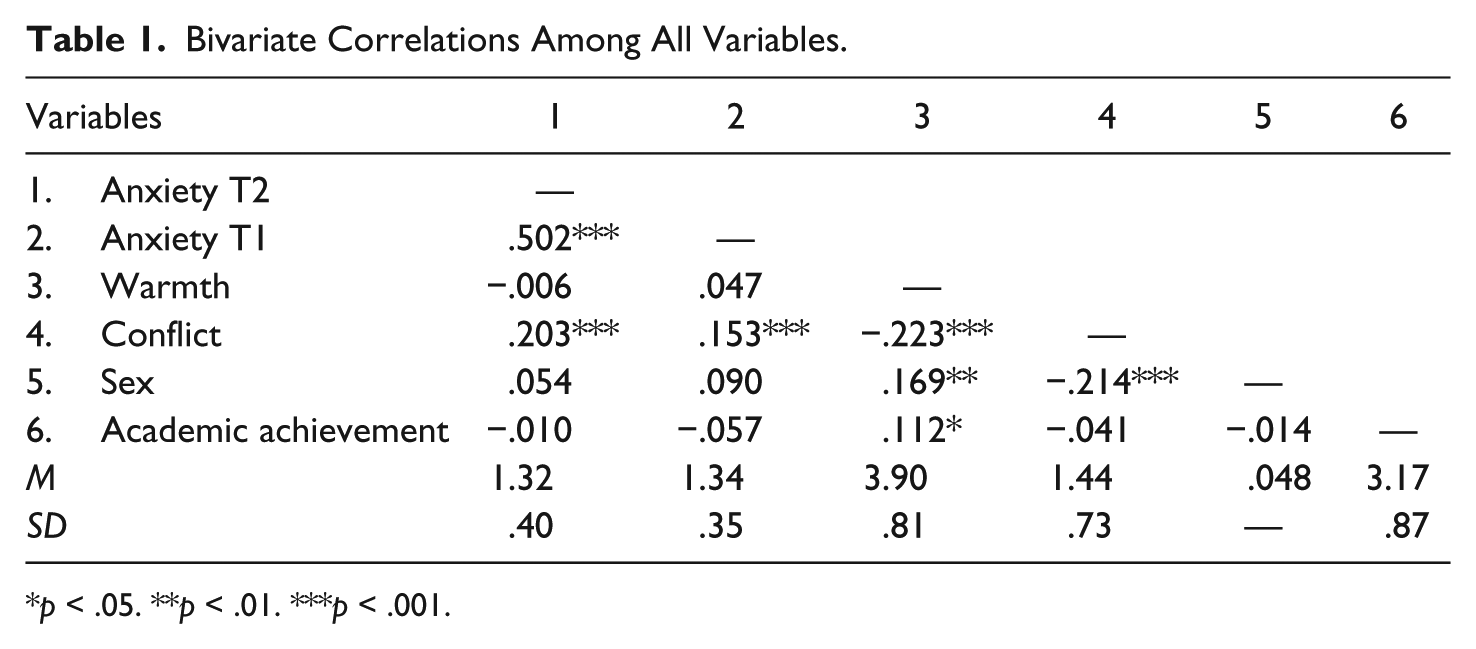
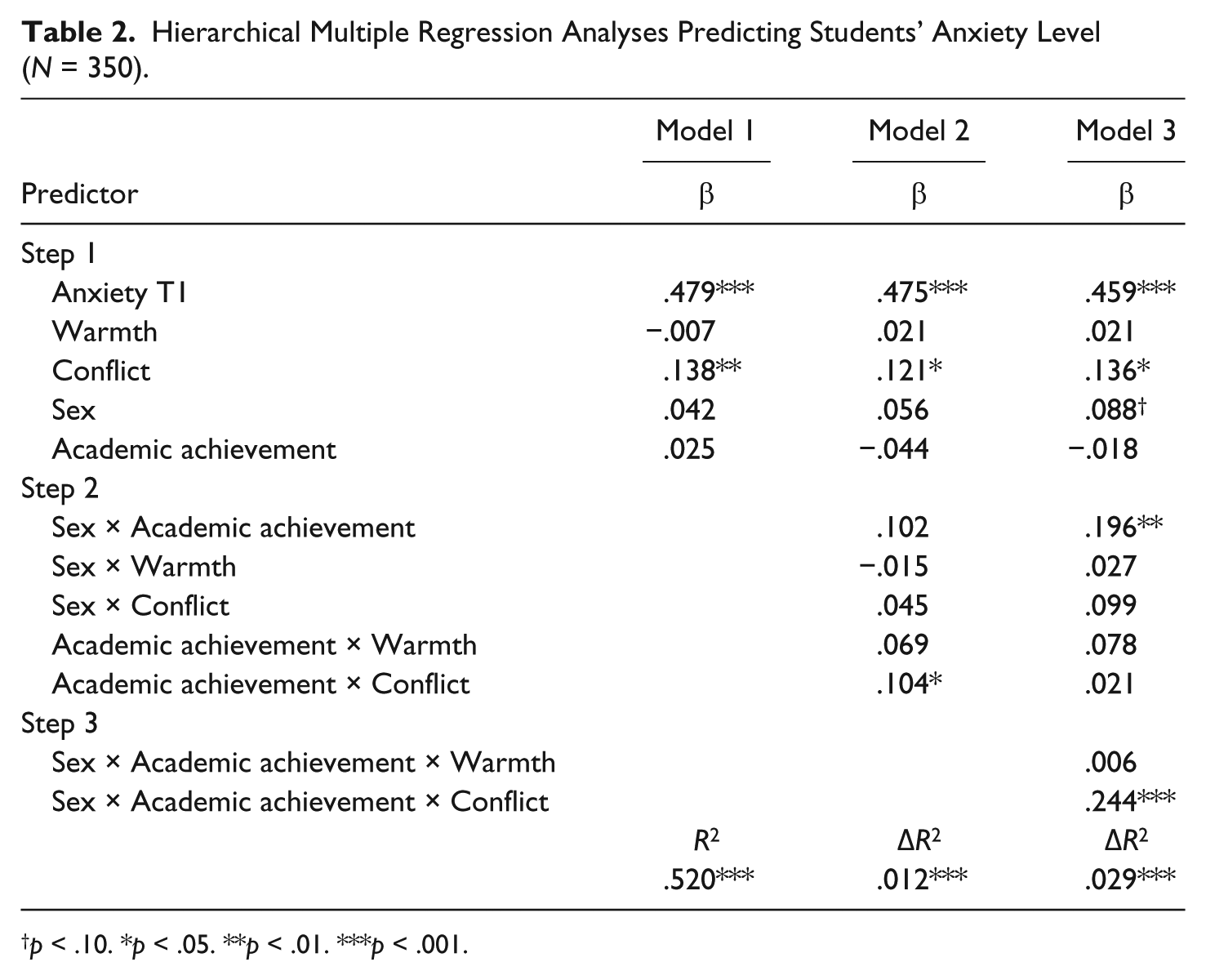
Means and standard deviations (or frequencies) are reported in Table 1, along with the bivariate correlations among all variables. All correlations were in the expected directions. We next ran a three-step regression model presented in Table 2. Only the final model will be examined in detail below. As shown in Table 2, when all variables and interactions are included in this last model, R = .56, F(10, 339) = 12.74, p < .001, anxiety and conflict in the relationship at T1 remain significant predictors of anxiety levels at T2. The sex variable also approaches significance, indicating that being a girl is associated with a higher level of anxiety at the end of the school year. The significant two-way interaction between academic achievement and conflict from Step 2 disappears, thus confirming the relative weakness of this preestablished link. Yet, another two-way interaction between academic achievement and sex is found significant in this model, as well as the three-way interaction between conflict, sex, and academic achievement. We only decomposed the three-way interaction below, as it included the significant two-way interaction. This three-way interaction was decomposed and four slopes were plotted in a graph for interpretation (see Figure 1): one for girls with high academic achievement (Group 1), one for girls with low academic achievement (Group 2), one for boys with high academic achievement (Group 3), and one for boys with low academic achievement (Group 4). The interaction reveals that the association between student–teacher conflict and anxiety is significantly stronger for girls who perform academically above average than for students from any other group, as their slope is significantly different from Group 2, t(341) = 4.229, p < .001, Group 3, t(341) = 3.458, p < .001, and Group 4, t(341) = 3.559, p < .001. This result indicates that girls with higher academic achievement are more susceptible to feel anxious when they have conflicts with their teacher than any other students, b = .449, t(341) = 4.636, p < .001. The influence of student–teacher conflict on anxiety is also significantly different for girls with low academic achievement compared with boys with low or high academic achievement, with a slope significantly different from Group 3, t(341) = −2.502, p = .013, and Group 4, t(341) = −2.196, p = .029. Indeed, for these girls (Group 2), a trend shows that the more conflictual their relationship is with their teacher at T1, the lower their level of anxiety is at T2, b = −.177, t(341) = −1.764, p = .079. Furthermore, results show that the relationship between conflict and anxiety does not significantly differ between boys with high academic achievement and those with low academic achievement, t(341) = .212, p = .833. However, for boys with high academic achievement, higher levels of conflict at T1 are associated with higher levels of anxiety at T2, b = .086, t(341) = 2.088, p = .038, while the slope is not significant for boys with low academic achievement, b = .062, t(341) = 1.301, p = .194.
Bivariate Correlations Among All Variables.
p < .05. **p < .01. ***p < .001.
Hierarchical Multiple Regression Analyses Predicting Students’ Anxiety Level (N = 350).
p < .10. *p < .05. **p < .01. ***p < .001.

Decomposition of the significant three-way interaction between conflict, sex, and academic achievement.
Discussion
Anxiety is an emotion that can have many long-term consequences on a child’s life. This prospective longitudinal study sought to focus on one important element of the classroom context, the student–teacher relationship, to examine its link with children’s self-reported anxiety levels at the end of the school year. Moreover, we assessed whether children’s sex and academic achievement could moderate this association. Our results first show that negative student-teacher relationships are associated with an increase in student anxiety symptoms as early as the third and fourth grade. Yet, these results also indicate that this association between the student–teacher relationship and child anxiety is not direct; it varies for boys and girls, according to their academic achievement.
We first expected that warmth and conflict in the student–teacher relationship would have a direct influence on student anxiety. Our results partly support this claim. Conflicts in the student–teacher relationship were significantly associated with higher anxiety in children at the end of the school year, but contrary to other studies (O’Connor et al., 2011; Pianta & Stuhlman, 2004), we found that harmonious student–teacher relationships were not linked to this outcome. Such results are surprising, but they are consistent with Drugli et al. (2011) findings, which showed that discord in the relationship with teachers had a stronger influence on internalizing symptoms than warmth. The possibility that warmth has an influence on anxiety cannot be completely excluded, but we can speculate that the presence of a close relationship with the teacher may not be enough to have a protective impact on child anxiety. Indeed, the absence of conflict with teachers must also be accounted for in the quality of support a child receives.
The association between student–teacher relationships and child level of anxiety was also expected to be different according to the child’s sex and academic achievement. This was found to be the case, but our results were not in the expected direction. Indeed, girls with high academic achievement were more affected by conflict with teachers and presented higher anxiety at the end of the school year compared with all other students, even the low-achieving girls. As anxiety is most prevalent in females (Albano et al., 2003), increased anxiety among girls was predictable. Yet, as low academic achievement is also more associated with anxiety than high academic achievement (Drugli et al., 2011), our results remain surprising. Nevertheless, they are some lines of explanation. For instance, girls and students with high academic achievement are often less involved in disputes with teachers than other students (McCormick & O’Connor, 2015). For that reason, high-achieving girls experiencing a difficult relationship with their teacher from the beginning of the year are probably less used to, and more affected by, these situations as they may not know how to cope with them. Experiencing a conflictual relationship with their teacher might be more distressing for them.
While high-achieving girls showed the highest increase in anxiety over the school year when sharing a conflictual relationship with teachers, boys who performed academically well also showed some increase in their anxiety. Facing conflict with teachers was less anxiety provoking for them than for their female peers. However, as for girls, these boys who perform academically well in school might also be used to having close and less discordant relationships with teachers. Conflict is probably somewhat unusual and thus also anxiety provoking for them.
Finally, conflict with teachers also affected low-achieving girls, but the marginal trend observed was quite different. For these girls, more conflict with teachers tended to be associated with an anxiety decrease. This result is difficult to explain. However, these girls who present low academic achievement and often fight with teachers may also present other difficulties such as externalizing behavior problems (Jerome et al., 2009). As such, it is possible that they have experienced other negative relationships with teachers in the past and, for that reason, have taken some distance from these adults over time to protect their self-worth.
Overall, this study highlights that conflict in the student–teacher relationship is generally associated with student anxiety. Specifically, boys and girls who perform academically well both reported feeling more anxious when in a conflictual relationship with a teacher, while low-achieving girls reported feeling less anxious in such relationships. More research will nevertheless be necessary to replicate these findings and better distinguish the differential effects due to student academic achievement.
Strengths, Limitations, and Future Directions
This study has several strengths. It is the first study to examine the association between student–teacher relationships and anxiety in third- and fourth-grade students using a prospective longitudinal design, which allowed us to control for initial levels of anxiety. This study also uses the two complementary dimensions of the student–teacher relationship, allowing the comparison of its negative and positive aspects. Finally, two different informants answered the questionnaires, which increased the independence of our measures.
Although this study represents an important step in understanding the longitudinal influence of teachers on student anxiety, certain limitations are worth mentioning. First, while our measure of anxiety has been used in large longitudinal studies (QLSCD; Institut de la Statistique du Québec, 2016), this measure is made of four items that do not include all possible symptoms of anxiety disorders. It measures the level of the anxiety felt, but not its correspondence to the diagnostic criteria of the disorders. Second, this study is correlational by design and our sample was not a clinical one, which limits our capacity to understand the development and causes of anxiety disorders. As such, we could not affirm that student-teacher relationships were the only source of influence as other variables, such as teaching practices, relationships with peers, and family context, could also have affected our outcome.
Our findings ought to be replicated. For instance, future studies should try to further understand why boys and girls with high academic achievement are more affected by conflict in their relationships with teachers while the opposite situation applies for low-achieving girls. Characteristics such as the importance attached to relationships, the desire to please teachers, and perfectionism could help explain such results in high-achieving students. As for low-achieving students, there are probably different characteristics, like externalizing and antisocial behaviors, that should be explored to explain our finding. Finally, to better examine the possible factors at play in the development, maintenance, and improvement of anxiety disorder symptoms, more components of the classroom context should be studied and followed over time. Studying components identified in other research as having an impact on children’s emotional well-being, such as teachers’ structure and autonomy support, could help us deepen our understanding of the factors in the classroom context that affect child anxiety. Teacher characteristics such as sex could also influence relationships with students and should be taken into account in futures studies.
Implications
Overall, the student–teacher relationship is associated with the development of anxiety in children in third and fourth grade. Specifically, high levels of conflict seem more relevant to the development of anxious feelings than the protective function of warmth. Teachers should therefore be sensitized to the importance of prioritizing conflict management in their classroom to protect children’s emotional well-being. In that sense, school professionals should be involved in providing teacher training on the topic, as well as individual support. Teachers need to talk about the negative experiences they have with some of their students to get tailored advice on how to resolve these conflicts and improve their relationships with these students. This study also directs attention to a group rarely considered at risk in schools: girls with high academic achievement. Our finding reinforces the idea that these girls, even if engaging in class and succeeding academically, can be greatly affected by discordance in their relationship with a teacher. It would be important to target these girls and involve them in effective prevention programs against anxiety. These programs could not only address a large set of strategies to deal with anxiety, but they could also include prevention strategies to help students deal with difficult situations such as conflicts with teachers. As they show great academic ability, these girls will likely be able to learn effectively from these interventions, understand the strategies taught, and apply their knowledge rapidly and effectively.
Footnotes
Declaration of Conflicting Interests
The author(s) declared no potential conflicts of interest with respect to the research, authorship, and/or publication of this article.
Funding
The author(s) disclosed receipt of the following financial support for the research, authorship, and/or publication of this article: This research was supported by a grant from the Quebec Fund for Research – Society and Culture awarded to Isabelle Archambault, and by a doctoral award from the Social Sciences and Humanities Research Council to Vanessa Kurdi.