




Abstract
The present research was carried out to clarify relationships between peer pressure, social networking site (SNS) addiction, and SNS-use motives in Korean adolescents. Adolescent SNS users (N = 300, 52.70% female) completed self-report measures of peer pressure, SNS addiction, and SNS-use motives. Findings indicated that adolescents reporting more peer pressure had higher levels of SNS addiction. Moreover, the relationship between peer pressure and SNS addiction was mediated by coping and social-conformity use motives. Results are discussed in terms of implications for prevention and intervention, for adolescents facing peer pressure.
Introduction
Social networking sites (SNS) (Facebook, Twitter, Instagram, etc.) are Web-based services that allow users to create self-descriptive profiles, communicate with friends, and meet other people based on shared interests (Griffiths et al., 2014). SNS addiction is a form of behavior addiction that is generally defined as follows: “Being overly concerned about SNS and driven by a strong motivation to log onto or use SNSs and to devote so much time and effort to SNS that it impairs one’s other social activities, studies/job, interpersonal relationships, and/or psychological health and well-being.” (Andreassen & Pallesen, 2014, p. 4054). This definition reflects seven core symptoms common in behavior addictions: salience, tolerance, mood modification, conflict, withdrawal, problems, and relapse (Griffiths et al., 2014).
Previous reports have suggested that SNS addiction may cause social and academic dysfunction among adolescents. According to prior research, using SNS for 2 or more hours per day is related to decreased academic performance/engagement and internalizing problems in adolescents (Tsitsika et al., 2014), and excessive SNS use may result in poorer mental health in this age group (Sampasa-Kanyinga & Lewis, 2015). In addition, SNS use has been linked to decreased well-being and self-esteem in adolescence (Valkenburg et al., 2006).
One important predictor of SNS addiction in adolescents is peer pressure. Peer pressure, defined as the “pressure to think or to behave along certain peer-prescribed guidelines” (Clasen & Brown, 1985, p. 452), has been shown to play a major role in the development and continuation of SNS use and SNS addiction during adolescence (e.g. Beyens et al., 2016; Turel & Osatuyi, 2017; Vlachopoulou & Boutsouki, 2014). Although the literature is clear that peer pressure is related to SNS addiction, far less is known about the factors underlying the association of peer pressure with SNS addiction. The present study examined the association between peer pressure and SNS addiction in a sample of Korean adolescents and assessed how this association was mediated by SNS use motives.
Previous studies suggested that use motives may be important determinants of SNS addiction (Alzougool, 2018; Yang & Brown, 2013). Initial models of use motives proposed a two-factor (Farber et al., 1980) and a three-factor model (Cooper et al., 1992). Subsequently, to explain mixed patterns of findings more fully, Cooper (1994) proposed that a four-factor model might better depict use motives for addiction. According to the Cooper’s model (1994), use motives can be classified into two dimensions: source of reinforcement (internal or external) and type of reinforcement desired (positive or negative). Combining these two dimensions yields four different use motives. With enhancement motives, an individual wants to boost positive emotions (internal/positive), whereas for coping motives an individual wants to avoid negative emotions (internal/negative). With social motives, the goal would be to achieve positive social benefit (external/positive), and with conformity motives, it would be to avoid peer disapproval (external/negative). Recent studies have suggested that SNS addiction can reflect two additional use motives (Shin & Lim, 2018). These motives, which have been labeled information motives and pastime motives, involve using SNS to acquire intellectual resources and to regulate boredom, respectively.
The SNS Use Motives Scale (SUMS; Shin & Lim, 2018) was developed to assess SNS use motives more comprehensively. SUMS was designed to assess the six domains suggested in previous addiction research, including information motives, enhancement motives, social motives, coping motives, conformity motives, and pastime motives. Factor analysis of SUMS (Shin & Lim, 2018) showed four factors underlying SNS use motives: (1) information-enhancement motives, (2) pastime motives, (3) social-conformity motives, and (4) coping motives. In their study, information and enjoyment motives were combined to form information-enhancement motives, and social and conformity motives to form social-conformity motives (Shin & Lim, 2018).
Given the lack of literature concerning the associations between peer pressure and SNS addiction, the purpose of the present study was to understand more fully the role that SNS use motives may play in the relationship between peer pressure and SNS addiction in a sample of Korean adolescents. Given that peer pressure has been linked to negative emotions (Santor et al., 2000), peer pressure may be related to coping motives. Individuals experiencing greater peer pressure may lack effective strategies for managing negative affect and may turn to SNS use to cope with their negative emotions. Also, given that peer pressure has been linked to the need for social relationships (Beyens et al., 2016), peer pressure may be associated with social-conformity motives. As no other studies have explored the relationship between peer pressure and SNS use motives, the purpose of the present study was to examine the motivational pathways between peer pressure and SNS addiction among adolescents. It was expected that peer pressure would be positively associated with coping and social-conformity motives and that these motives would mediate the association between peer pressure and SNS addiction.
Method
Participants
Three hundred high school students from five schools in Daegu City, South Korea, participated in this study. The schools were randomly selected, as were the classrooms. According to the Korean Statistical Information Service, in 2017, the personal per capita income of Daegu city was US$14,305, and private consumption per person was US$12,806. Daegu City is ranked 7th among 16 regions in Korea on both indices, indicating that socioeconomic status in the area where the school is located is average for Korea. Of the 300 participants, 52.7% were female, and the overall mean age [SD] of all participants was 16.51 [.90] years, with a range of 15–18 years. All participants were SNS users; the overall mean time [SD] spent on SNS per day was 143.14 min [106.30].
Measures
The Peer Pressure Scale (PPS)
We used the Korean version of the original PPS (Santor et al., 2000). The Korean PPS (Jung, 2007) consists of 11 items designed to measure peer pressure, each of which is rated on a 5-point Likert scale (1 = strongly disagree, 2 = mildly disagree, 3 = neither agree nor disagree, 4 = mildly agree, 5 = strongly agree). The Cronbach’s alpha for the original scale was .91 (Santor et al., 2000).
Several studies have reported adequate psychometric properties for the Korean version of the PPS (Heo & Ha, 2020; Jung, 2007; Lee, 2016) with internal consistency coefficients of .76–.87 (Heo & Ha, 2020; Jung, 2007; Lee, 2016). The scale has also been found to be significantly correlated with alcohol expectancy (r = .30), problematic alcohol use (r = .50), cognitive distortion (r = .47), moral identity (r = -.24), and ego-resilience (r = –.32) (Heo & Ha, 2020). In our sample, findings revealed that all the items of the PPS had good item-total correlations which ranged from .38 to .72.
The Social Network Site Use Motives Scale (SUMS)
SNS use motives were measured by SUMS, which was developed by Shin and Lim (2018) to evaluate SNS use motives in Koreans. This scale consists of 30 items representing four factors. The four factors, each reflecting a use motive, are information-enhancement (“I use SNS to get new information”; “It is interesting to access SNS”), social conformity (“The reason I use SNS is to get along with my friends”; “The reason I use SNS is to not be left out”), pastime (“I use SNS to fill time”), and coping (“I use SNS to forget my worries”). Participants respond to each of the items using a five-point scale ranging from 1 (strongly disagree) to 5 (strongly agree). The internal consistency coefficients for the factors of SUMS are .89–.91 (Shin & Lim, 2018). Although SUMS has been validated only with college students, this scale was originally designed for adults and young people over 15 years old (Shin & Lim, 2018).
The Social Network Site Addiction Proneness Scale (SAPS)
SNS addiction was measured by SAPS, which was developed by Jung and Kim (2014) to assess SNS addiction in Koreans. This scale consists of 24 items, each representing one of four factors: preoccupation and tolerance, avoidance of negative emotions, virtual life orientation and withdrawal, and disturbance of adaptive life and control failure. Participants respond to each item using a five-point scale ranging from 1 (strongly disagree) to 5 (strongly agree). The internal consistency coefficient of the SAPS is .92 (Jung & Kim, 2014). Although this scale has been validated only in college students, the items constituting the scale are easily understandable, and it has been used with elementary and middle school students in previous studies (Hong et al., 2015; Yu & Hong, 2015).
Procedure
After providing informed consent, the participants were asked to fill out the PPS, SUMS, and SAPS individually in a group format. Each group consisted of 20 to 30 students. Completion of the questionnaires took approximately 20 minutes. No personal identifying information was required to answer the questionnaire.
Data analyses
Data were analyzed using SPSS 25. Descriptive statistics were used to identify the basic features of the variables used in the study. Associations between study variables were calculated using Pearson correlation coefficients. The PROCESS macro v3.4 was used to conduct the mediation analysis (Hayes, 2017). The following regression models were used for the analysis. In the first model, the SAPS (dependent variable) was regressed on SUMS; in the second, SUMS (mediating variable) was regressed on PPS; for the third, SAPS was regressed on SUMS; and for the final model, SAPS was regressed on both SUMS and PPS simultaneously. The bootstrap method was used to estimate the indirect effects (i.e., PPS affected SUMS, which in turn affected SAPS). The 99% confidence intervals (CIs) were computed using 5000 bootstrap samples. The indirect effect was considered significant when the bootstrapping CI did not include zero (Hayes, 2017). The completely standardized effect sizes (CS) are reported as indices of effect size (Preacher & Kelley, 2011).
Results
Descriptive Analysis
Pearson correlation coefficients, means, and standard deviations of the scales are presented in Table 1. As expected, peer pressure was significantly and positively correlated with pastime, social-conformity and coping motives, and with SNS addiction. In addition, SNS addiction was positively and significantly related to information-enhancement motives, pastime motives, social-conformity motives, and coping motives.
Means, Standard Deviations, Cronbach’s Alpha and Pearson Intercorrelations Among Scales.
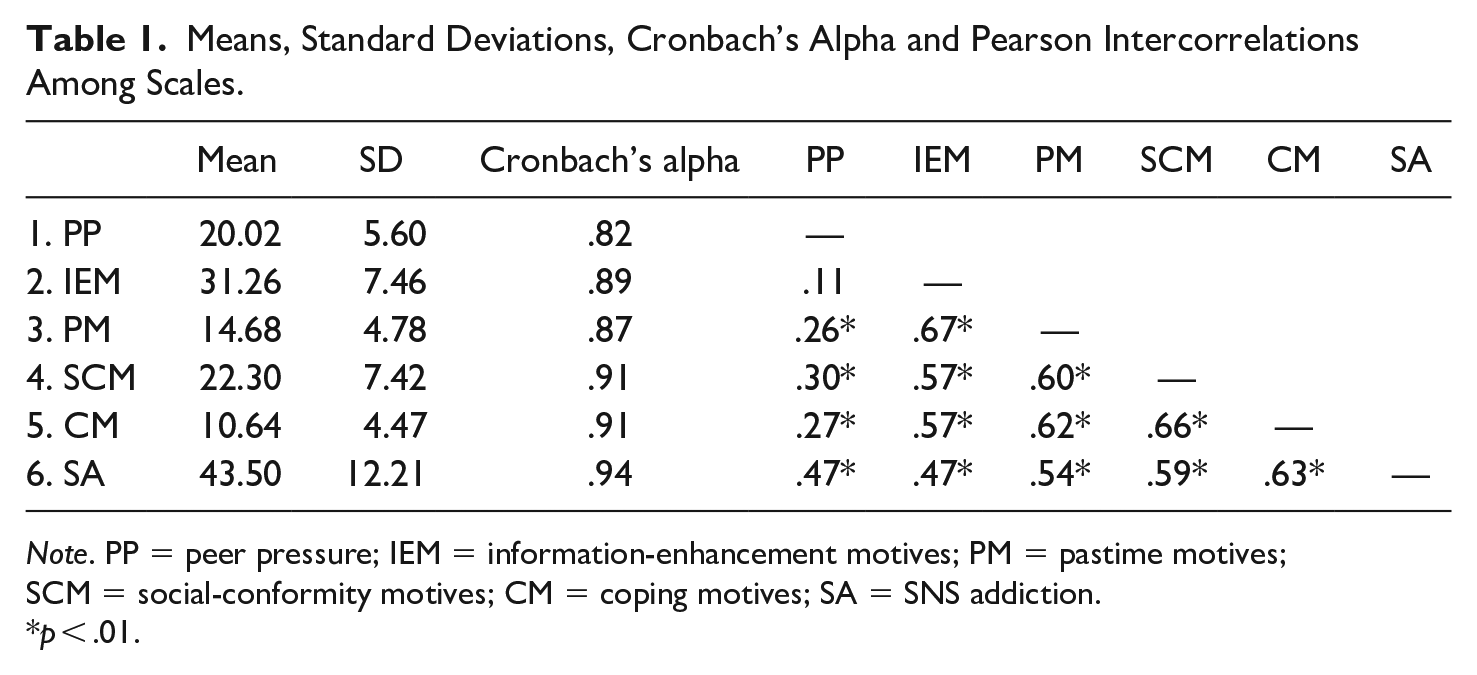
Note. PP = peer pressure; IEM = information-enhancement motives; PM = pastime motives; SCM = social-conformity motives; CM = coping motives; SA = SNS addiction.
p < .01.
Stepwise Regression Analysis
To examine the unique associations between predictors (peer pressure and SNS use motives) and SNS addiction, stepwise regression was carried out in which gender and age were entered in Step 1, and peer pressure or the four SNS use motives in Step 2 (Table 2). Significant predictors of SNS addiction included coping motives, peer pressure, and social-conformity motives. Thus, two to four SNS use motives and peer pressure uniquely accounted for the variance in SNS addiction.
Results of the Multiple Regression Analysis Related to SNS Addiction.
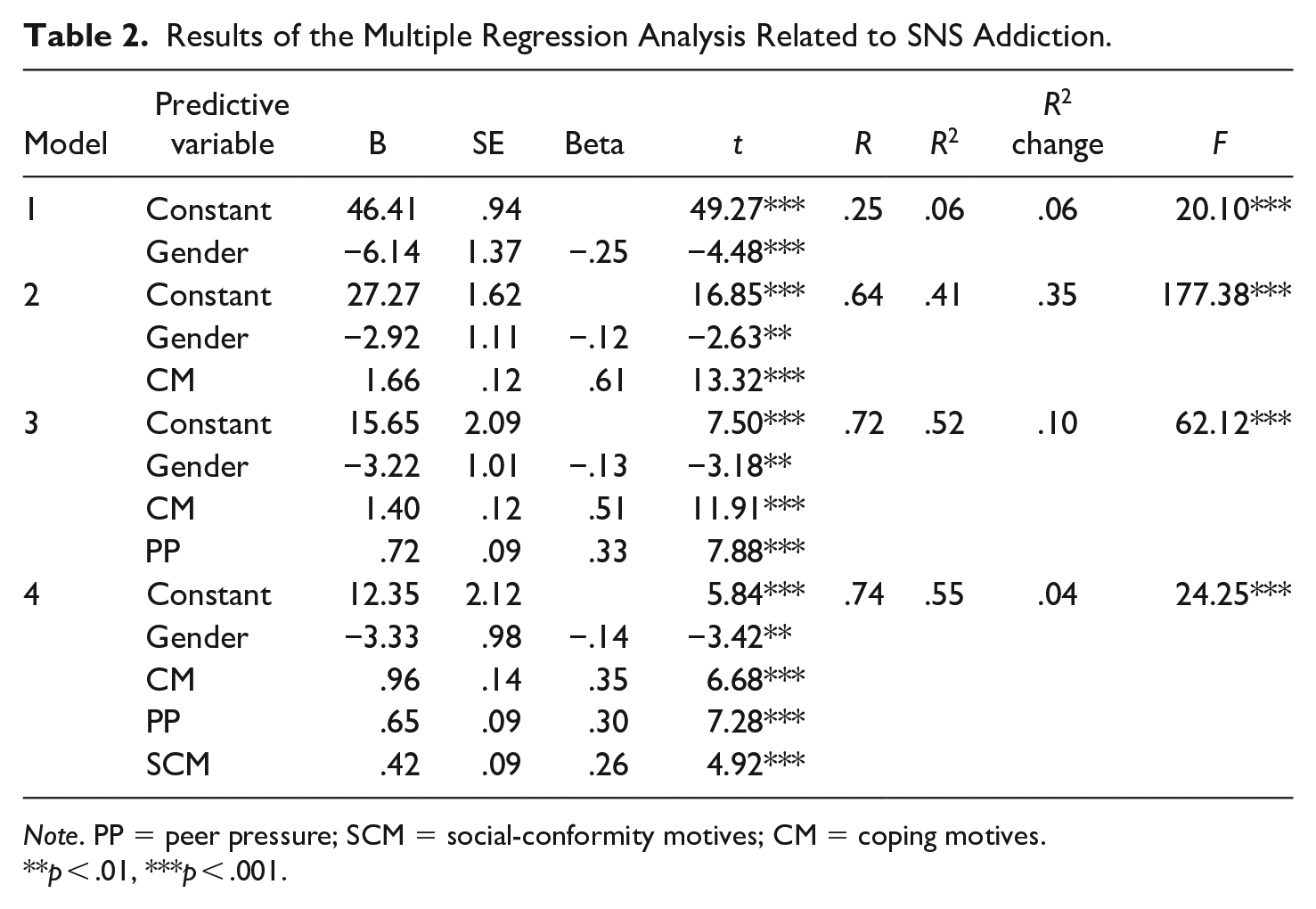
Note. PP = peer pressure; SCM = social-conformity motives; CM = coping motives.
p < .01, ***p < .001.
As can be seen in Table 2, coping motives, peer pressure, and social-conformity motives were all significant predictors of SNS addiction, accounting for 49% of the total variance in SNS addiction. Coping motives were found to be the most important predictor, explaining 35% of the total variance. Peer pressure, the second-most important predictor of SNS addiction, explained 10% of the total variance. The third variable, social-conformity motives, explained 4% of the variance.
Multiple Mediation Analysis
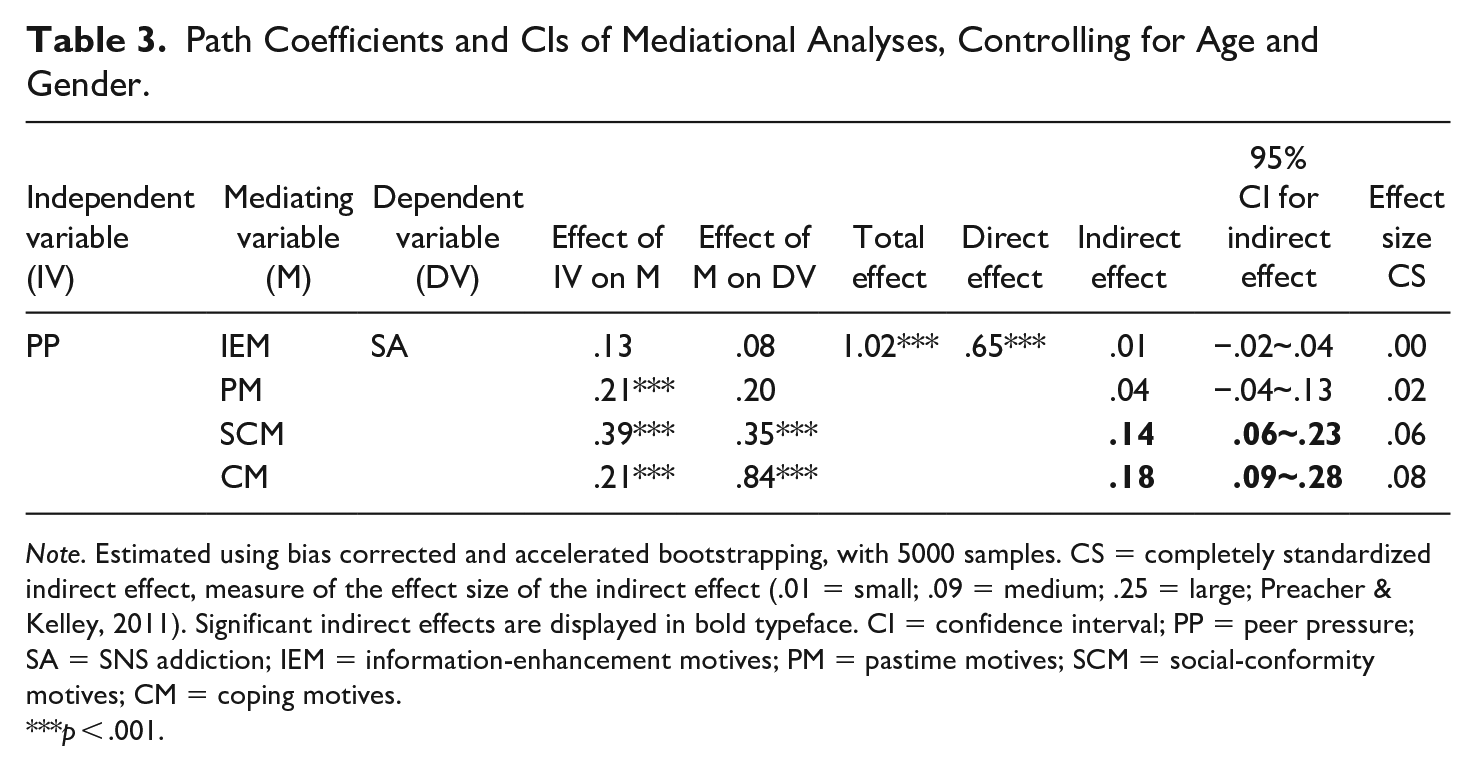
Age and gender were also included in the analysis to rule out the possibility that associations between peer pressure and SNS addiction were confounded by sociodemographic characteristics. Table 3 displays the results for the multiple mediation analysis.
Path Coefficients and CIs of Mediational Analyses, Controlling for Age and Gender.
Note. Estimated using bias corrected and accelerated bootstrapping, with 5000 samples. CS = completely standardized indirect effect, measure of the effect size of the indirect effect (.01 = small; .09 = medium; .25 = large; Preacher & Kelley, 2011). Significant indirect effects are displayed in bold typeface. CI = confidence interval; PP = peer pressure; SA = SNS addiction; IEM = information-enhancement motives; PM = pastime motives; SCM = social-conformity motives; CM = coping motives.
p < .001.
The overall model was statistically significant (F(7,292) = 52.70, p < .001) and explained 56% of the variance in SNS addiction. The total effect of peer pressure on SNS addiction was significant (B = 1.02, SE = .11, t = 9.54, p < .001). In addition, the direct effects of peer pressure on mediating variables of pastime (B = .21, SE = .05, t = 4.56, p < .001), social-conformity (B = .39, SE = .07, t = 5.45, p < .001), and coping motives (B = .21, SE = .04, t = 4.92, p < .001) were significant. However, the direct effect of peer pressure on information-enhancement motives (B = .13, SE = .07, t = 1.83, p = .07) was not significant.
A review of the direct effects of mediating variables on SNS addiction showed that the effects of social-conformity motives (B = .35, SE = .09, t = 3.75, p < .001), and coping motives (B = .84, SE = .16, t = 5.44, p < .001) were significant. However, the effects of information-enhancement (B = .08, SE = .09, t = .84, p = .40) and pastime motives (B = .20, SE = .15, t = 1.33, p = .18) on SNS addiction were not significant. The direct effect of peer pressure on SNS addiction decreased when the mediating variables were entered into the model; however, the statistical significance remained (B = .65, SE = .09, t = 7.19, p < .001).
The overall indirect effect of peer pressure on SNS addiction through the mediating variables was significant (B = .37, 95% CI: .22 to .52). The effect size of the total indirect effect (CS = .17) suggests a medium to large effect size for the relationship. Specifically, the indirect effects through social-conformity (B = .14, 95% CI: .06 to .23, CS = .06) and coping motives (B = .18, 95% CI: .09 to .28, CS = .08) were significant, whereas the indirect effects through information-enhancement motives (B = .01, 95% CI: –.02 to .04) and pastime motives (B = .04, 95% CI: –.04 to .13) were not.
Discussion
Recent studies of peer pressure have found a significant relationship of such pressure with SNS addiction. However, little is known about the motivational processes through which peer pressure operates in SNS addiction. In line with previous findings (Beyens et al., 2016; Turel & Osatuyi, 2017; Vlachopoulou & Boutsouki, 2014), in the present study, peer pressure showed a moderate and positive correlation with SNS addiction. Furthermore, peer pressure showed significant and positive, although small, associations with social-conformity and coping motives. These results are consistent with earlier studies (Beyens et al., 2016; Santor et al., 2000). Moreover, social-conformity and coping motives showed significant associations with SNS addiction, in line with the previous research (Shin & Lim, 2018).
Finally, we investigated whether social-conformity and coping motives served as potential mediators between peer pressure and SNS addiction. Results showed that social-conformity and coping motives mediated the relationship between peer pressure and SNS addiction. The effect size of the indirect effect through social-conformity motives was small to medium, and that of the indirect effect through coping motives was medium. Thus, greater peer pressure was significantly associated with higher levels of social-conformity and coping motives, which, in turn, predicted a higher level of SNS addiction. These results provide evidence supporting the view that peer pressure might lead to SNS addiction through motivational pathways. Also, the findings are in line with the principles of use motive theory, which considers use motives as important routes to SNS addiction (Khang et al., 2013; Shin & Lim, 2018).
As hypothesized, adolescents experiencing high peer pressure might be addicted to SNS because they use SNS to cope with negative emotions. These findings may suggest that adolescents who encounter high peer pressure experience more intense or frequent negative emotions in their lives and/or have a dispositional tendency to experience self-control failure in the face of negative emotions (Stautz & Cooper, 2014). Also, as hypothesized, adolescents who report high peer pressure might be addicted to SNS because they use SNS to achieve positive social benefits and/or to avoid peer rejection. These results suggest that adolescents who face high peer pressure may have a greater fear of rejection by their peers, and they may overestimate the likelihood of rejection by peers or loss of popularity in their peer group simply because they are not using SNS.
Even after controlling for the mediation pathway, the direct effect was significant, showing that SNS use motives helped to explain part of the relationship between peer pressure and SNS addiction. This suggests that various factors interact with motivational variables to sustain SNS addiction (e.g., personality and culture; see Kuntsche et al., 2006, for an overview).
This study attempted to combine the literature on peer pressure and SNS addiction with the literature on motivational theory (Cooper et al., 1995; Kuntsche et al., 2006), providing a basis for exploring the relationship between peer pressure and SNS addiction in terms of the existing literature on motivational theory. For example, it would be interesting in future research to investigate the effects of three aspects of peer pressure on SNS addiction as mediated by SNS use motives, given that these aspects of peer pressure have been shown to predict different use motives (Studer et al., 2014).
These findings may also be useful for developing more effective prevention or intervention programs for SNS addiction. SNS addiction programs for adolescents facing peer pressure might be particularly useful to decrease SNS addiction severity if they were to target social-conformity and coping motives. Adolescents might learn how to use specific strategies to regulate social-conformity and coping motives, which, in turn, might help them to reduce their SNS addiction level. For example, interventions aimed at reducing negative emotions and providing alternative ways of coping with negative emotions may be beneficial for adolescents with high peer pressure and strong coping motives. Interventions focused on providing alternative sources of social interaction or on correcting teens’ overestimation of the socializing merits of SNS might be appropriate for adolescents with high peer pressure and strong social-conformity motives.
These findings must be understood in the context of certain limitations. First, caution should be exercised when applying these results to other populations because the sample was recruited from a relatively small area. Second, the cross-sectional nature of the present study does not allow for causal interpretation. Thus, further longitudinal studies are needed to understand fully the relationships between peer pressure, SNS use motives, and SNS addiction. Third, SUMS and the SAPS have not been validated for adolescents in previous studies. Because the scales’ psychometric properties could differ across ages, further validation of the scales in various populations is needed. Fourth, because the data were self-reported, the associations between study variables are likely to be inflated by common method variance; thus, an observer rating method should be included in future studies.
Despite these limitations, this study highlights a need to examine the role of SNS use motives when investigating the relationship between peer pressure and SNS addiction. Given the limitations of the study discussed above, a replication study is needed with a larger and diverse sample, a longitudinal design, well-validated scales, and a variety of assessment methods to obtain a more comprehensive picture of the relationship between peer pressure and SNS addiction. As a result, more effective prevention and intervention programs may be developed, and adolescents at high risk for SNS addiction can be identified and targeted for prevention and intervention.
Footnotes
Declaration of Conflicting Interests
The author(s) declared no potential conflicts of interest with respect to the research, authorship, and/or publication of this article.
Funding
The author(s) received no financial support for the research, authorship, and/or publication of this article.
