




Abstract
A visual activity schedule (VAS) was used with a 7-year-old African-American (Non-Hispanic) male at-risk for school failure. An ABAB withdrawal design was used to assess the effectiveness of a VAS on decreasing latency during transitions. Results indicated that a VAS decreased transition latency between activities and reduced teacher prompting associated with the transitions. Limitations of this study and implications for practitioners and researchers are provided.
Successful transitions are exemplified when students comply with task directions and begin engaging in assigned activities. Some students may display difficulties transitioning between activities (e.g., attending to verbal directions) and, as such, may require direct supports. Implementing interventions to improve transition behaviors is important to ensure students fully access academic content and have an equal number of opportunities as peers for learning.
Visual activity schedules (VAS) refer to static images used to represent a singular or chained behavior. Recent reviews have suggested that VAS is an evidence-based approach for increasing independent transitions between activities and on-task behaviors during activities for students with disabilities; most research on VAS has focused on individuals with autism spectrum disorder (Knight et al., 2015) and intellectual disability (van Dijk & Gage, 2019), while two studies implemented VAS with students at-risk or without disabilities (Watson & DiCarlo, 2016; Zimmerman et al., 2017). Across studies, children typically displayed increases in independent transitions within routines and completed activities with fewer adult prompts. Previous studies have focused on explicit teaching techniques (i.e., system of least prompts, constant time delay) to train the student to use the VAS (cf. van Dijk & Gage, 2019; Zimmerman et al., 2017). In contrast, there are fewer studies that have evaluated (a) the use of VAS with a student at-risk of disability in a general education classroom, (b) the general education teacher being the primary implementer, and (c) a one-time training for the student that is absent of systematic instruction. The current study sought to expand the VAS literature by addressing these gaps.
Method
Participants
Sam, a 7-year-old African-American (Non-Hispanic) male, served as the participant in the study. He was considered at risk due to receiving Tier 2-Response-to-Intervention supports for academics (reading, math) and behavior (social skills). Sam’s teacher reported that he required multiple verbal prompts and occasional physical prompts to transition between activities. Sam’s teacher, a White (Non-Hispanic) female, conducted all sessions and was a certified elementary teacher with 7 years of experience.
Two peer models were identified by the teacher. She noted that one peer rarely required prompting to transition and one required supports on occasion. The peers were observed on three occasions during the targeted transitions and data were collected to identify a range of typical latencies to transition. These data served as guidelines for determining if effects were socially valid when comparing Sam’s behavior to same-age peers.
Setting
The study was conducted in a first-grade general education classroom at an urban public school located in the Southeastern US. Twenty-two students, one teacher, and one paraprofessional were in the classroom during the study. Four transitions that occurred in a 1-hr period were targeted for intervention. All transitions occurred between Sam’s desk and the classroom rug (1.16 m between the two locations).
Materials and Equipment
Sam was provided with assigned worksheets (reading or writing) for desktop activities. The VAS was a laminated piece of paper (216 × 279 mm) in landscape orientation with four Velcro® squares across the top and four across the bottom and four laminated photographs (each 50.8 × 50.8 mm) of centers, with the name of each center printed in black ink. During the intervention, the teacher wore a MotivAider®.
Data Collection and Experimental Design
The first author, the primary data collector, conducted observations once per school day for (a) latency to task engagement, (b) frequency of teacher prompts, and (c) treatment fidelity. Latency to task engagement was measured by starting a timer when Sam’s teacher dismissed him from an activity (baseline) or told Sam to “check schedule” (intervention) and stopping the timer once he was engaged in a center activity for five consecutive seconds. Engagement was defined as Sam appropriately manipulating materials or waiting for instruction (oriented toward the material or teacher) in an assigned center. Total latency was recorded for Sam and frequency of teacher prompts (verbal or physical) were recorded for the teacher. Prompts were defined as teacher behaviors that signaled to Sam where he was to go and what he was to do (e.g., transition to the spelling center at the rug). Prompting following the initial task direction was recorded. Prompts occurring within 3 s of each other were counted as a single prompt. Treatment fidelity was collected during intervention conditions using a task-analyzed checklist. A single-case withdrawal design (ABAB) was used to evaluate the effects of VAS on decreasing transition latency.
General Procedures
The teacher identified four in-class transitions to target during the 1-hr center time that included two activities at the rug (whole group reading and spelling group) and two activities at Sam’s desk (individual writing activities and small group instruction). These transitions represented moves for all students between the locations. The first transition began with the teacher reviewing the four centers, their location, and tasks to be completed. The teacher instructed students to transition to the proper center. At the beginning of each subsequent transition, students’ received task directions to transition to the next center. During the study, Sam had a maximum of 4 min per transition to move to the appropriate center prior to receiving physical prompting.
Baseline procedures
The teacher directed Sam by stating it was time to transition and telling him where to go (e.g., “Go to the rug for spelling.”). This type of task direction was used for each transition. There were no instructions given to the teacher to limit the number of prompts provided, there was no VAS used, and there were no behavior specific praise statements (BSP) used during baseline.
Teacher training
A one-time training provided by the first author was conducted before intervention and lasted 45 min. It included showing the teacher the VAS, explaining how to manipulate the photos, providing examples and nonexamples of how to prompt Sam to use the VAS, and how to provide BSP. In addition, the first author modeled and practiced the intervention with the teacher and provided feedback on her implementation. The teacher was instructed to turn on the MotivAider® when Sam was directed to check the VAS and turn it off when Sam was in the correct location and engaged in the appropriate activity for 5 s. A MotivAider® was used during intervention sessions on a fixed interval of 30 s to remind the teacher to provide a verbal prompt and the photograph. Treatment fidelity was collected on teacher behavior, during the training, until the teacher scored 100% fidelity for three consecutive opportunities. The teacher received one booster training session after intervention began when fidelity fell below 80% (teacher provided general praise instead of BSP). The booster training occurred in a face-to-face meeting with the teacher and consisted of additional examples and nonexamples of BSP.
Intervention procedures
The independent variable was VAS combined with BSP. Prior to implementing the intervention, a single practice trial was presented to Sam, where the teacher explained the VAS to Sam, modeled how and where to move the photos, and provided him an opportunity to practice. During intervention sessions, the VAS was placed either in Sam’s desk or next to his area on the rug. Photographs of the day’s activities were placed on the VAS prior to the session.
During transitions, the teacher gave the task direction “It is time to check your schedule.” Sam was to remove the photo for that center and transition to the center. Once at the correct location, Sam placed the photo of the center activity on the bottom half of the VAS. The timer stopped when Sam was in the correct center area and oriented towards his work or teacher for 5 s. The teacher provided BSP (e.g., “Sam, you transitioned quietly and quickly!”) following his transition. If Sam transitioned to the incorrect center or failed to respond, the teacher could verbally prompt him to transition. If the MotivAider® indicated it was time to prompt, the photograph of the appropriate center was paired with the verbal prompt.
Once in the appropriate center, Sam worked on the assigned task until the next task direction to transition. The teacher followed the same procedures for all transitions during intervention conditions. When latency decreased by 25% for three consecutive sessions, the intervention was removed. Procedures were repeated with second baseline and intervention conditions.
Reliability and Treatment Fidelity
Interobserver agreement (IOA) was collected for at least 20% of observations in each condition by a graduate student trained on response measures. To calculate IOA, the shortest latency was divided by longest latency and multiplied by 100; mean IOA was 98.5% (range 97%–99%). Treatment fidelity was collected by the first author through direct observation each session during intervention using a task analyzed checklist for each transition that included (a) prompt to go to center, (b) “Sam, check your schedule” and (c) providing BSP for accurate transition. To calculate treatment fidelity, the number of steps completed correctly was divided by the total number of steps multiplied by 100. Treatment fidelity averaged 88.9% (range 50-100%) and retraining occurred if fidelity was below 80%.
Results
Level, trend, stability, immediacy of effect, consistency of effect, and overlap were considered when visually analyzing total latency (i.e., sum of latency for all four transitions) to transition independently during center time activities (see Figure 1). Two peer models that were observed during the targeted transitions had a total latency ranging from 64 s to 81 s. Analysis of the first baseline condition indicated a total latency ranging from 85.25 s to 149.75 s with all data points in this condition exceeded the transition latency of peers. The teacher provided nine verbal prompts during this condition.
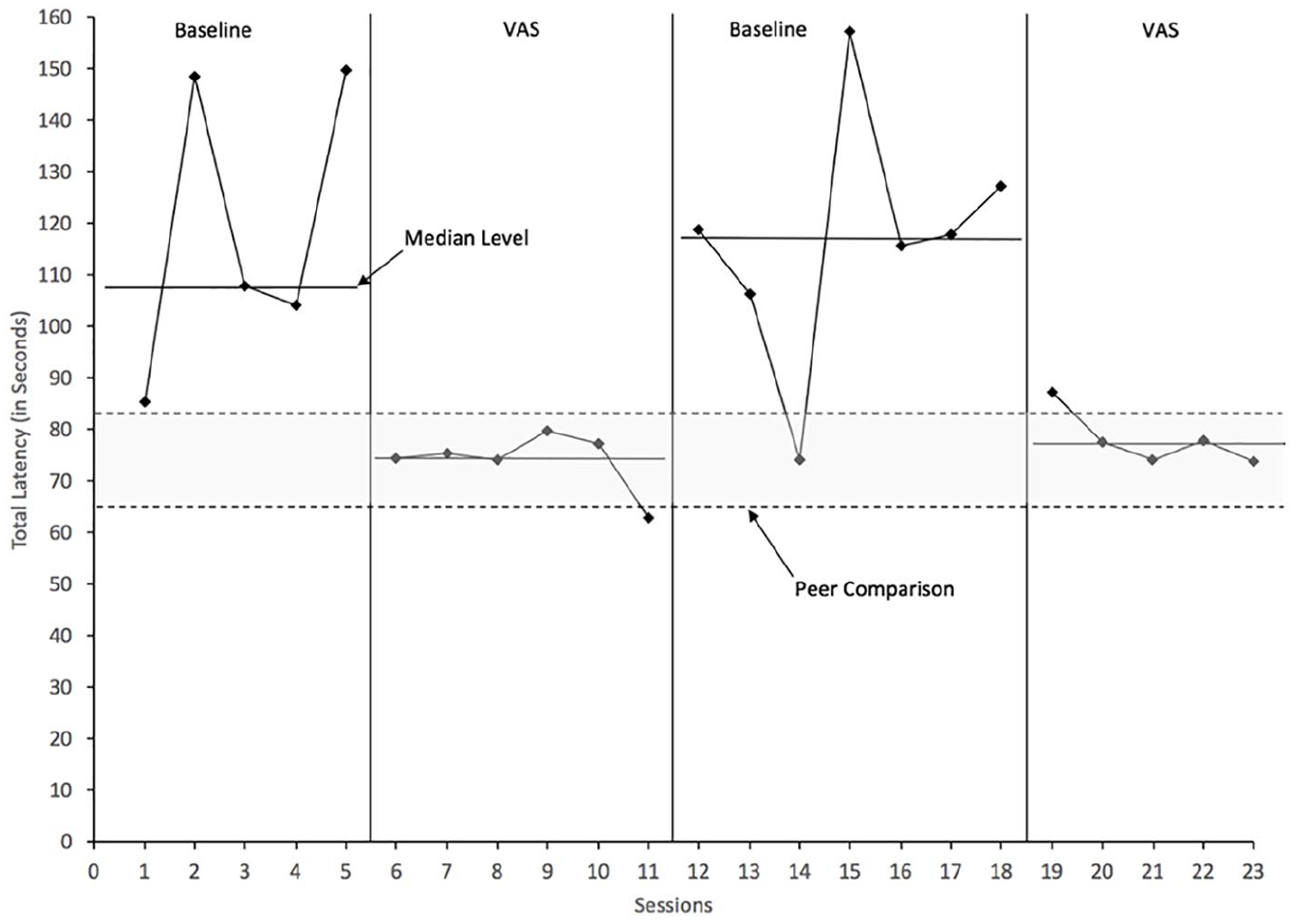
Total latency for all transitions during baseline and intervention for Sam.
Upon introduction of the VAS, an immediate and abrupt change were observed in total latency. Data ranged from 62.71 s to 79.75 s and were relatively stable across the first intervention condition. There was 100 percent non-overlapping data (PND) between the first two conditions. During this condition, all of Sam’s data points were within the range of his peers. The teacher provided five verbal prompts.
Returning to baseline resulted in the data path approximating the data path in the first baseline condition with total latency ranging from 74.24 s to 157.23 s. There was 92% PND between the first intervention and the second baseline condition. In this condition, transition latency exceeded peers on 85% of data points. Fourteen verbal prompts were given by the teacher.
Reapplying the VAS resulted in data ranging from 73.83 s to 87.3 s. There was a 92% PND between the second baseline condition and the second VAS condition. The initial data point exceeded peer comparison latency; however, the final data points were within the range of Sam’s peers. Three verbal prompts were used during this condition. Neither a verbal plus photograph nor physical prompt was used during either VAS condition.
Discussion
This study evaluated the effects of VAS for decreasing transition latency for an at-risk student in the general education classroom. Results indicated a functional relation between the intervention and a reduction in transition latency. This means that the systematic application and withdrawal of the VAS impacted Sam’s transition latency.
Verbal prompts given by the teacher decreased between baseline conditions (mean = 1.17) and VAS conditions (mean = 0.73). A reduction in teacher prompts when using the VAS was also noted by Watson and DiCarlo (2016). It is important to note that delivering additional prompts did not count as treatment error. During VAS, Sam’s transition latency was within or below the range of his peers on 91% (10 of 11 data points), while only 8% (1 of 12 data points) were within this range during baseline. When using VAS, Sam decreased transition time and teacher prompts for transitioning. It is plausible that the VAS affected these variables because the photo served as a visual reminder of where to transition. These photos may have served as discriminative stimuli to signal that reinforcement was available when Sam arrived at the appropriate location. Furthermore, Sam received teacher attention for transitioning appropriately (i.e., BSP) as opposed to being prompted to transition. Future studies should attempt to differentiate teacher attention.
The current study extends previous literature that found positive effect of VAS on students considered at-risk (Zimmerman et al., 2017) and positive effects of VAS in completing classroom routines (Watson & DiCarlo, 2016). This study adds to the literature by using the general education teacher as the primary interventionist and using a simple VAS that did not require extensive training for the student. It is worth noting that retraining for the teacher was required due to the teacher not using BSP statements following Sam’s correct use of the VAS.
Limitations and Future Research Directions
Limitations of this study warrant attention. First, only one student participated in this study. Although a functional relation was established, having additional participants would improve the external validity of the study. Furthermore, a functional assessment was not conducted to determine the function of Sam’s delayed transitioning. Future research should replicate this study using additional students and with functional assessments of targeted behaviors. Second, this study only focused on four transitions that took place within 1 hr of the school day. Future research could include transitions occurring throughout the school day and outside of the classroom. A lack of generalization of the intervention to transitions at other times or in other locations limits the utility of the intervention. Future studies should program for generalization across times and settings. Third, procedural fidelity was not collected during baseline or teacher training. Ensuring that the teacher was trained accurately should be paramount to any future study. Fourth, a formal social validity measure was not used, but should be included in future research. Finally, this was a multicomponent intervention (i.e., VAS plus BSP). It would be helpful for future studies to conduct a component analysis to determine how each component contributed to results.
Conclusion
This study extended the VAS literature to a student at-risk included in the general education classroom. This intervention required low effort to train the general education teacher to implement and the student to use, which may increase the utility of the intervention for teachers. Additionally, transition latency was reduced by using the VAS, which increase opportunities for the academic engagement.
Footnotes
Authors’ Note
This research was conducted as part of requirements for a Master’s of Science degree.
Declaration of Conflicting Interests
The author(s) declared no potential conflicts of interest with respect to the research, authorship, and/or publication of this article.
Funding
The author(s) received no financial support for the research, authorship, and/or publication of this article.
