




Abstract
Although the accurate diagnosis and effective instruction for reading disorders through multi-tiered systems of support is one of the most foundational components of school psychology training and practice, there are significant opportunities for innovation, renewed excitement, and social justice. In this article, we identify reading assessments, interventions, and systems-level policies shown to be effective through rigorous, empirical research. These effective practices are not well known by school psychologists or commonly implemented in schools. We propose four areas to better align school psychology training and practice with the most cutting-edge reading research to improve student outcomes in the future: (a) building knowledge of reading development, (b) increasing the commitment to school-based careers, (c) implementing more instructionally-useful reading screening and special education assessment practices (including using the hybrid model of identification), and (d) promoting evidence-based reading instruction and intervention. Throughout each of these four areas, we highlight the need for multi-disciplinary collaboration.
We are writing this article to identify tangible ways that school psychologists can recommit to reading instruction. Early literacy development is associated with greater success across schooling, increased likelihood of graduation, greater life satisfaction, and long-term economic stability (e.g., Fiester, 2010). We argue that fostering early literacy development holds the greatest potential for schools and school psychologists to promote social justice and achieve tangible outcomes for historically oppressed groups, including students with disabilities, students of color, and students from low-income households. Reading is access and writing is power to have one’s voice heard. Schools are the only universal opportunity to increase equity in reading and writing.
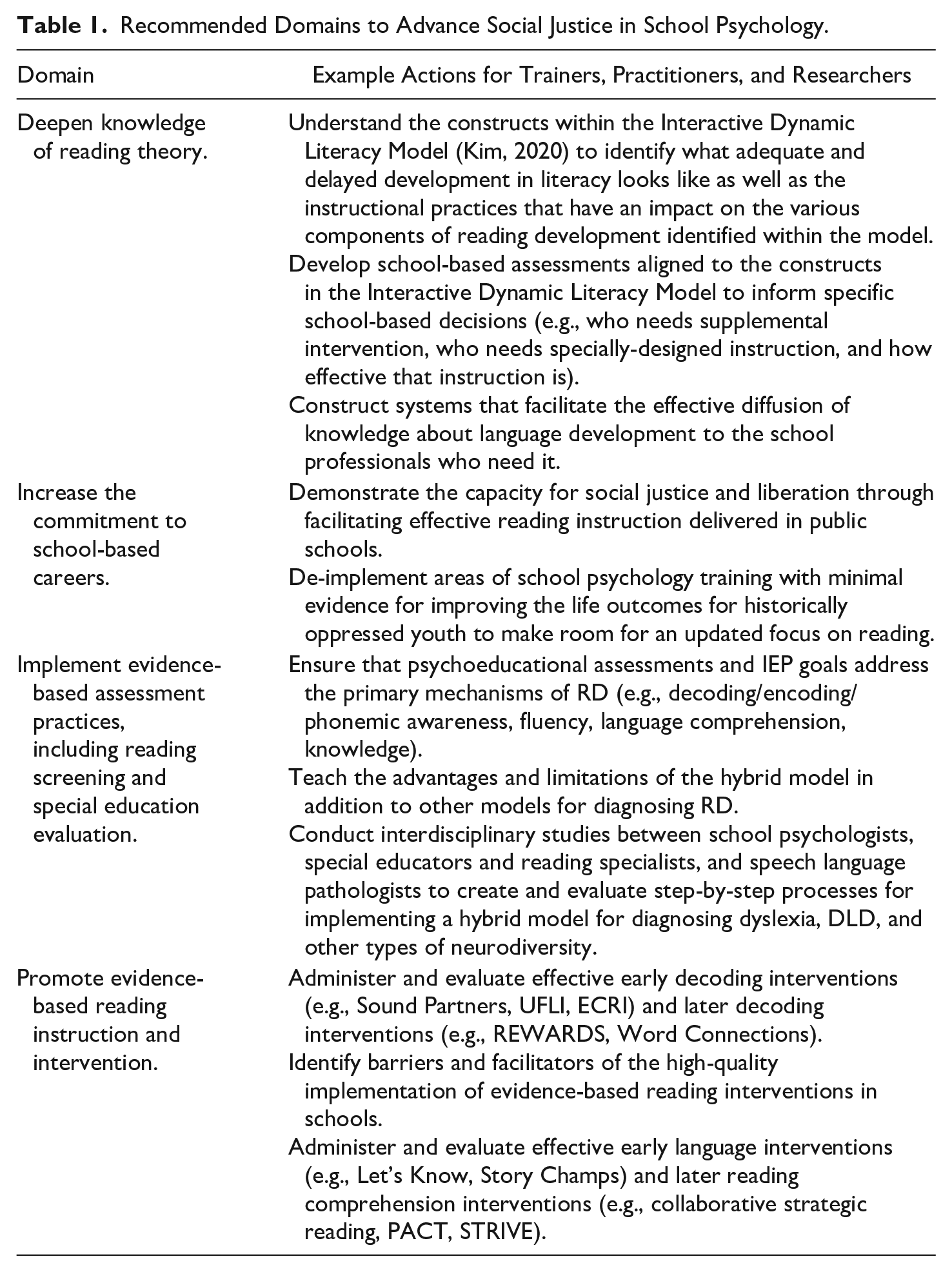
Life stories provided by many individuals with dyslexia and developmental language disorder (DLD) highlight places where some encountered privilege in receiving early reading instruction that met their needs and many more experienced systemic barriers throughout their life (e.g., Johnson, 2023; Orrego et al., 2023). In these life stories and documented through hundreds of research studies (e.g., Blachman et al., 2014; Hall et al., 2023), the mechanisms that change these individuals’ life trajectories are access to effective reading instruction, tailored to their needs, and delivered before gaps in their reading get larger (Connor, 2019). School psychologists have been seeking tangible strategies to combat racist, ableist, and ethnocentric systems. In this article, we argue that school psychologists can have the largest tangible impact on student outcomes by centering equitable access to effective reading instruction. In this context, we define equity as the exertion of additional efforts and resources to implement more intensive and specific reading instruction practices to students who do not learn to read through privilege. To achieve this goal, the field of school psychology must update their training and practice to (a) increase knowledge of recent research on reading development, (b) increase the commitment to school-based careers, (c) implement implementing more instructionally-useful reading screening and special education assessment practices, and (d) promote evidence-based reading instruction and intervention (see Table 1).
Recommended Domains to Advance Social Justice in School Psychology.
Terminology Used to Describe Reading Concerns
Research, practice, and policy intended to promote reading outcomes employ a wide range of terms to describe students with equity needs in reading, increasing confusion in the field, and reinforcing different systems for communities that do and do not have privilege. The terminology varies across settings (e.g., hospitals, schools), the credentials of the diagnostician (e.g., licensed clinical psychologist, nationally certified school psychologist), and various policies or procedures (e.g., Individuals with Disabilities Education Improvement Act, 2004; Diagnostic and Statistical Manual of Mental Disorders, 5th edition [DSM-5]). However, research shows that there are no meaningful differences between the terms dyslexia and specific learning disability (Fletcher et al., 2019). Further, the U.S. Department of Education issued a memo in 2015 explicitly stating that the terms dyslexia, DLD, and other neurodiverse disability terms can be used. We argue that it is more important to use terms that point to the most effective response that will improve outcomes for students. To represent the range of reading concerns, in this article, including reading difficulties that are due to access to poorly matched instruction and not disability, we employ the term reading difficulties (RD).
Research indicates that most RD is comprised of word-level reading difficulties and language comprehension difficulties (Adlof & Hogan, 2018; Catts et al., 2005). The greatest instructional need for children with dyslexia is in word reading and spelling, and the greatest instructional need for children with DLD is in vocabulary, syntax/grammar, and discourse structure. This may be an oversimplification of the terms, but we argue it is the most useful place to start (Truckenmiller, 2024).
Building Knowledge of Reading Development
Current graduate training overlooks the depth of understanding of reading development needed to select and implement the most effective assessments and instructional practices. Neither the National Association of School Psychologists (NASP, 2020), Canadian Psychological Association (CPA, 2023), nor the American Psychological Association (APA, 2019) require coursework or competencies in reading development for accreditation. Although school psychologists still spend the greatest amount of their time conducting psychoeducational evaluations, the majority of which are prompted by RD (Benson et al., 2019), very little graduate coursework is focused on RD. At best, RD diagnosis is addressed in one or two courses that also address a variety of other topics (e.g., standardized administration and scoring of cognitive assessments, ethics, report writing) and response-to-intervention is addressed in less than half of the course schedule in any given course (Barrett et al., 2015). Thus, many school psychologists lack the prerequisite knowledge of reading development to effectively improve reading outcomes.
Many school psychologists are likely familiar with the five big components of reading, identified by the National Reading Panel (NRP, 2000): phonemic awareness, phonics, fluency, vocabulary, and reading comprehension. However, they likely lack theoretical understanding of how these components interact, how to assess them, how to support their development, and most importantly how to connect assessment data with specific and more effective instructional decisions. We believe that school psychology training would benefit from highlighting the Interactive Dynamic Literacy Model (Kim, 2020). This model is more comprehensive than previous models and has the added benefits of being empirically tested across multiple studies, multiple age groups, and multiple languages. Briefly, the Interactive Dynamic Literacy Model shows how component skills of reading and writing (e.g., word reading, spelling, vocabulary, syntax/grammar, and discourse structure) interact with each other and with background knowledge to build fluent and skilled reading comprehension and written expression. It also has implications for systematic assessment and instruction going from larger grained skills (e.g.,reading comprehension or written expression) to smaller grained reading skills (e.g., decoding or vocabulary) and vice versa. In other words, it describes where to focus if reading is breaking down. For example, if a student struggles with decoding, then assessing and teaching spelling, handwriting, morphology, and letter-sound correspondence will be helpful. If language comprehension is a challenge, then teaching vocabulary, grammar/syntax, and discourse structures will be most effective. The Interactive Dynamic Literacy model also demonstrates (a) the constraints of working memory which point to the use of graphic organizers for instruction; (b) how strategies like self-regulated strategy development may play a role in the self-regulation of academic engagement; and (c) the interaction of background knowledge instruction with skill and strategy instruction.
Through more research and training on the Interactive Dynamic Literacy model, we want to empower school psychologists who may feel an unnecessary inferiority to clinical psychology. If school psychology training and practice align with reading research, specialist-level school psychologists are more qualified than licensed doctoral-level psychologists to prevent and diagnose RD and to promote tangible effects on socially just life outcomes for students with RD and students of color, who currently do not have access to systems that individualize effective instruction.
Increasing the Commitment to School-Based Practice
As reading outcomes deteriorated post-pandemic, the need for effective instruction for students with RD has grown and is even more pronounced in under-resourced rural and urban communities (Goldhaber et al., 2022). This need is exacerbated by school psychologist shortages (Sohn, 2024). Unfortunately, approximately half of doctoral-level school psychologists choose to practice in hospitals and clinics (Greer, 2005). It may be that school psychologists are attracted to these alternative placements because they assume that schools cannot have the impact that hospitals or clinics have. However, this assumption is inaccurate. Research documents the greatest effects for reading intervention happens in elementary schools (e.g., Blachman et al., 2014; Hall et al., 2023). High quality early reading instruction can reduce the achievement gap for students in poorer communities and communities of color (Haughbrook et al., 2016). The school setting is particularly important for marginalized youth, as a broad array of systemic barriers prevent marginalized youth from accessing services in hospitals and clinics (e.g., Bear et al., 2014).
Furthermore, the influence of school psychologists in non-school settings is limited to recommending accommodations and instruction in a report. Although accommodations may impact a single situation (e.g., college entrance exams), only reading instruction has the power to give students unfettered access to the world of knowledge available in print (e.g., Fletcher et al., 2019). Within a school context, school psychologists can employ their consultation skills to identify specific barriers to implementation, champion evidence-based reading programs, establish better data decisions, and garner buy-in among teachers and administrators (e.g., Barrett, 2021; Barrett et al., 2020). Psychologists outside of schools can do very little to meaningfully impact outcomes for students across the range of RD.
Evidence-Based Assessment: Screening, the Hybrid Model, and Diagnostic Content
Screening
Most research has focused on the accuracy with which reading screeners identify students at-risk of failing the state assessment. Unfortunately, the ability of reading screeners to inform the type of intervention students need is underexamined, yet it is the most important information needed by educators. A2i is a new type of reading screener designed specifically to align with theory about how reading develops and is directly connected to instructional decisions (Connor, 2019). A2i measures students’ phonemic awareness, word reading, and vocabulary development in Kindergarten through 2nd grade and then recommends the number of minutes needed in code-based instruction and meaning-based instruction and how much of it needs to be teacher-directed or child-directed. Across seven randomized controlled trials, Connor and her colleagues (2019) found that students who received instruction that matched their assessment profile showed greater improvement than when all students were provided with the same amount of instruction. This profile is powerful likely because it aligns with the two most common sources of RD: word reading and language comprehension.
More research like Connor’s is needed to influence school system decisions. There are very few efficient screening batteries that assess the instructional needs most closely aligned with RD (i.e., word reading/spelling, fluency, language comprehension) (Fletcher et al., 2020). DIBELS 8 with mClass may be the only currently commercially-available reading screener that measures all three components, and with high classification accuracy (Truckenmiller et al., 2024). Until better screeners are more accessible, schools can supplement their current reading screening practices with any of the curriculum-based measurement (CBM) products for word reading and with CUBED (Petersen & Spencer, 2012) for language comprehension. Also see Bao et al. (2024) for a review of language screeners.
Hybrid Model for Diagnosing RD
The primary goal of RD diagnosis is to improve reading outcomes through the mechanism of evidence-based reading intervention. Thus, the valuable time and resources spent in diagnosis needs to focus on identifying reading interventions that will be effective for each student. Many have argued that the diagnosis of RD must include intervention implementation (Fletcher et al., 2019). In a response-to-intervention (RtI) process, the purpose of diagnosis is to identify the type and level of intervention that needs to be sustained to improve student outcomes.
Unfortunately, RD diagnostic processes that do not include intervention (i.e., ability-achievement discrepancy and patterns of strengths and weaknesses) remain the most used approaches among school psychologists (Maki & Adams, 2018). Because school psychologists are already collecting achievement assessments in these other models, we encourage the field of school psychology to adopt hybrid or constellation models for RD diagnosis to effectively incorporate RtI in the process (Erbeli & Wagner, 2022; Spencer et al., 2014). Hybrid models integrate RtI data, cognitive abilities that align with dyslexia (e.g., phonological processing, rapid automatized naming), and reading achievement measures (e.g., Woodcock Johnson Achievement battery) that demonstrate a more reliable diagnosis (Erbeli & Wagner, 2023). Although, research suggests greater reliability for hybrid diagnostic criteria, very few education agencies have adopted a hybrid model. This is a significant implementation gap that is ripe for school psychologists to lead.
Using the Terms Dyslexia and DLD in Special Education Identification
We encourage school psychologists to use the terms dyslexia and DLD as a mechanism to improve assessment, instruction, and IEP goals decisions. In dyslexia, the mechanisms for improving reading outcomes are teaching word-level reading skills and fluency. Students with dyslexia should be administered phonemic awareness/decoding/encoding, and fluency assessments; be given interventions of varying intensity to improve phonemic awareness/decoding/encoding and fluency; and have IEP goals about their phonemic awareness/decoding/encoding, and fluency skill development. For DLD, the mechanisms for improving reading outcomes are teaching semantics (vocabulary), syntax (grammar), and discourse structure. Students with DLD should be administered language (vocabulary, syntax, and discourse) assessments; given interventions to improve their vocabulary, syntax, and discourse skills; and have IEP goals about their language development. Thus, the terms dyslexia and DLD communicate specific, useful information about the types of assessments and instruction needed for individual students. Currently, the diagnostic process de-emphasizes the assessment of these specific skills needed to inform instruction (Maki & Adams, 2018). Furthermore, the recommendations in most psychoeducational evaluation reports (Burns et al., 2020) and IEPs (Hott et al., 2020) are vague or not aligned with these skills.
DLD is just as common as dyslexia, but even more underdiagnosed. The term DLD only recently became the consensus term in 2016 (Bishop et al., 2016). In the school setting, students with DLD often receive diagnoses of speech language impairment (SLI), SLD in reading, or SLD in reading, math, and writing (Georgan et al., 2023). Unfortunately, even when students have received special education services for these eligibility categories, none of these diagnoses necessarily ensure that students receive interventions in their IEPs to meet their instructional needs, which are direct instruction targeting vocabulary, syntax, and/or discourse structure. Thus, if school psychologists were trained to understand DLD and collaborate more closely with speech language pathologists, they would be more likely to recommend effective instruction for these students.
This also offers an excellent opportunity for practitioners to collaborate with speech language pathologists practitioners and researchers to pursue interdisciplinary collaboration. Further, we suggest that school psychology trainers assign journal articles published in speech language journals in their coursework. This interdisciplinary approach might be supported through training grants that facilitate collaboration for trainees across fields, and research teams that includes speech language expertise. We recommend the Promoting Opportunities for Women in Education Research website (https://www.womeninedresearch.com) that facilitates research teams finding diverse women with a wide range of skill sets to collaborate on research and grant proposals.
Promoting Evidence-Based Reading Intervention
The conceptualization of a continuum of intensity for reading intervention fits with the nature of reading difficulties and RD. There is no cut point separating disabilities from other reading difficulties or from typical reading development (Fletcher et al., 2019). Rather the distinction is the focus of reading instruction that is needed (word reading/spelling, fluency, vocabulary, syntax/grammar, discourse structure) and the level of intensity needed (e.g., dosage; Fuchs et al., 2017). School psychologists may be broadly familiar with ways to increase the intensity of instruction, but they need greater knowledge of which specific programs and practices have an impact on each component of reading.
The following interventions have been shown to be effective in randomized controlled trials for students who were not responsive to Tier 1 instruction. In regards to phonemic awareness and word reading programs, Road to the Code and Road to Reading not only showed significant impacts on decoding for elementary aged students, they also showed long-term effects on graduation rates and decreased need for future special education services (Blachman et al., 2014). UFLI is a similar and newer intervention that has shown initial success (Contesse et al., 2020). Sound Partners has positive effects on decoding and can be feasibly implemented by relatively novice tutors (e.g., Vadasy & Sanders, 2008). For intervention at later ages, Word Connections is one the few interventions that effectively teaches multisyllabic word decoding, even though this is one of the greatest needs for students with dyslexia (Toste et al., 2017). See Hall et al. (2023) for a meta-analysis of other interventions impacting word reading/spelling, and fluency.
To improve language comprehension in the early grade levels, Let’s Know (Language and Reading Research Consortium et al., 2022) and Story Champs (Petersen et al., 2022) are two programs that can be recommended by school psychologists. For older students, both collaborative strategic reading (Vaughn et al., 2011) and Promoting Adolescents’ Comprehension of Text (Vaughn & Wanzek, 2024) are free and have practical effect sizes for that age group. Teaching the structure of language at the discourse level is effective for both reading and writing (Hebert et al., 2016), with the addition of self-regulation strategies having the largest effect sizes in academic achievement (Graham et al., 2005).
We propose two reasons why these programs are not more well-known to school psychologists and highlight opportunities. First, interventions are developed and evaluated in disciplinary silos. Reading research benefits from the multiple disciplines that contribute to the field (see Volumes 3 and 4 of The Reading League Journal for an overview). Although it is impossible to know all literatures equally well, it is within school psychologists’ realm to lead innovations integrating multiple fields. The field of school psychology cannot be surprised that schools are unaware of evidence-based assessments and interventions, if school psychology researchers and trainers are also unaware of these assessments or interventions. For example, there is a relatively recent meta-analysis of effective reading interventions published in a school psychology journal (Hall & Burns, 2018) and one published in a reading journal (Hall et al., 2023). One meta-analysis analyzed 26 reading intervention studies, the other analyzed 40 studies, but only four studies overlapped between the two meta-analyses. Although the meta-analyses had different inclusion criteria, this highlights a significant practical implication that different fields do not know about certain reading interventions.
Second, for programs that were developed with funding from the Institute of Education Sciences (IES) or National Institutes of Health (NIH), which are most of the assessments and programs included in this article, there is not an established pathway for large-scale dissemination or uptake. Mainstream publishing companies have the resources, skills, and infrastructure to support large-scale dissemination and uptake through marketing, customer service, and continuous improvement. However, market forces may not support uptake. Nor is there an established pathway to connect IES- or NIH-funded research directly with state departments of education, school districts, or individual schools. With school psychologists’ knowledge of implementation science and school processes, the opportunity for school psychology researchers and practitioners to connect these various stakeholder groups is significant. Finally, we encourage school psychology trainers and practitioners to use the IES Practice Guides in their courses. The IES Practice Guides integrate interdisciplinary research, distill the research into practitioner-friendly recommendations, and are freely available through the What Works Clearinghouse. Many practitioners may be unaware of the IES Practice Guides and associated resources (e.g., Professional Learning Community Facilitator’s Guide, videos). The IES Practice Guides also suggest directions for future research which may be helpful for early career faculty to develop a research agenda. Systematically incorporating these resources into training will develop a pipeline of knowledgeable school psychologists in the future.
Conclusion
School psychology trainers and practitioners should feel empowered to deepen their knowledge of the science of reading and commitment to careers in public school settings to improve lifelong outcomes for children from historically oppressed backgrounds. The field of school psychology can play a significant role in advancing social justice by teaching children how to read early in their schooling and prevent the widening of the achievement gap. We suggest that assessing and intervening with key component skills of reading (from the Interactive Dynamic Literacy model) has great potential to improve reading outcomes for students. Systems-level change and large-scale improvements in reading outcomes will require interdisciplinary collaboration and school psychologists are uniquely qualified to lead the charge.
Footnotes
Declaration of Conflicting Interests
The author(s) declared no potential conflicts of interest with respect to the research, authorship, and/or publication of this article.
Funding
The author(s) received no financial support for the research, authorship, and/or publication of this article.
Author Biographies
 ).
).