




Abstract
The intentional and sustained actions to advance diversity, equity, and inclusion (DEI) in school psychology science and scholarship, will have reciprocal and dynamic influences on graduate preparation and practice. Herein, the School Psychology Review leadership team provides reflections on several of our intentional efforts, to date, to advocate for and advance DEI in school psychology scholarship, and the associated implications for graduate preparation and practice. Contemporary actions of the School Psychology Review leadership team have included; (a) establishing commitments to advocating for and advancing DEI as the foundation of our scholarship; (b) diversifying journal leadership and editorial board members to reflect the diverse student body school psychologists serve; (c) preparing future diverse journal leadership through mentored editorial fellowship programs, and a student editorial board with members from diverse backgrounds; (d) featuring special topics relevant to further understanding and supporting diverse and minoritized children, youth, families, and school communities; (e) providing professional-development opportunities and resources; (f) implementation of Open Science opportunities in the journal, (g) implementing triple anonymous peer review to reduce bias, and (h) implementing a journal action plan focused on advancing DEI. Collectively these efforts are aimed to influence positive change in advancing and sustaining DEI efforts in school psychology science, scholarship, graduate preparation and practice.
The rationale and importance of advancing diversity, equity, and inclusion in school psychology science, scholarship, and practice have been clearly articulated (García-Vázquez et al., 2020; Jimerson, 2020, 2023; Jimerson et al., 2021; Sabnis & Proctor, 2022; Sullivan et al., 2022; Truong et al., 2021). The contributions of individuals from diverse disciplines and backgrounds is vital to address contemporary challenges facing children, youth, and families, thus, it is important to recognize systemic barriers that may impede the important contributions of minoritized and historically underrepresented colleagues to scientific journals (National Academies of Sciences, Engineering, and Medicine, 2023). While concerted and sustained efforts to advance diversity, equity, and inclusion are necessary across all levels (e.g., professional associations, graduate programs, school districts, journals, and individuals), the focus herein is on the specific efforts, outcomes, and implications associated with actions of leaders within the School Psychology Review journal. In particular, our efforts with School Psychology Review since 2019 have featured: (a) establishing commitments to advocating for and advancing DEI as the foundation of our scholarship; (b) diversifying journal leadership and editorial board members; (c) preparing future diverse journal leadership through mentored editorial fellowship programs, and a student editorial board with members from diverse backgrounds; (d) featuring special topics relevant to further understanding and supporting diverse and minoritized children, youth, families, and school communities; (e) providing professional-development opportunities and resources; (f) implementation of Open Science opportunities in the journal, (g) implementing triple anonymous peer review, and (h) implementing a journal action plan focused on advancing DEI. Importantly, as discussed below, the confluence of these collective efforts have resulted in a stellar collection of scholarly articles that have been featured in School Psychology Review across the past 4 years.
Commitment to Advancing Diversity, Equity, and Inclusion
The foundation for our collective efforts is our combined commitment to advocating for and advancing DEI in school psychology. As discussed by Jimerson et al. (2021), within the broader context our efforts are also articulated with the goals of the School Psychology Unified Anti-Racism Statement and Call to Action (García-Vázquez et al., 2020). The School Psychology Review leadership team (Jimerson et al., 2021) is committed to intentional and sustained efforts to advance each of the following;
• We will publish articles that will be resources for trainers and programs addressing diversity, equity, and inclusion related to the field of school psychology.
• We will mentor early career psychologists and students, especially those of color, with increased opportunities for collaboration and support.
• We will support school psychology graduate students with collaboration and guidance through providing opportunities, engagement, a mentoring program, and professional development.
• We will actively recruit diverse voices for leadership positions with the journal.
• We will engage colleagues to ensure that diverse voices are represented in reviewing and publishing scholarship in our field.
• We will regularly publish science and scholarship inclusive of voices and perspectives of scholars and communities of color.
• We will address the structural and pervasive challenges related to systemic racism and implicit bias in our journal activities by intentionally building equitable infrastructure around decision making, representation, sensitivity, and fairness in all journal activities.
These commitments are also consistent with two of the five NASP strategic plan goals (National Association of School Psychologists [NASP], 2017) focusing on Social Justice and Leadership Development. Jimerson (2020) highlighted the exceptional opportunity for school psychology journals to help transform the future of scholarship, science, practice, and policy in our field through intentional and purposeful efforts to further engage, involve, collaborate, and communicate with colleagues from underrepresented and marginalized groups. The SPR leadership team embraces and adheres to a shared commitment to each of these opportunities to advance DEI in school psychology scholarship.
Diversifying Journal Leadership and Editorial Board Members
The purposeful and intentional focus of establishing the editorial infrastructure was to identify and invite accomplished and distinguished scholars who shared a commitment to—and several who had previous leadership experience with—advancing DEI in the field of school psychology to serve as Senior Editors and Associate Editors (Jimerson, 2020; Jimerson et al., 2021). This process included extensive outreach and consultation with many leaders in the field, as well as a widely distributed open call for applications, which permitted colleagues outside of one’s immediate scholarly orbit to be included among potential candidates. The current leadership team is included among the authors of this paper. The composition of the School Psychology Review leadership team features an incredibly talented and distinguished group of scholars. Furthermore, the diversity among the leadership team is vast, including geographic locale, type of institution, disciplinary emphasis, areas of specialization, theoretical foundations, methodological expertise, as well as diversity across personal characteristics such as gender, race, culture, first generation college graduates, childhood poverty, immigration, nationality, languages, and more. Combined with stellar scholarly accomplishments, this diversity among and across members of the leadership team is essential to all facets of journal and editorial responsibilities focused on advancing science, practice, and policy related to school psychology. As an indicator of our accountability, whereas people of color represent fewer than 10% of school psychologists generally (e.g., membership of the National Association of School Psychologists, membership of Division 16 of the American Psychological Association, graduate educators in school psychology; see Jimerson, 2020), colleagues from historically underrepresented or marginalized groups comprise more than 80% of the School Psychology Review leadership team.
Editorial Advisory Board
In establishing the editorial infrastructure it was important to identify and invite diverse individuals to compose the editorial advisory board. In our experience, engaging in extensive outreach and widely distributed open calls for applications were valuable to identify a broad cross-section of faculty, practitioners, and post-doctoral scholars to be included among potential editorial board candidates. In particular, outreach to colleagues from historically underrepresented or marginalized groups was particularly important to ensure the breadth of expertise and experiences that would be essential to review manuscripts aiming to advance science, practice, and policy in school psychology. Moreover, the extensive diversity among individuals contributing to the editorial board affords greater awareness, sensitivity, and emphasis on cultural and contextual considerations key to further advocating for and advancing DEI in the field of school psychology. Across all indicators, the composition of the School Psychology Review editorial board reflects an incredibly strong group of scholars and practitioners and also represents tremendous diversity. As an indicator of our accountability, the number of colleagues (among those reporting) from historically underrepresented or marginalized groups exceeds more than 40% of the current editorial board.
Mentoring Early Career Colleagues and Graduate Students
Mentorship plays a critical role in advancing DEI objectives. The impact of race on mentoring relationships and career success has been explored in numerous studies (see for instance, Achinstein & Athanases, 2005; Blake-Beard, 1999; Bonifacino et al., 2021; Davidson & Foster-Johnson, 2001; K. M. Thomas et al., 2007), and its importance has been demonstrated in addressing issues of race, class, and gender (Johnson-Bailey & Cervero, 2004; D. A. Thomas, 2001). Mentoring provides access to informal information, common practice, and unspoken/hidden rules, which may be critical to the current socio-scientific zeitgeist, while simultaneously extending an individual’s professional network. Mentoring has been shown to be particularly important for the career progression and retention of colleagues from underrepresented groups, who often lack access to these informal professional and mentoring networks (Bonifacino et al., 2021; D. A. Thomas, 2001; K. M. Thomas et al., 2007). The School Psychology Review leadership team has been actively engaged in developing and implementing infrastructures to promote mentoring of the next generation of leaders and scholars who will continue to advance DEI in the field of school psychology.
School Psychology Review continues to be committed and actively engaged in a mentorship model that advances DEI by implementing a Student Editorial board and an Editorial Fellows program. Members of these initiatives come from diverse backgrounds across various institutions and are selected for their dedication to enhancing student outcomes and social justice efforts. These initiatives promote diverse perspectives in editorial decision-making while enhancing ongoing involvement in the scientific and social efforts surrounding the journal’s mission. Members of the editorial board, including the student editorial board, complete structured training in the editorial process, including reviewing and evaluating articles submitted to the journal. Similarly, the Editorial Fellows (who are each early career faculty) are selected in dyads and work directly with the journal’s editor and members of the leadership team. This structure provides a formal means for the fellows to expand their professional networks while learning about informal aspects of the journal’s infrastructure. These efforts have resulted in positive outcomes for the journal and the field. The journal has benefited from the diverse perspectives that have shaped editorial decisions and expanded the journal’s content into historically underrepresented topics. One of the editorial fellows has become an associated editor with School Psychology Review. In addition, the field of school psychology has also benefited from the pipeline of future journal leaders from diverse backgrounds that have been fostered through these efforts, including one editorial fellow who became the editor of another journal in the field. Currently, colleagues from historically underrepresented or marginalized groups currently comprise more than 85% of the School Psychology Review editorial fellows, with all sharing a commitment to advancing DEI in science, scholarship, and practice.
Recognizing that current graduate students are the future of the field, we embraced the opportunity to construct a student editorial board. The School Psychology Review leadership team determined that the optimal composition of the student editorial board would begin with the identification of graduate students who worked with members of the editorial board, such that a close mentoring relationship would be present to guide the student review process. The vision for establishing the student editorial board is multifaceted, with a strong emphasis on preparing and mentoring the next generation of colleagues who will become members of editorial boards (as reviewers) in the field of school psychology and, eventually, assume leadership roles as action editors and editors. Participation on the School Psychology Review student editorial board provides students with extensive opportunities for professional development (as detailed by Jimerson et al., 2021). With intentional and purposeful guidance to editorial board members, including an open application process for nominating student members, we have successfully established a student editorial board infrastructure that further contributes to the peer review process, as well as the learning and development of the participating graduate students. There were about 25 graduate students included in the first cohort (began 2020), of whom, many have now graduated and become members of the general editorial board of this journal and other journals, including 2 who have become editorial fellows with School Psychology Review. The second cohort (began 2024) includes more than 25 graduate students who were identified through the processes described above. The number of graduate students from historically underrepresented or marginalized groups (among those reporting) accounts for more than 82% of the student editorial board, with all sharing a commitment to advancing DEI in science, scholarship, and practice.
Featuring Special Topic Sections
The School Psychology Review leadership team has focused on identifying special topic sections that would address contemporary issues and next frontiers that inform DEI work in the field of school psychology. As described by Jimerson (2020, p. 2), SPR will feature high-quality scholarship that includes participants from diverse groups, geographic regions, cultural, and marginalized or underrepresented and underserved groups (e.g., LGBTQ, housing insecure, immigrant-origin, linguistically diverse). Scholarship focusing on diversity considerations, social justice, and diverse populations will be emphasized in general articles as well as in timely special topic sections featuring contemporary science.
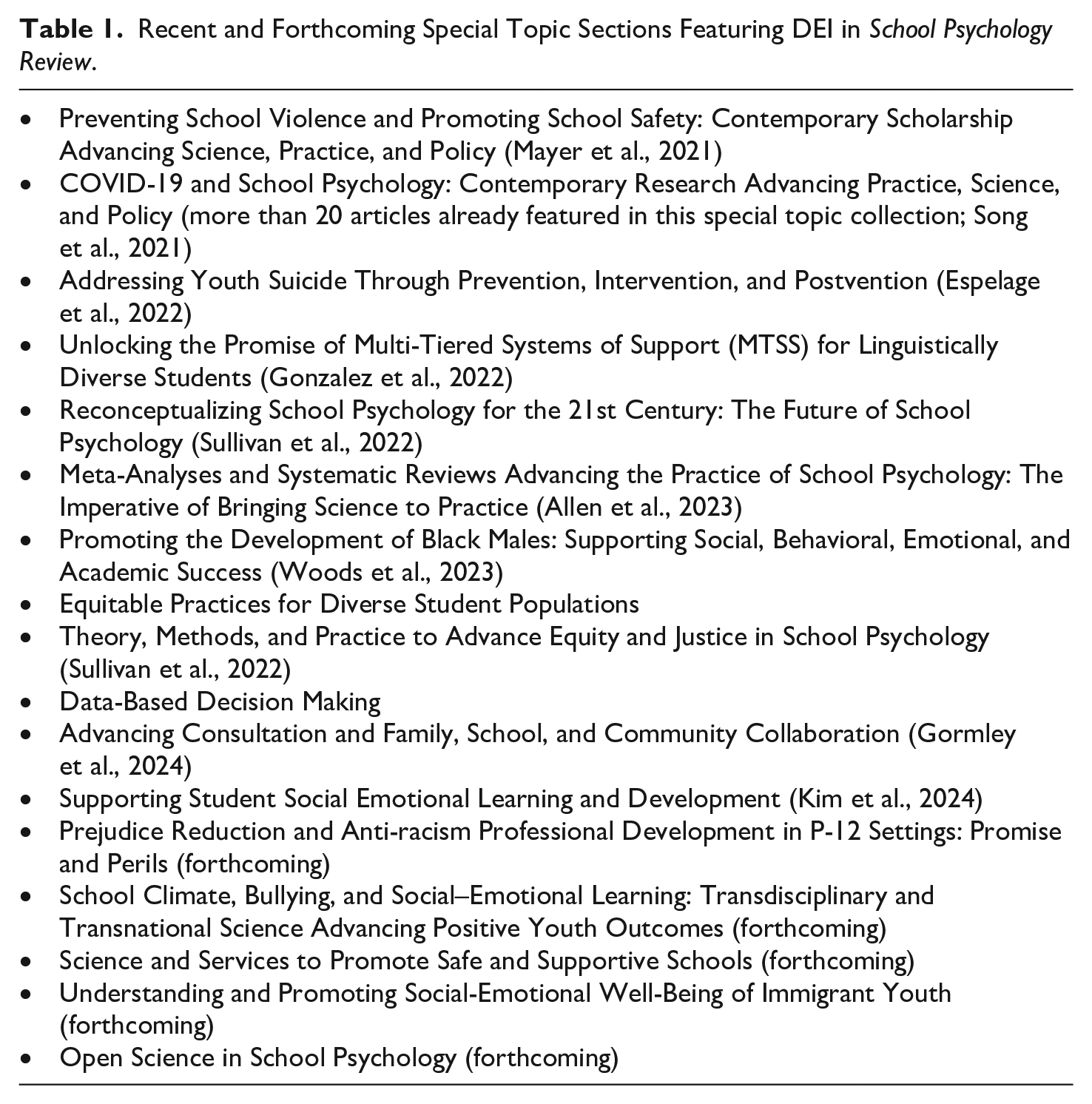
The open call for papers for each of the special topic sections permits all interested individuals to prepare and submit a paper for consideration rather than relying on invited submissions. Many of these special topics featured scholarship in which authors’ explicitly situated their scholarship within the broad sociocultural context of education to consider how school psychology could orient research, professional learning, and practice to enhance social relevance and impact (see Table 1). The resulting compilation of articles critiqued both the contributions and limitations of the field and articulated theories, frameworks, and approaches to position the field to help address social injustices affected students, families, and educators. For example, a theme across the articles in the special topic, Reconceptualizing School Psychology for the 21st Century: The Future of School Psychology in the United States, was the identification of foundational orientations necessary to support such efforts in graduate education and practice (Sullivan et al., 2022). These included critical consciousness, critical reflexivity, and key mindsets conducive to advancing anti-racism and social justice across all areas of the field. The authors identified specific targets for professional learning and graduate education (see Figure 1).
Recent and Forthcoming Special Topic Sections Featuring DEI in School Psychology Review.

Examples of foundational practices, activities, and areas of professional learning described in School Psychology Review special topic articles: reconceptualizing school psychology for the 21st century.
As another example, in the special topic section on Theory, Methods, and Practice to Advance Equity and Social Justice in School Psychology: Articulating a Path Forward (Sullivan et al., 2023), the authors critique the nature and scope of existing scholarship and confront the implications of whiteness and epistemic exclusion in limiting school psychology scholarship and practice. The authors provide important recommendations for how to counter this through centering justice, equity, and healing in practice; centering minoritized voices in scholarship and practice; and leveraging diverse research methods, including participatory approaches, to elevate youth and family voices and cultivate epistemic inclusion in order to expand the field’s scholarship, graduate education, and practice in the service of social justice and social impact in support of marginalized communities. Taken together, these collections provide concrete recommendations for graduate educators and practitioners committed to changing the ways they approach their work and engage the field’s diverse constituents.
Providing Professional-Development Opportunities and Resource
Another priority and initiative of the leadership team has been to provide professional development to empower the broader School Psychology Review community with competencies that will help increase DEI representation in scholarship and graduate preparation in the field of school psychology. These efforts are ongoing, including webinars, online courses, presentations for graduate students and faculty, readings, and reminders to help all colleagues (including those involved with the journal, to be aware of and knowledgeable about implicit bias as well as cultural and contextual considerations relevant to our responsibilities in reviewing scholarly works. We also emphasize the importance of kind, constructive, and thoughtful feedback to authors, to further encourage colleagues to engage in this important scholarship and submit their work to School Psychology Review for consideration for publication.
In addition, there are numerous opportunities for ongoing professional development related to DEI work for each of us, and we recognize the role of the journal as an influential outlet for promoting further knowledge and collective awareness of the impact and influence of racism, oppression, and discrimination on child development, adjustment, adaptation, wellness, wellbeing, and education outcomes. Recognition of DEI factors will further enrich future scholarship and science that aims to inform our understanding and practices to support the healthy development of children in our schools and communities. We remain committed to building, promoting, and contributing to professional development that will further advance DEI in the field of school psychology, including contributions to advancing practice, scholarship, science, and graduate education.
Implementing Open Science Opportunities
In our ongoing efforts to provide further dissemination of the science featured in School Psychology Review, we have developed an infrastructure to support open science initiatives. In the wake of the “replication crisis” (Open Science Collaboration, 2012, 2015) and following a substantial increase in digital resources for scholarship (e.g., online platforms for sharing data, research materials, and open access packages for running statistical analyses), a number of approaches have been promoted under the umbrella of open science. Open Science refers to a collection of research practices that makes research (e.g., materials, data, analyses) more accessible and transparent (Spellman et al., 2017); that is, Open Science functions to increase the trustworthiness of research (Cook et al., 2018). Examples of Open Science practices that authors can adopt include the registered report format (Chambers et al., 2015), material and data sharing (Klein et al., 2018), sharing reproducible analyses (Wilson et al., 2017), sharing preprints of their articles (Moshontz et al., 2021), and replication efforts (Zwaan et al., 2017). Open science principles and practices offer the potential to improve research transparency, foster collaboration, and address critical issues in school psychology. School Psychology Review reviews registered reports, open science badges, and is presently preparing a special topic section focused on Open Science. These ongoing efforts will be important to further expand the access to articles featured in the journal.
Implementing Triple Anonymous Peer Review
In our efforts to enhance equity and fairness in the review process, School Psychology Review is using a Triple-Anonymous Review process wherein, Authors, Action Editors, and Editorial Board members are each anonymous. The triple-anonymous peer review processes increase the openness and fairness of the process, through reducing implicit bias and other challenges related to positionality, reputation, and other subjective factors that may unnecessarily influence the peer review process. For example, whether there is one author or 20 authors, whether the author(s) is/are a graduate student, early career scholar, practitioner, or established scholar—the action editor does not attend to who the authors are.
Implementing a Journal Action Plan Focused on Advancing DEI
As described above, the action items outlined in the School Psychology Unified Anti-Racism Statement and Call to Action (García-Vázquez et al., 2020) provide guidance for each of us, as individuals and within the context of our collective actions through professional associations and groups, to further advance DEI efforts in school psychology. As briefly outlined in the above summary of some of our activities since 2019, we reaffirm our commitment to ongoing efforts to advance DEI in the field of school psychology. We have outlined our commitments in the School Psychology Review action plan to further contribute to advancing DEI in school psychology. We see this journal action plan as a larger, overarching editorial initiative, which motivated current efforts and will continue to drive our ongoing efforts toward advancing DEI into the future.
Reflections and Ongoing Efforts to Advance Diversity, Equity, and Inclusion
We embrace that it will take extensive and persistent individual and collective actions to overcome the systemic oppression, racism, inequities, and challenges that are present in our schools, communities, and society, and the field of school psychology. It is important to emphasize that our current DEI efforts are informed by and build upon the efforts of many colleagues who have contributed tremendous leadership and scholarship aimed at advancing diversity and social justice in school psychology (e.g., Beeks & Graves, 2017; Blake et al., 2016; Bocanegra et al., 2016; Clark et al., 2012; Goforth, 2016; Grapin et al., 2016; Graves & Brown-Wright, 2013; Graves & Wright, 2009; Gross & Malone, 2019; Harris & Sullivan, 2017; Liu et al., 2019; Malone & Ishmail, 2020; Mena & Rogers, 2017; M. L. Newell et al., 2010; Noltemeyer et al., 2013; Parris et al., 2019; Proctor et al., 2016; Proctor, Kyle, et al., 2018; Proctor, Nasir, et al., 2018; Proctor & Romano, 2016; Proctor & Truscott, 2012, 2013; Shriberg & Desai, 2013; Shriberg et al., 2008, 2011, 2013; Smith et al., 2016; Song et al., 2019; Sullivan & Proctor, 2016; Sullivan et al., 2015, 2020; Truscott et al., 2014; Vega et al., 2018; Zhou et al., 2004).
The efforts briefly described herein illustrate our ongoing efforts in School Psychology Review to advocate for and advance DEI in school psychology. These efforts include featuring research that informs, advances, and stimulates science, practice, and policy related to school psychology, as well as the purposeful and intentional efforts to advance leadership, social justice, and DEI in the field of school psychology. There are multiple indicators suggesting that these efforts are already having an impact in the field of school psychology, including the use of articles related to DEI in School Psychology Review, which are now being used in many graduate training programs and also serve as exemplars for further scholarship, to advance practice, science, and graduate preparation in the field of school psychology. In addition, the leadership team members, editorial board members, and student editorial board members continue to build further skills and knowledge and are contributing to further advancing DEI through the expanded roles and contributions across journals, professional associations, in graduate programs, as well as supervision of students and interns. We call again for all colleagues to join us and Be the Change to advance science, bring science to practitioners, advance practice, and bring science to policymakers who can influence future legislation that benefits schools, children, youth, and their families. It is imperative that we individually and collectively engage in further actions to advance DEI in the field of school psychology.
Footnotes
Declaration of Conflicting Interests
The author(s) declared no potential conflicts of interest with respect to the research, authorship, and/or publication of this article.
Funding
The author(s) received no financial support for the research, authorship, and/or publication of this article.
