



Abstract
The current healthcare system is often as highly stressful environment for patients, their families, and for the employees of the system. Health leaders also experience stress, which can have profound repercussions if not well managed. This article describes the impact of stress on the brain and nervous system functioning of health leaders, then, drawing on evidence from the literature, presents a three-step model for managing stress at the individual, team/organizational, and system levels.
Introduction
The healthcare system exists to improve the health of individuals, families, and populations, yet often its functioning contradicts everything we know about what enhances health. Instead of being a nurturing safe haven, where patients can feel cared for as they recuperate and recover from their injuries and illnesses, it is often an overcrowded, dehumanizing, confusing maze of fragmented silos, where patients frequently feel fearful, frustrated, and humiliated, as they are passed through a series of burnt-out staff 1,2 who place the quality of their experience squarely at the bottom of a list of otherwise unknown priorities.
Addressing this problem is not just window dressing. Patient suicide rates are at their highest following discharge from psychiatric hospitalization, 3 and shockingly, a meta-analysis showed that, even when assessed as low risk, people are significantly more likely to die by suicide if they have more contact with services. 4 Stress plays a key role in causing, triggering, and exacerbating a range of ailments, notably those that place the greatest demands on the healthcare system: mental health and substance use problems, 5 coronary conditions, 6 and cancer. 7 Family members, who provide the majority of care at home in the community, are placed under additional stress by the system, which stretches their personal resources to cope and adds unnecessary burdens of discomfort, guilt, and conflict within the family system, 8 and can have an intergenerational biological impact. 9 Stress can impair professionals’ ability to provide supportive, patient- and family-centred care 10 and to make rational decisions 11 and increases medical errors. 12
Clearly, the current healthcare system is deeply flawed. Central to the dysfunction of the system is the unnecessary stress that workers within the system are subjected to, which is passed on to patients and their families. While some stressors are inevitable, due to the focus of healthcare on pain, illness, and death, many are avoidable. They result from outdated ways of thinking, resistance to change, and a failure to recognize the importance of addressing and reducing stress at every level of the organization.
This article will provide an understanding of how excessive stress manifests in health leaders and negatively impacts the very nature of our roles as leaders, by impairing our cognitive functioning and our professional performance. By understanding how to shift to optimal stress and performance, we can begin to model this within the system and support our teams to do the same. The ultimate goal of facilitating an optimally performing healthcare workforce is anticipated to have a profound effect on the health and well-being of patients and the support they receive from their families in the community where the majority of healthcare takes place.
Stress in health leaders
There are specific justifications for concern about health leaders’ stress, specifically, the high-impact and far-reaching consequences of executive decisions on the functioning of their organizations. 13 The specific stressors that affect health leaders include organizational competition, 14 which even permeates the public sector; role stress, 15 resulting, for example, from the need for continuous improvement with ever more restrained budgets; and the unbounded responsibilities, which are only applicable at the leadership level. 11
Work-related stress is associated with reduced frontotemporal cortex activity, a condition observed in cases of depression. 16 It increases the incidence of migraines, which can become chronic in response to repeated stress, 17 and has impact on activation-deactivation pattern of the brain’s resting state networks, which may underlie stress-induced changes in several dimensions of brain activity and, if prolonged, can promote brain atrophy. 18 Specific cognitive difficulties experienced by workers under stress, even when they are at rest, are longer processing time and memory retrieval, mood and anxiety problems, higher vigilance and alertness, and emotional hyperactivity, as well as hyperactivation of cortical and subcortical attention areas of the brain oriented to perception-action, brain systems required to stress-related fight or flight responses. 19
Given this pattern of brain activation, even when at rest, it is unsurprising that the risk of substance use rises among stressed health professionals. 19 Nurses 20 and physicians 21,22 may be particularly vulnerable to developing substance use problems in response to work-related stress. There is also consistent evidence that stress leads to elevated neuroinflammation in the hippocampus and good evidence that this is also the case in other brain regions, specifically the prefrontal cortex, nucleus accumbens, the amygdala, and the paraventricular nucleus, elevating the risk of mental illness. 23 Stress has been found to be a crucial factor in the development of anxiety disorders, at the neurological level, 24 and is implicated in the development and exacerbation of numerous other mental health problems. 25
Impact of leadership stress on the organizational climate
Leaders under stress have a negative impact on the organizational climate and, in turn, increase the stress of those working in the organization, and ultimately, of patients. Stress in leaders increases their irritability 18 and has a negative effect on their social interactions. 26 At their worst, health leaders who have pathological levels of indifference toward the stress experienced by others can have extremely detrimental impacts on the health workforce and those served, as discussed by Nigro in this edition of Healthcare Management Forum. 27 Poorly managed stress impacts leaders’ decision-making, 13,19 particularly their ethical decision-making. 28 This has far-reaching consequences on the workforce, 16 including negatively impacting their mental health, 29 which in turn increases stress on patients and families.
Addressing health leaders’ stress
There is great variation in the level of stress inherent within leadership positions, 30 and between individuals in terms of the specific meaning attached to incoming stimuli, which they perceive as more or less stressful. 12 Health leaders’ experience of stress is a function not only of the stressors they are exposed to but also of their perceptions and interpretations of those stressors. 31,32
The relationship between stress and performance is long established 33 and has been refined with neuroscientific evidence. 25 While negative stress, or distress, should always be avoided, 34 a moderate level of positive stress, or eustress, actually improves performance, becoming problematic when it exceeds the individual’s capacity to cope. It is the interpretation of the stressor by the individual experiencing it that primarily determines whether it results in distress or eustress. The level of control felt by the person experiencing the stressor plays a key role in this determination. 17,18
Rather than eliminating stress, health leaders should thrive within the complex, dynamic environment of the health system, by achieving optimal performance and maintaining a level of mental focus that facilitates engaged, collaborative, well-thought-out decisions, while experiencing a moderate and manageable level of mental and physical arousal in response to the stressors of the working environment.
A three-step model of stress management for health leaders
As health leaders, it behooves us to recognize and address the importance of effectively managing and reducing stress as part of the transformation of the healthcare system, starting with ourselves. A model of how to manage stress on three levels: the personal level, the team or organizational level, and the system level follows and is illustrated in Figure 1.
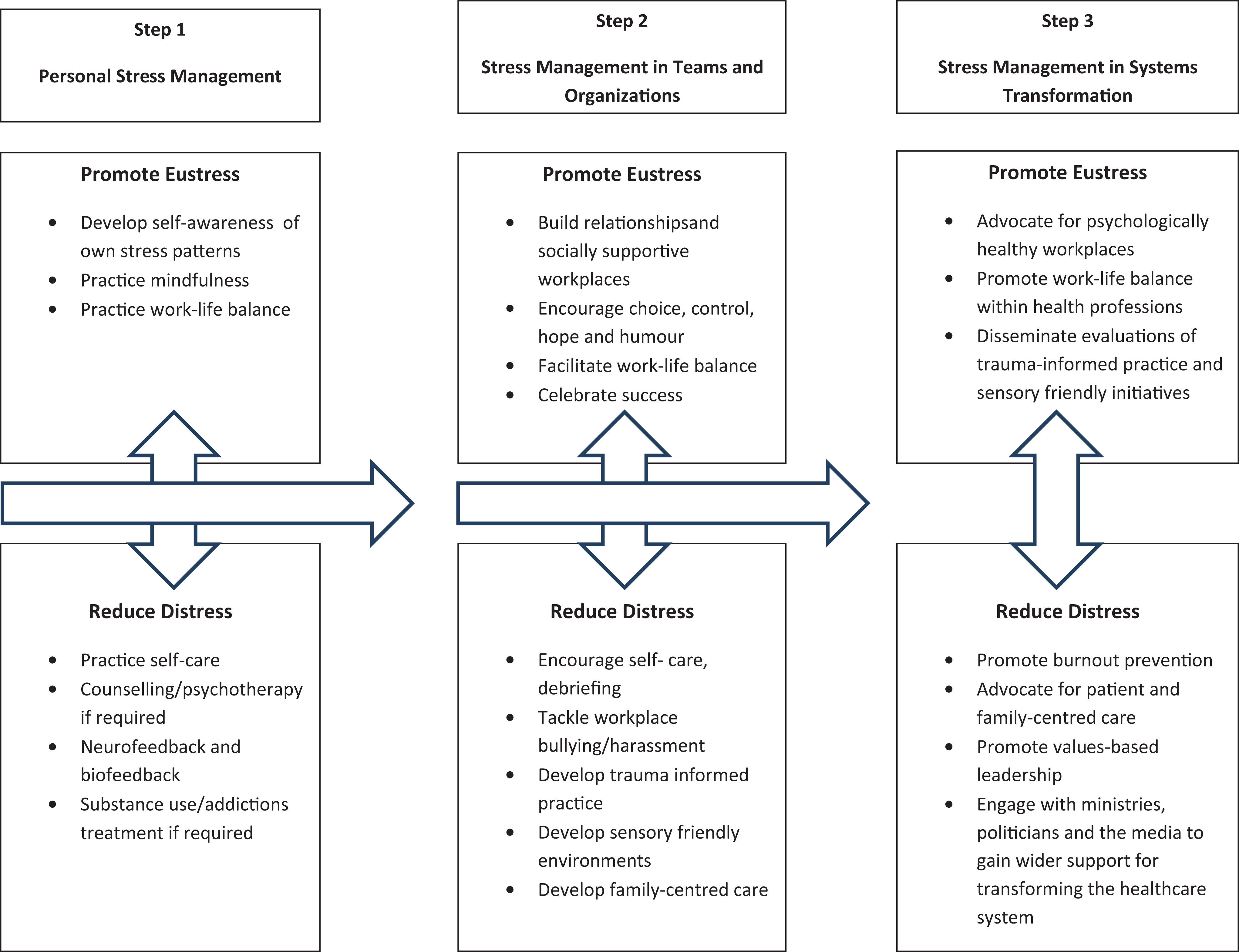
Three step model of stress management.
Step 1: Personal stress management
The first step in the health leaders’ stress management process is to manage one’s own stress. This begins with self-awareness, in particular, recognizing one’s own triggers. Practicing mindfulness, as advocated by Mohapel, 35 not only helps to reduce distress and improve mental focus but also helps to develop insight into the stress or “fight or flight” response when it occurs. On-line resources, such as the web site, mindful.org, can help with this process. An advantage to developing self-awareness is that leaders are better able to recognize and address stress in others.
If more support is needed to manage one’s own stress response, neurofeedback, as advocated by Swingle and Hartney, 36 and peripheral biofeedback training, from a Biofeedback Certification International Alliance (BCIA) certified practitioner, can greatly assist the process and may produce results more rapidly than traditional “talk therapy” approaches, such as Cognitive Behavioural Therapy (CBT). 37 Leaders who recognize detrimental patterns in their own behaviour, as described by Nigro, 27 or who may be experiencing mental health difficulties, such as anxiety or depression, are encouraged to seek counselling or psychotherapy from a registered psychologist. Substance use and mental health programs for physicians are highly effective. 38
As one becomes more aware of stress, beginning to recognize one’s positive reactions to stressful situations, or eustress, can support the development of optimal performance. Some common responses noted by health professionals include hope 39 and humour 40 ; leaders may also experience pleasure through solving problems, strategic planning, or communicating with staff. Empathy, compassion, or the expression of personal values or ethics may also bring a sense of spiritual fulfillment.
Step 2: Leading stress management in teams and organizations
Stress affects employees throughout the healthcare system, at every level, from nurses 2,41 and physician trainees, 42 to physicians, 1 up to senior leadership. 43 As health leaders become more adept at managing their own stress and develop greater empathy to stress in others, they can begin to promote stress management within their teams and organizations. Fundamental to this is the development of strong, trusting relationships with and between team members, so that the workplace becomes a social support system for employees. 44 The specifics of how this is best achieved will depend on the individual workplace culture and the needs of the employees. Encouraging and enabling choice and control 18 over professional practice and work-life balance, for example, enabling employees who are parents to take time off when their children are on vacation, will support this process.
Developing a culture that embraces hope, 38 humour, 39 and the expression of personal and organizational values 45 can elicit eustress in healthcare teams and organizations. The healthcare system has much to be proud of, yet we rarely celebrate our success, the lives we save, and the suffering we alleviate. If the healthcare culture did this more frequently, the sense of hope that is so crucial to invoking eustress in teams would become stronger in the way we go about our work. It may also reduce the need for health professionals to seek solace in substance use.
While some distress in healthcare work is inevitable, supports can be put in place to buffer the impact on employees. Positive leadership has been found to be related to stronger empowerment and lower demoralizing climate in high-stress healthcare environments and is negatively associated with staff turnover. 46 For example, providing opportunities to debrief following the death of a patient can significantly reduce the distress of employees. 47 Promoting ethical standards can help to reduce moral distress, a major cause of burnout. 48 Organizational strategies to reduce and ideally eliminate workplace bullying will greatly reduce stress among healthcare professionals. 49
Health leaders can support the creation of less distressing healthcare environments. Trauma-informed practice, 50 which has arisen from the recognition that many patients with mental health and substance use problems have significant trauma histories, which can be triggered through contact with the healthcare system, reduces stress for everyone in the workplace, not just patients. Sensory-friendly environments, 51 which have arisen from the recognition that people with conditions such as autism or sensory processing disorders are dysregulated by environments with unexpected or overwhelming sensory aspects, such as bright lights, loud noises, and crowds of people, have the potential to create a calm, supportive atmosphere for everyone, including healthcare professionals.
Creating family-friendly spaces within healthcare environments allows all families struggling with health difficulties to benefit from adequate, private space in which to support their loved ones; health professionals benefit from the lower levels of distress in patients and family members, as well as the additional support to patients’ well-being provided by family. This is particularly important when a patient’s culture is family focused, such as in Indigenous 52 or Asian 53 cultures.
Step 3: Stress management in system transformation
A fundamental shift in the culture of healthcare is required, which focuses on developing ways of working that function around the human needs and desires of the people working within the system, as well as those it serves. While round-the-clock care is essential to the effective functioning of the healthcare system, long hours for individual employees are not. Reasonable time off, opportunities to debrief stressful events and work-life balance should all replace the current outdated models of lengthy shifts, a stoic attitude to human suffering, and personal life coming far behind professional life. However, these deeply entrenched elements of the healthcare culture will only change through the advocacy of health leaders and professional associations.
Job stress is a serious threat to the quality of working life of healthcare employees and can cause hostility, aggression, absenteeism and turnover, and reduced productivity. 54 Therefore, addressing stress in the workplace is essential to curbing rising healthcare costs, and it is the role of health leaders to address this on a system level.
As teams implement these initiatives within their organizations, leaders can encourage and support documentation, rigorous evaluation to demonstrate their effectiveness, and dissemination, so that other organizations within the system can learn about and consider introducing such approaches themselves. Evaluation of the model and dissemination through further publications would be helpful in creating evidence to support broader system change. Further research with the model could illustrate how individual leaders implement the practice of managing stress in a complex healthcare environment with multiple competing and provide examples of how to balance the stress of work with the ability to perform the job. Communication with ministries, politicians, and the media can all be helpful in this regard. In spite of the initial human and financial investment in making these changes, the evidence points to wide-reaching benefits across the healthcare sector, including the reduction of disease.
Conclusion
Stress has negative impacts throughout the healthcare system, at the individual, team, and system levels. The process of change begins with the individual leader developing self-awareness and stress management; this can progress to supporting teams more effectively by tuning into the specific needs of the workforce. Finally, advocacy is needed to bring about widespread change in the healthcare system, to create a healthier workplace and a more supportive service for patients and families.
Many of the stressors which are inherent in the workings of the system are based on outdated ways of thinking, yet the healthcare system will not change in this fundamental way unless health leaders advocate for these changes at the political and structural levels. Psychologically healthy workplaces should be the norm within healthcare, and advocacy is needed from health leaders to make this happen. Then healthcare can become the nurturing safe haven it should be.
