



Abstract
Personal Protective Equipment (PPE) that was intentionally designed and manufactured as reusable, including gowns, goggles, face shields, and elastomeric respirators, took on a heightened role during the pandemic. Healthcare workers who had access to these products and infrastructure for cleaning and sterilizing them had a greater sense of confidence to undertake their jobs due to an increased sense of personal safety. Using multiple data sources, including a literature review, roundtables, interviews, surveys, and Internet-based research, the project team investigated the impact of disposable PPE and role of reusable PPE during the pandemic in Canada. This research supports the claim that adopting and supporting reusable PPE systems throughout the health sector can, if used appropriately on an ongoing basis, provide continuous access to reusable PPE while also contributing many co-benefits, including lower costs, domestic jobs, and improved environmental performance such as reduced waste and greenhouse gas emissions.
Introduction
The pandemic forced a global scramble to purchase Personal Protective Equipment (PPE) for the primary purpose of protecting the healthcare workforce. 1 The types of PPE used in healthcare in most demand included surgical/medical masks, gloves, gowns, N95 respirators, goggles, and face shields—products that were largely disposable. These supplies were provided at considerable cost; indeed, PPE comprised the largest spending category (33%) in the Canadian government’s pandemic response from March 2020 to October 2020, at $7.55 billion. 2 Yet access to PPE, especially during the initial stages of the pandemic, was poor due to the challenges of the global supply chain. 3 As well, some of the disposable PPE that was purchased did not meet quality standards. 4 Finally, most of the PPE used in Canada is made of plastic and is disposable. Early in the pandemic, Health Canada estimated that 63,000 tonnes of plastic waste would be generated over a one-year period (June 2020-June 2021). 5
Disruptions to the healthcare supply chain that affect the quantity or quality of PPE or other medical supplies can impact the safety of both patients and healthcare workers. Development of strategies to ensure 100% continuous access to essential healthcare products is needed. 6 A comprehensive reusable PPE health system, which includes reusable products, local infrastructure for cleaning and disinfecting, and associated transport and tracking systems, should be explored as a strategy to ensure 100% access for some PPE, and for the many environmental, social, and economic co-benefits of such a system.
The purpose of this study was to identify opportunities to reduce plastic PPE waste focusing on opportunities for reduction and reuse in the health system, and exploring synergies with other government and health system priorities that would enhance opportunities and support for a reusable PPE system.
Methods
Environment and Climate Change Canada has particular interests in reducing plastic waste and were looking for innovative approaches to address this excess waste. A focus on investigating the role of reusable PPE was of interest due to existing reuse infrastructure including healthcare laundries in many areas across Canada. Other government priorities such as reduction of Greenhouse Gases (GHGs) from the health system, and promoting circular economy approaches to resolve resource and waste issues, could also be supported through this approach.
The study used multiple methods to gain a robust overview of reusable PPE utilization, experiences, and impacts during the COVID-19 pandemic. Multiple data sources included a literature review, roundtables, interviews, surveys, and Internet-based research.
This article describes results obtained from Internet-based research, surveys, and interviews related to the Canadian health system, with a focus on reusable gowns.
Internet research
Publicly available PPE purchasing and use data reported from March 2020 to April 2022 were obtained through Internet searches to estimate waste quantities and Greenhouse Gas (GHG) emissions associated with PPE. Further details are available from the authors.
Surveys
The project team undertook two surveys to gather more detailed information from various healthcare perspectives on reusable gowns and other PPE and included: • Healthcare workforce—where the responders were involved in providing direct care. • Hospital facility—where the responders were generally support staff not providing direct care.
Healthcare Workforce Survey
The objective of this survey was to hear from healthcare workers across Canada on their experiences with reusable PPE such as gowns, elastomeric respirators, goggles, and face shields. This survey was developed by the project team and reviewed by the project advisors—including academics, the project healthcare partners, as well as individuals with expertise in this area. Twelve questions were developed including four background questions and eight questions probing experiences on a five-point Likert scale. The project lead was the Canadian Coalition for Green Health Care (CCGHC), a Canadian not-for-profit, where ethics approval was not required. The survey was distributed and promoted through partner networks and social media, and was open from February to May 2022.
Green Hospital Scorecard Survey
The GHS is a free hospital environmental benchmarking and recognition tool tracking energy, water, waste management, pollution prevention, transportation, food, climate change, and leadership hosted and delivered by the CCGHC. 7 Six new survey questions were developed focusing on PPE and incorporated into the GHS for the data call issued for the 2019 and 2020 surveys.
Interviews
From March 2020 to April 2022, the project team conducted semi-structured qualitative interviews by phone or Zoom, with stakeholders from the healthcare workforce, PPE manufacturing and business community, waste/recycling companies, and government representatives. Over 75 interviews were conducted to obtain in-depth insights into stakeholder-specific issues, concerns, and perspectives related to reusable PPE.
Results
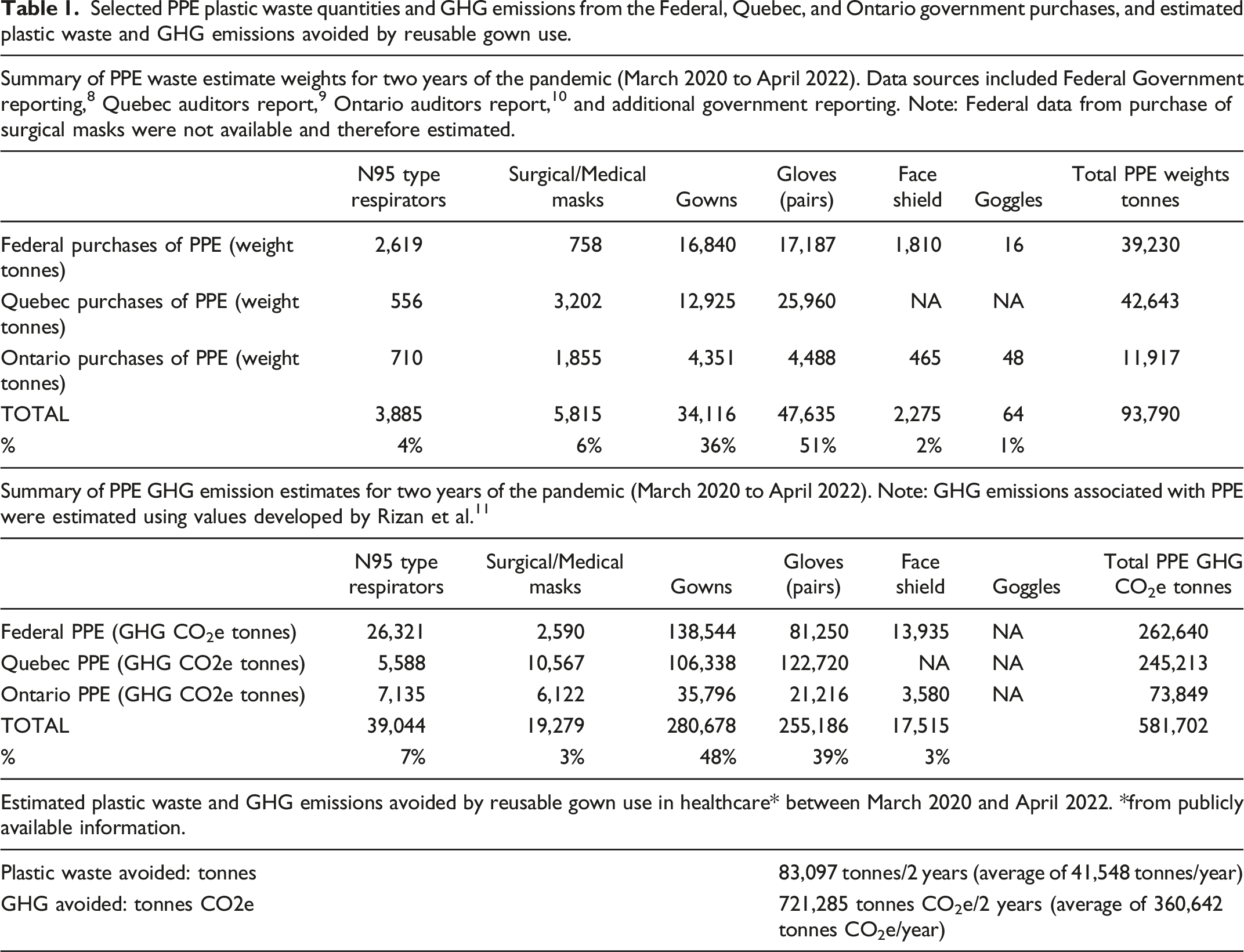
Selected PPE plastic waste quantities and GHG emissions from the Federal, Quebec, and Ontario government purchases, and estimated plastic waste and GHG emissions avoided by reusable gown use.
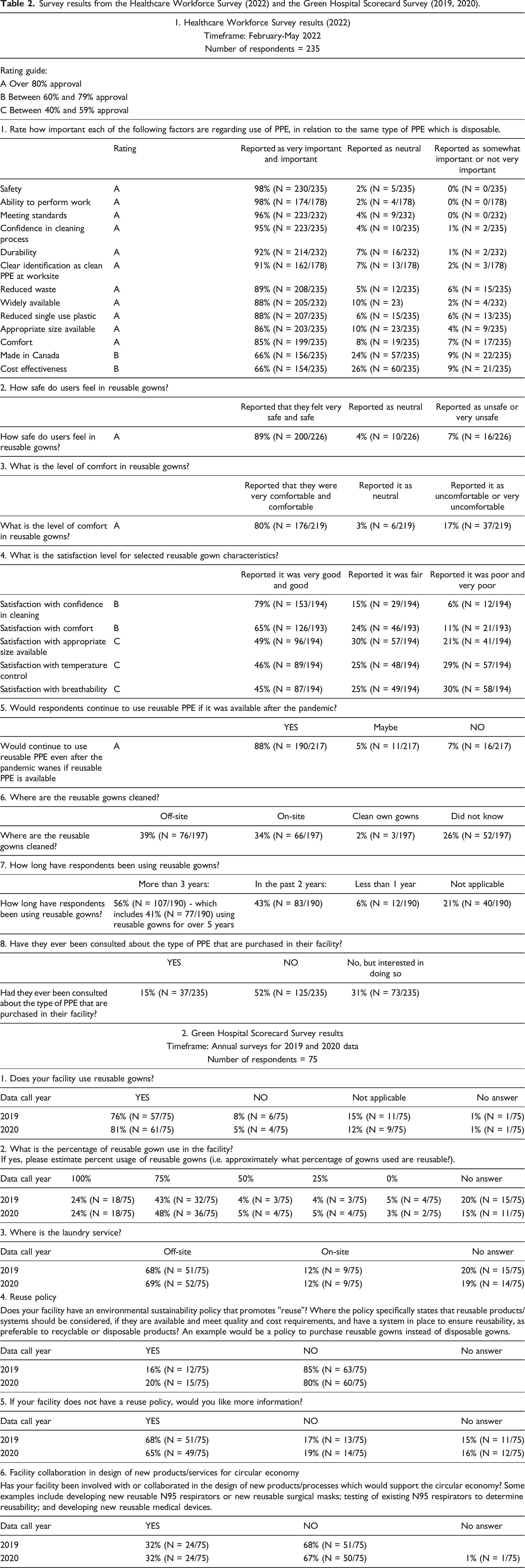
Survey results from the Healthcare Workforce Survey (2022) and the Green Hospital Scorecard Survey (2019, 2020).
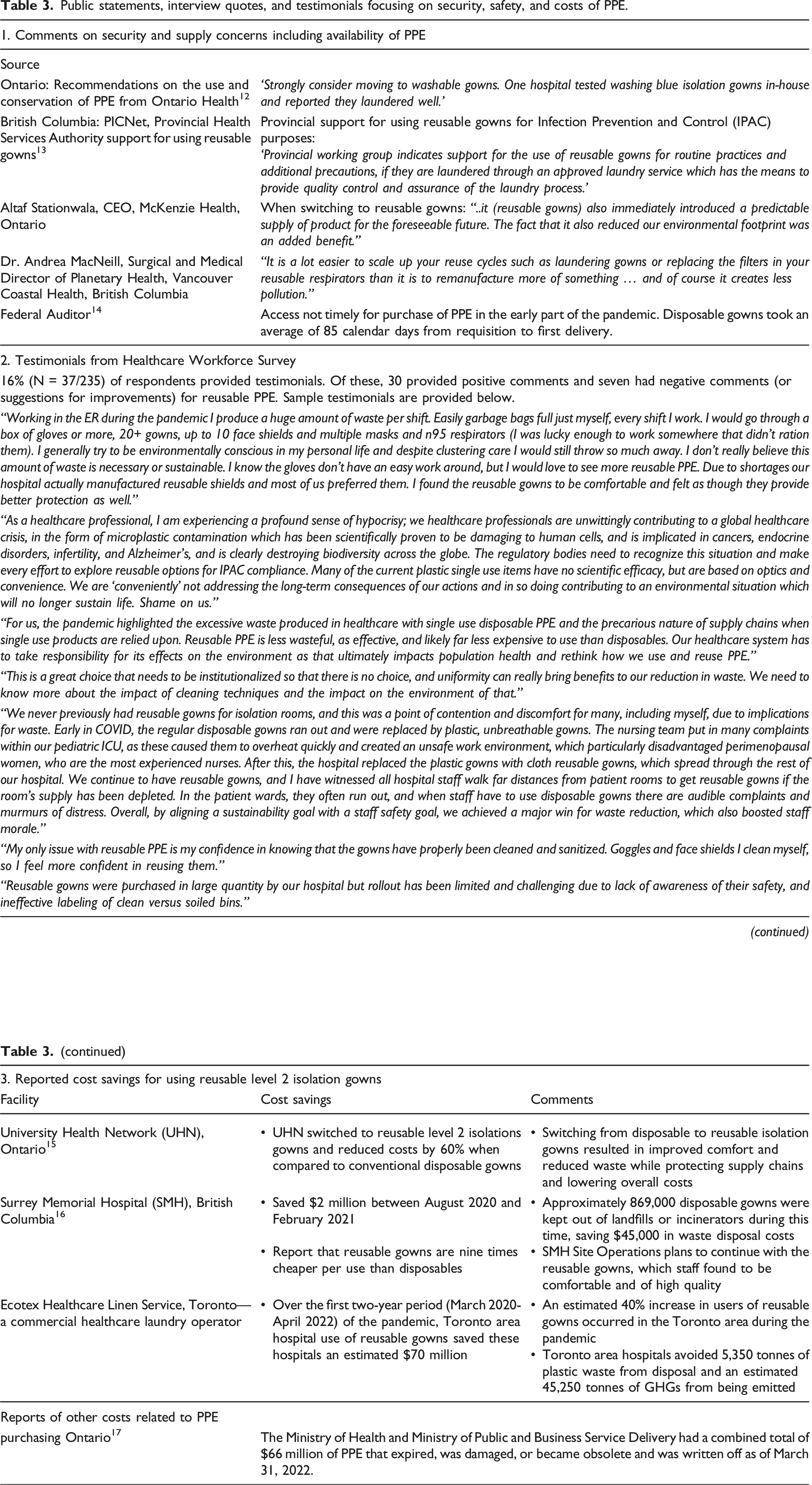
Public statements, interview quotes, and testimonials focusing on security, safety, and costs of PPE.
Personal protective equipment plastic waste quantities and greenhouse gas emissions
Publicly reported PPE purchasing information was obtained from the Federal, Quebec, and Ontario governments to estimate plastic waste quantities and GHG emissions with estimated emissions are provided in Table 1.
Survey results
Healthcare Workforce Survey results
The total number of respondents was 235 from nine provinces and territories, with the majority (91%) from Ontario, British Columbia, Quebec, and Newfoundland. The top reported work places included the following: hospitals: 66%, medical clinics: 9%, and long-term care homes: 9%. The top five areas within a hospital where reusable PPE was used were reported as emergency, intensive care, internal medicine, anesthesia, and surgery.
Green Hospital Scorecard Survey results
The total number of participating facilities was 75 with the breakdown of locations and peer groups of the participating hospitals as follows: 56 in Ontario, 5 in British Columbia, 1 in Alberta, 1 in Manitoba, and 12 in Newfoundland and Labrador. Hospital peer group breakdown: 28 community, 5 small, 33 academic, and 9 non-acute. The results from both surveys are presented in Table 2.
Public statements, interviews, and testimonials
Public statements and interviews provided background perspectives and insights into reusable gown priorities, and testimonials from the healthcare workforce provided insights related to security, safety, costs, and environmental concerns are provided in Table 3.
Discussion
Waste and greenhouse gas emissions from disposable personal protective equipment
Significant quantities of PPE waste and GHG emissions were generated from the top three procurement agencies in Canada: The Federal, Quebec, and Ontario governments where Ontario and Quebec together represent the majority (56%) of hospital beds in Canada. 18
An estimated 93,800 tonnes of plastic from disposable PPE were purchased and disposed of during the first two years of the pandemic from these three agencies alone. The primary use of this PPE was in healthcare settings. The largest contributors to this waste quantity were gloves, at 51% of the total waste, followed by gowns at 36% of the total waste.
An estimated 581,700 tonnes of CO2 equivalent (CO2e) GHG were emitted from this disposable PPE throughout its life cycle during the first two years of the pandemic. The largest contributor to GHG emissions came from disposable gowns (48%) followed by gloves (39%).
Available public data on use of reusable gowns during the first two years of the pandemic from healthcare sites across Canada revealed that reusable gowns displaced at least 83,100 tonnes of plastic disposable gown waste, while also displacing an estimated 721,300 tonnes CO2e in GHG emissions. Generally, public reporting on PPE purchasing did not include use of reusables, except in the Quebec auditor’s report. Many healthcare laundry facilities or hospitals they service did not disclose their use of reusable gowns, which impedes identifying possible challenges and opportunities. While gloves also constitute a high waste component of PPE, no reusable options are available. Another approach is to reduce unnecessary glove use, which is an initiative implemented by the United Kingdom’s Royal College of Nurses through their “Gloves Off Week” 19 campaign.
Healthcare workforce perceptions of safety and security
Early in the pandemic government agencies like Ontario Health advised hospitals to switch to reusables if they could, giving added credibility to the use of reusable gowns.
Forty-three percent of survey respondents reported that they started to use reusable gowns in the past two years, showing a shift of interest during the pandemic. Eighty-eight percent of respondents said they would continue to use reusable PPE even after the pandemic started to wane.
The majority of respondents (89%) reported feeling safe in their reusable gowns, and 80% reported feeling comfortable. There was confidence in the cleaning process (79%), but a lower range of satisfaction with appropriate sizing (49%), temperature control (46%), and breathability (45%). These results show opportunities for improvement in the design of reusable gowns.
Survey respondents reported a high level of importance for a number of variables such as safety, ability to perform work, meeting standards, confidence in cleaning process, durability, clear identification of clean PPE at worksite, reduced waste, widely available, reduced single use plastic, appropriate size, and comfort. A lower level of importance was placed on “made in Canada” and cost effectiveness. Knowledge about where the gowns were cleaned appears low, with 19-26% of respondents indicating they did not know where their gowns were cleaned. Healthcare workers also wanted to know how the gowns are cleaned, and the impact on the environment from the cleaning process. These factors should be included when developing knowledge translation materials for reusable PPE programs. It could be suggested greater acceptance of reusable systems may increase with improved knowledge of how the reusable systems work.
Reuse policies
The majority of facilities do not have specific reuse policies (average 18%), but 65-68% of facilities who do not have reusable policies would like more information, suggesting an opportunity to provide more information and education to support these types of policies. Even without reuse policies, hospitals are regularly employing other reuse activities in addition to reusable gowns, including reprocessing operating room instruments, reusable laryngeal mask airways, and reusable biomedical waste containers.
Health leaders can use the LEADS framework lens to help transform the health system from one with a significant reliance on single-use disposable products which can be highly susceptible to supply chain disruptions to a system which can rely on the safe renewal of supplies through reuse. This transformation can be supported by engaging the healthcare workforce for input, development of reuse policies which identify priority products and which are well articulated and communicated, working with community stakeholders to partner on reuse services for cleaning and sterilization as needed, and monitoring results for quality and costs.
Cost savings
The University Health Network in Ontario reported saving 60% of disposable gown costs when it switched to reusable level 2 isolation gowns. 15 Surrey Memorial Hospital in British Columbia switched to reusable gowns and saved $2 million between August 2020 and February 2021, reporting that reusable gowns are nine times cheaper per use than disposables. 16 Savings identified for Toronto area hospitals were reported by Ecotex, revealing that over the first two year period of the pandemic, Toronto area hospital use of reusable gowns saved these hospitals an estimated $70 million. In addition, added costs of disposable gowns accrued from over-purchasing and outdated supplies.
Healthcare laundries
While healthcare laundries are generally available across the country, some small or rural areas indicated lack of available healthcare laundry services. Some healthcare laundries and hospital sites reported their use of reusable gowns increased two to three times their normal use during the pandemic. Both healthcare facilities and laundries are considered critical infrastructure. 20 If there is to be a greater reliance on reusable gowns, there is a pressing need to assess the ability of healthcare laundries to continue service delivery during surges, and to develop contingency plans to cope with these surges. Options to explore include expanding healthcare laundry capacity by working with the underutilized hospitality laundry services. 21
Reusable personal protective equipment health systems
A comprehensive reusable PPE health system, which includes reusable products, sterilization systems, and associated transport and tracking capacity can contribute to numerous health system priorities, including addressing reliable supply of this essential product. Many of these components are already in place across Canada. Further assessments of these components can help form the basis of health system strategies for reusable healthcare PPE textiles, such as is happening in the United Kingdom. 22
Reusable personal protective equipment systems align with other priorities
Accreditation Canada surveys hospitals to rate them on the extent to which they meet national standards for quality and hospital operations. New standards regarding environmental stewardship were adopted for Leadership in 2021 and for Governing Bodies in 2022. Reusable PPE systems for textiles including gowns can be used to show facility sustainability and climate action meeting a recommendation or Required Organizational Practice for both of these standards as provided in the referenced guidance document. 23 Reusable gowns have been assessed and shown to be more environmentally friendly than disposable gowns.24,25
Limitations
Access to data on PPE purchasing was limited especially during the pandemic. The project team is aware that even though the Federal, Quebec, and Ontario governments reported on PPE purchasing, other provinces and territories also made PPE purchases. Additional purchases were also made directly by hospitals and health authorities, which were not available for analysis. Therefore, we consider these numbers as preliminary and an underreporting of the actual numbers.
Conclusions
Reusable gowns forming part of a reusable PPE health system is a strategy to ensure 100% continuous access for these essential healthcare products. This research supports the claim that adopting and supporting reusable PPE systems throughout the healthcare system can, if used on an ongoing basis, ensure enhanced resilience in the face of future pandemics and other supply-chain disruptions such as extreme weather events which are expected to increase as a result of our changing climate.
Reusable PPE, particularly gowns and other textiles, offer multiple benefits to the healthcare workforce and the health system including safety, security, and financial, social, and environmental sustainability. Safety includes verified safe products, and security includes psychological and personal security, and a reliable supply through timely and consistent access to PPE. Financial sustainability includes stable and lower cost of reusable PPE. Social sustainability includes greater assurance that these products have been manufactured using fair labour practices and processes, and provides increased domestic jobs. Environmental sustainability includes improved environmental performance through, for example, reduced waste, reduced use of single-use plastic, and reduced GHG generation.
Opportunities should be explored to increase reusable gown acceptance by enhancing the design of some reusable gowns and through education and awareness of reusable gown programs to the healthcare workforce. Engaging users of reusable PPE in the innovation and selection process could contribute to greater acceptance and system improvement. Greater access to information on PPE and reusable gown usage would improve the analysis of current practices, which could lead to deeper understanding of challenges and opportunities. Ensuring the reusable gown infrastructure is as robust as possible will help prepare the health system for the future. Combining reuse approaches with programs to prevent unnecessary use of gloves would prolong access to existing supplies while also conserve resources, reduce waste, and save money.
Finally, although this paper focused on reusable gowns, further work is needed to extend and support the concept of reuse within the health system, identifying which products should be prioritized to ensure medical devices and products are continually accessible, safe, affordable, as well as socially and environmentally responsible.
Footnotes
Acknowledgements
The authors respectively thank all the health system workers for their selfless dedication during the COVID-19 pandemic. The authors thank all health system stakeholders who took the time to participate in surveys and interviews, without whom this work could not have been undertaken. The authors thank our project funders for supporting this project.
Declaration of conflicting interests
The authors declared no potential conflicts of interest with respect to the research, authorship, and/or publication of this article.
Funding
The author(s) disclosed receipt of the following financial support for the research, authorship, and/or publication of this article: This work was supported by Environment and Climate Change Canada [Project Number GCXE21E036].
Ethical approval
Institutional Review Board approval was not required.
